PART 3
Matthew read the first sentence three times.
Then he looked up at James as though
the man standing before him had suddenly become a stranger.
The letter began with six words.
Matthew, I am not your tenant.
His hands trembled.
He looked back at the paper.
I am the owner of the home you ordered me to leave,
the company that manages it,
and the financial privileges you and Audrey have enjoyed for the past seven years.
Matthew swallowed.
Across the marble lobby of Vega Properties,
employees walked between elevators, carrying briefcases and cups of coffee.
A receptionist answered the telephone.
Somewhere behind the security desk, a printer hummed.
Everything continued normally.
Only my son seemed to have stopped breathing.
James stood quietly beside him.
“Mr. Vega,” he said, “your mother asked that you read the entire letter before requesting a meeting.”
Matthew looked up.
“Where is she?”
“She’s unavailable this morning.”
“Unavailable?”
James nodded.
“Yes, sir.”
Matthew gave a sharp, disbelieving laugh.
“I’m her son.”
“I know.”
“Then tell me where she is.”
James remained perfectly calm.
“Your mother has asked that all questions concerning the apartment, vehicle, and company accounts be directed to the appropriate departments.”
Matthew stared at him.
Then he looked toward the enormous black-and-white photograph on the wall.
There I was.
Thirty-four years younger.
Wearing a construction helmet and standing beside the unfinished steel skeleton of my first commercial building.
My hair was shorter.
My face was thinner.
And I was smiling with the kind of determination that only comes from knowing you’ve risked everything.
Beneath the photograph, the inscription read:
Katherine Vega — Founder and Chairwoman, Vega Properties. Established 1990.
Matthew shook his head.
“No.”
James said nothing.
“My mother worked in an office.”
James folded his hands.
“Your mother founded this company.”
Matthew stared at him.
“She told me she handled paperwork.”
James nodded.
“She handled quite a lot of paperwork.”
For the first time in his thirty-eight years, my son had absolutely nothing to say.
I wasn’t at Vega Properties that morning.
I was sitting in the breakfast room of my new home, a quiet brownstone overlooking a small garden on Manhattan’s Upper West Side.
The property had been mine for almost a year.
I’d purchased it through a separate holding company and spent months restoring it.
I hadn’t told Matthew or Audrey.
Not because I wanted to deceive them, but because I wanted one place in the world where nobody expected anything from me.
The house had tall windows, pale wooden floors, and a little library with built-in shelves.
There were no enormous chandeliers.
No imported marble dining table.
No rooms decorated to impress strangers.
Just comfortable furniture, family photographs, books, and the faint smell of coffee.
It was the kind of home I’d wanted for years.
And that Christmas morning, after being ordered out of the penthouse I’d paid for, I finally moved into it.
James called shortly after ten.
“Mrs. Vega?”
I set down my cup.
“Good morning, James.”
“Your son has received the letter.”
I looked toward the garden.
“How did he react?”
There was a pause.
“He was surprised.”
I smiled faintly.
“That’s a polite description.”
James cleared his throat.
“He has requested an immediate meeting.”
“Of course he has.”
“He also wants to know whether the credit cards can be restored.”
I closed my eyes.
There it was.
Not an apology.
Not concern about where I’d slept after leaving on Christmas night.
Not even a question about whether I was safe.
The credit cards.
I took a slow breath.
“Tell him my attorney will contact him about the property arrangements.”
“Yes, ma’am.”
“And James?”
“Yes?”
“Make sure everything is handled properly. No shortcuts. No surprises that violate an agreement.”
“Understood.”
I ended the call.
Then I sat quietly, listening to the clock above the fireplace.
For thirty-eight years, I had loved my son more than I knew how to explain.
But somewhere along the way, my love had become something he expected to receive without gratitude.
And I had helped create that expectation.
I was twenty-eight when I entered the real estate business.
My husband, Robert, was still alive then.
We lived in a cramped apartment in Queens.
Matthew was a toddler.
And I worked as a bookkeeper for a small construction company.
I loved numbers.
I loved buildings.
And I loved the idea that something abandoned could become useful again.
One afternoon, my employer sent me to inspect a neglected commercial property.
The building had broken windows, water damage, and a leaking roof.
Most people saw a disaster.
I saw potential.
The owner was desperate to sell.
I spent three weeks studying the numbers.
Then I approached Robert.
“I think we should buy it.”
He stared at me.
“With what money?”
I showed him my calculations.
He read them carefully.
Then looked up.
“Katherine, this is risky.”
“I know.”
“We could lose everything.”
“I know.”
He smiled.
“Then we’d better make sure your numbers are right.”
We borrowed carefully, invested our savings, and spent the next two years renovating that building.
Robert worked evenings after his regular job.
I handled financing, contractors, tenants, and paperwork.
We painted walls ourselves.
Cleaned construction debris.
And ate sandwiches on overturned buckets because we couldn’t afford furniture for the office.
The building eventually became profitable.
Then we purchased another.
And another.
By the time Matthew was ten, Vega Properties owned several commercial properties.
By the time he graduated from college, the company had grown into a substantial real estate business.
But Matthew never knew the full extent of it.
Not because we hid everything from him.
Because he never seemed interested in understanding what we did.
Robert died when Matthew was twenty-six.
A sudden heart attack.
One moment he was laughing over breakfast.
The next, I was standing in a hospital corridor, hearing words I couldn’t understand.
I was fifty-two.
Widowed.
Exhausted.
And terrified.
Matthew was devastated too.
For months, he struggled.
I tried to protect him.
Perhaps too much.
I paid his bills while he recovered.
Helped him purchase a car.
Covered the deposit on his first apartment.
And eventually gave him a job at one of our smaller property management offices.
He lasted eight months.
Then told me he wanted to pursue other opportunities.
I encouraged him.
When he married Audrey seven years later, I was delighted.
She was charming.
Beautiful.
And seemed genuinely devoted to him.
I wanted them to have a wonderful beginning.
So I offered them the use of a penthouse owned by one of my companies.
I arranged a heavily discounted lease.
I authorized Matthew to use a company-owned Cadillac under a family vehicle agreement.
And I gave Audrey access to a supplementary card for certain household and family expenses.
At the time, I thought I was helping.
I didn’t realize I was teaching them to confuse generosity with ownership.
The first warning came two years after their wedding.
Audrey wanted to redecorate the penthouse.
I said she could make reasonable changes, provided she coordinated them with the property manager.
A week later, I received an invoice for $47,000.
Imported furniture.
Designer lighting.
Custom curtains.
And an enormous dining table that cost more than my first car.
I called Matthew.
“Sweetheart, did you approve this?”
He laughed.
“Mom, Audrey has expensive taste.”
“I can see that.”
“Don’t worry. It’s all going into the apartment.”
I took a breath.
“Matthew, the apartment belongs to the company.”
He sounded irritated.
“Why do you always make everything about paperwork?”
I said nothing.
He continued.
“It’s our home.”
I swallowed.
“Yes, it is your home while you’re renting it. But that doesn’t mean you can spend unlimited amounts on it.”
He sighed.
“Mom, you’re being difficult.”
I ended the call feeling strangely ashamed.
Then I paid the invoice.
That was my mistake.
Not the first.
And certainly not the last.
Over the years, the demands increased.
Audrey wanted better furniture.
Matthew wanted a newer car.
They wanted holidays in Europe.
Expensive dinners.
Designer clothes.
Private club memberships.
I kept helping.
I told myself they were young.
That life was expensive.
That one day they’d become financially independent.
But one day never arrived.
Instead, they began treating me like an inconvenience.
Audrey complained when I visited.
Matthew criticized my cooking.
They made jokes about my age.
And whenever I tried to discuss money, Matthew reminded me that he was the man of the house.
The irony would have been funny if it hadn’t hurt so much.
Christmas dinner was the moment everything became impossible to ignore.
I’d arrived at the penthouse three days earlier to help prepare.
Audrey had invited twenty-five guests.
Her parents.
Her siblings.
Several cousins.
Friends from her social circle.
And a few people I barely knew.
She wanted a perfect Christmas.
But she didn’t want to organize it.
So I did.
I ordered groceries.
Prepared the guest rooms.
Coordinated deliveries.
Cooked.
Cleaned.
And arranged the dining room.
By Christmas evening, my back ached and my feet were swollen.
I had been awake since five.
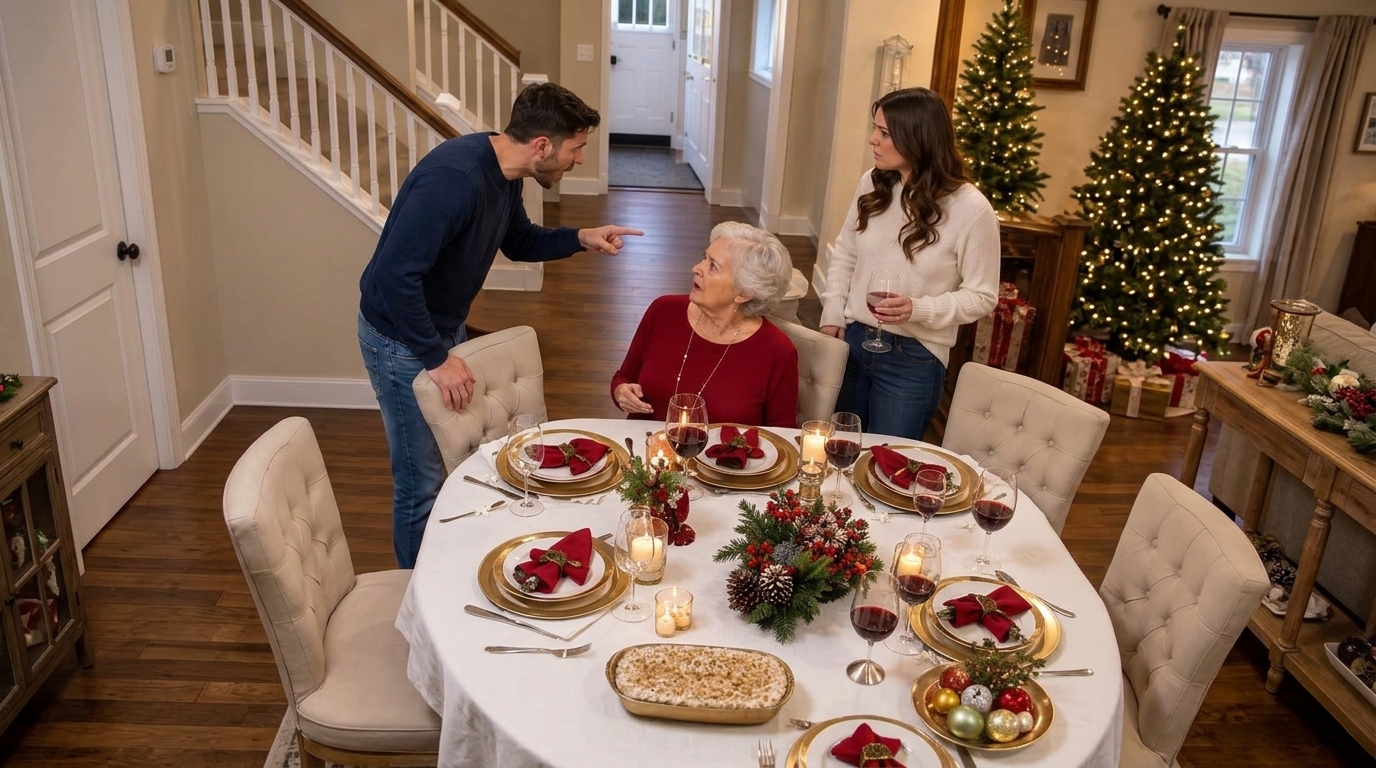
I was carrying a serving dish toward the table when Matthew stood.
“Mom, we need to talk about your living arrangement.”
I stopped.
“What?”
He smiled.
Not kindly.
Like a man enjoying an audience.
“You’ve been staying here without paying your fair share.”
The room fell silent.
I stared at him.
“Matthew, what are you talking about?”
Audrey leaned back in her chair.
“We’ve discussed this.”
I looked at her.
She smiled.
“You need to start contributing.”
I almost laughed.
Contributing.
To a home I owned.
To food I’d purchased.
To a dinner I’d cooked.
Matthew raised his voice.
“Pay the rent or get out.”
Twenty-five people watched.
Nobody spoke.
Then Audrey added, “Let’s see how you survive without us.”
I looked at my son.
For one brief moment, I waited for him to laugh and say it was a joke.
He didn’t.
Instead, he pointed toward the hallway.
“You heard me.”
Something inside me went very still.
I set down the serving dish.
Removed my apron.
And said, “Alright. I’ll leave.”
Now, sitting in my new home, I remembered every face at that table.
The silence.
The embarrassment.
The way Audrey smirked.
And the way Matthew looked pleased with himself.
They had mistaken my willingness to remain quiet for helplessness.
They believed I needed them.
But they were about to discover just how much they had needed me.
At eleven-thirty, James called again.
“Mrs. Vega, your son is still here.”
I sighed.
“What does he want now?”
“He’s demanding to speak with the owner.”
I looked toward the window.
“James.”
“Yes, ma’am?”
“Tell him he’s already met her.”
PART 4
Matthew called me seventeen times that afternoon.
I didn’t answer.
Not because I wanted him to suffer.
But because I knew what would happen if I picked up.
He would shout.
Accuse.
Demand.
And eventually remind me that I was his mother.
As though motherhood meant I was obligated to finance every decision he made.
Instead, I spent the afternoon reviewing documents with my attorney, Eleanor Price.
Eleanor had worked with Vega Properties for nearly fifteen years.
She was direct, meticulous, and completely unimpressed by family drama.
When I explained what happened on Christmas, she listened quietly.
Then she opened a legal pad.
“Katherine, we need to separate your personal decisions from the company’s contractual obligations.”
I nodded.
“Of course.”
“The cards are straightforward if the accounts are yours and the users have no independent entitlement. We can terminate their authorization according to the account terms.”
“And the Cadillac?”
“We’ll review the vehicle agreement and provide the required notice.”
I nodded.
“The apartment?”
Eleanor looked at me carefully.
“That requires more patience.”
I sighed.
“I know.”
She continued.
“Matthew has a lease. Whatever he said at Christmas doesn’t allow us to ignore tenant protections or simply change the locks.”
“I don’t want to.”
“Good. We’ll determine the proper notice, the lease expiration date, and any lawful rent adjustments. If the tenancy must end, we’ll follow the required process.”
I looked down.
“James said Matthew received an eviction notice.”
Eleanor frowned.
“He received a preliminary notice concerning the tenancy, not a court-ordered eviction. I’ll make sure the wording is clear.”
I nodded.
“I don’t want revenge that creates more problems.”
She smiled faintly.
“Then we’re going to handle this like a business matter.”
I took a breath.
“That’s exactly what I want.”
Eleanor reviewed the accounts.
Audrey’s supplementary credit card had been used for purchases far beyond the household expenses I’d originally authorized.
Designer handbags.
Luxury cosmetics.
Expensive restaurant bills.
Hotel stays.
Jewelry.
One charge caught my attention.
$18,600.
A jewelry boutique on Madison Avenue.
I stared at the statement.
“What is that?”
Eleanor looked at the receipt.
“A diamond bracelet.”
I swallowed.
“When?”
“Three weeks ago.”
I remembered Audrey showing me a bracelet at dinner.
She’d smiled proudly.
“Matthew bought it for our anniversary.”
I’d congratulated her.
Now I realized I’d paid for my son’s anniversary gift to his wife.
I sat back.
For a moment, I felt foolish.
Then angry.
Then deeply tired.
Eleanor watched me.
“Katherine?”
I shook my head.
“I’m alright.”
She waited.
I looked at the statement again.
“No,” I said quietly. “I’m not alright. But I will be.”
The next morning, Matthew arrived at my new house.
I still don’t know how he found the address.
Perhaps he asked someone at the company.
Perhaps he followed my driver.
Perhaps James finally gave him the location after checking with me.
What mattered was that at nine-fifteen, the doorbell rang.
I looked through the window.
Matthew stood on the steps.
Audrey was beside him.
Both looked furious.
I opened the door.
“Good morning.”
Matthew stared past me into the hallway.
His eyes widened.
“What is this place?”
“My home.”
He looked at me.
“Your home?”
“Yes.”
Audrey pushed forward.
“You bought another house?”
I folded my arms.
“Yes.”
Her mouth opened.
“With whose money?”
I stared at her.
“Mine.”
Matthew shook his head.
“This is unbelievable.”
I stepped aside.
“You can come in if you’re prepared to speak respectfully.”
They entered.
Audrey looked around at the staircase, the antique furniture, and the garden visible through the back windows.
Her expression changed.
I knew that look.
She was calculating.
How much the house cost.
How many bedrooms it had.
Whether it was more valuable than the penthouse.
I almost smiled.
Some habits were difficult to break.
We sat in the living room.
Matthew didn’t wait for tea.
“Mom, what the hell is going on?”
I looked at him.
“Watch your language.”
He laughed bitterly.
“Are you serious?”
“Yes.”
He leaned forward.
“You cut off our cards.”
“I revoked access to accounts I own.”
“You took away my car.”
“The vehicle belongs to the company. Your authorization is being terminated according to the agreement.”
“And you’re throwing us out of our home?”
I took a breath.
“Your lease will be handled through the proper legal process.”
Matthew stared at me.
“You can’t do this.”
I looked at him calmly.
“Why not?”
“Because I’m your son.”
There it was.
The same argument.
The same assumption.
I folded my hands.
“Matthew, being my son means I love you.”
He looked relieved.
Then I continued.
“It doesn’t mean you’re entitled to everything I own.”
His face hardened.
Audrey crossed her arms.
“This is cruel.”
I looked at her.
“Cruel?”
She nodded.
“You’re humiliating us.”
I felt something sharp move through my chest.
“Interesting choice of words.”
Matthew looked away.
I continued.
“Do you remember Christmas dinner?”
Neither answered.
I waited.
Finally, Matthew muttered, “That was different.”
“How?”
He shrugged.
“We were frustrated.”
I stared at him.
“You stood in front of twenty-five people and told me to pay rent or get out.”
He sighed.
“Mom, don’t be dramatic.”
I closed my eyes.
That phrase.
For years, it had been the easiest way to end any conversation about my feelings.
I opened my eyes.
“Matthew, I am not being dramatic.”
He looked at me.
“I am telling you what happened.”
Audrey leaned forward.
“You embarrassed us by walking out.”
I stared at her.
“You told me to leave.”
She looked irritated.
“We didn’t think you’d actually go.”
I nodded slowly.
“So you expected me to stay and accept being insulted?”
She said nothing.
I turned toward Matthew.
“Did you?”
He looked down.
For a moment, I saw the little boy who used to run into my arms after school.
The boy who cried when he scraped his knee.
The boy who brought me dandelions because he thought they were beautiful.
I loved that boy.
I always would.
But the man sitting before me had become someone who believed he could humiliate his mother without consequences.
I swallowed.
“Matthew, when your father died, I promised myself you would never struggle the way we did.”
His face softened slightly.
“I know.”
“No,” I whispered. “I don’t think you do.”
I leaned forward.
“I gave you everything I could.”
He looked away.
“I paid for your education. Helped with your wedding. Gave you a home at a fraction of its cost. Provided a car. Covered expenses.”
Audrey shifted uncomfortably.
“And somehow, instead of making you grateful, it made you believe I owed you more.”
Matthew’s jaw tightened.
“That’s not fair.”
I looked at him.
“Neither was Christmas.”
He stood abruptly.
“So what do you want?”
I remained seated.
“An apology would be a start.”
He laughed.
“You’re doing all this because your feelings got hurt?”
I looked up.
“No.”
He stared at me.
“I’m doing this because your behavior revealed something I can no longer ignore.”
He crossed his arms.
“What?”
“You don’t respect me.”
His expression changed.
I continued.
“And I can’t buy your respect by giving you more money.”
For the first time, Matthew looked uncertain.
Audrey stood beside him.
“Come on. We’re leaving.”
Matthew hesitated.
Then looked at me.
“Are you really going to let us lose everything?”
I took a breath.
“Matthew, you’re thirty-eight years old.”
He stared at me.
“You have an education. Work experience. A wife. Opportunities.”
I swallowed.
“I’m not making you helpless. I’m asking you to take responsibility for your own life.”
He shook his head.
“You’re unbelievable.”
Then he walked out.
Audrey followed.
The front door closed.
And I sat alone in the living room.
For several minutes, I didn’t move.
Then I began crying.
Because setting a boundary with someone you love can hurt almost as much as being betrayed by them.
Three days later, I received a call from my granddaughter.
Her name was Sophie.
She was eleven.
Matthew and Audrey’s only child.
I’d always been close to her.
We baked cookies together.
Visited museums.
And spent afternoons reading in the little library I’d arranged for her at the penthouse.
When I answered, her voice was small.
“Grandma?”
My heart softened.
“Hello, sweetheart.”
“Are you mad at us?”
I closed my eyes.
“No, Sophie.”
She hesitated.
“Mom says you don’t want us to have a home anymore.”
I felt my chest tighten.
I took a slow breath.
“Sophie, the adults are working through some important decisions.”
She was quiet.
Then whispered, “Did I do something wrong?”
Tears filled my eyes.
“Oh, sweetheart. No.”
I swallowed.
“You haven’t done anything wrong.”
She sniffled.
“Can I still see you?”
“Of course.”
“Promise?”
I closed my eyes.
“Promise.”
After hanging up, I called Eleanor.
I explained what Sophie had said.
Eleanor listened carefully.
Then asked, “What do you want to do?”
I thought about it.
“I want Sophie protected from this.”
She nodded.
“That’s reasonable.”
I continued.
“But I don’t want Matthew and Audrey using her to pressure me.”
“Then keep your support for Sophie separate from their financial privileges.”
I took a breath.
“How?”
“We can discuss appropriate arrangements for education and other needs without giving her parents unrestricted access to your accounts.”
I nodded.
That was exactly what I wanted.
Sophie deserved stability.
But she also deserved parents who took responsibility for her.
A week later, James came to my office with another folder.
“Mrs. Vega, there’s something you should see.”
I looked up.
“What is it?”
He placed several documents on my desk.
They were expense reports from Matthew’s former position at Vega Properties.
I frowned.
“Why are we reviewing these?”
James looked uncomfortable.
“During a routine audit, accounting found discrepancies in reimbursements approved several years ago.”
My stomach tightened.
“What kind of discrepancies?”
“Expenses that may have been personal rather than business-related.”
I stared at him.
“How much?”
He hesitated.
“Approximately sixty-four thousand dollars over the period under review.”
I sat back.
For a moment, I couldn’t speak.
Then I asked, “Are you certain?”
“Not yet. We need a proper review.”
I closed my eyes.
I remembered Matthew complaining that he hated working for the company.
That he deserved a better position.
That everyone expected too much of him.
I had let him leave without asking questions.
Now I wondered what else I’d overlooked.
I called Eleanor.
She advised an independent review.
No accusations.
No assumptions.
Just records.
The audit found that several reimbursements lacked adequate documentation.
Some appeared to relate to personal travel and entertainment.
Matthew was given an opportunity to explain.
He initially denied everything.
Then admitted he’d submitted certain expenses because he believed family members were entitled to benefits.
I stared at the written explanation.
I thought Mom wouldn’t mind.
Those five words hurt more than the amount.
Because they revealed exactly how he viewed me.
Not as a person.
Not as a business owner.
Not even as his mother.
As someone whose resources existed for him to use.
The company addressed the matter through its established procedures.
Matthew agreed to repay the improperly reimbursed amounts under a written arrangement.
I insisted that the process be documented.
Not because I wanted to punish him.
But because I wanted him to understand that family relationships didn’t erase financial responsibility.
For the first time in his adult life, Matthew couldn’t solve a problem by calling me and asking for money.
He had to face it.
And I had to let him.
Then, one rainy afternoon in February, Audrey came to my office alone.
She looked exhausted.
Her expensive coat was damp.
Her makeup was smudged.
And the confidence she usually carried like armor had disappeared.
James announced her.
I hesitated.
Then said, “Send her in.”
Audrey entered quietly.
“Hello, Katherine.”
I nodded.
“Hello.”
She sat across from me.
For several moments, she stared at her hands.
Then whispered, “Matthew and I are having problems.”
I remained silent.
She continued.
“He blames me for Christmas.”
I looked at her.
“And what do you think?”
She swallowed.
“I think we were both wrong.”
I waited.
She began crying.
“I treated you terribly.”
I felt a familiar ache.
Audrey wiped her eyes.
“You did so much for us. And I acted like you were in the way.”
I nodded slowly.
“Yes.”
She looked down.
“I was ashamed when I found out about the company.”
I studied her.
“Because you didn’t know I owned it?”
She shook her head.
“Because I realized how much you’d given us, and how little gratitude we’d shown.”
For the first time, I heard something that sounded like genuine remorse.
But I had learned not to confuse an apology with change.
So I said quietly, “Audrey, I appreciate you saying that.”
She looked hopeful.
Then I continued.
“But the financial arrangements are not going back to what they were.”
Her face fell.
I held her gaze.
“If you’re sorry, I hope you’ll show it in how you treat people from now on.”
She nodded.
And this time, she didn’t argue.
PART 5
The months that followed were difficult.
Matthew and Audrey moved out of the penthouse after the appropriate notice and agreed arrangements.
They rented a smaller apartment in Queens.
Matthew began working full-time for a property maintenance company.
It wasn’t glamorous.
He didn’t have a private office.
He didn’t drive a Cadillac.
And nobody addressed him as though he were important simply because of his last name.
At first, he hated it.
He complained about the commute.
The hours.
The responsibility.
But slowly, something changed.
He began showing up on time.
Taking additional shifts.
Learning how buildings were maintained.
And understanding how much work went into keeping a property functioning.
One evening, James told me Matthew had called him.
I looked up.
“What did he want?”
James smiled faintly.
“He asked how you started Vega Properties.”
I stared at him.
“Really?”
James nodded.
“He said he’d never understood what you did.”
I looked toward the photograph on my office wall.
The one of Robert and me standing beside our first building.
For thirty-four years, I’d worked to build something.
And my son had finally become curious about how.
I didn’t rush to welcome Matthew back into my financial life.
We spoke occasionally.
Mostly about Sophie.
Sometimes about his job.
At first, the conversations were awkward.
He seemed unsure how to talk to me without asking for something.
And I was learning how to be his mother without solving every problem.
It wasn’t easy.
There were moments when I wanted to send money.
When I wanted to buy him another car.
When I wanted to make his life comfortable again.
But then I remembered Christmas.
Not because I wanted to remain angry.
Because I wanted us both to learn from it.
One Saturday in April, Matthew called.
“Mom?”
I smiled faintly.
“Hello, sweetheart.”
He hesitated.
“Can I take you to lunch?”
I paused.
“Lunch?”
“Yes.”
I looked at my calendar.
“Alright.”
He cleared his throat.
“And Mom?”
“Yes?”
“I’m paying.”
I nearly cried.
We met at a small Italian restaurant in Queens.
Nothing fancy.
Red-checkered tablecloths.
Warm bread.
Family photographs on the walls.
Matthew was already there when I arrived.
He stood as I approached.
“Hi, Mom.”
I smiled.
“Hello.”
He pulled out my chair.
For a moment, I remembered the boy who used to insist on carrying my grocery bags.
Then we sat.
He looked nervous.
I waited.
Finally, he said, “I’ve been thinking about Christmas.”
My chest tightened.
I nodded.
He looked down.
“I was awful.”
I swallowed.
“Yes.”
He gave a small, painful laugh.
“I deserve that.”
I said nothing.
He continued.
“I thought you were just living with us because you didn’t have anywhere else to go.”
I stared at him.
“Why?”
He looked embarrassed.
“Because you never talked about money.”
I nodded.
“And because I never corrected you when you made assumptions.”
He swallowed.
“Yes.”
I took a breath.
“Matthew, I didn’t want you to love me because I was wealthy.”
His eyes filled.
“I know.”
“I wanted you to love me because I was your mother.”
He looked down.
Tears fell onto the tablecloth.
Then he whispered, “I forgot how much you did for me.”
My throat tightened.
He continued.
“I thought because you always helped, you always would.”
I nodded slowly.
“And when you didn’t do what I wanted, I got angry.”
He covered his face.
“I’m sorry, Mom.”
I stared at him.
For months, I’d imagined hearing those words.
But now that they were here, I didn’t feel triumphant.
I felt sad.
And relieved.
And hopeful.
All at once.
Matthew reached into his jacket.
He pulled out a small envelope.
I looked at it.
“What is that?”
He slid it across the table.
“It’s not much.”
I opened it.
Inside was a check for five hundred dollars.
I stared.
“Matthew?”
He swallowed.
“It’s the first payment toward what I owe the company.”
I looked up.
He continued.
“I know it’s not enough.”
My eyes filled.
“But I wanted to start.”
I held the check carefully.
For years, I’d given Matthew thousands without thinking.
Now he was giving me five hundred dollars he’d earned himself.
And somehow, it meant more than every expensive gift he’d ever bought me with my own money.
I smiled through tears.
“Thank you.”
He began crying again.
Then whispered, “I want to do better.”
I reached across the table.
“I hope you do.”
Rebuilding our relationship took time.
There were setbacks.
Arguments.
Moments when old habits returned.
Sometimes Matthew became defensive when I refused a request.
Sometimes I felt guilty and nearly gave in.
But we kept trying.
And slowly, the conversations changed.
He began asking about my work.
Not how much money I made.
Not what I could give him.
But what I actually did.
He wanted to know how I chose properties.
How I evaluated investments.
How I managed employees.
How I decided whether a building was worth renovating.
For the first time, he was interested in my life.
Not just my resources.
One afternoon, I invited him to visit our first building.
The property in Queens that Robert and I had purchased decades earlier.
It had been renovated several times.
Now it housed a small grocery store, two offices, and a community organization.
Matthew stood outside, looking up at the brick facade.
“This was your first building?”
I nodded.
“Yes.”
He studied it.
“How much did you pay?”
I told him.
His eyes widened.
“And you renovated it yourselves?”
“Much of it.”
He looked at me.
“You and Dad?”
I smiled.
“Yes.”
He was quiet.
Then whispered, “I never knew.”
I looked at the building.
“You never asked.”
He lowered his eyes.
“I know.”
We walked inside.
I showed him photographs from the original renovation.
Robert carrying lumber.
Me standing on a ladder painting a wall.
Matthew as a little boy sitting on a stack of unopened floor tiles.
He stared at that photograph.
“That’s me?”
I laughed.
“Yes.”
He smiled faintly.
“I remember Dad bringing me here.”
I nodded.
“He used to let you hand him tools.”
Matthew looked at the picture.
Then whispered, “I miss him.”
My heart tightened.
“So do I.”
We stood quietly for a moment.
Then Matthew turned toward me.
“Mom, I’m sorry I made you feel like you didn’t matter.”
I swallowed.
“Thank you.”
He looked around the building.
“You built all this.”
I smiled sadly.
“Your father and I started it. A lot of good people helped us grow.”
Matthew nodded.
Then said something I had waited years to hear.
“I’m proud of you.”
I began crying.
And this time, I let him hug me.
Audrey changed too.
Not overnight.
And not perfectly.
But she began working part-time at a design showroom.
She discovered she was good at helping customers choose furniture and plan interiors.
For the first time, she earned money of her own.
She called me one afternoon.
“Katherine?”
“Yes?”
“I got my first commission.”
I smiled.
“Congratulations.”
She laughed nervously.
“It’s not much compared to what you’re used to.”
I shook my head.
“Audrey, don’t measure your work against mine.”
She went quiet.
I continued.
“Be proud of what you’ve earned.”
She began crying.
“Thank you.”
I smiled.
“You’re welcome.”
Sophie remained the bright spot in all our lives.
She still visited me on weekends.
We baked cookies.
Read books.
And walked through Central Park.
I continued helping with her education through arrangements that didn’t give her parents unrestricted access to my accounts.
One afternoon, while we were making chocolate-chip cookies, she asked me a question.
“Grandma?”
“Yes, sweetheart?”
“Are you rich?”
I laughed softly.
“Why do you ask?”
She shrugged.
“Dad says you own lots of buildings.”
I smiled.
“I do.”
She thought for a moment.
“Does that mean you can buy anything?”
I looked at her.
“No.”
She frowned.
“Why not?”
I took a breath.
“Because some things can’t be bought.”
“Like what?”
I smiled.
“Trust. Respect. Love.”
She considered that.
Then grinned.
“And good cookies?”
I laughed.
“Those take practice.”
She giggled.
And I hugged her.
As the next Christmas approached, I wasn’t sure what I wanted to do.
The previous holiday still hurt.
Sometimes I remembered Matthew’s voice.
The twenty-five guests.
Audrey’s smirk.
The silence.
The way I’d stood there holding a serving spoon while my own son ordered me out.
I didn’t want another Christmas like that.
But I also didn’t want to spend the holiday alone.
Then, two weeks before Christmas, Matthew called.
“Mom?”
“Yes?”
“Would you come to our place for dinner?”
I hesitated.
He continued quickly.
“It’ll just be us. Me, Audrey, and Sophie.”
I looked toward the garden.
“What about Audrey’s family?”
“They’re celebrating somewhere else.”
I nodded.
Matthew swallowed.
“And Mom?”
“Yes?”
“You don’t have to cook.”
My eyes filled.
He continued.
“We’re doing everything.”
I laughed softly.
“Are you sure that’s a good idea?”
He laughed too.
“Probably not. But we’re trying.”
I thought for a moment.
Then said, “Alright.”
Christmas arrived cold and clear.
I dressed simply.
A cream sweater.
Dark trousers.
A wool coat.
No expensive jewelry.
No elaborate hairstyle.
Just me.
James offered to drive.
I thanked him but declined.
I wanted to take a taxi.
I wanted to arrive as Katherine.
Not as the chairwoman of Vega Properties.
When I reached Matthew and Audrey’s apartment, Sophie opened the door.
“GRANDMA!”
She threw herself into my arms.
I laughed.
“Merry Christmas, sweetheart.”
She pulled me inside.
The apartment was small.
The furniture was modest.
The Christmas tree leaned slightly to one side.
And the smell of something burning drifted from the kitchen.
I raised an eyebrow.
Matthew appeared wearing an apron.
“Don’t say anything.”
I burst out laughing.
He grinned.
“I’m working on it.”
Audrey came from the kitchen carrying a dish.
Her hair was tied back.
Her cheeks were flushed.
“Merry Christmas, Katherine.”
I smiled.
“Merry Christmas.”
She hesitated.
Then hugged me.
I hugged her back.
Dinner wasn’t perfect.
The turkey was a little dry.
The potatoes were lumpy.
And Matthew forgot the cranberry sauce.
But nobody complained.
We sat around the small dining table.
Sophie told us about school.
Audrey talked about work.
Matthew described a difficult repair project.
And I listened.
For the first time in years, nobody asked me for money.
Nobody criticized my cooking.
Nobody treated my presence as a burden.
I was simply there.
As a mother.
A grandmother.
A member of the family.
After dinner, Matthew stood.
My heart tightened.
For one terrible moment, I remembered the previous Christmas.
The way he’d stood in front of everyone.
The way his voice had cut through the music.
But this time, his expression was different.
He looked nervous.
Almost frightened.
“Mom,” he began.
I looked up.
He swallowed.
“Last Christmas, I stood in front of a room full of people and humiliated you.”
The table went quiet.
Audrey lowered her eyes.
Matthew continued.
“I told you to pay rent or leave.”
My throat tightened.
He looked directly at me.
“I thought I was powerful because I had a nice apartment, an expensive car, and money to spend.”
He shook his head.
“But none of those things were mine.”
I felt tears rising.
He continued.
“You gave me a life most people only dream about.”
His voice broke.
“And I repaid you by making you feel unwanted.”
I covered my mouth.
Matthew began crying.
“I’m sorry, Mom.”
He swallowed.
“I don’t expect you to forget.”
I shook my head slowly.
He continued.
“But I want you to know something.”
I looked at him.
“You will never have to earn your place at my table again.”
Tears streamed down my face.
Audrey reached for my hand.
“And I’m sorry too,” she whispered.
I looked at her.
She was crying.
“We were cruel.”
I nodded.
“Yes.”
She squeezed my fingers.
“And we were wrong.”
I took a shaky breath.
“Thank you.”
Then Sophie stood.
Everyone turned toward her.
She held a small wrapped package.
“Grandma, I made you something.”
I smiled through tears.
“Oh, sweetheart.”
She handed it to me.
I opened the paper.
Inside was a framed drawing.
Four people standing in front of a little house.
Matthew.
Audrey.
Sophie.
And me.
Above us, in colorful letters, she’d written:
Family means everyone belongs.
I stared at the picture.
Then began crying again.
Sophie looked worried.
“Do you like it?”
I pulled her into my arms.
“I love it.”
She smiled.
“Good.”
I kissed her forehead.
“It’s the best Christmas present I’ve ever received.”
Later that evening, Matthew walked me downstairs.
The street was quiet.
Snowflakes drifted beneath the streetlights.
He stood beside me while I waited for my taxi.
“Mom?”
I turned.
“Yes?”
He looked embarrassed.
“I used to think being successful meant having expensive things.”
I smiled faintly.
“And now?”
He took a breath.
“Now I think it means being able to take care of the people you love without making them feel small.”
My eyes filled.
I nodded.
“That’s a good place to start.”
He hugged me.
And for the first time in a very long time, I felt like I was holding my son again.
Not the angry man who had ordered me out.
Not the entitled adult who believed everything belonged to him.
But the boy I’d raised.
The boy who had finally begun growing into the man I hoped he could become.
I returned home that night and placed Sophie’s drawing on my mantel.
Beside a photograph of Robert.
I stood looking at them for a long time.
Then I sat in my favorite chair.
The house was quiet.
The fireplace crackled.
And outside, snow began covering the garden.
I thought about the previous Christmas.
The humiliation.
The pain.
The way I’d walked out carrying my suitcase.
I remembered calling James from the car.
The decision to end the financial privileges.
The look on Matthew’s face when he discovered who owned Vega Properties.
And the months of difficult conversations that followed.
It would have been easy to keep paying for everything.
Easier than confronting my son.
Easier than risking our relationship.
Easier than hearing him accuse me of cruelty.
But sometimes the easiest choice isn’t the kindest one.
Sometimes love requires boundaries.
Sometimes helping someone means allowing them to experience consequences.
And sometimes the greatest gift you can give your adult child is the opportunity to stand on their own feet.
People have asked me whether I regret cutting off Matthew’s financial privileges.
I don’t.
I regret waiting so long.
I regret believing that providing everything would guarantee gratitude.
I regret ignoring the disrespect because I was afraid of losing my son.
But I don’t regret finally setting limits.
Because those limits didn’t destroy our family.
They gave us a chance to rebuild it on something stronger than money.
I still own Vega Properties.
I still work.
I still make decisions.
And I still visit construction sites occasionally, even though James insists I should slow down.
Sometimes I stand beneath the enormous photograph in our headquarters lobby.
The young woman wearing a construction helmet.
The woman who started with almost nothing.
The woman who worked beside her husband to build a business.
And I smile.
Because that woman never imagined she’d one day need to teach her own son the difference between wealth and entitlement.
But she would have understood the lesson.
Last week, Matthew visited my office.
He brought Sophie.
She wanted to see the photograph on the founders’ wall.
When we reached it, she stared up at my younger face.
“Grandma, that’s you?”
I laughed.
“Yes.”
She looked amazed.
“You built buildings?”
I smiled.
“Helped build them.”
She turned toward Matthew.
“Dad, did you know Grandma was famous?”
He laughed softly.
“I knew she was special.”
I looked at him.
He smiled.
Then added, “I just didn’t appreciate it enough.”
I squeezed his hand.
And for the first time, the memory of that Christmas dinner didn’t hurt quite as much.
The night Matthew ordered me to pay rent or get out, he believed he was teaching me a lesson.
He thought I was a helpless old woman who needed his generosity.
He thought the penthouse belonged to him.
That the car was his.
That the credit cards would always work.
And that I would accept humiliation because I was afraid of losing my place in his life.
He was wrong.
I had spent thirty-four years building an empire.
But the most important thing I owned wasn’t a building.
It wasn’t a car.
It wasn’t a bank account.
It was my dignity.
And once I remembered that, everything changed.
My son thought he was throwing a helpless woman out of his home.
Instead, he was sending the owner of his entire lifestyle back to hers.
And the greatest lesson he learned wasn’t that his mother was wealthy.
It was that love could be unconditional without making money, respect, and responsibility optional.
THE END THANK YOU FOR READING !!!