PART 2
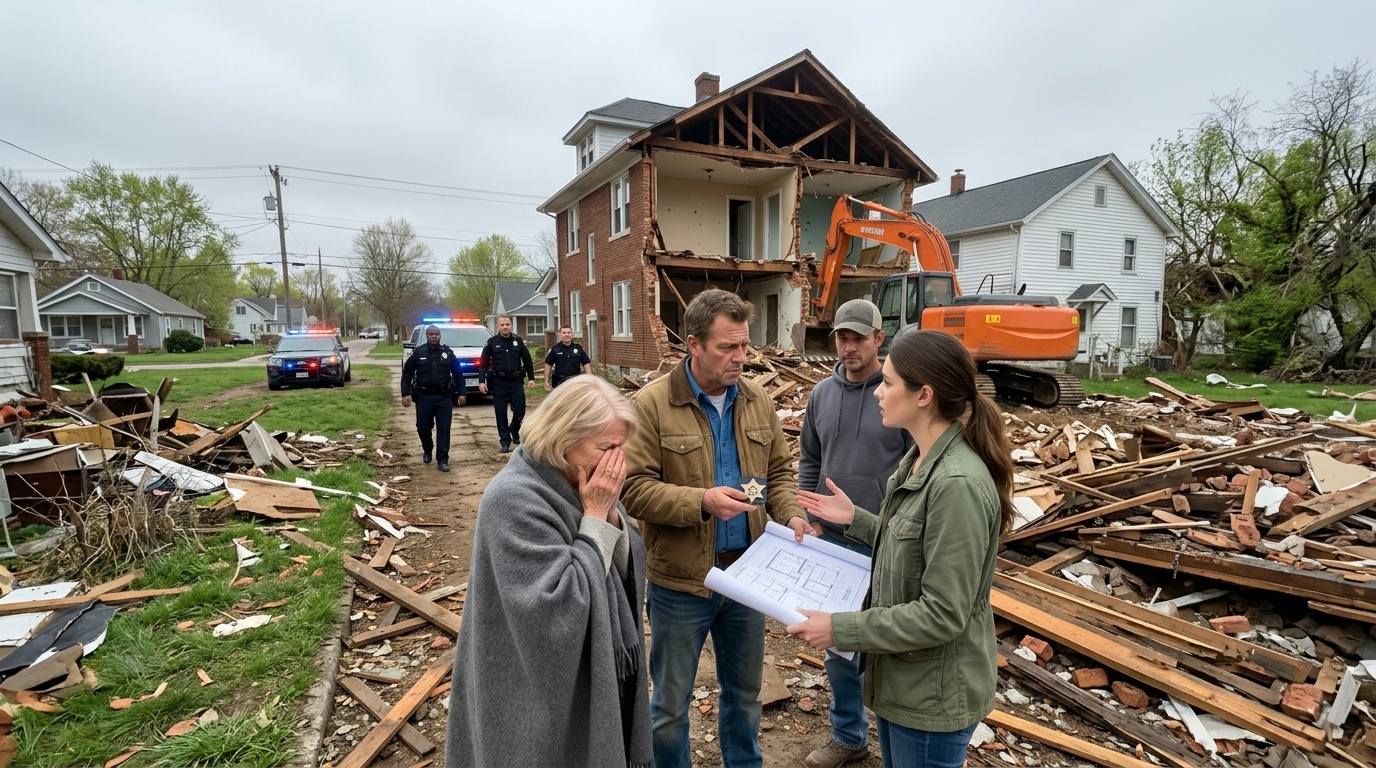
The investigator held the demolition order beneath
the flashing lights of his patrol vehicle.
His name was Captain Daniel Mercer,
and he had spent twenty-three years investigating fraud, corruption,
and violent crimes for the Kentucky State Police.
He was also one of the few men in Marlow County who knew exactly how difficult it was to make me lose my temper.
That morning, he came closer than anyone ever had.
“Anson,” he said quietly, “take a look at this.”
I stood beside my destroyed bedroom, still wearing the flannel shirt I’d slept in.
There was blood on my left forearm from pulling Bethany through broken glass.
My boots were covered in insulation.
Behind us, paramedics were examining my wife inside an ambulance.
The bulldozer remained embedded in the south wall of our farmhouse.
Its engine had finally stopped.
The silence afterward felt unnatural.
I looked at the paper Mercer handed me.
At the top were the words:
MARLOW COUNTY EMERGENCY DEMOLITION AUTHORIZATION
Below that was a parcel number, a description of the supposed safety violation, and an official-looking county seal.
Then I saw the signature.
Anson R. Tilbury, Sheriff, Marlow County.
For several seconds, I simply stared.
Mercer watched my face.
“Recognize it?”
I looked up.
“That’s supposed to be my signature.”
He nodded.
“Did you sign it?”
“No.”
“Ever authorize a demolition on this property?”
“No.”
“Ever request emergency removal of an abandoned structure at this address?”
I looked toward the wreckage.
“Daniel, that’s my bedroom.”
He folded the document carefully.
“Then we’ve got a problem.”
I turned toward Penelope Briarcliff.
She stood near the south fence with her arms crossed, speaking angrily to a deputy.
Her white HOA polo was spotless.
Her blonde hair was perfectly styled.
And despite the fact that a bulldozer had just torn through an occupied home, she appeared more offended by the police response than frightened by what she’d done.
When she noticed me looking, she raised her chin.
“This is ridiculous!” she shouted. “I have authorization!”
Mercer stepped forward.
“Mrs. Briarcliff, we’re going to need you to remain here.”
She gave a sharp laugh.
“Do you know who my husband is?”
Mercer didn’t blink.
“Right now, ma’am, I’m more interested in knowing who prepared that document.”
For the first time, her expression changed.
Only slightly.
But I saw it.
Fear.
Bethany was conscious when I reached the ambulance.
She sat on the stretcher with a blanket around her shoulders.
A paramedic was checking her blood pressure.
There was a small cut above her eyebrow.
Her hands trembled.
When she saw me, she reached out.
“Anson.”
I took her hand.
“I’m here.”
She looked past me toward the house.
“Our bedroom.”
I swallowed.
“I know.”
“Your father’s fireplace.”
I closed my eyes.
The stone fireplace had survived.
Barely.
The bulldozer blade had stopped less than three feet from it.
But the wall beside it was gone.
The wooden beams my father had installed in 1985 were splintered.
Our bed had been crushed.
And the cedar chest containing family photographs had disappeared beneath a mountain of debris.
Bethany began crying.
I sat beside her.
“Listen to me,” I whispered. “The house can be repaired.”
She shook her head.
“Your parents—”
“I know.”
My voice broke.
“But you’re alive.”
She looked at me.
I squeezed her hand.
“That’s what matters.”
For a moment, neither of us spoke.
Then she whispered something that made my blood run cold.
“Anson, if I’d gotten up when the alarm went off, I would have been standing right where that blade came through.”
I looked at her.
She continued.
“I was going to get up at five-fifty.”
My stomach tightened.
The bulldozer struck at five-fifty-five.
Five minutes.
That was the difference between my wife sitting beside me and something I couldn’t bear to imagine.
I leaned forward and kissed her forehead.
Then I told the paramedic to take good care of her.
Because the moment I stepped away from that ambulance, I knew I had to make a decision.
And it was one of the hardest decisions of my career.
I couldn’t lead the investigation.
Not properly.
Not when my family had been attacked.
Not when my home had been destroyed.
Not when the forged document carried my name.
I called the county attorney and requested that the Kentucky State Police handle the criminal investigation.
My chief deputy, Marcus Hale, would coordinate immediate public safety needs.
Captain Mercer would lead the outside investigative team until the appropriate supervisory arrangements were finalized.
I made the request in writing.
Then I stepped back.
I wasn’t going to give Penelope Briarcliff the opportunity to claim that I had used my office to settle a personal dispute.
I wanted every photograph documented.
Every witness interviewed.
Every financial record lawfully obtained.
Every piece of evidence handled by people who could stand in court and say the sheriff had not directed the investigation against his own neighbor.
Mercer understood.
He placed a hand on my shoulder.
“Go take care of Bethany.”
I nodded.
Then he added, “Anson?”
I looked back.
“We’ll follow the evidence.”
I held his gaze.
“That’s all I’m asking.”
By seven-thirty that morning, the entire south pasture had become an active investigation scene.
The demolition contractor, Heath Brenner, sat on the bumper of his work truck with his head in his hands.
He was thirty-four.
Thin.
Unshaven.
Wearing a faded orange safety vest.
His bulldozer had caused the damage.
But the expression on his face told me something important.
He hadn’t expected to find a family sleeping inside.
Mercer approached him.
“Heath Brenner?”
He nodded.
“Yeah.”
“I’m Captain Mercer. We need to talk about the work you performed this morning.”
Heath stared at the farmhouse.
“I didn’t know.”
Mercer waited.
Heath’s voice cracked.
“She told me it was abandoned.”
“Who?”
Heath pointed toward Penelope.
“That woman.”
Mercer took out his notebook.
“What exactly did she tell you?”
Heath swallowed.
“That the county had condemned an old outbuilding. She said the homeowners association had authorization to remove it before the property was redeveloped.”
Mercer looked toward the house.
“And you believed that?”
Heath covered his face.
“She had paperwork.”
“Did you verify it with the county?”
Heath didn’t answer.
Mercer waited.
Finally, Heath whispered, “No.”
Heath had accepted eight thousand dollars for the job.
Half up front.
Half after completion.
He’d been struggling financially.
His company had lost two major contracts.
His truck payment was overdue.
And Penelope had offered him what seemed like a straightforward demolition project.
She supplied a satellite image.
Marked a structure.
Provided an official-looking order.
And told him to arrive before sunrise to avoid disrupting the neighborhood.
Heath admitted that the timing seemed unusual.
But Penelope claimed the county wanted the work completed before a scheduled inspection.
He’d believed her.
Or perhaps he’d chosen not to ask too many questions.
Either way, his bulldozer had crossed my property line and entered my bedroom.
And no amount of regret could undo that.
At eight-fifteen, Penelope demanded to speak with the officer in charge.
Mercer approached her.
She held up her phone.
“My attorney is on the line.”
He nodded.
“That’s your right.”
She thrust the phone toward him.
Mercer didn’t take it.
“Mrs. Briarcliff, we’re documenting a serious incident. Your attorney can contact the appropriate investigators.”
She narrowed her eyes.
“This is political retaliation.”
Mercer remained calm.
“On what basis?”
She pointed toward me.
“Because that man is the sheriff!”
Mercer glanced in my direction.
I was standing beside the ambulance, speaking with Bethany.
Then he turned back.
“Mrs. Briarcliff, the sheriff has requested an outside investigation and is not directing this case.”
She opened her mouth.
Closed it.
Then snapped, “Well, he threatened me!”
Mercer looked at his notes.
“You reported that he came outside with a gun.”
“Yes!”
“Did you actually see a firearm?”
She hesitated.
“I saw something in his hand.”
“What?”
“I don’t know!”
Mercer waited.
Penelope’s voice rose.
“He’s dangerous!”
At that moment, Marcus Hale approached carrying the object I’d been holding when I came outside.
A flashlight.
A black metal flashlight with a cracked lens.
Marcus placed it in an evidence bag.
Mercer looked at Penelope.
“Is this what you saw?”
Her face went pale.
The entire incident had been captured by multiple cameras.
One was mounted above our barn.
Another covered the driveway.
A third overlooked the horse paddocks.
Bethany had installed them after several expensive saddles disappeared from a neighboring stable.
The cameras recorded Penelope arriving before dawn.
They recorded her meeting Heath beside the fence.
They recorded the bulldozer crossing onto our property.
And they recorded the moment the blade struck the house.
One camera even captured Penelope raising her phone and calling 911.
But the most important recording came from a camera above the stable office.
It had audio.
And the audio revealed something Penelope hadn’t expected anyone to hear.
At 5:42 a.m., Heath asked her a question.
“Are you sure nobody’s in there?”
Penelope replied, “The owners were notified.”
Heath looked toward the farmhouse.
“Looks like lights are on.”
Penelope said, “That’s automatic security lighting. Get it done.”
The recording continued.
Heath hesitated.
Then Penelope added:
“If you don’t finish before six, you don’t get the rest of your money.”
When Mercer heard those words, he stopped the recording.
Then replayed them.
Twice.
Because the woman who claimed she had merely authorized removal of an abandoned structure had been warned that the building might be occupied.
And she had ordered the work to continue.
At ten o’clock, Tobias arrived from Lexington.
He’d driven nearly two hours after Bethany called him.
His truck came down the gravel driveway too fast.
He jumped out before the engine had completely stopped.
“Dad!”
I turned.
He ran toward me.
Then saw the house.
He stopped dead.
For a moment, he looked like the little boy who used to cry when one of our horses got hurt.
“What happened?”
I took a breath.
“Your mom’s alright.”
He looked at the ambulance.
“Where is she?”
“At the hospital now. They’re checking her for injuries.”
He swallowed.
Then looked back at the wreckage.
“Who did this?”
I hesitated.
“Penelope arranged the demolition.”
His face hardened.
“Briarcliff?”
I nodded.
He stared at the broken wall.
Then whispered, “She could have killed you.”
I put a hand on his shoulder.
“I know.”
He looked at me.
“What are you going to do?”
I took a breath.
“I’m going to let the investigators do their jobs.”
Tobias shook his head.
“Dad—”
I interrupted gently.
“Son, listen to me.”
He looked up.
“Anger won’t rebuild that room.”
His jaw tightened.
“And it won’t help your mother.”
For several seconds, he said nothing.
Then he nodded.
And together, we drove to the hospital.
Bethany had a concussion, bruising, and several cuts.
The doctors wanted to observe her.
Lucinda arrived after school with tears streaming down her face.
She climbed into the hospital bed beside her mother.
For a while, nobody spoke.
We just held one another.
Then Lucinda whispered, “Are we going to lose the farm?”
I looked at my daughter.
“No.”
She swallowed.
“Promise?”
I took her hand.
“Promise.”
But even as I said it, I knew the next few months would test that promise.
Because Penelope hadn’t simply hired a bulldozer.
She had spent years preparing to take our land.
And the forged demolition order was only the beginning.
That evening, Mercer called.
“Anson, we’ve confirmed the map was altered.”
I sat upright.
“What did you find?”
“The parcel boundaries were moved.”
I closed my eyes.
“How far?”
“Enough to make your south wing appear inside a tract controlled by the HOA.”
I stared at the hospital wall.
Mercer continued.
“The county GIS office has no record of that version. The file appears to have been edited before it was given to the contractor.”
I swallowed.
“And the signature?”
“We’re examining its source.”
I looked toward Bethany, asleep in the hospital bed.
Then asked, “Anything else?”
Mercer hesitated.
“Yes.”
My stomach tightened.
“What?”
“The HOA treasurer contacted us.”
I sat forward.
“Why?”
Mercer’s voice lowered.
“Because she says Penelope has been moving money out of the association’s accounts.”
I closed my eyes.
The bulldozer had destroyed our bedroom.
But now it appeared that Penelope had been using the HOA itself to finance her scheme.
And the people who had elected her president were about to discover just how much she’d hidden.
PART 3
The HOA treasurer’s name was Marianne Keller.
She was sixty-three, a retired accountant who lived in a brick house near the entrance to Bluegrass Ridge Estates.
I’d met her only twice.
Once at a county fair.
And once when she came to our farm to purchase riding lessons for her granddaughter.
She was quiet.
Careful.
The kind of person who kept receipts in labeled folders and never wrote a check without recording it.
For three years, Marianne had served as the HOA’s volunteer treasurer.
She believed Penelope Briarcliff was difficult but competent.
That belief ended when she discovered a payment for eighteen thousand dollars labeled:
SOUTHERN PERIMETER SAFETY REMEDIATION
The payment had been made to a company called Bluegrass Community Improvements LLC.
Marianne had never heard of it.
She asked Penelope for an invoice.
Penelope told her the expense was confidential.
Marianne asked again.
Penelope threatened to remove her as treasurer.
That was when Marianne began reviewing the records.
And what she found frightened her.
Over three years, approximately one hundred twenty-four thousand dollars had left the HOA’s accounts through questionable transactions.
Some payments were labeled landscaping.
Others were marked legal consultation.
Several were described as emergency repairs.
But the supporting invoices were incomplete.
The vendors were difficult to verify.
And some transfers appeared to benefit a company connected to Penelope’s husband.
Marianne initially believed it was sloppy bookkeeping.
Then she discovered that the HOA’s reserve account had fallen dangerously low.
Money intended for road maintenance, stormwater drainage, and common-area repairs had disappeared.
When she confronted Penelope, the president laughed.
“Marianne, you worry too much.”
Marianne demanded an independent audit.
Penelope refused.
Then, three days before the bulldozer incident, Marianne received an email announcing that the HOA had approved a new land acquisition project.
The target property was described as eighteen acres along the development’s southern boundary.
My eighteen acres.
The email claimed that the HOA was negotiating to acquire the land for future recreational amenities.
Walking trails.
A clubhouse.
An equestrian facility.
And additional premium home sites.
The proposed purchase price was absurdly low.
Less than half the property’s estimated market value.
Marianne asked how Penelope intended to persuade me to sell.
Penelope replied:
Once the nuisance structures are removed, the owner will become more cooperative.
Marianne printed the email.
Then placed it in a folder.
She hadn’t understood what Penelope meant.
Not until she heard about the bulldozer.
When Mercer interviewed Marianne, she brought three binders.
Bank statements.
Meeting minutes.
Invoices.
Email correspondence.
And copies of the HOA’s annual budgets.
She placed them on the table.
Then said quietly, “Captain, I think our association has been robbed.”
Mercer examined the records.
“Why didn’t you report this earlier?”
Marianne’s eyes filled.
“I thought I was misunderstanding something.”
She looked down.
“Penelope kept telling me I was old-fashioned.”
Mercer waited.
“She said modern property management required flexibility.”
Marianne swallowed.
“And I believed her.”
Mercer shook his head.
“You did the right thing by bringing this forward.”
She nodded.
Then opened the third binder.
“There’s something else.”
Mercer looked up.
Marianne slid a printed email across the table.
It contained a proposal for a luxury equestrian development.
At the bottom was a handwritten note.
Tilbury parcel must be secured before investor meeting.
The proposed development wasn’t merely an HOA improvement.
It was a private business opportunity.
Penelope had been speaking with a real estate investor from Lexington about acquiring land along our south boundary.
The investor wanted a contiguous tract large enough for upscale homes and an equestrian club.
Our farm was the missing piece.
Without it, the project couldn’t proceed as designed.
Penelope had apparently convinced herself that if she could make our lives miserable enough, we’d sell.
First came the complaints.
Then the inspections.
Then the legal threats.
Then the forged demolition paperwork.
And finally, the bulldozer.
She had turned a neighborhood association into a weapon against a family that had lived on the land for more than a century.
The investigation expanded.
State investigators reviewed the financial records.
They examined the altered map.
They interviewed the contractor.
They obtained relevant communications through lawful procedures.
And they began tracing payments connected to the proposed land acquisition.
I received updates only through appropriate channels.
I didn’t sit in the interview rooms.
I didn’t question witnesses.
I didn’t direct the investigation.
That separation mattered.
Because Penelope’s attorney soon began telling reporters that the sheriff was abusing his position.
The story spread quickly.
Local television crews appeared near our driveway.
Reporters called the sheriff’s office.
Online commentators argued about property rights, HOA authority, and political corruption.
Some people believed Penelope’s claims.
Others were horrified by the footage of the bulldozer.
But I refused to turn our family’s trauma into a public spectacle.
When a reporter asked whether I wanted Penelope arrested, I gave a simple answer.
“I want a fair investigation based on evidence.”
Then I returned to the hospital to sit beside my wife.
Bethany came home three days after the incident.
She couldn’t sleep in our bedroom.
There wasn’t a bedroom left.
The south wing had been declared unsafe until structural repairs could be completed.
We moved into the upstairs guest rooms.
For the first week, Bethany woke whenever she heard a truck outside.
Once, a delivery vehicle backed down our driveway.
The warning alarm sounded.
Beep.
Beep.
Beep.
Bethany dropped a glass in the kitchen.
It shattered on the floor.
I rushed toward her.
She stood frozen.
Her face had gone pale.
“Beth?”
She looked at me.
Then whispered, “I thought it was coming through the wall again.”
I held her.
And she began crying.
That was when I realized something.
Penelope hadn’t merely damaged our house.
She had damaged the place where my wife had always felt safest.
Lucinda struggled too.
She began checking the locks before bed.
Then checking them again.
Tobias called every evening.
He wanted to leave school and come home.
I told him to finish the semester.
He argued.
I insisted.
“Your mother and I didn’t raise you to abandon your future because somebody else behaved recklessly.”
He went quiet.
Then said, “I hate being so far away.”
I swallowed.
“I know, son.”
He hesitated.
“Dad, are you scared?”
I looked toward the broken south wing.
The temporary plywood covering the wall moved slightly in the wind.
I took a breath.
“Yes.”
There was silence.
Then Tobias whispered, “I’ve never heard you say that.”
I closed my eyes.
“Being brave doesn’t mean you’re never frightened.”
He said nothing.
“It means you do what needs to be done anyway.”
Meanwhile, Bluegrass Ridge Estates was beginning to unravel.
Residents demanded an emergency meeting.
Penelope refused to call one.
So homeowners used the procedures in their governing documents to organize a special meeting.
More than forty households attended.
Marianne presented the financial discrepancies.
A lawyer explained that the HOA had no authority over our separate property.
Residents watched portions of the bulldozer footage.
And for the first time, many realized how badly they’d been misled.
One homeowner stood.
His name was Robert Ellis.
He was a retired Army colonel.
He’d lived in Bluegrass Ridge for eleven years.
“I want to know,” he said, “why our association president believed she had the authority to demolish somebody else’s home.”
Nobody answered.
He continued.
“And I want to know where our reserve money went.”
The room erupted.
Penelope arrived halfway through the meeting.
She wore a navy blazer and carried a leather folder.
Her husband, Gunner, followed.
She walked to the front of the room as though she still controlled it.
“This meeting is unauthorized,” she announced.
Marianne stood.
“The members called it according to the bylaws.”
Penelope laughed.
“You’ve been manipulated by the sheriff.”
Robert Ellis rose.
“Ma’am, sit down.”
Penelope stared at him.
“Excuse me?”
He folded his arms.
“We’ve heard enough speeches. We want answers.”
She looked around.
For the first time, the people who had once applauded her promises were staring at her with suspicion.
A woman in the second row raised her hand.
“Did you use HOA money to hire that bulldozer?”
Penelope snapped, “Absolutely not.”
Marianne opened her binder.
“Then can you explain the payment to Bluegrass Community Improvements?”
Penelope’s face changed.
Only for a moment.
But everyone saw it.
The meeting ended with a vote to remove Penelope from the presidency under the association’s governing procedures.
An independent financial audit was authorized.
The board also voted to cooperate fully with investigators.
Penelope stormed out.
Gunner followed.
But the damage was done.
She no longer controlled the HOA.
And without that authority, the network of threats and demands she’d built began collapsing.
Two weeks later, investigators executed court-authorized searches related to the financial investigation.
They obtained records from Penelope’s business interests.
They reviewed communications concerning the proposed land purchase.
And they interviewed Gunner.
He initially claimed to know nothing.
But records showed that some of the disputed HOA funds had moved through accounts associated with a company in which he held an interest.
Investigators examined whether those transfers represented legitimate services or improper payments.
The findings would ultimately become part of a broader financial case.
Heath Brenner, the demolition contractor, cooperated.
He provided text messages.
Payment records.
The altered satellite map.
And the demolition order Penelope had supplied.
He admitted he had failed to verify the authorization.
He also acknowledged that he’d ignored warning signs.
His cooperation didn’t erase his responsibility.
But it helped investigators reconstruct what happened.
One message from Penelope was especially revealing.
Sent the night before the demolition, it read:
Be there before six. The family should still be asleep, and I don’t want another confrontation.
When Mercer showed me that message through the proper victim-notification process, I felt physically sick.
She knew we might be asleep.
She knew the building was occupied.
And she sent the bulldozer anyway.
A month after the incident, I stood inside the ruined bedroom with a structural engineer.
The damaged wall had been stabilized.
The broken beams were exposed.
Dust covered the floor.
The engineer pointed toward the foundation.
“The original stonework is still sound.”
I looked at him.
“Can we rebuild?”
He nodded.
“Yes.”
I swallowed.
“And the fireplace?”
He examined it.
“The chimney needs work, but most of the stone can be saved.”
I closed my eyes.
My father had placed those stones with his own hands.
I remembered standing beside him in 1985.
Nineteen years old.
Sweating in the Kentucky summer heat.
Complaining about how heavy the stones were.
My father laughed.
“Anson, someday you’ll be glad we built this to last.”
I looked at the fireplace.
Then whispered, “You were right, Dad.”
The criminal investigation eventually resulted in charges against Penelope related to the forged documents, property destruction, and financial misconduct.
The exact allegations were determined by prosecutors after reviewing the evidence.
Heath faced consequences for his own role.
And the financial investigation continued to examine the disputed HOA payments and the involvement of others.
I didn’t celebrate the charges.
I felt relief.
But not joy.
Because no arrest could restore Bethany’s sense of safety overnight.
No indictment could erase the memory of a bulldozer entering our bedroom.
And no courtroom could give my parents another chance to sit beside that fireplace.
Still, accountability mattered.
And Penelope was finally going to face a process she couldn’t control with a threatening letter.
Then came the civil case.
Bethany and I filed claims seeking compensation for the damage to our home, our belongings, and the losses caused by the incident.
Our attorney also pursued the responsible parties and applicable insurance arrangements.
The process was slow.
There were inspections.
Expert reports.
Depositions.
Negotiations.
And months of uncertainty.
Penelope’s attorneys initially tried to portray the demolition as an unfortunate misunderstanding.
But the evidence made that explanation difficult.
The altered map.
The forged authorization.
The early-morning timing.
The contractor’s testimony.
The camera recordings.
And the message about our family being asleep.
Together, they told a story no public-relations statement could erase.
One afternoon, while the civil case was progressing, I received a letter from Penelope.
It came through her attorney.
I opened it at the kitchen table.
The letter was short.
She wrote that she regretted the distress caused by the incident.
She described the demolition as a mistake.
And she asked whether we might resolve matters privately.
I read it twice.
Then handed it to Bethany.
She studied the page.
Finally, she looked at me.
“Does she say she’s sorry for almost killing us?”
I shook my head.
“No.”
Bethany placed the letter on the table.
“Then she still doesn’t understand.”
I looked at my wife.
She was right.
Regretting consequences wasn’t the same as accepting responsibility.
And we weren’t going to pretend otherwise.
Six months after the bulldozer struck our home, the reconstruction began.
New beams were delivered.
The damaged foundation was repaired.
The fireplace stones were carefully numbered and preserved.
The pine siding was replaced with wood milled to match the original.
I spent hours watching the work.
Sometimes I helped.
Sometimes I simply stood beside the contractors and answered questions.
Bethany chose the new windows.
Lucinda helped select paint colors.
Tobias came home on weekends to work with the carpenters.
Slowly, the south wing began taking shape again.
And for the first time since that terrible Tuesday morning, I allowed myself to imagine sleeping there without fear.
But before the final wall was painted, Captain Mercer called with news.
“Anson, the financial case has reached a turning point.”
I sat down.
“What happened?”
He took a breath.
“Penelope’s former business partner has agreed to cooperate.”
I waited.
“And?”
Mercer paused.
“He says the demolition wasn’t just intended to pressure you into selling.”
My stomach tightened.
“What else?”
Mercer’s voice became very quiet.
“He says Penelope planned to use the destruction of your home as evidence that your property was unsafe, then push for an emergency sale.”
I stared at the wall.
And suddenly, the entire scheme became clear.
The bulldozer wasn’t simply an act of revenge.
It was supposed to be the first step in taking everything.
PART 4
The courtroom was silent when Penelope Briarcliff entered.
Gone was the white HOA polo.
Gone were the designer sunglasses.
Gone was the confident smile she used whenever she arrived at our property carrying another threatening letter.
She wore a gray suit.
Her hair was pulled tightly behind her head.
And for the first time since I’d known her, she looked like a woman who understood that her words might no longer be enough to control what happened next.
Bethany sat beside me.
Tobias was on my left.
Lucinda sat between her brother and grandmother’s sister, Aunt Margaret.
We had waited more than a year for this day.
The criminal proceedings had been complicated.
There were multiple allegations.
Several defendants.
Extensive financial records.
And serious questions about the altered documents and the demolition itself.
Penelope had initially denied wrongdoing.
Then, as the evidence accumulated, her attorneys began negotiating.
Ultimately, she entered guilty pleas to several charges under an agreement accepted by the court.
The financial misconduct case also produced findings and restitution obligations.
Other related matters were resolved separately.
I didn’t pretend to understand every legal detail.
I’d spent my career enforcing the law, not deciding sentences.
But I understood one thing.
Penelope was no longer standing before a judge as an HOA president issuing demands.
She was standing there as a defendant answering for her actions.
The prosecutor described the events of that Tuesday morning.
The altered map.
The forged demolition authorization.
The early arrival.
The occupied farmhouse.
The contractor’s warnings.
And the destruction of our bedroom.
Then the prosecutor discussed the financial investigation.
The questionable HOA transfers.
The private development proposal.
The attempts to pressure us into selling.
And the evidence suggesting that the demolition was intended to strengthen Penelope’s position in a future land acquisition.
The courtroom remained quiet.
Then the prosecutor played the stable camera recording.
Heath’s voice filled the room.
“Are you sure nobody’s in there?”
Penelope’s recorded reply followed.
“The owners were notified.”
Then Heath said:
“Looks like lights are on.”
And Penelope answered:
“That’s automatic security lighting. Get it done.”
Bethany gripped my hand.
I felt her trembling.
I squeezed gently.
She leaned closer.
“Anson.”
I turned.
Her eyes were filled with tears.
I whispered, “I’m here.”
When the recording ended, the prosecutor asked the judge to consider the danger created by Penelope’s decisions.
Not just the financial damage.
Not just the destroyed wall.
But the lives placed at risk.
The judge listened carefully.
Then asked whether any victims wished to address the court.
Bethany stood.
My heart tightened.
She had spent weeks preparing her statement.
She’d written it by hand.
Then rewritten it.
Then practiced reading it aloud in our kitchen.
But now, standing before the judge, she looked frightened.
I reached for her hand.
She squeezed it.
Then walked toward the front of the courtroom.
“My name is Bethany Tilbury,” she began.
Her voice trembled.
“I have lived on our farm with my husband for nearly thirty years.”
She looked down at her paper.
“Our bedroom was the safest place in the world to me.”
The courtroom remained silent.
“It was where we raised our children.”
She swallowed.
“Where we talked about our hopes.”
“Where we grieved our parents.”
“Where we celebrated birthdays and anniversaries.”
Her voice broke.
“And where I believed nobody could hurt us.”
She looked toward Penelope.
“On March nineteenth, at five-fifty-five in the morning, a bulldozer came through that wall.”
I closed my eyes.
Bethany continued.
“I remember the sound.”
She swallowed.
“I remember the bed moving.”
“I remember my husband pulling me away.”
“And I remember thinking I was going to die.”
Tears streamed down her face.
She looked at the judge.
“For months afterward, I couldn’t sleep through the night.”
“I was afraid of trucks.”
“Afraid of loud noises.”
“Afraid of being alone.”
She took a breath.
“I know a house can be repaired.”
Then she looked directly at Penelope.
“But you cannot repair what happened simply by replacing wood and stone.”
The courtroom was completely silent.
Bethany lowered her paper.
Then said the words I would remember for the rest of my life.
“You didn’t just break our wall.”
“You broke our peace.”
When she returned to her seat, I stood and hugged her.
She cried against my shoulder.
I held her tightly.
And for the first time since the bulldozer incident, I felt something begin to loosen inside my chest.
Not forgiveness.
Not relief.
Something closer to the realization that we had survived.
And that our voices had finally been heard.
When my turn came, I walked to the front of the courtroom.
I wasn’t wearing my sheriff’s uniform.
I wore a dark suit.
A plain tie.
And the watch my father had given me when I graduated from the state police academy.
I wanted the judge to see me as Anson Tilbury.
A husband.
A father.
A son.
A man whose family had lived on the same land for five generations.
Not simply as the county sheriff.
I unfolded my statement.
Then looked toward the bench.
“Your Honor, my family purchased our land in 1893.”
I paused.
“My great-great-grandfather paid four hundred and twenty dollars for it.”
A few people shifted in their seats.
“He built a farmhouse from timber cut on the property.”
“My grandfather maintained it.”
“My father expanded it.”
“And I hoped to pass it on to my children.”
I looked toward Tobias and Lucinda.
Both were crying.
I swallowed.
“Penelope Briarcliff believed she could force us to surrender that history because she wanted our land.”
I took a breath.
“She filed complaints.”
“Made threats.”
“Altered documents.”
“And eventually sent heavy equipment into a room where my wife and I were sleeping.”
I looked at Penelope.
She stared at the table.
Then I continued.
“I’ve served in law enforcement for decades.”
“I’ve seen people make terrible choices.”
“I’ve seen anger destroy families.”
“And I’ve seen what happens when someone convinces themselves that rules apply to everyone except them.”
I paused.
“But this case isn’t about my badge.”
I looked at the judge.
“It’s about the principle that nobody gets to use power, money, or influence to take what belongs to another person.”
I folded my paper.
Then added quietly.
“My wife and I didn’t ask for this fight.”
“We only wanted to live peacefully on our land.”
The judge considered the statements and the evidence presented.
Penelope received a sentence that included incarceration, financial penalties, and restitution obligations under the applicable orders.
The exact terms reflected the charges to which she had pleaded guilty and the court’s findings.
The judge also addressed the seriousness of using forged documents and dangerous equipment to interfere with another family’s property.
Penelope stood motionless as the sentence was pronounced.
Her attorney leaned toward her.
She nodded faintly.
Then, for the first time, she looked directly at me.
I didn’t smile.
I didn’t nod.
I didn’t say anything.
Because I wasn’t there to celebrate her downfall.
I was there because my wife had nearly died.
And because the law had finally caught up with a woman who believed she could control everyone around her.
The civil proceedings continued separately.
Our attorneys negotiated compensation for the structural damage, destroyed belongings, temporary housing, medical expenses, and other documented losses.
Insurance coverage and responsibility were disputed.
The process required additional expert reports and negotiations.
Eventually, a settlement was reached with several responsible parties.
It didn’t make us wealthy.
It didn’t erase the trauma.
But it provided resources to finish rebuilding and address the losses we’d suffered.
The HOA also underwent significant changes.
The new board hired an independent management company.
Financial controls were strengthened.
Members received detailed accounting reports.
And the association adopted procedures intended to prevent any future president from exercising unchecked authority.
Marianne Keller remained involved.
She insisted that every significant expenditure be properly documented.
Robert Ellis helped organize a committee to review the governing documents.
And several homeowners personally apologized to us for the harassment we’d endured.
One afternoon, Marianne came to the farm.
She stood on our porch holding a small basket.
Inside were homemade muffins and a handwritten card.
“Bethany,” she said quietly, “I know this doesn’t make up for anything.”
Bethany smiled.
“You don’t owe us an apology, Marianne.”
Marianne shook her head.
“I should have questioned Penelope sooner.”
I looked at her.
“You did question her.”
She lowered her eyes.
“Not soon enough.”
I stepped forward.
“Marianne, you brought the evidence forward when you understood what was happening.”
She looked up.
“That mattered.”
Her eyes filled.
Then Bethany hugged her.
And for the first time, the boundary between our farm and Bluegrass Ridge Estates began feeling less like a battlefield.
The reconstruction was completed the following spring.
I remember the day the contractors removed the final protective covering.
Sunlight poured through the new bedroom windows.
The pine walls had been restored.
The floorboards matched the original as closely as possible.
The stone fireplace stood proudly against the far wall.
And the chestnut beams had been repaired and reinforced.
Bethany walked into the room slowly.
She stopped beside the fireplace.
Then reached out and touched one of the stones.
“Your father placed this one?”
I smiled.
“No.”
I pointed to the stone beside it.
“That one.”
She laughed softly.
“Of course you remember.”
I nodded.
“I remember every stone we carried.”
She turned toward me.
Her eyes were wet.
“It’s beautiful.”
I swallowed.
“It’s home.”
We didn’t move back into the room immediately.
Bethany needed time.
The memories were still painful.
Some nights, she woke frightened.
Some mornings, she avoided looking toward the south wall.
We continued getting support and taking things slowly.
I learned that healing doesn’t follow a construction schedule.
You can rebuild a wall in months.
But rebuilding trust in the safety of your own home can take much longer.
So I didn’t rush her.
We slept upstairs.
We spent afternoons in the restored room.
We opened the windows.
Listened to the horses in the pasture.
Watched sunlight move across the floor.
And gradually, the room became familiar again.
Not exactly as it had been.
But ours.
One evening, Bethany stood in the doorway.
“Anson?”
I looked up from the book I was reading.
“Yes?”
She smiled.
“I think I’m ready.”
I closed the book.
“For what?”
She looked toward the bedroom.
“To sleep downstairs.”
My throat tightened.
I stood.
Then took her hand.
“Are you sure?”
She nodded.
“Yes.”
We walked into the restored room together.
The bed was new.
The curtains were pale blue.
A photograph of our wedding stood on the dresser.
And beside the fireplace sat the old wooden rocking chair my father had built.
Bethany sat on the edge of the bed.
Then looked around.
For a moment, she was silent.
Finally, she whispered, “I think your parents would be proud.”
I smiled through tears.
“I hope so.”
That summer, Tobias graduated from the University of Kentucky.
He accepted a position with an agricultural consulting firm but continued helping us manage the farm.
Lucinda received several college acceptance letters.
She eventually chose a university close enough to visit on weekends.
The day she left for school, Bethany cried.
I pretended not to.
Then Lucinda hugged me.
“Dad?”
“Yes, sweetheart?”
“Are you going to be alright?”
I smiled.
“Of course.”
She looked toward the farmhouse.
Then whispered, “I was scared we’d lose everything.”
I swallowed.
“I know.”
She hugged me tighter.
“But we didn’t.”
I closed my eyes.
“No.”
I kissed her forehead.
“We didn’t.”
Life slowly returned to normal.
The horses needed feeding.
The fences needed repairs.
The fields needed mowing.
Bethany resumed teaching.
Tobias came home on weekends.
Lucinda called every Sunday.
And I returned to the sheriff’s office with a deeper understanding of what victims experience after a violent incident.
Before the bulldozer, I’d spent years telling people that the justice system takes time.
Now I understood how exhausting that time could be.
The waiting.
The uncertainty.
The paperwork.
The repeated explanations.
The fear that nobody would believe you.
It changed the way I listened.
When someone came into my office frightened or angry, I remembered Bethany sitting in that ambulance.
I remembered Tobias staring at our broken home.
I remembered Lucinda asking whether we’d lose the farm.
And I tried to give people the patience I’d needed so badly myself.
One October morning, I walked the south fence line.
The leaves were turning red and gold.
The air smelled of damp earth.
The horses grazed quietly beyond the barn.
I stopped near the place where Penelope had stood holding her forged demolition order.
For years, that section of fence had been a source of conflict.
Complaints.
Threats.
Arguments.
Now it was quiet.
On the other side, Bluegrass Ridge residents were walking their dogs.
A man waved.
I waved back.
There were no cameras.
No reporters.
No angry letters.
Just neighbors.
And for the first time in years, that felt possible.
A few weeks later, the new HOA president asked whether he could visit.
His name was Thomas Reed.
He was a retired engineer.
Polite.
Practical.
And clearly embarrassed by what his predecessor had done.
We sat on the porch drinking coffee.
He looked toward the restored south wing.
“Sheriff, I wanted to tell you something.”
I smiled.
“Anson is fine.”
He nodded.
“Anson, the board has voted to formally acknowledge that your property is outside our association.”
I raised an eyebrow.
“That was never in question.”
He smiled awkwardly.
“I know.”
He continued.
“We’ve also removed the inaccurate boundary references from our internal materials.”
I nodded.
“Good.”
He hesitated.
“And we’d like to apologize.”
I looked at him.
He continued.
“Not because every homeowner supported Penelope.”
He took a breath.
“But because our association allowed one person to exercise far too much power.”
I considered his words.
Then extended my hand.
“Apology accepted.”
He shook it.
And just like that, a conflict that had consumed years of our lives finally began to end.
That Christmas, Bethany decorated the farmhouse more beautifully than she had in years.
Garlands wrapped around the porch railings.
Lights glowed in the windows.
A wreath hung on the front door.
And the old stone fireplace held stockings for our family.
Tobias came home.
Lucinda brought two college friends.
Margaret arrived with homemade pies.
We cooked.
Laughed.
Played cards.
And stayed up late telling stories.
At one point, Tobias stood beside the fireplace.
He touched one of the stones.
“Dad, is this the one you placed?”
I smiled.
“No.”
He laughed.
“You’re going to make me guess every year, aren’t you?”
I nodded.
“Probably.”
Lucinda rolled her eyes.
Bethany laughed.
And for a moment, everything felt exactly as it should.
Later that evening, after everyone had gone upstairs, Bethany and I sat beside the fire.
The room was quiet.
Snow drifted past the windows.
The horses were settled in the barn.
And the farmhouse stood strong around us.
Bethany leaned against my shoulder.
“Anson?”
“Yes?”
“Do you ever think about that morning?”
I looked toward the south wall.
“Every day.”
She nodded.
“Me too.”
We sat quietly.
Then she whispered, “I don’t want it to be the thing I remember most about this room.”
I turned toward her.
“What do you want to remember?”
She smiled.
“Your father building the fireplace.”
I nodded.
“Your mother sitting beside it.”
I swallowed.
“Our children opening Christmas presents.”
I smiled.
“Our wedding anniversary.”
She laughed softly.
“And the night you dropped an entire bowl of popcorn on the rug.”
I groaned.
“Bethany.”
She laughed harder.
I pulled her close.
And suddenly, we were laughing together.
Not because the past had disappeared.
But because it no longer controlled every moment.
People sometimes ask me what happened to Penelope Briarcliff.
I tell them the truth.
She faced the legal consequences of her actions.
She lost her position.
Her reputation.
And the control she’d worked so hard to build.
The HOA recovered what it could through the financial proceedings.
The community rebuilt its governance.
And my family rebuilt our home.
But I don’t spend my days thinking about Penelope anymore.
She already took enough of our time.
I won’t give her the rest of it.
What I remember most isn’t the courtroom.
It isn’t the sentence.
It isn’t the money.
And it isn’t the moment my chief deputy told her that the homeowner she’d reported was the county sheriff.
What I remember most is Bethany standing in our restored bedroom.
Touching the stones my father and I placed together.
And whispering, “It’s home.”
Because that was what Penelope never understood.
She looked at eighteen acres and saw a development opportunity.
She looked at our farmhouse and saw an obstacle.
She looked at our refusal to sell and saw a challenge to her authority.
But she never saw the generations of people who had lived there.
The marriages.
The birthdays.
The funerals.
The children.
The memories.
The love.
My great-great-grandfather paid four hundred and twenty dollars for that land in 1893.
My father helped build the south wing in 1985.
My wife nearly died there in 2024.
And our family rebuilt it with the same determination that had carried five generations before us.
Penelope thought a bulldozer could erase that history.
She thought a forged signature could give her authority.
She thought a false 911 report could turn the law against me.
And she thought the man standing on the porch was just another farmer she could intimidate.
She didn’t know I was the sheriff.
But that wasn’t her greatest mistake.
Her greatest mistake was believing that power meant being able to take whatever you wanted.
Because real power isn’t the ability to destroy somebody else’s home.
It’s having the courage to protect what matters, the discipline to let justice take its course, and the strength to rebuild after someone tries to take everything away.
And every morning, when the sun rises over our eighteen acres, I look toward the south wing of our farmhouse.
I see the stone fireplace.
The restored pine walls.
The windows Bethany chose.
And the land my family has loved for more than a century.
Then I remember what my father used to tell me when I was young.
“Anson, build things to last.”
I smile.
Because we did.
THE END THANK YOU FOR READING !!!!