PART 3
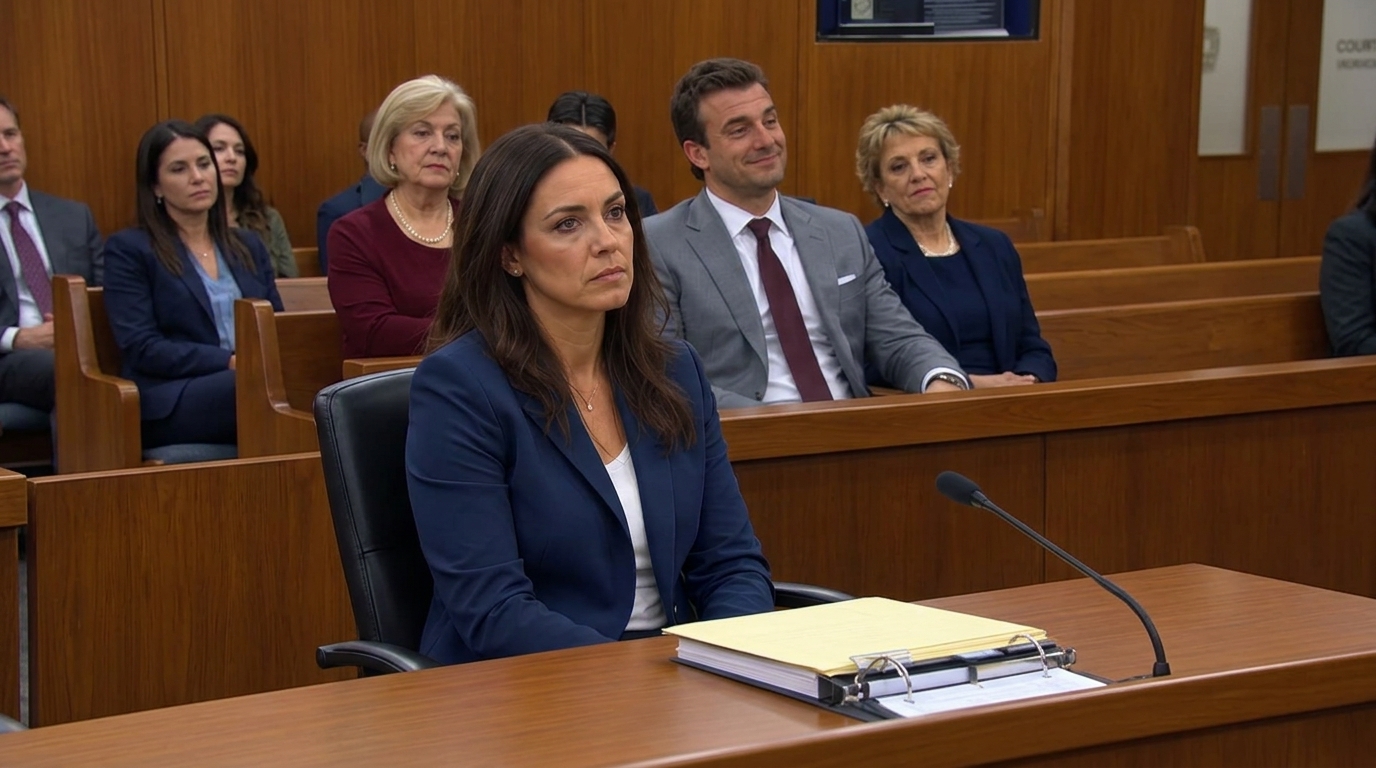
Benjamin was still standing when Judge Hawkins told him to sit down.
“Mr. Whitmore,” she said firmly,
you will have an opportunity to respond.
But you will not interrupt these proceedings.
My husband lowered himself into his chair.
For the first time since our divorce began, he looked genuinely frightened.
His mother, Dorothy, leaned toward his attorney and whispered something urgently.
Veronica, who had spent the entire morning smiling as though
she were attending a celebration,
had stopped smiling altogether.
I sat quietly beside Mr. Peterson.
My hands were trembling beneath the table.
Not because I was afraid of losing.
But because I knew what was coming.
And I knew that once the truth was spoken aloud,
there would be no returning to the family I had once believed I belonged to.
My name is Caroline Whitmore.
I was thirty-six years old.
And for eight years, I had been married to a man who convinced me that everything good in my life existed because of him.
The house.
The vacations.
The expensive dinners.
Even the clothes I wore.
Benjamin never missed an opportunity to remind me that I had married above my station.
What he never understood was that I hadn’t married him for his money.
I had married him because I loved him.
And for a long time, I believed he loved me too.
Judge Hawkins adjusted her glasses.
“Mr. Peterson, explain the relevance of this document.”
My attorney stood.
“Your Honor, this letter was written by the late Charles Whitmore, father of the respondent, Benjamin Whitmore.”
Dorothy stiffened.
Mr. Peterson continued.
“Mr. Whitmore founded Whitmore Holdings approximately thirty years ago. The company operates commercial properties and several manufacturing businesses.”
Benjamin’s attorney rose.
“Your Honor, we don’t dispute the company’s history, but this is a marital dissolution proceeding, not a corporate ownership trial.”
Judge Hawkins nodded.
“Then Mr. Peterson will explain why the evidence is relevant to the assets before this court.”
My attorney opened a folder.
“Because the respondent has repeatedly represented that he personally owns seventy percent of Whitmore Holdings.”
Benjamin crossed his arms.
Mr. Peterson continued.
“Those representations were used to support his claims about separate property, marital income, and the financial arrangements he says entitle my client to virtually nothing.”
Judge Hawkins looked toward Benjamin.
“Is that accurate?”
His attorney answered.
“My client maintains that he has a substantial ownership interest.”
Mr. Peterson nodded.
“And that is precisely what the authenticated corporate records call into question.”
He placed several documents before the judge.
“Your Honor, these include shareholder records, trust documents, and correspondence from the attorney who prepared the original estate plan.”
Dorothy’s face turned white.
I watched her carefully.
She knew.
Of everyone sitting on Benjamin’s side of the courtroom, she was the one who understood exactly what those documents meant.
Three weeks earlier, I had found the letter in Charles Whitmore’s old desk.
It happened almost by accident.
Benjamin had ordered me to remove my belongings from the guest wing of our house.
He’d already moved Veronica into the master bedroom.
He’d changed the password on our shared streaming accounts.
And he’d instructed the household staff not to prepare meals for me.
We were still legally married.
But he treated me like an unwelcome visitor.
One afternoon, while packing my books, I noticed a small brass key taped beneath the bottom drawer of Charles’s writing desk.
The desk had belonged to his father before him.
After Charles died, Benjamin had placed it in the guest library because he considered it old-fashioned.
I’d always loved it.
Charles had once told me that a good desk should hold more than paperwork.
“It should hold a person’s thoughts,” he’d said.
I removed the key.
Then noticed a small locked compartment behind the lower drawer.
Inside was a white envelope.
My name was written across the front.
For Caroline, when she needs the truth.
I stood there for several minutes before opening it.
Charles had died two years earlier.
Yet the handwriting was unmistakably his.
The first sentence made my knees weaken.
My dear Caroline, if you are reading this, I fear my son has finally become the man I spent years hoping he would never become.
I sat on the floor.
And read.
Charles explained that he had discovered serious irregularities in the management of Whitmore Holdings before his death.
Benjamin had been presenting himself as the controlling owner.
Dorothy had encouraged that belief.
But Charles had never transferred controlling ownership to Benjamin.
Instead, years earlier, Charles had placed sixty percent of the company’s voting shares into an irrevocable family trust.
The trust had been created to preserve the business and provide for future generations.
The beneficiaries included Benjamin and his sister, Margaret.
But beneficiaries were not the same as owners of the underlying shares.
The trust held them.
And the trustee was required to administer them according to its terms.
Benjamin had no authority to treat those shares as his personal property.
I read that section three times.
Then continued.
Charles wrote that he had become concerned about unauthorized distributions, misleading financial statements, and documents prepared at Dorothy’s direction.
He had retained independent counsel to investigate.
Before his death, he’d gathered records and placed copies with a trusted attorney.
The letter included that attorney’s name.
And one final warning.
Caroline, if Benjamin ever tells you that you have no rights because everything belongs to him, do not accept his word. Ask for the records. The truth is there.
I sat motionless.
Then I cried.
Not because I suddenly believed I would become wealthy.
But because Charles had seen what I had been too frightened to admit.
He had known his son could be cruel.
And he had tried to leave me a way to protect myself.
In court, Mr. Peterson turned another page.
“Your Honor, the trust instrument establishes that sixty percent of the voting shares were transferred to the Charles Whitmore Family Trust.”
Judge Hawkins examined the document.
“And who is the trustee?”
“A professional fiduciary appointed after Charles Whitmore’s death.”
Benjamin’s attorney frowned.
“My client was informed that he had inherited control.”
Mr. Peterson nodded.
“That appears to be what he believed. But the records indicate otherwise.”
Benjamin suddenly spoke.
“My father promised me the company.”
Judge Hawkins looked at him.
“Mr. Whitmore, please allow your attorney to speak.”
He leaned back, breathing hard.
Dorothy whispered, “Benjamin, stop.”
He turned toward her.
“Mom, what is going on?”
She wouldn’t look at him.
And that was when I knew something important.
Benjamin might have lied to me about many things.
But perhaps Dorothy had also lied to him.
Mr. Peterson continued.
“The trust owns sixty percent of the voting shares. Another twenty percent is held by other family members and investors. The respondent’s documented personal interest is substantially smaller than the controlling stake he claimed.”
The courtroom fell silent.
Benjamin stared at his attorney.
Veronica’s eyes widened.
Dorothy pressed her lips together.
Judge Hawkins looked down at the documents.
“Then the court will need accurate evidence concerning Mr. Whitmore’s actual interests, income, and distributions before determining the financial issues in this divorce.”
Mr. Peterson nodded.
“Exactly, Your Honor.”
Then he added, “And there is a second issue.”
My heart began pounding.
Benjamin’s attorney looked exhausted.
“What second issue?”
Mr. Peterson opened another folder.
“The respondent’s financial disclosures omit payments made from company accounts for personal expenses.”
Benjamin went rigid.
His attorney slowly turned toward him.
Mr. Peterson continued.
“Those expenses include luxury travel, jewelry, and residential costs associated with a third party.”
I looked toward Veronica.
Her face changed.
For the first time, she seemed to realize that the expensive lifestyle Benjamin had promised her might become part of the evidence.
Judge Hawkins looked up.
“Are you alleging that company funds were used for personal purposes?”
“We are asking the court to examine the documented transactions and their relevance to the respondent’s income, asset disclosures, and marital finances.”
The judge nodded.
“Then those records must be properly produced and evaluated.”
Benjamin stared straight ahead.
And I remembered every time he’d called me stupid for asking where our money went.
Every time he’d told me finances were too complicated for someone like me.
Every time he’d laughed when I mentioned returning to work.
He’d built his entire marriage around making me feel powerless.
Now the numbers were beginning to tell a different story.
The hearing ended with orders for additional financial disclosures and a schedule for further proceedings.
There was no dramatic declaration that the company suddenly belonged to me.
No instant transfer of millions.
No judge handing me a mansion because she’d read one letter.
The reality was more complicated.
But for the first time, Benjamin could no longer control the story simply by saying he owned everything.
The records would have to speak.
And that frightened him.
Outside the courtroom, Dorothy approached me.
Her heels clicked sharply against the marble floor.
“Caroline.”
I turned.
She stopped a few feet away.
Her face was pale.
“Where did you get that letter?”
I looked at her.
“Charles left it for me.”
Her eyes narrowed.
“That desk belonged to the family.”
I almost laughed.
“So did the truth.”
She stepped closer.
“You have no idea what you’re interfering with.”
I held her gaze.
“Then perhaps you should explain it.”
She glanced around.
Then lowered her voice.
“Benjamin has worked his entire life for that company.”
I nodded.
“And?”
“He deserves control.”
I stared at her.
“Then he should have earned it legally.”
Her face hardened.
“You ungrateful little—”
“Mrs. Whitmore.”
Mr. Peterson appeared beside me.
Dorothy stopped.
My attorney spoke calmly.
“Any communication concerning the disputed documents should go through counsel.”
Dorothy glared at us.
Then turned and walked away.
I watched her disappear through the courthouse doors.
And suddenly understood that the letter had not merely threatened Benjamin’s money.
It had threatened a secret Dorothy had protected for years.
That evening, I returned to my small rented apartment.
It was nothing like the mansion.
The kitchen barely had enough room for two people.
The living room contained a secondhand sofa.
And the bedroom window overlooked a parking lot.
But it was mine.
Nobody could order me out of it.
Nobody could tell me I was too stupid to understand the bills.
Nobody could bring another woman into my bedroom and expect me to accept it.
I made tea.
Sat beside the window.
And opened Charles’s letter again.
At the bottom, beneath his signature, he’d written one final sentence.
Never let anyone convince you that your value depends on what they allow you to have.
I pressed the paper against my chest.
Then cried until there were no tears left.
Because for the first time in years, someone had reminded me that I had value.
And that someone was the father of the man who had spent eight years trying to make me forget it.
PART 4
Two weeks after the hearing, Benjamin called me.
I hadn’t spoken to him privately in nearly a month.
Most communication went through our attorneys.
But when his name appeared on my phone, I answered.
“Caroline.”
His voice was different.
Less arrogant.
More careful.
“Hello, Benjamin.”
He cleared his throat.
“We need to talk.”
“About what?”
“The company.”
I looked out the window.
“That’s something your attorney can discuss with mine.”
He sighed.
“Please don’t do this.”
I almost laughed.
“Do what?”
“Destroy everything my father built.”
I closed my eyes.
There it was.
The accusation.
The attempt to make me responsible for consequences he hadn’t expected.
“Benjamin, your father’s trust documents existed before our divorce.”
He said nothing.
“I didn’t create them.”
Silence.
“I didn’t conceal them.”
He exhaled sharply.
“You don’t understand how business works.”
I felt something inside me settle.
For eight years, that sentence had ended countless conversations.
But not anymore.
“I understand that ownership records matter.”
He went silent.
I continued.
“And I understand that a company isn’t yours simply because you tell people it is.”
His voice hardened.
“You’ve changed.”
I looked toward the little kitchen.
The dishes drying beside the sink.
The books stacked on the table.
The quiet apartment.
“Yes,” I said.
“I have.”
Then I ended the call.
Three days later, Mr. Peterson asked me to come to his office.
When I arrived, he was sitting with a forensic accountant named Rachel Morris.
Rachel was in her early forties, with dark hair pulled into a neat bun and the focused expression of someone who enjoyed finding patterns other people missed.
She shook my hand.
“Mrs. Whitmore, thank you for coming.”
I sat down.
Mr. Peterson opened a folder.
“We’ve received additional financial records.”
My stomach tightened.
“From Benjamin?”
“Some from his disclosures. Others from records produced through the appropriate process.”
Rachel turned her laptop toward me.
“I want to show you a series of transactions.”
The screen displayed a spreadsheet.
Dates.
Amounts.
Account descriptions.
Vendor names.
I leaned closer.
“What am I looking at?”
Rachel pointed to a column.
“These are payments from accounts associated with Whitmore Holdings and related entities.”
I nodded.
“Some appear to be legitimate business expenses.”
She scrolled.
“But several require explanation.”
I saw hotel charges.
Airfare.
Jewelry purchases.
Luxury clothing.
And payments to a residential property management company.
My stomach tightened.
“That’s the apartment Benjamin rented for Veronica.”
Rachel nodded.
“The address matches the residence identified in the records.”
I stared at the screen.
“How much?”
She paused.
“Over the period reviewed, the personal expenditures we’ve flagged total approximately three hundred twenty thousand dollars.”
I covered my mouth.
Three hundred twenty thousand dollars.
I thought about the year I’d asked Benjamin whether we could replace our aging car.
He’d laughed.
“Money doesn’t grow on trees, Caroline.”
I remembered buying inexpensive groceries because he insisted we needed to be careful.
I remembered postponing dental work.
I remembered wearing the same winter coat for six years.
And all that time, he’d apparently been spending enormous sums on another woman.
Rachel continued.
“We haven’t concluded how every payment should be characterized. Some may have been reimbursed or reported as compensation. Others may represent unauthorized use of company funds.”
I nodded slowly.
“But the records matter?”
“Very much.”
Mr. Peterson leaned forward.
“They may affect the accuracy of Benjamin’s financial disclosures and the division of marital assets. The company and trustee may also have separate concerns.”
I stared at the screen.
For years, Benjamin had told me I contributed nothing.
But I had helped build the life he enjoyed.
I’d managed our household.
Organized events for his clients.
Prepared marketing materials for company presentations.
Handled charity campaigns.
And worked unpaid hours whenever Benjamin needed help.
He called those things favors.
I called them marriage.
Now I wondered whether he’d deliberately minimized my contributions because acknowledging them would have meant admitting I mattered.
Then Rachel opened another file.
“There’s something else.”
My stomach tightened.
“What?”
She showed me an email.
It had been sent four years earlier.
From Benjamin to Dorothy.
The subject line read:
Caroline’s involvement.
I stared.
Rachel asked, “Do you recognize this project?”
The email referenced a marketing campaign I’d developed for Whitmore Holdings.
Four years earlier, the company had been struggling to attract new commercial tenants.
Benjamin complained constantly about vacancy rates.
I offered to help.
Using my marketing degree, I developed a campaign targeting regional businesses.
I redesigned promotional materials.
Created digital advertisements.
Helped organize property tours.
And worked with a small team to update the company’s website.
Within a year, the campaign had generated significant interest.
Benjamin thanked me privately.
Then told everyone at the company that the strategy had been his idea.
I’d been hurt.
But I’d convinced myself it didn’t matter.
We were married.
His success was our success.
Or so I thought.
Rachel pointed to the email.
Benjamin had written:
Caroline did most of the campaign work. We need to make sure there’s no documentation that gives her a claim to compensation or influence later.
My breath caught.
Below it was Dorothy’s response.
Keep her role informal. She doesn’t need to understand the business arrangements.
I stared at the words.
For a moment, I couldn’t speak.
Then I whispered, “They planned it.”
Mr. Peterson looked at me gently.
“What do you mean?”
I swallowed.
“They knew I was doing the work.”
Rachel nodded.
“The email acknowledges your contribution.”
I felt tears rising.
“And they deliberately made sure I received no credit.”
Mr. Peterson paused.
“The legal significance will depend on the surrounding facts. But it’s relevant to understanding your role and may support certain claims.”
I looked at the screen.
My husband had spent years telling me I was worthless.
His mother had repeated it.
And now I was looking at written proof that they had recognized my work while deliberately hiding it.
That night, I couldn’t sleep.
I kept thinking about the woman I’d been when I married Benjamin.
I was twenty-eight.
Ambitious.
Creative.
Excited about my career.
I’d graduated with honors in marketing.
I’d worked for a regional advertising agency.
And I’d dreamed of starting my own consultancy.
Then Benjamin proposed.
He told me we would build a wonderful life together.
When his company began demanding more of his time, he suggested I leave my job temporarily.
“Just until things settle down.”
I agreed.
Then he needed help organizing a major company event.
Then another.
Then the marketing campaign.
Then managing our home became my full-time responsibility.
Every year, I told myself I’d return to work soon.
Every year, Benjamin found another reason I should wait.
Eventually, he began telling people I had no career because I lacked ambition.
And somehow, I’d started believing him.
The next morning, I opened my old laptop.
Inside a folder labeled Marketing Projects were years of work.
Presentations.
Advertising designs.
Campaign reports.
Client research.
Emails.
Draft proposals.
I’d saved everything.
Not because I expected a divorce.
But because I was proud of the work.
I sat there scrolling through files I’d almost forgotten.
Then I found a photograph.
It showed me standing beside a display at a Whitmore Holdings event.
I was smiling.
Confident.
Holding a folder containing the campaign I’d created.
Benjamin stood beside me.
His hand rested on my shoulder.
I remembered what he’d whispered before the photograph.
“Don’t talk too much about the strategy, Caroline. Let me handle the business questions.”
I stared at the picture.
Then closed my laptop.
For years, I’d mistaken his control for protection.
Now I understood the difference.
At the next hearing, the atmosphere was completely different.
Benjamin no longer smiled.
Dorothy sat stiffly behind him.
Veronica was absent.
Mr. Peterson had prepared a detailed presentation of the financial issues.
The judge reviewed the disclosures.
The disputed company interests.
The transactions.
And the evidence of my unpaid work.
Benjamin’s attorney argued that many expenses had been legitimate business expenditures.
Mr. Peterson acknowledged that proper accounting and factual findings were necessary.
The judge listened carefully.
Then asked Benjamin a question.
“Mr. Whitmore, did your wife perform marketing work for the company?”
Benjamin hesitated.
“Occasionally.”
Mr. Peterson produced the email.
The judge reviewed it.
Then looked at Benjamin again.
“Your own correspondence describes her as having performed most of the work on a major campaign.”
Benjamin shifted in his chair.
“She helped.”
Judge Hawkins looked at him steadily.
“Then the court expects your testimony to accurately reflect the extent of that assistance.”
I sat quietly.
For eight years, Benjamin had controlled the conversation.
Now he had to answer questions.
And for the first time, nobody was allowing him to dismiss me with a joke.
During a break, Veronica appeared in the courthouse hallway.
She looked different.
No designer purse.
No confident smile.
Her hair was pulled back.
She approached Benjamin near the elevators.
I wasn’t close enough to hear everything.
But I heard her say, “You told me you owned the company.”
Benjamin glanced around.
“Not here.”
She folded her arms.
“You said everything was yours.”
He grabbed her elbow.
She pulled away.
“Don’t touch me.”
Dorothy hurried toward them.
“Veronica, this isn’t the time.”
Veronica laughed bitterly.
“Apparently, there’s never a good time for the truth in this family.”
Then she walked away.
I watched her disappear.
I didn’t feel victorious.
Veronica had knowingly participated in an affair with my husband.
She had mocked me in court.
But I wasn’t interested in celebrating her humiliation.
I was interested in rebuilding my life.
A week later, Benjamin sent me an email.
Caroline, I think we should discuss settlement. This has gone far enough.
I forwarded it to Mr. Peterson.
He called me that afternoon.
“Would you consider mediation?”
I thought carefully.
“Yes.”
He sounded relieved.
“But only if Benjamin provides complete financial information.”
Mr. Peterson nodded.
“That’s reasonable.”
I looked toward my laptop.
The marketing files were still open.
“And I want my work acknowledged.”
He paused.
“In what way?”
I took a breath.
“I don’t want to be described as someone who contributed nothing.”
My attorney’s voice softened.
“Caroline, the evidence already contradicts that description.”
Tears filled my eyes.
For some reason, hearing him say it meant more than I expected.
Mediation began the following month.
Benjamin arrived with his attorney.
I arrived with Mr. Peterson.
We sat in separate rooms for much of the day.
Proposals went back and forth.
Property valuations.
Retirement accounts.
Income records.
The marital home.
My contributions.
Potential support.
The disputed transactions.
It was exhausting.
At one point, Benjamin asked to speak to me directly.
I agreed, with our attorneys present.
He sat across from me.
For the first time in years, he looked uncertain.
“Caroline,” he began, “I never meant for things to become this ugly.”
I stared at him.
“You brought your mistress to court.”
He looked down.
“You let your mother call me worthless.”
He swallowed.
“And you told me I’d never touch your money again.”
He covered his face.
“I was angry.”
I shook my head.
“Benjamin, anger doesn’t create eight years of disrespect.”
He looked up.
My voice trembled.
“You made me feel stupid every time I asked a question.”
He began crying.
“You made me feel guilty for spending money.”
I swallowed.
“You told me my work didn’t matter.”
His face crumpled.
“And then you stood in court and tried to erase everything I contributed.”
He whispered, “I’m sorry.”
I stared at him.
For eight years, I’d waited for those words.
Now that he’d finally said them, they felt strangely small.
I took a breath.
“I’m glad you understand that you hurt me.”
He looked hopeful.
Then I continued.
“But I’m not coming back.”
His expression collapsed.
And for the first time, I realized I no longer needed him to agree with my decision.
PART 5
The final settlement was reached four months later.
It wasn’t the dramatic fortune Benjamin’s family feared I would steal.
And it wasn’t the humiliating nothing they’d promised I would receive.
It was a fair resolution based on the financial records, the law, and the contributions made during our marriage.
The marital assets were divided.
The disputed transfers were accounted for.
The court approved financial arrangements that allowed me to rebuild independently.
And the final documents reflected the fact that I had contributed to the marriage in ways Benjamin had spent years denying.
The corporate ownership issues were addressed separately by the appropriate parties.
The trust retained the shares it legally owned.
Benjamin’s actual interest was established through the records.
And the company began reviewing the questionable expenses identified during the proceedings.
I didn’t become the owner of Whitmore Holdings.
That had never been my goal.
But Benjamin could no longer claim ownership he didn’t possess.
And he could no longer use imaginary wealth to intimidate me.
On the day the divorce was finalized, I wore a simple navy dress.
The same dress I’d worn to my first job interview after college.
I’d found it in the back of my closet while packing.
It still fit.
Barely.
I laughed when I zipped it.
Then stood in front of the mirror.
For years, Benjamin had chosen my clothes.
He preferred expensive dresses.
Neutral colors.
Elegant jewelry.
Things that made me look like the wife of a wealthy businessman.
But that morning, I wanted to look like myself.
The woman I’d been before I forgot she existed.
Mr. Peterson met me outside the courtroom.
“You ready?”
I took a breath.
“Yes.”
He smiled.
“Good.”
We walked inside.
Benjamin was already seated.
Dorothy sat behind him.
Veronica wasn’t there.
I later learned that she’d ended their relationship months earlier.
Apparently, she had discovered that Benjamin’s promises about his wealth and future were considerably less reliable than she’d believed.
I didn’t ask for details.
Their relationship was no longer my concern.
Judge Hawkins reviewed the final agreement.
She asked whether both parties understood its terms.
We said yes.
She confirmed that the settlement had been entered voluntarily.
Then she approved the dissolution.
It was surprisingly quiet.
No applause.
No dramatic speech.
Just a judge signing documents.
And an eight-year marriage coming to an end.
I sat motionless.
I had imagined this moment so many times.
I thought I would feel triumphant.
Instead, I felt grief.
Not for the man Benjamin had become.
But for the marriage I’d believed we had.
For the children we’d once talked about having.
For the vacations we’d planned.
For the little house I’d dreamed of buying together before his family convinced him we needed something grander.
I mourned the future that would never exist.
Then I took a breath.
And let it go.
Outside the courtroom, Dorothy approached me.
For once, she wasn’t wearing pearls.
Her expression was tired.
“Caroline.”
I turned.
“Hello, Dorothy.”
She hesitated.
Then said, “Charles always liked you.”
My throat tightened.
“I liked him too.”
She looked down.
“He thought you were good for Benjamin.”
I smiled sadly.
“I tried to be.”
Dorothy swallowed.
“He was disappointed in his son.”
I said nothing.
She continued.
“He was disappointed in me too.”
I looked at her.
For the first time, I saw something other than arrogance.
Regret.
Perhaps genuine.
Perhaps temporary.
But regret nonetheless.
She took a breath.
“I shouldn’t have said those things about you.”
I waited.
She looked directly at me.
“You weren’t worthless.”
My eyes filled.
For eight years, I’d wanted Dorothy to acknowledge me.
To treat me like family.
To see my contributions.
Now she was finally saying the words.
And I realized I didn’t need them anymore.
“Thank you,” I replied quietly.
She nodded.
Then stepped aside.
I walked past her.
And didn’t look back.
The first thing I did after the divorce was visit Charles’s grave.
It was a cool autumn afternoon.
The cemetery was quiet.
Leaves drifted across the grass.
I carried a small bouquet of white lilies.
Charles had loved lilies.
He used to say they reminded him of his mother’s garden.
I knelt beside the headstone.
“Hello, Charles.”
My voice trembled.
“I don’t know whether you can hear me.”
I placed the flowers carefully.
“But I wanted to thank you.”
The wind moved through the trees.
I looked down at the letter in my hand.
The paper had become slightly worn from being opened so many times.
I smiled through tears.
“You knew I might need help.”
I swallowed.
“And you left me the truth.”
For a long moment, I sat quietly.
Then whispered, “I wish you’d been here.”
Because Charles had been more of a father to me than Benjamin had ever understood.
He’d encouraged my career.
Asked about my ideas.
Listened when I spoke.
And never once made me feel small.
I touched the headstone.
“Thank you for believing I mattered.”
A month later, I started my own marketing consultancy.
I named it Caroline Hart Creative.
Hart was my maiden name.
I’d considered keeping Whitmore.
But every time I wrote it, I remembered the woman I’d been expected to become.
Quiet.
Decorative.
Grateful.
I wanted a name that belonged to me.
So I chose Hart.
My first client was a small family-owned bakery.
The owner, Maria, had been struggling to attract customers after a larger chain opened nearby.
She couldn’t afford a major advertising agency.
But she had wonderful products.
A loyal staff.
And a story worth telling.
I helped her redesign her website.
Created a social media campaign.
Organized a community tasting event.
And developed a simple loyalty program.
Within three months, her sales improved.
One afternoon, Maria called me.
“Caroline, you’re not going to believe this.”
I laughed.
“What happened?”
“We had our busiest Saturday in five years.”
My eyes filled.
“That’s wonderful.”
She began crying.
“You saved my business.”
I smiled.
“No, Maria. You built a good business. I just helped people notice.”
She laughed through tears.
Then said something that stayed with me.
“You’re very good at what you do.”
I sat quietly after we hung up.
For eight years, Benjamin had told me I was incapable.
Too simple.
Too emotional.
Not intelligent enough to understand business.
And now someone was paying me for the very skills he’d dismissed.
I opened my laptop.
Looked at the campaign results.
And smiled.
Because I was good at what I did.
I’d simply forgotten.
My consultancy grew slowly.
Then steadily.
A restaurant hired me.
Then a local construction company.
Then a nonprofit organization.
I rented a small office.
Hired a part-time assistant.
And began building the career I’d once dreamed about.
I didn’t become a millionaire overnight.
There were difficult months.
Late nights.
Clients who changed their minds.
Invoices that arrived late.
And moments when I wondered whether I’d made a mistake.
But every challenge belonged to me.
Every success was mine to celebrate.
And every decision was mine to make.
That freedom was worth more than any designer handbag Benjamin had ever bought me.
One evening, about a year after the divorce, I received an unexpected email.
It was from Margaret Whitmore.
Benjamin’s younger sister.
We had always been friendly, though not especially close.
The subject line read:
Dad’s letter.
I opened it.
Caroline, I hope you’re doing well. I wanted you to know that Dad spoke about you often during his final months. He admired your intelligence and your kindness. He also knew you were unhappy, even when you tried to hide it.
I felt tears rising.
The message continued.
He once told me that Benjamin had mistaken your patience for weakness. Dad hoped you would eventually remember who you were before our family made you feel small.
I covered my mouth.
Then read the final paragraph.
I’m sorry I didn’t do more. I hope your new business succeeds. You deserve a life where your work and your voice matter.
I sat at my desk and cried.
Not because I needed the Whitmore family’s approval.
But because Charles had seen me.
Even when I couldn’t see myself.
That Christmas, I hosted a small dinner in my apartment.
My sister came.
Two friends from college.
Maria from the bakery.
And Mr. Peterson, who had become a trusted friend.
We ate too much.
Laughed loudly.
And played a ridiculous board game until midnight.
At one point, my sister looked around the room.
“Caroline, you seem happy.”
I smiled.
“I am.”
She studied me.
“Really?”
I thought for a moment.
Then nodded.
“Really.”
She reached across the table.
“I’m proud of you.”
My eyes filled.
“Thank you.”
And for the first time in years, I believed I deserved to hear those words.
Benjamin contacted me once more.
It was almost eighteen months after the divorce.
He sent a short email.
Caroline, I heard your business is doing well. Congratulations. I know I didn’t treat you fairly. I’ve had a lot of time to think about what happened. I hope someday you’ll forgive me.
I stared at the message.
For a long time, I didn’t know what to say.
Part of me wanted to remind him of everything he’d done.
The insults.
The affair.
The humiliation.
The way he’d tried to convince a judge I deserved nothing.
But another part of me was simply tired.
I didn’t want to carry those memories like stones for the rest of my life.
So I wrote back.
Benjamin, thank you for acknowledging what happened. I hope you’ve learned from it. I’m building a good life, and I intend to keep moving forward. I wish you well.
I sent it.
Then closed my laptop.
I didn’t wait for a reply.
People sometimes ask whether I would have lost everything without Charles’s letter.
I don’t know.
The law still required proper disclosure.
My attorney still could have investigated.
And Benjamin’s claims would still have needed to withstand scrutiny.
But the letter gave us a place to begin.
It exposed questions that couldn’t be ignored.
It directed us toward records that told a different story.
And it reminded me that Benjamin’s confidence was not proof of his power.
The most important thing Charles left me wasn’t money.
It wasn’t shares.
It wasn’t a house.
It was a reminder.
That truth matters.
That documents matter.
That the loudest person in the room isn’t necessarily the strongest.
And that someone who spends years telling you you’re worthless may be doing so because they’re terrified you’ll discover your own value.
Last spring, I was invited to speak at a small business conference.
The organizers wanted me to discuss marketing strategies for independent businesses.
I prepared for weeks.
On the morning of the event, I stood backstage holding my notes.
My hands were trembling.
Then I remembered another room.
A courtroom.
Benjamin sitting across from me.
Dorothy smiling.
Veronica watching.
And my attorney opening a white envelope.
I remembered how frightened I’d been.
How small I’d felt.
How certain they were that I would leave with nothing.
Then I looked at the audience waiting beyond the curtain.
And smiled.
Because this time, I wasn’t standing before people who wanted to silence me.
I was standing before people who wanted to hear what I had to say.
My presentation lasted forty minutes.
I spoke about branding.
Customer relationships.
Creative strategy.
And the importance of understanding what makes a business valuable.
When I finished, the audience applauded.
I stood there for a moment, overwhelmed.
Then a young woman approached me.
She looked nervous.
“Ms. Hart?”
I smiled.
“Yes?”
She swallowed.
“Can I ask you something?”
“Of course.”
She looked down.
“My husband says my business idea is stupid.”
My heart tightened.
She continued.
“He says I don’t understand money. That I’ll embarrass myself if I try.”
I stared at her.
For a moment, I saw myself eight years earlier.
The woman who’d believed love meant accepting someone else’s judgment.
I took a breath.
“Do you believe in your idea?”
She nodded.
“Yes.”
“Have you researched it?”
“Yes.”
“Have you made a plan?”
She smiled faintly.
“I have.”
I nodded.
“Then let the work speak.”
Her eyes filled.
“What if I fail?”
I smiled gently.
“Then you’ll learn something. And you can decide what to do next.”
She swallowed.
“But don’t let someone else’s contempt become your opinion of yourself.”
She began crying.
Then hugged me.
And I realized that perhaps the most valuable thing I could do with my experience was help someone else avoid losing herself.
I’m thirty-eight now.
My business is growing.
My apartment is comfortable.
My friendships are stronger.
And my life is filled with possibilities I once thought were gone forever.
Sometimes I still think about the courtroom.
The polished wood.
The cold air.
Benjamin’s perfect suit.
Dorothy’s pearls.
Veronica’s cruel smile.
And the moment Judge Hawkins looked at the records and said five words that changed everything.
“You don’t own that company.”
Those words didn’t magically solve my problems.
They didn’t erase eight years of pain.
They didn’t hand me a perfect future.
But they opened a door.
A door Benjamin had spent years trying to keep closed.
And once I walked through it, I discovered something extraordinary.
I didn’t need his money to have value.
I didn’t need his family to approve of me.
And I didn’t need his permission to succeed.
The last time I read Charles’s letter, I noticed a sentence I’d overlooked.
It was near the end.
Written in his careful handwriting.
Caroline, I hope you never confuse being loved with being controlled.
I stared at those words.
Then folded the letter and placed it in a small wooden box on my desk.
Not hidden.
Not locked away.
Just kept somewhere safe.
A reminder of the truth that had helped me begin again.
Benjamin thought I would leave divorce court with nothing.
His mother agreed.
His mistress laughed.
And his lawyers prepared to prove I had no value beyond the name I’d married into.
But they were wrong.
I left with a fair settlement.
I left with my dignity.
I left with the freedom to rebuild my career.
And most importantly, I left with something Benjamin had spent eight years trying to take away.
My belief in myself.
Because the greatest victory wasn’t discovering that my husband didn’t own the company he claimed was his.
It was discovering that he had never owned me.
THE END THANK YOU FOR READING !!!



