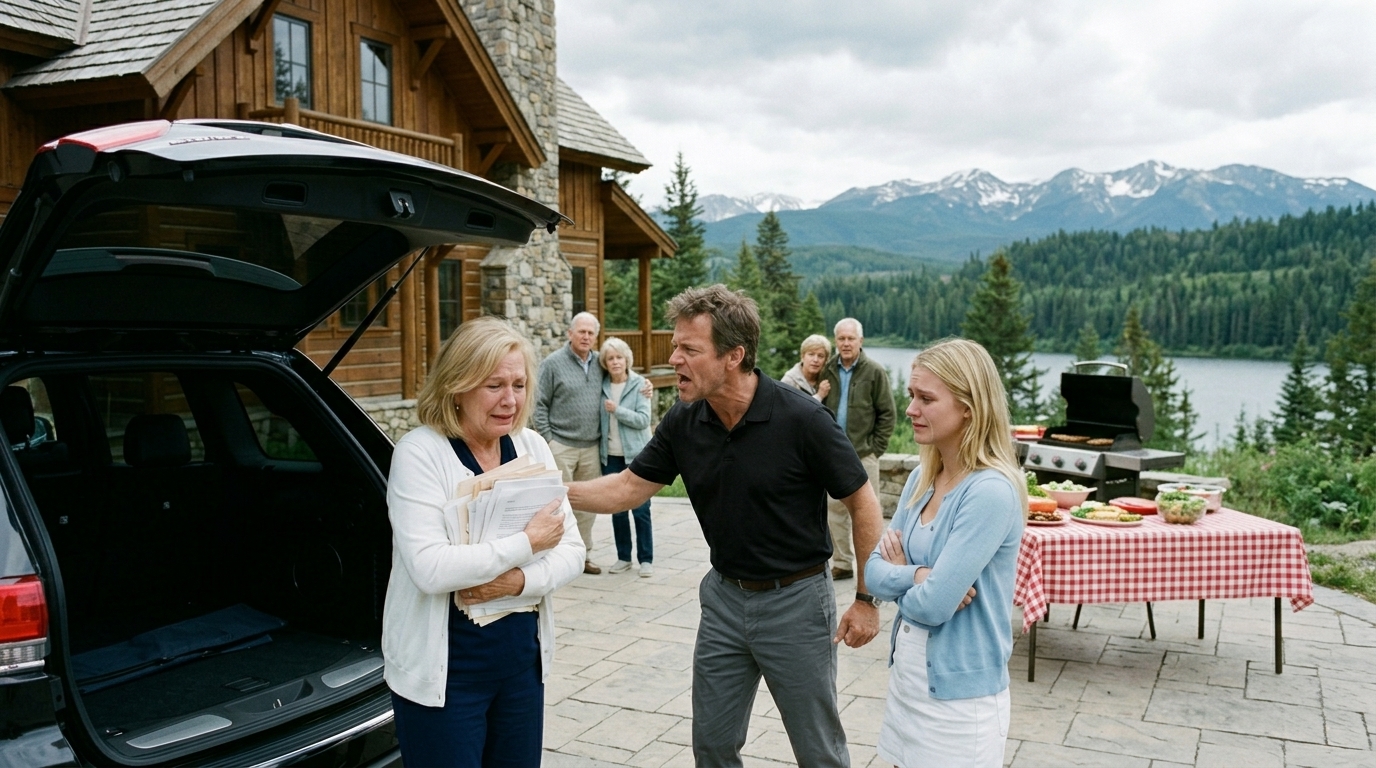
PART 3
At 11:43 that night,
I was sitting on the edge of a hotel bed
when Daniel’s mother called me.
Her name was Margaret Whitmore.
She was seventy-one years old,
a retired elementary school teacher,
and one of the few people in Daniel’s family
who had consistently treated me with kindness.
I almost didn’t answer.
After what had happened at the barbecue,
I wanted nothing to do with the Whitmores.
But something about seeing
Margaret’s name on my screen made me hesitate.
Finally, I answered.
“Hello?”
Her voice was barely above a whisper.
“Sweetheart, are you somewhere safe?”
I closed my eyes.
“Yes, Margaret.”
“Are you alone?”
“Yes.”
She exhaled shakily.
“Good. I need to tell you something.”
I looked toward the window.
Outside, traffic moved through the streets of Lakewood, Colorado. Somewhere below, a car alarm sounded.
“Margaret, if Daniel asked you to call me—”
“He doesn’t know I’m calling.”
I went still.
She continued.
“And I don’t want him to know until I’ve spoken to my attorney.”
My stomach tightened.
“Your attorney?”
There was a long silence.
Then she whispered, “Honey, Daniel has been lying to you about more than the money.”
I gripped the phone.
“What are you talking about?”
Margaret began crying.
“I should have told you months ago.”
I felt a chill move through me.
“Tell me what?”
She took a shaky breath.
“Daniel has been planning to leave you.”
For several seconds, I couldn’t speak.
Then I whispered, “What?”
“He told me last Christmas.”
My heart began pounding.
“He said your marriage wasn’t working, but he couldn’t afford to move out yet.”
I stared at the hotel wall.
Margaret continued.
“He said he needed to get his finances straight before making any decisions.”
I swallowed.
“Then why didn’t he leave?”
Her voice cracked.
“Because he was waiting until Ava’s education was paid for.”
I felt sick.
For three years, I had tried to become part of Daniel’s family.
I had remembered birthdays.
Attended school events.
Cooked dinners.
Paid bills.
Helped with braces and volleyball fees.
And all that time, my husband had apparently been calculating how much more he could take before walking away.
Margaret whispered, “There’s something else.”
I closed my eyes.
“What?”
“Ava wasn’t the only one who knew.”
I sat straighter.
“Who else?”
Margaret hesitated.
“Daniel’s brother, Richard.”
I remembered Richard standing beside the grill that afternoon.
Laughing with Daniel.
Watching as his niece screamed at me.
Watching as my husband ordered me to apologize or leave.
And saying absolutely nothing.
I covered my mouth.
Margaret continued.
“They’ve been discussing your money for months.”
I felt tears gather.
“Why didn’t you tell me?”
She began sobbing.
“Because Daniel is my son.”
I said nothing.
“And because I kept hoping he’d come to his senses.”
I looked down at my wedding ring.
The diamond caught the light from the bedside lamp.
Three years.
Three years of marriage.
Three years of trying to be good enough for a family that had apparently been waiting for me to finance their plans.
Margaret whispered, “I was wrong to stay quiet.”
I swallowed.
“Yes,” I said.
She cried harder.
“I know.”
Then she said something that made my blood run cold.
“Sweetheart, Daniel didn’t just want your money.”
I stared at the phone.
“He wanted you to believe you were losing your mind.”
I didn’t sleep.
Margaret explained that she’d overheard a conversation between Daniel and Richard several months earlier.
They had been discussing my increasing anxiety about the missing money.
I had spent weeks searching bank statements, questioning transfers, and wondering whether I had forgotten authorizing certain payments.
Daniel repeatedly told me I was stressed.
That I was working too hard.
That I was becoming suspicious over nothing.
Whenever I questioned him, he acted hurt.
“Why don’t you trust me?”
“Do you think I’m some kind of criminal?”
“Maybe you need to take a vacation.”
I had started doubting myself.
Now Margaret was telling me that wasn’t an accident.
According to her, Richard had advised Daniel to make me seem unreliable if I ever challenged the transfers.
I sat on the bed staring at the wall.
“Margaret, are you sure that’s what you heard?”
“Yes.”
“Did Daniel agree?”
She hesitated.
“He didn’t object.”
I closed my eyes.
She continued.
“Richard said that if you became upset enough, Daniel could tell people you were emotionally unstable.”
I felt my stomach twist.
“Why?”
“Because he thought it would make it easier for Daniel to explain the marriage ending.”
I stared at my wedding ring.
Then I slowly removed it.
I placed it on the nightstand.
And for the first time that day, I cried.
Not because I wanted Daniel back.
But because I finally understood how thoroughly he had betrayed me.
The next morning, I called my attorney, Caroline Bennett.
Caroline had been helping me quietly for nearly two months.
I had first contacted her after discovering the unusual transfers from my savings account.
At that time, I hadn’t been ready to end my marriage.
I wanted to understand what had happened.
I wanted to believe there was an innocent explanation.
Caroline had encouraged me to preserve records and avoid making accusations until we understood the transactions.
Now there was no reason to wait.
“Caroline,” I said, “I’m ready.”
She paused.
“To proceed with the divorce?”
“Yes.”
“Are you certain?”
I looked at the wedding ring on the nightstand.
“Completely.”
She took a breath.
“All right. We’ll proceed carefully.”
I told her about Margaret’s call.
Caroline listened without interrupting.
Then she said, “We need Margaret’s account documented accurately. What she personally heard may be relevant, but we shouldn’t assume every allegation is established.”
“I understand.”
“Also, we need to discuss the house.”
I closed my eyes.
“I changed the locks yesterday.”
Caroline was quiet for a moment.
“Did Daniel have access to the property afterward?”
“I left him a key and written instructions.”
“Good. We still need to handle possession and any marital claims through the proper process. Ownership and occupancy rights aren’t always the same thing.”
I nodded.
“I don’t want to do anything illegal.”
“Then we’ll arrange a lawful separation and property agreement.”
I looked toward the window.
“Caroline?”
“Yes?”
“Can he really take money from my account and get away with it?”
Her voice became firm.
“That depends on what happened, what authority he had, and what the evidence shows. But you have records, and we can pursue appropriate remedies.”
I swallowed.
“Good.”
By Monday afternoon, Daniel had called me thirty-four times.
He sent eleven text messages.
The first few were angry.
You embarrassed me in front of my family.
Changing the locks was completely unnecessary.
You can’t just throw away a marriage because of one argument.
Then his tone changed.
Please answer.
We need to talk.
I love you.
And finally:
I didn’t know you had the bank records.
I stared at that last message.
Then I took a screenshot.
For the first time, Daniel had admitted he knew exactly what I was referring to.
I forwarded it to Caroline.
She replied almost immediately.
Preserve the original message. Do not argue with him.
So I didn’t.
That evening, Margaret asked to meet me.
We chose a quiet coffee shop near her neighborhood.
She arrived wearing a gray cardigan and carrying a brown leather handbag.
When she saw me, her eyes filled.
“Oh, sweetheart.”
I stood.
She hugged me tightly.
For a moment, I wanted to pull away.
She had known.
She had watched me spend months doubting myself.
She had seen how Daniel treated me.
And she had remained silent.
But when I looked at her face, I saw genuine shame.
We sat down.
Margaret placed a small notebook on the table.
“I brought this.”
I frowned.
“What is it?”
She opened it.
Inside were dates.
Short descriptions.
Names.
I looked up.
“Margaret?”
She swallowed.
“I started writing things down after Christmas.”
I stared at her.
“Why?”
“Because I was afraid Daniel would deny what he’d said.”
She turned to a page marked in blue ink.
There was a date from February.
Below it, she’d written:
Daniel says Ava’s college money must be secured before separation.
My hands began trembling.
Margaret turned another page.
Richard says make her look unreasonable if she asks about transfers.
I looked up.
“Did you write these when the conversations happened?”
She nodded.
“Usually that evening.”
I stared at the notebook.
Then she said, “There’s one more thing.”
She reached into her handbag.
And pulled out a folded sheet of paper.
It was a printed email.
The sender was Daniel.
The recipient was Richard.
The subject line read:
Property and Education Planning.
I felt cold.
Margaret slid it across the table.
“Daniel left this on my printer when he visited in April.”
I looked down.
The message discussed the house.
My house.
The one I had purchased five years before marrying Daniel.
And halfway through the email was a sentence that made my hands go numb.
If she sells the property after we separate, I want to know whether I can claim part of the increase in value.
I looked at Margaret.
“He was planning to take my house too?”
She wiped her eyes.
“I don’t know what he could legally claim.”
I stared at the paper.
“But I know he was asking.”
That night, I returned to my hotel room and spread the documents across the desk.
Bank statements.
Screenshots.
Messages.
Margaret’s notes.
The email.
My marriage certificate.
Three years of joint tax records.
I looked at the evidence and felt something strange.
Not relief.
Not happiness.
Clarity.
For months, Daniel had made me believe I was imagining problems.
Now the problems were lying in front of me.
Printed.
Dated.
Organized.
Real.
At 9:16, my phone rang.
Daniel.
I let it go to voicemail.
Then another call came.
Ava.
I stared at her name.
In three years, she’d rarely called me unless she needed a ride or wanted me to pay for something.
I almost ignored it.
Then I answered.
“Hello?”
For a moment, she said nothing.
Then she whispered, “Did you really leave Dad?”
I took a breath.
“Yes, Ava.”
She was quiet.
Then she said, “Because of me?”
I closed my eyes.
“No.”
“But I yelled at you.”
“Yes.”
“And you left.”
I looked toward the documents.
“Ava, I left because of decisions your father made and because our marriage had become unhealthy.”
She began crying.
I felt my heart tighten.
Despite everything, she was still sixteen.
Still a child caught in an adult situation.
I had no intention of making her responsible for her father’s choices.
Then she whispered something unexpected.
“I didn’t know he was taking that much money.”
I went still.
“What?”
Ava sniffled.
“I knew about college.”
I gripped the phone.
“But I didn’t know about the other account.”
My heart began pounding.
“What other account?”
There was a long silence.
Then she whispered, “The one Dad told Uncle Richard to open.”
PART 4
I sat completely still.
“Ava,” I said carefully, “what account?”
She sniffled.
“I don’t know exactly.”
“Then tell me what you do know.”
She took a shaky breath.
“Dad and Uncle Richard were talking about it last month.”
I looked at the clock.
9:18 p.m.
I could hear traffic outside the hotel.
Ava continued.
“They said they needed somewhere to put money before everything changed.”
My stomach tightened.
“What money?”
“I don’t know.”
She began crying harder.
“Please don’t tell Dad I told you.”
I closed my eyes.
“Ava, I’m not going to ask you to keep secrets or take sides.”
She was quiet.
“If you’re worried about something, you can tell a trusted adult. But you shouldn’t have to investigate your father’s finances for me.”
She sniffled.
“Are you mad at me?”
I swallowed.
“I was hurt by what happened at the barbecue.”
“I know.”
“But you’re not responsible for fixing my marriage.”
There was silence.
Then she whispered, “I didn’t think you’d actually leave.”
I stared at the wall.
“What do you mean?”
She hesitated.
“Dad said you always came back.”
My chest tightened.
Ava continued.
“He said you’d get upset for a little while, then apologize because you wanted us to like you.”
I closed my eyes.
Three years.
Three years of swallowing insults.
Three years of trying harder.
Three years of believing patience would eventually earn affection.
And Daniel had interpreted every attempt at reconciliation as proof that I would never leave.
I took a breath.
“Ava, I hope you understand something someday.”
“What?”
“Being kind doesn’t mean someone has to accept being treated badly.”
She began crying again.
Then she whispered, “I’m sorry I yelled at you.”
I closed my eyes.
“Thank you for saying that.”
She sniffled.
“I really did bump into you.”
I felt my throat tighten.
“I know.”
“I just…”
She stopped.
I waited.
Then she whispered, “I wanted Dad to choose me.”
I covered my mouth.
Because there it was.
The truth beneath the anger.
A sixteen-year-old girl who believed love was something she had to compete for.
And a father who had encouraged that competition instead of teaching her that caring for his wife didn’t mean loving his daughter less.
The next morning, I told Caroline about the conversation.
She listened carefully.
Then she said, “Don’t involve Ava in collecting evidence.”
“I won’t.”
“She’s a minor. We need to protect her from being placed in the middle of this.”
I nodded.
“But the account?”
“We can pursue financial disclosure through the legal process.”
Caroline paused.
“And remember, what Ava overheard is a lead, not proof.”
“I understand.”
She continued.
“Your strongest evidence remains the bank records and communications already in your possession.”
I looked at the blue folder.
“Then let’s use those.”
Two weeks later, Daniel was formally served with divorce papers.
He responded by sending me a long email.
It began with an apology.
Then it turned into an accusation.
He claimed I had never accepted Ava.
He said I expected him to choose between his wife and his daughter.
He described the barbecue as a misunderstanding.
He insisted the financial transfers were legitimate household decisions.
And he ended with:
If you had just apologized to Ava, none of this would have happened.
I read that sentence three times.
Then I forwarded the email to Caroline.
Because Daniel still didn’t understand.
The barbecue hadn’t destroyed our marriage.
It had revealed what our marriage had already become.
The financial disclosure process took months.
Daniel initially provided incomplete records.
Caroline requested additional information.
Bank statements were obtained through the appropriate legal procedures.
Transfers were traced.
And slowly, the picture became clearer.
The money had moved through several accounts.
Some payments had gone toward Ava’s expenses.
Some had gone toward Daniel’s personal debts.
And a substantial amount had been transferred to an account associated with Richard.
When Caroline showed me the summary, I stared at the figures.
“Twenty-eight thousand four hundred dollars?”
She nodded.
“That’s the amount currently identified as having been transferred from your personal account without clear authorization.”
I felt sick.
I had spent months wondering whether I’d forgotten making those transfers.
Daniel had told me I was stressed.
That I was becoming paranoid.
That I needed to trust him.
And now there were bank records showing money moving from my savings into accounts I hadn’t approved.
Caroline continued.
“We also identified additional transfers from the joint account. Those will need to be evaluated separately.”
I looked at her.
“Where did the money go?”
She pointed toward the report.
“Some was used to pay Daniel’s debts. Some went to Richard’s account. We’re still reviewing the explanations.”
I swallowed.
“And the college account?”
She nodded.
“There were deposits into an education savings account for Ava. But the records don’t support the idea that every questionable transfer went there.”
I closed my eyes.
Ava had been used as an explanation.
A convenient justification.
A reason I was supposed to feel guilty for asking questions.
Daniel’s attorney requested mediation.
I agreed.
Not because I wanted to reconcile.
But because I wanted to resolve the financial issues without spending years in court.
The mediation took place in a conference room with pale walls and a long wooden table.
Daniel arrived wearing a navy suit.
He looked thinner.
Older.
For a moment, seeing him hurt.
I remembered our wedding day.
The way he’d smiled when I walked down the aisle.
The way he’d whispered, “I can’t believe I get to marry you.”
I remembered believing him.
Then he sat across from me.
And I remembered the barbecue.
The coldness in his voice.
The way he’d ordered me to apologize or leave.
He looked at me.
“Can we talk?”
I shook my head.
“We’re here to resolve the legal matters.”
His expression tightened.
“Everything has to be so formal now?”
Caroline spoke calmly.
“Let’s focus on the issues we’re here to discuss.”
Daniel looked away.
The mediator began with the financial records.
Daniel insisted the transfers were intended to support family expenses.
Caroline asked him to identify the authorizations.
He couldn’t account for several of them.
Then the mediator asked about Richard’s account.
Daniel shifted in his chair.
“That was temporary.”
I looked up.
“What was?”
He avoided my eyes.
“Richard was holding some money for me.”
My stomach tightened.
“Why?”
Daniel looked toward his attorney.
Then he said, “I was worried about what would happen if we separated.”
I stared at him.
“You were hiding money because you were planning to leave me?”
He said nothing.
I felt my hands begin to shake.
Caroline touched my arm.
I took a breath.
Then Daniel whispered, “I didn’t know how to tell you.”
I looked at him.
“You knew how to take my money.”
He flinched.
“You knew how to tell Ava to make me feel unwelcome.”
His face reddened.
“That isn’t fair.”
I stared at him.
“Fair?”
My voice trembled.
“Daniel, I spent three years trying to love your daughter without replacing her mother.”
He looked down.
“I helped pay for her braces.”
Silence.
“I drove her to practice.”
He rubbed his forehead.
“I remembered her birthday.”
His eyes filled.
“And when she accused me of pushing her in front of your family, you didn’t even ask what happened.”
He whispered, “I was trying to protect her.”
I shook my head.
“You weren’t protecting her.”
He looked up.
“You were teaching her that she could hurt someone and you’d reward her for it.”
The room went silent.
Then I said something I had been holding inside for months.
“You didn’t have to choose between your daughter and your wife.”
My voice broke.
“You only had to choose between what was right and what was easy.”
Daniel began crying.
But for the first time, his tears didn’t change my decision.
The mediation did not resolve everything that day.
But it established a path forward.
Daniel agreed to provide additional records.
He acknowledged that certain transfers had not been properly authorized.
And the parties began negotiating repayment and division of marital assets.
The house remained a separate issue.
I had purchased it before our marriage.
But Caroline explained that we still needed to address any legitimate marital claims, including contributions made during the marriage.
I accepted that.
I wasn’t interested in pretending Daniel had no legal rights.
I wanted the process handled fairly.
Eventually, we reached a written agreement.
Daniel would move out according to an agreed schedule.
He would repay a substantial portion of the disputed funds.
Other financial claims would be resolved through the divorce settlement.
And neither of us would publicly discuss Ava’s private affairs.
It wasn’t the dramatic revenge people might have expected.
There were no police officers dragging Daniel out.
No public humiliation.
No judge shouting at him.
Just documents.
Negotiations.
Accountability.
And the slow, painful ending of a marriage.
The hardest conversation came from Margaret.
She called me one afternoon.
“Sweetheart, can I ask you something?”
“Of course.”
“Do you hate my son?”
I looked toward the garden outside my hotel room.
I had moved into a short-term rental while the housing arrangements were being finalized.
I thought about Daniel.
The man I’d loved.
The man who’d lied.
The man who’d allowed his daughter to humiliate me.
Then I answered.
“No.”
Margaret was quiet.
“I don’t hate him.”
She exhaled.
“But I don’t trust him anymore.”
Her voice trembled.
“I understand.”
I swallowed.
“And I don’t want to spend the rest of my life trying to prove I deserve respect.”
Margaret began crying.
“I wish I’d spoken up sooner.”
I closed my eyes.
“Me too.”
She whispered, “I was afraid of losing my son.”
I nodded.
“I understand that.”
Then I added, “But silence didn’t protect him. It helped him keep making the same choices.”
She was quiet for a long time.
Finally, she said, “You’re right.”
Three months later, Ava sent me a message.
It was the first time she’d contacted me since our phone conversation.
Can we talk?
I stared at the screen.
Then replied:
We can talk somewhere comfortable, with your dad’s knowledge.
She agreed.
We met at a coffee shop on a Saturday afternoon.
Margaret came with her.
Ava wore jeans and a school sweatshirt.
She looked nervous.
When I arrived, she stood.
“Hi.”
I smiled gently.
“Hi, Ava.”
We sat down.
For several minutes, she stirred her hot chocolate without drinking it.
Then she whispered, “I’m sorry.”
I waited.
She looked up.
“For what happened at the barbecue.”
I nodded.
“Thank you.”
She swallowed.
“I knew you didn’t push me.”
My chest tightened.
She continued.
“I was angry because Dad had promised to take me shopping that morning, but he spent the time helping you with something.”
I stared at her.
She wiped her eyes.
“I thought if I made a scene, he’d pay attention to me.”
Margaret placed a hand on her shoulder.
Ava began crying.
“I didn’t think you’d leave.”
I took a breath.
“Ava, I need you to understand something.”
She nodded.
“I didn’t leave because you were upset with me.”
She looked down.
“I left because your father and I had serious problems that were our responsibility to address.”
She sniffled.
“But I made it worse.”
I nodded gently.
“You hurt me that day.”
Her eyes filled.
“And it’s important that you take responsibility for that.”
She nodded.
“But you are not responsible for the end of our marriage.”
She began crying harder.
I handed her a tissue.
Then she whispered, “Dad says he’s going to counseling.”
I smiled sadly.
“I’m glad.”
She looked at me.
“Are you ever coming back?”
I felt my throat tighten.
“No, sweetheart.”
Her face crumpled.
I continued.
“But that doesn’t mean your future has to be unhappy.”
She wiped her cheeks.
“You really loved him?”
I nodded.
“Very much.”
She looked down.
“Did you love me?”
The question nearly broke me.
I reached across the table but stopped short of touching her hand.
I remembered how fiercely she’d reacted to that accidental brush at the barbecue.
I wanted her to choose whether she was comfortable.
“Ava, I cared about you very much.”
She began crying.
“I know I wasn’t always kind.”
I smiled sadly.
“No, you weren’t.”
She nodded.
Then she whispered, “I wish I’d been nicer.”
I swallowed.
“Then take what you’ve learned and be kinder to the people in your life.”
She looked at me.
“Even when I’m angry?”
“Especially then.”
When we stood to leave, Ava hesitated.
Then she stepped forward.
“Can I hug you?”
I felt tears fill my eyes.
“Yes.”
She wrapped her arms around me.
For three years, I had never asked her for a hug.
Never demanded affection.
Never tried to force closeness.
And now, when our family was already coming apart, she offered one freely.
I held her gently.
Then she whispered, “I’m sorry.”
I closed my eyes.
“I know.”
PART 5
The divorce was finalized eleven months after the barbecue.
I remember the morning clearly.
The sky was gray.
A cold wind moved through Lakewood.
And I sat in my attorney’s office holding a copy of the final decree.
Caroline smiled gently.
“It’s finished.”
I stared at the papers.
For a moment, I expected to feel triumphant.
I had imagined this day so many times.
I thought I would feel relieved.
Powerful.
Vindicated.
Instead, I felt tired.
Three years of marriage.
Months of suspicion.
The humiliation at the barbecue.
The financial investigation.
The arguments.
The settlement.
The painful conversations.
All of it had led to a stack of documents on a desk.
I looked at Caroline.
“Is it strange that I feel sad?”
She shook her head.
“No.”
I swallowed.
“I know I made the right decision.”
She nodded.
“Both things can be true.”
I looked down at the decree.
Then I slowly exhaled.
For the first time in months, I wasn’t waiting for another argument.
Another accusation.
Another demand.
The marriage was over.
And my life was mine again.
The house was quiet when I returned.
Daniel had moved out several months earlier under our agreement.
Most of his belongings were gone.
The garage looked bigger.
The hallway closet was half empty.
Ava’s old volleyball bag no longer sat beside the front door.
For a while, the silence had hurt.
I would come home from work and instinctively listen for Daniel’s voice.
Sometimes I’d glance toward the stairs, expecting Ava to appear and ask for a ride.
But gradually, the silence changed.
It stopped feeling like absence.
And began feeling like peace.
The first thing I did after the divorce was repaint the living room.
Daniel had always preferred dark gray walls.
He said they looked sophisticated.
I had wanted a warm cream color.
He’d laughed.
“Too boring.”
For three years, I had lived with his choice.
Now I stood in the paint store holding samples.
Soft ivory.
Warm beige.
Pale sage.
I chose a light cream with a hint of gold.
Then I spent an entire weekend painting.
By Sunday evening, the room looked brighter.
The sunlight seemed to stretch farther across the floor.
I stood in the doorway holding a paint roller.
And laughed.
It was such a small thing.
A wall color.
But for the first time in years, I’d made a decision about my home without wondering whether someone would be upset.
The money Daniel agreed to repay arrived in installments.
Not all at once.
Not without delays.
But the payments came according to the settlement terms.
I used part of the money to restore my emergency savings.
I put some into retirement.
And I set aside a little for something I’d wanted to do for years.
A trip to the Oregon coast.
Daniel had always said it was too expensive.
Too inconvenient.
Too boring.
He preferred crowded resorts and expensive restaurants.
I wanted quiet beaches.
Small bookstores.
Coffee shops overlooking the ocean.
So I booked the trip.
For myself.
I drove along the coast in early September.
The sky was pale blue.
The ocean stretched endlessly beside the highway.
I stopped at a small café and ordered clam chowder.
Then I walked along the beach with my shoes in my hand.
The sand was cold beneath my feet.
Waves rolled toward the shore.
Seagulls circled overhead.
And for the first time in a long time, I felt completely alone without feeling lonely.
I thought about the barbecue.
The lemonade pitcher.
Ava’s scream.
Daniel’s cold expression.
The words that had changed everything.
“Apologize to her or leave.”
At the time, those words had felt like a rejection.
Now, standing beside the ocean, I understood they had also given me a choice.
I could apologize for something I hadn’t done.
I could accept another humiliation.
I could return home and pretend everything was fine.
Or I could leave.
I had chosen to leave.
And that decision had saved me from spending more years trying to earn love from someone who was willing to exploit it.
When I returned to Colorado, Margaret invited me to lunch.
I hesitated.
Our relationship had become complicated.
She was still Daniel’s mother.
And although she’d helped me, I knew she loved her son.
But I also knew she’d been trying to repair the damage caused by her silence.
So I agreed.
We met at a small restaurant near her home.
Margaret looked healthier than she had during the divorce.
She smiled when she saw me.
“Sweetheart.”
I hugged her.
“Hi, Margaret.”
We ordered soup and sandwiches.
For a while, we talked about ordinary things.
The weather.
Her garden.
A book she’d been reading.
Then she grew quiet.
“Can I tell you something?”
I nodded.
“Of course.”
She looked down at her hands.
“Daniel finally admitted what he did.”
I felt my stomach tighten.
“What do you mean?”
She swallowed.
“He told me he used your money without properly asking.”
I nodded.
“He acknowledged that he encouraged Ava’s resentment because he didn’t want to deal with conflict.”
I looked toward the window.
Margaret continued.
“And he admitted he’d been planning to leave the marriage before the barbecue.”
I took a slow breath.
“I’m glad he’s telling the truth.”
She nodded.
“He’s been going to counseling.”
I smiled sadly.
“That’s good.”
Margaret hesitated.
“He asked me whether I thought you’d ever forgive him.”
I looked at her.
For a moment, I didn’t know what to say.
Then I answered honestly.
“I hope someday I can remember him without anger.”
She nodded.
“But forgiveness doesn’t mean going back.”
Her eyes filled.
“I know.”
I reached across the table.
“Margaret, I don’t want Daniel to suffer forever.”
She squeezed my hand.
“I know.”
“I want him to become someone who doesn’t treat people the way he treated me.”
She began crying.
Then she whispered, “I wish he’d learned that before losing you.”
I looked down.
“So do I.”
Ava turned seventeen that winter.
A few days before her birthday, she sent me a message.
I know we’re not family anymore, but I wanted to tell you I made the varsity volleyball team.
I stared at the screen.
Then smiled.
I remembered driving her to practice.
Waiting in parking lots.
Buying sports drinks.
Listening to her complain about coaches.
And pretending not to notice when she asked Daniel to pick her up instead of me.
I typed:
Congratulations, Ava. You worked hard for that. I’m proud of you.
She replied almost immediately.
Thank you.
Then another message appeared.
I still have the knee pads you bought me.
I smiled.
I’m glad they’re getting some use.
A few minutes passed.
Then she wrote:
I’m sorry I made you feel like you didn’t belong.
I sat quietly for a long time.
Then replied:
Thank you for saying that. I hope you have a wonderful birthday.
I didn’t try to reopen the relationship.
I didn’t promise to become part of her life again.
But I was grateful she was learning.
Sometimes closure doesn’t mean becoming close again.
Sometimes it means two people finally acknowledging the truth.
The following spring, I began volunteering at a community literacy program.
I had always loved reading.
As a child, books had been my escape.
As an adult, they became my comfort.
Now I spent Saturday mornings helping children improve their reading skills.
One little boy named Oliver struggled with long words.
He would stare at the page, grow frustrated, and push the book away.
One morning, he looked at me.
“I’m stupid.”
I felt my heart tighten.
I closed the book.
“No, you’re not.”
He looked down.
“I can’t do it.”
I smiled gently.
“You can’t do it yet.”
He frowned.
“What’s the difference?”
I pointed toward the page.
“The word yet means we’re still learning.”
He considered that.
Then slowly picked up the book again.
And I realized something.
For years, I had spent so much energy trying to convince Daniel and Ava that I was worthy of love.
Now I was spending my time helping children believe in themselves.
The difference was enormous.
One drained me.
The other gave me purpose.
My friends began noticing the change.
My best friend, Rachel, came over one Friday evening.
We sat on the patio drinking iced tea.
She looked around the garden.
“Your place looks beautiful.”
I smiled.
“Thank you.”
She leaned back.
“And you look happy.”
I laughed softly.
“I think I am.”
Rachel studied me.
“Do you miss being married?”
I considered the question.
“Sometimes I miss having someone to share things with.”
She nodded.
“But?”
I looked toward the garden.
“I don’t miss being afraid of saying the wrong thing.”
Rachel’s expression softened.
I continued.
“I don’t miss wondering whether my husband believes me.”
I took a breath.
“And I don’t miss feeling like a guest in my own home.”
Rachel reached for my hand.
“Then I’d say you’re doing pretty well.”
I smiled.
“Yes.”
A year and a half after the barbecue, Daniel sent me a letter.
It arrived in a plain white envelope.
I recognized his handwriting.
For a moment, I considered throwing it away.
But curiosity won.
I opened it at the kitchen table.
The letter was three pages long.
Daniel wrote about counseling.
About recognizing how he’d allowed his guilt over his first marriage to affect his parenting.
About confusing loyalty to Ava with automatically defending her.
About using money he had no right to use.
And about how he’d convinced himself that because we were married, he could make financial decisions without my agreement.
Then I reached a paragraph that made me stop.
I told myself I was protecting my daughter. But I was teaching her that the people who love us are supposed to tolerate whatever we do to them.
I stared at the words.
Daniel continued.
I watched you try to be patient for three years. Instead of appreciating it, I used your patience against you.
My eyes filled.
Then I read the final paragraph.
When I told you to apologize or leave, I thought you would apologize. I never imagined you would actually walk away. Looking back, I realize that was the moment I finally saw how much I’d taken you for granted.
I folded the letter.
For a long time, I sat quietly.
Then I placed it in the drawer beside my old wedding photographs.
I didn’t respond.
Not because I wanted to punish him.
But because I no longer needed his understanding to move forward.
That summer, I hosted my first barbecue since the incident.
Rachel helped me plan it.
We invited friends.
Neighbors.
A few coworkers.
And several volunteers from the literacy program.
I bought fresh corn.
Hamburgers.
Watermelon.
Lemonade.
The weather was beautiful.
The backyard filled with laughter.
Someone played music.
Children chased bubbles across the grass.
And I stood beside the patio table holding a glass pitcher of lemonade.
For a moment, the memory returned.
Ava stepping backward.
The accidental brush.
Her scream.
Daniel’s cold voice.
“Apologize to her or leave.”
My hands tightened around the pitcher.
Rachel noticed.
“You okay?”
I looked at her.
Then toward the guests.
Everyone was laughing.
Talking.
Enjoying themselves.
Nobody was waiting for me to make a mistake.
Nobody was looking for a reason to humiliate me.
I took a breath.
“Yes.”
Rachel smiled.
“Good.”
I placed the lemonade on the table.
And for the first time, the memory didn’t control the moment.
Later that evening, after everyone had gone home, I sat alone on the patio.
The air was warm.
The lights around the fence glowed softly.
A few paper plates remained on the table.
I looked toward the side gate.
The same gate I’d walked through after leaving the Whitmore barbecue.
I remembered driving home that afternoon.
The silence in my car.
The way my hands had trembled when I reached the house.
The black folder.
The bank records.
The messages.
The locksmith.
The white envelope.
I had been frightened.
More frightened than I wanted to admit.
But I had also been determined.
For eight months, I’d been gathering evidence because something inside me knew the truth.
I had simply been afraid to face what it meant.
The barbecue changed that.
Daniel’s ultimatum forced me to see what I’d been avoiding.
I could continue living in a marriage where my feelings didn’t matter.
Or I could choose myself.
I chose myself.
People sometimes ask whether I regret walking away without arguing.
They say I should have defended myself more forcefully.
That I should have demanded Daniel listen.
That I should have made Ava admit she was lying in front of everyone.
But I know something now.
You cannot force someone to believe you when they’ve already decided you’re wrong.
You cannot argue someone into respecting you.
And you cannot build a healthy marriage with a person who treats your dignity as negotiable.
I had explained what happened.
I had apologized for the accidental contact.
I had asked my husband whether he truly believed I would intentionally hurt his daughter.
And he had answered with silence.
That was enough.
The money mattered.
Of course it did.
The unauthorized transfers represented years of work.
Savings I’d earned.
Security I’d built.
Trust I’d placed in my husband.
But the deepest wound wasn’t financial.
It was discovering that Daniel had been willing to let me doubt my own memory.
That he’d encouraged his daughter’s hostility.
That he’d planned his exit while allowing me to believe we were building a future together.
And that when I finally reached my breaking point, he acted as though I was the one destroying our marriage.
I spent months grieving that betrayal.
Then I stopped asking why I hadn’t been enough.
Because the truth was, I had been enough all along.
One quiet Sunday morning, I stood in my kitchen making coffee.
Sunlight streamed through the windows.
The walls were warm cream.
Fresh flowers sat on the counter.
My favorite music played softly.
I looked around the house.
The home I’d purchased before meeting Daniel.
The home I’d tried so hard to turn into a family home.
The home where I’d once felt like an outsider.
Now every room felt peaceful.
Every decision belonged to me.
And every morning began without the fear of being judged.
I carried my coffee onto the patio.
The garden was blooming.
A light breeze moved through the trees.
I sat down.
And smiled.
I still remember the gold bracelet Daniel gave me on our first anniversary.
I had worn it almost every day.
At the barbecue, I removed it and placed it beside the paper plates.
I never asked for it back.
For a while, I wondered whether that had been foolish.
It was beautiful.
Expensive.
A symbol of a time when I believed our marriage was strong.
But eventually, I realized something.
The bracelet wasn’t what I’d lost that day.
I’d lost the illusion that Daniel would protect our marriage with the same determination I had.
And once that illusion was gone, I could finally see the truth.
Last week, Rachel asked me whether I would ever get married again.
We were sitting at my kitchen table.
I smiled.
“Maybe.”
She raised an eyebrow.
“Really?”
I laughed.
“Why not?”
She grinned.
“I thought you’d sworn off marriage forever.”
I shook my head.
“No.”
I looked toward the window.
“I haven’t sworn off love.”
Rachel smiled.
“Then what have you sworn off?”
I took a sip of coffee.
“Begging for respect.”
She laughed.
Then raised her cup.
“To that.”
I raised mine.
And we both smiled.
If I ever marry again, I won’t be looking for someone who never makes mistakes.
I know relationships are complicated.
Families are complicated.
Children have difficult emotions.
Adults make poor decisions.
But I will look for someone who tells the truth.
Someone who listens before judging.
Someone who understands that loving a child doesn’t require humiliating a spouse.
Someone who respects financial boundaries.
And someone who doesn’t mistake patience for weakness.
I will never again spend years trying to earn a place in my own marriage.
On the afternoon of that barbecue, Daniel gave me a choice.
“Apologize to her or leave.”
He expected me to apologize.
He expected me to swallow the humiliation.
He expected me to return home and continue pretending everything was fine.
He had no idea that I’d spent eight months quietly discovering the truth.
He had no idea that I already knew about the missing money.
He had no idea that his own mother had begun documenting his conversations.
And he certainly had no idea that the woman he’d taken for granted was finally ready to walk away.
So I did.
I placed the lemonade on the table.
Removed my bracelet.
Walked through the side gate.
And drove home.
That evening, when Daniel and Ava returned, they found a white envelope waiting.
Inside was the beginning of the end of our marriage.
But for me, it was the beginning of something else.
Freedom.
Peace.
And the chance to build a life where I never again had to apologize for an accident just to keep someone else’s approval.
I used to think the saddest thing that could happen in a marriage was being left behind.
Now I know better.
The saddest thing is staying somewhere you are no longer valued and slowly forgetting who you were before you began trying to earn love.
I nearly made that mistake.
But one Saturday afternoon, standing beside a pitcher of lemonade, I finally understood that I deserved better.
And when my husband told me to leave, I listened.
Not because he had the right to send me away.
But because I finally had the courage to go.
THE END THANK YOU FOR READING !!!