PART 3
Daddy kept staring at the purchase agreement long after Bobby finished speaking.
The wind moved through the soybean stubble,
carrying the smell of damp earth and fallen leaves.
A crow called from the old tobacco barn.
Somewhere beyond the tree line, a tractor engine rumbled.
I had grown up on that land.
I knew every fence line, every creek crossing,
and every patch of ground that turned muddy after a hard rain.
But standing beside Daddy’s wheelchair that Sunday afternoon, I felt like a stranger.
Because someone had apparently tried to sell eighty acres of the farm without his knowledge.
And that someone was my own sister.
“Daddy?” I whispered.
He didn’t look at me.
His eyes remained fixed on the signature at the bottom of the page.
Then he said, “That’s not my handwriting.”
Bobby shifted uncomfortably.
“Clayton, I didn’t know what to think when Sherry brought those papers out.”
Daddy slowly folded the document.
“You did right keeping a copy.”
Bobby nodded.
“I figured if you wanted to sell, you’d tell me yourself.”
Daddy looked toward the south field.
“My daddy bought that eighty acres in 1948.”
His voice was quiet.
“He worked twelve-hour shifts at the mill and farmed before daylight to pay for it.”
I swallowed.
Daddy continued.
“I was sixteen when he signed the last payment receipt.”
He looked down at the paper again.
“And Sherry thinks she can take it with a piece of somebody else’s handwriting.”
I reached for his shoulder.
“Daddy, we don’t know whether the sale actually went through.”
He nodded.
“Then that’s the first thing we’re going to find out.”
Bobby cleared his throat.
“Clayton, there’s something else.”
My stomach tightened.
“What?”
He looked at me, then back at Daddy.
“Leonard came out here in July with a surveyor.”
Daddy went still.
“Surveying what?”
“The south eighty.”
I felt my mouth go dry.
Bobby continued.
“They marked the boundary along the creek. Leonard said he was planning to build a few houses out there.”
Daddy’s hands tightened around the wheelchair armrests.
“Houses?”
Bobby nodded.
“Said the land was going to be worth a fortune once the county improved the road.”
Daddy stared toward the tree line.
Then he said something I had never heard him say about either of his children.
“Sherry has forgotten who she is.”
On the drive back to the nursing home, Daddy barely spoke.
He watched the fields pass through the passenger window.
I could tell he was thinking.
Daddy had always been that way.
When something troubled him, he didn’t shout.
He got quiet.
My mother used to say that when Clayton Mercer stopped talking, everybody else ought to start worrying.
At the first stop sign, he finally turned toward me.
“How long have you been paying twenty-one hundred dollars a month?”
“Three years.”
“Every month?”
“Yes, Daddy.”
He looked down at his hands.
“Why didn’t you tell me?”
I felt my throat tighten.
“Sherry said you knew.”
He shook his head.
“She told me my pension and insurance covered everything.”
I swallowed.
“I didn’t want you worrying about money.”
He looked at me.
“I’m eighty-four, not eight.”
“I know.”
“Then don’t hide things from me to spare my feelings.”
Tears filled my eyes.
“I’m sorry.”
He reached across the console and rested his hand over mine.
“Baby girl, you’ve got nothing to apologize for.”
That nearly broke me.
For three years, I had watched my retirement account shrink.
Doug and I had postponed replacing our roof.
We had canceled two trips.
I had stopped buying little things I wanted because every month I knew another $2,100 would disappear.
And I had told myself it was worth it.
Because Daddy had spent his whole life taking care of us.
Now it was my turn.
But as we drove toward the nursing home, I began to understand something terrible.
I hadn’t been helping Daddy because he had no money.
I had been helping because Sherry had convinced everyone he had no money.
That evening, I called Doug.
He answered on the second ring.
“How’d it go?”
I sat in the nursing home parking lot.
“Doug, I need you to sit down.”
There was a pause.
“What’s happened?”
I told him everything.
The rent checks.
The purchase agreement.
The forged signature.
Leonard and the surveyor.
Doug didn’t interrupt once.
When I finished, he was quiet.
Then he asked, “Is your daddy all right?”
I started crying.
“I don’t know.”
“Are you?”
“No.”
His voice softened.
“Come home, sweetheart.”
I wiped my face.
“I need to find an attorney tomorrow.”
“Then we’ll find one.”
“Doug, we’ve paid more than seventy-five thousand dollars toward Daddy’s care.”
“I know.”
“And Sherry has been collecting twenty-six thousand a year from Bobby.”
“I know.”
I stared at the steering wheel.
“How could she do this?”
Doug was silent for a moment.
Then he said, “I don’t know why she did it. But I know what we’re going to do.”
“What?”
“We’re going to get the facts. Then we’re going to protect your daddy.”
I closed my eyes.
That was Doug.
No dramatic speeches.
No promises of revenge.
Just a steady voice when I needed one.
Monday morning, Daddy and I met with an attorney named Margaret Bell.
She was sixty-two, with silver hair, sharp eyes, and the kind of calm manner that made you feel foolish for ever believing shouting solved anything.
Her office sat above a pharmacy in the county seat.
Daddy insisted on wearing his good brown jacket.
He also insisted on carrying his own folder.
Margaret listened as we explained the situation.
Then she examined Bobby’s documents.
“Mr. Mercer,” she said, “do you understand what a power of attorney allows your daughter to do?”
Daddy nodded.
“She can handle my bills and bank accounts.”
“Depending on its terms, she may have broader authority. But she’s required to act in your interests and within the law.”
Daddy leaned forward.
“Can she sell my land?”
Margaret studied the document we’d brought.
“That depends on the powers granted, the applicable law, and whether any transaction was properly authorized. We need to examine the recorded documents.”
Daddy nodded.
“And if she signed my name?”
Margaret looked directly at him.
“Then we need to determine exactly how that signature got there.”
I swallowed.
“What should we do first?”
She opened a notepad.
“Preserve the evidence. Obtain the land records. Review the financial accounts. And determine whether Mr. Mercer wants to revoke the existing power of attorney.”
Daddy didn’t hesitate.
“I do.”
Margaret looked at him carefully.
“That’s your decision to make, provided you understand the consequences.”
“I understand them.”
He pointed toward the folder.
“My daughter was supposed to pay my bills, not sell my father’s farm.”
Margaret nodded.
“Then we’ll prepare the appropriate documents and notices.”
By Wednesday, we had our first answer.
The eighty acres had not yet been transferred.
The purchase agreement had been used to support a proposed transaction, but no completed deed conveying ownership to Leonard had been recorded.
I nearly collapsed with relief.
Daddy simply nodded.
“Good.”
But Margaret wasn’t finished.
“There is another issue.”
She placed a document on the table.
It was a financing statement associated with Leonard’s company.
The company was called Larkin Land Development.
I frowned.
“What’s this?”
Margaret explained that Leonard had apparently represented the south eighty acres as property his company expected to acquire.
The company had used the proposed purchase as part of discussions with a lender.
No valid lien against Daddy’s land had been established by the documents we’d seen.
But the lender had been given information suggesting the property transaction was legitimate.
Daddy stared at the page.
“So Leonard was trying to borrow money on land he didn’t own?”
Margaret chose her words carefully.
“That’s one of the questions we need answered.”
Daddy leaned back.
Then he said, “Call whoever needs calling.”
The financial review began the following week.
Margaret arranged for an accountant named Paul Henderson to examine the available records.
We requested statements from Daddy’s accounts and records of transactions made under Sherry’s authority.
We also obtained copies of Bobby’s canceled rent checks.
I remember the day Paul called us into his office.
He had arranged three years of documents in neat stacks.
“Mrs. Dalton,” he said, looking at me, “you told me you paid the nursing home approximately $2,100 a month?”
I nodded.
“For thirty-six months.”
“Yes.”
He tapped his calculator.
“That totals $75,600.”
I stared at the figure.
Seeing it written down made my chest hurt.
Paul continued.
“Mr. Whitt’s rent payments total approximately $78,000 over the same period.”
Daddy sat very still.
I whispered, “Seventy-eight thousand?”
Paul nodded.
“Based on the checks we’ve received.”
He turned another page.
“Those payments were deposited into an account controlled by Sherry.”
Daddy looked at him.
“Was it my account?”
Paul shook his head.
“Not the checking account you’ve used for your care expenses.”
I felt sick.
“Where did the money go?”
Paul looked at us.
“That’s what the next part of the review addresses.”
He placed a transaction summary in front of Daddy.
There were payments to credit card companies.
Transfers to Leonard’s business.
Personal purchases.
And several large withdrawals.
I stared at the numbers.
Then I noticed something.
A transfer for $18,500.
Another for $12,000.
A third for $9,700.
All going to the same business account.
Larkin Land Development.
I looked at Daddy.
His face had gone pale.
Then Paul said, “There’s more.”
I felt my stomach drop.
He opened another folder.
“Mr. Mercer, your daughter also made withdrawals from an investment account in your name.”
Daddy frowned.
“What investment account?”
Paul looked at him.
“The one your late wife established with you nearly twenty years ago.”
I stared at Daddy.
He slowly removed his glasses.
Then whispered, “That was Ruth’s money.”
Mama’s name was Ruth.
She had died eight years earlier.
She was the kind of woman who saved rubber bands in a kitchen drawer and washed aluminum foil if it was still clean enough to use again.
She worked as a school secretary for twenty-nine years.
Every payday, she put a little money aside.
Not much.
Twenty dollars.
Fifty dollars.
Sometimes a hundred.
She used to tell us, “Small money becomes big money if you leave it alone.”
When she died, Daddy told us she’d left savings intended to help with his care and eventually benefit the family.
He never gave us an exact figure.
And we never asked.
Now Paul was telling us that account had been accessed.
Daddy looked at the statement.
“How much?”
Paul hesitated.
“Over the last three years, approximately $64,000 was withdrawn or transferred.”
I gripped the edge of the table.
Daddy stared at the page.
Then he whispered, “Sherry told me that account was empty because the market went down.”
Paul shook his head.
“The records don’t support that explanation.”
For a long time, nobody spoke.
Then Daddy looked toward the window.
His voice was barely audible.
“Ruth saved that money a dollar at a time.”
I reached for his hand.
He squeezed mine.
And for the first time since we’d discovered the missing rent, I saw tears in my father’s eyes.
That afternoon, Daddy asked Margaret to help him make a phone call.
“To whom?” she asked.
“Sherry.”
I looked at him.
“Daddy, are you sure?”
He nodded.
“I’ve heard enough people talk about my daughter. I want to hear from her.”
Margaret advised him to keep the conversation factual and avoid making promises or accusations he couldn’t yet support.
Daddy agreed.
Then he dialed.
Sherry answered cheerfully.
“Daddy! How are you?”
“I’m fine.”
“Did you enjoy your Sunday outing?”
Daddy looked at me.
“Yes.”
“Good! I heard you went out to the farm.”
His expression changed.
“Who told you?”
“Bobby mentioned it to Leonard.”
Daddy nodded slowly.
“Sherry, I need you to come see me.”
There was a pause.
“Why?”
“I want to discuss my money.”
Silence.
Then she laughed.
“Oh, Daddy, you don’t need to worry about that.”
“I do.”
“Everything’s handled.”
Daddy looked down at the statements.
“No, it isn’t.”
Her voice sharpened.
“What’s going on?”
Daddy took a breath.
“I know about Bobby’s rent.”
There was complete silence.
Then Sherry said, “Daddy, I can explain.”
“I know about the south eighty acres.”
Another silence.
“And I know about Ruth’s account.”
For several seconds, I thought the call had disconnected.
Then Sherry whispered, “Who has been putting ideas in your head?”
Daddy closed his eyes.
And when he spoke again, his voice was stronger than I’d heard it in years.
“Sherry, my legs quit working. My mind didn’t.”
PART 4
Sherry arrived at the nursing home the following afternoon.
She wore a pale blue blouse, pearl earrings, and the same expression she’d worn when we were children and Mama caught her sneaking cookies before supper.
Offended innocence.
As though being questioned was somehow worse than whatever she’d done.
Leonard came with her.
He was a tall man with thinning hair and a habit of speaking over everyone else.
I was sitting beside Daddy’s wheelchair when they entered the family meeting room.
Margaret Bell was there too.
So was Paul Henderson.
Sherry stopped in the doorway.
“What is this?”
Daddy looked up.
“A meeting.”
Her eyes moved toward Margaret.
“You brought a lawyer?”
Daddy nodded.
“Yes.”
Sherry looked at me.
“Of course you did.”
I remained silent.
She folded her arms.
“So this is what we’re doing now? You’re turning Daddy against me?”
Daddy spoke before I could answer.
“Sit down, Sherry.”
She stared at him.
He repeated himself.
“Sit down.”
For the first time in years, my sister obeyed without arguing.
Daddy placed Bobby’s rent records on the table.
“Twenty-six thousand dollars a year,” he said.
Sherry looked down.
“Daddy—”
“Three years.”
She swallowed.
“It’s complicated.”
Daddy nodded.
“Then explain it.”
Sherry glanced at Leonard.
He leaned forward.
“Clayton, the farm has expenses.”
Daddy looked at him.
“I know what a farm costs.”
Leonard cleared his throat.
“Taxes. Maintenance. Insurance.”
Daddy nodded.
“Show me the bills.”
Leonard looked toward Sherry.
She shifted in her chair.
“We don’t have everything with us.”
Daddy pointed toward Paul.
“He’s got the records.”
Sherry’s face tightened.
Paul slid the financial summary across the table.
Sherry stared at it.
Then she looked at me.
“You had no right to go through my accounts.”
I finally spoke.
“We reviewed Daddy’s money.”
She laughed bitterly.
“You’ve always wanted to control everything.”
Daddy raised his hand.
“Enough.”
The room went quiet.
He looked at Sherry.
“Did you use my rent money for Leonard’s business?”
She swallowed.
“Some of it.”
“How much?”
She looked down.
“I don’t know exactly.”
Paul spoke calmly.
“The transfers we’ve identified total more than forty thousand dollars.”
Leonard leaned forward.
“Those were temporary loans.”
Daddy looked at him.
“Where’s the loan agreement?”
Leonard said nothing.
Daddy continued.
“Where’s the repayment schedule?”
Silence.
“Where’s the interest?”
Leonard’s face reddened.
“Clayton, you know how business works.”
Daddy stared at him.
“Yes, Leonard. I do.”
He tapped the table.
“And I know the difference between borrowing money and taking it.”
Sherry began crying.
“Daddy, I was trying to help the family.”
He looked at her.
“Which family?”
She blinked.
“What?”
“Mine or Leonard’s business?”
Her face crumpled.
“You don’t understand.”
Daddy nodded.
“Then make me understand.”
Sherry wiped her cheeks.
“Leonard had problems with a development project.”
I felt my stomach tighten.
She continued.
“We thought it would turn around.”
Leonard looked furious.
“Sherry—”
She ignored him.
“We needed money to keep the company operating.”
Daddy looked at her.
“So you used mine.”
She began crying harder.
“I was going to put it back.”
Daddy stared at her.
“Before or after you sold my land?”
The room went silent.
Leonard stood.
“This is ridiculous.”
Margaret spoke calmly.
“Mr. Larkin, please sit down. Nobody is required to remain here, but Mr. Mercer is entitled to ask questions about his own property.”
Leonard looked toward the door.
Then sat.
Daddy turned back to Sherry.
“Did you sign my name on that purchase agreement?”
Her face went pale.
“Daddy—”
“Did you?”
She looked at Leonard.
He stared at the table.
Finally, she whispered, “I thought it was allowed under the power of attorney.”
Margaret leaned forward.
“Then why does the agreement bear a signature purporting to be Clayton’s personal signature rather than identifying you as an agent?”
Sherry didn’t answer.
Daddy closed his eyes.
For a moment, I thought he might collapse.
I moved toward him.
But he raised his hand.
“I’m all right.”
Then he looked at my sister.
“Did you sign my name?”
Tears streamed down her face.
“Yes.”
I felt something inside me break.
Daddy stared at her.
Then he asked, “Why?”
Sherry whispered, “Because I knew you’d say no.”
That sentence stayed with me.
Not the excuses.
Not the tears.
Not the claims that she intended to repay everything.
Just those seven words.
Because I knew you’d say no.
Sherry hadn’t misunderstood Daddy’s wishes.
She had known them.
And she had decided they didn’t matter.
Daddy looked down at the table.
For several seconds, he said nothing.
Then he whispered, “Ruth would be ashamed.”
Sherry began sobbing.
“Daddy, please don’t say that.”
He looked at her.
“Your mother worked twenty-nine years to save that money.”
“I know.”
“She packed her lunch every day.”
“I know.”
“She wore the same winter coat for twelve years.”
Sherry covered her face.
“And you took what she saved because Leonard wanted to build houses.”
Leonard stood again.
“That’s not fair.”
Daddy looked at him.
“Sit down or leave.”
Leonard stared at him.
Daddy’s voice rose.
“It’s my money. My land. My wife’s savings. And my daughter sitting here telling me she signed my name because she knew I’d refuse.”
Leonard slowly sat.
Daddy turned toward Margaret.
“I want the power of attorney revoked.”
Margaret nodded.
“We’ve prepared the documents.”
“I want every account protected.”
“Yes, sir.”
“And I want my land left alone.”
She nodded again.
“We’ll take the appropriate steps.”
Sherry looked up.
“Daddy, please.”
He turned toward her.
His eyes were wet.
“Sherry, I trusted you.”
She began crying harder.
He shook his head.
“I trusted you with everything I couldn’t do from that nursing home.”
Then he whispered, “And you made your sister pay my bills while you spent my money.”
Sherry turned toward me.
“You don’t understand what I’ve been dealing with.”
I stared at her.
“What?”
She wiped her cheeks.
“Daddy’s appointments. His paperwork. The insurance company. The taxes. Everything.”
I felt anger rise.
“You think I don’t understand?”
She looked away.
I leaned forward.
“Sherry, I visited Daddy four times a week.”
She said nothing.
“I took him to appointments when you were busy.”
Her lips tightened.
“I brought his clothes home to wash because he hated the laundry service.”
I swallowed.
“And every month, I paid $2,100 because you told me he had nothing left.”
She stared at me.
I continued.
“Doug and I put off repairing our roof.”
Her eyes widened slightly.
“We canceled vacations.”
I wiped my cheeks.
“I stopped putting money into our emergency savings.”
Sherry looked down.
“And you knew.”
She began crying.
I shook my head.
“You knew exactly what I was sacrificing.”
She whispered, “I thought you could afford it.”
I stared at her.
Then I said, “You never asked.”
The meeting ended shortly afterward.
Margaret advised us to preserve all documents and allow the appropriate legal and financial processes to continue.
Sherry left crying.
Leonard followed her without saying goodbye.
Daddy sat in his wheelchair staring at the empty chairs.
I moved beside him.
“Daddy?”
He looked up.
“I’m tired.”
I nodded.
“Let’s get you back to your room.”
As I pushed him down the hallway, he whispered, “I never thought one of my girls would do this.”
My throat tightened.
“I know.”
He looked toward the windows.
“Your mama and I tried to raise you right.”
I stopped.
I walked around his chair and knelt beside him.
“Daddy, you did.”
He shook his head.
“Sherry—”
“Daddy, Sherry made her own choices.”
His eyes filled.
I took his hand.
“You didn’t teach her to steal.”
He began crying.
And I held my father’s hand while he grieved a daughter who was still alive.
The following months were difficult.
Margaret helped Daddy revoke Sherry’s authority and arrange new financial management protections consistent with his wishes.
Daddy chose a professional fiduciary to handle routine financial matters.
He wanted me involved in reviewing statements, but he didn’t want to place the entire burden on me.
“I’ve had enough family members fighting over my checkbook,” he said dryly.
I laughed for the first time in weeks.
The accountant continued tracing the missing funds.
The land records were monitored.
The disputed purchase agreement was formally challenged.
Leonard’s lender was notified that Daddy had not authorized the proposed sale.
The transaction did not proceed.
And Bobby began sending future rent payments according to the new instructions Daddy established with his advisers.
For the first time in three years, the farm income was being accounted for as Daddy’s money.
Not Sherry’s.
Not Leonard’s.
Daddy’s.
Then came the question of repayment.
The records showed that Sherry had diverted substantial funds from Daddy’s accounts.
Some money had gone to Leonard’s business.
Some had paid personal expenses.
Some transactions remained disputed.
Margaret explained that recovering everything might be difficult.
Leonard’s company was struggling.
Several creditors were already pursuing claims.
And Sherry’s personal finances were not nearly as comfortable as she’d pretended.
Daddy listened quietly.
Then he asked, “What about the money my youngest girl paid?”
I looked up.
“Daddy—”
He raised his hand.
“Let me finish.”
He turned toward Margaret.
“She paid seventy-five thousand six hundred dollars toward my care.”
Margaret nodded.
“Based on the records we’ve reviewed.”
Daddy looked at me.
“She did that because she was told I had no money.”
I swallowed.
“Daddy, you don’t owe me—”
“Yes, I do.”
His voice was firm.
I shook my head.
“You raised me.”
He looked at me.
“And you helped me when you thought I needed it.”
Tears filled my eyes.
He continued.
“But I have money. And you shouldn’t have had to empty your retirement to pay bills my own assets could cover.”
I began crying.
Daddy reached for my hand.
“Baby girl, I want that money returned to you.”
Margaret worked with Daddy’s financial advisers to arrange reimbursement from available funds in a way that preserved his care needs and complied with his wishes.
When the transfer finally appeared in my account, I stared at the screen.
$75,600.
Every dollar I’d paid toward the gap.
I sat at the kitchen table with my phone in my hand.
Doug walked in carrying two cups of coffee.
“What’s wrong?”
I looked up.
“Daddy paid us back.”
Doug set the cups down.
He looked at the screen.
Then at me.
For a moment, neither of us spoke.
Finally, he sat beside me.
“You okay?”
I nodded.
Then shook my head.
Then began crying.
Doug pulled me into his arms.
“I wasn’t doing it for the money,” I whispered.
“I know.”
“I would’ve kept paying if he really needed it.”
“I know.”
I wiped my cheeks.
“But I was so scared we’d run out.”
Doug held me tighter.
“I know, sweetheart.”
And for the first time in three years, I felt the weight of that monthly obligation lift from my shoulders.
Sherry’s legal troubles continued.
The financial records and disputed signature were referred to the appropriate authorities for review.
Investigators examined the transactions, the power of attorney, and the proposed land sale.
Sherry eventually admitted responsibility for several unauthorized transfers and for signing Daddy’s name on the purchase agreement.
Leonard’s involvement was investigated separately.
The case moved slowly.
There were interviews.
Bank records.
Attorney meetings.
And days when Daddy looked so tired I wished we could make the entire thing disappear.
But he never asked us to stop.
One afternoon, I asked him why.
He looked at me.
“Because if I let her get away with it, what have I taught her?”
I swallowed.
He continued.
“She’s sixty years old. It’s past time she learned that being my daughter doesn’t make my money hers.”
One evening, Sherry called me.
I almost didn’t answer.
But something made me pick up.
“Hello.”
She was crying.
“I need to talk to Daddy.”
I closed my eyes.
“Then contact Margaret about arranging a conversation.”
She sniffled.
“He won’t answer my calls.”
“He’s hurt.”
“I know.”
I waited.
Then she whispered, “Do you hate me?”
I stared at the wall.
For a long time, I couldn’t answer.
Finally, I said, “I don’t know what I feel.”
She began crying harder.
“I never meant for this to happen.”
I closed my eyes.
“Sherry, you didn’t accidentally deposit Bobby’s rent checks.”
Silence.
“You didn’t accidentally transfer Mama’s savings.”
She sniffled.
“And you didn’t accidentally sign Daddy’s name.”
She whispered, “I know.”
I took a breath.
“Then stop telling us you didn’t mean for it to happen.”
She said nothing.
I continued.
“Tell us you made choices. Tell us you were wrong. And start doing whatever you can to make it right.”
She cried quietly.
Then she whispered, “I’m sorry.”
I looked toward the kitchen window.
“I hope someday you understand what you’re apologizing for.”
Then I ended the call.
PART 5
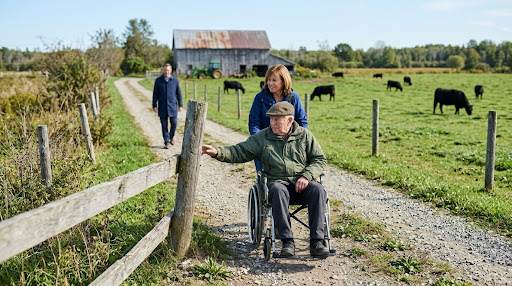
The first spring after everything came out, Daddy asked me to take him back to the farm.
It was a Saturday morning.
The sky was bright blue.
The fields were beginning to turn green.
And the air smelled of fresh grass and damp soil.
I arrived at the nursing home just after nine.
Daddy was waiting in his wheelchair.
He wore his brown felt hat.
His tan quilted jacket.
And a smile I hadn’t seen in months.
“Ready?” I asked.
He nodded.
“Been ready since breakfast.”
I laughed.
“Where do you want to go?”
He looked at me.
“Home.”
We drove along the same gravel lane we’d traveled the previous September.
The old tobacco barn still stood beside the pasture.
The fence posts leaned in familiar directions.
Bobby’s cattle grazed near the creek.
And the south eighty acres stretched toward the tree line.
Still Daddy’s.
Still part of the farm his father had worked so hard to buy.
When we reached the fence, Bobby was waiting.
He waved.
“Morning, Clayton!”
Daddy smiled.
“Morning, Bobby!”
I helped Daddy into his wheelchair.
Then pushed him toward the gate.
Bobby came over and shook his hand.
“How you feeling?”
Daddy grinned.
“Old.”
Bobby laughed.
“Me too.”
They talked about the weather.
The planting season.
The price of fertilizer.
The condition of the creek crossing.
Ordinary things.
The kind of conversation Daddy had been missing.
Then Bobby reached into his coat pocket.
“I brought something for you.”
Daddy looked curious.
“What?”
Bobby handed him a small envelope.
Inside was a copy of the new rent agreement.
Properly prepared.
Reviewed.
Signed by Daddy himself.
Bobby smiled.
“Thought you’d like a copy for your records.”
Daddy examined it.
Then nodded.
“Looks right.”
Bobby grinned.
“Figured you’d say that.”
Daddy laughed.
And for the first time since the whole mess began, the sound carried across the fields like it used to.
We stayed nearly two hours.
Daddy watched Bobby’s tractor move along the far field.
He pointed out places where he and Grandpa had repaired fences.
He told me about the winter of 1978, when snowdrifts covered the lane.
He remembered the first calf born in the old barn.
The summer Mama planted sunflowers beside the house.
The year a tornado tore the roof from the equipment shed.
I listened.
Some stories I’d heard a hundred times.
Others were new.
And I realized something.
The farm wasn’t valuable to Daddy only because of its acreage.
It held his life.
His father.
His mother.
His marriage.
His children.
His work.
Every season he’d survived.
Every harvest he’d brought in.
Every ordinary day that had slowly become a memory.
Sherry had looked at the south eighty acres and seen money.
Daddy looked at it and saw his father standing beside a fence post in 1961.
There was a difference.
And it was everything.
By summer, the legal proceedings had reached a turning point.
Sherry entered a plea agreement concerning certain financial offenses related to the misuse of Daddy’s funds and documents.
The court imposed restitution obligations and other penalties.
Leonard faced separate consequences connected to the business transactions and representations made during the proposed land deal.
Not every disputed transaction resulted in a criminal conviction.
Some issues were resolved through civil proceedings.
Others became part of repayment arrangements.
But the essential outcome was clear.
Daddy retained ownership of his land.
The unauthorized sale did not proceed.
His financial accounts were placed under new management.
And Sherry no longer controlled his money.
The restitution process would take time.
Some funds might never be fully recovered.
But Daddy was no longer being kept in the dark.
The hardest part wasn’t the money.
It was Sherry.
She had been Daddy’s first child.
The baby he’d carried home from the hospital in a borrowed car.
The little girl who followed him around the barn wearing red rubber boots.
The teenager who cried when he taught her to drive.
The woman he’d trusted to handle his affairs when his legs stopped working.
Now he struggled to speak her name without looking away.
One afternoon, I found him sitting by the nursing home window.
He was holding an old photograph.
Sherry and me.
We were children.
I was missing my front teeth.
Sherry had her arm around my shoulders.
Daddy looked up.
“Remember this?”
I smiled sadly.
“County fair.”
He nodded.
“Your mama made those dresses.”
I sat beside him.
He stared at the photograph.
“Sherry was a good girl once.”
I swallowed.
“She still has good in her, Daddy.”
He looked at me.
“Maybe.”
Then he sighed.
“But good people can do terrible things.”
I nodded.
“Yes.”
He looked toward the window.
“I keep wondering what I missed.”
I took his hand.
“Daddy, you didn’t cause this.”
He shook his head.
“I trusted her.”
“You were supposed to be able to trust her.”
His eyes filled.
I squeezed his hand.
“She made the choices. Not you.”
He looked down.
Then whispered, “I wish your mama were here.”
I began crying.
“Me too.”
A few weeks later, Sherry asked to see Daddy.
This time, she made the request through Margaret.
Daddy thought about it for several days.
Then he agreed to a short visit.
He asked me to stay.
I hesitated.
“Daddy, maybe you should talk privately.”
He shook his head.
“No more secrets.”
So I stayed.
Sherry arrived wearing a plain gray sweater.
She looked thinner.
Older.
Her hair had more silver in it.
When she entered Daddy’s room, she stopped.
For a moment, she looked like a frightened child.
“Hi, Daddy.”
He nodded.
“Sherry.”
She sat in the chair across from him.
Nobody spoke.
Then she began crying.
“I’m sorry.”
Daddy looked at her.
“For what?”
She swallowed.
“For taking your money.”
He waited.
“For lying to you.”
He nodded slowly.
“And?”
She looked down.
“For signing your name.”
Daddy remained quiet.
Sherry wiped her cheeks.
“And for making my sister pay your bills while I used your money.”
I felt my throat tighten.
Daddy looked at her for a long time.
Then he asked, “Why did you do it?”
Sherry stared at her hands.
“Leonard’s business was failing.”
Daddy nodded.
“I know.”
“I thought if we could just get through one more year, everything would be okay.”
He waited.
“Then one year became another.”
She began crying.
“And I kept telling myself I’d put everything back.”
Daddy looked toward the window.
“You should have told me.”
“I know.”
“You should have asked.”
“I know.”
“And when I said no, you should have respected it.”
She nodded.
Tears streamed down her face.
“I know.”
Daddy sighed.
“Sherry, I would’ve helped you figure out what to do.”
She looked up.
“Really?”
He nodded.
“I might not have given you the money. But I would’ve helped you face the problem.”
She covered her face.
He continued.
“Instead, you decided my money belonged to you.”
She whispered, “I’m sorry.”
Daddy looked at her.
“I believe you.”
Hope flickered across her face.
Then he added, “But believing you’re sorry doesn’t mean I can trust you with my affairs again.”
She nodded slowly.
“I understand.”
Daddy reached for her hand.
She took it.
He squeezed gently.
“You’re still my daughter.”
She began sobbing.
“But you have a lot of work to do.”
Their relationship didn’t heal overnight.
Some visits were awkward.
Some ended early.
Sometimes Daddy didn’t want to see her.
Sometimes he did.
Sherry began making restitution payments.
She found work after Leonard’s business collapsed.
She attended counseling.
And she stopped asking Daddy to rescue her from the consequences of her choices.
I didn’t suddenly trust her.
I didn’t forget what she’d done.
But I watched her begin the difficult process of taking responsibility.
That mattered.
Not because it erased the past.
But because it was the only possible beginning of something better.
Meanwhile, Doug and I finally repaired our roof.
I remember the morning the workers arrived.
Doug stood in the driveway holding a cup of coffee.
He looked up at the old shingles.
“About time.”
I laughed.
“Three years overdue.”
He smiled.
“Better late than never.”
We also began putting money back into our retirement savings.
And that fall, Doug surprised me with two tickets to the mountains.
I stared at them.
“What’s this?”
He smiled.
“A vacation.”
I laughed.
“Doug, we don’t need—”
He raised an eyebrow.
“Don’t finish that sentence.”
I smiled.
He took my hands.
“We’ve spent three years taking care of everybody else.”
I nodded.
“Now we’re going to take care of us.”
I began crying.
He pulled me into his arms.
And for the first time in a long time, I let myself believe we could enjoy the retirement we’d worked for.
Daddy’s care continued.
His Social Security and insurance still covered most of the nursing home bill.
The remaining expenses were paid from his own income and assets under the arrangements he’d approved.
The farm rent helped.
His investments helped.
And the financial planning gave him confidence that he could remain in the home without burdening his children.
One afternoon, he called me into his room.
He had a folder on his lap.
“Sit down, baby girl.”
I smiled.
“What have you got there?”
He handed it to me.
Inside were updated estate planning documents prepared with Margaret.
I looked at him.
“Daddy, what’s this?”
He nodded.
“My affairs.”
I swallowed.
He continued.
“I’ve made some changes.”
I looked down.
He raised his hand.
“Before you say anything, I want you to understand something.”
I nodded.
He took a breath.
“I love all my children.”
My eyes filled.
“But I also have a responsibility to protect what your mama and I built.”
I looked at him.
He continued.
“I’ve arranged for the farm to be managed according to my wishes, with clear instructions about its future.”
I nodded.
“And I’ve made sure nobody can quietly use it as their personal bank account again.”
I smiled sadly.
“Good.”
He looked at me.
“I also want you to know I haven’t forgotten what you and Doug did.”
I shook my head.
“Daddy—”
He smiled.
“Let an old man finish.”
I laughed through tears.
He squeezed my hand.
“You paid my bills because you loved me.”
I nodded.
“And I love you for it.”
Then he added, “But from now on, I want you to spend your retirement being my daughter. Not my bank.”
I began crying.
He opened his arms.
I hugged him.
And for a moment, I felt like the little girl who used to run into the barn when she scraped her knee.
That Christmas, Daddy asked to have dinner at the farm.
Not the nursing home dining room.
Not a restaurant.
The farm.
The old farmhouse had been empty for several years, but it was still maintained.
Doug and Wesley, our cousin, helped clean it.
I brought the food.
Daddy insisted on choosing the menu.
Ham.
Green beans.
Mashed potatoes.
Cornbread.
Sweet potato pie.
“Just like your mama made,” he said.
I smiled.
“I’ll try.”
He laughed.
“You’ll do fine.”
We set the table in the old dining room.
The same table where Mama had served thousands of meals.
The same table where Sherry and I had done homework.
Where Daddy had paid bills.
Where we had celebrated birthdays.
Where Mama had once announced she was finally retiring from the school office.
I stood beside it for a long time.
Then I placed Mama’s old ceramic salt and pepper shakers in the center.
They were shaped like little chickens.
One had a chipped beak.
I smiled.
Some things were worth keeping.
Daddy arrived just before noon.
Doug helped him into the wheelchair.
When he entered the farmhouse, he stopped.
His eyes moved slowly around the room.
The curtains.
The pictures.
The old clock above the doorway.
He took a breath.
“Smells like home.”
I laughed.
“That’s the ham.”
He shook his head.
“No.”
His eyes filled.
“It’s home.”
We ate together.
Bobby stopped by with a homemade pie from his wife.
A few neighbors visited.
Wesley told stories about getting his truck stuck in the creek when he was seventeen.
Daddy laughed so hard he had to wipe his eyes.
For a few hours, everything felt simple again.
Not because the past had disappeared.
But because we had found a way to make room for joy without pretending nothing had happened.
Sherry came later that afternoon.
Daddy had invited her.
She arrived alone.
She carried a small plate of cookies.
For a moment, she stood in the doorway looking uncertain.
Then Daddy called out.
“Well, come on in, Sherry. You’re letting the cold air out.”
She smiled through tears.
“Hi, Daddy.”
He nodded.
“Hi, honey.”
I watched them.
There was still pain between them.
Still distance.
Still consequences.
But there was also something I hadn’t expected to see again.
A possibility.
Not certainty.
Not complete forgiveness.
Just the possibility that honesty might someday build something stronger than the lies that had nearly destroyed us.
After dinner, Daddy asked me to take him outside.
I wrapped a blanket around his legs.
Helped him into his jacket.
And pushed him down the porch ramp.
The winter air was cold.
The fields lay quiet beneath a pale afternoon sky.
The old tobacco barn stood against the horizon.
Daddy pointed toward the fence.
“Take me over there.”
I smiled.
“It’s cold.”
He grinned.
“I’m old, not made of sugar.”
I laughed.
Then pushed him toward the corner post.
The same post where everything had begun.
He reached out.
Rested his hand against the weathered wood.
And closed his eyes.
For a long moment, neither of us spoke.
Then he whispered, “Your granddaddy and I set this post in 1961.”
I smiled.
“I remember.”
He opened his eyes.
“You know what he told me that day?”
I shook my head.
“What?”
Daddy looked toward the fields.
“He said land doesn’t make a man rich if he loses his family trying to keep it.”
I swallowed.
Daddy continued.
“But he also said a man ought to protect what he’s been trusted with.”
He patted the post.
“I think I forgot that second part for a while.”
I knelt beside him.
“Daddy, you trusted your daughter.”
He nodded.
“And she broke that trust.”
I squeezed his hand.
He looked at me.
“But you helped me see the truth.”
My eyes filled.
He smiled.
“And you didn’t do it by shouting.”
I laughed softly.
“No.”
“You just brought me home.”
I began crying.
He reached out and touched my cheek.
“That’s what good daughters do.”
That evening, as we drove back to the nursing home, Daddy watched the fields disappear behind us.
The sky had turned orange.
The bare trees stood dark against the sunset.
He looked peaceful.
For the first time in months, I didn’t see the worry in his face.
I saw the farmer he’d always been.
The man who’d worked through droughts.
Floods.
Bad harvests.
Hard winters.
The man who’d loved my mother for fifty-six years.
The man who’d raised two daughters and trusted them to become good people.
One had betrayed him.
The other had helped him find the truth.
But he was still Daddy.
Still Clayton Mercer.
Still the owner of two hundred acres of land his family had worked for generations.
And still sharp as a tack.
A few weeks later, I found a small envelope in my mailbox.
Daddy’s handwriting was on the front.
Inside was a photograph.
It showed him sitting beside the corner post on the day we’d returned to the farm.
His brown hat was tilted slightly.
His hand rested on the wood.
And he was smiling.
Behind the photograph was a note.
Baby girl,
I spent my life teaching you how to stand on your own two feet.
Then mine stopped working.
You never let me fall.
Thank you for bringing me home and reminding me that I still have a voice.
Love, Daddy.
I sat at my kitchen table and cried.
Doug came in and found me holding the picture.
He read the note.
Then sat beside me.
For a long time, neither of us spoke.
Finally, he said, “That’s worth more than seventy-five thousand dollars.”
I nodded.
“Yes.”
Then I smiled through tears.
“Much more.”
People sometimes ask me whether I regret paying Daddy’s nursing home bills for three years.
The answer is complicated.
I regret that Sherry lied.
I regret that she took advantage of our father’s trust.
I regret that Doug and I sacrificed so much because we believed Daddy had no money left.
But I don’t regret loving him.
I don’t regret visiting him.
I don’t regret making sure he had the care he needed.
And I certainly don’t regret driving him back to his land that Sunday afternoon.
Because the truth didn’t come from a shouting match.
It didn’t come from a family argument.
It came from an eighty-four-year-old man sitting beside a fence post, asking a farmer a simple question.
“Bobby, where do you send my rent?”
That question uncovered three years of missing income.
A forged signature.
An attempted land sale.
And the misuse of money my mother had spent decades saving.
But it also gave Daddy something he’d almost lost.
His independence.
His dignity.
And the knowledge that his voice still mattered.
Last Sunday, I took Daddy to the farm again.
The weather was warm.
Bobby was working near the barn.
The cattle grazed on the hill.
And the fields stretched green beneath the afternoon sun.
Daddy sat beside the fence.
His hand rested on the corner post.
I stood beside him.
For a while, we watched the land in silence.
Then he looked up at me.
“Baby girl?”
“Yes, Daddy?”
He smiled.
“Remember when you thought you had to pay my bills because I couldn’t take care of myself?”
I laughed softly.
“Yes.”
He nodded.
“Well, I still need help with some things.”
I squeezed his shoulder.
“I know.”
He looked toward the fields.
“But I never stopped being your daddy.”
My eyes filled.
“No, sir.”
He smiled.
“And I never stopped knowing right from wrong.”
I nodded.
“No, sir.”
Then he reached for my hand.
“And neither did you.”
I bent down and kissed his cheek.
The wind moved through the trees.
Somewhere in the distance, Bobby’s tractor started.
And Daddy looked out across his two hundred acres with the quiet satisfaction of a man who had finally taken back control of his own life.
I had spent three years believing I was saving my father.
But that Sunday, when I put his brown hat on his head and drove him home, he reminded me of something I’d forgotten.
Sometimes the best way to help someone isn’t to make every decision for them.
It’s to put the truth in their hands.
And let them speak for themselves.
THE END THANK YOU FOR READING !!!



