PART 3
I stared at the account number on Jared’s phone.
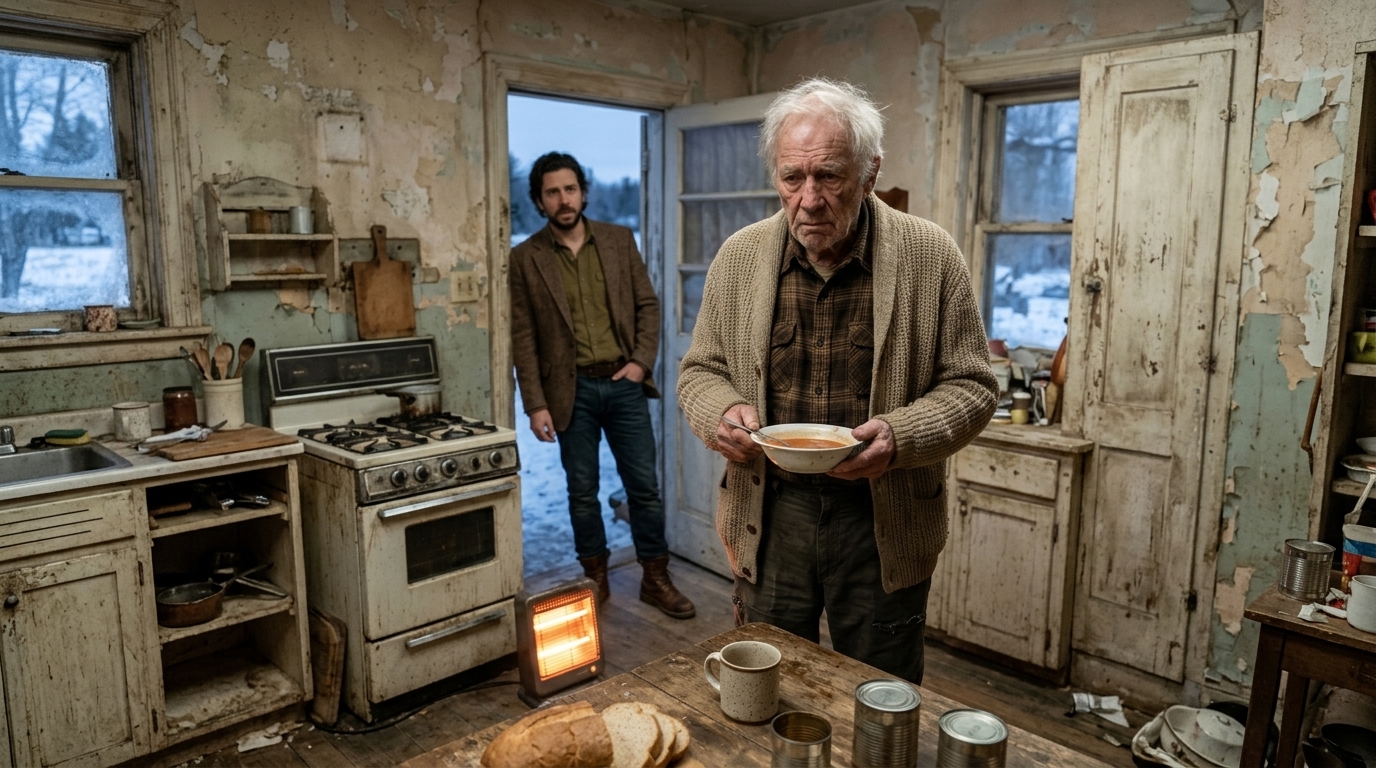
For a moment, the freezing apartment,
the canned soup,
and Lauren’s expensive white coat seemed to disappear.
All I could see were those final four digits.
4827.
I knew that number.
I had known it for more than twenty years.
It belonged to an account once controlled by my younger brother, Walter Blake.
And Walter had been dead for five years.
“Jared,” I said slowly, “where did you get that account number?”
My son looked confused.
“What?”
“The account receiving the transfers. Where did you get it?”
He glanced at his phone.
“Lauren gave it to our accountant when we established the trust.”
I looked at my daughter-in-law.
She had stopped smiling.
“Lauren,” I said, “why are payments intended for me going into an account associated with my dead brother?”
Her expression hardened.
“That’s ridiculous.”
“Then explain the account.”
She folded her arms.
“Oscar, you’re confused. That’s probably why you’ve been having so much trouble managing your finances.”
Jared looked at her sharply.
“What are you talking about?”
Lauren sighed dramatically.
“Your father hasn’t been well, Jared.”
I felt something cold settle in my chest.
Not fear.
Recognition.
I’d spent forty years listening to people explain away missing money.
The excuses changed, but the pattern rarely did.
First came denial.
Then confusion.
Then an attempt to discredit whoever was asking questions.
Lauren had just moved to the third stage.
“Not well?” Jared repeated.
She looked at him with an expression of practiced concern.
“Sweetheart, I didn’t want to worry you. Your father has been struggling with his memory.”
I almost laughed.
Instead, I remained silent.
Lauren continued.
“He’s been forgetting conversations. Misplacing money. Making strange accusations.”
Jared looked from her to me.
“Dad?”
I held his gaze.
“Son, I can tell you what I ate for breakfast on June 12, 1987, because it was the morning you were born.”
His eyes filled.
I continued.
“I can also tell you that account number belongs to an old financial arrangement involving your uncle Walter. Now I want to know why your wife used it.”
Lauren’s cheeks reddened.
“That’s not fair.”
“Neither is letting a seventy-two-year-old man survive on food donations while telling his son he’s living in luxury.”
Jared lowered his phone.
“Lauren, answer him.”
She shook her head.
“I can’t believe you’re taking his side.”
“This isn’t about sides.”
“Of course it is!”
Her voice rose.
“Your father has never liked me!”
I stared at her.
That accusation was so absurd I almost didn’t recognize it.
When Jared married Lauren six years earlier, I’d welcomed her into our family.
I’d paid for part of their wedding.
I’d given them Diane’s antique dining table because Lauren said it reminded her of her grandmother’s furniture.
I’d watched their dog when they traveled.
I’d never once questioned her expensive shopping habits or the way she seemed to know every detail of Jared’s finances.
I’d trusted her because my son loved her.
Now she stood in my apartment suggesting I was mentally incompetent.
Jared stepped between us.
“Lauren, stop.”
She looked stunned.
“What?”
“I need you to tell me exactly where Dad’s money has been going.”
She opened her mouth.
Then closed it.
Finally, she said, “I transferred it where it needed to go.”
“Where?”
“To his care.”
Jared gestured around the apartment.
“Does this look like eight thousand dollars a month in care?”
Lauren looked toward the kitchen.
The refrigerator hummed weakly.
A draft slipped through the cracked window frame.
My old space heater sat beside a stack of overdue utility notices.
She swallowed.
“Maybe your father spent the money irresponsibly.”
I stood.
“Then show us the statements.”
Her eyes narrowed.
“What?”
“The bank statements. The payment records. The invoices from this luxury senior residence you supposedly arranged.”
She stared at me.
I continued.
“If the money went toward my care, there should be documentation.”
Jared nodded.
“Dad’s right.”
Lauren gave a bitter laugh.
“Of course he is. He’s always right, isn’t he?”
I took a slow breath.
“Lauren, this isn’t an argument about whether you like me. It’s an accounting question.”
She looked toward the door.
And suddenly, I realized she wanted to leave.
Jared noticed too.
“Don’t walk away.”
“I have somewhere to be.”
“On Father’s Day?”
“Yes.”
He looked at her white coat.
Then at the designer handbag hanging from her shoulder.
“Where?”
She hesitated.
“A charity luncheon.”
I almost smiled.
Of course.
A charity luncheon.
While her father-in-law lived on donated food.
Jared’s face changed.
“You’re not leaving until we understand what’s happening.”
Lauren reached for her phone.
“I don’t have to stand here and be interrogated.”
I stepped toward the kitchen table.
“You’re right. You don’t.”
Jared looked at me.
“Dad?”
I pulled out a chair.
“But if you leave, we’re going to contact the bank, the trustee, and an attorney without you.”
Lauren froze.
I looked at her.
“And whatever the records show will speak for themselves.”
For the first time, she seemed genuinely frightened.
She slowly lowered her phone.
Then whispered, “You don’t understand.”
I sat down.
“Then help us understand.”
She stared at the floor.
For several seconds, nobody spoke.
Finally, she said, “Walter owed money.”
My heart skipped.
“What?”
“Your brother. Walter. He owed money before he died.”
I leaned forward.
“What does that have to do with my support payments?”
Lauren rubbed her forehead.
“He had financial obligations. Someone had to handle them.”
I stared at her.
Walter had been many things.
Stubborn.
Private.
Occasionally reckless.
But he’d also been my closest friend for most of my life.
Five years earlier, he’d died suddenly from a heart attack.
I’d helped settle his affairs.
And I knew something Lauren apparently didn’t.
Walter’s debts had been resolved through his estate.
There was no legitimate reason for money intended for me to be redirected toward his old accounts.
“Who told you Walter owed money?” I asked.
Lauren hesitated.
“His business partner.”
My pulse quickened.
“What business partner?”
She looked away.
“Thomas.”
I felt my stomach drop.
Thomas Reed.
A name I hadn’t heard in years.
Walter had worked with Thomas on several real estate investments.
The partnership ended badly.
There had been accusations of missing funds, questionable invoices, and unauthorized withdrawals.
Walter had once asked me to review some records.
I remembered sitting across from him at my kitchen table while Diane made coffee.
Walter had looked exhausted.
“Oscar, something doesn’t add up.”
I’d helped him identify irregularities.
Eventually, Walter separated from the partnership.
But Thomas disappeared from our lives before the dispute was fully resolved.
And now Lauren was telling me that the same man had somehow become involved in my financial support.
“Lauren,” I asked carefully, “how do you know Thomas Reed?”
Her expression changed.
Just slightly.
But enough.
Jared noticed.
“Lauren?”
She shook her head.
“It’s complicated.”
My son looked at me.
“Dad, who is Thomas Reed?”
“An old business associate of your uncle Walter.”
“Why would Lauren be sending him money?”
I looked at my daughter-in-law.
“That’s what I’d like to know.”
Lauren suddenly stood.
“This is ridiculous.”
She grabbed her handbag.
“I’m not doing this.”
Jared stepped aside rather than blocking her.
“Then we’ll get the records ourselves.”
She turned toward him.
“Jared, please don’t.”
He stared at her.
“Why?”
Her eyes filled with tears.
“Because you’ll destroy everything.”
My son went completely still.
“What does that mean?”
Lauren looked at me.
For the first time, I saw something beneath her anger.
Panic.
Not the panic of someone falsely accused.
The panic of someone who knew the truth was approaching.
She whispered, “I never meant for it to go this far.”
Jared’s voice became very quiet.
“How far?”
Lauren began crying.
But she still didn’t answer.
Then her phone vibrated.
She glanced at the screen.
I saw a name flash across it.
Thomas.
She quickly turned the phone facedown.
Too late.
Jared had seen it.
“Is that him?”
Lauren remained silent.
My son held out his hand.
“Lauren, I need the truth.”
She backed toward the door.
“Please, Jared.”
“Are you involved with this man?”
Her face crumpled.
And in that moment, I understood something terrible.
The missing money wasn’t simply a bookkeeping error.
It wasn’t an innocent misunderstanding.
And it wasn’t being held somewhere for my benefit.
My daughter-in-law had been secretly communicating with a man connected to my dead brother’s financial troubles.
A man whose old account number appeared beside nearly three hundred thousand dollars in transfers.
Jared stared at her.
“Lauren, are you having an affair?”
She began sobbing.
And her silence answered before her words did.
PART 4
Lauren left my apartment twenty minutes later.
Not because we’d forgiven her.
Not because she’d explained anything.
But because Jared finally realized that arguing with her wasn’t going to produce the truth.
He told her he would be staying with me until he understood what had happened.
She pleaded with him.
She cried.
She accused him of choosing his father over his wife.
Then she made one final attempt.
“Jared, if you love me, you’ll trust me.”
My son looked at her for a long moment.
Then he said something I never expected to hear.
“Trust isn’t the same as refusing to look at evidence.”
Lauren’s face hardened.
She walked out.
The door slammed behind her.
For several seconds, Jared and I sat in silence.
Then my son looked around the apartment again.
His eyes settled on the canned soup.
The old space heater.
The worn blanket folded across my chair.
And finally, the photograph of Diane sitting on the windowsill.
He covered his face.
“Dad.”
I waited.
His shoulders began shaking.
“I’m so sorry.”
I felt my throat tighten.
“Jared—”
“No.”
He looked up.
Tears streamed down his cheeks.
“Please don’t tell me it’s okay.”
I remained silent.
He gestured toward the kitchen.
“I built a company worth millions. I bought a house with six bedrooms. I spent eighty thousand dollars renovating a room nobody even uses.”
His voice broke.
“And my father has been eating food from a church pantry.”
I looked down.
“Son, I didn’t want to burden you.”
He shook his head.
“You weren’t a burden.”
I swallowed.
He continued.
“You gave me everything.”
I remembered the day he’d come home from college and told me his software company was failing.
He was twenty-three.
Exhausted.
Terrified.
He’d invested every dollar he had.
His business partner wanted to quit.
The bank had rejected another loan.
I still remembered the way he sat at our kitchen table.
“Dad, I think I’ve ruined my life.”
I’d placed my hand on his shoulder.
“No, son. You’ve learned something expensive. That’s not the same thing.”
Two weeks later, I sold the last investment property Diane and I owned.
I gave Jared the money.
Not as a loan.
As a chance.
He’d cried when I handed him the check.
“Dad, I can’t take this.”
I’d smiled.
“Then make something good out of it.”
And he had.
His company grew.
Investors arrived.
Contracts multiplied.
He became successful beyond anything either of us imagined.
But somewhere along the way, our lives had moved in different directions.
He became busier.
I became quieter.
And we both mistook occasional phone calls for closeness.
Jared reached across the table.
“Dad, why didn’t you tell me things were this bad?”
I took a slow breath.
“Because every time we spoke, you sounded exhausted.”
He closed his eyes.
“I would have helped.”
“I know.”
“Then why?”
I looked toward Diane’s photograph.
“Your mother and I spent our lives making sure you had opportunities. After she died, I didn’t know how to stop being the father who gave instead of asked.”
Jared began crying again.
I reached for his hand.
“Son, I’m not angry that you became successful.”
“I know.”
“I’m proud of you.”
His face crumpled.
“But I should have checked.”
I nodded slowly.
“Yes. You should have.”
He looked surprised.
Perhaps he expected me to excuse everything.
But I had spent too many years being honest about numbers to become dishonest about feelings.
“You should have visited,” I said gently. “And I should have told you the truth.”
He squeezed my hand.
“That changes today.”
That afternoon, Jared booked me a hotel room.
I protested.
He refused to listen.
“Dad, you’re not spending another night freezing in this apartment.”
I looked around the place I’d called home for three years.
The peeling paint.
The crooked shelves.
The radiator that worked only when it felt like it.
I had grown accustomed to living with less.
But I’d never realized how much I’d lowered my expectations.
Jared packed my medications, clothes, and important papers.
Then he carried my suitcase downstairs.
Before leaving, I stopped at the kitchen table.
One can of soup remained.
I picked it up.
Jared looked confused.
“Dad?”
I held the can.
“Don’t throw this away.”
His expression softened.
“Why?”
“Because I want to remember what happens when people stop asking questions.”
He nodded.
We left together.
That evening, in a warm hotel suite overlooking the Chicago River, my son opened his laptop.
For the first time, he showed me the financial records relating to the trust he’d established for my benefit.
I put on my reading glasses.
And something inside me changed.
For forty years, I’d worked as an auditor.
I’d followed paper trails through complicated corporate structures.
I’d examined accounts that had been deliberately obscured.
I’d learned to recognize when people were trying to make a simple transaction look complicated.
Now I was sitting beside my son, looking at the most painful financial puzzle of my life.
“Let’s start at the beginning,” I said.
Jared nodded.
He explained that three years earlier, he’d created a trust intended to provide me with financial security.
An independent financial institution served as trustee.
Lauren had been authorized to coordinate certain payments and provide information about my living arrangements.
Jared believed that eight thousand dollars per month was being distributed for my housing, medical needs, and personal expenses.
He’d received periodic reports.
He’d never questioned them.
I studied the documents.
“These aren’t all bank statements,” I said.
Jared frowned.
“What do you mean?”
“Some are summaries prepared by Lauren.”
He leaned closer.
I pointed to the headings.
“See this? ‘Monthly care allocation.’ That’s a description, not proof of payment.”
He stared at the screen.
“And this?”
“‘Residence expense reimbursement.’ Again, we need the actual invoices and the underlying transfers.”
He rubbed his forehead.
“I thought these were official reports.”
“Some may be. But we need to distinguish the trustee’s records from documents someone created afterward.”
Jared nodded.
Then he opened another file.
It contained monthly transfer confirmations from a separate account he’d used to fund my care.
Eight thousand dollars.
Every month.
For thirty-six months.
I calculated the total.
Two hundred and eighty-eight thousand dollars.
Jared stared at the number.
“Almost three hundred thousand.”
I nodded.
“And I received none of it.”
He looked physically sick.
We examined the destination information.
The transfers had been directed toward an account associated with a company called Northbridge Senior Services.
The company supposedly coordinated my housing and care.
I frowned.
“Never heard of it.”
Jared opened the business registration documents.
The company had been formed two years and eleven months earlier.
Its registered address belonged to a commercial office building in suburban Chicago.
Then I saw the name listed as its manager.
Thomas Reed.
My dead brother’s former business partner.
I leaned back.
“There he is.”
Jared looked at me.
“Who?”
“Thomas.”
He stared at the screen.
“Lauren’s Thomas?”
I nodded.
“Apparently.”
Jared closed his eyes.
Then whispered, “She told me he was a financial consultant.”
I turned toward him.
“When?”
“About two years ago.”
“What did she say?”
“That he was helping her manage some investments.”
I stared at him.
“Did you ever meet him?”
Jared shook his head.
“No.”
“Did you ask where he worked?”
“No.”
“Did you verify his credentials?”
He looked ashamed.
“No.”
I sighed.
“Son, trusting your spouse is understandable. But delegating financial responsibility doesn’t eliminate the need for oversight.”
He nodded.
“I know that now.”
We continued reviewing the records.
Some payments were labeled as housing expenses.
Others were described as medical coordination fees.
Several were listed as administrative charges.
But the amounts were suspiciously consistent.
Exactly eight thousand dollars each month.
No variation.
No supporting invoices.
No explanation for changing expenses.
I pointed toward the screen.
“Real living costs fluctuate. Rent may stay the same, but medical expenses, groceries, transportation, and services rarely produce identical monthly totals for three years.”
Jared looked at me.
“So you think it’s fabricated?”
“I think we need the underlying records.”
He nodded.
Then he called his attorney.
Her name was Evelyn Grant.
She had handled several major transactions for Jared’s company.
He explained the situation.
She listened carefully.
Then said, “Jared, don’t confront anyone else tonight. Preserve the documents, and let me review the trust agreement and the payment authority.”
I nodded approvingly.
Good advice.
Evelyn arranged an emergency meeting the following morning.
She also recommended contacting the financial institutions involved to secure the accounts and prevent further unauthorized transfers.
Jared agreed.
Then he asked, “Can my father attend?”
Evelyn replied, “Of course. He appears to be the person most directly affected.”
I almost laughed.
For three years, I’d been invisible in my own financial arrangements.
Now someone finally remembered that the money was supposed to support me.
The next morning, we met Evelyn in her office.
She was a sharp-eyed woman in her early fifties who asked precise questions and didn’t waste words.
After reviewing the documents, she looked at Jared.
“Your father’s trust and your separate monthly funding account are two different things.”
Jared frowned.
“What does that mean?”
“The trust holds assets intended for your father. The eight-thousand-dollar monthly payments appear to have come from a separate account you funded, using payment instructions supplied through Lauren.”
I leaned forward.
“So the trust itself may still be intact?”
“Possibly. We need confirmation from the trustee.”
Jared looked relieved.
Then Evelyn continued.
“But the separate payment arrangement raises serious concerns.”
She pointed toward the records.
“Northbridge Senior Services received substantial funds supposedly for Oscar’s benefit. We need to establish what services, if any, were provided.”
I nodded.
“And who controlled the receiving account.”
“Exactly.”
Evelyn requested additional documentation.
By the following afternoon, the bank had confirmed the transfers.
The company account was real.
The payments had been received.
But the bank could not simply disclose every subsequent transaction without proper authorization or legal process.
Evelyn explained that investigators and formal legal requests would be necessary to follow the money further.
I respected that.
After forty years in auditing, I knew the difference between suspicion and proof.
Still, one fact was undeniable.
Money intended for my care had gone somewhere else.
And Lauren had been responsible for the payment instructions.
Three days later, Evelyn received copies of several documents that Lauren had submitted to support the arrangement.
One was supposedly a residency agreement for a luxury senior living community.
It listed my name.
My date of birth.
My old home address.
And a signature.
My signature.
I stared at it.
Then laughed once.
A dry, humorless sound.
Jared looked at me.
“Dad?”
“That’s not my signature.”
Evelyn leaned forward.
“Are you certain?”
“Absolutely.”
I pointed to the page.
“Whoever wrote this copied the way I signed my name twenty years ago.”
Jared frowned.
“What do you mean?”
I explained.
Years earlier, I’d broken two fingers in my right hand during a fall.
Afterward, my handwriting changed.
My capital O became smaller.
The final stroke of my surname became shorter.
But the signature on the agreement used my old style.
The style I’d used before the injury.
I looked at Evelyn.
“Someone copied an old document.”
She studied the page.
“Do you have examples?”
I nodded.
“Plenty.”
We arranged to provide authentic signature samples for examination.
Then Evelyn turned to the next document.
It was an acknowledgment supposedly signed by me confirming that I’d received the services described.
Again, the signature resembled my old handwriting.
Again, it wasn’t mine.
Jared stood abruptly.
He walked toward the window.
For several seconds, he stared at the city below.
Then he whispered, “She forged Dad’s signature.”
Evelyn spoke carefully.
“We have reason to question the authenticity. A qualified examination and investigation will help establish what happened.”
Jared turned toward us.
“How could she do this?”
I didn’t answer.
Because I was beginning to understand that the missing money might not be the worst part.
Someone had created a false paper trail.
Someone had represented that I lived in a luxury residence.
Someone had submitted documents bearing a signature I denied making.
And someone had allowed my son to believe I was being cared for while I struggled to afford groceries.
Then Evelyn’s assistant knocked.
“There’s a woman on the phone asking for Mr. Blake.”
Jared frowned.
“Which Mr. Blake?”
“She asked for Oscar.”
I looked up.
“Who is it?”
The assistant hesitated.
“She says her name is Patricia Reed.”
My heart stopped.
Patricia.
Thomas Reed’s wife.
Or at least, she had been his wife when Walter was alive.
I hadn’t spoken to her in years.
“Put her through,” I said.
Evelyn activated the speakerphone.
A woman’s trembling voice filled the room.
“Mr. Blake?”
“Patricia?”
She began crying.
“I’m sorry to bother you.”
“What’s wrong?”
She took a shaky breath.
“I heard you’re investigating Northbridge Senior Services.”
Evelyn and Jared exchanged glances.
I leaned forward.
“Yes.”
Patricia whispered, “Then you need to know something.”
I gripped the edge of the table.
“What?”
“My husband has been lying to your family.”
I closed my eyes.
Then she said the sentence that changed everything.
“And Lauren isn’t the only person he’s been stealing from.”
PART 5
Patricia Reed arrived at Evelyn’s office the following morning.
She looked exhausted.
Her gray hair was pulled into a loose bun, and she carried a thick folder against her chest.
I barely recognized her.
The last time I’d seen Patricia, she’d been laughing beside Walter at a summer barbecue.
Now she looked like someone who hadn’t slept properly in months.
She sat across from us.
Then placed the folder on the table.
“I don’t know where to begin.”
Evelyn spoke gently.
“Start with what you personally know.”
Patricia nodded.
Then she looked at me.
“Oscar, I’m sorry about Walter.”
My throat tightened.
“Thank you.”
She swallowed.
“Thomas told me your brother was responsible for the partnership falling apart.”
I remained silent.
“He said Walter had hidden money.”
I shook my head.
“Walter suspected Thomas was taking money from their business. That’s why he asked me to review the accounts.”
Patricia looked down.
“I know that now.”
She opened the folder.
Inside were copies of business records, emails, and financial summaries.
Patricia explained that she’d recently begun divorce proceedings.
During the process, she’d discovered several companies associated with Thomas.
Some appeared to have little or no genuine business activity.
One of them was Northbridge Senior Services.
Evelyn leaned forward.
“How did you obtain these records?”
Patricia explained that the documents had been produced during the divorce proceedings and that her attorney had advised her to share potentially relevant information through proper legal channels.
Evelyn nodded.
“We’ll need to coordinate with your attorney before using any of this.”
Patricia agreed.
Then she looked toward Jared.
“Your wife has been working with Thomas for almost three years.”
My son went pale.
“Working?”
Patricia hesitated.
“They were involved personally too.”
Jared closed his eyes.
I’d suspected it.
But hearing it confirmed was different.
He sat very still.
Patricia continued.
“Thomas told Lauren he could help her build an investment portfolio.”
She looked at me.
“Then he learned about the money Jared was setting aside for you.”
I felt my stomach tighten.
“How?”
“Lauren told him.”
Jared stared at the table.
Patricia took a breath.
“Thomas proposed creating a company that would supposedly coordinate your care. He said the arrangement could be presented as a legitimate service business.”
Evelyn asked, “Do you know who prepared the documentation?”
Patricia shook her head.
“Not personally. But I found emails discussing the residency agreement and payment reports.”
She slid several pages across the table.
Evelyn examined them.
I watched her expression change.
One message discussed the need to maintain consistent monthly invoices.
Another referenced obtaining an old signature sample.
A third contained a sentence that made me feel physically ill.
“Jared won’t ask questions as long as Oscar doesn’t complain.”
I stared at those words.
Then looked at my son.
He was crying silently.
Patricia continued.
“Thomas believed you were too proud to ask for help.”
I felt something break inside me.
Because he was right.
My pride had made me vulnerable.
Not because I deserved what happened.
But because the people involved had understood exactly how to exploit my silence.
Patricia wiped her eyes.
“Thomas told Lauren that as long as you and Jared didn’t compare information, the arrangement could continue indefinitely.”
Evelyn looked up.
“Do these records identify where the money went?”
“Some of it.”
Patricia opened another section of the folder.
She explained that funds from Northbridge had been used for expenses that appeared unrelated to senior care.
Luxury travel.
Vehicle payments.
Personal purchases.
Transfers to other business accounts.
The documents did not establish every recipient or final destination.
But they provided a starting point for investigators.
Jared stared at the papers.
Then whispered, “I bought Lauren a car for our anniversary.”
I looked at him.
He continued.
“She told me she wanted to surprise me by paying for the next one herself.”
His face crumpled.
“I was proud of her.”
Nobody spoke.
Patricia looked ashamed.
“I should have said something sooner.”
Evelyn gently interrupted.
“The important thing now is preserving the evidence and ensuring it reaches the appropriate authorities.”
Patricia nodded.
She handed over her attorney’s contact information.
Then she turned toward me.
“Oscar, I can’t undo what Thomas did.”
I looked at her.
“I know.”
“But I wanted you to have the truth.”
I took a slow breath.
“Thank you.”
After she left, Jared remained seated.
He looked as though he’d aged ten years overnight.
Finally, he whispered, “Dad, I don’t know who I married.”
I reached across the table.
“Son, you married someone you believed you could trust.”
He shook his head.
“I should have seen it.”
“Maybe.”
He looked up.
I continued.
“But blaming yourself won’t help us establish what happened.”
His eyes filled.
“How are you so calm?”
I thought about that.
Then I smiled sadly.
“Because I’ve spent forty years learning that panic doesn’t change numbers.”
He gave a weak laugh.
I squeezed his hand.
“And because I’ve already survived worse than losing money.”
I looked toward the window.
“I lost your mother.”
Jared’s expression softened.
I continued.
“When Diane died, I thought my life had ended. But I kept going because I still had you.”
My voice trembled.
“And I still do.”
Jared covered his face.
Then he leaned forward and hugged me.
For the first time in years, my son held me the way he had when he was a little boy.
Not as a successful businessman.
Not as a millionaire.
Just as my son.
And I held him back.
Over the following weeks, the investigation expanded.
Evelyn coordinated with the financial institutions, the independent trustee, and law enforcement.
Jared provided the transfer records.
I supplied my authentic signature samples.
Patricia’s attorney arranged for relevant documents to be provided through the appropriate process.
The independent trustee confirmed that the primary trust assets remained intact.
That was a relief.
But it also made the separate monthly payment scheme even more disturbing.
Jared had created multiple layers of financial support because he wanted me to be comfortable.
Yet the arrangement he’d relied on most had been diverted.
Eventually, investigators established that Northbridge Senior Services had received the full two hundred and eighty-eight thousand dollars.
The company had not provided the housing or care described in its invoices.
Records also supported allegations that false documents had been submitted to justify the payments.
The matter was referred for criminal prosecution.
Thomas was charged in connection with the financial scheme.
Lauren faced charges relating to her alleged participation in the diversion of funds and the use of false documents.
Both had legal representation.
I understood that accusations weren’t convictions.
I also understood that the process would take time.
But one thing had already changed.
Nobody could pretend the money had reached me.
The records showed otherwise.
Jared filed for divorce.
He didn’t make the decision immediately.
For several weeks, he struggled.
He remembered the woman he’d married.
The vacations they’d taken.
The promises they’d exchanged.
The life he’d believed they were building.
But the evidence continued accumulating.
And eventually, he told me something that broke my heart.
“Dad, I could have forgiven an affair.”
I looked at him.
He swallowed.
“I don’t know if I could have stayed married afterward, but I could have understood that people make terrible mistakes.”
His eyes filled.
“But she watched me talk about taking care of you. She smiled when I said how grateful I was that you were comfortable.”
He shook his head.
“She knew you were hungry.”
I remained silent.
He whispered, “That’s what I can’t forgive.”
I placed my hand over his.
“You don’t have to decide what forgiveness looks like today.”
He nodded.
Then he looked toward the kitchen.
We were sitting in the temporary apartment he’d rented for me.
It was warm.
Clean.
Comfortable.
The windows overlooked a small park.
There was a proper dining table, a working oven, and a refrigerator filled with groceries.
Jared had insisted on paying for everything.
But I’d insisted on something too.
I wanted access to the financial records.
Every account.
Every statement.
Every payment made on my behalf.
Not because I distrusted my son.
Because I never wanted either of us to confuse love with a lack of accountability again.
We agreed that I would manage my own day-to-day finances, with professional assistance available if I wanted it.
The trust would remain under independent administration.
Jared would receive reports.
So would I.
And any major changes would require clear documentation and my involvement wherever legally appropriate.
For the first time in years, I felt financially secure.
But more importantly, I felt respected.
One afternoon, Jared arrived carrying a folder.
He placed it on the table.
“Dad, I found something.”
I put down my newspaper.
“What is it?”
He smiled.
“An old photograph.”
He opened the folder.
Inside was a picture of Diane and me standing beside a small brick house.
Jared was about eight years old.
He stood between us wearing a baseball cap and holding a plastic trophy.
I stared at the photograph.
“Oh, my goodness.”
Jared laughed.
“Remember that?”
I nodded.
“Your first Little League award.”
He smiled.
“You told everyone I’d hit a home run.”
I chuckled.
“You had.”
“Dad, I hit a single.”
“You made it all the way home eventually.”
We both laughed.
Then Jared became quiet.
“I found it in a box at the old storage unit.”
I looked at the photograph again.
Diane was smiling.
Her arm rested around my waist.
I could almost hear her laugh.
Jared sat beside me.
“Mom would be furious about what happened.”
I nodded.
“Yes.”
He looked down.
“Especially with me.”
I turned toward him.
“No.”
“Dad—”
“Your mother would be disappointed that we let so much time pass without really seeing each other.”
He swallowed.
“But she wouldn’t want us to spend the rest of our lives punishing ourselves.”
Jared wiped his eyes.
I placed the photograph on the table.
“She’d want us to do better.”
He nodded.
“Then that’s what we’re going to do.”
And he meant it.
From that day forward, Jared began visiting every Sunday.
Sometimes we cooked.
Sometimes we watched baseball.
Sometimes we simply sat together talking.
He told me about his company.
I told him stories from my auditing career.
We argued about politics, laughed about old family vacations, and remembered Diane.
Occasionally, he brought work problems for me to examine.
I teased him.
“Are you hiring me?”
He grinned.
“Only if your rates are reasonable.”
I laughed.
“Son, after forty years in auditing, my rates have gone up.”
He smiled.
“Whatever you want, Dad.”
For the first time in years, our relationship felt natural again.
Not a wealthy son supporting an aging father.
Not an old man afraid to ask for help.
Just family.
Several months later, the legal proceedings reached a resolution.
Lauren entered a guilty plea to offenses connected with the fraudulent payment arrangement and false documentation.
Thomas also pleaded guilty to financial crimes arising from the scheme.
The court ordered restitution and imposed sentences based on their respective roles.
Some of the diverted money was recovered through seized funds and negotiated repayment arrangements.
Not all of it.
Evelyn explained that collecting the full restitution could take years and might never be possible.
I accepted that.
Money mattered.
But I had learned that some losses couldn’t be measured on a balance sheet.
Three years of struggling.
Three years of believing I was alone.
Three years of watching my son build a successful life while I quietly worried about whether I could afford groceries.
No court order could give me those years back.
But I could decide what to do with the years I had left.
And I intended to make them count.
One morning, I returned to the church food pantry.
Not because I needed groceries.
Because I wanted to thank the people who had helped me survive.
The church stood on a quiet street lined with old brick buildings.
Its wooden doors were worn.
The front steps needed repair.
But the moment I entered, I felt something warm settle in my chest.
The familiar smell of coffee.
The sound of volunteers laughing.
The rustle of grocery bags being packed.
A woman named Mrs. Henderson stood behind the distribution table.
She was seventy-four and had been volunteering there for almost fifteen years.
When she saw me, her face lit up.
“Oscar!”
I smiled.
“Hello, Martha.”
She hurried around the table.
“We haven’t seen you in weeks!”
I nodded.
“Things have changed.”
She studied my face.
Then smiled.
“You look well.”
“I am.”
Her eyes filled.
“Oh, Oscar.”
She hugged me.
For a moment, I couldn’t speak.
Because this woman had handed me bags of food without ever making me feel ashamed.
She had never asked why my successful son wasn’t helping.
She had never treated me like a failure.
She had simply said, “Take an extra loaf of bread, Oscar. We have plenty today.”
I stepped back.
“Martha, I came to say thank you.”
She waved her hand.
“Oh, nonsense.”
“No.”
I took a breath.
“You helped me through some very difficult years.”
Her expression softened.
“We were glad to.”
I reached into my jacket.
Then handed her an envelope.
She looked confused.
“What’s this?”
“A donation.”
She opened it.
Inside was a check.
Twenty-five thousand dollars.
Her mouth fell open.
“Oscar!”
I smiled.
“I want the pantry to have enough food for the winter.”
She stared at the check.
Then at me.
“Are you sure?”
“Absolutely.”
Tears filled her eyes.
“But you don’t have to do this.”
I nodded.
“I know.”
Then I smiled.
“That’s why I want to.”
She began crying.
I hugged her again.
And for the first time in years, I felt the joy of giving without sacrificing my own security.
That evening, I told Jared what I’d done.
He smiled.
“Dad, that’s wonderful.”
I nodded.
“Those people helped keep me alive.”
He looked thoughtful.
Then said, “I’d like to help too.”
I raised an eyebrow.
“How?”
He smiled.
“Maybe the church could use a new heating system.”
I laughed.
“Son, you haven’t even seen the building.”
“Then take me.”
The following Saturday, we visited together.
Jared met the volunteers.
He toured the pantry.
He saw the aging refrigerators, the narrow storage room, and the unreliable heating system.
By the time we left, he had already begun making calls.
Within two months, the church had new refrigeration equipment, improved heating, and additional storage space.
Jared also arranged a recurring donation through his company.
But he did something else that mattered even more.
He began volunteering.
Not every week.
His schedule was still demanding.
But often enough that people learned his name.
He packed grocery bags.
Carried boxes.
Helped elderly visitors load food into their cars.
And sometimes, when nobody was watching, he sat with people who simply needed someone to talk to.
One afternoon, I saw him helping an older man carry groceries down the church steps.
The man thanked him.
Jared smiled.
“Happy to help.”
I stood nearby watching.
And suddenly, I remembered the little boy in the baseball cap.
The one who’d been so proud of his plastic trophy.
The one Diane and I had raised to believe that success meant more than money.
For a while, he’d forgotten.
So had I.
But we were remembering together.
The following Father’s Day arrived quietly.
I woke in my warm apartment to sunlight streaming through the curtains.
The radiator worked perfectly.
My refrigerator was full.
There were fresh flowers on the table.
And beside my coffee mug sat the old can of soup I’d saved from my previous apartment.
I’d cleaned it carefully and kept it as a reminder.
At ten o’clock, someone knocked.
I opened the door.
Jared stood outside holding two grocery bags.
He wore jeans and an old Chicago Cubs sweatshirt.
No expensive coat.
No business phone pressed against his ear.
Just my son.
“Happy Father’s Day, Dad.”
I smiled.
“Come in.”
He stepped inside and placed the bags on the counter.
“I brought breakfast.”
I raised an eyebrow.
“You’re cooking?”
He grinned.
“Don’t sound so surprised.”
I laughed.
“Last time you cooked eggs, we had to replace a frying pan.”
He shook his head.
“That was twenty years ago.”
“Some things stay with a father.”
We laughed together.
Then he pulled something from his pocket.
A small wrapped box.
“Dad, I got you something.”
I frowned.
“Jared, you didn’t have to.”
“I know.”
He smiled.
“Open it.”
Inside was an old-fashioned pocket watch.
Silver.
Simple.
Beautiful.
I stared at it.
Then noticed the engraving on the back.
“To Dad. Thank you for giving me your time. Now let me give you mine.”
My eyes filled.
I looked at Jared.
He was crying too.
“Son.”
He shook his head.
“Dad, I spent years thinking taking care of you meant sending money.”
I remained silent.
He continued.
“I thought if I made enough, you would never have to worry.”
His voice broke.
“But I forgot that you needed me.”
I reached for his hand.
He squeezed mine.
“I’m not going to make that mistake again.”
For several seconds, neither of us spoke.
Then I smiled through my tears.
“Your mother would have loved that watch.”
Jared laughed softly.
“She would have told me I spent too much.”
I chuckled.
“Absolutely.”
We sat together at the kitchen table.
He made scrambled eggs.
Burned the first batch of toast.
And somehow managed to spill orange juice across the counter.
I laughed harder than I had in years.
Later, we went for a walk beside the lake.
The Chicago wind was gentle that afternoon.
Families strolled along the path.
Children rode bicycles.
Couples sat on benches watching the water.
Jared walked beside me.
For once, neither of us was in a hurry.
After a while, he asked, “Dad, do you ever wish you hadn’t given me that money when I started my company?”
I stopped walking.
He looked at me.
I thought about the old house.
The investments Diane and I had sold.
The sacrifices we’d made.
Then I shook my head.
“No.”
He frowned.
“Even after everything?”
I nodded.
“Even after everything.”
“Why?”
I smiled.
“Because I didn’t give you that money to make you rich.”
He waited.
“I gave it to you because I believed in you.”
His eyes filled.
I continued.
“And I still do.”
He looked toward the lake.
Then whispered, “I love you, Dad.”
I placed my hand on his shoulder.
“I love you too, son.”
We stood there quietly.
Two men who had nearly lost each other without realizing it.
One because he was too proud to ask for help.
The other because he believed money could replace attention.
And between us lay three years of silence, betrayal, and unnecessary suffering.
But there was something else between us now.
Honesty.
The kind that didn’t disappear when conversations became uncomfortable.
The kind that asked difficult questions.
The kind that showed up.
That evening, Jared stayed for dinner.
We made chicken soup from Diane’s old recipe.
As the pot simmered, he noticed the empty soup can on my shelf.
He picked it up.
“Dad, why do you still keep this?”
I looked at him.
“Because it reminds me of something important.”
“What?”
I took the can from his hand.
“That a person can have very little and still have dignity.”
He nodded.
I continued.
“But it also reminds me that dignity doesn’t mean refusing help from people who love you.”
Jared smiled.
I placed the can back on the shelf.
“And that money can disappear when nobody asks where it’s going.”
He laughed softly.
“Spoken like an auditor.”
I grinned.
“Once an auditor, always an auditor.”
Then I looked at him seriously.
“Son, promise me something.”
“Anything.”
“Never assume someone is okay just because they don’t complain.”
His expression changed.
I continued.
“Visit them. Look around. Ask questions. Listen to the answers.”
He nodded slowly.
“I promise.”
I smiled.
“And remember that the people who love you most are sometimes the least likely to tell you when they’re struggling.”
Jared reached across the counter.
He hugged me.
And I held him tightly.
A year earlier, he’d walked into my freezing apartment and discovered that the money he’d been sending had never reached me.
That day had exposed betrayal, deception, and nearly three hundred thousand dollars in diverted funds.
But it had also exposed something neither of us wanted to admit.
We had allowed distance to grow between us.
We’d mistaken financial arrangements for family connection.
And we’d trusted assumptions instead of checking the truth.
Now, as my son stood in my warm kitchen on Father’s Day, I understood that the most valuable thing he’d given me wasn’t the recovered money.
It wasn’t the apartment.
It wasn’t the trust.
And it wasn’t the beautiful silver pocket watch.
It was his presence.
His time.
His willingness to sit beside me, listen, and make sure I never felt forgotten again.
Because after seventy-two years of living, I had learned one final lesson.
A father doesn’t need a millionaire son. He needs a son who remembers he’s still his father.
And a son doesn’t need to prove his love with expensive gifts.
Sometimes all he needs to do is knock on the door, sit at the kitchen table, and ask one simple question.
“Dad, are you really okay?”
This time, when Jared asked me that question, I looked around my warm home.
At the photographs.
At the dinner cooking on the stove.
At the man my little boy had become.
And I smiled.
“Yes, son.”
I reached for his hand.
“Now I really am.”
THE END THANK YOU FOR READING !!!



