PART 3
“Mommy, that’s not all I saw.”
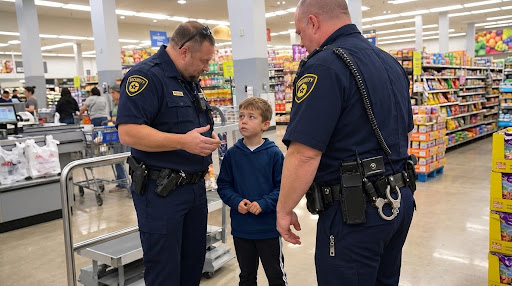
Ethan’s small voice cut through the silence of the security office.
The woman who had accused him of stealing stood motionless,
holding the photograph against her chest.
Her face had changed completely.
Only minutes earlier, she’d been shouting that my seven-year-old son was a thief.
Now her eyes were filled with tears,
and her hands trembled so badly that she could barely hold the picture.
I crouched beside Ethan.
“What else did you see, sweetheart?”
He looked toward the woman.
Then toward the security monitor.
“I saw somebody take something from her purse.”
The older security guard, whose name tag read MICHAEL, immediately straightened.
“What do you mean, buddy?”
Ethan pointed toward the screen.
“When the lady was crying, a man came behind her. He took something from her bag.”
The woman blinked.
“What?”
Ethan nodded seriously.
“He had a blue jacket. He put something in his pocket, then walked away.”
Michael exchanged a glance with his colleague.
“Can you show us when that happened?”
Ethan nodded.
“Before I picked up the picture.”
Michael rewound the footage.
We watched the electronics aisle appear on the monitor again.
The woman stood beside a display of headphones, looking down at the photograph.
She seemed completely unaware of the shoppers passing behind her.
Then a man wearing a navy-blue jacket entered the frame.
He slowed as he approached.
For a moment, he appeared to examine a nearby shelf.
Then he stepped closer to the woman’s shopping cart.
Her handbag was resting inside.
The man glanced around.
His hand moved toward the bag.
And within seconds, he removed a small brown wallet.
My stomach tightened.
“There,” Ethan whispered.
Michael paused the recording.
The woman’s mouth fell open.
“Oh, my goodness.”
The man slipped the wallet into his jacket and walked away.
The entire incident lasted fewer than ten seconds.
The woman slowly lowered herself into a chair.
“My wallet,” she whispered.
She reached into her handbag.
Her fingers searched desperately.
Then she looked up.
“It’s gone.”
Michael immediately called another security officer.
“Possible pickpocketing. Navy jacket, approximately forty years old. Check the exits and preserve the footage.”
His colleague hurried from the room.
I looked at Ethan.
“Why didn’t you tell me earlier?”
My son lowered his head.
“I tried, Mommy.”
My heart sank.
“What do you mean?”
He twisted his fingers together.
“When the lady started yelling, I wanted to tell her about the man. But she kept shouting that I was bad.”
His voice cracked.
“Then everybody was looking at me.”
I pulled him into my arms.
“Oh, sweetheart.”
He buried his face against my shoulder.
“I thought nobody would believe me.”
Those words hurt more than I expected.
Because he’d been telling the truth from the beginning.
And instead of listening, the adults around him had allowed a frightened child to become the center of a public accusation.
The woman covered her face.
“I’m so sorry.”
I looked toward her.
She was crying harder now.
“I’m so terribly sorry.”
Ethan didn’t answer.
He simply held on to me.
The woman looked at the photograph.
Then at my son.
“He was trying to help me.”
Michael nodded.
“That’s what the footage shows.”
She pressed a trembling hand against her mouth.
“And I accused him of stealing.”
For several seconds, nobody spoke.
Then she whispered, “What have I done?”
I took a slow breath.
“Ma’am, my son was frightened and humiliated. You accused him without evidence, and you continued even after security told you he hadn’t stolen anything.”
She nodded, tears falling onto her blouse.
“I know.”
“He deserves an apology.”
“Of course.”
She turned toward Ethan.
But he immediately moved closer to me.
I gently touched his shoulder.
“You don’t have to talk to her until you’re ready.”
The woman nodded.
“I understand.”
Then she looked at me.
“My name is Margaret Wilson.”
I said nothing.
She continued.
“I’m fifty-eight years old. And I have absolutely no excuse for the way I treated your little boy.”
Her voice broke.
“I was angry. I was upset. But none of that gave me the right to hurt him.”
I watched her carefully.
Something about her grief was unmistakably real.
But I wasn’t prepared to let her sorrow erase what she’d done.
“Why did you think Ethan stole something?”
Margaret looked down at the photograph.
“Because I saw him put something in his pocket.”
“He found your picture.”
She nodded.
“I know that now.”
Then she whispered, “I thought I’d lost it.”
Her eyes filled again.
“It’s the last photograph I have of my son holding his daughter.”
I glanced at the picture.
The young soldier looked barely twenty-five.
He wore a military uniform and smiled proudly while holding a tiny baby wrapped in a pink blanket.
The infant’s face was turned toward his chest.
Margaret touched the photograph.
“His name was Andrew.”
She swallowed.
“He was twenty-nine when he died.”
Ethan lifted his head slightly.
“Was he a soldier?”
Margaret nodded.
“Yes, sweetheart.”
My son looked at the photograph.
“Like my grandpa?”
I nodded.
“My dad served in the Army too.”
Margaret looked at me with surprise.
Then she returned her attention to Ethan.
“Your grandpa must be very brave.”
Ethan shook his head.
“Grandpa says being brave doesn’t mean you’re never scared.”
Margaret smiled through her tears.
“What does he say it means?”
Ethan thought carefully.
“He says it means doing the right thing even when you’re scared.”
The woman began crying again.
I held my son a little tighter.
Because he’d done exactly that.
He’d seen something wrong.
He’d tried to help.
And even after being publicly accused of stealing, he’d found the courage to speak up.
Michael’s radio crackled.
A voice came through.
“Suspect matching the description has been located near the parking garage. Police are responding.”
Margaret looked up.
“My wallet?”
“We’re working on it,” Michael replied.
Then he asked whether she wanted to report the theft.
She nodded immediately.
“Yes.”
A few minutes later, a police officer entered the security office.
Her name was Officer Angela Brooks.
She spoke with Margaret, reviewed the footage, and asked Ethan what he’d witnessed.
I remained beside him the entire time.
Officer Brooks crouched so she was at his eye level.
“Hi, Ethan. I’m Angela.”
He nodded shyly.
“Hi.”
“I heard you noticed something important.”
He looked toward me.
I smiled encouragingly.
“You can tell her what you saw.”
He explained the man in the blue jacket.
The wallet.
The photograph.
And how he’d tried to tell the woman before she started shouting.
Officer Brooks listened patiently.
When he finished, she smiled.
“Thank you for helping us understand what happened.”
Ethan looked surprised.
“I’m not in trouble?”
My chest tightened.
“No, sweetheart,” I said immediately.
Officer Brooks shook her head.
“Not at all.”
Ethan looked toward Margaret.
“She said I was a thief.”
The officer’s expression softened.
“I understand. But the video shows you didn’t steal anything.”
He looked down at his sneakers.
Then whispered, “I just wanted to help.”
Margaret covered her mouth again.
“I’m sorry, Ethan.”
My son remained quiet.
And I let him.
Because forgiveness wasn’t something I intended to demand from him.
Especially not to make an adult feel better.
Officer Brooks finished taking statements and stepped outside to speak with another officer.
Margaret remained seated.
She stared at the photograph for a long time.
Then she spoke quietly.
“Andrew used to do things like that.”
I looked at her.
“What things?”
“Help strangers.”
Her voice trembled.
“When he was little, he’d pick up things people dropped. He’d hold doors open. He once gave his entire birthday allowance to a man who’d lost his wallet.”
She smiled sadly.
“He was always trying to make the world a little kinder.”
Ethan listened.
Margaret looked at him.
“When I saw you put something in your pocket, I didn’t stop to think. I was so upset about the photograph that I assumed the worst.”
She paused.
“And because I assumed the worst, I treated a kind little boy terribly.”
I could see the shame in her face.
Then she said something unexpected.
“I came to this supermarket today because it’s where Andrew used to bring his daughter.”
I frowned.
“His daughter?”
Margaret nodded.
“Her name is Lily.”
She looked down at the photograph.
“She’s six now.”
Ethan tilted his head.
“Where is she?”
Margaret’s expression changed.
For a moment, she seemed unable to answer.
Then she whispered, “I haven’t seen her in almost three years.”
I felt a strange heaviness settle over the room.
“Why not?”
Margaret looked toward the security monitor.
“Because after Andrew died, our family fell apart.”
She took a shaky breath.
“And I made a mistake that cost me my granddaughter.”
I wasn’t sure what to say.
Margaret continued.
“Andrew’s wife, Sarah, was devastated. We all were. But instead of supporting each other, we started blaming each other.”
She wiped her eyes.
“I said things I should never have said.”
Her voice broke.
“Sarah took Lily and moved away.”
I glanced at Ethan.
He was listening intently.
Margaret looked toward the photograph again.
“I’ve spent three years wishing I could take back the things I said.”
Then she looked directly at my son.
“And today, I did the same thing to another innocent child.”
The room fell silent.
But before I could respond, Officer Brooks returned.
She held a small evidence bag.
Inside was Margaret’s brown wallet.
“We recovered this from the man shown in the video,” she explained.
Margaret gasped.
“Oh, thank goodness.”
The officer continued.
“We’ll need to complete some paperwork before returning it.”
Margaret nodded.
Then Ethan suddenly pointed toward the wallet.
“Mommy, that’s not the only thing he took.”
I turned toward him.
“What?”
Ethan looked at the security monitor.
“He took something from the little girl’s backpack too.”
Michael frowned.
“What little girl?”
Ethan pointed at the screen.
“The one with the yellow ribbons.”
The security guard rewound the footage again.
And what appeared on the monitor made everyone lean forward.
Because the man in the blue jacket hadn’t simply stolen Margaret’s wallet.
He’d approached another child moments earlier.
A little girl wearing a pink backpack.
And when Margaret saw the child’s face, she let out a strangled cry.
“Oh, my God.”
She stood so suddenly that her chair scraped against the floor.
“That’s Lily.”
Her granddaughter.
The little girl she hadn’t seen in three years.
And she had been standing just a few feet away from her the entire time.
PART 4
Margaret pressed both hands against the security monitor.
“That’s her.”
Her voice shook violently.
“That’s my Lily.”
Michael enlarged the image.
The little girl wore a yellow dress beneath a denim jacket.
Two bright ribbons held her dark hair in pigtails.
She stood beside a woman pushing a shopping cart.
The woman’s face was partially hidden by a shelf.
Margaret began crying again.
“I know those eyes. I know that face.”
She turned toward Officer Brooks.
“Please. Can you find her?”
The officer spoke calmly.
“Ma’am, we’ll review the footage and determine whether they’re still in the store.”
Margaret nodded desperately.
“Please.”
I watched the recording.
The little girl was examining a display of colorful headphones while the woman beside her looked at something on a nearby shelf.
The man in the blue jacket approached.
He leaned toward the shopping cart.
Then slipped his hand into the outside pocket of the little girl’s backpack.
He removed a small pink object.
Ethan pointed.
“See?”
Michael paused the video.
The object appeared to be a little wallet decorated with cartoon butterflies.
Officer Brooks looked toward her radio.
“Can someone check whether a pink children’s wallet was recovered from the suspect?”
A voice responded moments later.
“Stand by.”
Margaret was trembling.
I gently guided her back into the chair.
“Please sit down.”
She looked at me.
“That’s my granddaughter.”
“I understand.”
“I haven’t seen her since she was three.”
Her voice cracked.
“She probably doesn’t even remember me.”
Ethan looked up.
“Maybe she does.”
Margaret turned toward him.
“What?”
My son shrugged.
“I remember my grandma’s house from when I was three.”
He thought for a moment.
“It smelled like cookies.”
Margaret smiled weakly.
“Did it?”
Ethan nodded.
“And she had a blue couch.”
I stroked his hair.
Margaret stared at him.
Then whispered, “Lily used to call me Nana Maggie.”
She looked toward the monitor.
“I wonder if she remembers that.”
A security employee entered the room.
“The woman and child were seen near the bakery about ten minutes ago. We’re checking whether they’re still shopping.”
Margaret stood again.
“Can I go?”
Officer Brooks gently stopped her.
“Let’s make sure we approach this carefully. We don’t know the circumstances of your family situation.”
Margaret slowly sat down.
I appreciated the officer’s caution.
The last thing anyone needed was another confrontation involving a child.
Especially after what Ethan had endured.
The radio crackled again.
“Pink wallet recovered. Contains a child’s library card and several photographs.”
Officer Brooks nodded.
“Thank you.”
Then she looked at Margaret.
“We’re going to contact the child’s accompanying adult and explain the recovered property. If that person agrees to speak with you, we’ll let you know.”
Margaret clasped her hands together.
“Thank you.”
For the next fifteen minutes, we waited.
Ethan sat beside me eating crackers from his soccer bag.
Margaret held Andrew’s photograph.
Occasionally, she looked at my son.
Each time, her expression softened.
Finally, she spoke.
“Rachel?”
I looked up.
“Yes?”
“May I ask you something?”
I nodded.
She took a breath.
“How do you teach a child to be so kind?”
I looked at Ethan.
He was carefully arranging his crackers into a little tower.
I smiled.
“I don’t think kindness is something you teach once. You practice it every day.”
Margaret nodded.
“Andrew’s father used to say something similar.”
She looked down.
“I wish I’d remembered that this morning.”
I studied her.
There was no longer any trace of the woman who’d grabbed our cart and shouted accusations across the supermarket.
But I wasn’t going to pretend that transformation erased what happened.
“Margaret, I believe you’re sorry.”
She looked at me.
“But Ethan was genuinely frightened.”
“I know.”
“He thought he’d done something wrong simply because an adult was angry with him.”
Tears filled her eyes.
“I’m ashamed.”
I continued.
“He may remember today for a long time.”
She nodded.
“I understand.”
“And I need him to know that adults are responsible for their own behavior. He doesn’t have to forgive you just because you’re upset.”
Margaret looked toward Ethan.
“You’re right.”
For a moment, she was silent.
Then she said, “I don’t want him to feel responsible for making me feel better.”
I was surprised by her answer.
Because that was exactly what I’d been afraid of.
Ethan looked up.
“Mommy?”
“Yes, sweetheart?”
“Can I ask her something?”
“Of course.”
He turned toward Margaret.
“Why did you yell at me?”
The question was simple.
But it seemed to strike her harder than anything else.
She swallowed.
“Because I made a very bad assumption.”
Ethan frowned.
“What’s an assumption?”
Margaret thought carefully.
“It’s when you decide something is true before you know whether it really is.”
He considered that.
“Like thinking somebody stole something when they didn’t?”
She nodded.
“Exactly.”
He looked down.
“That wasn’t nice.”
“No,” Margaret whispered. “It wasn’t.”
Then she leaned forward slightly.
“Ethan, I want you to know something. You did nothing wrong. I was wrong.”
He studied her face.
“You made me scared.”
A tear rolled down her cheek.
“I know.”
He looked at me.
Then back at her.
“My teacher says you should use kind words.”
Margaret gave a broken little laugh.
“Your teacher is right.”
Ethan nodded.
Then returned to his crackers.
The conversation was over as far as he was concerned.
And I was proud of him for saying exactly what he felt.
A few minutes later, Officer Brooks returned.
“We located the woman and child.”
Margaret stood immediately.
“Are they okay?”
“They’re fine. The child wasn’t aware anything had been taken.”
Margaret pressed a hand to her chest.
“Thank goodness.”
The officer continued.
“The woman has identified herself as Sarah Wilson.”
Margaret closed her eyes.
“Andrew’s wife.”
“Yes.”
“Did you tell her I’m here?”
Officer Brooks nodded.
“She knows.”
Margaret’s hands began shaking.
“Does she want to see me?”
The officer hesitated.
“She has agreed to speak with you briefly, provided the conversation remains calm and her daughter is not pressured.”
Margaret covered her mouth.
“Oh, thank you.”
I stood.
“Ethan, sweetheart, let’s give them some privacy.”
But Margaret turned toward me.
“Rachel, please.”
I paused.
She looked embarrassed.
“I know I have no right to ask anything of you. But would you stay nearby?”
I glanced at Officer Brooks.
The officer said, “Only if you’re comfortable.”
I thought for a moment.
Then nodded.
“We can stay for a few minutes.”
Not because Margaret deserved it.
But because I wanted Ethan to see that people could take responsibility for their mistakes without pretending those mistakes had never happened.
The door opened.
A woman in her early thirties entered.
She had tired brown eyes and dark hair pulled into a loose braid.
Beside her stood the little girl from the video.
Lily.
She clutched a stuffed rabbit and looked curiously around the room.
Margaret froze.
For several seconds, nobody spoke.
Then she whispered, “Sarah.”
The younger woman’s expression remained guarded.
“Hello, Margaret.”
Margaret’s eyes filled.
“I didn’t know you were here.”
Sarah nodded.
“We moved back to town last month.”
Margaret looked toward Lily.
The little girl stared at her.
Then tilted her head.
“Mommy, who’s that?”
Margaret visibly struggled to breathe.
Sarah crouched beside her daughter.
“Sweetheart, this is your daddy’s mother.”
Lily looked confused.
“My daddy’s mommy?”
Sarah nodded.
“Yes.”
The little girl looked toward Margaret.
Then asked a question that made everyone go silent.
“Are you Nana Maggie?”
Margaret covered her mouth.
A sob escaped her.
“Yes, sweetheart.”
Lily smiled.
“Mommy showed me your picture.”
Margaret began crying.
Sarah looked away.
And I realized that whatever had happened between these two women, the little girl had not been completely deprived of her father’s family history.
Sarah had kept photographs.
She had told stories.
She had allowed her daughter to know that her grandmother existed.
Margaret took a shaky step forward.
Then stopped.
“May I say hello?”
Sarah hesitated.
Then nodded.
“Just hello.”
Margaret crouched carefully.
“Hello, Lily.”
The little girl smiled.
“Hi.”
Margaret’s voice trembled.
“You’ve grown so much.”
Lily held up six fingers.
“I’m six.”
Margaret laughed through her tears.
“I can see that.”
Then Lily noticed the photograph in Margaret’s hand.
“That’s Daddy!”
Margaret looked down.
“Yes.”
Lily stepped closer.
“Can I see?”
Margaret held out the picture.
The little girl studied it.
“Mommy has that picture too.”
Sarah’s eyes filled with tears.
Lily pointed toward the baby in Andrew’s arms.
“That’s me.”
Margaret nodded.
“Yes, sweetheart.”
Then Lily smiled.
“Daddy looks happy.”
Margaret could barely answer.
“He was very happy.”
For a few precious moments, the years of separation seemed to disappear.
But then Sarah spoke.
“Margaret, we need to talk.”
Margaret looked up.
Sarah’s voice was calm.
“I heard what happened with Rachel’s son.”
Margaret lowered her eyes.
“I know.”
Sarah continued.
“You accused a little boy of stealing and frightened him in front of strangers.”
Margaret nodded.
“Yes.”
“That’s exactly the kind of behavior I couldn’t allow around Lily.”
The room became painfully quiet.
Margaret began trembling.
“Sarah, please.”
The younger woman shook her head.
“No. You need to hear this.”
Margaret fell silent.
Sarah took a breath.
“After Andrew died, you were grieving. I understood that. I was grieving too.”
Her voice cracked.
“But you blamed me for his death.”
Margaret closed her eyes.
“You said if I’d convinced him to leave the military, he’d still be alive.”
I felt my chest tighten.
Sarah continued.
“You told me I was a selfish wife. You accused me of caring more about his benefits than his memory.”
Margaret began crying.
“I know.”
“And when Lily cried for her daddy, you told her she needed to stop because crying wouldn’t bring him back.”
Margaret covered her face.
Sarah’s eyes filled.
“She was three years old.”
I looked at Lily.
The little girl was quietly examining her stuffed rabbit, unaware of the full weight of the conversation.
Sarah lowered her voice.
“I didn’t move away to punish you. I moved because I couldn’t let my daughter grow up believing grief was something shameful.”
Margaret sobbed.
“I’m so sorry.”
Sarah shook her head.
“I needed you to understand that being in pain doesn’t give you permission to hurt other people.”
Margaret looked toward Ethan.
Then toward Lily.
“I understand that now.”
Sarah studied her.
“Do you?”
Margaret nodded.
“I accused that little boy because I was angry and frightened. I didn’t stop to think about what I was doing.”
She took a shaky breath.
“And when he showed me kindness, I realized how cruel I’d become.”
Sarah remained silent.
Margaret continued.
“I can’t change what I said to you. I can’t bring Andrew back. But I can stop using my grief as an excuse.”
Tears rolled down her face.
“I want to become someone my granddaughter can feel safe around.”
For several seconds, Sarah said nothing.
Then Lily suddenly looked up.
“Mommy?”
“Yes, sweetheart?”
“Can Nana Maggie come to my birthday?”
Everyone froze.
Sarah looked at her daughter.
Margaret pressed a hand against her chest.
Lily smiled innocently.
“I’m having a unicorn cake.”
Sarah took a slow breath.
Then looked at Margaret.
“We’ll talk about it.”
It wasn’t forgiveness.
It wasn’t a promise.
But it was more than Margaret had expected.
She nodded through her tears.
“Thank you.”
Then Ethan quietly tugged my sleeve.
“Mommy, can we go home now?”
I looked at him.
“Of course, sweetheart.”
As we turned toward the door, Margaret called my name.
“Rachel.”
I stopped.
She looked at my son.
“May I say one last thing?”
I glanced at Ethan.
He nodded.
Margaret crouched again.
“Ethan, today you helped me find my wallet.”
He listened.
“You returned a photograph that means more to me than anything I own.”
She swallowed.
“And because you spoke up, I got to see my granddaughter again.”
Her voice broke.
“But I want you to remember something important.”
Ethan tilted his head.
“What?”
“You didn’t have to do any of those things to deserve kindness.”
I felt tears rise in my eyes.
Margaret continued.
“You deserved kindness from the moment I met you. And I’m sorry I forgot that.”
Ethan thought carefully.
Then said, “It’s okay to be sad.”
Margaret nodded.
“Yes.”
“But you shouldn’t be mean.”
She smiled through her tears.
“You’re absolutely right.”
Then my son reached into his soccer bag.
He pulled out a small orange sticker shaped like a star.
His coach had given it to him after practice.
He held it toward Margaret.
“You can have this.”
I blinked.
“Ethan, sweetheart, you don’t have to—”
“I know, Mommy.”
He looked at Margaret.
“It’s for trying to be better.”
The woman stared at the little sticker.
Then accepted it with trembling fingers.
“Thank you.”
She began crying again.
And as we walked toward the exit, I heard her whisper something to Sarah.
“Andrew would have loved that little boy.”
I held Ethan’s hand.
My heart was full of complicated emotions.
Anger.
Relief.
Sadness.
Pride.
But I thought the worst of the day was finally behind us.
I was wrong.
Because the following Monday morning, I received a phone call from the supermarket manager.
And what he told me revealed that Ethan’s experience was part of a much bigger problem.
PART 5
The supermarket manager introduced himself as David Harris.
He sounded nervous.
“Mrs. Rachel Bennett?”
“Speaking.”
“My name is David. I’m the general manager of the Greenfield Market where you and your son were shopping on Saturday.”
I immediately felt my stomach tighten.
“Is something wrong?”
“No, ma’am. Actually, I’m calling because I’ve reviewed the incident involving your son.”
I glanced toward the living room.
Ethan was sitting on the carpet building a spaceship from plastic blocks.
“What about it?”
David hesitated.
“First, I want to apologize on behalf of our store.”
I remained silent.
He continued.
“Our security team handled the investigation appropriately once the accusation was made, but we should have intervened sooner when the woman began shouting at your child.”
I appreciated that he wasn’t pretending everything had gone perfectly.
“Thank you.”
He took a breath.
“There’s something else.”
I waited.
“After reviewing the footage, we discovered that the same man who stole Margaret Wilson’s wallet had been operating in our store on multiple occasions.”
My eyebrows rose.
“What?”
“Investigators believe he may be connected to several recent thefts.”
I sat down.
David continued.
“On two previous occasions, customers reported missing wallets. We initially believed the items had simply been misplaced.”
I thought about the man in the blue jacket.
The way he’d moved through the aisle.
The casual confidence with which he’d reached into Margaret’s purse.
He hadn’t looked nervous.
He’d looked practiced.
“Has he been arrested?”
“Police are handling the investigation. The man was detained on Saturday, and additional incidents are being reviewed.”
I exhaled slowly.
“Why are you telling me this?”
David paused.
“Because your son noticed something our security team hadn’t identified.”
I looked toward Ethan.
He was making explosion noises with his toy spaceship.
David continued.
“His observation helped us identify a pattern. We believe the footage he directed us to may assist investigators with other cases.”
I felt a surge of pride.
But I also felt protective.
“Ethan is seven years old. I don’t want him dragged into something frightening.”
“Absolutely,” David replied. “We understand.”
He explained that the store wanted to apologize formally and review its procedures for handling accusations involving children.
Then he asked whether I would be willing to meet with him.
I thought about it.
My first instinct was to refuse.
I wanted to forget the supermarket.
Forget the shouting.
Forget the way Ethan had hidden behind me.
But then I remembered something he’d said that evening.
“Mommy, why did all those people look at me like I was bad?”
I’d held him close and explained that people sometimes made mistakes.
But the question had stayed with me.
Because he hadn’t simply been embarrassed.
He’d been made to feel guilty for something he hadn’t done.
And I didn’t want another child to experience that.
So I agreed to meet David.
But I made one condition.
“Ethan won’t be required to attend.”
David agreed immediately.
The following afternoon, I sat across from him in a small office near the store’s entrance.
He was a middle-aged man with tired eyes and a sincere manner.
He placed a folder on the table.
“Mrs. Bennett, I’ve reviewed the recordings and spoken with the employees involved.”
I nodded.
He continued.
“The woman who accused your son was not an employee, but our staff should have moved the conversation away from the public aisle sooner.”
“Yes,” I said. “They should have.”
He looked embarrassed.
“I agree.”
Then he explained the changes the store intended to make.
Employees would receive additional training on handling theft allegations without publicly humiliating customers.
Security personnel would be instructed to avoid treating accusations as facts until evidence had been reviewed.
And when children were involved, staff would be expected to contact a parent or guardian and handle the situation with particular care.
I listened.
Then asked, “Will the employees understand why these changes matter?”
David looked at me.
“What do you mean?”
I took a breath.
“My son didn’t just have an unpleasant shopping experience. He spent the rest of Saturday asking whether people thought he was a criminal.”
David’s expression softened.
“He asked me whether he should stop helping strangers.”
The manager looked down.
“That’s heartbreaking.”
I nodded.
“He found a photograph. He tried to return it. And somehow, that turned into a public accusation.”
David was silent.
Then he said, “You’re right. Training shouldn’t just be about procedures. It should be about remembering there’s a person involved.”
I appreciated his response.
Before I left, he handed me an envelope.
Inside was a handwritten apology from the store’s management team.
There was also a gift card.
I looked at it.
“Mr. Harris, I didn’t come here for compensation.”
“I understand.”
He smiled gently.
“It’s not meant to erase what happened. It’s simply a gesture.”
I accepted the letter.
But I asked him to donate the value of the gift card to a local children’s charity instead.
He agreed.
Then he surprised me.
“Would you mind if I asked one more question?”
“Go ahead.”
“How is Ethan doing?”
I thought about my son.
His nightmares hadn’t been severe.
But he’d been unusually quiet on Sunday.
He’d asked whether we could shop somewhere else.
And when a neighbor complimented his soccer uniform, he’d hidden behind me.
“He’s getting better,” I said.
David nodded.
“Please tell him we’re sorry.”
“I will.”
That evening, I sat beside Ethan on the couch.
He was watching a cartoon about dinosaurs.
I turned down the volume.
“Sweetheart, can we talk about Saturday?”
He looked at me.
“At the store?”
“Yes.”
He nodded.
I explained that the manager had apologized.
I told him the store was changing how employees handled accusations.
Then I said, “And the police are looking into the man who stole those wallets.”
Ethan considered that.
“Did they find the little girl’s money?”
“They found her wallet.”
He smiled.
“Good.”
I brushed his hair away from his forehead.
“How do you feel about what happened?”
He shrugged.
“Okay.”
I waited.
Then he whispered, “I didn’t like when everybody stared.”
My heart tightened.
“I know.”
He looked down.
“I thought maybe they believed her.”
I took his hand.
“Some people might have been confused because they didn’t know what happened. But that doesn’t mean you did anything wrong.”
He nodded.
Then asked, “Mommy, can grown-ups get in trouble for being mean?”
I thought carefully.
“Sometimes there are consequences for hurting people. But even when there aren’t legal consequences, grown-ups still have a responsibility to apologize and change their behavior.”
He considered that.
“Like Margaret?”
“Yes.”
He smiled faintly.
“She cried a lot.”
I nodded.
“She did.”
Then he asked something unexpected.
“Do you think she’s still sad?”
I looked at him.
“Probably.”
He frowned.
“Because of her son?”
“Yes.”
Ethan sat quietly.
Then whispered, “I wish her son could come back.”
I pulled him close.
“Me too, sweetheart.”
He rested his head against my shoulder.
After a moment, he said, “I hope she gets to see Lily again.”
I kissed his forehead.
“That would be nice.”
But I reminded him that Margaret and Sarah would need to decide what was safe and healthy for their family.
He nodded.
Then returned to his dinosaurs.
I thought that might be the end of the story.
But two weeks later, an envelope arrived in our mailbox.
There was no return address.
Inside was a handwritten letter.
The handwriting was careful and slightly shaky.
It began:
“Dear Rachel and Ethan,”
I immediately recognized Margaret’s name at the bottom.
I sat at the kitchen table and began reading.
She wrote that she’d spent the past two weeks thinking about what happened.
She’d replayed the supermarket confrontation in her mind countless times.
She remembered Ethan’s frightened face.
The way he’d hidden behind me.
The way she’d refused to believe him even after security found no evidence of theft.
She wrote that she’d been ashamed to recognize how easily her grief had turned into anger.
Then she shared something unexpected.
After the supermarket incident, she’d contacted a grief counselor.
She’d also reached out to a local support group for parents who had lost adult children.
For the first time since Andrew’s death, she’d begun talking honestly about her pain instead of directing it toward other people.
She admitted that she’d spent years believing the world owed her something because she’d suffered.
But seeing Ethan offer kindness after being mistreated had forced her to reconsider the person she’d become.
Then I reached the paragraph that made my eyes fill with tears.
“Rachel, I don’t expect your son to forgive me. I don’t expect you to trust me. But I want you to know that what happened in that supermarket has changed how I treat people. I cannot undo the fear I caused Ethan. I can only make sure I don’t repeat it.”
I continued reading.
Margaret explained that Sarah had agreed to meet her for coffee.
Not with Lily.
Just the two of them.
They’d talked for nearly three hours.
Margaret apologized for the cruel things she’d said after Andrew died.
Sarah explained how deeply those words had wounded her.
There were tears.
Difficult conversations.
And long silences.
But neither woman walked away.
A week later, Sarah invited Margaret to join them at a public park.
Margaret saw Lily again.
They fed ducks.
Shared sandwiches.
And talked about Andrew.
Margaret wrote that Lily had asked whether her daddy liked strawberry ice cream.
Margaret told her it had been his favorite.
Then Lily insisted they all buy strawberry ice cream together.
I smiled through my tears.
At the bottom of the letter, Margaret had written one final message.
“Please tell Ethan that I still have his orange star sticker. I keep it beside Andrew’s photograph. It reminds me that kindness is a choice I must make every day.”
I folded the letter carefully.
Then called Ethan into the kitchen.
He climbed onto the chair beside me.
“What’s that, Mommy?”
“A letter from Margaret.”
His eyes widened.
“The lady from the store?”
“Yes.”
I read him the parts he could understand.
When I told him Margaret had seen Lily again, he grinned.
“Really?”
“Really.”
He clapped his hands.
“That’s good!”
Then I told him about the orange sticker.
He laughed.
“She kept it?”
“She did.”
He looked pleased.
Then he asked, “Can we send her another one?”
I smiled.
“If you’d like.”
He ran to his bedroom.
A few minutes later, he returned carrying a small sheet of stickers.
He carefully selected a blue star.
Then he took a piece of paper and began drawing.
I watched quietly.
He drew three people standing beneath a bright yellow sun.
A tall woman.
A little girl.
And a smiling boy wearing a soccer uniform.
At the bottom, he wrote in uneven letters:
“BE KIND. EVERYBODY HAS FEELINGS.”
I stared at the drawing.
Then looked at my son.
“That’s beautiful, sweetheart.”
He smiled.
“Can we send it?”
“Of course.”
We mailed the drawing the following morning.
I didn’t expect anything in return.
But a month later, Margaret sent a photograph.
It showed her sitting on a park bench beside Lily.
Sarah stood behind them, smiling gently.
Margaret was holding Ethan’s drawing.
On the back, she’d written:
“One step at a time.”
I placed the photograph in a drawer with the letter.
Not because I wanted Ethan to forget what happened.
But because I wanted him to understand that people could acknowledge their mistakes and work to become better.
Still, I knew something important.
Margaret’s grief explained her pain.
It did not excuse her behavior.
And Ethan’s kindness did not erase his right to feel hurt.
Both things could be true.
As the months passed, Ethan gradually stopped talking about the supermarket incident.
He returned to his usual routine.
Soccer practice.
School.
Homework.
Building elaborate structures from blocks.
Arguing with me about bedtime.
But occasionally, he’d surprise me.
One afternoon, we were walking through a park when he noticed an elderly man struggling to pick up a dropped bag of groceries.
Ethan immediately started toward him.
Then stopped.
He looked at me.
“Mommy, is it okay if I help?”
I smiled.
“Of course. Just ask him first.”
Ethan approached the man.
“Excuse me, sir. Would you like some help?”
The man looked up.
His face brightened.
“Why, thank you, young fellow.”
Ethan picked up two apples and placed them back into the bag.
The man thanked him again.
As we walked away, Ethan slipped his hand into mine.
“Mommy?”
“Yes?”
“That felt good.”
I squeezed his hand.
“Helping someone?”
He nodded.
“Yeah.”
Then he looked up at me.
“Even after what happened at the store, I still want to help people.”
My eyes filled with tears.
I stopped walking.
Crouched beside him.
And wrapped my arms around him.
“Sweetheart, that’s one of the things I love most about you.”
He hugged me tightly.
Then whispered, “Grandpa says being brave means doing the right thing when you’re scared.”
I smiled.
“Grandpa is right.”
He pulled away.
“And I wasn’t scared this time.”
I kissed his forehead.
“I’m proud of you.”
That evening, after Ethan fell asleep, I sat alone at the kitchen table.
I thought about the woman in the supermarket.
The accusation.
The shouting.
The security footage.
The stolen wallet.
The photograph of Andrew.
And the unexpected reunion between Margaret and her granddaughter.
It still amazed me how quickly an ordinary Saturday had changed so many lives.
A woman had entered a supermarket carrying years of grief and anger.
A little boy had entered the same store carrying nothing more than his soccer bag and a desire to help.
Their paths crossed.
And for a terrible moment, the woman’s pain nearly crushed the child’s kindness.
But the truth came out.
Not because Ethan shouted louder.
Not because he insulted her.
Not because he demanded revenge.
Because he remembered what he’d seen and found the courage to speak.
The cameras revealed the facts.
The police recovered the stolen property.
And Margaret was forced to confront the damage she’d caused.
But the most important lesson wasn’t about security footage.
It was about what happened afterward.
Margaret chose to take responsibility.
Sarah chose to consider whether reconciliation was possible.
And Ethan learned that he could remain kind without accepting mistreatment.
I looked toward the hallway where my son slept.
Seven years old.
Still learning how the world worked.
Still believing people deserved kindness.
And I hoped he would never lose that belief.
But I also hoped he’d remember something equally important.
That kindness doesn’t mean allowing people to hurt you.
That forgiveness cannot be demanded.
And that telling the truth matters, even when your voice shakes.
A few weeks later, Ethan’s soccer coach announced a special recognition at the end of practice.
The children gathered around while their parents watched from the sidelines.
Coach Daniel held up a small trophy.
“This award goes to a player who has shown courage, honesty, and kindness both on and off the field.”
Ethan stood beside his teammates, completely unaware.
The coach smiled.
“Ethan Bennett.”
My son stared.
“Me?”
The other children clapped.
Ethan walked forward slowly.
The coach handed him the trophy.
“Your mom told me about something difficult you went through. And I wanted you to know that doing the right thing matters, even when other people don’t recognize it immediately.”
Ethan looked down at the trophy.
Then toward me.
I was crying.
Again.
He smiled shyly.
“Thank you.”
The coach patted his shoulder.
Then the children rushed forward to congratulate him.
I watched my little boy standing among his teammates, holding a trophy almost as big as his forearm.
And I thought about the frightened child who’d hidden behind me in the supermarket.
The child who’d whispered, “Mommy, I didn’t steal anything.”
The child who’d wondered whether anyone believed him.
Now he stood smiling, surrounded by people who celebrated his honesty.
After practice, he ran toward me.
“Mommy! Look!”
I crouched.
“I see it!”
He held up the trophy.
“It’s shiny!”
I laughed.
“It certainly is.”
Then he looked at me seriously.
“Mommy, can I put it next to Grandpa’s picture?”
I smiled.
“Of course.”
He nodded.
“Because Grandpa taught me to be brave.”
I hugged him.
And for a moment, I wished my father could have been there to see it.
He’d passed away the previous winter.
But his lessons lived on in my son.
That evening, Ethan placed the trophy beside a framed photograph of my father wearing his old Army uniform.
Then he stood back and admired it.
I watched from the doorway.
He turned toward me.
“Mommy?”
“Yes, sweetheart?”
“Do you think Grandpa would be proud?”
My throat tightened.
I crossed the room and knelt beside him.
“Ethan, I think Grandpa would be prouder than you can imagine.”
He smiled.
Then wrapped his arms around my neck.
“I miss him.”
“I know, baby.”
We held each other quietly.
And in that moment, I understood something beautiful.
The woman in the supermarket had been grieving a son.
I had been grieving a father.
And my little boy, without realizing it, had reminded both of us that the love we lose can still shape the kindness we give.
Margaret had nearly allowed grief to make her cruel.
But Ethan’s courage helped her recognize that she could choose differently.
And I had learned that protecting my son meant more than defending him when someone accused him.
It meant teaching him that his feelings mattered.
That his voice deserved to be heard.
And that nobody, no matter how old or upset, had the right to humiliate him.
That night, after Ethan fell asleep, I returned to the living room.
His trophy stood beside Grandpa’s photograph.
The inscription read:
“FOR COURAGE, HONESTY, AND KINDNESS.”
I touched the little trophy.
Then whispered, “You did good, sweetheart.”
Because the greatest thing my son had done that Saturday wasn’t helping security identify a thief.
It wasn’t returning a precious photograph.
And it wasn’t helping a grieving grandmother reconnect with her family.
It was something much simpler.
He told the truth even when nobody wanted to listen.
And he reminded the adults around him of a lesson too many people forget.
Before you accuse someone, know the facts. Before you judge someone, remember they’re human. And before you let your pain become someone else’s suffering, choose kindness.
My son was only seven years old.
But on that ordinary Saturday afternoon, he taught an entire room of adults something they should have known all along.
THE END THANK YOU FOR READING !!!



