PART 3
My daughter-in-law’s scream was so loud that
the neighbor across the street came outside to see what had happened.
But I wasn’t there to hear it.
I was standing beside a floor-to-ceiling window in a Manhattan penthouse,
looking down at the Hudson River while sunlight spilled across the marble floor.
Three months earlier, I had been sitting in a cheap motel room,
wondering where I would sleep when my money ran out.
Now I was living on the forty-third floor of a building overlooking the city.
And the people who had thrown me out of my own home were discovering that
the woman they had called useless was the only person who could save them from financial ruin.
My name is Margaret Whitmore.
I am sixty-seven years old.
For forty-two years, I was married to a man named Harold.
And until the morning I walked into that bank on 47th Street,
I believed I knew almost everything about him.
I was wrong.
Harold had secrets.
But unlike the secrets my son and daughter-in-law kept, his were intended to protect me.
And when I finally understood what he’d done, I cried harder than I had at his funeral.
The morning I arrived at the bank, the woman in the gray suit introduced herself as Evelyn Carter.
She was the senior private banking director.
After examining the brass key, she escorted me into a private conference room.
The room had polished wooden walls, leather chairs, and a large window overlooking the busy Manhattan street.
I sat with my old purse in my lap.
My shoes were worn.
My coat had a missing button.
And I hadn’t eaten a proper breakfast.
I felt completely out of place.
Then two attorneys entered.
The older man introduced himself as Jonathan Mercer.
“Mrs. Whitmore,” he said gently, “your husband spoke about you often.”
I stared at him.
“You knew Harold?”
He smiled.
“For nearly thirty years.”
I frowned.
“My husband was a retired accountant.”
Jonathan exchanged a glance with Evelyn.
Then he opened a leather folder.
“Your husband was considerably more than that.”
He explained that Harold had helped establish a financial consulting company in the early 1990s.
The company eventually became part of a much larger investment and technology services group.
Harold had retained a substantial ownership interest.
He never appeared in publicity photographs.
Never attended lavish events.
Never purchased expensive cars.
He preferred working quietly behind the scenes.
When the company was acquired several years earlier, Harold’s ownership interest became extraordinarily valuable.
I stared at Jonathan.
“How valuable?”
He slid a statement across the table.
The figure at the bottom made my vision blur.
$28,417,630.
I read it twice.
Then a third time.
“There must be a mistake.”
Jonathan shook his head.
“No, Mrs. Whitmore.”
I stared at him.
“Harold had twenty-eight million dollars?”
“The combined assets held for your benefit are valued at approximately that amount.”
I looked down at my hands.
The same hands that had washed hospital linens.
Prepared meals.
Repaired clothing.
And counted grocery money.
I remembered Harold complaining about the price of coffee.
I remembered him fixing our old washing machine instead of buying a new one.
I remembered the winter we postponed replacing our car because he said it still had another year left.
And all that time, he’d been wealthy.
Not comfortable.
Not merely secure.
Wealthy beyond anything I’d imagined.
“Why didn’t he tell me?” I whispered.
Jonathan’s expression softened.
“He left you a letter explaining that.”
The envelope was cream-colored.
My name was written across the front in Harold’s familiar handwriting.
My Margaret.
Those two words nearly broke me.
Harold always called me his Margaret when he wanted to make me smile.
I opened the letter carefully.
If you’re reading this, sweetheart, then I’m no longer there to explain myself.
And for that, I’m sorry.
There are things I should have told you sooner.
But I wanted us to live an ordinary life.
I wanted to know that the people around us loved us for who we were, not for what we possessed.
I wiped my eyes.
I never cared about expensive things. You know that.
What mattered to me was our home, our mornings together, and the life we built.
But I also knew you would keep giving everything away if you thought someone needed it.
I gave a small, broken laugh.
He knew me too well.
You would give our son your last dollar.
You would sleep on the floor if it meant he could have a bed.
And you would apologize for needing anything in return.
My tears fell onto the page.
Then I reached the paragraph that made my hands tremble.
Margaret, I have watched the way Daniel and Vanessa treat you.
I know you believe their behavior will improve.
I hope you’re right.
But if I’m gone and they begin treating you as though you no longer belong, I want you to remember something.
You have always belonged.
And you have never needed their permission to be safe.
I pressed the letter against my chest.
Harold had seen it.
The small insults.
The dismissive comments.
The way Vanessa rolled her eyes whenever I spoke.
The way Daniel became uncomfortable whenever I disagreed with his wife.
He had noticed.
And he had prepared.
Jonathan waited until I finished crying.
Then he explained the second part of Harold’s arrangements.
The Manhattan penthouse.
It had been purchased through a trust years earlier.
Harold had kept it furnished and maintained.
He had visited occasionally for business.
But he had never lived there.
“Your husband instructed us to make it available to you whenever you were ready,” Jonathan said.
I stared at him.
“Ready for what?”
“For a different life, if you wanted one.”
I looked down.
“I don’t know how to live in a penthouse.”
Evelyn smiled gently.
“It’s still a home, Mrs. Whitmore.”
I almost laughed.
A home.
That word had become painful.
Five days after Harold’s funeral, Vanessa had stood in our living room and told me to go live on the streets.
And Daniel had said nothing.
I looked at Jonathan.
“What about the house in White Plains?”
His expression changed.
“That’s something we need to discuss.”
He opened another folder.
Inside was the deed to our home.
Harold and I had purchased it decades earlier.
Over the years, we’d refinanced, repaired, and eventually paid off the mortgage.
Several years before his death, Harold had arranged for the property to be held through a trust for my benefit.
I stared at the documents.
“Daniel said the house belonged to him.”
Jonathan shook his head.
“It does not.”
I felt my heart pounding.
“But I signed papers.”
“Do you have copies?”
I opened my purse.
The documents had been folded inside an envelope.
I handed them over.
Jonathan read them carefully.
Then he looked at me.
“Mrs. Whitmore, these papers don’t transfer ownership.”
I blinked.
“What?”
“They appear to be a proposed agreement prepared without proper authority. They also contain provisions that cannot override the existing trust arrangements.”
I stared at him.
“So I didn’t give away the house?”
“No.”
My eyes filled.
“Then why did Daniel tell me I had?”
Jonathan hesitated.
“That’s something we’ll need to investigate.”
I spent my first night in the penthouse sitting on the edge of an enormous bed.
The bedroom was larger than the entire living room of the motel where I’d stayed.
Soft lamps illuminated cream-colored walls.
The windows overlooked the city.
A vase of fresh flowers sat on the dresser.
And on the nightstand was a photograph.
Harold and me.
Taken on our thirty-fifth wedding anniversary.
I picked it up.
We were standing beside a lake.
He had one arm around me.
I was laughing.
I remembered that day.
He’d insisted on taking a picture even though my hair was blowing everywhere.
“You look beautiful,” he’d said.
I told him he needed glasses.
He laughed and kissed my cheek.
Now I sat in the penthouse he’d left me and cried.
Not because I wanted the money.
I would have traded every dollar to have him beside me again.
But because even after his death, he had found a way to protect me.
I looked at the photograph.
“Oh, Harold,” I whispered.
“You knew.”
Over the following weeks, Jonathan helped me understand the estate.
The assets weren’t simply sitting in one bank account.
There were investments.
Trust accounts.
Business interests.
And property.
I met with financial advisers.
An accountant.
And an estate-planning attorney.
They explained everything slowly.
They never made me feel foolish for asking questions.
That alone was a relief.
For years, Vanessa had spoken to me as though my age made me incapable of understanding ordinary things.
Now professionals managing millions of dollars treated me with more respect than my own family had shown me at dinner.
I learned that Harold had left detailed instructions.
He wanted me to remain independent.
He wanted the assets managed responsibly.
And he wanted me to have the freedom to decide what kind of life I wished to live.
There was also a provision involving Daniel.
A separate family trust had been established years earlier.
Daniel was a potential beneficiary.
But he wasn’t automatically entitled to the money.
Certain conditions had to be met.
And the trustee retained authority to protect the trust from misuse.
When Jonathan explained the provision, I frowned.
“Why would Harold do that?”
Jonathan looked at me.
“Because your husband was concerned about your son’s financial decisions.”
I thought about Daniel.
His expensive car.
The vacations he couldn’t afford.
The credit cards Vanessa insisted were necessary.
The constant requests for help.
Then I remembered something Harold once said.
“Daniel doesn’t need more money, Margaret. He needs to learn what money is worth.”
At the time, I’d accused him of being too strict.
Now I wondered whether he’d been right.
The first month in Manhattan felt strange.
I woke at 4:30 every morning out of habit.
I made coffee.
Looked out at the city.
And waited for Harold to come into the kitchen.
He never did.
Sometimes grief hit me so suddenly that I had to sit down.
Other times, I felt guilty for enjoying the comfort around me.
The penthouse had a beautiful library.
A private terrace.
And a kitchen with appliances I barely knew how to use.
I kept expecting someone to tell me I didn’t belong there.
But nobody did.
One afternoon, Evelyn visited to help me review some documents.
She found me sitting at the dining table wearing my old cardigan.
I apologized for not dressing more appropriately.
She smiled.
“Mrs. Whitmore, this is your home.”
I looked at her.
“You don’t have to impress anyone.”
Those words stayed with me.
For years, I’d tried to make myself useful enough to deserve kindness.
Now I was learning that dignity wasn’t something I had to earn.
Meanwhile, Daniel and Vanessa continued living in the White Plains house.
They believed I had disappeared.
They didn’t know where I was.
I had changed my phone number.
Jonathan handled all necessary communication.
I wasn’t hiding out of fear.
I simply needed time.
Time to grieve.
Time to understand Harold’s arrangements.
And time to decide what I wanted to do.
Then, six weeks after I left, Jonathan called with troubling news.
“Margaret, we’ve discovered something concerning the house.”
I sat down.
“What?”
“Daniel and Vanessa have been attempting to obtain financing using the property.”
My stomach tightened.
“What kind of financing?”
“A loan secured against the house.”
I closed my eyes.
“Can they do that?”
“Not lawfully without the required ownership and authorization.”
I looked toward Harold’s photograph.
“How much were they trying to borrow?”
Jonathan paused.
“Four hundred and fifty thousand dollars.”
I stared at the wall.
Nearly half a million dollars.
Against a house they didn’t own.
“Why?”
“We’re still reviewing the records.”
Then he added something that made my blood run cold.
“Margaret, there’s more.”
I swallowed.
“What?”
“They’ve told the lender that you are mentally incapable of managing your affairs.”
For a moment, I couldn’t breathe.
Then Jonathan said quietly, “And they’ve submitted paperwork claiming Daniel has authority to act on your behalf.”
I closed my eyes.
I remembered Vanessa’s voice.
Cry, pack your things, and go live on the streets.
They hadn’t simply wanted me gone.
They wanted control.
And now I understood why Harold had been so careful.
PART 4
The first time Jonathan showed me the paperwork, I thought I was going to be sick.
My name appeared at the top.
Margaret Whitmore.
Below it was a statement claiming I suffered from significant memory problems.
That I couldn’t manage financial matters.
That I had become confused after Harold’s death.
And that my son should be allowed to make decisions on my behalf.
I stared at the document.
“Who wrote this?”
Jonathan pointed to the signature.
Daniel Whitmore.
My son.
My only child.
The boy I’d held through fevers.
The teenager I’d helped with homework.
The young man whose college tuition Harold and I had struggled to pay.
Now he was describing me as incapable.
Not because he was worried about me.
But because he wanted access to property and money.
I looked at Jonathan.
“Did a doctor sign anything?”
“No valid medical determination supporting those claims has been provided.”
I swallowed.
“Then how can they say this?”
“They can make allegations, Margaret. That doesn’t make them true.”
I stared at the papers.
Then I whispered, “I want to stop them.”
Jonathan nodded.
“We will.”
The investigation uncovered more than I expected.
Daniel and Vanessa had contacted a private lender.
They represented themselves as having control over the White Plains property.
They claimed I had voluntarily transferred my interest after Harold’s death.
When the lender requested proof, they submitted copies of the documents I’d signed on my bedspread.
The same papers Jonathan had already explained were ineffective to transfer ownership.
But that wasn’t all.
They also supplied a letter claiming I had moved away because I could no longer care for myself.
According to the letter, Daniel was managing my affairs.
I stared at the words.
I remembered the motel.
The vending machine dinner.
The cold room.
The way I’d cried while clutching Harold’s photograph.
And now my son was telling strangers that he’d stepped in to protect me.
I felt anger rise through the grief.
“Jonathan,” I said, “I want everything documented.”
He nodded.
“Of course.”
“I want the truth.”
His expression softened.
“That’s exactly what we’re working toward.”
Two months after I arrived in Manhattan, I made my first visit to the penthouse terrace.
It was a bright May morning.
The city stretched beneath me.
Traffic moved far below.
The Hudson reflected the sunlight.
I stood beside the railing holding a cup of tea.
For the first time since Harold died, I felt something other than grief.
I felt possibility.
I thought about the life I’d lived.
Forty years of marriage.
Decades of work.
Raising Daniel.
Caring for Harold through his illness.
I had spent so much time being needed that I had forgotten what it felt like to make decisions for myself.
Now I had choices.
And I wasn’t going to let Daniel and Vanessa take them away.
Jonathan and the trust’s attorneys prepared a formal notice.
It was addressed to Daniel and Vanessa.
The notice explained that the White Plains property was held through the Whitmore Family Trust for my benefit.
It stated that neither Daniel nor Vanessa owned the property.
It demanded that they stop representing themselves as owners.
It required them to cease unauthorized financial activity involving the house.
And it notified them that their permission to occupy the property was being terminated through the appropriate legal process.
But there was another section.
One that would frighten Daniel far more than the loss of the house.
The family trust established for him.
Harold had created it years earlier.
It held a substantial investment portfolio.
Daniel had always believed he would inherit millions when his father died.
But Harold had written specific conditions into the trust.
Daniel’s future distributions depended on compliance with the trust’s terms.
And the trustees had authority to suspend discretionary payments when necessary to protect the trust.
Jonathan explained that Daniel’s attempt to use the White Plains property without authorization raised serious concerns.
Any future benefit would now require a thorough review.
I stared at him.
“So he might lose access to the money?”
Jonathan nodded.
“Depending on the terms and the trustees’ findings, yes.”
I looked down.
For a moment, I felt the old instinct to protect him.
Daniel was my son.
I had spent his entire life trying to keep him from suffering.
But then I remembered the funeral.
Vanessa’s voice.
Daniel’s silence.
The documents on my bed.
The motel.
And the false claims about my mental capacity.
I took a slow breath.
“Then let the trustees do their job.”
Exactly three months after Harold’s funeral, the notice was delivered.
It arrived at the White Plains house at 10:14 on a Tuesday morning.
Vanessa opened the door.
A process server handed her the documents.
She signed for them.
Then she carried the envelope into the kitchen.
According to what Daniel later told me, she assumed it was another bill.
She opened it while drinking coffee.
Read the first paragraph.
Then screamed.
“DANIEL!”
My son came running downstairs.
“What?”
Vanessa held up the letter.
“Your mother owns the house!”
Daniel stared at her.
“What?”
“She never transferred it!”
He took the documents.
Read them.
Then turned pale.
Vanessa began pacing.
“This is impossible!”
Daniel kept reading.
Then he reached the section concerning the family trust.
His hands began shaking.
“What does it say?” Vanessa demanded.
He didn’t answer.
“Daniel!”
He looked up.
His face had gone white.
“Dad left money in a trust.”
Vanessa stopped pacing.
“How much?”
“I don’t know.”
She grabbed the papers.
Then her expression changed.
Because the notice made something painfully clear.
They couldn’t force me out of my own home.
They couldn’t borrow against the property.
And they couldn’t demand money from Harold’s estate simply because Daniel was his son.
For the first time, their plans depended on rules they couldn’t manipulate.
At 10:37 that morning, my new phone rang.
I didn’t recognize the number.
But I knew who it was.
Daniel.
I let it ring.
Then another call came.
And another.
Finally, Jonathan called.
“Margaret, Daniel has contacted our office.”
I looked out the window.
“What did he say?”
“He wants to speak with you immediately.”
I took a slow breath.
“About what?”
“The house. The trust. And the notice.”
I almost laughed.
Three months earlier, he’d watched his wife throw me out.
Now he wanted to talk.
I looked toward Harold’s photograph.
Then said, “Tell him I’ll meet him through the attorneys.”
Jonathan paused.
“Are you certain?”
“Yes.”
I swallowed.
“And tell him I won’t discuss money until he acknowledges what happened.”
Daniel arrived at Jonathan’s office four days later.
Vanessa came with him.
I hadn’t seen either of them since the day I left.
When I entered the conference room, Daniel stood immediately.
“Mom!”
He took a step toward me.
Then stopped.
Perhaps he saw something in my face.
Perhaps he finally understood that I wasn’t the same woman he’d watched leave with one suitcase.
Vanessa stared at me.
Her eyes moved over my clothes.
My hair.
The pearl earrings I’d purchased for myself.
Then she looked at Jonathan.
“Where has she been?”
I sat down.
“Hello, Vanessa.”
She folded her arms.
“So this is some kind of revenge?”
I looked at her.
“Revenge?”
“You disappear for three months, then send legal papers threatening our home.”
I stared at her.
“Your home?”
She hesitated.
Then said, “We’ve been living there.”
I nodded.
“Yes.”
“And now you’re trying to throw us out.”
I looked at Daniel.
“Is that what you told her?”
He swallowed.
“Mom, please.”
I turned back to Vanessa.
“Three months ago, you told me to cry, pack my things, and go live on the streets.”
Her face reddened.
“I was upset.”
I nodded slowly.
“Five days after my husband’s funeral.”
She looked away.
“You were being dramatic.”
I felt something inside me settle.
For years, those words would have silenced me.
Now they simply confirmed what I already knew.
I looked at her.
“Vanessa, I left because you told me I didn’t belong.”
She opened her mouth.
I continued.
“And now you’re angry because you discovered the house belongs to me.”
She looked toward Jonathan.
“This is ridiculous.”
Jonathan calmly opened the property records.
“The ownership documents are clear.”
Vanessa stared at him.
Then at Daniel.
“You said your father left you the house.”
Daniel looked down.
“I thought he did.”
I shook my head.
“No, Daniel.”
He looked up.
“Your father told you repeatedly that the house was intended to protect me.”
His eyes filled.
“You chose not to listen.”
The meeting lasted nearly two hours.
Jonathan explained the property arrangements.
The trust provisions.
The occupancy termination process.
And the investigation into the attempted financing.
Vanessa interrupted repeatedly.
She demanded to know how much money Harold had left.
Jonathan declined to disclose information she wasn’t entitled to receive.
She asked whether I was hiding assets.
I remained silent.
Then she turned toward me.
“How much did he leave you?”
I looked at her.
“Enough.”
Her eyes narrowed.
“Enough for what?”
I smiled gently.
“Enough to live without depending on you.”
She stared at me.
Then Daniel spoke.
“Mom, we need help.”
I looked at him.
“With what?”
He swallowed.
“The mortgage.”
I frowned.
“There is no mortgage on my house.”
He looked away.
“Not that house.”
I stared at him.
“What house?”
Vanessa shifted in her chair.
Daniel rubbed his face.
“We bought an investment property last year.”
My stomach tightened.
“Where?”
“Connecticut.”
I looked at him.
“How much?”
He hesitated.
“Just over a million.”
I stared at him.
They had purchased another property.
While living in mine.
While telling me they couldn’t afford repairs.
While asking me to help with groceries.
While allowing me to believe they were struggling financially.
I looked at Vanessa.
She stared at the table.
Then Daniel whispered, “We can’t keep up with the payments.”
I closed my eyes.
There it was.
The real reason for the attempted loan.
Not emergency expenses.
Not helping me.
Not maintaining the family home.
They had overextended themselves.
And planned to use my property to rescue their investment.
I took a slow breath.
“Daniel, did you intend to borrow against my house to pay for yours?”
He began crying.
“Yes.”
I looked at him.
“And you were willing to declare me incapable to make that happen?”
He covered his face.
Vanessa snapped, “We were trying to protect our future!”
I turned toward her.
“At the expense of mine.”
She opened her mouth.
Then closed it.
For the first time, she had nothing to say.
At the end of the meeting, Daniel asked one final question.
“Mom, are you really going to make us leave?”
I looked at him.
For a moment, I saw the little boy who used to run through the backyard chasing fireflies.
The child Harold taught to ride a bicycle.
The teenager who cried when our dog died.
I loved him.
I always would.
But love didn’t erase what he’d done.
I took a slow breath.
“Yes.”
He began crying.
“Mom—”
“You have another property. You have jobs. You have choices.”
I paused.
“I had one home.”
My voice broke.
“And you let your wife throw me out of it five days after I buried your father.”
Daniel lowered his head.
I stood.
“I’m not going to spend the rest of my life paying for your decisions.”
Then I turned toward the door.
Vanessa called after me.
“You’ll regret this!”
I stopped.
Looked back.
And smiled sadly.
“No, Vanessa.”
I took a slow breath.
“I regret waiting so long.”
Then I walked out.
PART 5
The weeks following that meeting were difficult.
I wish I could say I felt nothing but triumph.
That I returned to my penthouse, poured myself a glass of champagne, and celebrated the downfall of the people who had hurt me.
But I didn’t.
I was a mother.
And my son was suffering.
Even when children grow older, a part of you still remembers holding them as babies.
You remember their first steps.
Their first words.
Their birthdays.
Their fears.
And you don’t stop loving them simply because they disappoint you.
But I was also a widow.
A woman who had spent forty-two years building a life with her husband.
A woman who had worked hard.
Sacrificed.
And given far more than anyone had ever asked of her.
For the first time, I understood that loving Daniel didn’t mean allowing him to destroy my security.
So I let the legal process continue.
Daniel and Vanessa eventually moved out of the White Plains house.
They didn’t leave happily.
Vanessa complained to relatives.
She claimed I had become selfish after Harold’s death.
She said money had changed me.
She told people I’d abandoned my own son.
For a while, I received messages from distant family members.
Some were angry.
Some were confused.
Others simply wanted to know whether the rumors were true.
At first, I tried to explain everything.
Then I realized I didn’t owe everyone a detailed account of my private life.
So I began answering with one sentence.
“The property belongs to me, and I’ve chosen to protect it.”
That was enough.
The attempted financing was investigated separately.
The lender confirmed that Daniel and Vanessa had represented themselves as having authority they didn’t possess.
The application had not resulted in a funded loan.
But the false statements and supporting documents raised serious concerns.
Jonathan worked with the appropriate professionals to address the matter.
I cooperated when necessary.
But I refused to let the investigation consume my life.
I had spent enough time thinking about people who didn’t think about my well-being.
Now I wanted to discover who I was without constantly serving someone else.
One morning, Evelyn asked whether I’d like to visit the Metropolitan Museum of Art.
I laughed.
“Evelyn, I haven’t been to a museum in twenty years.”
She smiled.
“Then you’re overdue.”
We spent an entire afternoon walking through galleries.
I admired paintings.
Sculptures.
Ancient jewelry.
And rooms filled with beautiful furniture.
At one point, I stood before a painting of a woman sitting beside a window.
She looked peaceful.
Alone.
But not lonely.
I stared at it for a long time.
Evelyn noticed.
“What do you think?”
I smiled.
“I think she looks free.”
Evelyn looked at the painting.
Then at me.
“Yes,” she said softly.
“She does.”
Over the following months, I began exploring New York.
I visited bookstores.
Attended concerts.
Walked through Central Park.
And discovered little cafés where nobody knew my name.
I joined a women’s reading group.
Made friends.
And started volunteering at a community organization that helped older adults navigate housing and financial problems.
That work became especially meaningful to me.
Because I knew what it felt like to be dismissed.
To be told you were too old.
Too confused.
Too dependent.
I knew what it felt like to have people assume your age made you powerless.
And I wanted other women to know they had options.
One afternoon, a woman named Ruth came into the organization.
She was seventy-three.
Her nephew had been pressuring her to sign over her home.
She looked frightened.
Embarrassed.
As though she believed asking for help made her foolish.
I sat beside her.
Listened.
Then helped connect her with a qualified attorney.
Before leaving, she took my hand.
“Thank you,” she whispered.
I smiled.
“You’re welcome.”
She hesitated.
“I’m sorry for bothering you.”
I shook my head.
“Ruth, you’re not a bother.”
Her eyes filled.
I squeezed her hand.
“And don’t let anyone convince you otherwise.”
When she left, I sat quietly for several minutes.
Because I realized something.
Harold hadn’t simply left me money.
He’d given me the opportunity to help other people without sacrificing myself.
The White Plains house remained empty for several months.
At first, I couldn’t decide what to do with it.
Sell it?
Rent it?
Keep it?
Every room held memories.
Harold’s laughter.
Daniel’s childhood.
Christmas mornings.
Sunday dinners.
The night Harold proposed to renew our vows on our fortieth anniversary.
I couldn’t imagine strangers living there.
But I also couldn’t imagine returning to the house where I’d been told to leave.
One afternoon, I drove to White Plains alone.
I parked beneath the maple tree.
Walked up the front steps.
And unlocked the door.
The house smelled of dust and old wood.
Sunlight streamed through the living room windows.
I walked slowly from room to room.
In the kitchen, I stood beside the counter where I’d made coffee every morning.
I could almost hear Harold calling from upstairs.
“Dot, is the coffee ready?”
I smiled through tears.
Then I walked into our bedroom.
The curtains I’d sewn were still hanging.
The old dresser stood against the wall.
And beside the window was the chair where Harold used to sit reading the newspaper.
I lowered myself into it.
For a long time, I simply sat.
Then I whispered, “What should I do, sweetheart?”
Of course, there was no answer.
But I remembered something he’d said years earlier.
“Margaret, a house is only worth keeping if it still feels like home.”
I looked around.
The house was beautiful.
It was full of memories.
But it no longer felt like the place where my future belonged.
So I made a decision.
I would sell it.
Not because Daniel and Vanessa had driven me away.
But because I was ready to begin a new chapter.
The sale took several months.
When it closed, I cried.
I stood outside one final time and touched the old maple tree.
Harold had planted it the year Daniel was born.
Its branches now stretched over the sidewalk.
I looked up through the leaves.
“Thank you,” I whispered.
For the marriage.
The memories.
The life we’d built.
Then I got into my car and drove away.
I didn’t feel as though I was abandoning Harold.
I felt as though I was carrying him with me.
Meanwhile, Daniel’s life was changing.
The investment property in Connecticut had become a financial burden.
He and Vanessa eventually sold it.
They lost money.
Their marriage grew increasingly strained.
And the lifestyle they’d worked so hard to display began falling apart.
I didn’t celebrate.
I didn’t feel satisfied.
I simply hoped Daniel would learn something from the experience.
Then, nearly a year after Harold’s death, my son called.
I hadn’t spoken to him in several months.
His voice sounded different.
Quieter.
“Mom?”
I took a slow breath.
“Hello, Daniel.”
There was a long silence.
Then he whispered, “I’m sorry.”
I closed my eyes.
“For what?”
He began crying.
“For everything.”
I waited.
He continued.
“For letting Vanessa throw you out.”
My throat tightened.
“For signing those papers.”
I swallowed.
“For trying to use the house.”
His voice broke.
“And for treating you like you didn’t matter.”
I looked toward Harold’s photograph.
Tears filled my eyes.
“Daniel…”
He interrupted gently.
“No, Mom. Please let me finish.”
I remained silent.
He took a shaky breath.
“I spent months telling myself you were being cruel.”
I closed my eyes.
“That you were punishing us.”
He paused.
“But then I thought about Dad.”
His voice cracked.
“I thought about how hard he worked.”
I wiped my cheeks.
“And I thought about you.”
He began crying harder.
“How you got up before dawn for years.”
“How you worked extra shifts.”
“How you always made sure I had what I needed.”
I pressed my hand against my chest.
Then he whispered, “And when Dad died, I didn’t even protect you for five days.”
I began crying.
He continued.
“I let my wife throw my mother out of the house where she raised me.”
For a long moment, neither of us spoke.
Then he said something I hadn’t expected.
“Mom, I don’t want your money.”
I looked up.
“I don’t want the house.”
He swallowed.
“I just want to know if there’s any chance you could forgive me.”
I didn’t answer immediately.
Forgiveness wasn’t something I could hand over simply because he finally asked.
It required time.
Honesty.
And change.
So I told him the truth.
“Daniel, I love you.”
He began crying.
“I love you too, Mom.”
“But love doesn’t erase what happened.”
“I know.”
“And I can’t pretend everything is fine.”
“I understand.”
I took a slow breath.
“If we rebuild a relationship, it will happen slowly.”
He whispered, “Okay.”
“And you need to take responsibility for your choices. Not blame Vanessa. Not blame money. Not blame grief.”
“I will.”
I looked out at the city.
“Then start there.”
Over the following year, Daniel began making changes.
He found steady work.
Moved into a modest apartment.
And started attending counseling.
He and Vanessa separated.
Their marriage had been troubled long before Harold’s death.
The financial problems simply exposed what was already broken.
I didn’t interfere.
That was their relationship to resolve.
But Daniel began contacting me regularly.
Not to ask for money.
Not to complain.
Just to talk.
Sometimes we discussed ordinary things.
The weather.
His job.
A book he’d read.
A memory of Harold.
Sometimes we met for coffee.
At first, the meetings were awkward.
We didn’t know how to speak to each other without the weight of the past between us.
But slowly, things improved.
One afternoon, Daniel asked whether he could visit Harold’s grave with me.
I agreed.
We went on a quiet Sunday morning.
He brought white roses.
Harold’s favorite.
We stood beside the headstone.
For a long time, Daniel said nothing.
Then he knelt.
“Dad,” he whispered, “I’m sorry.”
His shoulders began shaking.
I stood behind him.
Tears streaming down my face.
He continued.
“I should have taken care of Mom.”
I closed my eyes.
“I should have protected her.”
He pressed his hand against the headstone.
“I failed you.”
I stepped forward.
Placed my hand on his shoulder.
And whispered, “Your father would want you to become better, Daniel. Not spend the rest of your life hating yourself.”
He looked up at me.
“Do you think he could forgive me?”
I took a slow breath.
“I think he’d want you to prove you’ve changed.”
Daniel nodded.
Then he stood.
And for the first time in a long while, he hugged me.
Not because he needed money.
Not because he wanted something.
But because he was my son.
And I was his mother.
Two years after Harold’s death, I established a charitable foundation in his name.
The Harold Whitmore Foundation.
Its purpose was simple.
To help older adults facing housing insecurity, financial exploitation, and family pressure.
We partnered with legal aid organizations.
Supported financial education programs.
And helped connect vulnerable seniors with resources.
I didn’t want my experience to become merely a painful memory.
I wanted something good to grow from it.
At the foundation’s opening event, I stood before a small audience.
There were attorneys.
Social workers.
Community volunteers.
And older adults who had experienced difficult circumstances.
I looked around the room.
Then began speaking.
“My husband used to say that dignity should never have an expiration date.”
I paused.
“He believed that getting older didn’t make a person less deserving of respect.”
I looked toward his photograph on the wall.
“And he believed that love should never require someone to surrender their independence.”
My voice trembled.
“After he died, I learned how important those words really were.”
I took a slow breath.
“Today, this foundation exists because nobody should have to choose between family and safety.”
The room became quiet.
Then I continued.
“And nobody should ever be made to feel that their age makes them disposable.”
When I finished, the audience stood and applauded.
I looked toward the back of the room.
Daniel was standing there.
His eyes were wet.
He was clapping.
And for the first time in years, I saw something in his expression that reminded me of the little boy I’d raised.
Pride.
Not in money.
Not in property.
In his mother.
After the event, Daniel approached me.
“Mom?”
I smiled.
“Yes?”
He looked around the room.
“Dad would have loved this.”
My eyes filled.
“I hope so.”
He nodded.
“He would.”
Then he handed me a small envelope.
I opened it.
Inside was a photograph.
Harold and me standing outside our old house.
Taken years earlier.
Daniel had found it while sorting through old boxes.
On the back, in Harold’s handwriting, were five words.
My greatest treasure is Margaret.
I stared at the photograph.
Then began crying.
Daniel hugged me.
And for a moment, the years of pain seemed to soften.
Not disappear.
But become something I could carry without being crushed.
Today, I still live in the Manhattan penthouse.
I still wake early.
I still drink coffee from the same chipped mug Harold bought me years ago.
And I still keep his photograph beside my bed.
The money is carefully managed.
The foundation continues its work.
And I spend my days doing things that matter to me.
Sometimes I travel.
Sometimes I volunteer.
Sometimes I sit on the terrace watching the city lights.
And sometimes I simply stay home, read a book, and remember the man who loved me enough to plan for a future he wouldn’t live to see.
I don’t know what the rest of my life will bring.
But I know something I didn’t know three years ago.
I am not helpless.
I am not disposable.
And I am not defined by whether my son chooses to treat me well.
I love Daniel.
I hope our relationship continues to heal.
But my security no longer depends on his approval.
And my happiness no longer depends on keeping everyone else comfortable.
Last winter, I received a letter from Vanessa.
It was the first time she’d contacted me directly in more than two years.
She wrote that she’d been going through a difficult period.
That her marriage had fallen apart.
That she’d made mistakes.
And that she wanted to apologize.
I read the letter carefully.
There were explanations.
Excuses.
And a few sentences that sounded sincere.
Then, near the end, she wrote:
I hope one day you can understand that I was under tremendous stress.
I sat quietly for a long time.
Then I took out a sheet of paper.
I wrote:
Vanessa,
I understand that life can be difficult.
I also understand that difficulty does not excuse cruelty.
I hope you find peace and learn from what happened.
I have.
Margaret.
I folded the letter.
Placed it in an envelope.
And mailed it.
I didn’t need to punish her.
I didn’t need to humiliate her.
I didn’t need to prove anything.
I simply needed to continue living my life.
One evening, I stood on my terrace watching the sun set over Manhattan.
The sky glowed orange and pink.
The city lights began appearing below.
I held Harold’s photograph in my hands.
And I remembered the day Vanessa told me to leave.
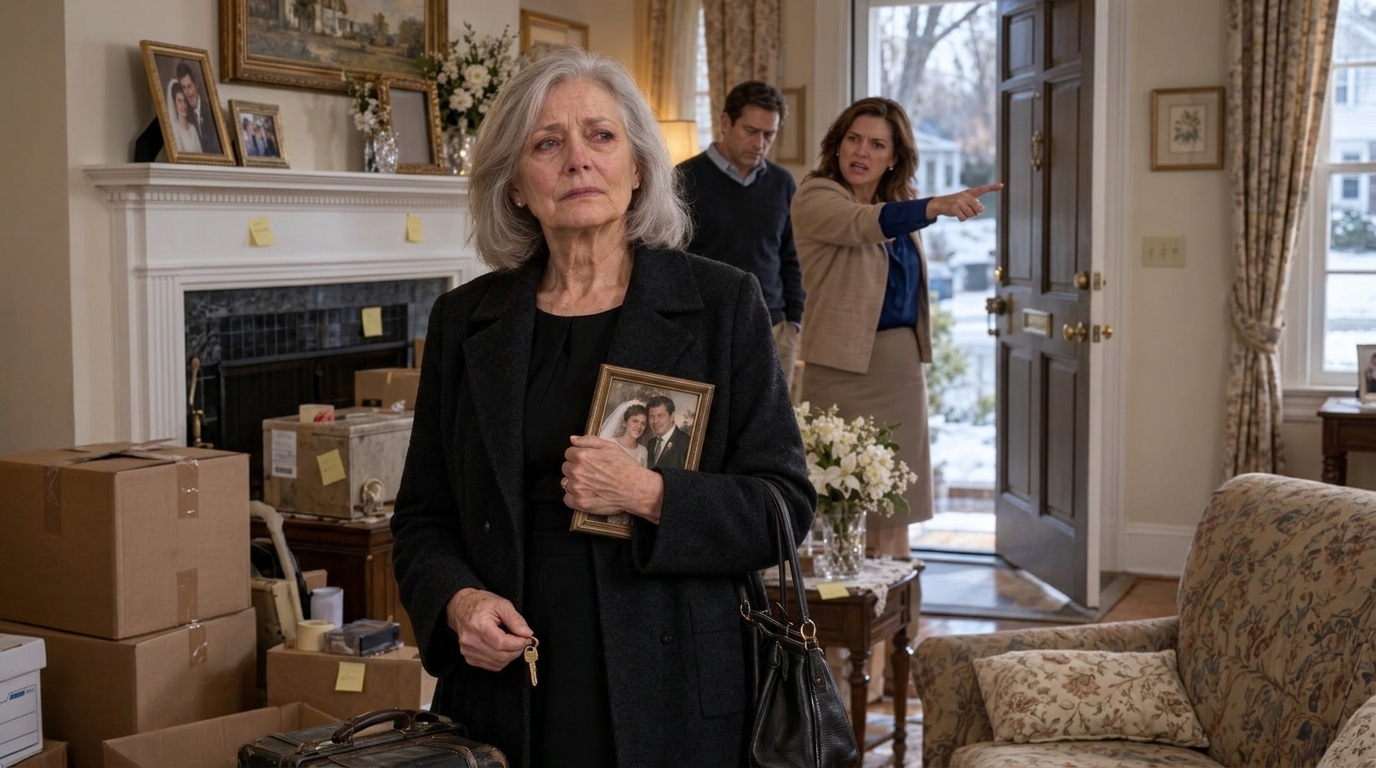
The black dress.
The sympathy flowers.
The yellow sticky notes on the furniture.
Daniel standing silently behind his wife.
And my own voice saying one word.
“Okay.”
At the time, I thought I was surrendering.
I thought I was walking away from everything Harold and I had built.
But I wasn’t.
I was walking toward the life he’d quietly prepared for me.
A life where I could be safe.
Independent.
Respected.
And free.
I looked at the photograph.
“Harold,” I whispered, “you always said I was stronger than I knew.”
A breeze moved across the terrace.
I smiled through tears.
“You were right.”
People sometimes ask whether the twenty-eight million dollars changed my life.
Of course it did.
It gave me financial security.
It gave me choices.
It allowed me to help others.
But the money wasn’t the most important thing Harold left me.
The most important thing was the reminder that I mattered.
That I deserved safety.
That I deserved respect.
And that I didn’t have to beg anyone for a place in my own family.
My son and daughter-in-law thought they were throwing an old widow onto the streets.
They believed I had nowhere to go.
They believed I had nothing.
And they believed my silence meant weakness.
But sometimes silence is simply the moment before someone makes a decision.
Sometimes walking away isn’t surrender.
It’s survival.
And sometimes the people who think they’ve taken everything from you discover that they never understood what you possessed in the first place.
I lost my husband.
I lost the home where we raised our son.
And for a while, I nearly lost my faith in family.
But I found something too.
My independence.
My dignity.
My purpose.
And a future I no longer had to apologize for wanting.
Three months after they told me to go live on the streets, a notice arrived at their door.
They thought it was the beginning of their nightmare.
For me, it was the moment I finally stopped living inside one.
And if there’s one thing I’ve learned, it’s this:
Never mistake an older woman’s quietness for helplessness. Sometimes she’s simply choosing not to reveal how much strength she still has.
I am Margaret Whitmore.
I’m seventy years old.
I’m a widow.
I’m a mother.
I’m a woman who has loved deeply, lost painfully, and learned to stand on her own.
And every morning, when the sunlight fills my penthouse, I look at Harold’s photograph and whisper the same words.
“Thank you for loving me enough to let me live.”
Then I make my coffee.
Open the curtains.
And begin another day.
Not as the woman they threw away.
But as the woman who finally understood that she was never theirs to discard.
THE END THANK YOU FOR READING !!!



