PART 3
For several seconds, I couldn’t speak.
The headlights of passing cars swept across
my windshield while I sat in the roadside parking lot,
gripping my phone so tightly that my fingers ached.
“Michael,” I finally whispered, “what did you just say?”
My son was breathing heavily.
“Mom, please don’t panic.”
“Answer my question.”
There was a long silence.
Then he said,
Lauren took out a loan.
She said you signed the paperwork.
I stared into the darkness.
“How much?”
“Mom—”
“How much, Michael?”
He swallowed.
“Seventy-five thousand dollars.”
I felt as though someone had punched me in the chest.
Seventy-five thousand dollars.
Against the house Robert and I had spent thirty-two years working to own.
The house where we’d raised Michael.
The house where Robert had planted an oak tree in the backyard because he wanted our grandchildren to play beneath its branches.
The house that was supposed to provide security during my retirement.
I closed my eyes.
“Tell me exactly what happened.”
Michael lowered his voice.
“Lauren said she arranged a home equity loan through a private lender. She told me you’d agreed to help us.”
I shook my head, even though he couldn’t see me.
“I never agreed to anything.”
“I know that now.”
“Did you sign anything?”
Another silence.
“Michael?”
“Yes.”
My heart sank.
“What did you sign?”
“Some forms. Lauren said they were related to the loan application.”
I stared at the steering wheel.
“You knew she was borrowing money against my house?”
“I thought you knew!”
His voice cracked.
“She said you’d already signed your part.”
I took a slow breath.
“Did you ever ask me?”
He didn’t answer.
“Michael, did you ever ask me whether I agreed to risk my home for your debts?”
“No.”
The word was barely audible.
I looked at the photograph resting on the passenger seat.
Robert stood beside me on a beach in North Carolina, his arm around my shoulders, smiling into the wind.
It was our last vacation together.
He died eight months later.
I touched the edge of the frame.
“Where did the money go?” I asked.
Michael hesitated.
“Lauren said it was for home improvements and paying off some credit cards.”
“Which home improvements?”
He said nothing.
I thought about the house.
The kitchen still had the same cabinets Robert installed.
The roof had been replaced using my savings.
The furnace had been repaired three winters earlier, and I’d paid that bill too.
There hadn’t been any major renovations.
“Michael?”
“She bought a new car.”
I closed my eyes.
Lauren’s silver luxury SUV.
She’d arrived home with it six months earlier, smiling as she told everyone her promotion prospects were improving.
She claimed she’d received a favorable financing arrangement.
I remembered congratulating her.
“What else?”
“She paid off some debt.”
“How much?”
“I don’t know.”
I felt my anger rising.
“And you never thought to ask?”
“Mom, please. I didn’t know.”
I stared through the windshield.
“You knew enough to sign documents without talking to me.”
He began crying.
“I’m sorry.”
I swallowed.
For years, I’d accepted his apologies as if they were solutions.
When he forgot my birthday.
When he canceled plans because Lauren’s mother needed something.
When he promised to help with repairs and never arrived.
When he watched his wife treat me like an unpaid housekeeper.
But this wasn’t a forgotten birthday.
This was my home.
My financial security.
And possibly a crime.
“Michael,” I said quietly, “I’m going to speak with an attorney tomorrow.”
His breathing quickened.
“Mom, can we just talk first?”
“We are talking.”
“I mean as a family.”
I looked toward the empty road.
“A family?”
My voice trembled.
“Your wife told me I wasn’t family three hours ago.”
He went silent.
“Then she told me to eat leftovers while she celebrated with nearly twenty people.”
“Mom, she didn’t mean—”
“Don’t.”
He stopped.
“Don’t tell me what Lauren meant. I heard her clearly.”
I took another breath.
“And now you’re telling me she may have forged my signature to borrow seventy-five thousand dollars against my house.”
He began crying harder.
“Please don’t do anything tonight.”
I looked at Robert’s photograph.
Then at the road ahead.
“I already did something tonight, Michael.”
“What?”
“I left.”
I ended the call.
And for the first time in seven years, I didn’t feel guilty about putting myself first.
I drove another forty minutes to a small hotel near Dayton.
The receptionist was a young woman with kind eyes and a silver name tag that read Emily.
She looked at my suitcase, then at my tired face.
“Long night?”
I gave a small smile.
“You could say that.”
She handed me a room key.
“Breakfast starts at six-thirty.”
“Thank you.”
As I turned away, she added, “I hope tomorrow is better.”
I stopped.
Such a simple sentence.
Such ordinary kindness.
Yet it nearly brought me to tears.
Because a complete stranger had shown more concern for me in ten seconds than my own family had shown all evening.
Upstairs, I placed my suitcase beside the bed.
The room was quiet.
No laundry waiting.
No dishes in the sink.
No children calling for snacks.
No Lauren shouting from another room because she couldn’t find her favorite blouse.
I sat on the edge of the mattress.
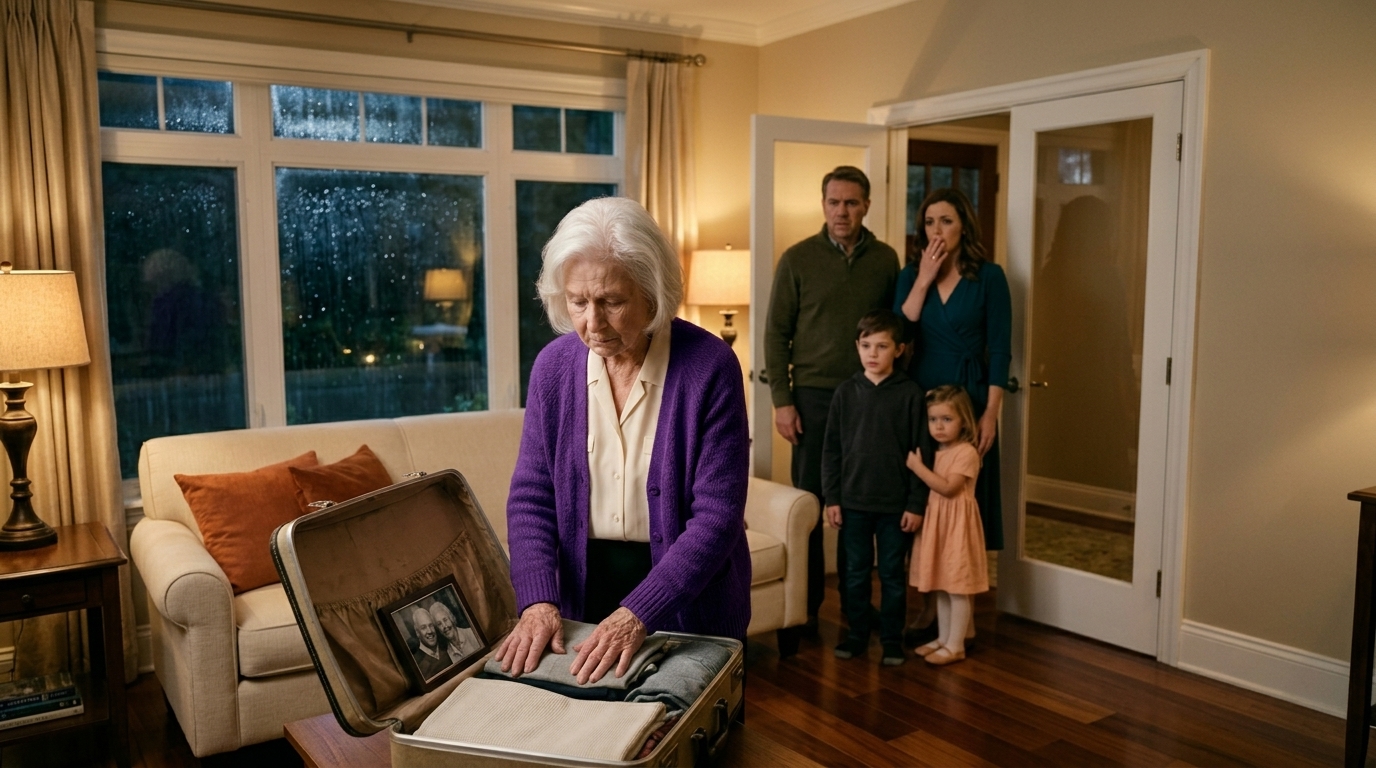
Then I opened the small blue suitcase.
Inside, beneath my folded sweaters, was Robert’s photograph.
I placed it on the nightstand.
“Well, sweetheart,” I whispered, “I finally did it.”
For a moment, I imagined his voice.
About time, Dot.
Robert had always called me Dot.
He was the only person who could make that nickname sound like a love song.
I began crying.
Not quietly.
Not politely.
I cried the way people cry when they’ve spent years swallowing disappointment.
When they realize how much they’ve tolerated.
When the people they love have slowly convinced them that being useful is the same as being valued.
I cried until my chest hurt.
Then I washed my face, changed into my nightgown, and lay down.
At 1:17 a.m., my phone vibrated.
A message from Lauren.
Dorothy, this is ridiculous. You’re embarrassing Michael. Come home tomorrow and we’ll discuss your behavior.
I stared at the screen.
My behavior.
Not the forged signature.
Not the loan.
Not the seven years of unpaid childcare and housework.
My behavior.
I typed a reply.
All future discussions about the house will go through my attorney.
Then I turned off my phone.
And slept better than I had in months.
The next morning, I called my oldest friend, Margaret Ellis.
Margaret and I had worked together at a hospital administration office for nearly twenty-five years.
She’d retired two years before me and now lived in a cheerful little cottage outside Springfield.
When I told her what happened, she didn’t interrupt.
She listened until I finished.
Then she said, “Dorothy, where are you?”
“At a hotel.”
“Pack your things.”
I frowned.
“Margaret—”
“You’re coming here.”
“I don’t want to impose.”
She made an impatient sound.
“Don’t you dare start that nonsense with me.”
I almost laughed.
“Margaret.”
“Dorothy Wilson, I have two empty bedrooms, a refrigerator full of food, and absolutely no patience for people who mistreat my friends.”
Tears filled my eyes.
“I don’t know how long this will take.”
“Then bring enough clothes.”
I laughed through my tears.
For the first time since leaving the house, I felt something other than fear.
I felt relief.
Margaret welcomed me with a hug and a pot of coffee.
Her cottage smelled of cinnamon and fresh bread.
She had placed clean towels in the guest bathroom and a vase of yellow flowers on the dresser.
“You didn’t have to do all this,” I said.
She waved a hand.
“Stop apologizing for existing.”
I smiled sadly.
She looked at me.
“I’m serious, Dorothy.”
I nodded.
“I know.”
After breakfast, Margaret gave me the name of an attorney.
Her niece, Rebecca Collins, handled property disputes, elder financial exploitation, and estate matters.
By noon, I was sitting in Rebecca’s office.
She was a woman in her early forties, with dark hair pulled into a neat bun and a calm, precise manner.
I explained everything.
The house.
Robert’s death.
Michael and Lauren moving in.
The years of unpaid work.
The restaurant celebration.
The document.
And the alleged loan.
Rebecca listened carefully.
Then she asked, “Mrs. Wilson, are you certain the property is titled solely in your name?”
“Yes.”
“Do you have the original deed?”
“I left a copy on the kitchen counter. The original is in my safe-deposit box.”
“Good.”
She nodded.
“Have you ever signed a power of attorney allowing Michael or Lauren to handle your finances?”
“No.”
“Have you ever authorized either of them to borrow against the property?”
“Absolutely not.”
Rebecca folded her hands.
“Then our first priority is to determine whether a loan was actually funded and whether any lien has been recorded.”
I stared at her.
“What happens if Lauren forged my signature?”
“That depends on the evidence. We may be dealing with identity theft, fraud, forged documents, and an attempted or completed improper lien. We’ll need to establish exactly what occurred.”
My hands trembled.
“Could I lose my house?”
Rebecca’s expression softened.
“I’m not going to promise an outcome before we’ve reviewed the documents. But a forged signature does not become valid simply because someone submitted it. We have ways to challenge fraudulent transactions.”
I nodded.
She continued.
“I also want you to contact your bank, review your credit reports, and secure your personal information.”
I swallowed.
“There’s something else.”
Rebecca looked up.
“What?”
“Lauren has had access to my mail for years.”
Her expression became serious.
“Then we need to look carefully at more than just the house.”
By the end of the week, we had uncovered the first layer of the truth.
A private lending company had received an application for a seventy-five-thousand-dollar loan secured by my home.
The paperwork included a photocopy of my driver’s license.
My Social Security number.
My date of birth.
And a signature that resembled mine.
But it wasn’t mine.
I knew that immediately.
The final letter of my last name had a flourish I’d stopped using after developing arthritis in my right hand.
Whoever forged the signature had copied it from an older document.
Rebecca noticed something else.
The application included an email address.
Not mine.
Lauren’s.
The phone number listed for verification also belonged to Lauren.
And the supporting documents included a statement claiming I had agreed to help my son and daughter-in-law consolidate household debt.
I hadn’t.
Rebecca arranged for the lender to preserve the application records, communications, and verification materials.
Then she contacted the county recorder’s office.
The results were troubling.
A lien had been recorded against my property.
My stomach dropped when Rebecca told me.
“But I never signed anything.”
“I know,” she said.
“And that’s why we’re challenging it.”
I stared at the wall.
Robert and I had worked our entire lives to pay off that house.
We celebrated the final mortgage payment with a homemade dinner and a bottle of sparkling cider.
Now someone had placed a financial claim against it without my consent.
Rebecca explained that the lender was reviewing whether its procedures had been followed and whether the transaction involved fraud.
I listened carefully.
Then asked the question that had been haunting me.
“Did Lauren receive the money?”
Rebecca paused.
“Yes.”
I closed my eyes.
“How much?”
“According to the initial records, the full seventy-five thousand dollars was disbursed.”
I felt sick.
Then Rebecca added, “And Dorothy, there’s something else.”
I opened my eyes.
“What?”
“The money wasn’t deposited into a joint account belonging to Michael and Lauren.”
I stared at her.
“Where did it go?”
Rebecca looked down at the report.
“An account held in Lauren’s name.”
My heart began pounding.
“And after that?”
She hesitated.
“Several large transfers were made.”
I swallowed.
“To whom?”
Rebecca looked at me.
“One of the recipients appears to be her mother.”
I sat perfectly still.
Lauren’s mother.
Patricia.
The woman who’d been sitting at the restaurant celebrating her daughter’s promotion.
The woman who’d smiled for photographs while I sat home alone.
I whispered, “How much?”
Rebecca took a slow breath.
“Twenty-eight thousand dollars.”
I stared at her.
And suddenly, I understood that the promotion dinner hadn’t simply been an insult.
It had been a celebration financed, at least in part, by money taken against my home.
But the worst discovery was still waiting.
Because when Rebecca traced the next transfer, she found a name I recognized immediately.
A name that made me realize Lauren had been planning far more than a dinner party.
PART 4
The second transfer was for eighteen thousand dollars.
It went to a business called Hawthorne Event Consulting.
At first, the name meant nothing to me.
Then Rebecca showed me the registration information.
The business owner was Lauren’s sister.
Stephanie.
I stared at the document.
“Her sister?”
Rebecca nodded.
“Yes.”
I thought about Stephanie.
Thirty-six years old.
Always beautifully dressed.
Always talking about starting a business.
Always asking Lauren for favors.
She’d attended the promotion dinner wearing a glittering green dress.
In one photograph, she stood beside Lauren holding a champagne glass.
I remembered the caption.
Celebrating success with the people who matter most.
I had looked at that photograph while sitting alone at my kitchen table.
Now I realized the people who supposedly mattered most had been receiving money from a loan secured against my house.
I looked at Rebecca.
“Did Stephanie know where the money came from?”
“We don’t know yet.”
“And Patricia?”
“We’ll need to determine that too.”
I pressed my hands together.
Rebecca continued.
“It’s important that we distinguish between receiving money and knowingly participating in fraud. The financial records establish where the funds went. They don’t automatically establish what each recipient knew.”
I nodded.
I appreciated her carefulness.
Because I wanted the truth.
Not revenge.
Not rumors.
The truth.
Still, I couldn’t stop thinking about the restaurant.
Nearly twenty people.
Expensive wine.
A private dining room.
Flowers on every table.
Lauren’s mother and sister sitting proudly beside her.
And me, the woman whose home had been used to obtain the money, eating leftovers alone.
Three days later, Michael came to Margaret’s house.
He called first.
I almost refused.
But Rebecca had advised me to avoid discussing the financial investigation without appropriate boundaries.
So I agreed to a brief conversation in Margaret’s living room.
Margaret stayed nearby.
Michael arrived carrying a small bouquet of flowers.
He looked exhausted.
His hair was uncombed.
Dark circles surrounded his eyes.
“Hi, Mom.”
I looked at him.
“Hello, Michael.”
He held out the flowers.
“These are for you.”
I accepted them.
“Thank you.”
Then we sat down.
For a long moment, neither of us spoke.
Finally, Michael whispered, “I miss you.”
My chest tightened.
I missed him too.
I missed the little boy who used to fall asleep on my lap.
The teenager who brought me dandelions because he couldn’t afford Mother’s Day flowers.
The young man who cried at Robert’s funeral.
But the man sitting across from me had watched his wife exclude me from a family celebration and said nothing.
And now my home was entangled in a fraudulent loan.
I took a slow breath.
“Michael, did you know Lauren was borrowing money against my house?”
He looked down.
“I knew she was applying for a loan.”
“Did you know it was secured by my property?”
He hesitated.
“Yes.”
I closed my eyes.
“Then why didn’t you ask me?”
He began crying.
“Because I thought you’d say no.”
The words struck me harder than any excuse could have.
I opened my eyes.
“So you knew I might not agree.”
He nodded.
“And you let her proceed anyway.”
He wiped his face.
“Yes.”
I stared at him.
For years, I had told myself Michael was simply passive.
That Lauren made decisions and he followed.
That he was afraid of conflict.
That he didn’t understand how much his silence hurt me.
But now I saw something I hadn’t wanted to acknowledge.
He wasn’t merely avoiding conflict.
He was benefiting from my sacrifice.
And he was willing to let me bear the consequences.
I whispered, “Michael, your father would be devastated.”
He began sobbing.
“I know.”
I shook my head.
“No. I don’t think you do.”
He looked up.
“Dad worked double shifts to pay off that house.”
“I remember.”
“He repaired the roof himself because we couldn’t afford a contractor.”
Michael nodded.
“He skipped vacations.”
“I know.”
“He drove the same truck for sixteen years.”
Tears streamed down my son’s face.
“And after he died, I kept that house because it was the last place where I could still feel close to him.”
My voice broke.
“You knew that.”
Michael covered his face.
“I know, Mom.”
I wiped my cheeks.
“Then why did you let Lauren use it like a credit card?”
He had no answer.
After a while, Michael lowered his hands.
“Lauren says you’re trying to destroy our marriage.”
I stared at him.
“Is that what she told you?”
He nodded.
“She says you’re punishing her because she didn’t invite you to dinner.”
I almost laughed.
Not because anything was funny.
Because the accusation was so absurd.
“Michael, if this were only about dinner, I would have been hurt. I might have left. I might have demanded better treatment.”
I leaned forward.
“But this is about someone borrowing seventy-five thousand dollars against my home using a signature I didn’t provide.”
He looked away.
“That’s what Rebecca is investigating.”
He nodded.
Then he whispered, “Lauren says the signature was authorized.”
I felt my stomach tighten.
“By whom?”
He hesitated.
“Me.”
I stared at him.
“What?”
“She says I told her you agreed.”
I shook my head.
“Did you?”
He began crying again.
“I told her you probably would.”
I closed my eyes.
There it was.
The terrible difference between assumption and permission.
Between believing your mother will help and deciding her property belongs to you.
I took a long breath.
“Michael, you had no authority to give permission on my behalf.”
“I know.”
“Then stop defending what happened.”
He looked down.
“I don’t know what to do.”
I watched him.
For thirty-nine years, I’d rushed to solve his problems.
When he forgot homework.
When he missed deadlines.
When he couldn’t pay a bill.
When he and Lauren needed childcare.
I’d stepped in.
Again and again.
But this time, I couldn’t rescue him without sacrificing myself.
So I said something he’d never heard from me before.
“You need to figure that out.”
He looked up.
“Mom?”
“I love you.”
His eyes filled.
“But I’m not going to fix this for you.”
The following week, Rebecca called with an update.
The lender had begun a formal fraud review.
The recorded lien was being challenged.
The financial records had been preserved.
And law enforcement had received information concerning the suspected forged documents.
Then she told me something unexpected.
“Dorothy, we’ve located an email Lauren sent to the lender.”
I sat down.
“What did it say?”
Rebecca read part of it.
Lauren had described me as elderly, confused, and unable to manage complicated financial decisions.
She claimed I had asked her to handle the paperwork because I was becoming forgetful.
I stared at the wall.
Forgetful.
Confused.
Unable to manage my affairs.
I thought about all the things I’d done for Lauren.
I’d managed her children’s schedules.
Handled grocery shopping.
Organized medical appointments.
Paid household bills when she and Michael were short.
Prepared meals.
Kept track of school forms.
Remembered birthdays.
Maintained the house.
Yet when it suited her, she described me as incapable.
Rebecca continued.
“There may also have been an attempt to establish broader financial authority.”
My heart sank.
“What do you mean?”
“Lauren requested information about obtaining a power of attorney.”
I closed my eyes.
A power of attorney.
If she’d succeeded in convincing me to sign one granting broad authority, she might have gained access to far more than the house.
My bank accounts.
My savings.
My financial decisions.
I remembered something.
Six months earlier, Lauren had brought me a folder.
She said it contained emergency medical paperwork.
“It’s just in case something happens,” she’d explained.
I remembered flipping through the pages.
One document had mentioned financial authority.
I asked why it was included.
Lauren laughed.
“It’s standard, Dorothy. Don’t worry about it.”
I hadn’t signed.
I’d told her I wanted my own attorney to review everything.
She became irritated.
For two days afterward, she barely spoke to me.
At the time, I thought she was offended because I didn’t trust her.
Now I realized my hesitation may have protected me.
I told Rebecca.
She made a note.
Then said, “Dorothy, you were right to have those documents reviewed before signing.”
I looked toward Robert’s photograph.
For years, I’d believed I was being difficult whenever I questioned Lauren.
Now I understood that asking questions wasn’t disloyal.
It was sensible.
The investigation moved slowly.
Weeks passed.
Then months.
During that time, I remained with Margaret while Rebecca helped me take the proper legal steps concerning the house.
Because Michael and Lauren had lived there for years, removing them wasn’t as simple as changing the locks.
They had occupancy rights that needed to be addressed through the appropriate process.
I followed Rebecca’s advice.
Written notices were served.
Deadlines were established.
And when Lauren refused to cooperate, the matter went before the court.
At the hearing, Lauren appeared wearing a pale pink suit.
She looked polished.
Confident.
Almost cheerful.
Her attorney argued that she and Michael had made the house their family home and had contributed to household expenses.
That was partly true.
They had paid for groceries occasionally.
Michael had helped with repairs.
Lauren had purchased furniture.
But none of that changed the deed.
And none of it gave them permission to borrow against my property.
Rebecca presented the ownership records.
The occupancy history.
And the evidence showing that I had not agreed to transfer ownership.
The judge reviewed the documents.
Then asked Lauren a question.
“Mrs. Wilson, do you claim that Dorothy Wilson transferred ownership of the property to you?”
Lauren hesitated.
“No.”
“Do you claim to hold a valid lease granting you indefinite occupancy?”
“No.”
“Then on what basis do you believe you may remain after the lawful termination of your occupancy?”
Lauren looked toward Michael.
He stared at the floor.
For the first time, she had no easy answer.
The court ultimately ruled in my favor on the occupancy dispute.
Michael and Lauren were required to leave according to the court’s order.
The separate investigation into the loan continued.
I didn’t attend every proceeding.
I didn’t want my life to become an endless series of arguments.
But I attended the day the house was finally returned to my control.
Margaret came with me.
Rebecca met us outside.
The driveway was empty.
Lauren’s SUV was gone.
The children’s bicycles were gone.
The porch furniture had been removed.
I stood at the front door holding my keys.
For a moment, I couldn’t move.
Margaret touched my arm.
“Dorothy?”
I nodded.
Then I unlocked the door.
The house smelled unfamiliar.
Several rooms were empty.
There were marks on the walls where pictures had hung.
The living room carpet needed cleaning.
But the house was still standing.
And it was mine.
I walked into the kitchen.
The same kitchen where I’d cooked thousands of meals.
Where I’d packed school lunches.
Where I’d waited for everyone to come home.
Where Lauren had told me to heat up leftovers.
I stood beside the counter.
Then I opened the refrigerator.
It was nearly empty.
A bottle of ketchup.
A carton of milk.
A forgotten jar of pickles.
I stared at the shelves.
Then I began laughing.
Margaret looked concerned.
“Dorothy?”
I laughed harder.
Then tears came.
Because for seven years, my life had revolved around feeding everyone else.
Now the refrigerator was empty.
And for the first time, I could fill it with whatever I wanted.
That evening, I ordered dinner from my favorite Italian restaurant.
I ate at the kitchen table.
Alone.
But not lonely.
I chose exactly what I wanted.
Chicken piccata.
Garlic bread.
And a slice of lemon cake.
No one complained.
No one asked me to make something different.
No one expected me to clear their plate.
I washed my own dishes.
Then sat on the porch beneath Robert’s oak tree.
The branches swayed gently in the evening breeze.
I looked toward the sky.
“Well, sweetheart,” I whispered, “I’m home.”
And for the first time since he’d died, the house felt like a place where I could begin living again.
But the story wasn’t finished.
Because three days later, Rebecca called with news that changed everything.
The lender’s internal investigation had uncovered evidence that the signature on the loan documents was not mine.
And one of the communications submitted with the application contained a recording.
A recording of Lauren discussing how she planned to get me to leave the house permanently.
When Rebecca told me what Lauren had said, I sat down so suddenly that my knees struck the kitchen table.
Because the woman I’d treated like a daughter hadn’t simply wanted my money.
She had wanted me gone.
PART 5
The recording was less than two minutes long.
It came from a business call preserved by the lending company during the application process.
Lauren had apparently believed she was speaking informally with a loan representative.
She didn’t realize the call would later become part of a fraud investigation.
Rebecca arranged for me to hear the relevant portion at her office.
I sat across from her, my hands folded in my lap.
“Dorothy,” she said gently, “you don’t have to listen to this.”
I looked at her.
“Yes, I do.”
She nodded.
Then pressed play.
Lauren’s voice filled the room.
Confident.
Impatient.
Familiar.
“The house is basically ours,” she said. “Dorothy’s just living there because Michael feels guilty about putting her somewhere else.”
I felt my stomach tighten.
The representative asked whether I had agreed to the loan.
Lauren laughed.
“She’ll agree to whatever Michael asks. She always does.”
I closed my eyes.
Then came the sentence that made my blood run cold.
“Once we get the money sorted out, I’m going to convince Michael it’s time to move her into assisted living. She doesn’t need that big house.”
I stared at the recorder.
The representative asked whether I had been informed of those plans.
Lauren replied, “Not yet. But honestly, she doesn’t have much say. She’s getting older, and Michael is her only child.”
Rebecca stopped the recording.
The room went silent.
I stared at the table.
For seven years, I’d cooked Lauren’s meals.
Washed her clothes.
Cared for her children.
Kept her home running.
And all that time, she’d been planning how to remove me from the house I’d paid for.
I whispered, “She wanted to put me somewhere else.”
Rebecca nodded.
“That’s what she said.”
I looked up.
“Even though the house belongs to me.”
“Yes.”
I shook my head.
“Why?”
Rebecca’s expression softened.
“I can’t tell you what she was thinking. But the evidence suggests she wanted control of the property without your involvement.”
I looked toward the window.
For a long moment, I said nothing.
Then I whispered, “Robert knew.”
Rebecca frowned.
“What do you mean?”
I opened my handbag.
Inside was the letter I’d taken from the nightstand.
The letter Robert had written before he died.
I unfolded it carefully.
The paper was worn along the creases.
I’d read it dozens of times.
But now one paragraph seemed to glow from the page.
Dot, you’ve spent your life giving people the benefit of the doubt. That’s one of the things I love most about you. But promise me you’ll never confuse being needed with being loved.
I swallowed.
Then continued.
Our home is yours because I want you to have security. Not because I expect you to sacrifice it for anyone else.
I pressed the letter against my chest.
Robert hadn’t known exactly what would happen.
He hadn’t predicted Lauren’s behavior.
But he knew me.
He knew how easily I put others first.
And he had tried to protect me from the part of myself that believed love meant never saying no.
The criminal investigation eventually resulted in charges against Lauren related to the fraudulent loan documents.
The authorities also examined Michael’s role.
He had signed supporting paperwork and had failed to verify my consent.
But the evidence showed that Lauren had submitted the forged signature and directed the loan proceeds.
Michael cooperated with investigators.
He provided messages.
Emails.
And records of conversations with Lauren.
It was a painful process.
Their marriage began falling apart almost immediately.
Lauren accused him of betrayal.
Michael accused her of lying.
And for the first time, my son was forced to face the consequences of allowing his wife to make decisions that affected other people.
I didn’t celebrate.
I didn’t feel victorious.
I felt exhausted.
Because nobody wins when a family reaches that point.
But I also knew something important.
The truth had to matter more than appearances.
The lender ultimately agreed to release the fraudulent lien after its investigation confirmed that I had not authorized the transaction.
The recorded lien was discharged.
My home was no longer tied to Lauren’s debt.
I remember the day Rebecca called with the news.
I was standing in the backyard, trimming the roses Robert had planted.
My phone rang.
“Dorothy,” she said, “I have good news.”
I held my breath.
“The lien has been released.”
For a moment, I couldn’t speak.
Then I whispered, “It’s over?”
“The property issue is resolved. There are still separate proceedings involving the loan and the people responsible, but your home is no longer encumbered by that lien.”
I sank onto the garden bench.
Tears streamed down my face.
“Thank you.”
Rebecca’s voice softened.
“You did the hard part, Dorothy.”
I shook my head.
“No. You helped me.”
She laughed gently.
“That’s what I’m here for.”
When we ended the call, I looked toward the oak tree.
Its leaves rustled in the breeze.
I imagined Robert standing beside me.
Smiling.
Proud.
And for the first time in a long while, I felt completely safe.
Michael asked to meet me a month later.
I agreed.
We chose a small café near the park.
He arrived early.
When I walked in, he stood immediately.
“Hi, Mom.”
“Hello, Michael.”
He looked thinner.
Older.
There were lines around his eyes I hadn’t noticed before.
We sat down.
For a while, we talked about ordinary things.
The weather.
The children.
His job.
Then he took a deep breath.
“Mom, I owe you an apology.”
I looked at him.
He continued.
“Not just for the loan.”
I remained silent.
“For everything.”
His eyes filled.
“For letting Lauren treat you like a servant.”
I swallowed.
“For watching you cook and clean and take care of our kids while we acted like you were lucky to live with us.”
He wiped his face.
“For not inviting you to dinner.”
I looked down.
That still hurt.
More than I wanted to admit.
He continued.
“When Lauren said it was family only, I should have stood up for you.”
“Yes,” I whispered.
“I should have told her you were family.”
Tears slipped down my cheeks.
“I should have told her there wouldn’t be a celebration without you.”
I looked at him.
“But you didn’t.”
He nodded.
“No.”
For a long moment, neither of us spoke.
Then he whispered, “I was a coward.”
I looked toward the window.
“I don’t need you to call yourself names, Michael.”
He looked up.
“I need you to understand what you did.”
He nodded.
“I do.”
I took a slow breath.
“Do you?”
He looked at me.
I continued.
“You didn’t just let Lauren hurt me. You benefited from it.”
He lowered his eyes.
“I know.”
“You let me become the person who handled everything nobody else wanted to do.”
“Yes.”
“And when I was excluded, you left anyway.”
His voice broke.
“I know.”
I wiped my cheeks.
“That’s what I need you to understand.”
He nodded slowly.
Then he whispered, “I’m sorry, Mom.”
I looked at him for a long time.
Then I said, “Thank you.”
He began crying.
I reached across the table and touched his hand.
Just briefly.
Then I let go.
Because I loved my son.
But I was no longer willing to make his comfort more important than my dignity.
Over the following months, Michael made changes.
He moved into a small apartment.
He began managing his own household.
He learned to cook meals.
Do laundry.
Keep track of school schedules.
And care for his children without expecting me to step in.
The first time he called to ask how to remove a stain from a school uniform, I almost laughed.
For years, I’d done those things automatically.
Now he was learning.
I gave him instructions.
Then I said, “You can handle it.”
He chuckled.
“I’m trying.”
“Good.”
I hung up smiling.
Because helping him learn was different from doing everything for him.
And I was finally beginning to understand the difference.
The children were the hardest part.
My grandchildren, Emma and Noah, were nine and six.
They didn’t understand the legal problems.
They only knew Grandma had moved out.
And Mom and Dad were no longer living together.
One afternoon, Michael brought them to visit.
Emma ran into my arms.
“Grandma!”
I hugged her tightly.
“Oh, sweetheart.”
Noah wrapped his arms around my legs.
“Are you coming back to live with us?”
My heart broke.
I knelt beside him.
“No, honey.”
His face fell.
“Why?”
I looked at Michael.
He nodded gently.
I turned back to Noah.
“Because Grandma needs her own home.”
He frowned.
“But this was our house.”
I swallowed.
“This has always been Grandma’s house. I let your family live here for a while.”
Emma looked confused.
“Did we do something wrong?”
I pulled both children close.
“No.”
My voice trembled.
“Absolutely not.”
I kissed Emma’s forehead.
“You two didn’t do anything wrong.”
Noah looked up.
“Can we still come over?”
I smiled through tears.
“Of course.”
His face brightened.
“Can we bake cookies?”
I laughed.
“Yes.”
Emma hugged me tighter.
“Can we stay overnight sometimes?”
I looked at Michael.
He nodded.
I smiled.
“Sometimes.”
And just like that, the children reminded me that love didn’t have to disappear simply because the adults had made terrible mistakes.
I established new boundaries.
The grandchildren could visit.
Michael could come by when invited.
But nobody had unrestricted access to my home.
Nobody had permission to use my financial information.
And nobody could make decisions about my property without my consent.
I also updated my estate plan with Rebecca’s help.
I wanted my wishes to be clear.
I wanted the grandchildren protected.
And I wanted to make sure nobody could use guilt or pressure to override my decisions.
For the first time, I understood that planning for the future wasn’t unkind.
It was responsible.
Lauren’s case eventually reached a resolution.
She admitted responsibility for submitting fraudulent documents and misrepresenting my authorization.
The court imposed a sentence that included financial restitution obligations and other penalties.
The exact consequences were determined by the evidence and the court’s assessment of her conduct.
Patricia and Stephanie were questioned about the money they’d received.
Investigators reviewed whether they knew the funds had been obtained improperly.
Some money was recovered.
Other amounts became part of the restitution proceedings.
I didn’t follow every argument.
I didn’t attend every hearing.
I had spent enough years allowing Lauren to occupy my thoughts.
Now I wanted to live.
The first thing I did was repaint the kitchen.
For years, Lauren had insisted on pale gray walls.
She said they looked modern.
I had always preferred yellow.
Robert used to call it the color of sunshine.
So I bought paint.
A warm, buttery yellow.
Margaret came over with rollers and old clothes.
We spent an entire Saturday painting.
By evening, the kitchen glowed.
Margaret stood in the doorway.
“Well?”
I smiled.
“It’s perfect.”
She laughed.
“Looks like you.”
I looked around.
And realized she was right.
For years, I’d lived in my own house as though I were a guest.
Now every room reflected me again.
I turned the spare bedroom into a reading room.
I replaced the heavy curtains with light ones.
Brought in a comfortable chair.
And filled the shelves with books I’d been meaning to read.
I planted herbs beside the kitchen window.
Started attending a local gardening club.
And joined a walking group that met every Tuesday morning.
I made friends.
Real friends.
People who invited me because they enjoyed my company.
Not because they needed someone to babysit.
Or cook.
Or clean.
Or solve their problems.
One afternoon, a woman from the walking group asked whether I wanted to join them for lunch.
I almost said no.
I had laundry waiting.
Then I stopped.
The laundry could wait.
So I went.
We ate sandwiches at a little café.
Talked about books.
Laughed about our grandchildren.
And planned a weekend trip to a nearby lake.
It was such an ordinary afternoon.
Yet I drove home feeling happier than I had in years.
Because I had finally remembered that I was allowed to have a life of my own.
On what would have been Robert’s seventy-second birthday, I visited his grave.
I brought yellow roses.
His favorite.
I sat on the bench beside the headstone and told him everything.
About the house.
The loan.
The investigation.
Michael’s apology.
The children.
The yellow kitchen.
The reading room.
And the friends I’d made.
Then I took out his letter.
The one I’d left on the kitchen counter that terrible night.
I read the final paragraph aloud.
Dot, if the day ever comes when you feel invisible in your own home, remember that you are not there to earn your place. You already belong.
My voice broke.
I pressed the paper against my chest.
“You were right, sweetheart.”
A breeze moved through the trees.
I smiled through tears.
“And I finally listened.”
A year after I left that restaurant celebration behind, Michael invited me to dinner.
Not at his apartment.
Not at my house.
At a small Italian restaurant downtown.
He called two weeks in advance.
“Mom, I’d like to take you out.”
I smiled.
“What’s the occasion?”
He hesitated.
“Nothing special.”
Then he added, “I just want to spend time with you.”
My throat tightened.
For years, I’d been invited only when someone needed help.
Now my son was asking because he wanted my company.
I agreed.
When I arrived, Michael was waiting outside.
Emma and Noah stood beside him.
Emma held a bouquet of flowers.
Noah carried a handmade card.
“Grandma!” they shouted.
I hugged them.
Then Michael opened the restaurant door.
“After you, Mom.”
Inside, the hostess led us to a table near the window.
There were four place settings.
One for Michael.
One for Emma.
One for Noah.
And one for me.
I looked at my son.
He smiled nervously.
“Family dinner.”
My eyes filled with tears.
He pulled out my chair.
“Everyone who belongs here is invited.”
For a moment, I couldn’t speak.
Then I sat down.
And smiled.
Not because someone told me to.
Not because I was trying to keep the peace.
But because I genuinely wanted to.
During dinner, Emma told me about a school project.
Noah showed me a drawing of a dinosaur.
Michael asked about my walking group.
Nobody asked me to cook.
Nobody handed me a list of chores.
Nobody treated me like an inconvenience.
We simply enjoyed being together.
After dessert, Michael looked at me.
“Mom?”
“Yes?”
He took a breath.
“I know one dinner doesn’t make up for everything.”
I nodded.
“No.”
“But I wanted you to know something.”
I waited.
He looked toward the children.
Then back at me.
“You were never just someone who helped us.”
His voice trembled.
“You were the reason our lives worked.”
I felt tears slip down my cheeks.
He continued.
“And I was too selfish to see it.”
I reached for his hand.
“Michael, I don’t need you to spend the rest of your life feeling guilty.”
He nodded.
“I know.”
“I need you to be different.”
He smiled sadly.
“I’m trying.”
I squeezed his hand.
“I can see that.”
And for the first time in a long while, I believed we might eventually build a healthier relationship.
Not the one we had before.
That one had been built on my endless giving and his endless taking.
Something new.
Something balanced.
Something honest.
Today, I still live in the house Robert and I bought together.
The oak tree in the backyard has grown taller.
The kitchen walls are yellow.
My reading room is full of books.
And the refrigerator contains food I actually enjoy eating.
Sometimes the grandchildren visit.
Sometimes Michael comes for Sunday lunch.
Sometimes I spend an entire weekend alone, reading, gardening, or visiting friends.
And I no longer apologize for any of it.
My house is peaceful.
My finances are secure.
And my life belongs to me.
I still think about the night Lauren celebrated her promotion.
The fancy restaurant.
The photographs.
The nearly twenty guests.
The message she sent at 9:30 p.m.
Heat up the leftovers in the fridge. Don’t waste them.
I remember staring at those words.
I remember typing:
Ok.
Two letters.
No argument.
No explanation.
No warning.
Just two letters.
Then I packed my suitcase.
At the time, I thought I was simply leaving a place where I wasn’t appreciated.
I didn’t realize I was about to uncover a fraudulent loan, reclaim my home, and change the way my family treated me forever.
But sometimes, the smallest decision begins the biggest transformation.
Sometimes, leaving quietly says more than a thousand arguments.
And sometimes, the people who treat you as invisible only recognize your value after you stop making their lives comfortable.
Last Sunday, I was sitting on the porch when Emma came outside carrying two glasses of lemonade.
She handed me one.
“Grandma?”
“Yes, sweetheart?”
She sat beside me.
“Can I ask you something?”
“Of course.”
She looked toward the oak tree.
“Why did you stop living with us?”
I took a slow breath.
I had answered a simpler version of that question before.
But Emma was older now.
She understood more.
I wanted to be honest without burdening her with adult problems.
So I said, “Because sometimes people who love each other need different homes to have healthy relationships.”
She thought about that.
“Did you stop loving us?”
My heart tightened.
“Oh, Emma.”
I put my arm around her.
“Never.”
She leaned against me.
“Then why?”
I looked toward the garden.
“Because Grandma needed to remember that she mattered too.”
Emma was quiet.
Then she nodded.
“That makes sense.”
I smiled.
“Does it?”
She looked up.
“Yes.”
Then she said something I’ll never forget.
“Grandma, you should always matter.”
Tears filled my eyes.
I hugged her tightly.
“Thank you, sweetheart.”
She smiled.
Then ran inside to find her brother.
I sat there for a long time afterward.
Thinking about those words.
You should always matter.
Such a simple truth.
Yet it had taken me years to believe it.
People sometimes ask whether I regret leaving that night.
My answer is always the same.
No.
I regret staying silent for so long.
I regret believing that being useful was the same as being loved.
I regret teaching my family, through my own willingness to sacrifice, that my needs could always come last.
But I don’t regret leaving.
I don’t regret protecting my home.
And I don’t regret demanding respect.
Because the truth is, I wasn’t asking for much.
I wasn’t asking Lauren to throw me a party.
I wasn’t asking for expensive gifts.
I wasn’t asking for special treatment.
I simply wanted to be treated like a member of the family I’d spent years caring for.
A place at the table.
A little gratitude.
A little kindness.
And the security of knowing the home Robert left me would remain mine.
When Lauren told me the restaurant was for family only, she thought she was reminding me of my place.
What she didn’t understand was that I was finally ready to choose a different one.
Not at the edge of someone else’s life.
Not in the kitchen waiting for leftovers.
Not in a house where my name was on the deed but my feelings didn’t matter.
I chose a place where I was respected.
Where my kindness wasn’t exploited.
Where my presence was welcomed.
And where I didn’t have to earn the right to belong.
Every evening, before I go to bed, I walk through my house and turn off the lights.
I pass the kitchen.
The living room.
The photographs of Robert.
The staircase where Michael used to sit as a child.
And the small table beside the front door.
On that table sits a framed photograph from my wedding day.
Robert and I are standing outside the church.
He’s wearing a dark suit.
I’m holding white roses.
We’re both smiling.
Beside it is the letter he left me.
I keep it there because I never want to forget what he tried to teach me.
That love should make you feel safe.
That family should make room for you.
And that generosity should never require surrendering your dignity.
Sometimes I touch the frame and whisper, “We did it, Robert.”
Because we did.
We built a home.
We raised a son.
We created a life.
And even after he was gone, the love he left behind helped me find the courage to protect what we’d built.
I am Dorothy Wilson.
I’m seventy-one years old.
I’m a widow.
A mother.
A grandmother.
And a woman who finally learned that her worth doesn’t depend on how much she does for other people.
I still cook.
But only when I want to.
I still help my family.
But not at the expense of my security.
I still love my son.
But I no longer confuse loving him with rescuing him from every consequence.
And I still believe in family.
Just not the kind that demands endless sacrifice from one person while everyone else enjoys the benefits.
I believe in the kind of family that makes room at the table.
The kind that notices when someone is missing.
The kind that says thank you.
The kind that understands love is not a license to take.
That night, Lauren celebrated her promotion with nearly twenty people.
Her mother was there.
Her sister was there.
Her coworkers were there.
Even strangers were there.
Everyone except me.
But when I packed my suitcase and drove away, I discovered something far more important than an invitation.
I discovered that I didn’t have to stay where I was treated as though I didn’t belong.
And the woman who once sat alone eating leftovers now sits at her own table, in her own home, surrounded by people who are genuinely happy she’s there.
Because sometimes the most powerful thing you can say isn’t a dramatic speech.
Sometimes it’s just two letters.
“Ok.”
And then you quietly choose yourself.
THE END THANK YOU FOR READING !!!



