PART 3
“Someone has been hiding the truth about your family for fourteen years.”
Andrew Collins placed the sealed envelope on the coffee table.
I stared at it.
For a moment, I couldn’t hear anything except the ticking of
the grandfather clock beside the fireplace.
Fourteen years.
Fourteen years since I’d stood beside two coffins,
believing my daughter and granddaughter were gone forever.
Fourteen years of birthdays I never celebrated.
Christmas mornings I spent alone.
Nights when I woke reaching for people who weren’t there.
And now a stranger was telling me that the little girl
I’d spent thirteen hours operating on was my great-granddaughter.
I looked at the elderly woman.
“Who are you?”
She swallowed.
“My name is Margaret Whitfield.”
I waited.
“My son was engaged to your daughter, Rebecca.”
The room seemed to shift beneath my feet.
“Rebecca wasn’t engaged.”
Margaret lowered her eyes.
“Not officially. They were planning to tell you.”
I shook my head.
“No. My daughter told me everything.”
Margaret looked at me with such sadness that I felt my stomach tighten.
“Did she, Doctor?”
I opened my mouth.
Then closed it.
Rebecca had been twenty-six when she died.
She was independent, stubborn, and fiercely protective of the people she loved.
We had been close.
Or at least, I believed we had.
She called me every Sunday.
She brought groceries when I worked too many shifts.
She teased me about living at the hospital.
But there had been a period during the final months of her life when she’d become strangely quiet.
She canceled dinners.
Stopped answering some of my calls.
And once, when I asked whether everything was all right, she started crying.
I remembered exactly what she’d said.
“Dad, sometimes people make decisions because they’re afraid of what will happen if they tell the truth.”
I’d assumed she was having trouble at work.
Now I wasn’t sure of anything.
I looked at Margaret.
“Your son. What’s his name?”
“Jonathan Whitfield.”
“And where is he?”
Her expression crumpled.
“He died eleven years ago.”
I stared at her.
“How?”
“An accident at a construction site.”
She pressed a tissue against her eyes.
“He spent the last three years of his life searching for answers about Rebecca.”
I felt cold.
“Answers about what?”
Margaret looked toward Andrew.
He nodded.
Then she said, “About what really happened the night your daughter died.”
I sat down because my knees would no longer support me.
Andrew opened the envelope.
Inside were photographs, hospital records, birth certificates, and several handwritten letters.
He placed the first photograph in front of me.
Rebecca.
My Rebecca.
She was sitting on a park bench, wearing a yellow summer dress.
Beside her was a young man with dark hair and a gentle smile.
Jonathan.
His arm rested around her shoulders.
She looked happy.
So happy that the sight of her face nearly broke me.
I touched the photograph.
“Where was this taken?”
“At Riverside Park,” Margaret whispered. “Jonathan took her there the day he proposed.”
I looked up.
“Proposed?”
Margaret nodded.
“She said yes.”
My throat tightened.
“She never told me.”
Margaret hesitated.
“She wanted to.”
I stared at her.
“Then why didn’t she?”
Margaret’s eyes filled.
“Because she was afraid you’d be disappointed.”
I felt as though someone had struck me.
“Disappointed?”
Andrew leaned forward.
“Dr. Miller, before we continue, I need you to understand that some of these records are still being verified. We don’t want to tell you anything as fact that the documents don’t support.”
I nodded numbly.
He slid another photograph toward me.
Rebecca stood in a hospital room holding a newborn baby.
A tiny girl wrapped in a pink blanket.
I stared at the photograph.
My breathing stopped.
“Who is that?”
Margaret whispered, “Your granddaughter.”
I shook my head.
“No.”
The baby had dark hair.
A small nose.
A tiny hand curled against Rebecca’s chest.
I recognized the blanket.
It was the same kind I’d bought when Rebecca told me she was pregnant.
I had purchased two blankets.
One pink.
One white.
I remembered laughing when she said I was spoiling a child who hadn’t even been born.
My eyes filled.
“I buried her.”
Margaret leaned forward.
“No, Doctor.”
I looked at her.
“Your granddaughter survived.”
I stared at the photograph.
“Then whose funeral did I attend?”
Nobody answered immediately.
Finally, Andrew spoke.
“The records suggest there was a serious error in how the deaths and surviving infant were identified after the crash. There are also indications that someone deliberately prevented the information from reaching you.”
I felt sick.
“Who?”
He looked at Margaret.
She closed her eyes.
Then whispered, “My husband.”
Her name was Evelyn Whitfield.
That was what Margaret told me next.
My granddaughter.
The baby I’d believed was dead.
The child whose tiny coffin I’d stood beside.
She had been named Evelyn after Rebecca’s grandmother.
And she’d survived the accident.
I stared at the birth certificate.
Evelyn Rebecca Whitfield.
Mother: Rebecca Miller.
Father: Jonathan Whitfield.
My hands trembled.
“How did this happen?”
Margaret took a deep breath.
“Rebecca and Jonathan had been having problems with my husband, Charles.”
I looked at her.
“What kind of problems?”
“Charles believed Jonathan should marry someone from a wealthy family. Someone who could help expand the Whitfield business.”
She swallowed.
“He didn’t approve of Rebecca.”
My jaw tightened.
“Because she was my daughter?”
Margaret nodded.
“Because she was a nurse. Because she didn’t come from the kind of family Charles wanted connected to ours.”
I stared at her.
“My daughter was an extraordinary woman.”
“I know.”
“She worked two jobs while finishing nursing school.”
Margaret began crying.
“I know.”
“She spent weekends volunteering at children’s hospitals.”
“I know, Doctor.”
My voice broke.
“And she was worth more than every dollar your husband ever made.”
Margaret covered her face.
“You’re right.”
For a moment, I wanted to stand up and leave.
I wanted to go home.
I wanted the world to make sense again.
But then I looked at the photograph.
My granddaughter.
Alive.
Somewhere in the world.
I forced myself to ask the question.
“Where is Evelyn now?”
Margaret lowered her hands.
Her face was pale.
“That’s what we’ve been trying to tell you.”
I stared at her.
Andrew spoke carefully.
“Evelyn was one of the adults in yesterday’s accident.”
The room went silent.
I felt the blood drain from my face.
“No.”
Andrew looked down.
“I’m sorry.”
I shook my head.
“No. You said she survived.”
“She survived the accident fourteen years ago.”
I stared at him.
“Yesterday?”
He nodded.
“She was driving.”
My chest tightened so violently that I pressed a hand against it.
I had spent thirteen hours operating on a five-year-old girl.
A child who looked like my granddaughter.
A child whose face had awakened memories I’d spent fourteen years trying to bury.
And while I was fighting to save her life, my granddaughter had been lying dead somewhere in the same hospital.
I stood abruptly.
“Why didn’t anyone tell me?”
Andrew rose.
“Doctor—”
“Why?”
My voice echoed through the room.
Margaret began crying.
“We only confirmed the connection after the accident. We were trying to reach you.”
I turned away.
I couldn’t breathe.
I was a surgeon.
I’d spent more than thirty-five years standing between patients and death.
I’d held pressure on bleeding arteries.
I’d repaired shattered organs.
I’d made impossible decisions in operating rooms.
But none of that training prepared me for the realization that my granddaughter had lived fourteen years without me.
And now she was gone.
Again.
I pressed both hands against my face.
“Oh, Rebecca.”
My voice cracked.
“Oh, sweetheart. What happened to our family?”
I don’t know how long I stood beside that fireplace.
Eventually, Margaret approached.
She didn’t touch me.
She simply stood nearby.
“I’m sorry,” she whispered.
I lowered my hands.
“Tell me everything.”
She nodded.
And she did.
After Rebecca’s accident, Charles Whitfield had taken control of the situation.
Jonathan was working overseas at the time.
Margaret had been recovering from surgery.
Charles told the family that Rebecca had died and the baby had been placed temporarily in protective care because of confusion surrounding the accident.
By the time Jonathan returned, the infant had been moved into a private guardianship arrangement.
Charles claimed he was trying to protect the child.
But according to documents Margaret later discovered, he had concealed information from Jonathan and prevented contact with me.
He also controlled the correspondence between the hospitals, legal representatives, and family members.
“Why?” I asked.
Margaret looked ashamed.
“Because Charles didn’t want Jonathan raising Rebecca’s daughter.”
I stared at her.
“His own granddaughter?”
She nodded.
“He believed the child would keep Jonathan connected to Rebecca’s family. He wanted Jonathan to move on.”
My hands curled into fists.
“What happened to the baby?”
“She was placed with a couple named Daniel and Susan Parker.”
I stared at her.
“Adopted?”
“Eventually, yes. But the process appears to have involved serious irregularities.”
Andrew leaned forward.
“We’re still examining the legal records. There may have been misrepresentations concerning family consent and notification.”
I looked at him.
“Did Jonathan know?”
Margaret shook her head.
“Not at first.”
She wiped her eyes.
“He spent months trying to find his daughter. Charles told him the adoption had been finalized and there was nothing he could do.”
My throat tightened.
“And he believed him?”
“Until he found evidence that Charles had lied.”
I looked at the photographs.
“Then what?”
Margaret’s voice broke.
“He started investigating.”
She reached for another envelope.
“These are his letters.”
I opened the first one.
The handwriting was uneven.
Dad says Evelyn is safe, but he refuses to tell me where she is. I don’t believe him anymore.
I swallowed.
The second letter was dated eight months later.
I found a woman who remembers the transfer. She says the baby was healthy. She says someone gave instructions not to contact the maternal grandfather.
My stomach turned.
The third letter was written shortly before Jonathan died.
If anything happens to me, someone must find Evelyn. She deserves to know where she came from. She deserves to know Rebecca was loved.
I lowered the letter.
My eyes burned.
“Did he ever find her?”
Margaret shook her head.
“Not before he died.”
I stared at her.
“And you?”
She looked down.
“I kept searching.”
Margaret explained that Charles had died six years earlier.
After his death, she’d gained access to private files he’d kept locked in his study.
Inside were copies of the original adoption documents.
Correspondence with attorneys.
And notes concerning Rebecca’s accident.
She’d spent years trying to understand what had happened.
Eventually, a private investigator located Evelyn.
By then, she was a young adult.
She had been raised by the Parkers in another state.
They were loving people, Margaret insisted.
They had not known the full circumstances of her adoption.
When Evelyn learned the truth, she began searching for her biological family.
She found Margaret first.
Then she learned about Rebecca.
About Jonathan.
And about me.
I stared at Margaret.
“She knew about me?”
Margaret nodded.
“Yes.”
My heart began pounding.
“Did she try to contact me?”
Margaret hesitated.
Then reached for a small blue envelope.
“She wrote you a letter.”
I stared at it.
My name was written across the front.
Dr. Samuel Miller.
My hands trembled.
“Why didn’t she send it?”
Margaret’s eyes filled.
“She was frightened.”
“Of me?”
“Of hurting you.”
I stared at her.
“Why would meeting my granddaughter hurt me?”
Margaret looked toward Andrew.
Then whispered, “Because she knew you’d been told she was dead.”
I closed my eyes.
Of course.
She had been trying to protect me.
Just like Rebecca.
Just like Jonathan.
Three generations of people who loved one another.
Separated by lies.
I opened the envelope.
Inside was a single page.
Dear Grandpa,
I don’t know whether I have the right to call you that.
My name is Evelyn.
I’m Rebecca’s daughter.
I know you believe I died with her.
I don’t know how to explain that I didn’t.
I have a little girl named Lily. She’s five, and she has the same gray eyes as the pictures I’ve seen of you.
Sometimes I look at her and wonder whether my mother would have loved her.
I think she would have.
I want to meet you.
But I’m afraid that appearing in your life will reopen a wound you’ve spent years trying to survive.
If you’re willing, I’d like to start with coffee.
Love, Evelyn.
I pressed the letter against my chest.
Then I began sobbing.
Not quietly.
Not politely.
I cried like a man whose heart had finally broken all the way through.
Because my granddaughter had wanted to meet me.
And now she never would.
After a long time, I looked at Margaret.
“Who was the second adult in the car?”
She swallowed.
“Evelyn’s husband, Nathan.”
I closed my eyes.
“And Lily?”
Andrew nodded.
“She’s their daughter.”
My great-granddaughter.
The child I’d saved.
The last living piece of Rebecca’s family line.
I looked at him.
“Where is she now?”
“At the hospital.”
I stood.
“I need to see her.”
Margaret rose.
“Doctor, she’s still recovering.”
“I know.”
My voice trembled.
“I operated on her.”
Andrew stepped forward.
“There’s something else you should know.”
I looked at him.
“What?”
He opened the final envelope.
Inside was a photograph.
Lily sat on a hospital bed, smiling at the camera.
Beside her was a small stuffed rabbit.
I recognized the rabbit immediately.
It was pale yellow, with one crooked ear.
I had given an identical rabbit to Rebecca when she was six.
She carried it everywhere.
Even after she grew older, she kept it on her bedroom shelf.
I stared at the photograph.
“Where did she get that?”
Margaret whispered, “Evelyn gave it to her.”
I looked up.
“Rebecca’s rabbit?”
She nodded.
“She found it among the belongings preserved after the accident.”
My hands began shaking.
For fourteen years, I’d believed everything was gone.
But somewhere, somehow, a small yellow rabbit had traveled through the years.
From my daughter.
To my granddaughter.
To my great-granddaughter.
I looked at Andrew.
“Take me to Lily.”
He nodded.
And for the first time in fourteen years, I felt something I had almost forgotten.
Hope.
PART 4
The hospital looked different when I returned.
I’d walked through those doors thousands of times.
I’d spent more hours inside that building than in my own home.
I knew the smell of the corridors.
The sound of the elevators.
The rhythm of the monitors.
The quiet conversations outside intensive care rooms.
But that afternoon, everything felt unfamiliar.
I wasn’t returning as a surgeon.
I was returning as a grandfather.
A great-grandfather.
And I had no idea how to do either.
Andrew walked beside me.
Margaret followed a few steps behind.
When we reached the pediatric intensive care unit, Nurse Rachel Bennett approached.
Rachel had worked with me for nearly twelve years.
She stopped when she saw my face.
“Dr. Miller?”
I swallowed.
“How is Lily?”
Her expression softened.
“She’s improving.”
I nodded.
“Is she awake?”
“Yes. She’s been asking questions.”
My stomach tightened.
“What questions?”
Rachel hesitated.
“About her parents.”
I closed my eyes.
Of course.
Five years old.
She had survived a terrible accident.
She was in pain.
Confused.
Frightened.
And the two people she wanted most were gone.
I knew that feeling.
I knew it too well.
Rachel touched my arm.
“Doctor, are you all right?”
I looked at her.
“No.”
She nodded.
Then waited.
I took a breath.
“Rachel, the child I operated on…”
My voice broke.
“She’s my great-granddaughter.”
Rachel stared at me.
For a moment, she couldn’t speak.
Then her eyes filled.
“Oh, Samuel.”
I looked away.
She placed a hand over her mouth.
“Oh, my God.”
I nodded.
“Fourteen years.”
She stepped closer.
“I’m so sorry.”
I swallowed.
“I need to see her.”
Rachel glanced toward the room.
“Of course. But let me speak with the team first. We need to make sure everything is handled properly.”
I nodded.
She was right.
Lily had just lost her parents.
She was recovering from major surgery.
And the last thing she needed was a room full of strangers overwhelming her with impossible family secrets.
I had spent my career telling people to slow down when emotions threatened to interfere with medical judgment.
Now I had to follow my own advice.
Twenty minutes later, Rachel returned with a pediatric social worker named Angela Brooks.
Angela was gentle but direct.
“Dr. Miller, Lily is awake and medically stable enough for a short visit.”
I nodded.
“But before you go in, we need to discuss something.”
I looked at her.
“What?”
“She doesn’t know yet that her parents died.”
My heart dropped.
I closed my eyes.
Angela continued.
“The team is coordinating how to tell her in a developmentally appropriate way. We want someone familiar to her involved if possible.”
I looked toward Margaret.
The elderly woman began crying.
Angela turned to her.
“Mrs. Whitfield, Lily knows you, correct?”
Margaret nodded.
“Yes. I’ve visited her family several times.”
“Does she know you as her great-grandmother?”
“She calls me Grandma Maggie.”
Angela nodded.
“That helps.”
Then she looked at me.
“Dr. Miller, Lily knows you as the doctor who operated on her. We can introduce your family connection gradually.”
I swallowed.
“Whatever is best for her.”
Angela smiled faintly.
“That’s exactly what I hoped you’d say.”
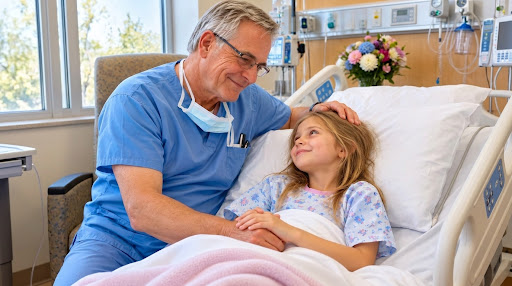
When I entered Lily’s room, the first thing I saw was the yellow rabbit.
It rested beside her pillow.
One ear folded sideways.
The fabric was worn.
The stitching around its nose had been repaired.
My chest tightened.
Then I saw her.
Small.
Pale.
Surrounded by medical equipment.
Her blond hair spread across the pillow.
A bandage covered part of her forehead.
She looked so much like Rebecca at that age that I had to grip the doorframe.
Lily turned her head.
Her gray eyes widened.
“Doctor!”
I swallowed.
“Hello, sweetheart.”
She smiled weakly.
“You’re the doctor.”
I nodded.
“That’s right.”
She studied me.
“Did you fix me?”
I felt tears burning behind my eyes.
“The whole team helped take care of you.”
She looked down at her blanket.
“My tummy hurts.”
“I know.”
I moved closer.
“The nurses are giving you medicine to help.”
She nodded.
Then looked at Margaret.
“Grandma Maggie!”
Margaret hurried to her bedside.
“Oh, my darling.”
She kissed Lily’s forehead.
Lily smiled.
Then looked at me again.
“Do you know Grandma Maggie?”
I nodded.
“Yes.”
She frowned.
“Are you friends?”
Margaret looked at me.
I swallowed.
“We’re getting to know each other.”
Lily seemed satisfied.
Then she picked up the rabbit.
“This is Buttons.”
My heart stopped.
Buttons.
That was what Rebecca had named him.
I stared at the toy.
Lily noticed.
“Do you like him?”
I nodded slowly.
“Very much.”
She held him toward me.
“He’s old.”
I laughed through my tears.
“Yes, he is.”
“Mommy says he belonged to someone special.”
My throat tightened.
I sat beside the bed.
“She’s right.”
Lily tilted her head.
“Did you know who?”
I looked at Margaret.
Her eyes filled.
Then I turned back to Lily.
“Yes, sweetheart.”
I touched the rabbit’s crooked ear.
“He belonged to a little girl I loved very much.”
Lily smiled.
“Was she nice?”
I couldn’t speak.
I nodded.
“She was wonderful.”
Lily hugged Buttons.
“Mommy says he keeps people brave.”
I pressed my lips together.
Then whispered, “He always did.”
The next few days were the hardest of my life.
Not because Lily’s recovery was going badly.
Her doctors were cautiously optimistic.
She was responding to treatment.
Her pain was becoming more manageable.
She began eating small meals.
She asked for coloring books.
She complained about the hospital television.
All ordinary things.
Beautiful things.
But outside her room, the adults were facing decisions none of us wanted to make.
Her parents were dead.
Her legal guardianship had to be addressed.
Her medical care needed continuity.
Her emotional well-being mattered more than any family reunion.
And I had to accept that discovering I was her great-grandfather didn’t automatically make me the right person to take over her life.
Margaret had known Lily for several years.
The Parkers, who had raised Evelyn, were also grieving.
Susan Parker had suffered a stroke the previous year.
Daniel Parker was in poor health.
But they loved Lily.
And Lily loved them.
There were no simple answers.
Angela organized a meeting with the hospital team and family representatives.
I sat beside Margaret.
Daniel Parker joined by video call.
He was an elderly man with tired eyes.
The moment he saw me, he began crying.
“Dr. Miller.”
I nodded.
“Mr. Parker.”
He wiped his face.
“I don’t know how to thank you.”
I swallowed.
“You don’t need to.”
He shook his head.
“You saved our granddaughter.”
I looked at him.
“Our great-granddaughter.”
He nodded.
“Yes.”
For a moment, we simply stared at each other.
Two old men.
Both grieving.
Both connected to the same child.
Both carrying years of unanswered questions.
Then Daniel said something I hadn’t expected.
“Samuel, I need you to know we loved Evelyn.”
My chest tightened.
“I believe you.”
He began crying.
“We didn’t know about you. We were told her biological family couldn’t be located.”
I nodded slowly.
“I know.”
He looked down.
“When Evelyn found out the truth, she was angry.”
I swallowed.
“At you?”
He shook his head.
“At the people who kept everyone apart.”
I looked away.
Daniel continued.
“She never stopped loving us. But she wanted to know where she came from.”
My eyes filled.
“She wrote me a letter.”
He nodded.
“I know.”
I stared at him.
“Did she talk about me?”
Daniel smiled through his tears.
“All the time.”
I pressed a hand against my mouth.
He continued.
“She was nervous about meeting you. She worried you’d be upset that she hadn’t found you sooner.”
I shook my head.
“I would have hugged her.”
Daniel began crying harder.
“I know.”
I stared at the screen.
Then whispered, “I would have hugged her every day if she’d let me.”
Two days later, Lily learned that her parents had died.
Angela and a child-life specialist helped Margaret tell her.
I waited outside.
I could hear nothing through the closed door.
But I knew what was happening.
I knew a little girl’s world was being divided into before and after.
Just as mine had been fourteen years earlier.
When the door opened, Margaret stepped into the hallway.
Her face was wet with tears.
I stood.
“How is she?”
Margaret shook her head.
“She’s asking when they’re coming back.”
My chest tightened.
I looked toward the room.
“Can I see her?”
Margaret nodded.
I entered quietly.
Lily was curled on her side.
Buttons rested beneath her chin.
Her eyes were red.
She looked at me.
“Doctor?”
I sat beside her.
“Yes, sweetheart?”
“Grandma Maggie says Mommy and Daddy died.”
I swallowed.
“Yes.”
She stared at me.
“Can doctors fix that?”
The question shattered me.
I had spent decades learning how to repair damaged bodies.
But there was no operation for this.
No medication.
No machine.
No skill that could give Lily what she wanted.
I took a breath.
“No, sweetheart.”
Her lower lip trembled.
“Why not?”
I felt tears sliding down my face.
“Because when someone dies, their body can’t start working again.”
She stared at Buttons.
Then whispered, “But I want Mommy.”
I nodded.
“I know.”
Her face crumpled.
“I want her.”
I leaned forward.
“Of course you do.”
She began sobbing.
I didn’t tell her to be brave.
I didn’t tell her everything happened for a reason.
I didn’t tell her that time would heal everything.
I simply sat beside her.
And when she reached for my hand, I held it.
Over the following weeks, I visited Lily every day.
Sometimes we talked.
Sometimes we watched cartoons.
Sometimes she slept while I sat beside her bed.
I learned that she loved strawberry ice cream.
That she hated peas.
That she wanted to become a veterinarian because animals couldn’t tell doctors where they hurt.
I learned she liked the color yellow.
That she was afraid of thunderstorms.
And that her father used to make pancakes shaped like dinosaurs.
One afternoon, she asked why I visited so often.
I hesitated.
Then said, “Because you’re very important to me.”
She studied my face.
“Like Grandma Maggie?”
I nodded.
“Yes.”
She frowned.
“Are you my family?”
My heart began pounding.
I looked toward Angela, who was sitting nearby.
She nodded gently.
We had discussed how to explain our relationship.
I took a breath.
“Yes, Lily.”
She sat up slightly.
“How?”
I smiled through my tears.
“Your mommy’s mommy was named Rebecca.”
Lily frowned.
“Mommy had a mommy?”
“Yes.”
“And a daddy?”
I nodded.
“Yes.”
She looked at me.
“Who?”
I swallowed.
“Me.”
Her eyes widened.
I continued carefully.
“That means I’m your mommy’s grandpa.”
She thought about it.
Then asked, “So you’re my great-grandpa?”
I nodded.
“That’s right.”
She stared at me.
Then smiled.
“That’s a lot of grandpas.”
I laughed.
A real laugh.
The first one I’d managed in weeks.
“Yes, sweetheart. It is.”
She held out her hand.
“Can I call you Grandpa Sam?”
I felt tears spilling down my cheeks.
“I would love that.”
She smiled.
“Okay, Grandpa Sam.”
Then she returned to coloring.
As though she’d simply discovered another ordinary fact about the world.
But I sat there, unable to move.
Because for fourteen years, I’d believed the word Grandpa belonged to a life that had ended.
And now a five-year-old girl had given it back to me.
Lily was discharged six weeks after the accident.
Her recovery would take time.
She needed follow-up appointments.
Physical therapy.
Emotional support.
And stability.
The family and child-welfare professionals worked through the appropriate arrangements.
Margaret remained a familiar presence.
The Parkers stayed involved.
And I became part of Lily’s support system.
At first, she stayed with Margaret while longer-term guardianship questions were resolved.
I visited often.
I learned how to make dinosaur pancakes.
Badly.
My first attempt looked like a melted shoe.
Lily laughed so hard she nearly spilled her orange juice.
“Grandpa Sam!”
I pretended to look offended.
“What?”
“That’s not a dinosaur!”
I studied the pancake.
“Of course it is.”
She giggled.
“What kind?”
I thought for a moment.
“A very rare one.”
She laughed harder.
And I realized something.
For years, I’d believed happiness was something that belonged to other people.
Now it was sitting across from me in pink pajamas, laughing at a terrible pancake.
But there was still one question I couldn’t stop asking.
What had really happened fourteen years earlier?
And why had Charles Whitfield gone to such lengths to keep Evelyn away from me?
The answer came from an unexpected place.
A retired hospital administrator named Patricia Lewis.
She contacted Andrew after hearing that the old adoption records were being reviewed.
She said she had information.
Information she’d carried for fourteen years.
And when she walked into Richard Collins’s office, she brought a small cardboard box.
Inside were documents that would finally explain why my granddaughter had been taken from our family.
PART 5
Patricia Lewis was seventy-four years old.
She wore a navy cardigan and carried a small leather handbag.
Her hands trembled as she placed the cardboard box on the conference table.
Andrew sat beside me.
Margaret sat across from us.
Patricia looked at each of us before speaking.
“I should have come forward years ago.”
Nobody answered.
She opened the box.
Inside were copies of hospital transfer records, internal correspondence, and a handwritten statement.
I stared at the papers.
“Why did you keep these?”
Patricia swallowed.
“Because I knew something was wrong.”
My chest tightened.
She explained that fourteen years earlier, she had worked in hospital administration when Rebecca was brought in after the crash.
Rebecca had been severely injured.
The baby, Evelyn, had survived.
But the confusion surrounding the accident created a terrible opportunity for someone determined to control the child’s future.
Charles Whitfield arrived at the hospital claiming to represent the family.
He presented documents.
He spoke with administrators.
He insisted the infant’s paternal family would handle all arrangements.
Patricia said she remembered asking whether Rebecca’s father had been contacted.
Charles told her I was already aware.
He claimed I was too emotionally distressed to participate.
I stared at her.
“That was a lie.”
Patricia nodded.
“I know.”
My hands trembled.
“Why didn’t you call me?”
She lowered her eyes.
“I trusted the documents. I trusted the people who said they were handling the matter.”
I felt anger rising.
“My granddaughter was alive.”
Patricia began crying.
“I know.”
“I buried an empty coffin.”
She covered her mouth.
“I’m so sorry.”
I stood.
For a moment, I couldn’t remain in that room.
I walked toward the window.
Outside, traffic moved through the city.
People hurried along sidewalks.
The world continued as though nothing had happened.
But inside me, fourteen years of grief were rearranging themselves into something unbearable.
I had not simply lost my granddaughter.
I had been robbed of knowing her.
Her first birthday.
Her first steps.
Her first words.
Her school performances.
Her graduation.
Her wedding.
The birth of Lily.
All those moments had happened somewhere in the world.
And I’d never known.
I pressed my forehead against the cool glass.
Then I heard Patricia whisper, “There’s more.”
I turned.
She removed a folded document from the box.
It was a copy of a letter.
Addressed to me.
Written by Rebecca.
Dated three days before the accident.
I stared at it.
My daughter’s handwriting.
The familiar looping letters.
The way she crossed her t’s too high.
I could barely breathe.
“Where did you get that?”
Patricia looked ashamed.
“It was among the documents forwarded to Charles Whitfield.”
I approached slowly.
She handed it to me.
I opened it.
Dad,
I need to tell you something.
Jonathan and I are engaged.
I know I should have told you sooner, but things have been complicated with his family.
I love him, Dad.
And I want you to know that we’re happy.
Evelyn is growing so quickly. She has your eyes.
I want you to meet her properly this weekend.
I want us to have dinner together.
I want you to hold her and tell her all those terrible jokes you used to tell me.
I know you’ve been worried about me.
But I’m okay.
And I need you to know something.
No matter how old I get, you’ll always be my safe place.
Love, Rebecca.
I couldn’t finish reading.
My knees gave way.
Andrew caught my arm and helped me into a chair.
I pressed the letter against my chest.
Then I cried.
For Rebecca.
For Evelyn.
For Jonathan.
For every birthday and Christmas I’d missed.
For the years I could never recover.
And for the simple dinner my daughter had wanted us to share.
A dinner that never happened.
The documents led to a formal review of the old case.
Investigators examined the adoption records, hospital correspondence, and the circumstances surrounding the false information given to family members.
Some questions were answered.
Others remained unresolved.
Charles Whitfield was dead.
Several people involved had retired.
Some records were incomplete.
And no legal finding could give back the years we’d lost.
But one thing became clear.
The separation hadn’t been caused by a family choosing to abandon Evelyn.
It had been caused by deception, failures of verification, and people who believed they had the right to decide which relatives mattered.
Margaret struggled with the truth.
She had loved Charles for decades.
She’d raised a family with him.
And now she was confronting evidence that he’d done something cruel beyond anything she’d imagined.
One afternoon, she came to my house.
We sat in the kitchen.
Lily was at a therapy appointment with her caregiver.
Margaret stared into her tea.
“Samuel, I don’t know how to live with what he did.”
I looked at her.
For a long time, I didn’t answer.
Then I said, “You didn’t do it.”
She shook her head.
“But I was his wife.”
I nodded.
“And I was Rebecca’s father.”
She looked up.
I continued.
“I keep asking myself why I didn’t notice she was frightened. Why I didn’t ask more questions. Why I didn’t insist on meeting Jonathan.”
My throat tightened.
“But we can’t change what we didn’t know.”
Margaret began crying.
I reached across the table.
“We can only decide what to do now.”
She held my hand.
And for the first time, I realized we were both grieving the same thing.
A family that should have existed.
And never had the chance.
Months passed.
Lily continued recovering.
She learned to walk longer distances without tiring.
Her nightmares became less frequent.
She began working with a child therapist who helped her understand grief in ways appropriate for her age.
Some days were good.
Some were terrible.
Sometimes she laughed.
Sometimes she cried for her mother.
Sometimes she became angry because her father wasn’t there to make dinosaur pancakes.
I learned not to rush her sadness.
I learned that love didn’t mean fixing every difficult feeling.
Sometimes it meant sitting beside someone while they experienced it.
One rainy afternoon, Lily was staying at my house for a visit.
She sat at the kitchen table drawing.
I was making hot chocolate.
Suddenly, she asked, “Grandpa Sam?”
“Yes, sweetheart?”
“Did you know my mommy when she was little?”
I turned.
“No, Lily. I didn’t get to meet her when she was little.”
She frowned.
“Why?”
I took a breath.
“Because some people made mistakes, and our family was separated.”
She thought about that.
Then asked, “Did you want to meet her?”
My throat tightened.
“Very much.”
She looked down at her drawing.
Then said, “Mommy would have liked you.”
I felt tears burning behind my eyes.
I sat beside her.
“How do you know?”
She smiled.
“Because she liked nice people.”
I laughed softly.
Then she added, “And you make funny pancakes.”
I wiped my eyes.
“That’s true.”
She looked at me.
“Grandpa Sam?”
“Yes?”
“Are you going to go away too?”
The question stopped my heart.
I looked at her.
Her small face was serious.
She had lost so much.
Her parents.
Her sense of safety.
The ordinary certainty that the people she loved would be there tomorrow.
I took her hand.
“Lily, I can’t promise that nothing bad will ever happen.”
Her eyes filled.
“But I can promise that I love you, and I’m going to do everything I can to be here for you.”
She studied my face.
Then nodded.
“Okay.”
She returned to drawing.
And I sat there, realizing that the most important promises were often the ones we made without pretending we controlled the future.
A year after the accident, Lily’s long-term guardianship arrangements were finalized.
After careful consideration of her needs, the court approved a plan that kept her connected to the people she knew and trusted.
Margaret remained one of her primary caregivers.
I became a regular part of her life.
The Parkers continued visiting.
We worked together.
Not always perfectly.
There were disagreements.
Scheduling problems.
Different opinions about school and routines.
But we all understood one thing.
Lily had already lost too much.
She didn’t need adults fighting over who loved her most.
She needed adults willing to cooperate.
And slowly, we became something I’d never expected.
A family.
Not the one we’d originally imagined.
Not the one we’d lost.
But a family nonetheless.
I reduced my surgical schedule.
At sixty-six, I finally began considering retirement seriously.
Not because I stopped loving medicine.
I still loved it.
I still believed there was no greater privilege than helping someone survive a moment that might otherwise end their life.
But I had spent decades using work to avoid going home.
After Rebecca died, the hospital became my refuge.
I volunteered for extra shifts.
Covered holidays.
Worked weekends.
Told myself patients needed me.
And they did.
But I also needed somewhere to put my grief.
Now, for the first time in fourteen years, I had somewhere else I wanted to be.
At school concerts.
At birthday parties.
At the kitchen table making terrible pancakes.
At the park, watching Lily chase butterflies.
I didn’t want to miss another childhood.
One afternoon, the hospital director called me into his office.
His name was Dr. Benjamin Carter.
We’d worked together for nearly twenty years.
He smiled when I entered.
“Samuel, sit down.”
I frowned.
“Am I in trouble?”
He laughed.
“Not today.”
He handed me a folder.
Inside was a proposal for a new pediatric trauma recovery program.
It would support children recovering from serious injuries.
Medical rehabilitation.
Family counseling.
Long-term follow-up.
Coordination with community resources.
I read the proposal carefully.
Then looked up.
“This is excellent.”
Benjamin nodded.
“We’d like you to help lead the advisory team.”
I hesitated.
“Ben, I’m reducing my hours.”
“I know.”
He smiled.
“That’s why we’re asking you to advise, not run the entire department.”
I looked at the folder.
He continued.
“You’ve spent your career saving lives in operating rooms. We’d like your help making sure children and families receive support after the surgery is over.”
I thought about Lily.
The nightmares.
The physical therapy.
The questions about her parents.
The long road from survival to recovery.
I looked at Benjamin.
“Yes.”
He smiled.
“Yes?”
I nodded.
“I’ll do it.”
The program launched the following spring.
We called it the Rebecca Miller Pediatric Recovery Initiative.
I insisted the name honor my daughter.
Not because she’d been a surgeon.
She hadn’t.
She’d been a nurse.
A woman who loved children.
A woman who believed every frightened patient deserved someone to sit beside them.
At the opening ceremony, I stood behind a podium.
Lily sat in the front row beside Margaret.
She wore a yellow dress.
Buttons rested in her lap.
I looked at her.
Then at the audience.
“Thirty-five years ago, I became a surgeon because I believed saving lives was the most important work I could do.”
I paused.
“I still believe that.”
The room grew quiet.
“But I’ve learned that surviving an injury is only the beginning.”
I looked toward Lily.
“Recovery takes time. It takes patience. It takes families, therapists, nurses, physicians, and communities working together.”
My voice trembled.
“And sometimes, it takes someone simply showing up.”
I swallowed.
“I lost my daughter fourteen years ago.”
Several people lowered their eyes.
“For a long time, I believed that loss had taken everything from me.”
I looked at Lily.
“Then, one night, a little girl arrived in our emergency department.”
My eyes filled.
“I didn’t know who she was.”
I paused.
“I only knew she needed help.”
Lily smiled at me.
“And in helping her, I discovered that my family had a story I never knew.”
I took a breath.
“This program is dedicated to my daughter Rebecca, to every child facing a difficult recovery, and to the families who need support long after the hospital doors close behind them.”
The room erupted in applause.
I stepped away from the podium.
Lily ran toward me.
“Grandpa Sam!”
I bent down.
She wrapped her arms around my neck.
“You did good!”
I laughed through my tears.
“Thank you, sweetheart.”
She pulled back.
“Can we get ice cream now?”
The audience laughed.
I smiled.
“Absolutely.”
Two years after the accident, Lily turned seven.
We held her birthday party in Margaret’s garden.
Yellow balloons hung from the trees.
A chocolate cake sat on the table.
Children ran across the lawn.
Buttons watched from a chair wearing a tiny paper party hat.
I stood near the fence, watching Lily laugh with her friends.
Margaret approached.
“You’re smiling.”
I looked at her.
“Am I?”
She nodded.
“More than you used to.”
I watched Lily chase a butterfly.
“I didn’t think I’d ever feel this way again.”
Margaret smiled sadly.
“Neither did I.”
We stood together.
Then she asked, “Do you ever think about how close we came to never finding each other?”
I nodded.
“Every day.”
She looked toward Lily.
“If that accident hadn’t happened…”
I finished the thought.
“We might still be strangers.”
The words hurt.
Because Lily had paid a terrible price.
I would never call the accident a blessing.
Her parents had died.
Nothing good could justify that.
But after tragedy, we had found a way to care for one another.
And that mattered.
That evening, after the party, Lily asked me to read her a bedtime story.
She was staying overnight at my house.
I tucked her beneath the blankets.
Buttons rested beside her pillow.
She pointed toward a photograph on the dresser.
It showed Rebecca holding baby Evelyn.
“Who’s that again?”
I smiled.
“That’s Rebecca.”
“Your daughter?”
I nodded.
“And that’s my mommy?”
“Yes.”
Lily studied the photograph.
“She looks happy.”
I swallowed.
“She was.”
Lily looked at me.
“Do you miss her?”
I nodded.
“Every day.”
She thought about that.
Then asked, “Do you miss my mommy too?”
My eyes filled.
“Yes.”
“But you didn’t know her.”
I smiled sadly.
“That’s part of why I miss her.”
Lily considered that.
Then held out Buttons.
“Maybe you can borrow him.”
I stared at the rabbit.
She smiled.
“He helps when you’re sad.”
I took him carefully.
For a moment, I was transported back more than fifty years.
Rebecca was six.
She had a fever.
I sat beside her bed.
She pressed Buttons into my hand.
“Daddy, he makes people brave.”
I looked at Lily.
My throat tightened.
“Thank you, sweetheart.”
She smiled.
“You’re welcome, Grandpa.”
I kissed her forehead.
Then turned off the light.
I am sixty-eight now.
I no longer work thirteen-hour emergency shifts.
I still advise the hospital.
I still teach younger surgeons.
And occasionally, when I walk through the trauma department, I remember the night Lily arrived.
The flashing lights.
The paramedics shouting.
The tiny body on the stretcher.
The moment I looked at her face and thought I saw Rebecca.
I remember the thirteen hours we spent fighting for her life.
And the exhaustion afterward.
I remember opening my front door the next morning.
A stranger standing on my porch.
A black car waiting behind him.
And the words that changed everything.
“I have something for you.”
At the time, I thought he was bringing news about a patient.
I didn’t know he was bringing me the truth about my family.
I didn’t know my granddaughter had survived fourteen years earlier.
I didn’t know she’d grown up, fallen in love, married, and become a mother.
I didn’t know she’d written me a letter.
I didn’t know she’d wanted to meet me.
And I didn’t know the little girl I’d operated on was the last living connection between us.
Sometimes people tell me I was lucky.
Lucky that Lily survived.
Lucky that Andrew found me.
Lucky that the truth finally came out.
I understand what they mean.
But I don’t think of it as luck.
I think of the people we lost.
Rebecca.
Jonathan.
Evelyn.
Nathan.
I think of the years stolen from our family.
The birthdays missed.
The photographs never taken.
The conversations we never had.
And I know nothing can make those losses right.
But I also think about Lily.
Her laughter.
Her gray eyes.
The way she insists I cut pancakes into dinosaur shapes.
The way she holds my hand when we cross the street.
The way she calls me Grandpa Sam.
And I understand that grief and love can exist in the same heart.
One doesn’t erase the other.
Last Christmas, Lily gave me a handmade card.
She’d drawn a picture of us standing beneath a yellow sun.
I was wearing my blue surgical scrubs.
She was holding Buttons.
Across the top, in large uneven letters, she’d written:
TO THE GRANDPA WHO FIXED ME.
I stared at it.
Then opened the card.
Inside was another message.
YOU FIXED MY BODY, BUT YOU ALSO HELP MY HEART. I LOVE YOU.
I couldn’t speak.
Lily looked worried.
“Grandpa?”
I swallowed.
“Yes, sweetheart?”
“Do you like it?”
I knelt in front of her.
“Oh, Lily.”
My voice broke.
“I love it.”
She smiled.
Then wrapped her arms around my neck.
I held her tightly.
And for a moment, I thought about Rebecca.
The little girl who’d once given me a yellow rabbit.
The young woman who’d written that I was her safe place.
The daughter I’d loved more than life itself.
I wished she could see us.
I wished Evelyn could too.
I wished they knew that Lily was safe.
That she was loved.
That she had people who would show up for her.
And that the family they’d been denied was finally learning how to be together.
That night, after Lily fell asleep, I sat in my study.
Rebecca’s letter rested beside my chair.
Evelyn’s letter lay beneath it.
And Lily’s Christmas card stood on the desk.
Three generations.
Three different pieces of paper.
Three voices reaching across time.
I read Rebecca’s final sentence again.
No matter how old I get, you’ll always be my safe place.
Then Evelyn’s.
If you’re willing, I’d like to start with coffee.
Then Lily’s.
I love you.
I sat there for a long time.
And finally understood something.
I had spent fourteen years believing my story ended the day Rebecca died.
But it hadn’t.
There had been a little girl growing up somewhere.
A granddaughter who wanted to know me.
A great-granddaughter who would one day need me.
And although I couldn’t change the past, I could choose what kind of man I would be for the family still here.
I could be present.
Patient.
Honest.
I could make room for their grief.
I could tell them stories about Rebecca.
I could make terrible pancakes.
I could show up.
Again and again.
For as long as I was able.
The next morning, Lily came running into my study.
“Grandpa Sam!”
I looked up.
“Good morning, sweetheart.”
She climbed onto my lap.
“Can we go to the park?”
I smiled.
“Of course.”
She looked at the letters on my desk.
“Are those from Mommy?”
I nodded.
“One is.”
She touched the paper gently.
“Do you think she loved me?”
My heart tightened.
I looked into her gray eyes.
“More than anything.”
She smiled.
“Even when I was little?”
I laughed softly.
“Especially then.”
She thought about that.
Then asked, “Do you think she knows I love her?”
I swallowed.
“I can’t know that for certain, sweetheart.”
She looked disappointed.
So I added, “But I know we can keep loving her and remembering her together.”
Lily nodded.
Then she took my hand.
“Come on, Grandpa. The swings are waiting.”
I stood.
Put on my coat.
And followed her toward the door.
As we stepped outside, the morning sunlight warmed my face.
For fourteen years, I’d walked into an empty house and wondered why I was still here.
Now a little girl was pulling me down the sidewalk, laughing because she couldn’t wait to reach the park.
And for the first time in a very long time, I wasn’t thinking about the life I’d lost.
I was thinking about the life I still had.
I thought I had saved a stranger’s daughter after a terrible accident. The next morning, a man arrived at my door and revealed that the little girl was my own great-granddaughter.
I couldn’t save Rebecca.
I couldn’t save Evelyn.
And I couldn’t recover the years someone had stolen from us.
But I could love Lily.
I could give her the stories of the women who came before her.
I could make sure she never wondered whether she belonged.
And whenever she reached for my hand, I could hold it.
Because sometimes a surgeon’s greatest work doesn’t happen beneath the bright lights of an operating room.
Sometimes it happens at a kitchen table, beside a child’s bed, or on the walk to a playground.
Sometimes the most important thing you can give someone isn’t another operation.
It’s the promise that they won’t have to face their future alone.
And after fourteen years of believing my family was gone, I finally had someone waiting for me at home.
THE END THANK YOU FOR READING !!!



