PART 3
I stared at Richard Hale across the mahogany desk.
“What do you mean the papers weren’t a transfer of ownership?”
The attorney folded his hands.
Margaret, before we discuss that,
I need you to tell me exactly what happened
when your son and daughter-in-law asked you to leave.
I swallowed.
For forty years, I’d been a nurse.
I’d held dying patients’ hands, delivered terrible news to frightened families,
and learned how to remain composed when the world around me was falling apart.
But sitting in that Manhattan office,
with my husband’s handwriting spread across the desk,
I suddenly felt like a frightened young woman who didn’t know where she belonged.
“My daughter-in-law, Vanessa, told me to get out,” I whispered.
“She said now that Thomas was gone, I had no reason to stay.”
Richard’s expression tightened.
“And your son?”
I stared at my hands.
“Michael stood behind her.”
“Did he object?”
I shook my head.
“Not once.”
Richard lowered his eyes.
That somehow hurt worse than if he’d looked surprised.
“Then what happened?”
“They put papers on my bed. Vanessa said Michael was taking responsibility for the house. She told me I needed to sign before I left.”
“Did you read them?”
I hesitated.
“Not properly.”
Richard nodded.
“Why?”
I looked toward the window.
“Because I’d just buried my husband.”
My voice broke.
“Because I hadn’t slept. Because I couldn’t stop thinking about the way Thomas looked in the hospital. Because my son was standing in the hallway waiting for me to leave the house where I’d raised him.”
Tears rolled down my cheeks.
“I thought signing was the only way to make them stop.”
Richard pushed a tissue box toward me.
“Margaret, do you remember what the documents were called?”
I frowned.
“One said acknowledgment. Another said something about possession.”
He nodded slowly.
“Did you sign a deed?”
“No. At least, I don’t remember signing one.”
“Did anyone notarize your signature?”
I shook my head.
“No.”
Richard opened a folder.
“That distinction matters. Your signature on those papers didn’t automatically transfer title to the property.”
I looked at him.
“Then what did I sign?”
“From what you’ve described, possibly an acknowledgment that you were voluntarily leaving the premises. I haven’t seen the originals yet, so I won’t pretend to know their precise effect.”
I sat back.
“Vanessa said the house was Michael’s.”
Richard’s expression changed.
“Did she?”
“She said Thomas had left everything to our son.”
Richard removed another document from his folder.
“Margaret, the house on Maple Avenue wasn’t owned by Thomas alone.”
I stared at him.
“What?”
He turned the page toward me.
It was an old property record.
I recognized the address immediately.
The house where Thomas and I had celebrated forty Christmases.
The house where Michael had taken his first steps.
The house where my husband’s slippers were still beside the bed.
Two names appeared on the deed.
Thomas Sterling.
Margaret Sterling.
Richard pointed to the ownership language.
“You and Thomas held the property jointly with rights of survivorship.”
I blinked.
“Meaning?”
“Subject to the usual documentation and title review, Thomas’s interest passed to you when he died.”
I couldn’t speak.
Richard continued.
“Michael didn’t inherit that house from his father.”
My hands began trembling.
“Then whose house is it?”
Richard looked directly at me.
“Yours, Margaret.”
For several seconds, the room seemed to tilt.
I gripped the arms of the chair.
“Mine?”
“Yes.”
“But Vanessa said—”
“Vanessa doesn’t determine property ownership.”
I pressed a hand against my mouth.
I had spent the previous night in a motel that smelled of stale cigarettes and disinfectant.
I’d eaten crackers from a vending machine.
I’d cried into a pillow because I thought I was homeless.
And all that time, the house I’d been forced to leave had legally belonged to me.
Richard waited until I could breathe again.
Then he said something that made my stomach tighten.
“Unfortunately, there’s another problem.”
I looked up.
“What problem?”
“Your son has been trying to borrow against the property.”
My heart dropped.
“How?”
“Thomas became concerned about several documents Michael presented before his death.”
Richard opened a second binder.
Inside were copies of emails, financial statements, and loan correspondence.
I recognized Michael’s name.
And Vanessa’s.
But the numbers meant nothing to me.
Richard pointed to one page.
“Michael approached a private lender about a substantial loan. The proposed security included the Maple Avenue property.”
I stared at him.
“Without asking me?”
“Thomas refused to authorize it. That’s when he came to me.”
I swallowed.
“How much money?”
Richard hesitated.
“Eight hundred and fifty thousand dollars.”
My mouth went dry.
“Eight hundred and fifty thousand?”
He nodded.
I stared at the documents.
Michael had always told me his business was doing well.
He owned a construction supply company.
He drove a luxury SUV.
Vanessa wore designer clothes.
They took vacations to Europe.
Their social media pages were full of restaurants, hotels, and smiling photographs.
I had believed they were successful.
Richard studied my expression.
“Did you know Michael was having financial difficulties?”
I shook my head.
“No.”
He turned another page.
“Thomas did.”
Richard explained that my husband had quietly investigated Michael’s business finances after being asked to guarantee a loan.
Thomas had spent his career working in commercial property management.
He understood contracts.
He understood debt.
And he understood the difference between helping family and putting everything you’d earned at risk.
Michael’s company had taken on too much debt.
Several major customers had delayed payments.
An expensive warehouse expansion had gone badly.
And Vanessa’s spending hadn’t slowed.
Thomas refused to use our home as collateral.
Michael became furious.
He accused his father of not believing in him.
He said parents were supposed to support their children.
He threatened to stop visiting.
Thomas didn’t change his mind.
But he began preparing.
I remembered those final months.
The quiet phone calls.
The folders he kept in his study.
The business card he slipped into my purse.
And the brass key he’d pressed into my palm three weeks before he died.
At the time, I’d thought he was worried about ordinary estate paperwork.
Now I understood.
He had been trying to protect me from something he feared might happen after he was gone.
I looked at Richard.
“Why didn’t he tell me?”
The attorney’s expression softened.
“Thomas wanted to. He said he was waiting until you were fully recovered from your surgery.”
My eyes filled.
“He thought we had more time.”
Richard nodded.
“So did he.”
I looked down at my husband’s letter.
For the first time since the funeral, I felt angry with Thomas.
Not because he’d protected the money.
Because he’d carried so much worry alone.
Then the anger dissolved.
And all I wanted was one more afternoon with him.
One more cup of coffee.
One more chance to ask what had been troubling him.
Richard opened the final section of the binder.
“Now, about the inheritance.”
I looked at him.
He turned a financial summary toward me.
The total was staggering.
Twenty-eight million, four hundred and sixty thousand dollars.
I stared at the number.
Then looked at him.
“Thomas never made that kind of money.”
Richard smiled faintly.
“He didn’t make it all at once.”
He explained that my husband had invested steadily for decades.
He’d purchased shares in several businesses before they became successful.
He’d inherited a small commercial property interest from his uncle and eventually sold it.
He’d invested proceeds into diversified holdings.
And he’d retained an ownership interest in a property management partnership that had grown considerably.
The Manhattan penthouse had been purchased years earlier through a trust.
The investments and property were held under a carefully structured estate plan.
I shook my head.
“Why did we still live so simply?”
Richard looked at me.
“Thomas told me you both liked your life.”
I stared at him.
He smiled.
“He said you loved the house in White Plains. He said you enjoyed nursing. And he said money was supposed to give you choices, not turn you into someone you didn’t recognize.”
I began crying.
That sounded exactly like Thomas.
The man who repaired his own lawn mower.
The man who wore the same winter coat for fifteen years.
The man who believed a good Sunday afternoon involved coffee, a newspaper, and me sitting beside him.
I touched his letter.
“Oh, Thomas.”
Richard waited.
Then he slid another envelope across the desk.
“This is what he wanted you to read after we reviewed everything.”
I opened it carefully.
Inside was a single handwritten page.
My Margaret,
If Richard has given you this letter, then I’m no longer there to hold your hand.
I wish I could explain everything in person. I know you’ll be angry that I kept some things from you, and you have every right.
I never wanted our son to know about the investments because I was afraid he’d stop seeing us as his parents and start seeing us as a solution to his problems.
I hoped I was wrong.
But if the day comes when Michael makes you feel unwanted in the home we built, remember this: you have never needed his permission to belong anywhere.
The penthouse is yours. The investments are yours. The house is yours.
Most importantly, your life is yours.
Don’t spend whatever years remain proving your love to people who only recognize it when they need something.
Go somewhere beautiful, Maggie.
Open the curtains.
And live.
Always yours, Thomas.
By the time I finished, the words had blurred.
I pressed the letter against my chest.
Richard quietly left the room to give me privacy.
I cried for the husband I’d lost.
For the son I thought I’d raised.
For the forty years that had disappeared too quickly.
And for the woman I’d almost allowed Vanessa to convince me I was.
Old.
Unwanted.
Disposable.
When Richard returned, I wiped my eyes.
“What happens now?”
He sat down.
“First, we protect your assets. Then we review the situation at Maple Avenue.”
I nodded.
“And Michael?”
Richard studied me.
“That depends on what he’s done.”
I looked at my husband’s letter.
Then at the property records.
For the first time in five days, I felt something stronger than grief.
Determination.
“Then let’s find out.”
Over the next two weeks, Richard and his team began reviewing everything.
I stayed in the Manhattan penthouse.
The first time I entered it, I stopped just inside the doorway.
Floor-to-ceiling windows overlooked the city.
The Hudson River shimmered beyond the buildings.
Cream-colored furniture filled the living room.
A grand piano stood beside a wall of bookshelves.
Fresh flowers waited on the dining table.
I turned toward Richard.
“Thomas owned this?”
He nodded.
“He purchased it through the trust nine years ago.”
I stared at the view.
“Did he ever come here?”
“Occasionally. Usually for meetings.”
I walked toward the window.
The city stretched beneath me.
I felt completely out of place.
A woman who’d spent decades wearing nursing scrubs and shopping with coupons.
A widow who’d eaten vending machine crackers in a motel two nights earlier.
And now I was standing in a penthouse worth more money than I’d ever imagined.
Richard approached quietly.
“Margaret, you don’t have to stay here.”
I looked at him.
“You can sell it, rent it, or keep it. These are your choices.”
I thought of Thomas’s letter.
Go somewhere beautiful.
Open the curtains.
I walked to the windows.
Pulled the curtains wider.
And whispered, “I’ll stay for a while.”
Three months passed.
I didn’t contact Michael.
He didn’t contact me either.
Not once to ask where I was sleeping.
Not once to ask whether I had enough food.
Not once to ask how I was coping with losing his father.
Through my attorney, I learned that he and Vanessa had moved into Maple Avenue.
They’d changed the locks.
Removed several pieces of furniture.
And begun renovations.
Vanessa posted photographs online.
New countertops.
Imported light fixtures.
A marble fireplace.
She called it their “forever home.”
My home.
The one she’d ordered me to leave.
I watched one short video.
She stood in my kitchen, smiling.
“Sometimes life gives you a fresh beginning,” she told her followers.
I looked at the cabinets behind her.
Thomas had installed them himself.
I closed the video.
Then called Richard.
“Is it time?”
He paused.
“Are you certain?”
I looked out over Manhattan.
“Yes.”
And that afternoon, Richard arranged for the notice to be delivered.
The notice that would change everything.
PART 4
Vanessa was filming a kitchen renovation video when the process server rang the doorbell.
I know because she later posted the first few seconds of the encounter before deleting the video.
She opened the front door wearing a cream-colored sweater and an expression of irritation.
“Can I help you?”
The man introduced himself and asked whether Michael Sterling lived there.
Vanessa frowned.
“He’s my husband.”
The man handed her an envelope.
She looked at it.
Then laughed.
“What’s this?”
“Legal documents.”
Her smile disappeared.
She opened the envelope before closing the door.
The first page identified me as the owner of the property.
The second explained that her and Michael’s occupancy had never been authorized by me.
The third demanded that they cease unauthorized alterations and address their continued occupation through the appropriate legal process.
And accompanying the notice was a letter from Richard Hale.
It stated that my attorneys were reviewing property damage, missing belongings, and any attempts to represent themselves as owners.
It also made clear that I had not transferred my interest in the house.
Vanessa called Michael immediately.
By that evening, I had eleven missed calls.
Seven from my son.
Four from Vanessa.
I didn’t answer.
Instead, I sat at my dining table in Manhattan, drinking tea from one of Thomas’s old mugs.
My phone rang again.
Michael.
I stared at his name.
For forty years, I’d imagined my son would be the person standing beside me when Thomas died.
Instead, he had become the reason I needed an attorney.
The call stopped.
Then a message appeared.
MOM, WHAT IS THIS?
I read it.
Another arrived.
YOU CAN’T THROW US OUT OF DAD’S HOUSE.
Then another.
CALL ME IMMEDIATELY.
I set the phone down.
Five minutes later, Richard called.
“Margaret, Michael’s attorney contacted my office.”
I took a breath.
“What did he say?”
“He’s requesting documentation of your ownership.”
I smiled sadly.
“Doesn’t Michael already know?”
“He may not have understood the title arrangement. Or he may have assumed you wouldn’t challenge him.”
I stared at the skyline.
“Then send him whatever you’re legally required to send.”
Richard nodded.
“Already underway.”
The next morning, Vanessa called from a different number.
I answered without realizing who it was.
“Hello?”
“Margaret!”
Her voice was sharp.
I closed my eyes.
“Vanessa.”
“What exactly do you think you’re doing?”
I sat down.
“What do you mean?”
“Don’t play innocent. We received your ridiculous legal notice.”
I took a breath.
“Then you should speak with your attorney.”
She laughed.
“Your attorney? Please. Michael says you’re confused about the estate.”
I stared at the wall.
“Does he?”
“Yes. That house belongs to him.”
“No, Vanessa.”
She paused.
I continued.
“It belongs to me.”
Silence.
Then she snapped, “Thomas promised Michael everything.”
I looked at my husband’s wedding photograph.
“Thomas left instructions.”
“You’re lying.”
I felt strangely calm.
“You’re welcome to have your lawyer review the records.”
Vanessa lowered her voice.
“Margaret, don’t make this ugly.”
I almost laughed.
Five days after my husband’s funeral, she’d told me to go live on the streets.
She’d removed my wedding photograph from the mantel.
She’d put sticky notes on my furniture.
She’d treated forty years of marriage like an inconvenience.
And now she was worried about ugliness.
I spoke quietly.
“Vanessa, you told me to leave.”
She scoffed.
“You were grieving. We thought you needed a change.”
“You told me to live on the streets.”
“That was an expression.”
I closed my eyes.
“No. It was a choice.”
She hesitated.
Then changed tactics.
“Margaret, we’re family.”
I looked at the city below.
“That’s what I thought too.”
Then I ended the call.
Two days later, Michael came to Manhattan.
He didn’t know my penthouse address.
He went to Richard’s office instead.
Richard called to ask whether I wanted to see him.
I sat silently for a long time.
Then said, “Yes.”
But I made one condition.
“Not alone.”
Richard understood.
We arranged to meet in his conference room.
When Michael entered, I barely recognized him.
He wore an expensive navy suit.
His hair was neatly styled.
But there were dark circles beneath his eyes.
He looked tired.
Angry.
And frightened.
“Mom.”
I stood.
“Michael.”
He approached as though he intended to hug me.
I stepped backward.
He stopped.
For a moment, hurt flashed across his face.
I wondered whether he remembered how it felt when someone you loved made you feel unwelcome.
He sat down.
Richard remained beside me.
Michael looked around.
“Do we really need lawyers for this?”
I folded my hands.
“Apparently.”
He sighed.
“Mom, this has gotten completely out of control.”
I waited.
He continued.
“Vanessa’s upset. The renovations are halfway finished. Contractors are calling. And now you’re threatening legal action.”
I stared at him.
“Did you come here to ask how I’ve been?”
He blinked.
“What?”
I repeated the question.
“Did you come here to ask how I’ve been since your father died?”
He looked uncomfortable.
“Of course I care.”
“Then ask.”
He stared at me.
I waited.
Finally, he said, “How have you been?”
The words sounded forced.
I swallowed.
“Your father is dead, Michael.”
He looked down.
“I know.”
“I buried the man I loved for forty-three years.”
His jaw tightened.
“And five days later, you watched your wife throw me out of my home.”
He rubbed his forehead.
“Mom, it wasn’t like that.”
I leaned forward.
“Then tell me what it was like.”
He hesitated.
“Vanessa thought you needed somewhere smaller.”
I stared at him.
“Did you?”
He looked away.
“Mom…”
“Did you believe I should leave?”
Silence.
That was my answer.
Again.
I leaned back.
“Your silence is becoming a habit.”
His face reddened.
“That’s unfair.”
I looked at him.
“Unfair?”
My voice trembled.
“Michael, I spent forty years making sure you had everything you needed.”
He opened his mouth.
I continued.
“When your father worked late, I helped with your homework. When you were sick, I sat beside your bed. When you couldn’t afford your first apartment, we helped with the deposit.”
Tears filled my eyes.
“When your business struggled, your father gave you money he never asked you to repay.”
Michael stared at the table.
“And when I needed one small kindness after burying him, you couldn’t even say, ‘Mom, you can stay.'”
He looked up.
His eyes were wet.
“I’m sorry.”
For a moment, I wanted to believe him.
Then he added, “But you can’t expect us to undo everything now.”
I went still.
“What?”
He shifted.
“We’ve already invested money into the house.”
I stared at him.
“Whose house?”
He swallowed.
“Mom, please.”
I repeated it.
“Whose house?”
He looked at Richard.
Then back at me.
“Yours.”
I nodded.
“Good. Now we’re finally being honest.”
Richard opened a folder.
“Michael, there are several issues we need to discuss.”
My son looked irritated.
“Like what?”
“First, the unauthorized renovations.”
Michael folded his arms.
“Those improvements increased the value.”
“That may or may not be true. The important point is that the owner didn’t approve them.”
Michael looked at me.
“Mom, you always wanted a new kitchen.”
I stared at him.
“Your father built that kitchen.”
He went quiet.
I continued.
“Every cabinet. Every shelf. Every little drawer that stuck when the weather changed.”
My throat tightened.
“You tore it apart.”
Michael looked away.
Richard continued.
“Second, several personal items appear to be missing.”
Michael frowned.
“What items?”
I took a photograph from my purse.
Thomas and me on our wedding day.
The original silver frame had been removed from the mantel.
I looked at Michael.
“Where is this?”
He stared at the photograph.
“Vanessa put it in storage.”
“Where?”
“I don’t know.”
I swallowed.
“Find it.”
He nodded.
Then Richard turned another page.
“Third, there’s the matter of the financing documents.”
Michael’s expression changed immediately.
I noticed.
Richard noticed too.
“What financing documents?” Michael asked.
Richard looked at him.
“The loan applications involving the Maple Avenue property.”
Michael went pale.
For several seconds, nobody spoke.
Then he whispered, “Dad told you?”
Richard nodded.
“He sought legal advice concerning the proposed arrangement.”
Michael rubbed his face.
“That was months ago.”
“Yes.”
“And nothing happened.”
Richard studied him.
“Then you’ll have no difficulty providing the complete records.”
Michael stared at him.
I felt cold.
“Michael?”
He looked at me.
“Mom, it’s complicated.”
I shook my head.
“No.”
He swallowed.
“Please.”
I leaned forward.
“Did you try to borrow money against my house?”
He closed his eyes.
Then whispered, “Yes.”
I stared at him.
“Without asking me?”
He nodded.
Tears slid down my face.
I looked away.
For a long time, nobody spoke.
Then I asked, “Why?”
Michael’s voice broke.
“Because I thought Dad would help.”
I turned back.
“And when he said no?”
Michael looked at the floor.
“I thought once the estate was settled, the house would come to me.”
My stomach twisted.
There it was.
The truth.
He hadn’t simply failed to protect me.
He’d been waiting for something he believed would become his.
My home.
My security.
The place where I’d raised him.
And when his father died, he’d moved quickly to claim it.
I wiped my eyes.
“Michael, I don’t know what happened to the little boy I raised.”
He began crying.
Neither of us spoke.
Then he whispered, “I’m in trouble, Mom.”
I stared at him.
“What kind of trouble?”
He swallowed.
“The business is failing.”
I closed my eyes.
Of course.
There was always a reason.
Always an emergency.
Always a problem someone else was expected to solve.
He continued.
“We owe more than we can pay. Vanessa doesn’t know how bad it is.”
I looked at him.
“Then tell her.”
He shook his head.
“She’ll leave me.”
I felt a painful ache in my chest.
He was frightened.
Genuinely frightened.
And some part of me still wanted to take his hand and promise everything would be all right.
But I remembered Thomas’s letter.
Don’t spend whatever years remain proving your love to people who only recognize it when they need something.
I took a breath.
“Michael, I love you.”
He looked up hopefully.
“But I will not give you my house.”
His expression collapsed.
“Mom—”
“And I will not secure your debts.”
He shook his head.
“You don’t understand.”
“I understand that you’re in financial trouble.”
I leaned forward.
“And I understand that you were willing to make me homeless to solve it.”
He began crying harder.
I waited.
Then I said something I’d never said to him before.
“You need to take responsibility for your own decisions.”
The meeting ended without an agreement.
Michael left angry.
Vanessa called Richard’s office repeatedly.
Their attorney requested more time.
But the legal process continued.
I didn’t change the locks myself.
I didn’t send strangers to drag their belongings onto the lawn.
I let Richard handle everything through the proper channels.
The court eventually addressed their occupancy.
And after months of negotiations and proceedings, Michael and Vanessa agreed to leave by a specified date.
They were required to return certain personal belongings and provide access for inspection.
The financing issues were handled separately.
I didn’t get every piece of furniture back.
Some things had been damaged.
Others had disappeared.
And the kitchen Thomas built was gone.
But the house was still mine.
Then, one afternoon, Richard called.
“Margaret, they’ve moved out.”
I sat quietly.
“Are you sure?”
“Yes. The property manager completed the inspection.”
I looked toward the Manhattan skyline.
For three months, I’d imagined that moment.
I thought I’d feel victorious.
Instead, I felt tired.
“Margaret?”
“I’m here.”
Richard hesitated.
“Would you like to return?”
I thought about the house.
The empty rooms.
The missing cabinets.
The memories.
Then I looked at Thomas’s photograph.
“Yes,” I whispered.
“But not to live there.”
PART 5
The first time I walked back into the house on Maple Avenue, I carried no suitcase.
Richard accompanied me.
So did a property manager named Ellen Foster.
It was a warm June morning.
The maple trees were full of green leaves.
The front porch looked exactly as I remembered.
But inside, everything felt different.
The living room had been painted gray.
The old floral curtains were gone.
The dining table had disappeared.
And the kitchen looked like something from a magazine.
White marble.
Black fixtures.
Glossy cabinets.
Everything expensive.
Everything cold.
I stood in the doorway.
For a moment, I couldn’t breathe.
Thomas’s kitchen was gone.
The little breakfast nook where we’d shared coffee every morning had been replaced with a built-in bench.
The old wall clock had disappeared.
Even the marks on the doorframe where we’d measured Michael’s height had been painted over.
I walked slowly through the rooms.
In the hallway, I stopped beside the place where Thomas had once hung his coat.
The hook was gone.
I touched the wall.
And cried.
Not because the house was ruined.
Because the life we’d lived there could never be restored by putting the furniture back.
Ellen waited quietly.
Richard stood near the doorway.
After a while, I wiped my eyes.
“Is the house structurally sound?”
Ellen nodded.
“The inspection found no major structural problems.”
I looked around.
“Good.”
Richard approached.
“What would you like to do?”
I took a breath.
“Sell it.”
He studied my face.
“Are you sure?”
I nodded.
“I loved this house.”
My voice trembled.
“I loved every Christmas morning. Every birthday. Every ordinary Tuesday when Thomas came home tired and asked what was for dinner.”
I looked toward the kitchen.
“But I don’t need to live inside those memories to keep them.”
Richard nodded.
“Then we’ll make arrangements.”
I walked outside.
The sunlight warmed my face.
For the first time since the funeral, I didn’t feel as though I was leaving something behind.
I felt as though I was finally choosing where to go.
Before the house was listed, I asked Ellen to search the storage areas for anything that belonged to Thomas.
She found several boxes in the garage.
Old photographs.
Christmas ornaments.
A fishing tackle box.
A collection of handwritten recipes.
And a small wooden clock he’d made during his retirement.
I took them all.
Then I asked about our wedding photograph.
Ellen looked uncomfortable.
“I’m sorry, Margaret. We haven’t found the original frame.”
My heart tightened.
I nodded.
“Thank you for looking.”
That evening, I sat in the penthouse and placed a copy of the photograph beside my bed.
Thomas was twenty-six.
I was twenty-three.
He wore a dark suit.
I wore a simple white dress I’d purchased on sale.
We looked impossibly young.
I touched the glass.
“Well, Tommy,” I whispered, “we certainly didn’t know what was coming.”
Then I smiled through my tears.
“But we had a good life, didn’t we?”
The apartment was silent.
I imagined his voice.
The best, Maggie.
The house sold several months later.
The proceeds were added to my estate plan.
Richard helped me review my finances, update my will, and establish protections so no one could pressure me into decisions I didn’t understand.
I didn’t give Michael control over anything.
I didn’t appoint him to manage my accounts.
I didn’t make Vanessa a beneficiary.
And I didn’t apologize.
Instead, I began asking myself a question I’d avoided for decades.
What did I want?
Not what Thomas wanted.
Not what Michael needed.
Not what Vanessa expected.
What did Margaret Sterling want from the years she had left?
At first, I didn’t know.
That embarrassed me.
I’d spent so much of my life being useful to other people that I’d forgotten how to imagine a future centered on myself.
I knew how to work a twelve-hour hospital shift.
I knew how to stretch a grocery budget.
I knew how to care for a sick child.
I knew how to make Thomas’s favorite chicken soup.
But I didn’t know what to do with a Tuesday afternoon when nobody needed me.
So I started small.
I bought flowers.
Not because company was coming.
Because I liked them.
I took long walks.
I visited museums.
I sat in cafés and watched people hurry through Manhattan.
I bought a beautiful blue coat without checking the clearance rack.
Then I cried in the department store because I felt guilty spending money on myself.
The saleswoman looked alarmed.
“Ma’am, are you all right?”
I laughed through my tears.
“Yes, sweetheart. I think I’m learning something.”
One afternoon, Richard invited me to lunch.
We met at a quiet restaurant overlooking the river.
After ordering, he asked how I was settling into the penthouse.
I smiled.
“Better than I expected.”
He nodded.
“Good.”
Then he asked, “Have you thought about what you’d like to do with your time?”
I looked at him.
“Actually, yes.”
He waited.
“I want to help people.”
He smiled faintly.
“You spent decades doing that.”
“I know.”
I took a breath.
“But I want to do it differently now.”
I explained that during my years at Saint Vincent’s Hospital, I’d seen elderly patients struggle after being discharged.
Some had no family.
Others had relatives who couldn’t afford to help.
And some had families who treated their savings and property as something to claim rather than something to protect.
I thought of the frightened widows I’d met.
The older men who didn’t understand financial paperwork.
The patients who had no one to accompany them to appointments.
I looked at Richard.
“I want to create something for them.”
He leaned forward.
“What kind of organization?”
“A foundation.”
I smiled.
“One that helps older adults access independent legal guidance, financial education, and practical support.”
Richard nodded thoughtfully.
“That could be meaningful.”
I looked down.
“I don’t want anyone else to sit in a motel wondering where they’re going to sleep because their own family told them they no longer belong.”
Richard’s expression softened.
“Then let’s explore how to build it properly.”
Six months later, the Thomas and Margaret Sterling Foundation opened its doors.
We partnered with established elder-law organizations, social workers, and community agencies.
The foundation funded legal assistance for older adults facing financial exploitation.
It supported educational workshops about powers of attorney, estate planning, and property rights.
It helped connect vulnerable seniors with housing resources and trusted professionals.
We didn’t promise to solve every problem.
We couldn’t.
But we could help people understand their choices before someone else made those choices for them.
At the opening ceremony, I stood beside a photograph of Thomas.
My hands trembled as I approached the microphone.
There were perhaps eighty people in the room.
Attorneys.
Nurses.
Social workers.
Community leaders.
And several older adults who had agreed to share their experiences.
I looked at the audience.
“Good afternoon. My name is Margaret Sterling.”
I smiled nervously.
“For forty years, I worked as a nurse. I thought I understood what it meant to be vulnerable.”
I paused.
“Then my husband died.”
The room grew quiet.
“And five days after his funeral, I was told to leave the home where I’d spent most of my adult life.”
I swallowed.
“I believed I had nowhere to go.”
Several people lowered their eyes.
“But I was fortunate. My husband had prepared. An attorney helped me understand my rights. And I had resources I didn’t know existed.”
I took a breath.
“Many people aren’t that fortunate.”
My voice strengthened.
“This foundation exists because growing older should not mean losing your dignity.”
I looked toward Thomas’s photograph.
“And because the people who have spent their lives caring for others deserve to know someone will stand beside them when they need help.”
The room erupted in applause.
I stepped away from the microphone.
And for the first time in months, I felt Thomas’s absence and his love at the same time.
Michael contacted me again that winter.
Not through an attorney.
Not through Vanessa.
He sent a handwritten letter.
I recognized his handwriting immediately.
The same slanted letters he’d used as a boy.
The same uneven spacing.
The same habit of pressing too hard with the pen.
I sat beside the window and opened it.
Mom,
I don’t know whether you’ll read this.
I’ve started and thrown away this letter more times than I can count.
I know I hurt you.
I know I stood there while Vanessa told you to leave.
I keep remembering Dad’s funeral and how you looked afterward.
You looked lost.
And instead of helping you, I thought about the house.
I stopped reading.
Tears filled my eyes.
I took a breath and continued.
My business failed.
Vanessa and I separated.
I’ve been working with a financial counselor and trying to understand how I allowed everything to become so important that I stopped seeing the people who loved me.
I’m not writing to ask for money.
I’m writing because I finally understand that I didn’t just lose a house.
I lost your trust.
I’m sorry, Mom.
I know that may not be enough.
Love, Michael.
I folded the letter.
Then sat quietly for a long time.
I wanted to believe him.
I wanted to call immediately.
I wanted to hear my little boy’s voice.
But I remembered the silence after Vanessa ordered me out.
And I knew love didn’t require me to pretend that moment hadn’t happened.
So I waited.
Three days later, I wrote back.
Michael,
I read your letter.
I love you. I always will.
But love and trust are not the same thing.
You hurt me deeply, and I need time to see whether your actions will match your words.
If you want a relationship with me, it must begin with honesty, respect, and no expectations concerning money or property.
I hope you continue getting help.
Mom.
I mailed it.
Then I went for a walk.
Over the following year, Michael made small efforts.
He sent birthday cards.
He called occasionally.
He asked about my health.
At first, our conversations were awkward.
We talked about the weather.
His work.
The foundation.
Nothing personal.
Then one Sunday afternoon, he asked whether we could meet for coffee.
I hesitated.
Then agreed.
We met in a public café near Grand Central Terminal.
When he walked in, he looked different.
Not dramatically.
He wore an ordinary jacket.
No expensive watch.
No polished image.
Just my son.
He sat across from me.
“Hi, Mom.”
I smiled faintly.
“Hello, Michael.”
For a while, we talked about ordinary things.
Then he looked at me.
“I went back to Maple Avenue before it sold.”
My chest tightened.
He swallowed.
“I stood in the kitchen.”
I waited.
“And I remembered Dad teaching me how to fix the cabinet hinges.”
Tears filled his eyes.
“He was so patient.”
I nodded.
“Yes, he was.”
Michael looked down.
“I ruined that kitchen.”
I swallowed.
“You changed it.”
He shook his head.
“No, Mom. I ruined it because I didn’t care what it meant to you.”
I stared at him.
For the first time, he wasn’t explaining.
He wasn’t blaming Vanessa.
He wasn’t asking me to understand his financial problems.
He was simply acknowledging what he’d done.
He wiped his eyes.
“I’m sorry.”
My own eyes filled.
“I know.”
He looked up.
“Can you ever forgive me?”
I thought carefully.
Then answered honestly.
“I don’t know what forgiveness will look like yet.”
He nodded.
“I understand.”
I took a breath.
“But I’m willing to see whether we can build something better.”
He began crying.
I reached across the table.
And for the first time since Thomas’s funeral, I held my son’s hand.
It wasn’t a perfect reunion.
There were no dramatic promises.
No instant return to the way things had been.
But it was a beginning.
And that was enough for one afternoon.
Vanessa never apologized.
After the separation, she moved to another state.
Occasionally, I heard news about her through relatives.
She continued working in luxury real estate.
She remarried several years later.
I didn’t follow her life.
I didn’t wish her harm.
I simply didn’t want her involved in mine.
Some people thought I should have confronted her publicly.
Others thought I should have used my money to ruin her.
But I had no interest in revenge.
I had spent enough years allowing other people’s choices to determine how I felt.
I wasn’t going to spend the rest of my life doing the same thing.
The legal notice had protected my property.
The court process had restored possession.
And the boundaries I’d established protected my peace.
That was enough.
Three years after Thomas died, I returned to Saint Vincent’s Hospital.
Not as a nurse.
As a guest.
The hospital was opening a new patient resource center funded in part by the Sterling Foundation.
It would help older patients and their families access social workers, financial counseling referrals, and community support after discharge.
I walked through the familiar corridors.
The smell of disinfectant brought back decades of memories.
The sound of carts rolling over polished floors.
The distant beeping of monitors.
The voices of nurses calling to one another.
I remembered being twenty-two, nervous on my first shift.
I remembered working nights while Michael was little.
I remembered Thomas waiting outside in the parking lot with coffee when I finished.
For a moment, I could almost see him.
Leaning against our old station wagon.
Smiling.
Asking whether I wanted breakfast.
I stopped beside a window.
My eyes filled.
A young nurse approached.
“Mrs. Sterling?”
I turned.
“Yes?”
She smiled.
“I’m Emily. I wanted to thank you.”
I looked surprised.
“For what?”
“My grandmother received help through your foundation last year.”
My heart tightened.
“Is she doing well?”
Emily nodded.
“Much better. Someone had been pressuring her to sign over her savings, and she didn’t know what to do.”
I listened.
“The foundation connected her with an attorney. She was able to get independent advice before making any decisions.”
Tears filled my eyes.
Emily smiled.
“She still talks about how relieved she felt.”
I pressed a hand against my chest.
“Thank you for telling me.”
She hugged me.
And in that moment, I understood something.
Thomas had left me money.
But what mattered most was what I could do with the years and resources he’d helped secure.
On the fourth anniversary of his death, I visited his grave.
It was a cool March morning.
The sky was pale.
The cemetery was quiet.
I brought yellow roses.
His favorite.
I knelt beside the headstone and placed them carefully.
“Hello, Tommy.”
My voice trembled.
“I hope you’re behaving yourself wherever you are.”
I smiled through my tears.
Then sat on the small bench nearby.
“I sold the house.”
The wind moved through the trees.
“I know you loved it. I did too.”
I looked down.
“But it didn’t feel like home anymore.”
I took a breath.
“I kept your clock. And the fishing tackle box. And the Christmas ornaments.”
I laughed softly.
“I still don’t know why you kept that broken fishing reel.”
For a while, I simply sat.
Then I whispered, “I started a foundation.”
My eyes filled.
“We’re helping people, Tommy.”
I looked toward the headstone.
“People who feel frightened. People who think they’ve lost everything.”
My voice broke.
“And Michael is trying.”
I wiped my cheeks.
“He’s not the man I hoped he’d become. Not yet. But he’s learning.”
I paused.
“I wish you were here.”
The words came out as a sob.
I covered my face.
For several minutes, I cried.
Then I looked up.
“But I’m living, Thomas.”
I smiled through my tears.
“Just like you asked.”
I am seventy-two now.
I still live in the Manhattan penthouse.
Some mornings, I wake before sunrise out of habit.
I make coffee.
I open the curtains.
And I watch the city slowly come alive.
I still wear comfortable shoes.
I still use coupons when I remember.
I still think expensive restaurants put far too little food on their plates.
And I still miss my husband every single day.
But my life didn’t end when his did.
That’s something I wish every widow could understand.
Grief changes the shape of your world.
It doesn’t mean you no longer deserve a place in it.
I sometimes think about that terrible afternoon in White Plains.
Vanessa standing in my living room.
Her voice sharp and triumphant.
“Now that he’s gone, cry, pack your things, and go live on the streets.”
Michael standing behind her.
Silent.
And me answering with one quiet word.
“Okay.”
At the time, they thought I was surrendering.
They thought I’d accepted that I no longer belonged.
They thought a grieving widow with one suitcase had no power.
They didn’t know about the brass key.
They didn’t know about the trust.
They didn’t know about the penthouse.
They didn’t know about the twenty-eight million dollars.
But the money wasn’t the most important secret.
The most important secret was that my husband had made sure I would never have to beg our son for a place to live.
And once I understood that, I began remembering something I’d forgotten.
I had worked for decades.
I’d raised a family.
I’d built a marriage.
I’d loved people.
I’d survived loss.
And I was still a person with choices.
Last Christmas, Michael visited me.
We weren’t completely healed.
I don’t know whether we ever will be.
But he arrived with a small wrapped package.
Inside was a wooden picture frame.
He’d made it himself.
I recognized the wood immediately.
It came from one of the old cabinets Thomas had built.
Michael had saved a piece before the kitchen was demolished.
He’d sanded it.
Polished it.
And shaped it into a frame.
Inside was a copy of my wedding photograph.
Thomas and me.
Young.
Smiling.
Full of hope.
I stared at it.
Then looked at Michael.
His eyes were wet.
“I know I can’t give you the kitchen back,” he whispered.
I couldn’t speak.
He swallowed.
“But I wanted you to have something Dad made.”
Tears spilled down my face.
I touched the frame.
Then whispered, “Thank you.”
Michael nodded.
“I’m sorry, Mom.”
I looked at him.
For once, I didn’t need to say anything.
I simply opened my arms.
He hugged me.
And I let myself hold him.
Not because everything was forgiven.
Not because the past had disappeared.
But because I could see him trying to become someone better.
And I was willing to leave room for that possibility without giving up my boundaries.
That evening, after Michael left, I placed the frame beside my bed.
Next to Thomas’s letter.
Next to the little brass key.
I sat there for a long time.
Then I looked toward the windows.
The Manhattan skyline glittered beneath the night sky.
Somewhere below, thousands of people were going home.
To apartments.
To houses.
To rented rooms.
To places filled with laughter.
To places filled with grief.
And I thought about the woman I’d been four years earlier.
Sitting alone in a cheap motel.
Holding a flip phone.
Wondering where she would sleep the following week.
I wished I could go back and sit beside her.
I wished I could take her hand.
And tell her she wasn’t finished.
That she wasn’t unwanted.
That she wasn’t a burden.
That the people who’d told her to disappear didn’t get to decide what her life was worth.
I would tell her that one day she’d stand in a Manhattan penthouse watching the city lights.
That she’d help strangers protect their homes.
That she’d learn to spend money without guilt.
That she’d laugh again.
That she’d find a way to love her son without allowing him to control her.
And that she’d carry Thomas’s love with her into every new chapter.
But perhaps I didn’t need to go back.
Because the woman in that motel had already done something brave.
She’d picked up the phone.
She’d asked for help.
And she’d walked into a bank with a brass key and no idea what awaited her.
People sometimes ask what happened to the twenty-eight million dollars.
They expect me to say I bought yachts.
Diamonds.
A private island.
Or that I used the money to punish everyone who hurt me.
I didn’t.
I invested carefully.
I supported the foundation.
I created a secure plan for my future care.
I traveled to places Thomas and I had always wanted to see.
I visited Italy.
I walked through gardens in England.
I watched the sun rise over the Atlantic Ocean from a quiet hotel balcony.
And I discovered that the greatest luxury wasn’t having people serve me.
It was waking up knowing nobody could threaten to make me homeless because I refused to surrender my dignity.
The penthouse was beautiful.
The money was useful.
But peace was the real inheritance.
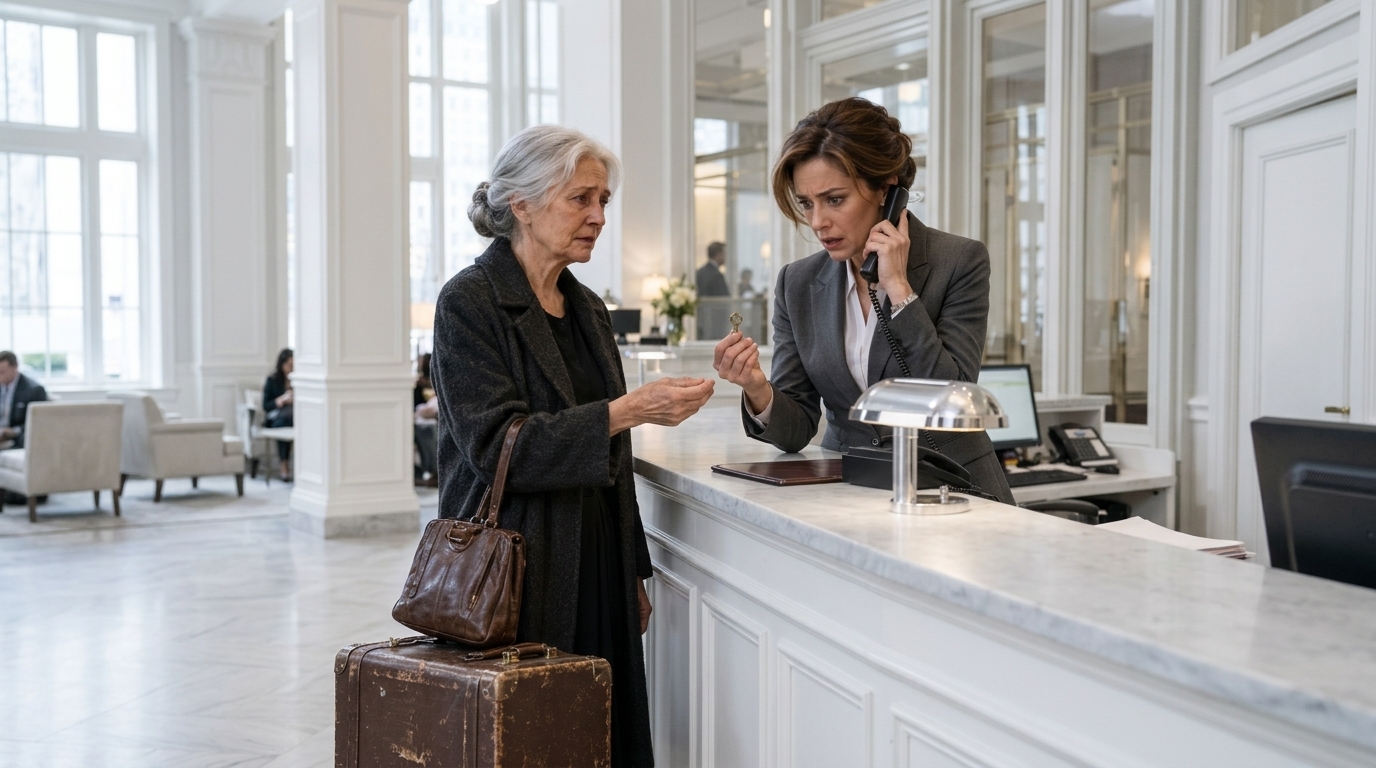
I still remember the four words the bank employee spoke that morning.
She had taken my brass key.
Looked at the number.
Picked up the telephone.
And said:
“Mrs. Sterling has arrived.”
At the time, I didn’t understand why those words changed everything.
Now I do.
For five days, I’d been treated as though I were someone who no longer mattered.
A widow.
An inconvenience.
A woman who should quietly disappear.
But somewhere in Manhattan, my husband had left instructions that said otherwise.
He had planned for the day I might need protection.
He had made sure someone would listen.
And he had left me enough to begin again.
Not because he thought I was weak.
But because he knew I deserved choices.
My daughter-in-law told me to pack my things and go live on the streets. Three months later, she received legal notice that the house she believed she’d taken from me was never hers to claim.
But the ending I treasure most wasn’t the day she opened that envelope.
It was the morning I opened the curtains of my own home, made myself a cup of coffee, and realized I no longer needed anyone’s permission to be happy.
I looked at my husband’s photograph.
Smiled.
And whispered the words I’d wanted to say since that terrible day.
“Thomas, I’m going to be all right.”
And this time, I truly believed them.
THE END THANK YOU FOR READING !!!



