PART 3
For several seconds, I couldn’t move.
I stood in the dark hallway of
the house James and
I had shared for nine years,
staring at the locked basement door
while an alarm screamed
somewhere beneath my feet.
Red lights flashed through
the narrow windows beside our front entrance.
Outside, headlights swept across the living room wall.
“Mrs. Bennett?” the man on the phone said urgently.
“Amelia, are you listening?”
I pressed the phone harder against my ear.
“Yes.”
My name is Daniel Reeves.
I’m your husband’s attorney.
I need you to step away from the basement door.
My mouth felt dry.
“You said someone tried to access evidence. What evidence?”
“I’ll explain everything, but first I need to know whether you’re alone.”
I looked toward the front door.
“I think so.”
“You think so?”
“I just got home from the airport. I’ve been sitting upstairs. The alarm started a few minutes ago.”
“Has anyone entered the house?”
“No.”
“Are any doors or windows open?”
“I don’t know.”
He paused.
“Amelia, I want you to leave the house through the front entrance. Don’t investigate the basement. Don’t confront anyone. Police are on their way.”
My heart began pounding.
“Why would someone be in my basement?”
“Your husband installed a security system in his office before leaving for Europe. It was designed to alert an independent monitoring company if someone attempted to open a protected storage cabinet.”
I stared at the door.
“James never told me.”
“I know.”
That answer frightened me more than anything else.
James and I had never been the kind of couple who kept secrets.
We shared passwords.
Bank accounts.
Plans.
Dreams.
He knew how I took my coffee.
I knew he couldn’t sleep unless the bedroom window was open slightly, even in winter.
When he traveled, he called every evening.
Even if he was exhausted.
Even if it was past midnight.
He would always say, “Just wanted to hear your voice, Ames.”
And now a stranger was telling me that my husband had installed a secret security system.
“Daniel,” I whispered, “what was James involved in?”
He hesitated.
“Something he believed could put him in danger.”
My knees nearly buckled.
Outside, a car door slammed.
Then someone knocked.
Three firm knocks.
“Mrs. Bennett? Portland Police!”
Daniel exhaled.
“That’s them. Verify their identification before opening the door.”
I looked through the peephole.
Two uniformed officers stood beneath the porch light.
Behind them, another patrol vehicle was pulling up.
I opened the door.
“Amelia Bennett?” the older officer asked.
I nodded.
“I’m Officer Maria Delgado. We received a monitored alarm notification associated with this address. Are you injured?”
“No.”
“Is anyone else inside?”
“I don’t think so.”
She glanced at the phone in my hand.
“Who’s on the line?”
“My husband’s attorney.”
She nodded.
“We’ll need you to step outside while we check the house.”
I walked onto the porch wearing slippers and James’s old gray sweatshirt.
Rain misted across the driveway.
The cold air made me shiver.
A neighbor, Mrs. Patterson, stood across the street in her bathrobe.
She raised a hand.
I tried to wave back.
But my arm felt too heavy.
Officer Delgado guided me toward her patrol car.
“Would you like to sit somewhere warm?”
I nodded.
She opened the passenger door.
I sat inside while officers entered the house.
Daniel remained on the phone.
“Amelia?”
“I’m outside.”
“Good.”
I stared at the house.
The red lights had stopped flashing, but the alarm still sounded faintly.
“Please tell me what’s happening.”
He was quiet for a moment.
Then said, “James contacted me six weeks ago.”
I closed my eyes.
Six weeks.
That was when he had started acting differently.
He’d been distracted at dinner.
He’d stayed awake late.
He’d asked strange questions about whether our home security cameras were working.
I assumed he was stressed about work.
James was a financial compliance specialist for a large international logistics company called Meridian Global Transport.
His job involved reviewing payments, contracts, and overseas business transactions.
He sometimes traveled to Europe and Asia.
He was careful.
Methodical.
The kind of man who read the fine print on parking receipts.
“What did he tell you?” I asked.
Daniel took a breath.
“He believed he’d uncovered financial misconduct involving senior executives at Meridian.”
I stared through the windshield.
“What kind of misconduct?”
“Improper transfers, falsified invoices, and payments routed through companies that appeared to have no legitimate business purpose.”
I swallowed.
“And he told you?”
“He came to me because he was frightened.”
My throat tightened.
“James wasn’t easily frightened.”
“I know.”
Daniel continued.
“He’d raised concerns internally. Shortly afterward, he noticed unusual access to his work files and received messages warning him to stop asking questions.”
I closed my eyes.
I remembered one evening when James had come home looking pale.
He’d stood in the kitchen holding his phone.
When I asked what was wrong, he said, “Just office politics.”
Then he hugged me longer than usual.
I had believed him.
“Why didn’t he tell me?”
Daniel’s voice softened.
“He said you were the most important person in his life. He didn’t want you drawn into something he didn’t fully understand.”
Tears filled my eyes.
“That sounds like him.”
“He arranged for relevant records to be preserved through counsel and appropriate reporting channels. The basement storage system was an additional safeguard for certain original materials.”
I stared at the house.
“Why did the alarm activate tonight?”
“We don’t know yet.”
My stomach tightened.
“Was someone trying to steal them?”
“Possibly. That’s what the police will investigate.”
I wiped my face.
“Daniel, James died from a brain aneurysm.”
There was a long silence.
Then he said, “That’s what the initial medical information indicated.”
I gripped the phone.
“What does that mean?”
“It means I don’t have evidence that his death was caused by anyone else. But given the threats he reported before traveling, I believe the circumstances deserve careful review.”
I closed my eyes.
I wanted to scream.
I wanted to tell him to stop.
I had spent three days accepting that my husband was dead.
I had stood beside his grave in a foreign country.
I had watched the coffin disappear beneath the earth.
And now someone was suggesting there might be questions about what happened before he collapsed.
I couldn’t bear it.
“Daniel,” I whispered, “I buried him this morning.”
His voice broke slightly.
“I know, Amelia.”
“I buried my husband.”
“I’m so sorry.”
I began sobbing.
Not quietly.
Not politely.
The kind of crying that comes from somewhere deep inside the body.
I bent forward, pressing my forehead against my knees.
Officer Delgado returned a few minutes later.
She opened the car door gently.
“Mrs. Bennett?”
I looked up.
Her expression was serious.
“We’ve cleared the house. No one is inside.”
I tried to breathe.
“Was someone there?”
“We found signs that an exterior basement access point may have been tampered with. We also found damage to a secured cabinet. We’ll need to document the scene.”
I stared at her.
“Did they take anything?”
“We can’t determine that yet.”
I looked toward my house.
A place that had always felt safe.
A place where James used to dance with me in the kitchen.
Where we decorated Christmas trees.
Where we celebrated birthdays.
Where he proposed we repaint the bedroom and then spent three weekends complaining about the color.
Now officers were searching it as a possible crime scene.
Officer Delgado spoke gently.
“Do you have somewhere you can stay tonight?”
I almost laughed.
My family lived less than an hour away.
My parents had a five-bedroom house.
My brother lived twenty minutes from the airport.
And every one of them had been too busy to pick me up.
I shook my head.
“No.”
She looked concerned.
“No relatives nearby?”
I stared at the rain.
“Yes.”
I swallowed.
“But I don’t want to call them.”
She didn’t ask why.
Instead, she said, “We can help you arrange somewhere safe.”
Daniel spoke through the phone.
“Amelia, I can arrange a hotel and transportation. You won’t need to handle anything tonight.”
I closed my eyes.
“Thank you.”
By two in the morning, I was sitting in a hotel room with a cup of tea I couldn’t drink.
My phone lay on the bedside table.
The family group chat had remained silent.
No one had asked whether I’d arrived home safely.
No one had asked how I was doing.
No one had asked about James.
At 2:17 a.m., a message finally appeared.
Mom: Don’t forget we’re having Sunday dinner this week. Please don’t bring up depressing things in front of the Hendersons.
I stared at the screen.
Then turned the phone face down.
For the first time in my life, I didn’t feel obligated to respond.
The next morning, Daniel arrived with a woman named Rachel Morgan.
Rachel was an investigator who worked with his law firm.
She was in her forties, with short dark hair and a calm expression.
They sat across from me in the hotel’s small conference room.
Daniel placed a folder on the table.
“Amelia, before James left, he signed instructions authorizing me to contact you if certain events occurred.”
I looked at him.
“What events?”
“An attempt to access the protected materials. A threat to your safety. Or his inability to return and explain the situation himself.”
My hands trembled.
“He knew something might happen.”
Daniel looked sad.
“He was concerned enough to prepare.”
Rachel leaned forward.
“We also need to ask about the circumstances surrounding his death.”
I took a breath.
“Okay.”
“Who contacted you?”
“His colleague, Nathan Brooks.”
“When?”
“Late Thursday night.”
“What did he say?”
“That James had collapsed during a meeting in Geneva. He said an ambulance took him to the hospital, but doctors couldn’t save him.”
Rachel nodded.
“Did you speak directly with the treating physician?”
“Yes. The next morning.”
“And what did the physician tell you?”
“That James had suffered a catastrophic brain hemorrhage consistent with a ruptured aneurysm.”
Rachel made a note.
“Were any concerns raised about poisoning, assault, or another external cause?”
“No.”
She nodded.
“Then we should not assume the death was criminal. We can request the relevant records and seek clarification where appropriate.”
I looked at her.
“Do you think someone killed him?”
She met my eyes.
“I don’t know. And I won’t pretend otherwise.”
For some reason, her honesty helped.
Daniel opened the folder.
“There’s something else James left.”
He removed a sealed envelope.
My name was written across the front.
In James’s handwriting.
I reached for it.
My fingers trembled so badly that I could barely tear it open.
Inside was a letter.
My beautiful Amelia,
If you’re reading this, something has happened that kept me from explaining everything myself.
First, please know that none of this is your fault.
I wanted to tell you what I discovered. I tried several times. But every time I looked at you, I thought about how much you deserved a peaceful life.
I made arrangements to protect the information because I believed the truth mattered.
But you matter more.
If I don’t come home, please don’t spend the rest of your life chasing shadows. Let the people trained to investigate do their work.
And please, Ames, don’t let anyone convince you that you have to face everything alone.
I love you more than all the ordinary days we never got to finish.
James.
I pressed the letter against my chest.
And cried until I couldn’t see.
When I finally looked up, Rachel was wiping her eyes.
Daniel waited quietly.
Then he said, “Amelia, there is one more thing.”
I looked at him.
“James prepared a recorded statement.”
My breath caught.
“His voice?”
Daniel nodded.
“Yes.”
I gripped the letter.
“Can I hear it?”
He hesitated.
“There are portions relevant to the investigation that need to remain protected for now. But he recorded a personal message for you.”
I nodded quickly.
“Please.”
Daniel opened his laptop.
A video appeared.
James sat in his basement office.
He wore the blue sweater I’d bought him for his birthday.
His hair was slightly messy.
He looked tired.
But alive.
So terribly alive.
Then he smiled at the camera.
“Hey, Ames.”
I covered my mouth.
“It’s me.”
He gave a nervous laugh.
“I know this is strange. And I hope you never have to watch it.”
My tears fell onto the table.
James leaned forward.
“But if you do, there’s something I need you to remember.”
He paused.
“You are stronger than you think.”
I began sobbing.
“And if your family makes you feel alone again, please remember that being related to someone doesn’t automatically make them your safe place.”
I froze.
James looked directly into the camera.
“I know how they’ve treated you. I know you’ve spent your whole life trying to earn their attention.”
He swallowed.
“But you don’t have to keep doing that.”
Then he smiled sadly.
“You deserve people who show up.”
The video ended.
I sat motionless.
Because James had known.
He had known how much my family’s indifference hurt me.
And even while facing his own frightening situation, he had been thinking about how to protect me from that pain.
Then Rachel’s phone rang.
She answered.
Listened.
And slowly stood.
“Daniel,” she said, “the police have identified the vehicle seen near Amelia’s house.”
My stomach tightened.
Daniel looked up.
“Who owns it?”
Rachel glanced at me.
Then said something I never expected.
“The registered owner is a company connected to Meridian Global Transport.”
And suddenly, the room felt very small.
PART 4
By noon, the police had returned to my house with additional investigators.
They had obtained security footage from two neighboring properties.
One camera showed a dark SUV entering our street shortly before the basement alarm activated.
Another showed the same vehicle leaving several minutes later.
The license plate was partially visible.
Investigators traced the vehicle to a fleet-leasing arrangement associated with a Meridian contractor.
That didn’t establish who had been driving.
It didn’t prove why the vehicle had been there.
But it was enough to justify further inquiries.
Rachel explained everything carefully.
“We need to distinguish what we know from what we suspect.”
I nodded.
“What do we know?”
“Someone appears to have attempted to enter the secured basement area. The alarm activated. A vehicle associated with a Meridian contractor was nearby.”
“And what do we suspect?”
“That the attempted access may be connected to the records James preserved.”
I looked at her.
“And his death?”
She shook her head.
“We still don’t have evidence connecting his death to any criminal act.”
I swallowed.
I wanted certainty.
I wanted someone to tell me exactly what had happened.
But I was beginning to understand that the truth rarely arrived in one dramatic moment.
Sometimes it came slowly.
Through documents.
Witnesses.
Timelines.
Questions nobody wanted answered.
Daniel told me that James had already made protected disclosures through legal channels before his trip.
He had preserved copies of relevant financial records with counsel.
The materials in the basement were not the only evidence.
That was important.
Because whoever had attempted to reach the cabinet had not destroyed the investigation.
I stared at Daniel.
“Did James know someone might come to our house?”
“He considered it possible.”
I looked down.
“He should have told me.”
Daniel nodded.
“Yes.”
The answer surprised me.
I had expected him to defend James.
Instead, he said, “He was trying to protect you, but that doesn’t mean every decision he made was right.”
I closed my eyes.
I loved my husband.
I would always love him.
But grief didn’t require me to pretend he had been perfect.
I wished he’d trusted me with the truth.
I wished I’d known he was frightened.
I wished I could go back to our last dinner and ask him why his hands were shaking.
But I couldn’t.
All I could do now was decide what happened next.
That afternoon, Rachel arranged for me to meet with a victim-support coordinator and a detective assigned to the attempted break-in.
I gave a formal statement.
I described the alarm.
The telephone call.
The vehicle.
The condition of the house when I returned from the airport.
I provided access to our home security records.
And I told them about James’s final trip.
The detective, Aaron Mitchell, listened carefully.
Then asked, “Mrs. Bennett, have you received any threatening messages?”
“No.”
“Has anyone contacted you about your husband’s work?”
“Only his colleague Nathan Brooks after James collapsed.”
He nodded.
“Has anyone asked whether your husband left documents behind?”
I thought for a moment.
Then remembered something.
Three days before I flew overseas, Nathan had called.
He said he wanted to help.
He asked whether James had left any work files at home.
At the time, I assumed he was trying to assist with company paperwork.
I had told him I didn’t know.
Detective Mitchell wrote something down.
“What exactly did he ask?”
I closed my eyes.
“He asked whether James kept backup drives in his office.”
Rachel looked at Daniel.
The detective continued.
“Did he explain why?”
“He said Meridian needed to secure confidential company information.”
I swallowed.
“Was that unusual?”
“It’s something we should verify.”
I looked at him.
“Do you think Nathan was involved?”
“We don’t know.”
I nodded.
But my stomach tightened.
Nathan had been James’s friend.
They had worked together for six years.
He’d attended our wedding.
He’d brought us dinner when I had surgery.
He was one of the first people who called after James died.
The possibility that he knew more than he’d told me made me feel sick.
That evening, I returned to the hotel.
I ordered soup.
Took three bites.
Then pushed it away.
My phone buzzed.
Mom.
I stared at the screen.
For a moment, I considered ignoring it.
Then I answered.
“Hello?”
“Amelia, finally.”
My mother’s voice sounded irritated.
“Why haven’t you answered the group chat?”
I looked toward the window.
“I’ve been busy.”
“With what?”
I almost laughed.
“My husband’s death, Mom.”
She sighed.
“Amelia, I know you’re grieving, but life doesn’t stop for everyone else.”
I closed my eyes.
“I understand.”
“Your brother says you’ve been acting strange.”
I frowned.
“Troy hasn’t spoken to me.”
“He said you were short with him.”
I stared at the wall.
“I asked for a ride from the airport.”
“Yes, and he was busy.”
I took a breath.
“Mom, I had just buried James.”
She was quiet.
Then said, “We all have responsibilities.”
Something inside me went still.
For thirty-five years, I had been trying to explain my feelings to a woman who treated them like inconveniences.
I remembered being twelve and waiting outside school after a concert because Mom forgot to pick me up.
I remembered my college graduation, when she left early because Troy had a baseball tournament.
I remembered calling her after my first miscarriage and hearing her say, “At least it happened early.”
And now, after burying my husband, she was telling me that everyone had responsibilities.
I looked at James’s letter beside the bed.
You deserve people who show up.
I took a slow breath.
“Mom, I’m going to hang up.”
She sounded offended.
“Excuse me?”
“I don’t have the energy for this conversation.”
“Amelia, don’t be dramatic.”
“Goodbye, Mom.”
I ended the call.
Then turned off notifications.
For the first time, I didn’t feel guilty.
I felt exhausted.
But also strangely relieved.
The following morning, news of the investigation began spreading.
A local television station reported that police had responded to a security alarm and possible attempted burglary at a residence in a quiet Portland neighborhood.
The report did not identify the homeowner initially.
But neighbors recognized the house.
Someone posted footage of the emergency vehicles.
Another person shared a photograph of investigators entering the property.
By afternoon, reporters had learned that the home belonged to James Bennett, a Meridian Global Transport employee who had recently died overseas.
The story changed.
A reporter contacted Meridian.
The company issued a brief statement expressing condolences and saying it was cooperating with inquiries.
Then another development emerged.
A federal agency confirmed that it was reviewing allegations involving financial transactions at Meridian.
The agency did not discuss individual witnesses or confidential records.
But the timing attracted attention.
A local journalist began asking questions about James’s death and the attempted break-in.
By evening, the story had become the lead item on a regional news broadcast.
I watched from my hotel room.
The screen showed my house.
Police vehicles.
The front porch where James used to leave his muddy shoes.
The flower beds I’d planted.
The little maple tree we bought on our fifth anniversary.
Then the reporter appeared.
“Authorities are investigating an attempted break-in at the home of a recently deceased financial compliance specialist whose work may be connected to an ongoing review of corporate financial practices.”
My hands began shaking.
The reporter continued.
“James Bennett, thirty-eight, died unexpectedly while traveling overseas. Officials have not announced evidence of foul play in his death.”
A photograph of James appeared.
His company headshot.
The one I had helped him choose.
He was smiling.
My beautiful, kind, ordinary husband.
Reduced to a picture on television.
I began crying.
Then the reporter said something that made me sit upright.
“Sources familiar with the matter say Bennett had raised concerns about irregular transactions before his death. Investigators are examining whether the attempted break-in was connected to his work.”
The broadcast showed my house again.
Then a photograph of me and James from a charity event.
I stared.
I hadn’t given anyone permission to use it, though it had been publicly available.
The reporter identified me as his surviving wife.
Amelia Bennett.
Thirty-five.
Recently returned from overseas.
I covered my face.
I hadn’t wanted attention.
I hadn’t wanted cameras.
I hadn’t wanted my husband’s death turned into a public mystery.
I wanted him home.
I wanted to hear his key in the front door.
I wanted him to complain about the weather.
I wanted to make dinner while he told me about his day.
But instead, the entire city was watching my house on television.
My phone began ringing.
Troy.
I ignored it.
Then Mom.
Then Dad.
Then Troy again.
Messages appeared in the family group chat.
Troy: Amelia, what the hell is going on?
Mom: Is that your house on Channel 8?
Dad: Call us immediately.
Troy: Why are there police cars outside?
Mom: Are you safe?
I stared at the messages.
For the first time since James died, my family was asking whether I was safe.
Not when I was alone overseas.
Not when I was burying him.
Not when I arrived at the airport carrying his belongings.
Only when the evening news showed my house.
Then Mom sent another message.
Mom: Why didn’t you tell us something was happening?
I looked at the screen.
My hands stopped shaking.
I typed slowly.
I told you I needed someone.
Then I set the phone down.
Within seconds, Troy called again.
I answered.
“Amelia!”
His voice was frantic.
“Where are you?”
“At a hotel.”
“A hotel? Why?”
“Because someone tried to break into my house.”
He went silent.
Then said, “Why didn’t you call us?”
I stared at the wall.
“Troy, I asked you to pick me up from the airport after I buried my husband.”
He exhaled.
“That’s different.”
“Is it?”
He sounded frustrated.
“I didn’t know things were this serious.”
I closed my eyes.
“James was dead.”
Silence.
I continued.
“I was coming home from his funeral.”
He said nothing.
“How much more serious did it need to be?”
His voice softened.
“Amelia—”
“No.”
I took a breath.
“You don’t get to tell me you didn’t know I needed help.”
He whispered, “I’m sorry.”
I looked at James’s photograph.
For years, I would have accepted those words immediately.
I would have reassured Troy.
Told him everything was fine.
Made sure he didn’t feel guilty.
But I couldn’t do that anymore.
“Thank you,” I said.
Then I ended the call.
A few minutes later, my mother sent a private message.
Amelia, people are asking us questions. Please call so we can coordinate what to say.
I stared at it.
Not Are you okay?
Not Can we help?
Not Do you need somewhere to stay?
People were asking questions.
And she wanted to coordinate appearances.
I turned off my phone.
Then I cried myself to sleep.
The next morning, Daniel arrived with another update.
Investigators had located the driver associated with the vehicle seen near my house.
His name was Marcus Vale.
He worked for a private security contractor that had previously provided services to Meridian.
He had agreed to speak with investigators.
And according to preliminary information, he’d been instructed to retrieve materials from James’s home.
I stared at Daniel.
“By whom?”
He hesitated.
“That’s still being established.”
Rachel leaned forward.
“But Marcus has identified someone who contacted him.”
My heart pounded.
“Who?”
She looked at me.
“Nathan Brooks.”
I felt the room tilt.
James’s friend.
The man who called to tell me my husband was dead.
The man who asked about backup drives.
The man who had attended our wedding.
I covered my mouth.
“No.”
Rachel spoke gently.
“His name has come up in the investigation. That doesn’t mean every allegation has been proven.”
I shook my head.
“He hugged me at the hospital.”
My voice broke.
“He told me James didn’t suffer.”
Daniel lowered his eyes.
I stared at them.
Then whispered, “Did he know what happened to James?”
Rachel paused.
“We’re still working to establish the facts surrounding the death.”
I closed my eyes.
Because suddenly, every memory of Nathan felt different.
Every conversation.
Every sympathetic message.
Every offer to help.
Then Daniel said something that made my blood run cold.
“Amelia, there’s another reason we wanted to speak with you today.”
I looked up.
“What?”
He opened a folder.
“James left a second set of instructions.”
My heart pounded.
“For what?”
Daniel looked at Rachel.
Then back at me.
“For what should happen if someone attempted to remove the records after his death.”
I stared at him.
“And?”
He took a breath.
“He instructed us to release the preserved evidence to the appropriate investigators and provide you with a complete inventory of the assets and arrangements he’d established for your protection.”
I swallowed.
“What arrangements?”
Daniel turned the folder toward me.
At the top was a document titled:
BENNETT FAMILY PROTECTION TRUST
I stared at the words.
Then looked up.
“What is this?”
Daniel’s expression softened.
“Amelia, your husband knew you might need to rebuild your life without him.”
He paused.
“And he made sure you would have the means to do it.”
PART 5
I stared at the trust document for so long that the words stopped making sense.
Bennett Family Protection Trust.
My husband’s name.
My name.
Dates.
Signatures.
Pages of legal language.
I looked at Daniel.
“James never told me about this.”
He nodded.
“I know.”
“Why?”
“Because he intended to explain everything when he returned.”
I looked down.
When he returned.
Two words that suddenly felt unbearable.
James had planned to come home.
He had planned to sit beside me at our kitchen table and explain the things he’d discovered.
He had planned to tell me about the threats.
The evidence.
The trust.
He had planned a future.
And then he died.
I pressed my hand against my mouth.
Daniel waited.
When I could finally speak, I whispered, “What does it mean?”
He opened the document.
“James established this trust using assets he owned separately and certain jointly planned arrangements. The trust was designed to provide financial support and professional assistance if he became incapacitated or died.”
I stared at him.
“How much money?”
He hesitated.
“Before I answer, I want you to understand that the trust doesn’t mean James expected to die. Many people create arrangements like this as a precaution.”
I nodded.
“Okay.”
He turned another page.
“The trust currently holds approximately $1.6 million in investment assets, subject to administration expenses and market changes.”
I stopped breathing.
“One point six million?”
“Yes.”
I shook my head.
“That can’t be right.”
Daniel looked at me.
“James had been investing for years. Some of the assets came from an inheritance he received from his grandfather. Others came from savings and investment accounts he kept separate from his employer.”
I stared at the papers.
James and I had lived comfortably.
But not extravagantly.
We drove ordinary cars.
Bought groceries on sale.
Took modest vacations.
He hated wasting money.
I knew we had savings.
I knew he invested.
But I had no idea he’d accumulated that much.
“Why didn’t he tell me?”
Daniel’s expression became sad.
“He believed you’d both have time to discuss it properly.”
I looked away.
There it was again.
Time.
The thing we’d always assumed we had.
I began crying.
Daniel continued gently.
“The trust also includes instructions for paying necessary expenses, maintaining the house, and providing access to independent financial advice.”
I nodded through tears.
“And what happens to it?”
“You are the primary beneficiary under the relevant provisions. The trustee will administer the assets according to the trust terms.”
I looked at him.
“Does this have anything to do with Meridian?”
“No. These are personal assets. They’re separate from the disputed company transactions.”
I exhaled.
For the first time since James died, I felt something other than fear.
Not happiness.
Not relief exactly.
But the knowledge that I wasn’t facing financial ruin while grieving.
James had protected me in a way I hadn’t even known I needed.
Then Daniel removed another envelope.
“This is from him.”
My hands trembled.
I opened it.
Inside was a short handwritten note.
Amelia,
If Daniel is showing you these papers, then life has taken a turn neither of us wanted.
Please don’t think of this money as a reason to stop living.
Think of it as permission to begin again whenever you’re ready.
Travel somewhere beautiful.
Take the painting classes you always talk about.
Buy the ridiculous yellow rain boots you keep putting back on the shelf.
And please, my love, don’t spend another year begging people to make room for you.
You already belong.
Always, James.
I laughed through tears.
The yellow rain boots.
I’d seen them in a shop window months earlier.
Bright yellow.
Completely impractical.
James had wanted to buy them.
I told him they were too expensive.
He’d laughed.
“Ames, they’re rain boots, not a yacht.”
I had promised to buy them someday.
Now someday had arrived without him.
I folded the letter carefully.
Then looked at Daniel.
“Thank you.”
He nodded.
“There are also some practical matters to address. We’ll help you understand the trust, estate administration, and any insurance benefits.”
I took a breath.
“Okay.”
Rachel leaned forward.
“And Amelia, regarding the investigation, there’s something important you should know.”
I looked at her.
“The authorities have received the preserved financial records James arranged to protect.”
My chest tightened.
“What happens now?”
“They’ll evaluate the evidence, interview witnesses, and determine whether any criminal or regulatory violations occurred.”
I nodded.
“And Nathan?”
“He has been interviewed. We can’t discuss every detail, but investigators are examining his role in the attempted retrieval of the records.”
I closed my eyes.
“Do they think he killed James?”
Rachel shook her head.
“There is still no established evidence that James’s death was caused by foul play.”
I swallowed.
For days, part of me had wanted to believe someone was responsible.
Not because I wanted revenge.
Because a villain would make the loss easier to understand.
If someone had caused James’s death, then perhaps there would be an explanation.
A reason.
A person to blame.
But the truth was more complicated.
James might have uncovered serious wrongdoing.
Someone might have tried to steal his evidence.
And he still might have died from a sudden medical catastrophe unrelated to those events.
Both things could be true.
The uncertainty hurt.
But I was learning that grief didn’t become easier simply because someone offered a dramatic explanation.
I wanted the truth.
Whatever it was.
Over the following months, the investigation continued.
The attempted break-in was examined separately from the allegations involving Meridian’s financial transactions.
The preserved records helped investigators reconstruct payments through several related companies.
Witnesses were interviewed.
Additional documents were obtained.
And eventually, authorities announced charges against individuals connected to a scheme involving fraudulent invoices and unauthorized transfers.
Nathan Brooks was among those accused of participating in the effort to recover and conceal certain records.
The criminal proceedings would take time.
I followed them through official updates and conversations with Daniel.
But I refused to turn my life into a permanent vigil.
James had specifically asked me not to spend the rest of my years chasing shadows.
So I let the investigators investigate.
I let the lawyers handle the legal work.
And I began the slow, painful process of learning how to live without my husband.
The medical review of James’s death ultimately supported the original conclusion.
He had suffered a catastrophic rupture of a cerebral aneurysm.
There was no substantiated finding of poisoning or assault.
The timing remained heartbreaking.
He had been under enormous stress.
He had been frightened.
He had been trying to do the right thing.
But the evidence did not establish that someone had murdered him.
I cried when Daniel told me.
Not because I had wanted a different answer.
Because the truth made the finality of his death feel real all over again.
There was no hidden explanation that would bring him back.
No dramatic courtroom revelation that would reverse what happened.
James was gone.
And I had to keep living.
That was the hardest part.
The investigation eventually produced accountability for the financial wrongdoing and the attempted interference with evidence.
But it couldn’t give me another morning with my husband.
It couldn’t return his laughter.
His terrible jokes.
The way he sang off-key while making pancakes.
The way he always warmed my side of the bed with his feet before I climbed in.
Those things were gone.
And no amount of money or legal justice could replace them.
Meanwhile, my family had suddenly become very interested in my life.
After the television report, my mother called almost every day.
Troy sent messages asking whether I needed help.
My father offered to come by and check the locks.
At first, I ignored them.
Then one afternoon, my mother appeared at the hotel where I’d been staying.
She stood in the lobby wearing a cream-colored coat and carrying a bouquet of white lilies.
“Amelia.”
I looked up from the chair where I’d been reading.
“Mom.”
She approached carefully.
“I’ve been trying to reach you.”
“I know.”
Her eyes filled.
“Why haven’t you answered?”
I closed my book.
“Because I needed space.”
She looked hurt.
“From your own mother?”
I took a breath.
“Yes.”
She sat across from me.
For a moment, she seemed uncertain.
Then she said, “We had no idea what you were going through.”
I stared at her.
“Mom, you knew James died.”
She looked down.
“You knew I buried him overseas.”
Her hands tightened around the flowers.
“You knew I was coming home alone.”
She swallowed.
I continued.
“And when I asked for a ride, you told me I should have planned better.”
Tears gathered in her eyes.
“I didn’t mean it like that.”
I shook my head.
“Then how did you mean it?”
She opened her mouth.
Then closed it.
I waited.
For once, I wasn’t going to help her find an excuse.
Finally, she whispered, “I was thoughtless.”
I looked at her.
She began crying.
“I was thinking about dinner plans. Your father’s schedule. Troy’s work.”
Her voice broke.
“And I didn’t stop to think about what you had just been through.”
I felt my throat tighten.
She wiped her cheeks.
“I’m sorry.”
For thirty-five years, I had wanted those words.
But now that she’d finally said them, I understood something.
An apology was important.
But it didn’t automatically erase years of neglect.
I looked at her.
“Thank you.”
She leaned forward.
“Can we start over?”
I took a slow breath.
“I don’t know.”
Her face fell.
I continued.
“I love you, Mom. But I need to see that things will actually change.”
She nodded slowly.
“What can I do?”
I thought about James’s video.
You deserve people who show up.
Then I answered.
“Stop waiting until something becomes public before you care.”
She began crying harder.
I looked away.
Not because I wanted to hurt her.
Because I was tired of making myself responsible for everyone else’s feelings.
My mother left the flowers.
I took them back to my room.
And for the first time, I didn’t feel obligated to call her that evening to reassure her.
Two weeks later, Troy came to see me.
He didn’t bring flowers.
He didn’t bring excuses.
He brought a cardboard box.
Inside were groceries.
Soup.
Bread.
Coffee.
Fresh fruit.
And a package of the chocolate cookies James used to buy.
I stared at them.
Troy looked embarrassed.
“I didn’t know what else to bring.”
I nodded.
“Thank you.”
He sat down.
For several minutes, neither of us spoke.
Then he said, “I was awful to you.”
I looked at him.
“Yes.”
He swallowed.
“I saw your message at work.”
I waited.
“I could have left early.”
My chest tightened.
He continued.
“I could have picked you up.”
His eyes filled.
“But I didn’t want to deal with something sad.”
I stared at him.
He wiped his face.
“That’s the truth.”
I looked down.
“I know.”
He began crying.
“I thought you’d be okay because you’re always okay.”
I felt tears gather.
“I’m not always okay, Troy.”
He nodded.
“I know that now.”
I looked at him.
“I wasn’t asking you to solve anything.”
His voice broke.
“I know.”
“I just didn’t want to walk through that airport alone.”
He covered his face.
And for the first time in years, my brother cried in front of me.
I didn’t immediately hug him.
I let him sit with the truth.
Then, after a long silence, I reached across the table and took his hand.
It wasn’t forgiveness for everything.
But it was a beginning.
Over the following months, Troy began showing up.
Not with grand gestures.
With ordinary ones.
He brought groceries.
Helped me replace a broken porch light.
Drove me to an appointment when I didn’t feel like driving.
Called on difficult anniversaries.
And sometimes he simply sat with me while I cried.
My mother tried too.
Her progress was slower.
She still occasionally said the wrong thing.
Still tried to organize my grief into a schedule.
But she began asking questions instead of offering instructions.
And when I told her I didn’t want visitors, she respected it.
For the first time, I wasn’t doing all the work to maintain those relationships.
They were meeting me halfway.
Not perfectly.
But genuinely.
Six months after James’s death, I moved back into our house.
The damaged basement door had been repaired.
The security system had been updated.
The investigation-related materials were no longer stored there.
And the house had been cleared for ordinary use.
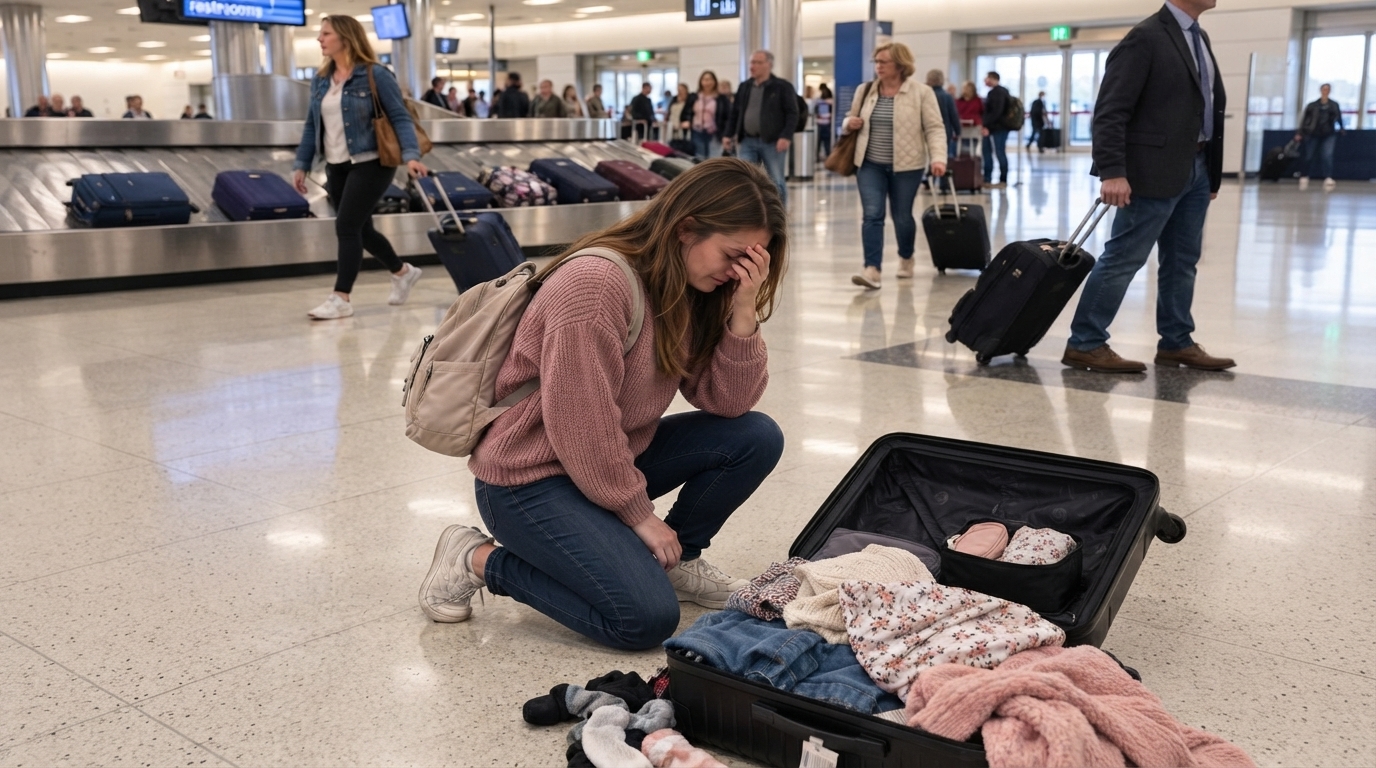
I stood in the front hallway with my suitcases.
The same black suitcases I’d brought home from overseas.
The ones that had burst open at the airport.
For a long time, I simply looked around.
The familiar furniture.
The photographs.
The kitchen where James used to make coffee.
The staircase where he’d sit to tie his shoes.
Everything was the same.
And nothing was.
I carried the suitcases upstairs.
Unpacked his clothes slowly.
Some I donated.
Some I kept.
His navy anniversary tie went into a memory box.
His favorite sweater stayed folded in my dresser.
I placed his shaving kit in a drawer.
Not because I expected him to return.
But because I wasn’t ready to let go of every trace of him.
And that was okay.
Grief didn’t have a deadline.
I didn’t need to organize it better.
I didn’t need to hurry.
I didn’t need to make anyone comfortable with my sadness.
I could simply miss my husband.
One rainy afternoon, I drove downtown.
I parked near the little shop where I’d seen the yellow rain boots.
They were still in the window.
Bright.
Ridiculous.
Beautiful.
I walked inside.
The saleswoman smiled.
“Can I help you?”
I pointed.
“Those yellow boots.”
She laughed.
“Good choice.”
I tried them on.
They fit perfectly.
I bought them.
Then I drove to the waterfront.
Rain fell steadily.
People hurried beneath umbrellas.
I stepped out of my car wearing my bright yellow boots and walked toward the river.
For the first time in months, I smiled without immediately feeling guilty.
I imagined James laughing.
“Told you they were worth it, Ames.”
I looked toward the gray sky.
“I know.”
Then I began crying.
But this time, the tears didn’t feel like they were drowning me.
They felt like love.
Love that had nowhere else to go.
A year after James died, I attended a small ceremony recognizing people who had helped expose financial misconduct at Meridian.
The company had undergone major changes.
Several individuals had faced legal consequences.
New oversight measures had been introduced.
The investigation had confirmed that James’s preserved records were important in uncovering the fraudulent transactions.
The organizers wanted to recognize his contribution.
I almost declined.
I didn’t want cameras.
I didn’t want speeches.
I didn’t want to hear strangers describe my husband as brave when I would have preferred him alive and ordinary.
But Daniel encouraged me to consider it.
“James cared deeply about doing the right thing,” he said.
I nodded.
“I know.”
“Maybe this could be a way to honor that.”
I thought about it for several days.
Then I agreed.
The ceremony was small.
No dramatic ballroom.
No enormous stage.
Just a gathering of colleagues, investigators, and people whose work had helped establish the truth.
When my name was called, I walked forward.
I accepted a framed letter recognizing James’s integrity and cooperation.
Then I stood at the microphone.
For a moment, I couldn’t speak.
I looked out at the audience.
Troy sat near the front.
My mother and father sat beside him.
Daniel Reeves was there.
Rachel Morgan too.
People who had helped me through the worst year of my life.
I took a breath.
“My husband was not a perfect man.”
A few people smiled gently.
“He forgot birthdays unless he put them in his phone. He left coffee cups everywhere. And he believed every meal could be improved with hot sauce.”
Soft laughter moved through the room.
I smiled through tears.
“But James believed something very strongly.”
I looked down at the framed letter.
“He believed that doing the right thing mattered, even when nobody was watching.”
My voice trembled.
“He didn’t want to become a hero.”
I paused.
“He wanted to come home.”
The room went silent.
I swallowed.
“And I wish more than anything that he had.”
Tears rolled down my cheeks.
“But I’m grateful that the truth he tried to protect wasn’t lost.”
I looked toward my family.
Then continued.
“This past year taught me that love isn’t measured by what people say when life is easy.”
I took a breath.
“It’s measured by who shows up when everything falls apart.”
Troy lowered his head.
My mother began crying.
I smiled sadly.
“And sometimes, the people who show up are strangers.”
I thought about the traveler at baggage claim.
Officer Delgado.
Daniel.
Rachel.
The hotel staff.
The neighbors.
The people who helped without being asked twice.
“Sometimes they’re people you’ve known your whole life who finally learn how to be there.”
I looked at Troy.
He nodded through tears.
“And sometimes the person who loved you most leaves behind enough courage for you to keep going.”
I touched the letter.
“James did that for me.”
I stepped away from the microphone.
The audience stood.
But I barely noticed.
Because in my mind, I could hear James’s voice.
You deserve people who show up.
That evening, I returned home.
Rain tapped gently against the windows.
I made tea.
Sat in James’s favorite armchair.
And opened our family group chat.
For months, I’d barely used it.
Now there were ordinary messages.
Photographs.
Dinner invitations.
Updates about work.
Nothing extraordinary.
Then Troy sent a message.
Hey, Amelia. I’m heading your way tomorrow. Want me to bring coffee?
I smiled.
Yes, please.
Mom replied.
I made your favorite soup. Can I drop some off this weekend? No pressure.
I looked at the screen.
Then typed:
Saturday would be nice.
It wasn’t perfect.
Our family still had work to do.
There were years of hurt that couldn’t be erased by a few kind gestures.
But for the first time, I wasn’t the only person trying.
I placed my phone on the table.
Then looked at James’s photograph.
He was standing on our back porch, holding a coffee mug.
Smiling.
Alive in that one frozen moment.
I touched the frame.
“I’m doing okay, sweetheart.”
My voice broke.
“Not every day.”
I smiled through tears.
“But I’m trying.”
Outside, the rain continued.
I looked toward the front door.
My yellow boots stood neatly beside it.
And I realized something.
A year earlier, I’d returned from burying my husband and asked my family for one small kindness.
A ride from the airport.
They refused.
They treated my grief like an inconvenience.
They told me to plan better.
So I answered with two words.
No problem.
At the time, I didn’t mean them.
Everything was a problem.
My husband was dead.
My heart was broken.
My house was empty.
And I felt completely alone.
But those two words became the beginning of something I never expected.
The beginning of boundaries.
The beginning of honesty.
The beginning of learning that I didn’t have to beg for love.
The evening news hadn’t made my family care.
It had simply forced them to see a reality they had chosen to ignore.
The real change came afterward.
When I stopped pretending their indifference didn’t hurt.
When I stopped apologizing for needing support.
And when they began understanding that being family required more than sharing a last name.
I still missed James every single day.
I missed him when I woke up.
When I cooked dinner.
When I heard a joke he would have loved.
When rain hit the windows.
When I saw a couple holding hands.
Some days, the grief still knocked the breath out of me.
But I was no longer afraid of it.
Because I had learned that grief wasn’t proof I was weak.
It was proof that I had loved someone deeply.
And that love had changed me forever.
I looked at James’s photograph one last time.
Then whispered:
“You were right, James. I deserved people who showed up.”
I smiled.
“And I finally learned that I could show up for myself, too.”
That night, I turned off the living room lights.
Walked upstairs.
And slept peacefully in the home we’d built together.
Not because everything had been fixed.
Not because the pain was gone.
But because I finally understood that my life wasn’t over simply because the life I’d planned had ended.
There were still mornings waiting for me.
Still places to see.
Still friendships to build.
Still laughter I hadn’t heard yet.
And somewhere inside that future, I knew I would carry James with me.
Not as a secret.
Not as a tragedy.
But as love.
The kind of love that doesn’t disappear when someone dies.
The kind that teaches you how to live again.
THE END THANK YOU FOR READING !!!