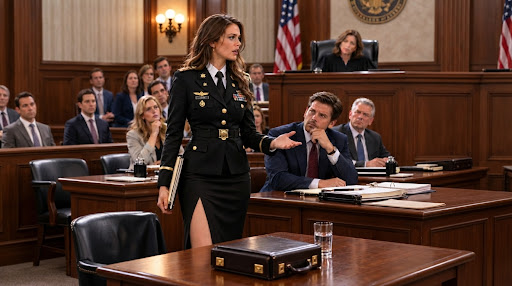
PART 3
For the first time since our divorce proceedings began,
Preston Hale looked genuinely frightened.
It wasn’t dramatic at first.
His mouth simply stopped moving.
Then his eyes shifted toward
the certified bank records in my hand,
and the confident expression he’d worn since
entering the courtroom slowly disappeared.
His father, Richard Hale, leaned forward.
“What account?” he whispered.
Preston didn’t answer.
Judge Rebecca Morrison adjusted her glasses.
“Mrs. Hale, please explain the relevance of these documents.”
I stood straight.
Your Honor, my husband submitted a sworn financial disclosure stating
that Hale Strategic Holdings was acquired entirely
through his separate business assets.
He also declared that
I made no financial contribution toward its purchase.”
I placed the first document on the evidence table.
“That statement is contradicted by these records.”
Martin Voss rose immediately.
“Objection, Your Honor. We have not established the authenticity or admissibility of these documents.”
I turned toward him.
“Counsel, the records were produced by the financial institution in response to a properly served subpoena, and certified copies were exchanged during discovery.”
Voss paused.
I continued.
“Your office acknowledged receipt eleven days ago.”
Judge Morrison examined the filing information.
“Mr. Voss, is that correct?”
He cleared his throat.
“We received a supplemental production, Your Honor.”
“And did you object to its authenticity before today’s hearing?”
“No, Your Honor.”
“Then let’s proceed with the appropriate foundation.”
I nodded.
“Thank you.”
Behind Preston, Vivian Hale stopped smiling.
I could almost hear her thinking.
How does Amelia know all these things?
For seven years, Vivian had treated me like an attractive piece of furniture.
Useful when guests needed entertaining.
Invisible when serious conversations began.
She called me “our little homemaker” at charity luncheons.
She told people I’d married above my station.
Once, during Thanksgiving dinner, she asked whether I understood what Preston actually did for a living.
I had smiled and passed the potatoes.
I understood far more than she imagined.
Before marrying Preston, I’d spent years serving as an Army judge advocate.
I’d handled investigations, advised commanders, prepared cases, and learned how to separate convincing stories from verifiable facts.
I had left active service because I wanted to build a different life.
I wanted a family.
A home.
A marriage where I didn’t have to spend every evening preparing for conflict.
I thought I had found that with Preston.
Instead, I had married into a family that mistook kindness for ignorance.
Judge Morrison looked toward me.
“Mrs. Hale, continue.”
I opened the folder.
“On March fourteenth, seven years ago, $640,000 was transferred from Carter Family Investments into an escrow account established for the acquisition of Hale Strategic Holdings.”
Preston shifted in his chair.
I displayed the transfer confirmation.
“The originating account belonged solely to me before our marriage. The funds came from an inheritance my grandmother left me and investments I accumulated during my military service.”
Voss stood.
“Your Honor, even if the funds originated from her account, that does not automatically establish the ownership or classification of the business.”
I nodded.
“Agreed.”
He blinked.
That wasn’t the response he’d expected.
“The legal treatment of the business depends on the governing documents, applicable marital-property law, and the evidence concerning the transaction.”
I turned another page.
“Which is why I’ve also provided the purchase agreement, the original operating agreement, and the accompanying contribution schedule.”
I placed the documents beside the bank records.
“The schedule identifies the $640,000 as a capital contribution made on my behalf.”
Judge Morrison studied the papers.
“And what ownership interest was associated with that contribution?”
I took a breath.
“Forty percent.”
The courtroom went silent.
Richard Hale slowly sat back.
Vivian whispered, “That’s impossible.”
I didn’t look at her.
For seven years, Preston had described himself as the sole architect of his company’s success.
At business dinners, he told people he’d started with nothing.
At family gatherings, Richard boasted that his son had inherited the Ashcroft—no, the Hale—instinct for building wealth.
Whenever someone asked what I’d contributed, Preston smiled.
“Amelia keeps the house running.”
He never mentioned the $640,000.
He never mentioned the ownership schedule.
And apparently, he had convinced himself that if he ignored those documents long enough, they would stop existing.
Judge Morrison turned toward Preston’s attorneys.
“Mr. Voss, does your client dispute the existence of this operating agreement?”
Voss whispered urgently to Preston.
My husband shook his head.
Voss stood.
“We need an opportunity to review the full implications.”
“The document was exchanged during discovery,” I said.
Judge Morrison raised a hand.
“Mrs. Hale, one moment.”
I sat.
The judge looked at Voss.
“Counsel, I will allow you to confer with your client. But I expect both parties to address the discrepancy between the sworn disclosure and the documents now before the court.”
She ordered a brief recess.
The moment she left the bench, Preston turned toward me.
“What the hell are you doing?”
His voice was low but furious.
I closed my folder.
“Presenting evidence.”
“You’re trying to destroy me.”
I looked at him.
“No, Preston. I’m trying to establish what actually belongs to whom.”
Richard Hale approached our tables.
His expensive shoes clicked against the floor.
“Amelia,” he said, “this is unnecessary.”
I looked up.
“Is it?”
He forced a smile.
“Family matters should be handled privately.”
I almost laughed.
Three weeks earlier, he’d called me a parasite.
He’d told Preston to make sure I walked away with nothing.
He’d offered to pay the legal fees if Preston refused every settlement proposal.
Now he wanted privacy.
I looked at him.
“Richard, you laughed when I walked into this courtroom without an attorney.”
His expression tightened.
“That was a misunderstanding.”
“No. It wasn’t.”
Vivian stepped closer.
“Amelia, darling, surely we can discuss this sensibly.”
I turned toward her.
“Of course.”
She looked relieved.
“Then let’s stop this spectacle.”
I closed my briefcase.
“Tell your son to correct his financial disclosures.”
Her smile disappeared.
Preston leaned forward.
“You have no idea what you’re doing.”
I looked directly at him.
“Actually, Preston, I do.”
Then I said something that made him go completely still.
“I know about the second company.”
His face drained.
Richard frowned.
“What second company?”
Preston stared at me.
“Amelia.”
I stood.
“Excuse me. I need some water.”
I walked away before he could answer.
Because the $640,000 wasn’t the entire story.
It was merely the first account I’d discovered.
The second company was where the real deception began.
And Preston had no idea how much evidence I’d already gathered.
When court resumed, Judge Morrison addressed the disputed ownership documents.
The hearing continued through the morning.
Voss attempted to characterize my original contribution as a voluntary gift.
I introduced correspondence discussing the ownership structure.
He suggested the contribution schedule had been superseded.
I presented the later amendment, which retained the original ownership allocation.
He argued that my role in the company had been passive.
I acknowledged that I had not managed daily operations.
Then I produced minutes from four company meetings listing me as a member whose consent was required for certain transactions.
Each document narrowed the distance between Preston’s story and the truth.
By lunchtime, the atmosphere had changed completely.
The amused spectators had gone silent.
Richard was no longer smiling.
Vivian had stopped whispering.
And Preston sat with his arms crossed, staring at the table.
Then Judge Morrison asked the question I had been waiting for.
“Mrs. Hale, you referred in your filing to additional transfers involving a related entity. Is that issue before the court today?”
I stood.
“Yes, Your Honor.”
“Explain.”
I opened my second folder.
“Over a period of eighteen months, approximately $1.8 million moved from Hale Strategic Holdings to an entity called Northbridge Advisory Group.”
Voss stood.
“Your Honor, those transfers were legitimate consulting expenses.”
I nodded.
“That is the explanation provided in the company’s financial statements.”
Judge Morrison looked at me.
“Are you disputing it?”
“Yes.”
“On what basis?”
I placed another certified record on the table.
“Northbridge Advisory Group was formed by a registered agent. Its listed manager is an entity controlled by Richard Hale.”
Richard stood so abruptly that his chair scraped against the floor.
“That’s a lie!”
Judge Morrison looked toward him.
“Sir, sit down.”
He remained standing.
“She’s making accusations against my family!”
“Mr. Hale, you are not counsel in this matter. Sit down or you will be removed.”
He lowered himself into his chair.
I kept my expression neutral.
Because I knew something Richard didn’t.
The records did not merely show that his company received money.
They showed what happened next.
And that trail led directly to a property Preston had sworn did not exist.
PART 4
The courtroom felt colder when I opened the third folder.
I had spent nearly six weeks preparing it.
Not because I wanted revenge.
Because I knew Preston.
He had always been charming when he believed he was winning.
But when confronted with evidence, he became unpredictable.
During our marriage, he could turn a simple disagreement into a courtroom argument without ever raising his voice.
He’d make me question what I remembered.
Question what I’d said.
Question whether I was being unreasonable.
Eventually, I’d apologize just to restore peace.
But the woman sitting at the defense table was not the same woman who had spent seven years apologizing for asking reasonable questions.
I had stopped apologizing.
And I had started documenting.
Judge Morrison examined the latest financial records.
“Mrs. Hale, you’re alleging that company funds were transferred to a related entity?”
“Yes, Your Honor.”
“And you believe those transfers affected the valuation of the marital estate?”
“Correct.”
I paused.
“Specifically, they may have reduced the reported value of Hale Strategic Holdings while benefiting entities controlled by members of my husband’s family.”
Voss rose.
“Your Honor, the transactions were disclosed to the company’s accountants.”
I turned toward him.
“Then the supporting invoices and work product should be available.”
He hesitated.
I continued.
“During discovery, I requested the consulting agreements, invoices, deliverables, and records of services performed.”
Judge Morrison reviewed the discovery correspondence.
“Mr. Voss, were those materials produced?”
“Some were.”
“And the remainder?”
“We maintain that certain requests were overly broad.”
I nodded.
“Your Honor, the court previously ordered production of the responsive records, subject to the stated limitations.”
The judge examined her notes.
“That is correct.”
I placed a copy of the order on the table.
“The production remains incomplete.”
Preston leaned toward Voss and whispered urgently.
I couldn’t hear what he said.
But I saw Voss’s expression change.
The judge addressed him.
“Mr. Voss, your client has an obligation to comply with discovery orders. I expect an explanation for the missing records.”
Voss nodded.
“Understood, Your Honor.”
I took a breath.
“May I address the related property?”
The judge considered the request.
“Proceed, subject to the applicable evidentiary foundation.”
I opened another exhibit.
“Northbridge Advisory Group made a series of transfers to an account associated with a real estate holding company called Harbor Crest Properties.”
Preston closed his eyes.
I continued.
“Harbor Crest Properties purchased a waterfront residence eighteen months ago.”
I placed the property records before the court.
“The purchase price was $2.4 million.”
Vivian’s hand flew to her mouth.
Richard stared at the papers.
I could tell from his expression that he recognized the property.
Preston had told me he was traveling frequently for business.
He claimed he needed to visit clients in Charleston.
He stayed away for weekends.
Sometimes entire weeks.
He always returned with expensive gifts.
Perfume.
Jewelry.
Designer handbags I never asked for.
I thought he was trying to make up for being absent.
Now I knew the gifts were easier than telling the truth.
The waterfront house wasn’t simply an investment property.
It was a second life.
One I had discovered through records, photographs, and a trail of expenses Preston believed I’d never examine.
Judge Morrison looked at the property documents.
“Who owns Harbor Crest Properties?”
I answered carefully.
“The public records identify its registered ownership structure. Additional records produced during discovery connect it to Northbridge Advisory Group and to an ownership interest held for my husband’s benefit.”
Voss stood.
“Your Honor, we dispute that characterization.”
I nodded.
“Then the court should examine the underlying records.”
I handed the clerk the relevant exhibit.
Preston was staring at me now.
Not with anger.
With fear.
Because he understood what came next.
I placed a photograph on the evidence table.
It showed the waterfront house.
White columns.
Glass balconies.
A private dock.
A swimming pool overlooking the harbor.
Judge Morrison examined it.
“Is this the property at issue?”
“Yes.”
Then I presented a second photograph.
This one showed Preston standing beside a woman in a red dress on the back terrace.
His arm was around her waist.
She was smiling.
And on her left hand was a diamond ring.
I heard Vivian gasp.
Richard whispered, “Preston?”
I kept my voice steady.
“The photograph is not offered merely to establish an extramarital relationship. It is relevant because it connects my husband to a property and expenditures omitted from his sworn financial disclosure.”
The judge nodded.
“Understood.”
Voss stood again.
“Your Honor, we object to any attempt to turn this hearing into a discussion of marital misconduct unrelated to the financial issues.”
I looked toward him.
“I agree that the court should focus on the financial issues.”
He seemed surprised.
I continued.
“Which is why I’m requesting an accounting of the purchase funds, ongoing property expenses, and any transfers made for the benefit of individuals outside the marriage.”
Judge Morrison considered the request.
“Those issues may be relevant to valuation and any claim concerning dissipation of assets. The court will determine the appropriate scope.”
Preston lowered his head.
I looked at him.
For seven years, I had believed we were building a future together.
I planned birthdays.
Organized holidays.
Hosted clients.
Helped with his mother’s charity events.
I sat through endless dinners listening to men discuss business strategies as though I couldn’t understand a balance sheet.
I canceled my own plans whenever Preston needed something.
I left a career I loved because he promised we’d build a family.
And while I was making our house a home, he was apparently financing another home through a complicated network of companies.
But the most painful discovery hadn’t been the house.
It had been the woman.
Her name was Celeste Monroe.
She was thirty-one.
A marketing consultant.
And according to the records, she’d been receiving payments from Northbridge Advisory Group.
I had discovered her name while reviewing invoices.
At first, I assumed she was a legitimate consultant.
Then I noticed the dates.
Payments continued during months when the company reported no active marketing campaign.
The amounts increased around holidays.
And one expense description referred to a private celebration at the waterfront property.
I requested supporting records through discovery.
The responses were incomplete.
So I followed the documents that were available.
Property records.
Corporate filings.
Bank transfers.
Invoices.
Communications produced in discovery.
The trail wasn’t perfect.
But it was substantial.
And it contradicted Preston’s claim that his finances were simple and fully disclosed.
Judge Morrison turned toward Voss.
“Counsel, I want a complete explanation of the relationship among these entities.”
Voss nodded.
“We can provide that.”
“Within the deadline established by the court.”
“Yes, Your Honor.”
She then looked at Preston.
“Mr. Hale, you signed your financial disclosure under oath?”
He swallowed.
“Yes.”
“Did you review it before signing?”
He glanced at Voss.
“Yes.”
“Were you aware that it omitted any reference to the Harbor Crest property?”
His face reddened.
Voss stood.
“Your Honor, I would ask that my client be permitted to consult with counsel before responding further.”
The judge nodded.
“Very well.”
A short recess followed.
I sat quietly while Preston and his attorneys gathered near the courtroom doors.
Richard approached them.
His face was pale.
He pointed toward Preston.
I couldn’t hear the words.
But I didn’t need to.
For the first time, Richard Hale was discovering that his son had been keeping secrets from him too.
Vivian sat alone.
She stared at the photograph of the waterfront house as though it had personally insulted her.
Then she looked toward me.
“Amelia?”
I raised my eyes.
She approached slowly.
“Did you know about that woman?”
I nodded.
“Yes.”
Her eyes filled.
“For how long?”
“Long enough to understand that Preston wasn’t telling me the truth.”
She looked devastated.
Then whispered, “Why didn’t you tell us?”
I stared at her.
“Would you have believed me?”
She opened her mouth.
Then closed it.
I continued.
“Vivian, when I told you Preston was withdrawing money from our household accounts without explaining where it went, you said I was being dramatic.”
She looked away.
“When I asked why he was spending so much time away, you told me successful men needed freedom.”
Her eyes filled.
“And when he filed for divorce, you called me a financial burden.”
She began crying.
I felt no satisfaction.
Only exhaustion.
“I didn’t tell you because you had already decided I was the problem.”
Vivian looked at the floor.
Then whispered, “I’m sorry.”
I studied her.
It was the first apology she’d ever offered me.
But I had learned not to confuse an apology with change.
“Thank you,” I said.
Then I turned back toward my documents.
When the hearing resumed, Voss informed the court that his client would be supplementing his financial disclosures.
Judge Morrison was not impressed.
“Mr. Voss, these matters should have been addressed before today’s hearing.”
“Yes, Your Honor.”
She looked at Preston.
“Mr. Hale, complete and accurate disclosure is essential in these proceedings. The court will not tolerate intentional concealment.”
Preston nodded.
“Yes, Your Honor.”
I stood.
“Your Honor, I have one additional request.”
The judge looked at me.
“Go ahead.”
“Given the discrepancies identified today, I request that the court consider appointing an independent forensic accountant and enter appropriate temporary orders to preserve disputed assets while the accounting is completed.”
Voss began to stand.
But Judge Morrison raised her hand.
“I will hear counsel on that request.”
The discussion continued for nearly an hour.
By the end, the judge had ordered additional financial production, set deadlines for an independent accounting process, and imposed temporary restrictions designed to prevent improper transfers of disputed assets.
She did not decide every ownership question that day.
She did not announce a final divorce settlement.
But the case Preston had described as straightforward was no longer straightforward at all.
His original financial narrative had collapsed.
And the court now required him to explain transactions he’d apparently expected nobody to examine.
As we gathered our belongings, Preston approached my table.
His face looked older.
“Amelia.”
I closed my briefcase.
“Yes?”
He glanced toward the gallery.
“Can we talk privately?”
I looked at him.
“About the case?”
He nodded.
“Then communicate through the proper channels.”
His jaw tightened.
“You’re enjoying this.”
I stared at him.
“No.”
He looked surprised.
“I loved you, Preston.”
For a moment, his expression softened.
I continued.
“I wanted a marriage. I wanted children. I wanted the life you promised.”
His eyes shifted away.
“But you wanted someone who would never question you.”
He whispered, “That’s not fair.”
I shook my head.
“Neither was hiding assets while telling a court I’d contributed nothing.”
He stepped closer.
“Amelia, please.”
I looked at him.
“What?”
He swallowed.
“Don’t destroy my father’s company.”
I stared at him.
Then understood.
Even now, he was more concerned about the family’s reputation than the damage he’d caused.
I picked up my briefcase.
“Preston, I didn’t create those transactions.”
I paused.
“And I didn’t sign your financial disclosure.”
Then I walked away.
But outside the courthouse, someone was waiting.
A woman in a red coat.
Celeste Monroe.
And the moment she saw me, she began crying.
“Amelia,” she whispered, “there’s something Preston never told you.”
I stopped.
She looked toward the courthouse doors.
Then said, “The waterfront house wasn’t the only property.”
PART 5
Celeste Monroe stood beneath the courthouse awning, trembling.
Rain fell behind her.
Her red coat was soaked at the shoulders.
She looked nothing like the confident woman in the photographs.
Her mascara had smudged.
Her hands shook.
And she kept glancing toward the courthouse entrance.
“Amelia,” she whispered, “please don’t walk away.”
I studied her.
For months, I’d imagined what I would say if I ever met the woman Preston had been seeing.
I imagined anger.
Accusations.
Questions about how she could knowingly become involved with a married man.
But standing there, I felt something unexpected.
Pity.
Because she looked frightened.
Not triumphant.
Not smug.
Frightened.
“What do you want to tell me?” I asked.
She swallowed.
“Preston lied to me too.”
I remained silent.
“He told me you were separated.”
I looked at her.
“He said the divorce had been finalized almost a year ago.”
I closed my eyes.
Of course he had.
Celeste continued.
“He said you were still living in the house temporarily because you didn’t have anywhere else to go.”
I almost laughed.
That sounded exactly like Preston.
He’d built his entire public identity around appearing generous.
The successful husband.
The devoted son.
The businessman who supported everyone.
And apparently, he’d told his girlfriend that he was generously allowing his former wife to remain in their home.
I took a breath.
“What about the other property?”
Celeste looked around.
“Can we speak somewhere private?”
I considered the request.
Then said, “You should understand that anything relevant to the case may need to be disclosed through the proper process.”
She nodded.
“I know.”
I called a nearby café and reserved a quiet table.
Then I sent a message to the appropriate court contact confirming that a potential witness had approached me, and I would preserve any materials she provided.
I wasn’t going to let Preston accuse me of hiding evidence.
At the café, Celeste opened her handbag.
She removed a folder.
Inside were copies of documents relating to another real estate holding company.
The company owned a condominium in Miami.
A mountain vacation property.
And an undeveloped parcel near a planned commercial project.
I examined the documents carefully.
The ownership structures were complicated.
Some entities were connected to Northbridge Advisory Group.
Others appeared to involve Preston’s business associates.
I couldn’t determine the legal ownership or marital classification from those papers alone.
But the records were enough to justify further investigation.
Celeste watched me.
“Is it bad?”
I looked up.
“It depends on what the complete records show.”
She swallowed.
“Preston told me the properties were part of an investment fund.”
“Did you invest money?”
She nodded.
“Seventy-five thousand dollars.”
I frowned.
“Your own money?”
“Yes.”
“Do you have documentation?”
She slid another paper toward me.
A wire transfer confirmation.
I examined it.
The receiving account belonged to an entity whose name I recognized from the existing discovery.
I took a breath.
“Celeste, you need independent legal advice.”
Her eyes filled.
“Do you think he stole from me?”
“I don’t know.”
I paused.
“But you need someone representing your interests, not Preston’s.”
She nodded.
Then whispered, “I’m pregnant.”
The words hung between us.
I stared at her.
She covered her face.
“I found out two weeks ago.”
I felt my chest tighten.
For seven years, Preston and I had discussed having children.
He always said the timing wasn’t right.
The business needed attention.
The economy was uncertain.
We should wait until things settled down.
And now the woman he’d been seeing was pregnant.
I looked toward the café window.
Rain streaked the glass.
For a moment, I couldn’t speak.
Celeste began crying.
“I didn’t know he was still married.”
I looked back at her.
“I believe you may have been told a great many things that weren’t true.”
She wiped her eyes.
“I don’t want his money.”
I nodded.
“I understand.”
“I just want to know what kind of man he is.”
I looked down at the documents.
Then said quietly, “I think we’re both learning that.”
We spoke for another twenty minutes.
I did not promise her protection.
I did not offer legal advice beyond encouraging her to consult her own attorney.
I accepted copies of the documents and preserved the information about how they had been obtained.
Then I left.
When I reached my car, I sat behind the steering wheel and cried.
Not because Celeste was pregnant.
Not entirely.
I cried because I finally understood how completely Preston had manipulated the truth.
He had made me feel inadequate for wanting children.
He had made me feel unreasonable for asking about finances.
He had made me feel ungrateful whenever I questioned his absences.
And now, after seven years, I was sitting alone in a parking garage holding documents that suggested the life we’d built together had been only one part of a much larger deception.
I thought about Captain Amelia Carter.
The woman I had been before marriage.
She had been confident.
Independent.
Capable.
She knew how to stand in a courtroom and ask difficult questions.
She knew how to evaluate evidence.
She knew that fear was not a reason to surrender.
Somewhere during my marriage, I had forgotten her.
But she wasn’t gone.
She was sitting right there.
Behind the steering wheel.
Waiting for me to stop apologizing for existing.
I wiped my eyes.
Then drove home.
Over the following months, the court-supervised financial review expanded.
The forensic accountant examined the disputed transfers, ownership records, and business valuations.
Preston’s attorneys produced additional documents.
Several earlier disclosures were corrected.
The process was slow.
Complicated.
Expensive.
And emotionally exhausting.
There were hearings.
Depositions.
Financial reports.
Disagreements over the classification of assets.
Arguments about whether certain transfers were legitimate business expenses.
But the facts gradually became clearer.
My original $640,000 contribution had been documented as an investment connected to a forty-percent ownership interest.
The company had grown substantially during our marriage.
Some assets Preston claimed were entirely separate were subject to serious ownership and valuation disputes.
The waterfront residence and additional properties required accounting.
And certain transactions involving related companies lacked adequate documentation.
The court did not simply award me everything.
That was never how the law worked.
The judge considered the evidence, governing agreements, applicable marital-property rules, and the parties’ respective claims.
But Preston could no longer pretend I had contributed nothing.
That lie had been exposed.
And with it, the foundation of his original settlement demand.
Six months after the first hearing, Martin Voss contacted me with a proposal.
Preston wanted to settle.
The offer included recognition of my documented ownership interest, a negotiated division of marital assets, and provisions addressing the disputed financial transactions.
I reviewed it carefully.
Then requested revisions.
Voss sounded surprised.
“Mrs. Hale, this is a substantial offer.”
I smiled.
“Then I’m sure your client won’t mind making sure the terms are accurate.”
There was a pause.
“Your Honor—”
He stopped himself.
I almost laughed.
“I’m not the judge, Mr. Voss.”
He cleared his throat.
“My apologies.”
I continued.
“I want complete financial schedules, enforceable payment terms, and clear treatment of the business interests.”
He sighed.
“Understood.”
The negotiations continued.
Eventually, we reached a comprehensive settlement.
It required court approval.
It did not erase the possibility of separate consequences arising from any improper conduct.
But it resolved the financial disputes between Preston and me on terms I could accept.
I retained the value of my recognized ownership interest through the negotiated arrangement.
I received my agreed share of marital assets.
The settlement addressed the disputed transfers and provided mechanisms for implementing the financial obligations.
Most importantly, I no longer had to depend on Preston’s goodwill.
Everything was documented.
Everything was enforceable.
And everything had been reviewed with the care I should have demanded years earlier.
On the day of the final hearing, I returned to Judge Morrison’s courtroom.
I wore a navy-blue suit.
My hair was pulled back.
My leather briefcase rested beside my chair.
Preston sat across from me.
He looked tired.
His expensive suit no longer seemed to fit quite right.
Richard and Vivian were not present.
For the first time, Preston had come without his parents.
Judge Morrison reviewed the settlement and confirmed that both parties understood its terms.
Then she looked toward me.
“Mrs. Hale, are you entering this agreement voluntarily?”
“Yes, Your Honor.”
“Have you had sufficient opportunity to review the documents and obtain legal advice if you wished?”
“Yes.”
“Do you understand the rights and obligations established by this agreement?”
“I do.”
She asked Preston the same questions.
He answered quietly.
Then the judge approved the settlement and entered the final divorce decree.
Just like that, seven years of marriage ended.
No dramatic speech.
No applause.
No thunderous declaration.
Just the judge’s signature.
And a strange silence inside my chest.
I gathered my belongings.
Preston approached me near the courtroom doors.
“Amelia.”
I turned.
“Yes?”
He looked at me for a long moment.
Then said, “I didn’t know you were a military lawyer.”
I stared at him.
“You never asked.”
He looked away.
“I knew you served.”
“Yes.”
“But I thought you worked in administration.”
I took a breath.
“Preston, I told you about my career when we first met.”
He frowned.
“You did?”
I nodded.
“I told you I was a judge advocate. I told you about my assignments. I showed you my commissioning photograph.”
His expression changed.
I continued.
“You just weren’t interested.”
He looked down.
For several seconds, neither of us spoke.
Then he whispered, “I underestimated you.”
I shook my head.
“No.”
He looked up.
“You didn’t underestimate me, Preston.”
I paused.
“You stopped seeing me.”
His eyes filled.
“Amelia, I’m sorry.”
I studied him.
There had been a time when those words would have meant everything.
I would have forgiven him instantly.
Made excuses.
Believed promises.
But I had learned that an apology did not automatically restore trust.
“I hope you become someone who tells the truth,” I said.
He nodded slowly.
Then stepped aside.
I walked out of the courthouse alone.
But this time, being alone didn’t frighten me.
It felt like freedom.
Three months later, I moved into a small house with a garden.
It wasn’t enormous.
It didn’t have marble floors or a grand staircase.
There was no formal dining room large enough for thirty guests.
No expensive artwork chosen to impress business associates.
Just three bedrooms.
A bright kitchen.
A fireplace.
And a little back patio where I could drink coffee in the morning.
I loved it immediately.
I bought a wooden dining table.
Hung photographs of my parents.
Unpacked my military awards.
And placed my old captain’s insignia inside a glass display case.
For years, those things had been hidden in boxes.
Preston said military decorations made the house look too formal.
Vivian said they were unfeminine.
Richard once joked that nobody cared about paperwork awards.
But now, they belonged somewhere visible.
Not because I needed to impress anyone.
Because they represented years of service, sacrifice, and hard work.
And I was done hiding parts of myself to make other people comfortable.
One afternoon, while unpacking, I found a letter I’d written to myself during my final year of active service.
I had forgotten about it.
The envelope was addressed:
To Amelia, when life gets difficult.
I sat on the floor and opened it.
Inside, in my own handwriting, were words I barely remembered writing.
You have already survived things you once thought would break you.
Don’t confuse peace with silence.
Don’t surrender your judgment just because someone you love insists you’re wrong.
And never forget that you are capable of standing on your own.
I read the letter three times.
Then I cried.
Because somewhere along the way, I had done exactly what I’d warned myself not to do.
I had confused peace with silence.
I had stopped asking questions.
I had accepted disrespect because I thought enduring it made me a good wife.
But the woman who wrote that letter had known better.
And now, finally, I did too.
I began rebuilding my life.
I reconnected with old military friends.
I volunteered with a nonprofit organization helping veterans navigate benefits and legal-resource referrals.
I attended professional continuing-education programs and explored returning to legal practice, subject to the licensing requirements where I lived.
For the first time in years, I felt intellectually alive.
I missed the work.
The research.
The discipline.
The satisfaction of helping someone understand their rights.
I had spent so long being told that my greatest value was maintaining Preston’s household that I’d forgotten how much I loved using my mind.
One evening, an old colleague named Colonel Daniel Reeves called.
He had supervised me during one of my military assignments.
“Amelia Carter,” he said warmly.
I laughed.
“It’s been a while, sir.”
“Don’t call me sir. I’m retired.”
“Old habits.”
He chuckled.
“I heard you’re getting back into legal work.”
“Considering it.”
“Good.”
I smiled.
“Why good?”
“Because you were one of the sharpest attorneys I ever worked with.”
My throat tightened.
He continued.
“You never missed a detail. Never let rank intimidate you. Never confused confidence with competence.”
I closed my eyes.
For seven years, I’d lived in a house where my intelligence was treated like an inconvenience.
And now someone who had actually worked beside me was reminding me who I had been.
“Thank you,” I whispered.
He paused.
“Amelia, whatever happened, don’t let it convince you that you lost those skills.”
I smiled through tears.
“I won’t.”
A year after the divorce, I attended a military legal conference.
I was standing near the registration table when a young woman approached me.
She looked nervous.
“Excuse me. Are you Captain Amelia Carter?”
I smiled.
“Former Captain Carter, yes.”
Her face brightened.
“My name is Lieutenant Hannah Brooks.”
She held out her hand.
“I studied one of your old training materials during my first assignment.”
I blinked.
“Really?”
She nodded enthusiastically.
“It helped me understand how to organize evidence during a complicated administrative investigation.”
I felt a warmth spread through my chest.
She continued.
“I just wanted to thank you.”
I shook her hand.
“You’re very welcome.”
She smiled.
“Can I ask you something?”
“Of course.”
“How did you learn to stay calm when people underestimated you?”
I thought about the courtroom.
Richard’s laughter.
Vivian’s diamond bracelet.
Preston’s three attorneys.
My empty table.
The single folder.
The certified bank records.
Then I smiled.
“I learned that the loudest person in the room isn’t necessarily the strongest.”
Hannah nodded.
I continued.
“Prepare carefully. Know your evidence. Respect the process. And don’t let someone else’s arrogance become your distraction.”
She smiled.
“Thank you.”
As she walked away, I felt something settle inside me.
A quiet certainty.
I hadn’t lost myself permanently.
I had simply spent too many years in a place where I was expected to remain small.
And now I was growing again.
Later that evening, I returned home.
The house was quiet.
Rain tapped against the windows.
I made tea and sat beside the fireplace.
On the mantel stood a photograph from my military years.
Captain Amelia Carter.
Standing beside colleagues after a difficult assignment.
We looked exhausted.
Proud.
Happy.
I studied the woman in the photograph.
Then I thought about the first day of the divorce hearing.
Richard Hale laughing.
Vivian whispering.
Preston smiling confidently.
Martin Voss calling the case straightforward.
They had all believed the same thing.
That a woman sitting alone at a table must be powerless.
That a woman without an expensive attorney must be unprepared.
That a woman who had spent years caring for a household couldn’t possibly understand business or law.
But they had mistaken my choices for limitations.
I had chosen to leave active military service.
I had chosen to support my marriage.
I had chosen to manage our home.
None of those choices erased my education.
My experience.
My judgment.
Or my rights.
I had entered that courtroom with one briefcase.
No entourage.
No expensive legal team.
No powerful father-in-law standing behind me.
But I had something they hadn’t expected.
Evidence.
Preparation.
And the courage to speak.
I remembered the exact moment the courtroom changed.
The moment I placed the certified bank records on the table.
The moment I said:
“Your Honor, the company my husband claims he built independently was purchased using money from an account he swore never existed.”
And then:
“The account holder was me.”
That sentence didn’t win the entire case.
The documents, testimony, accounting, negotiations, and court orders still mattered.
But it ended the illusion that I was helpless.
And that was the beginning of everything.
I looked around my little house.
My books.
My photographs.
My awards.
My garden beyond the window.
Nothing here had been chosen to impress Preston’s family.
Nothing here required their approval.
It was mine.
My life.
My peace.
My future.
I lifted my teacup and smiled.
Because the greatest thing I recovered from that divorce wasn’t the money.
It wasn’t the business interest.
It wasn’t the house.
It was the woman I had been before I learned to make myself smaller.
The woman who knew her worth.
The woman who trusted her judgment.
The woman who understood that love should never require surrendering your identity.
My father-in-law had laughed because I entered court without an attorney.
He thought I was too poor to defend myself.
My husband thought I was too ignorant to challenge his financial disclosures.
And his mother thought I was too weak to survive without their family.
But they had all forgotten one thing.
A woman who has been quiet for years may still know exactly how to speak when the moment finally comes.
And when I finally spoke, I didn’t need to shout.
I only needed to tell the truth.
THE END THANK YOU FOR READING !!!



