PART 3
For several seconds, I couldn’t speak.
I sat at the little kitchen
table in my furnished apartment,
staring at the cold coffee in front of me while
the bank manager waited on the telephone.
“Mr. Mercer? Are you still there?”
“Yes,” I whispered. “I’m here.”
My name is Caroline Bennett.
I’m the senior fraud manager assigned to your account.
I need to ask you a very important question.
I closed my eyes.
“Go ahead.”
Have you ever authorized your son, Daniel Mercer,
to borrow money against your investment portfolio?
“No.”
“Have you given him power of attorney over your financial accounts?”
“Absolutely not.”
She paused.
“Then we have a serious problem.”
My stomach tightened.
“What exactly happened?”
Caroline explained that six weeks earlier, someone had submitted an application requesting a $420,000 securities-backed loan using my investment account as proposed collateral.
The application listed Daniel as an additional authorized party.
It included copies of my identification documents, a recent investment statement, and an authorization form bearing what appeared to be my signature.
I gripped the edge of the table.
“Six weeks ago?”
“Yes.”
I thought back.
Six weeks earlier, Daniel had invited me into his home office.
He said he needed help organizing some insurance documents.
He had asked me to bring my investment statements because his accountant wanted to understand the family financial arrangements.
I remembered feeling pleased.
My son was finally taking an interest in responsible planning.
I had spent two hours helping him organize paperwork.
And apparently, somewhere during that afternoon, he had obtained information that could have been used to put my retirement savings at risk.
“Was the loan approved?” I asked.
“The application was not funded. Our verification team identified inconsistencies and placed it under review.”
I exhaled.
“Thank God.”
“But we need to establish whether your identity was used without authorization.”
“It was.”
“Then I recommend you submit a formal written dispute. We will preserve the application records and continue the investigation.”
I looked toward the apartment window.
Outside, the morning sun was beginning to illuminate the parking lot.
People were walking dogs.
A woman was loading groceries into her car.
The world was continuing as though nothing extraordinary had happened.
Meanwhile, I was discovering that my own son might have tried to borrow nearly half a million dollars using my financial identity.
“Caroline,” I asked, “who signed my name?”
“We have a submitted electronic signature and supporting records. The investigation will determine who completed the application.”
I swallowed.
“Can you send the documents to my attorney?”
“With your written authorization, yes.”
“Please do.”
When the call ended, I sat motionless.
Then I picked up my phone and called Evelyn Shaw.
She answered on the second ring.
“Thomas?”
“Evelyn, we have a problem.”
I explained everything.
She listened without interrupting.
When I finished, she said, “Do not contact Daniel about the application yet.”
I rubbed my forehead.
“Why?”
“Because we need to preserve the evidence before anyone has an opportunity to alter or destroy relevant records.”
I nodded.
“What should I do?”
“Send me Caroline’s contact information. I’ll coordinate the document request. You should also secure your financial accounts and place appropriate alerts or freezes on your credit files.”
I looked down at my hands.
They were trembling.
“Evelyn, I raised that boy.”
Her voice softened.
“I know.”
“I taught him to ride a bicycle. I took him fishing. I worked overtime to pay for college.”
I swallowed.
“And now I’m sitting here wondering whether he forged my signature.”
There was a long silence.
Then Evelyn said something I would remember for the rest of my life.
“Thomas, loving your son doesn’t require you to ignore what he may have done.”
I closed my eyes.
“I know.”
But knowing something and accepting it are very different things.
For ten years, I had convinced myself that Daniel was simply struggling.
His business had difficult months.
Vanessa liked expensive things.
The children attended private school.
Their mortgage was enormous.
Every time Daniel called, there was another emergency.
A supplier needed payment.
The insurance premium had increased.
The school wanted another deposit.
The SUV lease was due.
I helped because I could.
After my wife, Margaret, died, I had more money than I needed for my own modest lifestyle.
Margaret and I had spent forty-two years saving carefully.
We bought used cars.
We avoided unnecessary debt.
We invested consistently.
And when she became ill, we promised each other that whoever survived would remain financially secure.
I thought helping Daniel was honoring that promise.
Instead, I had slowly become the foundation supporting a lifestyle he could not afford.
And the more I gave, the less grateful he became.
My phone buzzed.
Daniel.
I stared at the screen.
Then another message arrived.
Dad, stop being ridiculous. You can’t just cancel everything without warning.
I didn’t respond.
A third message followed.
The mortgage payment is due next week. Vanessa’s car payment is tomorrow. Call me.
I looked at the messages.
Not one word about Christmas.
Not one apology.
Not one question about where I had slept.
Just money.
Then Vanessa called.
I let it go to voicemail.
Her message began with anger.
“Thomas, I don’t know what kind of game you’re playing, but you’re creating a huge problem for this family.”
I listened silently.
“You can’t promise to help and then abandon us because Daniel asked you to contribute your fair share.”
She paused.
Then added, “And the children are going to be devastated if their school tuition isn’t paid.”
I closed my eyes.
The children.
My grandchildren.
Ethan was thirteen.
Sophie was ten.
They were innocent in all this.
They hadn’t humiliated me at Christmas.
They hadn’t demanded rent.
They hadn’t submitted loan applications.
I loved them dearly.
And Vanessa knew it.
She had always known that mentioning the children was the quickest way to make me open my wallet.
But this time, I didn’t call back.
Instead, I forwarded the voicemail to Evelyn.
An hour later, she called.
“Thomas, I want to clarify something important.”
“Go ahead.”
“You can stop voluntary gifts and payments that are entirely your responsibility to choose. But obligations you’ve legally guaranteed, including the mortgage, require a separate process. We can’t simply cancel a guarantee because the family relationship has deteriorated.”
“I understand.”
“We’ll review each agreement carefully. The goal is to protect you without creating additional legal problems.”
I nodded.
“And the school tuition?”
“If you contracted directly with the school, we’ll need to review the enrollment and payment terms. We can notify them that future arrangements must be made with the parents, subject to any existing obligations.”
I sighed.
“Good.”
Then I asked the question that had been haunting me.
“Evelyn, what if Daniel really did sign my name?”
Her voice was steady.
“Then he will need to answer for that.”
I looked toward the small Christmas decoration on the apartment windowsill.
A red candle.
A plastic wreath.
Nothing like the enormous tree in Daniel’s living room.
But somehow, the apartment felt more peaceful than the mansion I had helped pay for.
“I never wanted any of this,” I whispered.
“I know.”
“I just wanted to spend Christmas with my family.”
Evelyn paused.
“Thomas, what happened at that dinner?”
I told her.
Every word.
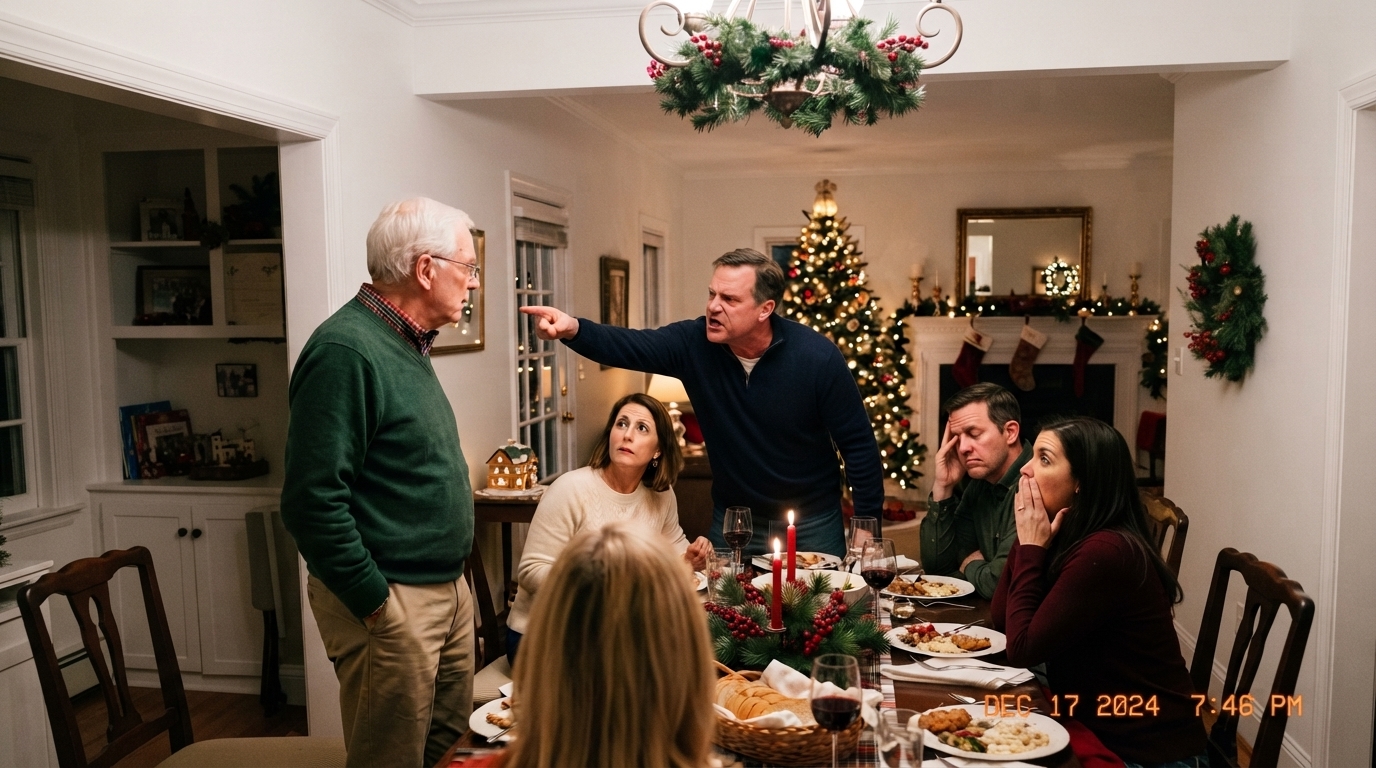
The twenty-two guests.
Daniel standing after dessert.
Vanessa raising her wineglass.
The demand for two thousand dollars in rent.
The laughter.
The relatives who looked away.
The silence that followed.
When I finished, Evelyn said, “And you were already transferring three thousand dollars a month into the household account?”
“Yes.”
“In addition to the mortgage support and other expenses?”
“Yes.”
She exhaled slowly.
“Thomas, have you ever calculated how much you’ve contributed over the past ten years?”
I frowned.
“Not exactly.”
“Then I think it’s time.”
That afternoon, I opened my records.
Ten years of statements.
Receipts.
Transfers.
Canceled checks.
Insurance payments.
Tuition invoices.
Vehicle payments.
I created a spreadsheet.
The numbers began to accumulate.
The original down payment.
$185,000.
Monthly household contributions.
$3,000 for 120 months.
$360,000.
Mortgage assistance beyond those contributions.
Property taxes.
Private-school tuition.
SUV payments.
Business insurance.
Emergency business loans.
Credit card charges.
Groceries.
Repairs.
By the time I finished, I was staring at a number that made my chest tighten.
$1,274,860.
More than 1.2 million dollars.
Not including the value of the mortgage guarantee.
Not including the time I spent handling Daniel’s business paperwork.
Not including the money I’d given them in cash over the years.
I leaned back.
For ten years, I had been told I was lucky they let me live in their guest suite.
And I had paid more than a million dollars to be treated like an unwanted tenant.
I laughed.
A bitter, exhausted laugh.
Then I cried.
Because suddenly, I could hear Margaret’s voice.
“Tom, don’t let people mistake your kindness for weakness.”
She had warned me about Daniel’s spending years earlier.
Not because she didn’t love our son.
Because she understood the difference between helping someone and financing their refusal to grow up.
I looked at her photograph beside my laptop.
“I’m sorry, Maggie,” I whispered.
“I should have listened.”
That evening, Evelyn sent me a secure message.
She had received preliminary documents from the bank.
There were three attachments.
The loan application.
The proposed collateral authorization.
And an identity verification record.
I opened the first document.
My name appeared at the top.
Thomas Edward Mercer.
My address.
My date of birth.
My investment account information.
Then I scrolled down.
There it was.
My signature.
Except it wasn’t mine.
It looked close.
Someone had copied the general shape.
The long T.
The sweeping M.
But the final letters were wrong.
Margaret used to joke that my signature looked like a doctor writing a prescription.
This one looked too neat.
Too careful.
Too deliberate.
I opened the second document.
And froze.
Because beside the signature was a witness certification.
The witness name was not Daniel.
It was Vanessa.
I stared at the screen.
Then I opened the third attachment.
The identity verification record showed that the application had been submitted from a device associated with Daniel’s business office.
I called Evelyn immediately.
“Have you seen this?”
“Yes.”
“Vanessa witnessed my signature?”
“Her name appears on the submitted document.”
“But I never signed it.”
“I understand.”
I looked at Margaret’s photograph.
“Then they were both involved.”
“Possibly. We need to let the investigation establish exactly what each person did.”
I swallowed.
“And Daniel’s office?”
“The submission information is relevant. It isn’t, by itself, proof of who operated the device.”
I nodded.
Evelyn continued.
“Thomas, there’s something else.”
My stomach tightened.
“What?”
“The application wasn’t the only document submitted.”
I closed my eyes.
“What else?”
“A financial statement.”
I frowned.
“What kind?”
“One describing you as a supporting investor in Daniel’s company.”
I sat upright.
“I’ve never been an investor in his company.”
“I know.”
She paused.
“But according to the statement, you agreed to provide ongoing financial support and additional collateral if needed.”
My heart began pounding.
“How much additional collateral?”
Evelyn took a breath.
“Thomas, the statement lists your retirement residence as an available asset.”
I stared at the wall.
My retirement residence.
The small lakeside cottage Margaret and I had purchased before she died.
The place where we had planned to spend our final years.
The property I had kept empty because returning there without her had been too painful.
And now Daniel had apparently listed it as something available to support his business.
I closed my eyes.
Then whispered, “He didn’t just want my money.”
Evelyn said nothing.
“He wanted everything.”
PART 4
I didn’t sleep that night.
Every time I closed my eyes, I saw Margaret standing on the porch of our lakeside cottage.
She was wearing her favorite blue sweater.
Her hair was blowing in the wind.
She was laughing because I’d forgotten to bring the key.
“Thomas Mercer,” she’d said, “you can remember every stock price you’ve ever seen, but you can’t remember where you put your own house key.”
I would have given every dollar in my investment account to hear her laugh again.
That cottage was more than property.
It was the last dream Margaret and I had built together.
We bought it when Daniel was already grown.
A modest two-bedroom place overlooking a quiet lake.
Nothing luxurious.
Just a stone fireplace, a wooden dock, and a screened porch where Margaret liked to drink coffee.
We planned to retire there.
Grow tomatoes.
Read books.
Invite the grandchildren for summer weekends.
Then Margaret became ill.
The cottage sat empty while hospitals replaced vacations.
After she died, I couldn’t bear to return.
Daniel told me I should move into his guest suite.
“You shouldn’t be alone, Dad.”
I believed him.
I thought he was protecting me.
Now I wondered whether he’d simply recognized an opportunity.
The next morning, I drove to the cottage.
It was forty-five minutes outside the city.
The roads were quiet.
The lake was covered with a thin layer of winter mist.
When I turned into the driveway, I felt something loosen in my chest.
The house looked exactly as I remembered.
The blue shutters.
The stone chimney.
The wooden bench beneath the porch window.
I stepped out of the car.
Cold air filled my lungs.
I stood there for several minutes.
Then I unlocked the door.
The cottage smelled of cedar and dust.
I walked through the living room.
Touched the fireplace mantel.
Opened the kitchen curtains.
And finally entered the bedroom.
Margaret’s blue sweater still hung in the closet.
I took it down.
Pressed it against my face.
And cried.
Not because of the money.
Not because of Daniel.
Because I missed my wife.
I missed the person who had always stood beside me.
The person who would have looked at our son’s behavior and told me the truth without trying to protect my feelings.
I sat on the edge of the bed.
“Maggie,” I whispered, “I don’t know what happened to our boy.”
The room remained silent.
But in that silence, I remembered something she had said shortly before she died.
“Tom, promise me you won’t spend the rest of your life trying to fix things Daniel refuses to fix himself.”
At the time, I thought she was talking about his business.
Now I understood she had been talking about much more.
I stayed at the cottage for several hours.
Then I called Evelyn.
“I want to move back here.”
She sounded pleased.
“Are you sure?”
“Yes.”
“What about the furnished apartment?”
“I’ll keep it until everything is settled. But this is where I belong.”
She paused.
“Then let’s make sure the property records are clear before you make any major changes.”
I nodded.
“Good.”
Over the next week, Evelyn coordinated a review of both the cottage’s title records and the financial documents Daniel had submitted.
The results brought relief.
No mortgage or lien connected to Daniel’s proposed financing had been recorded against the cottage.
The bank had not accepted it as collateral.
The $420,000 loan application remained unfunded and disputed.
My investment assets were still under my control.
But the evidence of attempted misuse was substantial enough that the bank continued its investigation and referred relevant information to the appropriate authorities.
I gave a formal statement.
I explained that I had never authorized the loan.
I identified the signatures I disputed.
I provided the messages Daniel had sent.
And I supplied copies of the records showing my existing financial relationship with his household.
It was one of the hardest things I had ever done.
Not because I doubted the truth.
Because I knew the truth could hurt my son.
But I had finally accepted that protecting Daniel from the consequences of his choices was not the same as loving him.
Two weeks after Christmas, Vanessa arrived at my apartment.
I had returned to collect some belongings.
When I opened the door, she stood in the hallway wearing an expensive beige coat.
Her eyes were red.
“Thomas.”
I looked at her.
“Vanessa.”
She stepped forward.
“We need to talk.”
I remained in the doorway.
“About what?”
She looked past me into the apartment.
“Can I come in?”
I hesitated.
Then stepped aside.
She entered slowly.
Her eyes moved around the modest living room.
The small sofa.
The inexpensive dining table.
The simple Christmas wreath.
For a moment, she looked confused.
“You’re really living here?”
I nodded.
“Yes.”
She swallowed.
“I thought you’d go to a hotel for a few days and then come back.”
I stared at her.
“Why?”
She looked away.
“Because you’re family.”
I almost laughed.
“Vanessa, you raised your glass while my son told me to disappear.”
Her face tightened.
“I was joking.”
“No.”
She looked at me.
“You weren’t.”
She began crying.
“Things got out of hand.”
I folded my arms.
“Did they?”
She sat on the sofa.
“The mortgage payment is due. The school has contacted us. The SUV lease company called. Daniel’s business insurance is going to lapse unless he makes arrangements.”
I nodded.
“I know.”
She looked up.
“Then you understand how serious this is.”
“Yes.”
She leaned forward.
“Thomas, the children could lose everything.”
I took a breath.
“The children have parents.”
She stared at me.
“That’s cruel.”
I shook my head.
“No. What’s cruel is teaching your children that someone else is responsible for financing every decision you make.”
Her eyes flashed.
“We never asked you to pay for everything.”
I looked at her.
“Vanessa, you asked me to cover the SUV because you said it was necessary for school transportation.”
She looked away.
“You asked me to pay the tuition because you said the public school wasn’t good enough.”
She said nothing.
“You asked me to cover groceries because Daniel’s business needed cash.”
I continued.
“And then you laughed when he demanded rent from me.”
Tears rolled down her cheeks.
“I didn’t think you’d actually leave.”
I stared at her.
There it was again.
The same assumption Daniel had made.
That I would complain.
That I would feel hurt.
That I would eventually apologize for being upset.
But that I would never truly leave.
I sat across from her.
“Vanessa, I need to ask you something.”
She wiped her face.
“What?”
“Did you sign the witness certification on the loan application?”
Her entire body went still.
For several seconds, she didn’t answer.
Then she whispered, “Daniel said it was just paperwork.”
My stomach tightened.
“What paperwork?”
“He said you had already agreed to help.”
I stared at her.
“Did you see me sign?”
She shook her head.
“No.”
“Then why did you certify that you had?”
She began crying harder.
“Because Daniel told me everything was arranged.”
I closed my eyes.
She continued.
“He said the bank needed another signature and that you wouldn’t mind.”
I looked at her.
“Vanessa, you know me.”
She nodded.
“You’ve known me for fifteen years.”
“Yes.”
“Have I ever signed a financial document without reading it?”
She shook her head.
“No.”
“Have I ever told you that you could use my retirement savings as collateral?”
“No.”
I took a breath.
“Then you knew something was wrong.”
She covered her face.
“I didn’t want to know.”
The honesty surprised me.
She lowered her hands.
“I knew Daniel was struggling. I knew the business was in trouble. I knew we were spending too much.”
Her voice shook.
“But I didn’t want to lose our lifestyle.”
I looked at her.
“So you let him use my name.”
She began sobbing.
“Yes.”
For a moment, I felt nothing.
Then a deep sadness settled over me.
Not rage.
Not satisfaction.
Sadness.
I had helped this woman for fifteen years.
Paid for vacations.
Covered medical bills.
Bought birthday gifts.
Helped with childcare.
And she had been willing to certify a signature she never witnessed because she didn’t want to give up a luxury SUV.
I stood.
“Vanessa, you need to tell the investigators exactly what you just told me.”
She looked terrified.
“Will I go to jail?”
“I don’t know.”
She began crying harder.
“Thomas, please.”
I shook my head.
“I can’t promise you protection from consequences.”
She looked at me.
“But you’re our father.”
I felt my chest tighten.
“Yes.”
I paused.
“And that should have meant something before you signed my name into your problems.”
She stared at the floor.
Then slowly stood.
At the door, she turned.
“Are you really going to let the children lose their school?”
I looked at her.
“I love Ethan and Sophie.”
Her eyes filled.
“But I won’t allow you to use them as a reason to keep financing a life you cannot afford.”
She began crying again.
I continued.
“If their schooling needs to change, you and Daniel must make that decision as their parents. I’ll always be their grandfather. But I won’t be your unlimited bank account.”
Vanessa looked at me for a long moment.
Then left.
I closed the door.
And sat down.
My hands were shaking.
I had never spoken to her that way before.
But I didn’t regret it.
For the first time in years, I had told the truth without apologizing for it.
Three days later, Daniel called.
I answered because Evelyn had told me that ordinary family contact was my choice, provided I didn’t discuss the investigation without legal advice.
“Dad?”
His voice sounded exhausted.
“Hello, Daniel.”
There was a long silence.
Then he said, “Vanessa told me she saw you.”
“Yes.”
“She said you refused to help.”
I looked out the window.
“I refused to continue paying your bills.”
He exhaled sharply.
“Same thing.”
I closed my eyes.
“No, son. It isn’t.”
He began speaking rapidly.
About the mortgage.
The business.
The school.
The SUV.
The credit cards.
He said everything was collapsing.
He said I had humiliated him.
He said his employees were frightened.
He said Vanessa was threatening to leave.
I listened.
Then asked one question.
“Daniel, did you submit the loan application using my name?”
Silence.
“Dad—”
“Did you?”
He sighed.
“I was going to tell you.”
“When?”
He didn’t answer.
I continued.
“Before or after the money was transferred?”
He snapped, “You don’t understand what it’s like running a business!”
I felt my jaw tighten.
“Then explain it.”
He began talking about rising costs.
Delayed payments.
Unexpected expenses.
The pressure of keeping employees.
I listened.
Then said, “Those are business problems, Daniel. They don’t give you permission to use my identity.”
He went silent.
I took a breath.
“Did you sign my name?”
There was a long pause.
Then he whispered, “Yes.”
My chest tightened.
I closed my eyes.
Even though I had suspected it, hearing the confession hurt.
“Why?”
He began crying.
“Because I was desperate.”
I looked at Margaret’s photograph.
“You could have asked me.”
“You would’ve said no.”
I nodded.
“Yes.”
He began crying harder.
“That’s why I did it.”
For several seconds, neither of us spoke.
Then I said something that seemed to frighten him.
“Daniel, I love you.”
He sniffled.
“I love you too, Dad.”
“But I will not protect you from the consequences of this.”
He went silent.
I continued.
“You need to tell the truth. You need to work with your attorney. And you need to stop blaming everyone else for your decisions.”
His voice shook.
“Dad, I could lose my business.”
“Yes.”
“My house.”
“Possibly.”
“Vanessa.”
I swallowed.
“Yes.”
He began sobbing.
“What am I supposed to do?”
I looked toward the lake visible in the photograph on my desk.
Then answered quietly.
“Start living within your means.”
He didn’t respond.
I continued.
“Sell what you cannot afford. Speak honestly with your creditors. Take responsibility for your actions. And stop expecting other people to pay for your mistakes.”
He whispered, “I don’t know how.”
I felt tears gather.
“Then learn.”
He began crying again.
I wanted to comfort him.
I wanted to say I would fix everything.
I wanted to reach for my checkbook and make his pain disappear.
But I remembered Christmas dinner.
Twenty-two guests.
My son standing over me.
Vanessa laughing.
Pay rent or disappear.
And I understood that rescuing Daniel again would only teach him that he could treat me however he wanted and still receive my money.
So I said, “I hope you make better choices, son.”
Then I ended the call.
That evening, Evelyn called with an update.
The bank had completed an important stage of its review.
The application had been formally rejected.
The disputed collateral authorization would not be accepted.
And the investigation records had been preserved.
I exhaled.
“Thank God.”
Evelyn paused.
“Thomas, there’s something else.”
My stomach tightened.
“What?”
“During the review, the bank identified another application connected to Daniel’s business.”
I closed my eyes.
“Another loan?”
“Yes.”
“How much?”
“Two hundred and sixty thousand dollars.”
I gripped the phone.
“And my name?”
She hesitated.
“Your name appears in the supporting financial statements.”
I stared at the wall.
Then whispered, “How long has he been doing this?”
Evelyn’s voice was quiet.
“That’s what we need to find out.”
PART 5
The second application changed everything.
It had been submitted almost nine months earlier.
Not six weeks.
Nine months.
The requested amount was $260,000.
The application described me as a financial backer of Daniel’s business.
It included statements suggesting that I had committed to provide support if the company experienced cash-flow problems.
But I had never made that commitment.
I had helped Daniel voluntarily.
I had paid expenses when he asked.
I had even lent him money on several occasions.
But I had never agreed to become an unlimited guarantor of his business debts.
Evelyn arranged for an independent review of the documents.
The bank confirmed that the earlier application had not resulted in a funded loan from that institution.
But the information raised serious questions.
And the investigators wanted answers.
I gave another statement.
I supplied financial records.
I explained which payments were gifts, which were loans, and which obligations I had actually signed.
I cooperated fully.
It was exhausting.
Every new document forced me to confront another part of the truth.
Daniel had not simply made one desperate mistake.
He had been building a financial story in which my money was always available.
My assets.
My investments.
My retirement.
My homes.
Everything I had spent forty years building with Margaret had become part of his imaginary safety net.
And when the numbers no longer worked, he had tried to turn that imaginary support into something real.
Without my permission.
For weeks, I struggled with guilt.
I worried about Ethan and Sophie.
I worried about Daniel.
I worried about what Margaret would think.
Then one afternoon, I drove to the cemetery.
It was a cold January day.
The grass was brown.
The trees were bare.
I stood beside Margaret’s grave holding a small bouquet of white roses.
For a long time, I said nothing.
Then I whispered, “I don’t know if I’m doing the right thing.”
The wind moved through the trees.
I knelt carefully.
“Daniel’s in trouble, Maggie.”
My voice broke.
“Real trouble.”
I looked at her name carved into the stone.
“I keep thinking about when he was little. Remember how he used to crawl into our bed during thunderstorms?”
I smiled through tears.
“He’d insist he wasn’t scared. Said he was just checking on us.”
I laughed softly.
Then the laughter disappeared.
“I don’t know when he started believing everything we owned belonged to him.”
I wiped my eyes.
“And I don’t know how to help him without letting him destroy what we built.”
For a moment, I could almost hear Margaret’s voice.
Tom, you can’t live his life for him.
She had said those words countless times.
When Daniel failed a class.
When he quit his first job.
When he borrowed money for a car he couldn’t afford.
Margaret had always loved him fiercely.
But she had understood something I struggled to accept.
A parent could offer guidance.
Support.
Love.
But a grown child still had to make his own choices.
I placed the roses beside her grave.
Then whispered, “I’m going to stop rescuing him.”
My voice trembled.
“Not because I don’t love him.”
I closed my eyes.
“Because I do.”
When I left the cemetery, I drove straight to the lakeside cottage.
I had decided to make it my permanent home.
The furnished apartment had served its purpose.
But the cottage was where Margaret and I had planned to grow old.
And I wasn’t going to let grief or guilt keep me away from it anymore.
I hired a contractor to repair the dock.
I replaced the old heating system.
I had the porch screens fixed.
And I finally unpacked the boxes Margaret and I had stored there years earlier.
Inside one box, I found a photograph album.
Our wedding.
Daniel’s first birthday.
Family vacations.
Christmas mornings.
The day we bought the cottage.
I sat on the living room floor turning pages.
Then I found a photograph that made me stop.
Daniel was seven years old.
He was standing beside Margaret, holding a homemade Christmas ornament.
On the back, she had written:
Our greatest gift is watching him become a good man.
I stared at those words.
Then cried.
Because I realized I still wanted that for him.
Not wealth.
Not success.
Not a beautiful house.
A good man.
And perhaps, for the first time, I was giving him the opportunity to become one without buying his way out of consequences.
The following months were difficult for Daniel.
His business entered a formal restructuring process with professional advice.
He sold equipment he could no longer afford to maintain.
He reduced expenses.
He moved out of the expensive office he’d rented to impress clients.
Vanessa returned her luxury SUV when the lease arrangements were resolved.
The children transferred to a more affordable school.
The family sold furniture.
Canceled vacations.
And began living on a budget.
I heard these things through occasional conversations with Daniel.
I didn’t offer money.
And slowly, he stopped asking.
The mortgage remained a separate concern because I had guaranteed it.
Evelyn worked with the lender to understand my continuing obligations and possible options.
I did not pretend I could erase a guarantee by sending an angry email.
The lender reviewed the account, the borrowers’ finances, and potential refinancing or sale arrangements.
Eventually, Daniel and Vanessa agreed to sell the house rather than continue carrying a payment they couldn’t afford.
The sale proceeds were applied according to the mortgage and closing obligations.
My guarantee exposure was resolved through the lender’s documented release after the transaction closed.
I paid for independent legal advice.
I did not pay for another luxury lifestyle.
And for the first time, Daniel had to confront the difference between what he wanted and what he could afford.
The legal investigation into the disputed loan documents continued separately.
I did not interfere.
I did not withdraw truthful statements.
I did not invent excuses.
I also refused to predict the outcome.
Whatever decisions the investigators and legal authorities made would be based on the evidence and applicable law.
That was no longer something I could control.
But I could control my own choices.
And those choices began changing my life.
I started walking every morning.
At first, only ten minutes.
Then twenty.
Eventually, I could walk the entire lakeside trail without stopping.
I joined a small woodworking group at the community center.
Margaret had always teased me because I could spend six hours building a shelf that could have been purchased for twenty dollars.
But I loved working with my hands.
The smell of sawdust.
The sound of a hammer.
The satisfaction of making something useful.
One afternoon, a man named Walter invited me to join a weekly breakfast group.
“Just a few old fellows complaining about the weather,” he said.
I laughed.
“Sounds perfect.”
We met every Thursday at a diner near the lake.
We talked about fishing.
Sports.
Grandchildren.
Retirement.
Sometimes we talked about grief.
Walter had lost his wife three years earlier.
Another man, George, had been widowed for almost a decade.
For the first time since Margaret died, I sat with people who understood that loneliness could exist even when your family was nearby.
I began enjoying my days again.
Not because I had forgotten Daniel.
But because I had stopped making his problems the center of my existence.
One spring afternoon, Ethan called.
My thirteen-year-old grandson.
“Grandpa?”
I smiled.
“Hey, buddy.”
“Can I ask you something?”
“Anything.”
He hesitated.
“Did Dad really kick you out at Christmas?”
My chest tightened.
I sat down.
“Your dad and I had a disagreement.”
Ethan was quiet.
Then he said, “Mom said you stopped helping because you were angry.”
I closed my eyes.
“Ethan, adults sometimes make mistakes in how they treat each other.”
He waited.
“I love your dad. And I love you and Sophie.”
“I know.”
“But your parents are responsible for paying their household expenses. That doesn’t mean I love you any less.”
He was quiet for a moment.
Then whispered, “I miss you.”
My throat tightened.
“I miss you too.”
“Can we come fishing?”
I smiled.
“Of course.”
He brightened.
“Really?”
“Really.”
That Saturday, Ethan and Sophie visited the cottage.
Daniel brought them.
He stayed only long enough to make sure they were settled.
For the first time in months, he didn’t ask me for money.
He didn’t complain about his business.
He didn’t blame Vanessa.
He simply said, “Thanks for having them, Dad.”
I nodded.
“Always.”
The children spent the afternoon fishing from the dock.
Sophie caught a tiny fish and screamed so loudly that Walter, who was helping us, nearly dropped his coffee.
Ethan laughed until he couldn’t breathe.
We made sandwiches.
Played cards.
And roasted marshmallows over a small fire.
That evening, Sophie climbed onto the sofa beside me.
“Grandpa?”
“Yes, sweetheart?”
“Are you lonely here?”
I looked around.
At the fireplace.
The lake outside the window.
Margaret’s photograph on the mantel.
“Sometimes.”
She rested her head against my shoulder.
“Mom says you have lots of money.”
I smiled sadly.
“Money doesn’t stop people from feeling lonely.”
She thought about that.
Then whispered, “I can call you every Sunday.”
My eyes filled.
“I’d like that very much.”
She smiled.
“Okay.”
And she kept her promise.
Every Sunday evening, Sophie called.
Sometimes for five minutes.
Sometimes for half an hour.
She told me about school.
Her friends.
Her drawings.
The books she was reading.
Not once did she ask for money.
Not once did she make me feel like a burden.
She simply wanted to talk to her grandfather.
And those calls became one of the happiest parts of my week.
Six months after Christmas, Daniel came to the cottage alone.
I was repairing a wooden chair on the porch when his car pulled into the driveway.
He stepped out wearing jeans and a faded work jacket.
He looked thinner.
Tired.
But different.
“Dad?”
I put down my tools.
“Hello, Daniel.”
He walked toward the porch.
“Can we talk?”
I hesitated.
Then nodded.
“Sit down.”
He lowered himself into the chair beside me.
For several minutes, we watched the lake.
Then he said, “I owe you an apology.”
I looked at him.
He swallowed.
“Not just for Christmas.”
I waited.
“For everything.”
His voice shook.
“For treating your money like it belonged to me.”
I felt my chest tighten.
“For letting Vanessa speak to you the way she did.”
He looked down.
“For making you feel like a guest in a house you helped us buy.”
I said nothing.
He continued.
“And for using your information on those loan applications.”
My hands tightened.
He began crying.
“I knew it was wrong.”
I looked at him.
“Yes.”
“I kept telling myself I would fix it before you found out.”
I nodded slowly.
“That doesn’t make it right.”
“I know.”
He wiped his face.
“I’ve spent months talking to my attorney, my counselor, and the people handling the business restructuring.”
He took a breath.
“And I realized something.”
I waited.
“I wasn’t running a business anymore. I was running away from failure.”
I looked at my son.
He continued.
“Every time something went wrong, I borrowed more. Spent more. Promised more.”
His voice broke.
“And when I couldn’t keep up, I looked at you.”
I closed my eyes.
He whispered, “Because you always saved me.”
For several seconds, neither of us spoke.
Then I said, “Daniel, I thought helping you was what a father was supposed to do.”
He began crying harder.
“I know.”
“But somewhere along the way, I stopped helping you stand on your own feet.”
I looked toward the lake.
“And started carrying you.”
He nodded.
“Yes.”
I swallowed.
“I should have set boundaries years ago.”
Daniel shook his head.
“No, Dad.”
I looked at him.
“You didn’t make me forge your signature.”
The words struck me.
He continued.
“You didn’t make me lie.”
Tears filled his eyes.
“You didn’t make me humiliate you at Christmas.”
I felt my throat tighten.
He looked directly at me.
“Those were my choices.”
For the first time in months, I saw something in my son that I had almost stopped believing existed.
Accountability.
Not excuses.
Not anger.
Not another request for money.
Just truth.
I nodded.
“Thank you for saying that.”
He wiped his face.
“I don’t expect you to forgive me today.”
I looked at him.
“I don’t know how long it will take.”
He nodded.
“I understand.”
“But I want you to keep doing the work.”
“I will.”
“And I want you to be honest with your children.”
He swallowed.
“I’ve started.”
I nodded.
“Good.”
We sat quietly.
Then Daniel looked around the porch.
“Mom would’ve loved seeing this place fixed up.”
I smiled sadly.
“Yes.”
He looked toward the lake.
“I miss her.”
I felt tears gather.
“So do I.”
He leaned forward.
“Dad, can I ask you something?”
“Of course.”
“Do you think she’d be ashamed of me?”
The question broke my heart.
I looked at my son.
The little boy who had once crawled into our bed during thunderstorms.
The teenager who loved basketball.
The man who had made terrible choices.
I took a breath.
“Your mother would have been deeply disappointed by what you did.”
Daniel closed his eyes.
“But she would also want you to become better.”
He began crying.
I continued.
“And she would tell you that becoming better requires more than saying you’re sorry.”
He nodded.
“I know.”
“It requires changing how you live.”
He looked at me.
“I’m trying, Dad.”
I reached across and placed my hand on his shoulder.
“Then keep trying.”
He covered my hand with his.
And for the first time since Christmas, we sat together without discussing money.
A year later, Christmas came again.
This time, I didn’t spend it in Daniel’s guest suite.
I didn’t sit at the far end of a dining table.
I didn’t transfer money into a household account.
I didn’t pay for a luxury SUV.
I didn’t finance a business.
I didn’t guarantee anyone’s lifestyle.
I spent Christmas at the lakeside cottage.
My home.
Margaret’s home.
The place where we had planned to grow old.
I decorated a small tree.
Hung our old ornaments.
Made her favorite roast chicken.
And invited a few friends for Christmas Eve dinner.
Walter came.
George came.
A neighbor brought homemade bread.
We laughed.
Played cards.
And watched the snow fall across the lake.
It was simple.
Peaceful.
Exactly what I needed.
On Christmas morning, my phone rang.
Daniel.
I answered.
“Merry Christmas, Dad.”
I smiled.
“Merry Christmas, son.”
There was a pause.
Then he said, “The kids wanted to know if we could visit this afternoon.”
I looked toward the tree.
“Of course.”
He hesitated.
“Vanessa too?”
I took a breath.
My relationship with Vanessa remained complicated.
She had apologized in writing.
She had cooperated with the investigation.
She had begun counseling.
But trust was still being rebuilt.
I considered the question.
Then said, “Yes. For a short visit. And Daniel?”
“Yes?”
“No financial discussions.”
He laughed softly.
“Agreed.”
They arrived at three o’clock.
Ethan carried a box of cookies.
Sophie brought a handmade card.
Vanessa held a small poinsettia.
Daniel carried a framed photograph.
When I opened the door, Sophie ran into my arms.
“Grandpa!”
I hugged her tightly.
“Merry Christmas, sweetheart.”
Ethan hugged me next.
Then Daniel.
Vanessa stood awkwardly near the doorway.
“Thomas,” she said quietly, “thank you for letting me come.”
I nodded.
“Come inside.”
We spent the afternoon drinking hot chocolate and playing board games.
The children laughed.
Daniel helped me bring firewood inside.
Vanessa washed the dishes without being asked.
And for several hours, nobody mentioned money.
Nobody asked for help.
Nobody complained.
Nobody treated me like a burden.
Before they left, Daniel handed me the framed photograph.
I looked down.
It was an old picture of Margaret and me standing on the dock.
We were younger.
Laughing.
Holding fishing rods.
The lake glittered behind us.
I stared at it.
“Where did you find this?”
Daniel smiled.
“In a box at the old house.”
My eyes filled.
He continued.
“I had it restored.”
I looked at the photograph.
Margaret’s smile.
My arm around her shoulders.
The happiness of a life we had built together.
I couldn’t speak.
Daniel touched my shoulder.
“Merry Christmas, Dad.”
I hugged him.
Not because everything was forgiven.
Not because the past had disappeared.
But because I could see that he was trying.
And because I still loved my son.
After they left, I placed the photograph on the mantel.
Beside Margaret’s favorite candle.
Then I sat in my armchair and looked around.
The fire crackled.
The tree lights glowed.
Snow drifted past the windows.
And the cottage felt warm.
Safe.
Mine.
I thought about the previous Christmas.
Twenty-two guests.
Daniel shouting.
Vanessa laughing.
The demand for rent.
The humiliation.
The suitcase.
The apartment.
The bank call.
The forged signature.
The months of investigation and difficult decisions.
I thought about how frightened I had been when I first walked away.
How guilty.
How uncertain.
How convinced I might lose my family forever.
But I hadn’t lost everything.
I had lost the illusion that keeping people financially comfortable would guarantee their love.
And that loss had given me something more valuable.
Freedom.
The freedom to say no.
The freedom to protect what Margaret and I had built.
The freedom to love my son without financing his mistakes.
The freedom to be a grandfather without becoming a bank account.
And the freedom to spend my remaining years somewhere I was wanted for who I was.
Not for what I could pay.
I looked at Margaret’s photograph.
Then whispered, “We did it, Maggie.”
I smiled through tears.
“We finally came home.”
My son told me to pay rent or disappear.
So I disappeared from the life where my money mattered more than my presence.
I stopped funding the luxury cars.
The expensive school.
The household account.
The business expenses.
And every other voluntary payment that had allowed Daniel and Vanessa to pretend they were financially independent.
I honored the obligations I was legally bound to honor while protecting myself from unauthorized ones.
And when the bank uncovered the attempted misuse of my identity, I refused to hide the truth.
I didn’t do it to destroy my son.
I did it because love without boundaries had nearly destroyed me.
At sixty-eight, I learned that being a good father doesn’t mean paying for every mistake your child makes.
Sometimes it means stepping aside.
Letting them face the consequences.
And trusting that if they truly want to change, they will.
That Christmas, I slept peacefully beneath the roof Margaret and I had chosen together.
No one demanded rent.
No one laughed at me.
No one threatened to throw me out.
And for the first time in years, I understood something simple.
I hadn’t lost my family when I walked away.
I had finally stopped losing myself to keep them.
THE END THANK YOU FOR READING !!!



