PART 3
The first thing Daniel Price asked me was
whether I was somewhere safe.
I sat in my car outside a little
coffee shop three streets from the beach,
staring at the ocean through my windshield.
“Yes,” I answered. “I’m perfectly safe.”
“Good. Now tell me exactly what happened.”
So I did.
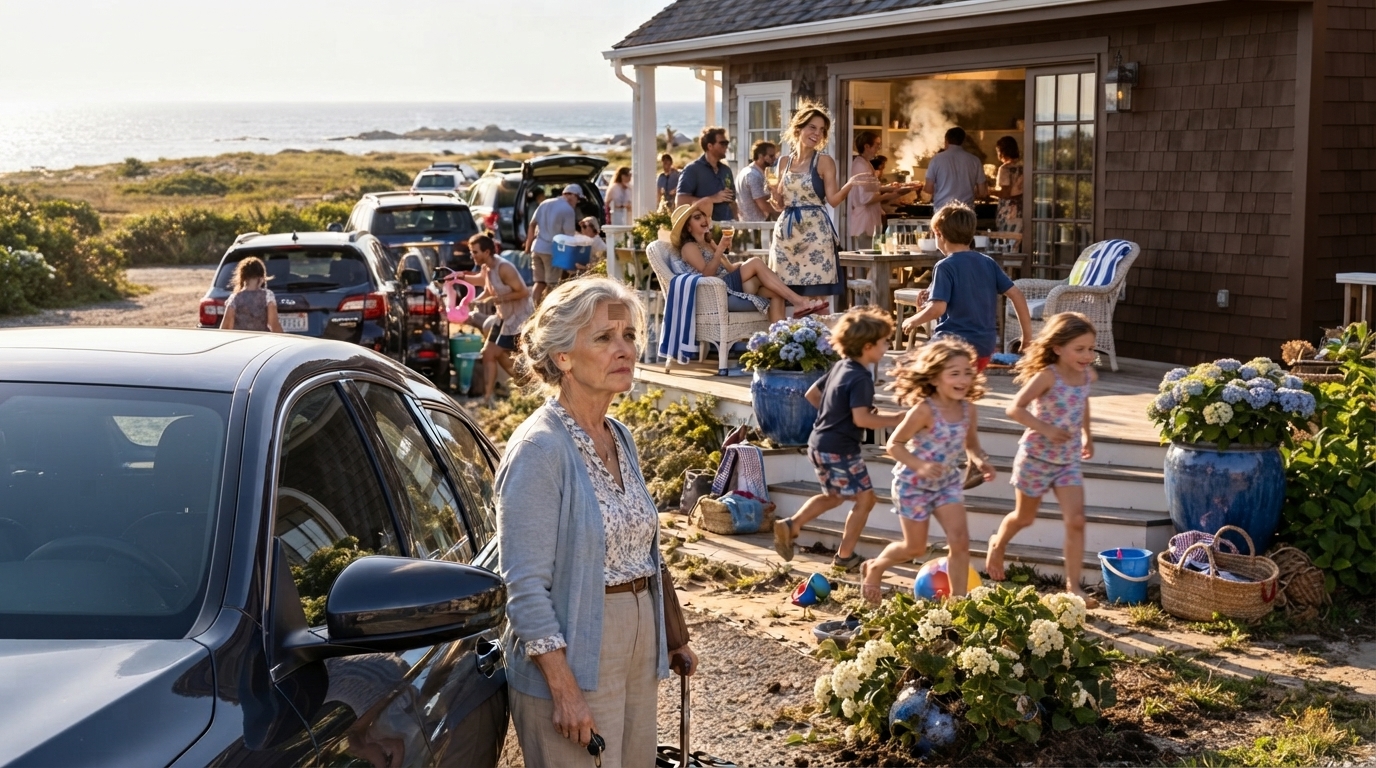
I told him about the cars covering my driveway,
the children trampling my flowers,
the strangers sleeping in my bedrooms,
and Megan standing on my deck wearing
my apron as though she owned the place.
I told him what she had said.
Why is she here? There’s no room for her.
Daniel was silent for several seconds.
Then he asked, “And Robert gave her permission?”
“That’s what she claims.”
“Did you?”
“Of course not.”
“Has Robert ever had authority to authorize overnight guests without your consent?”
“No.”
“Then we proceed carefully. I want photographs, witness statements, and documentation of any damage. We don’t want an argument about who said what.”
I looked down at my hands.
They were shaking.
Not from fear.
From the humiliation of standing outside a house I had paid for with forty years of work while strangers laughed at me.
“Daniel,” I whispered, “I just wanted a quiet weekend.”
His voice softened.
“I know, Eleanor.”
I closed my eyes.
He had known my late husband, David, for nearly thirty years.
When David died, Daniel helped me settle the estate. When I purchased the beach house, he reviewed the closing documents. And six weeks earlier, when I discovered something disturbing about my son Robert’s business dealings, Daniel was the first person I called.
That discovery was the reason he already knew which documents needed protecting.
“There’s another matter,” he said.
My stomach tightened.
“The bank responded to our inquiry this morning.”
I sat straighter.
“What did they say?”
“They confirmed that Robert submitted property information concerning your beach house as part of a commercial loan application.”
I stared at the ocean.
My son.
My only child.
The little boy who used to collect seashells in his pockets and bring them home as presents.
The man I had defended when his first business failed.
The man whose mortgage payments I had quietly covered during a difficult year.
“What exactly did he submit?”
Daniel hesitated.
“A copy of the deed, a property valuation, and a document purporting to authorize him to pledge the property as security.”
I felt my heart hammer.
“Purporting?”
“The document carries what appears to be your signature.”
I closed my eyes.
“I never signed anything like that.”
“I know. And we’ve already informed the bank that you dispute its authenticity.”
“Can they take my house?”
“Not simply because Robert submitted an application. The bank has placed the proposed transaction under review, and we’ll check the county records for any recorded instruments. But Eleanor, this is serious.”
I gripped the steering wheel.
“How serious?”
“Serious enough that I don’t want you discussing the loan directly with Robert until we have copies of everything.”
I stared through the windshield.
For weeks, I had been trying to convince myself there was an innocent explanation.
Maybe Robert had accidentally submitted the wrong property documents.
Maybe the bank misunderstood his application.
Maybe he was planning to ask my permission.
But now there was a document bearing my signature.
A signature I hadn’t written.
“Daniel,” I said, “I want my house back.”
“You have every right to control your property. I’ll contact the local property manager and arrange for an authorized representative to document the situation. If the guests refuse to leave after proper notice, we’ll use the lawful process.”
I nodded.
“Thank you.”
“And Eleanor?”
“Yes?”
“Don’t let anyone pressure you into signing anything.”
I almost laughed.
At seventy, I had signed thousands of things.
School permission slips.
Medical forms.
Loan guarantees for family emergencies.
Checks for tuition.
Contracts for sewing work.
But somehow, I had never imagined needing an attorney to protect my own home from my own son.
“I won’t,” I promised.
When the call ended, I sat in silence.
Then my phone buzzed.
Megan.
Where did you go? You left your car blocking the others earlier. Please don’t come back and make a scene.
I read it twice.
A scene.
Apparently, arriving at my own house was making a scene.
I took a screenshot and forwarded it to Daniel.
Then I ordered a cup of tea.
It tasted bitter.
But I drank it anyway.
Forty minutes later, Daniel called again.
“The property manager is on his way. His name is Frank Delaney. He’s familiar with your property and has a copy of the ownership records.”
I knew Frank.
He had helped arrange repairs after a storm damaged the porch roof the previous winter.
He was a quiet man in his fifties who treated every property as though it belonged to his own family.
“Will he make them leave?” I asked.
“He’ll speak with the occupants, explain the ownership situation, and request that unauthorized guests depart. If necessary, we’ll involve local authorities for any trespass or safety issues. Nobody is going to improvise an unlawful eviction.”
I nodded.
“And Robert?”
“I’ve asked him to meet us at the house.”
My stomach dropped.
“He knows?”
“He knows there’s a problem.”
I looked toward the ocean.
For a moment, I considered driving away.
Going home.
Pretending none of it had happened.
But then I pictured Megan wearing my apron.
Her mother sleeping in my favorite chair.
Children trampling the flower beds David and I had planted together.
And the document carrying my forged signature.
No.
I was finished retreating.
“I’ll meet you there,” I said.
“Eleanor, you don’t have to confront them.”
“I know.”
I took a breath.
“But I want them to see me standing in my own doorway.”
An hour later, I returned to the beach house.
The music was still playing.
The driveway was still crowded.
A young man was sitting on my porch railing with a cigarette.
When he saw me, he rolled his eyes.
“Oh, great. She’s back.”
I stepped out of my car.
“Please put that cigarette out. This is my property.”
He laughed.
“Lady, relax.”
Before I could respond, another vehicle pulled into the driveway.
A dark sedan.
Daniel stepped out carrying a briefcase.
Frank arrived behind him in a white truck marked with his property management company’s name.
The young man’s expression changed.
“What’s this?”
I smiled.
“People who know who owns the house.”
Megan appeared on the deck.
Her face tightened when she saw us.
“Eleanor, what are you doing?”
I looked at her.
“Taking care of my property.”
She laughed nervously.
“Robert said we could stay.”
Daniel stepped forward.
“I’m Daniel Price, Mrs. Eleanor Bennett’s attorney.”
Megan’s smile vanished.
“Attorney?”
“Yes.”
Frank approached with a clipboard.
“Mrs. Bennett is the recorded owner of this property. We’ve been asked to document the current occupancy and request that unauthorized visitors leave.”
Megan folded her arms.
“Robert owns this house.”
“No,” I said quietly.
“He doesn’t.”
She stared at me.
“That’s ridiculous.”
I reached into my handbag and removed a copy of the deed.
“My name is on it.”
Megan glanced at the paper.
Then looked away.
“Robert handles all the family properties.”
I almost smiled.
“There is no family property arrangement, Megan. There’s my house, and there’s Robert’s house.”
Her mother appeared behind her.
“What is all this noise?”
Megan pointed at me.
“She’s trying to kick us out!”
Her mother gasped.
“During a family vacation?”
I looked at the woman sitting on my deck.
“Mrs. Collins, you are welcome to arrange a vacation anywhere you like. But you are not entitled to stay in my home without my permission.”
She drew herself upright.
“Well, Robert invited us.”
“Then Robert should have checked with me first.”
Megan’s voice sharpened.
“You’re being selfish.”
That word.
Selfish.
I had heard it so many times over the years.
When I couldn’t babysit.
When I refused to lend money.
When I wanted to spend Christmas at home instead of cooking for twenty people.
When I asked Robert to repay the money I’d given him for his business.
Selfish.
As though every boundary I set was an injury to someone else.
I looked directly at Megan.
“Wanting access to my own home is not selfish.”
She opened her mouth.
But before she could speak, a silver SUV turned into the driveway.
Robert.
My son stepped out wearing a navy suit.
He looked annoyed.
Then he saw Daniel.
And his expression changed completely.
“Mom?”
I stood beside the porch steps.
“Hello, Robert.”
He glanced at Frank.
Then at the documents in Daniel’s hand.
“What is going on?”
Megan hurried toward him.
“Your mother brought a lawyer and is trying to throw everyone out!”
Robert looked at me.
“Mom, couldn’t this have waited until Monday?”
I stared at him.
For a moment, I thought I had misheard.
“Waited?”
He sighed.
“Megan’s family came a long way.”
I nodded.
“And I drove three hours to spend the weekend in my house.”
He rubbed his forehead.
“It’s just a weekend.”
I felt something inside me harden.
“Then why didn’t you ask me?”
Robert looked away.
“I assumed you wouldn’t mind.”
I stepped closer.
“You assumed wrong.”
Megan grabbed his arm.
“Tell her we have permission.”
Robert hesitated.
Then said, “Mom, let’s discuss this privately.”
Daniel stepped forward.
“Actually, Robert, there are two matters we need to discuss.”
Robert looked at him.
“What two matters?”
Daniel opened his briefcase.
“The unauthorized use of Mrs. Bennett’s property.”
He removed a second folder.
“And the commercial loan application submitted using documents that appear to bear her signature.”
Robert’s face drained of color.
Megan looked between them.
“What loan?”
My son said nothing.
Daniel continued.
“The bank has requested clarification regarding the purported authorization to pledge this property.”
Robert swallowed.
“Daniel, this isn’t the place.”
I looked at him.
“Then perhaps you should have thought of that before bringing strangers into my home.”
Megan stepped back.
“Robert?”
He stared at the folder.
“It’s complicated.”
Daniel’s voice remained calm.
“Then let’s simplify it. Eleanor did not authorize you to use her property as collateral.”
Robert looked at me.
“Mom, I was going to explain.”
I felt tears burning behind my eyes.
“When?”
He didn’t answer.
“Before or after the bank took my house?”
“Mom, nobody was going to take your house.”
“Then why did you need my signature?”
Silence.
Megan slowly released his arm.
And in that moment, I saw something I would never forget.
My daughter-in-law looked frightened.
Not because she had humiliated me.
Not because she had occupied my home without permission.
But because she was beginning to understand that the luxury lifestyle she thought Robert controlled might be built on something far less secure.
Then Daniel said, “Robert, there’s one more thing.”
My son closed his eyes.
“What?”
“The bank has provided us with a copy of the authorization document.”
He held up a page.
“And your mother’s signature isn’t the only one we need to discuss.”
Robert’s head snapped up.
Because beneath my forged signature was another name.
Megan’s.
And suddenly, the woman who had laughed at me on my own porch stopped smiling.
PART 4
Megan stared at the paper.
“What?”
Daniel held it where she could see.
“Your name appears as a witness to Eleanor’s purported signature.”
Her face turned pale.
“No.”
Robert looked at her sharply.
“Megan.”
She shook her head.
“I didn’t sign anything.”
Daniel nodded.
“Then that is something the bank’s investigators will need to examine.”
I looked at my daughter-in-law.
The woman who had just told me to find a hotel.
The woman who had laughed while strangers occupied my bedrooms.
The woman whose name now appeared on a document that could have placed my home at risk.
“Megan,” I asked quietly, “did you know Robert was using my house for a loan?”
She looked at him.
Then at me.
“I knew he was arranging financing.”
“What financing?”
She swallowed.
“For the business.”
I turned toward Robert.
“What business?”
He rubbed his face.
“Mom, please.”
“What business, Robert?”
He looked toward the house.
Then whispered, “The resort project.”
I stared at him.
“What resort project?”
Megan spoke before he could stop her.
“The boutique hotel investment.”
I blinked.
Robert had told me he was expanding his construction company.
He had said business was going well.
He had bought Megan a new SUV.
They had taken two vacations abroad.
They had renovated their kitchen.
And all the while, he had apparently been trying to use my beach house to secure financing for another investment.
“How much?” I asked.
Robert stared at the ground.
“Mom—”
“How much money?”
He swallowed.
“Four hundred and eighty thousand.”
The world seemed to tilt.
Nearly half a million dollars.
I looked toward the house.
My little refuge.
The place I had bought after decades of hemming dresses and repairing coats.
The place where I had finally learned to sleep without crying for David.
And my son had tried to place it behind a loan worth almost half a million dollars.
I stepped backward.
Daniel moved beside me.
“Eleanor?”
“I’m all right.”
But I wasn’t.
Not really.
I felt seventy years of memories pressing against my chest.
Robert as a baby.
Robert learning to walk.
Robert bringing home a broken seashell and insisting it was treasure.
Robert crying at David’s funeral.
Robert promising he would always take care of me.
And now this.
I looked at my son.
“Did you sign my name?”
He closed his eyes.
“Mom, I was desperate.”
The words struck me harder than a confession.
Desperate.
He had been desperate.
So he had decided that my home was available.
“Did you?” I repeated.
Robert nodded once.
Barely.
“Yes.”
Megan gasped.
“Robert!”
He turned toward her.
“Don’t.”
She stepped backward.
“You told me your mother had agreed!”
I stared at her.
“What?”
Megan’s eyes filled.
“He said you were helping us.”
Robert shook his head.
“Megan, stop talking.”
But she continued.
“He told me you wanted to invest in the resort!”
I looked at my son.
He wouldn’t meet my eyes.
Megan’s voice rose.
“He said you were too old to handle the paperwork and that he was managing everything for you!”
Something inside me went cold.
Too old.
I had heard that phrase more often lately.
Too old to drive long distances.
Too old to understand modern investments.
Too old to maintain a house by the ocean.
Too old to make complicated decisions.
And yet somehow, I was never too old to cook holiday dinners, watch their children, or lend them money.
I looked at Robert.
“Is that what you told her?”
He rubbed his forehead.
“I was trying to make things easier.”
“For whom?”
He didn’t answer.
I took a breath.
“Robert, I am seventy years old. I am not incapable.”
“I know.”
“Then why did you treat me as though I couldn’t decide what happened to my own property?”
His voice broke.
“Because I knew you’d say no.”
There it was.
The truth.
Not confusion.
Not misunderstanding.
Not an innocent mistake.
He had known.
He had known I would refuse.
So he had tried to proceed without me.
I looked away.
For several seconds, nobody spoke.
Then Frank cleared his throat.
“Mrs. Bennett, would you like me to continue with the occupancy documentation?”
I nodded.
“Yes.”
He turned toward Megan.
“I’m asking that the guests begin making arrangements to leave. We will document the property condition, and any dispute about continued occupancy will be handled through the proper legal process.”
Megan looked horrified.
“You can’t expect everyone to leave immediately!”
I turned toward her.
“You expected me to.”
Her mouth closed.
I continued.
“You stood on my deck and told me there was no room for me.”
Her eyes filled.
“Eleanor, I didn’t mean—”
“Yes,” I said quietly.
“You did.”
She stared at me.
I continued.
“You meant to humiliate me. You wanted your relatives to believe you had authority over this house.”
Megan looked down.
“You laughed when I stood there with my suitcase.”
She began crying.
I felt no satisfaction.
Only exhaustion.
“Now you know how it feels to discover you aren’t welcome somewhere you thought you belonged.”
Robert stepped forward.
“Mom, please don’t do this.”
I looked at him.
“Do what?”
“Make everyone leave.”
I stared at my son.
Even now, he was worried about Megan’s family.
Not about the forged document.
Not about the risk to my home.
Not about what he had done to me.
He was worried about appearances.
I shook my head.
“Robert, I have spent my entire life making sure other people were comfortable.”
My voice trembled.
“I worked until my fingers bled. I missed vacations. I wore the same winter coat for eleven years. I took extra sewing jobs because you needed braces and school supplies.”
He looked down.
“When your father died, I didn’t have the luxury of falling apart.”
Tears slipped down my cheeks.
“I had a little boy who needed breakfast.”
Robert covered his face.
“I know, Mom.”
“No,” I whispered.
“I don’t think you do.”
I pointed toward the house.
“That place is the only thing I ever bought entirely for myself.”
My voice broke.
“And you tried to take control of it without asking.”
Robert began crying.
“I’m sorry.”
I shook my head.
“I’m not ready to hear that.”
Daniel gently touched my arm.
“Eleanor, why don’t we step aside?”
I nodded.
We walked toward the end of the driveway.
The ocean wind lifted the edges of my cardigan.
Behind us, Frank began speaking with the guests.
Some looked embarrassed.
Others looked irritated.
A few were already carrying bags toward their cars.
Megan’s mother stood on the porch, arguing with her daughter.
But I barely noticed.
I was looking at the little blue flowerpots beside my front steps.
Two were broken.
The flowers had been crushed.
David had always loved blue flowers.
He used to say they reminded him of the sea on clear mornings.
I began crying again.
Daniel waited.
Then said, “Eleanor, we need to discuss the bank matter carefully.”
I wiped my cheeks.
“Tell me.”
“The lender has paused the application. There is no indication that the proposed loan was funded or that a valid lien has been recorded against your property.”
I exhaled.
“Thank God.”
“However, the disputed signatures and supporting documents need to be investigated.”
I nodded.
“Will Robert go to prison?”
Daniel paused.
“I can’t predict that. There are questions about what happened, who prepared the documents, and what laws may apply. Those are matters for investigators and prosecutors if the case reaches that stage.”
I looked back toward my son.
He was standing beside his SUV, his shoulders slumped.
“Do I have to report him?”
Daniel’s expression softened.
“Eleanor, you have the right to protect your identity and property. We should make an accurate report and preserve the evidence. The legal consequences are not yours to decide alone.”
I closed my eyes.
I loved Robert.
That was the terrible thing.
I loved him even now.
Even after the lies.
Even after the forged signature.
Even after he allowed his wife to throw me out of my own home.
A mother’s love doesn’t disappear simply because her child becomes someone she no longer recognizes.
But love couldn’t be the reason I allowed him to destroy my security.
I opened my eyes.
“Then we do it properly.”
Daniel nodded.
“Good.”
We spent the next hour documenting everything.
Frank photographed the damaged flowerpots, the trampled garden, the cigarette burns on the balcony railing, and the broken kitchen cabinet door.
The house smelled of spilled drinks and burnt meat.
Dirty plates covered my dining table.
Wet towels lay across the beds.
Someone had moved my husband’s seashell lamp from the living room to a bedroom.
The shade was cracked.
I picked it up carefully.
David had bought that lamp during our last vacation together.
He had laughed when I told him it was ugly.
“Then we’ll have to keep it forever,” he’d said.
I held the lamp against my chest.
And suddenly, I couldn’t bear to look at anyone.
I went into the guest room.
The quilt I had sewn from scraps of wedding dresses was lying on the floor.
A wet swimsuit had been thrown across it.
I knelt and lifted the quilt.
For forty years, I had saved those pieces of fabric.
Ivory satin.
Cream lace.
Pale pink silk.
Little scraps from dresses worn by brides who had trusted me with the happiest days of their lives.
Now the quilt smelled of chlorine.
I folded it carefully.
Then I heard footsteps behind me.
Robert.
“Mom?”
I didn’t turn.
“Please leave me alone.”
He stood in the doorway.
“I need to explain.”
I continued folding the quilt.
“No.”
“Mom, please.”
I stood.
“Robert, I have listened to your explanations for years.”
He stared at me.
“When your business failed, you said the economy was responsible.”
He looked down.
“When you borrowed money and didn’t repay it, you said you were waiting for a client.”
My voice strengthened.
“When you missed my birthday, you said you were busy.”
He swallowed.
“And today, when your wife threw me out of my own house, you asked me to wait until Monday.”
Tears filled his eyes.
“I know.”
I shook my head.
“You don’t need another explanation.”
He stared at me.
“You need to understand that your actions have consequences.”
He began crying.
“I could lose everything.”
I looked at him.
“And I almost lost the one thing I had left.”
He covered his face.
I waited.
Then he whispered, “I didn’t think you’d find out.”
The words hit me like a physical blow.
Not I didn’t mean to hurt you.
Not I made a terrible mistake.
I didn’t think you’d find out.
I stared at him.
And something inside me finally changed.
For years, I had believed Robert was simply careless.
Selfish sometimes.
Thoughtless.
Too busy.
But now I understood that he had been counting on my ignorance.
He had assumed I wouldn’t check the paperwork.
That I wouldn’t understand the loan.
That I wouldn’t question his authority.
And most of all, that I would forgive him before he had to face the consequences.
I looked at my son.
“Robert, I want you to leave.”
He froze.
“Mom?”
“Please.”
He looked around the room.
“This is my family.”
I held the quilt against my chest.
“No,” I said quietly.
“This is my home.”
He stared at me for several seconds.
Then turned and walked away.
I heard his footsteps fade down the hallway.
A few minutes later, his SUV started.
And for the first time in years, my son left my house because I had asked him to.
Not because he was busy.
Not because he had somewhere more important to be.
Because I had finally drawn a line he could not cross.
That evening, the last unauthorized guests departed.
Frank completed the initial property report.
Daniel secured the disputed documents.
And I stood alone in my living room, surrounded by the wreckage of what was supposed to have been a peaceful weekend.
The silence was enormous.
Then my phone rang.
It was Megan.
I almost ignored it.
But something made me answer.
“Hello?”
Her voice was shaking.
“Eleanor, there’s something you need to know.”
I closed my eyes.
“What now?”
She took a breath.
“Robert didn’t just use your beach house for the loan.”
My stomach tightened.
“What do you mean?”
“He told the investors he would be contributing two properties.”
I gripped the phone.
“Two?”
“Yes.”
I stared toward the darkening windows.
“What other property?”
Megan began crying.
Then she whispered the answer.
“Your house in town.”
PART 5
For a moment, I couldn’t speak.
My house in town.
The little brick home where David and I had raised Robert.
The place where I had sewn wedding dresses at the kitchen table.
The house where I had spent my first Christmas alone after David died.
I gripped the phone.
“Megan, what are you saying?”
She was crying.
“Robert told the investors that both houses were part of his family’s real estate holdings.”
I felt the room spin.
“He doesn’t own either one.”
“I know that now.”
I sat down.
“Did he submit documents for my house in town too?”
“I don’t know.”
I closed my eyes.
“Then why are you telling me this?”
Her voice broke.
“Because I don’t want you finding out later.”
For the first time, Megan sounded genuinely frightened.
Not offended.
Not angry.
Frightened.
I took a breath.
“Did you know he didn’t own the beach house?”
There was silence.
Then she whispered, “Yes.”
I stared at the floor.
“How long?”
“A few months.”
My heart sank.
“You knew.”
She began crying harder.
“He said you were going to transfer it to us eventually.”
I shook my head.
“I never said that.”
“I know.”
“Then why did you tell your family it belonged to you?”
She didn’t answer.
I waited.
Finally, she whispered, “Because I wanted them to think we were successful.”
I closed my eyes.
There it was.
The truth beneath the designer clothes.
The expensive vacations.
The parties.
The carefully staged photographs.
Appearances.
My daughter-in-law had turned my home into a prop for a life she wanted other people to admire.
And my son had apparently been willing to risk my property to maintain that illusion.
“Megan,” I said quietly, “you need to tell Daniel everything you know.”
She sniffled.
“Will you forgive me?”
I looked around my living room.
At the dirty carpets.
The damaged furniture.
The cracked seashell lamp.
The quilt folded carefully on the sofa.
“I don’t know.”
She began crying again.
“I really am sorry.”
I swallowed.
“Then start by telling the truth.”
I ended the call.
Then immediately called Daniel.
He listened without interrupting.
When I finished, he said, “I’ll order a review of the relevant property records and notify the appropriate lenders that Eleanor disputes any unauthorized encumbrances.”
I closed my eyes.
“Could I lose both houses?”
“We don’t have evidence that either property has been validly pledged. We’ll verify the records rather than assume the worst.”
I nodded.
“Thank you.”
“And Eleanor?”
“Yes?”
“Please don’t sign anything Robert brings you. Not a settlement, not an authorization, not a statement. Send it to me first.”
“I will.”
The next morning, I woke before sunrise.
For a few seconds, I forgot what had happened.
Then I saw the damaged lamp on the bedside table.
And remembered.
The party.
Megan’s laughter.
Robert’s confession.
The loan.
My house in town.
I lay there staring at the ceiling.
Then I got up.
Made tea.
And walked onto the porch.
The ocean was quiet.
The sky was turning pale pink.
Waves rolled toward the shore with the same patient rhythm they had kept long before any of us were born.
I sat in my favorite chair.
The one Megan’s mother had occupied while I stood outside with my suitcase.
And I cried.
Not because I was weak.
Not because I regretted standing up for myself.
But because I was grieving the son I thought I had.
The little boy who used to fall asleep against my shoulder.
The teenager who brought me flowers on Mother’s Day.
The young man who promised to take care of me after his father died.
Somewhere along the way, Robert had begun seeing me differently.
Not as his mother.
As a resource.
A source of money.
A source of property.
Someone who would always say yes.
I wiped my face.
And whispered into the morning air.
“David, I don’t know where I went wrong.”
The waves answered with their endless rushing.
I sat there for a long time.
Then I remembered something my husband used to say.
“Eleanor, loving someone doesn’t mean letting them walk all over you.”
He usually said it when I took on too many sewing jobs.
When I agreed to alter a dress for free because a customer had a sad story.
When I stayed awake all night fixing someone else’s mistake.
David would shake his head and smile.
“You have a good heart, Ellie. Just don’t let people confuse it with an open wallet.”
I laughed through my tears.
“Oh, David.”
Then I stood.
And went inside.
I had work to do.
Over the following weeks, Daniel and the independent professionals he recommended helped me review my financial and property records.
The bank confirmed that the disputed commercial loan had not been funded.
No valid mortgage securing that proposed loan had been recorded against my beach house.
The review of my town property also found no recorded lien connected to Robert’s investment proposal.
I nearly collapsed with relief.
But the investigation had uncovered something else.
Robert had circulated a presentation to prospective investors describing my properties as assets available to support the resort project.
The presentation included photographs.
Property valuations.
And statements suggesting he controlled the properties through a family arrangement.
There was no such arrangement.
Daniel helped me prepare written corrections and formal notices disputing Robert’s authority.
I also submitted an accurate report concerning the signature I had not authorized.
The investigation continued.
I didn’t know what criminal or civil consequences might follow.
But I knew the most important thing.
My homes were protected from that proposed transaction.
And Robert could no longer use my silence as evidence of consent.
For the first time in years, I felt as though I could breathe.
I changed the locks where appropriate after confirming there were no lawful occupants entitled to access.
I replaced the security system.
I updated my estate documents.
I removed Robert from any informal arrangements that had allowed him to handle property matters for me.
And I established a simple rule.
No one could use, borrow, rent, or occupy my beach house without my direct written permission.
It felt strange at first.
Almost cruel.
Then I reminded myself that strangers had slept in my bed while my daughter-in-law told me to find a hotel.
And the guilt disappeared.
Robert called repeatedly.
At first, I ignored him.
Then he began leaving messages.
“Mom, please call me.”
“Mom, we need to talk.”
“Mom, the investors are threatening legal action.”
“Mom, I don’t know what to do.”
Every message sounded desperate.
And for years, desperation had been the key that unlocked my wallet.
But this time, I didn’t rush to rescue him.
I forwarded relevant messages to Daniel.
And continued repairing my house.
Frank arranged for the carpets to be professionally cleaned.
The damaged cabinet was replaced.
The balcony railing was repaired.
The flower beds were replanted.
A local seamstress helped me clean and restore the quilt.
And a craftsman repaired David’s seashell lamp.
When he brought it back, I nearly cried.
The shade had been restored.
The base polished.
The little shells David had loved were still there.
I placed it beside my favorite chair.
Then switched it on.
Warm light filled the room.
And for the first time since the party, the beach house felt like mine again.
A month later, Megan sent me a handwritten letter.
I almost threw it away.
But curiosity won.
I sat at the kitchen table and opened it.
Dear Eleanor,
I don’t expect you to forgive me.
I was cruel to you.
I wanted my family to believe Robert and I were wealthy and successful. I let them think the beach house belonged to us because I liked how they treated me when they believed it.
When you arrived, I panicked. I knew I had no right to be there without your permission, and instead of admitting that, I humiliated you.
I paused.
Then continued reading.
I also knew Robert was trying to arrange financing using property that wasn’t his. I believed him when he said you would eventually agree, but I should have asked you directly.
I am ashamed of what I did.
I have told the investigators what I know.
I am not asking you for money or help.
I just wanted to tell you that you deserved better.
At the bottom, she had written:
I’m sorry.
I folded the letter.
Then sat quietly.
It was the first apology Megan had ever given me that didn’t include an excuse.
I didn’t respond immediately.
But I kept the letter.
Not because it erased what happened.
Because it was evidence that she had finally begun acknowledging the truth.
Two months later, I learned that Robert and Megan had separated.
Megan moved into an apartment near her sister.
Robert sold his luxury SUV.
His construction company was struggling.
The resort investment had collapsed.
And several business relationships had ended after the property ownership questions came to light.
I heard all of this through relatives.
I didn’t call him.
I didn’t offer money.
I didn’t ask Daniel to fix the business.
For once, Robert had to face a problem without his mother quietly standing behind him with a checkbook.
It hurt.
More than I expected.
Some nights, I lay awake worrying about him.
Was he eating?
Was he sleeping?
Was he depressed?
Had he found somewhere affordable to live?
Then I reminded myself that he was a grown man.
A man who had made decisions.
A man who had lied.
A man who had tried to use property he didn’t own.
I could love him.
I could hope he changed.
But I could not continue protecting him from every consequence.
That wasn’t love anymore.
It was enabling.
And I was finished.
Three months after the party, Robert appeared at my beach house.
I saw his car pull into the driveway just after ten on a Saturday morning.
For a moment, my heart stopped.
He stepped out slowly.
No expensive suit.
No polished shoes.
No confident smile.
He wore jeans and an old gray sweater.
His hair was longer.
He looked tired.
Older.
Almost unfamiliar.
I opened the front door before he reached the porch.
“Robert.”
He stopped.
“Hi, Mom.”
I looked at him.
“What are you doing here?”
He swallowed.
“I wanted to see you.”
I hesitated.
Then asked, “Did Daniel know you were coming?”
Robert shook his head.
“No.”
I folded my arms.
“Then this isn’t a good idea.”
His face fell.
“Mom, please.”
I looked at my son.
He was crying.
Not dramatically.
Not loudly.
Just tears slipping down his face.
“I know I don’t deserve your time.”
I said nothing.
He continued.
“I’ve lost almost everything.”
My chest tightened.
“Robert—”
“No, Mom. Please let me finish.”
I waited.
He wiped his face.
“I spent years convincing myself that I was successful because I had a nice house, expensive cars, and people who admired me.”
He looked toward the ocean.
“But none of it was real.”
His voice broke.
“I was borrowing money to keep up appearances. Taking risks I couldn’t afford. Telling lies because I was afraid people would find out.”
I listened.
Then he looked at me.
“And when I ran out of options, I looked at your beach house.”
My stomach tightened.
He continued.
“I told myself you’d understand. That you’d help me eventually. That because I was your son, I had some right to it.”
He began crying harder.
“But I didn’t.”
I looked at him.
“No.”
He nodded.
“I know.”
For several seconds, neither of us spoke.
Then he whispered, “I signed your name because I knew you’d say no.”
The words still hurt.
Even though I’d already heard them.
He looked down.
“And I let Megan throw you out because I was more worried about looking successful than protecting you.”
I felt tears gather.
Robert covered his face.
“I’m ashamed of myself.”
I waited.
Then he said something I hadn’t expected.
“I’m not here to ask for money.”
I looked at him.
“Then why are you here?”
He swallowed.
“Because I remember Dad bringing me here when you first bought the house.”
I frowned.
“Your father was already gone.”
Robert shook his head.
“No. I mean the beach.”
I stared at him.
He continued.
“Before you bought this place, Dad used to take us to the public beach every summer.”
I remembered.
Of course I remembered.
David would pack sandwiches.
Robert would carry a plastic bucket.
We would spend the whole day collecting shells and building crooked sandcastles.
Robert smiled through tears.
“Dad used to say the ocean didn’t care how much money you had.”
I began crying.
“He did.”
Robert nodded.
“And somehow, I forgot everything he taught me.”
He looked at the house.
“You worked your whole life for this place.”
“Yes.”
“And I treated it like something I was entitled to.”
I wiped my cheeks.
“Yes.”
He took a breath.
“I don’t expect you to forgive me.”
I looked at him.
“I don’t know if I can right now.”
He nodded.
“I understand.”
“But I want you to become someone who doesn’t do things like this.”
His face crumpled.
“I’m trying.”
I studied him.
“Are you?”
He nodded.
“I’ve started counseling. I’m working with an attorney to deal with the business problems. I’m cooperating with the investigation.”
I felt a small measure of relief.
“Good.”
He looked at me.
“I wanted you to know.”
I nodded.
“Thank you.”
Then he took something from his pocket.
A small seashell.
White.
Smooth.
Ordinary.
He held it out.
“I found this on the beach this morning.”
I stared at it.
He smiled sadly.
“Dad always said you liked the white ones.”
My throat tightened.
I took the shell.
For a moment, I saw my little boy again.
Barefoot.
Sunburned.
Running toward me with a bucket full of treasures.
“Mommy, look what I found!”
I closed my fingers around the shell.
Then looked at the man standing before me.
“Robert, I love you.”
He began crying.
“I love you too, Mom.”
“But love doesn’t mean you can do whatever you want to me.”
He nodded.
“I know.”
“And I won’t rescue your business.”
“I understand.”
“I won’t sign anything to protect you from the consequences of what happened.”
“I know.”
I took a breath.
“And I need time.”
He nodded again.
“Take all the time you need.”
Then he stepped backward.
“I should go.”
I watched him turn toward his car.
For a moment, every instinct in my body screamed at me to call him back.
To hug him.
To tell him everything would be fine.
To offer him a meal.
A bed.
A check.
Anything that might make his pain disappear.
But I stayed where I was.
Because I finally understood something.
Sometimes the most loving thing a mother can do is allow her grown child to face the truth.
Even when it hurts them both.
Robert drove away.
I stood on the porch holding the seashell.
Then I went inside and placed it beside David’s lamp.
Not as a promise of forgiveness.
Not as proof that everything was repaired.
But as a reminder that change was possible.
If Robert chose it.
Over the following year, my life became quieter.
Not empty.
Quiet.
There is a difference.
I spent mornings walking along the shore.
I drank tea on the porch.
I joined a local sewing circle.
I began teaching younger women how to alter clothes and repair garments instead of throwing them away.
Every Thursday afternoon, we gathered in a little community room near the library.
Some came because they wanted to save money.
Others came because they loved sewing.
A few came because they were lonely.
I understood that feeling.
So I made tea.
Brought biscuits.
And listened.
One afternoon, a young woman named Claire asked me why I still worked with fabric when I was retired.
I smiled.
“Because sewing gave me independence when I needed it most.”
She looked at the quilt spread across the table.
“Did you make that?”
I nodded.
“Forty years of scraps.”
She ran her fingers across the fabric.
“It’s beautiful.”
I smiled.
“Every piece has a story.”
And for the first time in years, I realized I was proud of my life.
Not because I owned a beach house.
Not because I had worked hard.
Not because I had raised a son.
But because I had survived loss without losing my ability to love.
And now, finally, I was learning to love myself too.
Megan contacted me again several months later.
She asked whether she could apologize in person.
I agreed to meet her at a café.
Not at my house.
Not at the beach.
Somewhere neutral.
She arrived early.
No designer sunglasses.
No expensive handbag.
Just a woman who looked tired and uncertain.
When I sat down, she immediately said, “I’m sorry.”
I nodded.
She continued.
“I know I was cruel.”
“Yes.”
“I wanted to impress people who didn’t really care about me.”
I looked at her.
“And you were willing to humiliate me to do it.”
She began crying.
“I know.”
I waited.
Then she whispered, “I’ve been thinking about what you said that day.”
“What did I say?”
“That wanting access to your own home wasn’t selfish.”
I nodded.
She looked down.
“I grew up believing that having expensive things meant you were important.”
I listened.
“And when Robert and I started struggling financially, I became terrified that everyone would see us differently.”
She wiped her cheeks.
“So I pretended we owned things we didn’t.”
I looked at her.
“Pretending doesn’t make something yours.”
She nodded.
“I know that now.”
We sat quietly.
Then she said, “I don’t expect us to be close.”
I smiled sadly.
“Neither do I.”
“But I wanted you to know I’m trying to become a better person.”
I nodded.
“Then keep trying.”
She looked at me.
“Do you forgive me?”
I took a breath.
“I hope someday I can.”
Her eyes filled.
“But forgiveness doesn’t mean you’ll have access to my house again.”
She nodded.
“I understand.”
And for the first time, I believed she might.
A year after that terrible weekend, I drove to the beach house on another Friday afternoon.
The sky was clear.
The ocean glittered beneath the sunlight.
I turned into the driveway.
And smiled.
There were no strange cars.
No loud music.
No children trampling the flowers.
No strangers carrying coolers through my door.
Just my little house.
Waiting for me.
I stepped out of the car.
The blue flowerpots were blooming again.
The porch railing had been repaired.
The windows were clean.
And the ocean breeze smelled of salt and sunshine.
I carried my suitcase inside.
Placed it beside the bedroom door.
Made myself a cup of tea.
Then settled into my favorite chair.
David’s seashell lamp glowed softly beside me.
The quilt lay folded across the sofa.
Everything was where it belonged.
I opened the window.
Listened to the waves.
And let the silence settle around me.
For years, I had believed peace meant avoiding conflict.
Keeping everyone happy.
Saying yes.
Making sacrifices.
Swallowing hurt feelings.
But I had learned that peace built on surrender wasn’t peace at all.
It was exhaustion.
Real peace came when I stopped allowing other people to treat my life as something they could claim.
That evening, my phone rang.
Robert.
I looked at the screen.
Then answered.
“Hello?”
“Hi, Mom.”
His voice sounded steadier than it had a year earlier.
“Hello, Robert.”
“I just wanted to check on you.”
I smiled.
“I’m fine.”
“Are you at the beach?”
“Yes.”
“Is everything okay with the house?”
I looked around.
“Everything’s wonderful.”
He paused.
Then said, “I’m glad.”
We talked for fifteen minutes.
About the weather.
About my sewing class.
About his new job.
He had started working for a smaller construction company.
Nothing glamorous.
Nothing flashy.
But honest work.
He told me he was still attending counseling.
Still dealing with the consequences of the business investigation.
Still rebuilding his finances.
I listened.
I encouraged him.
But I didn’t offer money.
And he didn’t ask.
When the conversation ended, he said, “Mom?”
“Yes?”
“Thank you for answering.”
I looked toward the ocean.
“You’re welcome.”
He hesitated.
“I love you.”
I smiled.
“I love you too.”
Then we hung up.
I sat quietly for a long time.
I didn’t know whether Robert and I would ever have the relationship we’d once shared.
Perhaps not.
Trust is fragile.
Once broken, it takes time to rebuild.
But I no longer needed everything to return to the way it had been.
Because the old way had required me to disappear.
And I wasn’t willing to do that anymore.
I stood and walked onto the deck.
The sun was setting.
The sky glowed orange and pink.
Waves rolled gently toward the shore.
I wrapped my cardigan around my shoulders.
Then looked at the chair where Megan had once sat, laughing as she told me there was no room for me.
I remembered how small I had felt.
How humiliated.
How foolish.
How close I had come to apologizing for arriving at my own home.
Then I smiled.
Because that woman was gone.
Not the loving mother.
Not the widow who missed her husband.
Not the seamstress who had worked for forty years.
Those parts of me remained.
But the woman who believed she had to accept disrespect to keep her family?
She was gone.
And I didn’t miss her.
I raised my cup of tea toward the ocean.
“To you, David,” I whispered.
“For teaching me that love should never cost me my dignity.”
Then I sat down.
And listened to the waves.
My daughter-in-law told me there was no room for me in my own beach house.
My son thought my property belonged to him because I had spent my life giving him everything.
They believed my silence meant permission.
But they were wrong.
I didn’t need to scream.
I didn’t need revenge.
I didn’t need to destroy anyone.
I needed one phone call.
The truth.
And the courage to stop surrendering what belonged to me.
I hadn’t spent forty years working so that someone else could decide whether I deserved a chair in my own home.
And at seventy, I finally understood something I wish I had learned much earlier.
The people who truly love you won’t require you to disappear to make room for them.
That night, I slept with the windows open.
The ocean sang beyond the curtains.
David’s lamp glowed beside the bed.
And for the first time in a very long while, I felt completely at home.
THE END THANK YOU FOR READING !!!



