PART 3
The first time Logan called,
I was sitting in a small café
twenty minutes outside Dallas,
drinking black coffee and watching
sunlight creep across the parking lot.
His name appeared on my phone.
I let it ring.
Thirty seconds later, he called again.
Then a third time.
By the seventh call, a message appeared.
“Dad, please pick up. Something is wrong.”
I stared at those words for a long moment.
Something is wrong.
For six years, something had been wrong.
It had been wrong when Chelsea started serving dinner to everyone except me.
It had been wrong when she introduced me to guests as
“Logan’s father who doesn’t have anywhere else to go.”
It had been wrong when my own son watched her move
my favorite chair into the garage because it didn’t match her decorating style.
And it had been terribly wrong when twelve people sat around a beautifully
decorated dining table while Chelsea ordered me out of the room like an unwanted animal.
But Logan hadn’t called those things wrong.
He had called them necessary compromises.
Now, suddenly, something was wrong because three envelopes had arrived.
I turned my phone facedown.
Across from me sat Fiona Cartwright,
the attorney who had spent the previous three weeks helping me separate my financial life from theirs.
She glanced at my phone.
“Your son?”
“Yes.”
“Are you going to answer?”
“Not yet.”
She nodded.
“That’s your decision.”
I stirred my coffee.
“Tell me everything was done correctly.”
Fiona opened her folder.
“Every notice was reviewed. Every contractual requirement was followed. We haven’t canceled anything you were legally obligated to maintain, and we haven’t attempted to interfere with property that belongs to them.”
I exhaled.
That mattered to me.
I wasn’t interested in revenge that would land me in court.
I had spent forty years working with numbers, contracts, audits, and financial statements.
I knew the difference between a legal right and an emotional impulse.
I wanted my independence.
And I wanted Logan to discover what independence actually cost.
Fiona tapped the first document.
“The first envelope contains notice that you will no longer provide voluntary monthly contributions toward their household expenses.”
I nodded.
For nearly four years, I had transferred $3,200 every month into an account used for household expenses.
Logan called it my contribution for living with them.
Chelsea called it rent.
Neither had ever asked why a supposedly struggling pensioner could afford that amount.
The truth was simple.
I had money.
Far more than they imagined.
My late wife, Margaret, and I had lived below our means for decades.
We invested carefully.
We avoided unnecessary debt.
We bought used cars and took modest vacations.
And when she died, I continued doing what we had always done.
Saving.
Investing.
Planning.
By the time I moved into Logan’s house, my personal investment portfolio had grown substantially.
Eight hundred thousand dollars sat in accounts nobody in that household knew existed.
Not because I was trying to deceive them.
Because my finances were my business.
And because Margaret had made me promise something before she died.
“Albert,” she whispered from her hospital bed, “don’t ever let grief convince you to give away your independence.”
I promised.
For six years, I had nearly broken that promise.
Fiona turned to the second document.
“The second envelope concerns your personal guarantee on the business credit facility.”
That was where things became complicated.
Four years earlier, Logan had started a home renovation company called Higgins Premier Renovations.
He was talented.
I had never denied that.
He understood construction, project management, and customer relationships.
But he didn’t understand cash flow.
He confused revenue with profit.
He believed that signing a contract meant the money was already his.
And when his business began expanding faster than his bank balance could support, he came to me.
“Dad, I just need someone with a solid financial history to help secure a credit line.”
I should have refused.
Instead, I reviewed the agreement.
I asked questions.
I negotiated terms.
And eventually, I agreed to provide a limited personal guarantee.
The bank approved a revolving credit facility of $350,000.
Logan hugged me afterward.
“You saved my company.”
I remembered smiling.
“No, son. I helped you get an opportunity. What you do with it is up to you.”
Unfortunately, Logan began treating opportunity like entitlement.
He bought a luxury SUV.
He leased expensive office space.
He hired Chelsea’s younger brother, who had no construction experience, as operations manager.
And whenever I suggested reviewing expenses, Chelsea accused me of trying to control their marriage.
The second envelope did not magically erase my guarantee.
Fiona had made that clear.
Instead, it notified Logan and the bank that I would not renew or expand my support, that I was exercising my contractual rights to request a review of the facility, and that any release from existing obligations would require the lender’s approval.
The bank had already informed us that the facility was approaching its annual review.
Without a replacement guarantor or sufficient collateral, Logan could face reduced borrowing capacity or a requirement to restructure the debt.
It wasn’t a punishment I invented.
It was a risk he had accepted when he built his company around someone else’s financial strength.
Then Fiona opened the third folder.
“The property.”
I looked out the window.
That was the one that hurt.
The house was a beautiful two-story property in a gated neighborhood north of Dallas.
Five bedrooms.
A swimming pool.
A three-car garage.
A kitchen Chelsea had remodeled twice in four years.
Everyone who visited believed Logan and Chelsea owned it.
They certainly behaved as though they did.
But the actual ownership was different.
The house belonged to Higgins Family Property Holdings, LLC.
And I owned that company.
All of it.
Years earlier, when Logan and Chelsea were searching for a larger home, they couldn’t qualify for the financing they wanted.
Their credit cards were nearly maxed out.
Logan’s business income was inconsistent.
Chelsea had recently left her marketing job.
They were disappointed.
Then I offered a solution.
My company would purchase the property.
They could live there under a written lease at a favorable rate, with an option to negotiate a purchase later.
It was supposed to give them time to stabilize their finances.
Instead, they moved in and gradually began acting as though my assistance had transferred ownership.
They paid some household expenses.
I covered the property taxes, insurance, and major repairs through the company.
I also allowed their rent to remain below market value.
Every year, I told myself things would improve.
Every year, Chelsea became more demanding.
And every year, Logan became less willing to disagree with her.
The third envelope contained formal notice that the company would not renew their lease when its term expired.
It also included an offer.
They could purchase the property at its independently appraised value, subject to financing and ordinary closing requirements.
Or they could make arrangements to leave at the end of the lease.
No illegal lockout.
No sudden eviction.
No threats.
Just the end of an arrangement I no longer wished to continue.
Fiona closed the folder.
“They have time to make decisions, Albert.”
“I know.”
“Then remember that when they start accusing you of destroying their lives.”
My phone vibrated again.
This time, it was Chelsea.
I watched her name appear.
Then disappear.
A voicemail followed.
I pressed play.
“Albert, what is this nonsense? You can’t just decide to take our house away! Logan is trying to reach you. You need to call us immediately and fix this.”
Her voice was sharp.
Angry.
Commanding.
Exactly the voice she used when telling me to move my shoes, lower the television volume, or disappear before guests arrived.
I deleted the voicemail.
Fiona raised an eyebrow.
“Still no apology?”
“Not even close.”
We finished our coffee.
Then I drove to the little apartment I had rented after leaving Logan’s house.
It wasn’t luxurious.
One bedroom.
A small balcony.
A kitchen with old cabinets.
But the first morning I woke there, I made breakfast without worrying whether Chelsea would complain about the smell.
I watched the news at whatever volume I wanted.
I placed Margaret’s photograph on the table.
And I cried.
Not because I missed Logan’s house.
Because I realized how long I had been living as a guest in my own life.
That afternoon, my phone rang again.
This time, Logan left a voicemail.
“Dad, I talked to the bank. They said they’re reviewing the credit line. Chelsea says the property documents mean we don’t own the house. I don’t understand what’s happening. Please call me.”
I listened twice.
Then I opened a drawer and removed an old photograph.
Logan was eight years old.
He was sitting on my shoulders at a county fair, holding a blue balloon.
Margaret stood beside us, laughing.
I remembered how proud I had been of him.
How I used to tell everyone my son would grow into a good man.
I still believed there was goodness in him.
But somewhere along the way, he had learned that keeping Chelsea happy mattered more than treating his father with dignity.
I placed the photograph back in the drawer.
Then I sent one message.
“Logan, all communication about the financial agreements should go through Fiona Cartwright. I am safe. I need space.”
His reply came immediately.
“Dad, please. We need you.”
I stared at those words.
Then typed six words.
“You needed me before that dinner.”
I sent the message.
And turned off my phone.
I thought that would be the end of it for the day.
I was wrong.
At 7:15 that evening, someone began pounding on my apartment door.
When I looked through the peephole, Chelsea was standing outside.
Her face was red.
Her expensive handbag hung from one shoulder.
And behind her stood Logan.
He looked exhausted.
“Albert!” Chelsea shouted.
“I know you’re in there!”
I didn’t move.
She knocked harder.
“You can’t hide from us!”
Then she said something that made my blood run cold.
“After everything we’ve done for you, this is how you repay us?”
I looked at the photograph of Margaret sitting on my table.
And for the first time in six years, I decided I was finished being polite.
I opened the door.
But I didn’t invite them inside.
“Chelsea,” I said calmly, “you have exactly one opportunity to speak to me respectfully.”
She opened her mouth.
I raised one hand.
“And if you can’t manage that, this conversation is over.”
Logan looked at me.
Really looked at me.
As though he had never seen this version of his father before.
Chelsea’s expression twisted.
“You think you’re powerful because you own a few papers?”
I met her eyes.
“No, Chelsea.”
I paused.
“I think I’m free because I finally remembered what those papers mean.”
And that was when Logan asked the question that would change everything.
“Dad,” he whispered, “how much money do you actually have?”
PART 4
I didn’t answer Logan’s question immediately.
Instead, I looked at the two people standing in the hallway.
My son wore the same navy jacket he had worn to the dinner party.
Chelsea had changed into designer jeans and a cream-colored sweater.
Her diamond earrings caught the light above my apartment door.
They looked like people who had come to demand something.
Not people who had come to apologize.
“How much money do you have, Dad?” Logan repeated.
I folded my arms.
“Why does that matter?”
He glanced at Chelsea.
“Because none of this makes sense.”
“What doesn’t?”
“You’ve been living with us for six years. You drive an old Toyota. You wear the same jackets. You told us your pension wasn’t much.”
“My pension isn’t much.”
Chelsea scoffed.
“Don’t play games, Albert.”
I looked at her.
“I told you to speak respectfully.”
She crossed her arms.
“You’re deliberately ruining our lives.”
“No,” I replied. “I’m ending arrangements that were never supposed to last forever.”
Logan rubbed his forehead.
“Dad, the bank called this afternoon. They want updated financial statements. They’re asking about collateral and whether I can provide another guarantor.”
“That sounds like a normal credit review.”
“They said our borrowing limit could change.”
“Yes.”
“And you knew that would happen?”
“I knew it was possible.”
Chelsea stepped forward.
“Then you’re doing this to punish us.”
I looked at her for a long moment.
“Chelsea, do you remember what you said to me at dinner?”
She rolled her eyes.
“Oh, here we go.”
“Do you?”
“I asked you to give us some privacy.”
“No.”
My voice remained quiet.
“You told my son to handle me. As though I were a problem that needed removing.”
She looked away.
I continued.
“You told me to stay in my room while your guests ate food I had spent the afternoon preparing.”
“That was one dinner.”
“No, Chelsea. It was the last dinner.”
Logan stared at the floor.
I turned toward him.
“And you told me to find somewhere else.”
His shoulders dropped.
“I didn’t mean it like that.”
“How did you mean it?”
He couldn’t answer.
I waited.
Then he whispered, “I just wanted everyone to stop arguing.”
I nodded slowly.
“There wasn’t an argument, Logan. Your wife humiliated me, and you asked me to disappear so the evening wouldn’t become uncomfortable.”
His eyes filled.
“Dad—”
“I spent six years making myself smaller because I thought that was the price of being close to you.”
Chelsea let out an impatient sigh.
“Oh, please.”
I turned toward her.
“Good night, Chelsea.”
I began closing the door.
Logan reached out.
“Wait.”
I stopped.
“Please, Dad. Can we just talk?”
I looked at him.
“Not with someone who keeps insulting me.”
Chelsea stared at him.
“Are you seriously going to let him talk to me like that?”
Logan didn’t answer.
For a few seconds, nobody moved.
Then he said quietly, “Chelsea, maybe you should wait in the car.”
Her expression changed.
“What?”
“I need to talk to my father.”
She laughed bitterly.
“Unbelievable.”
She turned toward me.
“You’ve always wanted to come between us.”
I shook my head.
“I wanted to belong somewhere.”
She opened her mouth again.
But Logan spoke first.
“Chelsea. Please.”
Something in his voice surprised all three of us.
She stared at him.
Then marched toward the elevator.
When the doors closed, Logan seemed to shrink.
He looked suddenly younger.
Not like the thirty-eight-year-old business owner who hosted expensive dinner parties.
Like the little boy who used to come to me after breaking something, hoping I could fix it.
“Can I come in?” he asked.
I stepped aside.
He entered my apartment slowly.
His eyes moved over the modest furniture.
The secondhand bookshelf.
The small television.
The framed photograph of Margaret.
He stopped in front of it.
“Mom always loved that picture.”
“Yes.”
He touched the edge of the frame.
For a moment, I thought he might cry.
Then he turned.
“Dad, why didn’t you tell us you owned the house?”
“I did.”
He frowned.
“No, you didn’t.”
“I explained the ownership arrangement when the property was purchased. You signed the lease and the option agreement. You had copies of everything.”
He looked confused.
“I thought those were just documents for the bank.”
I stared at him.
“Logan, you’re a businessman. You signed a residential lease with a company you knew I controlled.”
He sat down heavily.
“I guess I never really thought about it.”
“That has been a recurring problem.”
He winced.
I sat opposite him.
For several minutes, neither of us spoke.
Then he asked, “Did you really pay the property taxes?”
“Yes.”
“All of them?”
“Yes.”
“What about the insurance?”
“The company paid it.”
“And the roof replacement?”
“That too.”
He looked down.
“I thought Chelsea handled those things.”
“Chelsea arranged the contractor. I paid the invoice.”
He rubbed his face.
“Oh, God.”
I watched him carefully.
“Do you know how much I contributed to your household over the last six years?”
He shook his head.
I opened my laptop.
Not because I wanted to humiliate him.
Because numbers had always been the language I understood best.
I showed him a summary.
The voluntary monthly contributions.
The property taxes.
The insurance.
The major repairs.
The business expenses I had covered when cash was short.
The personal funds I had advanced to help him meet payroll during difficult months.
Some amounts were gifts.
Others were documented loans.
I wasn’t pretending every dollar could be recovered.
But the total support was substantial.
Logan stared at the screen.
“Over four hundred thousand dollars?”
“Across six years.”
He looked at me.
“Dad, I had no idea.”
“I know.”
“Why didn’t you say something?”
I closed the laptop.
“Because I thought helping my son was something I could do quietly.”
His eyes filled.
“And Chelsea thought you were living off us.”
“Yes.”
He covered his mouth.
Then whispered, “I let her think that.”
I said nothing.
He looked toward the photograph of Margaret.
“Mom would’ve been ashamed of me.”
That hurt more than I expected.
I leaned back.
“Your mother loved you very much.”
“I know.”
“She also believed that love should never require someone to surrender their dignity.”
Logan began crying.
I hadn’t seen him cry since Margaret’s funeral.
Part of me wanted to cross the room and put my arms around him.
But another part remembered all the nights I had sat alone in my bedroom, listening to laughter downstairs, wondering when my son had stopped seeing me as family.
I stayed seated.
Eventually, he wiped his face.
“Dad, I’m sorry.”
I nodded.
“Thank you.”
“I mean it.”
“I hope so.”
He swallowed.
“Can we fix this?”
I thought carefully.
“Our relationship?”
He nodded.
“Maybe. With time.”
“And the house?”
There it was.
The question I had been expecting.
I sighed.
“Logan, I need you to understand something. The house is not our relationship.”
He looked ashamed.
“I know.”
“Then stop treating them as the same problem.”
He stared at his hands.
I continued.
“The lease will end according to its terms. You and Chelsea can purchase the property if you qualify. Or you can find another place to live.”
“We can’t afford that house without your help.”
“I know.”
He looked up.
“You knew?”
“Yes.”
His expression changed.
Not anger exactly.
Something closer to disbelief.
“Then why did you let us live there?”
“Because I wanted to help you build a stable future.”
He looked away.
“And instead, we built a lifestyle we couldn’t afford.”
I nodded.
“That’s the first accurate financial assessment I’ve heard from you in years.”
He gave a weak, miserable laugh.
Then he asked, “What about the company?”
I leaned forward.
“That depends on you.”
He frowned.
“What do you mean?”
“I mean you need to stop using credit as a substitute for profit. You need to examine your overhead, your payroll, your margins, and your receivables. You need to stop assuming every new project will pay for the mistakes from the last one.”
He stared at me.
I continued.
“You have a real business, Logan. But you’ve been running it like a man trying to impress strangers.”
He lowered his head.
“Chelsea wanted us to look successful.”
“And what did you want?”
He thought for a long time.
“I wanted her to be proud of me.”
The answer was so sad that I almost forgot how angry I had been.
Almost.
“Son,” I said quietly, “if someone only respects you when you’re spending money, you need to ask what they’re actually respecting.”
He nodded.
Then his phone rang.
Chelsea.
He ignored it.
It rang again.
He turned it off.
For the first time in years, my son and I sat together without someone interrupting.
We talked for almost two hours.
About Margaret.
About his childhood.
About the company.
About the years after her death.
And eventually, about the dinner party.
“I saw your face,” Logan admitted.
“When?”
“When Chelsea told you to leave.”
I looked at him.
“You looked so disappointed.”
“I was.”
He swallowed.
“I knew I should’ve said something.”
“Then why didn’t you?”
He stared at the floor.
“Because I was afraid of what would happen afterward.”
I waited.
“She gets angry when I disagree with her.”
I nodded.
“And I kept telling myself it was easier to keep the peace.”
I leaned forward.
“Logan, peace that depends on humiliating someone else isn’t peace.”
He began crying again.
This time, I reached across the table and put my hand on his shoulder.
He covered it with his own.
For a few seconds, he was my little boy again.
Then I gently withdrew my hand.
“I’m glad we talked,” I said.
He nodded.
“But the financial decisions stand.”
His face tightened.
“Even after this?”
“Yes.”
He looked down.
I continued.
“If we rebuild our relationship, it has to be because we want to be father and son. Not because you need my signature.”
He nodded slowly.
“I understand.”
I wasn’t sure he did.
Not yet.
But I hoped he would.
When he left, I stood on the balcony and watched him walk toward the parking lot.
Chelsea was waiting beside their SUV.
Even from three floors up, I could see her anger.
She began speaking before he reached her.
Her arms moved sharply.
Logan stood still.
Then he said something.
Chelsea froze.
He opened the driver’s door.
She continued talking.
He got inside.
For a moment, she remained standing beside the vehicle.
Then she climbed in.
They drove away.
I went back inside.
And for the first time that evening, I felt hopeful.
Not because I expected everything to be repaired.
But because Logan had finally listened.
Unfortunately, Chelsea had not.
And two days later, she made a decision that would cost her far more than she imagined.
At 9:10 on Thursday morning, Fiona called.
“Albert, are you sitting down?”
I was reading the newspaper.
“Should I be?”
“Chelsea has contacted an attorney.”
I sighed.
“I expected that.”
“She’s claiming you promised to transfer the house to them permanently.”
I closed my eyes.
“On what basis?”
“An alleged verbal agreement.”
I almost laughed.
“Fiona, we have a signed lease.”
“I know.”
“And the purchase option?”
“Yes.”
“And the company records?”
“All of them.”
She paused.
“But that’s not the most concerning part.”
Something in her voice made me sit upright.
“What is?”
“She submitted a document that appears to carry your signature.”
I felt my stomach tighten.
“What document?”
“A purported amendment to the property agreement.”
I stood.
“An amendment?”
“Yes. It claims you agreed to transfer ownership of the house to Logan and Chelsea for one dollar after six years of occupancy.”
I stared at the wall.
“That never happened.”
“I believe you.”
“Fiona, I never signed anything like that.”
“I know. We’re going to obtain the original and examine it.”
I sat down slowly.
For years, Chelsea had called me foolish.
Forgetful.
Old-fashioned.
A burden.
Now she was apparently prepared to use a document I believed was fabricated to claim a house worth hundreds of thousands of dollars.
Fiona continued.
“Albert, there’s something else.”
“What?”
“The document is dated four years ago.”
I frowned.
“And?”
“The signature is supposed to be yours.”
“Yes?”
“But the name beneath it isn’t Albert Higgins.”
My blood went cold.
“What does it say?”
Fiona took a breath.
“Albert M. Higgins.”
I closed my eyes.
Nobody outside my closest family knew what the M stood for.
And four years earlier, I had stopped using that middle initial on every legal document.
Because it belonged to a name I had changed after my military service.
A detail Chelsea could only have found in one place.
My locked filing cabinet.
The one that had been inside my bedroom at Logan’s house.
I opened my eyes.
“Fiona,” I said quietly, “I think Chelsea went through my private papers.”
And suddenly, the three envelopes were no longer the biggest problem facing my son’s marriage.
PART 5
I didn’t sleep that Thursday night.
Not because I was afraid Chelsea would win.
But because I kept thinking about my filing cabinet.
It had stood in the corner of my bedroom for six years.
A plain gray metal cabinet with two drawers and a small brass lock.
Inside were old tax returns, military records, insurance documents, and correspondence from the years Margaret and I were married.
I kept nothing particularly valuable there.
The important originals were stored elsewhere.
But some documents contained personal information.
And Chelsea had apparently been searching.
I remembered an afternoon six months earlier when I returned from the grocery store and found my bedroom door open.
Chelsea was standing beside the cabinet.
She claimed she was looking for spare batteries.
I remember thinking it was strange.
But I didn’t accuse her of anything.
Now I wondered how many times she had entered that room while I was away.
The next morning, I met Fiona at her office.
She placed a copy of the disputed amendment on the conference table.
I examined it carefully.
The document was poorly constructed.
The language didn’t match the original lease.
The company name was incomplete.
The signature was a crude imitation.
And the date created an obvious contradiction.
Four years earlier, the property had been undergoing refinancing.
Any binding transfer agreement would have raised issues requiring proper disclosure and documentation.
More importantly, the supposed amendment referred to a company address that Higgins Family Property Holdings hadn’t begun using until two years later.
I pointed to the line.
“There’s your problem.”
Fiona leaned forward.
She smiled faintly.
“An anachronism.”
“Exactly.”
I turned another page.
“And look at this.”
The document listed a witness named Daniel Mercer.
I knew that name.
Daniel was Chelsea’s brother.
The same man Logan had hired as operations manager.
Fiona wrote something down.
“We’ll verify the circumstances and preserve the evidence.”
I nodded.
“What happens now?”
“We challenge the document through the appropriate process. If the evidence supports forgery or other misconduct, we’ll address that through the proper legal channels.”
I looked out the window.
“I never wanted any of this.”
“I know.”
“I just wanted to leave.”
Fiona closed the folder.
“Albert, you are allowed to protect yourself even when the people creating the problem are family.”
Those words stayed with me.
Because for years, I had treated protecting myself as an act of disloyalty.
I believed a good father endured.
A good father sacrificed.
A good father made excuses for his children.
But Margaret had never believed that.
She used to say, “Albert, helping someone stand up is love. Carrying them forever because they refuse to walk is something else.”
I had forgotten that.
Now I was remembering.
Three days later, Logan called.
This time, I answered.
“Dad?”
“Hello, son.”
He sounded exhausted.
“Chelsea told me she found an agreement proving you promised us the house.”
I said nothing.
“She says you signed it years ago.”
“Logan, did you ever see me sign such a document?”
“No.”
“Did you ever discuss purchasing the house for one dollar?”
“No.”
“Then why would you believe it?”
He hesitated.
“Because she said she found it in our files.”
I closed my eyes.
“Son, the document is being challenged. My attorney believes there are serious problems with its authenticity.”
He was silent.
Then he whispered, “Are you saying Chelsea forged your signature?”
“I’m saying I never signed it, and the evidence needs to be examined.”
I heard him breathe heavily.
“Dad, I don’t know what to believe anymore.”
I looked at Margaret’s photograph.
“Then don’t believe anyone blindly. Look at the records.”
He didn’t answer.
I continued.
“You’re old enough to understand that love doesn’t require you to ignore evidence.”
He began crying.
“Everything is falling apart.”
I felt the familiar urge to rescue him.
To offer money.
To call the bank.
To tell Fiona to stop.
To make the discomfort disappear.
But I resisted.
“Logan, sometimes things fall apart because they were built on something that couldn’t hold them.”
He was quiet.
Then he asked, “Can I come see you?”
“Yes.”
“Alone?”
“Yes.”
He arrived that evening carrying a small cardboard box.
When I opened the door, he looked as though he hadn’t slept.
He stepped inside.
Then placed the box on my kitchen table.
“What’s this?” I asked.
He opened it.
Inside were my old photographs.
A few books.
My favorite coffee mug.
And a small wooden carving Margaret had bought during our anniversary trip to Colorado.
Chelsea had packed those things away after I left.
I had assumed they were gone.
Logan lifted the carving.
“Mom loved this.”
I nodded.
“She bought it from an old man who made everything by hand.”
“I remember.”
He placed it gently on the table.
Then sat down.
For a long moment, he stared at his hands.
Finally, he said, “I checked the company records.”
I waited.
“You were right about the expenses.”
I nodded.
“We’re spending almost thirty thousand dollars a month before paying for materials on new projects.”
“That doesn’t surprise me.”
“Daniel has been charging personal purchases to the company.”
I raised an eyebrow.
“Have you documented them?”
“Yes.”
“Then have an independent accountant review everything before you make accusations or decisions.”
He nodded.
“I’ve already arranged it.”
I was relieved.
Not because his problems were solved.
But because he had finally taken responsibility.
Then he said something I didn’t expect.
“Chelsea and I are separating.”
I looked at him.
“Are you certain?”
He nodded slowly.
“I told her I wanted us to speak to a counselor. I wanted to understand how things got so bad.”
“And?”
“She said the only problem was you.”
I sighed.
He continued.
“She said if I really loved her, I’d make you give us the house.”
I felt something settle heavily in my chest.
“And what did you say?”
“I told her I wasn’t going to do that.”
His eyes filled.
“She said I was choosing you over her.”
I shook my head.
“Logan, I don’t want you choosing between people.”
“I know.”
“I want you choosing what is right.”
He wiped his face.
“I told her that.”
For the first time in years, I felt genuinely proud of my son.
Not because he had defended me perfectly.
Not because he had become the man I hoped he would be overnight.
But because he had finally made a difficult decision without hiding behind someone else’s anger.
We sat together until almost midnight.
And before he left, he asked the question I had been avoiding.
“Dad, do you really have eight hundred thousand dollars?”
I looked at him.
“Who told you that?”
“Chelsea found an old investment statement in your filing cabinet.”
I went still.
He continued.
“She said you had nearly eight hundred thousand dollars and pretended to be poor while living with us.”
I looked down at my hands.
So that was it.
The final secret.
The one I had protected for years.
I took a breath.
“Yes, Logan.”
He stared at me.
“I have approximately eight hundred thousand dollars in investments and savings held outside the property company.”
He looked stunned.
“Eight hundred thousand?”
“Yes.”
“Dad, that’s…”
“A lot of money?”
He nodded.
I smiled sadly.
“Your mother and I saved for decades.”
He leaned back.
“Why didn’t you tell me?”
“Because I wanted you to love me for being your father, not for what I could give you.”
His eyes filled.
“I would’ve loved you anyway.”
I looked at him.
“Maybe. But you also let your wife treat me like a penniless burden.”
He flinched.
I didn’t soften the words.
They were true.
He stared at the floor.
Then whispered, “I did.”
I continued.
“That money was never intended to finance your lifestyle. It was meant to protect me as I got older. To pay for medical care if I needed it. To make sure I never had to depend on someone who didn’t want me around.”
His eyes filled with tears.
“And we made you feel unwanted.”
“Yes.”
He covered his face.
For several minutes, he cried.
I let him.
Sometimes love means allowing someone to experience the weight of what they’ve done.
When he finally looked up, he said, “Dad, I don’t want your money.”
I studied him.
“Then prove it.”
He nodded.
“How?”
“Build your life without depending on it.”
He took a shaky breath.
“I’ll try.”
“That’s all I’m asking.”
Over the next four months, the situation changed dramatically.
The disputed property document was examined.
Its inconsistencies were documented.
Chelsea eventually withdrew the claim that the house had been promised to her and Logan for one dollar.
The question of how the document had been created remained with the appropriate legal professionals and authorities.
I didn’t turn it into a public spectacle.
I wanted the truth established.
Not another family war.
Logan hired an independent accountant to review Higgins Premier Renovations.
The findings were painful.
The company was profitable on some projects but losing money overall because of excessive overhead, poor billing practices, and uncontrolled spending.
Logan terminated several unnecessary contracts.
He moved into a smaller office.
He sold the luxury SUV.
He negotiated payment arrangements with creditors.
And he began working directly with his project managers to improve collections and cost controls.
The bank reduced his credit facility after its review, and he arranged alternative financing and a repayment plan without asking me to sign another guarantee.
It wasn’t easy.
He called me several times, exhausted and frightened.
But he never asked me for money.
Instead, he asked questions.
About cash flow.
About budgets.
About how to understand financial statements.
And sometimes, when he called, we talked about things that had nothing to do with money.
A football game.
A memory of Margaret.
A restaurant we used to visit when he was little.
Those conversations mattered more to me than any financial recovery.
Chelsea moved out of the house while she and Logan worked through their separation.
I didn’t celebrate.
Their marriage was their business.
I had no interest in controlling my son’s personal life.
But I was relieved that the hostility directed toward me was no longer something I had to endure.
When the lease ended, Logan chose not to purchase the property.
He couldn’t afford it.
For once, he admitted that without shame.
He rented a modest townhouse closer to his office.
Three bedrooms.
A small backyard.
A kitchen that needed painting.
The first time I visited, he made coffee.
Then he laughed.
“Sorry the place isn’t fancy.”
I looked around.
There were moving boxes stacked beside the sofa.
The furniture didn’t match.
The walls were bare.
But the place felt peaceful.
“Logan,” I said, “this is a good home.”
He smiled.
“Really?”
“Yes.”
I looked at him.
“Because it’s one you can afford.”
He laughed.
And for the first time in years, the sound reminded me of the boy I had raised.
A month later, he invited me to dinner.
Just the two of us.
When I arrived, the smell of garlic and butter filled the kitchen.
He stood at the stove wearing an apron.
“What are you making?” I asked.
He grinned.
“Stuffed mushrooms.”
I stopped in the doorway.
He looked nervous.
“Mom’s recipe. I found it in the old family cookbook.”
I swallowed.
Margaret used to make stuffed mushrooms for every holiday.
After she died, I continued the tradition because it reminded me of her.
And on the night Chelsea humiliated me, I had prepared them for Logan.
He remembered.
I walked into the kitchen.
“They smell wonderful.”
He looked relieved.
We ate at a small wooden table.
No expensive decorations.
No coworkers to impress.
No one telling me to disappear.
Just a father and son sharing dinner.
Halfway through the meal, Logan put down his fork.
“Dad, I need to tell you something.”
I looked up.
He took a breath.
“I’ve been seeing a counselor.”
I nodded.
“That’s good.”
“We’ve been talking about why I avoid conflict.”
I waited.
He continued.
“I think I spent so much time trying to keep everyone happy that I stopped noticing who I was hurting.”
I looked at him.
“That’s an important thing to recognize.”
He nodded.
“I also realized I treated your help like something I was entitled to.”
I said nothing.
He continued.
“You gave me opportunities I didn’t earn, and instead of being grateful, I built a life that depended on you continuing to sacrifice.”
His voice shook.
“I’m sorry, Dad.”
I felt tears gathering in my eyes.
“I know you are, son.”
He looked at me.
“Do you forgive me?”
I thought about the question.
I thought about the dinner party.
The silence.
The years of humiliation.
The lonely mornings.
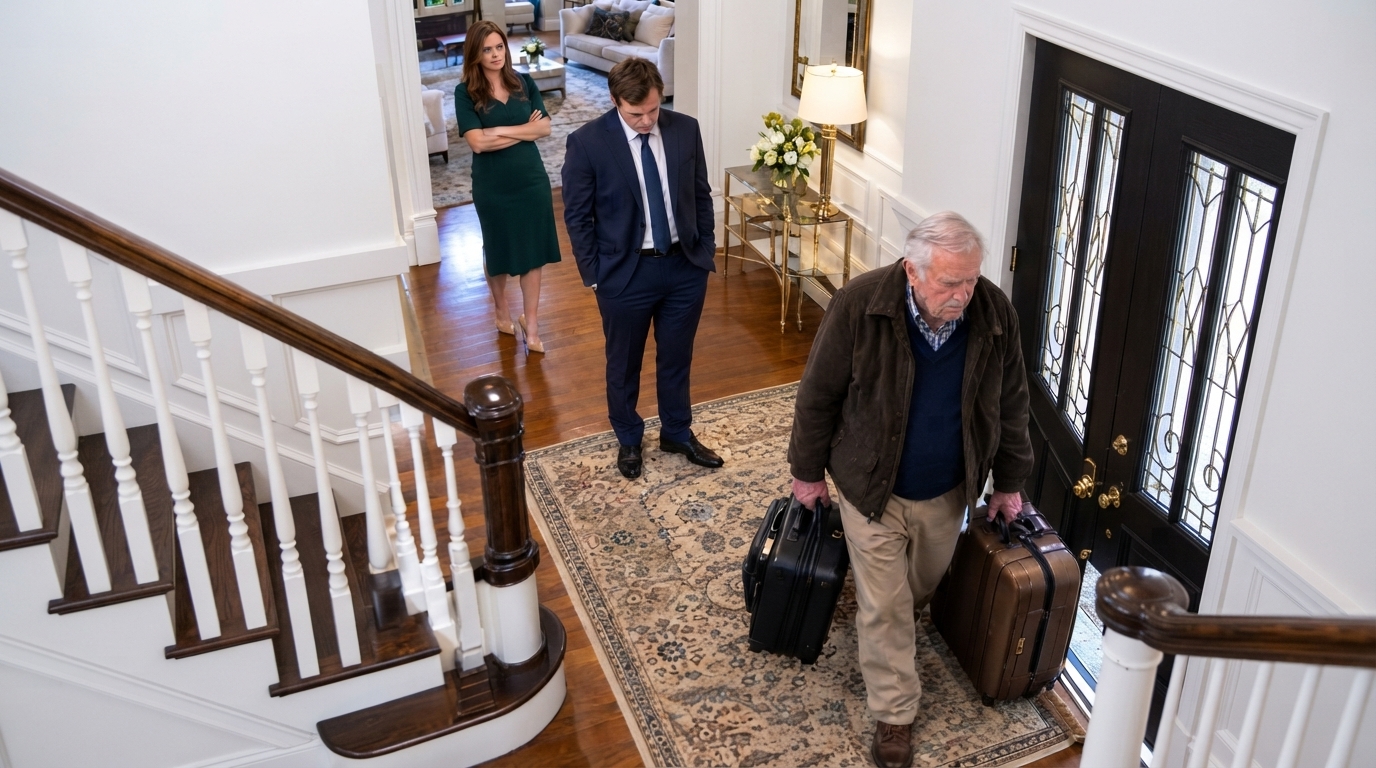
The two suitcases.
The key left on the kitchen counter.
And I thought about the man sitting across from me now.
A man who had lost his comfortable lifestyle but was beginning to recover something far more valuable.
His integrity.
“Yes,” I said quietly.
“I forgive you.”
He began crying.
I reached across the table and took his hand.
“But forgiveness doesn’t mean we’re going back to how things were.”
He nodded.
“I know.”
“We’re going to build something different.”
He squeezed my hand.
“I’d like that.”
So would I.
Several months later, I sold the large house through Higgins Family Property Holdings.
After the company paid the remaining expenses and completed the necessary accounting, I decided not to purchase another large property.
I had no interest in maintaining five bedrooms I didn’t need.
Instead, I bought a comfortable two-bedroom condominium near a park.
It had a balcony.
A bright kitchen.
A small study.
And enough room for Logan to visit.
I kept my investment accounts intact, adjusting them with professional advice to fit my retirement needs.
The eight hundred thousand dollars remained my safety net.
Not a weapon.
Not a reward.
Not an inheritance I was obligated to distribute while still alive.
It represented decades of work by Margaret and me.
And I intended to honor that work by living independently.
One Sunday afternoon, Logan came over carrying a framed photograph.
It was the old picture from the county fair.
The one where he sat on my shoulders holding a blue balloon.
He had restored it and placed it in a beautiful wooden frame.
“I thought you might like this for your study,” he said.
I took it carefully.
“Thank you, son.”
He looked around my new home.
“Are you happy here?”
I smiled.
“Very.”
He nodded.
Then asked, “Do you ever miss the old house?”
I thought about it.
The grand staircase.
The swimming pool.
The expensive dining room.
The bedroom where I had spent so many evenings alone.
“No,” I said.
“Not really.”
He looked surprised.
“Why?”
I placed the photograph on my desk.
“Because a house isn’t a home just because it’s beautiful.”
He nodded slowly.
I continued.
“A home is where you’re allowed to exist without apologizing.”
He looked down.
Then stepped forward and hugged me.
I held him tightly.
And for the first time in years, I didn’t feel like a burden.
I felt like his father.
That evening, after Logan left, I sat on my balcony with a cup of tea.
The sun was setting over the trees.
Children were playing in the park below.
A couple walked past holding hands.
And the world felt wonderfully ordinary.
I thought about the night I left Logan’s house.
How I had packed two suitcases.
How I had carefully wrapped Margaret’s photographs.
How I had placed my key on the kitchen counter.
I remembered standing in the doorway of that enormous house, wondering whether my son would ever understand what he had allowed to happen.
At the time, I thought leaving meant losing my family.
Now I understood something different.
Leaving had given us the chance to build a healthier relationship.
I had spent six years believing that love required me to accept disrespect.
I had confused sacrifice with duty.
I had convinced myself that keeping quiet was the only way to keep my son close.
But silence hadn’t protected our relationship.
It had slowly destroyed it.
And when I finally stopped paying the price of belonging, Logan was forced to decide whether he wanted his father or merely the financial security his father provided.
It took time.
It took painful conversations.
It took consequences neither of us enjoyed.
But eventually, he chose to rebuild our relationship.
Not perfectly.
Not immediately.
But sincerely.
I never told Logan that the eight hundred thousand dollars would someday be his.
I never promised him an inheritance.
I never used my money to demand obedience or affection.
Because I had learned something during those difficult months.
Money can provide shelter.
It can create opportunities.
It can protect your independence.
But it cannot purchase genuine love.
And when you use money to keep people close, you may never know whether they’re staying because they care about you or because they need what you provide.
I wanted my son to visit because he missed me.
Not because he needed another check.
I wanted him to call because he wanted to hear my voice.
Not because a bank was asking for my signature.
And I wanted to sit at his dinner table knowing I was welcome.
Not merely tolerated.
One evening, almost a year after I left, Logan called.
“Dad, are you busy Sunday?”
“Not particularly.”
“Would you like to come over for dinner?”
I smiled.
“What’s the occasion?”
“Nothing special.”
I waited.
Then he added, “I just want to see you.”
Those six words meant more to me than the entire eight hundred thousand dollars sitting in my accounts.
I looked at Margaret’s photograph.
And for a moment, I imagined her smiling.
“I’d love to, son.”
When Sunday arrived, I drove to Logan’s townhouse.
He opened the door before I knocked.
“Dad!”
He hugged me.
Then stepped aside.
“Come in. Dinner’s almost ready.”
I walked into the kitchen.
There were two plates on the table.
Two glasses.
A small bowl of stuffed mushrooms.
And a chair waiting for me.
Not in another room.
Not in the kitchen while everyone else entertained guests.
At the same table as my son.
I sat down.
Logan placed a plate in front of me.
Then smiled.
“I’m glad you’re here, Dad.”
I looked at him.
And I realized I had spent years waiting to hear those words.
“I’m glad too, son.”
We ate.
We laughed.
We talked about ordinary things.
And nobody asked me to leave.
Later that night, as I drove home, I thought about the three envelopes that had started everything.
Chelsea had opened the first and discovered my financial contributions were ending.
The second had revealed that Logan’s business could no longer depend indefinitely on my guarantee.
The third had forced them to confront the truth about the house.
But the most important thing I withdrew wasn’t money.
It wasn’t a signature.
It wasn’t even ownership of a property.
I withdrew my permission to be treated as though my existence was an inconvenience.
For six years, I had paid for a place at a table where nobody truly wanted me.
Then I stopped paying.
And eventually, my son learned that the relationship he had nearly lost was worth far more than the house, the cars, or the comfortable lifestyle he had once taken for granted.
My name is Albert Higgins.
I’m sixty-nine now.
I still drive my old Toyota.
I still wear comfortable clothes.
I still compare prices at the grocery store.
And I still believe in saving for a rainy day.
But there’s one thing I no longer believe.
I no longer believe that being a good father means allowing my own child to disrespect me.
I can love my son without financing his mistakes.
I can forgive him without pretending nothing happened.
And I can help him when I choose without surrendering the independence Margaret and I worked so hard to build.
The day Chelsea told me to leave, she thought she was throwing out a helpless old man.
She had no idea I owned the house.
She had no idea I had helped finance their lifestyle.
And she certainly had no idea about the eight hundred thousand dollars I had quietly saved.
But the greatest secret wasn’t hidden in my bank accounts.
It was something I had forgotten about myself.
I was still capable of walking away, starting over, and building a peaceful life without anyone’s permission.
And when I finally remembered that, everything changed.
I didn’t lose my home that night.
I found my way back to myself.
And eventually, I found my way back to my son.
THE END THANK YOU FOR READING !!!



