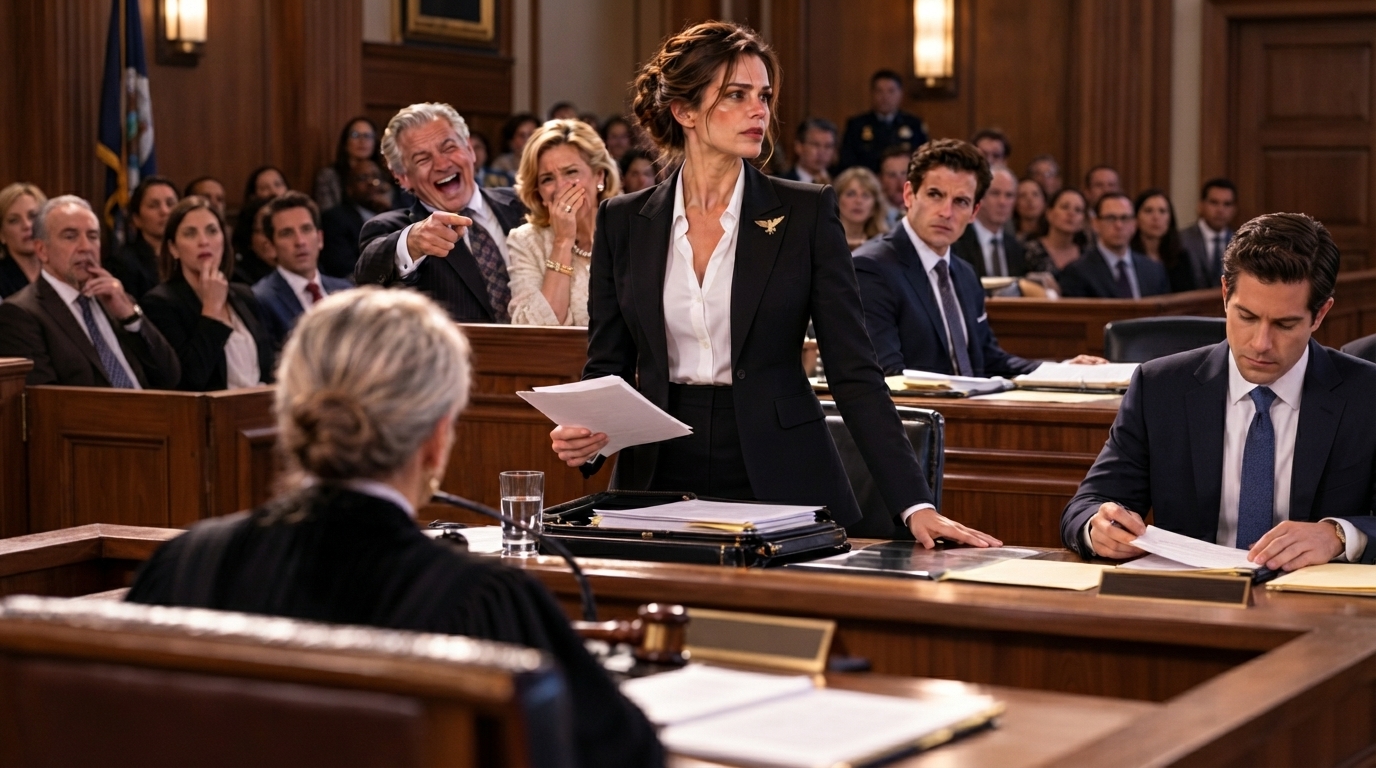
PART 3
For the first time since
I had entered the courtroom,
nobody was laughing.
Preston sat perfectly still,
his expensive suit suddenly looking
uncomfortable around his shoulders.
His father, Richard Hale, leaned forward,
the confident grin disappearing from his face.
Vivian’s fingers tightened around
the diamond bracelet she
had been showing off only minutes earlier.
And Martin Voss, the attorney who had described our divorce as a straightforward matter,
was staring at me as though I had just spoken a language he didn’t understand.
Judge Rebecca Morrison extended her hand.
“Mrs. Hale, I would like to examine those documents.”
I walked toward the bench and handed the folder to the court clerk.
Inside were twenty-three pages.
Bank statements.
Corporate transfer records.
Property documents.
And a financial affidavit bearing Preston’s signature.
Every page was numbered.
Every transaction was highlighted.
Every document had been obtained through lawful channels, authenticated where necessary, and disclosed to the opposing side according to the court’s procedures.
I hadn’t come to court hoping to surprise anyone with evidence that could be thrown out.
I had come prepared to make sure they couldn’t escape what their own records proved.
Martin suddenly stood.
“Your Honor, I object to the characterization of these transactions. My client has legitimate business arrangements that may not be immediately apparent to Mrs. Hale.”
Judge Morrison looked up.
“Mr. Voss, your client’s sworn financial affidavit states that Hale Development Group possesses fewer than forty thousand dollars in liquid assets.”
“That is correct, Your Honor.”
“Then perhaps you can explain why these records appear to show a transfer of four million eight hundred thousand dollars from a company account to a trust associated with his mother.”
Martin swallowed.
“I would need an opportunity to review—”
“You received these documents through discovery last Thursday,” I interrupted calmly.
The judge looked at him.
“Is that accurate?”
Martin’s face reddened.
“Yes, Your Honor, but—”
“Then you’ve had an opportunity to review them.”
A faint murmur moved through the gallery.
Richard leaned toward Preston.
I couldn’t hear every word, but I caught enough.
“What did you do?”
Preston whispered something back.
Richard’s expression darkened.
That was when I understood something important.
Richard knew about the money.
But he hadn’t expected me to find it.
There was a difference.
And that difference was about to destroy the careful story his family had constructed.
Three weeks earlier, when Preston handed me those divorce papers, I had believed our marriage was ending because he no longer loved me.
That had been painful enough.
But then I read the financial disclosures.
According to Preston, the business he had spent seven years building was practically worthless.
The house was supposedly burdened by debt.
Our joint savings had mysteriously dwindled.
And the retirement accounts I remembered helping fund had apparently suffered enormous losses.
He wanted me to accept twenty-five thousand dollars and leave the house within thirty days.
Twenty-five thousand dollars.
After seven years of managing his life, supporting his ambitions, and putting my own professional career on hold.
When I questioned the settlement, he laughed.
“You don’t understand business, Amelia.”
I remembered staring at him across our kitchen table.
“Then explain it to me.”
He sighed.
“That’s exactly the problem. Everything has to be explained to you.”
I said nothing.
He mistook my silence for embarrassment.
Then he added something I would never forget.
“My father says you should be grateful we’re offering anything.”
That night, after Preston went to sleep in the guest bedroom, I opened the filing cabinet in my study.
Inside was a locked metal box I hadn’t touched in years.
I entered the combination.
My old military identification was there.
So were photographs from my years in uniform, letters from former colleagues, and the certificates that had once hung proudly on my office wall.
At the bottom sat a small brass nameplate.
CAPTAIN AMELIA CARTER
JUDGE ADVOCATE
I held it for a long time.
Seven years earlier, I had placed that nameplate inside the box because Preston said it made him uncomfortable.
“People don’t need to know you used to prosecute soldiers,” he had told me.
I hadn’t corrected him about the full scope of my work.
I had served in several legal roles, including complex financial investigations and military justice proceedings.
I had spent years examining records that people desperately wanted hidden.
And I had learned something about dishonest people.
They rarely conceal everything.
They conceal what they think someone will bother looking for.
I put the nameplate on my desk.
Then I opened my laptop.
By morning, I had begun examining the financial records already available to me.
By the end of the first week, I knew Preston had lied.
By the end of the second, I knew his parents were involved.
And by the third, I knew our divorce wasn’t simply about ending a marriage.
It was about making sure I walked away before discovering what they had done.
Back in the courtroom, Judge Morrison finished examining the first several pages.
“Mrs. Hale, please explain how you obtained these records.”
“Through the court-authorized discovery process, Your Honor, including records produced by financial institutions and corporate documents provided in response to subpoenas.”
“Were these records authenticated?”
“Yes, Your Honor. The supporting certifications are included in Exhibit Four.”
Martin looked down at his own documents.
I could almost see the moment he realized what had happened.
His client had given him a story.
I had brought the evidence.
The judge turned another page.
“Mr. Voss, I see that your client identified the receiving trust as unrelated to marital assets.”
“Yes, Your Honor.”
“Yet Mrs. Hale’s documents indicate that your client retained substantial control over the funds.”
Martin said nothing.
I returned to my table.
“Your Honor, I would also like the court to examine the trust’s formation documents.”
The judge nodded.
“Proceed.”
I placed another document on the display screen.
A name appeared.
V. CARTER HOLDINGS TRUST.
Vivian’s maiden name was Carter.
A coincidence that had once seemed almost amusing.
Now it felt like an insult.
The trust had been established six months before Preston filed for divorce.
Its listed administrator was a longtime business associate of Richard Hale.
Its principal beneficiary was Preston.
And its original funding came from Hale Development Group.
The same company Preston claimed was nearly bankrupt.
Richard abruptly stood.
“This is ridiculous!”
Judge Morrison struck her gavel.
“Sir, sit down.”
Richard remained standing.
“My son built that company! This woman has no right to—”
“Mr. Hale.”
The judge’s voice became dangerously quiet.
“Sit down, or you will be removed from my courtroom.”
Richard lowered himself into his chair.
His face had turned an alarming shade of red.
I looked at him.
For years, Richard had treated me like an accessory to his son’s success.
At family dinners, he interrupted me whenever I spoke about finances.
When business partners visited, he introduced me as “Preston’s lovely wife.”
Once, during Thanksgiving, I offered a suggestion about a contractual dispute Preston was discussing.
Richard laughed so loudly that everyone at the table stopped eating.
“Amelia, sweetheart, leave the legal matters to people who understand them.”
I remembered Preston smiling into his wineglass.
I remembered Vivian changing the subject.
And I remembered promising myself I would never again offer that family advice they hadn’t earned.
Now Richard was watching me explain the legal consequences of his son’s financial arrangements.
And for once, he couldn’t interrupt.
Judge Morrison turned toward Preston.
“Mr. Hale, did you authorize the transfer of these funds?”
Martin immediately rose.
“Your Honor, I would advise my client—”
“I am asking whether the transfer was authorized by Mr. Hale,” the judge said. “Counsel may confer with him before he answers.”
Martin leaned toward Preston.
They whispered for nearly a minute.
Finally, Preston spoke.
“Yes.”
“Did you disclose the transfer in your sworn financial statement?”
Preston hesitated.
“No.”
The silence was absolute.
I watched the judge write something on her notepad.
“Why not?”
Martin stood again.
“Your Honor, given the potential implications, I request a recess so I may confer with my client.”
Judge Morrison looked at the clock.
“Fifteen minutes.”
Her gavel fell.
Preston immediately turned toward me.
For the first time in three weeks, he looked frightened.
“Amelia,” he whispered.
I gathered my papers.
He stepped closer.
“We need to talk.”
I looked at him.
“You had three weeks to talk.”
His jaw tightened.
“You don’t understand what you’re doing.”
I almost smiled.
“That makes two of us, Preston.”
Then I walked past him.
But before I reached the courtroom doors, Vivian caught my arm.
Her manicured fingers pressed hard against my sleeve.
“Whatever you think you’re proving,” she hissed, “you’re destroying this family.”
I gently removed her hand.
“No, Vivian.”
I looked directly into her eyes.
“I’m just making sure the court sees what your family did.”
She opened her mouth.
But I wasn’t finished.
“And I haven’t even mentioned the house yet.”
The color drained from her face.
Because Vivian knew exactly what I meant.
And the worst part of their deception was still waiting inside my briefcase.
PART 4
The fifteen-minute recess became twenty-five.
I spent most of it sitting alone on a wooden bench outside the courtroom, reviewing my notes.
I didn’t need to.
I knew the documents almost by heart.
But the familiar routine steadied me.
During my military career, I had learned that preparation wasn’t about eliminating fear.
It was about being able to function despite it.
And beneath my calm expression, I was afraid.
Not of Preston.
Not of Richard.
Not even of losing the case.
I was afraid of what winning would mean.
Because winning would require accepting that the marriage I had spent seven years protecting had been built on something much uglier than ordinary dishonesty.
Preston hadn’t simply fallen out of love.
He had made a calculated decision to leave me financially helpless.
And his parents had helped him.
I was still staring at my notes when someone stopped beside me.
“Captain Carter?”
I looked up.
A tall man with silver hair stood a few feet away.
For a moment, I didn’t recognize him.
Then his smile appeared.
“Major Daniel Reeves,” he said. “Although I suppose it’s Colonel Reeves now.”
I stood immediately.
“Daniel?”
He laughed softly.
“You haven’t changed much.”
“Neither have you.”
“That is a generous assessment.”
Daniel had served alongside me during one of the most demanding periods of my legal career.
He had been a senior military attorney when I handled a financial misconduct investigation involving millions of dollars in government contracts.
We had worked sixteen-hour days for months.
He knew exactly how I approached a case.
He also knew why I had eventually left active service.
Daniel glanced toward the courtroom.
“I saw your name on the docket. I wasn’t certain it was you until I heard you speak.”
“What are you doing here?”
“Meeting another attorney in the building. Then I heard about the hearing.”
He studied my face.
“Are you all right?”
It was such a simple question.
And somehow, after weeks of being treated like an obstacle, it nearly broke me.
“I will be.”
Daniel nodded.
“Good.”
Then he lowered his voice.
“I remember you telling me once that you wanted a life where nobody needed you to fight.”
I looked away.
“I thought I found it.”
He didn’t offer some easy reassurance.
He simply said, “Sometimes peace isn’t the absence of a fight. Sometimes it’s knowing which fight is worth having.”
I swallowed.
“Thank you.”
He smiled.
“For what it’s worth, Amelia, I remember your closing argument in the Whitcomb case.”
I laughed despite myself.
“That was years ago.”
“You got a witness to admit the entire scheme with three questions.”
“Four.”
“Still counting?”
“Always.”
The courtroom doors opened.
The clerk announced that proceedings were resuming.
Daniel stepped aside.
“Go finish your case, Captain.”
I returned to my table.
And this time, when Preston looked across the aisle, he saw Daniel standing near the back of the gallery.
His expression changed.
He recognized something about the way Daniel had spoken to me.
Respect.
Professional familiarity.
A history Preston knew nothing about.
Richard leaned toward his son.
“Who is that?”
Preston shook his head.
“I don’t know.”
That small exchange gave me an unexpected sense of clarity.
For seven years, they had believed they knew everything worth knowing about me.
They had never once bothered to ask.
Judge Morrison returned to the bench.
“Mr. Voss, are you prepared to proceed?”
Martin rose slowly.
“Yes, Your Honor.”
“Has your client provided an explanation for the undisclosed transfer?”
“We acknowledge that certain financial disclosures may require correction.”
The judge looked at him over her glasses.
“Correction?”
“Yes, Your Honor.”
“Mr. Voss, the omission involves four million eight hundred thousand dollars.”
Martin’s mouth tightened.
“We understand the seriousness of the matter.”
“Then I suggest you choose your words carefully.”
I waited.
The judge turned toward me.
“Mrs. Hale, you indicated that there were additional concerns involving the marital residence.”
“Yes, Your Honor.”
“Proceed.”
I removed a second folder.
This one was blue.
Preston stared at it.
I could tell he didn’t recognize it.
That was because the documents inside hadn’t come from his office.
They had come from the county recorder, the title company, and the lender through properly authorized requests.
“Our marital residence was purchased four years ago,” I began. “At the time, I contributed two hundred and eighty thousand dollars from my personal savings toward the purchase.”
Martin stood.
“We do not dispute that Mrs. Hale contributed funds toward the property.”
“Thank you,” I said.
He frowned.
I continued.
“The remaining purchase price was financed through a mortgage. Both Preston and I signed the original loan documents, and both our names appeared on the recorded deed.”
I placed the original deed on the screen.
There they were.
Preston Hale.
Amelia Carter Hale.
Joint owners.
“However,” I said, “eight months ago, a second deed was recorded.”
The image changed.
A new document appeared.
This one purported to transfer my interest in the property to a holding company controlled by Richard Hale.
The transfer price was listed as ten dollars.
A murmur moved through the courtroom.
Martin looked startled.
“Your Honor, I haven’t seen this document.”
“You have now,” I said.
Judge Morrison leaned forward.
“Mrs. Hale, are you alleging that you voluntarily transferred your ownership interest?”
“No, Your Honor.”
“Then what are you alleging?”
I looked toward Preston.
He was staring at the document.
His fingers had gone white around the edge of the table.
“I am alleging that the signature attributed to me on this deed is not mine.”
Richard stood halfway out of his chair.
“That’s a lie!”
The judge struck her gavel.
“Mr. Hale, this is your final warning.”
He sat.
I continued.
“More importantly, Your Honor, I have evidence showing that the notarization associated with this document could not have occurred as represented.”
Martin’s expression sharpened.
“What evidence?”
I turned another page.
“The deed states that I personally appeared before a notary on March fourteenth at two thirty in the afternoon.”
I paused.
“On that date, I was in Washington, D.C., attending a legal conference.”
Preston blinked.
He remembered that trip.
He had complained about it.
He had called me selfish for spending three days away from home.
I displayed the conference registration, hotel receipt, travel records, and a timestamped photograph taken during the afternoon session.
Then I presented a certified statement from the notary named on the deed.
Her commission had expired before the purported acknowledgment.
She denied notarizing the document.
The courtroom became so quiet that I could hear the air-conditioning.
Judge Morrison studied the screen.
“Mrs. Hale, are you asserting that the deed was forged?”
“Yes, Your Honor.”
Martin stood.
“I object to any implication that my client personally participated in the preparation of this document without evidence establishing that connection.”
“That’s fair,” I replied.
The judge looked at me.
“Do you have such evidence?”
“Yes.”
I opened the third section of the folder.
“Exhibit Eleven contains an email produced by Hale Development Group in discovery.”
The email was dated three days before the deed was recorded.
It had been sent from Preston’s corporate account to Richard.
The subject line read:
HOUSE TRANSFER — FINAL VERSION
And the message itself contained one sentence.
Dad, make sure Amelia doesn’t see the paperwork until everything is finished.
Preston closed his eyes.
Richard whispered something that sounded like a curse.
Vivian stared straight ahead.
I looked at the judge.
“Your Honor, I am not asking this court to determine criminal responsibility today. I am asking the court to preserve the property, recognize that the purported transfer is disputed, and prevent further disposition of the asset while its validity is examined.”
Judge Morrison nodded slowly.
“An appropriate request.”
Martin requested permission to approach the bench.
The judge allowed it.
For several minutes, they spoke quietly.
I remained at my table.
Then the judge announced that she would issue temporary orders preserving the property and requiring additional disclosures. The validity of the deed would be addressed through the appropriate proceedings, and the matter would be referred for further investigation if warranted.
Preston looked as though he had been punched.
But Richard was furious.
He leaned toward Vivian and whispered loudly enough for me to hear.
“She planned this.”
I turned.
“No, Richard.”
His eyes met mine.
“You planned it. I documented it.”
He looked away.
The hearing continued.
I presented records showing that household expenses had been paid from accounts I maintained, that I had personally covered significant business costs during Hale Development Group’s early years, and that my financial contributions extended far beyond the down payment on our home.
Then came the document I had almost decided not to use.
A handwritten letter.
Dated six years earlier.
Preston had written it on our first wedding anniversary.
I had found it while packing my belongings.
At the time, I sat on the bedroom floor and cried for nearly an hour.
Because it reminded me of the man I had believed I married.
I asked the judge’s permission to introduce the letter as evidence relevant to Preston’s earlier acknowledgment of my contributions.
Martin objected.
The judge considered the foundation and admitted it for that limited purpose.
I read only the portion that mattered.
“Amelia, I know I wouldn’t have made it through this first year without you. You paid our bills when I couldn’t. You believed in my company when nobody else did. Everything I build will always be something we built together.”
My voice remained steady.
But my hands trembled.
I placed the letter down.
Then I looked toward Preston.
“Do you remember writing that?”
He stared at the table.
“Preston?”
His attorney whispered something.
Finally, Preston nodded.
“Yes.”
“Was it true?”
He said nothing.
Judge Morrison looked toward him.
“Mr. Hale, please answer the question.”
Preston swallowed.
“Yes.”
I waited.
“Then when did it stop being true?”
Martin stood.
“Objection. Argumentative.”
“Sustained,” the judge said.
I nodded.
“No further questions on that point.”
But I didn’t need another answer.
Everyone in the courtroom had heard the one that mattered.
Preston had acknowledged my contributions.
His own words contradicted the financial story he had sworn was true.
The judge looked at the clock.
“We will take a brief afternoon recess before addressing the remaining issues.”
As she rose, Preston suddenly called my name.
“Amelia.”
I didn’t turn.
“Amelia, please.”
Something in his voice stopped me.
Not anger.
Not arrogance.
Desperation.
I looked back.
His eyes were wet.
“I didn’t know Dad had done all of that.”
For one second, the old part of me wanted to believe him.
The part that had spent seven years explaining away his cruelty.
The part that remembered birthdays, vacations, and the way he once held my hand when my mother died.
But then I remembered the email.
Make sure Amelia doesn’t see the paperwork.
I looked at him.
“You knew enough to tell him to hide it from me.”
His face crumpled.
And I walked away.
Outside the courtroom, Daniel was waiting.
“You did well,” he said.
I shook my head.
“It’s not over.”
“No,” he agreed. “But they’ve stopped underestimating you.”
I looked through the glass doors.
Richard was shouting at Martin.
Vivian was crying.
Preston stood alone.
And suddenly, I realized something.
For the first time in seven years, I wasn’t carrying their problems.
They were.
But there was one more secret.
One that Preston had never told his parents.
And when the judge heard it, the entire direction of the case would change.
PART 5: THE FINAL VERDICT
The final secret wasn’t hidden in a bank account.
It wasn’t buried in a corporate filing.
And it had nothing to do with a forged deed.
It was contained in a small, cream-colored envelope Preston had given me five years earlier.
At the time, I had considered it one of the most meaningful gifts of our marriage.
Now, it had become the last piece of evidence I needed.
When court resumed, Judge Morrison addressed the parties.
“Before we proceed, I want to be clear. The financial discrepancies presented today raise substantial concerns. However, this court will make findings based on admissible evidence and applicable law, not speculation or emotion.”
“Yes, Your Honor,” I replied.
Martin nodded.
Preston sat with his hands clasped tightly in front of him.
Richard and Vivian had returned to their seats.
Neither looked at me.
The judge turned toward Martin.
“Does your client intend to maintain the position that Mrs. Hale made no meaningful financial contribution during the marriage?”
Martin hesitated.
“No, Your Honor. We are prepared to amend that characterization.”
I almost laughed.
Amend.
That was the word they chose.
As though seven years of dismissal could be corrected with a sentence.
As though the insults, the humiliation, and the attempt to strip away my property were simply clerical mistakes.
Judge Morrison looked toward me.
“Mrs. Hale, do you have anything further before I address the requested temporary relief?”
“Yes, Your Honor.”
I reached into my briefcase.
And removed the envelope.
Preston looked up.
For the first time that afternoon, genuine confusion appeared on his face.
I held it carefully.
“This document concerns Hale Development Group.”
Richard immediately leaned forward.
“What document?”
I ignored him.
“Five years ago, Preston asked me to invest a portion of an inheritance I received from my grandmother into his company.”
The judge nodded.
“Continue.”
“At that time, the company was struggling. It had missed several major payments, and Preston was considering closing it.”
I remembered those days vividly.
The unpaid invoices.
The midnight phone calls.
The evenings Preston sat at our kitchen table with his head in his hands.
I remembered making coffee while he stared at spreadsheets.
I remembered telling him that failure didn’t have to be permanent.
And I remembered the afternoon I transferred six hundred and fifty thousand dollars from my separate inheritance account.
It had been almost everything my grandmother left me.
She had worked as a school principal for thirty-eight years.
She lived modestly.
She saved carefully.
And she taught me that money was not merely something to spend.
It was freedom.
I had used that freedom to help the man I loved.
Preston had cried when I told him I would invest.
He promised he would never forget it.
Two weeks later, he gave me the envelope.
Inside was a signed agreement.
Not a sentimental note.
Not a thank-you card.
A formal investment agreement.
Prepared by an attorney who had represented the company at the time.
The document acknowledged my contribution and granted me a thirty-percent ownership interest in Hale Development Group, subject to its stated terms.
I had reviewed it carefully before signing.
So had Preston.
And the company had recorded the transaction in its internal records.
But somewhere along the way, Preston apparently decided I had forgotten.
Or perhaps he believed I would never understand what the agreement meant.
Judge Morrison examined the document.
Martin requested a copy.
I provided one.
His eyes moved rapidly across the pages.
Then he turned toward Preston.
“Did you know about this?”
Preston looked down.
“Yes.”
Martin stared at him.
“You told me your wife had no ownership interest.”
Preston didn’t answer.
Richard stood.
“That agreement isn’t valid!”
The judge looked up.
“Mr. Hale, sit down.”
Richard pointed toward me.
“She manipulated him into signing it!”
I felt something inside me go completely still.
For years, Richard had accused me of depending on Preston’s money.
Now, faced with proof that I had invested my own, he was accusing me of taking advantage of him.
There was no version of reality in which that family would willingly recognize my contribution.
I finally understood that.
And understanding it was strangely liberating.
Judge Morrison addressed Richard.
“If you interrupt again, you will be removed.”
He sat.
The judge turned toward me.
“Mrs. Hale, has the company recognized this agreement in its records?”
“Yes, Your Honor.”
I displayed a copy of the company’s ownership ledger from the year the agreement was executed.
My name appeared clearly.
Amelia Carter Hale.
Thirty percent.
I then presented subsequent company records obtained during discovery.
The ownership interest remained recorded for several years.
Then, shortly before Preston began preparing for divorce, my name disappeared from a revised capitalization table.
There was no signed transfer agreement.
No payment.
No documented relinquishment of my interest.
Just an unexplained removal.
Martin stared at the screen.
“Your Honor, we will need time to examine the authenticity and enforceability of these documents.”
“I agree,” Judge Morrison said.
Then she looked toward Preston.
“But your client has some explaining to do.”
Preston finally raised his head.
“I thought the agreement had expired.”
I turned toward him.
“On what basis?”
He hesitated.
“Dad said it wasn’t enforceable anymore.”
Richard’s face went pale.
I asked the question I had been waiting to ask.
“Did you consult the attorney who prepared it?”
“No.”
“Did I sign anything surrendering my interest?”
“No.”
“Did the company pay me to buy back my shares?”
“No.”
I looked at the judge.
“Your Honor, I request that the court preserve the disputed ownership interest, order a complete accounting of the company, and prevent any further transfers designed to frustrate equitable distribution or my contractual rights.”
Judge Morrison made several notes.
“The court will consider those requests. The company’s ownership dispute may require additional proceedings, but I am satisfied that immediate preservation measures are warranted.”
Richard whispered something to Vivian.
She shook her head.
He whispered again.
This time she stood.
“Your Honor, may I say something?”
The judge regarded her carefully.
“Mrs. Hale, you are not a party to this divorce proceeding. If you have relevant testimony, the appropriate procedure must be followed.”
Vivian looked at Martin.
Then at Preston.
Then at her husband.
For the first time, I saw something in her expression I had never seen before.
Fear of Richard.
Not fear for him.
Fear of him.
“There’s something I need to tell the court,” she whispered.
Richard grabbed her wrist.
“Vivian, sit down.”
She pulled away.
“Richard.”
His expression hardened.
“Don’t.”
Judge Morrison immediately addressed the courtroom deputy.
“Please ensure that Mrs. Hale is not being prevented from leaving or speaking with counsel.”
Vivian stepped away from her husband.
Martin looked bewildered.
Preston stood.
“Mom?”
Vivian began crying.
“I didn’t know what they were doing at first.”
Richard’s face twisted.
“She’s confused.”
Vivian shook her head.
“No.”
The judge ordered another recess so that the parties could determine whether Vivian intended to provide testimony and whether additional counsel was necessary.
What happened next changed everything.
During the recess, Vivian asked to speak privately with an attorney.
She did not approach me.
I was grateful.
I had no desire to become the person responsible for comforting her.
For seven years, she had watched Richard belittle me.
She had laughed when Preston dismissed my opinions.
She had told me more than once that a wife should never embarrass her husband by appearing more capable than he was.
Now she was facing the consequences of the world she had helped maintain.
When proceedings resumed, Vivian had obtained independent legal advice and agreed to provide a sworn statement, subject to later examination.
The judge made clear that the statement would not automatically establish every disputed fact.
But it contained information that justified further investigation.
Vivian acknowledged that Richard had discussed transferring company assets before the divorce.
She said she had been told the arrangement was necessary to protect the family’s wealth.
She also disclosed that Richard had instructed her not to ask questions about the trust.
Then came the detail nobody expected.
The money had not all remained in the trust.
A substantial portion had been used to secure a private loan benefiting another business Richard controlled.
Preston turned toward his father.
“What?”
Richard stared straight ahead.
Vivian continued.
“Richard told me Preston would take responsibility if anyone discovered it.”
Preston rose halfway from his chair.
“Dad?”
Richard said nothing.
“Dad, is that true?”
Martin placed a hand on Preston’s arm.
“Do not discuss this here.”
But Preston was no longer listening.
“You told me we were protecting the company.”
Richard finally looked at him.
“Everything I did was for this family.”
Preston laughed.
It was a terrible sound.
“You used my company to borrow money for yourself?”
Richard’s silence answered more than any speech could have.
Judge Morrison struck her gavel.
“Mr. Hale, sit down. This courtroom will not become a family argument.”
Preston sank into his chair.
I watched him stare at his father.
For seven years, Preston had treated Richard’s opinions as unquestionable truth.
If Richard said I was weak, Preston believed him.
If Richard said I didn’t deserve a share of the business, Preston repeated it.
If Richard said hiding assets was necessary, Preston obeyed.
Now he was discovering that the same man who taught him to deceive me had been deceiving him.
I felt no satisfaction.
Only exhaustion.
Because none of this had needed to happen.
We could have ended our marriage honestly.
We could have divided what we owned.
We could have acknowledged that two people sometimes grow apart without turning their history into a battlefield.
But Preston wanted to win.
And Richard wanted to make sure I lost.
They had confused cruelty with strength.
Now they were learning the difference.
By late afternoon, Judge Morrison announced her temporary rulings.
The court would not issue a final divorce judgment that day.
The evidence required further examination.
But the immediate orders were significant.
The marital residence would remain protected against unauthorized transfer.
Preston would be required to provide corrected financial disclosures.
Additional records would be produced concerning Hale Development Group and the disputed trust.
A neutral forensic accountant would be appointed to examine the financial transactions.
The disputed ownership interest would be preserved pending further proceedings.
And the questionable deed and financial representations would be referred to the appropriate authorities for review.
Then Judge Morrison looked directly at Preston.
“Mr. Hale, this court expects complete honesty in financial disclosures. Any further attempt to conceal, transfer, or misrepresent assets may result in serious consequences.”
Preston nodded.
“Yes, Your Honor.”
The judge turned toward me.
“Mrs. Hale, you have demonstrated substantial preparation today. However, given the complexity of the corporate issues and the potential for related litigation, I strongly encourage you to consider independent counsel.”
I nodded.
“Thank you, Your Honor. I understand.”
And I did.
Being a former military attorney didn’t mean I knew everything about civilian divorce and corporate law.
I had spent weeks reviewing the applicable procedures, and I knew that professional specialization mattered.
But I also knew enough to recognize what was happening.
Enough to preserve the evidence.
Enough to ask the right questions.
And enough to prevent Preston’s family from obtaining an easy victory through intimidation.
When the judge adjourned, nobody moved immediately.
Richard sat staring at the floor.
Vivian wiped her face with a tissue.
Martin began packing his documents with the grim efficiency of someone reconsidering every representation his client had made.
And Preston looked across the aisle at me.
“Amelia.”
I closed my briefcase.
He approached slowly.
“I never knew you were a lawyer.”
I studied his face.
There was something almost absurd about that sentence.
Seven years.
Seven years of marriage.
Seven years of sharing a home, meals, holidays, and supposedly our deepest thoughts.
And he had never cared enough to learn about the career I had sacrificed.
“You knew I served in the military,” I said.
“Yes, but I thought you worked in administration.”
“Because that’s what you assumed.”
He looked ashamed.
“Why didn’t you tell me?”
I took a moment before answering.
“I tried.”
He frowned.
“When?”
“During our first year together. You told me my old career wasn’t relevant anymore.”
He looked away.
“At your father’s birthday dinner, I mentioned working on a military justice case. He laughed and said women in uniform probably spent their time organizing paperwork.”
Preston closed his eyes.
“You laughed too.”
He said nothing.
“And after that,” I continued, “I stopped trying to explain myself to people who had already decided I wasn’t worth listening to.”
His eyes filled.
“I’m sorry.”
I believed he meant it.
At least in that moment.
But regret wasn’t the same as accountability.
And an apology offered after the evidence came out couldn’t erase years of deliberate choices.
“I know,” I said.
He reached for my hand.
I stepped back.
“Amelia, maybe we can fix this.”
I looked at him.
“Which part?”
He blinked.
“The marriage?”
“The money you hid? The house you tried to take? The company shares you erased? Or the seven years you spent convincing me that loving you meant becoming smaller?”
He couldn’t answer.
I nodded.
“That’s what I thought.”
Then I walked away.
But the case wasn’t finished.
Not even close.
Over the following months, the forensic accountant uncovered additional transactions.
Some involved legitimate business expenses.
Others raised serious questions about the timing and purpose of transfers between Hale Development Group and entities connected to Richard.
The accountant’s report also confirmed that my original investment had been recorded as an equity contribution, not a gift or personal loan.
The corporate records supported my ownership claim.
Preston eventually retained new counsel.
Richard hired separate attorneys.
Vivian moved out of the family home.
And the relationship between father and son, once presented as unbreakable, deteriorated almost completely.
I didn’t celebrate any of it.
Instead, I rebuilt my life.
I hired a civilian family-law attorney with extensive experience in complex property division.
I also consulted corporate counsel about the disputed company interest.
I returned to legal work gradually, taking continuing education courses and exploring positions that would allow me to use my experience again.
The first morning I walked into a professional office wearing a tailored suit, carrying my old leather briefcase, I felt something I hadn’t experienced in years.
Recognition.
Not from anyone else.
From myself.
I remembered who I had been before I started apologizing for being capable.
I remembered the woman who could stand before a panel of senior officers without losing her composure.
The woman who believed facts mattered.
The woman who had worked hard for everything she achieved.
And I realized she hadn’t disappeared.
She had simply been waiting.
Six months after that first hearing, Preston and I reached a settlement.
It came after extensive negotiations, corrected disclosures, and a formal accounting of the disputed assets.
The settlement recognized my financial contributions and resolved my ownership claim through a substantial buyout.
I retained the marital residence, subject to the agreed financial adjustments.
Preston retained control of the company after the buyout, although its financial condition was far less impressive than he had once claimed.
The final terms were documented, reviewed by counsel, and approved through the appropriate process.
The separate investigations concerning the questionable deed and financial transactions continued independently.
I did not pretend that a divorce settlement determined criminal guilt.
Those questions belonged to the authorities responsible for investigating them.
But one thing was certain.
The attempt to send me away with twenty-five thousand dollars had failed.
Completely.
On the day our divorce became final, Preston waited for me outside the courthouse.
He looked older.
His expensive suit hung loosely on his shoulders.
“Amelia,” he said quietly.
I stopped.
“I wanted to tell you something.”
I waited.
“My father always said you were lucky I married you.”
I looked at him.
Preston swallowed.
“I think I was the lucky one.”
For a moment, neither of us spoke.
Then he continued.
“I had someone who believed in me when I had nothing. Someone who invested in my dreams. Someone who made everything possible. And I treated her like she was replaceable.”
His voice broke.
“I don’t expect you to forgive me.”
I looked toward the courthouse doors.
Six months earlier, I had entered that building terrified that everything I built would be taken away.
Now I was leaving with my rights recognized and my future back in my own hands.
“Preston,” I said, “I forgave myself for staying as long as I did. That’s the forgiveness I needed.”
He wiped his eyes.
“Are you happy?”
I thought about it.
The house was quiet now.
No more tense dinners.
No more criticism disguised as advice.
No more wondering whether I had spoken too confidently or embarrassed someone by knowing more than they did.
I was learning to enjoy mornings again.
I had started running.
I was reconnecting with old friends.
And for the first time in years, I was making decisions without asking whether Preston or Richard would approve.
“Yes,” I said.
“I think I’m getting there.”
He nodded.
Then stepped aside.
I walked to my car.
But before opening the door, I heard someone call my name.
“Captain Carter!”
I turned.
Daniel Reeves stood near the courthouse steps.
He had come to support me during the final proceedings.
He raised a hand.
“How does freedom feel?”
I smiled.
“Strange.”
He laughed.
“It usually does at first.”
We walked together toward the parking lot.
He asked whether I had decided what to do next.
I told him I was considering returning to public service or working with veterans who needed legal assistance.
He nodded approvingly.
“You’d be good at that.”
I smiled.
“I used to be.”
Daniel stopped walking.
“Amelia, you never stopped being good at it. You just spent too long around people who benefited from making you forget.”
I looked down at the briefcase in my hand.
The same briefcase I had carried into the courtroom alone.
The same one Richard had mocked.
The same one Preston had barely glanced at.
It was old.
The leather was scratched.
One corner had begun to wear thin.
But it had held everything I needed.
I thought about replacing it.
Then decided against it.
Some things deserved to stay.
Three months later, I accepted a position with a legal organization assisting veterans and military families.
On my first day, I placed a small brass nameplate on my desk.
CAPTAIN AMELIA CARTER
JUDGE ADVOCATE
It wasn’t my current job title.
It was a reminder of the person I had once been, and the part of myself I had finally reclaimed.
Beside it, I placed a photograph of my grandmother.
The woman whose savings had helped build Preston’s company.
The woman who taught me to keep records, read contracts, and never surrender my independence.
I wished she could have seen how everything ended.
But I liked to think she would have been proud.
One afternoon, several weeks after starting my new job, a young woman came into my office.
She was twenty-seven.
Recently separated.
Her husband had told her she was entitled to nothing because she had stayed home raising their children.
She sat across from me, twisting a tissue between her fingers.
“He says I don’t understand how money works,” she whispered.
I felt something tighten in my chest.
The words were painfully familiar.
“He says I’ll lose everything if I fight him.”
I leaned forward.
“Has an attorney reviewed your situation?”
She shook her head.
“I can’t afford the kind of lawyer he has.”
I handed her information about available legal resources and explained how we could help her find appropriate representation.
Then I said something I wished someone had told me years earlier.
“His confidence is not proof that he’s right.”
She looked up.
I continued.
“Being quiet doesn’t mean you’re weak. Being kind doesn’t mean you’re foolish. And spending years caring for a family doesn’t mean you contributed nothing.”
Her eyes filled.
For the first time since entering my office, she smiled.
“Thank you.”
After she left, I sat alone for a long time.
I thought about Richard’s laughter.
Vivian’s diamond bracelet.
Martin’s expensive suit.
Preston’s confident expression.
They had all believed the same thing.
That a woman sitting alone at a courtroom table must be powerless.
That an empty table meant an empty mind.
That silence meant ignorance.
They had never considered that the woman they mocked might know exactly what she was doing.
And the most extraordinary part wasn’t the money I recovered.
It wasn’t the house.
It wasn’t even the look on Richard’s face when the judge ordered further investigation.
It was the moment I realized I no longer needed their approval.
I had spent seven years trying to convince that family I deserved respect.
In the end, I stopped asking.
I demanded that my legal rights be recognized.
And I gave myself the respect I had been waiting for them to offer.
Sometimes people mistake your kindness for weakness because they have never seen what happens when you finally establish a boundary.
Sometimes they laugh because they believe they’ve already won.
And sometimes the person sitting quietly across from them is the one who has spent years learning how to recognize the truth.
Richard Hale laughed when I entered that courtroom without an attorney.
He thought I couldn’t afford someone to defend me.
He had no idea that I had spent years defending others.
He had no idea that I understood evidence, testimony, and the importance of a carefully chosen question.
And he certainly had no idea that his son’s own financial records would become the strongest evidence against the story they had constructed.
I never forgot the silence that followed my first question.
Not because I enjoyed humiliating them.
But because, for the first time, they were forced to listen.
They thought I had walked into that courtroom with nothing.
What they didn’t understand was that I had finally walked in as myself.
And that was worth more than anything they had tried to take.
THE END THANK YOU FOR READING !!!



