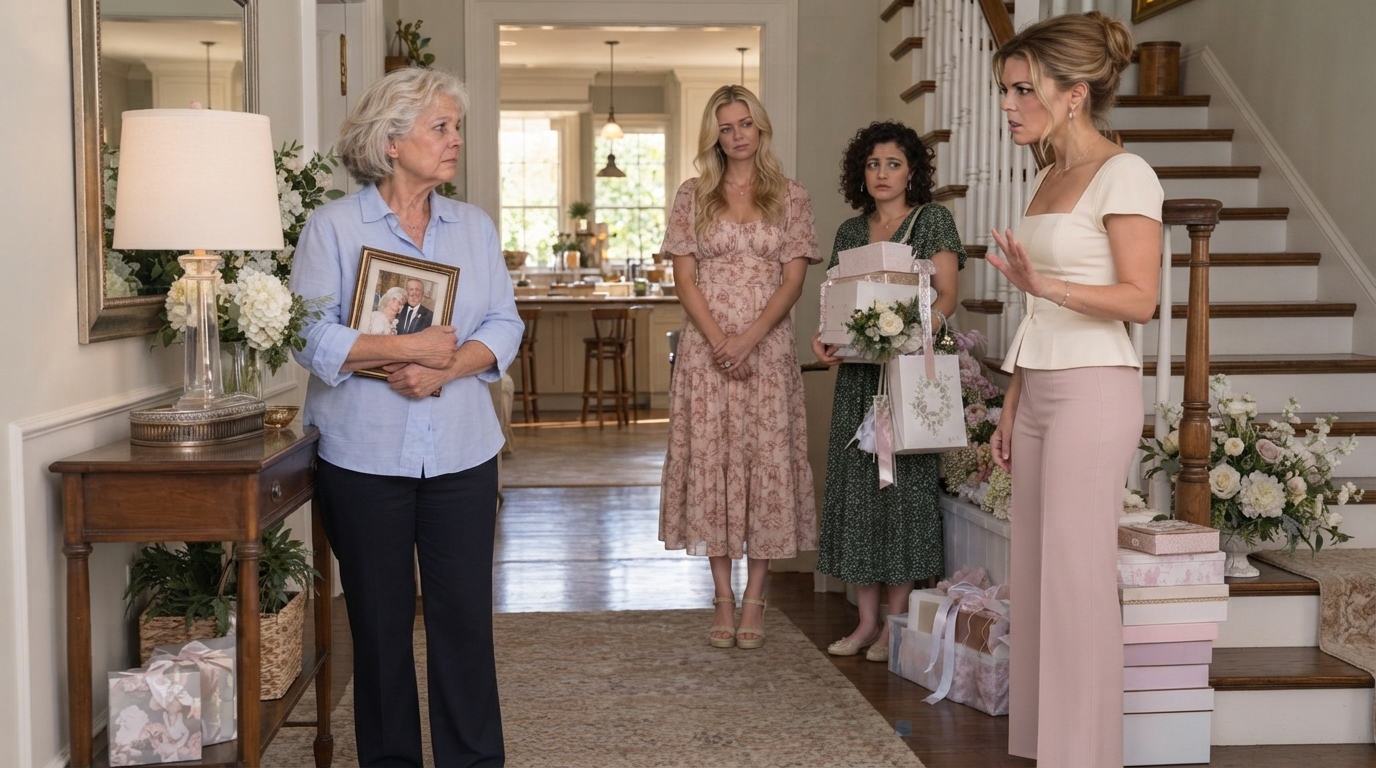
PART 3
The rehearsal dinner isn’t
the only event your son and his fiancée
have been planning at your house,
Mrs. Whitfield.
The venue manager’s words made me straighten in my chair.
Her name was Eleanor Price,
and she had been coordinating weddings
at Ashbourne Estate for nearly twenty years.
I remembered meeting her in February,
when Ben and Sloane had walked through
the historic ballroom holding hands and
whispering about their perfect day.
“What do you mean?” I asked.
There was a pause.
Perhaps it would be better if you came in.
There are some documents
I believe you should see before making any final decisions.
I looked at the wedding binder spread across my dining table.
Eleanor, I’m sixty-three years old.
I’ve managed a transportation company through recessions,
labor disputes, and a pandemic.
Whatever it is, you can tell me.
She exhaled.
Your future daughter-in-law contacted us last week about changing the billing arrangements.
She said you were experiencing memory problems and
that your son would soon be handling your financial affairs.
For several seconds, I couldn’t speak.
“Memory problems?”
“That’s what she told our accounting department.”
I looked toward the photograph of Arthur sitting on the mantel.
My husband had been gone for twenty-six years, but I could almost hear his voice.
Margaret, don’t let anyone make you question what you know.
“What exactly did she request?”
“She wanted us to issue a revised agreement listing your son as the authorized representative for your payments. She also asked whether we could charge additional wedding expenses against your existing deposit without contacting you directly.”
My fingers tightened around the telephone.
“Did you agree?”
“Absolutely not. Your signature is on the contract. We require your written authorization for changes. But there’s something else.”
I waited.
“She mentioned that the rehearsal dinner was part of a larger family transition. She said you were planning to move into a retirement community after the wedding and that your house would be transferred to the newlyweds.”
I stood so suddenly that my chair scraped against the hardwood floor.
“My house?”
“Yes, ma’am.”
I stared through the window at the garden Arthur had planted.
The maple tree near the fence had grown from a thin sapling into something magnificent. The stone pathway had been laid by Arthur himself. The kitchen doorway still carried the faint pencil marks recording Ben’s height from age seven through seventeen.
And apparently, my future daughter-in-law had already decided it belonged to her.
“Eleanor,” I said quietly, “please email me everything you have concerning these requests.”
“I’ll send the correspondence. I should clarify that none of these proposed changes was approved.”
“Thank you. And I want to proceed with the cancellation.”
She explained the contractual penalties. Some deposits were nonrefundable, and other vendors would have their own terms.
I didn’t hesitate.
“Process whatever cancellations I’m legally entitled to make. I’ll handle the losses.”
When I ended the call, I sat motionless for almost ten minutes.
I had believed Sloane was spoiled.
I had believed Ben was weak.
But this was something else entirely.
They weren’t simply demanding that I finance their wedding.
They were discussing my future as though I were an inconvenient piece of furniture.
And the worst part was that my son apparently knew.
I opened my laptop and checked the email address I used for wedding correspondence.
There were messages from florists, photographers, musicians, and caterers.
Then I noticed something strange.
Several vendors had copied an unfamiliar email address on their recent communications.
The address contained the words Whitfield Family Holdings.
I had never created such an account.
I clicked through the messages.
One florist had been told that all future invoices should go to the new address because Margaret Whitfield was “stepping away from administrative responsibilities.”
A caterer had received instructions to increase the guest count by forty people.
The photographer had been asked to add an elaborate engagement portrait session.
And the transportation company providing wedding shuttles had received a request for three luxury vehicles.
Every additional expense was supposed to be charged to me.
I began printing everything.
By noon, my dining table looked like an accountant’s office.
Then I called my lawyer.
His name was Daniel Mercer, and he had handled Arthur’s estate years earlier.
Daniel was seventy, meticulous, and possessed the wonderful ability to remain calm when everyone around him was behaving like a fool.
“Margaret,” he said when I explained the situation, “I want you to bring those documents to my office.”
“Do you think they’re trying to steal my house?”
“I think we need to establish exactly what they’ve done before we decide what it means.”
I appreciated that answer.
Anger can make people careless.
I had no intention of being careless.
At two o’clock, I walked into Daniel’s office carrying two folders and a bank statement.
He listened without interrupting.
When I finished, he removed his glasses.
“First, your house is in your name alone, correct?”
“Yes.”
“And you haven’t signed a power of attorney appointing Ben?”
“No.”
“Have you signed anything recently that he or Sloane brought to you?”
I thought carefully.
“Wedding contracts. A few vendor forms. Nothing else.”
“Good. We’ll review those. We should also check the property records and make sure no unauthorized documents have been registered.”
He tapped the bank statement.
“This joint account concerns me. You said you opened it for wedding expenses?”
“Yes. I deposited sixteen thousand dollars.”
“And Ben was a joint holder?”
“Unfortunately.”
Daniel nodded.
“Then the bank may have treated his withdrawals as authorized. Whether you have a claim against him depends on the account terms and the circumstances. We shouldn’t assume the bank can simply reverse everything.”
“I don’t expect miracles. I want the account closed properly, and I want him away from the rest of my finances.”
“Then that’s where we start.”
Over the next two hours, Daniel helped me organize a plan.
We contacted the bank to restrict any further access where legally possible, reviewed the account closure requirements, and arranged for my remaining personal accounts to receive additional security protections.
We also discussed replacing the locks.
That evening, I called a locksmith.
By six-thirty, the front door, back door, and garage entry had new locks.
I reset the security system, changed the wireless network password, and removed Ben’s access to the smart garage controller.
Then I walked through my house.
For the first time in months, it felt like mine again.
I opened the guest bedroom.
Boxes of wedding decorations filled the closet.
There were gold candleholders, artificial flowers, ribbons, and dozens of personalized gift bags.
On the bed sat a large white binder labeled:
THE WHITFIELD HOUSE TRANSFORMATION
I stared at it.
Then I opened it.
Inside were photographs of every room in my home.
My living room.
My kitchen.
The upstairs bedrooms.
Even Arthur’s study.
Someone had taken pictures while I wasn’t there.
Beside each photograph were handwritten notes.
Remove outdated furniture.
Replace curtains.
Convert study into home office.
Primary bedroom suitable for Ben and Sloane.
My heart began pounding.
Then I reached the final section.
It contained photographs of retirement residences.
Three different facilities.
Each had a printed brochure, monthly pricing, and handwritten comparisons.
At the top of one page, Sloane had written:
Margaret’s transition — ideally completed before Christmas.
I sat on the edge of the bed.
My birthday was in November.
Christmas was six months away.
They had already planned where I would live.
Without asking me.
Without telling me.
Without considering whether I wanted to leave the home where I had spent most of my adult life.
I took photographs of every page.
Then I called Daniel again.
“There’s more,” I said.
And for the first time that afternoon, his voice changed.
“Margaret, don’t throw anything away. Keep the binder exactly as you found it.”
I slept badly that night.
At seven the next morning, my phone rang.
Ben.
I watched his name flash across the screen.
I didn’t answer.
He called again.
Then again.
At seven-twenty, the first text arrived.
BEN: Mom, what did you do?
A second message followed.
BEN: Ashbourne says the wedding is canceled. They say YOU authorized it.
Then:
BEN: CALL ME RIGHT NOW.
I made coffee.
At seven-forty, Sloane sent her first message.
SLOANE: You have absolutely no right to sabotage our wedding because your feelings got hurt.
I took a sip.
Another message appeared.
SLOANE: My family has already booked travel. People have spent thousands. You are humiliating us.
Then Ben again.
BEN: You promised to pay. You can’t just change your mind.
I finally replied.
ME: You told me to accept Sloane completely or be dead to you. I accepted your decision. You are free to marry anyone you choose, but I will no longer finance the wedding.
His answer came almost immediately.
BEN: You’re being vindictive.
I typed six words.
ME: Then pay for it yourselves.
I placed the phone facedown.
For twenty-six years, I had worried about disappointing my son.
That morning, I realized he had stopped worrying about disappointing me a long time ago.
At nine-fifteen, my doorbell rang.
I checked the security camera.
Ben stood on the porch wearing a navy jacket.
Sloane was beside him.
And behind them stood her parents.
All four looked furious.
I didn’t open the door.
Instead, I pressed the intercom.
“Good morning.”
Sloane stepped toward the camera.
“Open this door, Margaret!”
“No.”
Ben leaned forward.
“Mom, stop acting crazy. We need to talk.”
“We can talk through the intercom.”
His father-in-law-to-be, Richard, shook his head.
“This is ridiculous. We’re family.”
I almost laughed.
Family.
Such a convenient word when someone wanted access to my money.
“Richard,” I said, “your daughter and my son have decided I’m no longer part of their family. I’m simply respecting their wishes.”
Sloane’s mother, Patricia, raised both hands.
“Margaret, surely you understand that weddings are stressful. Nobody meant any harm.”
I looked at the camera.
“Then why did your daughter tell the venue manager I have memory problems?”
Silence.
Complete, beautiful silence.
Sloane’s expression changed.
Ben turned toward her.
“What?”
I continued.
“And why did she tell the venue that I’m moving into a retirement residence and giving you my house?”
Richard slowly lowered his arms.
Patricia stared at her daughter.
Sloane recovered first.
“That was taken out of context.”
“Was it?”
“Yes! We were discussing possibilities!”
“Possibilities involving my house and my retirement?”
Ben rubbed his forehead.
“Mom, we can explain.”
“Then explain why there’s a binder in my guest room detailing how you plan to renovate my house and move me out before Christmas.”
This time, nobody spoke.
I waited.
Then I said something I had never imagined saying to my own child.
“Ben, you need to leave my property.”
His face twisted.
“You can’t do this to me.”
I looked at the man I had raised.
The boy who used to fall asleep against my shoulder during thunderstorms.
The teenager who had once promised to take care of me when I got old.
The adult who now stood outside my home demanding payment for a wedding while secretly planning to take over the place I lived.
“Actually,” I answered, “I can.”
Then I ended the intercom call.
But they didn’t leave.
Sloane began pounding on the door.
And when I heard Ben shout that he would break the window if I didn’t open it, I reached for my phone.
This time, I called the police.
PART 4
The police arrived eleven minutes later.
By then, Sloane had moved from pounding on the front door to shouting through the living room window.
“You’ve ruined everything!”
Ben stood near the garage, pacing with his hands on his head.
Richard and Patricia were arguing beside their car.
I watched from the hallway as two officers stepped onto my driveway.
The older officer approached Ben first.
“Sir, we’ve received a complaint about a disturbance.”
Ben pointed at my house.
“My mother has locked us out!”
The officer glanced at the front door.
“Do you live here?”
“No, but—”
“Then why would you expect to have access?”
Ben opened his mouth.
Closed it.
Sloane rushed forward.
“Because we’re family! She canceled our wedding and stole our money!”
That was when I opened the door.
Not all the way.
Just enough to speak.
“Officers, I’m Margaret Whitfield. I own this property. These people have been asked to leave.”
The older officer introduced himself as Constable Harris.
“Are you safe, ma’am?”
“Yes, thank you. I’d prefer they leave.”
Sloane pointed at me.
“Tell them what you did!”
I looked at her.
“I canceled contracts that I signed and funded. That’s between me and the vendors.”
“You promised!”
“Promises don’t give you permission to threaten someone at their home.”
Constable Harris turned toward Ben.
“Sir, did you threaten to break a window?”
Ben looked embarrassed.
“I was frustrated.”
“That wasn’t my question.”
Ben swallowed.
“I said something like that.”
The constable nodded.
“Then you’re going to step away from the house. Everyone needs to calm down.”
Richard approached me.
“Margaret, can we at least discuss the deposits? We have guests coming from overseas.”
“You’re welcome to discuss your daughter’s wedding expenses with your daughter.”
His expression tightened.
“That’s a little unfair.”
I felt something inside me settle.
For months, I had been trying to remain agreeable.
I had apologized for misunderstandings I hadn’t caused.
I had ignored disrespect because I didn’t want conflict.
But standing there with two police officers in my driveway, I realized something important.
Being peaceful did not require me to be powerless.
“Richard,” I said, “I have already spent thousands of dollars trying to make your daughter’s dream wedding happen. She repaid me by making plans for my house and telling strangers I was mentally unwell. I don’t owe anyone another dollar.”
Patricia looked genuinely uncomfortable.
She glanced at Sloane.
“Is that true?”
Sloane threw up her hands.
“Oh, please! Everyone is acting like I committed a crime because I tried to plan ahead.”
“Plan ahead for what?” Patricia demanded.
“For our future!”
“In Margaret’s house?”
Sloane looked away.
And that was the first moment I suspected her parents didn’t know everything.
Constable Harris asked the group to leave.
Ben stood motionless.
“Mom,” he said, his voice suddenly smaller, “please don’t do this.”
For one painful second, I saw my little boy again.
I remembered him at eight, standing beside Arthur’s hospital bed, asking whether Daddy would be home for Christmas.
I remembered holding him while he cried.
I remembered promising that no matter what happened, he would always have me.
My eyes burned.
But then I remembered the binder.
The retirement brochures.
The photographs of my bedroom.
And the text telling me I was dead to him.
“You made your choice, Benjamin.”
He flinched.
I rarely called him Benjamin.
“Now you have to live with it.”
I closed the door.
They finally drove away.
I stood in the hallway for a long time afterward, listening to the ticking clock.
Then I cried.
Not because I regretted what I had done.
Because I had finally stopped pretending my son was treating me with love.
That afternoon, Daniel called.
He had reviewed the photographs from Sloane’s binder.
“Margaret, I need to ask you something. Did Ben ever discuss selling his current apartment?”
“Not seriously. Why?”
“Because the plans in this binder suggest they intended to live in your house after the wedding. Have they made any financial commitments based on that assumption?”
“I don’t know.”
“Then I think we should find out. And I want you to avoid meeting either of them alone for now.”
I agreed.
Two days later, the answer arrived from an unexpected source.
Patricia called me.
Her voice was shaky.
“Margaret, I’m sorry to bother you. Could we meet somewhere private?”
I almost refused.
Then she said something that made me reconsider.
“I think my daughter has been lying to all of us.”
We met at a small café near the waterfront.
Patricia arrived wearing sunglasses despite the cloudy weather.
She looked exhausted.
For several minutes, she stirred her tea without drinking it.
Finally, she opened her handbag and removed a folded sheet of paper.
“Richard and I gave Sloane twelve thousand dollars toward the wedding,” she began.
I nodded.
“She told us you were paying for the rest.”
“That’s true.”
“She also told us you were gifting the house to Ben and her as a wedding present.”
I stared.
“What?”
Patricia swallowed.
“She said you had already agreed. She showed us photographs of the renovations she planned.”
I leaned back.
“Patricia, I have never offered them my house.”
“I know that now.”
She pushed the paper toward me.
It was a copy of a financing application.
The document listed Ben and Sloane as applicants for a substantial renovation loan.
Under the section describing the proposed property, my address appeared.
I recognized it immediately.
My house.
My property.
My life.
The application had not been approved, and Patricia couldn’t tell me whether it had even been formally submitted.
But the figures were astonishing.
They proposed spending nearly $180,000 on renovations.
New kitchen.
Expanded primary bathroom.
Custom wardrobes.
A home office.
A landscaped outdoor entertaining area.
And at the bottom, under the proposed source of ownership, someone had written:
Anticipated family transfer.
I looked up.
“Where did you get this?”
“Richard found it among papers Sloane left at our house.”
“Did Ben know?”
Patricia hesitated.
“I asked him yesterday.”
“And?”
“He said they thought you would eventually agree.”
I closed my eyes.
There it was.
The truth.
They hadn’t misunderstood me.
They hadn’t believed I had offered them the house.
They had simply decided that if they pushed hard enough, I would surrender.
Patricia began crying.
“I raised Sloane to be ambitious, Margaret. I wanted her to have opportunities. But I didn’t raise her to do this.”
I didn’t know whether that was true.
I only knew she looked genuinely ashamed.
“Does Richard know you’re here?”
“Yes. He’s furious with both of them.”
She wiped her eyes.
“There’s something else. Sloane told us you were becoming forgetful. She said Ben was worried about you living alone.”
I felt cold.
“Has she been telling other people that?”
“Apparently.”
Patricia looked down.
“She mentioned it to some relatives at her bridal shower. She said you had become difficult since your husband’s death and that they were trying to help you transition into a safer living arrangement.”
I almost laughed at the absurdity.
Arthur had died twenty-six years ago.
For twenty-six years, I had run a company, raised a child, managed investments, maintained a house, and lived independently.
But now, because I refused to surrender my home, I was suddenly incapable of caring for myself.
“Thank you for telling me,” I said.
Patricia nodded.
“I know it doesn’t fix anything.”
“No. But it matters.”
Before leaving, she reached across the table.
“Margaret, I hope someday Ben realizes what he’s done.”
I looked at her hand.
“So do I.”
That evening, I forwarded the financing application to Daniel.
He called almost immediately.
“This is serious enough that we need to document everything carefully,” he said. “But remember, a proposal isn’t the same as a completed property transfer or a fraudulent registration. We’ll verify what actually happened.”
“I understand.”
“We’ll also send formal notice that you have not authorized any transfer, financing, or representation concerning your property.”
“Good.”
“And Margaret?”
“Yes?”
“Don’t allow them to convince you that protecting yourself is cruelty.”
I thanked him.
Then I sat at my dining table and opened a notebook.
I wrote down every event I could remember.
The first renovation demand.
The unauthorized guests.
The moved furniture.
The photograph of Arthur.
The wedding account withdrawals.
The threats.
The false statements about my memory.
The retirement brochures.
The financing application.
By midnight, I had filled eleven pages.
Seeing everything written down was painful.
But it was also clarifying.
Each incident had seemed small when it happened.
Together, they told a different story.
Three days later, Ben came to my house alone.
He didn’t pound on the door.
He didn’t shout.
He rang the bell once and stood on the porch holding a paper bag.
I checked the camera.
“Mom?”
His voice sounded tired.
“Could we talk?”
I hesitated.
Then I opened the door but remained in the doorway.
“What do you need?”
He lifted the bag.
“I brought your favorite lemon pastries.”
I stared at it.
He had been bringing me lemon pastries from the same bakery since he got his first summer job.
At sixteen, he used to arrive home with a little paper bag and say, “For the hardest-working mom in Ontario.”
For a moment, the memory nearly broke me.
“Ben, pastries aren’t an apology.”
His shoulders sagged.
“I know.”
We stood silently.
Then he said, “Sloane and I have been fighting.”
“I’m sorry to hear that.”
“Her parents are threatening to stop helping us. The venue won’t reinstate our booking without a new contract and deposits. Some vendors have already taken other jobs.”
I waited.
He looked at me.
“We don’t have enough money.”
There it was.
Not I hurt you.
Not I’m sorry I let her disrespect your home.
Not I was wrong.
Just another financial emergency.
“Ben, I can’t solve that for you.”
He stared at the ground.
“Could you at least help us recover some of the deposits?”
“I’m already working through the cancellations. Refunds will go back to the people who paid, subject to the contracts.”
“But we need the money.”
I felt the last bit of hope drain from me.
“Benjamin, do you understand why I canceled the wedding?”
“Because Sloane upset you.”
“No.”
He looked confused.
“Because you both decided my money, my home, and my future belonged to you.”
He shook his head.
“That’s not fair.”
“Then tell me about the renovation loan.”
His face went pale.
I watched him process the question.
“How do you know about that?”
“Answer me.”
He swallowed.
“We were just exploring options.”
“For renovating my house?”
“We thought if you moved somewhere smaller—”
“Stop.”
My voice was quiet, but he fell silent.
“I am not moving anywhere. I am not giving you this house. And I am not financing another wedding expense.”
He stared at me as though I had become a stranger.
“Mom, you have more money than you’ll ever need.”
I felt something sharp twist inside my chest.
“That money represents thirty years of work, Benjamin. It represents your father’s sacrifices and mine. It isn’t a prize you receive because you want it.”
He looked away.
Then he said the sentence that finally told me how far we had drifted apart.
“You always said everything you had would be mine someday.”
I nodded slowly.
“Someday, Ben. When I am gone. Not while I’m alive and standing in front of you.”
He didn’t answer.
I stepped backward.
“I think you should leave.”
He looked at the pastries.
“Do you want these?”
“No, thank you.”
His eyes filled.
For one brief moment, I thought he might finally apologize.
Instead, he whispered, “Sloane was right. You never wanted us to be happy.”
I closed the door.
And this time, I didn’t cry.
Because something had changed.
I was no longer grieving the argument.
I was grieving the person my son had become.
But the story wasn’t over.
The following Monday, Daniel called with news that made me grip the kitchen counter.
“Margaret, we’ve received a letter from a lawyer representing Ben and Sloane.”
“What kind of letter?”
“They’re demanding reimbursement for wedding-related losses.”
I blinked.
“Reimbursement?”
“Yes. They claim you made a binding commitment to finance the wedding and that your cancellation caused them financial harm.”
I stared at the wall.
After everything they had done, they were threatening legal action.
Then Daniel added, “There’s a second demand.”
My stomach tightened.
“They want the remaining wedding deposits returned directly to them.”
I slowly sat down.
“Daniel, those deposits came from my accounts.”
“I know.”
“And the money from the joint account?”
“We’re still reviewing that.”
I looked at Arthur’s photograph.
Then I asked one question.
“Can they actually force me to pay?”
Daniel’s answer was measured.
“That depends on the agreements, evidence, and applicable law. But they don’t get to turn an accusation into a legal obligation simply by writing an aggressive letter.”
I took a deep breath.
“Then I want to respond properly.”
“That’s exactly what we’re going to do.”
And for the first time, I understood that the next battle wouldn’t happen at my front door.
It would happen on paper.
PART 5
The letter arrived on a Thursday.
It was six pages long.
Six pages of carefully worded accusations describing me as an unreasonable mother who had withdrawn financial support without warning, causing severe emotional distress and financial hardship to her son and future daughter-in-law.
According to the letter, I had promised to fund a $94,000 wedding.
According to the letter, Ben and Sloane had relied on that promise.
According to the letter, my cancellation had damaged their reputation among friends and relatives.
There was no mention of my house.
No mention of the retirement brochures.
No mention of the statements about my memory.
And certainly no mention of the nearly fifteen thousand dollars that had disappeared from the joint account.
I read the entire document twice.
Then I put it down.
For thirty years, I had dealt with contracts.
I understood that promises could sometimes have legal consequences, depending on the circumstances.
But I also understood that a threatening letter was not a court judgment.
I called Daniel.
“What’s our next step?”
“We respond with facts, not anger.”
That was precisely what I wanted.
Over the following week, Daniel and his staff reviewed every wedding agreement.
The venue contract was in my name.
The caterer’s agreement was in my name.
The photographer, florist, and musicians had all contracted directly with me.
Some deposits were nonrefundable.
Others were partially recoverable.
A few vendors agreed to return most of their advance payments because the cancellation occurred early enough for them to accept other bookings.
The final accounting was unpleasant.
I lost more than eleven thousand dollars in cancellation fees and nonrefundable deposits.
It hurt.
But I considered it the price of ending a much larger mistake.
Then we turned to the joint account.
The records showed payments to clothing boutiques, a luxury hotel, a spa, and a private fitness club.
There were also transfers to an account belonging to Ben.
Daniel explained that because Ben was a joint account holder, recovering the money would not be simple.
I understood.
I had trusted him with access.
That trust had consequences.
Still, Daniel prepared a formal request for an accounting of the wedding funds, along with a response rejecting the unsupported allegations in their lawyer’s letter.
He also made it clear that I had not authorized any transfer of my home or anyone to act on my behalf concerning my property.
We checked the land registry.
No unauthorized transfer or mortgage had been registered.
I felt enormous relief.
But I also knew that if I hadn’t discovered the binder, I might never have understood what they were planning.
Two weeks later, the lawyer representing Ben and Sloane requested a meeting.
Daniel advised me to attend only if I felt comfortable.
I did.
Not because I wanted another argument.
Because I wanted to hear my son explain himself without Sloane standing beside him whispering what to say.
The meeting took place in a conference room at Daniel’s office.
Ben arrived first.
He looked thinner.
His hair was uncombed, and there were dark circles beneath his eyes.
Sloane entered behind him wearing a cream-colored suit and carrying an expensive handbag.
Their lawyer, a younger man named Peter Collins, placed a folder on the table.
Daniel sat beside me.
The meeting began politely.
Peter explained that his clients believed I had created reasonable expectations regarding the wedding expenses.
Daniel responded by asking for the specific basis of each claimed loss.
Then he placed the account statements on the table.
“Before we discuss reimbursement,” he said, “we’d like clarification concerning the expenditure of funds from the wedding account.”
Sloane stiffened.
Peter glanced at the statements.
“These are joint account transactions?”
“Yes,” Daniel replied. “Our client deposited sixteen thousand dollars for wedding-related expenses. We’re requesting an explanation for several transactions that appear unrelated to the wedding.”
Sloane leaned forward.
“The spa was for bridal preparation.”
Daniel nodded.
“And the fitness membership?”
“I needed to look my best.”
“The hotel stay?”
“A planning weekend.”
“The designer clothing?”
“Wedding events.”
Daniel turned a page.
“And the transfer of four thousand dollars to Ben’s personal account?”
Ben stared at the table.
Sloane answered for him.
“That was for expenses.”
“What expenses?”
“Personal expenses.”
Daniel waited.
Sloane folded her arms.
“This is ridiculous. Margaret gave us the money.”
I finally spoke.
“I provided money for wedding expenses, Sloane. Not for whatever lifestyle you wanted.”
She turned toward me.
“You knew how important this wedding was!”
“I did.”
“Then why are you punishing us?”
I looked directly at her.
“Because you tried to arrange my future without my consent.”
Her expression hardened.
“Nobody tried to do that.”
Daniel opened another folder.
He placed photographs of the binder on the table.
The retirement brochures.
The renovation plans.
The photographs of my bedroom.
Then he placed the financing application beside them.
Peter Collins looked at the documents.
His face changed.
“Are these authentic?”
I nodded.
“The binder was found in my guest bedroom. Patricia provided the financing application.”
Peter turned toward Sloane.
“Why wasn’t I informed about this?”
She looked furious.
“Because it has nothing to do with the wedding!”
“It has quite a lot to do with the circumstances surrounding the dispute,” Daniel said calmly.
Ben closed his eyes.
I looked at him.
“Did you know she was telling people I had memory problems?”
He said nothing.
“Benjamin.”
His voice was barely audible.
“She said it would make things easier.”
The room went silent.
I felt as though someone had struck me.
“Easier?”
He rubbed his face.
“Mom, we thought you might resist moving. Sloane said if people understood you were getting older, they’d be more supportive.”
I stared at him.
“You told people I couldn’t manage my own life because you wanted my house?”
He looked miserable.
“We didn’t think of it like that.”
“How did you think of it?”
He couldn’t answer.
I remembered teaching him to tie his shoes.
Helping him with homework.
Sitting beside him through fevers.
Working overtime so he could attend university without graduating under a mountain of debt.
And now he sat across from me explaining how he had helped his fiancée spread doubts about my mental competence.
Something inside me finally broke.
Not loudly.
Not dramatically.
It simply stopped holding on.
I turned toward Daniel.
“I’d like to end this meeting.”
He nodded.
Peter began gathering his papers.
Sloane looked stunned.
“That’s it?”
I stood.
“Yes.”
“What about our wedding?”
I looked at her.
“You’re welcome to have one.”
“With what money?”
I picked up my handbag.
“That’s a question for you and Benjamin.”
Then I walked out.
I didn’t look back.
For several weeks, I heard almost nothing.
The lawyers exchanged correspondence, but no lawsuit was filed.
Eventually, Peter confirmed that his clients were no longer pursuing their reimbursement demands.
Daniel helped me finalize the accounting of the remaining vendor refunds.
After reviewing the bank records and discussing the cost and uncertainty of litigation, I decided not to pursue recovery of the disputed joint-account spending.
It wasn’t forgiveness.
It was a practical decision.
I refused to spend another year of my life fighting over money I might never recover.
The wedding, meanwhile, collapsed under the weight of its own expectations.
I learned this from Patricia.
Sloane had insisted on keeping the historic estate, the elaborate flowers, the luxury transportation, and the enormous guest list.
Without my financial support, the numbers simply didn’t work.
Richard and Patricia refused to increase their contribution.
Ben had savings, but nowhere near enough.
They argued about downsizing.
They argued about inviting fewer guests.
They argued about whether the wedding should be postponed.
Then they began arguing about the house.
My house.
Sloane had apparently built her entire future around moving into it.
Without that possibility, their plans changed dramatically.
Three months after the canceled wedding, Patricia called.
“Margaret, I thought you should hear this from someone who knows you.”
I sat down.
“What happened?”
“Ben and Sloane have separated.”
I closed my eyes.
I hadn’t wished for their relationship to fail.
Despite everything, I had wanted my son to be happy.
But happiness built on someone else’s surrender is a fragile thing.
“Is Ben all right?”
“He’s staying with a friend.”
“And Sloane?”
“She’s with us.”
Patricia hesitated.
“She’s very angry.”
I almost smiled.
“That seems familiar.”
Patricia gave a sad little laugh.
Then she became serious.
“Margaret, I’m sorry. Richard and I should have asked more questions when she told us about your house.”
“You didn’t know.”
“We should have known something was wrong.”
I appreciated her honesty.
But I didn’t need another apology for someone else’s behavior.
I needed peace.
And slowly, I began finding it.
I returned to my garden.
I invited old friends for Sunday dinners.
I took a short trip to Prince Edward County with my sister, Helen.
We visited wineries, walked along the waterfront, and laughed until my stomach hurt.
One afternoon, Helen looked at me across the restaurant table.
“You seem different.”
“Older?”
“No.”
She smiled.
“Lighter.”
I thought about that.
For months, I had carried the responsibility for Ben’s happiness as though it were a debt I could never finish paying.
Every time he wanted something, I tried to provide it.
Every time he struggled, I tried to solve it.
Every time he made a mistake, I tried to soften the consequences.
Somewhere along the way, I had confused love with endless rescue.
And he had confused my generosity with entitlement.
“I think,” I told Helen, “I’m finally learning how to be his mother without being his safety net.”
She reached across the table and squeezed my hand.
“Arthur would be proud of you.”
That nearly made me cry.
Because I hoped she was right.
Autumn arrived.
The maple leaves turned gold.
The garden Arthur planted began preparing for winter.
And one quiet Sunday afternoon, I heard a knock at the door.
Not the doorbell.
A gentle knock.
I looked through the window.
Ben stood on the porch.
Alone.
He wasn’t carrying pastries.
He wasn’t holding paperwork.
He wasn’t wearing the angry expression I had come to recognize.
He simply stood there with his hands in his coat pockets.
I opened the door.
“Hello, Benjamin.”
His eyes filled immediately.
“Hi, Mom.”
We stood looking at each other.
Then he said, “I owe you an apology.”
I didn’t move.
He swallowed.
“A real one.”
I stepped aside.
“Come in.”
He entered slowly, almost cautiously, as though he wasn’t sure he belonged there anymore.
He stopped in the hallway and looked at Arthur’s photograph.
It was exactly where it had always been.
“I’m glad you didn’t move that,” he whispered.
I folded my arms.
“Neither am I.”
We sat at the kitchen table.
The same table where he had once asked me for ninety-four thousand dollars.
The same table where I had read his ultimatum.
The same table where I had decided to stop paying for his choices.
Ben stared at his hands.
“I’ve been seeing a counselor.”
I nodded.
“That’s good.”
“I started because I couldn’t understand why everything fell apart.”
He gave a humorless laugh.
“At first, I blamed you.”
I waited.
“I told myself that if you’d just paid for the wedding, none of this would have happened.”
“And now?”
He looked at me.
“Now I realize the wedding wasn’t the problem.”
His voice broke.
“I was.”
I felt tears gathering, but I stayed quiet.
He continued.
“I let Sloane treat you terribly because I was afraid she’d leave if I disagreed with her. Every time you complained, I told myself you were being difficult. It was easier than admitting I was letting her hurt you.”
He wiped his eyes.
“And when we started talking about your house, I knew it was wrong.”
I swallowed.
“Then why did you do it?”
He looked down.
“Because I wanted the life she promised. The big house. The perfect wedding. The kind of future where everyone thought we were successful.”
He shook his head.
“I convinced myself you didn’t need all that space. That you’d be happier somewhere smaller. That someday the house would be mine anyway.”
I stared at him.
“Benjamin, your father and I built this life together. I am still living it.”
“I know.”
“Do you?”
He nodded.
“I do now.”
Then he said something I hadn’t expected.
“I went back through our messages. All of them. And I found the one where I told you to accept Sloane or be dead to us.”
His voice cracked.
“I couldn’t believe I’d written that to you.”
I looked toward the garden.
“Neither could I.”
He began crying.
Not loudly.
Just quiet, ashamed tears.
“I’m sorry, Mom. I’m sorry I made you feel like you had to buy my love. I’m sorry I let her disrespect Dad’s memory. And I’m sorry I treated your home like something I was waiting to inherit.”
I wiped my cheeks.
For the first time in months, I believed he understood at least part of what he had done.
But understanding wasn’t the same as repairing.
“Ben,” I said, “I love you. That hasn’t changed.”
He looked up hopefully.
“But trust has changed.”
His face fell.
“I know.”
“I can’t pretend this never happened.”
“I’m not asking you to.”
“And I won’t give you another key. Not now.”
He nodded.
“I understand.”
“I won’t fund another wedding, pay your bills, or make decisions about your future for you.”
“I know.”
“And if you ever tell anyone I’m incapable of managing my own affairs again, our relationship will suffer consequences you won’t be able to talk your way out of.”
He looked directly at me.
“I won’t.”
I studied him.
Then I asked the question that mattered most.
“Are you apologizing because you need something?”
He shook his head immediately.
“No.”
“Are you in debt?”
“A little. But I’m handling it.”
“Do you need somewhere to live?”
“I’m renting a room near work.”
“Do you want money?”
“No, Mom.”
He took a breath.
“I just wanted to see you.”
Something inside my chest softened.
Not completely.
But enough.
We talked for nearly three hours.
He told me about his separation.
He admitted that Sloane had pressured him to maintain a lifestyle neither of them could afford.
He also admitted that he had willingly participated.
That mattered.
I didn’t want him replacing one excuse with another.
Sloane had behaved badly.
But Ben had made his own choices.
He told me he had begun saving money again.
He had sold his expensive car and bought a used one.
He had started cooking instead of ordering restaurant meals every evening.
And he had taken extra responsibilities at work.
“I should’ve done all this years ago,” he said.
“Maybe.”
He smiled sadly.
“You’re not going to tell me everything will be fine?”
I reached for my tea.
“No, Benjamin. You’re thirty-four. I think you’re old enough to discover that for yourself.”
He laughed.
It was the first genuine laugh I’d heard from him in months.
When he stood to leave, he hesitated near the door.
“Can I hug you?”
My throat tightened.
“Yes.”
He wrapped his arms around me.
For a moment, I remembered the seven-year-old boy who had clung to me after Arthur’s funeral.
The child who had been terrified that everyone he loved would disappear.
I held him tightly.
But this time, I didn’t promise to protect him from everything.
I simply told him I loved him.
And I let him go.
Over the following months, Ben kept showing up.
Not demanding.
Not expecting.
Just showing up.
He called on Sundays.
He asked whether I needed help in the garden.
Sometimes I said yes.
Sometimes I said no.
He accepted both answers.
He brought groceries when I had a cold.
He repaired a loose step on the back porch.
He helped me move heavy flowerpots into the garage before the first snowfall.
And he never once asked for money.
One evening in December, he came over for dinner.
We made Arthur’s favorite roast chicken with rosemary potatoes.
Ben washed the dishes afterward.
Then he stood in the living room, looking at the old photograph of his father.
“I used to think Dad left me nothing,” he said quietly.
I looked up.
“What do you mean?”
“I mean, I was so young when he died. I don’t remember much about him. Sometimes I felt cheated.”
I nodded.
“I know.”
He touched the edge of the frame.
“But he left me you.”
My eyes filled.
“And I almost threw that away.”
I walked over and stood beside him.
“Your father loved you very much.”
“I know.”
He turned toward me.
“Do you think he’d forgive me?”
I thought carefully.
Arthur had been a gentle man, but he wasn’t foolish.
He believed in second chances.
He also believed those chances should be earned.
“I think,” I said, “your father would want you to become someone who doesn’t need to keep asking for forgiveness for the same behavior.”
Ben nodded slowly.
“That’s fair.”
We stood together in silence.
Outside, snow began falling across the garden.
Inside, the house was warm.
My house.
The home I had almost allowed someone else to take from me.
The following spring, I made a decision.
I updated my estate plan.
Not as revenge.
Not to punish Ben.
But to make sure my wishes were clear and my independence protected.
Daniel helped me review my will, powers of attorney, and other documents.
I also established a charitable gift in Arthur’s memory to support young people who had lost a parent.
Ben knew about it.
And when I explained why I wanted to do it, he smiled.
“Dad would’ve liked that.”
“I think so too.”
He didn’t ask how much he would inherit.
He didn’t ask whether the house would still be his.
For the first time, that silence felt like progress.
Nearly a year after the canceled wedding, I hosted a small dinner.
Helen came.
Patricia and Richard came too, after our relationship had slowly recovered.
And Ben came carrying a bouquet of yellow roses.
Arthur used to bring me yellow roses every anniversary.
Ben placed them on the kitchen table.
“These are for you, Mom.”
I smiled.
“Thank you.”
During dinner, nobody mentioned the ninety-four-thousand-dollar wedding.
Nobody discussed retirement homes.
Nobody criticized my curtains or my mismatched cookware.
We ate roast chicken, shared stories, and laughed about old memories.
At one point, Patricia looked around the dining room.
“Margaret, your home is beautiful.”
I glanced at the photograph of Arthur.
“Thank you. It’s exactly how I like it.”
Later, after everyone had gone, Ben helped me carry the dishes into the kitchen.
He paused at the doorway.
“Mom?”
“Yes?”
“Do you ever regret canceling the wedding?”
I considered the question.
I thought about the deposits I had lost.
The nights I had cried.
The legal bills.
The months of silence.
The humiliation of having police officers remove my own son from my property.
Then I thought about everything I had gained.
My peace.
My independence.
My dignity.
And, perhaps, the beginning of a healthier relationship with Ben.
“No,” I answered.
He nodded.
“I don’t either.”
I looked at him.
“Really?”
“Really.”
He dried his hands on a towel.
“If that wedding had happened, I think I would’ve spent the rest of my life believing love meant giving someone whatever they demanded.”
He paused.
“And I would’ve kept expecting you to do the same.”
I smiled sadly.
“Love isn’t a blank cheque, Benjamin.”
“I know that now.”
He kissed my cheek and went home.
I stood alone in the kitchen afterward.
The clock ticked.
The dishwasher hummed.
Outside, the garden lights glowed softly against the evening sky.
I walked into the living room and picked up Arthur’s photograph.
For years, I had wondered whether I had raised Ben properly.
Had I worked too much?
Had I spoiled him because I felt guilty about his father?
Had I made life too easy?
Perhaps I had made mistakes.
Most parents do.
But I finally understood that my son’s adult choices were not all mine to carry.
I had given him love.
I had given him opportunities.
I had given him a home.
What he chose to do with those gifts was his responsibility.
I placed the photograph back on the mantel.
Then I whispered, “We did our best, Arthur.”
And for the first time in a long time, I felt certain that was enough.
People sometimes ask whether I was too harsh.
Whether I should have paid for the wedding anyway.
Whether a mother should forgive everything because her child is her child.
My answer is simple.
I forgave my son.
But forgiveness did not require me to finance his entitlement.
I welcomed him back into my life.
But I did not give him back unrestricted access to my home.
I loved him.
But I finally loved myself enough to establish boundaries.
That canceled wedding cost me thousands of dollars.
Yet it may have saved my house, my retirement, and the relationship I had spent thirty-four years trying to protect.
Because sometimes the most loving thing a parent can say to an adult child isn’t yes.
Sometimes it’s no.
And sometimes the words that change everything are the simplest ones.
“I love you. But you will not treat me this way.”
I am Margaret Whitfield.
I’m sixty-four now.
I’m still a widow.
I’m still a mother.
And every morning, I wake up in the house Arthur and I built, make coffee in my old kitchen, and look out at the garden we planted together.
My curtains are still dark.
My cookware is still mismatched.
Arthur’s photograph is still on the mantel.
And the locks?
Those are still new.
THE END THANK YOU FOR READING !!!



