PART 3
“I want everything stopped,”
I told my accountant.
Every payment, every financial arrangement,
every favor I’ve been providing my family.
I’m finished.
There was a long silence on the other end of the phone.
My accountant, Michael Reeves,
had worked with me for eleven years.
He was meticulous, cautious,
and the kind of man who could identify a financial problem
simply by hearing someone hesitate before answering a question.
“Spencer,” he said slowly,
before we discuss stopping anything,
there’s something you need to know.
I leaned back in my office chair.
“What?”
“Your father called me three weeks ago.”
My fingers tightened around the phone.
“Why would Dad call you?”
“That’s what concerned me. He wanted information about the mortgage payments.”
I frowned.
“He knows I’m paying them.”
Yes, but he wasn’t asking how much you were contributing.
He wanted to know whether the payments could continue if
the house was transferred to another family member.
I sat completely still.
“Transferred?”
“Specifically, he asked whether the mortgage arrangement could remain in place if he and your mother transferred ownership to Drew.”
For several seconds, I couldn’t speak.
The Thanksgiving dinner suddenly seemed very far away.
“Michael, are you telling me my father is planning to give Drew the house?”
“I can’t confirm his intentions. I told him I couldn’t discuss your private financial arrangements without authorization. But he was quite persistent.”
I stared at the family photograph on my desk.
It had been taken five years earlier, before my divorce. Drew stood beside Dad, both of them laughing. Mom held Vanessa’s youngest daughter. I stood at the edge of the picture, one arm around my former wife.
Even in that photograph, I looked like an afterthought.
“Did Dad explain why he wanted to transfer the property?”
“He mentioned estate planning. Said Drew had children and needed stability.”
I laughed once.
It was a strange, hollow sound.
“And I don’t?”
Michael didn’t answer.
My ex-wife and I had never had children. After years of fertility treatments and difficult conversations, our marriage had slowly collapsed beneath the weight of disappointment and resentment.
My family knew how painful that period had been.
Apparently, they also considered my childlessness a reason I deserved less.
“There’s more,” Michael said.
I closed my eyes.
“Of course there is.”
“Last month, your father asked whether the payments you’ve made could be classified as gifts rather than loans or advances.”
“They were gifts,” I said. “I never expected repayment.”
“I understand. But he specifically wanted written confirmation that you had no financial claim against the property.”
My stomach tightened.
“Why?”
“I asked him that. He said he was trying to avoid complications when the house eventually passed to Drew.”
I looked toward the window.
Outside, the neighborhood was quiet. A woman walked her dog along the sidewalk. Across the street, someone was hanging Christmas lights.
Ordinary people living ordinary lives.
Meanwhile, my family had apparently been making plans involving hundreds of thousands of dollars without mentioning them to the person keeping their house from foreclosure.
“Michael, pull every payment I’ve made toward that mortgage.”
“I already have the records.”
“How much?”
He paused.
“Over thirty-six months, approximately eighty-seven thousand dollars.”
I swallowed.
Eighty-seven thousand dollars.
I knew the monthly amounts, of course. But hearing the total made something inside me shift.
“That’s almost the amount I put down on my townhouse.”
“I know.”
“And Dad wants to give the house to Drew.”
“That appears to be what he’s considering.”
I rubbed my forehead.
“Okay. First, I want to stop any voluntary mortgage contributions after reviewing the obligations and notice requirements. I’m not interested in creating a default if I’ve signed something binding.”
“That’s sensible.”
“Second, I want every business arrangement involving Drew’s company reviewed. Existing contracts will be honored. No interference with awarded work. But I won’t keep using my position to create special opportunities for him.”
“Understood.”
“And Michael?”
“Yes?”
“Send me everything.”
When I ended the call, I sat alone for nearly an hour.
I had spent years telling myself my family loved me in their own imperfect way.
Drew teased because he was Drew.
Mom avoided conflict because she hated arguments.
Dad kept quiet because he was proud.
Those explanations had become comfortable.
But the truth was becoming harder to ignore.
My family hadn’t simply taken my generosity for granted.
They had begun planning their future around it.
And apparently, they had decided I didn’t deserve a seat at the table where those plans were made.
That afternoon, Dad called again.
I finally answered.
“Spencer!”
His voice sounded desperate.
“Thank God. I’ve been trying to reach you.”
“I noticed.”
“Son, we need to talk about yesterday.”
“Go ahead.”
He sighed.
“Your brother went too far. I’ll admit that. But you know how Drew is.”
“Yes, Dad. I do.”
“He thought it was funny.”
“Did you?”
Silence.
“Spencer, don’t make this into something bigger than it is.”
I looked at the spreadsheet on my computer.
Eighty-seven thousand dollars in mortgage payments.
More than a million dollars in contracting opportunities.
And one plastic cup beside a washing machine.
“I think it’s already bigger than you realize.”
Dad lowered his voice.
“Listen, I need to know whether you’re planning to change the mortgage arrangement.”
There it was.
Not Are you okay?
Not I’m sorry we humiliated you.
Just the money.
“Why?”
“Because the payment comes out next week.”
“And?”
“And your mother and I depend on that arrangement.”
I took a breath.
“Dad, I need to ask you something. Are you planning to transfer the house to Drew?”
The silence was immediate.
I could hear a television playing in the background.
Then Dad cleared his throat.
“Who told you that?”
“Answer the question.”
“Spencer, it’s complicated.”
“Then explain it.”
He sighed heavily.
“Drew has three children. He needs a proper family home. Your mother and I are getting older, and we’ve been discussing our estate.”
“So you’re giving him the house?”
“Eventually.”
“While I’m paying the mortgage?”
“Well, we assumed you’d continue helping us until things were settled.”
I stared at the wall.
“You assumed?”
“Son, you have a good income. Drew has a family to support.”
“So do I, Dad.”
He sounded confused.
“What do you mean?”
“I mean I have a life. Bills. Retirement plans. A future. Just because I don’t have children doesn’t mean my money belongs to everyone else.”
“Nobody said that.”
“You didn’t have to.”
Dad became irritated.
“Now you’re being dramatic.”
I felt an unexpected calm settle over me.
“Did Drew know about the house?”
Another pause.
“Yes.”
“Did Mom?”
“Yes.”
“Was anyone planning to tell me?”
“We hadn’t worked out the details.”
I closed my eyes.
For three years, I had helped save that house because I thought I was protecting my parents.
Now I understood that they were quietly using my money to preserve an inheritance for my brother.
“Dad, I’m ending the voluntary mortgage support after Michael confirms the proper arrangements.”
His breathing changed.
“You can’t do that.”
“I can.”
“We could lose the house!”
“Then perhaps you shouldn’t be promising it to Drew.”
He raised his voice.
“After everything we’ve done for you!”
I almost laughed.
“What exactly have you done for me lately, Dad?”
“That’s a terrible thing to say to your father.”
“Is it worse than letting your son eat Thanksgiving dinner in the laundry room?”
He said nothing.
I continued.
“Do you know what hurt the most? It wasn’t Drew. He’s been making me the punchline since we were children. It was you sitting there, watching, while I stood in that doorway.”
“Spencer—”
“You knew what I’d done for you. You knew how much I was helping. And you still couldn’t tell him to stop.”
His voice softened.
“Son, please. Don’t make a financial decision while you’re angry.”
“I’m not angry anymore, Dad.”
And that was true.
I was disappointed.
I was exhausted.
But the anger had burned away, leaving something much more permanent.
“I’ve made my decision.”
Then I ended the call.
Ten minutes later, Drew called.
I watched his name appear.
I answered.
“Hey, little brother!” he said, forcing a laugh. “You done sulking?”
I said nothing.
“Come on, man. Mom says you’re threatening to stop helping Dad. That’s insane.”
“Why?”
“Because it’s our parents’ house!”
“Exactly. Their house. Their responsibility.”
He scoffed.
“You’re really going to punish them over a joke?”
I leaned forward.
“Drew, did you know Dad was planning to give you the house?”
Silence.
Then he laughed nervously.
“What are you talking about?”
“Don’t insult me twice.”
He sighed.
“Look, Dad mentioned something about estate planning. It’s not a big deal.”
“Then why didn’t you tell me?”
“Because you’d probably get emotional.”
I smiled bitterly.
“Emotional. Interesting word.”
“Spence, you’ve always had it easier than me.”
I nearly dropped the phone.
“Easier?”
“Come on. No kids. No wife anymore. You make good money. What expenses do you even have?”
For a moment, I couldn’t speak.
Then I asked, “Do you know how much work your company received through my developments?”
He laughed.
“What does that have to do with anything?”
“Answer me.”
“I don’t know. A few projects?”
“One point two million dollars.”
He went silent.
“Over the last three years,” I continued. “Approximately seventy percent of your company’s revenue, based on the records I’ve reviewed.”
“That’s impossible.”
“Check your invoices.”
“Those were legitimate contracts!”
“Yes. Your crews performed the work. I’m not disputing that. But my project managers made sure your company had opportunities to bid because I trusted you.”
His voice changed.
“Spencer, don’t tell me you’re going to interfere with my business.”
“I’m not interfering with existing contracts. I’m removing the special treatment.”
“You can’t!”
“I can stop recommending your company.”
“You’re trying to destroy me!”
“No, Drew. I’m allowing you to succeed without me.”
He began shouting.
I held the phone away from my ear.
Then I heard him say something that made my blood run cold.
“You’re just bitter because Dad chose me!”
I froze.
There it was.
The truth he had been hiding behind jokes for years.
He believed our father’s love was a competition.
And he believed he had won.
I took a breath.
“Congratulations, Drew.”
“What?”
“You can have the extra chair.”
Then I hung up.
That evening, Mom sent me a message.
Spencer, your father is very upset. Drew says you’re threatening his livelihood. Please stop this before you tear the family apart.
I stared at the words.
Then I typed:
Mom, I didn’t put my own son in a laundry room on Thanksgiving. I didn’t laugh while he was humiliated. And I didn’t secretly plan to give away a house he was helping pay for. Maybe you should ask who actually tore this family apart.
She didn’t respond.
But at eleven-thirty that night, another message arrived.
This one was from Aunt Carol.
Spencer, there’s something else you need to know. Call me tomorrow. Please.
I barely slept.
The next morning, Carol answered on the first ring.
“Sweetheart,” she said, “I think you need to come over.”
“Why?”
“Because I have something your father never wanted you to see.”
And suddenly, I understood that the Thanksgiving humiliation was only the beginning.
PART 4
Aunt Carol lived twenty minutes from my townhouse, in a modest brick bungalow surrounded by enormous maple trees.
She was my mother’s older sister, seventy-one years old, sharp as a tack, and the only person in my family who had consistently treated me like an adult rather than an inconvenience.
When I arrived, she had coffee waiting.
She didn’t bother with small talk.
“Sit down, Spencer.”
I sat at her kitchen table.
She placed a manila envelope in front of me.
“What is this?”
“Something your grandmother asked me to keep.”
I frowned.
“Grandma Evelyn?”
Carol nodded.
My grandmother had died six years earlier.
She had been the one person who never compared me with Drew.
When I was thirteen, she taught me how to balance a checkbook.
When I graduated university, she gave me a fountain pen and told me that success meant nothing if I lost my character.
When my marriage ended, I had wished more than anything that she were still alive.
“What does Grandma have to do with this?”
Carol folded her hands.
“Your grandmother helped your parents buy their house.”
I nodded.
“I know. She gave them money for the down payment.”
“Yes. But there was an agreement attached.”
She pushed the envelope toward me.
Inside were copies of old financial records, a signed letter, and a document prepared by a lawyer.
I read slowly.
Grandma Evelyn had contributed sixty thousand dollars toward the original purchase.
The money had been documented as a family loan, with repayment provisions tied to certain events involving the property.
There was also a handwritten letter explaining why she had helped.
I want this home to remain a place where both my grandsons are welcome and treated equally.
I stared at the words.
Carol watched me carefully.
“Your grandmother was worried about the way your parents favored Drew.”
I looked up.
“Even back then?”
“Especially back then.”
She sighed.
“Your brother could break a window and somehow you were expected to apologize for standing too close to it.”
I laughed despite myself.
That was painfully accurate.
“Grandma knew?”
“Everyone knew, Spencer. Most people just didn’t want to argue with your father.”
I looked down at the documents.
“Does Dad still owe this money?”
“That’s what needs to be checked. I don’t know whether the loan was repaid, forgiven, or dealt with during your grandmother’s estate administration. These are copies she gave me, not proof of a current debt.”
I nodded.
“Why are you showing me now?”
Carol’s expression darkened.
“Because your father came to me in September.”
I looked up.
“He asked whether I still had these papers. He said he wanted to transfer the house to Drew and needed to know whether your grandmother’s loan would create complications.”
My stomach tightened.
“What did you tell him?”
“I told him to speak with the estate lawyer.”
“And?”
“He got angry. Said I was interfering in private family business.”
I leaned back.
Carol reached across the table.
“Spencer, I don’t want you using this to hurt anyone. But I won’t stand by while your father makes decisions based on information he’s deliberately kept from you.”
I stared at Grandma’s handwriting.
Both my grandsons.
Not Drew.
Not the one with children.
Both.
For years, I had believed my grandmother’s love was something I simply remembered fondly.
Now I realized she had seen the imbalance long before I understood it.
“Thank you, Aunt Carol.”
She squeezed my hand.
“You’re welcome, sweetheart.”
Before I left, she said something else.
“Your father has always been proud of Drew because Drew reminds him of himself. But that doesn’t mean Drew is the better man.”
I looked at her.
“And what does Dad see when he looks at me?”
Carol smiled sadly.
“Someone who doesn’t need him. I think that’s always frightened him.”
I drove home thinking about those words.
That afternoon, I contacted an independent estate lawyer, Rebecca Lawson, and arranged a consultation.
She reviewed the documents carefully.
“The first thing we need to determine is whether this loan remains enforceable or was resolved during your grandmother’s estate,” she explained.
“So it might mean nothing?”
“It may have historical significance without creating any present claim. We need the original documents and estate records before reaching conclusions.”
I appreciated her caution.
I wasn’t interested in inventing a legal weapon.
I wanted to understand the truth.
Rebecca also reviewed my mortgage contributions.
Because I had voluntarily paid money toward a property owned by my parents, I didn’t automatically acquire an ownership interest.
She explained that any possible claim would depend on the evidence, intentions, and applicable law.
I understood.
I wasn’t trying to take my parents’ house.
I was trying to stop being financially responsible for a house they planned to give away without even discussing it with me.
Rebecca helped me draft a letter asking my parents to clarify their intentions and provide any documents they expected me to sign concerning the property.
Meanwhile, Michael completed his review of the mortgage arrangement.
I had never guaranteed the mortgage.
I wasn’t a borrower.
The contributions had been voluntary transfers.
He helped me terminate the recurring payments and notify the appropriate parties without disrupting any bank authorization belonging to my parents.
The next payment would be their responsibility.
I knew that would frighten Dad.
But I had already spent three years protecting him from a financial reality he needed to face.
I couldn’t continue indefinitely.
The following week, Drew’s company received notice that our procurement process was being standardized.
All future contracting opportunities would be evaluated according to the same criteria applied to other vendors.
Existing agreements remained in place.
Approved work would be paid.
No projects were canceled out of spite.
But there would be no more private introductions, preferential invitations, or personal recommendations from me.
I also disclosed my family relationship to the appropriate people within my firm and removed myself from decisions where that relationship created a conflict.
That was important.
I had spent years building a reputation in commercial real estate.
I wasn’t going to damage it because my brother had behaved like a bully.
Drew, however, interpreted fairness as persecution.
He called my office.
He called my project managers.
He sent angry emails accusing me of sabotaging his company.
One project manager forwarded me a message that said:
Spencer is trying to ruin my business over a family disagreement. You need to remember who helped make your projects successful.
I stared at it.
Then I forwarded it to our legal department.
I didn’t respond personally.
Two days later, Drew received a professional notice directing him to communicate through normal business channels.
He stopped calling the office.
But he didn’t stop calling me.
I ignored the first twelve calls.
On the thirteenth, I answered.
“What do you want, Drew?”
His voice was furious.
“You’ve embarrassed me in front of my entire industry!”
“No. I established professional boundaries.”
“My biggest project manager won’t return my calls!”
“Then contact procurement like everyone else.”
“You know what I mean!”
I waited.
He took a breath.
“Spence, I need those contracts.”
“Then submit competitive bids.”
“You don’t understand. I’ve got payroll. Equipment leases. Trucks. Insurance.”
“I understand perfectly.”
“Then help me!”
I looked at my computer.
On the screen was a photograph of the laundry room TV tray that Aunt Carol had taken before someone removed it.
A plastic cup.
A paper napkin.
A lonely plate.
I had saved the picture as a reminder.
Not of revenge.
Of clarity.
“Drew, did you ever wonder why your company kept getting opportunities on projects connected to my firm?”
He was silent.
“Did you ever think to ask whether I had something to do with it?”
“You’re my brother. Of course you’d help.”
“Exactly.”
He sounded confused.
“What?”
“You believed my help was automatic. You never considered that I was choosing to give it.”
He scoffed.
“That’s what family does.”
“Then why couldn’t family give me a chair at Thanksgiving?”
He didn’t answer.
I continued.
“You had no problem taking my help when it made your business successful. But when I walked into that dining room, you couldn’t even offer me basic respect.”
“It was a joke!”
“No, Drew. It was a message.”
He became quiet.
I spoke slowly.
“You wanted everyone to see that I didn’t belong. Congratulations. I finally believed you.”
Then I ended the call.
That night, Vanessa sent me a long email.
She accused me of being vindictive, bitter, and jealous of her family’s happiness.
She claimed Drew’s business had earned every contract and that I was trying to take credit for his hard work.
On that point, she was partly right.
Drew’s crews had done the work.
I had never disputed their skills.
But she ignored the difference between earning a contract and being given repeated access to opportunities.
Then she wrote something that made me stop reading.
You should be grateful we included you in Thanksgiving at all. After your divorce, everyone feels awkward around you.
I stared at that sentence.
My divorce had been one of the most painful experiences of my life.
I had lost the woman I thought I would grow old with.
I had spent months questioning whether I had failed as a husband.
And while I was struggling, my family had apparently been discussing how uncomfortable my presence made them.
I closed the email.
For the first time, I didn’t feel tempted to defend myself.
Some accusations are so revealing that answering them would only waste time.
Instead, I called Aunt Carol.
“Are you busy next Sunday?”
“Not particularly. Why?”
“Would you like to come over for dinner?”
She laughed.
“Only if you promise not to put me in the laundry room.”
I smiled.
“You’re getting the best chair in the house.”
We both laughed.
And for the first time since Thanksgiving, I felt genuinely happy.
But the next morning, my mother appeared at my front door.
She wasn’t carrying food.
She wasn’t smiling.
She was holding a folder.
And when I invited her inside, she sat on my couch and said something that made my chest tighten.
“Spencer, your father has been lying to all of us.”
PART 5
Mom looked older than I remembered.
Her hair was neatly styled, and she wore the same burgundy coat she’d worn on Thanksgiving.
But her hands trembled as she placed the folder on my coffee table.
I sat across from her.
“What do you mean Dad’s been lying?”
She took a breath.
“About the house.”
I waited.
“After you stopped the payments, I started going through our finances. Your father had always handled the mortgage. I trusted him.”
I felt a familiar uneasiness.
“Mom, what did you find?”
She opened the folder.
Inside were mortgage statements, credit card bills, and a home equity line of credit agreement.
I recognized the property address immediately.
My parents’ house.
But the balances were nothing like I expected.
“Mom, what’s this?”
She looked down.
“Your father borrowed against the house.”
I stared at the documents.
The line of credit had an outstanding balance of more than seventy thousand dollars.
“What was the money for?”
Her eyes filled.
“Drew.”
I slowly leaned back.
Of course.
Of course it was Drew.
Mom wiped her cheeks.
“Three years ago, when your father was injured, Drew was having trouble keeping his company afloat. Equipment repairs, overdue invoices, payroll. Your father helped him.”
“How much?”
“At first, twenty thousand. Then more.”
I looked at the statements.
“Seventy thousand?”
“Not all at once. And some of it went toward our own expenses. But your father kept borrowing because he believed Drew would eventually repay him.”
I stared at her.
“And Dad never told you?”
“He told me there was a small loan. I didn’t know how much.”
I rubbed my forehead.
“Mom, this is why you were struggling with the mortgage?”
She nodded.
“Partly. Your father’s retirement income wasn’t enough to cover everything, especially with the additional debt.”
I felt a slow, painful understanding settle over me.
For three years, I had been sending money to keep my parents’ home secure.
Meanwhile, Dad had borrowed against that same home to support Drew.
And then he had planned to transfer the property to Drew.
The brother who was supposed to repay the money.
The brother whose business depended heavily on opportunities I had helped create.
It was a circle of financial dependence.
And I had been standing underneath it, holding the entire thing up.
“Mom,” I asked quietly, “did Dad know how much I’d contributed?”
She nodded.
“Yes.”
“Did he ever tell Drew?”
“I don’t think so.”
“Did he tell you?”
Her eyes filled again.
“No. I thought you were helping with a smaller amount. Your father said he’d arranged things with you.”
I stared at her.
“Why didn’t you ask me?”
She looked ashamed.
“Because I was embarrassed. We raised two sons. We should have been able to take care of ourselves.”
I sat silently.
Then I asked the question that had been haunting me.
“Did you know about the plan to give Drew the house?”
She nodded slowly.
“Your father said it made sense because Drew had children.”
“And you agreed?”
“I didn’t object.”
I looked away.
That hurt more than I wanted to admit.
Mom leaned forward.
“Spencer, I know what we did was wrong.”
I said nothing.
She began crying.
“I saw that tray in the laundry room. I knew it was cruel. Vanessa thought it was hilarious, and Drew was laughing, and I just wanted everyone to have a peaceful dinner.”
I looked at her.
“Peaceful for whom, Mom?”
She covered her mouth.
I continued.
“You watched your son get humiliated in his childhood home. And you decided the easiest solution was for him to accept it.”
Her shoulders shook.
“I know.”
“You could have moved a chair.”
“I know.”
“You could have told Drew to stop.”
“I know.”
“You could have said, ‘Spencer, sit beside me.'”
She began sobbing.
And for the first time, I didn’t rush to comfort her.
Not because I didn’t love her.
Because I needed her to understand that her discomfort didn’t erase what had happened.
After several minutes, she wiped her eyes.
“I’m sorry, Spencer.”
I looked at her.
“Thank you.”
She reached toward me.
“Can you forgive me?”
I thought carefully.
“I can work toward forgiving you. But I can’t pretend nothing happened.”
She nodded.
“That’s fair.”
Then she looked at the folder.
“Your father wants you to restart the payments.”
I shook my head.
“No.”
“He says the bank is going to start calling.”
“Then he needs to speak with the bank.”
“He doesn’t know what to do.”
“Mom, you and Dad need independent financial advice. You need to understand every debt, every payment, and every option available to you.”
She looked frightened.
“Could we lose the house?”
“Possibly. I don’t know enough to tell you. But hiding the numbers won’t protect you.”
She nodded.
I leaned forward.
“I’ll help you understand the paperwork. I’ll even help you find a qualified adviser. But I won’t resume paying a mortgage on a house Dad intends to give Drew.”
She looked at me for a long time.
Then she whispered, “I understand.”
For the first time in years, I believed she might.
After she left, I sat alone in my living room.
I thought about calling Dad.
I thought about confronting Drew.
I thought about demanding repayment.
But instead, I opened my laptop and wrote down three rules.
I would no longer fund financial decisions made without my knowledge.
I would no longer provide professional advantages that compromised my judgment.
And I would no longer attend family gatherings where humiliation was treated as entertainment.
Simple rules.
Rules I should have established years earlier.
The next few months were difficult.
Dad initially refused to speak with me.
When he finally called, he accused me of abandoning the family.
I listened.
Then I asked him whether he had told Mom about the home equity debt.
He went silent.
“Spencer, that’s between your mother and me.”
“Then the mortgage is between you and Mom too.”
He didn’t like that answer.
He hung up.
Two weeks later, he called again.
This time, his voice was quieter.
“Your mother says we need to meet with a financial adviser.”
“She’s right.”
“She also says we need to stop talking about giving Drew the house.”
I waited.
Dad sighed.
“I suppose that plan wasn’t fair.”
I felt something tighten in my throat.
“It wasn’t.”
He cleared his throat.
“Son, I never meant to hurt you.”
I looked out the window.
“I believe you didn’t want to deal with the consequences of hurting me. That’s different.”
He didn’t answer.
I continued.
“Dad, I don’t need you to give me the house. I never asked for it. I needed you to treat me like I mattered.”
His voice broke.
“You do matter.”
“Then why didn’t you say anything at Thanksgiving?”
He was silent for a long time.
Finally, he whispered, “Because I was afraid of upsetting Drew.”
I closed my eyes.
There it was.
The truth.
He had been willing to hurt one son to avoid upsetting the other.
“That’s something you need to think about, Dad.”
“I know.”
For the first time, he didn’t argue.
Over the following weeks, Mom and Dad met with a financial adviser.
They reviewed their debts.
They cut expenses.
They spoke with their lender about available repayment options.
They considered downsizing.
Eventually, they decided to sell the large family home voluntarily and move into a smaller condominium.
It wasn’t the ending Dad had imagined.
But it was a decision based on reality rather than pretending I would always be there to cover the difference.
The house sold the following summer.
After the mortgage, line of credit, selling costs, and other obligations were settled, my parents had enough left to purchase a modest condominium with a manageable financial plan.
The old family home was gone.
But my parents were no longer living one unexpected expense away from disaster.
And I was no longer secretly financing a property someone else intended to inherit.
As for Drew, things became complicated.
Without the same steady stream of opportunities, his company had to compete more aggressively.
Some bids were successful.
Others weren’t.
He lost a few jobs to competitors offering better pricing or schedules.
He reduced expenses.
He sold one of his newer trucks.
And eventually, he had to admit that his business wasn’t as financially secure as he had believed.
I learned most of this from Aunt Carol.
I didn’t celebrate his struggles.
His employees had families.
His children were innocent.
And I didn’t want anyone harmed simply because Drew had been cruel to me.
But I also refused to take responsibility for saving him.
One afternoon, he called unexpectedly.
I answered.
“Spence?”
“Hello, Drew.”
He sounded exhausted.
“Can we talk?”
“About what?”
“Everything.”
I hesitated.
Then I agreed to meet him at a café.
He arrived wearing work boots and a faded jacket.
Gone was the expensive watch he used to display at every family gathering.
He looked older.
We ordered coffee.
For several minutes, neither of us spoke.
Then Drew looked at me.
“I owe you an apology.”
I waited.
He rubbed his hands together.
“That Thanksgiving thing was stupid.”
I said nothing.
“Vanessa thought it would be funny. I went along with it.”
“You helped plan it.”
He nodded.
“Yeah.”
“Why?”
He stared at his coffee.
“Because I knew it would get a laugh.”
“That’s not what I asked.”
He looked uncomfortable.
I leaned forward.
“Why was humiliating me funny to you?”
He took a long breath.
“Because you’ve always made me feel like I had something to prove.”
I stared at him.
“What?”
He gave a bitter laugh.
“You’re the smart one, Spence. The responsible one. The one who went to university, built a career, and always knew what to do.”
I shook my head.
“Drew, Dad spent our entire childhood telling everyone you were the successful one.”
“Because he wanted me to be.”
His voice cracked.
“He knew I wasn’t as good with money as you. He knew I struggled. Every time I messed up, he covered for me.”
I looked at him.
“And somehow that became my fault?”
“No.”
He swallowed.
“But I resented you anyway.”
I sat back.
Drew wiped his eyes.
“I thought if I could make everyone laugh at you, maybe I’d feel like I was winning at something.”
The admission hung between us.
I thought about every family dinner.
Every joke.
Every comment about my divorce.
Every time I had smiled because fighting seemed pointless.
“Did it work?” I asked.
He shook his head.
“No.”
For the first time in years, I saw something other than arrogance in my brother.
I saw insecurity.
It didn’t excuse what he’d done.
But it explained part of it.
Drew looked at me.
“I also found out about the contracts.”
I nodded.
“My accountant showed me the numbers. You really did help my company that much.”
“Your crews earned the work.”
“Yeah. But you opened doors.”
“Yes.”
He looked down.
“I never thanked you.”
“No.”
“And when you stopped, I acted like you were stealing something from me.”
I didn’t respond.
He took a breath.
“I’m sorry, Spencer.”
I studied him.
“Thank you.”
He looked hopeful.
“Do you think we could start over?”
I considered the question.
“I think we can start differently.”
He frowned.
“What does that mean?”
“It means I’m not going back to being the brother who accepts insults to keep everyone comfortable.”
He nodded.
“And I’m not going to arrange business opportunities for you.”
“I understand.”
“If your company wins work through a fair process, that’s fine. But our relationship can’t depend on contracts.”
He nodded again.
Then I said, “And Drew?”
“Yeah?”
“If you ever make another joke about my divorce, my family, or my worth as a person, I will leave. I won’t argue. I won’t explain. I’ll simply leave.”
He looked ashamed.
“Fair enough.”
We finished our coffee.
When we stood to leave, Drew hesitated.
“Spence?”
“What?”
“That Thanksgiving dinner?”
I looked at him.
“I wish I could take it back.”
I nodded.
“So do I.”
We shook hands.
Not hugged.
Not yet.
But it was a beginning.
That autumn, Aunt Carol invited me to Thanksgiving at her house.
I accepted immediately.
She had invited Mom and Dad too.
Drew and Vanessa were coming with the children.
I thought about declining.
Then Carol called.
“Spencer, sweetheart, I want you there. But only if you’re comfortable.”
I smiled.
“Will there be enough chairs?”
She laughed.
“I counted them twice.”
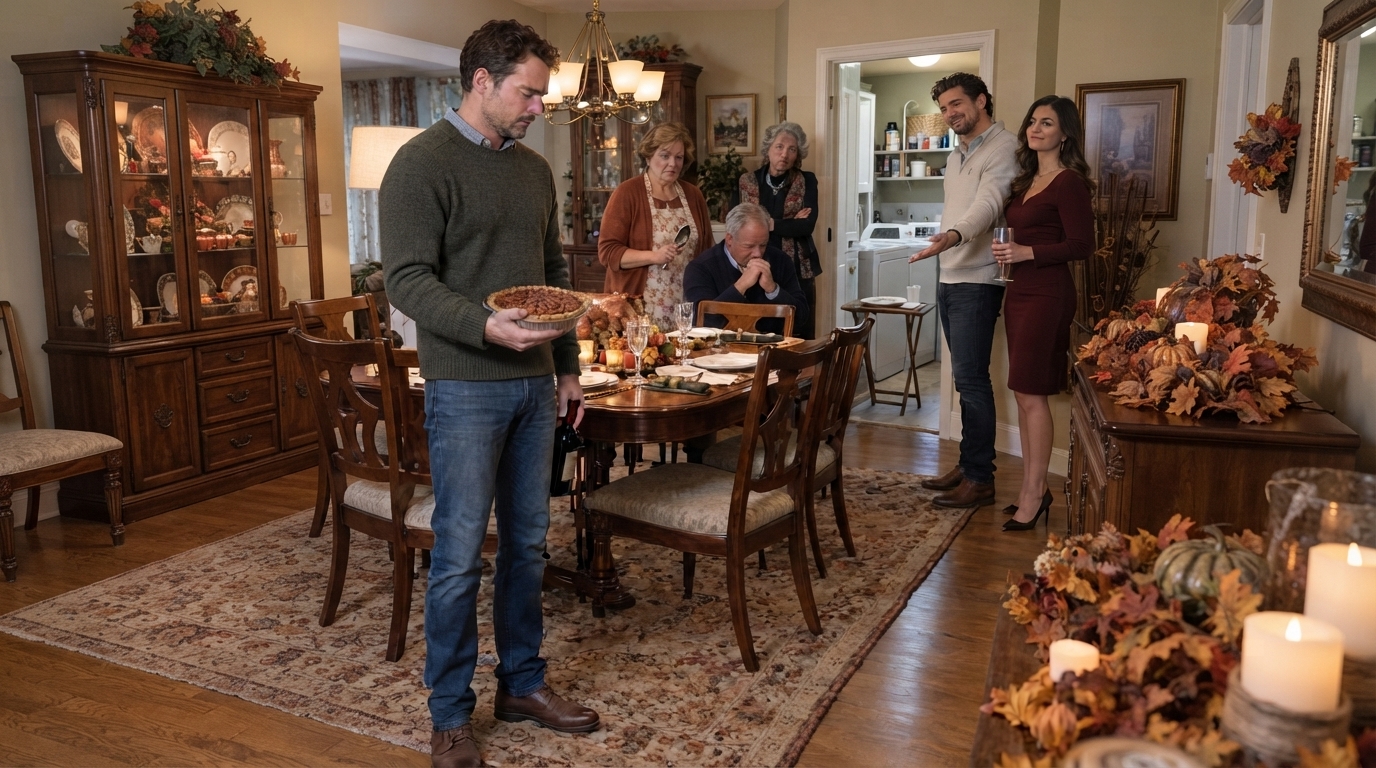
When Thanksgiving arrived, I brought a pecan pie.
The same recipe I’d made the year before.
As I walked into Carol’s house, the smell of turkey and cinnamon greeted me.
For a moment, my stomach tightened.
I remembered the laundry room.
The folding tray.
The laughter.
Dad’s silence.
Then Carol appeared.
“There he is!”
She hugged me.
“Come in. Dinner’s almost ready.”
I walked into the dining room.
The table was beautifully set.
And at the center of one side, beside Aunt Carol, was a place card.
SPENCER
I stared at it.
A proper plate.
A real glass.
A cloth napkin.
A comfortable chair.
Nothing extravagant.
Nothing expensive.
Just a place at the table.
Mom approached quietly.
“I helped set everything up.”
I nodded.
“It looks nice.”
Her eyes filled.
“Your chair is right there.”
I looked at her.
“Thank you, Mom.”
She squeezed my arm.
Dad stood near the window.
He looked nervous.
“Hello, son.”
“Hi, Dad.”
He cleared his throat.
“Carol says you brought the pie.”
“I did.”
“Good. I’ve missed that pie.”
I smiled faintly.
Then Drew approached.
He looked at the place card.
“Hey, Spence.”
“Hey.”
He hesitated.
Then he pulled out the chair for me.
“Saved you a seat.”
I looked at him.
He wasn’t smiling.
He wasn’t waiting for a laugh.
He was simply offering me a chair.
“Thanks,” I said.
And I sat down.
Dinner was quieter than previous years.
Not uncomfortable.
Just different.
People listened when someone spoke.
Nobody made jokes about my divorce.
Nobody asked me for money.
Nobody mentioned contracts.
The children told stories about school.
Carol talked about her garden.
Mom described decorating the new condominium.
Dad asked about a project I was working on.
And for once, he seemed genuinely interested in the answer.
After dinner, I helped Carol carry dishes into the kitchen.
She glanced at me.
“How are you feeling?”
I thought about it.
“Good.”
She smiled.
“Really?”
“Really.”
She dried her hands.
“You know, your grandmother would have loved seeing you stand up for yourself.”
I looked at her.
“I wish she’d been here.”
Carol touched my shoulder.
“She taught you how to recognize your own worth. I’d say part of her is still here.”
My throat tightened.
Later that evening, Dad asked if we could speak privately.
We stepped onto the back porch.
The air was cold.
He stood beside me, looking out at the yard.
“Spencer, I’ve been thinking about something.”
I waited.
“All those years, I thought I was helping Drew by protecting him from consequences.”
I nodded.
“And I thought I was helping you by staying out of your way because you were strong.”
He sighed.
“But I see now that I made both of you carry things you shouldn’t have.”
I looked at him.
He continued.
“I made Drew believe someone would always rescue him. And I made you believe you had to earn your place by being useful.”
For a moment, I couldn’t speak.
Then Dad turned toward me.
“I’m sorry, son.”
I felt my eyes sting.
He swallowed.
“You shouldn’t have had to pay our mortgage to feel like a good son. And you certainly shouldn’t have had to pay for a chair at our table.”
I laughed softly through my tears.
“No, Dad. I shouldn’t have.”
He stepped closer.
“Can I give you a hug?”
I nodded.
He wrapped his arms around me.
For the first time in years, I let myself lean into him.
Not because everything was fixed.
Because something had finally been acknowledged.
When I drove home that night, my phone buzzed.
A message from Drew.
Thanks for coming tonight. It meant a lot.
A second message followed.
And Spence? You were right. The joke wasn’t funny. I’m sorry.
I smiled faintly.
Then I put the phone away.
The following morning, I woke up early.
Sunlight streamed through my townhouse windows.
I made coffee and sat at my kitchen table.
My life wasn’t perfect.
I was still divorced.
I still lived alone.
I still had difficult memories.
But I had a career I loved, friends who respected me, and a home where I never had to wonder whether I belonged.
And my family was finally learning something I had spent forty-two years trying to understand.
Love should never require humiliation.
Generosity should never become an obligation.
And being dependable doesn’t mean being available for exploitation.
I thought about the eighty-seven thousand dollars I’d spent helping my parents.
I thought about the business opportunities I’d created for Drew.
I thought about the Thanksgiving dinner that had changed everything.
For a long time, I’d believed the problem was that my family didn’t appreciate how much I gave.
But eventually, I understood something deeper.
The problem was that I had started measuring my value by how much I could give them.
And when I finally stopped, I discovered who was willing to love me without receiving anything in return.
Aunt Carol had been there from the beginning.
Mom was learning.
Dad was trying.
Even Drew had begun taking responsibility.
I didn’t know whether every relationship would fully recover.
Maybe some wounds would always leave scars.
But I no longer needed a perfect ending.
I needed an honest one.
Several months later, my company held its annual appreciation dinner.
We invited employees, contractors, and project partners.
Drew attended as a vendor representative after his company had successfully won a small project through our standard competitive process.
It wasn’t a huge contract.
But it was legitimate.
He had earned it without asking me for help.
During the reception, he approached me.
“Hey, Spence.”
“Hey.”
He looked around the room.
“Nice event.”
“Thanks.”
He hesitated.
“Listen, I just wanted to say something.”
I waited.
“That contract we won? We worked hard for it.”
“I know.”
“And honestly, it feels better this way.”
I smiled.
“Good.”
He nodded.
Then he said something I never expected.
“I’m proud of you, little brother.”
I looked at him.
For years, he’d used that phrase sarcastically.
This time, there was no joke behind it.
“Thanks, Drew.”
He smiled.
“And I’m trying to become someone you can be proud of too.”
I held out my hand.
He shook it.
Then, after a moment, he pulled me into a brief hug.
It wasn’t dramatic.
Nobody applauded.
There was no grand speech.
Just two brothers finally meeting each other without a competition between them.
That evening, when I returned home, I placed my keys on the counter and noticed the photograph Aunt Carol had given me at Christmas.
It showed Grandma Evelyn sitting between Drew and me when we were children.
I was nine.
Drew was twelve.
Grandma had an arm around each of us.
All three of us were laughing.
I picked up the frame.
For years, I’d wondered why she always insisted on giving us equal birthday gifts, equal attention, and equal encouragement.
Now I understood.
She had seen what favoritism could do.
And she had tried, in her own quiet way, to make sure neither grandson believed he was worth less.
I placed the photograph beside my coffee maker.
Then I smiled.
Because the lesson she’d taught me had finally taken root.
I didn’t need the biggest house.
I didn’t need the most successful business.
I didn’t need to win an argument with my brother.
And I certainly didn’t need to buy my family’s affection.
I simply needed to know that I deserved the same basic respect I gave everyone else.
That Thanksgiving, they offered me a seat in the laundry room.
They thought they were reminding me where I belonged.
Instead, they reminded me that I had a choice.
I could continue paying for the privilege of being disrespected.
Or I could walk away.
I chose to walk away.
And strangely enough, that was the decision that finally made my family see me.
Not as their emergency fund.
Not as their business connection.
Not as the divorced brother who could absorb every insult.
But as Spencer.
A son.
A brother.
A man with a life of his own.
And a man who had finally learned that his worth was never determined by the chair someone else decided to give him.
Because when people make you feel like you don’t deserve a seat at their table, sometimes the most powerful thing you can do is leave—and build a life where nobody has to question whether you belong.
THE END THANK YOU FOR READING !!!



