PART 3
I stared at Camila’s message until the letters blurred.
Please don’t involve the police. Ricardo says he can explain everything.
Explain everything.
I wondered how he planned to explain a document bearing my forged signature.
Or why a real estate agent had visited my beach house the day before he ordered me to leave.
Or why fifteen people had been invited to spend the weekend on property that didn’t belong to any of them.
My phone rang again.
Camila.
This time, I answered.
“Valeria, thank God,” she said immediately. “Where are you?”
“At the gas station.”
“Come back. We can talk.”
I looked through my windshield at the highway stretching toward Veracruz.
“Talk about what?”
She hesitated.
“Ricardo says you’re making a huge misunderstanding out of something simple.”
I almost laughed.
“Camila, he brought a real estate agent to my house.”
Silence.
Then she whispered, “Who told you that?”
My stomach tightened.
“So you knew.”
“Valeria, listen—”
“Did you know he was trying to sell my property?”
She exhaled sharply.
“Nobody is selling anything.”
“Then why does a real estate agent have a document with my signature?”
Camila said nothing.
I gripped the steering wheel.
“Answer me.”
Her voice dropped.
“Ricardo said he was just checking what the house might be worth.”
I closed my eyes.
“He doesn’t need my signature to ask what a house is worth.”
“I know, but—”
“And he doesn’t need to tell an agent he owns it.”
Camila began crying.
“Please don’t do anything until we talk.”
I stared at the ocean visible between two roadside buildings.
For years, those tears would have worked.
I would have rushed to comfort her.
I would have told her everything was fine.
I would have agreed to discuss the situation privately.
But something had changed when Ricardo called me a parasite in my own doorway.
I wasn’t going to protect their feelings at the expense of my property.
“Camila,” I said quietly, “I’m not coming back to argue.”
“Then what are you doing?”
“Protecting my house.”
I ended the call.
My attorney, Alejandro Serrano, called ten minutes later.
Alejandro had helped me purchase the property three years earlier.
He knew how hard I’d worked to afford it.
He knew I’d spent years saving a portion of every paycheck, declining expensive vacations, and working additional research assignments.
When I told him what had happened, his voice became unusually serious.
“Valeria, I want you to send me every message Camila has written about the property.”
“Why?”
“Because we need to establish what permission, if any, you gave them.”
I swallowed.
“I never gave them permission to use the house this weekend.”
“Then document that clearly.”
He paused.
“And don’t confront Ricardo alone.”
I looked down.
“Do you think he’s dangerous?”
I don’t know. But someone who presents a questionable authorization to sell property and then becomes aggressive with the owner is not someone I want you facing without support.”
I nodded.
“What about the document?”
We need to obtain a complete copy and verify exactly what he presented.
A forged signature on an informal paper doesn’t transfer ownership,
but it could indicate an attempt to deceive someone.
I exhaled shakily.
“Can he sell the house?”
“Not lawfully without the required ownership and conveyancing formalities. Your title documents are important, and we should check the property records to make sure no unauthorized transaction has been attempted.”
For the first time since leaving the house, I felt a little steadier.
Ricardo might be arrogant.
He might be manipulative.
But he couldn’t simply declare himself the owner of my home.
My next call was to Javier Morales, the property manager.
Javier was fifty-eight, with a quiet voice and the practical manner of someone who had spent most of his life repairing things other people broke.
He lived about fifteen minutes from my house.
He checked the property when I was away, coordinated maintenance, and kept an eye on the security system.
“Señorita Valeria,” he answered, “I have the camera footage ready.”
“Thank you, Javier.”
He hesitated.
“There’s more you should know.”
My stomach tightened.
“What?”
“Ricardo’s family arrived yesterday afternoon. Your sister used the spare key.”
I closed my eyes.
I’d given Camila that key two years earlier.
Not so she could use my house whenever she pleased.
But because she’d agreed to check on the property during a storm while Javier was away.
I had never asked for it back.
I should have.
Javier continued.
“Later, Ricardo went into your study.”
I sat upright.
“My study?”
“Yes.”
That room was always locked.
It contained my research materials, photographs, and a small cabinet where I kept personal records.
I swallowed.
“How did he get in?”
Javier hesitated.
“He forced the lock.”
I stared at the dashboard.
“Are you sure?”
“The hallway camera shows him entering with a screwdriver. He spent several minutes working on the door.”
My chest tightened.
“What did he take?”
“I can’t tell from the footage.”
I closed my eyes.
Inside that study were copies of my property documents.
Tax records.
Insurance information.
And correspondence from the bank.
I suddenly understood why Ricardo had been so interested in the house.
“Javier,” I whispered, “please preserve every recording.”
“Already done.”
“And don’t go inside while they’re there.”
“I won’t.”
I swallowed.
“Thank you.”
Before hanging up, Javier added, “Señorita Valeria, your father would have been proud of how calmly you’re handling this.”
My throat tightened.
My father had died five years earlier.
He was the person who taught me never to sign a document without reading it.
The person who insisted that women should understand their own finances.
The person who told me that kindness was valuable, but boundaries were necessary.
I looked toward the highway.
And whispered, “I hope so.”
An hour later, I met Alejandro at a small café near the municipal offices.
He had driven from Veracruz after rearranging his afternoon.
When I arrived, he was already sitting at a table with his laptop open.
Beside him sat a woman wearing a dark blue blazer.
“Valeria,” Alejandro said, standing, “this is Lucía Mendoza.”
She shook my hand.
“I’m an attorney who handles property disputes and related complaints in this area.”
I sat down.
Alejandro turned his laptop toward me.
“Javier sent the footage.”
The screen showed the hallway inside my beach house.
I recognized the framed photograph beside my study door.
It was a picture I’d taken during a marine research expedition.
Then Ricardo appeared.
He looked over his shoulder.
Pulled a screwdriver from his pocket.
And began working on the lock.
I stared.
He forced the door open.
Then disappeared inside.
Seven minutes later, he emerged carrying a brown folder.
My folder.
I recognized it immediately.
It was the one where I kept copies of my purchase documents.
My hands began trembling.
“He took my property records.”
Lucía leaned forward.
“Do you have the originals somewhere secure?”
I nodded.
“The original purchase deed and registration documents are with my other important papers in a bank safe-deposit box. The folder contains copies.”
Alejandro nodded.
“That’s good.”
I stared at Ricardo on the screen.
He was smiling.
He tucked the folder beneath his arm and walked toward the living room.
Then the recording ended.
I felt sick.
For years, I’d helped this man.
I’d lent him money.
Driven his children to school when Camila was sick.
Spent holidays cooking for his family.
And now he was breaking into a locked room in my house.
Lucía opened another file.
“This is the photograph the real estate agent provided.”
On the screen was a document titled Authorization to Negotiate Sale.
My name appeared at the top.
Ricardo’s name appeared below it.
And at the bottom was a signature.
My signature.
Except it wasn’t mine.
I leaned closer.
“That’s not my handwriting.”
Alejandro nodded.
“The agent said Ricardo claimed you had given him permission to market the property.”
I stared at the document.
“Did she believe him?”
“Apparently, she became suspicious when he couldn’t provide proper identification and proof of authority.”
Lucía added, “She didn’t proceed with a sale. She contacted the property manager after learning he was connected to the house.”
I exhaled.
At least one person had asked questions.
One person had refused to accept Ricardo’s word.
I looked at Alejandro.
“Why would he do this?”
He studied me.
“Do you know whether Ricardo is having financial difficulties?”
I thought about the past year.
The new pickup truck.
The expensive vacations.
The way Camila had started asking me for money more frequently.
Three months earlier, she’d requested eighty thousand pesos.
She said Ricardo’s business needed temporary help.
I’d refused because she’d never repaid the previous loan.
Camila had been furious.
I swallowed.
“He owns a small construction company.”
Alejandro nodded.
“Has it been doing well?”
“I thought so.”
He looked at Lucía.
She opened another document.
“We’ve found public indications of financial disputes involving his company. That doesn’t prove his motive, but it may be relevant.”
My stomach tightened.
“How much does he owe?”
“We don’t have a complete picture yet.”
I stared at the screen.
Suddenly, the family gathering looked different.
Perhaps it wasn’t just a vacation.
Perhaps Ricardo had brought everyone to the house to create the appearance that he controlled it.
Perhaps he’d expected me to surrender because fifteen people were watching.
And perhaps he believed that once I left, he could continue whatever scheme he’d started.
The local authorities took my report that afternoon.
I provided my identification, proof of ownership, the security recordings, and the messages from Camila.
I explained that the people inside the house had entered without my permission and that Ricardo had refused to let me remain there.
The officer listened carefully.
Then asked, “Are you willing to make a formal statement?”
“Yes.”
He nodded.
“We’ll document your complaint and determine the appropriate next steps.”
I knew it might take time.
Property disputes could be complicated.
Even when the facts seemed obvious.
But I wasn’t expecting someone to solve everything with one dramatic phone call.
I wanted the situation handled properly.
I wanted my house secured.
And I wanted the truth preserved.
At six that evening, my phone rang.
Ricardo.
I looked at Alejandro.
He nodded toward the phone.
“Answer if you want, but don’t argue.”
I put the call on speaker.
“Hello?”
Ricardo didn’t bother greeting me.
“What the hell have you done?”
I remained calm.
“What do you mean?”
“Javier says you called the authorities.”
“Yes.”
He laughed angrily.
“Over a family weekend?”
I looked at Alejandro.
Then answered, “Over unauthorized entry, damage to my study door, and a document bearing a signature I didn’t write.”
Silence.
Then Ricardo said, “You’re being ridiculous.”
“Am I?”
“You know perfectly well Camila gave us permission.”
“Camila doesn’t own the property.”
He exhaled sharply.
“She’s your sister.”
“Yes.”
“So what’s the problem?”
I closed my eyes.
“The problem is that you called me a parasite in my own house.”
He scoffed.
“Oh, grow up.”
“And you tried to sell property that doesn’t belong to you.”
The line went quiet.
Then his voice changed.
“Who told you that?”
I felt cold.
“Ricardo, why did you take documents from my study?”
He didn’t answer.
I continued.
“Why did you force the lock?”
His voice hardened.
“You’ve been spying on us?”
I stared at the phone.
“Those are security cameras in my house.”
He cursed.
Then said, “You have no idea what you’re getting yourself into.”
Alejandro leaned forward.
I kept my voice steady.
“I’m not discussing this further. Any communication about the property can go through my attorney.”
Ricardo laughed bitterly.
“You think a lawyer scares me?”
“No,” I replied.
“I think the truth should.”
Then I ended the call.
That night, I checked into a small hotel overlooking the coast.
The room was modest.
The sheets smelled faintly of detergent.
And through the window, I could hear waves crashing against the shore.
I should have been sitting on my own terrace.
Reading a book.
Drinking tea.
Watching the moon rise over the Gulf.
Instead, I was paying for a hotel room while strangers occupied my house.
I sat on the edge of the bed.
And finally began crying.
Not because I was afraid of Ricardo.
But because Camila had betrayed me.
My sister.
The girl who used to climb into my bed during thunderstorms.
The girl who held my hand at our father’s funeral.
The girl who promised we’d always look after each other.
She had given her husband the keys to my home.
Then watched him humiliate me.
And said nothing.
My phone buzzed.
A message from Camila.
Valeria, please. Ricardo is furious. He says you’ve destroyed everything.
I stared at it.
Then typed a reply.
Camila, I didn’t destroy anything. I simply stopped allowing you to take what belongs to me.
I sent it.
Then turned off my phone.
For the first time that day, I slept.
PART 4
The following morning, Javier called at seven.
“Señorita Valeria?”
I sat upright.
“What happened?”
“Ricardo’s relatives are leaving.”
I blinked.
“All of them?”
“Most of them.”
I exhaled.
Javier continued.
“Two cars left before sunrise. Another three are being packed now.”
I looked toward the window.
“Why?”
He hesitated.
“I think someone told them about the police report.”
I closed my eyes.
The people who had laughed while Ricardo called me a parasite were suddenly in a hurry to leave.
Interesting.
“Is Ricardo still there?”
“Yes.”
“And Camila?”
“Yes.”
Javier paused.
“His parents are also still inside.”
I nodded.
“Please don’t confront anyone.”
“I won’t.”
By nine, Alejandro had arranged for me to meet with the responding authorities and the property manager near the house.
The situation had changed.
Most of the guests had voluntarily departed.
Ricardo and Camila were still inside.
But the officers had made contact and were documenting the circumstances.
I remained outside while the officials spoke with them.
I wasn’t interested in another shouting match.
Eventually, Camila came onto the terrace.
She looked exhausted.
Her hair was pulled into a messy bun.
Her eyes were red.
When she saw me, she began crying.
“Valeria.”
I stood beside Alejandro.
“Hello, Camila.”
She took a step forward.
“Can we talk?”
I looked at my attorney.
He nodded.
“I’m staying nearby.”
Camila glanced at him.
Then lowered her voice.
“Do you really need a lawyer for this?”
I stared at her.
“Yes.”
Her face crumpled.
“I’m your sister.”
I felt a sharp ache.
“I know.”
She wiped her eyes.
“Then why are you treating me like a criminal?”
I took a breath.
“Because someone forced open my study and took documents. Because Ricardo presented a paper with my forged signature. And because you let him throw me out of my own home.”
Camila looked away.
I waited.
Finally, she whispered, “I didn’t know about the signature.”
I studied her.
“Did you know about the real estate agent?”
She hesitated.
My stomach tightened.
“Camila?”
She nodded.
I closed my eyes.
“Why?”
Her voice broke.
“Ricardo said he was arranging financing.”
I stared at her.
“Financing for what?”
She swallowed.
“His business.”
I felt cold.
“What does my house have to do with his business?”
Camila began crying harder.
“He said he could use the property as security.”
I stared at her.
“Without asking me?”
She covered her face.
“He said you’d agree eventually.”
I almost laughed.
“Because I’m always the one who helps?”
She nodded miserably.
I looked toward the ocean.
The waves were calm.
The morning sunlight glittered across the water.
It was beautiful.
And somehow, that made the conversation hurt more.
“Camila,” I said quietly, “how much does Ricardo owe?”
She shook her head.
“I don’t know exactly.”
I stared at her.
“Don’t lie to me.”
She swallowed.
“Almost four million pesos.”
For a moment, I couldn’t breathe.
Four million pesos.
A debt large enough to destroy their financial stability.
I stared at my sister.
“How did that happen?”
She wiped her eyes.
“His company lost two contracts. Then a supplier sued him. He borrowed money to cover payroll.”
I nodded slowly.
“And?”
“He borrowed more to repay the first loans.”
I closed my eyes.
“And now?”
“He can’t keep up.”
I looked at her.
“So he decided to use my house.”
Camila began sobbing.
“He said it would only be temporary.”
I stared at her.
“Temporary?”
She nodded.
“He said once the company recovered, he’d pay everything back.”
I felt anger rising.
“Camila, you can’t temporarily mortgage someone else’s property without their permission.”
She looked down.
“I know.”
I took a breath.
“Then why did you give him my keys?”
She whispered, “Because he told me you owed us.”
I froze.
“What?”
Her eyes filled.
“He said you had money while we were struggling. That you were selfish for keeping the house empty.”
I stared at her.
“Camila, I worked ten years to buy this house.”
She nodded.
“I know.”
“I paid for it.”
“I know.”
“I pay the taxes, insurance, repairs, and maintenance.”
She began crying.
“I know.”
My voice broke.
“Then why did you let him call me a parasite?”
Camila covered her mouth.
For a long moment, she said nothing.
Then she whispered, “Because I was afraid he’d leave me if I defended you.”
I stared at her.
There it was.
The truth.
Not a misunderstanding.
Not a harmless family gathering.
Fear.
And a choice.
My sister had chosen to protect her marriage by sacrificing me.
I stepped away.
I needed air.
Alejandro approached.
“Are you all right?”
I nodded, though I wasn’t.
He glanced toward Camila.
“Did she tell you anything important?”
I took a shaky breath.
“Ricardo owes almost four million pesos. He wanted to use my house as security.”
Alejandro’s expression hardened.
“Did she say whether he submitted anything to a lender?”
“She doesn’t know.”
He nodded.
“We’ll follow up.”
Then he looked at me carefully.
“Valeria, don’t let sympathy pressure you into signing anything.”
I shook my head.
“I won’t.”
He paused.
“Even if Ricardo’s business collapses?”
I looked toward my sister.
She was sitting on the terrace steps, crying.
I felt terrible for her.
But I also remembered the broken study lock.
The forged document.
The humiliation.
And the fact that Ricardo had planned all of this without asking me.
I took a breath.
“His business isn’t my responsibility.”
Alejandro nodded.
“Good.”
Ricardo emerged from the house shortly before noon.
He looked furious.
His father followed behind him.
The older man was tall, gray-haired, and clearly uncomfortable.
Ricardo pointed at me.
“This is all your fault.”
I stared at him.
“Good morning to you too.”
He stepped closer.
Alejandro moved slightly forward.
Ricardo stopped.
“You’ve embarrassed my entire family.”
I looked at him.
“You called me a parasite in my own doorway.”
He scoffed.
“That was a joke.”
I almost laughed.
“A joke?”
He folded his arms.
“Everybody knows you take things too seriously.”
I stared at him.
“Did everybody also know you were trying to use my property to secure your debts?”
His face changed.
Only slightly.
But enough.
His father turned toward him.
“Ricardo?”
Ricardo looked away.
“Don’t start.”
His father frowned.
“What is she talking about?”
I glanced at Alejandro.
He nodded.
I answered calmly.
“Your son presented a document claiming I authorized him to negotiate a sale of my house. I never signed it.”
The older man’s face went pale.
“Ricardo?”
Ricardo exhaled sharply.
“It was just paperwork.”
His father stared at him.
“What paperwork?”
Ricardo snapped, “Dad, stay out of it.”
But his father didn’t move.
Instead, he looked at me.
“Valeria, did you give him permission?”
“No.”
The older man closed his eyes.
Then turned toward his son.
“Tell me you didn’t forge her signature.”
Ricardo said nothing.
The silence was unbearable.
His father stepped back.
“Ricardo.”
My brother-in-law looked toward the driveway.
Then muttered, “I was going to explain everything.”
I felt cold.
“To whom?”
He didn’t answer.
I continued.
“To me? After you got the money?”
His jaw tightened.
“You don’t understand what it’s like to have a business falling apart.”
I stared at him.
“No. But I understand what it’s like to work for something and have someone else try to take it.”
He glared.
“You have no idea how hard I’ve worked.”
I took a breath.
“Then you should understand why my property matters to me.”
For the first time, he had no immediate answer.
The officers and attorneys continued handling the situation.
Ricardo and Camila were instructed about the complaint and the need to resolve possession and property issues through the appropriate process.
Because the house was a privately owned residence and no lawful authorization had been established for their weekend use, the remaining guests eventually agreed to leave voluntarily.
I didn’t cheer when they drove away.
I simply watched.
One car.
Then another.
Then Ricardo’s pickup truck.
His father sat in the passenger seat, staring straight ahead.
Camila followed in her own vehicle.
She looked at me once before leaving.
I didn’t wave.
I didn’t turn away.
I just stood beside the driveway until they were gone.
When Javier opened the front door, I almost cried.
The smell hit me first.
Beer.
Grease.
Wet towels.
And something sour coming from the kitchen.
I stepped inside.
The living room was a disaster.
Empty bottles covered the coffee table.
Food wrappers were scattered across the floor.
My white carpet had dark stains.
One of the dining chairs was broken.
And someone had left a wet swimsuit hanging over the back of my favorite armchair.
I stared.
Javier shook his head.
“I’m sorry.”
I swallowed.
“It’s not your fault.”
We walked through the house.
The kitchen counters were sticky.
The refrigerator was almost empty.
Several decorative pieces were missing from the shelves.
Upstairs, the guest bedrooms were filled with damp towels and sand.
Then we reached my study.
The lock was broken.
The doorframe was splintered.
I stepped inside.
My desk drawers had been opened.
Papers were scattered everywhere.
The brown folder was gone.
And the small wooden box where I kept photographs of my father had been knocked onto the floor.
I knelt beside it.
The lid was cracked.
Inside were pictures of him standing beside me at my university graduation.
My first research expedition.
The day I received my professional certification.
I picked up one photograph.
It showed my father smiling proudly, his arm around my shoulders.
I began crying.
Not because the box was valuable.
But because Ricardo had entered the one room I kept private and treated everything inside it as disposable.
Javier crouched beside me.
“Señorita Valeria?”
I wiped my eyes.
“I’m okay.”
He looked at the broken box.
“Do you want me to repair it?”
I nodded.
“Please.”
We documented everything.
Photographs.
Videos.
A written inventory.
The broken lock.
The damaged furniture.
The missing items.
The cleaning costs.
I contacted my insurer and followed Alejandro’s advice about preserving evidence before repairs.
By the end of the day, I was exhausted.
But my house was finally empty.
I stood on the terrace as the sun began setting.
The sea stretched endlessly before me.
For three years, this place had been my refuge.
And for the first time, I understood how easily peace could disappear when people decided your boundaries didn’t matter.
My phone buzzed.
A message from Camila.
Ricardo says you ruined his chance to save the business.
I stared at it.
Then typed:
He ruined that chance when he tried to use property that wasn’t his.
I sent the message.
And went inside.
Three days later, Alejandro called.
“Valeria, we have confirmation that Ricardo approached at least one financing intermediary using the document.”
My stomach tightened.
“Did he get money?”
“No. The process stopped before any loan secured by your property was completed.”
I exhaled.
Alejandro continued.
“The intermediary requested proper documentation and verification of ownership. Ricardo couldn’t provide it.”
I closed my eyes.
Thank God.
“But there’s another development,” he said.
I sat upright.
“What?”
“The real estate agent has provided a written account of her meeting with Ricardo.”
I swallowed.
“And?”
“He told her the house belonged to his wife.”
My stomach dropped.
“Camila?”
“Yes.”
I stared at the wall.
He hadn’t merely claimed to have my permission.
He’d told someone the house belonged to my sister.
Alejandro paused.
“Valeria, we’re going to need to determine whether Camila knew he was making that claim.”
I closed my eyes.
Because suddenly, the question wasn’t only how far Ricardo had gone.
It was how much my sister had helped him.
PART 5
Camila came to my apartment in Veracruz two weeks later.
She stood outside my door holding a small paper bag.
Her eyes were swollen.
Her clothes looked wrinkled.
And for the first time in years, she wasn’t wearing the expensive jewelry Ricardo had given her.
I opened the door but didn’t invite her inside immediately.
“Hello, Camila.”
She swallowed.
“Can we talk?”
I studied her.
Then stepped aside.
She entered quietly.
The paper bag contained pastries from the bakery our father used to visit every Sunday.
I stared at it.
“Why did you bring these?”
She looked down.
“Because you used to love them.”
I almost smiled.
Almost.
Then I remembered my study door.
The forged signature.
And the way she’d looked at her phone while Ricardo humiliated me.
I folded my arms.
“What do you want to say?”
Camila sat on the couch.
For a moment, she said nothing.
Then she began crying.
“I’m sorry.”
I waited.
She looked up.
“I know that doesn’t fix anything.”
“No,” I said quietly. “It doesn’t.”
She nodded.
“I’ve been thinking about what happened.”
I sat across from her.
“Good.”
She swallowed.
“Ricardo told me the house was basically ours because you never used it.”
I stared at her.
“Camila, I use it whenever I can.”
“I know.”
“I pay for it.”
“I know.”
“And even if I never visited, it would still be mine.”
She began crying harder.
“I know that now.”
I shook my head.
“You knew it then.”
She went silent.
I continued.
“You knew I was coming that weekend. You knew Ricardo didn’t have permission. You watched him order me out.”
Her face crumpled.
“I was afraid.”
I took a breath.
“Camila, being afraid doesn’t excuse hurting someone.”
She nodded.
“I know.”
Then she reached into her purse.
And placed a small envelope on the table.
My stomach tightened.
“What is that?”
She swallowed.
“Something I should have given you sooner.”
I opened it.
Inside was a handwritten note.
And a photograph of a document.
I stared at the image.
It was the same authorization Ricardo had shown the real estate agent.
But this photograph was clearer.
I could see the signature.
The date.
And a handwritten notation in the corner.
I looked at Camila.
“Where did you get this?”
She lowered her eyes.
“Ricardo asked me to take a picture of it.”
I felt cold.
“When?”
“Two days before the gathering.”
I stared at her.
“So you knew about the document.”
She began crying.
“I knew he was preparing something. He told me it was for an appraisal.”
I closed my eyes.
“Camila.”
She looked up.
“I didn’t know he’d copied your signature.”
I studied her.
“Did you ask where my signature came from?”
She shook her head.
My heart sank.
“You didn’t want to know.”
She covered her face.
For a long moment, neither of us spoke.
Then she whispered, “You’re right.”
Camila told me Ricardo had become increasingly desperate over the previous six months.
His construction business had lost contracts.
Creditors were demanding payment.
He’d borrowed money from relatives.
Then borrowed more to repay them.
He’d hidden the full extent of the debt from her until the situation became impossible to conceal.
When he discovered how much my beach house was worth, he’d become obsessed with it.
He told Camila I was selfish.
That I had no children.
That I didn’t need such a large property.
That family should share.
And that if I truly loved my sister, I would help save their home and business.
I listened quietly.
Then asked, “Why didn’t he ask me directly?”
Camila looked down.
“Because he knew you’d say no.”
I nodded.
There it was.
The simplest explanation.
Ricardo hadn’t misunderstood my generosity.
He’d counted on it.
And when he realized I wouldn’t willingly give him what he wanted, he’d tried another way.
Camila wiped her eyes.
“There’s something else.”
My stomach tightened.
“What?”
She swallowed.
“Ricardo told me that if you refused to help, he’d make sure the whole family knew how selfish you were.”
I stared at her.
“He said he’d tell everyone you abandoned us.”
I closed my eyes.
“And you believed him?”
She nodded miserably.
“I thought if we had everyone at the house, you’d feel pressured to let us stay.”
I felt sick.
“So the gathering wasn’t just a vacation.”
Camila shook her head.
“No.”
My chest tightened.
“It was supposed to make me give in.”
She began crying.
“Yes.”
I looked away.
For years, I’d been the reliable sister.
The one who helped.
The one who lent money.
The one who showed up.
And my sister had helped arrange a confrontation designed to exploit exactly that.
I took a slow breath.
“Camila, I need time.”
She nodded.
“I understand.”
I looked at her.
“And I need you to tell the truth to Alejandro and the authorities.”
Her eyes widened.
“Valeria—”
“No.”
She fell silent.
“You came here to apologize. Then tell the truth.”
She stared at me.
I continued.
“Not just the parts that make Ricardo look bad.”
Her face crumpled.
“All of it.”
Camila gave a formal statement through the appropriate process.
She provided messages between herself and Ricardo.
Copies of documents he’d sent her.
And information about his attempts to obtain financing.
Her cooperation didn’t erase her role in the situation.
But it helped establish what had happened.
Alejandro kept me informed as the complaint proceeded.
The authorities investigated the suspected falsification and use of the document.
The property damage was documented separately.
The financial intermediary confirmed that no loan had been issued against my house.
And the real estate agent provided her account of Ricardo’s representations.
The process wasn’t fast.
There were interviews.
Requests for records.
Legal expenses.
And frustrating delays.
But I had learned something important.
Real accountability rarely happens as quickly as it does in movies.
Sometimes it means months of paperwork.
Sometimes it means telling the same painful story to different people.
And sometimes it means resisting the temptation to give up simply because you’re exhausted.
Ricardo’s business eventually closed.
I learned about it from my mother.
She called one evening and said, “Valeria, have you heard?”
I was sitting on my balcony with a cup of tea.
“Heard what?”
“Ricardo shut down the company.”
I closed my eyes.
“I’m sorry for the employees.”
My mother sighed.
“He’s telling everyone you caused it.”
I stared at the city lights.
“Of course he is.”
She hesitated.
“Your uncle says you should forgive him.”
I took a breath.
“Forgiveness and financial responsibility are different things.”
My mother was silent.
I continued.
“I didn’t borrow the money. I didn’t lose the contracts. And I didn’t forge anyone’s signature.”
She sighed.
“I know.”
I looked toward the dark sky.
“Then please don’t ask me to take responsibility for what he did.”
My mother was quiet for a long moment.
Then she whispered, “You’re right.”
I nearly cried.
Because for years, I’d been expected to keep the peace.
Even when keeping the peace meant accepting blame.
Now, for the first time, my mother was acknowledging that I didn’t have to.
Several months later, Ricardo faced legal consequences connected to the false document and his conduct.
The resolution included financial obligations arising from the property damage and the proceedings.
I won’t pretend I felt happy when I heard.
I didn’t.
I felt tired.
I thought about Camila.
About their children.
About the family gatherings that would never feel quite the same.
But I also felt relief.
Because the truth had finally been recognized through the proper process.
And my house was secure.
The repairs took almost six weeks.
The study door was replaced.
The damaged furniture was repaired or replaced.
The carpets were professionally cleaned.
The missing items were documented, and the security system was upgraded.
Javier supervised most of the work.
He called me every few days with updates.
One afternoon, he sent me a photograph.
My study.
Clean.
Bright.
The desk back in place.
The shelves repaired.
And my father’s wooden box sitting on the corner.
The lid had been carefully restored.
I stared at the picture.
Then called Javier.
“It’s beautiful.”
He laughed softly.
“I thought you’d like it.”
My eyes filled.
“Thank you.”
He paused.
“Your father would have liked it too.”
I began crying.
The following month, I returned to Costa Esmeralda.
Alone.
This time, nobody was waiting in my living room.
Nobody was drinking from my glasses.
Nobody was telling me I didn’t belong.
I opened the front door.
Stepped inside.
And stood quietly.
The house smelled like fresh paint and sea air.
Sunlight spilled across the white carpet.
The windows were open.
And beyond the terrace, the Gulf stretched toward the horizon.
I set my weekend bag beside the couch.
Then walked into the kitchen.
Everything was clean.
Everything was where it belonged.
I opened the refrigerator.
Placed my groceries inside.
And smiled.
For the first time in months, I felt like I could breathe.
That evening, I made myself dinner.
Grilled fish.
Rice.
A small salad.
Nothing elaborate.
I carried my plate onto the terrace and sat facing the ocean.
The sun was setting.
The sky glowed orange and pink.
And the waves moved steadily toward shore.
I thought about the day Ricardo had ordered me out.
The contempt in his voice.
The laughter behind him.
The way Camila avoided my eyes.
At the time, I’d felt humiliated.
But now I understood something.
Leaving that day hadn’t meant surrendering.
It had meant refusing to give Ricardo the confrontation he wanted.
He’d expected me to scream.
To argue.
To plead.
To become so emotional that he could dismiss me as unreasonable.
Instead, I’d walked away.
Gathered evidence.
Called professionals.
And let the facts speak.
My phone buzzed.
A message from Camila.
I’m glad you’re back at the beach house. I hope someday you’ll let me visit again.
I stared at it.
For a long time, I didn’t respond.
Then I typed:
Maybe someday. But things have to be different.
A few seconds later, she replied.
I understand.
I hoped she did.
I truly did.
But rebuilding trust would take more than words.
Over the next year, Camila and I began speaking occasionally.
At first, only on birthdays.
Then holidays.
Eventually, we met for coffee.
She had separated from Ricardo.
She was working again.
Raising her children.
Trying to rebuild a life that had become tangled in his financial problems and her own decisions.
I didn’t rescue her.
I didn’t pay her debts.
I didn’t offer her my house.
But I listened when she spoke honestly.
And when she apologized without making excuses, I acknowledged it.
Our relationship wasn’t what it had been.
Maybe it never would be.
But it was becoming something more truthful.
And perhaps that was enough.
One afternoon, nearly a year after the incident, Camila asked me something unexpected.
“Valeria, why didn’t you fight Ricardo that day?”
We were sitting at a café in Veracruz.
I looked at her.
“What do you mean?”
She stirred her coffee.
“When he told you to leave. Why didn’t you argue?”
I thought for a moment.
Then smiled faintly.
“Because I knew the house was mine.”
She looked confused.
I continued.
“I didn’t need to convince him.”
She stared at me.
“I didn’t need to convince his family.”
I took a sip of coffee.
“And I certainly didn’t need to stand in my own doorway begging for permission to enter.”
Camila looked down.
I continued.
“I knew the truth. I just needed to make sure the right people had the evidence.”
She was quiet.
Then whispered, “You were stronger than I was.”
I shook my head.
“Camila, strength isn’t about never being afraid.”
She looked at me.
“It’s about deciding what you won’t allow fear to make you do.”
Her eyes filled.
And for the first time, I thought she might truly understand.
Today, my beach house remains my favorite place in the world.
I still work as a marine biologist in Veracruz.
I still spend long days studying coastal ecosystems.
I still come home exhausted after research trips.
And whenever I can, I drive to Costa Esmeralda.
Sometimes I bring friends.
Sometimes my mother visits.
Sometimes I spend the entire weekend alone.
Reading.
Swimming.
Walking along the shore.
Watching the sunrise.
The difference is that everyone who enters my house now does so with my permission.
Not because I want control over people.
But because I understand the value of boundaries.
I’ve learned that generosity can be beautiful.
Helping family can be wonderful.
Sharing what you have can bring enormous joy.
But generosity stops being generosity when someone demands it.
And family stops being a safe place when love is used as a weapon.
Ricardo thought my quietness meant weakness.
He thought my willingness to help meant he could take whatever he wanted.
He thought fifteen people in my living room would be enough to frighten me into surrendering.
He was wrong.
Last weekend, I woke before sunrise.
I made coffee.
Opened the terrace doors.
And stepped outside barefoot.
The sand was cool.
The ocean was calm.
A few fishing boats moved slowly across the horizon.
I stood there holding my cup, breathing in the salt air.
Then I heard my father’s voice in my memory.
Never confuse kindness with permission, Valeria.
I smiled.
He’d told me that when I was seventeen.
At the time, I hadn’t understood.
Now I did.
I walked back inside and glanced toward the front door.
The same door where Ricardo had stood.
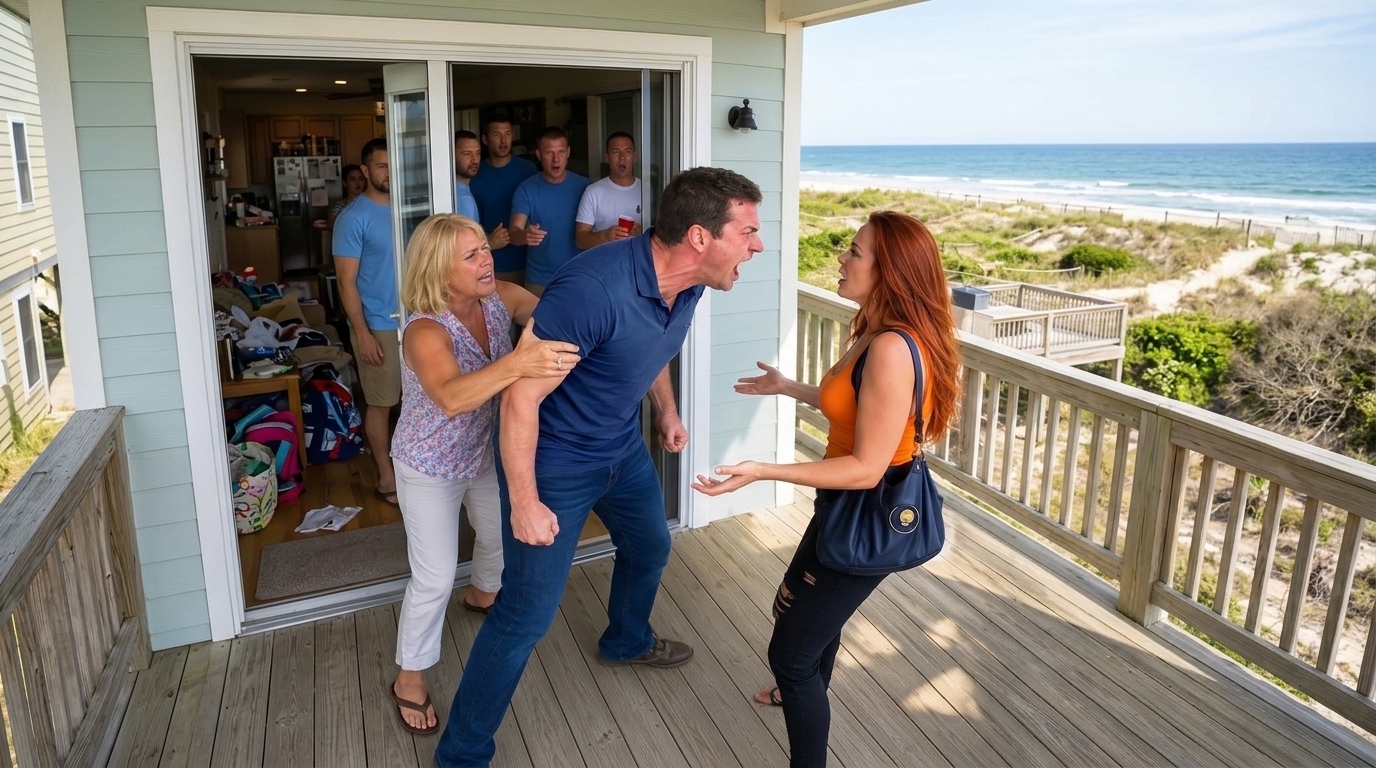
The same doorway where he’d pointed at me and called me a parasite.
I remembered how I’d smiled.
How I’d said, “Alright, I’ll leave.”
And how he’d laughed, believing he’d won.
I shook my head.
If only he’d understood.
I hadn’t left because he had the right to send me away.
I left because I knew I had the right to come back.
And I knew there were better ways to protect my home than arguing with a man determined to humiliate me.
People sometimes ask whether I regret helping Camila and Ricardo over the years.
The loans.
The babysitting.
The countless favors.
I don’t regret being kind.
But I do regret ignoring the moments when kindness became an expectation.
The times Ricardo spoke to me disrespectfully and I laughed it off.
The times Camila asked for money without explaining why.
The times I felt uncomfortable but said yes anyway.
I can’t change those moments.
But I can learn from them.
And I have.
The next time someone tells me that family should share everything, I’ll smile.
Because I believe families should share love.
Respect.
Support.
Honesty.
And responsibility.
But they should never share someone else’s property without permission.
They should never mistake another person’s success for something they’re entitled to.
And they should never assume that the quietest person in the room is the easiest to control.
That morning, as the sun rose over Costa Esmeralda, I sat on my terrace and opened a book.
The house was peaceful.
The air smelled like salt and coffee.
And nobody was there to tell me I didn’t belong.
I looked around at the walls I’d paid for.
The furniture I’d chosen.
The photographs I’d taken.
The life I’d built.
Then I smiled.
Because Ricardo had called me a parasite.
He’d told me to get out.
He’d believed that because I walked away, he had won.
But the truth was simple.
I didn’t need to fight for a house that was already mine.
I only needed to stop letting people treat my kindness as weakness.
And when Ricardo finally understood that, it was already too late to undo what he’d done.
My house was still standing.
My future was still mine.
And the peace I’d worked so hard to create had finally returned.
THE END THANK YOU FOR READING !!!



