PART 3
For several seconds,
I couldn’t hear anything except the pounding of my own heart.
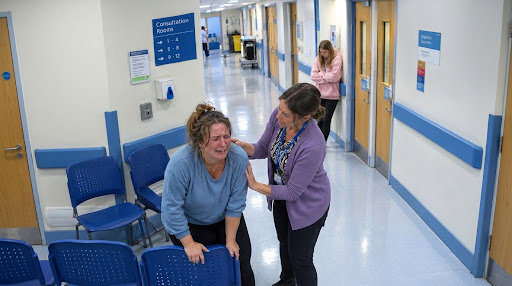
Dr. Adler stood in front of me holding
the medical records from the private clinic.
Behind him, nurses hurried through the corridor,
pushing equipment toward the operating room where my fifteen-year-old daughter was being prepared for emergency surgery.
Twenty-two days.
My husband had known for twenty-two days
that something was seriously wrong with Hailey.
Twenty-two days of watching her curl up in pain.
Twenty-two days of hearing her cry behind her bedroom door.
Twenty-two days of telling me she was pretending.
I gripped the back of a waiting-room chair.
“What else?” I whispered.
Dr. Adler glanced toward the operating-room doors.
Mrs. Carter, the earlier ultrasound identified a complex mass near Hailey’s left ovary.
The clinic recommended immediate evaluation
at a hospital because of its size and the possibility of complications.
I stared at him.
“Then why did Mark bring her home?”
He hesitated.
“The records indicate that your husband declined the recommended transfer and signed a form acknowledging that decision.”
My stomach twisted.
“He signed what?”
“A refusal of the recommended transfer.”
I shook my head.
“No. That’s impossible.”
Dr. Adler’s expression softened.
“I’m sorry.”
I looked down at the papers.
Mark’s signature appeared near the bottom.
I recognized every curve.
Every letter.
He had signed it.
Then brought our daughter home and pretended nothing was wrong.
I pressed a hand against my mouth.
“Why would he do that?”
Dr. Adler paused.
“There’s another note in the record. The clinic documented that your husband was particularly concerned about whether the visit would appear on your family’s insurance statements.”
I stared at him.
“Insurance?”
He nodded.
“He reportedly asked whether the clinic could keep the visit confidential from you.”
The corridor seemed to tilt.
Mark hadn’t simply ignored Hailey’s pain.
He had tried to keep me from discovering that she’d already been examined.
I remembered how he’d insisted I stop asking questions.
How he’d told Hailey to quit being dramatic.
How he’d snapped at me whenever I mentioned taking her to a doctor.
And suddenly, his behavior seemed much more frightening.
“Mrs. Carter?”
I looked up.
Dr. Adler’s voice was gentle.
“Right now, our priority is your daughter.”
I nodded shakily.
“Is she going to die?”
He didn’t give me a false promise.
“The surgical team is working to address the bleeding and determine exactly what’s happening. We’ll update you as soon as we can.”
I swallowed.
“Can I see her?”
“They’re preparing her for surgery. I’ll ask the team whether there’s time for you to speak with her before she goes in.”
I nodded.
“Please.”
He walked away.
I stood alone in the corridor, clutching the records.
Then my phone rang.
Mark.
I stared at his name.
For fifteen years, I’d believed my husband was the person I could depend on when something terrible happened.
Now I was afraid to answer his call.
Finally, I pressed the button.
“Hello?”
“Where are you?” he demanded.
“At the hospital.”
“I know that. Which hospital?”
I closed my eyes.
“St. Helena.”
He cursed under his breath.
“Listen to me carefully. Don’t show anyone those clinic papers.”
My blood went cold.
“Why?”
“Because they’ll misunderstand what happened.”
I stared at the operating-room doors.
“Mark, our daughter is having emergency surgery.”
“I know.”
“She’s bleeding internally.”
Silence.
Then he said, “The clinic told me it probably wasn’t serious.”
I looked at the form in my hand.
“That’s not what the records say.”
He exhaled sharply.
“You don’t understand medical terminology.”
I almost laughed.
Not because anything was funny.
Because even now, he was trying to make me doubt what I could see with my own eyes.
“Mark, why did you refuse to take her to the hospital?”
He didn’t answer.
“Why did you tell me she was pretending?”
His voice hardened.
“Because you panic over everything.”
I felt tears streaming down my face.
“Our daughter could die.”
“Stop being dramatic.”
Those words.
Again.
Something inside me changed.
I lowered my voice.
“Don’t come here to argue with me.”
He sounded startled.
“What?”
“If you come, you will not intimidate Hailey or interfere with her treatment.”
“She’s my daughter.”
“Yes,” I whispered. “She is.”
Then I ended the call.
Ten minutes later, a nurse came to get me.
Hailey was lying on a narrow hospital bed.
Her face looked impossibly small against the white pillow.
An IV line ran into her arm.
Her eyes were wet.
“Mom?”
I rushed to her side.
“I’m here, baby.”
She reached for my hand.
I kissed her forehead.
“I’m right here.”
Her lips trembled.
“Am I going to be okay?”
I wanted to promise her everything.
That she would wake up.
That the doctors would fix whatever was wrong.
That we’d go home and never have another frightening day.
But I couldn’t promise what I didn’t know.
So I squeezed her hand.
“The doctors are doing everything they can. And I’m staying right here.”
She nodded.
Then whispered, “Are you mad at me?”
My heart broke.
“What?”
“For not telling you.”
I stared at her.
“Oh, Hailey.”
She began crying.
“Dad said you would be upset.”
I brushed her hair away from her forehead.
“Sweetheart, I could never be angry with you for being sick.”
She swallowed.
“He said I’d already cost too much money.”
I froze.
“What?”
Tears spilled down her cheeks.
“He said the clinic visit was expensive. And if I kept complaining, I’d make everything worse.”
I closed my eyes.
I remembered Hailey’s birthday three months earlier.
Mark had bought himself a new fishing boat.
He’d spent nearly forty thousand dollars without discussing it with me.
But he’d convinced our daughter that medical care was too expensive.
I leaned closer.
“Listen to me, Hailey.”
She looked at me.
“You are more important than any bill, any house, any car, or anything we own.”
Her face crumpled.
“Really?”
I began crying.
“Always.”
She wrapped her fingers around mine.
Then whispered, “Mom, there’s something else.”
I felt my stomach tighten.
“What, sweetheart?”
She looked toward the door.
“Dad told me not to tell you about the woman.”
I stared at her.
“What woman?”
But before she could answer, the anesthesiologist entered.
It was time.
I kissed Hailey’s forehead one last time.
“I love you.”
She squeezed my fingers.
“Love you too, Mom.”
Then the nurses began moving her bed.
I followed until they reached the double doors.
One nurse turned gently.
“We’ll take good care of her.”
I nodded.
Then watched the doors close.
The last thing I saw was Hailey looking back at me.
Her eyes were frightened.
And I couldn’t do anything except stand there.
I sat in the waiting room for nearly an hour before I remembered what she’d said.
The woman.
What woman?
Had someone else been at the clinic?
Had Mark taken Hailey somewhere afterward?
I opened my phone and scrolled through our messages.
Three weeks earlier, Mark had texted me that he was taking Hailey to the mall.
I remembered being surprised.
He rarely spent time alone with her.
I’d replied with a heart.
That’s sweet. Have fun.
Now I stared at those words with a sick feeling.
He hadn’t taken her shopping.
He’d taken her to a clinic.
Then lied about it.
I checked the date.
Exactly twenty-two days earlier.
At 6:17 that evening, Mark arrived.
I saw him before he saw me.
He came through the waiting-room entrance wearing his expensive navy jacket and carrying his phone.
He looked irritated.
Not frightened.
Not devastated.
I stood as he approached.
“Where is she?”
“In surgery.”
He frowned.
“Still?”
I stared at him.
“Yes, Mark. Still.”
He glanced toward the nurses’ station.
“What did they tell you?”
I crossed my arms.
“That she has internal bleeding and a large mass near her ovary.”
His face tightened.
“Did they say anything else?”
I studied him.
“Why?”
He looked away.
“I’m just asking.”
I took a step closer.
“Who was the woman?”
He froze.
“What woman?”
“The one Hailey mentioned.”
His expression changed.
Only slightly.
But I saw it.
He looked toward the hallway.
Then said, “I have no idea what you’re talking about.”
I felt cold.
“Mark.”
He lowered his voice.
“Not here.”
I stared at him.
“Then where?”
He grabbed my elbow.
“Come outside.”
I pulled away.
“Don’t touch me.”
Several people looked toward us.
Mark’s face flushed.
He forced a smile.
“Let’s not make a scene.”
I stared at the man I’d married seventeen years earlier.
And for the first time, I wondered whether I knew him at all.
Before he could say anything else, Dr. Adler appeared.
“Mrs. Carter?”
I turned immediately.
“How is she?”
He approached us.
“The surgeons have identified the source of the bleeding.”
My heart hammered.
“And?”
“A large ovarian mass appears to have twisted, compromising blood flow to the affected ovary. There is also bleeding associated with the mass.”
I covered my mouth.
Dr. Adler continued.
“The surgical team is working to control the bleeding and remove the affected tissue. They’ll preserve as much healthy tissue as safely possible.”
I began crying.
“Will she survive?”
He looked directly at me.
“She’s receiving the care she needs. The team is managing the situation, and we’ll keep you informed.”
I nodded shakily.
Mark stepped forward.
“Is all this really necessary?”
Dr. Adler looked at him.
“Your daughter has a serious surgical emergency.”
Mark cleared his throat.
“I mean, couldn’t medication have handled it?”
The doctor remained calm.
“Not with the findings we’re seeing.”
I turned toward Mark.
He looked down.
And in that moment, I understood something terrible.
He still cared more about being proven right than about the fact that our daughter was fighting for her life.
The surgery lasted almost four hours.
Mark spent most of that time looking at his phone.
Twice, he stepped outside to make calls.
Once, I heard him whisper angrily, “I told you not to contact me tonight.”
When he noticed me watching, he walked farther down the hallway.
I didn’t confront him.
Not then.
I was too frightened for Hailey.
Finally, shortly after ten, the surgeon came into the waiting room.
Her name was Dr. Rebecca Monroe.
She looked exhausted.
But she smiled gently.
“Hailey is out of surgery.”
My knees nearly gave way.
I grabbed the chair.
“She’s alive?”
Dr. Monroe nodded.
“Yes.”
I began sobbing.
The surgeon continued.
“We controlled the bleeding and removed the mass along with the severely damaged left ovary. Her right ovary appeared healthy.”
I covered my face.
“Thank God.”
“She’ll need close monitoring during recovery, and we’ve sent the tissue for pathology. We won’t know the final diagnosis until those results return.”
I nodded.
“Can I see her?”
“Soon.”
Then Dr. Monroe’s expression grew serious.
“Mrs. Carter, there’s one more matter we need to address.”
My heart tightened.
“What?”
“Your daughter expressed significant fear about discussing her symptoms at home. Our pediatric social worker would like to speak with her privately when she’s well enough.”
I looked at Mark.
He stiffened.
“Why would she need a social worker?”
Dr. Monroe answered evenly.
“Because we want to make sure Hailey feels safe and supported during recovery.”
Mark opened his mouth.
But I spoke first.
“Whatever she needs.”
And this time, I didn’t look at my husband for permission.
PART 4
Hailey woke up just after midnight.
I was sitting beside her bed when her eyes fluttered open.
She looked confused.
Then frightened.
“Mom?”
I leaned forward.
“I’m here.”
Her lips trembled.
“Did they fix it?”
I brushed her hair gently.
“The doctors removed the mass, sweetheart. You’re recovering now.”
She closed her eyes.
A tear slipped down her cheek.
“Am I going to die?”
My heart broke.
I squeezed her hand.
“The surgery is over, and the doctors are watching you carefully. We’ll take everything one day at a time.”
She nodded weakly.
Then whispered, “Where’s Dad?”
I hesitated.
“He’s downstairs.”
Her breathing changed.
“Don’t let him in.”
I froze.
“Hailey?”
She gripped my fingers.
“Please.”
I leaned closer.
“Okay.”
Her eyes filled.
“Promise?”
I kissed her forehead.
“I promise I’ll tell the nurses you don’t want visitors right now.”
She relaxed slightly.
Then fell asleep again.
The next morning, a pediatric social worker named Denise Walker came to see us.
She introduced herself warmly.
Then asked whether Hailey would feel comfortable speaking with her privately.
I looked at my daughter.
Hailey nodded.
I kissed her forehead.
“I’ll be right outside.”
She squeezed my hand.
“Okay.”
I stepped into the hallway.
For twenty minutes, I sat on a bench watching nurses move between rooms.
I had never felt so helpless.
My daughter had been suffering in silence.
My husband had hidden medical information.
And now Hailey was afraid of him.
I wondered how many signs I’d missed.
How many times she’d wanted to tell me something but couldn’t.
When Denise finally opened the door, she asked me to come inside.
Hailey was sitting up slightly.
Her eyes were red.
Denise pulled a chair beside us.
“Mrs. Carter, Hailey has agreed that we can discuss some of what she shared.”
I nodded.
Denise looked toward my daughter.
“Would you like to tell your mother, or would you prefer I help?”
Hailey swallowed.
“Can you help?”
“Of course.”
Denise turned toward me.
“Hailey says that after the private clinic recommended hospital care, her father told her she was exaggerating and instructed her not to discuss the visit with you.”
I closed my eyes.
Denise continued.
“She also reports that he threatened to take away her phone and soccer activities if she told you.”
I stared at Hailey.
She began crying.
“I was scared, Mom.”
I moved beside her.
“Oh, sweetheart.”
She covered her face.
“I thought maybe he was right. Maybe I was being dramatic.”
I wrapped my arms around her carefully, avoiding her incision.
“You weren’t.”
She sobbed against my shoulder.
“You weren’t,” I repeated.
Then Denise said, “There’s another issue Hailey wants to explain.”
I looked up.
“The woman?”
Hailey nodded.
My stomach tightened.
She wiped her eyes.
“Dad took me to the clinic on a Wednesday.”
I nodded.
“Okay.”
“Afterward, he stopped at a coffee shop.”
I waited.
“There was a woman waiting for him.”
I felt cold.
“What woman?”
Hailey swallowed.
“Her name was Vanessa.”
The name meant nothing to me.
“She had blonde hair and a red coat. Dad hugged her when he thought I wasn’t looking.”
My chest tightened.
Hailey continued.
“She got into the car. Dad told me she was someone from work.”
I stared at her.
“Then what happened?”
Hailey looked down.
“She asked why I was crying. I told her my stomach hurt.”
I nodded.
“And?”
“She got mad at Dad.”
I blinked.
“What?”
Hailey looked at me.
“She said, ‘Mark, the doctor told you to take her to the hospital. What are you doing?’”
My heart began pounding.
Hailey continued.
“Dad told her to mind her own business.”
I swallowed.
“Then?”
“She said she wasn’t going to sit there and watch him ignore a sick kid.”
I stared at her.
“Did she take you to the hospital?”
Hailey shook her head.
“No. Dad made her get out.”
My chest tightened.
“Where?”
“At a gas station.”
I closed my eyes.
Hailey began crying again.
“Dad told me she was unstable and I shouldn’t believe anything she said.”
I looked at Denise.
She remained calm.
Then Hailey whispered, “Mom, I think Dad has a girlfriend.”
I didn’t scream.
I didn’t throw anything.
I didn’t rush downstairs to confront Mark.
I simply sat beside my daughter’s hospital bed, feeling as though the last seventeen years of my life had been pulled out from under me.
The affair hurt.
Of course it did.
But it wasn’t the worst part.
The worst part was realizing that another adult had apparently recognized Hailey needed help.
And Mark had still brought her home.
He’d chosen secrecy.
Convenience.
Control.
Whatever he was trying to protect.
Over our daughter’s health.
That afternoon, Dr. Monroe returned with an update.
Hailey was stable.
Her blood counts were being monitored.
Her pain was improving.
And the team was encouraged by her recovery.
The pathology results would take several more days.
I listened carefully.
Asked questions.
Wrote everything down.
Then I asked, “Could the surgery have been avoided if we’d come in three weeks ago?”
Dr. Monroe considered the question.
“Earlier evaluation might have allowed treatment before this emergency developed. But we can’t say with certainty what would have happened.”
I nodded.
“Would she still have her ovary?”
“It’s possible earlier treatment could have changed the surgical options. But again, we can’t know that for sure.”
I looked down.
Dr. Monroe spoke gently.
“What matters now is helping Hailey recover and making sure she has appropriate follow-up care.”
I nodded.
But the question stayed with me.
What if I’d trusted Mark?
What if I’d waited another day?
What if I’d believed my daughter was pretending?
I couldn’t stop thinking about how close I’d come to leaving her alone with that pain.
That evening, Mark called.
I stepped into an empty family consultation room before answering.
“Hello?”
“Why won’t they let me see Hailey?”
I took a breath.
“Because she doesn’t want visitors right now.”
His voice sharpened.
“I’m her father.”
“I know.”
“You can’t keep me away from my own daughter.”
I closed my eyes.
“Mark, she is recovering from emergency surgery. This isn’t about what you want.”
He went silent.
Then said, “You’ve turned her against me.”
I stared at the wall.
“No.”
“You’ve been filling her head with nonsense.”
I felt anger rising.
“She’s fifteen, Mark. She’s in pain. She’s frightened. And she knows you told her to hide a medical emergency.”
He exhaled sharply.
“I was trying to keep everyone calm.”
I almost laughed.
“Calm?”
He didn’t answer.
I continued.
“She could barely stand. She was losing weight. She was crying at night.”
His voice dropped.
“Keep your voice down.”
I stared at the phone.
For years, he’d used that phrase whenever I challenged him.
Keep your voice down.
Don’t make a scene.
You’re overreacting.
But my daughter had nearly paid for his certainty with her life.
I took a breath.
“Who is Vanessa?”
Silence.
Then he whispered, “What?”
“Vanessa. The woman you met after taking Hailey to the clinic.”
He said nothing.
I waited.
Finally, he asked, “What did Hailey tell you?”
And I knew.
Mark admitted he’d been seeing Vanessa for almost a year.
She worked for a company that supplied equipment to his construction business.
They’d met through a project.
Started having lunch.
Then began an affair.
He insisted it had nothing to do with Hailey’s medical emergency.
But his explanation made everything worse.
He said he’d taken Hailey to the private clinic because he didn’t want me to know he’d canceled part of our family’s health coverage during a period of financial difficulty.
I stared at the wall.
“You canceled our insurance?”
“Not all of it.”
My heart pounded.
“Mark.”
He sighed.
“I changed plans. The new coverage had a huge deductible. I was trying to save money.”
I closed my eyes.
“And you didn’t tell me?”
“I was going to.”
I thought about the new fishing boat.
The expensive dinners.
The weekends he claimed were business trips.
I swallowed.
“You had money for Vanessa.”
He didn’t answer.
“You had money for your boat.”
Silence.
“But you wouldn’t take our daughter to a hospital.”
He raised his voice.
“That’s not fair!”
I stared at the phone.
“Not fair?”
He continued.
“You have no idea how much pressure I’ve been under.”
I felt something inside me go quiet.
For seventeen years, I’d listened to Mark explain why his needs came first.
His job.
His stress.
His reputation.
His expenses.
His plans.
There was always a reason.
Always an excuse.
Always someone else to blame.
I took a breath.
“I’m not discussing this anymore tonight.”
He sounded startled.
“What?”
“Hailey needs me.”
Then I ended the call.
Two days later, I met Vanessa.
She came to the hospital after learning that Hailey had undergone surgery.
A nurse asked whether I wanted to speak with her.
At first, I said no.
Then I changed my mind.
Vanessa was younger than me.
Maybe thirty-five.
She wore a plain gray sweater and looked exhausted.
When she saw me, her eyes filled.
“Mrs. Carter?”
I nodded.
She swallowed.
“I’m sorry.”
I folded my arms.
“For which part?”
She looked down.
“All of it.”
I stared at her.
She continued.
“I didn’t know Mark was still living with you as husband and wife when we started seeing each other.”
I said nothing.
She swallowed.
“He told me you were separated.”
I almost laughed.
We’d celebrated our wedding anniversary three months earlier.
Mark had bought me flowers.
Taken me to dinner.
Told me he loved me.
Vanessa looked miserable.
“I found out he was lying later. I should have ended it immediately.”
I nodded slowly.
Then asked the only question that mattered.
“What happened at the clinic?”
Her expression changed.
She took a breath.
“Mark called me afterward. He said Hailey had been examined and the doctor was making a big deal out of nothing.”
I stared at her.
“He told you that?”
She nodded.
“When I saw Hailey, she was pale and crying. She could barely sit upright.”
My throat tightened.
Vanessa continued.
“I asked Mark what the doctor had said.”
She swallowed.
“He admitted they’d recommended a hospital.”
I closed my eyes.
“I told him to take her immediately.”
I looked up.
“He got angry.”
Vanessa nodded.
“He said he couldn’t afford another medical bill. He said you would find out about the insurance situation.”
I felt sick.
“He said if he took Hailey to the hospital, everything would come out.”
I stared at her.
Vanessa began crying.
“I told him that none of that mattered.”
She wiped her eyes.
“He ordered me out of the car.”
I swallowed.
“Why didn’t you call me?”
She looked ashamed.
“I didn’t have your number. I tried calling Mark later, but he blocked me.”
I studied her face.
“Did you contact anyone?”
She nodded.
“I called the clinic and told them I was worried about the child they’d seen. They said they couldn’t discuss her medical information with me.”
She looked down.
“I should have done more.”
I didn’t comfort her.
But I believed she regretted what happened.
Before leaving, Vanessa handed me her phone number.
“If anyone needs to know what I witnessed, I’ll tell them.”
I nodded.
“Thank you.”
That evening, I sat beside Hailey while she slept.
The hospital room was quiet.
Her breathing was steady.
A small stuffed rabbit rested beside her pillow.
I looked at my daughter.
Then at the wedding ring on my finger.
For years, I’d believed marriage meant standing beside someone through difficult times.
But standing beside someone didn’t mean allowing them to endanger your child.
I slowly removed the ring.
Placed it in my purse.
And made a decision.
I would not bring Hailey back into the same home with Mark until I knew she would be safe.
The following morning, I called my older sister, Diane.
She lived forty minutes away in a quiet neighborhood with her husband.
When I told her what had happened, she began crying.
Then she said, “Come here.”
I swallowed.
“Diane—”
“Don’t argue.”
I closed my eyes.
She continued.
“We have a guest room. Hailey can recover here. You can stay as long as you need.”
Tears streamed down my face.
“Are you sure?”
Her voice broke.
“She’s my niece.”
I covered my mouth.
“And you’re my sister.”
I began sobbing.
Diane waited.
Then whispered, “You don’t have to do this alone.”
PART 5
Hailey stayed in the hospital for six days.
The pathology report arrived on the fifth.
I was sitting beside her when Dr. Monroe entered with a folder.
Her expression was calm.
I immediately stood.
“Is it cancer?”
Dr. Monroe smiled gently.
“No.”
My knees weakened.
I grabbed the chair.
She continued.
“The mass was a benign ovarian tumor. It wasn’t cancerous.”
I covered my mouth.
Tears streamed down my face.
Hailey looked at me.
“Mom?”
I rushed to her side.
“It’s not cancer, baby.”
She began crying.
Dr. Monroe explained that the tumor had become large enough to contribute to twisting of the ovary and serious complications.
The surgery had been necessary to treat the emergency.
Hailey would need follow-up appointments and time to recover.
But her remaining ovary appeared healthy.
When the doctor left, Hailey stared at the ceiling.
Then whispered, “I’m going to be okay?”
I kissed her forehead.
“We’re going to take good care of you.”
She smiled weakly.
For the first time in weeks, I saw a little of the girl I remembered.
We moved into Diane’s house after Hailey was discharged.
Diane had prepared the guest bedroom with fresh sheets, soft blankets, and a small table for Hailey’s medications and water.
Her husband, Paul, had placed a television across from the bed.
There were flowers on the dresser.
And a handmade sign taped to the door.
WELCOME HOME, HAILEY.
My daughter stared at it.
Then began crying.
Diane wrapped her arms around her.
“Oh, sweetheart.”
Hailey whispered, “Thank you.”
Diane kissed her forehead.
“You’re family. You never have to thank us for caring about you.”
I looked away.
Because those words hurt in a way I couldn’t explain.
For weeks, my daughter had been made to feel guilty for needing help.
Now someone was reminding her that she deserved it.
The first month was difficult.
Hailey needed rest.
She had pain from the surgery.
She tired easily.
And some nights, she woke crying.
Not because of the incision.
Because she remembered the fear.
The clinic.
Her father’s anger.
The weeks of wondering whether something terrible was happening inside her body.
One night, I found her sitting on the edge of the bed.
Her face was wet with tears.
“Mom?”
I sat beside her.
“What’s wrong?”
She looked down.
“Why didn’t Dad believe me?”
My heart broke.
I took her hand.
“I don’t know why he made the choices he did.”
She swallowed.
“Was I annoying?”
I stared at her.
“What?”
“Did I complain too much?”
I pulled her gently into my arms.
“No, sweetheart.”
She began crying.
“You were sick. You needed help. You did nothing wrong.”
She clung to me.
I held her until her breathing slowed.
Then she whispered, “I thought maybe I was imagining it.”
I closed my eyes.
That was the part I would never forget.
My daughter had been in genuine pain.
And the person who should have protected her had convinced her not to trust her own body.
I arranged counseling for Hailey with a therapist experienced in working with teenagers after medical trauma.
Her name was Dr. Rachel Bennett.
At first, Hailey barely spoke during their sessions.
Then slowly, she began opening up.
She talked about the pain.
Her father’s threats.
The fear of being called dramatic.
And the shame she’d felt when he complained about the cost of medical care.
Dr. Bennett helped her understand that needing medical attention wasn’t something to apologize for.
She also helped Hailey practice speaking up when something felt wrong.
One afternoon, after a session, Hailey climbed into the car and smiled.
“Mom?”
I looked at her.
“Yes?”
“Dr. Bennett says I’m allowed to disagree with adults.”
I laughed softly.
“Within reason.”
Hailey smiled.
“She said being respectful doesn’t mean staying quiet when something hurts.”
My eyes filled.
“She’s right.”
Hailey looked out the window.
Then whispered, “I wish I’d known that before.”
I reached for her hand.
“You know it now.”
Meanwhile, I consulted an attorney.
Her name was Caroline Foster.
She helped me understand my options regarding separation, divorce, temporary custody arrangements, and Hailey’s safety.
I gave her copies of the clinic records.
The hospital discharge documents.
The messages Mark had sent.
And the information about the insurance changes.
Caroline reviewed everything carefully.
Then looked at me.
“Mrs. Carter, your daughter’s welfare needs to be our priority.”
I nodded.
“It is.”
She continued.
“We can seek appropriate temporary arrangements while the family court reviews the circumstances.”
I swallowed.
“Will Hailey have to see Mark?”
Caroline spoke gently.
“Her wishes and safety concerns matter. The court will consider the relevant evidence and determine what arrangements are appropriate.”
I nodded.
Then whispered, “I just want her to feel safe.”
Caroline’s expression softened.
“That’s a reasonable goal.”
The hospital’s child protection team had also reviewed the circumstances surrounding the delayed medical care.
Because Hailey was a minor and there were concerns about possible medical neglect, the matter was referred to the appropriate child protective authorities.
Investigators spoke with me.
With Hailey.
With the clinic staff.
And with Mark.
I told the truth.
I didn’t exaggerate.
I didn’t try to make Mark look worse than he already did.
I simply explained what had happened.
The symptoms.
The clinic visit he’d concealed.
The refusal of recommended care.
And the weeks of telling our daughter she was pretending.
The professionals reviewed the evidence and handled the matter independently.
I knew there could be consequences for Mark.
But I also knew that hiding what happened would teach Hailey the wrong lesson.
She deserved to know that her pain mattered.
And that adults could be held accountable when they failed to protect her.
Mark began calling constantly.
At first, he was angry.
He accused me of overreacting.
Said I was destroying our family.
Claimed I was turning Hailey against him.
Then his tone changed.
He began apologizing.
He sent flowers.
Wrote long messages.
Promised he’d change.
One evening, he left a voicemail.
“I made a mistake. I know that now. But you can’t throw away seventeen years of marriage over one mistake.”
I listened to it twice.
Then deleted it after saving a copy for my attorney.
Because this wasn’t one mistake.
It was weeks of decisions.
Weeks of dismissing our daughter.
Weeks of hiding medical information.
Weeks of making Hailey feel ashamed for being sick.
And when I’d finally taken her to the hospital, he’d still tried to minimize the emergency.
I could forgive many things.
But I couldn’t pretend those choices hadn’t happened.
Two months after surgery, Hailey returned to school part-time.
Her friends had made her a welcome-back poster.
Her soccer teammates signed a ball.
And her photography teacher gave her a new memory card filled with pictures from events she’d missed.
When Hailey came home that afternoon, she was smiling.
I nearly cried.
“How was school?”
She shrugged.
“Good.”
I laughed.
“Just good?”
She grinned.
“Okay. Really good.”
Then she pulled out her phone.
“Look.”
It was a photograph of her friends standing together outside the school.
All of them smiling.
Hailey was in the middle.
Her face was still a little pale.
But her eyes were bright.
I stared at the picture.
Then whispered, “You look happy.”
She smiled.
“I am.”
As the months passed, Hailey grew stronger.
Her appetite returned.
Her energy improved.
She began taking short walks.
Then longer ones.
Eventually, with her doctor’s approval, she returned gradually to physical activities.
Soccer took longer.
Her body needed time.
And some days, she became frustrated.
But she kept going.
One afternoon, I found her standing in the backyard with a soccer ball at her feet.
She gently kicked it toward the fence.
Then turned and smiled at me.
“Mom, watch.”
I laughed.
“I’m watching.”
She kicked it again.
A little harder.
Then she raised both arms.
“Still got it!”
I burst out laughing.
“Yes, you do.”
She ran toward me carefully.
And hugged me.
I held her tightly.
For a moment, I remembered her lying in that hospital bed.
Pale.
Frightened.
Whispering that she wanted the pain to stop.
I kissed her hair.
Then whispered, “I’m so proud of you.”
The divorce proceedings continued.
Mark eventually acknowledged that he’d concealed the clinic visit and failed to follow the recommendation for urgent hospital evaluation.
The court considered the evidence and Hailey’s needs when making temporary parenting arrangements.
The child protection review also resulted in requirements intended to address the concerns about his judgment and Hailey’s safety.
I didn’t celebrate.
I didn’t want my daughter’s father to suffer.
I wanted him to understand what he’d done.
And I wanted Hailey to grow up knowing that love should never require her to ignore pain or fear.
One afternoon, several months later, Hailey asked whether she could write Mark a letter.
I looked at her.
“Of course.”
She sat at Diane’s kitchen table for nearly an hour.
Then handed me the page.
“Can you read it?”
I nodded.
Her handwriting was neat.
The letter began:
Dad,
I used to think you knew everything.
When I was little, you taught me how to ride a bike. You told me not to be afraid of falling because you’d catch me.
But when I got sick, I needed you to catch me again.
And you didn’t.
I covered my mouth.
Tears blurred the words.
I continued.
You told me I was pretending.
You told me I cost too much money.
You told me not to tell Mom.
I started thinking something was wrong with me for being in pain.
But the doctors told me I was really sick.
I needed surgery.
I lost an ovary.
And I was scared I might die.
I began crying.
Hailey sat quietly beside me.
The letter continued.
I don’t hate you.
But I’m not ready to pretend everything is okay.
I need time.
I need you to stop blaming Mom.
And I need you to understand that I wasn’t lying.
I was hurting.
Your daughter, Hailey.
I folded the letter carefully.
Then looked at her.
“Sweetheart, this is very brave.”
She swallowed.
“Do you think he’ll understand?”
I took her hand.
“I hope so.”
She looked down.
“What if he doesn’t?”
My heart tightened.
I leaned closer.
“Then that doesn’t change the truth.”
She nodded slowly.
And for the first time, I saw that she was beginning to believe it.
A year after the surgery, Hailey turned sixteen.
We held a small birthday party at Diane’s house.
There were balloons.
A chocolate cake.
Her soccer teammates.
Her photography friends.
And a playlist she’d spent three days creating.
Hailey wore a blue dress.
Her hair fell over her shoulders.
And she laughed so much that my cheeks hurt from smiling.
After everyone sang happy birthday, she closed her eyes and made a wish.
Then blew out the candles.
Everyone cheered.
I watched her carefully.
A year earlier, I’d been afraid I might lose her.
Now she was standing in front of me, surrounded by friends, laughing as Noah—Diane’s youngest grandson—tried to steal frosting from the cake.
I began crying.
Hailey noticed.
“Mom?”
I wiped my eyes.
“I’m okay.”
She smiled.
“Happy tears?”
I nodded.
“Very happy tears.”
She hugged me.
Then whispered, “I’m glad you took me to the hospital.”
I closed my eyes.
“So am I, sweetheart.”
Later that evening, after the guests left, Hailey and I sat on the back porch.
The air was warm.
Crickets chirped in the garden.
She leaned her head against my shoulder.
“Mom?”
“Yes?”
“Do you think Dad loves me?”
The question broke my heart.
I thought carefully before answering.
“I believe he has feelings for you, sweetheart. But love also has to be shown through actions.”
She nodded.
I continued.
“And what happened wasn’t okay.”
She looked down.
“I know.”
I kissed her forehead.
“Whatever happens with your dad, you deserve to be listened to and cared for.”
She smiled faintly.
“Thanks, Mom.”
We sat quietly for a while.
Then she whispered, “I’m not scared all the time anymore.”
Tears filled my eyes.
I wrapped my arm around her.
“I’m glad.”
People sometimes ask me why I didn’t listen to Mark.
Why I took Hailey to the hospital without telling him.
Why I trusted my instincts when he insisted she was pretending.
The answer is simple.
I knew my daughter.
I knew the girl who used to race across soccer fields without getting tired.
The girl who laughed until she snorted.
The girl who carried her camera everywhere.
The girl who used to sit on my bed at midnight telling me about her dreams.
And I knew that girl was disappearing.
I didn’t know what was wrong.
I didn’t know about the tumor.
I didn’t know about the internal bleeding.
I certainly didn’t know about the clinic visit Mark had hidden.
But I knew she needed help.
And I refused to ignore her.
Looking back, I wish I’d acted sooner.
I wish I’d questioned Mark more.
I wish I’d recognized how frightened Hailey had become.
But I can’t change the past.
What I can do is make sure she never again believes she has to suffer silently to keep someone else comfortable.
I can listen.
I can believe her when she says something hurts.
I can ask questions.
And I can make sure she receives appropriate care.
Last week, Hailey came home from school carrying a photograph she’d taken for a class assignment.
It showed a small flower growing through a crack in the sidewalk.
The petals were bright yellow.
The concrete around it was gray.
She placed it on the kitchen table.
“What do you think?”
I smiled.
“It’s beautiful.”
She sat beside me.
“Our assignment was to photograph something that represents strength.”
I looked at the picture.
“Why did you choose this?”
She smiled.
“Because the flower grew anyway.”
My throat tightened.
I looked at my daughter.
Her eyes were bright.
Her smile was genuine.
And the girl I’d once feared losing was sitting beside me, planning her future.
I reached for her hand.
“That’s a wonderful choice.”
She grinned.
“I thought so.”
Then she leaned against me.
And I held her close.
I’ll never forget the day Dr. Adler walked into that examination room and told me there was something inside my daughter.
I’ll never forget the fear.
The surgery.
The hospital corridors.
Or the terrible discovery that my husband had known she needed help.
But those memories no longer define our entire story.
Because Hailey survived.
She healed.
She learned to trust herself again.
And I learned that protecting my child sometimes means making decisions that change everything.
Even my marriage.
Even my home.
Even the future I thought we were going to have.
That night, after Hailey went upstairs to finish her homework, I stood alone in the kitchen looking at her photograph.
The yellow flower.
The cracked sidewalk.
The little piece of life growing where nobody expected it.
I smiled.
Because that was my daughter.
She had been frightened.
She had been hurt.
She had endured more than any fifteen-year-old should have to endure.
But she was still growing.
Still laughing.
Still dreaming.
And she knew something now that I hoped she’d carry for the rest of her life.
Her pain mattered.
Her voice mattered.
Her life mattered.
No matter what anyone told her.
I picked up the photograph and placed it on the refrigerator.
Then I wrote five words on a small piece of paper and taped them underneath.
I WILL ALWAYS LISTEN, HAILEY.
The next morning, I found a note beside it.
In my daughter’s handwriting were five more words.
I KNOW YOU WILL, MOM.
I stood there crying.
Because after everything we’d survived, those words meant more than anything else in the world.
THE END THANK YOU FOR READING !!!



