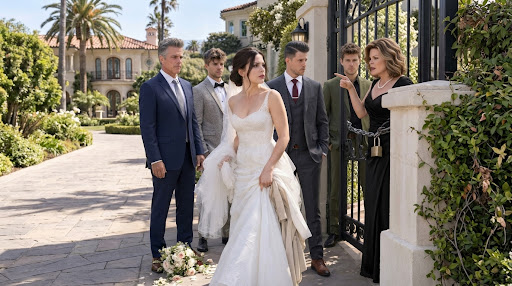
PART 2
At 7:42 the following morning,
I stood outside the same iron gate
where my future mother-in-law had humiliated
me less than twenty-four hours earlier.
Only this time, I wasn’t wearing a wedding dress.
I wore dark jeans, a cream-colored blouse,
and comfortable shoes.
My hair was pulled into a tight ponytail,
and the only jewelry I wore was the gold necklace
my grandmother had given me when I graduated from college.
Behind me were two moving trucks.
Beside me stood my father,
my uncle Raymond, and a woman named Rebecca Collins,
an attorney my father had recommended.
In my hands was a thick blue folder.
Inside were seventy-three thousand,
eight hundred and forty dollars in receipts, invoices,
payment confirmations, delivery records, and written messages.
Every document represented something
I had purchased because I believed I was building a future with Brandon.
Every page reminded me how easily generosity could become something other people considered their property.
The house was quiet.
The wedding decorations still hung from the porch.
White ribbons fluttered around the railings.
A large floral arrangement stood beside the front door.
And on the gate, someone had left the chain.
I stared at it.
My father touched my shoulder.
“Are you sure you’re ready?”
I looked toward the house.
“No,” I admitted. “But I’m doing it anyway.”
Rebecca opened her briefcase.
“Remember what we discussed, Savannah. We can request the return of your personal property and any items you can establish you own. But we cannot enter without permission, and permanent improvements to the house are a separate legal issue.”
I nodded.
“I understand.”
She looked at the movers.
“They’ve been instructed not to remove anything unless ownership and access are clear.”
“Good.”
I wasn’t there to damage Gertrude’s home.
I wasn’t going to rip flooring from the walls or tear out kitchen cabinets.
I wanted something more important than revenge.
I wanted my dignity back.
And I wanted Brandon’s family to understand that the woman they’d treated like an unwanted servant was no longer willing to finance their comfort.
At 7:51, Brandon opened the front door.
He was wearing gray sweatpants and a wrinkled T-shirt.
His hair was messy.
His eyes were bloodshot.
When he saw me, his expression changed.
Then he noticed the trucks.
“What the hell is this?”
I stood on the sidewalk.
“Good morning, Brandon.”
He looked behind me.
“Why are there moving trucks?”
Rebecca stepped forward.
“My name is Rebecca Collins. I represent Savannah. We’re here to request the return of her personal belongings and discuss property she purchased for this residence.”
Brandon stared at her.
Then he looked at me.
“You brought a lawyer?”
“Yes.”
“Savannah, are you insane?”
I didn’t answer.
He pointed toward the trucks.
“You’re trying to embarrass us in front of the neighbors!”
I looked at him.
“Yesterday, your mother chained me outside this gate in front of fifty wedding guests.”
His jaw tightened.
“That was different.”
“How?”
“She was upset.”
I stared at him.
“And I wasn’t?”
He looked away.
Rebecca spoke calmly.
“Mr. Hayes, we’re not here to argue. We’d like to arrange a peaceful inventory and removal of items belonging to my client.”
Brandon laughed bitterly.
“Nothing in this house belongs to her.”
I opened the folder.
“Then this should be a very short conversation.”
I pulled out the first receipt.
“Refrigerator. Three thousand two hundred dollars.”
Another.
“Washing machine and dryer. Two thousand six hundred.”
Another.
“Living room television. Two thousand one hundred.”
I continued.
“Dining table and eight chairs. Four thousand eight hundred.”
Brandon’s expression tightened.
“Those were gifts.”
I looked at him.
“Some may have been. That’s why we’re going to establish exactly what was agreed.”
He stepped closer.
“You can’t just take things back because you’re angry.”
Rebecca raised her hand.
“That’s correct. Gifts generally cannot simply be reclaimed. We are here to identify items Savannah retained ownership of and to resolve any disputed claims lawfully.”
I looked at Brandon.
“Unlike your mother, I’m not interested in inventing rules because they suit me.”
His face reddened.
Then a familiar voice came from behind him.
“What is all this noise?”
Mrs. Gertrude appeared in the doorway.
She wore a purple robe and slippers.
Her bright red wedding-day dress was gone, but the expression on her face was exactly the same.
When she saw me, she smiled.
“Well, look who’s come crawling back.”
I felt my father’s hand tighten on my shoulder.
I remained still.
Gertrude looked at the trucks.
Then at Rebecca.
Her smile disappeared.
“What are those for?”
I held up the blue folder.
“Your renovation records.”
She blinked.
“What?”
“And the receipts for everything I paid for.”
Her eyes narrowed.
“Are you threatening me?”
“No.”
I looked directly at her.
“I’m correcting a mistake.”
Gertrude folded her arms.
“You gave those things to our family.”
I nodded.
“Some of them, yes.”
She seemed surprised.
I continued.
“And some were purchased under agreements that they would remain my property until Brandon and I established our own household.”
Brandon looked at me sharply.
“What agreements?”
I opened the folder.
“The messages you sent me.”
He went still.
I pulled out a printed conversation from eight months earlier.
Brandon had written:
Babe, let’s buy the appliances now. Once we’re married, we can move everything to our place if Mom doesn’t need them.
Below it, I had replied:
Okay, but I’m keeping the purchase records in my name until we decide.
His response was simple.
Of course. They’re yours.
I handed the page to Rebecca.
She looked at Brandon.
“Do you recognize these messages?”
He stared at the ground.
Gertrude stepped forward.
“Those were just words!”
Rebecca remained calm.
“Written communications can be relevant evidence of an agreement.”
Gertrude looked at me.
“You think a few messages make you clever?”
I closed the folder.
“No, Mrs. Gertrude. I think keeping records makes me prepared.”
She pointed toward the road.
“Get off my property!”
Rebecca nodded.
“We’ll respect that. We’ll send a formal request for the return of the disputed items and pursue the appropriate remedies if necessary.”
I looked toward the house.
Then back at Gertrude.
“You have every right to decide who enters your home.”
Her expression softened with satisfaction.
I continued.
“But you don’t have the right to keep taking my money after telling me I’m not good enough to belong to your family.”
Brandon looked up.
“What money?”
I stared at him.
“The automatic transfers.”
His face changed.
Gertrude turned toward him.
“What transfers?”
I almost smiled.
There it was.
The first crack.
For eleven months, I had been paying several household expenses directly.
The home insurance.
A portion of the property taxes.
The internet service.
A monthly payment toward the kitchen renovation.
And a recurring transfer into an account Brandon claimed was used for household repairs.
He had told me the arrangement would end after our wedding.
I had believed him.
The previous night, after driving home from Grand Rapids, I had reviewed every payment.
Then I contacted my bank.
I canceled future voluntary transfers.
I removed my card from accounts that belonged to Brandon.
And I made arrangements to settle only the obligations that were legally mine.
I had not touched Gertrude’s accounts.
I had not reversed legitimate completed payments.
I had simply stopped paying bills I was no longer willing to cover.
Brandon stared at me.
“You canceled everything?”
“Everything I was voluntarily paying.”
His face drained.
“Savannah, the contractor payment is due next week.”
I nodded.
“I know.”
“Mom can’t afford that.”
I looked toward Gertrude.
“Then perhaps you should discuss it as a family.”
Gertrude stepped toward me.
“You selfish girl!”
My father moved forward.
I gently stopped him.
“Dad, it’s okay.”
Gertrude pointed at my face.
“You were going to marry into this family! That means helping us!”
I stared at her.
“Yesterday, you told me I wasn’t worthy of entering your home.”
She opened her mouth.
I continued.
“Today, you’re telling me I should keep paying for it.”
Her lips tightened.
“You have no respect for elders.”
I took a slow breath.
“Respect doesn’t require humiliation.”
She looked at Brandon.
“Say something!”
He rubbed his forehead.
“Savannah, can we please talk privately?”
I shook my head.
“Anything important can go through Rebecca.”
His expression collapsed.
“Are you seriously ending everything over one bad morning?”
I looked at him.
“No.”
My voice remained steady.
“I’m ending everything because that morning showed me what the rest of my life would look like.”
We didn’t remove a single disputed item that morning.
Rebecca had warned me that forcing entry or taking property without agreement could create legal problems.
Instead, we completed an inventory from the records and photographs I already possessed.
Brandon agreed to release several clearly identified personal belongings that I’d stored in the house.
My wedding shoes.
Two suitcases.
A box of family photographs.
Some clothing.
A laptop I’d purchased for myself.
And several unopened household items still bearing my name on the delivery labels.
The movers collected those items after Brandon allowed access.
The rest remained untouched pending resolution.
When the trucks finally pulled away, one was nearly empty.
I didn’t care.
The trucks had never been the point.
The point was that I had returned.
Not begging.
Not apologizing.
Not waiting outside a chained gate for permission to be treated like a human being.
I had returned with documentation, witnesses, and a decision.
And I was no longer afraid of disappointing Brandon’s family.
As we prepared to leave, Brandon hurried toward my car.
“Savannah, wait.”
I stopped.
He looked exhausted.
“Can we please fix this?”
I studied his face.
For three years, I had loved that man.
I knew the way he laughed when he was nervous.
The way he rubbed his thumb against his wedding ring finger even though he had never worn a ring.
The way he called his mother every evening.
I knew how much he loved baseball.
How he hated thunderstorms.
How he always ordered extra pickles on his burgers.
I knew a thousand small things about him.
But I hadn’t known the most important one.
When I needed him to stand beside me, he would choose his mother’s approval over my dignity.
“Brandon,” I said quietly, “when your mother chained that gate, what did you think?”
He blinked.
“What?”
“What did you think when she told me to wait outside for three hours?”
He looked away.
“I thought she was being unreasonable.”
“Then why didn’t you say so?”
He swallowed.
“Because arguing with her makes everything worse.”
I nodded slowly.
“And you thought letting her humiliate me would make things better?”
He said nothing.
I looked at him.
“That’s the problem.”
He stepped closer.
“I love you.”
My eyes filled.
“I loved you too.”
He reached for my hand.
I stepped back.
Then he whispered, “Please don’t throw away three years.”
I looked toward the chained gate.
“Brandon, I didn’t throw them away.”
My voice broke.
“I spent three years trying to build a future with you. Yesterday, you showed me there wasn’t room for me in it.”
I climbed into my car.
And this time, when I drove away, I didn’t look back.
That evening, Rebecca called.
“Savannah, I’ve reviewed the renovation invoices.”
I sat at my kitchen table.
“And?”
“Some payments appear to have been made directly to contractors for permanent improvements to Gertrude’s property.”
I nodded.
“Yes.”
“Those are more complicated than movable personal property. We’ll need to examine whether there were enforceable agreements, promises, or other grounds for recovery.”
I closed my eyes.
“I understand.”
She paused.
“But there’s something else.”
I sat straighter.
“What?”
“One of the contractors contacted me after receiving our request for records.”
My stomach tightened.
“Which contractor?”
“The company that handled the kitchen renovation.”
I frowned.
“What did they say?”
Rebecca hesitated.
“According to their records, Brandon asked them to issue two separate sets of invoices.”
I stared at the wall.
“Why?”
“One set reflected the actual work completed.”
“And the other?”
Her voice became serious.
“The second set listed additional charges that don’t appear to correspond to any work.”
I gripped the phone.
“How much?”
“Just over nineteen thousand dollars.”
I felt cold.
Rebecca continued.
“Savannah, I think we need to examine where that money went.”
PART 3
I didn’t sleep that night.
Every time I closed my eyes, I saw Brandon standing beside the chained gate, telling me to adjust to his family.
Then I saw the kitchen.
The beautiful white cabinets.
The polished countertops.
The expensive fixtures Gertrude had chosen from catalogs while I sat beside her, calculating how much everything would cost.
I remembered her smiling at me.
“Savannah, you’re such a blessing to this family.”
I had believed her.
I had been so desperate to feel accepted that I hadn’t noticed the difference between gratitude and appetite.
The more I gave, the more they wanted.
And now I was learning that some of the money I’d paid might never have gone toward the renovations at all.
The following morning, I met Rebecca at her office.
She had arranged the invoices across a long conference table.
“Let’s go through this carefully,” she said.
I sat down.
She pointed toward the first document.
“This is the contractor’s original estimate.”
I nodded.
“Forty-one thousand six hundred dollars.”
“Correct.”
She moved to another page.
“This is the final invoice reflecting the work the contractor says was actually completed.”
I studied it.
“Forty-three thousand two hundred.”
Rebecca nodded.
“Now look at this.”
She placed a third document beside it.
The total was sixty-two thousand four hundred dollars.
I stared at the number.
“That can’t be right.”
Rebecca looked at me.
“Did Brandon ever explain the increase?”
I tried to remember.
“He said there were unexpected structural problems.”
“What kind?”
“Water damage. Electrical issues. Something about the foundation.”
Rebecca nodded.
“Did you ever see photographs?”
“No.”
“Inspection reports?”
“No.”
“Change orders signed by the contractor?”
I shook my head.
She leaned back.
“According to the contractor, those additional charges were not part of the work they performed.”
I stared at the invoice.
The difference was nineteen thousand two hundred dollars.
My stomach tightened.
“Where did the money go?”
Rebecca folded her hands.
“That’s what we’re trying to establish.”
The contractor’s name was Michael Porter.
He had operated a renovation company in Grand Rapids for twenty-three years.
When we met him, he looked uncomfortable.
“I don’t want trouble,” he said immediately.
Rebecca nodded.
“We understand.”
He glanced at me.
“Miss Savannah, I didn’t know you were paying for everything.”
I stared at him.
“What?”
He swallowed.
“Brandon told me the renovation was being financed through a family account.”
I looked at Rebecca.
Michael continued.
“He said his fiancée was helping manage the payments.”
I nodded.
“That part is true.”
He looked down.
“But when he asked me to prepare a second invoice with additional charges, I refused.”
My stomach dropped.
“Then where did that invoice come from?”
Michael shook his head.
“I don’t know. It wasn’t issued by my company.”
Rebecca slid the document toward him.
“Is this your business logo?”
“Yes.”
“Your address?”
“Yes.”
“Your signature?”
He stared at it.
Then shook his head.
“No.”
I felt sick.
Michael continued.
“I told Brandon that if there were legitimate additional expenses, we’d document them properly. He said he’d handle it.”
I looked at the paper.
The signature looked convincing.
The logo was correct.
The invoice number followed the same format as the legitimate ones.
But according to the contractor, the document was false.
Rebecca asked Michael whether he would provide a written statement and authentic records.
He agreed.
As we left, he stopped me near the door.
“Miss Savannah?”
I turned.
“Yes?”
He looked genuinely ashamed.
“I’m sorry.”
I shook my head.
“You didn’t do this.”
He sighed.
“I should have contacted you when Brandon started asking strange questions.”
I smiled sadly.
“Thank you for telling us now.”
Over the next two weeks, Rebecca and a forensic accountant reviewed the relevant payments.
The accountant traced the questionable transfers as far as the available records allowed.
The money had not gone directly to Michael’s company.
Instead, several payments had been routed through an account Brandon controlled.
Some funds were then transferred to another account associated with Gertrude.
Others appeared to have been used for personal expenses.
I sat in Rebecca’s office staring at the summary.
Nineteen thousand two hundred dollars.
I thought about the overtime I’d worked.
The weekends I’d spent reviewing financial reports.
The vacations I’d postponed.
The retirement contributions I’d reduced because I believed I was helping build a family home.
And I felt something inside me finally break.
Not loudly.
Not dramatically.
Just a quiet realization.
They hadn’t merely accepted my generosity.
Someone had apparently exploited it.
Brandon called me that evening.
I let it ring.
Then he called again.
And again.
Finally, I answered.
“Hello.”
“Savannah, we need to talk.”
His voice sounded frantic.
I looked toward the folder on my desk.
“About what?”
“The contractor.”
I remained silent.
He swallowed.
“Michael called Mom.”
I nodded.
“And?”
“He said you’re accusing us of fraud.”
I looked at the window.
“Brandon, did you create a false invoice?”
There was silence.
“Savannah—”
“Did you?”
He exhaled sharply.
“It wasn’t like that.”
I closed my eyes.
“Then explain.”
He hesitated.
“Mom needed money.”
I stared at the wall.
“What?”
“She had debts.”
“What debts?”
He rubbed his forehead.
“Credit cards. A personal loan. Some medical expenses.”
I felt my stomach tighten.
“So you used the renovation payments?”
He didn’t answer.
“Brandon.”
“Yes,” he whispered.
I closed my eyes.
The truth hurt more than I’d expected.
“How much?”
He swallowed.
“About nineteen thousand.”
I sat down.
“Did you ever intend to tell me?”
Silence.
I waited.
Then he whispered, “I was going to replace it.”
I almost laughed.
That sentence.
The same excuse people used when they borrowed money without permission.
The same excuse that somehow always appeared after someone discovered the truth.
I looked toward the ceiling.
“You lied to me.”
He began crying.
“I know.”
“You used my money.”
“I know.”
“You let me believe it was paying for repairs.”
His voice broke.
“Yes.”
I swallowed.
“And yesterday, when your mother locked me outside the gate, you told me to adjust.”
He said nothing.
I wiped my eyes.
“Brandon, I need you to understand something.”
“Please—”
“No. Listen.”
I took a breath.
“I would have helped your mother if she’d asked honestly.”
He began crying harder.
“I know.”
“But you didn’t give me a choice.”
I looked toward the folder.
“You made the decision for me, lied about it, and then expected me to accept humiliation as the price of belonging.”
He whispered, “I’m sorry.”
I closed my eyes.
“I believe you’re sorry now.”
Hope entered his voice.
“Then maybe we can—”
“No.”
Silence.
“I believe you’re sorry because you got caught.”
Then I ended the call.
The next morning, Gertrude appeared at my apartment in Detroit.
I was drinking coffee when someone knocked.
I opened the door and found her standing in the hallway.
She wore a dark coat and carried a handbag large enough to hold a small dog.
Her expression was stiff.
“Savannah.”
I stared at her.
“Mrs. Gertrude.”
She glanced past me.
“May I come in?”
I hesitated.
Then stepped aside.
She entered slowly.
For a moment, she looked around my apartment.
The simple furniture.
The bookshelves.
The photographs.
The small dining table.
Then she sat on the sofa.
I remained standing.
“What can I do for you?”
She folded her hands.
“Brandon tells me you’re taking legal action.”
I nodded.
“Rebecca is handling the matter.”
Gertrude sighed.
“Surely we can settle this privately.”
I looked at her.
“That depends on what you’re prepared to acknowledge.”
Her expression tightened.
“I never meant for things to become so ugly.”
I stared at her.
“You chained me outside your gate on my wedding day.”
She looked away.
“That was a misunderstanding.”
I felt anger rise.
“No.”
She looked back.
I continued.
“You told me to wait outside for three hours because a tarot reader said I needed humility.”
Her lips tightened.
“I was following spiritual advice.”
I shook my head.
“You were humiliating me.”
She sighed.
“Savannah, you have to understand. Brandon is my only son.”
I stared at her.
“And?”
“I’ve always been protective of him.”
I nodded slowly.
“Protective?”
She looked uncomfortable.
I continued.
“Protective enough to let him lie to me about nineteen thousand dollars?”
Her face changed.
For a moment, she looked frightened.
Then she whispered, “He told you?”
I stared at her.
“You knew?”
She looked down.
I felt my stomach drop.
“Mrs. Gertrude, did you know Brandon used renovation money to pay your debts?”
She began crying.
“I was desperate.”
I stood very still.
She wiped her cheeks.
“The credit card companies were calling. I was behind on payments. Brandon said he could help.”
I stared at her.
“And neither of you thought to ask me?”
She looked up.
“We were embarrassed.”
I almost laughed.
“Embarrassed?”
She nodded.
I felt my voice rise.
“You were too embarrassed to ask me for help, but not too embarrassed to chain me outside your gate in front of fifty people?”
Gertrude flinched.
I took a breath.
Then I sat across from her.
“Why did you hate me?”
She looked startled.
“I didn’t hate you.”
“Then why did you treat me that way?”
She stared at her hands.
For a long time, she said nothing.
Then she whispered, “Because Brandon listened to you.”
I frowned.
“What?”
She wiped her eyes.
“He used to ask me about everything.”
I stared at her.
“Then you came along.”
She looked toward the window.
“He started talking about moving to Detroit. Buying a house. Starting his own life.”
I felt cold.
“You were afraid he’d leave.”
She nodded.
“I didn’t want to lose my son.”
I stared at her.
“So you decided to make me feel unwelcome?”
She began crying.
“I thought if you learned to be more submissive, things would be easier.”
I felt something inside me settle.
There it was.
Not a tarot reader.
Not spiritual energy.
Not tradition.
Fear.
Control.
And resentment toward a woman who represented a future Gertrude couldn’t manage.
I looked at her.
“You weren’t protecting Brandon.”
She wiped her cheeks.
“You were protecting your control over him.”
She looked away.
Gertrude stayed for another twenty minutes.
She apologized several times.
But every apology seemed to come with an explanation.
She was frightened.
She was embarrassed.
She was worried about her blood pressure.
She hadn’t expected me to cancel the wedding.
She thought I would understand.
Finally, I stood.
“Mrs. Gertrude, I accept that you’re telling me you regret what happened.”
Her eyes brightened.
“Then you’ll speak to Brandon?”
I shook my head.
“No.”
Her expression collapsed.
“Savannah—”
“I can acknowledge your regret without returning to a relationship that hurt me.”
She began crying again.
I continued.
“And the financial matter will be handled through Rebecca.”
She stood slowly.
At the door, she turned.
“Do you really think you’ll find someone better than my son?”
I looked at her.
For a moment, I almost smiled.
Then I answered.
“I’d rather be alone than spend my life begging someone to defend me.”
She stared at me.
Then she walked away.
The civil dispute continued for several months.
Rebecca negotiated with Brandon’s attorney.
The clearly identified personal belongings were returned.
The questionable invoice payments became the subject of a separate financial claim.
The permanent improvements to Gertrude’s home were more complicated.
Some had been gifts.
Some were connected to written promises.
Others were disputed.
I didn’t recover every dollar.
I hadn’t expected to.
But the false invoice issue was resolved through a written settlement requiring repayment.
Brandon and Gertrude agreed to a payment schedule.
The agreement also addressed several other disputed expenses.
I accepted it after Rebecca explained the risks and costs of continued litigation.
The settlement wasn’t a victory parade.
There were no reporters.
No dramatic courtroom confession.
No judge ordering Gertrude to apologize in front of the neighborhood.
There was simply a signed agreement.
A repayment schedule.
And the end of a financial relationship that had become painfully unhealthy.
Three months after the canceled wedding, I received a letter from Brandon.
It arrived on a rainy Thursday afternoon.
The envelope was handwritten.
I recognized his writing immediately.
I sat at my kitchen table and opened it.
He wrote that he had begun counseling.
That he was learning to understand how much his fear of disappointing his mother had shaped his decisions.
He admitted he’d allowed me to carry responsibilities that weren’t mine.
He acknowledged lying about the renovation money.
And he wrote something that made me cry.
I thought keeping Mom happy was the same as being a good son. I didn’t understand that I was hurting the woman I claimed to love.
I read that sentence three times.
Then I continued.
When you stood outside the gate, I knew what Mom was doing was wrong. I knew it. But I was more afraid of her anger than your pain. That’s the truth I have to live with.
I wiped my cheeks.
At the bottom, he wrote:
I don’t expect you to come back. I just want you to know that you were right to leave.
I folded the letter carefully.
Placed it in the drawer.
And cried for the future we’d never have.
PART 4
Six months after I canceled my wedding, I returned to Grand Rapids.
Not for Brandon.
Not for Gertrude.
And certainly not to revisit the gate where everything had ended.
I returned because my cousin Emily was getting married.
Her ceremony was being held in a small garden outside the city.
She had asked me to be one of her bridesmaids.
At first, I’d hesitated.
The thought of another wedding made my stomach tighten.
White dresses.
Flowers.
Music.
Families smiling for photographs.
All the things that had become painful reminders of my own humiliation.
But Emily had called me one evening and said something I couldn’t forget.
“Savannah, you didn’t ruin weddings. Brandon and his mother ruined yours. Don’t let them steal everyone else’s happiness too.”
I had laughed through my tears.
Then I agreed.
On the morning of Emily’s wedding, I stood in front of my bedroom mirror wearing a soft lavender dress.
My hair was curled.
My makeup was simple.
And around my neck was the gold necklace my grandmother had given me.
I looked at myself for a long moment.
Six months earlier, I’d stood in front of another mirror wearing a white gown.
I had been nervous.
Excited.
Hopeful.
I’d imagined walking toward Brandon and beginning a new chapter of my life.
Instead, I’d spent the morning standing outside a chained gate while his mother announced that I needed to learn humility.
I closed my eyes.
Then I took a breath.
That woman in the white dress had been frightened of losing love.
The woman in the lavender dress was learning that love shouldn’t require losing herself.
The ceremony was beautiful.
Emily walked down the aisle beneath an arch covered in white roses.
Her fiancé, Jonathan, began crying the moment he saw her.
When she reached him, he took both her hands.
Then he whispered something that made her laugh.
I watched them exchange vows.
And for the first time since my canceled wedding, I didn’t feel bitterness.
I felt hope.
Not necessarily for another marriage.
Not for a particular man.
But for the possibility that love could still be gentle.
That partnership could still mean standing beside someone.
That a wedding could be a celebration rather than a test of obedience.
During the reception, my uncle Raymond approached me.
He carried two glasses of sparkling cider.
“Savannah.”
I smiled.
“Uncle Raymond.”
He handed me one.
Then he looked toward the dance floor.
“Beautiful wedding.”
I nodded.
“It is.”
He took a sip.
Then he said, “I’m proud of you.”
I laughed softly.
“For what?”
He looked at me.
“For leaving.”
My smile faded.
He continued.
“People talk about courage like it’s always loud.”
I looked toward him.
“But sometimes courage is taking off your veil and walking away when everyone expects you to stay.”
My eyes filled.
“Uncle Raymond…”
He smiled.
“You saved yourself a lifetime of pain.”
I looked toward the dance floor.
Emily and Jonathan were laughing together.
I swallowed.
“I wish it hadn’t happened.”
He nodded.
“Of course.”
Then he added, “But I’m glad you listened when your heart told you something was wrong.”
I leaned against his shoulder.
For a moment, I felt like a little girl again.
Safe.
Loved.
Protected.
After the wedding, I began rebuilding my life.
Not dramatically.
Not overnight.
But one decision at a time.
I returned to my normal work schedule.
I started saving again.
I met friends for dinner without feeling guilty about spending money on myself.
I took a weekend trip to Chicago with Emily.
We visited museums.
Ate expensive desserts.
Walked along the lake.
And laughed until our stomachs hurt.
I hadn’t realized how much of my life had revolved around Brandon’s family.
Every weekend seemed to involve a repair project.
A family obligation.
A bill.
A visit to Gertrude.
A conversation about why I needed to be more patient.
Now my weekends belonged to me.
At first, the freedom felt strange.
Then it began to feel wonderful.
The settlement payments arrived according to schedule.
Not always early.
Sometimes just before the deadline.
But they arrived.
Rebecca monitored the agreement.
I kept the records.
And every time a payment cleared, I transferred the money into a separate savings account.
I labeled it:
MY FUTURE.
Not Brandon’s.
Not Gertrude’s.
Not the family home.
Mine.
It wasn’t about becoming wealthy.
It was about remembering that I had worked hard for my money.
And that generosity should be a choice, not an obligation enforced through guilt.
One evening, my father invited me to dinner.
We sat in his kitchen eating homemade chicken soup.
He had always been a quiet man.
Not particularly emotional.
Not someone who gave long speeches.
But that night, he looked at me across the table.
“Savannah, can I ask you something?”
I smiled.
“Of course.”
He hesitated.
“Do you regret leaving Brandon?”
I considered the question.
Then I answered honestly.
“Sometimes I regret what we could have had.”
He nodded.
“But?”
I looked down at my soup.
“I don’t regret leaving.”
He smiled faintly.
“Good.”
I looked at him.
“Dad, did you know something was wrong before the wedding?”
He sighed.
“I had concerns.”
My stomach tightened.
“Why didn’t you tell me?”
He looked at me carefully.
“Because you loved him.”
I nodded.
“And because I wanted you to make your own decisions.”
He paused.
“But I also knew that if you ever needed help leaving, I would be there.”
My eyes filled.
I reached across the table.
He took my hand.
Then he said something I would remember for the rest of my life.
“A good family doesn’t make you earn the right to be treated with dignity.”
I began crying.
He squeezed my hand.
“And a good husband doesn’t stand by while someone humiliates his wife.”
Nearly a year after the canceled wedding, I received a message from Brandon.
It was short.
Savannah, I hope you’re doing well. I’ve completed the counseling program I started. I’m still working on myself. I don’t expect anything from you. I just wanted to say thank you for making me face the truth.
I stared at the screen.
For a long time, I didn’t know whether to respond.
Part of me wanted to ask a hundred questions.
Was he happy?
Had he moved out of his mother’s house?
Did he still think about the wedding?
Did he ever regret choosing silence?
But I knew those questions wouldn’t change my future.
So I typed:
I’m glad you’re taking responsibility for your choices. I wish you well.
Then I pressed send.
And for the first time, I felt no urge to wait for his reply.
That spring, I bought a small townhouse.
It wasn’t extravagant.
Two bedrooms.
A bright kitchen.
A little backyard with enough space for flowers.
The walls were painted a soft cream color.
The windows faced east.
And the morning sunlight filled the living room.
I paid the down payment from my own savings.
I signed every document myself.
And when the realtor handed me the keys, I stood in the empty living room and cried.
Not because I was sad.
Because the place was mine.
No one could tell me I had to wait outside.
No one could demand that I prove my humility before entering.
No one could use my generosity as a reason to control me.
I walked through every room.
Opened every closet.
Stood in the kitchen.
Then I went outside and looked at the front gate.
It was a simple wooden gate with a small brass latch.
No chain.
No padlock.
No one standing on the other side deciding whether I deserved to enter.
I smiled.
My father helped me move.
Uncle Raymond came too.
Emily brought pizza.
We spent the entire Saturday carrying boxes, arranging furniture, and laughing about how many books I owned.
At one point, my father stood in the doorway holding a box labeled KITCHEN.
He looked around.
“Nice place.”
I smiled.
“Thanks, Dad.”
He set the box down.
Then he looked at me.
“You happy?”
I took a breath.
“Yes.”
He smiled.
“Good.”
Then he walked toward the kitchen.
And I realized that sometimes the greatest blessing isn’t a dramatic rescue.
Sometimes it’s having people who quietly show up when you need them.
A few months later, I began dating again.
Not because I was lonely.
Not because I needed someone to complete my life.
But because I finally felt ready to meet people without trying to earn their approval.
I went on a few dates.
Some were awkward.
Some were pleasant.
One man spent an entire dinner talking about his ex-wife.
Another asked how much money I earned before the appetizers arrived.
I laughed about those dates with Emily.
Then, one Saturday afternoon, I met a man named Nathan at a community volunteer event.
He was thirty-four.
An architect.
Divorced.
Kind.
We were helping repaint a neighborhood youth center.
I accidentally spilled blue paint on my shoe.
Nathan handed me a paper towel.
Then he smiled.
“Good news.”
I laughed.
“What?”
“Blue is definitely your color.”
I stared at him.
Then burst out laughing.
It was such a ridiculous thing to say.
But he didn’t seem embarrassed.
He simply smiled.
And something about that small moment felt easy.
Nathan and I became friends first.
We talked about books.
Travel.
Work.
Family.
He listened when I spoke.
He asked questions.
He remembered the answers.
And when I told him about my canceled wedding, he didn’t interrupt.
He didn’t tell me I should have been more patient.
He didn’t suggest I should have tried harder.
He simply listened.
Then he said, “That must have been incredibly painful.”
I nodded.
“It was.”
He looked at me.
“But I’m glad you had people who supported you.”
I smiled.
“Me too.”
He paused.
Then added, “For what it’s worth, I don’t think love should require someone to be humiliated.”
I looked at him.
And for the first time in a long time, I felt something warm and hopeful stir inside me.
We dated slowly.
There was no rush.
No pressure.
No grand promises.
Nathan never asked me to pay his bills.
He never expected me to solve his family’s problems.
He had a good relationship with his parents, but he made his own decisions.
And when we disagreed, he didn’t disappear into silence.
He talked.
He listened.
He apologized when he was wrong.
I wasn’t used to that.
Sometimes I found myself waiting for the other shoe to drop.
But gradually, I began to understand that healthy love doesn’t always feel dramatic.
Sometimes it feels peaceful.
Sometimes it looks like someone remembering how you take your coffee.
Sometimes it sounds like, “I understand why that upset you.”
And sometimes it means knowing that if someone treats you badly, the person beside you will not ask you to endure it just to keep the peace.
One afternoon, Nathan came over to help me assemble a bookshelf.
We were sitting on the living room floor surrounded by screws and wooden panels.
He looked toward the window.
“Savannah?”
“Yes?”
“Can I ask you something?”
I smiled.
“Sure.”
He hesitated.
“Do you ever think about getting married again?”
I looked at him.
The question surprised me.
Not because I hadn’t considered it.
But because the word marriage still carried memories of white flowers, a chained gate, and fifty people watching me be humiliated.
I took a breath.
“Sometimes.”
He nodded.
“But?”
I looked at him.
“I’d need to know I was marrying someone who would stand beside me.”
Nathan was quiet.
Then he said, “That seems like a reasonable requirement.”
I laughed softly.
He smiled.
“And Savannah?”
“Yes?”
“If we ever reach that point, I promise there won’t be any locked gates.”
I stared at him.
Then I laughed.
For the first time, the memory didn’t hurt quite so much.
Two years after the canceled wedding, I returned to Grand Rapids for a work conference.
On the final afternoon, I drove past the neighborhood where Brandon’s family lived.
I hadn’t planned to.
But the road was familiar, and before I realized it, I was approaching the house.
The roof looked the same.
The windows I’d paid for still reflected the afternoon sunlight.
The kitchen curtains were visible through the front window.
The wooden porch railings had been repainted.
And the gate stood open.
I slowed for a moment.
Then stopped across the street.
I looked at the house.
For three years, I’d believed it represented my future.
I’d spent money there.
Time.
Energy.
Hope.
I’d imagined family dinners.
Holiday celebrations.
Children playing in the yard.
A life built around people I thought would eventually accept me.
But the house no longer felt like something I’d lost.
It felt like a place I’d finally outgrown.
I didn’t feel angry.
I didn’t feel tempted to knock.
I didn’t wonder whether Gertrude regretted what she’d done.
I simply looked at the open gate.
Then smiled.
As I prepared to drive away, my phone rang.
It was Nathan.
“Hey,” I answered.
“Hey, beautiful. How’s the conference?”
I smiled.
“Good.”
“Heading home?”
“Soon.”
He laughed.
“I made dinner.”
I raised an eyebrow.
“Should I be worried?”
“Only if you’re afraid of lasagna.”
I laughed.
“Did you burn it?”
“Not this time.”
I smiled.
Then looked toward Brandon’s old family home one final time.
Nathan continued.
“Drive safely. I’ll see you when you get here.”
I swallowed.
“Okay.”
He paused.
“Everything all right?”
I looked at the gate.
“Yes.”
And I meant it.
“Everything’s all right.”
When I returned home that evening, Nathan was waiting in my kitchen.
The table was set.
The lasagna smelled wonderful.
There were flowers in a small vase beside the window.
He looked up when I entered.
“Hey.”
I smiled.
“Hey.”
He walked over and kissed my forehead.
“Long day?”
I nodded.
“Very.”
He took my bag.
“Dinner’s ready.”
I looked around the kitchen.
The warm lights.
The flowers.
The quiet.
The man who had made dinner simply because he wanted to.
And I felt something settle inside me.
Peace.
Not the kind that comes from avoiding conflict.
The kind that comes from knowing you are safe enough to be yourself.
Later that night, I sat on the back patio with a cup of tea.
Nathan was inside washing the dishes.
The air smelled of fresh grass.
The little wooden gate stood open.
I looked toward it.
Then thought about the morning of my canceled wedding.
I remembered standing outside Brandon’s family home in my white dress.
The chain wrapped around the gate.
Gertrude’s red dress.
The fifty guests.
The humiliation.
The silence.
And Brandon whispering, “Just go along with it.”
For a long time, I had wondered what would have happened if I’d listened.
If I’d waited three hours.
If I’d apologized for an attitude I didn’t have.
If I’d walked through that gate pretending everything was fine.
Perhaps the wedding would have continued.
Perhaps the photographs would have looked beautiful.
Perhaps everyone would have smiled.
But I knew something now.
The humiliation wouldn’t have ended at the gate.
It would have followed me into the marriage.
Into the kitchen.
Into every family gathering.
Into every financial decision.
Into every moment when Brandon’s mother demanded obedience and he asked me to keep the peace.
I would have spent years proving I deserved respect from people who had already decided not to give it.
And I might have lost myself trying.
Nathan stepped onto the patio.
He carried two cups of tea.
“Mind if I join you?”
I smiled.
“Never.”
He sat beside me.
For a while, we watched the evening sky.
Then he looked toward the little gate.
“Did you leave that open?”
I nodded.
“Yes.”
He smiled.
“Want me to close it?”
I considered the question.
Then shook my head.
“No.”
He looked curious.
“Why not?”
I smiled.
“Because I like knowing I can.”
He laughed softly.
Then took my hand.
And I realized something that made my eyes fill.
I had once stood outside a gate, begging silently for the man I loved to choose me.
Now I sat inside a home I’d built for myself, beside a man who never made me question whether I belonged.
People sometimes ask whether I regret canceling my wedding in front of fifty guests.
They ask whether I could have handled things more quietly.
Whether I should have waited.
Whether I should have forgiven Gertrude.
Whether I should have given Brandon another chance.
I understand why they ask.
From the outside, walking away from a wedding can seem dramatic.
Expensive.
Embarrassing.
A terrible waste.
But I know what I saw that morning.
I saw a woman who believed humiliation was a form of authority.
I saw a man who believed silence was easier than courage.
And I saw the future waiting for me if I agreed to accept both.
So I took off my veil.
I canceled the wedding.
And I walked away.
Not because I didn’t love Brandon.
But because I finally understood that loving him could not require abandoning myself.
The seventy-three thousand eight hundred and forty dollars I spent taught me an expensive lesson.
Not every dollar came back.
Not every apology felt complete.
Not every memory stopped hurting.
But I recovered something far more valuable.
My ability to say no.
My confidence.
My independence.
And my belief that I deserved a relationship built on mutual respect.
I had mistaken generosity for belonging.
I had mistaken patience for love.
And I had mistaken silence for peace.
Never again.
That night, before going to bed, I opened the drawer where I kept the blue folder.
Inside were the receipts.
The settlement agreement.
The final payment records.
And Brandon’s letter.
I looked through them one last time.
Then I placed everything in a storage box.
Not because I wanted to forget.
But because I no longer needed to revisit the pain to remember the lesson.
I closed the box.
Put it on the highest shelf in my closet.
And turned off the light.
The next morning, sunlight filled my bedroom.
I woke to the smell of coffee.
Nathan was in the kitchen humming.
I slipped on my robe and walked downstairs.
He looked up.
“Morning.”
I smiled.
“Morning.”
He handed me a cup.
“Coffee?”
I took it.
“Thank you.”
He kissed my cheek.
Then returned to making breakfast.
No demands.
No tests.
No humiliation.
Just kindness.
I stood in the kitchen holding my coffee and thought about the woman I’d been two years earlier.
The woman who believed she had to earn a place in someone else’s family.
The woman who thought love meant paying bills, swallowing insults, and adjusting until there was nothing left of herself.
I wished I could reach back through time and hold her hand.
Tell her she wasn’t difficult.
She wasn’t disrespectful.
She wasn’t too proud.
She was simply asking to be treated like a human being.
And that was never too much to ask.
I don’t know what happened to Gertrude after that.
I don’t know whether Brandon eventually learned to stand up for himself.
I hope he did.
I hope they both found a way to live without controlling or depending on someone else’s sacrifices.
But their future is no longer my responsibility.
Mine is.
And my future is bright.
Not because everything turned out perfectly.
But because I finally stopped confusing being chosen with being valued.
On the morning of my canceled wedding, Gertrude told me I needed three hours outside her gate to learn humility.
She was wrong.
I didn’t need three hours.
I needed three seconds.
Three seconds to look at Brandon.
Three seconds to understand his silence.
Three seconds to realize that the marriage I’d imagined was not the marriage I was about to enter.
So I removed my veil.
Dropped my bouquet.
And walked away.
The next morning, I returned with two moving trucks and a folder full of receipts.
But the most important thing I took back wasn’t furniture.
It wasn’t money.
It wasn’t anything that could be loaded into a truck.
It was my self-respect.
And once I had that back, I never let anyone lock it outside a gate again.
THE END THANK YOU FOR READING !!!



