PART 3
For a moment, nobody moved.
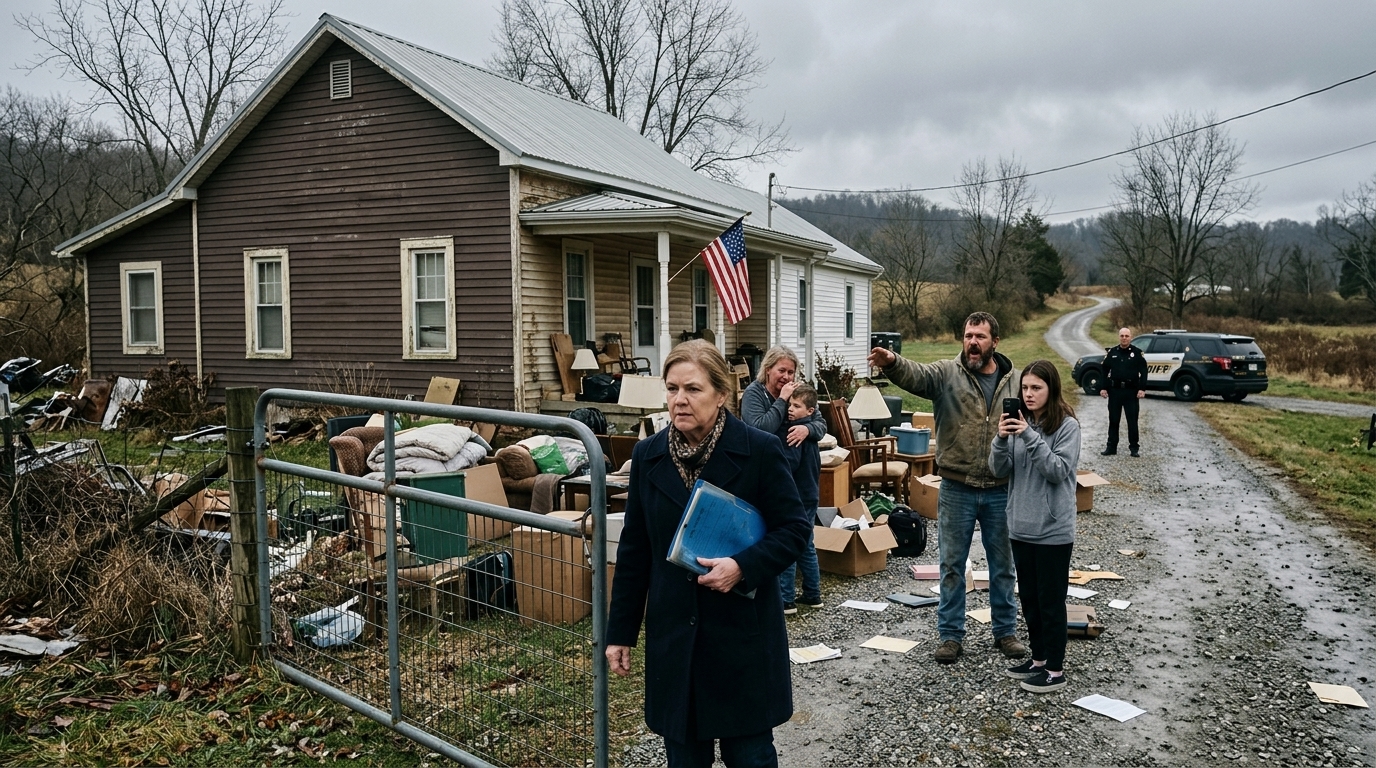
The county sheriff’s cruiser sat beside the gate with its engine idling,
and eight members of Omar’s family stood scattered
across my daughter’s gravel driveway.
A few minutes earlier, Denise had been
ordering Sasha to make fresh eggs.
Now she was staring at the envelope in my hand as
though it contained something poisonous.
Her son Omar had gone pale.
His brother Derek was standing beside
the overturned storage bin, breathing hard.
And my daughter was looking at a document
bearing a signature she swore she had never written.
I held the paper carefully by its edges.
“Officer,” I said, “I think you need to see this.”
Deputy Marcus Reed approached.
He was a broad-shouldered man in his forties,
with a calm expression and the patient manner of someone
who had spent years dealing with people who believed shouting could change the law.
“What have you got?”
I handed him the envelope.
He studied the notice.
Then he looked toward Sasha.
“Ma’am, are you the property owner?”
“Yes.”
“Is this your signature?”
Sasha stepped closer.
Her face was white.
“No.”
“Are you certain?”
She nodded.
“I’ve never seen that document before.”
Omar suddenly spoke.
“That’s ridiculous. She signed paperwork last month.”
Sasha turned toward him.
“What paperwork?”
He hesitated.
“The financial documents we discussed.”
Her voice shook.
“Omar, you told me those were insurance forms.”
Denise stepped forward.
“Oh, for heaven’s sake. Don’t pretend you don’t remember.”
I looked at her.
“Denise, I suggest you stop talking.”
She gave me a poisonous smile.
“You think because you’re old, everyone has to listen to you?”
“No,” I said. “I think because my daughter’s name is on the deed, people should stop trying to steal her house.”
The deputy raised his hand.
“Everyone needs to remain calm.”
He examined the papers again.
Then he asked Derek, “Where did these documents come from?”
Derek swallowed.
“Family business.”
“That wasn’t my question.”
Derek glanced at Omar.
Omar shook his head almost imperceptibly.
I saw it.
So did the deputy.
“Sir,” Deputy Reed said, “I’m asking you directly.”
Derek looked toward his truck.
“I was just keeping them safe.”
“Safe from whom?”
Nobody answered.
The deputy explained that a disputed property document would need to be investigated through the appropriate offices and that he couldn’t determine its validity on the driveway.
He also clarified that people who had established residency might have legal protections requiring formal removal procedures.
I appreciated that.
I wasn’t interested in pretending the law was simpler than it was.
But Sasha’s statement mattered.
She told him Omar’s relatives had arrived three weeks earlier supposedly for a weekend visit.
Then they began moving belongings into the bedrooms.
She had repeatedly asked them to leave.
Omar had told her she was selfish.
Denise had called her ungrateful.
And Derek had warned that if she made trouble, she would regret it.
The deputy documented everything.
The family had already carried their belongings outside during the argument, and after speaking with the deputy, they agreed to leave voluntarily while the residency and property questions were resolved.
Except Omar.
He stood beside the gate, glaring at Sasha.
“You’re choosing your mother over your husband.”
Sasha’s hands trembled.
I expected her to apologize.
That was what she’d done throughout her first marriage.
That was what she’d been doing with Omar.
Apologizing for being tired.
Apologizing for needing sleep.
Apologizing for asking people to clean up after themselves.
But this time, she lifted her chin.
“No,” she whispered.
Omar blinked.
“What?”
“I’m choosing myself.”
For the first time that morning, I saw my daughter straighten her shoulders.
“I asked you to help me build a peaceful home. You turned it into a place where I was afraid to speak.”
Omar laughed bitterly.
“You’re being dramatic.”
She shook her head.
“I’m being honest.”
He stepped forward.
The deputy moved between them.
“Sir, that’s enough.”
Omar looked at me.
“This is your fault.”
I held his gaze.
“No, Omar. Your choices brought you here.”
He climbed into his truck.
Denise followed, muttering threats about lawyers and family loyalty.
Taylor and Morgan squeezed into another vehicle.
Derek loaded his plastic bin without looking at anyone.
And one by one, the vehicles disappeared down the driveway.
Only then did Sasha begin shaking.
I caught her before her knees gave out.
“Mom,” she whispered, “what have I done?”
I wrapped my arms around her.
“You told the truth.”
She began crying.
“What if he comes back?”
I held her tighter.
“Then we deal with it properly. Together.”
After the deputy left, I walked through the farmhouse with Sasha.
I had expected the place to be messy.
I hadn’t expected what I found.
The guest bedroom was filled with Denise’s clothes.
Her jewelry lay across Sasha’s grandmother’s dresser.
A framed photograph of Omar’s parents had replaced the photograph of Sasha and me on the bedside table.
In the second bedroom, Derek’s children had drawn on the walls with markers.
A broken lamp lay behind the door.
The hallway closet was packed with someone else’s shoes.
And in Sasha’s own bedroom, Omar had moved her belongings into two drawers.
His clothes occupied the rest.
I stood in the doorway, staring.
“Sasha.”
She looked down.
“I know.”
“How long has it been like this?”
She hesitated.
“Almost since they arrived.”
I turned toward her.
“Why didn’t you call me?”
Her eyes filled.
“Because I thought you’d be disappointed.”
Those words hurt more than anything Denise had said.
I sat on the edge of the bed.
“Come here.”
Sasha sat beside me.
I took her hand.
“Sweetheart, I didn’t buy this house because I expected you to make perfect decisions.”
She wiped her cheeks.
“I know.”
“I bought it because I wanted you to have somewhere safe to make your own decisions.”
Her chin trembled.
“I thought Omar loved me.”
“Maybe he loved what you could provide.”
She looked away.
I squeezed her hand.
“But whatever he felt, it didn’t give him the right to treat you this way.”
She began crying again.
“I feel so stupid.”
I shook my head.
“You trusted someone you married. That doesn’t make you stupid.”
She leaned against me.
For a while, we simply sat there.
Then she whispered something that made my blood run cold.
“Mom, there’s something else.”
I looked at her.
“What?”
“Omar made me sign some papers last month.”
My stomach tightened.
“What papers?”
“He said they were for a better homeowners insurance policy.”
I sat very still.
“Did you read them?”
She shook her head.
“He was rushing me. He said the agent needed them immediately.”
I closed my eyes.
“Did anyone witness you signing?”
“Derek was there.”
My heart began pounding.
“And Denise?”
“She was in the kitchen.”
I looked toward the hallway.
The papers in Derek’s storage bin suddenly seemed much more dangerous.
“Sasha,” I said carefully, “we need a lawyer.”
By Monday morning, we were sitting in the office of attorney Rachel Donovan.
Rachel was in her late forties, with dark hair, reading glasses, and a voice that made every sentence sound deliberate.
She specialized in property disputes and civil litigation.
I placed my blue folder on her desk.
Inside were the deed, loan documents, tax receipts, photographs, and copies of the papers Deputy Reed had documented.
Rachel reviewed them silently.
Then she looked up.
“Mrs. Collins, you did something very important.”
I frowned.
“What?”
“You kept records.”
I almost laughed.
“Thirty years of bookkeeping will do that.”
She smiled briefly.
Then her expression became serious.
“Sasha, I need to ask you some questions.”
My daughter nodded.
“Did you ever intend to transfer ownership of this property to your husband?”
“No.”
“Did you authorize anyone to prepare a deed transferring the property?”
“No.”
“Did you sign a power of attorney granting Omar authority over your property?”
Sasha hesitated.
“I don’t think so.”
Rachel leaned forward.
“That’s different from no.”
Sasha looked frightened.
“He had me sign documents. I thought they were insurance forms.”
Rachel nodded.
“All right. We need copies of everything you signed.”
She examined the disputed document again.
Then she said something that made my stomach drop.
“This appears to be part of an attempted transfer of an ownership interest.”
I gripped the arms of my chair.
“To whom?”
Rachel turned the paper toward us.
The proposed recipient was listed as a limited liability company.
HARBOR RIDGE PROPERTY HOLDINGS, LLC.
I stared at the name.
“I’ve never heard of it.”
Sasha shook her head.
“Neither have I.”
Rachel tapped the page.
“We need to determine who controls this company and whether any document was actually recorded.”
I looked at her.
“Can they take the house?”
“Not simply by producing a questionable piece of paper. But we need to act quickly to protect the title and challenge anything unauthorized.”
She wrote several notes.
Then she looked at Sasha.
“Has your husband ever mentioned refinancing?”
Sasha nodded slowly.
“He said we could use the house to get a business loan.”
My heart tightened.
“What business?”
She swallowed.
“He wanted to open an equipment rental company with Derek.”
Rachel’s expression changed.
“Did you agree?”
“No. I told him I didn’t want to risk the house.”
I looked at my daughter.
“And what did he say?”
She lowered her eyes.
“He said I didn’t understand how successful families build wealth.”
I felt anger rise.
Rachel continued.
“Did he ask you to use the property as collateral?”
“Yes.”
“And you refused?”
“Yes.”
Rachel placed her pen on the desk.
“Then we need to investigate whether someone attempted to obtain financing without your informed authorization.”
I stared at the company name.
Harbor Ridge Property Holdings.
An unfamiliar company.
A disputed signature.
A husband who had moved his entire family into my daughter’s house.
And a mother-in-law who had shouted that the paperwork should have been finished before I arrived.
Something told me the house wasn’t merely convenient to Omar’s family.
It was the center of a plan.
Rachel began checking the public records.
Within an hour, she discovered that Harbor Ridge Property Holdings had been formed just six weeks earlier.
Its registered agent was a local business services company.
But its managing members were listed in another filing.
Omar.
Derek.
And Denise.
I stared at the screen.
“All three?”
Rachel nodded.
Sasha covered her mouth.
Her husband.
His brother.
His mother.
They had formed a property company without telling her.
And now documents bearing her signature appeared to propose transferring an interest in her home to that company.
Rachel printed the filing.
Then she looked at us.
“There’s more.”
I felt my stomach tighten.
“What?”
“A preliminary financing inquiry appears to have been made using this property as a proposed asset.”
Sasha began shaking.
“How much?”
Rachel looked down.
“The amount referenced in the documents is one hundred and eighty thousand dollars.”
I stared at her.
The farmhouse had cost fifty-two thousand dollars.
I had emptied my savings and taken out a loan to buy it.
I was still making payments.
And Omar’s family appeared to be trying to use it as the foundation for a loan more than three times its original purchase price.
Sasha whispered, “Mom, I never agreed to this.”
I took her hand.
“I know.”
Rachel looked at us both.
“Then we are going to document that clearly.”
That afternoon, Rachel helped Sasha prepare a formal written dispute and began contacting the relevant offices and parties to preserve records.
She advised us not to confront Omar about the documents.
She also recommended that Sasha secure her personal accounts, change passwords, review her credit reports, and avoid signing anything without independent advice.
I listened carefully.
Then I asked the question I’d been holding back.
“Rachel, what happens if Omar comes home?”
She looked at Sasha.
“That depends on his legal occupancy rights and any court orders. We need to handle the marital and property issues lawfully.”
Sasha nodded.
Rachel continued.
“If there have been threats or coercion, we should document them. And if Sasha feels unsafe, we can discuss protective options.”
I looked at my daughter.
She was staring at the table.
For a moment, I saw the frightened woman who had arrived at my apartment after her first divorce.
I had promised myself she would never feel that way again.
But I was beginning to understand something.
I could give my daughter a house.
I could help pay bills.
I could keep records.
I could stand beside her.
But I couldn’t make every person she trusted worthy of that trust.
That was a lesson I hated learning.
Three days later, Sasha received a text message from Omar.
We need to talk about the house. You’re making a huge mistake.
She showed it to Rachel.
Rachel advised her to preserve it.
An hour later, another message arrived.
Mom says you don’t understand what you’re throwing away.
Then another.
If you keep listening to Helen, you’ll lose your marriage and the house.
Sasha stared at the screen.
Then she looked at me.
“Mom?”
“Yes?”
“I think he never wanted me.”
My heart broke.
I sat beside her.
“Sweetheart—”
She shook her head.
“He wanted the property.”
I didn’t answer.
Because for the first time, I feared she was right.
Then her phone rang.
It was an unfamiliar number.
Sasha hesitated before answering.
A woman spoke.
“Is this Sasha Collins?”
“Yes.”
“My name is Andrea Price. I work for a title company. I need to ask whether you personally signed documents authorizing the transfer of your farmhouse.”
Sasha went pale.
“No.”
There was silence.
Then Andrea said:
“Mrs. Collins, I think you need to know something. Your husband came to our office yesterday with a woman claiming to be you.”
PART 4
Sasha almost dropped the phone.
I watched the color disappear from her face.
“What did you say?” she whispered.
The woman on the other end repeated herself.
“Your husband came to our office with someone identifying herself as Sasha Collins.”
My daughter looked at me.
I felt my stomach turn.
Andrea continued.
“We had concerns about the identification presented and did not complete the requested transaction. We are reviewing the incident and preserving the relevant records.”
Sasha gripped the phone.
“Who was the woman?”
“I can’t confirm her identity over the phone. But we would like you to come in with your attorney.”
I reached for my own phone.
Within minutes, Rachel Donovan was arranging a meeting.
The title company occupied a small office building near the courthouse.
Andrea Price met us in a conference room.
She was a careful, serious woman who seemed uncomfortable with the circumstances.
Rachel introduced herself and explained that she represented Sasha.
Andrea placed a folder on the table.
“Three days ago, a man identifying himself as Omar Collins came here with a woman claiming to be his wife.”
Sasha shook her head.
“I wasn’t here.”
Andrea nodded.
“We understand.”
She continued.
“They requested assistance with documents involving a transfer to Harbor Ridge Property Holdings.”
Rachel asked several questions about the transaction.
Andrea explained that the company had not completed the transfer.
There were discrepancies in the identification and signatures.
The matter had been flagged internally.
Then she showed us a still image from the office’s security camera, which the company had preserved.
I leaned forward.
The woman in the photograph wore sunglasses and a cream-colored jacket.
Her hair was pulled back.
She stood beside Omar at the reception desk.
Sasha gasped.
“Oh my God.”
I looked at her.
“Who is it?”
Her hands began shaking.
“Taylor.”
I stared at the photograph.
Omar’s younger sister.
The same woman who had been sitting on Sasha’s couch demanding sugar.
The same woman who had rolled her eyes when I confronted the family.
The same woman who had cried angry tears outside the gate.
She had apparently accompanied Omar to the title company and presented herself as my daughter.
I felt my anger turn cold.
Rachel looked toward Andrea.
“We’ll need to coordinate preservation of the records and any appropriate reporting.”
Andrea nodded.
“We’re cooperating.”
Sasha stared at the photograph.
Then she whispered, “They were all involved.”
I put my arm around her.
She began crying.
And this time, I didn’t tell her everything would be all right.
I simply held her.
Because I was no longer willing to make promises I couldn’t guarantee.
The following weeks were exhausting.
Rachel worked with Sasha to challenge the disputed documents and protect the property’s title.
The title company provided records through the appropriate process.
Investigators reviewed the attempted transaction.
The sheriff’s office took additional statements.
And Sasha began consulting a family-law attorney about her marriage.
I watched my daughter move through those days as though she were carrying a weight too heavy for one person.
Some mornings, she barely spoke.
Other mornings, she became furious.
She would pace the kitchen and ask questions neither of us could answer.
“How could Omar do this?”
“Why did Denise hate me so much?”
“Did any of them ever care about me?”
I never tried to answer for them.
Instead, I asked her something.
“What do you want now?”
At first, she didn’t know.
Then one evening, while we sat on the porch watching the sunset, she said:
“I want my house back.”
I looked at her.
“It’s still your house.”
She shook her head.
“No, Mom. I mean I want it to feel like mine again.”
I understood.
The walls still held the marks left by Derek’s children.
The guest bedroom still smelled faintly of Denise’s perfume.
The kitchen table had a burn mark where Morgan had placed a hot pan without a trivet.
And every time a vehicle came down the road, Sasha looked toward the window.
The house belonged to her on paper.
But emotionally, Omar’s family had taken something much harder to recover.
Peace.
We began with the kitchen.
I bought a gallon of pale yellow paint.
Sasha chose new curtains.
We scrubbed the cabinets.
Replaced the broken drawer handles.
And removed Denise’s handwritten chore list from the refrigerator.
Sasha stood holding it.
For a moment, she stared at the words.
SASHA RESPONSIBLE.
Then she laughed.
Not a happy laugh.
A tired, disbelieving one.
“I can’t believe I let them put this up.”
I took the paper from her.
“You were trying to keep the peace.”
She looked at me.
“There wasn’t any peace.”
“No,” I said. “There wasn’t.”
She took the paper back.
Then she tore it into four pieces.
Dropped them into the trash.
And said, “Never again.”
A week later, Omar arrived unexpectedly.
I was trimming the roses near the porch when his truck pulled into the driveway.
Sasha was inside.
I set down my pruning shears.
Omar climbed out wearing a clean blue shirt and carrying flowers.
He looked almost like the man I’d met when he first started dating my daughter.
Polite.
Careful.
Smiling.
“Morning, Helen.”
I didn’t smile back.
“Omar.”
He glanced toward the house.
“Is Sasha home?”
“Yes.”
“I’d like to talk to my wife.”
I looked at the flowers.
“Does she know you’re coming?”
He hesitated.
“No.”
“Then wait here while I ask her.”
His smile tightened.
“I’m her husband.”
“I know.”
“This is my home too.”
I held his gaze.
“Your rights and responsibilities are being addressed through the proper legal process.”
He laughed.
“Still hiding behind paperwork?”
I looked at him.
“Funny. Paperwork seems to be your favorite thing.”
His expression changed.
I turned and went inside.
Sasha was standing near the window.
She’d seen him.
Her hands were shaking.
“Mom, I don’t want to talk to him.”
I nodded.
“Then you don’t have to.”
She took a breath.
“Tell him to leave.”
I stepped back onto the porch.
“Omar, Sasha doesn’t want to speak with you.”
He stared at me.
“She’s my wife.”
“She knows.”
He stepped closer.
“Tell her I brought flowers.”
I shook my head.
“She said no.”
His face hardened.
Then the smile disappeared.
“You’ve poisoned her against me.”
I looked at him.
“No, Omar. You did that yourself.”
He threw the flowers onto the gravel.
Then he pointed toward the house.
“You think she can keep that place without me?”
I felt my heart pound.
“What do you mean?”
He smiled coldly.
“You’ll find out.”
Then he climbed into his truck and drove away.
I called Rachel immediately.
She documented the visit and advised Sasha on the appropriate next steps.
But the threat stayed with me.
You think she can keep that place without me?
It wasn’t the kind of thing a loving husband said.
It sounded like a man who still believed he had leverage.
Two days later, we learned why.
Rachel called us into her office.
She placed a stack of documents on the table.
“We’ve identified another issue.”
My stomach tightened.
“What now?”
She looked at Sasha.
“Someone submitted an application for a home-equity loan using information associated with your property.”
Sasha stared at her.
“I didn’t apply for anything.”
“I know.”
Rachel continued.
“The lender flagged discrepancies before disbursing funds. No loan proceeds were released.”
I let out a breath I hadn’t realized I was holding.
“How much?”
Rachel looked down.
“One hundred and twenty-five thousand dollars.”
I stared at her.
Sasha covered her mouth.
Rachel continued.
“The application appears connected to the same business plan involving Harbor Ridge.”
I shook my head.
“They weren’t satisfied with trying to transfer the property?”
Rachel looked serious.
“The evidence suggests there may have been multiple attempts to obtain financing.”
Sasha began crying.
“I told Omar I didn’t want debt.”
I reached for her hand.
“He knew.”
She looked at me.
“He knew, Mom.”
I nodded.
And that was the moment my daughter’s grief began changing into something else.
Resolve.
The investigation expanded.
Records showed that Omar and Derek had been struggling financially.
Their proposed equipment rental business had accumulated expenses before it ever opened.
They had leased commercial space.
Ordered equipment.
Signed agreements.
And borrowed money from relatives.
Denise had contributed savings.
Taylor had helped prepare paperwork.
Morgan had been promised a job.
The entire family had convinced themselves the business would make them wealthy.
But they lacked sufficient financing.
Then Omar married Sasha.
A woman who owned a farmhouse and five acres of land.
A woman who had been hurt before.
A woman who wanted so badly to believe in love that she ignored warning signs.
The house became their solution.
And Sasha became the obstacle.
One afternoon, Rachel showed us a message investigators had obtained through the legal process.
It was from Denise to Omar.
You need to get Sasha to cooperate before Helen starts asking questions.
Another message read:
Once the property is in the company, she won’t be able to change her mind.
Sasha stared at the screen.
Her lips trembled.
Then she asked, “Did he ever love me?”
Rachel didn’t answer.
Neither did I.
Because no document could prove what Omar had felt in his heart.
But his actions were becoming painfully clear.
He had treated my daughter’s home as an asset to control.
And when she refused, he had tried to go around her.
Sasha filed for divorce.
It was one of the hardest decisions she’d ever made.
She cried while signing the papers.
Not because she wanted Omar back.
But because she was mourning the marriage she’d believed she had.
“I thought I finally got it right,” she whispered.
I sat beside her.
“Sweetheart, you don’t have to prove your worth by staying in a marriage that hurts you.”
She looked at me.
“I feel like I’ve failed twice.”
I shook my head.
“Two relationships ended. That doesn’t mean you failed as a person.”
She wiped her cheeks.
“Then why does it feel like that?”
“Because you loved people who didn’t treat you with the care you deserved.”
She leaned against me.
For a long time, we sat quietly.
Then she whispered, “I’m scared to start over.”
I kissed her forehead.
“I know.”
She looked up.
“What if I make another mistake?”
I smiled sadly.
“Then you’ll still be worthy of love, safety, and respect.”
The criminal investigation eventually led to charges against Omar and others involved in the attempted property and financing transactions.
The exact allegations differed depending on each person’s role.
The authorities examined suspected identity misuse, fraudulent representations, and document falsification.
I didn’t celebrate when I heard.
I was too tired.
Sasha simply sat at the kitchen table and stared at the wall.
Then she whispered, “It’s really happening.”
I nodded.
“Yes.”
She looked at me.
“Mom, I never wanted any of this.”
I took her hand.
“I know.”
“I just wanted a family.”
I felt tears gather.
“You have one.”
She looked at me.
I squeezed her hand.
“And you always did.”
Months passed.
The disputed property documents were formally challenged.
The attempted financing did not proceed.
The relevant title records were corrected or cleared through the legal process, and Sasha received confirmation that the property remained in her name, subject to the legitimate loan and obligations already attached to it.
Her divorce case continued separately.
The criminal proceedings moved slowly.
There were hearings.
Lawyers.
Witness statements.
And more paperwork than I could have imagined.
But the most important change wasn’t happening in a courtroom.
It was happening inside my daughter’s house.
She began sleeping through the night.
She stopped apologizing every time she asked for something.
She invited friends over.
She planted tomatoes.
She painted the guest bedroom blue.
And one morning, I arrived to find her standing in the kitchen, singing while she made breakfast.
I stopped in the doorway.
She turned.
“Mom?”
I smiled.
“Nothing.”
She laughed.
“What?”
I shook my head.
“I haven’t heard you sing in a long time.”
Her smile softened.
Then she turned back to the stove.
And kept singing.
PART 5
The first time I saw Sasha laugh without looking over her shoulder, I nearly cried.
It happened on an ordinary Tuesday afternoon.
We were in the backyard planting lavender along the fence.
She had dirt on her cheek.
Her hair was tied in a messy bun.
And she’d just dropped a bag of potting soil onto her own shoes.
For some reason, that struck her as hilarious.
She bent over laughing.
I started laughing too.
And for a few minutes, we stood in the garden like two foolish women who had forgotten the world could be cruel.
Then Sasha straightened.
“Mom?”
“Yes?”
“Do you think I’ll ever trust someone again?”
I looked at her.
“Probably.”
She sighed.
“That scares me.”
I nodded.
“Trust should be earned. You don’t have to hand it over all at once.”
She thought about that.
Then she smiled.
“I like that.”
I picked up my trowel.
“Good. Now help me with these flowers before my knees give out.”
She laughed again.
And we went back to work.
The legal proceedings continued through the summer.
Omar’s business plans collapsed.
The equipment rental company never opened.
The commercial lease was terminated.
Several creditors pursued the debts owed by the people who had signed the agreements.
Sasha’s attorney made sure she did not voluntarily assume obligations that weren’t hers.
The disputed loan application remained part of the investigation.
And the property transfer attempt became central to the case.
Eventually, Omar entered a plea agreement concerning his role in the fraudulent documents.
Derek also faced consequences for his involvement.
Taylor’s conduct at the title company was examined separately, and she ultimately accepted responsibility for making false representations during the attempted transaction.
Denise, who had helped organize the scheme, was required to answer for her own actions.
Not every person received the same outcome.
Not every allegation resulted in a conviction.
But the records established something that mattered enormously to Sasha.
She had not imagined what happened.
She had not misunderstood an innocent family arrangement.
She had been pressured and deceived.
And the people involved were finally being held accountable through the legal process.
The divorce was finalized the following autumn.
Sasha called me from outside the courthouse.
“Mom?”
I answered immediately.
“Sweetheart?”
“It’s over.”
I closed my eyes.
For a moment, I couldn’t speak.
Then I asked, “How do you feel?”
She was quiet.
“Sad.”
I nodded.
“That’s understandable.”
“And relieved.”
I smiled.
“That too.”
She took a shaky breath.
“Is it strange to feel both?”
“No.”
I looked toward the window.
“Sometimes the right decision still hurts.”
She began crying softly.
“I thought I’d feel happy.”
“You don’t have to feel anything on schedule.”
She laughed through her tears.
Then she whispered, “Can I come over?”
I smiled.
“Of course.”
An hour later, she arrived carrying a paper bag from our favorite bakery.
Inside were two cinnamon rolls.
We sat at my kitchen table.
Ate them with coffee.
And talked about everything except Omar.
It was one of the nicest afternoons we’d had in months.
The following week, Sasha asked me to come to the farmhouse.
When I arrived, she was standing on the porch holding an envelope.
I climbed the steps.
“What’s that?”
She smiled.
“Open it.”
Inside was a copy of the updated title report and a letter from Rachel confirming the status of the property after the disputed filings had been resolved.
I read it carefully.
Then I looked up.
“Sasha.”
Her eyes filled.
“It’s mine, Mom.”
I nodded.
“It always was.”
She shook her head.
“No. I mean it’s really mine again.”
I understood what she meant.
The fear was lifting.
The uncertainty was ending.
The house was no longer a weapon someone could use against her.
It was becoming what I’d hoped it would be when I signed the deed.
A place where she could breathe.
That evening, we walked through the house together.
The living room had been repainted a warm cream color.
The damaged baseboards were repaired.
The old couch had been replaced with a smaller one Sasha found at an estate sale.
The hallway was clean.
The guest bedrooms were bright.
And in the kitchen, the handwritten chore list was gone.
In its place was a small framed sign.
HOME IS WHERE YOU ARE SAFE TO BE YOURSELF.
I stood looking at it.
Sasha came beside me.
“Too sentimental?”
I shook my head.
“No.”
My voice tightened.
“It’s perfect.”
She smiled.
Then she took my hand.
“Come outside.”
We walked through the back door.
The orchard was glowing in the evening sunlight.
The apple trees had begun producing fruit.
The grass was freshly cut.
And near the fence, Sasha had planted a row of white roses.
I stared at them.
“Those are beautiful.”
She smiled.
“They’re for you.”
I looked at her.
“Me?”
She nodded.
“You gave me this house because you wanted me to have peace.”
Her eyes filled.
“I didn’t understand how much that meant until I almost lost it.”
I swallowed.
“Sasha—”
She shook her head.
“Let me finish.”
I nodded.
She took both my hands.
“I know you used your savings. I know you took out a loan. I know you worked hard your whole life.”
My eyes began burning.
“And I know you did it because you loved me.”
I smiled through my tears.
“Of course I did.”
She squeezed my hands.
“But I want you to know something.”
“What?”
“You didn’t just give me a house.”
Her voice broke.
“You gave me somewhere to become myself again.”
I pulled her into my arms.
And we stood beneath the apple trees while the evening light faded around us.
A month later, Denise called.
I almost didn’t answer.
But curiosity got the better of me.
“Hello?”
“Helen.”
Her voice sounded different.
Tired.
Smaller.
I sat down.
“Denise.”
There was a long silence.
Then she said, “I suppose you’re satisfied.”
I looked toward the window.
“With what?”
“With what happened to my family.”
I felt anger stir.
But I kept my voice calm.
“Denise, your family made its own decisions.”
She sighed.
“Omar lost his marriage.”
I nodded.
“He did.”
“Derek has legal bills.”
“Yes.”
“Taylor can’t find decent work.”
I was quiet.
Then Denise whispered, “Everything fell apart.”
I looked down at my hands.
“Denise, you had a woman who welcomed you into her home.”
She said nothing.
“She cooked for you. Cleaned for you. Tried to make you comfortable.”
My voice tightened.
“And you treated her like she was nothing.”
Denise began crying.
“I didn’t think it would go this far.”
I closed my eyes.
“That doesn’t make what you did harmless.”
She was quiet.
Then she whispered, “Can you ask Sasha to forgive us?”
I looked toward the photograph of my daughter on the mantel.
“No.”
Denise gasped softly.
“Why not?”
“Because forgiveness belongs to Sasha.”
I paused.
“And because she doesn’t owe it to you.”
Then I ended the call.
I told Sasha about the conversation.
She listened quietly.
Then she asked, “Do you think Denise is sorry?”
I considered the question.
“I think she’s sorry about what happened.”
Sasha nodded.
“That’s not the same thing.”
“No.”
She looked toward the orchard.
“I don’t hate them anymore.”
I smiled.
“That’s good.”
“But I don’t want them in my life.”
I nodded.
“That’s your decision.”
She looked at me.
“Do you think that makes me cruel?”
I shook my head.
“No, sweetheart.”
I took her hand.
“Boundaries aren’t cruelty.”
She smiled sadly.
Then she whispered, “I wish I’d known that sooner.”
Winter arrived.
The farmhouse looked beautiful beneath the first snowfall.
Sasha sent me photographs of the orchard covered in white.
She decorated the porch with evergreen branches.
She bought a small Christmas tree.
And for the first time since moving into the house, she invited people over without asking anyone’s permission.
She hosted Christmas dinner.
Not for eight demanding relatives.
Not for people who expected her to serve them.
But for friends.
Neighbors.
And me.
There were twelve of us.
We ate roast chicken, mashed potatoes, green beans, and homemade apple pie.
Everyone brought something.
Everyone helped clean up.
Nobody ordered Sasha around.
Nobody criticized the food.
Nobody made her feel small.
At one point, I walked into the kitchen and found three women laughing while washing dishes together.
Sasha stood beside them.
Smiling.
Relaxed.
Happy.
I stopped in the doorway.
She noticed me.
“Mom?”
I smiled.
“Just checking on you.”
She laughed.
“I’m fine.”
And this time, I believed her.
After dinner, Sasha asked everyone to gather in the living room.
She stood beside the Christmas tree holding a small wrapped package.
“I want to say something.”
The room grew quiet.
She looked toward me.
“Eighteen months ago, my mother gave me this house.”
My eyes filled.
“She wanted me to have somewhere safe after a difficult time in my life.”
She paused.
“Then I made another mistake.”
I shook my head.
But she smiled gently.
“Mom, let me say this.”
I nodded.
She continued.
“I trusted someone who didn’t respect me. And I allowed people into my home who made me feel like I didn’t belong here.”
Her voice trembled.
“But my mother reminded me that this house was mine.”
She looked around the room.
“And she reminded me that I was allowed to say no.”
I began crying.
Sasha walked toward me.
She handed me the package.
“Open it.”
Inside was a small silver keychain.
Attached to it was a miniature house.
On the back, engraved in tiny letters, were the words:
YOU GAVE ME THE KEY. I FOUND MY VOICE.
I covered my mouth.
Sasha hugged me.
“Thank you, Mom.”
I held her tightly.
And for a moment, the room disappeared.
There was only my daughter.
Alive.
Safe.
And finally beginning to believe she deserved peace.
The next spring, Sasha started a small gardening business.
Nothing extravagant.
She began by growing herbs and vegetables on the property.
Then she sold seedlings at the local farmers market.
Her tomatoes became popular.
So did her basil.
And her homemade herb baskets.
I helped with the bookkeeping.
She handled the growing.
We spent Saturday mornings loading plants into her truck and laughing about how much dirt ended up in the seats.
One afternoon, she handed me an envelope.
I opened it.
Inside was a check.
I stared at her.
“What’s this?”
She smiled.
“My first payment toward the loan.”
I shook my head.
“Sasha, you don’t have to—”
“I know.”
She took my hand.
“But I want to.”
I looked at the check.
It wasn’t a large amount.
But it represented something much bigger than money.
My daughter was rebuilding her independence.
And she wanted to help carry the responsibility I’d taken on for her.
I hugged her.
“I’m proud of you.”
She smiled.
“For the business?”
I shook my head.
“For the woman you’re becoming.”
By the following summer, the farmhouse had changed completely.
The orchard was thriving.
The vegetable garden stretched behind the garage.
A small greenhouse stood near the fence.
Sasha had built a wooden bench beneath the largest apple tree.
And every Saturday afternoon, we sat there with iced tea.
Sometimes we talked.
Sometimes we didn’t.
We watched birds move through the branches.
Listened to the wind.
And enjoyed the kind of silence that doesn’t hurt.
One afternoon, Sasha looked toward the house.
“Mom?”
“Yes?”
“Do you remember the day you found me crying in the kitchen?”
I nodded.
“I’ll never forget it.”
She smiled sadly.
“I thought my life was over.”
I looked at her.
“I know.”
“I thought Omar would leave me and I’d lose everything.”
I squeezed her hand.
“But you didn’t.”
She shook her head.
“No.”
Then she laughed softly.
“Actually, I gained something.”
I smiled.
“What?”
She looked at me.
“Myself.”
A few weeks later, I received a letter from the bank.
The loan balance had fallen significantly because of the extra payments Sasha had been making.
I sat at my kitchen table reviewing the figures.
Thirty years of bookkeeping had taught me to appreciate small progress.
Every payment mattered.
Every dollar counted.
I thought about the day I’d emptied my savings to buy that farmhouse.
I’d been frightened.
I was getting older.
My knees hurt.
My pension wasn’t generous.
And I knew I was taking a risk.
But I had looked at my daughter, exhausted and frightened after her first marriage, and decided that some things mattered more than financial comfort.
I still believed that.
But I’d learned something too.
Giving someone a safe place was only the beginning.
They also needed to believe they deserved to live there without fear.
That autumn, Sasha invited me to the farmhouse for dinner.
When I arrived, the driveway was lined with small solar lights.
The porch had been repainted.
The windows glowed warmly.
And the smell of apple pie drifted through the screen door.
I stepped inside.
Sasha stood in the kitchen wearing a blue apron.
She smiled.
“Hi, Mom.”
I looked around.
The counters were clean.
The table was set for two.
Fresh flowers stood beside the window.
And the house was quiet.
Not the frightened silence I’d found that terrible Saturday.
A peaceful quiet.
The kind I’d imagined when I first signed the deed.
Sasha noticed me looking around.
“What?”
I smiled.
“Nothing.”
She laughed.
“Mom, you always say that when you’re about to cry.”
I laughed too.
Then I hugged her.
After dinner, we walked outside.
The sky was filled with stars.
The orchard rustled softly in the breeze.
We stopped beside the gate.
The same gate where Omar had stood accusing Sasha of destroying their marriage.
The same gate where Denise had shouted that family had rights.
The same gate where I’d watched the sheriff’s cruiser turn into the driveway.
Sasha rested her hand on the latch.
“Mom?”
“Yes?”
“Do you remember what you said to them?”
I smiled.
“Of course.”
She laughed.
“Three words.”
I nodded.
“You are trespassing.”
She looked toward the road.
“For a long time, I thought those words were about the house.”
I tilted my head.
“What do you mean?”
She turned toward me.
“I think they were about my life.”
I felt my eyes fill.
She continued.
“They weren’t just trespassing on my property. They were trespassing on my peace.”
I nodded slowly.
“They were taking things they had no right to take.”
She looked at me.
“My time. My energy. My confidence.”
Her voice trembled.
“And I let them because I was afraid of being alone.”
I took her hand.
She smiled.
“But I’m not afraid anymore.”
I looked at her.
“You don’t have to be.”
She squeezed my hand.
Then she closed the gate.
Gently.
Without anger.
Without fear.
Just a quiet click of metal against metal.
And somehow, that sound meant more to me than all the shouting that had happened there months earlier.
I was sixty-eight years old when I bought my daughter that farmhouse.
I thought I was giving her a roof.
A garden.
A place to recover from heartbreak.
I never imagined I’d have to stand at the gate and defend her right to live there.
I never imagined the man she married would try to turn her home into a financial opportunity for his family.
And I never imagined I’d watch my daughter nearly disappear beneath the weight of other people’s demands.
But I learned something important.
A house can have strong walls and still be filled with fear.
A marriage can have a wedding ring and still lack respect.
And a family can use the word love while asking someone to sacrifice everything that makes them whole.
Sasha had to learn those lessons the hard way.
So did I.
But we learned them together.
And when I look at her now, standing in her garden with sunlight on her face, laughing without apology, I know the money I spent was never wasted.
Not because the farmhouse increased in value.
Not because the orchard began producing fruit.
Not because she started a successful little business.
But because the woman who once stood crying over a sink full of dirty dishes now wakes every morning knowing she belongs in her own life.
Before I left that evening, Sasha walked me to my car.
She hugged me tightly.
“Thank you for coming, Mom.”
I smiled.
“Always.”
She looked toward the house.
Then back at me.
“Do you know what my favorite thing about living here is?”
“The orchard?”
She shook her head.
“The garden?”
“No.”
I laughed.
“Then what?”
She smiled.
“I can close my front door whenever I want.”
I felt tears gather.
She continued.
“And nobody gets to make me feel guilty for it.”
I hugged her again.
Then I climbed into my car.
As I drove down the gravel driveway, I looked in the rearview mirror.
Sasha stood on the porch beneath the warm yellow light.
She waved.
I waved back.
And for the first time since buying that house, I knew with certainty that she was home.
Not merely living in a building with her name on the deed.
Home.
Safe.
Respected.
Free.
I had given her the keys.
But she had finally learned that she was the one who decided who could come through the door.
THE END THANK YOU FOR READING !!!



