PART 3
The second vehicle came down the gravel driveway slowly,
its tires grinding against the stones as though the driver had all the time in the world.
I was still kneeling beside the refrigerator.
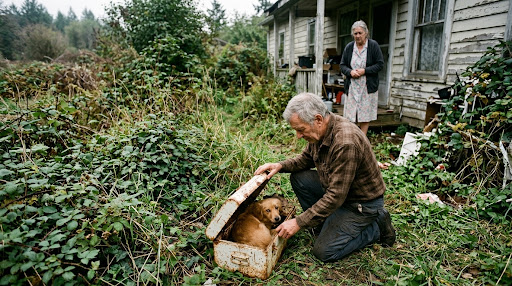
The Golden Retriever lay against my knees,
breathing in short, shallow bursts.
His tongue hung from his mouth,
and his eyes kept closing despite his desperate effort to stay awake.
The woman beside me gripped my arm.
“Walter, please. You need to hide the camera.”
I looked at her.
“Lady, I don’t even know your name.”
“Rebecca.”
“Rebecca what?”
“Rebecca Harlan.”
The name meant nothing to me.
But the terror in her eyes did.
I glanced toward the driveway.
A black pickup had stopped behind my truck.
A man climbed out.
He was broad-shouldered, probably in his late forties,
wearing work boots, dark jeans, and a gray polo shirt.
His hair was neatly combed, and he carried himself with
the relaxed confidence of someone accustomed to walking into places where he expected to be obeyed.
He looked toward the refrigerator.
Then toward Rebecca.
His expression changed.
“Rebecca,” he called. “What are you doing here?”
She went rigid.
I stood carefully, keeping myself between the man and the dog.
The stranger approached.
“Afternoon,” he said, offering a smile that didn’t reach his eyes. “You must be the new owner.”
“Walter Bennett.”
“Daniel Harlan.”
He extended his hand.
I didn’t take it.
His gaze dropped toward the open refrigerator.
For one brief second, his face went completely blank.
Then he smiled again.
“Well, I’ll be damned. That old dog is still alive.”
Something cold moved through my chest.
“You knew he was in there?”
Daniel shrugged.
“Stray animal. Been causing trouble around the neighborhood.”
I looked at the padlock lying in the weeds.
“Strays don’t lock themselves inside refrigerators.”
His smile faded.
“Careful, old man.”
Rebecca stepped forward.
“Daniel, please.”
He turned sharply.
“Get back in your car.”
She flinched.
I looked from one to the other.
Then I reached into my pocket and pulled out my phone.
“I’ve already called for veterinary help.”
Daniel’s eyes narrowed.
“Cancel it.”
“No.”
“That dog belongs to me.”
“Then you can explain to animal control why he was locked in a metal box.”
Daniel took another step.
“You have no idea what you’re getting involved in.”
I thought about the woman who had just told me my wife hadn’t died the way I believed.
I thought about the camera hidden beneath the dog’s filthy collar.
And I thought about the fact that Daniel Harlan seemed more concerned about a device than a dying animal.
“Maybe not,” I said. “But I’m about to find out.”
Daniel moved toward the refrigerator.
I stepped into his path.
“Don’t.”
He looked at me with open irritation.
“Move.”
“No.”
“That’s my dog.”
“Then he’s your responsibility.”
His jaw tightened.
For a moment, I thought he might hit me.
I was sixty years old, with two bad knees and a shoulder that complained every morning before breakfast.
I wasn’t interested in fighting a younger man.
But I wasn’t moving either.
Daniel glanced toward Rebecca.
“Did you tell him?”
She didn’t answer.
His voice hardened.
“Rebecca.”
She looked down.
I saw his hand curl into a fist.
Then, from the road, came the sound of another engine.
A white veterinary emergency van turned into the driveway.
Daniel stepped backward.
The van stopped beside my truck, and a woman in navy scrubs climbed out carrying a medical bag.
Another technician followed with a stretcher.
“Walter Bennett?” she asked.
“That’s me.”
“I’m Dr. Claire Morgan. Where’s the animal?”
I pointed toward the refrigerator.
Her expression changed when she saw him.
“Oh, sweetheart.”
She immediately knelt beside the dog.
The technician brought oxygen and emergency supplies.
Dr. Morgan examined his gums, checked his breathing, and felt along his ribs.
“Severe dehydration,” she said. “Possible heat injury. Extreme malnutrition.”
She looked up.
“How long has he been trapped?”
“I don’t know.”
Daniel spoke.
“He’s been wandering around for weeks.”
Dr. Morgan glanced at him.
“Are you the owner?”
“Yes.”
“Then we’ll need your contact information.”
Daniel hesitated.
Rebecca stepped forward.
“His name is Samson.”
The dog lifted his head slightly.
His tail moved.
Dr. Morgan looked toward her.
“You know him?”
Rebecca nodded.
“He’s seven years old.”
Daniel turned on her.
“Rebecca, stop talking.”
The veterinarian stood.
“Sir, I need you to step back.”
For a moment, Daniel looked ready to argue.
Then he noticed the technician photographing the refrigerator and damaged lock.
He stepped away.
I watched Dr. Morgan and her assistant gently transfer Samson onto the stretcher.
When they lifted him, something small slipped beneath his collar.
A black plastic device.
The camera.
Daniel saw it.
His entire expression changed.
“Wait,” he snapped. “That collar belongs to me.”
He reached forward.
I caught his wrist before he touched the dog.
“Leave him alone.”
He jerked free.
“Get your hands off me.”
Dr. Morgan stepped between us.
“The animal needs emergency treatment. Any property questions can be addressed afterward.”
Daniel stared at the collar.
Then he looked at Rebecca.
There was hatred in his eyes.
Real hatred.
And I suddenly understood that the dog wasn’t the only one afraid of him.
The veterinary team left with Samson.
I gave Dr. Morgan my phone number and told her I would pay the emergency deposit if necessary.
Daniel watched the van disappear.
Then he turned toward me.
“You’ve made a mistake.”
I looked at him.
“Maybe.”
He pointed toward the driveway.
“That animal is stolen property.”
I glanced at the refrigerator.
“Then I suggest you report it.”
He stepped closer.
“You think you’re clever?”
“No,” I said. “I think I’m tired.”
His eyes narrowed.
“Tired?”
“I’ve been working since sunrise. I found a dog dying in a refrigerator. And now I’ve got a stranger standing on my property threatening me.”
I paused.
“So unless you’ve got something useful to say, get off my land.”
Daniel stared at me.
Then he looked toward Rebecca.
“This isn’t finished.”
She said nothing.
He walked back to his pickup.
But before climbing inside, he turned.
“Walter Bennett,” he said slowly. “I know who you are.”
My stomach tightened.
He smiled.
“And I know what happened to your wife.”
Then he drove away.
Rebecca waited until the sound of his engine disappeared.
Then her knees seemed to give out.
She sat on an overturned bucket near the garage and covered her face.
I stood beside her.
“Start talking.”
She shook her head.
“I shouldn’t have come.”
“Rebecca.”
She looked up.
“You said something about my wife.”
Her eyes filled.
“I know.”
“My wife, Margaret, died three years ago.”
Rebecca nodded.
“October nineteenth.”
I felt my heart stop for a second.
“How do you know that?”
She looked toward the driveway.
“Because Daniel was there.”
The yard seemed to tilt beneath me.
I gripped the handle of my digging bar.
Margaret had died in a collision on a rainy county road.
A delivery truck had struck her car near the intersection outside Willow Creek.
The investigation concluded that she had entered the intersection during a signal malfunction.
The truck driver had survived.
Margaret hadn’t.
For three years, I’d carried the terrible thought that she’d made one mistake at the wrong moment.
She’d been driving to the pharmacy.
She’d called me twenty minutes earlier to ask whether I wanted anything from the grocery store.
I’d told her we needed milk.
Those were the last words I’d ever spoken to her.
“Daniel was there?” I whispered.
Rebecca nodded.
“He owned the delivery company.”
I stared at her.
The driver had worked for a company called Harlan Logistics.
I’d forgotten the owner’s name.
Or perhaps I’d never known it.
I only remembered the police report.
The rain.
The hospital.
The officer standing in my doorway.
Rebecca continued.
“Daniel told me the accident wasn’t his fault.”
“Whose fault?”
She swallowed.
“The driver’s. That’s what he said.”
I shook my head.
“Then why are you telling me this?”
She looked at me with tears running down her cheeks.
“Because I found out the truck’s brakes had been reported defective before the accident.”
My mouth went dry.
“And Daniel knew?”
She nodded.
“He ordered the truck kept in service.”
I stared at her.
“Why?”
“Because the company was behind on deliveries. He didn’t want to pay for repairs.”
For a moment, I couldn’t speak.
Then I whispered, “What does Samson have to do with any of this?”
Rebecca reached into her handbag.
She removed a small memory card.
“The camera on his collar was part of a home security system Daniel installed. It recorded short clips whenever Samson moved near the driveway or garage.”
I looked at the card.
“Three years ago?”
She nodded.
“Daniel kept the old recordings on a backup drive. Last month, I found footage from the night before the accident.”
My hands began trembling.
“What footage?”
She looked directly into my eyes.
“Daniel talking to the driver about the brakes.”
I stared at her.
Then she said something worse.
“He told the driver to take the truck out anyway. And he said if anything happened, the company would make sure the blame went somewhere else.”
I didn’t believe her immediately.
I wanted to.
God help me, I wanted to.
For three years, I’d wondered whether Margaret had died because of a momentary mistake.
I’d imagined her frightened in those final seconds.
I’d replayed our last telephone call until the words lost their meaning.
But wanting an answer didn’t make it true.
“Rebecca,” I said carefully, “why didn’t you go to the police?”
She looked ashamed.
“Because I was afraid of him.”
“Afraid he’d hurt you?”
She nodded.
“Has he?”
She looked away.
That was answer enough.
I sat beside her.
For a long time, neither of us spoke.
Then I asked, “Why now?”
She looked toward the refrigerator.
“Because Samson found the backup drive.”
I frowned.
“What?”
“Daniel had hidden it in a storage cabinet. Samson knocked the cabinet open while we were moving boxes. I found the drive and started looking through the files.”
She wiped her cheeks.
“When Daniel realized I’d seen them, he took the drive away. But I’d already copied several clips.”
I looked at the memory card.
“And the collar camera?”
“Daniel thought Samson might have recorded him destroying the backup equipment. He took the dog to this property after the foreclosure and left him here.”
My stomach turned.
“Inside the refrigerator?”
Rebecca nodded.
“He told me Samson had run away.”
I stared toward the weeds.
Then I thought of the dog lifting his head toward daylight.
The single movement of his tail.
The way he’d tried to crawl toward my hand.
“He was going to let that animal die,” I whispered.
Rebecca began crying again.
I stood.
“Come with me.”
She looked frightened.
“Where?”
“To my truck.”
“Why?”
“Because we’re not standing in an empty yard waiting for your husband to come back.”
I picked up my phone.
Then I called the county sheriff’s office.
And this time, I didn’t report a trespassing problem.
I reported a suspected act of animal cruelty, possible evidence destruction, and information concerning a fatal collision that had taken my wife’s life.
When the dispatcher asked whether I was safe, I looked at Rebecca.
Then toward the road.
“I don’t know,” I answered.
“But I intend to stay that way.”
PART 4
Deputy Marcus Hale arrived twenty minutes later.
He was younger than I expected, with a calm voice and the kind of patient expression that made people feel they could finish a sentence without being interrupted.
A second deputy followed.
They spoke with Rebecca separately.
They photographed the refrigerator.
They documented the broken hasp, the padlock, the surrounding tire tracks, and the condition of the backyard.
I handed over the photographs I’d taken before opening the refrigerator.
Then I explained what Rebecca had told me.
Deputy Hale listened without interrupting.
When I finished, he looked toward her.
“Mrs. Harlan has provided us with information that needs to be verified.”
I nodded.
“I understand.”
“We’ll also need to review the original accident investigation.”
I swallowed.
“Will you tell me what you find?”
“We’ll keep you informed as much as we legally can.”
He looked at me carefully.
“Mr. Bennett, I don’t want you confronting Daniel Harlan.”
“I won’t.”
“And if he contacts you?”
“I’ll call.”
He nodded.
“Good.”
Before leaving, he asked whether I’d be willing to provide a formal statement.
I agreed.
Then I watched the deputies drive away.
The yard fell quiet again.
But it was no longer the quiet I’d known that morning.
Something had opened.
Something I’d spent three years trying to bury.
And I knew I wouldn’t sleep until I understood what it meant.
That evening, Dr. Morgan called.
I answered before the second ring.
“How is he?”
She paused.
“Samson is very sick, Walter.”
I closed my eyes.
“Is he going to make it?”
“We’re doing everything we can. He’s severely dehydrated and malnourished. His body temperature was dangerously elevated when he arrived.”
I sat down.
“But he’s responding to treatment.”
I held my breath.
“He’s receiving carefully monitored fluids, oxygen support, and treatment for his other injuries. The next twenty-four hours are important.”
I stared at the wall.
“Can I see him?”
“Tomorrow morning, if he remains stable.”
I swallowed.
“Thank you.”
She hesitated.
“Walter, there’s something else.”
“What?”
“He reacts when we say his name.”
I closed my eyes.
“Samson?”
“Yes. And when one of the technicians mentioned your name, he lifted his head.”
I couldn’t speak.
Dr. Morgan continued softly.
“I think he remembers you.”
After the call ended, I sat in my kitchen for a long time.
Margaret’s photograph stood beside the window.
She was smiling beneath the apple tree we’d planted on our twentieth anniversary.
I looked at her.
“Something’s happening, Maggie,” I whispered.
“I don’t know what it is yet.”
The following morning, I visited Samson.
He lay on a thick blanket in a quiet treatment room.
An IV line ran to his leg.
His breathing was easier.
His eyes opened when I entered.
“Hey, boy.”
His tail moved.
Just once.
But stronger than before.
I knelt beside him.
“Look at you.”
He tried to lift his head.
I rested my hand gently against his neck.
“You don’t have to do anything,” I whispered. “Just get better.”
Dr. Morgan stood beside me.
“He’s a fighter.”
I looked at her.
“He shouldn’t have needed to be.”
She nodded.
“No. He shouldn’t.”
I stayed twenty minutes.
Before leaving, I asked whether Samson had a legal owner.
She explained that animal control would need to determine custody while the cruelty investigation proceeded.
I nodded.
“If he’s ever available for adoption, I’d like to be considered.”
Dr. Morgan smiled.
“I had a feeling you might say that.”
The investigation moved slowly.
That was the hardest part.
I wanted answers.
I wanted someone to tell me exactly what had happened on the night Margaret died.
But investigators had to verify records.
They had to examine the video files.
They had to determine when the recordings were created, whether they had been altered, and whether the people in them could be identified.
They also had to compare the recordings with the original collision report.
I learned more about the legal process in those weeks than I’d ever wanted to know.
And I learned something else.
Truth rarely arrives all at once.
Sometimes it comes in pieces.
A maintenance record.
A phone message.
A witness who finally decides to speak.
A document someone thought nobody would ever read.
Three weeks after I found Samson, Detective Laura Chen called.
She asked me to come to the sheriff’s office.
I drove there with my stomach in knots.
Detective Chen met me in a small interview room.
She was in her fifties, with silver beginning to show at her temples.
She placed a folder on the table.
“Mr. Bennett, we’ve reviewed the original collision investigation.”
I folded my hands.
“And?”
She looked at me.
“We found evidence that the delivery truck had unresolved brake maintenance issues before the collision.”
My throat tightened.
“Did the driver know?”
“We have records indicating that concerns were reported.”
I stared at her.
“And Daniel?”
She paused.
“We have communications suggesting that company management was aware of those concerns.”
I felt my eyes burn.
“Was my wife blamed for something she didn’t do?”
Detective Chen leaned forward.
“Walter, I need to be careful here. We are still reviewing the evidence. But the original conclusion may not have reflected all the relevant information.”
I looked down.
For three years, I’d imagined Margaret entering that intersection too quickly.
I’d wondered whether she had been distracted.
I’d wondered whether she’d missed the light.
Now there was reason to believe the truck might not have been able to stop properly.
Detective Chen continued.
“We’ve also identified discrepancies in maintenance records submitted after the collision.”
I looked up.
“What kind?”
“Records indicating repairs had been completed when other evidence suggests they had not.”
My hands began shaking.
“Someone falsified them?”
“That’s one possibility we’re investigating.”
I stared at the folder.
Then I whispered, “Can I see the video?”
She hesitated.
“We can show you a limited portion that has been reviewed.”
I nodded.
She turned a laptop toward me.
The footage was grainy.
A garage.
A parked delivery truck.
A dog moving near the bottom of the frame.
Then two men entered.
One was Daniel Harlan.
The other wore a company uniform.
I heard the driver say, “The brakes are still pulling.”
Daniel answered, “Then compensate for it.”
The driver shook his head.
“I already wrote it up.”
Daniel’s voice hardened.
“We’ve got deliveries to finish. The mechanic can look at it tomorrow.”
The driver said something I couldn’t hear.
Then Daniel replied, “If you refuse the route, I’ll find someone who wants your job.”
The video ended.
I stared at the screen.
My mouth had gone dry.
Detective Chen closed the laptop.
“Walter?”
I couldn’t answer.
For three years, I’d been trying to forgive my wife for a mistake she might never have made.
And now I had heard the man responsible for that truck dismiss a safety warning.
I covered my face.
The tears came without warning.
Not quiet tears.
Not dignified tears.
I cried the way I had cried in the hospital when the doctor told me Margaret was gone.
Detective Chen waited.
She didn’t tell me to calm down.
She didn’t offer meaningless reassurance.
She simply gave me time.
When I finally looked up, I whispered, “She was going to buy milk.”
Detective Chen’s expression softened.
“What?”
“Margaret. She called me before the accident.”
I wiped my eyes.
“She asked if we needed anything. I told her milk.”
My voice broke.
“She died because she went to get milk.”
Detective Chen shook her head gently.
“Walter, she died in a collision. You didn’t cause it by asking for groceries.”
I looked at her.
I wanted to believe that.
For the first time in three years, I thought perhaps I could.
The investigation eventually uncovered more than the video.
Former employees came forward.
One mechanic testified that he’d recommended taking the truck out of service.
A dispatcher provided messages concerning delivery deadlines.
A former manager described pressure to keep vehicles operating despite maintenance problems.
The evidence did not suggest Daniel had deliberately targeted Margaret.
That distinction mattered.
My wife had not been murdered as part of some secret plan.
But investigators believed the collision involved preventable safety failures, and that company records had been altered afterward to conceal what management knew.
The truth was terrible enough without inventing anything more.
Daniel Harlan had not set out to kill my wife.
He had made decisions that placed other people’s lives at risk.
Then, according to the evidence investigators were gathering, he had tried to protect himself when those decisions ended in tragedy.
And three years later, when Rebecca discovered the old recordings, he had allegedly tried to destroy the evidence.
Samson had become another victim.
Rebecca contacted me once during that period.
She had moved out of Daniel’s house and was staying with her sister.
She sounded exhausted.
“Walter, I’m sorry.”
I stood in my garden, holding the phone.
“For what?”
“For not coming forward sooner.”
I looked toward the apple tree.
“Rebecca, did you know about the video three years ago?”
“No.”
“Did you know the truck had problems?”
“Not until I found the records.”
“Then you couldn’t have told me something you didn’t know.”
She began crying.
“I should have left Daniel years ago.”
I was quiet.
Then I said, “You left when you could.”
She took a shaky breath.
“Do you hate me?”
I looked at the soil beneath my boots.
“No.”
“Why?”
“Because you came to that house.”
She didn’t answer.
“You could have stayed away. You could have let the dog die and the recordings disappear.”
My voice tightened.
“But you came.”
She began crying harder.
“Thank you.”
I closed my eyes.
“Just promise me you’ll stay safe.”
“I will.”
Samson spent nearly six weeks recovering.
He gained weight slowly.
His coat began to shine.
The sores on his body healed.
And the exhausted look in his eyes gradually gave way to something I hadn’t expected.
Curiosity.
He started watching birds through the clinic window.
He learned to trust the technicians.
He wagged his tail when I arrived.
And one morning, Dr. Morgan called to tell me he had carried a tennis ball across the treatment room.
I laughed so hard I nearly dropped the phone.
“Really?”
“Really.”
“Did he bring it back?”
“No,” she said. “He took it to his bed and refused to surrender it.”
I smiled.
“That sounds like a healthy dog.”
“It sounds like a dog who’s remembering how to enjoy being alive.”
The day Samson was released, I arrived with a new leash and a blue collar.
Animal control had completed the necessary process, and I had been approved to adopt him.
Dr. Morgan brought him into the waiting room.
He was still thinner than he should have been.
But he was walking.
His tail moved from side to side.
When he saw me, he stopped.
Then he hurried forward.
I knelt.
He pressed his head against my chest.
I wrapped my arms around him.
For a long moment, neither of us moved.
Dr. Morgan smiled.
“I think he knows.”
I looked up.
“Knows what?”
“That he’s going home.”
I felt tears gather.
“Yeah,” I whispered.
“I think he does.”
I took Samson to the house Margaret and I had shared.
He walked through the front door cautiously.
Sniffed the hallway.
Explored the living room.
Then stopped beside Margaret’s old armchair.
He looked at it for a long time.
I stood behind him.
“That was her chair,” I said softly.
He turned toward me.
I smiled sadly.
“You would’ve liked her.”
Samson approached the chair.
Sniffed the cushion.
Then lay down beside it.
I sat on the floor next to him.
For the first time in three years, the house didn’t feel entirely empty.
And for the first time since Margaret died, I realized I had something to come home to.
But the investigation wasn’t finished.
Not yet.
Because two months later, Detective Chen called with news that would finally force Daniel Harlan to answer for what had happened.
PART 5
Daniel Harlan was arrested on a cold November morning.
The charges concerned alleged falsification of business records, obstruction-related conduct, and animal cruelty.
Additional proceedings examined the company’s maintenance practices and the fatal collision involving Margaret.
I learned about the arrest from Detective Chen.
She called while I was making breakfast.
Samson was lying beside the kitchen table, waiting hopefully for something to fall.
“Walter,” she said, “I wanted you to hear this from me.”
I set down my coffee.
“What happened?”
“Daniel Harlan has been taken into custody.”
I closed my eyes.
For several seconds, I couldn’t speak.
Then I asked, “Does this mean it’s over?”
“Not yet. There will be court proceedings.”
I nodded, though she couldn’t see me.
“But we’ve reached an important point.”
I looked toward Margaret’s photograph.
“Thank you.”
After the call ended, I sat quietly.
Samson lifted his head.
I reached down and scratched behind his ears.
“They found him, boy.”
Samson wagged his tail.
I smiled.
“You did good.”
The case took months.
There were hearings.
Attorneys.
Witnesses.
Financial records.
Maintenance logs.
And more technical testimony than I could ever fully understand.
The video from Samson’s collar was only one part of the evidence.
Investigators had recovered additional records from company computers and backup systems.
Former employees testified about safety complaints.
The mechanic described the repairs he’d recommended.
And the driver, who had survived the collision, admitted that he had been frightened of losing his job if he refused the route.
I listened to him testify.
He was older than I’d expected.
His hair had gone gray.
His hands shook as he spoke.
He said he’d been driving for Harlan Logistics for eleven years.
He’d raised concerns about the truck’s brakes.
He’d asked for another vehicle.
But the company had been behind schedule, and he believed refusing the assignment would cost him his livelihood.
Then he looked toward me.
“Mr. Bennett,” he whispered, “I’m sorry.”
I stared at him.
For three years, I’d imagined this man as the person who had taken my wife from me.
I’d hated him.
Sometimes I’d hated him so much that I couldn’t sleep.
But now, looking at his trembling hands, I saw someone who had also spent years living with what happened.
I didn’t excuse his decision to drive.
I couldn’t.
But I understood that the responsibility extended beyond one frightened employee.
I nodded once.
He lowered his head.
And I realized that anger could become a prison if you let it decide who deserved to be heard.
Daniel’s defense argued that he had not intended anyone to be harmed.
His attorneys emphasized that he had not been driving the truck.
They questioned whether the video captured the full conversation.
They argued that maintenance decisions involved multiple employees and that the collision itself had several contributing factors.
The court examined those arguments.
Witnesses were questioned.
Evidence was challenged.
And the legal process continued.
I didn’t enjoy any of it.
I didn’t enjoy sitting in a courtroom listening to people discuss my wife’s final moments.
I didn’t enjoy hearing her name repeated as part of a case file.
And I certainly didn’t enjoy seeing Daniel Harlan sitting across the room, dressed in a suit, looking as though the entire matter were an inconvenience.
But I attended because Margaret deserved the truth.
And because Samson deserved to have what happened to him taken seriously.
Eventually, Daniel entered a negotiated plea to several offenses, including charges connected to the concealment of records and the mistreatment of Samson.
The company also faced substantial civil penalties and financial consequences arising from its safety failures.
A separate civil resolution addressed the claims connected to Margaret’s death.
No amount of money could replace her.
I knew that before the attorneys explained the settlement.
I knew it when I signed the documents.
And I knew it when the final payment arrived.
Margaret wasn’t coming back.
Not for a million dollars.
Not for ten million.
Not for every dollar Daniel Harlan had ever earned.
But the official findings corrected the false impression that Margaret had simply caused the collision through carelessness.
The records now reflected the evidence of serious mechanical problems and management failures.
That mattered.
Not because it changed what happened.
Because it changed what people understood about what happened.
For three years, my wife had carried blame she did not deserve.
Now the truth had finally reached the people who needed to hear it.
After the proceedings, Detective Chen met me outside the courthouse.
“You held up well,” she said.
I gave a tired laugh.
“Didn’t feel like it.”
She smiled.
“You don’t have to feel strong to be strong.”
I looked toward the courthouse steps.
“Do you think Margaret would be satisfied?”
Detective Chen considered the question.
“I didn’t know your wife.”
I nodded.
“But from what you’ve told me, I think she’d be glad you found the truth.”
I looked down.
“And the dog?”
She smiled.
“I think she’d be glad about him too.”
I laughed softly.
“Yeah.”
Then I wiped my eyes.
“She always wanted another dog.”
Rebecca came to see Samson the following spring.
She called first.
I invited her over on a Saturday afternoon.
When she stepped onto my porch, Samson was lying in a patch of sunlight.
He lifted his head.
For a moment, he stared at her.
Then he stood.
Rebecca froze.
“Samson?”
His tail began moving.
She knelt.
He walked toward her slowly.
Then pressed his head into her hands.
Rebecca burst into tears.
“Oh, my sweet boy.”
I stood quietly near the doorway.
She wrapped her arms around his neck.
“I’m so sorry.”
Samson licked her cheek.
She laughed through her tears.
“I missed you.”
For a long time, she sat on the porch holding him.
Then she looked up at me.
“He looks wonderful.”
I smiled.
“He’s spoiled rotten.”
She laughed.
“I can see that.”
“He sleeps on the sofa.”
“Of course he does.”
“He steals my gardening gloves.”
Rebecca smiled.
“He always liked carrying things.”
I nodded.
“And he thinks every squirrel in the neighborhood is a personal enemy.”
She laughed again.
For a moment, she looked like someone who had forgotten what it felt like to laugh.
Then she stood.
“Walter, thank you.”
I shook my head.
“You saved him too.”
She looked toward Samson.
“I wish I’d done it sooner.”
I placed a hand on her shoulder.
“You did it when it mattered.”
She nodded.
Then she asked, “Can I visit him sometimes?”
I smiled.
“Of course.”
The foreclosed house eventually sold.
I finished cleaning the yard.
Repaired the fence.
Removed the old refrigerator after investigators released it.
And made sure every discarded appliance on the property was handled safely.
I couldn’t look at an old refrigerator the same way again.
Sometimes, while working, I’d remember that thin scratching sound.
The weak whine.
The way Samson’s tail had moved once against the metal.
And I’d have to stop for a moment.
Because I knew how close he’d come to dying.
I knew how easily I could have mistaken the sound for rats.
How easily I could have walked away.
How easily the truth about Margaret might have remained hidden.
Life can turn on something so small.
A sound.
A decision.
One person choosing not to ignore what doesn’t seem right.
With part of the civil settlement, I established a small fund in Margaret’s name.
Not a grand foundation.
Nothing with a fancy office or expensive brochures.
Just a fund administered through a local animal welfare organization to help older dogs receive emergency veterinary treatment.
I called it the Margaret Bennett Second Chance Fund.
The first dog it helped was a twelve-year-old Labrador named Rosie.
She’d been abandoned after her owner moved away.
She needed dental treatment, medication, and a safe place to recover.
The fund covered her care.
A retired couple adopted her three weeks later.
When the rescue sent me a photograph of Rosie sleeping beside a fireplace, I sat at my kitchen table and cried.
Margaret would have loved that.
She’d always been the kind of woman who stopped to help injured birds.
Who carried spare dog biscuits in her purse.
Who once made me drive twenty miles out of our way because she’d seen a lost-cat poster at a gas station and wanted to check the neighborhood.
She believed every living thing deserved kindness.
I couldn’t bring her back.
But I could keep something she believed in alive.
Summer returned.
The garden grew thick with tomatoes, roses, and climbing beans.
Samson followed me everywhere.
He slept beneath the workbench while I repaired tools.
He carried sticks around the yard as though he had important responsibilities.
And every morning, when I stepped outside with my coffee, he waited beside the door.
Sometimes I’d look at him and remember the dog I’d found in that refrigerator.
Thin.
Weak.
Almost gone.
Now he weighed seventy-two pounds.
His coat shone gold in the sunlight.
His eyes were bright.
And his tail never seemed to stop moving.
One morning, I sat beneath the apple tree Margaret and I had planted.
Samson lay beside me.
I looked toward the branches.
The apples were beginning to form.
Small.
Green.
Full of promise.
“Your mom would’ve liked you,” I told him.
He lifted his head.
I smiled.
“Not your real mom, of course.”
He tilted his head.
I laughed.
“Margaret. My Margaret.”
He moved closer and rested his head on my knee.
I scratched behind his ears.
“She would’ve spoiled you worse than I do.”
His tail thumped against the grass.
I looked toward the house.
For three years, I’d believed my life was getting smaller.
I’d believed the best part of it had ended when Margaret died.
I’d worked because I didn’t know what else to do.
I’d bought neglected houses because fixing broken things gave me something to think about besides the one thing I couldn’t fix.
But then I’d found Samson.
And somehow, in saving him, I’d begun finding my way back to the world.
On the third anniversary of the day I discovered him, I returned to the old foreclosure property.
The new owners had renovated the house.
The windows were repaired.
The yard was green.
A vegetable garden stood where the rusted grill had once been.
The refrigerator was long gone.
A young family lived there now.
They had two children and a brown dog who barked excitedly when Samson and I walked past.
I stopped near the sidewalk.
Samson sniffed the grass.
I looked toward the backyard.
For a moment, I remembered everything.
The heat.
The weeds.
The scratching.
The padlock.
The smell when the refrigerator opened.
And the terrible fear that I was too late.
I knelt beside Samson.
He looked at me.
“Do you remember this place, boy?”
He wagged his tail.
I smiled.
“Maybe it’s better if you don’t.”
He leaned against me.
I wrapped one arm around his neck.
Then I stood.
“Come on. Let’s go home.”
That evening, I made dinner for two.
Not because I had another person sitting at the table.
Because Samson had his own bowl beside my chair.
I cooked chicken and vegetables.
He ate his prescribed dog food with the enthusiasm of a creature who still considered every meal a miracle.
Afterward, we sat on the porch.
The sky turned orange.
The crickets began singing.
A breeze moved through the roses.
I looked at Margaret’s photograph on the small table beside me.
“It’s been a strange few years, Maggie,” I whispered.
Samson lifted his head.
I smiled.
“You wouldn’t believe half of it.”
I thought about the courtroom.
The video.
Rebecca.
The long months of waiting.
The moment the official findings finally acknowledged what had happened.
And I thought about the man I’d been before finding Samson.
A lonely widower who expected the rest of his life to become quieter and smaller.
Now my mornings began with a dog nudging my hand.
My afternoons were filled with gardening, rescue visits, and the occasional phone call from Rebecca.
And my evenings no longer ended in complete silence.
I still missed Margaret.
I always would.
Some losses don’t disappear.
You simply learn to carry them differently.
But I no longer felt as though I was waiting for my life to end.
I felt as though I had been given another chapter.
One I hadn’t expected.
One that began with a sound almost too faint to hear.
A few weeks later, the animal rescue invited me to speak at a small fundraiser.
I almost refused.
I wasn’t a public speaker.
I was a gardener.
A man who preferred soil to microphones.
But the director told me the event was raising money for emergency animal care.
So I agreed.
I stood before about eighty people with Samson beside me.
He wore a blue bandana.
He looked considerably more comfortable than I felt.
I cleared my throat.
“My name is Walter Bennett,” I began. “And three years ago, I found this dog inside an abandoned refrigerator.”
The room went silent.
I looked down at Samson.
He wagged his tail.
I smiled.
“When I found him, I thought I was too late.”
My voice tightened.
“But he was alive.”
I paused.
“And I learned something that day.”
I looked around the room.
“Sometimes the world gives you a chance to do one good thing. It might be inconvenient. It might be frightening. It might lead somewhere you never expected.”
I swallowed.
“But if something needs help, don’t walk away just because helping is difficult.”
Samson leaned against my leg.
I rested my hand on his head.
“This dog survived because someone stopped and listened.”
I looked toward the photograph of Margaret displayed beside the stage.
“And I survived a very lonely time in my life because he gave me a reason to keep going.”
For a moment, I couldn’t speak.
Then the audience began applauding.
I looked down.
Samson wagged his tail harder.
And I laughed through my tears.
That night, after the fundraiser, I drove home beneath a sky full of stars.
Samson slept in the passenger seat.
His head rested on a folded blanket.
Every few minutes, he’d make a little sound in his sleep.
Not the exhausted whine I’d heard from the refrigerator.
Something softer.
Peaceful.
The sound of a dog dreaming.
I pulled into the driveway and turned off the engine.
For a moment, I sat quietly.
Then I looked toward the house.
The porch light was on.
The garden was growing.
The windows reflected the stars.
And somewhere inside, Margaret’s photograph waited beside the kitchen window.
I reached over and scratched Samson’s head.
He opened one eye.
“Ready to go home, old boy?”
His tail moved.
I smiled.
Then I opened the door.
Because three years earlier, I had walked into an abandoned backyard expecting to clear weeds and broken furniture.
Instead, I’d found a dying dog.
A hidden camera.
The truth about my wife’s death.
And, eventually, a reason to believe my own life wasn’t finished.
I had spent forty years helping things grow.
Trees.
Flowers.
Gardens.
Places other people called home.
But the most important thing I ever saved wasn’t something I’d planted.
It was a Golden Retriever who had been left to die in the dark.
And the most important thing he gave me wasn’t evidence.
It wasn’t justice.
It wasn’t even companionship.
It was the simple reminder that life can begin again when you least expect it.
Sometimes all it takes is one small sound.
One decision to listen.
And one old man who refuses to walk away.
THE END THANK YOU FOR READING !!!