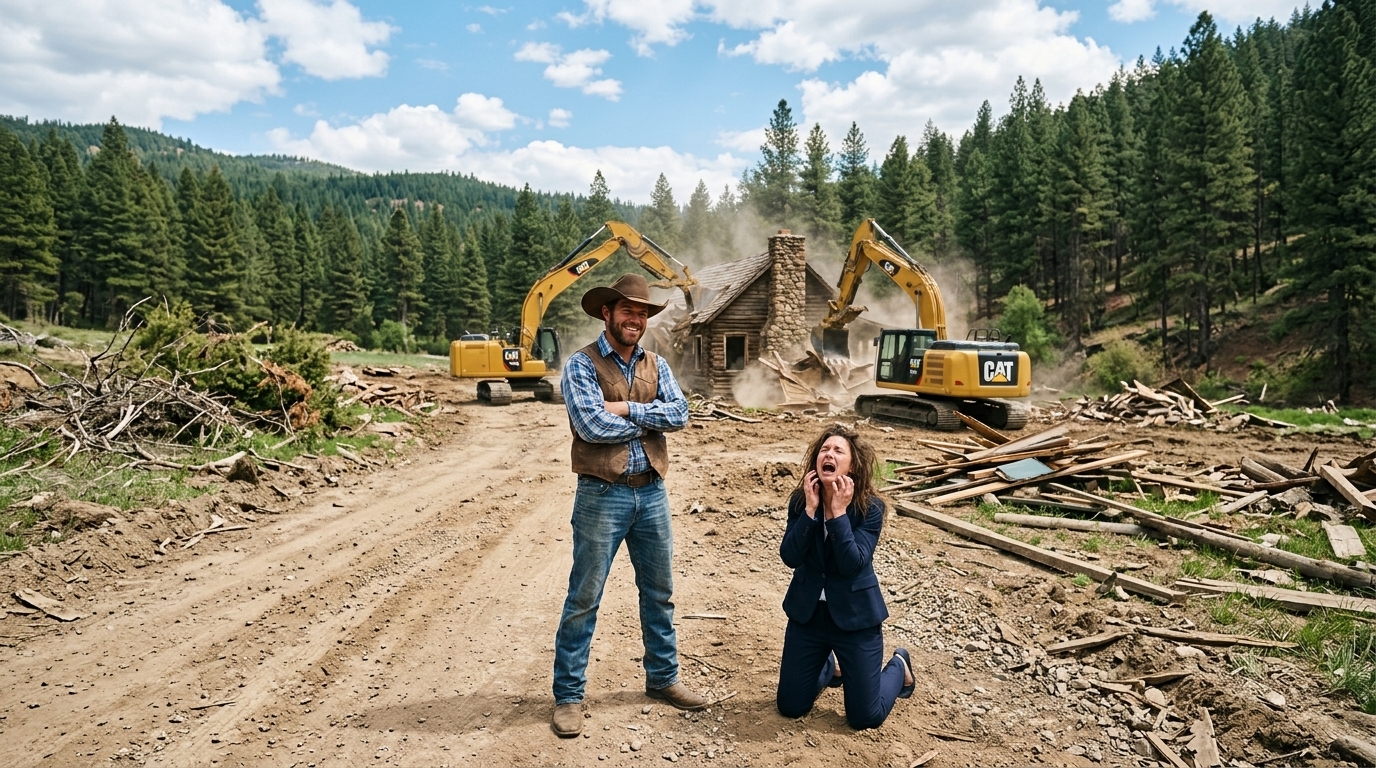
Part 3
The courtroom went completely silent.
I stared at the document the judge was holding,
trying to understand how anyone could have been foolish
enough to put my father’s name on a legal agreement dated eleven years after his death.
My father, Walter Mitchell,
had passed away from a heart attack when I was forty-one.
I remembered the exact date.
March 17, 2015.
I remembered the hospital corridor,
the smell of disinfectant,
and the way his hand had gone cold inside mine.
I remembered standing beside his grave three days later
while rain soaked through my jacket.
And now, according to the document Karen Westbrook had submitted to the court,
he had apparently returned from the dead to authorize construction of an HOA cabin.
Judge Eleanor Hayes adjusted her glasses.
“Mrs. Westbrook, I am going to ask you that question again. Who signed this agreement?”
Karen stood beside her attorney, wearing a navy suit and the confident expression she usually reserved for HOA meetings.
“Walter Mitchell,” she answered. “The original landowner.”
The judge looked toward me.
“Mr. Mitchell, is Walter Mitchell your father?”
“Yes, Your Honor.”
“And is he living?”
“No, Your Honor. He died eleven years before the date on that agreement.”
Karen’s expression changed.
Only slightly.
But I saw it.
Her lips parted, and her eyes moved toward the attorney standing beside her.
Judge Hayes lowered the document.
“Counsel, were you aware of this discrepancy?”
Karen’s attorney, a middle-aged man named Peter Lawson, looked genuinely startled.
“Your Honor, this document was provided by my client as part of the association’s historical property records. I had not been informed that the named signatory was deceased at the time of execution.”
The judge leaned back.
“Then I suggest you and your client determine precisely how this document came into existence.”
Karen raised her hand.
“Your Honor, perhaps there’s a misunderstanding. Walter Mitchell could have signed something years earlier, and the date may have been entered incorrectly.”
I felt my jaw tighten.
The judge examined the page again.
“The agreement references a subdivision expansion approved in 2024. Are you suggesting Mr. Mitchell signed an agreement concerning a project that did not exist until years after his death?”
Karen said nothing.
My attorney, Sarah Bennett, rose.
“Your Honor, we have certified records establishing Mr. Mitchell’s date of death. We also have the original recorded deed showing that my client acquired sole ownership of the property before the alleged agreement was executed.”
She placed the documents before the court.
Judge Hayes reviewed them carefully.
Then she turned toward Karen.
“Mrs. Westbrook, this is a serious matter. The authenticity of this document is now directly in question.”
Karen’s face flushed.
“I didn’t personally prepare it.”
That was the first time she had stopped claiming complete authority over everything.
Sarah glanced at me.
I knew what she was thinking.
The case had just changed.
Until that morning, the dispute had concerned unauthorized construction, trespassing, and competing claims about property rights.
Now it involved a document that appeared to carry a forged signature.
And the person who had submitted it was the president of Pine Ridge HOA.
The judge did not immediately declare anyone guilty of forgery.
Instead, she ordered the parties to preserve the original documents and authorized further examination of the disputed agreement.
The HOA’s request for damages remained unresolved.
The court also entered temporary restrictions intended to prevent further construction, alterations, or interference with the disputed area while the property claims were examined.
That meant nobody could expand the cabin.
Nobody could remove evidence.
And nobody could pretend the situation was simply a disagreement about where hikers were allowed to walk.
Outside the courtroom, Karen approached me.
Her heels clicked against the marble floor.
“Robert, we need to talk.”
I stopped.
Sarah remained beside me.
“About what?” I asked.
Karen glanced around.
“Not here.”
“Then contact my attorney.”
She lowered her voice.
“You’re making this unnecessarily complicated.”
I stared at her.
“You submitted an agreement carrying my dead father’s signature.”
Her expression hardened.
“I didn’t create that document.”
“Then who did?”
She looked away.
“I don’t know.”
I studied her face.
For months, Karen had acted as though she personally controlled every acre surrounding Pine Ridge.
She had ordered me to remove my sign.
She had threatened legal action.
She had claimed the cabin was an approved community retreat.
And when I refused to surrender my property, she had demanded seventy-five thousand dollars from me.
Now she suddenly knew nothing.
“Karen,” I said quietly, “someone built a cabin on my land. Someone removed my boundary markers. And someone submitted a document that my father could not possibly have signed.”
She crossed her arms.
“What are you accusing me of?”
“I’m asking who authorized it.”
Her eyes narrowed.
“You should be careful.”
Sarah stepped forward.
“My client has no further comment. Any communication should come through counsel.”
Karen watched us walk away.
I could feel her staring at my back.
But for the first time since discovering the cabin, I wasn’t worried about what she might say.
I was wondering what the records would reveal.
Two days later, Sarah called.
“Robert, I need you to come to my office.”
I was repairing a section of fencing near the creek.
“Did something happen?”
“We received the HOA’s construction records.”
“And?”
She paused.
“There’s more than one suspicious document.”
I set down my hammer.
“I’ll be there in forty minutes.”
When I arrived, Sarah had arranged several folders across her conference table.
She pointed toward the first.
“These are invoices for the cabin.”
I looked at the amounts.
Foundation work: $38,400.
Framing and roofing: $61,700.
Electrical installation: $24,900.
Plumbing and septic work: $31,600.
Interior finishes and furnishings: $47,800.
Land clearing, grading, and access improvements: $29,300.
Other expenses brought the total to approximately $267,000.
I stared at the final figure.
“Two hundred sixty-seven thousand dollars?”
Sarah nodded.
“According to these records.”
I looked up.
“They spent that much building something on land they didn’t own?”
“Apparently.”
I turned another page.
The invoices were addressed to Pine Ridge Homeowners Association.
Several bore Karen’s approval.
Others had been authorized by the association’s treasurer, a man named Douglas Price.
But one document caught my attention.
It was a payment request labeled:
SPECIAL COMMUNITY IMPROVEMENT FUND — PHASE TWO.
Amount: $185,000.
I frowned.
“Phase two?”
Sarah opened another folder.
“That’s where things become interesting.”
Inside was a proposed development map.
The cabin appeared in the center.
But the drawing didn’t stop there.
A paved parking area was planned near my eastern boundary.
A walking trail extended toward my creek.
A wooden bridge crossed the water.
And beyond it, several small structures were marked as future rental cottages.
I stared at the map.
“They weren’t building one cabin.”
“No,” Sarah said.
“They were planning a resort.”
“That’s what it looks like.”
I leaned back.
The cabin had never been intended as a simple community retreat.
It was the beginning of something much larger.
And every proposed improvement crossed deeper into my property.
That evening, I walked to the clearing.
The cabin stood beneath the pines, looking almost peaceful.
It had a wide porch, cedar siding, and large windows overlooking the valley.
Someone had planted flowers beside the entrance.
A wooden plaque near the door read:
PINE RIDGE HERITAGE LODGE
A PLACE FOR OUR COMMUNITY TO GATHER
I stared at those words.
My father had spent thirty years caring for this land.
He had planted trees.
Repaired fences.
Protected the creek from erosion.
He had taught me that ownership wasn’t simply about possession.
It was about responsibility.
And now someone had used his name to justify taking it.
I walked around the cabin without touching anything.
My cameras were still recording.
The damaged boundary marker remained where investigators had documented it.
I stopped near the trail.
That was when I noticed fresh tire tracks.
Someone had driven a vehicle toward the cabin recently.
Despite the court’s restrictions.
I photographed the tracks.
Then I checked the cameras.
At 11:42 the previous night, a dark pickup had entered from the subdivision.
Two people climbed out.
One carried a cardboard box.
The other carried what looked like a portable storage container.
They entered the cabin using a key.
Twenty minutes later, they left carrying several folders.
I watched the recording again.
Then I enlarged the clearest frame.
One of the people was Douglas Price.
The HOA treasurer.
The other was Karen Westbrook.
And the box Karen carried out had the words PROPERTY RECORDS printed across the side.
I immediately called Sarah.
“Someone went into the cabin last night.”
“Who?”
“Karen and Douglas.”
There was a pause.
“Do you have the recording?”
“Yes.”
“Preserve the original. Don’t confront them.”
I looked toward the cabin.
“Sarah, I think they’re removing documents.”
“Then we need to notify the court.”
The following morning, Sarah filed the appropriate notice and requested preservation measures concerning the records.
Karen’s attorney insisted the visit had been for routine administrative purposes.
But when the court requested an accounting of the materials removed, the HOA’s explanations became inconsistent.
One board member claimed the documents were maintenance records.
Another said they were historical property files.
Douglas described them as financial paperwork.
Karen said she couldn’t remember exactly what had been inside the box.
For someone who had once insisted that every HOA decision passed through her office, she suddenly had a remarkably poor memory.
Then a new witness contacted Sarah.
His name was Henry Collins.
He was seventy-three, a retired survey technician, and one of the original residents of Pine Ridge.
He said he had something important to tell us.
When Henry arrived at Sarah’s office, he carried a weathered blue folder.
He placed it on the table.
“I’ve been waiting for somebody to ask the right questions,” he said.
I leaned forward.
“What questions?”
Henry opened the folder.
“Questions about why Karen moved the boundary line on the association’s maps.”
I stared at him.
“Moved it?”
He nodded.
“Not the legal boundary. The line on the maps they showed homeowners.”
Sarah sat upright.
“Mr. Collins, can you explain?”
Henry took out two drawings.
One was the original subdivision survey.
The other was a community map distributed three years earlier.
On the original survey, my property line was clearly marked.
On the newer map, the HOA’s recreational area extended hundreds of feet into my woods.
The cabin stood inside that falsely expanded section.
I looked at Henry.
“Who changed it?”
He hesitated.
Then he said, “Karen told the board that your father had donated the land years ago.”
My stomach tightened.
Henry continued.
“When I questioned her, she said the paperwork was in storage. I asked to see it. She told me to stop causing trouble.”
“Did you believe her?”
“No.”
“Then why didn’t you tell me?”
He looked ashamed.
“Because I thought the board would eventually correct it. And because I didn’t want to spend my retirement fighting my neighbors.”
He pushed another document toward me.
It was a copy of meeting minutes from three years earlier.
One sentence had been highlighted.
President Westbrook confirmed that the Mitchell woodland tract had been transferred to the association through a prior family agreement.
I stared at the words.
My father’s name had been used to create a history that never happened.
And now I understood why Karen had been so determined to remove my PRIVATE PROPERTY sign.
The sign didn’t simply challenge her authority.
It threatened the story she’d spent years building.
But Henry had one more document.
And when Sarah unfolded it, even she looked stunned.
It was a preliminary budget showing projected income from renting the cabin to nonresidents.
The amount was more than $90,000 annually.
Karen hadn’t merely built an unauthorized community amenity.
She had helped create a business on land that belonged to someone else.
Part 4
The emergency HOA meeting was scheduled for the following Tuesday.
I didn’t attend because I wanted to embarrass anyone.
I attended because the association’s decisions had affected my property, and the homeowners deserved to understand what was happening.
Sarah accompanied me.
Henry sat beside us.
The clubhouse was packed.
Residents filled every chair.
Others stood along the walls.
Some looked angry.
Others looked confused.
A few avoided eye contact.
Karen sat at the front table beside Douglas and two other board members.
Her expression was tight.
She had clearly expected the meeting to be uncomfortable.
I doubted she expected what came next.
A middle-aged woman stood near the back.
“My name is Linda Harper,” she announced. “I’ve lived here for nine years, and I want to know why our monthly dues increased three times to pay for a cabin that apparently isn’t even on HOA property.”
Murmurs spread through the room.
Karen leaned toward the microphone.
“Mrs. Harper, the association has always been transparent about community improvements.”
Linda held up a folder.
“Then why doesn’t the annual budget show the full construction cost?”
Douglas shifted in his chair.
Karen frowned.
“Some expenses were allocated across multiple categories.”
A man near the front stood.
“That’s not what we were told.”
Karen looked irritated.
“Please wait until you’re recognized.”
The man continued.
“My name is James Foster. I paid a $2,500 special assessment because the board said the cabin was necessary to preserve property values.”
Several residents nodded.
James pointed toward me.
“Now I’m hearing it was built on Mr. Mitchell’s land. Is that true?”
Karen opened her mouth.
Sarah rose.
“The recorded surveys place the cabin on my client’s property. The association disputes certain rights, but no valid conveyance has been produced establishing HOA ownership of the land.”
The room erupted.
Karen struck the table with a small wooden gavel.
“Order!”
Nobody listened.
A woman near the windows shouted, “You told us the land had been donated!”
Another resident demanded, “Where’s the deed?”
Douglas stared at his papers.
Karen’s voice rose.
“We have historical documentation!”
Henry slowly stood.
“Then show it.”
The room quieted.
Karen stared at him.
“Henry, sit down.”
He remained standing.
“I worked with property surveys for thirty-eight years,” he said. “And I’ve asked you for that document repeatedly.”
Karen’s cheeks reddened.
“This isn’t the appropriate forum.”
Henry lifted his folder.
“Then perhaps you can explain why the community map was changed without a recorded boundary adjustment.”
A murmur swept across the room.
He held up the two maps.
Several residents leaned forward.
“That’s the original survey,” Henry explained. “And that’s the map the board circulated after Karen became president.”
He pointed to the altered boundary.
“The legal line didn’t move. The drawing did.”
Karen stood.
“That is a gross misrepresentation!”
Henry looked at her.
“Then show everyone the recorded deed.”
Silence.
For the first time that evening, Karen had no immediate response.
The meeting lasted nearly four hours.
By the end, homeowners had demanded an independent financial audit, access to the association’s records, and a special election to reconsider the board’s leadership.
Several residents were furious that their money had funded construction on disputed land.
Others were frightened about possible legal liability.
One elderly couple approached me afterward.
The woman introduced herself as Margaret Ellis.
“Mr. Mitchell, I want to apologize.”
I shook my head.
“You don’t owe me an apology.”
She looked toward the clubhouse.
“We believed the board. We thought the cabin was something nice for our grandchildren.”
“I understand.”
Her husband sighed.
“We never imagined they hadn’t checked the ownership.”
I looked at them.
“Most people assume an organization spending that much money has done its homework.”
Margaret nodded.
Then she said something that stayed with me.
“It’s frightening how easily people can confuse confidence with honesty.”
I thought about Karen standing at my gate, demanding that I remove my sign.
“Yes,” I said. “It is.”
The independent audit began two weeks later.
The association hired an outside accounting firm.
The board also retained separate legal counsel to review the property dispute and the authenticity of the documents.
The auditors requested invoices, bank statements, meeting minutes, vendor agreements, and records concerning the cabin’s operation.
What they discovered surprised even Sarah.
The cabin had been rented to private groups.
Not just residents.
Wedding parties.
Corporate retreats.
Birthday celebrations.
Weekend gatherings.
The rental fees had been deposited into an account associated with a company called Westbrook Community Services.
The company was registered to Karen’s brother, Steven.
I stared at the information.
“Her brother?”
Sarah nodded.
“That’s what the corporate records indicate.”
“Did the HOA authorize this arrangement?”
“That’s under investigation.”
The financial records showed that money had moved between the HOA, the management company, and several vendors.
Some payments were supported by invoices.
Others required further explanation.
The auditors did not immediately conclude that every questionable transaction was fraudulent.
But they identified serious deficiencies in the association’s financial controls.
There were missing approvals.
Incomplete records.
Payments that lacked adequate supporting documentation.
And contracts involving individuals connected to board leadership.
The more I learned, the clearer the picture became.
Karen had not simply mistaken my property for community land.
She had presided over an organization that treated its own procedures as optional whenever they interfered with her plans.
One afternoon, Sarah received a call from Douglas Price.
He wanted to speak privately.
His attorney would be present.
We met at Sarah’s office.
Douglas looked exhausted.
His hands shook as he placed a folder on the table.
“I should have stopped this,” he said.
Sarah waited.
Douglas looked at me.
“Robert, I knew the cabin was being built near your property. I didn’t realize how far inside the boundary it was until the foundation was finished.”
I folded my arms.
“Then why didn’t you contact me?”
He looked down.
“Karen said the land had been transferred years ago.”
“Did you see the transfer?”
“No.”
“Did you ask?”
“Yes.”
“What did she say?”
“That the documents were confidential.”
I stared at him.
“Property ownership isn’t established by a confidential conversation.”
He nodded miserably.
“I know that now.”
Sarah leaned forward.
“Mr. Price, what can you tell us about the disputed agreement?”
Douglas swallowed.
“Karen brought it to a board meeting after the cabin was already under construction.”
“Did you see Walter Mitchell sign it?”
“No.”
“Did anyone?”
“Not that I know of.”
He hesitated.
Then he opened his folder.
Inside was an email.
Karen had sent it to Douglas eighteen months earlier.
The subject line read:
LAND AGREEMENT — FINAL VERSION
The message said:
Use this copy for the records. The old owner authorization has been updated to match the current project.
Sarah read the sentence carefully.
“Do you know who prepared the updated document?”
Douglas shook his head.
“No. But Karen told me Steven had someone handle it.”
My jaw tightened.
Karen’s brother.
Again.
Douglas continued.
“I didn’t ask questions because I was afraid of what would happen if I challenged her.”
I stared at him.
“And what happened when nobody challenged her?”
He looked at the floor.
I didn’t need to answer.
The cabin itself was the answer.
The court proceedings resumed the following month.
This time, the disputed agreement was examined alongside the survey records, construction documents, and witness testimony.
A forensic document examiner testified about inconsistencies in the signature attributed to my father.
The certified death record established that he could not have signed the document on its stated date.
The HOA’s attorney acknowledged that the association could not authenticate the agreement as a valid conveyance of property rights.
Sarah presented the original surveys and the county ownership records.
She also introduced the camera footage showing the removal of my sign and interference with the boundary marker.
The footage was clear.
The two men arrived in a vehicle associated with an HOA contractor.
One removed the sign.
The other disturbed the marker.
Neither had permission from me.
Karen watched from the defense table.
Her expression was rigid.
When she testified, Sarah questioned her about the original property records.
“Mrs. Westbrook, did you personally verify that the association owned the land before authorizing construction?”
Karen adjusted her jacket.
“I relied on information available to the board.”
“Did you obtain a current boundary survey?”
“No.”
“Did you contact Mr. Mitchell?”
“No.”
“Did you verify the alleged transfer with the county recorder?”
Karen hesitated.
“I believed the historical agreement was sufficient.”
Sarah held up the disputed document.
“An agreement dated eleven years after the named landowner’s death?”
Karen’s face flushed.
“I didn’t know he was deceased.”
Sarah paused.
“Did you ever attempt to confirm whether he was alive?”
“No.”
“Yet you represented to homeowners that the land had been donated?”
Karen stared at the table.
“Yes.”
“Without verifying that claim?”
There was a long silence.
Then Karen whispered, “Yes.”
I sat motionless.
For months, she had insisted I was the unreasonable one.
She had accused me of interfering with community rights.
She had demanded that I remove my own sign.
Now she was admitting she hadn’t taken the most basic steps to confirm whether the HOA owned the land it was building on.
The judge issued a written decision several weeks later.
The court found that the HOA had not established ownership of the cabin site or a valid right to construct there.
The disputed agreement did not establish a lawful transfer.
The recorded surveys supported my ownership claim.
The association’s demand for seventy-five thousand dollars in damages was rejected.
And the court ordered further proceedings concerning removal of the encroaching structure, restoration of the property, and appropriate financial remedies.
I read the decision twice.
Then I called Sarah.
“Does this mean it’s over?”
“Not completely,” she said. “But the central ownership question has been resolved in your favor.”
I looked out my window.
The pines moved gently in the wind.
For the first time since finding the cabin, I felt my shoulders relax.
Then Sarah added something unexpected.
“Robert, the HOA’s new attorney has contacted us about a settlement.”
“What kind?”
“They want to discuss purchasing the land beneath the cabin.”
I closed my eyes.
Of course they did.
After losing the ownership dispute, they wanted to solve the problem with money.
“How much are they offering?”
Sarah told me.
Two hundred thousand dollars.
I looked toward the woods.
The cabin stood in a clearing my father had loved.
A place where deer used to gather at dusk.
A place he had once described as the quietest corner of the entire property.
“No,” I said.
Sarah paused.
“Are you certain?”
“Yes.”
“Robert, it may be worth considering the costs of continued litigation.”
“I understand.”
I took a breath.
“But I didn’t fight to prove I own that land so I could turn around and sell it because they built something there.”
Sarah was quiet.
Then she said, “All right. I’ll tell them.”
I ended the call.
And I thought that would be the final decision.
But the next morning, a letter arrived from Karen Westbrook.
It contained no threats.
No legal arguments.
No demands.
Just six handwritten words.
Please don’t destroy the cabin yet.
Part 5
I stared at Karen’s letter for a long time.
For months, she had treated me like an obstacle.
Now she was asking for mercy.
I wasn’t sure what to make of it.
The letter continued on a second page.
Mr. Mitchell,
I understand that the court has ruled against the association. I know you have every right to demand removal of the cabin.
But before you make that decision, I would like the opportunity to explain something.
I realize I have no right to ask you for anything.
Still, I hope you’ll listen.
I folded the letter.
Then I called Sarah.
“Karen wants to talk.”
Sarah sighed.
“Of course she does.”
“She says she wants to explain something about the cabin.”
“Do you want to meet?”
I thought about the damaged markers.
The false agreement.
The money homeowners had spent.
The way Karen had stood at my gate and told me I had no authority over my own land.
Part of me wanted to throw the letter away.
But another part wanted to know what she could possibly say.
“Arrange it,” I told Sarah. “At your office.”
Karen arrived three days later.
She looked different.
Her blonde hair was no longer perfectly styled.
She wore a plain gray cardigan instead of her usual expensive jackets.
There were dark circles beneath her eyes.
She sat across from me without speaking.
Finally, I asked, “What do you want, Karen?”
She looked down at her hands.
“I wanted to apologize.”
I waited.
“I know that sounds meaningless after everything that’s happened.”
“It doesn’t mean much without the truth.”
She nodded.
“You’re right.”
For several seconds, she stared at the table.
Then she began.
“When I became HOA president, I wanted to build something people would remember.”
I said nothing.
“The subdivision had been struggling. Homeowners complained that their dues were too high and their amenities were outdated. I thought if I could create something beautiful, people would see me as someone who made things better.”
She swallowed.
“Steven told me there was unused woodland beside the subdivision. He said the association had historical rights to it.”
“Your brother?”
“Yes.”
“Did you verify his claim?”
“No.”
“Why not?”
She looked at me.
“Because I wanted it to be true.”
That answer surprised me.
Not because it excused anything.
Because it was the first honest thing I’d heard from her.
Karen continued.
“When the first surveyor raised concerns, Steven told me the old maps were inaccurate. I believed him.”
“Did you know about the false agreement?”
She hesitated.
“I knew the document had been prepared after the fact.”
My jaw tightened.
“Did you know my father’s signature was on it?”
She lowered her eyes.
“Yes.”
The room went silent.
Sarah leaned forward.
“Karen, you understand that this information may have legal consequences.”
Karen nodded.
“I’ve already spoken to my attorney. I’m prepared to cooperate with the investigation.”
I stared at her.
“Then why did you tell the court you didn’t know?”
Tears filled her eyes.
“Because I was afraid.”
“Afraid of what?”
“Losing everything.”
I leaned back.
“Karen, you tried to take something that belonged to me because you were afraid of losing your position.”
She began crying.
“I know.”
I watched her carefully.
For the first time, she wasn’t defending herself.
She wasn’t blaming the surveyor.
She wasn’t claiming the HOA had some mysterious authority.
She was admitting that she’d known enough to stop.
And hadn’t.
Karen wiped her face.
“There’s something else.”
I waited.
“The cabin wasn’t originally supposed to be a rental property.”
I frowned.
“What was it supposed to be?”
“A place for residents who had lost someone.”
She reached into her handbag and removed an old photograph.
It showed a young man standing beside her.
He looked about twenty.
He had dark hair and a wide smile.
“My son, Andrew,” she whispered.
I looked at the photograph.
“He died six years ago.”
I said nothing.
“He was twenty-four. A car accident.”
Her voice broke.
“He loved hiking. He loved being outdoors. After he died, I couldn’t stand being inside our house. Everything reminded me of him.”
She looked toward the window.
“I started walking the trails behind the subdivision. Sometimes I’d sit in that clearing for hours.”
I felt something shift inside me.
Not forgiveness.
Understanding.
Karen continued.
“I wanted to build a place where people could sit quietly when they were grieving. Somewhere peaceful.”
She swallowed.
“Then Steven convinced me it could become a community investment. A rental property. A way to recover the construction costs.”
She shook her head.
“I let the project become something completely different.”
I looked at the photograph again.
Andrew was smiling.
He looked like a young man who had expected to live a long life.
For a moment, I thought about my father.
The way he used to walk through those woods.
The stories he’d tell me.
The silence after he died.
I understood grief.
But I also understood that grief didn’t give anyone permission to take another person’s property.
“Karen,” I said quietly, “I’m sorry about your son.”
She nodded through her tears.
“But your loss doesn’t excuse what happened here.”
“I know.”
“You could have asked me.”
She covered her mouth.
“I know.”
“And if you’d asked, we might have found a way to create something meaningful without taking my land.”
She began sobbing.
I let her cry.
Then I said, “I won’t promise anything about the cabin today.”
She looked up.
“Thank you.”
“Don’t thank me yet.”
She nodded.
“I understand.”
After Karen left, Sarah turned toward me.
“What are you thinking?”
I stared at the photograph she’d left behind.
“I’m thinking about my father.”
Sarah waited.
“He taught me to respect property boundaries. But he also taught me that being right doesn’t mean you have to be cruel.”
She nodded.
“That’s true.”
“I want the land restored.”
“Of course.”
“But I don’t necessarily want a perfectly usable building destroyed if there’s another lawful solution.”
Sarah leaned forward.
“What do you have in mind?”
I took a breath.
“Let’s find out whether the cabin can be moved.”
The next month, we hired a structural engineer and a company specializing in relocating buildings.
They inspected the cabin.
Measured the foundation.
Reviewed the access route.
And determined that moving the structure was possible, though expensive.
The cabin would need reinforcement.
Utilities would have to be disconnected.
A new foundation would be required.
And the structure would need to be transported carefully to an approved location.
The estimated cost was substantial.
But it was less than demolishing the cabin and rebuilding something comparable elsewhere.
Sarah presented the findings to the HOA’s new board.
By then, Karen had resigned as president.
Douglas had also stepped down.
The association had elected new leadership and implemented stricter financial controls.
An independent audit remained ongoing, and separate investigations into the disputed documents and financial transactions continued.
The new president was a woman named Rebecca Ellis.
She was practical, soft-spoken, and refreshingly uninterested in making speeches about authority.
When Sarah explained the relocation option, Rebecca listened carefully.
Then she said, “If we can resolve this without wasting more homeowners’ money, we should.”
I liked her immediately.
The association proposed moving the cabin to a parcel it actually owned near the subdivision’s community center.
The location had proper road access.
It was outside my boundary.
And it could be reviewed through the normal permitting process.
I agreed to consider a settlement that required the HOA to pay for the relocation, restore my land, replace the damaged boundary markers, and cover agreed legal and restoration costs.
The settlement also required that the HOA permanently acknowledge my ownership and refrain from claiming access rights that had not been legally established.
Everything would be documented.
Everything would be approved through the proper channels.
No verbal promises.
No mysterious historical agreements.
No signatures from people who had been dead for eleven years.
The HOA held a special meeting to vote on the proposal.
This time, I attended by invitation.
Rebecca stood at the front.
She explained the settlement terms.
She showed the relocation estimates.
She answered questions.
And she made something clear.
“The association made serious mistakes,” she told the homeowners. “We cannot undo them. But we can stop making them worse.”
A resident raised his hand.
“Why should we pay to move a cabin the old board built illegally?”
Rebecca nodded.
“That’s a fair question.”
She paused.
“Because the association is responsible for resolving the encroachment. The alternative could involve demolition, additional litigation, and higher costs.”
Another homeowner stood.
“What about the people who approved this?”
Rebecca answered carefully.
“Any individual accountability will be addressed through the appropriate legal and financial processes. This settlement doesn’t prevent those matters from continuing.”
The room remained quiet.
Then Margaret Ellis, the elderly woman who had apologized to me months earlier, stood.
“I think we should move it.”
Several people nodded.
Margaret continued.
“We were wrong to trust the old board without asking questions. But Mr. Mitchell has been more patient than most people would have been.”
She looked toward me.
“He could have insisted on tearing it down. Instead, he’s giving us a chance to make things right.”
I lowered my eyes.
I hadn’t come for praise.
I just wanted the matter finished.
The homeowners voted.
The relocation proposal passed.
Moving the cabin took nearly four months.
There were permits.
Engineering plans.
Contractors.
Inspections.
Weather delays.
And more paperwork than I ever wanted to see again.
But eventually, the day arrived.
I stood near the clearing as workers prepared the structure.
The cabin had been lifted from its foundation and secured for transport.
A large truck waited on the access road.
Rebecca stood beside me.
“Never thought I’d see this day,” she said.
“Neither did I.”
She looked toward the cabin.
“Thank you for agreeing to this.”
I nodded.
“Just make sure it ends up on land you actually own.”
She laughed.
“Believe me, we’ve checked the survey about twenty times.”
I smiled.
“Good.”
The truck began moving.
Slowly.
Carefully.
The cabin rolled away from the clearing.
I watched until it disappeared beyond the trees.
Then I stood alone in the open space.
For the first time in nearly two years, there was no building on my land.
Just disturbed soil.
A concrete foundation that still needed removal.
And sunlight falling across the clearing.
I took a photograph.
Not because I needed evidence anymore.
Because I wanted to remember the moment the land finally began returning to what it had been.
The restoration work continued through the summer.
The old foundation was removed.
The ground was regraded.
Native grasses were planted.
Young pines were added near the clearing.
The damaged boundary markers were replaced by a licensed surveyor.
And the trail connecting the subdivision to my property was closed and redirected entirely onto HOA land.
I installed one new sign.
It was simple.
Red letters on a white background.
PRIVATE PROPERTY
MITCHELL FAMILY LAND
PLEASE RESPECT THE BOUNDARY
Nothing threatening.
Nothing dramatic.
Just the truth.
I photographed it.
Then I went home.
The legal investigations continued after the settlement.
The document examiner’s findings, the financial audit, and witness statements were reviewed by the appropriate authorities.
Karen cooperated.
Steven was questioned about his role in preparing the documents and managing rental income.
Douglas provided records concerning the board’s approvals.
The final outcomes involved financial penalties, restitution arrangements, and other legal consequences for those whose conduct was established.
Not every allegation resulted in a criminal charge.
Not every suspicious payment proved to be theft.
But the central facts were no longer disputed.
The cabin had been built on my property without authorization.
The HOA had failed to verify its rights.
The agreement bearing my father’s signature was invalid.
And the association had spent hundreds of thousands of dollars pursuing a project it had no lawful right to construct there.
The new board adopted policies requiring independent title verification, written legal review, and documented homeowner approval before major property projects.
It also created a system allowing residents to inspect financial records more easily.
For the first time in years, Pine Ridge began operating like an association accountable to its members rather than a private kingdom.
One autumn afternoon, I received a letter from Rebecca.
Inside was a photograph.
It showed the relocated cabin beside the community center.
The exterior had been repainted.
A new walkway led to the entrance.
Flowers grew beneath the windows.
And the old sign had been replaced.
The building was now called:
ANDREW’S HOUSE
A QUIET PLACE FOR REFLECTION AND COMMUNITY
Rebecca’s letter explained that the HOA had decided to use the cabin primarily for resident gatherings, grief-support meetings, and community programs.
It would no longer operate as an unrestricted private rental business.
The new board had also created clear rules governing its use.
At the bottom, Rebecca had written:
Thank you for helping us find a better ending to a terrible situation.
I looked at the photograph for a long time.
Then I placed it in my desk.
I didn’t feel triumphant.
I felt relieved.
Because the cabin had finally become something it should have been from the beginning.
A building standing on land its owners had the right to use.
Nothing more.
Nothing less.
The following spring, I walked the property line again.
Just as my father had taught me.
The morning was cool.
Mist hung between the pines.
Birds moved through the branches.
And the creek carried the sound of melting snow down from the hills.
When I reached the old cabin site, I stopped.
The grass had begun growing back.
The young trees were taking root.
The clearing looked different.
But it was healing.
I sat on a fallen log and poured coffee from my thermos.
For a moment, I imagined my father sitting beside me.
He would have asked whether I’d checked the boundary markers.
He would have wanted to know whether the documents were recorded properly.
And he would have reminded me to keep copies of everything.
I smiled.
Then I remembered something he told me when I was seventeen.
We had been repairing a fence after a storm.
I’d complained that our neighbor kept letting his cattle wander onto our land.
My father had listened patiently.
Then he said, “Robert, a good fence doesn’t mean you hate your neighbor. It means both of you know where you stand.”
At seventeen, I thought he was talking about cattle.
At sixty, I finally understood he was talking about people.
Boundaries weren’t cruelty.
They were clarity.
And clarity gave people the opportunity to respect one another.
Several weeks later, I received one final letter from Karen.
It was short.
Robert,
I visited Andrew’s House yesterday. For the first time, I sat inside that cabin without feeling proud of what I had built.
Instead, I thought about everything I had done wrong.
I thought about your father, whose name I allowed to be used on a false document.
I thought about the homeowners who trusted me.
And I thought about how easily I convinced myself that wanting something badly enough made it mine.
I can’t change the past.
But I can spend the rest of my life refusing to repeat it.
Thank you for not destroying the cabin.
Karen.
I read the letter twice.
Then I placed it beside the photograph Rebecca had sent.
I didn’t write back.
Not because I hated Karen.
I didn’t.
But some apologies don’t require a response.
Sometimes the most meaningful thing you can do is accept that someone has acknowledged the truth and continue living your life.
That summer, my grandson visited the property.
He was nine years old, full of questions, and fascinated by everything in the woods.
We spent the morning fishing.
After lunch, he asked if we could walk the boundary trail.
I smiled.
“Your great-grandfather would have liked that.”
We followed the old path through the pines.
When we reached the clearing, he stopped.
“Grandpa, wasn’t there a house here?”
“A cabin.”
“Who lived in it?”
“Nobody permanently.”
“Why was it here?”
I considered how much to explain.
Then I told him the truth.
“Some people built it without asking permission.”
He frowned.
“On your land?”
“Yes.”
“That’s not fair.”
“No, it wasn’t.”
“What did you do?”
I pointed toward the boundary marker.
“I made sure I knew exactly where the property line was. Then I gathered evidence and asked the court to help resolve it.”
He thought about that.
“Did you get mad?”
I laughed softly.
“Very.”
“Did you yell?”
“Not much.”
“Why?”
I looked toward the trees.
“Because being loud doesn’t always make you right.”
He nodded seriously.
Then he asked, “What happened to the cabin?”
“They moved it somewhere it was allowed to be.”
He smiled.
“That’s good.”
I looked down at him.
“Yes,” I said. “It is.”
We continued walking.
When we reached the new PRIVATE PROPERTY sign, he stopped and read it aloud.
Then he looked at me.
“Grandpa, why do you need a sign if the land already belongs to you?”
I smiled.
“Because sometimes people need reminding.”
He thought about that for a moment.
Then he took my hand.
“Can we go fishing again?”
“Absolutely.”
And just like that, the whole ordeal felt smaller.
Not forgotten.
Not meaningless.
Just finished.
That evening, I sat on my porch as the sun disappeared behind the trees.
My grandson was asleep inside.
The house was quiet.
The air smelled of pine needles and fresh earth.
I thought about the day I first discovered the cabin.
How strange it had looked standing in my clearing.
How angry I’d felt when Karen demanded I remove my sign.
How absurd it had been to see my father’s name on a document dated long after his death.
And how easily the entire situation could have become worse if I’d reacted without thinking.
I could have marched into the cabin.
I could have confronted contractors.
I could have torn down signs or blocked access with my truck.
Instead, I had documented what I found.
I had verified the records.
I had preserved the camera footage.
And I had let the evidence establish what confidence and threats could not change.
The cabin was gone.
The land was restored.
The HOA had new leadership.
And the boundary was clear.
I took one final sip of coffee.
Then I looked toward the woods and whispered the words my father had taught me so many years earlier.
“Always know where your land begins and ends.”
Because the most important thing I learned wasn’t about property.
It was about standing firm without becoming the kind of person who had wronged you.
Karen believed authority came from a title.
The HOA believed ownership could be created through a meeting.
And someone believed a forged signature could change the truth.
But the truth had been there all along.
In the surveys.
In the county records.
In the photographs.
And in the quiet, unmistakable line separating what belonged to me from what belonged to someone else.
I didn’t need to win an argument. I only needed to prove where the boundary stood.
And once I did, the land finally spoke for itself.
THE END THANK YOU FOR READING !!!



