PART 3
The envelope was yellowed around the edges,
but I would have recognized that handwriting anywhere.
Ray always wrote his capital E with a little loop at the top.
Forty-six years of marriage had taught me to recognize
his handwriting from across a room.
And there it was.
FOR ELEANOR, IF DANIEL BETRAYS HER.
I stood in the doorway of Storage Unit 47,
staring at those five words while eleven bikers waited silently behind me.
For a moment, I forgot about my aching leg.
I forgot about the nursing home.
I even forgot that my son had spent the last eight months
convincing everyone that I was losing my mind.
All I could think was that my husband had known.
Somehow, before he died, Ray had known something terrible might happen.
“Grizz,” I whispered, “why would Ray write that?”
The enormous man beside me didn’t answer immediately.
He removed his sunglasses and tucked them into the pocket of his leather vest.
Then he looked toward the wooden chest.
“Because your husband asked me to promise him something.”
My heart began pounding.
“What promise?”
Grizz swallowed.
“That if Daniel ever tried to take away your freedom, I wouldn’t let you face it alone.”
I stared at him.
Ray had been dead for eight months.
And suddenly, standing in a dusty storage facility on the outskirts of town, I felt as though he had reached through all that darkness to take my hand.
Before I could ask another question, Grizz gently guided me outside.
“First, we do this properly,” he said. “Nobody moves anything until the police document what we’ve found.”
One of the younger riders, a man named Tommy, had already called the nonemergency police number.
Another rider was photographing the storage unit from the public driveway.
Grizz explained that he had contacted the facility manager before the door was opened. I had brought the receipt from Daniel’s truck, and the manager had agreed to inspect the unit because I had reported that my property was being concealed there.
The lock had been removed under the manager’s supervision, but that didn’t mean we were free to take everything away.
“We’re not giving your son a chance to say we stole anything,” Grizz told me.
That sentence mattered.
Because Daniel had already spent months making me look unreliable.
If I wanted my life back, I needed more than anger.
I needed proof.
Twenty-five minutes later, two police officers arrived.
The older officer introduced himself as Sergeant Michael Reeves.
He listened while I explained what had happened.
My husband’s death.
The missing jewelry.
The watches.
The coin collection.
The nursing home paperwork.
The bruises on my wrist.
And the way Daniel repeatedly told me I was confused whenever I questioned him.
Sergeant Reeves examined the yellowing marks around my wrist.
“Did your son cause these?”
I hesitated.
Not because I didn’t know.
Because admitting it aloud felt like betraying the little boy I had once carried on my hip.
“Yes,” I finally whispered.
“When?”
“Wednesday evening. I told him I didn’t want to move into Sunrise Meadows. He grabbed me and said I was making things difficult.”
The sergeant’s expression changed.
“Has he done that before?”
I looked down.
“Not exactly like that.”
It was the truth.
Daniel had never been particularly gentle with his words, but physical intimidation was new.
Or perhaps I had simply refused to recognize the warning signs.
Sergeant Reeves asked whether I wanted to make a formal report.
I looked at Grizz.
He didn’t nod.
He didn’t tell me what to do.
He simply waited.
That was the first thing I noticed about him.
He was a stranger who treated my decisions as if they mattered.
My own son hadn’t done that in months.
“Yes,” I said.
“I want to make a report.”
The officers photographed the storage unit and began documenting the property.
One box contained Ray’s silver pocket watches.
Another held his coin collection, carefully arranged in velvet-lined cases.
There was my mother’s sapphire ring.
My wedding pearls.
The little gold bracelet Ray had given me when Daniel was born.
And sitting beneath a canvas cover was the motorcycle.
A 1978 Harley-Davidson Electra Glide.
Cherry red.
Chrome polished until it caught the afternoon light.
Ray had called her Ruby.
I hadn’t seen that motorcycle since the week after his funeral.
Daniel told me he’d sold it to a collector.
He said the money had gone toward funeral expenses.
I believed him.
I believed him because I was grieving.
Because I couldn’t imagine that my own son would lie about something his father loved.
But there she was.
Ruby.
Waiting in the dark.
I reached toward the motorcycle, then stopped myself.
The sergeant noticed.
“Is that your husband’s?”
I nodded.
“He bought it the year our son was born.”
My voice broke.
“He said we were bringing two new loves into our lives.”
Nobody laughed.
Nobody hurried me.
For the first time in eight months, nobody told me to stop being emotional.
Then the officers turned their attention to the wooden chest.
It was about three feet long, made of dark walnut, with brass corners and a heavy lock.
Ray had built it himself.
I remembered watching him sand the lid in our garage.
He told me it was for important documents.
But I had never seen what he kept inside.
Sergeant Reeves asked whether I had a key.
I shook my head.
Grizz reached beneath his shirt and pulled out a chain.
Hanging from it was a small brass key.
My breath caught.
“Ray gave you that?”
“Three weeks before he died.”
Grizz held it carefully.
“He told me I’d know when it was time.”
The officer photographed the key and envelope before allowing us to examine the chest.
When the lock finally clicked open, I felt my knees weaken.
Inside were three leather folders.
A sealed letter.
A small black recording device.
And a photograph.
The photograph showed Ray standing beside Grizz and several other bikers outside our old house.
Ray was smiling.
Grizz was younger.
And between them stood Daniel.
He couldn’t have been older than sixteen.
I remembered that day.
It was the summer Daniel crashed his bicycle into the neighbor’s fence.
Ray had spent the afternoon teaching him how to repair it.
I remembered thinking how lucky our son was to have such a patient father.
I picked up the photograph.
“Why is this here?”
Grizz looked away.
“Because your husband wanted you to remember that Daniel wasn’t always the man he became.”
Then he pointed toward the letter.
“Read that first.”
My hands trembled so badly that Sergeant Reeves offered to hold the paper while I read.
But I shook my head.
“No.”
I had spent months being told I couldn’t do things for myself.
I was going to open my husband’s letter.
Even if it took me all afternoon.
The envelope tore softly.
Inside was a handwritten message.
My Ellie,
If you’re reading this, something has gone wrong.
I hope with everything in me that I’m mistaken.
But I have seen things in our son that frighten me.
He has borrowed money without returning it. He has lied about debts. And recently, he asked questions about our property that no son should ask while his parents are still alive.
I confronted him. He promised to change.
I want to believe him.
But I have spent forty-six years loving you, and I will not leave your future dependent on a promise I no longer trust.
I stopped reading.
Tears blurred the page.
Grizz quietly offered me a tissue.
I continued.
The documents in this chest explain what belongs to you and what I arranged to protect you.
Please remember something, Ellie.
You are not helpless because your hands shake.
You are not foolish because you trust people.
And you are not finished because you’ve grown older.
You rode beside me through rainstorms, mountain roads, and years when we had barely enough money for gasoline.
You were never the passenger in my life.
You were my partner.
Don’t let anyone make you forget that.
Love always,
Ray.
I pressed the letter against my chest.
For several minutes, I couldn’t speak.
Then Grizz opened the first folder.
And what I saw inside changed everything.
It contained property records, account statements, and a notarized copy of a trust agreement.
The documents identified me as the beneficiary of a protected fund Ray had established years earlier.
The amount listed on the most recent statement was $486,000.
I stared at the number.
“What is this?”
Grizz smiled sadly.
“Your husband was better at saving money than he ever let on.”
I knew Ray had worked hard.
He had owned a small repair shop for thirty-seven years.
He fixed motorcycles, restored old engines, and occasionally purchased abandoned vehicles to rebuild and resell.
We lived comfortably, but never extravagantly.
I had no idea he had accumulated nearly half a million dollars in a separate trust.
“Why didn’t he tell me?”
“He intended to,” Grizz said. “But then he got sick.”
The second folder contained a letter from Ray’s attorney, Margaret Ellis.
It explained that the trust assets were meant to supplement my retirement income and could not be controlled by Daniel.
The third folder was more troubling.
It contained copies of loan documents.
Three loans.
All connected to Daniel.
The total was $173,000.
My stomach dropped.
I recognized the signatures.
Or rather, I recognized the signatures Daniel had tried to imitate.
Ray’s name appeared on two documents.
Mine appeared on the third.
But I had never signed anything.
“Those aren’t my signatures,” I whispered.
Sergeant Reeves leaned forward.
“Are you certain?”
“Absolutely.”
I had worked as a school secretary for twenty-nine years.
I knew my own handwriting.
I knew Ray’s.
And I knew when someone had tried to copy them.
The officer carefully collected the documents for further examination.
Then Grizz pointed to the black recording device.
“Ray asked me to keep that with the chest.”
“What is it?”
“A recording he made after confronting Daniel.”
My heart began hammering.
Sergeant Reeves explained that the device might contain evidence and should be preserved properly.
But there was a memory card inside, and with my consent, he arranged for a copy to be reviewed while preserving the original.
We waited in the facility office.
I sat between Grizz and Tommy while the afternoon sunlight moved across the floor.
Then Sergeant Reeves returned.
His face was serious.
“Mrs. Bennett, there’s something you should hear.”
He played a short section.
Ray’s voice filled the room.
Older.
Tired.
But unmistakably his.
“Daniel, I know you used my information to apply for that loan.”
Then my son’s voice.
“You don’t understand. I’m trying to fix things.”
“By stealing from your parents?”
“I was going to pay it back!”
“You’ve been saying that for three years.”
A chair scraped.
Then Daniel spoke again.
“If you leave everything to Mom, she’ll waste it. She doesn’t know how to manage anything.”
Ray’s answer came immediately.
“Your mother managed this family while I worked sixteen-hour days. Don’t you ever speak about her that way.”
There was a long silence.
Then Daniel said something that made the room turn cold.
“Someday she’ll need somebody making decisions for her.”
Ray replied quietly.
“And that somebody won’t be you.”
The recording ended.
I sat completely still.
I had spent eight months wondering whether my son had changed after his father’s death.
Now I understood.
The change had begun long before.
And Ray had seen it.
But the worst discovery was still waiting.
Because Sergeant Reeves opened another document recovered from the chest.
It was a letter from a financial institution dated six weeks before Ray died.
A warning about suspicious activity.
And attached to it was a copy of an application.
An application for a home-equity loan.
Against my house.
For $220,000.
With my forged signature.
I looked at the officer.
“Was this approved?”
He shook his head.
“According to the attached records, it was stopped before funding.”
I exhaled shakily.
Then he continued.
“But Mrs. Bennett, we need to check whether your son tried again after your husband died.”
My mouth went dry.
Because suddenly I remembered something.
Three weeks after Ray’s funeral, Daniel had brought me a stack of papers.
He told me they were insurance forms.
He pointed to the signature lines.
And because I could barely see through my tears, I signed every page.
I looked at Grizz.
“Oh, God.”
He leaned closer.
“What is it, Eleanor?”
I could barely force out the words.
“I think I signed away my house.”
PART 4
By four o’clock that afternoon, I was sitting in an attorney’s office with Ray’s letter folded inside my purse.
Margaret Ellis was a small woman in her sixties with silver-framed glasses and the kind of calm expression that made people stop talking nonsense.
She had known Ray for twenty years.
When I walked through her office door, she stood immediately.
“Eleanor.”
Her voice softened.
“I’ve been trying to reach you.”
I stared at her.
“What?”
Margaret opened a file.
“Three letters. Two certified notices. And several telephone calls.”
I shook my head.
“I never received anything.”
She looked at Grizz.
Then back at me.
“Your son told my office you were suffering from serious cognitive decline and that all communication needed to go through him.”
I felt the blood drain from my face.
“He said that?”
Margaret nodded.
“He also claimed he was arranging your long-term care.”
I gripped the arms of my chair.
“I’m not confused.”
“I can see that.”
“He keeps telling everyone I am.”
Margaret removed her glasses.
“Then we’re going to make sure your voice is heard.”
She asked me several questions about my finances, my health, and my living arrangements.
I answered every one.
Yes, I had arthritis.
Yes, my left leg had become weaker after a fall.
Yes, my hands trembled.
But I paid my bills.
I remembered my medications.
I prepared my meals.
I knew exactly what day it was.
And I knew my son had been lying to me.
Margaret listened carefully.
Then she asked the question I had been dreading.
“Eleanor, did Daniel ever ask you to sign a power of attorney?”
I swallowed.
“He said I was signing insurance paperwork after Ray’s funeral.”
She slid a document across the desk.
My signature appeared at the bottom.
I stared at it.
I remembered the day.
Daniel had been sitting beside me at the kitchen table.
I was wearing Ray’s old blue sweater.
The funeral flowers were still dying in their vases.
Daniel had said, “Just sign here, Mom. I’ll handle everything.”
And I had.
The document was a durable financial power of attorney.
It authorized Daniel to manage certain financial matters on my behalf.
It did not give him ownership of my property.
But it gave him access.
And access was exactly what he wanted.
Margaret explained that we needed to notify the relevant institutions immediately, revoke the authority where legally possible, and investigate what Daniel had already done.
She called another attorney who specialized in elder financial exploitation.
Then she asked me whether I wanted to remain in my home.
“Yes,” I said.
The answer came so quickly that I surprised myself.
“I want my house. I want my garden. I want to sleep in the bed I shared with Ray.”
Margaret nodded.
“Then that’s our objective.”
For the next two hours, we reviewed records.
The picture that emerged was worse than I expected.
Daniel had used the power of attorney to gain access to my checking account.
He had withdrawn $31,400 over seven months.
Some transactions were labeled household expenses.
Others were transfers to an account I didn’t recognize.
He had also contacted a real estate agent about selling my home.
And he had placed a deposit at Sunrise Meadows using money from my own account.
I stared at the paperwork.
“He told me the nursing home was his gift.”
Margaret’s mouth tightened.
“I’m sorry.”
Then she turned another page.
And I saw the listing agreement.
My house.
The little white house Ray and I had purchased in 1983.
The one with the red maple tree in front.
The one where Daniel had learned to ride a bicycle.
The one where Ray had planted roses along the fence because I once mentioned liking them.
Daniel had arranged for it to be listed for sale.
The asking price was $389,000.
The proposed listing date was Monday.
The same day he intended to move me into Sunrise Meadows.
I stared at the page until the numbers blurred.
“He was going to put me away and sell my home.”
Nobody answered.
There was nothing to say.
Then Margaret turned to the final document.
It was a copy of an email from Daniel to the real estate agent.
The subject line read:
PROPERTY MUST BE VACANT BY MONDAY.
And in the body, my son had written:
My mother is no longer capable of making decisions. Once she’s placed in care, we can move forward without complications.
I felt something inside me go very still.
Not broken.
Still.
For months, I had cried over every small insult.
Every time Daniel called me forgetful.
Every time he corrected me in front of strangers.
Every time he took my car keys or told me I shouldn’t cook.
But reading that email, I finally understood something.
My son hadn’t been protecting me.
He had been preparing to remove me.
And suddenly, I was finished being afraid of upsetting him.
“What do we do?” I asked.
Margaret looked directly at me.
“We protect you. And we let the evidence speak.”
By evening, the police had opened an investigation into the missing property and suspected financial exploitation.
Margaret prepared documents to revoke Daniel’s financial authority.
The bank placed additional safeguards on my accounts while the transactions were reviewed.
The real estate agent was notified that I disputed Daniel’s authority to sell my home.
Sunrise Meadows received written notice that I did not consent to admission.
And I arranged to stay somewhere Daniel couldn’t intimidate me.
Grizz offered to help find a safe place.
I expected a motel.
Instead, he drove me to a small cottage behind a motorcycle repair shop.
It belonged to his sister, June.
She was sixty-eight, had bright red glasses, and greeted me with a bowl of chicken soup.
“Ray fixed my first motorcycle,” she told me.
Then she hugged me.
“He was a good man.”
I started crying.
Not because I was frightened.
Because after months of being treated like a burden, someone had welcomed me without asking for anything.
That night, I slept beneath a handmade quilt.
For the first time in eight months, I didn’t worry about someone opening my bedroom door and telling me what I was allowed to do.
But Saturday morning brought another surprise.
At 8:17, my phone rang.
Daniel.
I watched his name flash across the screen.
Grizz was sitting at June’s kitchen table drinking coffee.
He looked at me.
“You don’t have to answer.”
I thought about that.
Then I picked up.
“Hello, Daniel.”
“Mom, where are you?”
His voice was sharp.
“I’m somewhere safe.”
“What does that mean?”
“It means I’m safe.”
“Stop playing games. I went to the house and you weren’t there.”
I remained silent.
He exhaled angrily.
“Did you take something from my truck?”
I looked at Grizz.
Then I answered.
“I found the storage receipt.”
Silence.
A long, heavy silence.
Then Daniel said, “What storage receipt?”
“Unit 47.”
He didn’t speak.
I continued.
“I found your father’s motorcycle.”
His breathing changed.
“And my jewelry.”
“Mom—”
“And the coin collection.”
“Listen to me—”
“And the papers you made me sign.”
He suddenly raised his voice.
“You had no right going through my things!”
I closed my eyes.
There it was.
Not concern.
Not shame.
Not even surprise that I had discovered my belongings.
Only anger that I had found them.
“Those were my things, Daniel.”
“You don’t understand what’s going on.”
“I understand more than you think.”
“Who’s putting ideas in your head?”
“Nobody.”
“It’s those bikers, isn’t it? They’re taking advantage of you.”
I looked across the table.
Grizz was quietly buttering a piece of toast.
For a moment, the accusation almost made me laugh.
A stranger had helped me recover my property.
My own son had hidden it.
Yet Daniel still believed he was the trustworthy one.
“Daniel,” I said, “I want you to listen carefully.”
He went quiet.
“I am not moving into Sunrise Meadows.”
“Mom, we already discussed this.”
“No. You discussed it. I never agreed.”
“You can’t live alone.”
“That’s a medical decision, not yours.”
“You’re being ridiculous.”
“And you are not selling my house.”
The silence that followed was absolute.
Then he whispered, “Who told you about that?”
My throat tightened.
“You were going to sell the home your father built with me.”
“It’s too much house for you!”
“You were going to take the money.”
“I was going to manage it!”
“For yourself?”
“Everything I’ve done has been for this family!”
I felt tears sting my eyes.
But I didn’t let them change my voice.
“Then why did you hide my wedding pearls?”
He said nothing.
“Why did you tell me I was imagining things?”
Nothing.
“Why did you grab my wrist?”
His voice dropped.
“You’re making this sound worse than it was.”
And there it was again.
The old trick.
Make me question what I remembered.
Make me feel unreasonable.
Make me apologize for asking questions.
But this time, I knew better.
“Daniel, I love you.”
His breathing slowed.
For one brief moment, I heard hope in his voice.
“Then come home, Mom.”
I swallowed.
“But loving you doesn’t mean allowing you to hurt me.”
I ended the call.
My hands shook afterward.
June brought me another cup of tea.
Grizz didn’t congratulate me.
He simply said, “That took courage.”
I looked at him.
“No. Courage was walking into that diner.”
He smiled.
“Then you’ve got plenty of it.”
By Sunday afternoon, Daniel had left seventeen voicemails.
Some were furious.
Some were pleading.
One said he had been under terrible financial pressure.
Another claimed he had only borrowed the jewelry because he planned to sell it and replace it later.
Then came the message that changed everything.
“Mom, please. I need you to stop whatever you’ve started. If the bank looks too closely, I’ll lose everything.”
I listened twice.
Then I forwarded it to Margaret.
She called immediately.
“Eleanor, don’t delete that.”
“Why?”
“Because it may help explain his motive.”
The next morning, we learned what Daniel had been hiding.
He had lost his job almost a year earlier.
He never told me.
Instead, he continued living as though nothing had changed.
He kept his expensive truck.
His country club membership.
His weekend trips.
And the large house he shared with his wife, Melissa.
He had borrowed money from several lenders.
He had fallen behind on his mortgage.
And he had convinced himself that my savings and property were the solution.
When Ray refused to help him, Daniel became desperate.
After Ray died, desperation turned into opportunity.
At least, that was how Daniel saw it.
But what hurt most wasn’t the money.
It was discovering that Melissa had known.
She had helped arrange the nursing home.
She had accompanied Daniel to meetings with the real estate agent.
And she had told her friends that I was “too far gone to understand what was happening.”
I remembered the birthday cards I had sent her.
The Christmas dinners.
The weekends I had babysat their children.
I remembered how she used to call me Mom.
Now I wondered whether she’d ever meant it.
Monday morning arrived.
Nine o’clock.
The time Daniel had planned to have me admitted to Sunrise Meadows.
Instead, I sat in Margaret’s office wearing Ray’s riding jacket.
At 9:06, my phone rang.
It was the nursing home.
A woman politely explained that Daniel had arrived and was insisting they hold my room.
I told her I would not be coming.
She sounded relieved.
“Mrs. Bennett, we’ve received your attorney’s notice. We won’t admit you without the proper consent and assessment.”
I thanked her.
Then I ended the call.
At 9:19, Daniel appeared outside Margaret’s office.
He was carrying a folder.
His face was red.
And he was shouting.
“Mom! You can’t do this to me!”
The receptionist asked him to lower his voice.
He refused.
Margaret stood.
“Eleanor, would you like me to handle this?”
I looked toward the glass door.
My son was pacing outside.
The same son who had once run into my arms after his first day of kindergarten.
The same boy who had cried when Ray taught him to ride a bicycle.
The same man who had tried to make me disappear.
“No,” I said quietly.
“I think it’s time I spoke for myself.”
I walked toward the door.
And when Daniel saw me, he stopped shouting.
Because behind me stood Grizz.
And beside him were two men Daniel hadn’t expected to see.
Sergeant Reeves.
And a state investigator specializing in financial crimes.
Daniel’s face went pale.
“Mom,” he whispered, “what have you done?”
I looked him straight in the eyes.
“Something I should have done months ago.”
Then I stepped aside.
And the investigator asked Daniel to accompany him for questioning.
PART 5
I had imagined that moment differently.
For weeks, whenever Daniel spoke to me like I was a foolish child, I dreamed of standing up to him.
I imagined shouting.
I imagined telling him everything I had sacrificed.
Every birthday cake I baked.
Every sleepless night when he was sick.
Every dollar Ray and I saved so he could go to college.
I imagined reminding him that the house he wanted to sell had once been the safest place in his world.
But when the investigator approached him outside Margaret’s office, I didn’t feel triumphant.
I felt terribly old.
Not because I was seventy-two.
Because grief has a way of adding years that never appear on a calendar.
Daniel looked at the investigator.
“Am I under arrest?”
“Not at this moment,” the man replied. “We need to speak with you about several financial transactions and property belonging to your mother.”
Daniel turned toward me.
“Mom, tell them this is a misunderstanding.”
I looked at him.
He was forty-three years old.
Tall like his father.
Brown eyes like mine.
For a moment, I saw the boy who used to leave muddy shoes beside the kitchen door.
Then he spoke again.
“Tell them I was helping you.”
And the memory disappeared.
Because he was still asking me to lie.
Still asking me to protect him from the consequences of his own decisions.
“No, Daniel.”
His face tightened.
“Mom—”
“No.”
It was a small word.
Two letters.
But I had spent most of my life struggling to say it to the people I loved.
That morning, I finally understood its power.
Daniel looked toward Grizz.
“This is because of you.”
Grizz didn’t move.
“I didn’t take your mother’s things.”
Daniel’s jaw clenched.
“You don’t know anything about my family.”
Grizz’s expression changed.
“I knew your father for forty years.”
Daniel looked startled.
“And I remember the day he taught you to change a motorcycle tire.”
For the first time, my son seemed uncertain.
Grizz continued.
“Your dad loved you, Daniel. But he never taught you that loving somebody means taking everything they have.”
Daniel looked away.
The investigator asked him again to accompany him for an interview.
This time, Daniel went.
There was no dramatic arrest in the hallway.
No handcuffs.
No crowd cheering.
Just a man walking toward the consequences he had spent months trying to avoid.
And somehow, that was more powerful than anything I had imagined.
Margaret guided me back into her office.
I sat down.
Then I began to cry.
Not loudly.
Not beautifully.
I cried the way people cry when they’ve held themselves together for too long.
My shoulders shook.
My breathing came in little broken gasps.
And I kept saying the same thing.
“He’s my son.”
Margaret sat beside me.
“I know.”
“I raised him.”
“I know.”
“I don’t understand how he could do this.”
She handed me a tissue.
“You may never understand every choice he made.”
I wiped my eyes.
“Does that mean I failed him?”
Margaret shook her head.
“No. His choices belong to him.”
I wanted to believe her.
But mothers carry strange burdens.
We remember every mistake we ever made.
Every impatient word.
Every missed school event.
Every time we worked too late or forgot something important.
And when our children grow into adults who hurt people, we search our memories for the moment we could have prevented it.
I spent days doing exactly that.
I remembered when Daniel was eight and stole a candy bar from the grocery store.
Ray made him return it and apologize.
I remembered when he was seventeen and lied about damaging a neighbor’s fence.
Ray made him repair it.
I remembered when he was twenty-five and borrowed money he never repaid.
We forgave him.
Perhaps that was where things went wrong.
Perhaps we rescued him too often.
Perhaps we confused helping with protecting him from consequences.
But then I remembered something else.
Daniel had been given love.
He had been taught honesty.
He had watched his father work hard.
He had watched me care for elderly neighbors without asking for payment.
He knew the difference between right and wrong.
And he had chosen wrong anyway.
That realization hurt.
But it also freed me.
Because I could not rewrite his childhood.
And I could not live the rest of my life paying for his decisions.
Over the following weeks, the investigation uncovered more evidence.
The financial institution confirmed that several transactions had been made using the authority Daniel obtained after Ray’s death.
Investigators examined the forged loan applications Ray had preserved.
They reviewed the withdrawals from my checking account.
They documented the jewelry, watches, and coins recovered from Unit 47.
And they interviewed the storage facility manager.
He remembered Daniel.
Apparently, Daniel had visited the unit regularly.
Sometimes he brought boxes.
Sometimes he removed them.
The manager recalled one particularly strange visit.
Daniel had arrived with a man who examined Ray’s coin collection.
The man later identified himself as a collectibles dealer.
He told investigators that Daniel had asked him to estimate the value of several items.
Daniel claimed the collection belonged to him.
The dealer offered approximately $24,000 for part of it.
Daniel refused.
He believed the coins were worth more.
That detail made me sick.
My husband had spent decades collecting those coins.
Every one had a story.
One came from a trip to Colorado.
Another from an estate sale in Wyoming.
One rare silver dollar had been a gift from Ray’s grandfather.
Daniel hadn’t seen memories.
He had seen inventory.
A few days later, Margaret called with another discovery.
“Eleanor, we’ve confirmed that your house was never transferred out of your name.”
I sat down so quickly that June looked over from the kitchen.
“Are you sure?”
“Absolutely. Daniel had begun arranging a sale, but he had not completed one. The real estate agent has withdrawn the listing.”
I covered my mouth.
For months, I had been afraid of losing my home.
Now it was still mine.
My little white house.
My red maple tree.
My roses.
The porch where Ray used to sit drinking coffee.
Still mine.
But Margaret wasn’t finished.
“The bank has also confirmed that the protected trust Ray established was never accessible to Daniel.”
I stared out the window.
“Four hundred eighty-six thousand dollars?”
“Approximately, subject to the current account balance and administration.”
I swallowed.
“Ray really did that?”
“Yes.”
“Why didn’t he tell me?”
Margaret was quiet for a moment.
“Your husband planned to explain everything once his medical treatment stabilized. Unfortunately, he died before he could.”
I closed my eyes.
For eight months, Daniel had told me we were nearly broke.
He had warned that the house was too expensive.
That my savings wouldn’t last.
That I couldn’t afford help.
That the nursing home was my only option.
And all along, Ray had left me enough money to live comfortably.
Enough to hire assistance when I needed it.
Enough to repair the house.
Enough to choose where and how I wanted to spend my remaining years.
My husband had given me freedom.
My son had tried to hide it.
I sat quietly for a long time.
Then I asked Margaret something that surprised even me.
“Can I use some of that money to help other elderly people?”
She laughed softly.
“It’s your money, Eleanor.”
I looked down at Ray’s letter.
For the first time since his funeral, I smiled without forcing it.
“Then I know what I want to do.”
But before I could begin, there was one more thing I needed.
I wanted to go home.
Not just to collect my clothes.
Not to sign paperwork.
Not to prepare for a move.
I wanted to walk through my front door and know I belonged there.
So Margaret helped arrange for the locks to be changed.
A local handyman inspected the house.
June helped me clean.
Tommy carried boxes.
And Grizz arrived with a toolbox that looked older than I was.
On a bright Wednesday morning, I returned.
The roses had begun blooming.
The porch steps creaked beneath my shoes.
Inside, the house smelled stale.
There was dust on the windowsills.
An empty coffee mug sat beside the sink.
Daniel had left several drawers open.
But the furniture was still there.
The family photographs still hung on the walls.
And Ray’s old recliner remained beside the living room window.
I stood in the doorway.
Then I walked toward it.
Slowly.
My leg dragged.
My hands trembled.
But nobody hurried me.
I lowered myself into the chair.
The leather was cracked along one arm.
Ray had refused to replace it.
“Fits me better than a new one,” he always said.
I ran my hand across the worn surface.
Then I whispered, “I’m home, sweetheart.”
And for a moment, I could almost hear him answering.
June began crying behind me.
Grizz turned toward the window.
Nobody said anything.
They didn’t need to.
That evening, we ate dinner around my kitchen table.
Chicken casserole.
Fresh bread.
Peach pie.
Grizz told stories about Ray’s younger years.
Stories I had never heard.
Like the time Ray rode eighty miles through a thunderstorm to deliver medicine to a sick friend’s daughter.
Or the time he spent an entire weekend repairing a stranger’s motorcycle without accepting payment.
“He always said a machine could be fixed,” Grizz told me. “But people needed somebody willing to stop and help.”
I smiled.
“That sounds like Ray.”
Then Grizz looked at me.
“He talked about you constantly.”
I laughed.
“Oh, I’m sure he complained.”
“Never.”
“Grizz.”
He shook his head.
“He used to say you were the bravest person he’d ever met.”
I stared at him.
“Me?”
“He said you were afraid of heights, afraid of snakes, and afraid of riding over bridges.”
I laughed through my tears.
“All true.”
“But you still climbed onto that motorcycle and rode across half the country with him.”
I looked toward the photograph on the mantel.
Ray and me.
Young.
Windblown.
Standing beside Ruby somewhere in the mountains.
Grizz continued.
“He said courage wasn’t about not being afraid. It was about refusing to let fear decide your life.”
I looked down at my hands.
They were trembling again.
But for the first time, I didn’t feel ashamed of them.
Over the next three months, my life changed in ways I never expected.
I hired a physical therapist to help strengthen my leg.
I arranged for a housekeeper to visit twice a week.
I had a handrail installed beside the front steps.
I replaced the old bathroom tiles with nonslip flooring.
And I bought a comfortable new mattress.
Small things.
Ordinary things.
But every one reminded me that I still had choices.
I also began volunteering at the senior center.
At first, I helped organize donated clothing.
Then I started speaking with older people who were struggling with family pressure.
Some had adult children who controlled their money.
Some were frightened of being forced from their homes.
Some had been told they were too old to make decisions.
I recognized the look in their eyes.
The embarrassment.
The fear.
The terrible uncertainty.
So I began telling them my story.
Not the dramatic parts.
Not the motorcycles.
Not even the money.
I told them about the little things.
How Daniel corrected me in public.
How he hid my belongings.
How he made me doubt my own memory.
How I stopped trusting myself.
And how everything began changing when I finally asked for help.
One afternoon, a woman named Patricia approached me after a meeting.
She was seventy-nine.
Her daughter had taken her bank card.
Patricia whispered, “I thought I was the only one.”
I took her hand.
“You aren’t.”
She began crying.
And I realized that Ray’s final gift was becoming something larger than either of us had imagined.
With Margaret’s help, I established a small charitable fund in Ray’s name.
It provided grants to local organizations that offered legal guidance, transportation, and emergency support to older adults experiencing financial exploitation.
We called it the Ray Bennett Freedom Fund.
The first donation paid for transportation services for seniors who could no longer drive.
The second helped a community organization expand its legal-aid referrals.
The third supported a program that taught older adults how to recognize financial abuse.
I didn’t put my name on a billboard.
I didn’t want attention.
I wanted other people to have the help I almost never found.
Meanwhile, Daniel’s case continued.
The investigation eventually led to criminal charges involving financial exploitation and fraudulent documents.
He retained an attorney.
Melissa moved out of their house.
Their marriage deteriorated under the weight of debts and accusations.
The expensive truck was sold.
The country club membership disappeared.
And the image of success Daniel had worked so hard to maintain finally collapsed.
I didn’t celebrate.
There was nothing joyful about watching my child face criminal proceedings.
But I attended the hearings when I was needed.
I told the truth.
I answered questions.
And I refused to let anyone convince me that protecting myself was an act of cruelty.
Several months later, Daniel accepted responsibility for some of the financial misconduct through a negotiated plea.
The court ordered restitution and imposed a sentence that included supervised conditions and additional penalties.
The details mattered to the lawyers.
What mattered to me was that the truth was finally on record.
My son had taken advantage of my trust.
And the law had recognized it.
A week after the hearing, I received a letter.
The return address was Daniel’s.
I left it unopened on the kitchen counter for two days.
Then I made tea.
Sat beside the window.
And opened it.
Mom,
I don’t know if you’ll ever forgive me.
I told myself I was borrowing money. I told myself I was protecting you. I told myself I would fix everything before you found out.
But I wasn’t protecting you.
I was protecting myself.
I lost my job and couldn’t admit I had failed. I kept spending because I didn’t want anyone to know. When Dad refused to help me, I was angry. After he died, I convinced myself the money would be mine eventually anyway.
I know how terrible that sounds.
I don’t expect you to believe me when I say I’m sorry.
But I am.
I miss Dad.
And I miss you.
Daniel.
I read the letter three times.
Then I folded it.
Placed it inside a drawer.
And went outside to water the roses.
I didn’t call him.
Not that day.
Not the next.
Because forgiveness and trust are not the same thing.
I could hope my son became a better man.
I could pray he learned from what he’d done.
I could even love him.
But I didn’t have to hand him the keys to my life again.
Six months later, I agreed to meet him.
Not at my house.
Not alone.
We met in a quiet room at a community center, with a counselor present.
Daniel looked older.
Thinner.
His hair had begun turning gray.
When he saw me, he stood.
“Hi, Mom.”
I sat across from him.
“Hello, Daniel.”
He looked at my hands.
“Are you doing okay?”
I smiled faintly.
“Better than I was.”
He nodded.
Then his eyes filled with tears.
“I really am sorry.”
I studied his face.
For once, he wasn’t asking me for money.
He wasn’t telling me what to do.
He wasn’t demanding that I forget what happened.
He simply looked ashamed.
I took a breath.
“I hope you mean that.”
“I do.”
“Then prove it by changing your life.”
He wiped his eyes.
“I will.”
I looked toward the window.
Outside, people were walking beneath the autumn trees.
The world continued.
It always does.
Then I turned back to my son.
“I love you, Daniel.”
He began crying.
“But I will never let you control my money, my home, or my decisions again.”
He nodded.
“I understand.”
I hoped he did.
Only time would tell.
We spoke for another twenty minutes.
Then I stood.
Daniel reached toward me as though he wanted a hug.
I hesitated.
Finally, I opened my arms.
He embraced me carefully.
I could feel his shoulders shaking.
For one brief moment, he was my little boy again.
But when I stepped away, I knew something important.
I could love the boy I remembered without surrendering my safety to the man he had become.
And that was enough.
The following spring, almost exactly one year after I walked into the Roadside Diner, Grizz arrived at my house on a Saturday morning.
I was sitting on the porch drinking coffee.
He pulled into the driveway on his motorcycle.
Behind him came Tommy.
Then June.
Then eight more riders.
Their engines rumbled through the quiet neighborhood.
I laughed.
“What in heaven’s name is happening?”
Grizz removed his helmet.
“Got something to show you.”
He pointed toward the back of a trailer.
And there she was.
Ruby.
Ray’s beloved red Harley-Davidson.
Restored.
Polished.
Beautiful.
The chrome gleamed in the sunlight.
The paint looked as rich as it had when Ray first brought her home.
I covered my mouth.
“Oh, Grizz.”
He smiled.
“Took us a while.”
I walked slowly toward the motorcycle.
My fingers touched the fuel tank.
For a moment, I was twenty-six again.
Standing outside our first apartment.
Ray grinning like a boy.
Holding out a spare helmet.
Come on, Ellie. Let’s see where the road goes.
I closed my eyes.
The memories rushed back.
Mountain mornings.
Rain-soaked highways.
Cheap roadside motels.
Coffee from paper cups.
Ray singing terribly inside his helmet.
My arms around his waist.
A lifetime of ordinary happiness.
Grizz waited until I opened my eyes.
Then he held out a helmet.
“Eleanor Bennett,” he said, “how would you like that ride you asked me for?”
I laughed.
Then I cried.
Then I laughed again.
“Grizz, I’m seventy-three now.”
“So?”
“My leg still gives me trouble.”
“We’ve got a safe passenger setup, and we’ll take it slow.”
“My hands shake.”
“You don’t have to drive.”
I looked at the motorcycle.
Then at the riders waiting behind him.
And suddenly I remembered the woman who had walked half a mile to a diner wearing her dead husband’s jacket.
She had been frightened.
Lonely.
Almost convinced that her life was over.
She had asked for one last ride.
One final moment of freedom before being locked away.
But the road had given her something entirely different.
A way back to herself.
I smiled.
“Give me a minute.”
I went inside.
Opened my closet.
And took down Ray’s old leather jacket.
The sleeves were still a little too long.
The leather still smelled faintly of engine oil.
I put it on.
Then I looked at myself in the mirror.
Gray hair.
Wrinkled face.
Trembling hands.
A woman who had survived grief, betrayal, and fear.
A woman who had almost lost everything.
But hadn’t.
When I returned outside, June helped me fasten my helmet.
Grizz made sure I could get on and off comfortably.
He checked that I felt steady and secure.
Then he helped me onto Ruby’s passenger seat.
I settled behind him.
Wrapped my arms around his waist.
And looked toward the road.
Eleven motorcycles waited behind us.
The morning sun warmed my face.
Grizz turned his head.
“Ready, Eleanor?”
I looked up at the sky.
Somewhere, I liked to imagine, Ray was smiling.
“Ready.”
The engines started.
One after another.
A deep, beautiful thunder rolled through the neighborhood.
And then we moved.
Slowly at first.
Past my house.
Past the red maple tree.
Past the grocery store where Ray used to buy me flowers.
Past the church where we were married.
And finally onto the open road.
The wind pressed against my jacket.
The world opened around me.
For the first time in a very long time, I wasn’t thinking about Daniel.
Or the nursing home.
Or the stolen money.
I was thinking about the sunshine.
The mountains in the distance.
The sound of the engine beneath me.
And the extraordinary gift of being alive.
We rode for nearly an hour, stopping whenever I needed a rest.
At the end, Grizz pulled into the same Roadside Diner where everything had begun.
He helped me off the motorcycle.
The other riders parked beside us.
And together we walked inside.
The waitress recognized me immediately.
“Well, look who’s back!”
I smiled.
“Hello, sweetheart.”
She looked at the motorcycles outside.
Then at my jacket.
“Another ride?”
I glanced at Grizz.
He grinned.
“Something like that.”
We sat in the corner booth.
The same one where I had first asked him for help.
He ordered coffee.
I ordered pancakes.
And while we waited, he leaned back and studied me.
“You know something, Eleanor?”
“What?”
“The first time you walked in here, you asked me for one last ride.”
I nodded.
“I remember.”
He smiled.
“Looks like you got more than you bargained for.”
I looked out the window.
At Ruby.
At the riders.
At the sunlight dancing across the chrome.
Then I thought about Ray’s letter.
You were never the passenger in my life.
You were my partner.
Don’t let anyone make you forget that.
I smiled.
“No, Grizz.”
I reached for my coffee.
“I didn’t get my last ride.”
He raised an eyebrow.
“Then what did you get?”
I looked him straight in the eyes.
“My first ride into the rest of my life.”
And for the first time since Ray died, the future didn’t frighten me.
Because I finally understood something my husband had spent forty-six years trying to teach me.
Growing old doesn’t mean surrendering your freedom.
Loving your children doesn’t mean allowing them to destroy you.
And needing help doesn’t mean you’ve lost the right to decide how your story ends.
I was seventy-three years old.
My leg still dragged.
My hands still trembled.
But my house was mine.
My memories were mine.
My future was mine.
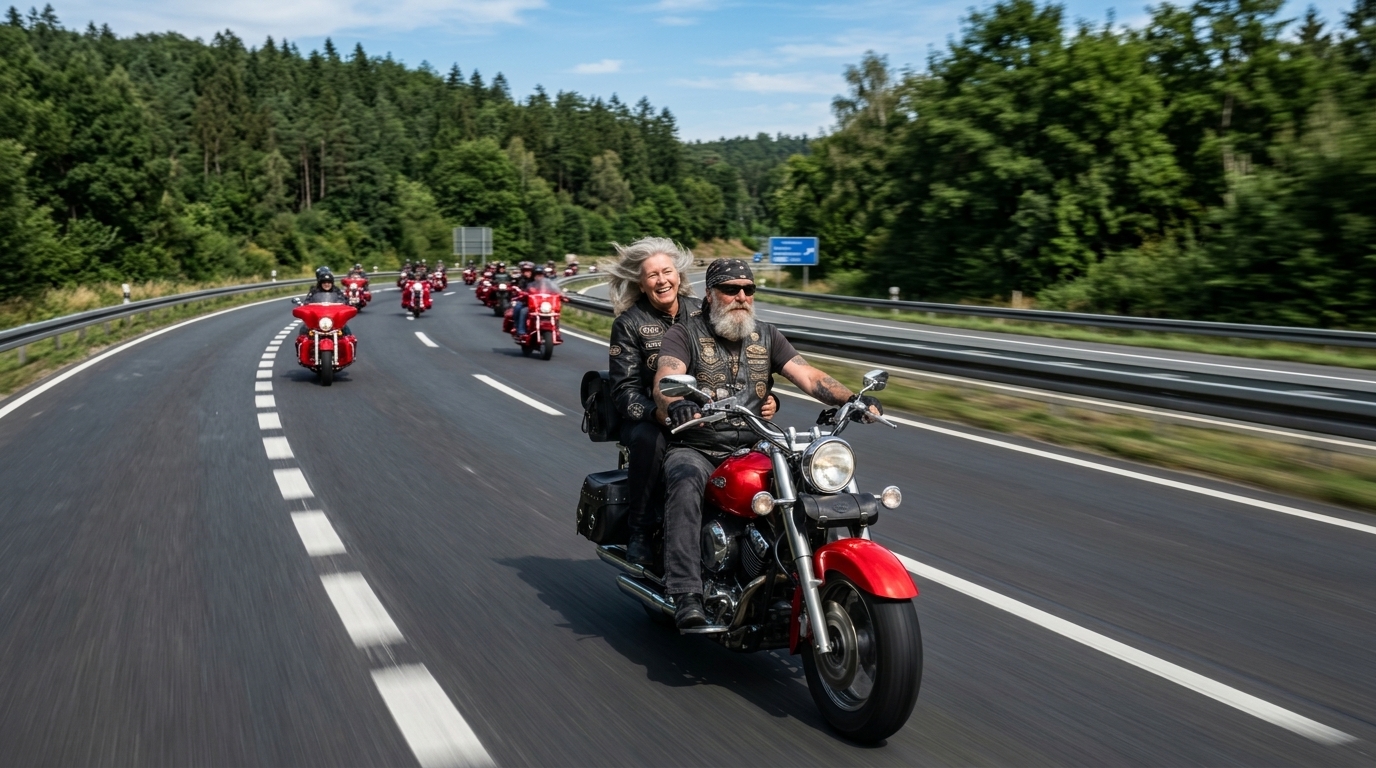
And whenever the road called, I knew exactly where to find my friends.
THE END THANK YOU FOR READING !!!



