PART 3
Linda stared at the envelope in my hand as though
I had just pulled a court summons from my gardening bucket.
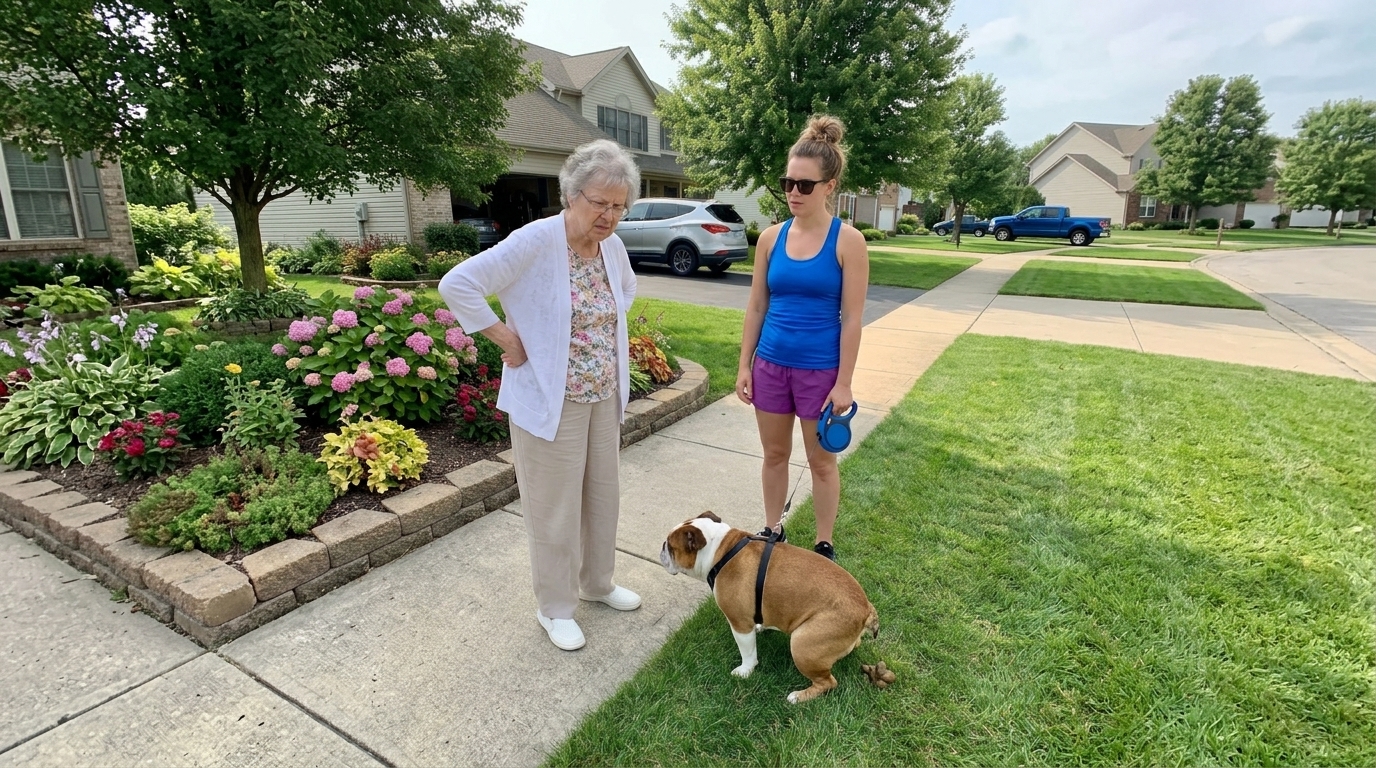
Her English bulldog, Winston, stood beside her,
panting happily, completely unaware that his morning routine
had become the center of a neighborhood confrontation.
“What is that?” she demanded.
I glanced at the envelope.
“Something I thought you might find interesting.”
She adjusted her sunglasses.
“Are you threatening me?”
“No, Linda. I’m asking you to take responsibility for your dog.”
She gave a short, dismissive laugh.
“You’re making an enormous fuss over a little dog poop.”
I looked at Winston.
He was sitting in the grass, looking remarkably pleased with himself.
“Actually,” I said, “Winston hasn’t done anything wrong. He’s a dog. He goes wherever you lead him.”
Linda tightened her grip on the blue leash.
“Well, excuse me for not realizing your lawn was sacred.”
“It isn’t sacred. It’s private property.”
Her expression hardened.
I had known Linda for almost four years.
She was fifty-six, recently divorced, and had moved into the house beside ours shortly after her marriage ended.
She worked from home as an interior design consultant and took tremendous pride in appearing sophisticated, organized, and socially connected.
Her front porch was always decorated for the season.
Her windows were spotless.
Her white SUV was washed every weekend.
And her social media pages were filled with photographs of Winston wearing little bow ties.
From the outside, Linda looked like someone who had everything under control.
But there was one thing she apparently considered beneath her dignity.
Cleaning up after her own dog.
For six months, I had been doing it for her.
Not once or twice.
Almost every morning.
Sometimes twice in one day.
I’d gone outside in freezing rain, summer heat, and early morning darkness with a plastic bag in my hand because I didn’t want my children stepping in the mess.
I’d replaced patches of damaged grass.
I’d apologized to our gardener when he accidentally stepped in something Linda had left behind.
And I’d kept my mouth shut because I believed being a good neighbor meant choosing peace whenever possible.
But after the meeting, I realized something important.
Peace wasn’t the same thing as allowing someone to disrespect you.
Linda pointed toward the envelope.
“Well? Are you going to show me what’s inside?”
I nodded.
“Certainly.”
I opened it and removed three sheets of paper.
The first was a copy of our neighborhood association’s pet waste policy.
The second was a printed summary of the association’s complaint procedure.
The third was a dated log of incidents on my property.
Linda’s eyes moved across the documents.
Then she laughed.
“You’ve been keeping records?”
“Yes.”
“Of my dog?”
“Of what you’ve been leaving on my lawn.”
She looked offended.
“That is incredibly strange.”
I smiled.
“Perhaps. But so is watching someone clean up after your pet every morning and never offering to help.”
Her cheeks reddened.
“I don’t watch you.”
“Linda, you’ve stood on your porch drinking coffee while I’ve done it.”
She looked away.
I continued.
“On June eighth, you even asked whether I had changed fertilizer because the hydrangeas looked especially healthy.”
Her lips tightened.
“I don’t remember that.”
“I do.”
She folded her arms.
“Well, what exactly are you planning to do with those papers?”
“Nothing, if you stop bringing Winston onto my lawn and clean up after him.”
She stared.
“That’s it?”
“That’s it.”
For a moment, I thought the conversation was finished.
Then she said something so astonishing that I almost laughed.
“You’re being extremely unneighborly.”
I blinked.
“Unneighborly?”
“Yes. People are supposed to be understanding. Winston has a sensitive stomach.”
I looked down at the bulldog.
He was sniffing a dandelion.
“Then I’m sorry he’s uncomfortable. But that doesn’t mean my lawn should become his bathroom.”
Linda rolled her eyes.
“You have children. Surely you understand that accidents happen.”
I felt my patience thinning.
“Of course I understand accidents.”
I paused.
“But six months of the same behavior isn’t an accident.”
She opened her mouth.
Then closed it.
I continued in the same calm voice.
“Yesterday, you told everyone at the meeting that people should take responsibility for what they’ve tamed.”
Her expression changed.
“I wasn’t talking about you.”
I raised my eyebrows.
“You looked directly at me.”
“That doesn’t mean anything.”
“Perhaps not.”
I glanced at Winston.
“But I agreed with your statement. That’s why we’re having this conversation.”
Linda stared at me.
Then she gave a bitter little laugh.
“You’re still upset because I said your children were loud.”
I shook my head.
“My children are allowed to play in our yard during reasonable hours. If their noise bothers you, we can discuss it respectfully.”
She looked surprised.
“But your dog is a separate issue.”
I held out the association policy.
“Please read this.”
She didn’t take it.
Instead, she stepped closer.
“Let me tell you something, Rachel.”
I waited.
“I’ve lived in neighborhoods much nicer than this one. People don’t behave like this over a dog.”
I looked at her perfectly manicured lawn.
Then at mine.
“Then I’m sure you won’t mind letting Winston use your grass.”
Her face tightened.
“He doesn’t like going there.”
“Why not?”
She hesitated.
Then said, “Because I don’t want him ruining it.”
For several seconds, neither of us spoke.
I looked at her.
She looked at me.
Even Winston seemed to pause.
Finally, I said, “Linda, I think you’ve just explained the problem better than I ever could.”
Her cheeks turned crimson.
“That’s not what I meant.”
“Then what did you mean?”
She tugged at the leash.
“Come on, Winston.”
The bulldog reluctantly stood.
Linda turned toward her house.
But before she reached the sidewalk, she looked back.
“You know, Rachel, some people really need a hobby.”
I smiled.
“I have one.”
She frowned.
“Gardening.”
Then I picked up my bucket and went inside.
My husband, Daniel, was standing beside the kitchen window.
He had watched the entire exchange.
He looked at me for a long moment.
Then burst out laughing.
“Rachel!”
I set the bucket beside the back door.
“What?”
“You actually did it.”
I poured myself coffee.
“I did.”
He shook his head.
“I’ve been telling you for months to say something.”
“I know.”
“And you didn’t even raise your voice.”
“I didn’t need to.”
He leaned against the counter.
“What was in the envelope?”
I explained.
His smile widened.
“You printed the neighborhood rules?”
“Yes.”
“And the complaint procedure?”
“Yes.”
He laughed again.
“That’s my girl.”
I took a sip of coffee.
“Daniel, I’m not trying to embarrass her.”
His expression softened.
“I know.”
“I just want her to stop.”
He nodded.
“Then hopefully she will.”
I wanted to believe that.
Unfortunately, Linda had other plans.
At 9:14 that morning, my phone began vibrating.
It was a message from our neighborhood group chat.
Linda had posted a photograph of my little sign.
Underneath, she’d written:
Apparently some people have decided to turn our friendly neighborhood into a place of threats and harassment. Very disappointing.
Within minutes, replies appeared.
What happened?
Is everything okay?
Who is harassing you?
Then Linda wrote:
A neighbor confronted me this morning and threatened official action because my elderly dog occasionally walks across her grass. Some people have no compassion.
I stared at the screen.
Occasionally walks across her grass.
That was an interesting description of six months of daily messes.
Daniel looked over my shoulder.
“Oh, she’s unbelievable.”
I didn’t answer.
I kept reading.
A woman named Patricia wrote:
That’s terrible, Linda. Winston is such a sweet dog.
Another neighbor replied:
Maybe everyone should calm down.
Then Linda added:
Some people care more about their lawns than about living creatures.
I put my phone down.
Daniel stared at me.
“You’re not going to respond?”
“Not yet.”
“Rachel.”
I looked at him.
“If I answer while I’m angry, she’ll make this about my tone instead of her behavior.”
He nodded slowly.
“Fair point.”
I picked up my phone again.
There were already twenty-three messages.
Linda was still typing.
Then she posted something that made my stomach drop.
And since we’re discussing responsibility, perhaps certain parents should spend less time policing dogs and more time controlling their children.
I stared at the screen.
My children were eight and ten.
They played basketball in the driveway.
They rode bicycles.
They laughed.
Sometimes they shouted.
They were children.
And Linda had now publicly dragged them into a dispute about her dog.
Daniel’s face darkened.
“Okay. That’s enough.”
I held up my hand.
“Give me a minute.”
I opened my photo gallery.
Six months of evidence.
Dated pictures of Winston on my lawn.
Photographs of the messes he’d left behind.
Images showing Linda standing nearby with the leash in her hand.
And one particularly clear video from our doorbell camera.
It showed Linda bringing Winston across the sidewalk, waiting while he relieved himself beside my flower bed, then walking away without picking anything up.
I watched the recording once.
Then I opened the neighborhood group chat.
I typed a message.
Deleted it.
Started again.
Finally, I sent:
Good morning, everyone. I agree that we should treat our neighbors respectfully. I also agree with Linda’s statement from yesterday’s meeting that pet owners should take responsibility for their animals. I’ve privately asked her to stop bringing Winston onto my lawn and leaving waste behind. This has happened repeatedly for six months. I’m not asking anyone to take sides. I’m simply asking that the association’s existing pet waste rules be followed.
Then I attached one photograph.
Not the most embarrassing one.
Not the video.
Just a clear image showing the problem.
And I put my phone down.
For almost three minutes, nothing happened.
Then a message appeared.
It was from Mrs. Patterson, who lived across the street.
Rachel, I’m glad you said something. I’ve had the same problem.
I sat up.
Another message appeared.
Me too, wrote Mr. Collins from the corner house.
Then another.
I thought I was imagining things.
I looked at Daniel.
His smile disappeared.
“Wait.”
I nodded.
“This isn’t just happening to us.”
Within ten minutes, five neighbors had spoken up.
All describing the same thing.
Winston being walked onto their lawns.
Linda leaving without cleaning up.
And nobody wanting to cause trouble.
Then Mrs. Patterson sent a message that changed everything.
I have video from last Thursday. Linda actually moved my little lawn sign so Winston could go behind it.
Daniel stared at the phone.
“You’re kidding.”
I shook my head.
I wasn’t.
The problem was much bigger than my flower beds.
And Linda had just invited the entire neighborhood to discuss it.
But what happened that evening surprised me even more.
At 6:30, someone knocked on our front door.
I opened it.
Standing on the porch was Mr. Howard, the president of our neighborhood association.
He held a folder.
And beside him stood Mrs. Patterson.
Mr. Howard looked uncomfortable.
“Rachel,” he said, “we need to talk about Linda.”
I stepped aside.
“Of course.”
He entered the living room.
Then said something I hadn’t expected.
“You’re not the first person to complain.”
I stared at him.
“What?”
He sighed.
“You’re the first person who’s been willing to put it in writing.”
PART 4
Mr. Howard sat at our dining table while Mrs. Patterson settled beside him.
Daniel brought coffee.
I sat across from them.
For a moment, nobody spoke.
Then Mr. Howard opened his folder.
“Rachel, I’ve been president of this association for seven years.”
I nodded.
“And in that time, I’ve learned that the smallest disputes sometimes reveal the biggest problems.”
I looked at the documents.
“What kind of problems?”
He sighed.
“People being afraid to speak up.”
Mrs. Patterson nodded.
“That’s exactly it.”
Mr. Howard continued.
“Over the past year, I’ve received several informal complaints about pet waste. Most people didn’t identify the owner. They didn’t want trouble.”
I leaned forward.
“But you suspected Linda?”
He hesitated.
“I suspected there was a recurring issue. I didn’t have enough information to make a formal determination.”
Mrs. Patterson gave a dry laugh.
“Well, I knew.”
I looked at her.
She was seventy-eight, widowed, and one of the kindest people on our street.
She baked cookies for new neighbors.
She watered plants when people went on vacation.
She remembered everyone’s birthday.
“What happened?” I asked.
She folded her hands.
“Last winter, I found dog waste beside my front steps three mornings in a row.”
I stared.
“I thought maybe someone was walking a dog at night. Then one morning, I saw Linda.”
She shook her head.
“I asked her politely to clean up.”
“And?”
“She told me Winston couldn’t help himself.”
Daniel frowned.
“That’s ridiculous.”
Mrs. Patterson nodded.
“I said I understood, but she still needed to pick it up.”
She paused.
“Do you know what she said?”
I shook my head.
“She said, ‘At your age, Margaret, you probably need the exercise anyway.'”
I felt my jaw tighten.
“She said that to you?”
Mrs. Patterson nodded.
“I was so shocked I didn’t answer.”
Mr. Howard looked uncomfortable.
“Margaret mentioned it to me, but she didn’t want to file a complaint.”
“Because I didn’t want to become the neighborhood gossip,” she said.
I understood that feeling completely.
For six months, I’d been afraid of the same thing.
Mr. Howard slid a paper toward me.
“Our association rules require owners to remove pet waste from common areas and other residents’ property. We have a written complaint process and can issue notices or fines where the governing documents authorize them.”
I read the page.
The rules were straightforward.
Nothing dramatic.
Nothing unreasonable.
Just basic responsibility.
“So what happens now?” I asked.
Mr. Howard folded his hands.
“We need statements from the affected homeowners and whatever evidence they’re willing to provide. Then we’ll follow the association’s normal process.”
I nodded.
“That’s fair.”
He looked relieved.
“I appreciate your approach.”
I smiled faintly.
“I don’t want revenge.”
Mrs. Patterson looked at me.
“Neither do I.”
I continued.
“I want my lawn to stay clean, and I want Linda to understand that she can’t keep making her problem everyone else’s responsibility.”
Mr. Howard nodded.
“That’s reasonable.”
We spent the next hour discussing the situation.
I showed him the dated photographs.
I played the doorbell recording.
Mrs. Patterson showed her own video.
Mr. Howard took notes.
Then he said something that surprised me.
“Rachel, would you be willing to speak at a special association meeting?”
I hesitated.
“Why?”
“Because Linda has accused you of harassment in the neighborhood group.”
I sighed.
“I saw that.”
“She has also requested that the association take action against you.”
Daniel stared.
“Against Rachel?”
Mr. Howard nodded.
“She claims the sign is intended to humiliate her.”
I almost laughed.
“My sign doesn’t mention her.”
“I know.”
“It doesn’t mention Winston.”
“I know.”
“It simply says responsible pet owners should clean up.”
Mr. Howard nodded.
“That’s why I think it would help to discuss the issue openly and fairly.”
I thought about it.
A meeting.
Neighbors.
Linda.
And the possibility of another argument.
I didn’t want any of it.
But then I remembered her comment about my children.
And Mrs. Patterson’s story.
And the other neighbors who had stayed quiet because they were afraid of being labeled difficult.
I looked at Mr. Howard.
“All right.”
He nodded.
“I’ll speak.”
The meeting was scheduled for Thursday evening.
By Wednesday morning, Linda had posted three more messages in the neighborhood group.
The first accused unnamed residents of exaggerating.
The second described Winston as an innocent victim.
The third suggested that the association should focus on “real problems” instead of “petty complaints.”
I didn’t respond.
I had already said what needed to be said.
But Linda wasn’t finished.
At 4:15 that afternoon, my eight-year-old daughter, Sophie, came inside looking upset.
I was chopping vegetables for dinner.
“Mom?”
I turned.
“What’s wrong, sweetheart?”
She hesitated.
“Did I do something bad?”
I put down the knife.
“Of course not. Why?”
She looked at the floor.
“Mrs. Linda said we should stop playing outside because we’re making everyone angry.”
My heart sank.
“What?”
Sophie twisted her fingers.
“She said grown-ups are having problems because some kids don’t know how to behave.”
I knelt beside her.
“Where did she say that?”
“By the sidewalk.”
“Was your brother with you?”
She nodded.
“Yes.”
I took a slow breath.
“What exactly happened?”
Sophie explained that she and her brother, Ben, had been riding their bicycles in our driveway when Linda walked past with Winston.
Linda had stopped.
She’d told them their noise was disturbing the neighborhood.
Then she’d said that if they wanted to act responsibly, they should stop making trouble for their parents.
Sophie looked at me.
“Are you and Daddy in trouble?”
I felt anger rise so quickly that my hands began trembling.
But I kept my voice steady.
“No, sweetheart.”
“Are we allowed to play outside?”
“Yes.”
She looked relieved.
I hugged her.
“You haven’t done anything wrong.”
After she went upstairs, I called Daniel.
He listened quietly.
Then said, “I’m coming home.”
“Daniel—”
“No. She can argue with adults all she wants. She doesn’t get to frighten our children.”
I agreed.
But I also knew that confronting Linda in anger would only make things worse.
So I did something else.
I wrote down what Sophie had told me.
I saved the date and time.
And I sent Mr. Howard a brief message asking that any future discussions remain between adults.
He responded within minutes.
Understood. I’ll address that.
That evening, Daniel and I sat with Sophie and Ben.
We explained that adults sometimes disagree.
That they were not responsible for those disagreements.
And that if any neighbor spoke to them in a way that made them uncomfortable, they should come directly to us.
Ben looked confused.
“Is Winston in trouble?”
I smiled sadly.
“No, honey.”
“Good. He’s a nice dog.”
I nodded.
“He is.”
Ben thought for a moment.
“Then why is Mrs. Linda mad?”
I looked at my husband.
Then back at my son.
“Sometimes people get upset when someone asks them to change something they’ve been doing.”
Ben frowned.
“Even if it’s wrong?”
“Especially then.”
He considered that.
Then shrugged.
“Well, she should just pick up the poop.”
Daniel burst out laughing.
I couldn’t help smiling.
Sometimes children understand things adults spend months complicating.
Thursday evening arrived.
The association meeting was held in the community center.
I wore jeans, a pale blue blouse, and comfortable shoes.
Nothing dramatic.
Nothing intended to make a statement.
Daniel came with me.
So did Mrs. Patterson.
When we entered, I was surprised by the number of people already seated.
At least thirty residents.
Some were talking quietly.
Others were looking at their phones.
Linda sat in the front row.
She wore a cream-colored blazer and a pearl necklace.
Her hair was perfectly styled.
And her expression suggested she was attending a meeting to receive an award.
When she saw me, she smiled.
Not warmly.
Triumphantly.
I sat three rows behind her.
Daniel squeezed my hand.
“You okay?”
I nodded.
“Yes.”
Mr. Howard called the meeting to order at seven.
He explained that the purpose was to discuss neighborhood pet waste concerns, review the existing rules, and allow affected residents to speak.
Then Linda raised her hand.
“Before we begin, I’d like to address the personal attacks against me.”
Mr. Howard looked at her.
“You’ll have an opportunity to speak.”
She stood anyway.
“I have been subjected to an organized campaign of harassment.”
Several neighbors exchanged glances.
Linda continued.
“My dog is elderly and has medical needs. Instead of showing compassion, certain people have been photographing him, posting accusations, and making me feel unsafe in my own neighborhood.”
She turned toward me.
“Some people simply cannot tolerate anything that inconveniences them.”
I remained silent.
Linda looked around the room.
“I have always been a considerate neighbor.”
Mrs. Patterson lowered her eyes.
Linda continued.
“I’ve never intentionally caused anyone trouble.”
Mr. Howard nodded.
“Thank you, Linda. Please sit down.”
She did.
Then he looked toward me.
“Rachel, would you like to speak?”
I stood.
My heart was beating faster than I’d expected.
I wasn’t accustomed to speaking in front of thirty neighbors.
But I remembered something my father used to tell me.
When you know you’re telling the truth, you don’t need to decorate it.
So I didn’t.
“My name is Rachel,” I began, “and I’ve lived here with my husband and two children for eight years.”
Several people smiled.
“I love this neighborhood. I love that our children can ride bicycles safely. I love that neighbors look after one another.”
I paused.
“And I love dogs.”
A few people chuckled.
“Especially Winston. He’s a wonderful bulldog.”
Linda looked surprised.
I continued.
“My complaint isn’t about Winston. It’s about what happens after he’s brought onto my property.”
I held up a printed photograph.
“For approximately six months, I’ve repeatedly cleaned up waste left on my lawn after Linda walked him there.”
Linda shook her head.
“That’s exaggerated.”
I looked toward Mr. Howard.
He nodded for me to continue.
“I kept photographs because I wanted to be sure I wasn’t mistaken.”
I placed the pictures on the table.
“I also have a short recording showing one of the incidents.”
Linda crossed her arms.
“Anyone can take a picture of a dog.”
I nodded.
“That’s true.”
Then I looked at Mr. Howard.
“Would you please play the recording?”
He connected his laptop to the projector.
The lights dimmed.
The screen showed my front yard.
A date and time appeared in the corner.
7:41 a.m.
Linda walked into view.
Winston followed.
She guided him toward my flower bed.
He relieved himself.
Linda looked down.
Then looked toward my house.
And walked away.
The recording ended.
Nobody spoke.
Mr. Howard turned on the lights.
Linda’s cheeks were red.
“That proves nothing about six months.”
I nodded.
“You’re right. One recording shows one incident.”
Then I placed the log on the table.
“That’s why I documented the others.”
Mrs. Patterson stood.
“I’d like to speak.”
Mr. Howard nodded.
She walked slowly toward the front.
Her hands trembled slightly as she unfolded a piece of paper.
“I’ve lived in this neighborhood for twenty-three years,” she began.
The room became quiet.
“I’ve never filed a complaint against anyone.”
She looked at Linda.
“But last winter, I asked you to clean up after Winston.”
Linda looked away.
Mrs. Patterson continued.
“And you told me I probably needed the exercise.”
A murmur spread through the room.
Linda stood.
“That was a joke!”
Mrs. Patterson looked at her.
“It wasn’t funny.”
Linda sat down.
Mrs. Patterson continued.
“I didn’t say anything afterward because I didn’t want trouble.”
She looked around the room.
“But I realized that staying quiet was allowing someone else to keep doing the same thing.”
Then Mr. Collins stood.
He described his own experience.
Another neighbor followed.
Then another.
By the time the fifth person spoke, Linda was staring at the floor.
Mr. Howard raised his hand.
“Thank you. I think we’ve established that there are multiple concerns requiring review.”
Linda suddenly stood.
“This is ridiculous!”
Her voice echoed through the room.
“You’re all acting like I’ve committed some terrible crime!”
Nobody answered.
She pointed toward me.
“And this woman started it!”
I looked at her.
“No, Linda.”
She froze.
I continued calmly.
“I asked you to stop.”
Her face tightened.
“You’ve turned everyone against me!”
I shook my head.
“Your behavior brought us here. You can still choose what happens next.”
She stared.
Then she said something that changed the atmosphere completely.
“You have no idea what it’s like to take care of that dog!”
Her voice cracked.
Everyone fell silent.
Linda looked down.
“Winston has arthritis. Sometimes he can barely make it down the driveway.”
Her eyes filled.
“I’ve spent thousands on veterinary appointments. I have to get him outside early, and sometimes he can’t wait.”
For the first time, she sounded less angry than exhausted.
I looked at her.
“Linda, I’m sorry he’s struggling.”
She wiped her eyes.
“But why didn’t you tell me?”
She stared at me.
I continued.
“If Winston needs help, we could have talked about it. We could have found a solution.”
She looked away.
“Instead, you brought him onto my lawn and left me to clean up.”
Her lips trembled.
I spoke gently.
“I can understand why caring for an aging pet is difficult. But I can’t understand why that meant I had to do the cleanup without even being asked.”
Linda covered her face.
For a moment, I thought she might apologize.
Instead, she whispered, “You don’t understand.”
Then she grabbed her purse and hurried out.
The room remained silent.
Mr. Howard looked at the door.
Then back at us.
“We’ll follow the established complaint process and communicate the outcome in writing.”
He paused.
“But I hope everyone remembers that the goal is to solve the problem, not punish someone for being embarrassed.”
I nodded.
That was exactly what I wanted.
Or so I thought.
Because the next morning, at 7:40, Linda didn’t appear.
Neither did Winston.
And by lunchtime, I learned why.
PART 5
At eleven thirty Friday morning, Mrs. Patterson called me.
“Rachel, have you seen Linda today?”
I looked out the kitchen window.
“No.”
“Her car is still in the driveway.”
“Maybe she’s working.”
Mrs. Patterson hesitated.
“I knocked earlier. Nobody answered.”
I frowned.
“Why did you knock?”
“Because I saw her taking Winston outside around six this morning.”
I waited.
“He could barely walk.”
My heart tightened.
“What happened?”
“She was helping him down the steps. He stumbled, and she nearly fell trying to hold him.”
I looked toward Linda’s house.
“Did you offer to help?”
“Yes. She said she was fine.”
Mrs. Patterson paused.
“But she didn’t look fine.”
After we hung up, I stood at the window for several minutes.
Linda’s house looked the same as always.
The porch flowers were neatly arranged.
The curtains were drawn.
Her SUV sat in the driveway.
I thought about the meeting.
Her anger.
Her embarrassment.
And the moment her voice had cracked when she mentioned Winston’s arthritis.
For six months, I’d seen a selfish neighbor.
And she had behaved selfishly.
That hadn’t changed.
But now I was beginning to understand that there might be more happening behind her perfectly maintained front door.
At noon, I walked next door.
I rang the bell.
Nothing.
I waited.
Then rang again.
Finally, I heard footsteps.
The door opened a few inches.
Linda stood there wearing sweatpants and an old sweater.
Her hair was uncombed.
Her eyes were swollen.
She looked nothing like the woman who’d attended the meeting in pearls the previous evening.
“What do you want?” she asked.
I kept my voice gentle.
“Mrs. Patterson said Winston wasn’t doing well.”
Her expression hardened.
“He’s fine.”
I nodded.
“All right.”
I started to turn away.
Then I heard a faint whimper from inside.
I stopped.
“Linda?”
She looked down.
The sound came again.
I could see Winston lying on a blanket in the hallway.
He lifted his head slightly.
Then lowered it.
My heart sank.
“Has he seen his veterinarian?”
Linda’s eyes filled.
“Yesterday.”
“What did they say?”
She looked away.
“His arthritis is getting worse.”
I waited.
“He needs medication adjustments and maybe physical therapy.”
She swallowed.
“I don’t know how much more I can do.”
For the first time, I saw something beneath her anger.
Fear.
Not fear of fines.
Not fear of embarrassment.
Fear of losing the dog she loved.
I softened my voice.
“Can I come in for a minute?”
She hesitated.
Then opened the door.
The house was immaculate.
Everything had a place.
But Winston’s blanket was surrounded by medication bottles, towels, and a half-empty water bowl.
Linda knelt beside him.
“Come on, sweetheart.”
He lifted his head.
She stroked his ears.
“Good boy.”
I watched quietly.
Then asked, “How old is he?”
“Almost eleven.”
I nodded.
“That’s a good age for a bulldog.”
Her eyes filled.
“He was my husband’s dog.”
I looked at her.
She continued.
“Well, our dog.”
She swallowed.
“When my husband left, Winston was the only thing he didn’t want to take.”
I sat on the edge of a nearby chair.
“I’m sorry.”
Linda gave a bitter laugh.
“Everyone says that.”
I didn’t answer.
She looked down at Winston.
“He used to sleep between us.”
Her voice cracked.
“Now he can barely climb onto the couch.”
I watched her stroke his head.
For several minutes, neither of us spoke.
Then she said, “I know what you think of me.”
I looked at her.
“What?”
“That I’m selfish.”
I chose my words carefully.
“I think you’ve been inconsiderate.”
She winced.
“But I don’t think that’s all you are.”
Her eyes filled again.
I continued.
“Linda, you were wrong to leave Winston’s waste on my lawn.”
She nodded faintly.
“And you were wrong to bring my children into it.”
She closed her eyes.
“I know.”
I waited.
Then she whispered, “I’m sorry.”
It was the first apology I’d heard from her.
Not a defensive explanation.
Not a joke.
Not a complaint about being misunderstood.
Just two words.
I’m sorry.
I nodded.
“Thank you.”
She looked at me.
“I was embarrassed.”
“At the meeting?”
She nodded.
“Everyone was looking at me.”
I smiled sadly.
“I know how that feels.”
She looked confused.
I continued.
“That’s how I felt when you talked about my children.”
Her face crumpled.
“Oh.”
I nodded.
“Yes.”
She looked down.
“I shouldn’t have done that.”
“No.”
She wiped her cheeks.
“I was angry because you made me look irresponsible.”
I held her gaze.
“Linda, I didn’t make you look irresponsible.”
She swallowed.
“Your choices did.”
For a moment, I thought she might become defensive again.
Instead, she nodded.
“You’re right.”
I glanced at Winston.
“Can he walk to your backyard?”
She sighed.
“Sometimes. But the back steps are difficult for him.”
I thought for a moment.
“Have you considered a small ramp?”
She looked at me.
“A ramp?”
“Yes. Something sturdy with a nonslip surface.”
She frowned.
“I’ve looked at them. They’re expensive.”
I nodded.
“Some are. But there may be simpler options.”
She looked toward the window.
“I suppose.”
I continued.
“And if he can’t reach the backyard, you could create a small designated area closer to your door.”
She stared.
“On my lawn?”
I smiled gently.
“Yes, Linda. On your lawn.”
For a moment, she looked embarrassed.
Then she laughed.
A small, genuine laugh.
“Fair enough.”
I stood.
“I should go.”
She looked up.
“Rachel?”
I turned.
“Yes?”
She hesitated.
“Would you tell your children I’m sorry?”
I nodded.
“I will.”
Then she added, “And if they want to say hello to Winston sometime, they’re welcome.”
I smiled.
“They’d love that.”
As I walked home, I felt strangely lighter.
The situation wasn’t magically fixed.
Six months of disrespect didn’t disappear because someone apologized once.
But the conversation had finally moved beyond accusations.
And for the first time, Linda seemed willing to change.
That afternoon, Daniel came home carrying a cardboard box.
I stared at it.
“What’s that?”
He grinned.
“Something I ordered.”
I opened the box.
Inside was a sturdy pet ramp designed for small porch steps.
I looked at him.
“Daniel.”
He shrugged.
“I heard Winston was having trouble.”
I smiled.
“You’re impossible.”
He laughed.
“I know.”
Then his expression became serious.
“Rachel, I don’t want you thinking this means we have to tolerate what Linda did.”
“I don’t.”
He nodded.
“Good.”
I touched the ramp.
“But helping an old dog isn’t the same as excusing his owner’s behavior.”
Daniel smiled.
“Exactly.”
The next morning, we carried the ramp next door.
Linda opened the door looking surprised.
“What’s that?”
Daniel lifted the box.
“A little project.”
She stared.
“For Winston?”
He nodded.
“Thought it might make things easier.”
Linda’s eyes filled.
“Oh.”
For several seconds, she couldn’t speak.
Then she whispered, “You don’t have to do that.”
Daniel smiled.
“We know.”
We helped her set it up at the back steps.
Winston approached cautiously.
He sniffed the ramp.
Then looked at Daniel.
“Come on, buddy,” Daniel encouraged.
Winston took one step.
Then another.
Slowly, carefully, he made his way down.
Linda covered her mouth.
“Oh, Winston.”
The bulldog reached the grass.
He looked around.
Then waddled toward a sunny patch beside the fence.
Linda laughed through her tears.
“Look at him!”
I smiled.
“He seems pleased.”
Daniel folded his arms.
“That’s one happy bulldog.”
Linda watched Winston for a moment.
Then turned toward us.
“I don’t know what to say.”
I smiled.
“Start with using that designated area and cleaning up after him.”
She laughed.
“I will.”
And this time, she meant it.
Over the next few weeks, things changed.
Linda began carrying waste bags every time she took Winston outside.
She used the ramp.
She kept a small covered disposal bin near her back gate.
And she stopped bringing him onto other people’s lawns.
The association reviewed the complaints and issued a written reminder requiring compliance with the neighborhood rules. Linda acknowledged it and agreed to follow them.
There was no dramatic courtroom scene.
No enormous fine.
No public humiliation.
Just a woman finally accepting responsibility for something she should have handled months earlier.
But the most surprising change came later.
One Saturday morning, I was working in my flower beds when Linda approached.
She carried a small potted hydrangea.
“Rachel?”
I looked up.
“Morning.”
She held out the plant.
“This is for you.”
I stared.
“Linda, you don’t have to—”
“I know.”
She smiled faintly.
“But I wanted to.”
I took the pot.
The flowers were pale blue.
Beautiful.
She looked at my garden.
“I remember asking you how you kept yours so healthy.”
I smiled.
“I remember.”
She swallowed.
“I was jealous.”
I blinked.
“Of my hydrangeas?”
She laughed.
“Of everything.”
I stared.
She looked toward my house.
“Your husband. Your children. The way everyone seems happy when they’re outside.”
Her voice softened.
“After my divorce, I couldn’t stand hearing families laughing. I know that sounds awful.”
I didn’t answer.
She continued.
“I’d sit inside alone, and I’d hear your children playing. And instead of being happy that they were having fun, I’d feel angry.”
She looked down.
“I think I started looking for things to complain about because I didn’t know what else to do with that feeling.”
I studied her.
“Linda, loneliness can make people bitter.”
She nodded.
“But it doesn’t give them permission to be cruel.”
Her eyes filled.
“I know.”
I touched the hydrangea.
“Thank you for telling me.”
She smiled sadly.
“I’ve started seeing a counselor.”
I looked at her.
“That’s good.”
She nodded.
“I needed someone to tell me that being hurt doesn’t mean everyone else owes me something.”
I smiled.
“That sounds like useful advice.”
She laughed softly.
Then looked toward my front porch.
“Are your children home?”
“Yes.”
She hesitated.
“Would it be all right if I apologized to them myself?”
I considered that.
Then nodded.
“With me there.”
“Of course.”
I called Sophie and Ben outside.
They approached cautiously.
Linda knelt slightly so she could look them in the eyes.
“I owe you both an apology.”
Sophie looked at me.
I nodded encouragingly.
Linda continued.
“I said some unkind things about you playing outside. That was wrong.”
Ben frowned.
“We weren’t doing anything bad.”
Linda shook her head.
“No, you weren’t.”
She swallowed.
“I was upset about other things, and I took it out on you.”
Sophie looked thoughtful.
“Are you still upset?”
Linda smiled sadly.
“Sometimes.”
Then she added, “But that’s something I need to work on. It’s not your job to fix it.”
I felt a quiet warmth in my chest.
That was the first time I’d heard Linda say something truly responsible.
Ben looked toward her house.
“How’s Winston?”
Linda smiled.
“Much better.”
His face brightened.
“Can we see him?”
She looked at me.
I nodded.
“Later this afternoon, if that’s okay.”
Linda grinned.
“He’d love that.”
As the children ran back inside, Linda turned toward me.
“Thank you.”
I smiled.
“You’re welcome.”
She hesitated.
“For not giving up on me.”
I looked at her for a long moment.
Then answered honestly.
“Linda, I wasn’t going to keep cleaning up after you.”
She laughed.
“I know.”
“But I didn’t want us to become enemies either.”
She nodded.
“Neither did I.”
That summer, our neighborhood held its annual barbecue.
There were folding tables in the park.
Children played tag.
Someone brought a portable speaker.
Mr. Collins grilled hamburgers.
Mrs. Patterson arrived with a huge bowl of potato salad.
And Linda came with Winston.
He wore a blue bandana.
He moved slowly, but he seemed happy.
She carried a roll of waste bags clipped to his leash.
When he stopped beside a tree, Linda immediately reached for one.
Mrs. Patterson watched.
Then leaned toward me.
“Well, would you look at that.”
I smiled.
“Progress.”
She laughed.
“Miracles happen.”
Later that afternoon, Linda approached me while I was arranging plates.
“Rachel?”
I turned.
“Yes?”
She looked nervous.
“Mr. Howard asked whether I’d be willing to help organize a little pet-owner information table at next month’s meeting.”
I raised my eyebrows.
“Really?”
She nodded.
“About waste disposal, leash rules, and caring for older dogs.”
I smiled.
“That sounds useful.”
She laughed.
“I suppose I’m the neighborhood expert on what not to do.”
I shook my head.
“You’re becoming an expert on doing better.”
Her eyes softened.
“Thank you.”
I looked across the park.
Winston was lying in the shade while Ben gently scratched behind his ears.
Sophie sat beside him.
Daniel was taking photographs.
The sight made me smile.
Six months earlier, I would never have imagined that scene.
I’d believed Linda was simply an inconsiderate woman who thought the rules didn’t apply to her.
And in many ways, she had been.
But she was also lonely.
Frightened.
Overwhelmed.
And too proud to admit she needed help.
None of those things excused what she’d done.
But understanding them made it possible to move forward.
That evening, after the barbecue, Daniel and I sat on our porch.
The children were inside getting ready for bed.
The neighborhood was quiet.
Across the street, Linda was helping Winston up his ramp.
Daniel watched her.
Then looked at me.
“You know something?”
I smiled.
“What?”
“You really did teach her a lesson.”
I laughed.
“I didn’t think it would turn into all this.”
He shook his head.
“Neither did I.”
I leaned back.
“All I wanted was a clean lawn.”
Daniel grinned.
“And now you’ve got a clean lawn, a happier neighbor, and a bulldog who thinks you’re his best friend.”
I laughed.
“Not bad.”
He reached for my hand.
“Do you regret not confronting her sooner?”
I thought about that.
The six months of cleaning up.
The frustration.
The neighborhood meeting.
The embarrassment.
The group chat.
The evidence.
The apology.
And the unexpected friendship that had begun growing between two women who’d once barely understood each other.
“Yes,” I said finally.
Daniel looked surprised.
“Really?”
I nodded.
“I regret waiting so long to set a boundary.”
He squeezed my hand.
I continued.
“I thought staying quiet was keeping the peace. But it was really teaching her that I would tolerate something that wasn’t fair.”
He nodded.
“That’s true.”
I looked toward Linda’s house.
“But I don’t regret giving her a chance to change.”
Daniel smiled.
“That’s the difference.”
I leaned my head against his shoulder.
For a while, we sat in silence.
Then Winston barked once from next door.
Daniel laughed.
“There’s our boy.”
I smiled.
And I thought about the sentence Linda had spoken at the neighborhood meeting.
If you can’t be responsible for what you’ve tamed, you shouldn’t take it on.
She’d intended those words as an insult.
Instead, they became the very lesson she needed to learn.
Because responsibility isn’t just about feeding a dog or paying a bill.
It’s about recognizing the effect your actions have on other people.
It’s about admitting when you’re wrong.
It’s about cleaning up the messes you’ve made, even when nobody is watching.
And sometimes, it’s about accepting help without treating kindness as something you’re entitled to.
The following morning, I woke at 7:15.
Out of habit.
I made coffee.
Opened the curtains.
And looked toward the sidewalk.
At exactly 7:40, Linda appeared with Winston.
She smiled and waved.
I waved back.
Then she guided him down her own driveway, through her side gate, and into the little designated area beside her garden.
Winston sniffed around.
Found his favorite spot.
And did what dogs do.
Linda waited patiently.
Then she pulled a bag from the dispenser, cleaned up, and placed it in the covered bin.
Before going inside, she looked toward my house.
She lifted the little bag dispenser and gave me a playful salute.
I laughed.
Then closed the curtain.
My lawn was clean.
My children were happy.
My neighbor had learned to respect boundaries.
And Winston was still the sweetest bulldog on the street.
I hadn’t needed to shout.
I hadn’t needed to insult anyone.
I hadn’t needed to become cruel just because someone had treated me unfairly.
I’d simply stopped doing what another adult should have been doing for herself.
And when she finally understood, I gave her the opportunity to do better.
Because sometimes the strongest lesson isn’t revenge.
It’s a boundary delivered calmly, followed by the chance to make things right.
Linda once told me that people should take responsibility for what they’ve tamed. In the end, she learned that responsibility also means cleaning up your own messes—and respecting the people who’ve been quietly cleaning them up for you.
THE END THANK YOU FOR READING !!!



