PART 3
For the first time since I had met Adrian Vale,
my husband looked genuinely frightened.
Not irritated.
Not inconvenienced.
Frightened.
The courtroom was so quiet that I could hear
the faint hum of the air-conditioning above us.
Adrian sat beside his attorney,
Richard Whitmore,
a man whose hourly fee exceeded what most families earned in a week.
Richard was staring at the corporate resolution
as though he had just discovered a bomb beneath his expensive leather briefcase.
Behind them, Celeste Vale gripped the edge of her chair.
Her perfectly manicured fingers had turned white.
And I sat quietly beside my attorney, Margaret Ellis,
with my newborn son Noah sleeping in the arms of my cousin Charlotte.
Adrian finally found his voice.
“What exactly does that mean?”
The judge, Honorable Rebecca Lawson, looked over her glasses.
“Mr. Vale, this court is addressing your divorce and the related financial disclosures. The corporate resolution presented here appears to concern separate governance arrangements involving Vale Global. Your counsel will have an opportunity to review it.”
Adrian turned toward Richard.
“Tell me she’s bluffing.”
Richard didn’t answer.
“Richard!”
His attorney leaned closer.
“Adrian, lower your voice.”
I watched the exchange without moving.
For three years, Adrian had used silence as a weapon.
When I asked where he had been, he ignored me.
When I confronted him about photographs of other women, he walked away.
When I called from the hospital because my blood pressure had become dangerously high, he allowed the phone to ring until voicemail answered.
Now he was the one demanding answers.
And nobody was rushing to comfort him.
Margaret stood.
“Your Honor, we are not asking this court to determine corporate control today. We are submitting these documents because they directly affect the financial representations Mr. Vale has made in his proposed divorce settlement.”
Judge Lawson nodded.
“Proceed.”
Margaret turned toward Adrian.
“Mr. Vale, did you disclose to your wife that Vale Global’s controlling shareholder was subject to an irrevocable succession arrangement?”
Adrian frowned.
“What succession arrangement?”
Celeste suddenly leaned forward.
“Richard, object.”
The judge looked at her.
“Mrs. Vale, you are not a party to this proceeding. Please remain silent.”
Celeste sat back.
But her eyes never left the documents.
Margaret continued.
“Fifteen years ago, Vale Global was facing insolvency. Its lenders were preparing to enforce their security interests. The company required a substantial capital injection.”
Adrian scoffed.
“Everybody knows my grandfather saved the company.”
I almost smiled.
That was the story the Vale family had repeated for years.
At charity galas.
During television interviews.
In glossy business magazines.
The great Vale dynasty had survived because of its own brilliance.
The truth was less flattering.
My father, Jonathan Mercer, had provided the money.
He was not a billionaire celebrity.
He didn’t appear on magazine covers.
He was a disciplined investor who understood distressed businesses and believed that a struggling company could recover if the right people were placed in charge.
He invested $240 million through Mercer Capital Partners.
In exchange, he received a controlling economic interest, governance protections, and carefully drafted succession provisions.
The Vale family retained the public image of ownership.
But their power had always depended on honoring the agreement.
Margaret placed a copy of the original investment contract before Adrian’s attorney.
“Mr. Mercer didn’t merely provide a loan. His investment was structured through a holding company and a trust arrangement.”
Richard turned several pages.
His expression became increasingly serious.
Adrian laughed.
“This is ridiculous. My family owns Vale Global.”
Margaret looked at him.
“Your family has managed Vale Global. That is not the same thing.”
I watched Celeste close her eyes.
She knew.
Of course she knew.
She had been present when my father negotiated the rescue.
She had personally signed two of the supporting agreements.
But she had spent fifteen years pretending the arrangement didn’t exist.
Margaret continued.
“Under the original agreement, the Vale family’s voting authority could be suspended following specified acts of fraud, concealment, or intentional financial misconduct affecting a protected direct descendant.”
Adrian stared at her.
“Protected descendant?”
Margaret turned toward Charlotte.
My cousin gently adjusted the blanket around Noah.
“Your son.”
Adrian’s eyes widened.
He looked at the baby.
Then at me.
Then back at the documents.
“No.”
His voice was barely audible.
I remained silent.
He shook his head.
“No. Evelyn told me she wasn’t pregnant.”
I felt something cold move through my chest.
I had never told him that.
Not once.
I had tried to tell him I was pregnant.
Three times.
The first time, he ended the call before I could finish speaking.
The second time, his assistant told me he was unavailable.
The third time, I sent a message asking him to call because I had important family news.
He replied two days later.
Whatever it is, have my office handle it.
I had kept that message.
Margaret looked toward him.
“Mrs. Vale has submitted records showing repeated attempts to contact you during her pregnancy.”
Adrian’s face reddened.
“That doesn’t prove anything.”
Margaret nodded.
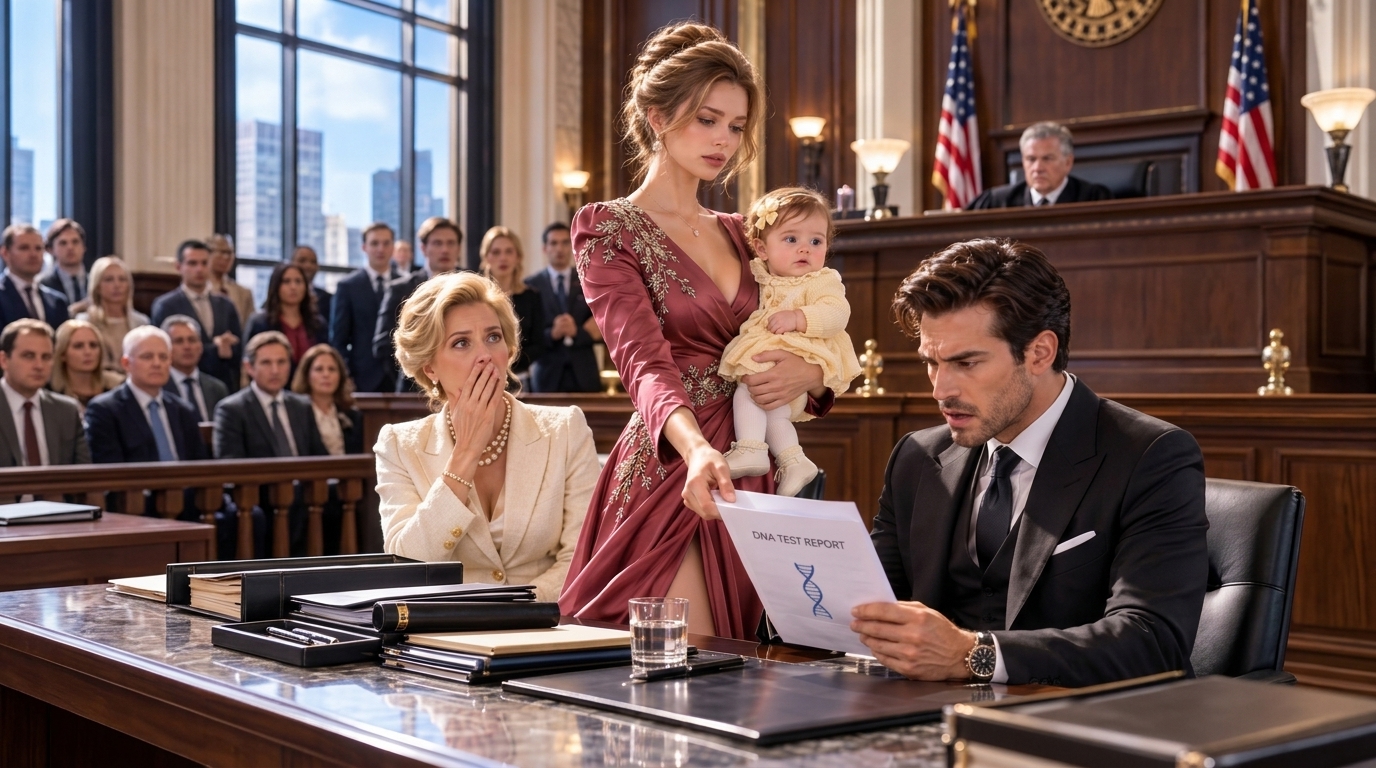
“Which is why we also have the DNA report.”
She placed the certified report before Richard.
The results established Adrian’s paternity.
His attorney read the document.
Then quietly pushed it toward him.
Adrian stared.
For several seconds, he appeared unable to understand what he was seeing.
Then he whispered, “He’s mine?”
I finally spoke.
“Yes, Adrian.”
He looked at me.
“Why didn’t you tell me?”
I felt a sharp ache behind my ribs.
“I tried.”
He shook his head.
“You should have tried harder.”
There it was.
Even now.
Even with the truth spread across the table.
He still believed every failure belonged to someone else.
I looked directly at him.
“I was hospitalized twice. I called you. I sent messages. You were busy celebrating your freedom in Monaco.”
A faint murmur moved through the courtroom.
Judge Lawson called for order.
Adrian looked down.
Margaret continued.
“Following confirmation of Noah’s parentage and the submission of evidence concerning financial concealment, the independent trustee initiated a review under the original investment agreement.”
Richard leaned forward.
“Has the trustee actually taken action?”
Margaret nodded.
“Yes.”
She handed him the resolution.
“The board of Mercer-Vale Holdings met yesterday. Pursuant to the trust and shareholder agreements, the trustee exercised the voting rights held through the Mercer investment structure.”
Adrian stared at Richard.
“What does that mean?”
His attorney took a long breath.
“It means the holding company has suspended your voting authority pending the outcome of the governance review.”
Adrian blinked.
“My voting authority?”
Richard continued.
“And the board has appointed an interim executive committee.”
Celeste made a strangled sound.
Adrian looked at me.
“You did this?”
I held his gaze.
“No, Adrian. Your actions triggered a process your family agreed to long before we met.”
He slammed his palm against the table.
“This is my company!”
The judge’s expression hardened.
“Mr. Vale, another outburst will result in sanctions.”
He sat back.
His breathing became shallow.
Margaret turned another page.
“There’s one more matter, Your Honor.”
Richard closed his eyes.
I knew exactly what was coming.
The financial disclosures.
The settlement Adrian had demanded I sign.
The agreement that would have left me with a single apartment and a modest payment while requiring me to abandon any claim connected to Vale Global.
Adrian had presented it as generosity.
Celeste had called it charity.
But there was a problem.
The documents contained representations that were not true.
Margaret held up the settlement.
“Mr. Vale’s proposed agreement states that there are no undisclosed assets, no pending material governance disputes, and no known financial arrangements affecting his beneficial interests.”
She paused.
“Those representations are contradicted by documents recently produced by the independent trustee.”
Richard stared at the agreement.
Adrian looked confused.
“So?”
Margaret answered.
“So your settlement was prepared using incomplete and potentially misleading financial disclosures.”
The judge turned toward Richard.
“Counsel, I expect full disclosure before any financial settlement is considered.”
Richard nodded.
“Understood, Your Honor.”
Celeste suddenly stood.
“This is outrageous!”
Judge Lawson looked directly at her.
“Mrs. Vale, sit down.”
But Celeste wasn’t looking at the judge.
She was staring at me.
“You ungrateful little nobody!”
The words echoed through the courtroom.
My stomach tightened.
For three years, she had called me a nobody.
A charity case.
A woman fortunate enough to marry into the Vale family.
Now she was learning that the money protecting her family’s empire had come from the father she had spent years insulting.
I looked at her calmly.
“My father had a name, Celeste.”
Her face twisted.
“Don’t you dare.”
“Jonathan Mercer.”
She went still.
“He saved your company when nobody else would.”
Adrian turned toward his mother.
“Mom?”
Celeste didn’t answer.
I continued.
“And you knew exactly who I was when Adrian married me.”
Her lips trembled.
For the first time, she had no insult ready.
The judge called a recess so the attorneys could review the documents.
As everyone stood, Adrian approached me.
Margaret immediately stepped between us.
He looked over her shoulder.
“Evelyn, we need to talk.”
I adjusted Noah’s blanket.
“About what?”
“Our son.”
I felt my chest tighten.
He had never asked about Noah before that moment.
Not his birthday.
Not his health.
Not whether he’d been born safely.
Only now, after discovering what his existence meant for the company, did Adrian suddenly remember he was a father.
I looked at him.
“His name is Noah.”
Adrian swallowed.
“I know.”
“No,” I said softly. “You know now.”
His face fell.
I continued.
“Being his father is not a corporate position you can reclaim when the board votes against you.”
Margaret gently guided me toward the exit.
But before I reached the door, Celeste called my name.
“Evelyn.”
I stopped.
She was standing beside Richard, her face pale.
For the first time since I’d known her, she looked uncertain.
“Your father,” she whispered. “Did he tell you everything?”
I turned.
“What do you mean?”
Celeste looked toward Adrian.
Then back at me.
“There was another agreement.”
My heart began pounding.
Margaret went still.
Celeste swallowed.
“One your father signed shortly before he died.”
I stared at her.
“What agreement?”
Her voice dropped.
“The one that explains why Adrian was encouraged to marry you in the first place.”
And suddenly, the courtroom felt colder than it had all morning.
PART 4
I had believed the worst thing Adrian ever did was betray our marriage.
I was wrong.
The worst thing was discovering that our marriage had begun with a lie.
After the hearing, Margaret arranged a private meeting with the trustee overseeing my father’s investment.
His name was Samuel Whitaker.
He was sixty-eight, soft-spoken, and had worked with my father for more than twenty years.
I remembered him from childhood.
He used to visit our home on Sunday afternoons, carrying a leather briefcase and a box of pastries.
My father would make coffee.
They would disappear into his study.
And I would sit on the staircase listening to them discuss businesses, investments, and people who made promises they couldn’t keep.
Samuel had attended my father’s funeral.
He’d also attended my wedding.
Now he sat across from me in Margaret’s office, looking deeply uncomfortable.
“Evelyn,” he began, “there are things your father wanted you to know when the time was right.”
I folded my hands.
“Apparently the time was three years ago.”
He lowered his eyes.
“You’re right.”
I looked toward Margaret.
She nodded encouragingly.
Samuel opened his briefcase.
Inside was a thick blue folder.
Across the front were three words.
MERCER FAMILY PROTECTION TRUST.
I stared at it.
“I’ve never seen that.”
Samuel nodded.
“Your father established the trust before his death.”
My father had died five years earlier.
I was twenty-nine.
Already practicing corporate law.
Already building a reputation for handling complicated acquisitions.
I knew he had left substantial assets.
I knew he had structured his investments carefully.
But I had never been interested in using his money to live extravagantly.
I wanted my own career.
My own accomplishments.
My own identity.
After he died, I delegated much of the trust administration to professionals and focused on my work.
I trusted Samuel.
And I trusted my father’s judgment.
Now I wondered whether that trust had made me careless.
Samuel continued.
“Your father knew the Vale family was struggling with the succession provisions.”
I frowned.
“Why?”
“Because the original investment agreement gave them operational authority but limited their ability to transfer control outside the agreed structure.”
I nodded.
That much I understood.
Samuel looked uncomfortable.
“Celeste wanted the restrictions removed.”
I stared at him.
“Of course she did.”
“She approached your father several times.”
I leaned forward.
“And?”
“He refused.”
Samuel opened the folder.
Then handed me a letter.
It was written on my father’s personal stationery.
I recognized his handwriting immediately.
The familiar slant of the letters made my throat tighten.
I began reading.
Evelyn,
If you are reading this, circumstances have developed in a way I hoped to prevent.
I stopped.
My hands trembled.
Margaret quietly pushed a glass of water toward me.
I took a sip.
Then continued.
The Vale family has repeatedly attempted to renegotiate the protections attached to my investment. I believe their concern is not simply financial. They want unrestricted control without the accountability that made the rescue possible.
I have refused.
If you ever become personally connected to that family, I want you to understand that your identity and inheritance may create conflicts of interest.
My heart pounded.
I read the next paragraph.
Do not mistake attention for loyalty. Do not mistake wealth for character. And never allow anyone to convince you that you are fortunate merely because they have chosen you.
Tears filled my eyes.
My father had known.
Not about Adrian’s affairs.
Not about the divorce.
But about the danger of becoming entangled with the Vale family.
I looked at Samuel.
“Did Adrian know about this?”
Samuel hesitated.
“Not all of it.”
I frowned.
“What did he know?”
Samuel opened another section of the folder.
It contained correspondence between Celeste and a former Vale Global executive.
The messages were dated four years earlier.
One year before Adrian and I married.
I read the first email.
Celeste: If Adrian establishes a permanent family relationship with the Mercer beneficiary, it may create an opportunity to negotiate the succession restrictions.
My stomach dropped.
The second email was worse.
Executive: Does Adrian understand the strategic importance of the relationship?
Celeste’s reply was short.
He understands enough.
I stared at the words.
For several seconds, I couldn’t breathe.
Then I looked at Samuel.
“Are you telling me Celeste encouraged Adrian to pursue me because of my father’s investment?”
Samuel nodded slowly.
“The correspondence strongly suggests that.”
I felt sick.
Memories began rushing back.
The charity gala where Adrian and I met.
The way he seemed to know everything about my career.
The flowers he sent after our first date.
The expensive dinners.
The way he told me he admired women who were independent.
He had seemed different from the men who were impressed by my father’s money.
He’d told me he didn’t care about my family connections.
I remembered his exact words.
I want you, Evelyn. Not your inheritance.
I covered my mouth.
Margaret spoke gently.
“Evelyn, we don’t yet know exactly what Adrian was told or when.”
I nodded.
She was right.
Evidence mattered.
Assumptions were dangerous.
But my instincts were screaming.
I looked at Samuel.
“Was there a marriage agreement?”
He shook his head.
“Not one your father approved.”
“Then what did Celeste mean in court?”
Samuel turned another page.
“After your father’s death, Celeste proposed a side agreement that would have weakened certain trust protections if you voluntarily consented.”
I stared at him.
“Did I consent?”
“No.”
“Did anyone ask me?”
“No.”
I leaned back.
“Then why does it matter?”
Samuel looked at Margaret.
She answered.
“Because we’ve discovered that someone submitted a document purporting to bear your signature.”
The room went silent.
I stared at her.
“What?”
Margaret slid a copy across the table.
It was titled:
CONSENT TO MODIFICATION OF BENEFICIAL INTERESTS.
At the bottom was my name.
Evelyn Mercer Vale.
And beneath it was a signature.
It looked almost like mine.
Almost.
But the final flourish was wrong.
I had been signing legal documents since my early twenties.
I knew exactly how my signature looked.
I stared at the page.
“I didn’t sign this.”
Margaret nodded.
“We believe that may be the case.”
I felt my stomach turn.
“Who submitted it?”
Samuel answered.
“An attorney working for the Vale family.”
I looked at him.
“When?”
“Eight months after your wedding.”
I closed my eyes.
Eight months.
That was when Adrian had begun traveling more frequently.
That was when Celeste had started insisting I sign documents without reading them.
That was when she’d told me the Vale family’s financial arrangements were too complicated for someone who hadn’t grown up in their world.
I remembered laughing.
I was a corporate attorney.
I understood complicated financial arrangements better than most of the people in that family.
But Celeste had never wanted me to understand.
She’d wanted me to feel small.
Margaret continued.
“The document was never accepted as valid by the independent trustee. Samuel requested verification, and the matter was left unresolved.”
I looked at Samuel.
“Why didn’t you tell me?”
His face filled with regret.
“I should have.”
I stared at him.
He continued.
“Your father instructed us to avoid unnecessary interference in your personal life. I thought rejecting the document was enough.”
I felt tears rise.
“It wasn’t.”
He lowered his head.
“I know.”
I looked back at the signature.
For three years, I’d believed Adrian’s greatest deception was his infidelity.
Now there was evidence that someone had attempted to alter my beneficial rights using a signature I denied making.
That was not merely cruel.
It was potentially criminal.
I took a deep breath.
“Margaret, preserve everything.”
She nodded.
“Already underway.”
“Every email. Every document. Every communication.”
“Yes.”
“And I want an independent forensic examination of that signature.”
Samuel nodded.
“We’ll cooperate fully.”
I looked down at the paper.
Then whispered, “I want to know who did this.”
Two weeks later, the answer began to emerge.
A forensic document examiner identified significant inconsistencies between the disputed signature and my verified writing samples.
The attorney who had submitted the document was interviewed.
He maintained that he’d received it through Celeste’s office.
Celeste denied any wrongdoing.
Adrian claimed he knew nothing about the document.
But then the trustee’s investigation uncovered a series of emails.
One was sent from Adrian’s corporate account.
It was dated eight months after our wedding.
Adrian: Mother, I thought you said Evelyn’s consent would solve the problem. Why is Whitaker refusing to accept it?
Celeste replied:
Because he’s being difficult. Leave this to me.
Adrian answered:
I don’t want Evelyn involved. She’ll start asking questions.
I stared at that last sentence for a long time.
He knew.
Maybe not every detail.
Maybe not who had prepared the disputed signature.
But he knew someone was trying to use my supposed consent.
And he wanted me kept out of it.
That evening, Adrian called.
I hadn’t spoken to him directly since the court hearing.
Margaret had advised me to keep communication limited and documented.
But this time, I answered.
“Evelyn.”
His voice sounded exhausted.
I remained silent.
He took a breath.
“I heard about the emails.”
I looked out the window.
Noah was sleeping in his bassinet beside the sofa.
“Which ones?”
Adrian hesitated.
“The ones involving my mother.”
I closed my eyes.
“Did you know she wanted you to marry me because of the Mercer investment?”
Silence.
Then he whispered, “Not at first.”
My heart stopped.
I gripped the phone.
“What does that mean?”
He exhaled.
“She introduced us because she thought you’d be good for the family.”
I laughed bitterly.
“Good for the family?”
“Evelyn—”
“Did you know who my father was?”
“Yes.”
“Did you know about the investment?”
“Some of it.”
I swallowed.
“And did you know marrying me might help your family regain control of Vale Global?”
He remained silent.
I closed my eyes.
That silence answered more than words could.
Finally, he said, “I did fall in love with you.”
I felt tears rise.
“Did you?”
“Yes.”
“Then why did you treat me like I was disposable?”
He didn’t answer.
I continued.
“Why did you humiliate me? Why did you cheat? Why did you leave me alone in the hospital?”
His voice broke.
“I don’t know.”
I shook my head.
“That’s not good enough.”
He began crying.
“Evelyn, I made mistakes.”
I felt something inside me harden.
“Mistakes?”
I looked toward Noah.
My beautiful son.
Sleeping peacefully.
Unaware that his father had spent months trying to erase his mother from the Vale family.
“Adrian, forgetting an anniversary is a mistake.”
My voice trembled.
“Leaving your pregnant wife alone while you travel with other women is a choice.”
He began crying harder.
“And allowing your family to use my identity without telling me is another choice.”
He whispered, “I never wanted to hurt you.”
I closed my eyes.
“But you did.”
Silence.
Then Adrian said something unexpected.
“My mother told me the company would collapse if we didn’t change the trust.”
I frowned.
“What?”
“She said the Mercer restrictions were strangling us.”
I sat up.
“Adrian, the Mercer investment is the reason Vale Global survived.”
He swallowed.
“I know that now.”
I looked toward the window.
The city lights were beginning to glow.
I took a slow breath.
“Then perhaps you should have asked questions before helping your mother hide things from me.”
He began crying again.
“Evelyn, can I see Noah?”
My chest tightened.
I looked at my son.
His tiny fingers were curled against his cheek.
He had Adrian’s dark hair.
My eyes.
And a future I was determined to protect.
I answered carefully.
“Any arrangements concerning Noah will be handled through our attorneys and the appropriate parenting process.”
Adrian was silent.
Then he whispered, “You don’t trust me.”
I looked down.
“No.”
The word hurt.
But it was true.
He took a shaky breath.
“I understand.”
I almost told him I hoped he did.
Instead, I ended the call.
Three months later, the investigation reached a turning point.
The independent trustee’s review found that Celeste had directed efforts to obtain my consent to modify the trust protections.
The disputed document had been submitted without adequate verification.
Investigators were examining whether false representations had been made in connection with the attempted modification.
Meanwhile, Vale Global’s board discovered something else.
The company had been hiding significant financial problems.
Not insolvency.
Not yet.
But years of questionable transactions.
Unusual consulting fees.
Payments to companies controlled by people close to Celeste.
Luxury expenses charged to corporate accounts.
And investment decisions that appeared designed to benefit family insiders rather than shareholders.
When Margaret showed me the preliminary findings, I stared at the numbers.
Millions.
Not thousands.
Millions of dollars.
I looked up.
“How long has this been happening?”
She shook her head.
“The review is ongoing.”
I felt a strange sadness.
My father had spent years building protections against exactly this kind of conduct.
And the Vale family had spent years looking for ways around them.
Then Margaret handed me one final document.
It was a letter from the independent trustee.
The board had completed its initial governance review.
Adrian’s suspension would remain in place.
Celeste had been removed from her advisory role.
And the controlling voting rights held through the Mercer investment structure would continue to be exercised for the benefit of the protected trust beneficiaries, including Noah.
I read the letter twice.
Then looked at Margaret.
“What happens now?”
She smiled gently.
“Now you decide what kind of future you want for yourself and your son.”
I looked toward Noah.
He was awake.
His tiny blue eyes were fixed on me.
I picked him up.
Held him against my chest.
And whispered, “A different one.”
But before I could begin building that future, Celeste made one final attempt to take everything away.
And this time, she didn’t come after the company.
She came after my son.
PART 5
The first custody petition arrived on a rainy Thursday morning.
Noah was five months old.
I had just finished feeding him when Margaret called.
“Evelyn, I need you to remain calm.”
My stomach tightened.
“What happened?”
“Adrian has filed a petition concerning custody and parenting time.”
I looked down at Noah.
He was sleeping against my shoulder.
“Okay.”
Margaret hesitated.
“Celeste is supporting it.”
I closed my eyes.
Of course she was.
For months, Celeste had watched her family’s control over Vale Global slip away.
She’d lost her advisory position.
Her influence over the board had been curtailed.
Her financial decisions were under review.
And now she had apparently decided that Noah was the key to getting everything back.
I took a slow breath.
“What are they asking for?”
Margaret answered carefully.
“Adrian is requesting substantial parenting time and decision-making authority. His filing includes allegations about your ability to provide a stable environment.”
I almost laughed.
“Stable?”
I looked around my apartment.
It was spacious, comfortable, and filled with everything Noah needed.
I had hired an experienced pediatric nurse to assist during the early weeks after his birth.
My cousin Charlotte visited regularly.
I had a flexible work schedule.
And I had spent nearly every day of Noah’s life caring for him.
Meanwhile, Adrian had seen him only during a small number of arranged visits.
I swallowed.
“What allegations?”
Margaret paused.
“That you’re overly focused on business matters and that your involvement in the corporate dispute may interfere with parenting.”
I stared at the wall.
The irony was almost unbearable.
Adrian had spent months traveling the world with other women.
Now he was accusing me of caring too much about work.
Margaret continued.
“We’ll respond through the proper process. The court will focus on Noah’s best interests, not the company’s ownership.”
I nodded.
“Good.”
Then I asked the question that mattered most.
“Can Celeste take him from me?”
Margaret’s voice softened.
“Celeste cannot simply take custody because she wants influence over the trust. Any custody or visitation decision will be made under the applicable law and the evidence presented.”
I held Noah closer.
For the first time since the divorce began, I felt truly afraid.
Money could be protected.
Shares could be placed in trusts.
Corporate resolutions could be challenged.
But Noah was my child.
And the thought of someone using him as leverage made my entire body shake.
That evening, Charlotte came over.
She found me sitting on the nursery floor.
Noah was asleep in his crib.
I was staring at the wall.
“Evelyn?”
I looked up.
She knelt beside me.
“What’s wrong?”
I told her.
By the time I finished, tears were streaming down my face.
Charlotte wrapped her arms around me.
“Listen to me.”
I shook my head.
“What if they convince the court I’m not a good mother?”
She pulled back.
“Evelyn, look at me.”
I did.
She spoke firmly.
“You have cared for that baby every single day. You have medical records, witnesses, and a documented history of his care.”
I swallowed.
“But they’re powerful.”
“So are facts.”
I closed my eyes.
Charlotte squeezed my hands.
“And you have people who will tell the truth.”
I leaned against her.
For a long time, we sat together.
Then I wiped my face.
“You’re right.”
She smiled.
“I usually am.”
I laughed through my tears.
It was the first time I’d laughed that day.
The custody proceedings lasted several months.
There were interviews.
Financial disclosures.
Parenting evaluations.
Medical records.
And difficult questions about Adrian’s past involvement.
I complied with every lawful request.
I didn’t attempt to prevent Adrian from developing a relationship with Noah.
I wanted my son to know his father.
But I also wanted that relationship to be safe, consistent, and based on genuine parental responsibility rather than corporate strategy.
Adrian’s attorney argued that he had substantial resources and could provide extraordinary opportunities.
Margaret responded that wealth alone did not establish parenting ability.
The court considered the evidence.
And gradually, something became clear.
Celeste was far more interested in the trust than in Noah’s daily needs.
During one meeting, she repeatedly asked whether custody arrangements would affect the child’s beneficial interest in Mercer-Vale Holdings.
The evaluator redirected her.
She asked again.
Then again.
Eventually, the question was documented.
When Margaret showed me the report, I felt a cold sadness.
Celeste had never asked what Noah’s favorite toy was.
She had never asked whether he was sleeping through the night.
She had never asked about his vaccinations, his feeding schedule, or the little songs that made him laugh.
But she knew exactly how many voting shares were connected to the trust.
I looked at Margaret.
“She doesn’t see him as a baby.”
Margaret’s expression softened.
“I can’t speak to what she feels. But her statements are relevant to understanding her priorities.”
I nodded.
That was enough.
The court ultimately established a parenting arrangement that preserved Noah’s primary residence with me while allowing Adrian structured parenting time, with provisions for gradually increasing his involvement if he demonstrated consistency.
Celeste received no independent authority over Noah’s upbringing.
The order did not give anyone control of the trust merely because they spent time with him.
When the decision was announced, I closed my eyes.
Relief washed over me so intensely that I nearly collapsed.
Margaret squeezed my hand.
“It’s over for today.”
I nodded.
But I knew the larger story wasn’t finished.
Because while the custody proceedings continued, the investigation into Vale Global had been moving forward.
The independent review uncovered a network of related-party transactions.
Several consulting companies had received substantial payments without adequate documentation of the services provided.
Some expenses had been improperly approved.
Others appeared to violate internal governance policies.
The board referred the findings to the appropriate authorities and pursued recovery where legally justified.
Celeste’s former associates began cooperating.
Records were produced.
Questions were asked.
And the polished image of the Vale family began cracking.
Adrian was removed from his executive role after the board concluded that his conduct and failures of oversight made his continued leadership untenable.
He retained whatever personal financial interests he lawfully owned, subject to the governing agreements and ongoing proceedings.
But he no longer controlled Vale Global.
His office was reassigned.
His company expense accounts were closed.
His access to confidential systems was restricted.
The private jet was no longer available for his personal travel.
For a man who had spent his entire adult life believing the company existed to serve him, the consequences were devastating.
But the company itself survived.
That mattered to me.
Thousands of employees depended on Vale Global.
They had mortgages.
Children.
Parents.
Medical bills.
Dreams.
They hadn’t participated in Adrian’s affairs.
They hadn’t forged documents.
They hadn’t mistreated me.
And they didn’t deserve to lose their livelihoods because the family at the top had behaved irresponsibly.
So I made a decision.
I would not destroy Vale Global.
I would help protect it.
With the trustee’s approval and under the applicable governance rules, I joined a newly established oversight committee.
Not as Adrian’s wife.
Not as a figurehead.
But as a corporate attorney with experience in restructuring and governance.
The board appointed an independent chief executive.
A woman named Dr. Helena Brooks.
She was fifty-six, brilliant, and completely unimpressed by the Vale family name.
At our first meeting, she looked around the conference table.
Then said, “We’re going to run this company like a business, not a family vacation fund.”
I almost smiled.
Several directors shifted uncomfortably.
Helena continued.
“That means transparent reporting, independent oversight, and consequences for misconduct.”
I nodded.
“Agreed.”
Over the following year, the company implemented significant reforms.
Related-party transactions required independent review.
Executive expenses were audited.
Internal reporting procedures were strengthened.
And the trust’s governance protections were clarified so that no single family member could quietly manipulate them.
It wasn’t glamorous work.
There were no dramatic speeches.
No champagne celebrations.
No cameras waiting outside.
Just meetings.
Documents.
Decisions.
And people doing the difficult work of rebuilding trust.
My father would have appreciated that.
He had always told me that the most important victories rarely made headlines.
They happened when people stopped making excuses and started doing what was right.
One afternoon, Samuel Whitaker invited me to his office.
He was preparing to retire.
His hair had become almost completely white.
But his eyes were still sharp.
He handed me a small wooden box.
“Your father asked me to give you this when you were ready.”
I stared at him.
“Ready for what?”
Samuel smiled sadly.
“To understand why he made certain decisions.”
I opened the box.
Inside was a fountain pen.
My father’s pen.
Dark blue.
Gold trim.
A small scratch near the cap.
He had used it for years.
I remembered sitting at his desk as a child, pretending to sign contracts with it.
Tears filled my eyes.
Beneath the pen was a folded letter.
I opened it carefully.
My dearest Evelyn,
If this letter has reached you, I hope you have already learned something that took me most of my life to understand.
Money can create opportunity, but it cannot create character.
Power can protect people, but it can also reveal the worst parts of them.
I have spent years building safeguards around the investments I made because I know how easily wealth can become a weapon.
But no legal document can protect your heart from every disappointment.
I stopped reading.
My throat tightened.
Then continued.
If someone ever makes you feel small because they have more money, more influence, or a more famous name, remember that none of those things determines your worth.
You were extraordinary before you inherited anything.
You will remain extraordinary even if every dollar disappears.
And if you ever have children, teach them that the greatest inheritance is not ownership.
It is the freedom to become decent people.
I pressed the letter against my chest.
For several minutes, I couldn’t speak.
Samuel quietly looked away.
When I finally found my voice, I whispered, “He knew.”
Samuel nodded.
“He knew what kind of people the Vales could become if nobody held them accountable.”
I looked down at the pen.
“And he still invested in their company.”
Samuel smiled.
“Because he believed the employees deserved a chance. And because he believed good governance could outlast bad leadership.”
I closed my eyes.
That was my father.
Practical.
Principled.
Never impressed by wealth for its own sake.
I looked at Samuel.
“Thank you.”
He nodded.
“Make him proud.”
I smiled through tears.
“I’ll try.”
Two years after the divorce, Adrian asked to meet me.
Not in a courtroom.
Not through lawyers.
At a quiet café near the park where I often took Noah.
I agreed because our parenting arrangement had become more stable, and we needed to discuss Noah’s preschool plans.
Adrian arrived early.
He wore a simple gray sweater.
No designer suit.
No expensive watch.
No assistant hovering nearby.
He looked older.
Not dramatically.
But enough that I noticed.
When I sat down, he stood.
“Thank you for coming.”
I nodded.
“How are you?”
He gave a tired smile.
“Learning.”
I ordered tea.
For a while, we discussed Noah.
His favorite books.
His fascination with toy trains.
The way he insisted on sleeping with a stuffed elephant named Captain.
Adrian smiled when I mentioned it.
“He brings Captain to my apartment too.”
I nodded.
“I know.”
There was a pause.
Then Adrian looked down.
“Evelyn, can I say something?”
I waited.
He took a breath.
“I spent years believing I was important because of my last name.”
I remained silent.
He continued.
“I thought money meant I could do whatever I wanted. I thought people would always forgive me because I was Adrian Vale.”
His voice became quiet.
“Then I lost my marriage. My position. Most of the people who used to call me every day.”
I looked at him.
He swallowed.
“And I realized something.”
“What?”
“None of those people knew me.”
He laughed bitterly.
“Some of them didn’t even like me.”
I took a sip of tea.
He continued.
“But you did.”
My chest tightened.
“Adrian—”
He shook his head.
“I’m not asking you to come back.”
I looked at him.
He smiled sadly.
“I know that door is closed.”
For the first time, he sounded as though he truly understood.
He continued.
“I just wanted to apologize without asking for anything.”
I remained silent.
He took a breath.
“I was cruel to you. I humiliated you. I cheated on you. I made you feel like you weren’t enough.”
His eyes filled.
“And the truth is, I was the one who wasn’t enough.”
I looked down.
For years, I’d imagined hearing those words.
I thought they would feel like victory.
Instead, they felt like the closing of a very painful chapter.
Adrian continued.
“I don’t expect forgiveness.”
I nodded.
“Thank you for saying that.”
He wiped his eyes.
“I want to be a better father to Noah.”
I looked at him carefully.
“Then keep showing up.”
He nodded.
“I will.”
“Not with expensive gifts.”
“I know.”
“Not with promises you forget.”
He swallowed.
“I know.”
I leaned forward.
“Show up when he’s sick. When he’s frightened. When he’s disappointed. When he needs help with homework.”
Adrian nodded.
“Okay.”
“And never make him feel that love depends on how successful he becomes.”
Tears rolled down Adrian’s cheeks.
“I won’t.”
I hoped he meant it.
But I had learned not to build my future around hope alone.
I would watch his actions.
And Noah would have the protection of clear boundaries.
That was the best I could offer.
When the meeting ended, Adrian stood.
He hesitated.
Then said, “Evelyn?”
I looked up.
“Yes?”
“You were always enough.”
My throat tightened.
For a moment, I couldn’t speak.
Then I smiled sadly.
“I know.”
And I walked away.
Not because I hated him.
Not because I wanted revenge.
But because I no longer needed him to confirm something I should never have doubted.
I was enough before Adrian.
I was enough during our marriage.
And I was enough after it ended.
Three years later, Noah turned five.
We celebrated in the garden behind my home.
There were balloons.
A chocolate cake.
A small inflatable castle.
And enough children running around to make the entire afternoon wonderfully chaotic.
Charlotte helped organize the games.
Margaret stopped by with a gift.
Samuel arrived carrying a toy airplane.
And Adrian came with a carefully wrapped box containing a model train set.
Noah screamed with excitement.
“Daddy!”
Adrian knelt and hugged him.
I watched from across the garden.
There had been a time when seeing Adrian would have filled me with anger.
Now I felt something quieter.
Acceptance.
Not of what he’d done.
But of the fact that our lives had changed.
He was Noah’s father.
I was Noah’s mother.
And we had learned, imperfectly, to keep our personal history from becoming our son’s burden.
Later that afternoon, Noah climbed into my lap.
“Mommy?”
“Yes, sweetheart?”
He looked toward the garden.
“Am I rich?”
I nearly laughed.
Of all the questions he could have asked.
“Why do you want to know?”
He shrugged.
“Oliver at school says his daddy has a really big house.”
I smiled.
“Well, having a big house doesn’t tell you everything about a person.”
Noah frowned.
“Then what makes somebody rich?”
I thought about my father.
About the trust.
About the court hearings.
About the nights I’d cried alone while pregnant.
About the day Adrian told me I would never be enough.
Then I looked at my son.
“Having people who love you is one kind of richness.”
He considered that.
“And toys?”
I laughed.
“Toys are nice too.”
He grinned.
Then asked, “What about money?”
I nodded.
“Money is useful. It helps us buy things we need, take care of people, and create opportunities.”
He listened carefully.
“But money doesn’t make someone better than anyone else.”
Noah looked thoughtful.
Then he smiled.
“Okay.”
He jumped down and ran toward his friends.
I watched him go.
Five years old.
Happy.
Healthy.
Unaware of the enormous financial arrangements designed to protect his future.
And that was exactly how I wanted it.
Noah’s beneficial interests remained governed by the trust.
Independent fiduciaries continued to oversee the assets.
Noah would receive information and responsibilities appropriate to his age as he grew older.
But I was determined that he would never believe wealth entitled him to mistreat people.
I wanted him to understand work.
Kindness.
Responsibility.
The value of a promise.
And the importance of respecting someone even when they had nothing he wanted.
That evening, after the guests had left, I carried Noah upstairs.
He was exhausted.
His cheeks were pink from running around.
He clutched Captain the elephant against his chest.
I tucked him into bed.
He looked up at me.
“Mommy?”
“Yes?”
“Will you always love me?”
My heart tightened.
I brushed his hair away from his forehead.
“Always.”
“Even if I make mistakes?”
I smiled.
“Even then.”
He yawned.
“What if I break something?”
“We’ll figure out how to fix it.”
“What if I do something really bad?”
I took a slow breath.
“Then we’ll tell the truth, take responsibility, and work to make things right.”
He nodded sleepily.
“Okay.”
I kissed his forehead.
“Goodnight, sweetheart.”
“Goodnight, Mommy.”
Within minutes, he was asleep.
I remained beside his bed for a while.
Watching his small chest rise and fall.
Thinking about how close I’d come to believing Adrian’s words.
You were never enough for me.
For months, those words had followed me everywhere.
Through the hospital.
Through my pregnancy.
Through the divorce.
Through sleepless nights when I wondered whether I had somehow failed.
But now, sitting beside my son, I understood how wrong Adrian had been.
My worth had never depended on whether he remained faithful.
It had never depended on whether Celeste accepted me.
It had never depended on how many shares I controlled.
Or how much money sat inside a trust.
I had been worthy of respect all along.
The DNA test hadn’t created my value.
The corporate resolution hadn’t created my strength.
The divorce hadn’t destroyed my future.
Those events had simply revealed the truth.
The Vale family had spent years treating me like an outsider.
A woman they could discard.
A wife they could silence.
A mother they could intimidate.
But they had underestimated something.
I knew how to read a contract.
I knew how to follow the money.
I knew when to fight.
And, more importantly, I knew when to walk away.
I hadn’t taken Vale Global to punish Adrian.
I had enforced protections my father created to prevent abuse.
I hadn’t fought for Noah’s future because I wanted him to become a billionaire.
I fought because I wanted him to grow up secure.
Free.
Loved.
And able to choose his own life.
When I finally left Noah’s bedroom, I walked into my study.
My father’s fountain pen rested on the desk.
Beside it was a framed photograph of him holding me when I was a little girl.
I picked up the pen.
Turned it slowly between my fingers.
And smiled.
“Thank you, Dad,” I whispered.
Outside, the garden lights glowed softly against the evening sky.
The house was quiet.
For the first time in years, silence didn’t feel lonely.
It felt peaceful.
I sat at my desk and opened the journal I’d started after the divorce.
On the first page, written during one of the hardest nights of my life, were the words:
I don’t know who I am without Adrian.
I stared at that sentence.
Then turned to a fresh page.
And wrote:
I am Evelyn Mercer.
A mother.
An attorney.
A daughter.
A woman who survived betrayal without allowing it to define her.
I paused.
Then added one final sentence.
I was never the woman who wasn’t enough. I was the woman they underestimated.
I closed the journal.
And for the first time, I felt no need to prove anything to anyone.
Because the day Adrian walked into divorce court smirking, he believed he was about to erase me from his life.
Instead, he discovered that the woman he’d dismissed had the knowledge, the evidence, and the determination to protect herself and her child.
He thought the greatest thing he could take from me was his last name.
But my future had never belonged to the Vale family.
And my son would grow up knowing something his father had learned far too late.
An empire can be inherited. Respect must be earned.
THE END THANK YOU FOR READING !!!



