PART 3
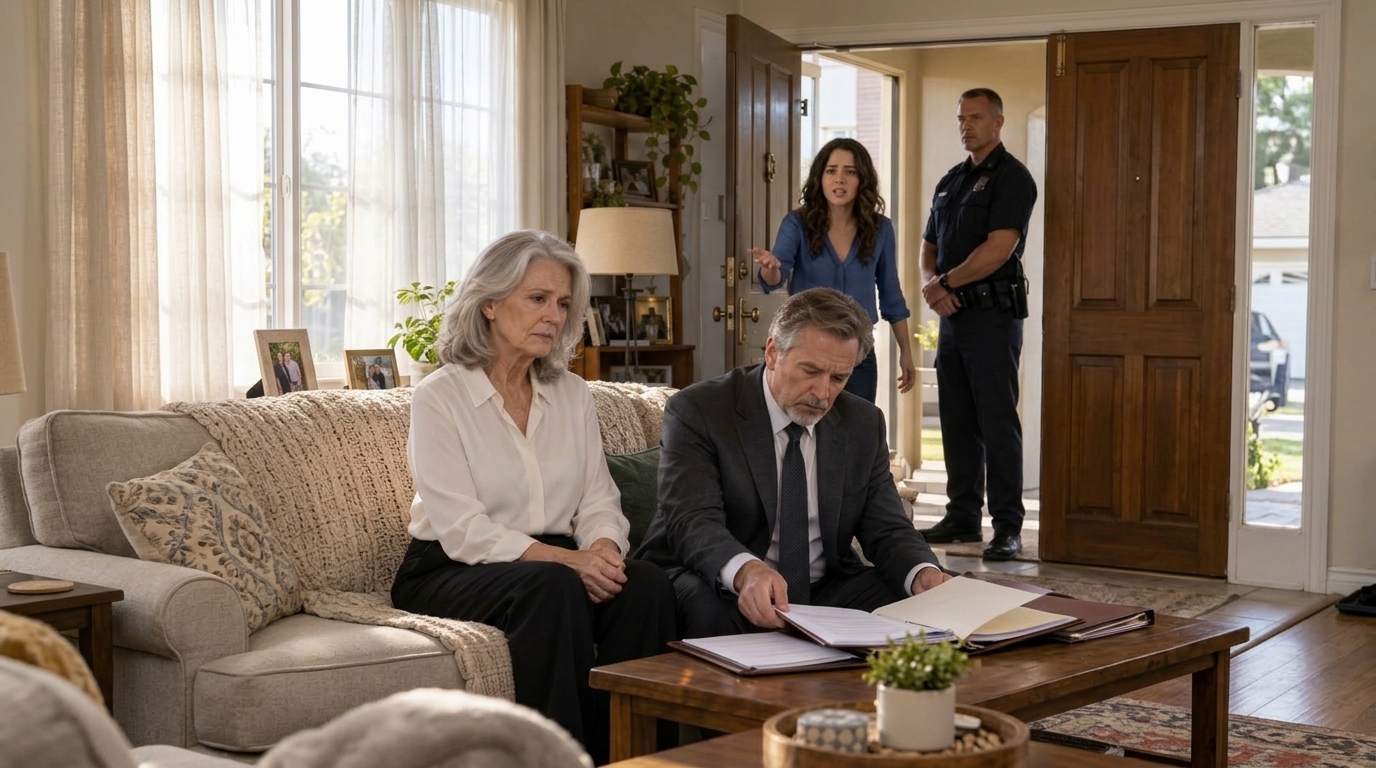
Matthew stared at the document on my coffee
table as though it were something poisonous.
For thirty seconds, nobody spoke.
The only sound came from the old wall clock above my kitchen doorway.
Tick.
Tick.
Tick.
I had owned that clock for twenty-seven years.
Matthew used to complain about its noise
when he was studying for exams.
He would climb onto a chair, take out the battery, and forget to put it back.
I always forgave him.
I wondered how many other things I had forgiven without realizing
what they would eventually become.
“That’s not what you think,” Matthew finally said.
Gregory Hayes, my attorney, remained standing beside the coffee table.
“Then perhaps you can explain it.”
Matthew’s eyes darted toward the court officer near the door.
“Why is he here?”
“Because your mother was concerned about your reaction,” Gregory replied.
Matthew looked offended.
“I’m her son.”
“Yes,” I said quietly. “That’s why I hoped you wouldn’t come here screaming.”
His jaw tightened.
“Mom, this is ridiculous. You moved all the money without telling me.”
I looked at him.
“Did you tell me you were planning to spend it?”
He opened his mouth.
Nothing came out.
Gregory turned the document toward him.
“This is a purported authorization bearing Carol’s signature. It was submitted as part of the financing documentation for the property you intended to purchase.”
Matthew glanced down.
“She signed it.”
“No,” I said.
His head snapped toward me.
“You don’t remember.”
Those three words struck harder than I expected.
Not because I believed them.
Because I recognized the strategy.
First, my son had called me old.
Then vulnerable.
Then incapable of handling my own affairs.
Now he was suggesting I couldn’t remember signing away my life savings.
I leaned forward.
“Matthew, I remember exactly what I signed at the bank. I remember the date, the branch, and the woman who witnessed the documents. I did not sign this.”
He looked at Gregory.
“She’s confused.”
Gregory didn’t raise his voice.
“Your mother has already supplied comparison signatures. The disputed document has been referred for examination.”
Matthew’s face lost some of its color.
Then he pointed at the second page.
“What’s that?”
Gregory took a slow breath.
“An authorization involving another person’s assets.”
Matthew’s hands began trembling.
“That has nothing to do with Mom.”
“Perhaps not directly,” Gregory said. “But the same property transaction appears in both sets of records.”
I looked at my lawyer.
“Gregory, tell him.”
Gregory nodded.
“The other person is Mr. Leonard Price.”
Matthew staggered backward.
“No.”
I felt my chest tighten.
Leonard Price.
Seventy-four years old.
A retired high school principal.
And Samantha’s father.
I had met Leonard only a handful of times during the seven years Matthew and Samantha had been married.
He was a gentle man who spoke softly, wore old-fashioned cardigans, and always insisted on washing his own dishes after family dinners.
His wife, Patricia, had died three years earlier.
Since then, Samantha and Megan had been managing many of his financial affairs.
I had never thought much about it.
Until Gregory discovered the second authorization.
Matthew shook his head.
“Leonard agreed to help.”
“Did he?” Gregory asked.
“Yes!”
“Then why has he stated that he never approved the transaction?”
Matthew went completely still.
I stared at him.
The son I had raised was suddenly standing in front of me like a stranger caught in a locked room.
“Leonard knows?” he whispered.
Gregory nodded.
“He does.”
Matthew looked toward the door.
Then back at me.
“Mom, listen. Samantha’s father has plenty of money. He doesn’t need all of it.”
I felt something inside me harden.
“And that makes it yours?”
Matthew rubbed his forehead.
“You’re twisting everything.”
“No, son. I’m asking you a simple question.”
He glared at me.
I continued.
“Why did you believe you had the right to use money belonging to two people who trusted you?”
His expression changed.
For one brief moment, I saw the little boy who used to hide broken toys behind the couch and insist they had fallen apart on their own.
Then he said, “Because neither of you was doing anything with it.”
The room fell silent.
I stared at him.
“Doing anything?”
He threw up his hands.
“Mom, you’re sixty-two. You live in a small apartment. You wear the same clothes every year. You don’t travel. You don’t buy anything expensive.”
I could barely breathe.
He continued.
“You’ve got over a million dollars sitting there while Samantha and I are trying to build a future.”
I looked at him.
“A future?”
“Yes!”
“With my retirement money?”
He clenched his jaw.
“Eventually, it would have been mine anyway.”
There it was.
The sentence I had feared.
The one that told me my son had stopped seeing me as a living person.
He was already dividing an inheritance I hadn’t left.
I sat back slowly.
“Matthew, I am not dead.”
He looked away.
“And even when I am, you don’t get to decide what happens to my property.”
His eyes flashed.
“After everything I’ve done for you?”
I almost laughed.
Not because anything was funny.
Because I couldn’t understand how a child who had received so much could convince himself he was the one who had sacrificed.
“What exactly have you done for me?” I asked.
He stared.
“I visit.”
“Once every six weeks.”
“I call.”
“When you need something.”
“That’s not fair.”
I nodded.
“You’re right. This isn’t fair.”
My voice trembled.
“Because I spent forty years making sure you never went without, and somewhere along the way, you decided that meant I should never have anything of my own.”
Matthew looked toward Gregory.
“Can we talk privately?”
“No,” I said.
His expression darkened.
“Mom.”
“No, Matthew. We have talked privately for years. Every time, you told me what a good son you were while asking for something else.”
I stood.
My knees trembled, but I remained upright.
“Today, I want witnesses.”
He looked at the court officer.
“Am I under arrest?”
Vincent answered calmly.
“No. I’m here in connection with the court-authorized service and security arrangements. I’m not here to arrest you.”
Matthew swallowed.
Gregory picked up another document.
“However, you should understand that the disputed financial documents have been reported to the appropriate authorities. You should seek independent legal advice before making further statements.”
Matthew stared at the papers.
Then he looked at me.
“You’re reporting your own son?”
I felt tears sting my eyes.
“I am reporting what happened to my money.”
He shook his head.
“Same thing.”
“No,” I whispered. “It isn’t.”
For several seconds, he stood there breathing heavily.
Then his phone rang.
Samantha.
He answered immediately.
“What?”
I couldn’t hear her words.
But I watched his expression change.
First confusion.
Then anger.
Then panic.
“What do you mean the closing is canceled?”
He paced toward the window.
“Samantha, listen to me.”
A pause.
“No, she moved everything.”
Another pause.
“Yes, all of it!”
He looked at me with pure fury.
Then he said, “Your father talked to someone too.”
Whatever Samantha said next made him close his eyes.
He lowered his voice.
“Don’t do anything stupid.”
I felt a chill.
He ended the call.
Then turned toward me.
“Mom, you’ve ruined everything.”
I looked at him.
“No, Matthew. I stopped you from ruining me.”
He grabbed his jacket.
At the doorway, he paused.
For one desperate second, I hoped he would turn around and apologize.
Instead, he said, “Don’t expect me to come back.”
I nodded slowly.
“Then don’t.”
His face twisted.
He slammed the door behind him.
The apartment became quiet.
I remained standing until I heard his footsteps disappear down the stairs.
Then my knees gave way.
Gregory helped me back onto the sofa.
I covered my face.
And I cried.
Not for the money.
The money was safe.
I cried for the boy who once brought me dandelions from the school playground because he couldn’t afford flowers.
The boy who used to fall asleep with his head on my shoulder.
The boy who promised, at eight years old, that he would buy me a beautiful house when he grew up.
Somewhere between that promise and the million-dollar house he wanted for Samantha’s family, something had gone terribly wrong.
Gregory waited until I could breathe again.
Then he said gently, “Carol, there’s something else you need to know.”
I looked up.
He placed a photograph on the table.
It showed the house Matthew intended to purchase.
A sprawling property with stone pillars, a swimming pool, and a circular driveway.
I had already seen it in the real estate brochures.
But Gregory pointed toward the ownership paperwork.
“The proposed purchaser wasn’t Matthew.”
I frowned.
“What?”
“The purchase documents listed a company.”
He turned the page.
SMP FAMILY HOLDINGS LLC.
I stared at the name.
“Samantha. Megan. Price.”
Gregory nodded.
“And according to the organizational documents we’ve obtained, Matthew wasn’t listed as an owner.”
I felt my stomach drop.
My son had been willing to steal from me.
But the house he wanted so desperately wouldn’t even belong to him.
And when Gregory explained who controlled the company, I realized Matthew might not have been the only person being used.
PART4
The next morning, I woke before sunrise.
For forty years, my body had been trained to rise early.
When Matthew was little, I got up at four-thirty to prepare breakfast before my cleaning shift.
Later, when I worked at the restaurant, I woke at five to pack his lunch and catch the first bus.
Even after retirement, I rarely slept past six.
That morning, however, I remained in bed staring at the ceiling.
I kept hearing Matthew’s voice.
“Eventually, it would have been mine anyway.”
I had never felt so old.
Not physically.
My health was good.
I still walked three miles most mornings.
I managed my properties and investments without difficulty.
But emotionally, I felt as though forty years had passed overnight.
At eight, my phone rang.
It was Gregory.
“Carol, are you awake?”
“Of course.”
“I’ve received a call from Leonard Price’s attorney.”
I sat up.
“Is Leonard all right?”
“He’s shaken, but he’s safe. He wants to meet with you.”
I hesitated.
“Why?”
“Because he believes you deserve to hear what happened from him.”
An hour later, I was sitting in Gregory’s office.
Leonard arrived wearing a gray cardigan and carrying a small leather briefcase.
He looked older than I remembered.
His shoulders were hunched.
His hands trembled.
When he saw me, his eyes filled.
“Carol.”
I stood.
“Leonard.”
He took both my hands.
“I’m so sorry.”
I shook my head.
“You haven’t done anything to me.”
His voice broke.
“Maybe not. But my daughters have.”
We sat across from each other.
Gregory and Leonard’s attorney, a woman named Helen Morris, remained nearby.
Leonard opened his briefcase.
Inside were copies of bank statements and property documents.
He looked at me.
“Three months ago, Samantha told me she and Matthew wanted to buy a larger home.”
I nodded.
“She said it would have enough space for the whole family.”
My stomach tightened.
“Her family?”
Leonard nodded.
“Samantha. Megan. Megan’s husband and children. And me.”
I frowned.
“All of you?”
“Yes.”
He looked down.
“She said I was getting too old to live alone.”
I recognized the words immediately.
Too old.
Not safe.
Needed protection.
The same language Matthew had used with me.
Leonard continued.
“She wanted me to sell my house and contribute the proceeds.”
“Did you agree?”
He shook his head.
“I told her I wasn’t ready.”
His eyes filled.
“Patricia and I lived there for thirty-nine years. Every room reminds me of her.”
I reached across the table.
He squeezed my hand.
“Then Megan began visiting more often. She said the stairs were dangerous. She said I was forgetting things.”
I swallowed.
“Were you?”
He gave a sad smile.
“Sometimes I forget where I put my glasses. But I haven’t forgotten how to manage my finances.”
Gregory nodded.
Leonard continued.
“Eventually, Samantha brought me paperwork. She said it would allow her to help with medical decisions if I became ill.”
He looked at Helen.
“Instead, some of those documents were used to support financial authority I never intended to give.”
Helen spoke carefully.
“The exact circumstances are being reviewed. Leonard has disputed the purported authorization for the house transaction, and we’ve taken steps to revoke any unnecessary financial authority.”
Leonard nodded.
Then he looked at me.
“Carol, they planned to use your savings to purchase the house and my investments to cover renovations and living expenses.”
I stared at him.
“How much of your money?”
He swallowed.
“Approximately four hundred thousand dollars was identified in the preliminary paperwork.”
I felt sick.
Together, Samantha and Megan had been discussing access to nearly $1.7 million belonging to two older parents.
Two people who had worked for decades.
Two people who trusted their children.
And neither of us had agreed to give them that money.
I looked at Leonard.
“Did Matthew know about your investments?”
Leonard hesitated.
“That’s one of the things we’re trying to establish.”
He opened another folder.
Then removed a printed email.
“I found this after Helen helped me regain access to my accounts.”
He passed it across the table.
The message was from Samantha to Megan.
It discussed the house.
The purchase price.
The anticipated funding.
And the planned ownership structure.
I read the final paragraph twice.
Then a third time.
Once the property is purchased through the company, Matthew won’t have any direct ownership rights. That protects the house if his mother starts making trouble.
My hands went cold.
I looked up.
Leonard nodded sadly.
“That’s why I wanted you to see it.”
I stared at the page.
Samantha had planned for the possibility that I would object.
She’d anticipated a dispute.
And she’d structured the purchase so that even if Matthew obtained my money, he wouldn’t control the property.
I felt a strange mixture of anger and pity.
Matthew had betrayed me.
That was undeniable.
But he had also been so eager to please Samantha that he hadn’t realized he was being excluded from the very asset he was trying to obtain.
I turned toward Gregory.
“Does Matthew know?”
“We don’t know.”
I looked at Leonard.
“Have you told him?”
He shook his head.
“No.”
I sat back.
For several seconds, I considered what to do.
A small, bitter part of me wanted Matthew to learn the truth the hard way.
I wanted him to experience the humiliation of discovering that someone he loved had valued him only for what he could provide.
Then I remembered his face when he was twelve.
He had come home crying because his best friend had stolen his bicycle.
“Why would he do that, Mom? I trusted him.”
I’d held him and said, “Someone else’s dishonesty doesn’t mean you were foolish to care.”
I looked down at the email.
My son had become dishonest himself.
But I still remembered the boy who once believed people should keep their promises.
“Gregory,” I said, “make sure Matthew’s attorney receives the relevant information through the proper channels.”
Gregory nodded.
“That’s sensible.”
Leonard looked relieved.
Then he said quietly, “Carol, I don’t know what will happen to our children.”
I stared at the table.
“Neither do I.”
He swallowed.
“But I know something.”
I looked up.
“We cannot save them by allowing them to destroy us.”
For the first time that morning, I felt understood.
Over the following weeks, the situation became more complicated.
The canceled house purchase was only the beginning.
Gregory obtained records showing that Matthew had attempted to initiate transfers from my former accounts.
Because I’d moved the funds and closed the accounts, those attempts had failed.
The bank retained records of the requests.
The disputed authorization bearing my signature was also examined.
A forensic document examiner concluded that there were significant differences between the signature on the authorization and my verified signatures.
The findings were referred to investigators.
Leonard’s attorney submitted his disputed documents for separate review.
Meanwhile, the real estate company confirmed that the purchase had never closed.
No ownership had transferred.
The mansion remained on the market.
That was the good news.
The bad news arrived on a Thursday afternoon.
I was watering the plants on my balcony when Gregory called.
“Carol, Samantha has contacted your bank.”
I froze.
“Why?”
“She’s claiming that you promised the money as a family gift.”
I almost dropped the watering can.
“What?”
“Her attorney has sent a letter alleging that the family relied on your supposed promise when making arrangements for the house.”
I stared across the street.
A woman was walking her dog.
A delivery truck stopped at the corner.
The world continued moving as though nothing extraordinary had happened.
I took a slow breath.
“Gregory, I never promised them anything.”
“I know.”
“I never even discussed buying that house.”
“That’s consistent with what you’ve told me and the records we’ve reviewed.”
I swallowed.
“Can she take my money?”
“She can’t simply take it because she makes a claim. We’ll respond appropriately.”
I sat down.
For the first time since the confrontation, I felt afraid.
Not because I doubted the truth.
Because I was beginning to understand how far Samantha was willing to go.
That evening, Matthew called.
I stared at his name on the screen.
For several seconds, I considered ignoring it.
Then I answered.
“Hello.”
Silence.
Finally, he said, “Mom.”
His voice sounded different.
Tired.
Uncertain.
I closed my eyes.
“Matthew.”
He took a breath.
“I need to ask you something.”
I waited.
“Did you really never promise Samantha the money?”
I stared at the wall.
“No.”
He swallowed.
“She said you agreed.”
“I didn’t.”
“She said you wanted to help us buy the house.”
I felt tears rise.
“Matthew, when have I ever told you I wanted to give away my retirement savings?”
He remained silent.
I continued.
“I helped with your apartment down payment. I paid for part of your education. I helped when you lost your job three years ago.”
My voice trembled.
“But I never agreed to buy a mansion for Samantha’s family.”
He exhaled.
Then whispered, “I saw the email.”
I closed my eyes.
“The one about the ownership company?”
“Yes.”
I waited.
He began crying.
“She told me we’d own it together.”
I felt a painful tug in my chest.
“I’m sorry she lied to you.”
He laughed bitterly.
“That’s all you have to say?”
I sat up.
“What would you like me to say?”
He was silent.
Then he whispered, “I thought you would understand.”
I felt my heart ache.
“Matthew, I understand that being betrayed by someone you love is devastating.”
He began crying harder.
“But you need to understand something too.”
“What?”
“You did the same thing to me.”
Silence.
I continued.
“You didn’t ask whether I wanted to help. You planned to take my money.”
He whispered, “I know.”
“You called it yours.”
“I know.”
“You tried to make me believe I couldn’t remember signing documents.”
He began sobbing.
“Mom, please.”
I closed my eyes.
“Do you know what that felt like?”
He didn’t answer.
I took a shaky breath.
“It felt like losing my son while he was still alive.”
For a long time, neither of us spoke.
Then Matthew said something I had never heard him say before.
“I was wrong.”
I stared at the phone.
He continued.
“I was so wrong.”
I wanted to believe him.
I wanted to reach through the phone and hold him.
But forty years of motherhood had taught me how easily love could make a person ignore warning signs.
So I said quietly, “Then show me.”
He sniffed.
“How?”
“Tell the truth. Cooperate with the investigation. Stop blaming other people for choices you made.”
He remained silent.
“And get your own lawyer.”
He nodded, though I couldn’t see him.
“Okay.”
Then he whispered, “Will you ever forgive me?”
I stared at the photograph of him on my bookshelf.
He was seven years old.
Missing two front teeth.
Holding a birthday cake I’d baked after working a double shift.
My eyes filled.
“I don’t know yet, Matthew.”
He began crying again.
I continued.
“But forgiveness and trust aren’t the same thing.”
He whispered, “I understand.”
I wasn’t sure he did.
Not yet.
But for the first time, he hadn’t asked me for money.
And that was something.
Three days later, Samantha arrived at my apartment.
She wasn’t alone.
Megan stood beside her.
Both women wore expensive coats.
Both looked furious.
Samantha knocked so hard that my neighbor opened his door.
When I answered through the intercom, she shouted, “Carol, we need to settle this!”
I remained behind the locked door.
“Contact my attorney.”
She laughed.
“You’re really going to hide behind lawyers?”
I looked through the peephole.
“No, Samantha. I’m going to protect myself with them.”
Megan stepped forward.
“You’ve destroyed our family!”
I felt a strange calm.
“No. I refused to finance your house.”
Samantha’s face twisted.
“Matthew promised us that money!”
I took a breath.
“Then Matthew promised something he didn’t own.”
She slammed her palm against the door.
“You selfish old woman!”
I closed my eyes.
There it was again.
Old.
Selfish.
As though living long enough to save money meant I had somehow forfeited the right to keep it.
I spoke clearly.
“Leave my building. Any further communication goes through Gregory.”
Samantha shouted something I couldn’t understand.
Then footsteps echoed down the hallway.
I called building security to document the incident.
Afterward, I sat at my kitchen table.
My hands were shaking.
But I wasn’t crying.
Not this time.
Because something had finally become clear.
Samantha and Megan weren’t angry because I’d hurt them.
They were angry because I’d stopped them.
And that was a difference I would never forget.
A month later, Gregory called with news.
“Carol, investigators have requested a formal interview.”
I looked toward the window.
“About Matthew?”
“About the entire transaction.”
I swallowed.
“All right.”
Then he said, “There’s one more thing.”
I closed my eyes.
“What?”
“Matthew has agreed to provide documents and communications concerning the house purchase.”
I sat very still.
“Voluntarily?”
“Through his attorney, yes.”
I looked at the photograph on my bookshelf.
The little boy with the missing teeth.
For the first time in weeks, I felt a tiny flicker of hope.
Not that everything would return to normal.
It couldn’t.
But perhaps my son was finally beginning to understand that telling the truth mattered more than protecting a lie.
And perhaps, just perhaps, the story wasn’t going to end with him standing at my door demanding money.
Perhaps it would end with him learning what it meant to become a man worthy of trust.
PART 5
Six months after Matthew stormed into my apartment, I sat in a courtroom listening to a judge explain the conditions of a plea agreement.
I had imagined that moment many times.
In some versions, I was angry.
In others, I was triumphant.
Sometimes I imagined standing up and telling everyone exactly how much I’d sacrificed for my son.
But when the day finally arrived, I felt neither victory nor satisfaction.
I felt tired.
Matthew sat at the defense table beside his attorney.
He wore a dark suit.
His hair was neatly combed.
He looked thinner than he had six months earlier.
He didn’t look at me when I entered.
I sat beside Gregory.
Leonard Price sat on my other side.
We had become friends during the months of investigations, paperwork, and difficult conversations.
Every Thursday, we met for coffee.
Sometimes we discussed the case.
Sometimes we talked about our children.
Often, we spoke about our late spouses, the lives we’d built, and the strange loneliness of realizing that people we’d raised could become people we barely recognized.
That morning, Leonard reached for my hand.
“Are you all right?”
I nodded.
“Are you?”
He gave a sad smile.
“As much as I can be.”
Across the courtroom, Samantha sat with her attorney.
Megan sat several rows behind her.
The investigation had established that Samantha and Megan were deeply involved in arranging the proposed property purchase.
Financial records, emails, and messages revealed their efforts to obtain funds from both families.
The authorities had also reviewed the disputed signatures and authorization documents.
The legal consequences differed according to each person’s actions and the available evidence.
Matthew had admitted participating in an attempt to use my funds without my consent.
He had also acknowledged making false statements about my authorization.
Through his attorney, he had provided communications that helped investigators reconstruct the plan.
Samantha faced separate charges connected with the disputed documents and attempted financial transactions.
Megan’s involvement was addressed through a separate proceeding.
I didn’t celebrate any of it.
These were people who had sat at my table.
People whose birthdays I’d remembered.
People I’d welcomed into my family.
And now their names appeared in court documents.
The judge reviewed Matthew’s plea.
There were conditions.
Restitution for documented losses.
Financial restrictions.
Supervision.
Community service.
And requirements designed to prevent further misconduct.
The exact sentence reflected the charges, his cooperation, and the fact that the major transfer had been stopped before my savings disappeared.
When the judge asked whether Matthew wished to speak, he stood.
His hands trembled.
For several seconds, he stared at the floor.
Then he looked toward me.
“Your Honor, I spent most of my life believing my mother would always rescue me.”
My throat tightened.
He continued.
“When I was a child, she worked two jobs. She made sure I had food, clothes, school supplies, and opportunities she never had.”
His voice broke.
“And instead of being grateful, I started thinking that everything she had belonged to me.”
I felt tears fill my eyes.
Matthew swallowed.
“I convinced myself that because she would probably leave me her money someday, I had the right to use it now.”
He shook his head.
“That’s not an excuse. It’s the truth about how selfish I became.”
The courtroom was silent.
He continued.
“I let my wife and her family encourage something I already wanted. I blamed them when things went wrong, but I made my own decisions.”
My hands trembled.
He looked directly at me.
“Mom, you gave me a life. I tried to take away your security.”
Tears streamed down his face.
“I’m sorry.”
I covered my mouth.
He continued.
“I don’t expect you to forgive me. I don’t expect you to trust me. I just want you to know that I finally understand the difference between being your son and being entitled to what you own.”
I closed my eyes.
For years, I’d waited for Matthew to understand how much I’d given him.
Now, hearing him say those words, I realized something.
I didn’t need him to understand every sacrifice.
I needed him to respect that I was a person.
A woman with dreams.
Fears.
Needs.
And a future that belonged to me.
When Matthew sat down, Leonard squeezed my hand.
I cried quietly.
Not because everything was fixed.
Because something important had finally been said aloud.
The proceedings continued.
Matthew’s sentence was imposed.
Samantha’s separate case remained unresolved for several more months.
Eventually, she entered a plea concerning her role in the fraudulent documentation and attempted transactions.
Megan also faced consequences related to her participation.
Leonard’s disputed financial authority was revoked, and his accounts were secured.
The attempted purchase never closed.
The $1.2 million mansion remained someone else’s property.
And my $1.3 million stayed where it belonged.
Under my control.
But the months after the court hearing were not easy.
Matthew and Samantha separated.
Their marriage had already been strained by arguments about money, ownership, and the failed purchase.
Once the emails became public in the legal proceedings, Matthew could no longer ignore that Samantha had intended to place the house outside his ownership.
He moved into a small rented apartment.
For the first time in his adult life, he had to manage a household without relying on me to rescue him from financial mistakes.
He called occasionally.
At first, our conversations were awkward.
“How are you, Mom?”
“I’m fine.”
“How’s the apartment?”
“Good.”
“Anything you need?”
“No, thank you.”
Then silence.
Sometimes I wanted to fill it.
I wanted to ask whether he was eating properly.
Whether his bills were paid.
Whether he needed groceries.
But I stopped myself.
Not because I no longer cared.
Because I had finally learned that love did not require me to solve every problem.
One Sunday, Matthew called and asked whether he could visit.
I hesitated.
Then agreed.
He arrived carrying a small paper bag.
No expensive gifts.
No elaborate apologies.
Just a bag from the bakery around the corner.
“I brought your favorite cinnamon rolls.”
I looked at him.
“You remembered?”
He smiled sadly.
“Of course.”
We sat at the kitchen table.
The same table where he’d once asked to become a co-owner of my bank accounts.
For a while, we talked about ordinary things.
His job.
The weather.
A baseball game he’d watched.
Then Matthew looked toward the old clock above the doorway.
“It still ticks too loudly.”
I laughed softly.
“You used to take out the battery.”
He smiled.
“I remember.”
Silence settled between us.
Then he said, “Mom, can I ask you something?”
I nodded.
“Do you hate me?”
My heart tightened.
I looked at him for a long moment.
“No.”
His eyes filled.
“But I was very hurt.”
He nodded.
“I know.”
“And I’m still hurt.”
He lowered his head.
“I know.”
I took a breath.
“Matthew, there were nights when I couldn’t sleep because I kept wondering what I did wrong.”
He looked up.
My voice trembled.
“I wondered whether I spoiled you. Whether I gave too much. Whether I taught you that my needs didn’t matter.”
He began crying.
I continued.
“But I’ve realized something.”
He waited.
“I made mistakes as a mother. Every parent does. But I didn’t teach you to forge signatures or take money that wasn’t yours.”
He nodded slowly.
“Those were your choices.”
“I know.”
“And you have to live with them.”
He wiped his eyes.
“I am.”
I looked at him.
“Then perhaps we can build something different.”
His expression changed.
“Really?”
I nodded.
“Slowly.”
He began crying harder.
I continued.
“That doesn’t mean access to my accounts. It doesn’t mean borrowing money. It doesn’t mean pretending nothing happened.”
He nodded repeatedly.
“I understand.”
“It means honesty. Respect. Boundaries.”
He reached across the table.
“Whatever you need, Mom.”
I looked at his hand.
For a moment, I remembered the tiny fingers that used to wrap around mine when we crossed busy streets.
Then I placed my hand over his.
“Start by being a son who comes to visit because he wants to see his mother.”
He nodded.
“Okay.”
“And not because he wants something.”
His face crumpled.
“I promise.”
I wanted to believe him.
But this time, I knew promises were only the beginning.
Over the following year, Matthew began proving himself through small actions.
He called every Sunday.
Not to ask about my finances.
Not to complain about Samantha.
Not to request help.
Just to ask how I was doing.
Sometimes he visited.
He fixed a loose cabinet hinge.
Helped carry groceries.
Took me to lunch.
And once, when I had the flu, he brought soup and left it outside my door because I told him I didn’t want visitors.
He didn’t argue.
He simply texted, “Feel better, Mom.”
It was such a small thing.
But after everything that had happened, respecting a simple request mattered.
Meanwhile, I began making changes of my own.
For forty years, I’d lived as though saving money was the only way to stay safe.
I packed lunches.
Bought secondhand clothes.
Compared prices.
Avoided unnecessary expenses.
Even after accumulating substantial savings, I continued living as though one unexpected bill might destroy everything.
Some habits had protected me.
Others had become a prison.
One afternoon, Gregory asked me a question.
We were reviewing my updated estate documents.
“Carol, what do you want to do with your money while you’re alive?”
I frowned.
“What do you mean?”
He smiled.
“You’ve spent your life saving. What would you enjoy?”
I stared at him.
Nobody had asked me that in years.
I thought about it.
Then laughed.
“I don’t know.”
Gregory leaned back.
“Well, perhaps it’s time to find out.”
That evening, I sat at my kitchen table with a notebook.
At the top of the page, I wrote:
THINGS I WANT TO DO BEFORE I’M TOO OLD TO ENJOY THEM.
Then I crossed out the last part.
I wasn’t too old.
I was sixty-two.
Healthy.
Financially secure.
And finally free to make decisions without explaining myself to anyone.
I started again.
THINGS I WANT TO DO.
First, I wrote: Visit Italy.
I’d dreamed of seeing Florence since I was a teenager.
I’d watched documentaries about the museums, the churches, and the narrow streets.
Diane, my closest friend from childhood, had once promised we’d go together.
But life intervened.
Children.
Work.
Bills.
Then Diane died unexpectedly at fifty-eight.
I’d attended her funeral and promised myself I would stop postponing things.
But I hadn’t.
Now I looked at the words.
Visit Italy.
And smiled.
Second, I wrote: Take a painting class.
I’d loved drawing when I was young.
Before Matthew.
Before the double shifts.
Before every dollar became a responsibility.
Third, I wrote: Help other women build financial independence.
That one surprised me.
But the more I thought about it, the more it mattered.
I knew what it felt like to raise a child alone.
I knew what it meant to work until your feet hurt.
I knew how easily people could convince mothers that their value came only from what they sacrificed.
And I wanted other women to know they were allowed to build something for themselves.
Three months later, I boarded a plane to Italy.
Alone.
I was terrified.
I’d never traveled internationally by myself.
I checked my passport six times.
I arrived at the airport four hours early.
I worried about losing my luggage.
But when the plane lifted into the sky, I looked out the window and began crying.
For the first time in my adult life, I was going somewhere simply because I wanted to.
Not for Matthew.
Not for work.
Not because someone needed me.
For me.
I spent twelve days exploring Florence, Rome, and Venice.
I visited museums.
Ate pasta in tiny restaurants.
Walked along cobblestone streets.
Bought a beautiful blue scarf without checking whether it was on sale.
And one afternoon, I sat in a café overlooking a square and ordered dessert.
A slice of chocolate cake.
Just for myself.
I stared at it for a moment.
Then laughed.
Because when Matthew was little, I never ordered dessert unless he wanted something and couldn’t finish it.
Now I was sixty-three years old.
Sitting in Italy.
Eating an entire piece of cake.
And nobody needed my permission.
When I returned home, I enrolled in a painting class.
I wasn’t very good.
My first landscape looked more like a crooked potato field.
But I loved it.
I made friends.
We went for coffee.
We visited galleries.
And gradually, my life became something more than a collection of sacrifices.
I also established a small educational fund through a local nonprofit.
It provided modest grants for single parents pursuing job training or community college programs.
I called it the Second Beginning Fund.
The first year, we helped six women.
One trained as a medical assistant.
Another completed a bookkeeping certificate.
A third earned her commercial driver’s license.
When I met them, I saw pieces of my younger self.
Exhausted.
Determined.
Afraid.
But unwilling to give up.
One woman named Teresa hugged me after receiving her grant.
“I don’t know how to thank you.”
I smiled.
“Finish your training.”
She laughed through tears.
“I will.”
“And when you’re able, help someone else.”
She nodded.
That evening, I went home feeling something I hadn’t experienced in years.
Peace.
Not the kind that comes from having money.
The kind that comes from knowing your life still has purpose.
My estate plan changed too.
I worked with Gregory to establish clear instructions for my assets.
Matthew would no longer automatically receive everything simply because he was my only child.
I made provisions for charitable giving and for people and causes that mattered to me.
I also left room for my relationship with Matthew to improve over time.
But I refused to make inheritance a reward he could demand.
When Gregory asked whether I was comfortable with the changes, I nodded.
“Yes.”
He smiled.
“Good.”
I looked at the documents.
For the first time, they reflected my wishes.
Not my guilt.
Not Matthew’s expectations.
Mine.
Two years after the confrontation, Matthew invited me to dinner.
He’d moved into a modest apartment.
Nothing luxurious.
A small living room.
A narrow kitchen.
A dining table that had clearly come from a discount furniture store.
When I arrived, he opened the door wearing an apron.
I stared at him.
“You’re cooking?”
He laughed.
“Trying.”
I stepped inside.
The apartment smelled like chicken and onions.
He’d made chicken and dumplings.
My recipe.
I looked at the pot.
“Where did you learn?”
He smiled sheepishly.
“I watched about fifteen videos and called Aunt Linda twice.”
I laughed.
“That sounds about right.”
We sat down.
The dumplings were slightly too thick.
The broth needed salt.
But it was the best meal I’d eaten in a long time.
Because Matthew had made it himself.
Not to impress anyone.
Not to gain something.
Just because he remembered that it was my favorite.
After dinner, he brought out a small envelope.
My heart tightened.
For one awful second, I thought it contained another financial request.
Matthew noticed my expression.
He smiled sadly.
“Don’t worry, Mom. I’m not asking for money.”
I relaxed.
He handed me the envelope.
Inside was a photograph.
Me.
At twenty-one.
Holding Matthew as a toddler.
I was standing outside the tiny apartment where we’d lived when he was little.
My hair was pulled into a messy ponytail.
My clothes were plain.
I looked exhausted.
But I was smiling.
On the back, Matthew had written:
You gave me everything I needed when you had almost nothing. I’m sorry I forgot that your life belonged to you too.
My eyes filled.
I looked at him.
He was crying.
“I found it in an old box,” he whispered.
I held the photograph carefully.
Then said, “Matthew, I loved being your mother.”
He nodded.
“I know.”
“But I wish I’d remembered sooner that I was allowed to be Carol too.”
He began crying harder.
I reached across the table.
He took my hand.
“I’m glad you’re happy, Mom.”
I smiled.
“I am.”
And for the first time, I believed he meant it without wanting anything in return.
Our relationship was not the same as before.
It never would be.
Trust, once broken, doesn’t return simply because someone apologizes.
It grows slowly.
Through honesty.
Through consistency.
Through respecting boundaries when nobody is watching.
Matthew still had consequences to live with.
Financial obligations.
Damaged relationships.
A reputation he had to rebuild.
And the knowledge that he’d nearly destroyed the person who loved him most.
But he was making different choices.
And I was learning to love him without sacrificing myself.
That was enough for now.
Last Sunday, Matthew came to visit.
He brought groceries.
Not because I needed them.
Because he’d found fresh peaches at the farmers market and remembered I loved them.
We sat on my balcony drinking tea.
The afternoon sunlight warmed the railing.
A breeze moved through the potted flowers.
Matthew looked around.
“Mom, you seem different.”
I smiled.
“Different how?”
He thought for a moment.
“Happier.”
I nodded.
“I am.”
He looked toward the street.
“Do you ever think about what happened?”
I took a slow breath.
“Sometimes.”
He lowered his head.
“I’m still ashamed.”
I reached for his hand.
“Shame can teach you something, Matthew. But don’t let it become an excuse to stop growing.”
He nodded.
Then asked, “Do you think we’ll ever be like we were before?”
I looked at him.
The little boy I’d raised.
The man who’d betrayed me.
The son who was slowly learning to become someone better.
“No,” I said gently.
His face fell.
I squeezed his hand.
“Because before, I thought being your mother meant giving you everything.”
He looked up.
“And now?”
I smiled.
“Now I know being your mother means loving you enough to tell you no.”
He was quiet.
Then he smiled.
“I think I needed that.”
I laughed softly.
“So did I.”
We sat together watching the sunset.
For years, I’d believed my greatest achievement was raising a successful son.
Then I believed my greatest failure was discovering what he’d become.
But I finally understood that neither was the whole truth.
Matthew was responsible for his choices.
And I was responsible for mine.
I could love him.
I could hope for him.
I could support his growth.
But I did not have to surrender my future to prove my devotion.
The $1.3 million I’d saved was still mine.
Not because money mattered more than family.
But because my security, dignity, and independence mattered too.
I had spent forty years building that life.
I wasn’t going to apologize for protecting it.
And I wasn’t going to spend the rest of my years waiting for someone else to decide what I deserved.
As Matthew prepared to leave, he paused at the door.
“Mom?”
“Yes?”
He smiled.
“Are you making chicken and dumplings next Sunday?”
I raised an eyebrow.
“Maybe.”
He laughed.
“Can I come?”
I looked at him for a moment.
Then smiled.
“Only if you help with the dishes.”
He grinned.
“Deal.”
After he left, I returned to my balcony.
The city lights were beginning to glow.
Somewhere below, children were laughing.
A couple walked hand in hand along the sidewalk.
Life continued.
Ordinary.
Beautiful.
Uncertain.
I thought about the morning Matthew had stormed into my apartment screaming, “Where is my money?”
I remembered his fury.
His disbelief.
The way his face had changed when he saw Gregory and the court officer.
Back then, I thought protecting my savings would mean losing my son forever.
Instead, it had forced both of us to confront a truth we’d avoided for years.
Love is not ownership.
A child does not own a parent’s sacrifices.
A parent does not owe a grown child unlimited access to everything they’ve earned.
And being a good mother does not mean allowing yourself to be destroyed.
I had given Matthew my youth.
My energy.
My sleepless nights.
My patience.
My love.
Those gifts were real.
And I would never regret them.
But the years I had left were mine.
I intended to live them.
To travel.
To paint.
To laugh.
To help others.
To enjoy dessert without guilt.
And to wake each morning knowing I no longer had to choose between loving my son and protecting myself.
Because at sixty-three, I had finally learned something I wished I’d known at eighteen.
A mother’s love can be endless without her sacrifices being endless too.
And sometimes the most powerful words a mother can say are not “I’ll give you everything.”
Sometimes they are simply:
“I love you, son. But this belongs to me.”
THE END THANK YOU FOR READING !!!



