PART 3
My father had spent fifteen years convincing me
that everything I owned belonged to the family.
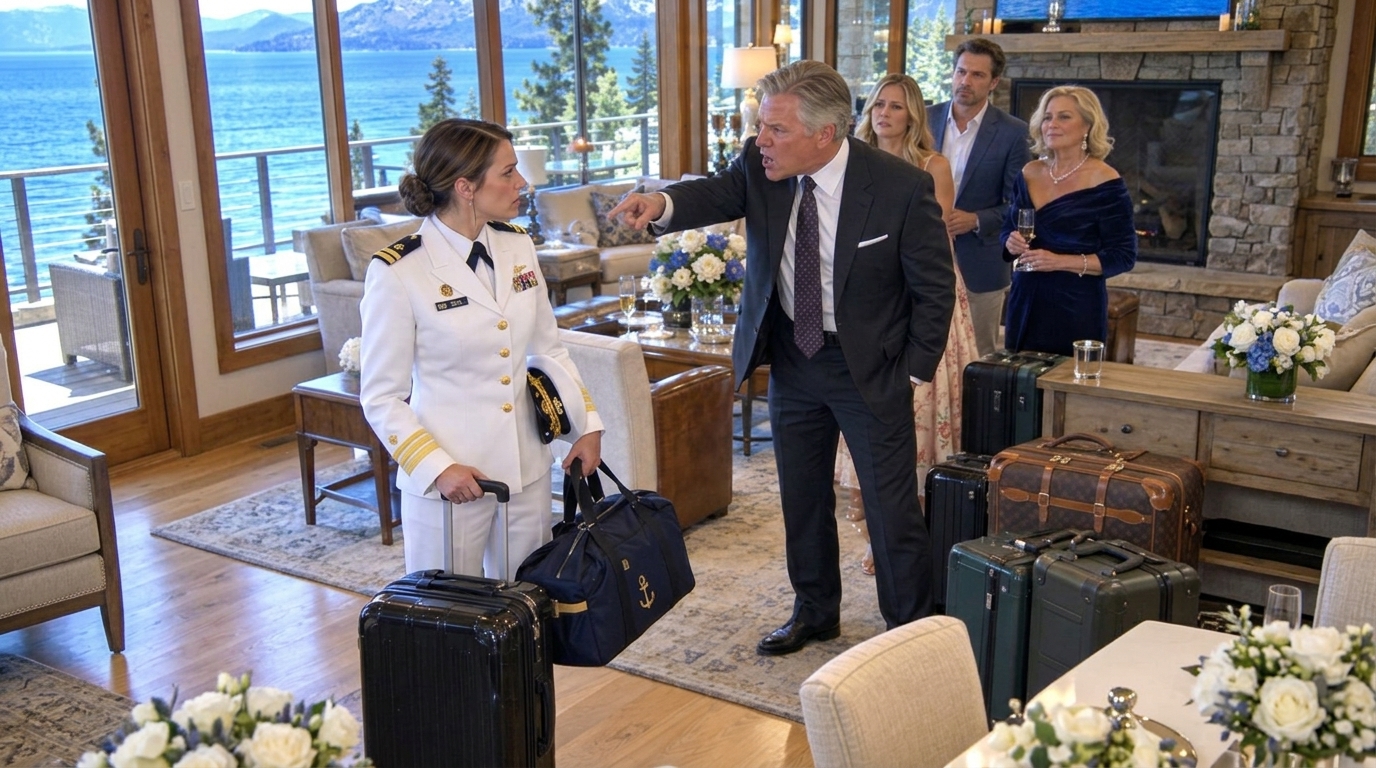
Now, standing in the living room of my Lake Tahoe villa,
he was discovering that the law had a very different opinion.
I watched the security feed from my apartment in
San Diego as Michael Vance stood at
the front entrance, holding a thick folder.
Beside him were the foundation’s property manager,
Rebecca Collins, and a sheriff’s deputy named Thomas Reed.
My father stood in the doorway, his face turning an alarming shade of red.
“What mortgage application?” he demanded.
Michael didn’t raise his voice.
The application submitted to Sierra Crest Lending six weeks ago,
Mr. Martin. The one identifying Commander Lauren Martin as
the borrower and listing this property as collateral.”
For a moment, nobody spoke.
Then Olivia laughed nervously.
“That must be a mistake.”
Michael opened the folder.
“The lender doesn’t believe so.”
My father looked toward the ceiling camera.
He knew I was watching.
“Lauren!” he shouted. “Turn this ridiculous thing off!”
I leaned back in my chair.
I had heard that tone since childhood.
It was the voice he used whenever he wanted a conversation to end before anyone could question him.
When I was nine, he used it after spending my birthday money.
When I was seventeen, he used it when I asked
why Olivia had received a new car while I was working two jobs to afford college.
When I was thirty-six, grieving my husband,
he used it while demanding fifty thousand dollars to save the family home.
For years, that voice had made me feel like a disobedient child.
But I was forty-one now.
A United States Navy commander.
A widow.
And the sole person responsible for deciding what happened to my life.
I pressed the microphone button.
“Dad, Michael is authorized to speak for me. Listen to him.”
He spun toward the camera.
“You ungrateful little—”
Michael interrupted.
“Mr. Martin, I strongly recommend that you stop speaking until you understand the situation.”
My father stared at him.
Then David stepped forward.
“Look, we were told we could move in. We’ve got two children and a truck full of furniture. Surely we can settle this like adults.”
Rebecca glanced at the suitcases scattered across the marble floor.
“Who told you that you had permission?”
David pointed at my father.
“He did.”
Rebecca looked directly at Dad.
“And what authority did you have to grant permission?”
My father straightened.
“I’m Lauren’s father.”
Rebecca waited.
He frowned.
“What?”
“I’m asking whether you own the property, hold a valid lease, or have written authorization from the owner.”
His mouth tightened.
“I don’t need paperwork to make decisions for my daughter.”
Rebecca calmly opened her tablet.
“Actually, you do.”
I almost smiled.
My father had spent his life relying on the assumption that people would become uncomfortable enough to surrender.
Rebecca didn’t appear uncomfortable at all.
She looked like someone who had handled difficult property disputes for twenty years and had no intention of being impressed by a man shouting in an expensive kitchen.
Michael continued.
“The foundation acquired the villa through a properly executed transfer, subject to the foundation’s governance requirements. The property records have been updated. The foundation’s independent trustees have not authorized your occupancy.”
Olivia looked around the room.
“You donated the whole house?”
I answered through the speaker.
“Yes.”
Her mouth fell open.
“Without telling us?”
I stared at her image.
“Did you tell me before you decided to move in?”
She said nothing.
I continued.
“Did you ask me before you started measuring my walls?”
Her cheeks flushed.
“That’s different.”
“How?”
“Because we’re family!”
I closed my eyes.
There it was.
The phrase that had cost me more money, more peace, and more dignity than any financial mistake I’d ever made.
Because we’re family.
As though those three words could turn theft into generosity.
As though love meant permanent surrender.
As though my years of military service had somehow erased my right to own a home.
Michael placed another document on the counter.
“Before we discuss your departure, we need to address the attempted loan.”
My father’s expression changed.
Not anger this time.
Fear.
And I knew immediately that Michael had found something far worse than I expected.
Three days earlier, Michael had called me with an unusual question.
“Lauren, have you recently applied for a home equity loan?”
I was sitting in my office reviewing equipment readiness reports.
“No.”
“Not through Sierra Crest Lending?”
“No.”
He’d paused.
“Did you authorize anyone to obtain financing against your Tahoe property?”
I had gone completely still.
“Michael, what’s happening?”
He explained that during his review of the property records, he had discovered an inquiry associated with a proposed secured loan.
The application hadn’t resulted in a funded mortgage.
But it contained enough personal information to raise serious concerns.
My name.
My former residential address.
My approximate income.
And a signature resembling mine.
I remembered gripping the edge of my desk.
“How much?”
Michael had hesitated.
“Four hundred eighty thousand dollars.”
I stared at the wall.
Nearly half a million dollars.
My father had demanded fifty thousand after James died.
He had pressured me for smaller amounts for years.
But this was different.
This wasn’t another request.
Someone had attempted to create debt in my name.
And use my home to secure it.
Michael had immediately advised me to preserve records, contact the lender’s fraud department, and take appropriate steps to protect my credit.
He also arranged for an independent forensic document examiner to review the application.
We didn’t know everything yet.
But the documents had revealed one particularly troubling detail.
The contact telephone number on the application belonged to my father.
Back on the security feed, Michael showed him the lender’s correspondence.
Dad’s eyes moved across the page.
Then he laughed.
A strange, brittle laugh.
“This is a misunderstanding.”
Michael remained silent.
My father continued.
“I was exploring options.”
“Options for whom?” Michael asked.
“For the family.”
“Using Lauren’s identity?”
Dad waved his hand.
“I wasn’t going to hurt her.”
I pressed the microphone button.
“Then why didn’t you tell me?”
He looked up.
“Because you would have said no.”
The room went silent.
Even Olivia stopped moving.
I stared at my father.
For years, he’d disguised his demands as emergencies.
He always claimed there wasn’t enough time to explain.
That the bank needed an answer immediately.
That someone would be hurt if I didn’t act.
But now, with everyone listening, he’d admitted the truth.
He hadn’t asked because he already knew my answer.
Michael made a note.
“Mr. Martin, whether you believed you were helping the family does not establish authorization.”
Dad turned toward David.
“Say something.”
David looked at the application.
Then slowly stepped backward.
“I didn’t know about that.”
My father stared at him.
“Don’t start.”
David’s voice sharpened.
“You told me Lauren agreed to help finance the renovation.”
I leaned forward.
Renovation?
What renovation?
Michael noticed the same thing.
“What renovation?”
David swallowed.
“The expansion. The guest wing. The new deck.”
Rebecca looked around.
“The foundation hasn’t approved any construction.”
Olivia suddenly covered her mouth.
I watched her husband turn toward her.
“Olivia, tell them.”
She shook her head.
“David, stop.”
But David was already speaking.
“Her father said there was a loan being arranged. He told us the villa would eventually be transferred into Olivia’s name.”
My pulse slowed.
That familiar coldness settled over me.
The feeling I experienced during operational emergencies when panic would only make things worse.
I pressed the microphone.
“Dad, how long have you been planning this?”
He stared at the camera.
“Lauren, we can talk privately.”
“No.”
His jaw tightened.
“Don’t embarrass me in front of strangers.”
I looked at the people gathered inside my home.
My father.
My stepmother.
My sister.
Her husband.
The property manager.
The attorney.
The deputy.
And I realized something astonishing.
My father wasn’t embarrassed by what he’d done.
He was embarrassed that other people knew.
Rebecca explained that the foundation required everyone to leave and that any disputed claim would need to be handled through the proper legal process.
The deputy documented the circumstances and made clear that the parties should not attempt further unauthorized entry.
Because my father and his family had only just arrived, had no established residence there, and could produce no valid permission, they ultimately agreed to remove their belongings rather than remain and face further proceedings.
They were not happy.
Olivia cried.
Susan threatened to call a lawyer.
David argued with the moving company.
My father kept insisting that I would change my mind.
But within two hours, the villa was empty again.
Rebecca inspected the property.
Nothing significant had been damaged.
A few suitcases had scraped the floors.
Several cabinets had been opened.
And Olivia had placed a framed family photograph on the mantelpiece.
A photograph taken at her wedding.
Everyone smiling.
Everyone dressed beautifully.
Everyone except me.
I hadn’t been invited.
I watched Rebecca remove it.
“Would you like this preserved with their belongings?” she asked.
“Yes,” I replied.
Then I added, “Please make sure everything is returned properly.”
I didn’t want their property.
I didn’t want revenge.
I wanted the boundaries I’d established to be respected.
And I wanted the truth.
That evening, Michael called.
“They’re gone.”
I closed my eyes.
“Thank you.”
“Lauren, there’s something else.”
I straightened.
“What?”
“We obtained additional records from the lender’s fraud review.”
My stomach tightened.
“And?”
“The loan application included an electronic copy of a document you signed four years ago.”
I frowned.
“What document?”
“An authorization related to your father’s financial affairs.”
I stared at the wall.
Then remembered.
Four years earlier, Dad had been hospitalized after a cardiac episode.
He’d insisted he needed temporary help dealing with certain bills.
I had signed a limited authorization allowing his accountant to communicate with me about specified accounts.
Nothing involving my property.
Nothing involving loans.
Nothing giving him authority over my finances.
Michael continued.
“The signature image appears similar to the one on that document.”
I whispered, “He reused it?”
“That’s one possibility investigators will examine.”
I closed my eyes.
Then Michael said, “There’s another detail.”
I waited.
“The application included a statement claiming the Tahoe villa was a family investment property purchased using pooled family funds.”
I felt sick.
“That’s a lie.”
“I know.”
“Every payment came from my accounts.”
“We have the records.”
I looked toward the photograph of James on my desk.
He was standing beside a Navy helicopter, smiling into the sunlight.
For three years after his death, I had worked desperately to preserve the people he believed were my support system.
Now I was learning that some of those same people had been planning to take the one peaceful place I had built for myself.
I swallowed.
“Michael, how far back does this go?”
There was a pause.
Then he answered.
“Far enough that I think we need to review every major transfer you’ve made to your father.”
I stared at the phone.
“Every transfer?”
“Yes.”
I looked down at my hands.
The SUV.
The gambling debt.
The family mortgage.
The emergencies.
The guilt.
The endless promises that everything would be repaid.
And suddenly, I wondered whether any of those emergencies had been real.
Michael’s next words made my blood run cold.
“Lauren, I don’t think your father was simply trying to take your villa.”
He paused.
“I think he’s been building a financial scheme around your money for years.”
PART 4
The first thing Michael told me was that we needed to separate what we suspected from what we could prove.
It was advice I understood.
In the Navy, assumptions could destroy an operation.
A single incorrect report could send an entire team in the wrong direction.
I had spent fifteen years learning to distinguish evidence from emotion.
But when the person under investigation was my father, every document felt personal.
Every signature.
Every withdrawal.
Every message.
Every carefully worded request.
I had trusted him because he was my father.
Now I was reviewing his financial dealings like a hostile transaction.
And what we uncovered made the villa incident look almost ordinary.
We started with the $25,000 I had wired him while deployed overseas.
I remembered that call clearly.
It had come at an awful hour.
I was exhausted.
Our communications window was limited.
And Dad sounded terrified.
“Lauren, I need help.”
I had sat upright immediately.
“What’s wrong?”
“Some men are threatening me.”
My stomach had dropped.
“What men?”
“I made a mistake.”
He’d begun crying.
“Gambling. I borrowed money. They’re saying they’ll come to the house.”
I remembered gripping the phone.
“Have you contacted the police?”
“No!”
His voice had sharpened.
“You can’t involve anyone. They’ll ruin me.”
Then he’d lowered his voice.
“Please, sweetheart. I don’t know who else to call.”
I had transferred the money within hours.
No questions.
No conditions.
No written agreement.
Just fear.
And the desperate belief that if I paid quickly enough, my father would be safe.
Now Michael had obtained the relevant banking records through lawful requests and the information Dad had provided during the initial review.
The account receiving my money belonged to my father.
That much was expected.
What happened next wasn’t.
Within forty-eight hours, most of the money had been transferred to a company called Blue Summit Ventures.
I stared at the statement.
“What is Blue Summit Ventures?”
Michael looked grim.
“A business registered by David.”
I felt the air leave my lungs.
“Olivia’s husband?”
“Yes.”
I stared at the page.
The same David who’d stood inside my villa discussing where to mount his television.
The same man who claimed his children needed my home more than I did.
The same man who’d told Michael he didn’t know about the suspicious loan.
I whispered, “What kind of business?”
“Real estate investment and consulting.”
I looked up.
“Was Dad’s gambling debt real?”
Michael folded his hands.
“We haven’t found evidence supporting the story he told you. The records we do have show the money flowing into David’s company.”
I stared at the bank statement.
Twenty-five thousand dollars.
Money I had sent from thousands of miles away because I believed my father was in danger.
And most of it had ended up connected to my sister’s husband.
I felt my throat tighten.
“Did Olivia know?”
Michael hesitated.
“We’re still reviewing that.”
I nodded.
But something inside me already knew.
My sister had always been remarkably comfortable receiving the benefits of my sacrifices.
She rarely asked where the money came from.
And she never seemed surprised when another family emergency ended with something new for her.
The next discovery concerned the fifty thousand dollars I’d given Dad after James died.
That one hurt even more.
I remembered standing beside my husband’s grave.
The military honors.
The folded flag.
The silence after the final salute.
James had been forty.
We had planned a lifetime together.
A little house.
Travel after retirement.
Maybe children if life allowed us the time.
Then illness had taken him.
And suddenly, all those plans became memories of a future that would never exist.
Three weeks after his funeral, Dad called.
“Lauren, I’m sorry to bother you.”
I had been sitting on the floor of our bedroom, holding one of James’s shirts.
“What’s wrong?”
“The bank.”
I closed my eyes.
“What about it?”
“They’re going to take the house.”
His voice broke.
“The home your mother loved.”
My mother had died when I was nineteen.
The house had been one of the few remaining places where I could still imagine her laughing in the kitchen.
Dad knew that.
He knew exactly which memory to touch.
I sent the money the next morning.
Fifty thousand dollars.
From savings James and I had built together.
Savings meant for a future he would never see.
Now Michael placed the mortgage records in front of me.
“The house wasn’t in foreclosure.”
I stared at him.
“What?”
“There was no foreclosure proceeding at the time of the transfer.”
My hands went cold.
“Was he behind on payments?”
“There had been some late payments, but the situation he described to you doesn’t match the records we’ve obtained.”
I stared at the documents.
“Then where did the money go?”
Michael slid another page toward me.
A series of transfers.
A payment to Blue Summit Ventures.
A payment toward Olivia and David’s home renovation.
And a large withdrawal associated with a luxury vehicle purchase.
I closed my eyes.
The vehicle.
I remembered seeing Olivia drive up to a family dinner in a new black SUV.
She’d laughed when I complimented it.
“David surprised me.”
I had smiled.
“That’s wonderful.”
She’d hugged him.
Dad had raised his glass.
Everyone celebrated.
And I had sat there quietly, still wearing my wedding ring, wondering how they could all be so happy while my world had ended.
Now I knew.
Some of their happiness had been financed by the money I’d given them while grieving.
I left Michael’s office and drove toward the ocean.
I didn’t know where else to go.
The afternoon sky was gray.
Waves broke against the shore.
I parked and sat with the engine off.
Then I cried.
Not the quiet tears I allowed myself at memorial services.
Not the controlled grief I carried through deployments.
I cried so hard my chest hurt.
I cried for James.
For my mother.
For the years I’d spent trying to earn my father’s approval.
And for the young woman who had believed that if she became successful enough, generous enough, obedient enough, her family would finally be proud of her.
I had commanded sailors through dangerous operations.
I had received commendations.
I had built a career I was proud of.
But at home, I was still the daughter whose achievements mattered only when they produced another check.
I rested my forehead against the steering wheel.
And remembered James.
His warm hands.
His terrible jokes.
The way he always brought me coffee before an early shift.
His voice on the final night we were able to speak.
“Take care of the family.”
I had carried those words like an order.
But James had never meant for me to destroy myself.
He had never asked me to finance lies.
He had never asked me to surrender my home.
He had never asked me to accept betrayal.
I looked toward the water.
“I’m sorry, James,” I whispered.
Then I stopped.
Because suddenly, I understood.
I didn’t owe him an apology.
The people who had used his memory did.
The investigation continued.
Michael and the financial specialist he retained reviewed the transfers I could document.
The $35,000 SUV I’d bought Olivia had been a genuine gift.
That was painful, but legally straightforward.
I’d agreed to pay for it.
Nobody had forced my signature.
I had been manipulated emotionally, but that didn’t automatically make the purchase recoverable.
The other transfers were more complicated.
The $25,000 had been requested under a specific story about gambling creditors.
The $50,000 had been requested under a specific story about an imminent foreclosure.
Both explanations were now contradicted by significant evidence.
Michael cautioned me that proving fraud required more than showing someone had lied.
We needed to establish the necessary legal elements, including intent and reliance.
But the records gave us a strong reason to investigate further.
Then he found something that changed the entire case.
An email.
It had been produced during a review of Blue Summit Ventures’ dealings.
The sender was my father.
The recipient was David.
The subject line read:
LAUREN — NEXT STEPS
My hands trembled as I opened it.
The message was dated two months before Dad confronted me at the villa.
She’s never there anyway. The Tahoe place is sitting unused. We need to get Olivia settled before Lauren starts asking questions.
I stared at the screen.
The next sentence made my stomach turn.
If she refuses, remind her what James wanted. She always gives in when you bring him up.
I covered my mouth.
There it was.
In writing.
My husband’s name.
Used as a strategy.
Used as leverage.
Used to control me.
I read the message again.
Then a third time.
I could almost hear Dad saying it.
Casually.
Confidently.
As though manipulating my grief were no different from negotiating a car payment.
Michael watched me quietly.
“Lauren?”
I looked up.
My eyes were wet.
“I want to know everything.”
He nodded.
“We will keep following the evidence.”
Two days later, Olivia called.
I almost ignored it.
Then I answered.
“What do you want?”
She sounded furious.
“Dad says you’ve hired people to investigate him.”
“Yes.”
“Are you insane?”
I stared at the wall.
“Olivia, did you know he tried to borrow money against my villa?”
She hesitated.
“That’s not what happened.”
“What happened, then?”
“He was trying to arrange financing.”
“In my name?”
She sighed.
“Lauren, you’re being technical.”
I closed my eyes.
Technical.
Apparently, my ownership of a house was technical.
My signature was technical.
My consent was technical.
But their desire to live there was sacred.
I took a breath.
“Did you know about the loan?”
She was silent.
“Olivia.”
Finally, she whispered, “I knew Dad was working on something.”
My chest tightened.
“What did he tell you?”
“That he could make the house available.”
“Did he say I’d agreed?”
She hesitated.
“Yes.”
“Did you believe him?”
Another silence.
Then she said, “I didn’t ask.”
I stared at the phone.
“Why not?”
Her voice sharpened.
“Because every time we ask you for anything, you make us feel guilty!”
I almost laughed.
“Olivia, I bought you a thirty-five-thousand-dollar SUV.”
“That was years ago!”
“I helped Dad with seventy-five thousand dollars in emergencies.”
“Dad needed help!”
“And you moved into my home without asking me.”
Her breathing grew louder.
Then she said something I would never forget.
“You don’t even have children, Lauren. What do you need a villa for?”
I went completely still.
She continued.
“David and I have a family. You just have your career.”
I stared at James’s photograph.
The man I’d buried.
The children we’d talked about but never had.
The future we’d lost.
Olivia knew all of it.
She knew.
And she had chosen those words anyway.
I swallowed.
“Did you really just say that?”
She hesitated.
Then snapped, “I’m just being practical.”
I felt something inside me close.
Not violently.
Not dramatically.
Like a door settling into its frame.
“Olivia, you will not use my husband’s death or the fact that I don’t have children to justify taking my property.”
She scoffed.
“You’re twisting my words.”
“No.”
I took a breath.
“For once, I’m hearing them exactly as you said them.”
Then I ended the call.
A week later, Michael requested a meeting.
When I arrived, Ethan Wright was already there.
He stood when I entered.
“Commander.”
I smiled faintly.
“Ethan, you can call me Lauren.”
He nodded.
“Lauren.”
Michael gestured toward the table.
“We’ve completed the authorized review of the villa’s access records.”
I sat down.
Ethan opened his laptop.
“When your father entered the property, he used an old physical key.”
I nodded.
“I saw that.”
“The foundation had already changed the alarm credentials and revoked the previous remote access permissions. The old key should not have been used.”
I frowned.
“Then why did the door open?”
“Because the mechanical cylinder hadn’t yet been replaced. The locksmith was scheduled for the following morning.”
I stared at him.
“So they got inside because the physical lock still worked?”
“Yes.”
I nodded slowly.
That was a security gap.
One I wouldn’t have tolerated in an operational environment.
Ethan continued.
“The entry alert worked as designed. The television message came from the foundation’s property-management display system, which was configured to show an occupancy warning after an unauthorized entry event.”
I looked at him.
“And the cameras?”
“All lawfully installed in common and exterior areas. No private rooms were monitored.”
I nodded.
He closed the laptop.
“The system preserved the entry footage, the notice removal, and the conversations captured through the entryway system.”
Michael added, “Those records may help establish what happened, but we’ll use them only as permitted by applicable law.”
I appreciated that.
The point wasn’t to humiliate my family.
It was to document the truth.
Then Michael slid one final document across the table.
It was a financial summary.
The title read:
BLUE SUMMIT VENTURES — PROPOSED PROPERTY ACQUISITION PLAN
I frowned.
“Acquisition?”
Michael nodded.
“David had been exploring a transaction involving your villa.”
I stared at the page.
The plan described an eventual purchase of the property through a company affiliated with Blue Summit Ventures.
The proposed price was substantially below the property’s estimated market value.
The plan also referenced financing and an anticipated transfer of beneficial control.
My heart pounded.
“They weren’t just planning to live there?”
Michael shook his head.
“The records suggest they were considering a path toward acquiring the property.”
I stared at him.
“How?”
“That’s what the attempted loan and disputed authorization documents appear to have been intended to facilitate.”
I looked down at the page.
For years, I’d thought my family wanted money.
Then I thought they wanted my house.
But now I understood something far more frightening.
They wanted the power to decide what belonged to me.
And they had started believing that my consent was an inconvenience they could work around.
I sat back.
“What happens next?”
Michael looked directly at me.
“Next, we stop treating this as a family argument.”
He paused.
“We deal with it as a documented financial and property dispute.”
That evening, I returned to my apartment and opened the last letter James had written me.
He’d left it inside a book on our nightstand.
I found it after his funeral.
For three years, I had been unable to read it without crying.
Now I unfolded it again.
His handwriting was uneven.
He’d been weak when he wrote it.
Lauren,
I know you will try to carry everyone when I’m gone.
That’s who you are.
But promise me you’ll remember something.
You are allowed to rest.
You are allowed to be happy.
And you are allowed to build a life that belongs to you.
I pressed the letter against my chest.
For years, Dad had repeated four words.
Take care of the family.
But he had never mentioned the rest.
He had never mentioned that James wanted me to rest.
To be happy.
To have a life of my own.
I looked toward the window.
Then whispered, “I finally understand.”
And for the first time since James died, I felt ready to honor his wishes instead of my father’s interpretation of them.
PART 5
My father arrived at Michael Vance’s office three weeks later.
He came wearing an expensive charcoal suit and carrying a leather briefcase.
Susan walked beside him.
Olivia and David followed.
They had retained an attorney.
That was fine with me.
I preferred dealing with people who understood that documents mattered more than family theatrics.
The meeting had been arranged to discuss the disputed financial transfers and the unauthorized occupation of the villa.
It was not a courtroom.
Nobody was going to be arrested dramatically in the middle of a conference room.
There would be no television cameras.
No public spectacle.
Just evidence.
And consequences.
I arrived ten minutes early.
Michael was already seated.
He had arranged the documents in three folders.
One concerning the villa.
One concerning the loan application.
And one concerning the financial transfers.
I sat beside him.
For the first time in years, I wasn’t afraid of seeing my father.
I was simply tired of being lied to.
Dad entered and immediately looked at me.
“Lauren.”
I nodded.
“Dad.”
He sat down.
Susan looked offended by the entire setting.
Olivia avoided my eyes.
David kept checking his phone.
Their attorney, a woman named Karen Bell, opened her notebook.
Michael began.
“We’re here to discuss the parties’ positions regarding the property, the disputed loan application, and certain financial transfers.”
My father interrupted.
“This is ridiculous. We’re family.”
I looked at him.
“No, Dad.”
He frowned.
“What?”
“Being family doesn’t make this ridiculous.”
He stared at me.
I continued.
“You entered my house without permission.”
His mouth tightened.
“You tried to give it to Olivia.”
He looked away.
“And someone submitted a loan application using my identity.”
He slammed his hand on the table.
“I was trying to help!”
I didn’t flinch.
“Help whom?”
He opened his mouth.
Then stopped.
I leaned forward.
“Because it wasn’t me.”
Michael presented the ownership records.
The villa had been purchased using my funds.
My name had appeared on the deed.
My father had no ownership interest.
The subsequent transfer to the Martin Veterans Recovery Foundation had been completed through the proper legal process.
The foundation was a separately governed charitable organization.
Its trustees had accepted the property for its stated mission.
No one in the room had authority to reverse that transfer simply because they disliked it.
My father’s attorney reviewed the documents.
Then spoke quietly to him.
He looked furious.
Olivia leaned forward.
“So there’s no way Lauren can just give it back?”
Michael answered.
“Any future disposition would have to comply with the foundation’s legal obligations and independent governance.”
She stared at me.
“You really gave away a multimillion-dollar house just to spite us?”
I looked at her.
“No.”
She scoffed.
“Then why?”
I took a breath.
“Because James and I wanted to create something meaningful for veterans and their families.”
Her expression changed.
I continued.
“We discussed it before he died. A place where injured service members and their families could rest, reconnect, and receive support.”
I looked toward Dad.
“The villa was always supposed to be part of that dream.”
He stared at me.
I continued.
“I delayed it because I was grieving. And because I kept thinking I had to solve everyone else’s problems first.”
My voice remained steady.
“Your decision to take the house reminded me that I’d postponed something important for too long.”
Susan crossed her arms.
“So you punished your sister.”
I shook my head.
“No. I fulfilled a promise to my husband.”
Then Michael opened the second folder.
The loan application.
The signature comparison.
The lender correspondence.
The identity information.
My father’s attorney studied the documents carefully.
Her expression grew increasingly serious.
Finally, she turned toward him.
“Did you personally submit this application?”
Dad shifted in his chair.
“I was exploring possibilities.”
She repeated the question.
“Did you submit it?”
He looked toward David.
David stared at the table.
My father swallowed.
“I helped prepare it.”
Karen’s expression hardened.
“Using your daughter’s information?”
He hesitated.
Then whispered, “Yes.”
I closed my eyes.
There it was.
No shouting.
No dramatic confession.
Just a quiet admission that he had used my identity without my permission.
His attorney immediately advised him not to discuss the application further without appropriate legal counsel regarding potential criminal exposure.
I didn’t argue.
I wasn’t there to force a confession.
The lender’s fraud department and the appropriate authorities were already reviewing the matter.
The application had been stopped before any funds were released.
The attempted transaction had not placed a valid mortgage on my property.
And the evidence would be handled through the proper channels.
That was enough for the moment.
Michael then opened the third folder.
The money.
The SUV.
The alleged gambling debt.
The supposed foreclosure.
The transfers into Blue Summit Ventures.
And the messages discussing how to pressure me.
My father watched silently.
When Michael displayed the email about using James’s memory to influence me, Dad looked away.
I stared at him.
“Did you write that?”
He didn’t answer.
“Dad.”
His shoulders dropped.
“Yes.”
I felt tears burn behind my eyes.
I had imagined this moment so many times.
I thought I’d scream.
Demand explanations.
Ask how he could have been so cruel.
But now that he was sitting in front of me, admitting what he’d done, I felt something else.
Grief.
Not for the father I had.
For the father I’d spent my whole life hoping he would become.
I took a slow breath.
“Did you know how much I missed James?”
He looked up.
His eyes were wet.
“Lauren—”
“Did you know?”
He nodded.
“Yes.”
My voice broke.
“Then why would you use him against me?”
He covered his face.
For a moment, nobody spoke.
Then he whispered, “Because it worked.”
The words landed harder than any insult he’d ever thrown at me.
Because it worked.
Not because he believed James wanted it.
Not because he thought I was obligated.
Not because there was a genuine emergency.
Because he knew my grief made me vulnerable.
And he used it.
I looked down at my hands.
Then I said quietly, “That’s the last time it ever will.”
The meeting ended without reconciliation.
There were legal matters to resolve.
The disputed transfers required further review.
The attempted loan application remained under investigation.
And the property access incident had been documented.
Over the following months, my father and David faced civil claims related to the financial dealings.
The lender cooperated with investigators reviewing the suspected identity misuse.
My attorney kept me informed, but I didn’t interfere with the process.
I wanted accountability.
Not a performance.
Eventually, a civil settlement was reached.
It included repayment obligations for amounts supported by the evidence and releases addressing specified financial claims.
My father sold an investment property to satisfy part of his obligations.
David’s company underwent its own financial review.
The attempted loan remained a separate matter, and I allowed the relevant authorities to determine what action was warranted.
I did not pretend that every lie had been punished or every dollar restored.
Life rarely works that neatly.
But the villa was secure.
My financial accounts were protected.
And my father no longer had access to my money, my property, or my personal information.
For the first time in fifteen years, the demands stopped.
Olivia called me once after the settlement.
I was sitting on the balcony of my San Diego apartment.
The evening air smelled faintly of salt.
“Lauren?”
“Yes?”
She hesitated.
“Are you happy now?”
I looked toward the ocean.
“What do you mean?”
“You ruined everything.”
I closed my eyes.
“Olivia, I didn’t ruin your life.”
She laughed bitterly.
“David had to sell his boat.”
I stared at the phone.
For a moment, I couldn’t believe what I’d heard.
His boat.
She was upset about a boat.
Not the forged paperwork.
Not the attempted loan.
Not the money taken from me under false pretenses.
A boat.
I almost laughed.
Then I felt terribly sad.
“Olivia, do you remember when James died?”
She was silent.
“Do you remember coming to the hospital?”
“Yes.”
“Do you remember what you said to me?”
She hesitated.
“No.”
I did.
I remembered every word.
She’d hugged me.
Then whispered, “At least the military benefits will help.”
At the time, I’d told myself she was trying to comfort me.
Now I understood that she had been thinking about money even then.
I swallowed.
“You’ve spent years treating my losses as opportunities.”
She began protesting.
I interrupted gently.
“I don’t hate you.”
She stopped.
“But I can’t keep living as though your happiness is more important than my safety.”
Her voice trembled.
“Are you cutting us off?”
I looked toward the horizon.
“I’m ending the financial relationship. And I need distance.”
She began crying.
For once, I didn’t rush to fix it.
I simply said goodbye.
Six months later, the Martin Veterans Recovery Foundation held its first official retreat at Lake Tahoe.
I stood outside the villa early that morning, watching sunlight move across the mountains.
The air was crisp.
The lake shimmered beneath a pale blue sky.
For the first time since the day my father had tried to take the house, I returned without dread.
Rebecca Collins stood beside me.
“Everything’s ready, Commander.”
I smiled.
“Lauren is fine.”
She laughed.
“Everything’s ready, Lauren.”
Inside, the villa had changed.
Not dramatically.
The marble floors remained.
The wide windows still overlooked the lake.
The rooftop terrace still caught the afternoon sun.
But the rooms felt different.
The expensive decorative pieces had been replaced with comfortable furniture.
Several guest rooms had been adapted for accessibility.
There were family gathering spaces.
Quiet reading corners.
And an office for coordinating support services through qualified partners.
The foundation wasn’t a hospital.
It wasn’t a rehabilitation clinic.
It was a place for rest, connection, and recovery-oriented retreats.
A place where veterans and their families could step away from the pressure of everyday life.
A place where they could breathe.
Our first guests arrived shortly after ten.
A retired Marine named Thomas Bennett came with his wife, Sarah, and their two children.
Thomas had suffered serious injuries during his service.
His recovery had been long.
He walked with a cane.
His youngest daughter held his hand as they entered.
She looked around the enormous living room.
“Daddy, are we really staying here?”
Thomas smiled.
“Yes, sweetheart.”
She stared through the windows.
“That’s the biggest lake I’ve ever seen!”
I laughed softly.
Thomas approached me.
“Commander Martin?”
I shook his hand.
“Lauren.”
His eyes filled.
“I don’t know how to thank you.”
I smiled.
“You don’t have to.”
He looked around.
“We haven’t had a real vacation in years.”
Sarah wiped her eyes.
“Every time we planned something, another medical appointment came up. Another bill. Another problem.”
I nodded.
“I understand.”
Thomas looked toward his children.
“They’ve been through a lot.”
My throat tightened.
I thought about James.
The hospital.
The appointments.
The nights when we both pretended not to be frightened.
Then I looked at Thomas.
“I hope this place gives your family some good memories.”
He squeezed my hand.
“It’s already started.”
That afternoon, I stood on the terrace while the children played in the garden.
Their laughter drifted through the open doors.
I looked toward the lake.
For a moment, I remembered my father standing in the same place.
Champagne glass raised.
Telling me I wasn’t welcome.
I remembered Olivia’s victorious smile.
David measuring the walls.
Susan planning where to put the furniture.
They had looked at the villa and seen luxury.
An investment.
A prize.
A house they deserved because I wasn’t using it enough.
Now I looked at the same property and saw something entirely different.
A place where exhausted families could rest.
Where children could laugh without worrying about medical bills.
Where service members could spend time with the people they loved.
And where James’s memory could become something living.
Something generous.
Something lasting.
I closed my eyes.
“Look what we did, James,” I whispered.
The breeze moved gently across the terrace.
And for the first time in years, remembering him didn’t feel like a wound.
It felt like love.
That evening, Michael and Ethan joined me for dinner.
We sat outside beneath the stars.
Rebecca had arranged a simple meal.
Grilled chicken.
Roasted vegetables.
Fresh bread.
Nothing extravagant.
Michael raised his glass.
“To the foundation.”
Ethan smiled.
“To James.”
I looked at them.
Then raised mine.
“To everyone who deserves a place to feel safe.”
We touched glasses.
For a while, nobody spoke.
Then Ethan looked toward the house.
“Lauren, can I ask you something?”
“Of course.”
“Do you ever regret giving it away?”
I looked at the villa.
The lights glowing warmly through the windows.
The sound of children laughing somewhere inside.
The mountains rising beyond the lake.
I thought about the money I’d spent buying it.
The renovations.
The years I’d imagined growing old there with James.
Then I smiled.
“No.”
Ethan nodded.
“Even after everything your family did?”
I took a slow breath.
“Especially after everything they did.”
Michael looked curious.
I continued.
“They thought the villa was valuable because of its price.”
I glanced toward the windows.
“But James and I never dreamed about owning a beautiful house just to impress people.”
My voice softened.
“We dreamed about building a place where people felt loved.”
I looked toward the lake.
“And now that’s exactly what it is.”
A year later, I received a letter from my father.
It arrived at my attorney’s office.
There was no demand for money.
No complaint about the settlement.
No request for access to the villa.
Just a letter.
I waited several days before opening it.
Then I sat at my kitchen table and read.
Lauren,
I don’t know whether you will ever forgive me.
I have spent most of my life convincing myself that because I was your father, I had the right to decide what was best for you.
The truth is that I used your success to avoid facing my own failures.
I stopped reading.
My eyes filled.
Then I continued.
I took your generosity for granted.
I lied about needing money.
And I used James’s memory because I knew you loved him more deeply than you ever loved yourself.
I pressed a hand against my mouth.
There is no excuse for that.
I am ashamed of what I did.
I don’t expect you to trust me again.
I only want you to know that you deserved a better father than the one I chose to be.
I sat there for a long time.
Then folded the letter.
I didn’t call him.
I didn’t rush to forgive him.
I didn’t pretend that one apology erased fifteen years of manipulation.
But I placed the letter in a drawer.
Because it was the first time I could remember my father admitting wrongdoing without demanding something in return.
And that mattered.
Not enough to restore our relationship.
But enough for me to hope he might finally become someone more honest.
Even if I never allowed him close enough to hurt me again.
Two years after the villa incident, I was promoted.
The ceremony was held at the naval base in San Diego.
My fellow officers stood beside me.
Sailors I’d served with attended.
Michael and Ethan were there.
Rebecca came from Lake Tahoe.
And in the front row sat several veterans whose families had participated in foundation retreats.
I wore my dress uniform.
My shoulders were straight.
My hands were steady.
When the promotion was announced, applause filled the room.
For a moment, I thought about my father.
He’d always been more interested in the financial benefits of my career than the work itself.
He rarely asked about my assignments.
Rarely remembered my achievements.
And often introduced me as “my daughter who works for the Navy,” as though fifteen years of service were a hobby.
Now I looked around at the people who had come to celebrate.
They knew what I’d done.
They knew what I’d sacrificed.
And they were proud of me without expecting anything in return.
I smiled.
Because for the first time, I understood that I had never needed my father’s approval to make my life meaningful.
After the ceremony, a young sailor approached.
“Ma’am?”
I turned.
“Yes?”
She looked nervous.
“I’m sorry to bother you.”
“It’s no bother.”
She swallowed.
“I heard about the foundation.”
I smiled.
“Yes?”
“My husband was injured during his last deployment.”
Her eyes filled.
“We’ve been struggling.”
I nodded gently.
“I’m sorry.”
She continued.
“I just wanted to thank you for creating something for families like ours.”
My throat tightened.
I looked at her.
“How is he doing?”
She smiled sadly.
“Better. Some days.”
I nodded.
Then I gave her the foundation’s contact information.
“Please reach out. The team can explain our programs and see whether there’s a retreat that might be appropriate.”
She stared at the card.
“Thank you, ma’am.”
I smiled.
“You’re welcome.”
She hesitated.
Then said, “My husband keeps telling me he feels like a burden.”
My chest tightened.
I remembered James.
The way he apologized whenever I helped him out of bed.
The way he worried that his illness was stealing my future.
I looked directly at her.
“Please tell him something for me.”
She nodded.
“Tell him that needing help doesn’t make him a burden.”
Her eyes filled.
“And tell him his service doesn’t become less meaningful because he needs care now.”
She began crying.
I gently squeezed her shoulder.
Then she thanked me again and walked away.
I stood there for a long time.
Thinking about James.
Thinking about the villa.
Thinking about how close I’d come to allowing my family to turn our dream into another instrument of control.
Today, I’m forty-three.
I still serve in the Navy.
I still have difficult days.
There are mornings when I miss James so much that I can barely look at his photograph.
There are holidays when I think about my mother.
And there are moments when I wonder whether my father and sister will ever truly understand what they destroyed.
But I no longer confuse sadness with weakness.
And I no longer confuse family obligation with unconditional surrender.
I have learned that loyalty must include respect.
That generosity without boundaries can become exploitation.
And that protecting your peace sometimes means disappointing people who benefited from your silence.
The Lake Tahoe villa is no longer my private home.
Legally, it belongs to the Martin Veterans Recovery Foundation.
Its independent trustees oversee the property.
Its programs serve veterans and their families.
And its purpose is bigger than any one person.
Including me.
Sometimes I visit on quiet mornings before the guests arrive.
I walk through the garden.
Stand on the terrace.
And watch sunlight move across the water.
I think about the day my father threw me out.
The champagne.
The laughter.
The suitcases.
The words that echoed through the marble hallway.
“Go back to your base, Commander. You’re not welcome here.”
He thought those words would break me.
He thought I would beg.
Cry.
Or offer another payment to keep the family together.
Instead, I picked up my duffel bag.
Walked away.
And finally stopped allowing people to use my love against me.
Last autumn, I stood beside the lake with a group of veterans and their families.
A little boy was skipping stones.
His father sat nearby, laughing as the stones bounced across the water.
The boy turned toward me.
“Miss Lauren?”
I smiled.
“Yes?”
“Do you live here?”
I looked toward the villa.
Then shook my head.
“No, sweetheart.”
He frowned.
“Then whose house is it?”
I looked at his father.
At the other families.
At the beautiful building nestled beneath the mountains.
And I smiled.
“It belongs to a foundation that helps people like your family.”
He thought about that.
Then grinned.
“That’s cool.”
I laughed.
“Yes.”
My voice softened.
“It really is.”
That night, after everyone had gone inside, I remained on the terrace.
The sky was filled with stars.
The lake was dark and still.
I held James’s old wedding ring in my palm.
For years, I’d carried it on a chain beneath my uniform.
A reminder of the man I’d loved.
The life we’d planned.
And the promise I’d struggled so hard to keep.
I looked toward the mountains.
“James,” I whispered, “I finally took care of the family.”
My eyes filled.
“Not the way Dad wanted.”
I smiled through tears.
“But the way you meant.”
I thought about the children laughing inside.
The wounded veterans resting beside their spouses.
The families finding moments of peace.
And the people who would come after them.
Then I closed my fingers around the ring.
My father tried to steal my villa because he believed I had no right to keep something my sister wanted.
He believed my military career made me less deserving of a home.
He believed my widowhood made my needs smaller.
And he believed my love for James could be used to control me forever.
He was wrong.
My career did not make me less human.
My grief did not make me weak.
And my generosity did not make my property available for anyone to claim.
I didn’t defeat my family by shouting louder.
I didn’t destroy them.
I didn’t need to.
I documented what happened.
Protected my rights.
Allowed the legal process to take its course.
And built something meaningful from the place they had tried to take.
They wanted a luxury villa.
I created a refuge.
They wanted control.
I chose freedom.
They wanted my silence.
I chose the truth.
And when my father told me to go back to my base because I wasn’t welcome in my own home, he thought he was delivering the final humiliation.
He never imagined that his cruelty would push me to fulfill the dream James and I had once shared.
My father tried to steal a house from me.
But in the end, he couldn’t take the one thing that truly belonged to me.
My right to decide what my life would mean.
And as I stood beneath the stars, listening to the laughter of families finding peace inside the villa, I finally understood something.
The greatest victory wasn’t watching the people who betrayed me lose what they wanted.
It was realizing I no longer needed their love, their permission, or their approval to build something beautiful.
THE END THANK YOU FOR READING !!!



