PART 3
Genevieve pressed play on the second recording,
and for the first time in my thirty-eight years,
I understood what it meant to feel your entire life collapsing while you were still standing.
The footage was dated the previous afternoon.
My wife, Marsha, was standing beside her mother’s wooden shed,
holding a black plastic storage container.
Sue Melton stood next to her with a clipboard.
They were talking casually.
Not arguing.
Not hesitating.
They were discussing my five-year-old son as though
he were a problem that needed to be eliminated.
“The first night is always the hardest,” Sue said.
Marsha nodded.
“He needs to understand that crying won’t get him anywhere.”
Sue opened the shed door.
Inside was a narrow wooden bench, a bucket, and a heavy chain hanging from a ceiling beam.
I leaned closer to the screen.
“What is that?” I whispered.
Genevieve didn’t answer.
She didn’t have to.
Sue reached for the chain and attached it to a metal bracket mounted beside the bench.
Marsha watched.
Then she said something I would hear in my nightmares for years.
“Just make sure he doesn’t leave marks. William notices everything.”
I felt the room tilt.
My wife knew.
She had known all along.
The woman I had married eight years earlier, the mother of my only child, had helped prepare a place where our little boy would be frightened into obedience.
And she had counted on my trust to deliver him there.
I backed away from the kitchen table.
“No,” I whispered.
Genevieve paused the video.
“William, there’s more.”
I shook my head.
“I need to see my son.”
“He’s safe in my bedroom.”
“I need to see him now.”
She led me down a narrow hallway.
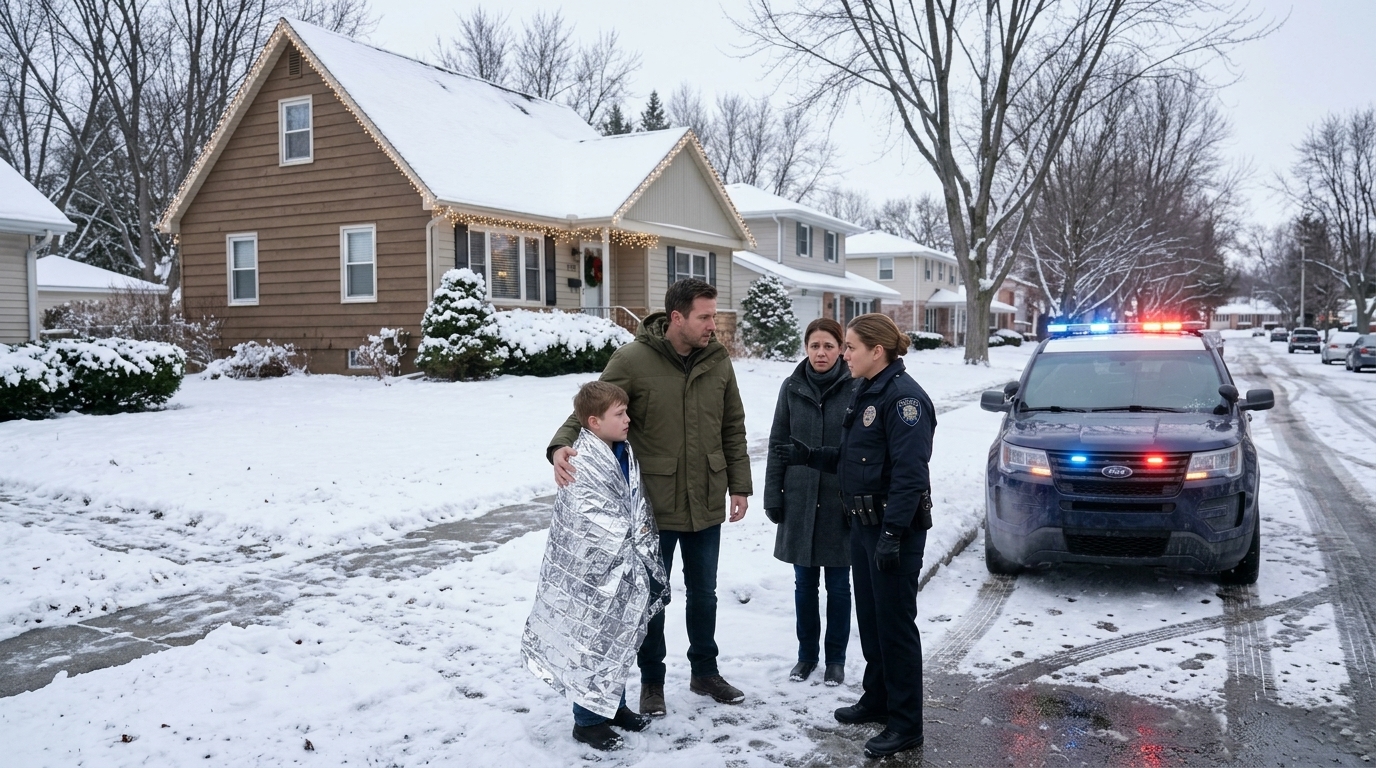
Owen was sitting on the edge of her guest bed, wrapped in a blue blanket decorated with tiny dinosaurs.
His shoes were missing.
His socks were dirty.
There was a small scratch across his cheek.
When he saw me, he didn’t smile.
He flinched.
That single movement hurt worse than anything on the recording.
“Daddy?”
I knelt.
“I’m here, buddy.”
His bottom lip trembled.
“Are you taking me back?”
“No.”
“Promise?”
I swallowed.
I had already made him one promise that afternoon.
I had promised to return Sunday.
I had promised he would be okay.
And I had left him anyway.
This time, I looked directly into his frightened eyes.
“I promise you will not go back there tonight. I’m staying with you.”
He stared at me for several seconds.
Then he climbed into my arms and began sobbing.
Not loudly.
Not dramatically.
Just exhausted, broken little sounds against my shoulder.
“I’m sorry,” he whispered.
I held him tighter.
“For what?”
“For being bad.”
Something inside my chest cracked.
“You weren’t bad, Owen.”
“Grandma said I was.”
“Grandma was wrong.”
“Mommy said Daddy would be disappointed.”
I closed my eyes.
“Owen, listen to me. You did nothing wrong. Nothing.”
He pulled back just enough to look at my face.
“Even when I ran away?”
“Especially when you ran away.”
He started crying harder.
I stayed on the floor holding him until his breathing slowed.
When I finally carried him back into Genevieve’s kitchen, she had already placed a glass of water on the table.
“I called the police,” she said quietly.
I nodded.
“Good.”
“William, there’s something you need to understand. This wasn’t the first time.”
I looked up.
“What?”
She sat across from me.
“I’ve lived next door to Sue for eleven years. I’ve heard children crying before.”
“Children?”
She nodded slowly.
“Sue used to run a private childcare program. Not a licensed daycare, exactly. She called it a behavioral development service.”
I stared at her.
“She told us she was retired.”
“She stopped advertising about six years ago. But people still brought children here occasionally.”
My mouth went dry.
“Why didn’t anyone report her?”
“Some people did.”
Genevieve looked ashamed.
“I did once. The children were gone when someone came to investigate, and Sue said I’d misunderstood what I’d heard.”
She glanced toward the hallway.
“Today, when I saw Owen running across my lawn, I knew I couldn’t ignore it again.”
Before I could answer, headlights swept across her front windows.
A police cruiser stopped outside.
Two officers approached the door.
I stood immediately.
The older officer introduced herself as Sergeant Elena Ruiz.
Her partner, Officer Daniel Price, remained near the entrance while Ruiz asked what had happened.
Genevieve showed them the footage.
I watched Ruiz’s expression change.
Her jaw tightened.
She asked to see the recordings from the previous day.
When Marsha’s voice came through the speaker, Ruiz paused the video.
“Is that your wife?”
“Yes.”
“And that’s her mother?”
“Yes.”
“Where is your wife now?”
“At Sue’s house, as far as I know.”
Ruiz exchanged a look with her partner.
Then she asked something that made my stomach drop again.
“Has your son ever been left alone with his grandmother before?”
I opened my mouth.
Then closed it.
Because suddenly I remembered things.
Small things.
Things I had explained away.
Owen refusing to wear a certain yellow sweater because Grandma said yellow was for babies.
Owen waking up crying after a Sunday visit.
Owen hiding his toys whenever Sue came to our house.
The time he wet the bed after spending an afternoon with her, even though he had been fully toilet-trained for nearly two years.
And the worst memory of all.
Three months earlier, Owen had asked me whether people could still breathe if they were locked inside a room without windows.
I had answered as a psychology professor.
I had explained ventilation.
I had explained that buildings needed airflow.
I had missed the question beneath the question.
I covered my face.
“Oh, God.”
Ruiz waited.
Then she said, “Mr. Edwards, right now the most important thing is keeping Owen safe. We’ll arrange for him to be medically evaluated, and a child protection specialist will help us speak with him.”
I nodded.
“Whatever he needs.”
She looked at Genevieve.
“Can you preserve the original recordings?”
“Already done.”
“Good.”
Then she turned to me.
“Do not confront your wife or mother-in-law yourself. Let us handle this.”
For the first time that evening, I realized I had been gripping my car keys so tightly they had left marks in my palm.
I set them down.
And then my phone rang.
Marsha.
Her name filled the screen.
I stared at it.
Ruiz nodded toward the phone.
“Answer it. Don’t argue. Put it on speaker if you’re comfortable.”
I accepted the call.
“William?”
Marsha sounded irritated.
“Where are you?”
I forced my voice to remain steady.
“Why?”
“Because Mom says Owen ran off. She’s furious. I’ve been calling you.”
I looked at the small boy sleeping against Genevieve’s shoulder.
“Is he okay?” I asked.
Marsha hesitated.
“What?”
“Our son. Is he okay?”
“Of course he’s okay. He’s being dramatic. Mom says he had another tantrum.”
I felt cold.
“Where is he?”
A pause.
Then Marsha said, “He’s probably hiding somewhere nearby. Mom is looking.”
I looked at Sergeant Ruiz.
She was writing something in her notebook.
“You don’t know where our five-year-old son is?”
“William, don’t start.”
“He’s five, Marsha.”
“And he’s manipulative. That’s exactly what Mom is trying to correct.”
I stared at the phone.
Then I asked the question that ended my marriage.
“What did you put inside that shed?”
Silence.
Complete silence.
Then I heard Sue’s voice in the background.
“Hang up.”
Marsha’s breathing changed.
“Who told you about the shed?”
I didn’t answer.
“William?”
I looked at Owen.
His little fingers were still curled around the edge of Genevieve’s blanket.
“Who told you?” Marsha demanded.
Sergeant Ruiz gently took the phone.
“Mrs. Edwards, this is Sergeant Elena Ruiz. We need you to remain at your mother’s residence. Officers are on their way.”
Marsha screamed my name.
Ruiz ended the call.
And somewhere across the street, the woman I had trusted with my entire life finally realized her secret was no longer safe.
But the most horrifying discovery was still waiting behind that wooden shed door.
PART 4
By eleven that night, Owen was sitting in a pediatric emergency department with a stuffed fox tucked beneath his arm.
A nurse had found it in a donation basket.
He named it Captain.
I sat beside him while a physician examined his scratches and checked for injuries.
He had bruising around one wrist.
There were red marks on his upper arm.
His feet were sore from running barefoot across gravel.
But the doctor said the most concerning signs weren’t necessarily the ones visible on his skin.
Owen startled whenever a door closed.
He became frightened when anyone mentioned going home.
And when a nurse asked whether he wanted the lights dimmed, he began crying.
“No dark,” he whispered.
The nurse immediately turned the lights back up.
“Okay, sweetheart. We can keep them on.”
I wanted to ask him everything.
I wanted to know what Sue had done, how long it had been happening, and why Marsha had participated.
But Sergeant Ruiz had warned me not to question him repeatedly.
Children needed trained professionals who could gather information without unintentionally shaping their memories.
So I did the only thing I should have done from the beginning.
I listened.
I held his hand.
I let him decide when he wanted to talk.
At 12:18 a.m., he asked me a question.
“Daddy, are you mad at Mommy?”
I looked at him.
“I’m upset about what happened.”
“Mommy said you get mad when I cry.”
I swallowed.
“I was wrong when I didn’t listen to you.”
He stared at Captain’s orange ears.
“Grandma said brave boys don’t cry.”
“Brave boys can cry.”
“Even big boys?”
“Even grown men.”
He considered that.
Then he looked at my face.
“Are you crying?”
I hadn’t realized tears were running down my cheeks.
“Yes, buddy.”
He reached up and wiped one away.
“It’s okay, Daddy.”
Those four words nearly destroyed me.
My five-year-old son, who had spent the evening terrified, was trying to comfort the father who had failed to protect him.
I leaned forward and kissed his forehead.
“You don’t have to take care of me, Owen. That’s my job.”
He nodded.
Then he leaned against my shoulder and fell asleep.
The next morning, Sergeant Ruiz returned with information that changed everything.
Sue Melton had been taken into custody after officers searched the property under a warrant.
Inside the shed, investigators found the chain Genevieve’s camera had recorded.
They also found a small electronic alarm, a padlock, a folding chair, and a plastic container holding printed behavior charts.
Each chart had columns labeled:
CRYING.
DISOBEDIENCE.
RESISTANCE.
COMPLIANCE.
Beside the columns were dates and children’s initials.
One set of initials appeared repeatedly.
O.E.
Owen Edwards.
My son.
I stared at the photograph Ruiz showed me.
There were entries stretching back almost nine months.
Nine months.
I remembered every visit during that time.
Every family dinner.
Every afternoon Marsha said she was taking Owen to Grandma’s so I could finish grading papers.
Every time Owen begged to stay home.
Every time I told him he needed to be polite.
I felt physically sick.
Ruiz explained that investigators were reviewing the records and contacting other families.
They hadn’t yet determined what every entry meant.
But the photographs and video were enough to establish that the shed had been deliberately prepared for Owen.
Then she showed me a printed message recovered from Marsha’s phone.
It had been sent to Sue two weeks earlier.
Marsha: He’s starting to tell William things. We need to get this under control before he makes us look bad.
Sue: Bring him for the weekend. By Sunday he’ll understand.
Marsha: Don’t let him call his father.
I read those words three times.
Then I handed the paper back.
“I want a divorce.”
Ruiz didn’t react.
She simply said, “You should speak with a family law attorney as soon as possible. We’ll provide documentation of the investigation.”
I called one that afternoon.
Her name was Rebecca Hart.
She had spent seventeen years handling custody disputes involving allegations of child abuse.
When I explained what happened, she listened without interrupting.
Then she asked whether Owen was currently with me.
“Yes.”
“Keep following the safety plan provided by law enforcement and child protective services. We’ll seek an emergency protective order and temporary custody arrangements through the court.”
“What if Marsha comes to our house?”
“Don’t confront her. Call the police if there’s a threat or an order is violated.”
I looked through the hospital window.
Owen was sitting with a child life specialist, drawing a dinosaur.
For the first time since the previous afternoon, he was smiling.
“I don’t want her near him,” I said.
Rebecca paused.
“Then we’ll present the evidence and ask the judge for protections that are appropriate while the investigation continues.”
I had expected the hardest part to be filing for divorce.
I was wrong.
The hardest part came when I returned home to collect Owen’s belongings.
Marsha was there.
She stood in our kitchen wearing the same cream-colored cardigan she’d worn the day we dropped him off.
Her eyes were swollen.
Her phone sat on the counter beside a half-empty cup of coffee.
“William,” she said.
I stopped in the doorway.
Rebecca had advised me to avoid unnecessary confrontation, but I needed Owen’s clothes, medication, and favorite blanket.
A police officer accompanied me while I gathered them.
Marsha looked past me.
“Where’s Owen?”
“Somewhere safe.”
“He’s my son.”
I stared at her.
“He was your son when he begged us not to leave him.”
She flinched.
“Please don’t do this.”
“Do what?”
“Destroy our family over a misunderstanding.”
I couldn’t believe what I was hearing.
“A misunderstanding?”
She lowered her voice.
“Mom went too far. I admit that.”
I stared at her.
“You helped prepare the shed.”
Her face changed.
Only slightly.
But I saw it.
The moment she understood that I knew.
“I didn’t think she’d actually use it.”
“You told her not to leave marks.”
Marsha’s mouth opened.
No words came out.
“You told her not to let Owen call me.”
She looked down.
I stepped away from her.
“Why?”
Her eyes filled with tears.
“Because you always undermine me.”
I stared at her.
“What?”
“You make me feel like a terrible mother. Every time Owen cries, you comfort him. Every time I punish him, you question me. Mom said children need boundaries.”
“Boundaries don’t involve chains.”
“She wasn’t going to chain him!”
“Then why was it there?”
Marsha began crying harder.
“I don’t know!”
But I could see the answer in her face.
She knew more than she was saying.
I walked toward Owen’s bedroom.
His dinosaur pajamas were folded on the bed.
His little red sneakers sat beside the closet.
On his nightstand was a framed photograph of the three of us at the beach.
Owen was sitting on my shoulders.
Marsha was laughing.
We looked happy.
We looked normal.
I picked up the photograph.
For years, I had taught students that appearances could conceal dysfunctional family systems.
I had discussed denial.
Minimization.
Coercive control.
The ways people rationalize cruelty when it comes from someone they love.
And I had lived inside the very pattern I taught.
Marsha appeared in the doorway.
“William, please. Mom raised me the same way, and I turned out fine.”
I turned toward her.
“No, Marsha.”
Her face hardened.
“What?”
“You didn’t turn out fine.”
She stared at me.
“You grew up believing fear was love. And instead of protecting our son from that, you handed him over to it.”
She began shaking her head.
“You don’t understand my childhood.”
“Then tell me.”
She looked away.
For a moment, I thought she might finally tell the truth.
Instead, she whispered, “My mother did what she had to do.”
I placed Owen’s pajamas inside his overnight bag.
“No child deserves what happened to him.”
Marsha followed me into the hallway.
“You can’t take him away from me.”
I looked at the officer standing near the front door.
Then back at my wife.
“I’m not deciding what happens next by myself. The court will. But I will do everything legally possible to keep him safe.”
She started sobbing.
I didn’t comfort her.
For eight years, I had rushed to soothe every disagreement between Marsha and her mother.
I had apologized when I wasn’t wrong.
I had kept the peace.
And our son had paid for it.
I left with his belongings.
Three days later, Rebecca called.
“William, we received additional evidence.”
I was sitting at Genevieve’s kitchen table while Owen played in the living room.
“What evidence?”
“An old report involving Sue Melton.”
My chest tightened.
“How old?”
“Twenty-six years.”
I sat up.
Rebecca continued.
“A child protection investigation. A little girl was found locked in a utility room at Sue’s former residence.”
I felt cold.
“Who was the little girl?”
There was a pause.
Then Rebecca said, “Marsha.”
I closed my eyes.
For several seconds, I couldn’t speak.
My wife had not simply learned cruelty from her mother.
She had survived it.
And somehow, over the years, she had become part of the very system that had hurt her.
But Rebecca wasn’t finished.
“William, there’s another name in the records.”
“Whose?”
“A woman named Caroline Melton.”
I frowned.
“I’ve never heard of her.”
“She was Sue’s younger daughter.”
I stared at the wall.
“Marsha has a sister?”
“Apparently.”
“Where is she?”
Rebecca took a breath.
“That’s what we’re trying to find out.”
And when I finally learned what had happened to Caroline Melton, I understood why Sue had spent so many years making certain nobody questioned her methods.
PART 5
Caroline Melton was forty-one years old when I met her.
She lived in a small town nearly two hours away, worked as a veterinary technician, and had not spoken to her mother in nineteen years.
Rebecca located her through records connected to the old child protection case.
Caroline agreed to speak with investigators.
Then, after learning what had happened to Owen, she asked to meet me.
We sat in a quiet conference room at Rebecca’s office.
Caroline had dark hair streaked with gray and the same pale green eyes as Marsha.
But there was something different about her.
She looked directly at me.
She didn’t make excuses.
And the first thing she said was, “I’m sorry nobody warned you.”
I shook my head.
“You didn’t know us.”
“No. But I knew what my mother was capable of.”
She folded her hands.
“I tried to warn people years ago. Nobody wanted to listen.”
I waited.
Caroline stared at the table.
“My mother believed children were born selfish. She thought affection made them weak. She called it character training.”
I thought of Owen begging me not to leave him.
Caroline continued.
“When we cried, she locked us away. Sometimes in closets. Sometimes in the basement. Sometimes outside.”
I swallowed.
“And your father?”
“He left when I was seven. He knew enough to suspect what was happening, but he didn’t fight for us.”
Her voice remained steady.
That somehow made it worse.
“Marsha was the obedient one,” she said. “She learned that if she helped Mom enforce the rules, Mom would leave her alone.”
I looked at her.
“She helped punish you?”
Caroline nodded.
“Sometimes. She was a child trying to survive. I understood that eventually.”
She paused.
“But understanding why someone became cruel doesn’t mean allowing them to hurt another child.”
Those words stayed with me.
Caroline explained that when she was fifteen, she had told a school counselor about being locked in a utility room.
An investigation followed.
Sue denied everything.
Marsha, frightened of her mother, told investigators that Caroline was lying.
The case ended without the protection Caroline needed.
At eighteen, Caroline left home.
She never returned.
“Did you ever try contacting Marsha?” I asked.
“Many times.”
“What happened?”
“She said I was ungrateful. She said Mom had sacrificed everything for us.”
Caroline looked at me.
“Then she told me never to contact her again.”
I stared at the window.
All those years, Marsha had described herself as an only child.
She had told me her father died when she was young.
She had built an entire family history around protecting Sue’s reputation.
And I had believed every word.
Caroline reached into her purse and removed a photograph.
Two little girls stood outside a brick house.
One was smiling nervously.
The other looked frightened.
“That’s Marsha,” Caroline said, pointing to the older girl.
Then she pointed to the younger one.
“And that’s me.”
Behind them stood Sue.
Her hands rested on their shoulders.
Her expression was stern.
I studied the photograph.
It looked like an ordinary family picture.
But now I knew better.
Caroline put it away.
“William, there’s something else.”
I waited.
“When Marsha was little, Mom used to tell her that if she didn’t obey, nobody would love her.”
My throat tightened.
“Marsha says things like that to Owen.”
Caroline nodded sadly.
“Then the cycle never stopped.”
I sat there for a long time.
Part of me felt grief for the frightened little girl Marsha had once been.
Another part of me felt anger toward the adult woman who had watched our son suffer.
Both feelings were real.
Neither canceled the other.
Before Caroline left, she asked one question.
“How’s Owen?”
I showed her a photograph from the previous morning.
He was sitting at Genevieve’s kitchen table, smiling over a plate of pancakes.
Caroline’s eyes filled.
“He looks like a sweet little boy.”
“He is.”
She smiled.
“Tell him something for me.”
“What?”
“Tell him that being scared doesn’t make him weak.”
I promised I would.
Over the following weeks, our lives changed in ways I could never have imagined.
The court granted temporary custody arrangements that kept Owen in my care while the investigations continued.
Marsha was prohibited from contacting him outside the conditions set by the court.
Sue remained subject to criminal proceedings.
Investigators continued examining her records and interviewing families.
The legal process was slow.
Painfully slow.
There were hearings.
Statements.
Medical reports.
Meetings with child protection professionals.
There were nights when I lay awake wondering how I had missed so much.
But Rebecca reminded me of something important.
“William, accountability matters. You can acknowledge that you failed to recognize Owen’s fear without allowing that guilt to stop you from protecting him now.”
I understood what she meant.
Guilt could become another form of avoidance.
I could spend the rest of my life punishing myself.
Or I could become the father Owen needed.
I chose the second.
I took a leave of absence from teaching.
I found a child therapist experienced in helping children recover from frightening experiences.
Her name was Dr. Hannah Pierce.
She had a warm office filled with toys, soft cushions, and shelves of picture books.
During Owen’s first appointment, he refused to leave my side.
Hannah didn’t force him.
She simply sat on the carpet and began building a tower with wooden blocks.
After ten minutes, Owen moved closer.
After twenty, he handed her a blue block.
By the end of the session, he was helping her build a castle.
On the drive home, he asked, “Daddy, do I have to go back?”
“No, buddy. We’re going home.”
“Can I see the nice doctor again?”
“Of course.”
He smiled.
It was a small smile.
But it felt like sunlight after months of darkness.
Recovery wasn’t immediate.
Some nights, Owen woke screaming.
Sometimes he refused to enter a room unless I checked it first.
He became frightened when someone raised their voice.
Once, when I accidentally closed the bathroom door while he was brushing his teeth, he began pounding on it.
“Daddy! Daddy!”
I opened it immediately.
He threw himself against me.
“Don’t lock me in!”
I knelt.
“I’m sorry. The door wasn’t locked, but I understand it scared you.”
He was trembling.
I held him until he calmed down.
Then I showed him how the handle worked.
We practiced opening and closing the door together.
Not because I wanted to prove he was safe through logic.
But because he needed to experience safety repeatedly before he could trust it.
I learned to ask before hugging him.
I learned not to dismiss his fears.
I learned that healing rarely follows a straight line.
Some days were wonderful.
Others felt like we had returned to the beginning.
But slowly, the nightmares became less frequent.
He started sleeping through the night.
He stopped hiding his toys.
And one afternoon, while we were making cookies, he spilled flour across the counter.
His face went white.
He dropped the measuring cup.
“I’m sorry!”
I looked at the flour.
Then at him.
“It’s okay.”
He shook his head.
“I made a mess.”
“I see that.”
“Are you mad?”
“No.”
He looked confused.
“But I wasn’t careful.”
I picked up a dish towel.
“Then we’ll clean it together.”
He stared at me.
“I’m not in trouble?”
“No, Owen. Accidents happen.”
His shoulders relaxed.
Then he did something I hadn’t heard him do in months.
He laughed.
A real laugh.
The kind that comes from the belly.
I started laughing too.
Soon we were both covered in flour.
And for a few precious minutes, the house felt like a home again.
Two months after the incident, Marsha requested permission to send Owen a letter.
Rebecca discussed it with me and the professionals involved in his care.
The court’s restrictions remained in place, and we followed the guidance of Owen’s therapist about whether and how any communication should occur.
I was given a copy.
Marsha had written three pages.
She said she missed him.
She said she loved him.
She said she was receiving counseling.
And she said she finally understood that her mother’s treatment of children had been abusive.
But one paragraph stood out.
“I thought if I could make Owen stronger, he would never suffer the way I did. Instead, I became someone he needed protection from.”
I read that sentence several times.
It was the first time Marsha had acknowledged her responsibility without blaming Owen.
But acknowledgment wasn’t the same as change.
And change wasn’t the same as restored trust.
I hoped she would continue getting help.
Not because I wanted our marriage back.
I didn’t.
But because Owen deserved a mother who understood what she had done.
Whether she would ever become that person was not something I could promise him.
The divorce proceedings continued.
So did the criminal investigation.
Caroline provided investigators with information about her childhood.
Genevieve preserved her security recordings and cooperated with authorities.
Other former families came forward.
Some described experiences that investigators considered relevant to Sue’s history.
Not every allegation could be verified.
But the evidence involving Owen was clear enough that the case moved forward.
Months later, Sue accepted a plea agreement on charges arising from her treatment of Owen.
The court imposed a custodial sentence and restrictions on future contact.
Marsha’s case was handled separately.
Her participation in preparing the shed and facilitating the circumstances that placed Owen at risk became central issues in both the criminal and family court proceedings.
She accepted responsibility for her conduct in court.
I attended the hearing.
Not because I wanted revenge.
But because I wanted to hear her say the truth without hiding behind her mother.
When the judge asked whether she understood the seriousness of what she had done, Marsha answered quietly.
“Yes.”
Then she began crying.
I felt sadness.
But I didn’t feel the need to rescue her.
That was new for me.
For years, I had mistaken keeping the peace for keeping my family safe.
Now I understood the difference.
Six months after the night Owen ran to Genevieve’s house, something unexpected happened.
It was a Saturday morning.
We were at a park near our new apartment.
Owen had been hesitant around playground equipment for weeks, especially anything enclosed.
But that morning, he approached a small tunnel slide.
He stood at the entrance.
Looked inside.
Then turned toward me.
“Daddy?”
“Yeah, buddy?”
“Will you wait at the bottom?”
“Absolutely.”
He climbed the steps.
I walked around to the bottom of the slide.
For a moment, nothing happened.
Then I heard his voice.
“Daddy?”
“I’m here.”
“Can you see me?”
“I can see your shoes.”
He giggled.
Then he slid down.
He landed on the rubber playground surface with a delighted squeal.
“I did it!”
I laughed.
“You sure did!”
He jumped up.
“Again!”
For the next twenty minutes, he went down that slide over and over.
Each time, he looked for me.
Each time, I was there.
Finally, he stopped asking whether I was waiting.
He simply climbed the steps, confident that I would be at the bottom.
I stood there watching him, tears filling my eyes.
Because I understood what had changed.
He wasn’t just learning to trust the slide.
He was learning to trust me again.
And that was the greatest gift I could have received.
The following spring, Genevieve invited us over for dinner.
She had become an important part of Owen’s life.
He called her Miss Genny.
She never treated him like a fragile child.
She let him help water her garden.
She taught him how to make pancakes.
And she listened when he talked.
That evening, after dinner, Owen asked whether he could show her something.
He pulled a folded piece of paper from his backpack.
It was a drawing.
Three people stood beneath a bright yellow sun.
One was tall.
One was small.
The third had curly gray hair.
There was a little house with blue windows.
And beside it stood a large green dinosaur.
Genevieve smiled.
“Who’s everyone?”
Owen pointed.
“That’s Daddy.”
Then himself.
“That’s me.”
Then Genevieve.
“And that’s you.”
She pressed a hand to her chest.
“Oh, sweetheart.”
Owen smiled proudly.
“It’s my safe people.”
Genevieve’s eyes filled with tears.
She looked at me.
I couldn’t speak.
Owen continued.
“Daddy says safe people listen when you say you’re scared.”
Genevieve nodded.
“Your daddy is right.”
He thought for a moment.
Then added, “And safe people don’t make you earn hugs.”
I turned away.
I had never been prouder of him.
A year after everything happened, I returned to teaching.
My first lecture was about childhood emotional development.
I stood before a classroom of sixty students.
My notes were prepared.
My slides were ready.
But when I reached the section about fear responses, I stopped.
I looked around the room.
Then I closed my laptop.
“I want to tell you something,” I said.
The students grew quiet.
“For years, I taught that children communicate distress through behavior before they can explain it with words.”
I paused.
“I believed I understood that principle.”
I looked toward the windows.
“Then my own son tried to tell me he was afraid, and I didn’t listen.”
Nobody moved.
I didn’t share the private details of Owen’s trauma.
Those belonged to him.
But I told my students about the danger of dismissing children’s fears simply because adults find them inconvenient.
I explained that obedience and emotional health were not the same thing.
That a quiet child was not necessarily a safe child.
That a child who stopped crying might have learned not that the world was safe, but that nobody would respond.
Then I wrote one sentence on the board.
A child’s fear deserves attention, even when we don’t yet understand its cause.
I turned back to the class.
“Never assume that your professional knowledge makes you immune to denial.”
A young woman in the front row raised her hand.
“What should parents do when they realize they’ve made a serious mistake?”
I thought of Owen.
Of the hospital.
Of the flour-covered kitchen.
Of the little boy waiting at the top of a slide.
“Take responsibility,” I said. “Protect the child. Get appropriate help. And then show, through consistent actions, that the child can trust you again.”
The room remained silent.
Then several students began writing.
I hoped they would remember.
Owen turned seven that summer.
We celebrated in our backyard.
There were balloons.
A dinosaur cake.
A small inflatable pool.
Six children from his school.
Genevieve brought homemade cookies.
Caroline came too.
Over the previous year, she had slowly become part of our lives.
She never pushed Owen to call her Aunt Caroline.
She simply showed up when invited.
Sometimes she brought books.
Sometimes she helped us plant flowers.
Sometimes she sat quietly while Owen explained the complicated adventures of his toy dinosaurs.
He liked her.
And I was grateful that something good had grown from such a painful discovery.
At the party, Owen wore a blue T-shirt with a cartoon rocket.
He ran across the grass, laughing with his friends.
At one point, a balloon popped.
He startled.
His face tightened.
I saw the old fear flash through his eyes.
But then he looked around.
He saw me.
He saw Genevieve.
He saw Caroline.
He took a breath.
And went back to playing.
That moment meant more to me than the birthday cake.
More than the presents.
More than anything.
Because healing wasn’t the absence of every frightening memory.
It was Owen learning that those memories no longer controlled every moment of his life.
That evening, after everyone left, we sat together on the back porch.
The sky was turning pink.
Owen rested his head against my arm.
“Daddy?”
“Yeah?”
“Can I ask you something?”
“Anything.”
He was quiet for a moment.
“Why didn’t you believe me that day?”
I felt the question settle into my chest.
I had known it would come eventually.
I didn’t want to lie.
And I didn’t want to burden him with excuses.
So I told him the truth.
“Because I made a mistake. I listened to grown-ups instead of listening to you. I should have taken your fear seriously.”
He looked down at his hands.
“Did you think I was bad?”
“No.”
“Then why did you leave?”
I swallowed.
“Because I convinced myself everything would be okay, even though you were telling me it wasn’t. That was wrong.”
He considered my answer.
“Will you do it again?”
I turned toward him.
“I will always do my best to keep you safe, and I will listen when you tell me something is wrong. You can tell me anything, even if it’s about someone I love.”
He looked at me for a long time.
Then he nodded.
“Okay.”
I put my arm around him.
We watched the sunset.
After a while, he whispered, “I was really scared.”
“I know.”
“I thought you weren’t coming.”
My throat tightened.
“I’m so sorry, Owen.”
He leaned closer.
“But you did.”
I kissed the top of his head.
“Yes, buddy. I did.”
That night, after Owen went to sleep, I sat alone in the living room.
On the bookshelf was a framed photograph from his birthday.
Owen stood in the middle of the backyard, smiling so widely his eyes were nearly closed.
His arms were spread.
His face was covered in frosting.
Behind him, the sun shone through the trees.
I picked up the frame.
Then I thought about the day everything began.
The afternoon drive.
The crying.
Marsha’s irritation.
Sue waiting on the porch.
My son’s tiny voice asking me not to leave.
For a long time, I had wished I could return to that moment.
I imagined pulling the car over.
Turning around.
Taking Owen home.
I imagined telling Marsha that discipline could wait, but our son’s fear couldn’t.
I imagined a different ending.
One where Genevieve never needed to make that phone call.
One where Owen never had to run barefoot through the dark.
But I couldn’t change what happened.
I could only decide what kind of father I would be afterward.
And that meant more than apologizing.
It meant showing up.
Every morning.
Every bedtime.
Every nightmare.
Every ordinary day when nothing dramatic happened at all.
Because children don’t build trust from grand speeches.
They build it from repeated experiences of being heard, respected, and protected.
I placed the photograph back on the shelf.
Then I heard small footsteps in the hallway.
Owen appeared in his dinosaur pajamas.
He was carrying Captain, the stuffed fox from the hospital.
“Daddy?”
I smiled.
“What’s up, buddy?”
He rubbed his eyes.
“Can you tuck me in again?”
“Of course.”
I followed him to his bedroom.
He climbed beneath the blankets.
I tucked them around his shoulders.
Then he caught my hand.
“Daddy?”
“Yeah?”
“I’m not scared of the dark anymore.”
I smiled.
“That’s wonderful.”
He looked toward his nightlight.
“But can we leave that on anyway?”
I reached over and switched it on.
“Absolutely.”
He grinned.
Then he said something I will carry for the rest of my life.
“It’s nice when I get to choose.”
I sat beside him.
“Yes, Owen. It is.”
He closed his eyes.
Within minutes, he was asleep.
I stayed a little longer.
Watching his chest rise and fall.
Listening to the quiet sounds of our home.
A home without threats.
Without punishments disguised as love.
Without a little boy wondering whether the people responsible for protecting him would become the people he needed protection from.
I turned toward the doorway.
Then Owen murmured in his sleep.
“Love you, Daddy.”
I smiled through tears.
“Love you too, buddy.”
And as I walked into the hallway, I finally understood the lesson my son had spent so long trying to teach me.
A child’s greatest need isn’t to become tough enough to endure cruelty. It’s to know that the people who love him will never ask him to endure it.
I had failed to understand that once.
I would spend the rest of my life making certain Owen never had to teach me again.
Because the night my five-year-old son ran barefoot to a neighbor’s house wasn’t the night our family fell apart.
It was the night someone finally believed him.
And it was the night he began to get his childhood back.
THE END THANK YOU FOR READING !!!



