PART 3
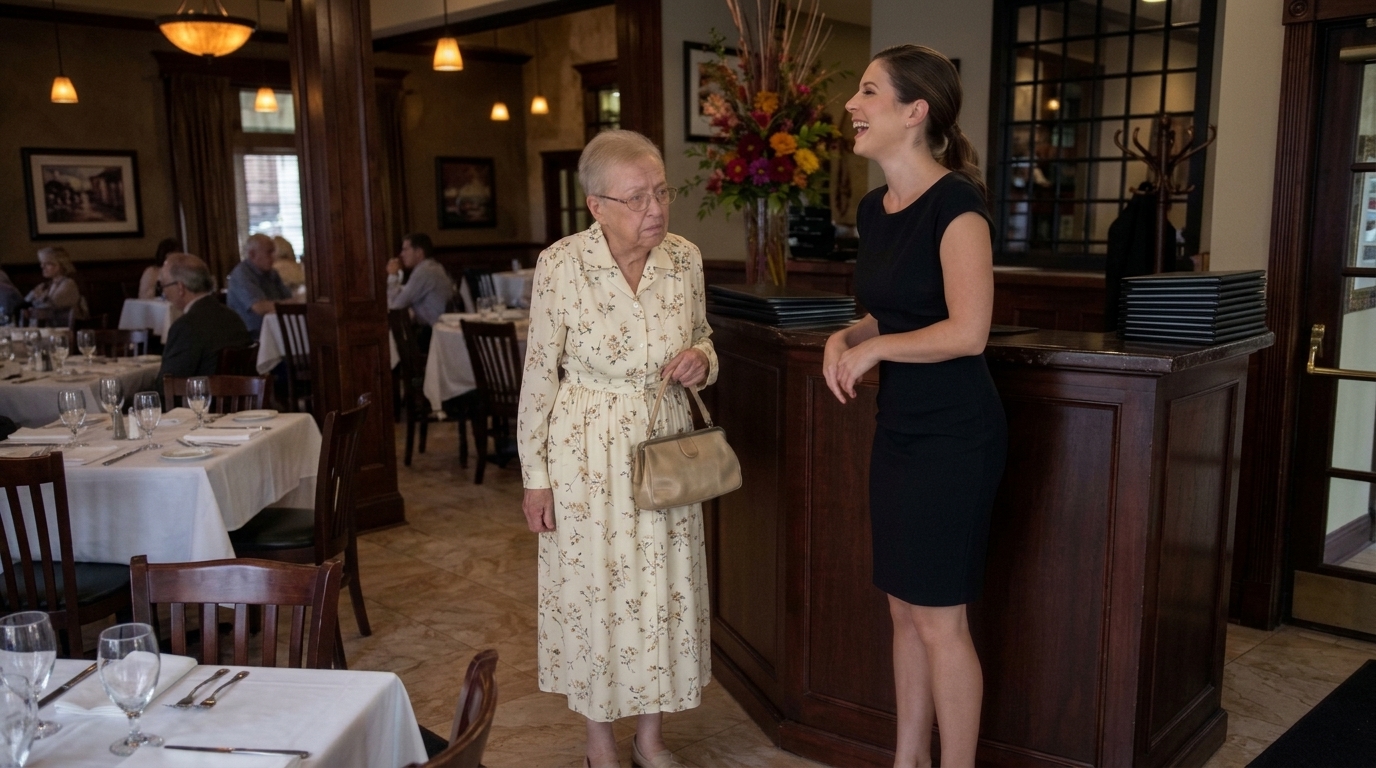
The hostess’s scream echoed through the elegant dining room.
“YOU CAN’T FIRE ME! I’VE WORKED HERE FOR SIX YEARS!”
Every conversation stopped.
Forks hovered in midair.
Wineglasses remained suspended between tables and lips.
Even the soft Italian music playing through
the speakers suddenly seemed too loud.
The man in the black suit didn’t raise his voice.
He simply looked at the hostess with an
expression so cold that she stopped shouting.
“Your six years of employment,” he said quietly,
“should have taught you the difference between elegance and cruelty.”
The hostess, whose name tag read Vanessa, folded her arms.
I was protecting the restaurant’s reputation, Mr. Romano.
Look at them! They obviously can’t afford to eat here.
My grandmother’s fingers tightened around mine.
She was ninety-two years old.
Ninety-two.
She had survived the Great Depression’s aftermath, buried her husband, lost her only daughter and son-in-law, raised an orphaned grandchild, and fought cancer with more courage than anyone I’d ever known.
Yet a stranger had managed to make her feel ashamed of a dress she had carefully ironed that morning.
I felt something burning behind my eyes.
“That’s enough,” I said.
But the owner gently raised his hand.
“Please,” he told me. “Allow me.”
Then he turned toward Vanessa.
“Do you know what this woman was doing while people like you were learning to judge others by their clothing?”
Vanessa rolled her eyes.
“Sir, I don’t see what—”
“She was saving my life.”
The room went completely silent.
My grandmother blinked.
“I’m sorry,” she whispered. “Have we met?”
The man’s face softened.
“You don’t remember me, Mrs. Bennett?”
Grandma studied his face.
His silver hair.
His dark eyes.
The small scar near his left eyebrow.
Then she shook her head.
“I’m afraid my memory isn’t what it used to be, sweetheart.”
He smiled.
“You used to call me little Tony.”
Grandma’s mouth fell open.
“Tony?”
The man nodded.
“Antonio Romano.”
Her hand flew to her chest.
“Little Tony from Saint Mary’s?”
He laughed, but tears were already forming in his eyes.
“Yes, ma’am.”
And then something happened that I will remember for the rest of my life.
The wealthy owner of one of the most prestigious Italian restaurants in the state lowered himself onto one knee in front of my grandmother.
Right there.
On the polished marble floor.
In front of nearly sixty guests.
He took her fragile hands between his.
“I’ve been looking for you for forty-seven years.”
Grandma began to cry.
“Oh, Tony.”
He kissed her hands.
“You saved my life, Mrs. Bennett. And everything I have today exists because you refused to give up on me.”
I stared at them.
I had never heard this story.
Not once.
My grandmother had told me about her childhood, her marriage, her years working at the laundry, and the terrible night my parents died.
But she had never mentioned saving a boy named Antonio Romano.
“What happened?” I whispered.
Antonio looked up at me.
“You really don’t know?”
I shook my head.
He smiled sadly.
“Then I think it’s time you heard about the woman who raised you.”
He stood and helped Grandma into a comfortable chair near the entrance.
Then he asked a waiter to bring her water.
Vanessa remained beside the host stand, looking increasingly uncomfortable.
“Mr. Romano,” she interrupted, “I still think this is being blown out of proportion.”
Antonio turned toward her.
“You told a ninety-two-year-old woman that she was too poor to be seen in my restaurant.”
“I was just—”
“You laughed when she cried.”
Vanessa swallowed.
“And then you tried to hide her beside the restroom because you were embarrassed by her appearance.”
“I didn’t mean—”
“You meant every word.”
He paused.
“And the fact that you said those things to someone who saved my life makes this personal. But understand something, Vanessa. Even if she were a complete stranger, your behavior would still be unacceptable.”
Several guests nodded.
A woman sitting near the window spoke up.
“I heard everything. It was disgusting.”
Another man added, “My wife and I were about to leave.”
Vanessa’s face turned bright red.
Antonio pointed toward the office.
“Please collect your belongings. You are relieved of your duties effective immediately. Our manager will handle the paperwork.”
Vanessa stared at him.
“You’re firing me over one old woman?”
Antonio’s expression hardened.
“No. I’m firing you because you have forgotten that every person who walks through those doors deserves dignity.”
She opened her mouth again.
“One more thing,” he said.
She froze.
“That woman you called poor is the reason this restaurant exists.”
A murmur spread through the dining room.
Antonio turned back toward Grandma.
“Mrs. Bennett, would you allow me to tell them?”
Grandma wiped her cheeks.
“Oh, Tony. You always did talk too much.”
The entire restaurant laughed.
And for the first time since we arrived, Grandma smiled.
Antonio pulled up a chair.
“Forty-seven years ago,” he began, “I was seventeen years old, homeless, hungry, and convinced my life was over.”
He looked around the room.
“My father had died when I was thirteen. My mother worked herself sick trying to keep us afloat. When she passed away four years later, I lost our apartment within weeks.”
He swallowed.
“I slept behind Saint Mary’s Church because the building blocked the winter wind.”
Grandma lowered her eyes.
Antonio continued.
“I hadn’t eaten a proper meal in three days when Mrs. Bennett found me.”
I turned toward Grandma.
She gave a tiny shrug.
“He was such a skinny boy.”
Antonio laughed.
“Skinny? I looked like a broomstick wearing somebody else’s jacket.”
A few guests chuckled.
“She was working evenings at the church kitchen. One night, she noticed me searching through the garbage behind the building.”
His voice trembled.
“I thought she would call the police.”
Instead, Grandma had brought him inside.
She had made him sit near the stove.
Then she placed a bowl of hot pasta in front of him.
“Eat,” she told him.
Antonio remembered every detail.
The tomato sauce.
The garlic bread.
The chipped white plate.
The way she pretended not to notice when he began crying.
“That was the first time anyone had treated me like a human being in months.”
Grandma reached over and patted his arm.
“You were a human being, sweetheart.”
Antonio closed his eyes.
“Yes. But I’d forgotten.”
He explained that Grandma began bringing him food every evening.
Sometimes soup.
Sometimes sandwiches.
Sometimes leftovers from the family she worked for.
She found him clean clothes, helped him apply for jobs, and convinced the church caretaker to let him sleep in a small heated storage room until he could afford somewhere safer.
But the most important thing she gave him wasn’t food or shelter.
It was belief.
“One night,” Antonio said, “I told her I wanted to open an Italian restaurant someday.”
He smiled at the memory.
“I expected her to laugh.”
Grandma shook her head.
“Dreams aren’t funny.”
“That’s exactly what you said.”
Antonio looked toward the ceiling.
“You told me that if I was willing to work hard, there was no reason I couldn’t build something beautiful.”
Then his voice cracked.
“And when I got my first job washing dishes, you bought me a pair of black shoes.”
Grandma nodded.
“Your old ones had holes.”
Antonio looked down at his expensive leather shoes.
“I still have them.”
My breath caught.
“You kept the shoes?”
“For forty-seven years.”
He turned toward me.
“They’re in a glass case in my office.”
I couldn’t speak.
Antonio continued.
“Eventually, I saved enough to attend culinary school. I worked nights, studied days, and wrote letters to Mrs. Bennett whenever I could.”
But after several years, the letters stopped reaching her.
Grandma had moved to another city after my grandfather became ill.
Antonio tried to find her.
He contacted the church.
He searched old directories.
He even hired someone years later.
But the records were incomplete, and Grandma’s married name had been misspelled in several documents.
“I thought I’d lost her forever,” he whispered.
Grandma squeezed his hand.
“Well, you found me now.”
Antonio smiled through his tears.
“Yes, ma’am. I finally did.”
Then he stood.
“Ladies and gentlemen, I want you to know something.”
Every guest turned toward him.
“This restaurant was built on one simple principle: nobody should ever feel hungry, unwanted, or ashamed.”
He gestured toward Grandma.
“That principle came from Eleanor Bennett.”
A woman near the fireplace began clapping.
Then another guest joined.
Within seconds, the entire dining room erupted in applause.
Grandma covered her face.
“Oh, goodness gracious.”
I wrapped my arms around her shoulders.
“You never told me any of this.”
She looked up at me.
“Well, honey, it wasn’t anything special.”
Antonio shook his head.
“It was everything.”
Then he turned toward the staff.
“Prepare the private dining room.”
The manager nodded immediately.
“And bring out our finest birthday cake.”
Grandma protested.
“Oh, Tony, that’s too much.”
He smiled.
“Mrs. Bennett, you’ve waited forty-seven years for me to cook you dinner.”
He leaned closer.
“Please don’t make me wait another minute.”
Grandma laughed.
And just like that, the worst birthday of her life began turning into something extraordinary.
But Antonio wasn’t finished.
Not even close.
Because before he escorted us to our table, he looked at me and asked a question that made my stomach drop.
“May I ask how your grandmother has been doing these past few years?”
I hesitated.
Grandma quickly answered.
“Oh, I’ve been fine.”
Antonio studied her carefully.
Then he noticed the faint scar above her collarbone.
His expression changed.
“Mrs. Bennett…”
He looked at me.
“Has she been sick?”
I swallowed.
“She had cancer.”
Antonio went completely still.
“And the treatment?”
“Chemotherapy. Surgery. Months of hospital visits.”
His eyes filled with tears.
“Did she recover?”
“Yes,” I whispered. “But it took almost everything we had.”
Antonio looked at Grandma.
She was staring at the floor.
Then he asked one more question.
“Are you struggling financially?”
Grandma immediately shook her head.
“We manage.”
I knew what that meant.
We managed because she refused to buy new clothes.
We managed because I worked overtime.
We managed because every unexpected bill meant sacrificing something else.
Antonio seemed to understand.
He nodded slowly.
Then he said something I didn’t expect.
“Mrs. Bennett, forty-seven years ago, you made me promise that if I ever became successful, I would help someone who needed it.”
Grandma smiled.
“And did you?”
“Thousands of people.”
“Then you’ve already repaid me.”
Antonio shook his head.
“No, ma’am.”
He took her hand.
“Not even close.”
And the look in his eyes told me he was about to do something none of us could have imagined.
PART 4mething out of a movie.
Golden chandeliers hung above a long polished table. Fresh white roses filled crystal vases. Soft candlelight reflected against cream-colored walls decorated with paintings of the Italian countryside.
Through enormous windows, we could see a garden filled with olive trees and a stone fountain.
Grandma stopped in the doorway.
“Oh, my.”
Antonio smiled.
“Do you like it?”
She nodded.
“It’s beautiful.”
“Then it’s yours for the evening.”
Grandma immediately shook her head.
“Tony, sweetheart, we only reserved a little table for two.”
“I know.”
“And we don’t need all this fuss.”
“I know that too.”
He gently guided her toward the best chair.
“But tonight, you’re letting somebody take care of you.”
Those words made her eyes fill again.
For as long as I could remember, Grandma had been the person who took care of everyone else.
She was the one who made soup when neighbors were sick.
The one who slipped grocery money into church envelopes.
The one who repaired children’s clothes without charging their struggling parents.
Even during chemotherapy, she worried more about whether I had eaten dinner than whether she would survive another treatment.
Being cared for didn’t come naturally to her.
Antonio seemed to know that.
He pulled out her chair himself.
Then he placed a folded linen napkin across her lap.
“Just for tonight,” he whispered.
Grandma smiled.
“You’re still a stubborn boy.”
“And you’re still the reason.”
A waiter brought sparkling water with lemon.
Another arrived carrying warm bread and olive oil.
Then Antonio disappeared into the kitchen.
I leaned toward Grandma.
“Why didn’t you ever tell me about him?”
She looked surprised.
“About Tony?”
“About saving his life.”
Grandma considered the question.
Then she smiled.
“Honey, when someone is hungry, you feed them. When someone is cold, you give them a blanket. You don’t keep a list.”
I stared at her.
“But he says you changed everything.”
She reached across the table and touched my hand.
“People change their own lives, sweetheart. Sometimes they just need someone to remind them they can.”
I looked down.
Suddenly, I remembered being seven years old.
It was winter.
Our apartment heater had stopped working.
Grandma had wrapped me in three blankets and told me we were camping indoors.
She made hot chocolate using the last milk in the refrigerator.
I thought it was an adventure.
Only years later did I realize she had spent that night sitting awake beside me because she was afraid I would get too cold.
I remembered being ten.
My school announced a field trip that cost forty dollars.
I knew we didn’t have the money, so I threw the permission slip away.
Grandma found it.
The next morning, forty dollars appeared inside my lunchbox.
I didn’t discover until much later that she had sold her wedding anniversary watch.
And I remembered being sixteen.
I wanted to attend a summer science program.
The tuition was more than we could afford.
Grandma took an extra cleaning job.
For six weeks, she left home before sunrise and returned after dark.
When I asked why she was so tired, she smiled.
“Old bones, honey.”
Now, sitting in that beautiful room, I realized how much of her life had been spent making sure mine was beautiful.
“Grandma,” I whispered, “you deserved so much more.”
She frowned.
“More than what?”
“More than working yourself exhausted. More than worrying about bills. More than being treated like that woman treated you.”
Grandma squeezed my hand.
“Listen to me.”
I looked up.
“I had a wonderful life.”
“But—”
“I had your grandfather. I had your mother. And when I thought I’d lost everything, I had you.”
Her voice softened.
“You were never a burden. You were my second chance to love someone with my whole heart.”
I started crying.
She laughed gently.
“Now look at us. Two old fools crying over bread.”
I laughed through my tears.
“You’re the old fool.”
“Exactly. You’re supposed to be the sensible one.”
At that moment, Antonio returned.
But he wasn’t carrying food.
He was holding a small wooden box.
Behind him stood an elderly man wearing a chef’s jacket.
The chef had white hair, thick glasses, and a trembling smile.
Antonio stopped beside Grandma.
“Mrs. Bennett, there’s someone else I’d like you to meet.”
The chef stepped forward.
“Hello, Eleanor.”
Grandma looked at him.
For several seconds, she seemed confused.
Then her eyes widened.
“Samuel?”
The chef began crying.
“Hello, Ellie.”
Grandma gasped.
“Oh, my heavens!”
She pushed back her chair.
Samuel hurried forward and embraced her.
They held each other for nearly a minute.
I looked at Antonio.
“Who is he?”
Antonio smiled.
“Samuel Price. My executive chef. And another one of the boys your grandmother helped at Saint Mary’s.”
I stared.
“Another one?”
Antonio nodded.
“Your grandmother didn’t just feed me. She helped dozens of struggling children and teenagers.”
Samuel wiped his eyes.
“She taught me how to make tomato sauce.”
Grandma laughed.
“And you burned it every single time.”
Samuel grinned.
“Only the first six times.”
“Seven,” Grandma corrected.
Everyone laughed.
Samuel pulled up a chair.
He explained that he had grown up in foster care.
At fifteen, he ran away from an abusive placement and spent weeks sleeping in abandoned buildings.
Grandma found him behind the church.
She fed him.
Helped him return to school.
And taught him to cook.
“When I had nowhere to go,” Samuel said, “she made me feel like I belonged somewhere.”
He looked around the room.
“Today, I have three children, seven grandchildren, and a career I love.”
Then he took Grandma’s hand.
“And I owe you more than I can say.”
Grandma shook her head.
“Oh, Samuel. You worked hard for everything.”
He smiled.
“Because you taught me how.”
Antonio placed the wooden box on the table.
“Mrs. Bennett, there’s something I’ve wanted to show you for years.”
He opened it.
Inside was a pair of old black shoes.
The leather was cracked.
The soles were worn.
One lace had been carefully replaced.
Grandma stared.
“Oh, Tony.”
Antonio lifted one shoe.
“You bought these for me when I got my first job.”
She nodded slowly.
“I remember.”
He turned the shoe over.
“Do you remember what you wrote inside?”
Grandma shook her head.
Antonio showed us the faded handwriting along the inner lining.
Every great journey begins with someone believing in you. Love, Mrs. B.
My throat tightened.
Antonio carefully returned the shoes to the box.
“I carried these through culinary school. Through my first restaurant opening. Through bankruptcy. Through every failure.”
He paused.
“When I finally opened Romano’s, I placed them in my office.”
He looked at Grandma.
“Every time I thought about giving up, I looked at those shoes.”
Grandma was crying openly now.
Antonio continued.
“But there’s something else you don’t know.”
He walked toward the far wall.
There was a large painting of an Italian village hanging above a fireplace.
Antonio pressed a small switch.
The painting slowly moved aside, revealing a framed photograph.
It showed a younger version of Grandma standing outside Saint Mary’s Church.
She wore a simple blue dress.
Her hair was dark.
She held a tray of bread rolls.
Around her stood several smiling children.
I recognized her immediately.
“Grandma!”
She stared at the photograph.
“Oh, goodness.”
Antonio smiled.
“This picture has been hanging in my restaurant since the day we opened.”
He pointed toward a small brass plaque beneath it.
I walked closer.
The words read:
In honor of Eleanor Bennett, who taught us that no one should ever be turned away hungry.
I covered my mouth.
For years, strangers had eaten in a restaurant dedicated to my grandmother.
And she had never known.
Antonio looked at me.
“When I couldn’t find her, I decided the best way to honor her was to build a place that reflected everything she taught me.”
He gestured toward the windows.
“Every Monday, this restaurant serves free meals to families facing hardship.”
Samuel nodded.
“We also provide culinary scholarships to young people who can’t afford training.”
Antonio continued.
“We’ve helped hundreds of students find jobs, housing, and opportunities.”
Then he smiled at Grandma.
“All because one woman refused to let a hungry boy sleep outside in the cold.”
Grandma shook her head.
“Tony, I don’t know what to say.”
“You don’t have to say anything.”
He knelt beside her again.
“Just know that your kindness never stopped working.”
I looked at the photograph.
Then at Grandma.
Then at the old shoes.
And something inside me shifted.
For years, I had measured success in dollars.
I worried about how much money we had.
How much we had lost.
How much I still needed to earn.
But my grandmother had spent her life building something money couldn’t measure.
She had built people.
And those people had built beautiful things.
Antonio stood.
“Now, I believe we have a birthday dinner to serve.”
Samuel grinned.
“And I made the sauce myself.”
Grandma raised an eyebrow.
“Did you burn it?”
The room erupted in laughter.
Samuel placed a hand over his heart.
“Mrs. Bennett, after fifty years, I think I’ve finally learned.”
“Well,” Grandma said, “we’ll see.”
Dinner was extraordinary.
Fresh pasta with slow-cooked tomato sauce.
Homemade ravioli.
Roasted vegetables.
Warm bread.
And Grandma’s favorite dessert, tiramisu.
Antonio sat with us between trips to the kitchen.
He asked about my childhood.
About my parents.
About Grandma’s cancer treatment.
When I told him how much she had suffered, his expression grew serious.
“She never told me,” he whispered.
“She doesn’t like people worrying about her.”
Antonio nodded.
“That sounds exactly like her.”
Then he asked about our living situation.
I explained that we rented a small two-bedroom apartment.
The building was old.
The elevator broke frequently.
And Grandma had difficulty climbing the stairs when it wasn’t working.
Antonio frowned.
“Does she have everything she needs?”
I hesitated.
Grandma quickly interrupted.
“We’re perfectly comfortable.”
I looked at her.
She gave me a warning glance.
I knew that look.
It meant don’t embarrass me by talking about money.
So I said nothing.
But Antonio had already noticed.
He didn’t push.
Instead, he smiled and changed the subject.
At eight o’clock, the lights dimmed.
The doors opened.
And nearly the entire restaurant staff entered carrying a magnificent birthday cake.
It had three tiers.
White frosting.
Fresh roses made from sugar.
And ninety-two tiny golden decorations arranged around the edges.
Everyone began singing.
“Happy birthday to you…”
Grandma stared in disbelief.
Then she started laughing.
And crying.
And laughing again.
I had never seen her so happy.
When the song ended, Antonio placed the cake in front of her.
“Make a wish, Mrs. Bennett.”
Grandma closed her eyes.
For several seconds, she remained completely still.
Then she blew out the candles.
The room erupted in applause.
Antonio leaned closer.
“What did you wish for?”
Grandma smiled.
“If I tell you, it won’t come true.”
He laughed.
“Fair enough.”
But when she turned toward me, she whispered something so softly that only I could hear.
“I wished for you to stop worrying about me.”
I hugged her.
“That’s impossible.”
She kissed my cheek.
“Then I suppose I’ll have to keep wishing.”
We were still laughing when Antonio’s manager appeared in the doorway.
His expression was tense.
“Mr. Romano?”
Antonio turned.
“Yes, Daniel?”
“Could I speak with you privately?”
Antonio stood.
“Of course.”
But before he reached the door, Daniel glanced toward Grandma.
Then he said something that made Antonio stop walking.
“Vanessa is refusing to leave. And she’s threatening to tell everyone that Mrs. Bennett is trying to get money out of you.”
My smile vanished.
Antonio’s face became unreadable.
“Where is she?”
“At the front entrance.”
He adjusted his jacket.
“Then I think it’s time we settle this properly.”
Grandma reached for his arm.
“Tony, please don’t make trouble over me.”
Antonio looked down at her.
“Mrs. Bennett, you spent your life standing up for people who couldn’t stand up for themselves.”
He smiled gently.
“Tonight, it’s my turn.”
And what happened next changed far more than one woman’s birthday.
PART 5
When we returned to the main dining room, Vanessa was standing near the entrance with her handbag clutched against her chest.
Her face was red.
Her eyes were furious.
Two staff members stood several feet away, looking uncomfortable.
A few customers had gathered nearby.
Vanessa spotted Grandma immediately.
“There she is!”
She pointed at her.
“This is ridiculous! That woman shows up dressed like she’s homeless, tells some sad story, and suddenly I’m losing my job!”
I felt Grandma flinch beside me.
Before I could speak, Antonio stepped forward.
“Vanessa.”
She turned toward him.
“Mr. Romano, you need to listen to me.”
“I’ve listened to you all evening.”
“Then you should understand that I’m being treated unfairly.”
Antonio folded his hands.
“Tell me exactly what you believe is unfair.”
Vanessa stared.
“You fired me because of her!”
“No,” Antonio replied. “I dismissed you because you humiliated a guest, ignored a confirmed reservation, and openly discriminated against someone based on her appearance.”
Vanessa scoffed.
“Everyone knows this restaurant has standards.”
“Yes,” Antonio said.
His voice remained calm.
“And our standards include kindness, professionalism, and respect.”
Vanessa glanced toward the guests.
“Fine. Then explain why you’re giving this woman special treatment.”
Antonio nodded.
“Gladly.”
He turned toward the dining room.
“Ladies and gentlemen, I apologize for interrupting your evening again.”
Several people shook their heads.
One woman called out, “Don’t apologize!”
Antonio continued.
“I’d like to clarify something important.”
He gestured toward Grandma.
“This woman did not ask me for money.”
Grandma lowered her eyes.
“She did not ask for special treatment.”
He paused.
“She came here to celebrate her ninety-second birthday with the grandchild she raised.”
My throat tightened.
“And when she arrived, an employee of this restaurant made her feel unwelcome because of her clothing.”
A man near the bar shook his head.
Antonio continued.
“That would be unacceptable whether she were a stranger, a millionaire, or someone who had once saved my life.”
He looked directly at Vanessa.
“Her history with me explains my gratitude. It does not determine her right to be treated with dignity.”
The room became silent.
Then Antonio said something that made my grandmother look up.
“Forty-seven years ago, this woman fed a starving seventeen-year-old boy who had nothing.”
He placed a hand against his chest.
“I was that boy.”
Several guests gasped.
“She gave me food, shoes, encouragement, and the belief that my future wasn’t over.”
He pointed toward the photograph behind the painting.
“This restaurant was built in her honor.”
Vanessa stared at him.
Her mouth opened.
But no words came out.
Antonio continued.
“She has never asked me for repayment. In fact, until tonight, she didn’t even know I owned this place.”
Grandma whispered, “Tony, sweetheart…”
He smiled at her.
“Just one more minute.”
Then he turned back toward Vanessa.
“You asked why I’m giving her special treatment.”
He paused.
“Because gratitude is a privilege. But respect is something every guest deserves.”
A woman near the window stood and began clapping.
Others joined her.
Within seconds, the entire dining room was applauding.
Vanessa looked around, stunned.
Then she grabbed her handbag.
“You’re going to regret this.”
Antonio nodded.
“I regret that I didn’t recognize your behavior sooner.”
Daniel, the manager, approached.
“Vanessa, I’ll escort you to collect your belongings.”
She glared at Grandma one final time.
But Grandma didn’t glare back.
Instead, she said quietly, “I hope someday you understand that a person’s clothes don’t tell you what they’ve been through.”
Vanessa hesitated.
For a moment, I thought she might apologize.
But she turned and walked away.
And that was the last time we saw her.
At least, that was what I believed then.
Antonio returned to Grandma.
“I’m sorry you had to hear any more of that.”
She patted his arm.
“Oh, Tony. People say foolish things when they’re angry.”
He smiled sadly.
“You’re far more forgiving than I am.”
Grandma shook her head.
“Forgiveness doesn’t mean pretending someone did nothing wrong. It just means I don’t want to carry their ugliness home with me.”
I looked at her.
Even after being humiliated, she had somehow found a way to protect her own peace.
Antonio seemed deeply moved.
He kissed her forehead.
“Come back inside. There’s still something I want to give you.”
We returned to the private dining room.
The cake had been carefully sliced.
Fresh coffee waited on the table.
But there was also a large cream-colored envelope beside Grandma’s plate.
Antonio picked it up.
“Mrs. Bennett, I know you don’t like gifts.”
Grandma immediately frowned.
“Tony…”
He laughed.
“See? I knew you’d say that.”
She crossed her arms.
“I already had a wonderful dinner.”
“And I enjoyed every minute of it.”
“Then we’re even.”
Antonio shook his head.
“Not quite.”
He placed the envelope in front of her.
“Please open this.”
Grandma hesitated.
Then she carefully slid one finger beneath the flap.
Inside were several documents.
She unfolded the first page.
Her eyes moved slowly across the writing.
Then she frowned.
“Tony, I don’t understand.”
He pulled his chair closer.
“Let me explain.”
The first document was a letter.
It was written on Romano’s official stationery.
Antonio began reading aloud.
“Dear Mrs. Bennett, forty-seven years ago, you taught me that kindness is not charity. It is an investment in another person’s future.”
His voice trembled.
“You invested in mine when I had nothing to offer in return.”
Grandma pressed a tissue against her mouth.
Antonio continued.
“Because of you, I built a career, a family, and a business that has helped countless people.”
He paused.
“Now I would like to offer you something in return—not because you need to earn it, but because you deserve to receive kindness too.”
He placed the letter down.
Then he looked at her.
“Mrs. Bennett, I want to make sure you never have to worry about basic living expenses again.”
Grandma’s eyes widened.
“Tony, absolutely not.”
“Please hear me out.”
“No, sweetheart. I didn’t help you so you could give me money.”
“I know.”
“Then you understand.”
Antonio nodded.
“I do. But I’m not trying to buy your gratitude.”
He leaned forward.
“I’m trying to express mine.”
He explained that he had spoken with his attorney several years earlier about creating a fund for the person who had helped him as a teenager.
He had intended to establish it if he ever found Grandma.
The money had already been set aside.
He had simply never known where she was.
“Your name has been part of my life for decades,” he said.
Grandma stared at him.
“But I don’t need a fortune.”
Antonio smiled.
“Then don’t think of it as a fortune.”
He pointed toward the papers.
“Think of it as a little boy finally being able to buy dinner for the woman who fed him.”
Grandma laughed through her tears.
“That’s an awfully expensive dinner.”
Antonio laughed too.
Then he turned toward me.
“I also understand that medical treatment has been difficult for your family.”
I nodded.
“Very.”
He asked whether there were still outstanding bills.
I hesitated.
Grandma looked uncomfortable.
“Tony, please…”
But he gently interrupted.
“Mrs. Bennett, may I ask you something?”
She nodded.
“When I was seventeen, did you ask whether I deserved those black shoes?”
“No.”
“Did you ask whether I had earned the soup you gave me?”
“Of course not.”
“Did you tell me I was too proud to accept help?”
Grandma lowered her eyes.
“No.”
Antonio smiled.
“Then please don’t ask me to treat you differently.”
For a long moment, nobody spoke.
Finally, Grandma whispered, “You always were a clever boy.”
Antonio laughed.
“I had a very good teacher.”
He explained that he wanted to pay any remaining medical bills directly through the appropriate providers, with our permission.
He also offered to arrange a comfortable, accessible apartment for Grandma, where she wouldn’t have to worry about broken elevators or difficult stairs.
And he wanted to provide ongoing financial support through the fund he had established.
Nothing would require her to surrender control of her life.
Nothing would be imposed without her consent.
There would be no publicity.
No interviews.
No obligation.
Just help.
Grandma sat silently for several minutes.
Then she looked at me.
“Honey, what do you think?”
I couldn’t answer immediately.
Part of me wanted to shout yes.
I wanted her to have everything she’d spent ninety-two years denying herself.
But I knew Grandma.
She valued her independence more than almost anything.
So I took her hand.
“I think you should only accept what makes you happy.”
She studied my face.
“And you?”
I smiled.
“I’d be happiest knowing you could finally rest.”
Her eyes filled.
Then she turned toward Antonio.
“All right.”
He held his breath.
“But I have conditions.”
Antonio grinned.
“Of course you do.”
“First, I don’t want a mansion.”
He laughed.
“Understood.”
“Second, I want to keep cooking my own meals whenever I feel like it.”
“Absolutely.”
“Third, you are not allowed to treat me like a helpless old lady.”
Antonio placed his hand over his heart.
“Never.”
“And fourth…”
She paused.
“I want to help choose some of the young people who receive your culinary scholarships.”
Antonio’s smile disappeared.
For a moment, he looked completely stunned.
Then tears rolled down his cheeks.
“Mrs. Bennett…”
Grandma smiled.
“If you’re going to spend all that money, we might as well make sure it helps somebody.”
Antonio stood and embraced her.
“That,” he whispered, “would mean more to me than anything.”
And just like that, a new chapter of my grandmother’s life began.
But the surprises weren’t finished.
Not yet.
Because Antonio had one final birthday gift.
And it wasn’t inside the envelope.
Three weeks later, Grandma and I moved into a beautiful apartment overlooking a quiet garden.
It wasn’t enormous.
Grandma had insisted on that.
But it was perfect.
There were two bedrooms, wide doorways, a comfortable kitchen, and a balcony where she could sit in the morning sunlight.
The building had reliable elevators and accessible entrances.
Best of all, it was only fifteen minutes from Romano’s restaurant.
Antonio had arranged the apartment through a long-term housing agreement that gave Grandma security without taking away her independence.
The remaining medical bills were reviewed and paid.
And for the first time in years, I didn’t wake up every morning wondering which expense we would have to postpone.
But the biggest change wasn’t financial.
It was Grandma herself.
She started smiling more.
She began gardening again.
She bought herself a new blue dress.
Not because she was ashamed of the old one.
She still kept that dress carefully folded in her closet.
But because, as she told me, “A woman should be allowed to buy something pretty without calculating the grocery bill first.”
Every Tuesday, Antonio visited.
Sometimes he brought fresh pasta.
Sometimes flowers.
Sometimes he came with nothing except a story from the restaurant.
Grandma always made tea.
And they would sit together for hours, laughing about the past.
Samuel visited too.
He brought homemade bread and argued with Grandma about recipes.
She insisted his tomato sauce still needed more basil.
He insisted she was impossible to please.
They loved every minute of it.
A month after her birthday, Antonio invited Grandma to visit the restaurant’s scholarship program.
She expected to meet a few students.
Instead, nearly forty young people were waiting.
Some had grown up in foster care.
Others had experienced homelessness.
Several were supporting younger siblings.
One young woman had been sleeping in her car before receiving a culinary scholarship.
Grandma listened to their stories.
She hugged them.
She encouraged them.
And when a nervous eighteen-year-old boy admitted that he didn’t think he was good enough to become a chef, Grandma took his hands.
“Sweetheart,” she said, “you don’t have to be good enough today. You just have to be willing to learn tomorrow.”
Antonio turned away.
I knew he was crying.
Because those were almost the same words she had said to him forty-seven years earlier.
That afternoon, Antonio made an announcement.
The scholarship program would officially be renamed the Eleanor Bennett Culinary Foundation.
Grandma nearly dropped her teacup.
“Tony!”
He laughed.
“Too late. The paperwork is already prepared.”
She shook her head.
“You are the most stubborn man I’ve ever met.”
Antonio grinned.
“I learned from the best.”
The students applauded.
And Grandma, who had spent her entire life avoiding attention, stood in front of them and gave a short speech.
She didn’t talk about sacrifice.
She didn’t talk about hardship.
She didn’t even mention the hostess.
Instead, she said something simple.
“When I was young, I thought being rich meant having a big house and beautiful clothes.”
She paused.
“Then I got older.”
The room became quiet.
“And I learned that the richest people are the ones who have enough love to share.”
She looked at the students.
“Some of you have been through terrible things. Some of you have been told you’re not worth much.”
Her voice grew stronger.
“Don’t believe them.”
A young woman in the front row began crying.
Grandma continued.
“Your past may explain where you started, but it does not decide where you finish.”
Then she smiled.
“And when you finally make something wonderful of your life, remember to leave the door open for somebody behind you.”
The applause lasted nearly two minutes.
I stood at the back of the room with tears streaming down my face.
That was my grandmother.
Not the poor old woman Vanessa had mocked.
Not the frail cancer survivor strangers sometimes pitied.
But the strongest, kindest person I had ever known.
Two months after the birthday dinner, something unexpected happened.
A letter arrived at our apartment.
There was no return address.
Grandma opened it at the kitchen table.
Inside was a handwritten note.
It was from Vanessa.
I recognized the name immediately.
My stomach tightened.
“Grandma, you don’t have to read that.”
But she had already unfolded the paper.
Her eyes moved slowly across the page.
Then she handed it to me.
Vanessa wrote that losing her job had forced her to confront things she had ignored for years.
She admitted that she had become obsessed with appearances.
She judged people by their clothes, their cars, and the amount of money they seemed to have.
She believed wealthy customers deserved better treatment because they tipped more.
And she had convinced herself that being cruel was the same as being sophisticated.
She didn’t excuse what she had done.
She simply apologized.
Near the bottom, she wrote:
I don’t expect forgiveness. I just wanted you to know that I am ashamed of how I treated you. You deserved a beautiful birthday, and I helped ruin it.
I finished reading.
Then I looked at Grandma.
“What do you think?”
She sat quietly.
Finally, she said, “I think she might be learning.”
“Do you forgive her?”
Grandma considered the question.
“Yes.”
I stared.
“Just like that?”
She smiled.
“Forgiveness doesn’t mean she should get her job back. It doesn’t mean what she did was acceptable.”
She folded the letter.
“It means I hope she becomes a better person.”
I shook my head.
“You’re incredible.”
Grandma laughed.
“No, sweetheart. I’m ninety-two. At my age, you learn that carrying bitterness is exhausting.”
She placed the letter in a drawer.
And that was that.
She never asked Antonio to rehire Vanessa.
She never sought another apology.
She simply moved forward.
Six months after her birthday, Romano’s hosted a special dinner celebrating the foundation’s first graduating class.
Grandma was the guest of honor.
This time, when we arrived, the doors opened before we reached them.
Daniel, the manager, greeted us with a warm smile.
“Good evening, Mrs. Bennett.”
Grandma smiled.
“Hello, Daniel.”
“Your table is ready.”
She looked at me.
“Well, isn’t that nice?”
I laughed.
Inside, the dining room was filled with flowers.
A string quartet played softly near the windows.
Former scholarship recipients had traveled from several states to attend.
Some owned restaurants.
Others worked as chefs.
A few had become teachers.
Every one of them had a story about how the foundation had changed their life.
Antonio approached wearing a dark suit and a familiar smile.
“Mrs. Bennett.”
“Little Tony.”
He kissed her cheek.
“You look beautiful.”
Grandma glanced down at her dress.
“Well, I had to dress up. Apparently, this is an upscale restaurant.”
Antonio burst out laughing.
So did I.
It was the first time Grandma had joked about what happened on her birthday.
And somehow, hearing her laugh made the memory lose its power.
Antonio offered his arm.
“May I escort you to your table?”
Grandma took it.
“Only if you promise not to make me give another speech.”
He grinned.
“No promises.”
We walked through the restaurant together.
People smiled.
Some stood.
Others approached to thank her.
And as I watched Grandma greeting everyone, I realized something extraordinary.
The same woman who had been told she was too poor to be seen in that dining room was now the person everyone had come to honor.
But Grandma didn’t seem interested in being admired.
She was too busy asking the young chefs whether they were eating properly.
At dinner, Antonio stood to make a toast.
He raised his glass.
“Forty-seven years ago, I met a woman who changed my life with a bowl of pasta.”
Everyone smiled.
“She had no idea that small act would eventually help build this restaurant, this foundation, and the futures of so many people.”
He looked toward Grandma.
“Tonight, I want to thank her for teaching me something I hope none of us ever forget.”
He paused.
“True elegance has nothing to do with expensive clothing.”
The room became silent.
“It is found in how we treat people who have nothing to offer us in return.”
He raised his glass higher.
“To Eleanor Bennett.”
Everyone stood.
“To Eleanor!”
Grandma covered her mouth.
I wrapped an arm around her.
She leaned against me.
And whispered, “Your mother would have loved this.”
My heart tightened.
I looked at her.
“Yes,” I whispered. “She would.”
Grandma squeezed my hand.
“She’d be proud of you, too.”
I shook my head.
“Grandma, tonight is about you.”
She smiled.
“Oh, honey. Everything I’ve ever done was about love. And you’re the best part of that.”
I couldn’t hold back my tears.
We hugged while the entire room applauded.
And for a moment, I felt as though all the years of struggle had led us to that beautiful evening.
Not because we were finally surrounded by wealth.
But because Grandma was finally receiving a small portion of the love she had spent her life giving away.
Grandma turned ninety-three the following year.
Then ninety-four.
Her health wasn’t perfect.
Some mornings, her knees hurt.
Other days, she needed extra rest.
But her doctors were pleased with her recovery, and she continued attending foundation events whenever she felt strong enough.
Antonio never missed her birthday.
Neither did Samuel.
And every year, Grandma insisted on celebrating at Romano’s.
She always ordered the same thing.
Spaghetti with tomato sauce.
Extra basil.
And tiramisu.
Antonio once offered to prepare something more expensive.
Grandma waved him away.
“Tony, if a restaurant can’t make good spaghetti, it has no business calling itself Italian.”
He laughed so hard he nearly dropped the menu.
On her ninety-fourth birthday, she wore the same faded blue dress she’d worn that terrible evening two years earlier.
I was surprised.
“Grandma, why that one?”
She looked down at the fabric.
Then she smiled.
“Because it’s comfortable.”
I laughed.
“But you have so many beautiful new dresses.”
She nodded.
“And I love them.”
“Then why this one?”
Grandma reached for my hand.
“Because I don’t ever want you to think we needed money to become worthy of respect.”
I went quiet.
She continued.
“This dress was good enough for me when I was poor. It’s good enough for me now.”
I looked at the faded sleeves.
The carefully repaired hem.
The tiny pearl buttons she’d sewn back on herself.
Then I looked at the woman wearing it.
And suddenly, it was the most beautiful dress I’d ever seen.
That evening, when we arrived at Romano’s, Antonio was waiting at the entrance.
He saw Grandma’s dress.
For a moment, he simply smiled.
Then he opened his arms.
“There’s my favorite lady.”
Grandma hugged him.
“Hello, little Tony.”
He stepped aside.
“Your table is ready.”
She took my arm.
And together, we walked into the restaurant.
No one stared at her clothes.
No one questioned whether she belonged.
No one tried to hide her in a hallway.
Instead, the staff greeted her by name.
The chefs came out to hug her.
And a group of scholarship students presented her with a bouquet of white roses.
Grandma smiled so brightly that I thought my heart might burst.
Later that night, as we drove home, she rested her head against the seat.
“Did you have a good birthday?” I asked.
She nodded.
“The very best.”
I smiled.
“You say that every year.”
“Because every year I’m still here to say it.”
I laughed softly.
Then Grandma turned toward me.
“Sweetheart?”
“Yes?”
“Do you remember what that woman said to me on my ninety-second birthday?”
My hands tightened around the steering wheel.
“Unfortunately.”
Grandma nodded.
“She thought I was poor.”
I glanced at her.
“She was wrong.”
Grandma smiled.
“Not entirely.”
I frowned.
“What do you mean?”
She looked out the window at the passing streetlights.
“There were times when I didn’t have two dollars to rub together.”
“I know.”
“There were times when I worried about how I’d feed you.”
My throat tightened.
“I know, Grandma.”
“And there were times when I thought life had taken everything from me.”
She turned back toward me.
“But do you know something?”
“What?”
“I was never truly poor.”
I looked at her.
She smiled.
“Because I always had someone to love.”
For a moment, I couldn’t speak.
Then she added, “And when you have love, sweetheart, you have something no amount of money can buy.”
I reached over and squeezed her hand.
She squeezed back.
And we drove the rest of the way home in comfortable silence.
Sometimes, I still think about that terrible evening.
I remember the hostess’s laughter.
The way Grandma lowered her eyes.
The cruel words about her clothes.
The humiliation of being told she wasn’t good enough to sit among wealthy strangers.
But those aren’t the memories that stay with me the longest.
I remember Antonio dropping to one knee.
I remember the old black shoes.
I remember the photograph behind the painting.
I remember forty-seven years of gratitude finally finding its way home.
And I remember my grandmother smiling beneath the golden lights of a restaurant that existed because she once fed a hungry boy.
People sometimes ask whether Antonio’s generosity changed our lives.
Of course it did.
We no longer feared every medical bill.
Grandma had a comfortable home.
I could finally save money without constantly worrying about emergencies.
But the greatest gift wasn’t financial security.
It was seeing Grandma understand that the kindness she’d given away had never disappeared.
It had traveled through decades.
Through strangers.
Through kitchens and classrooms.
Through families she had never met.
And eventually, it found its way back to her.
One evening, not long after her ninety-fourth birthday, I found Grandma sitting on the balcony.
She was holding an old photograph of my parents.
The sunset painted the sky orange and pink.
I sat beside her.
“Thinking about Mom and Dad?”
She nodded.
“Sometimes I wish they could see you now.”
I rested my head against her shoulder.
“I wish they could see you.”
Grandma smiled.
“Oh, honey. I’ve had my turn.”
I sat up.
“Don’t say that.”
She chuckled.
“I’m not going anywhere tonight.”
Then she took my hand.
“But when my time does come, I want you to promise me something.”
My eyes filled.
“What?”
“Don’t spend your life trying to repay me.”
I shook my head.
“Grandma—”
“Promise.”
I swallowed.
“All right.”
She squeezed my fingers.
“Instead, find someone who needs help.”
I nodded.
“Someone who’s hungry. Someone who’s frightened. Someone who thinks their life is over.”
Her voice softened.
“And remind them that tomorrow can be different.”
I began crying.
Grandma pulled me close.
“That’s how you thank me.”
I held her tightly.
And in that moment, I understood what Antonio had been trying to tell us from the beginning.
Kindness isn’t a debt that must be repaid to the person who gave it.
It’s a gift meant to be passed forward.
Today, whenever I visit Romano’s, I always stop beside the photograph of Grandma at Saint Mary’s Church.
I look at her younger face.
The tray of bread in her hands.
The children gathered around her.
And the little brass plaque beneath the frame.
Then I think about the woman who once looked at my grandmother’s old dress and decided she wasn’t worthy of respect.
She saw poverty.
Antonio saw the person who had saved his life.
And I saw the woman who had given me mine.
Because the value of a human being is never measured by the clothes they wear, the money in their pocket, or the place they sit at a table.
It is measured by the love they give, the lives they touch, and the kindness they leave behind.
My grandmother walked into that restaurant on her ninety-second birthday wearing an old blue dress and a pearl necklace.
She walked out knowing that a simple act of compassion from forty-seven years earlier had grown into something extraordinary.
And whenever I remember that night, I remember one final thing Antonio whispered to her as we were leaving.
He hugged her, kissed her cheek, and said:
“Mrs. Bennett, when I had nothing, you made me feel like I mattered.”
Grandma smiled.
“You always mattered, Tony.”
He nodded through his tears.
“And now I get to spend the rest of my life making sure you know that you do too.”
THE END THANK YOU FOR READING !!



