PART 3
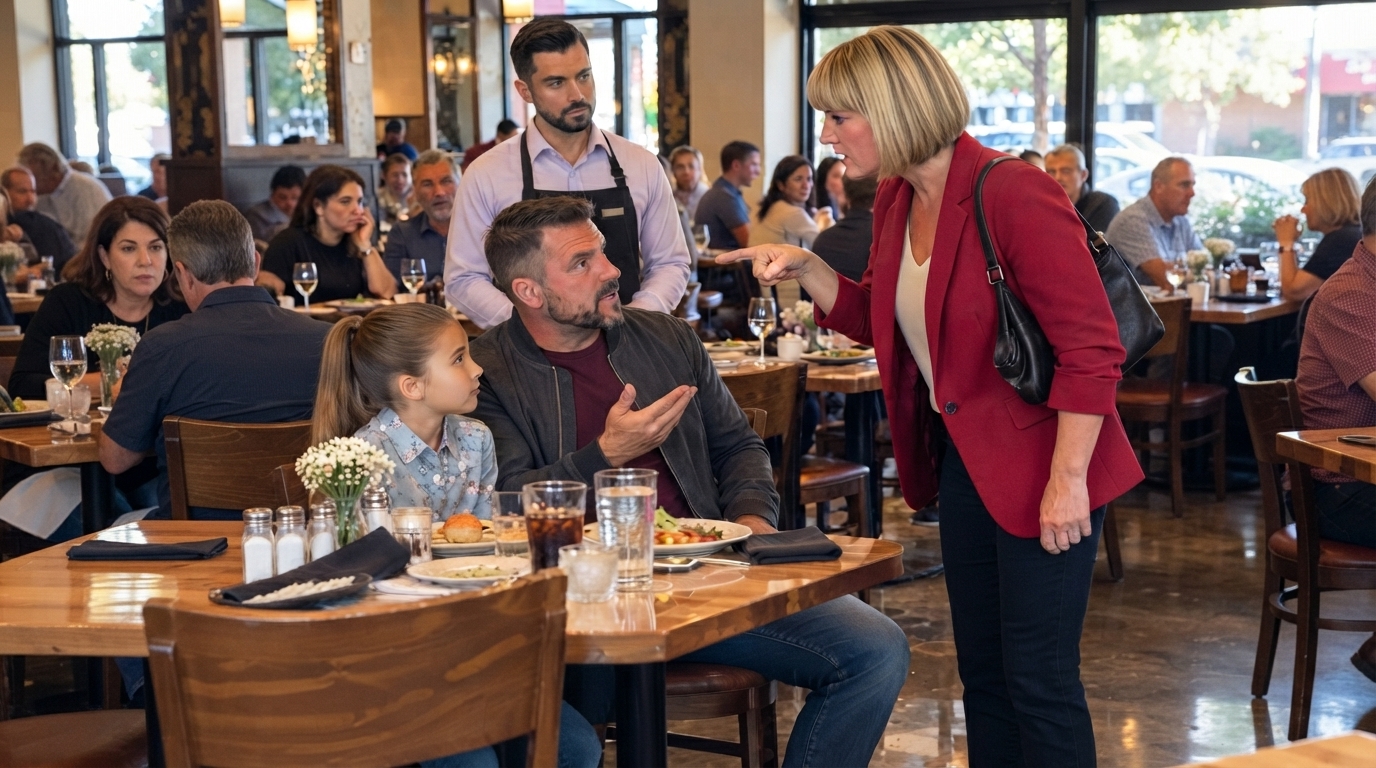
Vanessa Cole stood beside our table
with her phone pressed against her ear.
I watched the color drain from her face.
A moment earlier,
she’d been threatening to have security escort
my eight-year-old daughter and me out of the restaurant.
Now she was listening to someone on
the phone with the expression of a woman
who had just discovered she’d made a terrible mistake.
“I’m sorry,” she said nervously. “Could you repeat that?”
She glanced toward me.
Then toward Sophie.
Then back at me.
“Mr. Mercer?” she whispered.
I said nothing.
The security guard standing beside her shifted uncomfortably.
Vanessa swallowed.
“Yes, of course. I understand.”
She ended the call.
For several seconds, nobody spoke.
Then she forced a smile.
“Mr. Mercer, I believe there’s been a misunderstanding.”
I looked at her.
“Has there?”
“Yes. A rather unfortunate misunderstanding.”
I glanced at Sophie.
My daughter was sitting very still, holding her purple crayon.
Her chicken had gone cold.
The broccoli remained untouched.
She was watching the adults with the frightened expression children get
when they know something is wrong but don’t understand why.
I turned back toward Vanessa.
“Five minutes ago, you told us we didn’t belong in this section.”
Vanessa’s smile tightened.
“I was simply trying to maintain our dining standards.”
“And now?”
“Now I realize there was some confusion.”
I leaned back.
“About what?”
She hesitated.
“Your identity.”
I nodded slowly.
“So the problem wasn’t my behavior.”
“No, sir.”
“Or my daughter’s behavior.”
“Of course not.”
“Or whether we’d paid for our meal.”
“No.”
“The problem was that you didn’t know who I was.”
Her face reddened.
“Mr. Mercer, please understand—”
“I understand perfectly.”
I looked at the security guard.
“What’s your name?”
He straightened.
“Marcus Hill, sir.”
“Marcus, were you told why you were being called over?”
He glanced nervously at Vanessa.
“Ma’am said there was a guest refusing to cooperate with a seating request.”
I nodded.
“Did she tell you we’d threatened anyone?”
“No, sir.”
“Raised our voices?”
“No.”
“Refused to pay?”
“No, sir.”
“Then what were you supposed to do?”
Marcus hesitated.
Vanessa interrupted.
“Mr. Mercer, perhaps we could discuss this privately.”
I ignored her.
“Marcus?”
He took a breath.
“I was instructed to escort you and your daughter from the dining room if you refused to move.”
I looked at him carefully.
“Thank you for answering honestly.”
He nodded.
Then I turned toward Vanessa.
“You called security on a father and his eight-year-old daughter because you didn’t like how his boots looked.”
She opened her mouth.
Nothing came out.
At that moment, Sophie tugged my sleeve.
“Daddy?”
I turned immediately.
“Yes, sweetheart?”
“Are we in trouble?”
My chest tightened.
I moved beside her and knelt.
“No, Sophie. We’re not in trouble.”
She glanced toward Vanessa.
“Then why did she want us to go?”
I brushed a strand of hair away from her face.
“Because sometimes grown-ups make unfair decisions.”
Her eyes filled.
“Because your shoes are dirty?”
I looked down at my boots.
“Maybe.”
She stared at them.
“But you were helping fix things.”
I smiled sadly.
“That’s right.”
She considered that.
Then she whispered, “Mommy always said people who fix things are important.”
For a moment, I couldn’t breathe.
Claire.
Even after three years, my daughter could bring her back with a single sentence.
I kissed Sophie’s forehead.
“Mommy was right.”
Behind me, Vanessa cleared her throat.
“Mr. Mercer, I would be happy to arrange a complimentary dessert for your daughter.”
I stood.
“That’s not necessary.”
“Perhaps a gift certificate?”
“No.”
Her expression became desperate.
“Then please tell me what I can do to resolve this.”
I looked around the dining room.
Several customers were watching.
Two servers stood near the kitchen entrance.
One of them, a young woman with dark hair tied into a neat bun, looked especially anxious.
I recognized her from a confidential employee report.
Her name was Maya Torres.
She had worked at Bellmont House for almost four years.
According to the complaint, Vanessa had recently threatened to reduce Maya’s shifts after she helped a customer who couldn’t afford an expensive meal.
I looked back at Vanessa.
“You can begin by allowing my daughter to finish dinner.”
“Of course.”
“And you can stop treating ordinary customers like they’re embarrassing you.”
She nodded rapidly.
“Absolutely.”
I picked up my knife and returned to cutting Sophie’s chicken.
Vanessa remained standing there.
I looked up.
“Was there something else?”
She blinked.
“No, sir.”
“Then please give us some privacy.”
She stepped away.
Marcus followed her.
But before they reached the hostess station, I heard Vanessa whisper something sharply.
Marcus stopped.
His expression changed.
Then he looked back toward me.
I couldn’t hear every word.
But I heard enough.
“Don’t say anything to corporate.”
I placed my knife down.
That was when I knew this problem was bigger than one rude manager.
It wasn’t simply that Vanessa treated customers unfairly.
She was trying to control what employees said about it.
And I was beginning to understand why the anonymous complaints had become increasingly desperate.
Ten minutes later, my phone vibrated.
A message from Olivia Grant, our corporate director of operations.
I’m fifteen minutes away. HR director is joining remotely. Legal has been notified. Are you and Sophie safe?
I replied:
We’re safe. Please preserve the security footage from 6:00 p.m. onward. I want the employee complaints reviewed alongside tonight’s incident.
Then I put the phone away.
Sophie looked up.
“Daddy, can I still have dessert?”
I smiled.
“Did you eat your broccoli?”
She glanced at her plate.
Two pieces were missing.
I raised an eyebrow.
She sighed dramatically.
“One more bite?”
“One more bite.”
She ate it.
Then she smiled.
“Chocolate cake?”
“Chocolate cake.”
For the first time that evening, she laughed.
And I realized something important.
Vanessa had already ruined part of our dinner.
I wasn’t going to let her take the rest of it.
A few minutes later, Maya approached our table.
She carried a fresh glass of lemonade.
“Here you go, sweetheart,” she told Sophie.
“Thank you,” Sophie said.
Maya smiled.
Then she looked at me.
“Mr. Mercer, may I speak with you for a moment?”
I nodded.
“Of course.”
Her hands trembled slightly.
“I just wanted to apologize for what happened.”
“You don’t need to apologize for someone else’s decision.”
She glanced toward the hostess station.
“Vanessa said we weren’t supposed to serve this section unless guests met certain expectations.”
I kept my voice low.
“What expectations?”
Maya swallowed.
“She calls it the Bellmont image.”
I waited.
“She says customers who look like they won’t spend much money should be seated near the kitchen or offered takeout.”
I felt my stomach tighten.
“Is that an official company policy?”
Maya shook her head.
“No, sir.”
“Then why did you follow it?”
Her eyes filled.
“Because people who argue lose their shifts.”
I looked at her.
“Has that happened?”
She nodded.
“To me.”
Before I could respond, Vanessa appeared behind her.
“Maya!”
The young woman flinched.
Vanessa approached quickly.
“Why are you bothering our guest?”
Maya stepped back.
“I was just checking on the table.”
“Then return to your station.”
I raised my hand.
“Vanessa.”
She stopped.
“Maya was speaking to me because I asked her a question.”
Vanessa forced a smile.
“Of course, Mr. Mercer. I simply don’t want your evening disturbed.”
I looked directly at her.
“Then stop interrupting it.”
Her smile vanished.
Maya lowered her eyes.
I turned toward her.
“Thank you for your honesty.”
She nodded and walked away.
Vanessa followed her with a look that made my blood run cold.
I had seen that expression before.
Not in restaurants.
In corporate investigations.
It was the expression of someone already planning retaliation.
I took out my phone again.
Olivia, employee retaliation risk. Please make sure staff receive a direct confidential reporting channel tonight.
Then I looked at Sophie.
She was coloring the lobster purple again.
“Daddy?”
“Yes?”
“Do you think Mommy would like my picture?”
I smiled.
“She would love it.”
Sophie held up the menu.
The lobster had purple claws, green shoes, and a bright yellow crown.
“He’s the king of lobsters,” she announced.
I laughed.
“Very impressive.”
“His name is Sir Pinchy.”
I nearly spilled my water.
For a few beautiful seconds, we were simply a father and daughter having dinner.
Then the front doors opened.
Olivia Grant walked into the restaurant.
Behind her was our regional operations director, Andrew Collins.
Vanessa hurried toward them.
Her smile returned.
“Olivia! Andrew! What a wonderful surprise!”
Olivia didn’t smile.
“Vanessa, we need to speak.”
Vanessa glanced toward me.
“Of course. Perhaps in my office?”
Olivia looked across the dining room.
Her eyes met mine.
I gave a small nod.
Then she turned back toward Vanessa.
“Yes. Your office.”
Vanessa visibly relaxed.
She thought she was being given a chance to explain everything privately.
What she didn’t know was that Olivia had already reviewed the complaints.
And the security footage wasn’t the only evidence waiting for her.
PART 4
I didn’t follow Olivia into Vanessa’s office immediately.
Sophie deserved to finish her meal.
So I stayed at booth seventeen while Maya brought our chocolate cake.
It arrived with two forks.
One large slice.
And a little strawberry cut into the shape of a heart.
Sophie gasped.
“Daddy, look!”
I smiled.
“That’s beautiful.”
Maya looked nervous.
“I hope that’s okay.”
“It’s perfect,” I said.
Sophie took a bite.
Then she closed her eyes dramatically.
“This is the best cake in the whole world.”
Maya laughed.
I watched her smile.
It was the first relaxed expression I’d seen on her face all evening.
“Did you make it?” Sophie asked.
“No, sweetheart. Our pastry chef did.”
“Can you tell him he’s amazing?”
“I certainly will.”
Maya turned to leave.
I stopped her gently.
“Maya, Olivia Grant is here from corporate. She’ll be speaking with employees tonight. You won’t be required to discuss anything with Vanessa present.”
Her face changed.
“Really?”
“Really.”
She looked down.
“Thank you, Mr. Mercer.”
I nodded.
“And Maya?”
“Yes?”
“Your job shouldn’t depend on whether you’re willing to humiliate someone.”
Her eyes filled.
She whispered, “I know.”
Then she returned to the kitchen.
Twenty minutes later, Olivia approached our table.
She looked at Sophie.
“Hello, Sophie.”
My daughter brightened.
“Aunt Olivia!”
Olivia had known Sophie since she was a baby.
She bent down and hugged her.
“How’s my favorite artist?”
Sophie proudly displayed her lobster.
Olivia studied it.
“That’s magnificent.”
“His name is Sir Pinchy.”
“Of course it is.”
Then Olivia looked at me.
“Daniel, Andrew is reviewing the records. We need you for a few minutes.”
I nodded.
I had already arranged for Sophie to remain in the dining room with Maya, whom she knew and liked, while I met Olivia in the nearby office.
I knelt beside her.
“Sweetheart, I need to talk to some people about the restaurant. I’ll be right over there.”
She nodded.
“Are you going to fire the mean lady?”
The question caught me off guard.
I looked at Olivia.
Then back at Sophie.
“I’m going to make sure everyone is treated fairly.”
Sophie considered that.
“Even the mean lady?”
I smiled sadly.
“Even her.”
She nodded.
“Okay.”
I kissed her forehead.
Then I followed Olivia.
Vanessa’s office was immaculate.
A framed hospitality award hung behind her desk.
Several certificates lined the wall.
A photograph showed her shaking hands with a regional executive.
Everything about the room suggested success.
But when I entered, Vanessa was sitting stiffly in her chair.
Andrew stood near the window.
Olivia closed the door.
“Daniel,” she said, “we’ve reviewed the initial evidence.”
Vanessa immediately stood.
“Mr. Mercer, before this goes any further, I want to apologize again for the misunderstanding.”
I remained standing.
“Vanessa, please sit.”
She obeyed.
Olivia opened a folder.
“Over the last two months, corporate received fourteen customer complaints concerning discriminatory or degrading seating practices at this location.”
Vanessa shifted.
“Many of those complaints were exaggerated.”
Olivia continued.
“We also received six employee reports alleging retaliation, inappropriate scheduling decisions, and pressure to misrepresent service standards.”
Vanessa shook her head.
“Disgruntled employees say all kinds of things.”
Andrew spoke for the first time.
“Several reports include specific dates, shift records, and written messages.”
Vanessa went pale.
I looked at her.
“Did you instruct hosts to evaluate guests based on clothing and apparent wealth?”
She hesitated.
“I encouraged staff to maintain the premium atmosphere.”
“That wasn’t my question.”
She swallowed.
“Yes, but only to protect the brand.”
I felt something tighten in my chest.
“The brand?”
She nodded quickly.
“Bellmont House has a reputation. Customers expect sophistication.”
I looked at Olivia.
Then back at Vanessa.
“Do you know who founded this restaurant?”
Vanessa looked confused.
“You and your late wife.”
“Do you know what Claire believed?”
She hesitated.
“Excellent service?”
I shook my head.
“Claire believed excellent service meant treating the person ordering soup with the same dignity as the person ordering a thousand-dollar bottle of wine.”
Vanessa looked away.
I continued.
“She believed a tired nurse deserved a comfortable table. A construction worker deserved respect. A family celebrating a birthday deserved kindness, even if they couldn’t afford dessert.”
My voice grew quieter.
“And she believed nobody should leave this restaurant feeling smaller than when they arrived.”
Vanessa said nothing.
I looked around the office.
“Somewhere along the way, you decided our business was about making wealthy people feel important by making everyone else feel unwelcome.”
She opened her mouth.
I raised one hand.
“That is not the company my wife and I built.”
Olivia placed another document on the desk.
“There’s more.”
Vanessa stiffened.
Olivia continued.
“We reviewed scheduling records from the past six months. Employees who received negative comments for serving lower-spending customers also experienced reductions in preferred shifts.”
Vanessa shook her head.
“That’s coincidence.”
Andrew opened his laptop.
“Then perhaps you can explain this message.”
He turned the screen toward her.
I read it.
It was a message Vanessa had sent to the assistant manager.
Stop rewarding servers who waste time on low-value tables. Put Maya on weekday lunches until she learns how to prioritize revenue.
I stared at the screen.
Vanessa’s face turned crimson.
“That was taken out of context.”
Olivia remained calm.
“What context would make it appropriate?”
Vanessa said nothing.
Andrew scrolled.
Another message appeared.
Window booths are for guests who look like they belong there. We are not running a roadside diner.
I felt sick.
I remembered the customers described in the complaints.
The hospital worker.
The construction crew.
The mother celebrating her daughter’s birthday.
How many people had walked into the restaurant Claire loved, hoping for one pleasant evening, only to be judged before anyone asked their names?
I turned toward Vanessa.
“Did you personally approve these instructions?”
She looked down.
“Yes.”
I nodded.
“Thank you for answering.”
For a moment, she seemed relieved.
Then Olivia opened another folder.
“Vanessa, we’re placing you on administrative leave effective immediately while HR completes its investigation.”
Vanessa jumped to her feet.
“What?”
Olivia continued.
“You will retain access to the appropriate HR contact, but you are not to direct staff, alter schedules, contact employees about their statements, or interfere with records.”
Vanessa looked at me.
“Mr. Mercer, you can’t be serious.”
I met her gaze.
“I’m very serious.”
Her voice rose.
“I’ve given this company six years!”
“And tonight you threatened to have my daughter removed because of my clothes.”
“I didn’t know who you were!”
The words burst out before she could stop them.
Silence filled the room.
Vanessa stared at me.
Then she realized what she’d said.
I nodded slowly.
“Exactly.”
She looked horrified.
I continued.
“You would have treated me differently if you’d known I owned the company.”
She said nothing.
“But what about the father who works construction and saves for three months to bring his daughter here? What about the nurse finishing a fourteen-hour shift? What about the elderly couple celebrating fifty years of marriage?”
My voice shook.
“They don’t own the company. Does that mean they deserve less respect?”
Vanessa’s eyes filled.
“No.”
“Then why did you treat them that way?”
She sat down heavily.
For the first time, she had no answer.
Olivia explained the administrative process.
Vanessa would have an opportunity to respond to the allegations.
The investigation would review records, interview staff, and determine appropriate disciplinary action.
I supported that approach.
I wanted accountability.
Not a theatrical dismissal designed to make me feel powerful.
Vanessa eventually gathered her personal belongings and left with Andrew accompanying her through the staff corridor.
Before she reached the door, she turned toward me.
“Mr. Mercer?”
I looked up.
“I’m sorry about your daughter.”
I studied her.
“I hope someday you understand that you should be sorry about every daughter you’ve made feel unwelcome.”
She lowered her eyes.
Then she left.
Afterward, Olivia and I remained in the office.
She looked exhausted.
“Daniel, I should have caught this sooner.”
I shook my head.
“So should I.”
“You stepped away for Sophie.”
“I know.”
“And you had every right to.”
I looked at Claire’s photograph on my phone.
“But stepping away from day-to-day management didn’t mean I stopped being responsible for the company.”
Olivia nodded.
“We need changes.”
“Yes.”
I looked toward the dining room.
“And they need to begin tonight.”
We returned to the restaurant.
By then, Sophie had finished her cake.
Maya was showing her how to fold a napkin into a little fan.
When Sophie saw me, she smiled.
“Daddy!”
I walked over.
“Everything okay?”
She nodded.
“Maya says I can be a chef when I grow up.”
I laughed.
“Of course you can.”
Sophie looked thoughtful.
“Or a restaurant boss.”
Maya smiled.
“That too.”
I sat beside her.
“Well, if you’re going to be a restaurant boss, there’s something important you need to know.”
She looked at me seriously.
“What?”
“People are more important than fancy furniture.”
She nodded.
“Even if their shoes are muddy?”
I smiled.
“Especially then.”
She laughed.
I looked at Maya.
“Would you ask the staff who are comfortable staying a few minutes after closing to meet with Olivia? Anyone who needs to leave should be free to do so.”
Maya nodded.
“Of course.”
Then she hesitated.
“Mr. Mercer, may I ask something?”
“Yes.”
“Are we going to lose our jobs?”
The question broke my heart.
I shook my head.
“No, Maya. We’re reviewing management conduct, not punishing employees for speaking up.”
Her shoulders relaxed.
“Thank you.”
Later that evening, Olivia met with the employees.
I attended only briefly.
I wanted them to understand that their concerns mattered, but I didn’t want my presence to pressure anyone into speaking.
Olivia explained the confidential reporting process.
She assured staff that retaliation would not be tolerated.
She announced an independent review of scheduling, disciplinary records, and customer-service practices.
Then she invited employees to share concerns privately.
I stood near the back of the room.
A young host raised his hand.
“Can I ask something?”
Olivia nodded.
“Of course.”
He looked at me.
“Mr. Mercer, are we still supposed to ask people to move if they don’t look right for the window section?”
My chest tightened.
“No,” I said.
He looked surprised.
“Even if they’re wearing work clothes?”
“Even then.”
“What if they only order coffee?”
“If we have a table available and our service policy allows it, treat them respectfully.”
He nodded.
Then he asked quietly, “What if someone complains?”
I looked around the room.
“Then we handle the complaint fairly. We don’t punish a guest for being less wealthy than someone else.”
Several employees exchanged glances.
A woman near the kitchen began crying.
I recognized her from one of the anonymous reports.
Her name was Teresa.
She had been with Bellmont House for twelve years.
She raised her hand.
“Mr. Mercer?”
“Yes?”
“Your wife used to say something to us every morning before opening.”
I felt my throat tighten.
“What was that?”
Teresa smiled through her tears.
“Everybody eats.”
I closed my eyes.
For a moment, I could almost hear Claire saying it.
Teresa continued.
“She said we were never supposed to make people feel ashamed for being hungry, tired, poor, or different.”
I nodded.
“That’s right.”
Teresa wiped her cheeks.
“Some of us thought those days were gone.”
I looked around the room.
“They aren’t.”
Then I made a promise.
“We’re going to rebuild the culture of this restaurant. Not through slogans on the wall, but through how we treat people when nobody important is watching.”
A quiet murmur moved through the room.
I continued.
“And if any of you are ever pressured to humiliate a guest or punished for treating someone kindly, I want you to report it.”
Olivia nodded.
“We’ll make sure there are independent channels for that.”
I looked at the employees.
“Claire and I built this place with borrowed money, secondhand equipment, and more hope than experience. We weren’t wealthy when we opened.”
I smiled sadly.
“We were the people some of you have been told not to seat by the window.”
Nobody spoke.
I continued.
“So if this restaurant has forgotten how to welcome ordinary people, then it has forgotten why it exists.”
When I finished, the room was quiet.
Then Teresa began clapping.
Others joined.
I raised my hand gently.
“Thank you. But what matters is what we do tomorrow.”
That night, Sophie and I finally left Bellmont House.
The rain had stopped.
The pavement glistened beneath the streetlights.
As I helped her into the car, she looked at me.
“Daddy?”
“Yes, sweetheart?”
“Did Mommy really make this restaurant?”
I smiled.
“She helped build every part of it.”
Sophie looked back at the glowing windows.
“Then I think she’d be sad about the mean lady.”
I nodded.
“She would.”
Sophie considered that.
Then she smiled.
“But she’d be happy you fixed it.”
I felt tears sting my eyes.
“I hope so, sweetheart.”
I started the car.
But before we drove away, Sophie said something I would remember forever.
“Daddy, can we come back tomorrow?”
I looked at her.
“Why?”
She smiled.
“Because Maya said the chef makes pancakes shaped like hearts.”
I laughed.
“Then I suppose we have a breakfast date.”
And for the first time in months, I felt something I’d almost forgotten.
Hope.
PART 5
The investigation lasted three weeks.
During that time, Bellmont House operated under temporary management.
Olivia appointed an experienced regional manager named Rebecca Hayes to oversee daily operations.
Rebecca had worked for our company for fourteen years.
She began as a hostess.
Then became a server.
Then an assistant manager.
Eventually, she managed one of our most successful locations.
But what impressed me most wasn’t her sales record.
It was something Olivia told me.
“Rebecca once paid for a stranded family’s dinner out of her own pocket because their credit card stopped working.”
I looked at her.
“Did she ask to be reimbursed?”
Olivia smiled.
“No. We only found out because the family wrote a letter.”
I nodded.
“That’s the kind of judgment we need.”
Rebecca’s first decision was simple.
She removed the unofficial seating instructions.
No more judging guests by clothing.
No more assigning tables based on assumptions about income.
No more treating families with children as inconveniences.
Reservations, accessibility needs, guest preferences, and normal service operations would determine seating.
Not someone’s shoes.
She also reviewed staff schedules.
Employees who had lost preferred shifts after questioning management were given opportunities to restore their schedules where appropriate.
The company arranged back-pay reviews where wage or scheduling violations might have occurred.
And Olivia established an independent reporting channel that bypassed local management.
It wasn’t glamorous.
It didn’t make headlines.
But it mattered.
Because a restaurant’s culture isn’t defined by the speech its owner gives.
It’s defined by what happens during an ordinary Tuesday dinner when nobody is watching.
The HR investigation eventually substantiated multiple violations of company policy.
Vanessa had directed employees to treat guests differently based on perceived spending power.
She had pressured staff to move customers away from prominent tables for reasons unrelated to reservations or service needs.
She had also used scheduling decisions to punish employees who challenged her instructions.
After reviewing the evidence and Vanessa’s response, the company terminated her employment.
I didn’t attend the final meeting.
That decision belonged to HR and operations.
I had been personally involved in one of the incidents, and I didn’t want the process to become about my anger.
Still, when Olivia called to tell me the outcome, I felt a strange sadness.
Not for the loss of Vanessa’s position.
For how unnecessary the entire situation had been.
She was intelligent.
Experienced.
Capable of running a successful restaurant.
But somewhere along the way, she’d convinced herself that making certain customers feel inferior was part of creating luxury.
And that belief had cost her everything she’d built at Bellmont House.
A few days later, I received a letter.
It was from Vanessa.
I almost didn’t open it.
But curiosity won.
The letter was handwritten.
Mr. Mercer,
I know an apology cannot undo what happened to your daughter or the other customers I mistreated.
When I first became a manager, I believed my job was to make every guest feel welcome. Over time, I became obsessed with sales targets, customer spending, and maintaining an image I thought wealthy guests expected.
I began judging people before they sat down.
I told myself I was protecting the business.
The truth is that I was protecting my own ambitions.
When I realized who you were, I was frightened because I thought I had offended someone powerful.
I should have been ashamed because I had offended someone who deserved respect, regardless of power.
Your daughter did nothing wrong.
Neither did the other customers.
I did.
I’m sorry.
I read the letter twice.
Then I placed it in my desk drawer.
I didn’t respond immediately.
I wasn’t sure what I wanted to say.
Eventually, I sent a brief note.
Vanessa, I appreciate your acknowledgment of what happened. I hope you carry these lessons into whatever work comes next. Every customer deserves dignity, whether or not they can affect your career.
I meant it.
I didn’t need Vanessa to suffer forever.
I needed her to understand why her behavior had been wrong.
And I needed to make sure it never became acceptable in my company again.
Over the following months, we reviewed all forty-one Bellmont locations.
I didn’t want to assume the problem was limited to one manager.
Olivia organized independent employee surveys.
We examined customer complaints.
We reviewed performance incentives.
And we discovered something uncomfortable.
Some of our corporate systems had unintentionally encouraged the very behavior we were condemning.
Managers received bonuses heavily tied to average guest spending.
Customer satisfaction mattered, but the way we measured it favored expensive transactions.
Regional executives praised locations that increased premium wine sales.
They rarely discussed whether guests felt welcome.
The numbers had become more important than the people behind them.
I sat through meeting after meeting, listening to reports.
Finally, I asked our leadership team a question.
“What are we actually rewarding?”
Nobody answered immediately.
I continued.
“If a manager increases revenue by making ordinary customers uncomfortable, have we succeeded?”
Olivia shook her head.
“No.”
“Then why does our bonus system treat that as success?”
The room went quiet.
Our chief financial officer looked down at his notes.
Our regional director shifted in his chair.
I wasn’t angry at them.
I had approved some of those systems myself years earlier.
That was the hardest part.
It would have been easy to blame Vanessa and move on.
But leadership meant admitting when the structure itself needed improvement.
So we changed it.
We revised management evaluations to include fair service standards, employee well-being, complaint resolution, and verified customer satisfaction.
We strengthened training.
We made it clear that staff would not be punished for treating lower-spending guests with courtesy.
And we began recognizing employees who demonstrated the values Claire and I had built the company around.
Not just those who sold the most expensive bottle of wine.
One afternoon, Olivia brought me a report.
“Daniel, you should see this.”
I looked at the page.
It contained feedback from Bellmont House customers over the previous month.
One comment caught my attention.
My husband and I celebrated our fortieth anniversary here. We were nervous because we don’t usually eat at expensive restaurants. Our server treated us like royalty. We’ll remember this night forever.
I smiled.
Another read:
I came in wearing hospital scrubs after a difficult shift. The hostess gave me a window table without hesitation. It was the first peaceful meal I’d had all day.
My throat tightened.
Then I saw a third comment.
Our daughter has sensory sensitivities, and the staff helped us find a quiet table without making us feel difficult. Thank you for treating our family with kindness.
I sat back.
This was what Claire had wanted.
Not perfection.
Not endless praise.
Just ordinary people leaving with good memories.
“Olivia,” I said quietly, “send these to Rebecca.”
She smiled.
“Already did.”
I looked up.
“And tell the staff I’m proud of them.”
She nodded.
“I will.”
That summer, Bellmont House celebrated its twenty-fifth anniversary.
We organized a special evening for employees, longtime customers, and community members.
I hadn’t originally planned to speak.
Public appearances still felt difficult without Claire beside me.
For years, she had been the one who made everyone laugh.
I handled budgets.
She handled people.
I could negotiate a commercial lease for six hours without blinking.
But standing in front of a room and talking about my late wife?
That was another matter.
Still, Olivia convinced me.
“Daniel, this restaurant means something to people. They should hear from you.”
So I agreed.
The anniversary dinner was held on a warm Friday evening.
Bellmont House looked beautiful.
Fresh flowers decorated the tables.
Candles flickered beneath the windows.
Soft music filled the room.
But the most meaningful detail was near the entrance.
Rebecca had installed a framed photograph of Claire.
Beneath it was a simple inscription:
CLAIRE MERCER
Co-Founder, Bellmont House
Everybody Eats. Everybody Belongs.
I stood in front of the photograph for a long time.
Claire was smiling.
Her hair was pulled back.
She wore the old white blouse she loved.
The picture had been taken during our first year in business.
We were exhausted.
We were terrified of failing.
And we were happier than we’d ever been.
“Daddy?”
I looked down.
Sophie stood beside me in a blue dress.
She held my hand.
“Mommy looks pretty.”
I smiled.
“She was beautiful.”
Sophie studied the photograph.
“Was she happy here?”
I knelt beside her.
“Very happy.”
“Because she liked cooking?”
I laughed softly.
“Your mother was actually a terrible cook.”
Sophie gasped.
“Really?”
“Really. She once burned toast so badly the smoke alarm went off.”
Sophie burst out laughing.
“But she loved making people happy,” I continued. “And she believed food could bring people together.”
Sophie looked at the photograph again.
“Then I think she’d like the restaurant now.”
I swallowed.
“I think so too.”
When it was time for my speech, I walked to the front of the dining room.
The room grew quiet.
I looked around.
Employees stood beside longtime customers.
Families sat together.
A construction crew occupied a table near the window.
A group of nurses laughed near the bar.
An elderly couple held hands beneath the chandelier.
And Sophie sat in booth seventeen.
Our booth.
Claire’s booth.
I took a breath.
“Twenty-five years ago, my wife and I opened this restaurant with very little money and absolutely no idea how difficult running a business would be.”
A few people laughed.
“We had secondhand tables, a temperamental oven, and a coffee machine that broke almost every Tuesday.”
More laughter.
“Claire insisted we could make it work.”
I smiled.
“She was right.”
I looked toward her photograph.
“But Claire believed something that took me longer to understand.”
I paused.
“She believed the most important thing we served wasn’t food.”
The room became still.
“It was dignity.”
I looked around.
“People come into restaurants carrying things we cannot see. They may be celebrating an anniversary. They may be grieving. They may be exhausted from work. They may have saved for months to afford one special evening.”
My voice tightened.
“And every one of them deserves to be treated with kindness.”
I glanced toward Sophie.
“Several months ago, my daughter and I came here for dinner. I was wearing muddy boots after working at one of our properties.”
A few people smiled.
“We were told we didn’t belong in the section where we were sitting.”
The room went silent.
I continued.
“My daughter asked me whether we’d done something wrong.”
I paused.
“That question broke my heart.”
I looked down briefly.
“Because no child should ever feel ashamed of her father for working hard. And no parent should have to explain why someone thinks their family isn’t good enough to sit at a table.”
Several employees lowered their eyes.
I continued.
“That evening forced me to confront something I had neglected. I had allowed our company to drift away from the values Claire and I believed in.”
I took a breath.
“We’ve made changes. We still have work to do. But I want everyone here to understand something.”
I looked around the room.
“Bellmont House does not belong only to people who can afford expensive wine.”
I smiled.
“It belongs to the nurse who needs a peaceful meal after a long shift.”
“To the construction worker celebrating his daughter’s birthday.”
“To the elderly couple sharing dessert.”
“To the family ordering the least expensive thing on the menu because being together is what matters.”
My voice broke.
“And to every child who walks through our doors believing this might be the most special dinner of their life.”
I paused.
“Claire used to say two words to our staff before every shift.”
I looked toward her photograph.
“Everybody eats.”
The room remained quiet.
“Tonight, I want to add something.”
I looked directly at the employees.
“Everybody belongs.”
For a moment, nobody moved.
Then Teresa began applauding.
Maya joined her.
Soon the entire room was standing.
I looked toward Sophie.
She was clapping harder than anyone.
Her face glowed with pride.
And for one impossible second, I could almost imagine Claire standing beside her.
Smiling.
Laughing.
Proud of what we’d built.
After the speech, I returned to booth seventeen.
Sophie climbed onto my lap.
“Daddy, you did good.”
I laughed softly.
“Thank you, sweetheart.”
She looked serious.
“Mommy would’ve clapped too.”
My eyes filled.
“I hope so.”
Sophie wrapped her arms around my neck.
“I know so.”
I held her tightly.
Later that evening, Maya approached our table.
She wore a name badge with a new title.
ASSISTANT RESTAURANT MANAGER
I smiled.
“How does it feel?”
She laughed nervously.
“Terrifying.”
“Good.”
She looked confused.
I smiled.
“A little fear means you understand the responsibility.”
She nodded.
“I’m going to do my best.”
“I know.”
She looked toward the photograph of Claire.
“I wish I’d met your wife.”
I smiled sadly.
“She would’ve liked you.”
Maya’s eyes filled.
“Thank you.”
Then Sophie interrupted.
“Maya?”
“Yes, sweetheart?”
“Can I have chocolate cake?”
Maya laughed.
“Of course.”
Sophie looked at me.
“With two forks?”
I smiled.
“With two forks.”
As Maya walked away, Olivia joined us.
She sat across from me.
“How are you feeling?”
I looked around the dining room.
“Better than I have in a long time.”
She smiled.
“Claire would be proud.”
I nodded.
“I hope so.”
Olivia looked at Sophie.
“And I think someone else is pretty proud too.”
Sophie grinned.
“My daddy owns the restaurant.”
I laughed.
“That’s true.”
Then she added something that made everyone at the table fall silent.
“But he doesn’t own the people.”
I stared at her.
Olivia slowly smiled.
“No, Sophie. He doesn’t.”
My daughter looked confused.
“What?”
I hugged her.
“Nothing, sweetheart. That was just a very important thing to say.”
She shrugged.
“Mommy told me.”
My breath caught.
“When?”
Sophie thought for a moment.
“When I was little. She said being the boss means helping people, not being mean to them.”
I closed my eyes.
Claire had been sick during Sophie’s earliest years.
There were so many conversations I hadn’t known about.
So many small lessons she’d left behind.
I kissed Sophie’s forehead.
“Your mommy was a very wise woman.”
Sophie smiled.
“I know.”
That night, after the celebration ended, I walked through Bellmont House one last time.
The dining room was quiet.
The candles had been extinguished.
The kitchen staff were finishing their work.
I stopped beside booth seventeen.
I remembered Claire sitting there twenty-five years earlier, laughing because I’d accidentally spilled coffee on the new tablecloth.
I remembered our first profitable month.
Our first anniversary.
The night we learned Sophie was coming.
The birthday dinners.
The celebrations.
And the last time Claire had sat beside me before her illness made leaving home too difficult.
For three years, I’d avoided this booth because it reminded me of everything I’d lost.
But that evening, I understood something.
The memories weren’t there to punish me.
They were there to remind me what mattered.
I ran my hand along the polished wood.
Then I whispered, “We did it, Claire.”
My voice trembled.
“We remembered.”
Behind me, Sophie called out.
“Daddy! Are you coming?”
I turned.
She stood near the entrance holding her purple lobster drawing.
I smiled.
“Coming, sweetheart.”
As we walked toward the door, Marcus Hill, the security guard from that terrible evening, approached us.
He had remained with the company after the investigation.
He’d completed additional training and helped improve how staff handled customer concerns.
“Good night, Mr. Mercer.”
“Good night, Marcus.”
He looked at Sophie.
“Good night, young lady.”
She smiled.
“Good night!”
Then she paused.
“Marcus?”
“Yes?”
“Do you like purple lobsters?”
He laughed.
“I’ve never met one.”
She proudly showed him the drawing.
“This is Sir Pinchy.”
Marcus studied it seriously.
“Very impressive.”
Sophie beamed.
Then she handed him the picture.
“You can have it.”
He looked surprised.
“Are you sure?”
She nodded.
“Because you were nice tonight.”
Marcus smiled.
“Thank you, Sophie.”
I watched him carefully place the drawing inside his jacket.
And I thought about how much had changed.
A few months earlier, he’d been ordered to remove my daughter and me from the dining room.
Now my daughter was giving him a drawing because he’d treated her kindly.
Not every mistake had to define a person’s future.
But every mistake demanded a choice.
Defend it.
Excuse it.
Or learn from it.
As we stepped outside, the evening air was cool.
The city lights reflected against the pavement.
Sophie slipped her hand into mine.
“Daddy?”
“Yes?”
“Can we come back next Friday?”
I smiled.
“Of course.”
“Can I wear my rain boots?”
I laughed.
“Absolutely.”
“Even if they’re muddy?”
I looked down at her.
“Especially if they’re muddy.”
She giggled.
Then she grew thoughtful.
“Daddy, what if someone else comes in with muddy shoes?”
I squeezed her hand.
“Then I hope someone welcomes them.”
She smiled.
“Like Mommy would.”
I nodded.
“Exactly like Mommy would.”
We reached the car.
I helped her into her seat.
As I closed the door, I looked back at Bellmont House.
The sign glowed warmly above the entrance.
Inside, employees were finishing their shifts.
Tomorrow, customers would arrive.
Some would wear expensive suits.
Others would wear jeans.
Some would order elaborate meals.
Others would order soup.
Some would celebrate.
Others would simply be hungry.
And every one of them would deserve a place at the table.
I thought about Vanessa.
About the complaints.
About the employees who had been afraid to speak.
About the customers who had quietly walked away feeling unwelcome.
I couldn’t undo every hurt.
But I could make sure we stopped repeating them.
And I could teach my daughter something more valuable than how to run a successful company.
I could teach her that wealth doesn’t determine worth.
Clothing doesn’t determine character.
And power means nothing if you use it to make other people feel small.
Three years after losing Claire, I had finally found a way to honor her that went beyond photographs and memories.
I could protect what she believed in.
I could keep her kindness alive.
And I could make sure the little restaurant we’d built together remained a place where ordinary people felt extraordinary simply because they were treated with respect.
As I drove home, Sophie fell asleep in the back seat.
Her purple crayon was still tucked inside her jacket pocket.
I glanced at her in the rearview mirror.
And I remembered the moment Vanessa had looked at my muddy boots and decided we didn’t belong.
She had thought she was removing an undesirable customer.
She had no idea she was confronting the owner.
But that was never the most important part of the story.
The important part was what would have happened if I hadn’t been the owner.
If I’d been an ordinary father.
A mechanic.
A cleaner.
A delivery driver.
A construction worker.
Someone who couldn’t call corporate.
Someone whose daughter would have gone home believing her family wasn’t good enough.
That was the injustice I couldn’t ignore.
Because respect that changes depending on someone’s wealth isn’t respect at all.
It’s fear of power disguised as politeness.
And my daughter deserved to grow up knowing the difference.
The next morning, I found a note Sophie had left on my desk.
It was written in her uneven eight-year-old handwriting.
Dear Daddy,
Thank you for making the restaurant nice again.
I think Mommy is smiling.
Love, Sophie.
Beneath the words, she’d drawn three people standing together.
A little girl.
A man.
And a woman with long hair and enormous angel wings.
I sat at my desk holding that drawing for a long time.
Then I placed it beside Claire’s photograph.
And for the first time in three years, I didn’t feel that the restaurant was something I’d lost with my wife.
It was something she had left for us to protect.
A place built on love.
A place where kindness mattered.
A place where every person deserved to belong.
That evening, a manager told my daughter and me that people like us weren’t supposed to sit in the best section.
She was wrong.
Because the best seat in any restaurant isn’t reserved for the wealthiest customer.
It’s the one where you are welcomed, respected, and allowed to feel that you belong.
And that’s the kind of place Claire and I had always wanted Bellmont House to be.
THE END THANK YOU FOR READING !!!



