PART 3
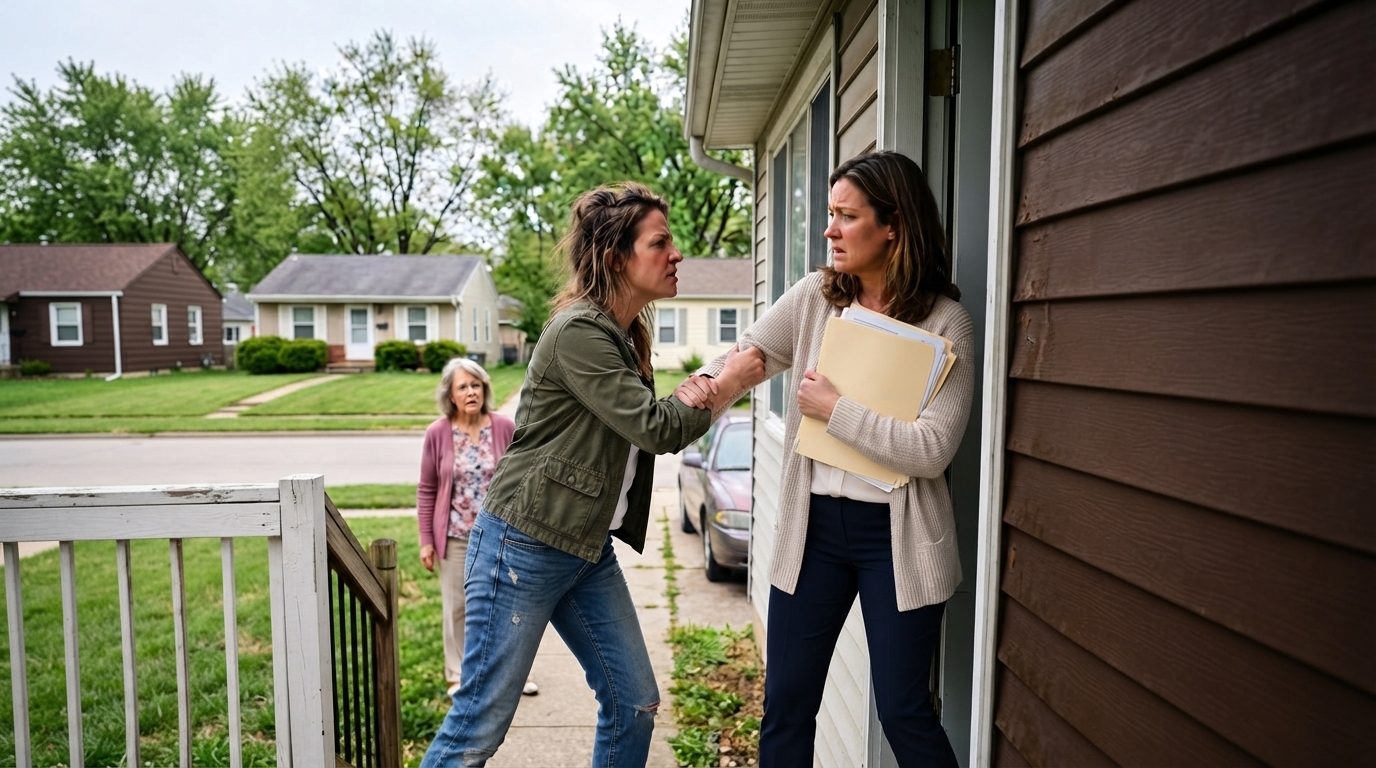
For several seconds, nobody said a word.
The moving truck sat in
my driveway with its engine idling.
Two movers stood beside
the open passenger door,
looking increasingly uncomfortable.
My mother, Diane, had both hands planted on her hips.
My sister Stephanie stood beside her,
holding the document she had waved
in my face just moments earlier.
And Officer Ramirez was staring at
the signature at the bottom of that paper.
My signature.
Except I had never signed it.
“Ma’am,” he said, looking at Stephanie,
“you need to explain where this document came from.”
Stephanie folded her arms.
“It’s a family agreement.”
“Who prepared it?”
“My grandmother.”
I felt something cold settle in my stomach.
Officer Ramirez glanced at the date again.
“Your grandmother passed away on March eighth, correct?”
I nodded.
“Yes.”
He pointed toward the document.
“This is dated March nineteenth.”
Stephanie blinked.
“So?”
I stared at her.
“Stephanie, Grandma was buried on March twelfth.”
Her face reddened.
My mother stepped forward.
“It’s obviously a clerical error.”
Officer Ramirez looked at her.
“Who made the error?”
My mother hesitated.
“The attorney.”
“Which attorney?”
She glanced at Stephanie.
Stephanie looked away.
I almost laughed.
For years, they had operated this way.
Mom made a demand.
Stephanie repeated it.
And if I questioned either of them, I was accused of being difficult.
But this wasn’t a family argument about who got the bigger bedroom or who deserved more attention.
This was my home.
My grandmother’s home.
And the paper in Stephanie’s hand contained a signature that wasn’t mine.
Officer Ramirez turned toward me.
“Did you sign this agreement?”
“No.”
“Have you ever agreed to transfer the property to your sister?”
“No.”
“Do you recognize the signature?”
I looked at it carefully.
It resembled mine at first glance.
But the letters were too rounded.
The final stroke was wrong.
And the middle initial was written in a way I hadn’t used since high school.
“No,” I said. “That’s not how I sign my name.”
Stephanie rolled her eyes.
“Oh, please. Now you’re pretending you don’t recognize your own signature?”
I looked at her.
“Stephanie, I didn’t sign that.”
“You always do this.”
“Do what?”
“Act like everyone is trying to steal from you.”
I felt my face grow hot.
“You arrived at my house with a moving truck and a document saying I’ve surrendered ownership.”
She shrugged.
“Because Grandma wanted me to have it.”
I stared at her.
“Then why did she leave it to me in her will?”
My mother stepped between us.
“Enough. Your grandmother loved both of you. She simply realized Stephanie needed the house more.”
I looked at her.
“Grandma’s will was signed eighteen months before she died. She had an attorney. She was clear about her wishes.”
Mom’s eyes narrowed.
“Your grandmother was old.”
“She was seventy-nine.”
“She was confused.”
That was when something inside me snapped.
Not because I was surprised.
Because I had heard that excuse before.
Whenever Grandma refused to give Stephanie money, Mom said she was confused.
Whenever Grandma questioned my parents’ decisions, they said she was stubborn.
And when Grandma insisted I should inherit the home where she’d raised me, suddenly she was incapable of knowing what she wanted.
I looked directly at my mother.
“Grandma wasn’t confused.”
Mom scoffed.
“She wasn’t thinking clearly.”
I took one step closer.
“She knew exactly what she was doing.”
Officer Ramirez raised a hand.
“Everyone, let’s keep this calm.”
Then he turned toward the movers.
“Gentlemen, were you hired to remove property from this residence?”
One of them nodded.
“Yes, sir.”
“Who hired you?”
He pointed toward Stephanie.
“She did.”
“Were you told the property was vacant?”
The man hesitated.
Stephanie suddenly interrupted.
“They don’t need to answer that.”
Officer Ramirez looked at her.
“I asked them.”
The mover cleared his throat.
“We were told the current occupant had been given notice and would be gone.”
I stared at Stephanie.
“You told them I’d moved out?”
She shrugged.
“You were supposed to.”
Officer Ramirez turned toward the driver.
“Until the ownership and occupancy issues are resolved, you should not remove anything from this property without lawful authorization.”
The driver nodded immediately.
“No problem, Officer. We’re not getting involved.”
He motioned to his partner.
They climbed into the truck.
Stephanie shouted, “Wait! I already paid you!”
The driver leaned out his window.
“Ma’am, you can contact the office about the job. We’re not moving anybody’s belongings under these circumstances.”
Then he drove away.
I watched the truck disappear around the corner.
Stephanie stood frozen.
My mother looked furious.
And for the first time in my life, neither of them had managed to get what they wanted simply by showing up and demanding it.
Officer Ramirez handed Stephanie’s document back after recording the relevant details.
“I’m documenting this incident,” he said. “A disputed signature and potentially false paperwork are serious matters. But I cannot determine ownership conclusively here on the driveway.”
He turned toward me.
“Do you have an attorney?”
“Yes. His name is Daniel Mercer.”
“Contact him immediately. Preserve all the documents and communications. If anyone attempts to enter unlawfully or remove property, call us.”
I nodded.
“Thank you.”
Then he looked at my mother and sister.
“Until this is resolved through the appropriate legal process, you should not attempt to take possession based on this disputed document.”
Stephanie opened her mouth.
But my mother grabbed her arm.
“We understand.”
I almost smiled.
It was the first time I’d ever heard Mom accept an answer she didn’t like.
Officer Ramirez returned to his cruiser.
Then drove away.
The moment he was gone, Stephanie turned on me.
“You embarrassed us!”
I stared at her.
“You brought the police into this!”
“I called the nonemergency line because you threatened to remove me from my home.”
Mom pointed a finger at my face.
“You’ve always been selfish.”
I felt the old familiar sting.
The accusation I’d heard since childhood.
Stephanie needed new clothes?
I was selfish if I didn’t share.
Stephanie wanted my birthday money?
I was selfish if I refused.
Stephanie failed to pay her rent?
I was selfish if I wouldn’t help.
Now she wanted my grandmother’s house.
And once again, I was selfish for saying no.
I looked at my mother.
“Do you know what Grandma told me the week before she died?”
Mom folded her arms.
“What?”
“She said, ‘Don’t let them make you feel guilty for keeping what I’ve chosen to give you.’”
Stephanie laughed bitterly.
“Convenient.”
I shook my head.
“No. Sad.”
They both stared at me.
“It’s sad that she knew exactly what you’d do.”
My mother’s face changed.
For one brief moment, I saw something beneath her anger.
Recognition.
Then she hardened again.
“Your grandmother turned you against us.”
I looked toward the house.
The white porch.
The flowerbeds.
The old maple tree beside the driveway.
The place where Grandma had taught me to ride a bicycle.
The kitchen where she helped me finish homework.
The bedroom where she sat beside me after my parents forgot my high school graduation.
“No,” I said quietly.
“Grandma taught me what love was supposed to look like.”
Stephanie grabbed her handbag.
“This isn’t over.”
I nodded.
“I know.”
Mom stepped closer.
“You’ll regret treating your family this way.”
I looked at her.
For years, those words would have frightened me.
But standing in front of the home Grandma left me, I realized I had already lost the family I’d spent my childhood trying to please.
There was nothing left to threaten me with.
“Goodbye, Mom.”
I walked inside.
Closed the door.
And locked it.
My hands were shaking so badly I could barely hold the key.
Then I leaned against the door and cried.
Not because I thought they would win.
But because a small part of me had still hoped they would stop.
That they would look at Grandma’s house and remember her.
That they would realize what they were doing.
Instead, they’d brought a moving truck.
And a forged signature.
I wiped my face.
Then called Daniel Mercer.
He answered on the second ring.
“Everything all right?”
“No,” I said.
“They came.”
He paused.
“With the movers?”
“Yes.”
“Did anyone enter the house?”
“No. The police intervened before that happened.”
“Good. Are you safe?”
“Yes.”
“Tell me exactly what occurred.”
I explained everything.
The document.
The date.
The signature.
The officer’s questions.
When I finished, Daniel was silent for a moment.
Then he said, “I need you to send me photographs of that document and your police incident number.”
I nodded.
“I have both.”
“Don’t confront them again. Don’t destroy or alter anything. Preserve every message.”
I took a breath.
“Daniel?”
“Yes?”
“Could they actually take the house?”
He answered carefully.
“Based on the records we’ve reviewed, your title is documented. But we need to investigate this new document and whether anyone has tried to record or use it. If they have, we’ll take the appropriate legal steps.”
I looked toward Grandma’s photograph on the mantel.
“And if they forged my signature?”
“Then that may involve criminal as well as civil issues. We will handle the evidence properly.”
I closed my eyes.
“Okay.”
Before hanging up, Daniel added, “Your grandmother planned carefully. Don’t forget that.”
I looked at the photograph.
Grandma was standing in her garden, smiling beneath her favorite straw hat.
“I won’t.”
But three hours later, Daniel called back.
His voice was different.
More serious.
“I found something.”
My stomach dropped.
“What?”
“Someone submitted paperwork to the county recorder last week claiming you had transferred the property to Stephanie.”
I gripped the phone.
“Was it accepted?”
“The recording status and legal effect need to be addressed, but the submission itself is documented.”
I sank into Grandma’s old armchair.
Daniel continued.
“And there’s something else.”
I swallowed.
“What?”
“The paperwork lists a notary.”
I closed my eyes.
“Who?”
He paused.
“Your mother’s longtime friend, Patricia Wells.”
I stared at the wall.
Patricia.
The woman who had attended every family Christmas for twenty years.
The woman who called my mother her best friend.
The woman who once told me I should be grateful Stephanie was willing to tolerate me.
Daniel’s voice came through the phone.
“Are you still there?”
“Yes.”
“Do you know her?”
I took a breath.
“Very well.”
Then I looked at Grandma’s photograph.
And suddenly, I remembered a conversation we’d had six months before she died.
A conversation about Patricia.
And a warning I had almost forgotten.
PART 4
The memory came back so clearly that I could almost smell Grandma’s lavender hand lotion.
It was a Sunday afternoon.
She was sitting in her favorite chair by the living room window, folding a blue knitted blanket across her knees.
I had brought groceries.
She had made tea.
And we were discussing her estate documents.
Grandma had always been practical about death.
She didn’t like pretending it wasn’t coming.
“Sweetheart,” she’d said, “when I’m gone, your mother will make a fuss about this house.”
I’d laughed nervously.
“Grandma, don’t talk like that.”
She looked at me.
“I’m serious.”
I sat beside her.
She took my hand.
“Your mother has asked me to put Stephanie on the deed three times.”
I stared.
“Three times?”
Grandma nodded.
“She says Stephanie needs stability.”
I felt my stomach tighten.
“What did you tell her?”
“No.”
I smiled.
Grandma squeezed my hand.
“Then she brought Patricia over.”
“Patricia Wells?”
“Yes.”
Grandma’s expression hardened.
“Patricia started talking about paperwork. Said there were simple ways to make sure the house stayed in the family.”
I frowned.
“But it is staying in the family.”
Grandma smiled sadly.
“Not the family they mean.”
I didn’t understand then.
Now I did.
Grandma had continued.
“I told Patricia that if I wanted legal advice, I’d call my attorney. And I told your mother not to bring her here again to discuss my property.”
I remembered laughing.
“Did Mom get mad?”
Grandma had raised one eyebrow.
“Furious.”
Then she’d said something that made my skin crawl now.
“People who won’t accept a clear no sometimes start looking for a way around it.”
I sat in the armchair with my phone against my ear.
Daniel was still waiting.
“Are you there?”
“Yes,” I whispered.
“Daniel, Grandma warned me about Patricia.”
He listened as I explained.
When I finished, he said, “That’s relevant. Write down everything you remember, including approximately when the conversation occurred.”
I nodded.
“I will.”
“And don’t contact Patricia yourself.”
“Why?”
“Because we need to preserve the evidence and avoid interfering with any investigation.”
I agreed.
That evening, I opened Grandma’s old writing desk.
It was a small oak secretary with brass handles and a drawer that always stuck.
She kept greeting cards in the top compartment.
Recipes in the middle.
And important papers in a locked drawer at the bottom.
I had the key.
She’d given it to me the year before she died.
Inside were old insurance policies, letters, and photographs.
I began sorting through them.
Then I found a sealed envelope.
My name was written across the front.
FOR WHEN YOU NEED TO REMEMBER WHY.
My throat tightened.
I recognized Grandma’s handwriting immediately.
I sat down.
Opened it carefully.
And unfolded three pages.
The first line made me cry.
My sweet girl,
If you’re reading this because your mother or sister is making you doubt my decision, I want you to stop and remember something.
I knew exactly what I was doing.
I pressed the paper against my chest.
Then continued.
Grandma wrote about the years she’d raised me.
About the mornings she drove me to school.
The nights she stayed awake helping with homework.
The time she sat beside my hospital bed after I broke my arm.
She remembered everything.
Even things I had forgotten.
Then she wrote:
Your mother has always believed Stephanie deserves more because Stephanie asks for more. But needing something and being entitled to it are not the same.
I began crying harder.
Grandma continued.
I love both my granddaughters. But I am leaving this house to you because it has been your home in every meaningful sense.
You cared for it.
You cared for me.
You never made your love conditional on what I could give you.
I wiped my face.
Then I reached the final paragraph.
I have made my wishes clear to my attorney. If anyone tells you I changed my mind, ask for proof. If anyone tells you you’re selfish, remember that saying no to someone who wants what belongs to you is not cruelty.
And if your mother tries to make you feel small again, remember that you were never the problem.
Love, Grandma Elaine.
I sat there for nearly an hour.
The letter in my lap.
The house quiet around me.
For years, I’d wondered why my mother couldn’t love me the way she loved Stephanie.
Why my accomplishments were never enough.
Why every holiday seemed to revolve around my sister’s needs.
Grandma had never been able to change my mother.
But she’d given me something better.
She’d shown me that I didn’t have to spend my entire life trying to earn love from someone determined to withhold it.
The next morning, I brought the letter to Daniel.
He read it carefully.
Then looked up.
“Your grandmother was a remarkable woman.”
I smiled through my tears.
“She was.”
He placed the letter back in its envelope.
“This supports the history of her intentions, although the recorded estate documents remain the central evidence of ownership.”
I nodded.
“I understand.”
Then he opened another folder.
“We’ve also obtained information about Patricia’s notarial commission.”
My stomach tightened.
“What did you find?”
“Her commission was active on the date shown on the document. But that doesn’t establish that she properly witnessed your signature.”
I nodded.
“Because I wasn’t there.”
“Exactly.”
He continued.
“We’ll pursue the relevant records and coordinate with the appropriate authorities. There are questions about whether she actually witnessed anyone sign, how she identified the signer, and who prepared the document.”
I swallowed.
“Could Patricia go to jail?”
Daniel paused.
“That depends on what the evidence establishes and what authorities decide. Our priority is protecting your property and preserving the evidence.”
I nodded.
Then he said something unexpected.
“There’s another issue.”
I looked up.
“What?”
“Stephanie has been communicating with a real estate investor.”
I stared.
“About what?”
“About selling the house.”
My mouth fell open.
“She doesn’t own it!”
“I know.”
“Then how can she sell it?”
“She may have been trying to persuade someone she had the authority to do so.”
I felt sick.
Daniel slid a printed email across the table.
It was part of the information his office had obtained during the initial inquiry.
The subject line read:
PROPERTY ACQUISITION — 417 WILLOW LANE
My address.
Below it was a message from Stephanie.
The property will be transferred into my name shortly. I am interested in a quick cash sale.
I stared at the screen.
The message was dated two weeks before my mother called to give me forty-eight hours to leave.
Two weeks.
They hadn’t simply decided I should move out.
They had already been planning what to do with my house.
I looked at Daniel.
“Why would Stephanie want to sell it?”
He hesitated.
“We don’t know yet.”
But I had a terrible feeling.
Stephanie had always lived beyond her means.
Designer handbags.
Expensive vacations.
New cars.
Restaurants she couldn’t afford.
Whenever money became tight, she called Mom.
And Mom called me.
But this was different.
This wasn’t a request for help.
This was an attempt to take the largest asset Grandma had left me.
Daniel leaned forward.
“There’s one more thing I want you to see.”
He opened a financial summary.
“Stephanie appears to have been discussing a sale price significantly below the property’s estimated market value.”
I frowned.
“Why?”
“Possibly because she wanted a fast transaction.”
I stared at the numbers.
The proposed price was almost one hundred thousand dollars below the value Daniel’s real estate consultant had estimated.
My stomach turned.
Grandma had spent decades paying for that house.
Maintaining it.
Repairing it.
Planting the garden.
And Stephanie had been willing to sell it cheaply just to get cash quickly.
I looked at Daniel.
“I want this stopped.”
He nodded.
“We’re taking steps to challenge the disputed instrument, notify the relevant parties, and protect your title.”
I took a breath.
“And I want to know who signed my name.”
He looked at me.
“So do I.”
The following weeks were exhausting.
There were legal filings.
Document requests.
Interviews.
And long conversations about the circumstances surrounding the disputed paperwork.
I provided handwriting samples.
Old signed contracts.
Bank documents.
Letters.
Anything that could help establish how I normally signed my name.
Daniel arranged for appropriate expert review.
The investigator handling the reported forgery requested additional information.
Patricia was contacted through official channels.
Stephanie retained an attorney.
And my mother began calling relatives.
According to her, I was trying to destroy my sister’s life over a misunderstanding.
She told people Grandma had promised Stephanie the house.
She claimed I had manipulated Grandma.
She even suggested I was suffering from emotional problems because I refused to share.
For a while, it hurt.
Then I remembered Grandma’s letter.
If anyone tells you you’re selfish, remember that saying no to someone who wants what belongs to you is not cruelty.
I stopped defending myself to everyone.
I let the records speak.
One afternoon, my cousin Rachel called.
She was the daughter of Grandma’s younger brother.
We hadn’t spoken in months.
“Hey,” she said quietly.
“Hi, Rachel.”
“I heard what’s happening.”
I sighed.
“I’m sure you did.”
She hesitated.
“Your mom called me.”
I closed my eyes.
“What did she say?”
“That you’re refusing to honor Grandma’s wishes.”
I almost laughed.
“Of course.”
Rachel paused.
“That’s why I’m calling.”
I sat up.
“What do you mean?”
“Because I was there when Grandma talked about the house.”
My heart began pounding.
“When?”
“Last Thanksgiving.”
I remembered.
Grandma had been tired that day.
She’d sat in the living room while everyone else ate.
Rachel had spent most of the afternoon with her.
“What did she say?”
Rachel took a breath.
“She told me your mother was pressuring her to change the will.”
I closed my eyes.
“And?”
“She said she’d rather sell the house and donate every penny than let anyone bully her into changing her mind.”
Tears filled my eyes.
Rachel continued.
“She told me she’d already made her decision and wanted you to have it.”
I swallowed.
“Would you be willing to tell Daniel?”
“Of course.”
I began crying.
Rachel’s voice softened.
“Grandma loved you.”
“I know.”
“She knew what you did for her.”
I wiped my eyes.
“Thank you.”
After the call, I sat quietly for a long time.
Then my phone buzzed.
A message from Stephanie.
We need to talk. Alone.
I stared at it.
I didn’t answer.
A minute later, another message arrived.
Mom doesn’t know I’m contacting you.
Then a third.
There’s something about the paperwork you need to understand.
I forwarded everything to Daniel.
He called almost immediately.
“Don’t meet her alone.”
I nodded.
“I wasn’t planning to.”
“Would you be willing to hear what she has to say through counsel?”
I looked at Grandma’s photograph.
Then at the messages.
“Yes.”
Because I wanted the truth.
Even if it hurt.
Two days later, Stephanie arrived at Daniel’s office with her attorney.
She looked terrible.
Her eyes were swollen.
Her hair was pulled into a messy ponytail.
For once, she wasn’t carrying a designer handbag.
She sat across from me.
And for several minutes, nobody spoke.
Finally, she whispered, “I didn’t think it would go this far.”
I stared at her.
“What did you think would happen?”
She looked down.
“That you’d leave.”
I felt my chest tighten.
“And then?”
She swallowed.
“We were going to sell.”
I closed my eyes.
There it was.
The truth.
I opened them again.
“Who signed my name?”
Stephanie began crying.
Then she looked toward her attorney.
He nodded slightly.
She took a breath.
And said the sentence that changed everything.
“Mom told me you’d never fight us.”
PART 5
I stared at my sister.
For a moment, I couldn’t speak.
“Mom told you I’d never fight?”
Stephanie nodded.
Tears rolled down her cheeks.
“She said you always give in eventually.”
I felt something twist inside me.
Because she wasn’t wrong.
For most of my life, I had given in.
When Stephanie wanted my toys, I shared them.
When she wanted the bigger bedroom, I moved.
When she needed money, I helped.
When Mom forgot my birthday but threw elaborate parties for Stephanie, I pretended not to care.
I had spent years trying to prove I was a good daughter.
A good sister.
A good person.
And they had mistaken my kindness for permission.
I looked at Stephanie.
“Who prepared the document?”
She glanced at her attorney.
He spoke quietly.
“Stephanie, answer only what you’re comfortable addressing here. We need to be mindful of the ongoing investigation.”
She nodded.
Then looked at me.
“Mom found someone who said the paperwork could be fixed later.”
I swallowed.
“Patricia?”
Stephanie didn’t answer directly.
Instead, she stared at her hands.
“I knew the document wasn’t right.”
My chest tightened.
“You knew?”
She nodded.
“I knew Grandma hadn’t signed it.”
I felt tears filling my eyes.
“And my signature?”
Stephanie began sobbing.
“I didn’t write it.”
I stared at her.
“Then who did?”
She shook her head.
“I can’t answer that here.”
Her attorney placed a hand on the table.
“We are prepared to provide information through the appropriate legal process.”
I looked at Daniel.
He gave me a small nod.
The meeting continued carefully.
Stephanie admitted that she had been under serious financial pressure.
She had accumulated credit card debt.
A car loan she could barely afford.
And obligations connected to a failed business venture.
She had been borrowing money from Mom for months.
Then Mom began telling her that Grandma’s house was the solution.
“She said it was unfair,” Stephanie whispered.
“What was?”
“That Grandma left everything to you.”
I shook my head.
“Grandma didn’t leave everything to me.”
Stephanie looked up.
I continued.
“She left you money. Jewelry. Her car. And the antique furniture you asked for.”
Stephanie wiped her face.
“I know.”
“You received an inheritance.”
“I know.”
“Then why wasn’t that enough?”
She looked down.
“Because the house was worth more.”
The honesty hurt.
But at least it was honesty.
I leaned back.
“So you wanted to sell the house to pay your debts.”
Stephanie nodded.
“And Mom helped you.”
She began crying again.
I stared at her.
“Did either of you think about where I would live?”
Silence.
I waited.
Finally, Stephanie whispered, “Mom said you’d figure something out.”
I felt my heart break.
Not because I was surprised.
Because those words perfectly summarized my childhood.
Stephanie needed something.
Mom made sure she got it.
And I was expected to figure something out.
I looked at my sister.
“Grandma raised me in that house.”
She nodded.
“She was the one who came to my school plays.”
Tears rolled down my cheeks.
“She was the one who sat beside me when I was sick.”
Stephanie stared at the table.
“She was the one who helped me apply to college. She taught me how to budget. She taught me how to stand up for myself.”
My voice cracked.
“And when she died, she left me the home where I had always felt safe.”
Stephanie began sobbing.
I continued.
“You weren’t trying to take a building from me.”
I paused.
“You were trying to take the last place where I still felt close to her.”
The room went silent.
Stephanie covered her face.
For a moment, I almost reached across the table.
Almost.
Then I remembered the moving truck.
The forged signature.
The forty-eight-hour ultimatum.
And I kept my hands in my lap.
Compassion didn’t require me to erase what she’d done.
The meeting ended without a dramatic reconciliation.
Stephanie’s attorney agreed to cooperate with the process for withdrawing or invalidating the disputed claims to the property.
The legal and investigative matters continued separately.
I left with Daniel.
Outside, the afternoon sky was gray.
He walked beside me toward my car.
“You handled that well.”
I shook my head.
“I feel terrible.”
He nodded.
“That’s understandable.”
I looked at him.
“Part of me still wants to help her.”
He stopped.
“Wanting to help someone doesn’t mean you must give them what they tried to take.”
I looked down.
“I know.”
He continued.
“And you can care about your sister while still allowing her to face the consequences of her choices.”
I nodded.
For the first time, I understood that forgiveness and trust were not the same thing.
And neither required surrendering my home.
Over the following months, the civil dispute moved toward resolution.
The challenged document was addressed through the appropriate legal process.
The court entered orders protecting and confirming my ownership interests.
The recorded property records were corrected as required.
The attempted sale never proceeded.
And my home remained mine.
The investigation into the document and notarial acknowledgment continued.
Eventually, authorities determined there was sufficient evidence to bring charges related to the false paperwork against certain individuals involved.
The exact legal consequences were decided through the criminal process, not by me.
I cooperated when asked.
Provided records.
Answered questions.
And let the authorities do their work.
I didn’t celebrate when I heard charges had been filed.
There was nothing joyful about learning that people I’d known my entire life had become involved in something so dishonest.
Patricia lost the trust of people who had known her for decades.
Stephanie faced serious financial and legal consequences.
And my mother finally discovered that telling everyone her version of the story didn’t make it true.
For a while, Mom refused to speak to me.
Then she began sending messages.
At first, they were angry.
You’ve ruined this family.
Your grandmother would be ashamed.
Stephanie could lose everything because of you.
I didn’t respond.
Then the messages changed.
Please call me.
We need to talk.
You’re still my daughter.
That last message made me cry.
Because I had spent my whole life waiting for her to remember that.
But now, seeing the words on my phone, I realized something.
Being someone’s daughter didn’t mean I had to accept mistreatment.
And being someone’s mother didn’t give a person the right to control them forever.
I didn’t answer immediately.
I needed time.
Time to grieve Grandma.
Time to process the betrayal.
Time to understand what kind of relationship, if any, I wanted with my mother and sister.
So I focused on the house.
Grandma had always loved her garden.
Every spring, she planted yellow roses beside the porch.
She said they reminded her of sunshine after rain.
The year she died, I had been too overwhelmed to maintain them properly.
Weeds had spread.
The flowerbeds were overgrown.
The wooden fence needed painting.
And the old porch swing creaked whenever I sat on it.
One Saturday morning, I decided to change that.
I bought gardening gloves.
New tools.
Fresh soil.
And six yellow rosebushes.
Then I spent the entire weekend working.
I pulled weeds.
Trimmed branches.
Cleaned the flowerbeds.
Painted the fence.
And repaired the porch swing.
By Sunday evening, my back ached.
My hands were sore.
But the garden looked beautiful.
I sat on the porch swing with a glass of lemonade.
And for the first time since Grandma’s funeral, I felt something close to peace.
The house was quiet.
The windows were open.
The smell of fresh soil drifted through the yard.
I looked toward the roses.
Then whispered, “I kept it, Grandma.”
Tears rolled down my cheeks.
“I kept our home.”
A soft breeze moved through the garden.
And somehow, that was enough.
A few weeks later, my cousin Rachel came to visit.
She brought a casserole and a box of old family photographs.
We spent the afternoon sorting through them.
There were pictures of Grandma as a young woman.
Grandma holding me as a baby.
Grandma teaching me to bake.
Grandma standing beside me at graduation.
I laughed.
Cried.
And remembered.
Then Rachel pulled out one photograph I had never seen.
It showed Grandma standing in front of the house shortly after she purchased it.
She looked young.
Confident.
Proud.
On the back, she’d written:
MY FIRST HOME. MY OWN PLACE IN THE WORLD.
I stared at those words.
Then looked around the room.
Suddenly, I understood why Grandma had been so determined to protect the house.
It wasn’t just about money.
Or property.
Or inheritance.
It was about independence.
Grandma had grown up in a family where women were expected to depend on other people.
She had worked hard to build a life where she could make her own decisions.
And when she saw me struggling under my mother’s expectations, she wanted to give me that same freedom.
Rachel smiled.
“She always said you were just like her.”
I laughed through my tears.
“Stubborn?”
Rachel grinned.
“Very.”
We laughed.
Then she reached across the table and squeezed my hand.
“She’d be proud of you.”
I looked at Grandma’s photograph.
“I hope so.”
That summer, I made another decision.
I wanted the house to become more than a place where I hid from my family.
I wanted it to be a place where people felt welcome.
So I began inviting friends over.
Neighbors.
Coworkers.
Rachel and her family.
People who had supported me through the difficult months.
We had dinners in the garden.
Coffee on the porch.
Movie nights in the living room.
And once, a ridiculous karaoke party that ended with everyone laughing so hard we could barely breathe.
For years, I’d believed family meant the people who shared my blood.
But Grandma had taught me something different.
Family was also the people who showed up.
The people who respected your boundaries.
The people who celebrated your happiness without trying to take it.
The people who loved you without demanding that you become smaller.
One evening, after everyone had gone home, I sat at the dining table looking at the empty plates.
And I smiled.
Because the house felt alive again.
Not because someone had claimed it.
But because I had finally filled it with people who cared.
Several months later, Mom called.
I stared at her name on the screen for a long time.
Then answered.
“Hello?”
Her voice sounded older.
Tired.
“Hi, sweetheart.”
I closed my eyes.
It had been years since she’d called me that.
“Hello, Mom.”
There was a long silence.
Then she said, “I’ve been thinking.”
I waited.
“About your grandmother.”
My chest tightened.
“What about her?”
Mom took a breath.
“She was a good woman.”
I looked toward the photograph on the mantel.
“Yes.”
“She loved you very much.”
Tears filled my eyes.
“I know.”
Mom began crying.
“I didn’t understand why she left you the house.”
I remained silent.
She continued.
“I thought she was punishing Stephanie.”
I took a breath.
“She wasn’t.”
“I know that now.”
I stared at the wall.
Then Mom whispered, “I was wrong.”
For a moment, I couldn’t speak.
She continued.
“I was wrong to demand the house. Wrong to pressure you. Wrong to treat Stephanie’s needs as more important than yours.”
Tears rolled down my cheeks.
“I waited my whole life to hear you say that.”
Mom began sobbing.
“I know.”
I closed my eyes.
“I don’t know if I can trust you again.”
“I understand.”
“And I don’t know what our relationship will look like.”
She sniffled.
“I understand that too.”
I took a breath.
“But I’m willing to talk.”
There was a long pause.
Then she whispered, “Thank you.”
We didn’t fix everything that day.
There was too much history.
Too much hurt.
Too much damage.
But for the first time, my mother acknowledged that I had been treated unfairly.
And that mattered.
Stephanie’s path was more difficult.
She had to deal with her debts.
Her legal problems.
And the consequences of her decisions.
I didn’t pay those debts.
I didn’t offer the house.
I didn’t rescue her from the situation she’d created.
But I also didn’t spend my days hoping she’d suffer.
I hoped she would learn.
I hoped she would become someone who could take responsibility.
And I hoped that one day, we might speak without either of us pretending the past hadn’t happened.
Until then, I kept my distance.
I had learned that peace sometimes requires boundaries stronger than guilt.
A year after the moving truck arrived, I held a small gathering at the house.
It was the anniversary of Grandma’s birthday.
I baked her favorite lemon cake.
Made her famous chicken casserole.
And placed a vase of yellow roses in the center of the table.
Rachel came.
Several neighbors came.
A few close friends joined us.
We shared stories about Grandma.
How she always carried peppermints in her purse.
How she refused to buy expensive coffee.
How she could tell when someone was lying just by looking at their face.
Everyone laughed.
Then Rachel raised her glass.
“To Elaine.”
We all lifted ours.
“To Elaine.”
I looked around the table.
The people smiling.
The food.
The flowers.
The familiar walls.
And I realized something.
Grandma hadn’t simply left me a house.
She’d left me the chance to build a life where I didn’t have to beg anyone to respect me.
After everyone left, I walked through the rooms.
The kitchen where she taught me to cook.
The hallway where she’d measured my height every birthday.
The living room where we watched old movies.
The bedroom where she read me stories when I was little.
I stopped beside the mantel.
Picked up her photograph.
And smiled.
“Thank you,” I whispered.
Then I looked toward the front door.
The same door Stephanie had tried to unlock with a key that no longer worked.
The same door where my mother had stood demanding I leave.
The same door where Officer Ramirez had examined the documents and discovered the date that exposed their story.
I thought about how frightened I’d been that morning.
How my hands had shaken.
How badly I’d wanted Grandma beside me.
Then I remembered something she used to say.
“You don’t have to be fearless to stand up for yourself. You just have to decide that fear doesn’t get the final word.”
I smiled.
Because she had been right.
My mother gave me forty-eight hours to leave a house that wasn’t hers to give away.
My sister arrived with a moving truck, a forged document, and the confidence of someone who had never been told no.
They expected me to cry.
To argue.
To surrender.
Instead, I gathered my documents.
Protected my home.
And let the truth speak for itself.
But the greatest victory wasn’t watching their plan collapse.
It wasn’t seeing the movers drive away.
It wasn’t even having my ownership confirmed.
The greatest victory was finally understanding that I didn’t need my mother’s approval to deserve the life Grandma wanted for me.
I didn’t need to compete with Stephanie.
Didn’t need to prove I was the better daughter.
Didn’t need to apologize for receiving something that had been given to me freely and legally.
I simply needed to honor the woman who had loved me when others made me feel unwanted.
And I could think of no better way than to live happily in the home she’d entrusted to me.
Today, the yellow roses are blooming again.
The porch swing is repaired.
Grandma’s recipes are still in the kitchen drawer.
Her photographs fill the hallway.
And every morning, when I open the curtains and see sunlight spilling across the garden, I remember what she taught me.
Love doesn’t demand that you surrender everything.
Family doesn’t mean someone has the right to take what belongs to you.
And kindness should never be mistaken for weakness.
My mother thought forty-eight hours would be enough to frighten me into leaving.
But Grandma had spent a lifetime teaching me how to stand.
And when the moment came, I finally did.
THE END THANK YOU FOR READING !!



