PART 3
The bank president’s words seemed to
drain every sound from the lobby.
Even the coffee machine stopped humming.
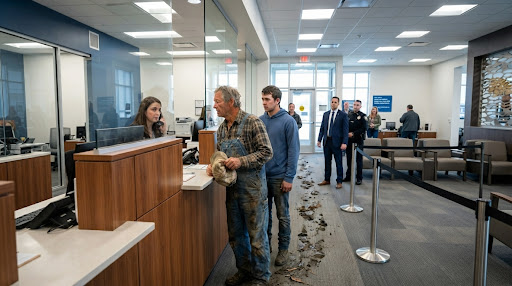
Tom Callahan stood beside my grandfather,
his face red with anger.
The security guard, Rick,
immediately removed his hand from his belt.
The young teller stared at Tom as though she had never seen him before.
“Mr. Callahan,” she stammered,
“I was only following security procedures.”
Tom looked at her.
“Security procedures?”
“Yes, sir. He was requesting a large cash withdrawal, and he became—”
“Careful,” Tom interrupted.
His voice wasn’t loud.
That somehow made it worse.
“Choose your next words very carefully.”
The teller swallowed.
“He became difficult.”
I felt my hands clench.
Grandpa hadn’t raised his voice once.
He hadn’t threatened anyone.
He hadn’t even complained when she held his driver’s license up to the light as though it were counterfeit.
Tom turned toward me.
“Caleb, is that what happened?”
I blinked.
He knew my name.
Of course he did.
Tom Callahan had attended my high school graduation.
He had brought a casserole to Grandpa’s house after Grandma died.
But I’d never seen him look this serious.
“No, sir,” I answered. “Grandpa asked for two thousand dollars. She questioned him about why he needed it, told him to use the ATM, and then called security when I said he was asking for his own money.”
Tom looked at Grandpa.
“Earl?”
Grandpa shrugged.
“That’s about the size of it.”
The teller’s cheeks turned crimson.
“Mr. Callahan, I didn’t know he was someone important.”
The words came out before she could stop them.
And they were the worst possible words she could have chosen.
Tom stared at her.
“Someone important?”
She opened her mouth.
Nothing came out.
Tom stepped closer to the counter.
“Every person who walks through those doors is important, Miss Parker.”
The teller looked down.
“Every farmer. Every mechanic. Every teacher. Every retired factory worker. Every person who trusts us with five dollars or five million.”
He paused.
“And you don’t get to decide who deserves respect based on the condition of their boots.”
Grandpa cleared his throat.
“Tom, I don’t want anybody getting into trouble over me.”
Tom turned immediately.
His expression softened.
“Earl, you’ve got every right to be upset.”
Grandpa smiled faintly.
“I’m not upset. I’m late getting my combine fixed.”
For some reason, that made Tom look even angrier.
Not at Grandpa.
At the situation.
He turned toward Rick.
“Please return to your post.”
The guard nodded.
“Yes, sir.”
Then Tom looked at the teller.
“Step away from the window. I’ll have the branch manager take over while we review what happened.”
Her eyes widened.
“Am I being fired?”
“I haven’t made any employment decision,” Tom replied. “But you will not continue serving customers until we’ve addressed this.”
She stepped backward.
I watched her disappear through a side door.
The woman who had laughed behind us was already gone.
Two other customers stood silently near the entrance.
One elderly man wearing a mechanic’s jacket slowly nodded.
Tom turned toward Grandpa.
“Come into my office.”
Grandpa glanced down at his muddy boots.
“Tom, I’ll mess up your carpet.”
Tom looked at him.
Then laughed sadly.
“Earl, if that carpet can’t survive a little farm mud, I bought the wrong carpet.”
Grandpa finally smiled.
We followed Tom across the lobby.
As we passed the teller windows, several employees looked up.
One older woman behind the counter gasped.
“Mr. Doyle?”
Grandpa raised his cap.
“Morning, Susan.”
She came around the counter so quickly she nearly bumped into a chair.
“Oh, Earl, it’s wonderful to see you.”
She hugged him.
Grandpa chuckled.
“Careful, Susie. I’m covered in half the north field.”
“I don’t care.”
Then she looked toward Tom.
“Is everything all right?”
Tom’s expression tightened.
“We’ll discuss it later.”
Susan glanced at me.
I could tell she understood something had happened.
But she didn’t ask questions.
Instead, she squeezed Grandpa’s hand.
“Tell me when you need anything.”
“Will do.”
We continued into Tom’s office.
The room was enormous.
Dark wooden shelves covered one wall.
A framed photograph of the bank’s original building hung behind the desk.
There were leather chairs, polished furniture, and a large window overlooking Main Street.
Grandpa stopped in front of the photograph.
“Well, I’ll be.”
Tom smiled.
“You remember that place?”
Grandpa laughed.
“Remember it? I helped carry the bricks.”
I looked at him.
“What?”
Grandpa pointed toward the photograph.
The old building looked nothing like the modern bank.
It was a narrow brick structure with two windows and a wooden door.
A sign above the entrance read:
CALLAHAN COMMUNITY BANK — EST. 1963
Grandpa tapped the frame.
“Your great-grandfather and I used to haul supplies down here on Saturday mornings.”
I stared.
“Great-Grandpa helped build the bank?”
Tom chuckled.
“Caleb, your grandfather has been leaving out quite a bit of family history.”
Grandpa waved a hand.
“Old stories.”
Tom shook his head.
“Important stories.”
He gestured toward the chairs.
“Sit down. Both of you.”
Grandpa lowered himself carefully into a leather chair.
I sat beside him.
Tom picked up the telephone.
“Susan, could you arrange a two-thousand-dollar withdrawal for Mr. Doyle after completing the normal verification? And bring us some coffee, please.”
He listened.
“Thank you.”
Then he turned toward Grandpa.
“Earl, why didn’t you call me?”
Grandpa looked puzzled.
“About what?”
“The money.”
“Because I’ve got a checking account, Tom. I figured that’s what the teller window was for.”
Tom stared at him.
Then laughed.
A genuine laugh this time.
“Fair enough.”
Grandpa leaned back.
“Besides, you were probably busy.”
Tom shook his head.
“Never too busy for you.”
I looked between them.
There was something in the way Tom spoke to my grandfather.
Not simply respect.
Something deeper.
Gratitude.
Almost reverence.
Finally, I couldn’t stand it.
“Mr. Callahan?”
Tom looked at me.
“Yes, Caleb?”
“What did you mean when you said Grandpa is the reason this bank exists?”
Grandpa groaned.
“Oh, here we go.”
Tom smiled.
“I was wondering when you’d ask.”
He stood and walked toward a cabinet.
From the bottom drawer, he removed a thick leather-bound book.
Its cover was cracked.
The corners were worn.
He placed it on the desk.
“Caleb, do you know what happened to this town in 1985?”
I shook my head.
Tom opened the book.
“Then I think it’s time you learned.”
Inside were old newspaper clippings, photographs, and handwritten financial records.
I leaned forward.
The first headline read:
LOCAL BANK FACES CLOSURE AS FARM CRISIS DEEPENS
Tom pointed to the article.
“In the mid-eighties, farms were failing across the country. Land values collapsed. Interest rates had been brutal. Families who had worked their property for generations were losing everything.”
Grandpa stared at the photograph.
His expression changed.
I had never seen him look quite like that.
It was the face of someone remembering a terrible winter.
Tom continued.
“This bank was struggling. My father was president then. We had too many troubled agricultural loans and not enough capital to withstand the losses.”
He looked at Grandpa.
“Most people thought we’d close.”
Grandpa said nothing.
Tom turned another page.
There was a photograph of a younger Earl Doyle standing beside a group of farmers.
My grandfather was maybe forty-three.
Broad-shouldered.
Dark-haired.
Wearing the same sort of overalls he wore today.
Under the photograph was a handwritten caption.
Farmers’ meeting — Doyle barn, November 1985.
I looked at Grandpa.
“You organized a meeting?”
He shrugged.
“Somebody had to.”
Tom smiled.
“That’s one way to describe it.”
He looked back at me.
“Your grandfather helped organize a group of local farmers and business owners who believed this bank was worth saving.”
I frowned.
“How?”
Tom opened another page.
“By persuading people not to panic, encouraging qualified investors to provide new capital, and working with my father on a plan to restructure troubled loans.”
He paused.
“And Earl put a substantial amount of his own savings into the bank when almost nobody else would.”
I stared at Grandpa.
“How much?”
Grandpa looked uncomfortable.
“Enough.”
Tom smiled.
“That’s what he always says.”
He pulled out a document.
“Your grandfather became one of the bank’s early community shareholders during the restructuring.”
My eyes widened.
“Grandpa owns part of this bank?”
Grandpa sighed.
“Caleb, don’t start.”
Tom chuckled.
“Yes. He does.”
I looked at my grandfather.
He was sitting there with mud drying on his boots, a faded cap in his lap, and a work shirt with a missing button.
He had driven into town in a truck older than I was.
He had been worried about paying cash for a combine part.
And now I was learning he owned shares in the bank whose teller had treated him like a nuisance.
“How much of the bank?” I asked.
Tom looked toward Grandpa.
Grandpa shook his head.
“That’s private.”
Tom nodded.
“Then we’ll leave it there.”
I respected that.
But the revelation was already enormous.
Tom closed the ledger.
“Your grandfather helped save this institution at a time when its future was uncertain.”
Grandpa looked out the window.
“Tom, your father did most of the hard work.”
“My father always said otherwise.”
Grandpa smiled sadly.
“Your dad was a good man.”
Tom’s eyes softened.
“He was.”
For a moment, the room went quiet.
Then Tom said something I’ll never forget.
“When my father died, he left me a letter. In it, he wrote, ‘Never forget Earl Doyle. When this bank needed friends, he was the first man through the door.’”
Grandpa looked down at his hands.
I saw him swallow.
Tom continued.
“And today, when Earl walked through those doors, one of my employees treated him as though he didn’t belong.”
His voice hardened.
“That is a failure of this bank, Caleb. Not of your grandfather.”
I looked at Grandpa.
He was staring at the floor.
And I realized the humiliation had hurt him more than he wanted anyone to know.
Not because he needed special treatment.
But because he’d spent sixty-one years trusting this place.
Then there was a knock.
Susan entered carrying coffee and a small envelope containing the cash Grandpa had requested.
She set everything on the desk.
“Two thousand dollars, Mr. Doyle. Verified and documented.”
Grandpa smiled.
“Thank you, Susie.”
She smiled back.
“Anything for you.”
After she left, Tom slid the envelope across the desk.
Grandpa counted the money.
Exactly two thousand dollars.
He placed it carefully inside his wallet.
Then stood.
“Well, Tom, I appreciate the history lesson, but I’ve got a combine sitting dead in a field.”
Tom stood too.
“Earl, there’s something else we need to discuss.”
Grandpa frowned.
“What?”
Tom looked at me.
Then back at him.
“The board meeting next month.”
Grandpa sighed.
“Tom—”
“No. You need to hear this.”
Tom opened another folder.
“There’s a proposal on the table that could change the future of this bank.”
I watched my grandfather’s expression shift.
“What kind of proposal?”
Tom hesitated.
“A regional financial group wants to acquire us.”
Grandpa went still.
Tom continued.
“And if they succeed, the agricultural lending division may be closed.”
For the first time that morning, Grandpa looked genuinely alarmed.
“Closed?”
Tom nodded.
“Most of the smaller farm accounts would be transferred or managed remotely. Several local branches could eventually disappear.”
Grandpa slowly sat back down.
I looked between them.
Tom took a breath.
“Earl, I was planning to call you this week.”
Grandpa stared at him.
“Why?”
“Because some of the directors think the bank has outgrown the people who built it.”
He glanced toward the lobby.
“And after what happened today, I’m beginning to understand how they got that idea.”
Then Tom said something that made my grandfather’s face harden.
“The proposed buyer’s representative is already here.”
I looked toward the glass wall.
Standing outside the office was a man in an expensive gray suit.
He was watching us.
And he was smiling.
PART 4
The man outside Tom’s office was named Gregory Harlan.
He was tall, probably in his early fifties, with silver hair and the polished confidence of someone accustomed to being listened to.
Tom introduced him reluctantly.
“Gregory represents Westbridge Financial Group.”
Gregory extended his hand toward Grandpa.
“Mr. Doyle. A pleasure.”
Grandpa shook it.
“Morning.”
Gregory glanced at the mud on Grandpa’s boots.
Then at Tom.
“I hope I’m not interrupting.”
Tom’s expression remained neutral.
“We’re discussing bank business.”
Gregory smiled.
“Excellent. Then perhaps Mr. Doyle would appreciate hearing about the opportunities ahead.”
Grandpa folded his arms.
“What opportunities?”
Gregory looked pleased.
“Modernization. Efficiency. Improved digital services. Better returns for shareholders.”
Grandpa nodded slowly.
“Sounds expensive.”
Gregory laughed.
“Progress often requires investment.”
Grandpa looked at him.
“And who’s paying for it?”
Gregory’s smile weakened.
Tom cleared his throat.
“Gregory, this isn’t the appropriate time.”
But Grandpa raised a hand.
“No, Tom. Let the man talk.”
Gregory straightened his jacket.
“Our proposal would allow Westbridge to acquire the bank at a premium to its current valuation. Shareholders would receive an attractive return.”
Grandpa stared at him.
“And the farmers?”
Gregory blinked.
“Excuse me?”
“The farmers. The families with equipment loans. The folks who need operating credit before planting season.”
Gregory smiled politely.
“Those accounts would be reviewed under our centralized lending standards.”
Grandpa nodded.
“And who makes those decisions?”
“Our regional underwriting team.”
“Where?”
“Chicago.”
Grandpa looked toward me.
Then back at Gregory.
“So a fellow sitting two hundred miles away decides whether a farmer here gets the money to plant corn?”
Gregory’s smile disappeared.
“That’s an oversimplification.”
Grandpa leaned forward.
“Is it wrong?”
Gregory hesitated.
“Not entirely.”
Grandpa nodded.
“And if the farmer has a bad harvest?”
“We evaluate repayment capacity based on established risk criteria.”
Grandpa looked at Tom.
“Your father used to drive out to farms himself.”
Tom nodded.
“He did.”
“He’d walk the fields. Look at the equipment. Talk to the family. Sometimes he’d know a crop was worth saving before the numbers showed it.”
Gregory cleared his throat.
“Mr. Doyle, modern banking requires objective financial analysis.”
Grandpa looked at him.
“I’m not against numbers, son. I’m against pretending numbers tell you everything.”
I nearly smiled.
That sounded exactly like Grandpa.
He had never trusted anyone who thought a spreadsheet could explain an entire human life.
Gregory looked toward Tom.
“With respect, this is precisely why community institutions struggle to compete. Sentiment can interfere with sound business decisions.”
Grandpa didn’t respond immediately.
He picked up his cap.
Turned it slowly in his hands.
Then looked Gregory directly in the eyes.
“Do you know what happened here in 1985?”
Gregory hesitated.
“I’m familiar with the bank’s history.”
“No, son. I asked whether you know what happened.”
Gregory’s expression tightened.
Grandpa continued.
“Families lost farms. Men who’d worked land since they were children watched auctioneers sell their equipment. Good people went broke.”
The room grew quiet.
“Some of those families needed better business plans. Some had borrowed too much. Some were caught in circumstances nobody could control.”
He paused.
“But when this bank nearly failed, the people who saved it weren’t investors from Chicago.”
He pointed toward the window.
“They were the people who lived here.”
Gregory folded his arms.
“That’s admirable history.”
Grandpa’s voice hardened.
“It wasn’t history to us.”
Tom looked down.
Grandpa continued.
“We buried friends who couldn’t bear what happened. We helped neighbors keep their lights on. We watched families pack up and leave.”
I had never heard Grandpa speak about those years in such detail.
His voice was steady.
But his hands trembled.
“And we saved this bank because we believed this town deserved a place where somebody knew its people.”
Gregory shifted uncomfortably.
“Mr. Doyle, I respect your perspective. But our shareholders have a responsibility to consider financial returns.”
Grandpa nodded.
“They do.”
He looked at Tom.
“Can I see the proposal?”
Tom hesitated.
“Earl, there are confidentiality requirements.”
Grandpa nodded.
“Then arrange whatever is necessary for me to review it properly.”
Tom looked relieved.
“Of course.”
Gregory’s smile returned.
“I’m confident you’ll find our offer attractive.”
Grandpa stood.
“Maybe.”
Then he added, “But I won’t decide what a bank is worth until I know what happens to the people who use it.”
We left shortly afterward.
Outside, the morning sun had finally burned through the clouds.
Grandpa climbed into his old Ford.
I slid into the passenger seat.
For a while, neither of us spoke.
Then I turned toward him.
“Grandpa?”
“Yeah?”
“Why didn’t you ever tell me you helped save the bank?”
He started the engine.
“Didn’t seem worth talking about.”
I stared at him.
“You helped save a bank!”
He shrugged.
“Lots of folks helped.”
“But you invested your savings.”
He nodded.
“Some.”
“How much?”
He looked at me.
“Caleb, are you going to ask me that every ten minutes?”
“Probably.”
He laughed.
Then pulled out of the parking lot.
We drove to the farm supply store.
The parts manager had already set aside the belt Grandpa needed.
He counted out the cash.
Accepted the receipt.
And spent fifteen minutes discussing the weather with two other farmers.
Nobody cared that his boots were muddy.
Nobody questioned why he needed money.
Nobody asked whether he belonged.
He was simply Earl.
And watching him stand there, laughing with men who had known him for decades, I realized something.
The teller had looked at Grandpa and seen poverty.
But everyone who truly knew him saw a lifetime of work.
We returned to the farm before noon.
Grandpa insisted on helping replace the combine belt.
I tried to convince him to let me handle the heavy work.
He gave me a look.
“Caleb, I’ve been fixing machinery since before your father was born.”
“Yeah, and that’s why your knees sound like gravel.”
He laughed.
“Just hand me the wrench.”
By late afternoon, the combine was running again.
Grandpa climbed down from the cab, wiped his hands, and looked toward the fields.
“Good.”
Then he turned toward me.
“Tomorrow we start early.”
I stared at him.
“Grandpa, you just found out you might help decide the future of the town’s bank.”
He shrugged.
“Corn doesn’t care.”
That night, I couldn’t stop thinking about what had happened.
I searched through old newspapers online.
Found articles about the farm crisis.
Read about the bank’s restructuring.
And discovered photographs of Grandpa attending community meetings long before I was born.
One article described him as a local farmer who had helped organize a group of investors and depositors during the bank’s recovery.
Another mentioned a scholarship fund he had helped establish for children from struggling farm families.
I stared at the screen.
A scholarship fund?
Grandpa had never mentioned that either.
The next morning, I confronted him over breakfast.
“What’s the Doyle Agricultural Scholarship?”
He nearly choked on his coffee.
“Where’d you hear about that?”
“The internet.”
He groaned.
“Should’ve known.”
I folded my arms.
“Grandpa.”
He sighed.
“Your grandmother and I helped start a little scholarship years ago.”
“How little?”
“Caleb.”
“How many students?”
He scratched his chin.
“Over the years? Maybe sixty or seventy.”
I stared.
“Seventy students?”
He shrugged.
“Something like that.”
“And you never told me?”
He looked genuinely puzzled.
“Why would I?”
I didn’t know what to say.
Grandpa returned to his eggs.
And I began to understand that the bank was only one part of a much larger story.
For decades, Earl Doyle had quietly helped people.
Without announcements.
Without photographs.
Without expecting gratitude.
He had simply done what he believed needed doing.
Three weeks later, Tom called.
The bank’s board had scheduled a special meeting to review the acquisition proposal.
Grandpa had received the appropriate materials as a shareholder.
He spent several evenings reading them at the kitchen table.
I watched him make notes in the margins.
He asked me to help organize information about branch locations, agricultural loans, and the bank’s community programs.
I was studying agricultural economics at college, so I understood some of the figures.
But Grandpa understood the people behind them.
He recognized family names.
Farms.
Businesses.
Generations of customers.
One evening, he pointed toward a list.
“See that account?”
I leaned closer.
“Peterson Family Farms?”
He nodded.
“Third generation. Their grandfather and I used to share a hay baler.”
He pointed to another.
“Martinez Equipment Repair. Started in a shed behind their house. Now they employ twelve people.”
Then another.
“Wilson Dairy. They almost lost everything after the flood. This bank helped them rebuild.”
I looked at the pages.
They weren’t just accounts anymore.
They were families.
Jobs.
Histories.
Lives.
Grandpa leaned back.
“That’s what I want the directors to remember.”
I nodded.
Then I asked, “What if they don’t?”
He stared out the window.
“Then we’ll have to decide what comes next.”
The special meeting took place on a Friday afternoon.
Grandpa wore clean overalls.
I had suggested a suit.
He laughed so hard he nearly spilled his coffee.
“Caleb, I haven’t worn a suit since your grandmother’s funeral.”
“You could at least wear dress pants.”
He looked at me.
“Son, if they won’t listen to me in overalls, they don’t need my opinion.”
I gave up.
We drove into town.
This time, when we entered the bank, Susan greeted us immediately.
“Good afternoon, Mr. Doyle.”
Grandpa smiled.
“Afternoon, Susie.”
The young teller was nowhere to be seen.
Tom met us near the conference room.
He shook Grandpa’s hand.
“Earl.”
“Tom.”
Then he looked at me.
“Caleb, good to see you.”
We entered the room.
Several directors sat around a long polished table.
Gregory Harlan was there.
So were two other representatives from Westbridge Financial.
A presentation screen displayed charts and financial projections.
Grandpa took his seat.
He placed his old cap on the table.
Then opened his folder.
The meeting began.
Gregory presented the acquisition proposal.
He discussed projected efficiencies.
Technology upgrades.
Cost savings.
Shareholder returns.
The numbers sounded impressive.
But as the presentation continued, I noticed what wasn’t being discussed.
There were no detailed commitments to preserve agricultural lending relationships.
No firm guarantee that local branches would remain open.
No clear plan for employees whose positions might be eliminated.
Finally, Tom invited questions.
Grandpa raised his hand.
The room quieted.
Gregory smiled.
“Mr. Doyle.”
Grandpa looked at the screen.
“Your presentation says you expect substantial operating savings over three years.”
Gregory nodded.
“Correct.”
“Where do those savings come from?”
“Operational integration.”
Grandpa waited.
Gregory continued.
“Technology consolidation, staffing efficiencies, and centralized services.”
Grandpa nodded.
“How many local jobs?”
Gregory hesitated.
“Final staffing decisions haven’t been made.”
Grandpa looked around the table.
“Then how can you promise the savings?”
Nobody answered immediately.
He turned another page.
“You also project lower servicing costs for agricultural loans.”
Gregory nodded.
“Yes.”
“How?”
“Centralized portfolio management.”
Grandpa leaned forward.
“So the local loan officers go?”
“Not necessarily.”
“But maybe.”
Gregory’s jaw tightened.
“Potentially.”
Grandpa looked toward the directors.
“That’s what I thought.”
He closed his folder.
Then spoke quietly.
“Gentlemen, I’m not here to tell you this bank shouldn’t change.”
The room was silent.
“I’m eighty-four years old. I’ve seen more changes than I can count. I’ve watched tractors get bigger, farms get smarter, and banking move from handwritten ledgers to computers.”
He smiled faintly.
“Most of those changes were good.”
Then his expression grew serious.
“But change isn’t automatically progress.”
He looked toward Gregory.
“And profit isn’t the only thing a community bank is supposed to produce.”
I saw Tom nod.
Grandpa continued.
“When we helped save this place forty years ago, we didn’t do it because we thought we’d get rich.”
He looked around the room.
“We did it because losing the bank would’ve hurt this town.”
He paused.
“And if you sell it now without protecting the people who depend on it, then you might make the shareholders happy for a year while leaving the community poorer for a generation.”
Gregory shifted in his chair.
Grandpa continued.
“I’m not asking you to reject the proposal without studying it. I’m asking you to consider what you’re selling.”
Then he looked at Tom.
“Because if this bank forgets who it serves, it won’t matter whose name is on the building.”
The room remained silent.
For several seconds, nobody moved.
Then one director began nodding.
Another looked down at the presentation.
Tom slowly stood.
“Thank you, Earl.”
Grandpa nodded.
“That’s all I’ve got.”
But it wasn’t.
Because after the meeting, Tom asked Grandpa to stay.
And what he told us next changed everything.
PART 5
Tom closed the conference-room door.
The other directors had left.
Gregory and his colleagues were gone.
Only Grandpa, Tom, and I remained.
Tom looked exhausted.
He loosened his tie and sat across from us.
“Earl, I need to be honest with you.”
Grandpa nodded.
“Always preferred that.”
Tom took a breath.
“The acquisition proposal has support from several major shareholders.”
Grandpa looked unsurprised.
“Figured as much.”
“The offer is financially attractive. Some directors believe selling is the safest way to protect shareholder value.”
Grandpa nodded.
“Could be.”
Tom looked at him.
“But I don’t believe it’s the only option.”
Grandpa leaned forward.
“What are you thinking?”
Tom opened a folder.
“I’ve been working with our finance team on an alternative plan.”
He slid several pages across the table.
The proposal involved strengthening the bank’s capital position, improving its technology, and maintaining its local agricultural lending operations.
It would require investment.
Careful management.
And support from shareholders.
Grandpa read quietly.
I watched his eyes move across the figures.
He asked questions.
Tom answered.
Sometimes Grandpa nodded.
Other times he circled numbers with his pen.
Finally, he looked up.
“Why didn’t you present this?”
Tom sighed.
“Some directors don’t think we can raise enough support.”
Grandpa looked at the documents again.
“How much?”
Tom told him the estimated amount of additional capital the bank hoped to secure.
It was substantial.
More money than I could imagine.
Grandpa sat silently.
Then asked, “Have you talked to the other community shareholders?”
Tom shook his head.
“Not all of them.”
“Why not?”
“We were waiting for the board to authorize a formal process.”
Grandpa nodded.
“Then get the proper approvals and talk to them.”
Tom looked surprised.
“You think they’d be interested?”
Grandpa smiled faintly.
“Tom, you keep forgetting something.”
“What?”
“This town has more people who care about that bank than you realize.”
He stood.
“Put together a lawful, realistic plan. Show folks the risks. Show them the numbers. Then let them decide.”
Tom looked relieved.
“Would you help?”
Grandpa picked up his cap.
“I’ll listen. And if the plan makes sense, I’ll support it.”
Tom smiled.
“That means a lot.”
Grandpa shrugged.
“Don’t thank me yet. You’ve got work to do.”
Over the next several weeks, the bank explored its options through the appropriate governance and regulatory processes.
The directors reviewed the alternative plan.
Financial advisers evaluated its feasibility.
Shareholders received information through authorized channels.
And the bank began discussing what remaining independent would require.
Grandpa didn’t run the process.
He wasn’t the bank president.
He wasn’t a director.
And he never pretended he could decide the future of the institution by himself.
But he did something he had always done well.
He talked to people.
He listened.
He asked questions.
And he reminded them why the bank mattered.
At the feed store, he spoke with farmers who remembered the old building.
At church, he talked with business owners.
At the diner, he listened to retired employees who had worked at the bank for decades.
He didn’t tell anyone how to vote.
He simply encouraged them to understand the choices.
Meanwhile, Tom addressed the incident with the teller.
The bank conducted a formal review of what had happened.
Employees were reminded of the importance of treating customers fairly, following consistent identification procedures, and avoiding assumptions based on appearance.
The young teller, whose name was Madison Parker, was given an opportunity to respond.
Her conduct was reviewed under the bank’s employment policies.
She was removed from customer-facing duties during the review and later returned after corrective action and training.
Grandpa was surprised when Tom told him.
“You didn’t fire her?”
Tom shook his head.
“Not automatically. We reviewed the circumstances and decided on a corrective response.”
Grandpa nodded.
“Good.”
I stared at him.
“Good?”
He looked at me.
“Caleb, the girl made a mistake.”
“She humiliated you.”
“She did.”
“And you don’t want her fired?”
Grandpa shrugged.
“Son, if everybody who ever said something foolish lost their job, this town would be empty.”
I laughed despite myself.
Then he grew serious.
“That doesn’t mean what she did was acceptable.”
“I know.”
“But people ought to have a chance to learn when they can.”
I looked at him.
There it was again.
That stubborn kindness.
Not weakness.
Not surrender.
Just a refusal to turn one person’s mistake into the whole story of their life.
Several days later, Madison asked whether she could apologize to Grandpa.
Tom contacted him first.
Grandpa agreed.
We met at the bank on a quiet afternoon.
Madison stood near the counter, looking nervous.
She wasn’t wearing the confident expression I’d seen on that first Tuesday.
Her hands trembled slightly.
“Mr. Doyle,” she began, “I owe you an apology.”
Grandpa nodded.
“Go ahead.”
She swallowed.
“I judged you by your clothes. I assumed you didn’t belong here. I questioned you in a way I wouldn’t have questioned another customer.”
She looked down.
“And I called security when you hadn’t done anything threatening.”
Grandpa listened.
Madison’s eyes filled.
“I was wrong.”
For a moment, he said nothing.
Then he asked, “How long have you worked here?”
“Four months.”
“Where’d you grow up?”
“Indianapolis.”
He nodded.
“Big city.”
She smiled weakly.
“Yes, sir.”
“Ever worked on a farm?”
She shook her head.
“No.”
Grandpa looked down at his boots.
“These are work boots, Madison. They look rough because I work in them.”
She nodded.
“I understand.”
He smiled.
“Maybe now you do.”
Her eyes filled again.
Grandpa continued.
“Next time somebody comes through those doors looking like they just climbed out of a ditch, don’t assume they don’t belong.”
“I won’t.”
“And don’t assume they have money either.”
She looked confused.
Grandpa smiled.
“Treat them right either way.”
Madison nodded.
“I will.”
He extended his hand.
She shook it.
Then he said, “Now, I’ve got a question.”
“Yes, sir?”
“Can you tell me the withdrawal limit on that ATM out front?”
She looked startled.
Then laughed nervously.
Grandpa grinned.
“Just checking.”
Even Tom laughed.
And for the first time since the incident, the bank lobby felt normal again.
But the larger decision was still ahead.
The bank’s shareholders would ultimately consider the acquisition proposal and the alternative plan through the required process.
There were no guarantees.
The bank faced real challenges.
Technology costs were rising.
Competition was increasing.
And remaining independent required more than good intentions.
Grandpa understood that.
He had spent his entire life managing risk.
Weather.
Crop prices.
Equipment failures.
Debt.
He knew sentiment couldn’t pay bills.
But he also knew that a business could lose its purpose while remaining profitable.
The final shareholder meeting took place several months later.
I attended with Grandpa.
He wore clean overalls again.
This time, nobody looked surprised.
Tom presented the board’s evaluation of the alternatives.
Financial advisers explained the risks.
Shareholders asked difficult questions.
Some favored selling.
Others supported remaining independent.
The debate was serious.
Respectful.
And sometimes emotional.
Then the vote was held.
I watched Grandpa sit quietly while the results were tabulated.
He didn’t tap his foot.
Didn’t whisper.
Didn’t seem nervous.
But I noticed his hands.
They were clasped tightly in his lap.
Finally, the results were announced.
The acquisition proposal had not received the required support.
The bank would continue pursuing its approved independent strategy, subject to the financial and regulatory steps still necessary.
For a moment, nobody spoke.
Then scattered applause began.
Tom closed his eyes.
Grandpa simply nodded.
I turned toward him.
“Grandpa?”
“Yeah?”
“We did it.”
He looked at me.
“Caleb, don’t get ahead of yourself.”
I laughed.
“The bank isn’t being sold!”
“Not today.”
He looked toward Tom.
“Now they’ve got to prove they can make the other plan work.”
I stared at him.
He was right.
Of course he was.
Grandpa had never believed winning a vote was the same as solving a problem.
The work came afterward.
And that was the lesson he wanted me to understand.
The bank continued operating independently.
Over the following year, it implemented technology improvements, strengthened its capital planning, and maintained its agricultural lending services.
Not everything went smoothly.
Some changes were expensive.
Some customers complained.
Some employees had to learn new systems.
But the bank remained committed to serving the community that had helped build it.
And Grandpa?
He went back to farming.
He still drove his old Ford.
Still wore muddy overalls.
Still argued with the weather forecast.
Still insisted he could fix equipment that had clearly reached the end of its useful life.
And he still refused to let anyone make a fuss over him.
But something had changed for me.
I began seeing him differently.
Not because I learned he owned bank shares.
Not because Tom Callahan treated him with respect.
Not because people had applauded at a shareholder meeting.
I saw him differently because I finally understood the life he’d built.
Grandpa had spent decades quietly helping his community.
He had supported neighbors through difficult years.
Helped students afford college.
Worked the same land through droughts and storms.
And invested in a local institution because he believed the people around him deserved a chance.
He didn’t do those things for recognition.
He did them because he thought they were right.
One Sunday afternoon, I found him sitting on the porch.
The harvest was finished.
The fields were brown and quiet.
He held a cup of coffee in one hand.
His old cap rested beside him.
I sat down.
“Grandpa?”
“Yeah, Caleb?”
“Can I ask you something?”
He smiled.
“You usually do.”
I laughed.
“Why do you still work so hard?”
He looked toward the fields.
“What do you mean?”
“You’re eighty-four. You could retire.”
He chuckled.
“Retire from what?”
“Farming.”
He stared at me.
Then laughed.
“Son, farming isn’t just something I do.”
I waited.
“It’s part of who I am.”
He looked toward the barn.
“My father worked this land. His father before him. Your dad learned to drive a tractor right out there.”
He pointed toward the north field.
“And now you’re learning.”
I nodded.
Grandpa continued.
“Money’s useful. Don’t get me wrong. It pays for things. Keeps the lights on. Helps you through bad years.”
He paused.
“But money isn’t the reason I get out of bed.”
“What is?”
He looked toward the horizon.
“Knowing there’s something worth doing.”
I thought about that.
Then asked, “Do you regret what happened at the bank?”
He looked puzzled.
“The teller?”
“Yeah.”
He shrugged.
“Not much.”
I stared.
“Grandpa, she called security on you.”
“I remember.”
“She embarrassed you in front of everyone.”
He nodded.
“Yep.”
“And you don’t regret it?”
He smiled.
“Caleb, I didn’t do anything wrong.”
I was quiet.
He continued.
“Why should I carry somebody else’s mistake around like it’s mine?”
I looked at him.
That was probably the wisest thing anyone had ever said to me.
He took another sip of coffee.
“Besides, maybe that young lady learned something.”
I nodded.
“Maybe.”
“And maybe Tom remembered something too.”
I smiled.
“What?”
“That banks are supposed to serve people.”
We sat in silence.
Then Grandpa looked at me.
“Now let me ask you something.”
“Okay.”
“What did you learn?”
I thought about the bank.
The teller.
The security guard.
Tom Callahan.
The old ledger.
The shareholder meeting.
And my grandfather sitting in muddy overalls while people in expensive suits discussed millions of dollars.
Finally, I answered.
“That you shouldn’t judge people by how they look.”
Grandpa nodded.
“Good start.”
I smiled.
“And that money doesn’t make someone important.”
He nodded again.
“Keep going.”
I thought harder.
“That people can do important things without telling everyone.”
Grandpa smiled.
“Now you’re getting somewhere.”
I looked toward the fields.
“And that being respected shouldn’t depend on whether you own part of a bank.”
Grandpa turned toward me.
For a moment, he said nothing.
Then he smiled.
“That’s the one.”
I laughed.
He reached over and squeezed my shoulder.
“Caleb, listen to me.”
I turned toward him.
“Someday you’ll meet people who have more money than you can imagine.”
I nodded.
“And you’ll meet people who don’t know where their next meal is coming from.”
He paused.
“Don’t let either fact tell you what kind of person they are.”
I swallowed.
“Okay.”
“Look at how they treat others. Look at whether they keep their word. Look at what they do when nobody’s watching.”
He smiled.
“That’s where you’ll find out who they really are.”
I nodded.
We sat together until the sun began dropping behind the grain bins.
A few weeks later, Tom invited Grandpa to a community appreciation event at the bank.
Grandpa refused at first.
Said he didn’t need a ceremony.
Said he had chores.
Said somebody else deserved recognition.
Tom finally convinced him by promising there would be pie.
That worked.
The event was held in the bank’s community room.
Farmers.
Teachers.
Retired employees.
Small-business owners.
Families who had banked there for generations.
They gathered to celebrate the institution’s history and the people who had helped sustain it.
Tom spoke briefly.
He thanked the employees.
The customers.
The shareholders.
And the community.
Then he invited Grandpa forward.
My grandfather looked horrified.
He turned toward me.
“You knew about this?”
I grinned.
“Maybe.”
He shook his head.
“Traitor.”
But he stood.
Walked slowly toward the front.
And accepted a small framed photograph.
It showed the original bank building in 1963.
Beneath it was a plaque.
IN GRATITUDE TO EARL DOYLE
For a lifetime of service, integrity, and commitment to our community.
Grandpa stared at it.
Then looked toward Tom.
“You didn’t have to do this.”
Tom smiled.
“I know.”
Grandpa cleared his throat.
He turned toward the room.
For a moment, he looked uncomfortable.
Then he spoke.
“I don’t know much about giving speeches.”
Several people laughed.
He smiled.
“But I do know this town.”
The room quieted.
“I’ve lived here my whole life. I’ve seen good years and bad ones. I’ve seen families celebrate and families struggle.”
He paused.
“And through all of it, the thing that mattered most wasn’t how much money anybody had.”
He looked around.
“It was whether people showed up for each other.”
I felt my throat tighten.
Grandpa continued.
“That’s what made this place worth saving back then.”
He looked toward Tom.
“And that’s what will keep it worth saving now.”
The room erupted in applause.
Grandpa looked embarrassed.
He nodded once.
Then stepped away from the microphone.
When he returned to his seat, I leaned toward him.
“Nice speech.”
He grumbled.
“Don’t encourage me.”
I laughed.
Afterward, people lined up to shake his hand.
Some thanked him for helping their families years earlier.
Others told stories I’d never heard.
One woman said Grandpa had helped her father repair a tractor during a terrible harvest.
A retired teacher said the scholarship fund had helped her daughter finish college.
A local mechanic remembered Grandpa bringing groceries to his family when his father was injured.
I watched my grandfather listen to each story.
He seemed almost surprised that people remembered.
And that’s when I realized something.
He had spent his life planting things he never expected to harvest.
Not just corn.
Not just soybeans.
But kindness.
Trust.
Opportunity.
And loyalty.
Now, at eighty-four, those seeds were growing all around him.
As we left the bank, Madison stood near the entrance.
She smiled.
“Good evening, Mr. Doyle.”
Grandpa tipped his cap.
“Evening, Madison.”
She looked at his boots.
They were muddy again.
Then she grinned.
“Long day in the fields?”
Grandpa laughed.
“Always.”
She held the door open.
“Drive safely.”
“Will do.”
We walked outside.
The evening air was cool.
Grandpa climbed into his old Ford.
I got into the passenger seat.
For a moment, neither of us spoke.
Then I looked at him.
“Grandpa?”
“Yeah?”
“Do you think you’ll ever buy a new truck?”
He looked at the dashboard.
The cracked vinyl.
The worn steering wheel.
The radio that only worked when you hit it.
Then he smiled.
“Why?”
I laughed.
“Because this thing is older than half the people at the bank.”
He started the engine.
It coughed twice.
Then roared to life.
“Still runs.”
I shook my head.
“Barely.”
Grandpa grinned.
“That’s all it needs to do.”
We drove home beneath a sky turning orange and purple.
The fields stretched out on either side of the road.
The grain bins appeared in the distance.
And the old farmhouse lights glowed warmly against the evening.
As we pulled into the driveway, Grandpa said something I still think about.
“Caleb, don’t ever confuse being wealthy with being worth something.”
I looked at him.
He continued.
“And don’t ever confuse being poor with having nothing to offer.”
I nodded.
“Okay, Grandpa.”
He smiled.
“Good.”
Then he climbed out of the truck, picked up his cap, and headed toward the barn.
Because even after everything that had happened, there were still chores to finish.
And Earl Doyle had never been the kind of man to leave work undone.
Years from now, people in town may remember the day a bank teller called security on an elderly farmer.
They may remember the president running out of his office.
They may remember learning that the man in muddy overalls had helped save the bank decades earlier.
But that’s not the part I’ll remember most.
I’ll remember Grandpa standing at that teller window, holding his cap in both hands.
Calm.
Polite.
Unashamed.
He didn’t announce his investments.
Didn’t threaten to close his accounts.
Didn’t demand special treatment.
He simply asked for his own money.
And when someone treated him badly, he didn’t allow their judgment to change how he saw himself.
Because real dignity doesn’t come from the clothes you wear, the vehicle you drive, or the balance in your bank account.
It comes from the life you’ve lived, the promises you’ve kept, and the way you’ve treated people who could do nothing for you in return.
My grandfather walked into that bank wearing muddy overalls.
The teller saw a poor old farmer.
The president saw a man who had helped save his family’s business.
But I saw something even greater.
I saw the kind of man I hoped to become.
And if Grandpa taught me anything that day, it was this:
Never judge the worth of a person by the mud on their boots.
Sometimes those boots belong to the person who helped build the very ground you’re standing on.
THE END THANK YOU FOR READING !!!



