PART 3
The photograph was old.
Its corners were curled,
and a pale crease ran diagonally across the center.
The colors had faded into that soft yellowish tint
old photographs acquire after decades inside drawers.
But the faces were clear.
A young man stood beside a red pickup truck,
one arm resting on the shoulder of a little boy.
The man looked like Mr. Vance.
Not the elderly neighbor I remembered sitting on his porch,
but a younger version with dark hair, broad shoulders, and the same gentle eyes.
The boy couldn’t have been older than ten.
He wore a baseball cap and held a small wooden airplane.
I looked at Noah.
“Do you recognize him?”
My son shook his head.
“No.”
Then he pointed toward the boy.
“But Mom, look at the back.”
I turned the photograph over.
Three words had been written in faded blue ink.
Daniel. Summer, 1984.
Below that was another sentence.
The last summer before everything changed.
I looked toward the attorney.
His name was Thomas Whitaker, a silver-haired man who had introduced himself only minutes earlier.
He stood near the door, holding his briefcase.
“Mr. Whitaker, what is this?”
He spoke gently.
“Mr. Vance wanted you to read the entire letter before I explained anything.”
Noah looked at me.
“Should I keep going?”
I squeezed his hand.
“Yes, sweetheart.”
He unfolded the second page.
His voice trembled as he began reading aloud.
“Dear Noah, I owe you more than a thank-you. For four years, you came to my house without being asked. You cut my grass, cleared my walkway, carried groceries, and sometimes sat with me for hours when there was nothing left to do.”
Noah swallowed.
“You never treated me like a burden. You never made me feel old or useless. You simply showed up.”
My son stopped reading.
His eyes filled.
I put my arm around him.
“Take your time.”
He nodded and continued.
“There’s something I should have told you while I was alive. Forty years ago, I had a son named Daniel. He was the best thing that ever happened to me.”
I looked at the photograph again.
The little boy.
The wooden airplane.
The father’s hand resting on his shoulder.
Noah continued.
“Daniel loved airplanes. He built them from cardboard, folded them from newspaper, and dreamed of becoming a pilot. Every Saturday morning, he followed me around the yard, asking questions and offering to help.”
My son smiled faintly through his tears.
“Sounds familiar,” he whispered.
I nodded.
Then he read the next paragraph.
“When Daniel was eleven, I made a decision I have regretted every day since.”
The room seemed to grow quieter.
“I was working long hours at the factory. My wife, Eleanor, had asked me to spend more time with our son, but I always said there would be another weekend.”
Noah’s voice slowed.
“One Saturday, Daniel asked me to take him to the county air show. I promised I would. Then my supervisor called and offered me an overtime shift.”
He paused.
“I took the shift.”
I felt something tighten in my chest.
Noah continued.
“Daniel was disappointed, but he told me he understood. Eleanor decided to take him herself. On the way home, another driver crossed the center line.”
My hand flew to my mouth.
“The accident killed them both.”
Noah stopped.
For several seconds, neither of us spoke.
I looked at the photograph again.
The smiling boy.
The father who had no idea what was coming.
The summer before everything changed.
Noah whispered, “Mom.”
I pulled him closer.
The letter continued.
“After the funeral, I couldn’t bear the silence in our house. I stopped attending church. I stopped visiting friends. I worked until I was exhausted because being busy was easier than remembering.”
I pictured Mr. Vance sitting alone on his porch.
The faded cardigan.
The empty chair beside him.
The way he watched the street.
“I spent decades believing that if I had simply kept my promise that Saturday, my wife and son would still be alive.”
I wiped my eyes.
“Eventually, I understood that grief doesn’t obey logic. But understanding something and forgiving yourself are not always the same.”
Noah lowered the letter.
“That’s why he always asked about my Saturdays.”
I looked at him.
“What do you mean?”
“He used to ask whether I was missing things because I helped him.”
My son stared at the table.
“He’d say, ‘Noah, don’t let an old man steal your weekends.’”
I smiled sadly.
“What did you tell him?”
“That I wanted to be there.”
He swallowed.
“And he’d always look away.”
I thought about all those mornings when Noah crossed the street carrying our lawn mower.
I had believed he was helping a lonely neighbor.
I hadn’t understood that his presence was reaching a wound forty years old.
Noah returned to the letter.
“When you first appeared at my gate, I thought you were simply a polite boy doing a good deed. But when you came back the following Saturday, and the Saturday after that, I began looking forward to something again.”
His voice cracked.
“You reminded me of Daniel, Noah. Not because you looked like him, but because you noticed things. You asked questions. You remembered what people told you.”
A tear dropped onto the page.
“You remembered that my wife loved yellow roses. You remembered that Daniel wanted to fly airplanes. You remembered the anniversary of their deaths even though I mentioned it only once.”
I turned toward my son.
“You knew?”
He nodded.
“Mr. Vance told me one afternoon.”
“Why didn’t you say anything?”
Noah shrugged.
“He didn’t ask me to tell anyone.”
I studied him.
He was eighteen now.
Tall, thoughtful, and sometimes so quiet that people mistook him for shy.
But he had carried an elderly man’s grief with more care than many adults ever learn.
The next paragraph made me cry harder.
“On the first anniversary of Eleanor and Daniel’s deaths after we became friends, you left two yellow roses on my porch.”
Noah looked down.
“I didn’t know what else to do.”
I remembered that morning.
He had asked me for twelve dollars.
I thought he wanted lunch money.
Instead, he had walked to the grocery store and bought flowers.
He never told me where they went.
The letter continued.
“I watched you place those roses beside my door. You didn’t knock. You didn’t expect thanks. You simply left them there and walked home.”
Noah covered his eyes.
“That was the first time in thirty-six years,” he read, “that I felt someone remembered my family with me.”
The words broke something inside me.
I had spent years worrying about whether Noah had enough.
Enough money.
Enough opportunities.
Enough stability.
Enough of the things his father had never provided.
But somehow, without my realizing it, my son had given another human being something no amount of money could purchase.
The feeling that his loved ones had not been forgotten.
Noah took a shaky breath.
Then he read the final paragraph on the page.
“Your mother deserves to know something too. I watched her raise you from across the street. I saw her leave for work before sunrise and return after dark. I saw her carry groceries through the rain and shovel snow when she was clearly exhausted.”
I stared at the paper.
“I saw her teach you kindness even when life gave her very little kindness in return.”
My vision blurred.
“I wish someone had told her more often that she was doing a good job.”
I pressed my hand over my mouth.
For years, I had wondered whether I was enough.
Whether Noah needed a father.
Whether I had failed him by not being able to provide the things other children received.
And now a man who had barely spoken to me beyond our driveway was telling me he had noticed.
Noah wrapped his arms around me.
“You are a good mom,” he whispered.
I held him tightly.
Then he turned the page.
There were only four lines left.
“Now I need to explain what I have left you. Please don’t think of it as payment for mowing my lawn. You gave me something I thought I would never have again.”
Noah read the next sentence.
“A reason to wake up on Saturday mornings.”
He stopped.
Then whispered the final words.
“Mr. Whitaker will explain the rest.”
We sat in silence.
Finally, Noah looked toward the attorney.
“What did he leave me?”
Mr. Whitaker approached the table.
He opened his briefcase.
Then placed a second folder beside the letter.
“Mr. Vance made arrangements for you several months before his death.”
Noah shook his head.
“I don’t understand.”
The attorney opened the folder.
“His estate includes his home, savings, and investments.”
I felt my stomach tighten.
Mr. Whitaker continued.
“He made specific provisions for his relatives. He also established a separate trust intended to support a young person he believed deserved an opportunity.”
Noah stared at him.
“Who?”
The attorney looked directly at my son.
“You.”
Noah went completely still.
Then Mr. Whitaker told us the amount.
And I thought my son might faint.
PART 4
“One million, two hundred and forty thousand dollars.”
Mr. Whitaker said the amount calmly.
As though he were discussing the weather.
As though he hadn’t just changed the entire direction of my son’s life.
I stared at him.
“I’m sorry?”
He folded his hands.
“Mr. Vance established a trust for Noah. Its assets were valued at approximately $1.24 million at the most recent accounting.”
Noah looked from the attorney to me.
Then back again.
“There must be a mistake.”
“There isn’t.”
“But I only mowed his lawn.”
Mr. Whitaker smiled sadly.
“Yes. You mentioned that.”
Noah pushed the folder away.
“I can’t take his family’s money.”
The attorney didn’t appear surprised.
“Mr. Vance anticipated you might say that.”
He opened another envelope.
“This is a separate note he asked me to read if you objected.”
Noah looked bewildered.
“He wrote another letter?”
“A short one.”
Mr. Whitaker unfolded the page.
“Dear Noah, if you’re telling Mr. Whitaker you cannot accept this because all you did was mow my lawn, then you’re proving I chose the right person.”
Despite everything, I almost laughed.
The attorney continued.
“Please understand that I did not leave you this because I believed your kindness could be purchased. I left it because I wanted the good you brought into my life to continue long after I was gone.”
Noah stared at the table.
“Use it to learn. Build something worthwhile. Help people when you can. And don’t ever feel guilty for accepting an opportunity freely given.”
Mr. Whitaker lowered the paper.
My son whispered, “He really wrote that?”
“Yes.”
I looked at the attorney.
“What exactly does the trust provide?”
He opened the folder.
“Mr. Vance arranged for the trust to be administered independently. The funds are intended to support Noah’s education, housing, and long-term financial stability, with distributions governed by the trust documents.”
I nodded slowly.
That made sense.
Mr. Vance hadn’t simply handed an eighteen-year-old a fortune and hoped for the best.
He had planned.
Carefully.
Thoughtfully.
The way he apparently approached everything important.
Mr. Whitaker continued.
“Noah will receive a copy of the relevant documents, and I strongly recommend independent legal and financial advice before making any decisions.”
I looked at my son.
His face was pale.
“Mom,” he whispered, “I don’t know what to do.”
I took his hand.
“You don’t have to decide anything today.”
The attorney nodded.
“Exactly.”
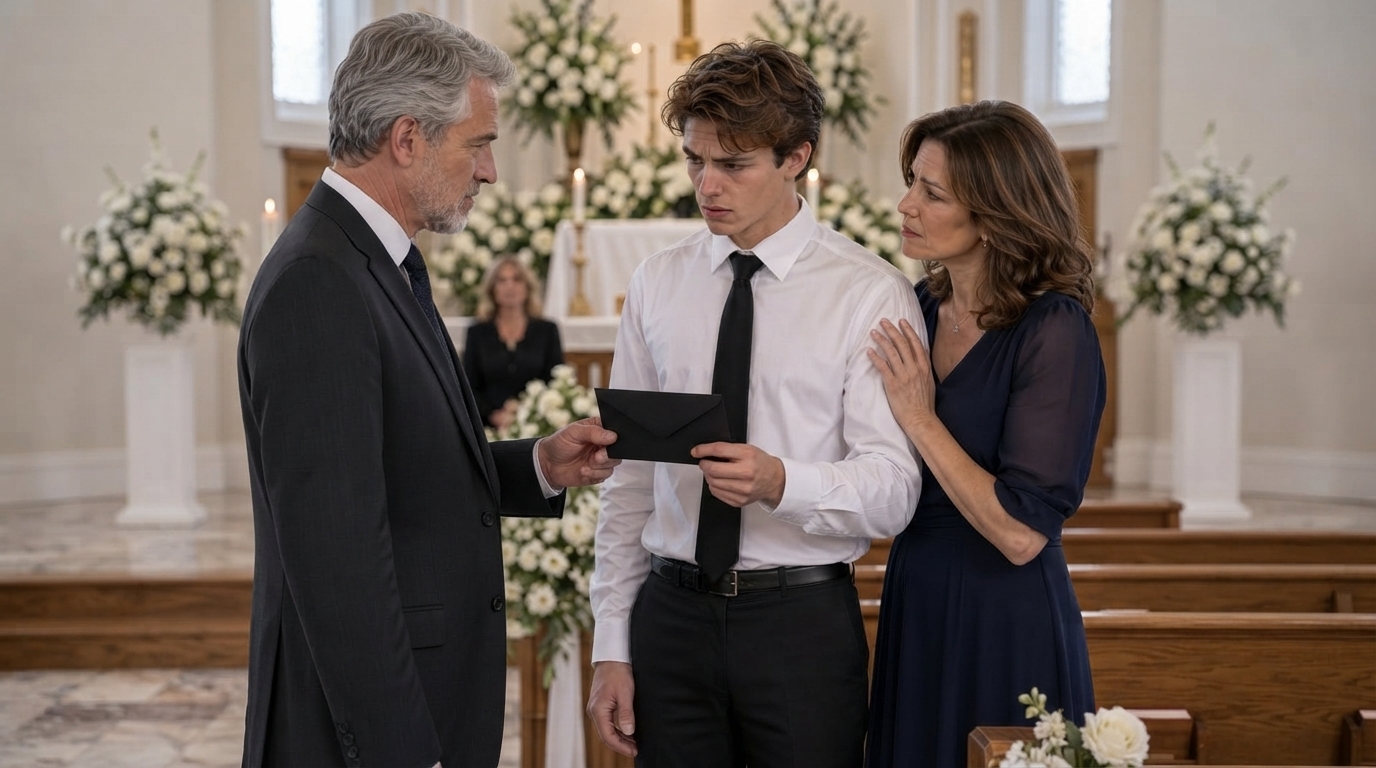
Then the door opened.
A woman stood in the hallway.
She looked to be in her late fifties, with carefully styled hair and an expression that immediately reminded me of someone who had arrived expecting answers.
“Thomas?”
Mr. Whitaker turned.
“Mrs. Vance.”
The woman looked at Noah.
Then at the folder.
Her expression changed.
“What’s going on?”
The attorney stood.
“Carolyn, we’re having a private conversation.”
She stepped inside.
“My father’s funeral just ended. I think I have a right to know what’s happening.”
I realized she was Mr. Vance’s daughter.
The little girl from the funeral photographs.
Now a grown woman.
Noah stood immediately.
“Ma’am, I’m sorry. I didn’t mean—”
She looked at him.
“Are you the boy from across the street?”
“Yes.”
“The one who cut Dad’s grass?”
He nodded.
Carolyn’s eyes moved toward the papers.
Then back to the attorney.
“Thomas, what did my father leave him?”
Mr. Whitaker remained composed.
“Carolyn, I won’t discuss Noah’s private arrangements without his permission. Your father’s estate plan will be explained to the beneficiaries through the proper process.”
She laughed sharply.
“Private arrangements?”
Noah stepped backward.
I stood beside him.
“Perhaps this isn’t the time,” I said.
Carolyn turned toward me.
“And who are you?”
“His mother.”
She looked us both over.
Then her expression hardened.
“I knew something like this would happen.”
Mr. Whitaker spoke firmly.
“Carolyn.”
She ignored him.
“My father spent years giving money away to strangers.”
Noah flinched.
“He wasn’t a stranger to me,” he whispered.
Carolyn looked at him.
“You knew him for four years.”
My son swallowed.
“Yes.”
“I knew him my entire life.”
The words were sharp.
But underneath them, I heard something else.
Pain.
I knew enough about grief to recognize it.
Carolyn looked toward the attorney.
“Did he leave us anything?”
“Yes,” Mr. Whitaker answered. “Your father’s estate plan includes provisions for his family.”
She folded her arms.
“Then why are you meeting privately with a teenager?”
The attorney’s voice remained steady.
“Because your father instructed me to deliver a personal letter and explain a separate trust.”
Carolyn stared.
“A trust?”
Noah looked at me.
His eyes were wet.
“Mom, I don’t want trouble.”
I touched his shoulder.
“You haven’t caused any.”
Carolyn shook her head.
“This is unbelievable.”
Then she walked out.
The door closed behind her.
For several seconds, nobody spoke.
Finally, Mr. Whitaker sighed.
“I apologize.”
Noah stared at the floor.
“She’s right.”
I turned toward him.
“What?”
“I’m not family.”
I looked at my son.
“Noah, you don’t have to decide whether to accept anything today. But you don’t have to apologize for being loved by someone either.”
He wiped his eyes.
Mr. Whitaker nodded.
“Your mother is right.”
He closed the folder.
“Mr. Vance knew his estate plan might surprise people. He considered his decisions carefully, consulted professionals, and made his wishes clear.”
I looked at him.
“Was he mentally capable when he made these arrangements?”
“Yes. His capacity was considered and documented as part of the planning process.”
That mattered.
Not because I doubted Mr. Vance.
But because I understood what a large inheritance could do to a family.
Money had a way of revealing feelings people had kept hidden for years.
And I suspected we were about to see more of that.
The following week was difficult.
Word spread quickly.
People who had barely noticed Noah mowing the lawn suddenly wanted to talk about him.
Some congratulated him.
Others whispered.
A neighbor asked whether he had known Mr. Vance was wealthy.
Another suggested that nobody helped someone for four years without expecting something.
Noah heard enough of it to stop going outside for several days.
One evening, I found him sitting at the kitchen table.
The trust documents lay unopened beside his schoolbooks.
He looked exhausted.
“Mom?”
“Yes?”
“Do you think people believe I was pretending to care about him?”
I sat across from him.
“No.”
He looked doubtful.
“Some people probably do.”
I took a breath.
“Then let them.”
He frowned.
“That’s easy for you to say.”
“No, sweetheart. It isn’t.”
I thought about all the years people had judged me for raising a child alone.
Some assumed I had made terrible choices.
Others believed Noah needed a father to become a decent young man.
People had opinions about everything.
But none of them had been there during the hard nights.
None had paid our bills.
None had watched Noah grow into the person he was.
“People will always invent explanations for kindness they don’t understand,” I said.
He looked down.
“I just miss him.”
That sentence silenced me.
Of course.
While everyone else talked about money, my son was grieving.
He had lost a friend.
A man who had listened to him.
Encouraged him.
Asked about his exams.
And waited for him every Saturday.
I moved beside him.
“Then let’s talk about him.”
Noah smiled faintly.
“He used to tell terrible jokes.”
I laughed.
“I remember hearing you two laughing across the street.”
“He thought he was hilarious.”
“Was he?”
“No.”
We laughed.
Then Noah began telling me stories I’d never heard.
Mr. Vance had taught him how to repair a loose porch step.
How to sharpen garden tools safely.
How to recognize different birds by their calls.
He had also taught Noah how to change the oil in our car.
I stared at him.
“That was Mr. Vance?”
Noah nodded.
“I told you I watched a video.”
I shook my head.
He grinned.
“He said you might not want an old man interfering.”
I laughed through my tears.
Then Noah grew serious.
“He used to ask me what I wanted to do after high school.”
“What did you tell him?”
“That I wanted to study engineering.”
I nodded.
Noah had always loved building things.
But college frightened him.
Not academically.
Financially.
He had been accepted to several schools but was still waiting for financial aid decisions.
“And what did he say?” I asked.
Noah smiled.
“He said, ‘Don’t choose your future based only on what scares you today.’”
I closed my eyes.
What a gift that was.
Not the trust.
Not the money.
The confidence.
Mr. Vance had seen potential in my son and treated it as something worth protecting.
Two weeks later, Carolyn requested a meeting through the attorney.
I was hesitant.
Noah was even more hesitant.
But Mr. Whitaker explained that she wanted to speak privately, without the rest of the family.
We agreed to meet in his office.
Carolyn arrived carrying a small wooden box.
She looked different.
Tired.
Less angry.
She sat across from Noah.
For a moment, nobody spoke.
Then she said, “I owe you an apology.”
Noah blinked.
“Ma’am?”
“At the funeral, I was cruel.”
He shook his head.
“You were upset.”
“That doesn’t excuse it.”
She looked toward me.
“I was angry because my father left something significant to someone I barely knew.”
I nodded.
“I understand.”
Carolyn took a breath.
“After the funeral, I went through some of Dad’s belongings.”
She placed the wooden box on the table.
“Inside his desk, I found a notebook.”
Noah leaned forward.
“What kind of notebook?”
“A journal.”
She opened the box.
Inside were several small notebooks with worn covers.
Carolyn picked up the first.
“My father kept notes about his days.”
She opened it.
Then began reading.
“Saturday. Noah came at nine. Cut the grass. We talked about his chemistry exam. He thinks he failed. I told him one test doesn’t define a person.”
Noah’s eyes filled.
Carolyn turned a page.
“Saturday. Rain all morning. Noah came anyway. We sat on the porch and watched the storm.”
She swallowed.
“Saturday. Noah brought two yellow roses. I don’t know how he remembered.”
My son covered his mouth.
Carolyn’s voice broke.
“I didn’t know.”
She looked at him.
“I knew you helped Dad with the yard. I didn’t know you were his friend.”
Noah wiped his eyes.
Carolyn continued.
“I live three states away. I called when I could. I visited on holidays. But after Mom died, Dad stopped talking about his feelings.”
She stared at the notebook.
“I thought he preferred being alone.”
I felt tears rising.
She looked at Noah.
“Then I read what he wrote about you.”
She turned to the final page.
Her hands trembled.
“Saturday. Noah asked whether I was lonely. I told him sometimes. He said everyone gets lonely, but that doesn’t mean they have to stay that way.”
Carolyn stopped.
Then whispered, “My father wrote that he hadn’t felt truly alone since you started coming over.”
Noah began crying.
Carolyn reached across the table.
“Thank you.”
He shook his head.
“I didn’t do anything special.”
She smiled through her tears.
“Yes, Noah. You did.”
Then she opened the wooden box again.
“There is something else.”
She removed a small object wrapped in cloth.
A wooden airplane.
Old.
Hand-carved.
One wing slightly crooked.
I recognized it immediately.
The airplane from the photograph.
Carolyn placed it in front of Noah.
“This belonged to Daniel.”
My son stared at it.
“Are you sure?”
She nodded.
“Dad kept it beside his bed for forty years.”
Noah touched the wooden wing.
Carolyn continued.
“In his journal, he wrote that he wanted you to have it.”
My son began shaking.
“Why?”
Carolyn smiled sadly.
“Because you reminded him that the love he had for Daniel didn’t have to disappear when Daniel died.”
Noah covered his face.
And for the first time since the funeral, I saw him understand what those Saturdays had truly meant.
He hadn’t replaced Mr. Vance’s son.
He had helped a grieving father remember that his heart still had room for someone else.
But the greatest surprise was still waiting.
Because Carolyn had found one final entry in her father’s journal.
An entry written only six days before he died.
And it contained a request that would change what Noah decided to do with his inheritance.
PART 5
Carolyn opened the final notebook.
The last entry was written in shaky handwriting.
Some letters leaned sharply.
Others were barely legible.
Mr. Vance had clearly been struggling.
But the message was unmistakable.
Carolyn took a breath and read.
“I’m getting tired now. I can feel it. The doctors have been kind, but I know my body is slowing down.”
Noah stared at the wooden airplane.
Carolyn continued.
“I’ve spent years thinking about the things I failed to do for Daniel. The birthdays I missed. The promises I broke. The Saturdays I traded for overtime.”
Her voice trembled.
“Then Noah came along and reminded me that kindness doesn’t have to be complicated.”
She paused.
“He never asked me for anything. He simply noticed I needed help and decided to give it.”
I wiped my eyes.
Carolyn read the final paragraph.
“If Noah accepts what I’ve left him, I hope he uses it to build the future he deserves. But I also hope he remembers the people who are still sitting on porches, waiting for someone to notice them.”
The room was silent.
Then Carolyn read the last sentence.
“Tell him that if he ever wonders whether four years of Saturdays made a difference, he should know they gave an old man four more years of belonging.”
Noah lowered his head.
His shoulders shook.
I moved beside him and held him.
For a long time, nobody spoke.
Then my son whispered, “I wish I’d told him how much he meant to me.”
Carolyn reached across the table.
“He knew.”
Noah shook his head.
“I don’t think I ever said it.”
She smiled through her tears.
“You didn’t have to. He wrote about it every week.”
Mr. Whitaker quietly closed the folder.
And I realized that the most important inheritance in that room wasn’t worth $1.24 million.
It was the proof that my son’s kindness had mattered.
Not in some vague, sentimental way.
But in the daily life of a man who had spent decades carrying grief.
The following months brought changes I could never have imagined.
Noah graduated from high school.
He received his diploma on a warm June evening while I sat in the auditorium crying harder than any reasonable mother should.
He walked across the stage wearing his blue graduation gown.
When his name was announced, I stood and cheered.
He looked toward me.
Then smiled.
After the ceremony, he found me near the entrance.
“Mom, you’re embarrassing me.”
I hugged him.
“It’s my job.”
He laughed.
Then he reached into his pocket.
“I brought something.”
He opened his hand.
The wooden airplane.
I stared at it.
“You carried that during graduation?”
He nodded.
“Mr. Vance would’ve wanted to see it.”
I swallowed.
“Yes,” I whispered. “He would have.”
That summer, Noah began preparing for college.
With the trust providing financial support under its terms, he could consider schools without allowing cost to be the only factor.
He chose an engineering program at a university several hours away.
I was proud.
Terrified.
Excited.
And deeply aware that my little boy was becoming a man.
One evening, while we were packing his belongings, I found him sitting on the floor beside an open box.
Inside were notebooks, photographs, and the old wooden airplane.
He looked thoughtful.
“Mom?”
“Yes?”
“I’ve been thinking about the trust.”
I sat beside him.
“What about it?”
“I don’t want to waste it.”
“You won’t.”
He looked down.
“That’s a lot of money.”
“It is.”
“Mr. Vance worked his whole life for it.”
I nodded.
“He did.”
Noah turned the airplane over in his hands.
“I don’t want people to think I got rich because I helped someone.”
I considered his words.
“Then don’t make the money the center of your story.”
He looked at me.
“What should I do?”
“Keep being the person who helped him.”
He was quiet.
Then he smiled.
“I think I know what I want to do.”
He explained that he wanted to establish a small community program connecting teenagers with elderly residents who needed help with simple outdoor chores.
Lawn mowing.
Leaf raking.
Snow shoveling.
Carrying groceries.
Minor yard maintenance.
Nothing dangerous.
Nothing requiring professional licenses.
Just practical assistance for people who struggled to manage everything alone.
But he wanted one condition.
The teenagers wouldn’t be required to work for free.
I raised an eyebrow.
“Really?”
He nodded.
“Mr. Vance always tried to pay me. I refused because I wanted him to know I wasn’t doing it for money.”
He paused.
“But some kids need money. That doesn’t make their kindness less real.”
I smiled.
That was my son.
Always thinking one step beyond himself.
“So what’s your idea?”
He leaned forward.
“We could find sponsors to cover small stipends for the teenagers, while the seniors receive help without paying.”
I considered it.
“That could work.”
“And maybe the students could spend time talking with the people they help.”
I laughed softly.
“Like you did with Mr. Vance?”
He nodded.
“Yeah.”
Then his expression changed.
“Mom, I think a lot of older people are lonely.”
I looked toward the window.
Across the street, Mr. Vance’s porch stood empty.
The chair was gone.
The grass had grown slightly taller.
And the house looked strangely quiet.
“I think you’re right,” I said.
Noah looked at me.
“Would you help me?”
I smiled.
“Of course.”
We contacted Mr. Whitaker and an independent financial adviser.
They explained the trust’s restrictions and helped Noah understand which funds were available for his personal needs and which decisions required trustee approval.
We also consulted a local nonprofit organization that already worked with older adults.
Rather than create something complicated overnight, Noah began with a small volunteer project.
Six teenagers.
Four elderly residents.
Two Saturdays a month.
The program started quietly.
No cameras.
No newspaper articles.
No speeches.
Just young people arriving with rakes, gloves, and lawn mowers.
The first Saturday, I watched Noah organize the group in the parking lot of the community center.
He wore an old baseball cap.
The same one he’d worn while mowing Mr. Vance’s lawn.
He handed out assignments.
Reviewed basic safety rules.
Then told the volunteers something that made my throat tighten.
“Remember, you’re not just here to finish a job. You’re here to make someone’s day a little easier.”
One boy raised his hand.
“What if they want to talk for a long time?”
Noah smiled.
“Then listen if you can.”
I turned away before anyone saw me cry.
The program grew slowly.
More students volunteered.
Local businesses donated equipment.
The nonprofit helped coordinate requests and make sure participants worked safely.
Some older residents needed yard work.
Others needed someone to carry groceries.
A few simply wanted company.
Noah named the project Saturday Neighbors.
He refused to put his own name on it.
When someone suggested calling it the Noah Vance Foundation, he shook his head.
“Mr. Vance didn’t help me become famous. He helped me become better.”
Instead, he placed a small dedication on the program’s website.
In memory of Arthur Vance, who taught us that showing up matters.
I hadn’t realized until then how much the old man’s full name suited him.
Arthur.
A quiet, sturdy name.
The kind that belonged to someone who kept promises and remembered birthdays.
One afternoon, Carolyn visited the community center.
She brought several boxes of gardening gloves and supplies.
Noah greeted her warmly.
“Mrs. Vance!”
She smiled.
“Carolyn, please.”
She looked around the room.
Teenagers were sorting equipment.
A volunteer coordinator was reviewing schedules.
Several elderly residents sat drinking coffee.
Carolyn’s eyes filled.
“My father would’ve loved this.”
Noah smiled.
“I hope so.”
She reached into her handbag.
“I brought something for you.”
He looked surprised.
“What?”
She handed him a framed photograph.
It showed Mr. Vance sitting on his porch.
Noah was beside him.
Both were laughing.
I stared.
I had never seen that picture.
“Where did you get this?” Noah asked.
Carolyn smiled.
“Dad had a small camera near the front window. He liked taking pictures of the birds. Apparently, he also took pictures of you.”
My son studied the photograph.
He looked about fifteen.
Mr. Vance was holding a glass of lemonade.
Neither was looking at the camera.
They were simply enjoying the moment.
Carolyn touched the frame.
“He had this printed before he died.”
Noah swallowed.
“Why?”
She smiled sadly.
“On the back, he wrote, ‘My favorite Saturdays.’”
My son began crying.
Carolyn hugged him.
And I stood nearby, watching two people who had loved the same man in different ways find comfort in each other.
That autumn, Noah left for college.
I helped him carry boxes into his dormitory.
He insisted he could manage everything himself.
I insisted on making his bed.
We compromised.
He carried the heavy boxes.
I arranged the sheets.
When it was time for me to leave, he walked me to the parking lot.
“Mom?”
“Yes?”
“Are you going to be okay?”
I laughed.
“I’m the mother. I’m supposed to ask you that.”
He smiled.
“I know.”
I looked at him.
“You’re going to do wonderful things.”
He shook his head.
“I don’t know about wonderful.”
I touched his cheek.
“You already have.”
He hugged me.
Then whispered, “Thank you for letting me go across the street that first Saturday.”
I closed my eyes.
Of all the things he could have thanked me for, that was the one he chose.
I held him tightly.
“Thank you for going.”
Then I drove home.
The house felt terribly quiet.
For eighteen years, my life had revolved around raising Noah.
School lunches.
Homework.
Laundry.
Soccer practices.
Late-night fevers.
College applications.
And now, suddenly, the bedroom upstairs was empty.
I missed him.
Of course I did.
But I was proud too.
Because he had grown into someone who understood that kindness wasn’t weakness.
It was a choice.
A powerful one.
And sometimes, it changed lives in ways nobody could predict.
Over the next four years, Noah studied engineering.
He worked hard.
Made friends.
Learned to manage his finances responsibly.
And remained involved with Saturday Neighbors whenever he came home.
He never treated the trust as permission to stop trying.
He saw it as an opportunity to build something meaningful.
The independent trustee continued administering the funds according to Mr. Vance’s instructions.
Noah learned about investing, budgeting, and long-term planning.
He also learned that money could disappear quickly when people made careless decisions.
He took those lessons seriously.
During his junior year, he helped design a simple scheduling system for Saturday Neighbors.
It allowed volunteers to register, track assignments, and coordinate with the nonprofit’s staff.
By graduation, the program had expanded to several nearby communities.
Hundreds of older residents had received help.
Dozens of teenagers had participated.
Some earned stipends.
Others volunteered.
And many formed friendships that lasted beyond the chores.
One elderly woman named Mrs. Ellison began teaching a sixteen-year-old volunteer how to bake bread.
A retired mechanic helped another teenager prepare for automotive school.
A former teacher tutored students who struggled with reading.
The program had become more than lawn care.
It had become a way for generations to meet.
And I often thought about how it began.
One boy.
One lawn mower.
One elderly neighbor.
One Saturday morning.
Four years after Mr. Vance’s funeral, Noah returned home after completing his engineering degree.
He had accepted a job with a company that designed accessible housing equipment.
He was excited about the work.
He said he wanted to create practical products that helped older adults remain independent.
When he told me, I smiled.
“Mr. Vance would be proud.”
Noah looked toward the window.
“I hope so.”
That afternoon, he crossed the street.
Mr. Vance’s house had been sold to a young couple with two children.
The porch had been painted.
The garden had been replanted.
A swing hung from a tree near the driveway.
But the old oak beside the walkway was still there.
Noah stood beneath it for a long time.
Then he returned home.
“Mom, can we go somewhere?”
“Of course.”
We drove to the cemetery.
Mr. Vance was buried beside Eleanor and Daniel.
Three names.
Three lives.
One family reunited in the quietest way.
Noah carried three yellow roses.
He placed one beside each headstone.
Then he knelt.
“Hi, Mr. Vance.”
His voice shook.
“I graduated.”
I stood several feet away.
He continued.
“I got a job. A good one.”
He smiled faintly.
“And the Saturday program is still going.”
The breeze moved through the trees.
Noah looked down.
“I hope you’re not mad that I accepted the money.”
My heart broke.
Even after all those years, he still worried.
“I tried to use it the right way.”
He paused.
“I miss you.”
Then he reached into his pocket.
He removed the wooden airplane.
For a moment, I thought he intended to leave it there.
Instead, he held it gently.
“I still have Daniel’s plane.”
He smiled through his tears.
“I’m taking good care of it.”
Then he stood.
I walked toward him.
He hugged me.
We remained there for a long time.
When we finally turned to leave, Noah looked back once more.
“Thanks for the Saturdays,” he whispered.
On the drive home, he was quiet.
Then he asked me something.
“Mom, do you think Mr. Vance knew how much he changed my life?”
I considered the question.
“Yes.”
He looked at me.
“How?”
“Because he knew how much you changed his.”
Noah smiled.
And I realized that was the truth at the center of everything.
People would always remember the inheritance.
The money.
The lawyer.
The envelope at the funeral.
The astonishing amount left to a teenager who mowed a neighbor’s lawn.
But those were only the details that made strangers pay attention.
The real story had nothing to do with becoming wealthy.
It was about a lonely old man who found a reason to look forward to Saturday mornings.
And a boy who learned that showing up for someone could matter more than anything he could buy.
Mr. Vance had lost his son.
Noah had grown up without a father.
Neither could replace what the other had lost.
But somehow, across a quiet neighborhood street, they found something both had been missing.
A friendship.
A sense of belonging.
Someone who listened.
Someone who cared.
And someone who noticed when the porch chair was empty.
That evening, Noah and I sat on our own porch.
The sun was setting.
The neighborhood was quiet.
Across the street, two children were playing in the yard.
Their father was trying to assemble a small wooden swing.
He looked frustrated.
Noah watched him for a moment.
Then stood.
“Where are you going?” I asked.
He smiled.
“Across the street.”
I laughed.
“Of course you are.”
He walked down the steps.
Crossed the road.
And offered to help.
The young father looked surprised.
Then grateful.
A few minutes later, Noah was holding one end of the swing while the man tightened a bolt.
I watched them work.
And suddenly, I was back in our kitchen four years earlier, watching a fourteen-year-old boy push a lawn mower across the street.
I had thought he was doing a simple good deed.
I had no idea he was beginning a friendship that would shape his future.
I had no idea an elderly man was sitting on his porch, carrying decades of grief.
And I certainly had no idea that one day, a lawyer would hand my son an envelope containing more money than I had ever seen.
But now, looking across the street, I understood something I hadn’t known then.
The money had never been the most important part.
The most important part was that Noah still noticed when someone needed help.
He still crossed the street.
He still showed up.
And he still expected nothing in return.
Later that night, he came home with sawdust on his shirt.
“Fixed the swing,” he announced.
I smiled.
“Did they offer to pay you?”
He laughed.
“Actually, yes.”
“And?”
He grinned.
“I told them to buy their kids ice cream.”
I shook my head.
Some things never changed.
Then Noah sat beside me.
We watched the last light disappear behind the houses.
And I thought about Mr. Vance’s final words.
You gave me something I thought I would never have again.
A reason to wake up on Saturday mornings.
I looked at my son.
He was grown now.
An engineer.
A college graduate.
A young man with a secure future and opportunities I could never have imagined when he was little.
But the thing I loved most about him hadn’t changed since he was fourteen.
His heart.
I reached for his hand.
“I’m proud of you.”
He smiled.
“I know, Mom.”
“No,” I said softly. “I mean it.”
He looked at me.
“Not because of college. Not because of the trust. Not because of your job.”
His expression softened.
“Then why?”
I looked across the street.
“Because when you see someone struggling, you still ask how you can help.”
He squeezed my hand.
For a while, neither of us spoke.
Then he said, “Mr. Vance used to tell me something.”
“What?”
“He said the world doesn’t always need grand gestures.”
I smiled.
“What does it need?”
Noah looked toward the quiet house across the street.
“People who keep coming back.”
I felt tears rise.
Because that was exactly what he had done.
Week after week.
Season after season.
For four years.
Without applause.
Without payment.
Without knowing anyone was keeping track.
And somewhere along the way, those Saturdays had become the most valuable gift either of them would ever receive.
People thought my son inherited a fortune because he mowed an old man’s lawn.
But the truth was that Mr. Vance left him a fortune because Noah had given him something money could never buy: friendship, dignity, and four years of being remembered.
And if there’s one lesson I hope people take from our story, it’s this:
Never underestimate the power of showing up for someone.
A kind word.
A helping hand.
An afternoon spent listening.
A promise kept when nobody is watching.
You may never know what those small acts mean to another person.
You may never receive recognition.
You may never receive a reward.
But somewhere, someone may be getting out of bed because they know you’re coming.
And sometimes, that is worth more than all the money in the world.
THE END THANK YOU FOR READING !!!