PART 3
Mrs. Callahan held the folded report between her fingers,
but she didn’t immediately hand it over.
Instead, she looked toward the kitchen,
where Maya was standing beside the sink.
“Greg,” she said quietly, before you read this,
I need you to understand something.
Your daughter has been trying very hard to protect everyone around her.
My stomach tightened.
“Protect them from what?”
Tiffany stepped forward.
“June, this is completely inappropriate.”
Mrs. Callahan didn’t even look at her.
“I’ve been concerned about Maya for several months.”
I stared at the teacher.
“Why didn’t anyone tell me?”
“We tried.”
Those two words landed harder than I expected.
“What do you mean, you tried?”
Mrs. Callahan unfolded the paper.
It was a school student-support report, dated three weeks earlier.
At the top was Maya’s name.
Beneath it were several observations written by her teachers.
Frequent exhaustion during morning classes.
Incomplete assignments despite previously strong academic performance.
Withdrawal from extracurricular activities.
Anxiety when discussing home responsibilities.
Repeated requests to leave school immediately after dismissal.
I read each line slowly.
My daughter had always loved school.
She used to race through her homework so she could read novels before bed.
She adored soccer.
She talked endlessly about her friends.
But lately, she’d become quiet.
And I’d accepted Tiffany’s explanations because I wanted to believe everything was fine.
Mrs. Callahan pointed toward the bottom of the report.
“We attempted to arrange a meeting with you.”
I looked at the contact history.
Three emails.
Two telephone calls.
One request for a parent conference.
All directed to an email address I didn’t recognize.
I frowned.
“That’s not my email.”
Tiffany immediately said, “Greg, we changed the school contact information when you were traveling so much.”
I looked at her.
“We?”
She hesitated.
“I mean, I updated it.”
“Without telling me?”
“You were busy.”
I stared at the report.
The listed address belonged to Tiffany.
She had apparently made herself the primary contact and redirected school communications through her own email account.
My hands began trembling.
“Why wasn’t I told?”
Tiffany sighed.
“Because every little school issue doesn’t require an emergency conference.”
Mrs. Callahan’s expression hardened.
“This wasn’t a little issue.”
Tiffany turned toward her.
“June, you’re crossing a line.”
“No,” I said.
Both women looked at me.
I folded the report carefully.
“I’m beginning to think the line was crossed a long time ago.”
The living room fell silent.
One of Tiffany’s friends quietly collected her purse.
The other followed.
Neither looked comfortable.
“I think we should leave,” one murmured.
Tiffany looked furious.
“Fine.”
They moved toward the front door.
Mrs. Callahan stayed.
I turned to her.
“Please don’t go yet.”
She nodded.
“Of course.”
Then I looked toward the kitchen.
“Maya?”
My daughter appeared in the doorway.
Her hands were still damp.
She looked from me to Tiffany.
“Did I do something wrong?”
My heart broke.
“No, sweetheart.”
She swallowed.
“Is everyone upset because I didn’t finish the floor?”
I felt something cold settle inside me.
I walked toward her.
“No, Maya. Nobody should be upset with you about the floor.”
She looked down.
“But Tiffany said—”
Tiffany interrupted.
“Maya, don’t start making excuses.”
I turned.
“Don’t.”
My wife blinked.
“What?”
“Don’t interrupt her.”
Tiffany stared at me.
I looked back at my daughter.
“Sweetheart, I need you to tell me something.”
Maya’s eyes filled.
“Okay.”
“Do you usually clean the house like this when I’m away?”
She glanced at Tiffany.
I gently moved so she could see only me.
“Look at me, honey.”
Her chin trembled.
“Sometimes.”
“What does sometimes mean?”
She swallowed.
“Most days.”
My chest tightened.
“What do you clean?”
She hesitated.
“The kitchen.”
I nodded.
“What else?”
“The bathrooms.”
I stared at her.
“The bathrooms?”
She nodded.
“And the floors. And the laundry. And sometimes the windows.”
I couldn’t speak.
She continued quietly.
“I have to make sure everything is done before Tiffany gets home.”
I felt my heartbeat in my throat.
“Before she gets home from where?”
“Shopping. Or lunch. Or when she visits her friends.”
Tiffany threw up her hands.
“Oh, for heaven’s sake. She’s making it sound like she’s working in a factory.”
I turned toward her.
“Be quiet.”
She stared at me.
I had never spoken to her like that before.
But I wasn’t interested in protecting her feelings.
Not anymore.
I crouched in front of Maya.
“Sweetheart, how long have you been doing all this?”
She looked down.
“Since November.”
November.
The month she quit soccer.
The month her grades started slipping.
The month my mother noticed she was becoming anxious.
I swallowed.
“Why did you quit soccer?”
Her eyes filled.
“Tiffany said practice took too much time.”
I stared at her.
“What?”
“She said if I wanted to keep playing, I had to finish everything before practice.”
“What everything?”
Maya wiped her cheeks.
“The cleaning.”
I closed my eyes.
She continued.
“Sometimes I couldn’t finish before we had to leave.”
My voice broke.
“So you missed practice?”
She nodded.
“And then Coach said I couldn’t stay on the team if I kept missing.”
I pressed my hand against my mouth.
I remembered asking Tiffany why Maya had quit.
She’s growing up, Greg. Kids change their interests.
I had believed her.
My daughter hadn’t lost interest in soccer.
She had been made to choose between her childhood and keeping the house clean.
I looked at Maya.
“Why didn’t you tell me?”
She began crying.
“I tried.”
My chest tightened.
“When?”
She wiped her face.
“On the phone. When you were in Houston.”
I remembered that call.
Maya had asked when I was coming home.
She’d sounded strange.
I told her I had meetings.
Then Tiffany came into the room and said Maya needed to finish her homework.
I’d said goodnight.
I hadn’t asked another question.
Maya continued.
“Tiffany said you were already stressed at work.”
I stared at her.
“She said if I complained, you’d have to stop traveling, and then we’d lose the house.”
My stomach turned.
“She told you that?”
Maya nodded.
“She said your job was very important, and I shouldn’t make things harder.”
I felt tears burn behind my eyes.
My daughter had been carrying fear that never should have belonged to her.
She thought telling me the truth could cost me my job.
Our home.
Our security.
And because she loved me, she’d stayed silent.
I pulled her into my arms.
“Oh, sweetheart.”
She began sobbing against my shoulder.
“I’m sorry, Dad.”
I held her tighter.
“No.”
My voice broke.
“You have nothing to apologize for.”
She clung to me.
“I tried to do everything right.”
“I know.”
“I really tried.”
I closed my eyes.
“I know, baby.”
Behind us, Tiffany made an irritated sound.
“This is ridiculous. She’s twelve, not six. Children need discipline.”
I slowly stood.
Maya remained beside me.
I looked at my wife.
“Discipline?”
Tiffany crossed her arms.
“Yes.”
“You told my daughter that if she complained about cleaning, I could lose my job and we’d lose our home.”
Tiffany looked away.
“That’s not what I said.”
Maya flinched.
I noticed.
And that tiny movement told me more than any argument could.
I turned toward Mrs. Callahan.
“June, would you mind staying with Maya for a moment?”
She nodded.
“Of course.”
Then I looked at Tiffany.
“We need to talk.”
She followed me into the dining room.
The moment we were out of Maya’s hearing, she began.
“Greg, you are making a terrible mistake.”
I stared at her.
“Am I?”
“Yes. Maya is manipulating you.”
I felt my jaw tighten.
“She’s twelve.”
“And she’s smart enough to know exactly what she’s doing.”
I shook my head.
“You lied to your friends about who she was.”
Tiffany rolled her eyes.
“I made a harmless joke.”
“About my daughter being a neighborhood cleaning helper?”
“It was a misunderstanding.”
“You changed the school’s contact information.”
“Because you were never home.”
“You made her quit soccer.”
“She needed to prioritize responsibilities.”
“You told her our house depended on her keeping quiet.”
Tiffany’s face reddened.
“I was trying to teach her gratitude.”
I stared at her.
“Gratitude?”
“Yes. She has a beautiful home. Nice clothes. Everything she needs.”
My voice grew quieter.
“And you think she should repay that by scrubbing floors for your friends?”
Tiffany looked offended.
“Don’t twist my words.”
I took a breath.
“Then explain why she was cleaning while four adults sat drinking wine.”
She hesitated.
“Because the house needed cleaning.”
“Then why weren’t you cleaning it?”
Silence.
I waited.
She looked away.
And suddenly, I understood.
This wasn’t about teaching responsibility.
It wasn’t about household chores.
It was about power.
Tiffany had found a child who wanted to please adults, who feared disappointing her father, and who could be made to feel responsible for the family’s happiness.
And she’d used that fear.
I looked at her.
“I want you to stay somewhere else tonight.”
Her mouth fell open.
“Excuse me?”
“Maya needs space. So do I.”
She laughed sharply.
“You can’t throw me out of my own house.”
I took a breath.
“I’m asking you to leave voluntarily while we figure out what happens next.”
She stared at me.
“And if I refuse?”
“Then we will need to make other arrangements that protect Maya while respecting everyone’s legal rights.”
Tiffany shook her head.
“This is unbelievable.”
I looked toward the kitchen.
My daughter was sitting at the table with Mrs. Callahan.
Her shoulders were hunched.
She looked smaller than she had that morning.
I turned back to Tiffany.
“What’s unbelievable is that my daughter was afraid to stop cleaning in her own home.”
Tiffany grabbed her purse.
“You’re going to regret choosing her over me.”
I stared at her.
“There shouldn’t have been a choice.”
She opened her mouth.
Then closed it.
For the first time, she had nothing to say.
She left twenty minutes later after collecting an overnight bag.
I watched her car disappear down the driveway.
Then I returned to the kitchen.
Maya looked up.
“Is Tiffany mad?”
I sat beside her.
“Yes.”
She swallowed.
“Is she coming back?”
I took her hand.
“Not tonight.”
Her eyes filled.
“Are you mad at me?”
That question broke something inside me.
I pulled her close.
“No, sweetheart.”
I kissed her forehead.
“I’m angry that you were treated this way.”
She began crying again.
I held her until she stopped trembling.
Then I picked up the box of cinnamon rolls.
They were cold.
The icing had melted into the cardboard.
But Maya smiled when she saw them.
“You remembered.”
I looked at her.
“Of course I remembered.”
She took one.
Then asked quietly, “Dad?”
“Yes?”
“Can I go back to soccer?”
I felt tears fill my eyes.
I smiled.
“Sweetheart, we’re going to find a way.”
She leaned against me.
And for the first time since I’d walked through the front door, I saw her shoulders relax.
But that evening, after Maya went to bed, Mrs. Callahan called.
“Greg, there’s something else you need to know.”
I sat upright.
“What?”
She hesitated.
“Maya has been keeping a notebook.”
My stomach tightened.
“A notebook?”
“Yes.”
“She brought it to school last week because she was afraid someone at home would find it.”
I closed my eyes.
“What is in it?”
Mrs. Callahan’s voice softened.
“A record of what she’s been expected to do.”
I stared at the dark hallway.
Then she said something that made my blood run cold.
“Greg, the entries don’t just describe chores.”
I swallowed.
“What else?”
“She wrote down the punishments.”
And suddenly, I understood that the worst part of what had happened in my house might still be waiting to be discovered.
PART 4
The next morning, I drove Maya to school myself.
For years, I’d believed that providing a beautiful house, a stable income, and a comfortable life meant I was being a good father.
Now I was beginning to understand that none of those things mattered if my daughter didn’t feel safe inside the home I provided.
Maya sat quietly in the passenger seat.
She wore her favorite purple sweatshirt.
Her backpack rested against her knees.
At a red light, I glanced toward her.
“Sweetheart?”
She looked up.
“Yes?”
“Mrs. Callahan mentioned a notebook.”
Her expression changed instantly.
She gripped the backpack straps.
I kept my voice gentle.
“You’re not in trouble.”
She stared at me.
“I promise.”
Her eyes filled.
“Did she tell you?”
“She told me you had written some things down.”
Maya looked toward the window.
I waited.
Then she whispered, “Tiffany said nobody would believe me.”
My chest tightened.
“Why would she say that?”
Maya shrugged.
“She said you always believed her.”
I stared ahead.
Those words hurt because they were true.
I had believed Tiffany.
When Maya quit soccer.
When her grades dropped.
When she became tired.
When she stopped inviting friends over.
I’d accepted Tiffany’s explanations without asking enough questions.
I had trusted my wife.
And in doing so, I’d failed to listen closely enough to my daughter.
I took a breath.
“Maya, I believe you.”
She looked at me.
“Really?”
“Yes.”
Her chin trembled.
“Even if Tiffany says I’m lying?”
“Even then.”
She began crying quietly.
I pulled into the school parking lot.
Then turned off the engine.
“We don’t have to rush.”
She wiped her cheeks.
After a moment, she unzipped her backpack.
From beneath her notebooks, she removed a small blue journal.
The cover had a cartoon moon and stars.
I’d bought it for her at a bookstore the previous summer.
She held it in both hands.
“I started writing things down because I kept forgetting what day things happened.”
I swallowed.
“Okay.”
She opened it.
The first entry was dated November 6.
Cleaned kitchen before school. Forgot to wipe the cabinet handles. Tiffany said I couldn’t go to soccer practice.
The next entry was November 9.
Had to wash bathroom floor again because there were water spots.
November 13.
Missed soccer practice. Tiffany said I didn’t finish laundry fast enough.
November 18.
Had to stand in hallway for one hour because I broke a glass.
I stared at the page.
Then looked at Maya.
“An hour?”
She nodded.
“Was anyone with you?”
“No.”
I felt my stomach twist.
She turned another page.
December 2.
Couldn’t call Mom because I hadn’t finished the kitchen.
I went still.
“Your mother?”
Maya nodded.
“She said I could call after the chores.”
I swallowed.
“Did you get to call?”
“Not that night.”
My chest tightened.
Kelly.
Maya’s biological mother.
The woman who called three times a week.
The woman who’d asked me whether Maya was getting enough sleep.
I had reassured her.
I’d told her everything was fine.
I looked back at the journal.
December 11.
Had to redo the guest bathroom. Tiffany said if I complained, Dad would get upset and stop trusting me.
January 8.
Hailey visited. She didn’t have to clean because Tiffany said she was a guest.
I closed my eyes.
Hailey.
Tiffany’s daughter.
She stayed with us every other weekend.
I’d agreed that both girls would have reasonable chores.
But Maya’s notebook suggested the rules had never been equal.
January 17.
Asked if I could go to Lily’s birthday party. Tiffany said no because I hadn’t finished the windows.
February 3.
Fell asleep doing homework. Tiffany said lazy girls don’t deserve privileges.
My hands trembled.
I looked at Maya.
“Sweetheart, did she ever hit you?”
Maya shook her head.
“No.”
I exhaled.
Then she added, “But sometimes she’d grab my arm when I was too slow.”
I looked at her.
“Did it hurt?”
She hesitated.
“Sometimes.”
I swallowed.
“Did she leave marks?”
Maya shook her head.
“Not usually.”
I stared at the notebook.
There were pages of entries.
Some short.
Some detailed.
All written in the careful handwriting of a child trying to make sense of something she knew wasn’t right.
I wanted to go back in time.
I wanted to be there on every date.
I wanted to open the door before she missed practice.
Before she stood alone in the hallway.
Before she fell asleep over her homework.
But I couldn’t.
I could only change what happened next.
I handed the notebook back.
“Thank you for trusting me.”
Maya looked uncertain.
“Are you going to show Tiffany?”
“No.”
She exhaled.
I continued.
“I may need to share what you’ve written with people whose job is to help keep children safe. But I will explain what’s happening as much as I can.”
She nodded slowly.
“Okay.”
I reached for her hand.
“And Maya?”
“Yes?”
“You never have to earn food, rest, school, or time with your parents by cleaning.”
Her eyes filled.
“Really?”
I felt my throat close.
“Really.”
She leaned across the center console and hugged me.
I held her.
Then whispered, “I’m sorry I didn’t see it sooner.”
She shook her head.
“It’s okay, Dad.”
But it wasn’t.
And I wasn’t going to pretend otherwise.
After walking Maya into school, I met privately with Mrs. Callahan and the school counselor.
They reviewed the concerns already documented.
The counselor explained that the school had obligations to respond to suspected child mistreatment and that appropriate reports and referrals would be made.
I cooperated.
I provided the short video I’d recorded.
I described what I’d witnessed.
And with Maya’s knowledge, I made sure the notebook could be reviewed and preserved appropriately.
The counselor also helped arrange support for Maya during the school day.
Mrs. Callahan looked at me.
“Greg, I want you to know something.”
I nodded.
“Maya is an extraordinary student.”
My eyes filled.
“She always has been.”
The teacher smiled sadly.
“She started coming to my classroom during lunch because she was too tired to sit in the cafeteria.”
I stared at her.
“She would sometimes fall asleep with her head on her arms.”
I closed my eyes.
“And when I asked whether everything was okay, she always said she didn’t want to cause trouble.”
I swallowed.
Mrs. Callahan continued.
“She was trying to protect you.”
I looked down.
The words hurt.
Because they were true.
My twelve-year-old daughter had been protecting me from information I should have been protecting her from.
That afternoon, I called Kelly.
She answered on the second ring.
“Greg?”
“Kelly, we need to talk about Maya.”
Her voice changed immediately.
“What’s wrong?”
I took a breath.
Then told her everything.
The cleaning.
The book club.
The school report.
The notebook.
The missed soccer practices.
The punishments.
The fear.
Kelly didn’t interrupt.
When I finished, there was a long silence.
Then she whispered, “Oh my God.”
I closed my eyes.
“I know.”
Her voice broke.
“I asked you, Greg.”
I swallowed.
“I know.”
“I asked you why she was exhausted.”
“Yes.”
“I asked you why she stopped talking about soccer.”
“I know.”
Kelly began crying.
“Why didn’t you listen?”
I stared at my desk.
There was no answer that would make me look better.
No excuse that would undo what happened.
So I told the truth.
“Because I trusted Tiffany more than I trusted the warning signs.”
Kelly sobbed.
I continued.
“And I was wrong.”
For several minutes, neither of us spoke.
Then Kelly said, “I’m coming to Texas.”
I nodded.
“Okay.”
“I need to see my daughter.”
“Of course.”
She took a shaky breath.
“And Greg?”
“Yes?”
“Please don’t make me fight you about protecting her.”
My eyes filled.
“I won’t.”
Kelly arrived the next evening.
Maya ran into her arms at the airport.
I stood a few feet away while my daughter cried against her mother’s shoulder.
Kelly held her tightly.
“Oh, baby.”
Maya sobbed.
“Mom.”
“I’ve got you.”
I looked away.
Not because I didn’t want to see them together.
Because I knew how much my daughter had needed that comfort.
And because I had failed to recognize it.
We spent the next several days making practical decisions.
Kelly took time off work.
Maya met with a child therapist.
The school adjusted deadlines while she recovered from months of exhaustion and anxiety.
I contacted my employer and arranged to reduce my travel temporarily.
And I met with a family-law attorney to discuss my marriage, our home, and how to maintain a safe environment for Maya.
I didn’t want a dramatic confrontation.
I wanted a plan.
Tiffany, however, had other ideas.
Three days after leaving, she called.
I answered while sitting in my attorney’s office.
“Greg, this has gone far enough.”
I took a breath.
“What do you want, Tiffany?”
“I want to come home.”
“We need to discuss that through our attorneys.”
She laughed bitterly.
“You’re seriously getting lawyers involved over household chores?”
I looked at the notebook on the table.
“No.”
I paused.
“I’m getting legal advice because my daughter has described months of mistreatment.”
Tiffany’s voice hardened.
“Maya is exaggerating.”
I closed my eyes.
“Then the appropriate people can review the facts.”
She scoffed.
“You’re going to destroy our marriage over a child’s complaints.”
I took a breath.
“Our marriage was damaged when you made my daughter afraid to tell me what was happening in our own home.”
She was silent.
Then said, “You’ll regret this.”
I looked toward my attorney.
“No, Tiffany.”
My voice remained steady.
“I regret not noticing sooner.”
I ended the call.
My attorney, Daniel Mercer, waited a moment.
Then said, “Greg, we need to talk about the property.”
I frowned.
“What about it?”
He opened a folder.
“Who owned the house before the marriage?”
“I did.”
“Was Tiffany added to the deed?”
“No.”
He nodded.
“And have you signed any agreements concerning ownership?”
“Not that I know of.”
He made a note.
“We’ll verify the records and review any marital-property issues. Ownership and occupancy rights can be complicated, and we need to handle this correctly.”
I nodded.
Then he asked another question.
“Has Tiffany ever had access to your financial accounts?”
I hesitated.
“Yes. Our household checking account.”
“Any others?”
“She had a credit card for shared expenses.”
He nodded.
“Have you reviewed the statements recently?”
I frowned.
“Not closely.”
He looked at me.
“I suggest you do.”
That evening, I opened our financial records.
I expected groceries.
Utilities.
Household purchases.
Instead, I found charges that made me sit upright.
A luxury spa membership.
Designer clothing.
Expensive restaurant bills.
Several purchases from a high-end home furnishing store.
Some were legitimate personal spending we’d previously agreed to.
Others were unfamiliar.
I looked more closely.
There were repeated payments to a cleaning service.
A cleaning service.
I stared at the screen.
The charges appeared every other Friday.
Hundreds of dollars each month.
I checked the dates.
Then looked at Maya’s notebook.
On several of those same days, my daughter had recorded hours of cleaning.
I felt my stomach turn.
Why was I paying for a cleaning service while my twelve-year-old daughter scrubbed the house?
The next morning, I called the company.
After verifying that I was an authorized account holder, I asked about the services billed to our household.
The manager reviewed the records.
Then said, “Mr. Holloway, those charges were for cleaning services at another address.”
I froze.
“Another address?”
“Yes.”
I stared at the wall.
“What address?”
She read it aloud.
It was a condominium complex in Frisco.
I didn’t recognize it.
I asked whether she could provide copies of invoices through the appropriate account-access process.
She agreed.
When the records arrived, I opened them.
The service address belonged to a condominium rented by Tiffany.
And the listed customer contact was her personal email.
I stared at the invoices.
My wife had been paying someone to clean a separate condominium while making my daughter scrub our house.
I didn’t know why she had the condominium.
I didn’t know whether she was living there part-time, using it for another purpose, or helping someone else.
But I knew she’d hidden it from me.
And suddenly, I began wondering how many other things she’d concealed.
Then I received a message from a number I didn’t recognize.
Mr. Holloway, my name is Lauren. I used to work for Tiffany. I heard what happened with Maya. There’s something you should know.
I stared at the screen.
A second message arrived.
I quit because I couldn’t stand watching how she treated your daughter.
And for the first time, I realized Maya might not have been the only witness.
PART 5
I read Lauren’s message three times before replying.
Thank you for reaching out. Would you be willing to speak with my attorney?
Her response came almost immediately.
Yes. I’ve been hoping someone would ask.
The following afternoon, Lauren met with Daniel Mercer and me at his office.
She was twenty-four, with dark hair pulled into a loose ponytail and a nervous expression.
She kept twisting a ring around her finger.
“Mr. Holloway,” she began, “I’m sorry.”
I frowned.
“For what?”
“For not telling you sooner.”
I leaned forward.
“Lauren, what happened?”
She took a breath.
“I worked for Tiffany for about five months.”
I nodded.
“She hired me to help with errands and some household tasks.”
“What kind of tasks?”
“Shopping. Organizing. Picking up dry cleaning. Sometimes cleaning.”
I looked at her.
“And Maya?”
Lauren’s eyes filled.
“At first, I thought Maya was just helping around the house.”
She swallowed.
“Then I noticed how much she was doing.”
I felt my stomach tighten.
Lauren continued.
“She’d come home from school and immediately start cleaning.”
I closed my eyes.
“Every day?”
“Most days I was there.”
She nodded toward the folder on the table.
“I saw her washing floors, cleaning bathrooms, folding laundry, and organizing Tiffany’s closet.”
My jaw tightened.
“Did Tiffany make her do those things?”
Lauren hesitated.
“Yes.”
She wiped her eyes.
“And if Maya didn’t finish quickly enough, Tiffany would take away privileges.”
“What privileges?”
“Phone calls. Television. Seeing friends.”
I stared at her.
Lauren continued.
“One afternoon, Maya asked if she could call her mother.”
My chest tightened.
“Tiffany told her she could call after finishing the kitchen.”
I looked down.
“Maya was exhausted. She started crying.”
Lauren’s voice broke.
“And Tiffany told her to stop being dramatic.”
I closed my eyes.
I remembered how often I’d used that phrase myself.
Not to Maya.
But when Tiffany described her as overly sensitive.
I’d nodded.
Accepted the explanation.
Moved on.
Lauren continued.
“I tried to help Maya clean.”
I looked up.
“What happened?”
“Tiffany got angry.”
She swallowed.
“She told me Maya needed to learn responsibility.”
I stared at her.
“And then?”
“She said if I kept interfering, I could find another job.”
Lauren looked down.
“I needed the money.”
I nodded slowly.
“I understand.”
She began crying.
“But eventually I couldn’t keep watching.”
I took a breath.
“So you quit?”
“Yes.”
“Did you tell anyone?”
She nodded.
“I contacted the school after I left.”
I looked at Daniel.
He made a note.
Lauren continued.
“I didn’t know whether they could do anything. I just wanted someone to check on her.”
I stared at the young woman across from me.
She had been a stranger.
Someone hired to run errands.
And she’d noticed what I hadn’t.
She’d tried to help.
I swallowed.
“Thank you.”
Lauren began crying harder.
“I should have done more.”
I shook my head.
“You did something.”
My voice broke.
“And I wish I had listened sooner.”
Daniel asked whether Lauren had any relevant records.
She nodded.
“I saved some messages.”
She handed him her phone.
There were texts from Tiffany.
Instructions about errands.
Schedules.
Household tasks.
And several messages mentioning Maya.
One read:
Don’t help Maya with the bathrooms. She needs to learn to finish her responsibilities.
Another said:
If she asks to call Greg, tell her he’s busy.
I stared at the screen.
Then another message appeared.
Don’t let her leave for soccer until the floors are done.
I closed my eyes.
There it was.
Not a misunderstanding.
Not a child’s exaggeration.
A written instruction.
I looked at Daniel.
He nodded.
“We’ll preserve these appropriately.”
Over the following weeks, the picture became clearer.
Lauren’s account supported parts of Maya’s notebook.
School records documented the changes in Maya’s behavior.
The teacher and counselor provided their observations through the appropriate channels.
And Maya continued working with her therapist.
The process wasn’t simple.
There were interviews.
Questions.
Difficult conversations.
And days when Maya became frightened that Tiffany would return.
But slowly, my daughter began to understand that she was no longer responsible for keeping everyone happy.
One afternoon, I came home from work and found Maya sitting on the living room carpet.
She was surrounded by colored pencils.
A sketchbook lay open in front of her.
For a moment, I simply watched.
She was drawing a dragon.
A ridiculous green dragon wearing sneakers.
I smiled.
“That’s impressive.”
She looked up.
“Really?”
“Absolutely.”
She grinned.
“It’s supposed to be funny.”
I laughed.
“It succeeded.”
Then I noticed something.
There were colored pencils scattered across the carpet.
A few sheets of paper lay beside the couch.
And Maya wasn’t rushing to clean them up.
She was simply enjoying herself.
It was such a small thing.
But it made my eyes fill.
I sat beside her.
“Can I draw too?”
She laughed.
“Dad, you’re terrible at drawing.”
I pretended to be offended.
“Excuse me?”
She giggled.
“You always make people look like potatoes.”
I picked up a pencil.
“Then prepare to meet the world’s greatest potato dragon.”
She laughed so hard she fell sideways onto the carpet.
And I realized I hadn’t heard that sound in months.
Not her polite little smile.
Not the careful laugh she used when adults were watching.
Her real laugh.
The one that used to fill our house.
I blinked away tears.
Because for the first time, I felt like I was getting my daughter back.
Kelly stayed in Texas for several weeks.
We worked together to create a plan that gave Maya stability while allowing both of us to remain actively involved.
There were no arguments about who deserved credit.
No competition over which parent was better.
We both knew we’d missed warning signs.
And we both wanted to do better.
One evening, Kelly and I sat at the kitchen table after Maya went to bed.
She looked toward the hallway.
“She’s sleeping better.”
I nodded.
“She is.”
Kelly smiled faintly.
“She called me yesterday just to tell me about a book.”
I looked up.
“Really?”
“Yes.”
Her eyes filled.
“She talked for forty minutes.”
I smiled.
“Sounds like Maya.”
Kelly nodded.
Then she grew serious.
“Greg, I know you’ve been blaming yourself.”
I looked down.
“I should have noticed.”
“Yes,” she said gently.
I looked up.
She continued.
“You should have.”
I swallowed.
She wasn’t trying to comfort me with a lie.
And strangely, I appreciated that.
“But,” she added, “you’re listening now.”
I nodded.
“I’m trying.”
She reached across the table.
“Then keep listening.”
I squeezed her hand.
“I will.”
Meanwhile, my marriage was ending.
Tiffany had initially insisted that everything was a misunderstanding.
She accused me of overreacting.
She claimed Maya had exaggerated.
She told mutual friends that I was allowing my daughter to destroy our marriage.
But as the documented concerns accumulated, her explanations became harder to maintain.
My attorney advised me to avoid public arguments and let the appropriate legal and child-protection processes address the allegations.
I followed that advice.
I didn’t post about Tiffany online.
I didn’t contact her friends.
I didn’t try to humiliate her.
I simply focused on Maya.
The divorce proceedings addressed our property, finances, and other legal obligations.
The condominium charges became part of the financial review.
It emerged that Tiffany had been renting the condominium for personal use without telling me.
She had used shared household funds for some of its expenses.
The financial issues were handled through the divorce process.
I didn’t need a dramatic courtroom speech.
I needed accurate records and a fair resolution.
The marriage ended.
And for the first time in two years, our home felt peaceful.
Not immediately.
There were still difficult days.
Maya sometimes apologized for things that didn’t require an apology.
If she spilled water, she froze.
If she forgot to put away a plate, she became anxious.
If I came home tired, she asked whether she’d done something wrong.
Each time, I tried to respond patiently.
“No, sweetheart.”
“It’s okay.”
“Accidents happen.”
“You don’t have to be perfect.”
And slowly, those words began to matter.
One Saturday morning, I was making pancakes when Maya dropped a glass.
It shattered on the kitchen floor.
She went completely still.
Her face turned pale.
“Dad…”
I turned off the stove.
“Don’t move, honey. There might be glass near your feet.”
She began crying.
“I’m sorry.”
I grabbed a broom.
“It’s okay.”
She shook her head.
“I didn’t mean to.”
“I know.”
Her breathing became quick.
“I’ll clean it.”
I knelt in front of her.
“Maya.”
She looked at me.
“It’s just a glass.”
Tears rolled down her cheeks.
I smiled gently.
“Glasses break.”
She stared.
“People make mistakes.”
She swallowed.
“And nobody loses love because of a broken glass.”
She began sobbing.
I pulled her into my arms.
For a long time, she cried against my shoulder.
Then she whispered, “Tiffany used to say I ruined everything.”
My chest tightened.
I kissed her forehead.
“You don’t ruin anything, sweetheart.”
She clung to me.
“You make my life better.”
That afternoon, we went shopping.
Not for furniture.
Not for cleaning supplies.
For soccer equipment.
Maya had been nervous about returning to the team.
She worried her friends would ask why she’d disappeared.
She worried she’d forgotten how to play.
She worried the coach wouldn’t want her back.
But Coach Ramirez welcomed her immediately.
“We’ve missed you, Maya.”
My daughter smiled shyly.
“I’ve missed soccer.”
He nodded.
“Then let’s get you back out there.”
Her first practice was difficult.
She was out of shape.
She missed several passes.
She stumbled once.
But when she came running off the field afterward, her cheeks were flushed and her eyes were bright.
“Dad!”
I smiled.
“How’d it go?”
She laughed.
“I was terrible!”
I grinned.
“Wonderful.”
She stared at me.
“What?”
“You had fun?”
She nodded.
“So it was wonderful.”
She laughed again.
Then hugged me.
I held her tightly.
And I realized something.
For months, Maya had been taught that mistakes were failures.
Now she was learning that mistakes were simply part of being alive.
Part of learning.
Part of growing up.
Part of being twelve.
The following school term, her grades began improving.
Not instantly.
But steadily.
She started inviting friends over again.
She joined a creative-writing club.
She returned to soccer.
And one afternoon, Mrs. Callahan called with news that made me cry.
Maya had entered a school writing competition.
Her essay had been selected for recognition.
I smiled.
“That’s wonderful.”
Mrs. Callahan hesitated.
“Greg, she wrote about home.”
My throat tightened.
“What did she say?”
The teacher paused.
“I think she’d like to tell you herself.”
That evening, Maya came home carrying a folder.
She looked nervous.
“Dad?”
“Yes?”
“Can I show you something?”
I smiled.
“Of course.”
She sat beside me on the couch.
Then handed me three pages.
At the top was the title:
WHAT HOME IS SUPPOSED TO FEEL LIKE
I began reading.
I used to think home was a place where everything had to be perfect.
The floors had to be clean.
The dishes had to be put away.
The towels had to be folded correctly.
And if something was wrong, I thought it meant I was wrong.
I swallowed.
The next paragraph made my eyes fill.
Then one day, my dad came home early.
He brought cinnamon rolls.
And he told me I could stop cleaning.
At first, I didn’t believe him.
I thought I would get in trouble.
But he kept telling me it was okay.
I wiped my eyes.
Now I know home isn’t supposed to be perfect.
It’s supposed to be safe.
It’s where you can spill water and someone helps you clean it up.
It’s where you can lose a soccer game and still be loved.
It’s where you can be tired.
It’s where you can say you’re scared.
It’s where you don’t have to earn kindness.
I could barely see the page.
Then I reached the final paragraph.
My dad says he wishes he’d come home sooner.
But I don’t think that’s the most important part.
The most important part is that when he finally saw what was happening, he listened.
And now, when I hear his car in the driveway, I don’t feel afraid.
I feel happy.
I lowered the pages.
Maya watched me nervously.
“Is it okay?”
I couldn’t speak.
She looked worried.
“Dad?”
I pulled her into my arms.
“It’s beautiful.”
She smiled.
“Really?”
I nodded through tears.
“Really.”
She hugged me.
“I love you, Dad.”
I held her tightly.
“I love you more than anything.”
Several months later, Maya’s school held an evening ceremony to recognize student writing.
Kelly flew in from Phoenix.
My mother came.
Mrs. Callahan sat near the front.
And I sat beside my daughter, holding a program with her name printed inside.
When Maya was called to the stage, she stood slowly.
She looked nervous.
Then she glanced toward us.
I smiled.
Kelly waved.
My mother blew her a kiss.
Maya took a breath.
Then walked forward.
She read her essay clearly.
Her voice trembled at first.
But as she continued, it grew stronger.
When she reached the line about not having to earn kindness, I saw several parents wipe their eyes.
Mrs. Callahan smiled through tears.
And when Maya finished, the room filled with applause.
She looked stunned.
Then she smiled.
A real smile.
Bright.
Unafraid.
Afterward, she ran toward us.
Kelly hugged her first.
Then my mother.
Then me.
“Dad!”
I lifted her off the floor.
She laughed.
“Put me down!”
I grinned.
“Never.”
She laughed harder.
I set her down.
Then she looked at me.
“Are you proud?”
My throat tightened.
“Sweetheart, I’ve always been proud of you.”
She smiled.
“Even when I make mistakes?”
I nodded.
“Especially when you keep trying.”
She hugged me again.
And in that moment, I realized how much had changed.
A year earlier, I’d believed being a good father meant working hard enough to give my daughter everything she needed.
A beautiful house.
A good school.
Nice clothes.
A secure future.
I thought those things proved I was doing my job.
But I had missed something far more important.
My daughter didn’t need a perfect house.
She needed a home where she could be imperfect.
She needed someone who noticed when her smile disappeared.
Someone who asked questions when she became quiet.
Someone who believed her when she said something was wrong.
Someone who understood that providing for a child meant more than paying the bills.
It meant being present.
Listening.
Protecting.
And admitting when you’d failed.
That evening, after the ceremony, Maya and I returned home.
She kicked off her shoes near the front door.
Dropped her backpack beside the couch.
And ran upstairs to change.
I looked at the shoes.
The backpack.
The little trail of ordinary childhood mess.
For a moment, I remembered the afternoon I’d come home early.
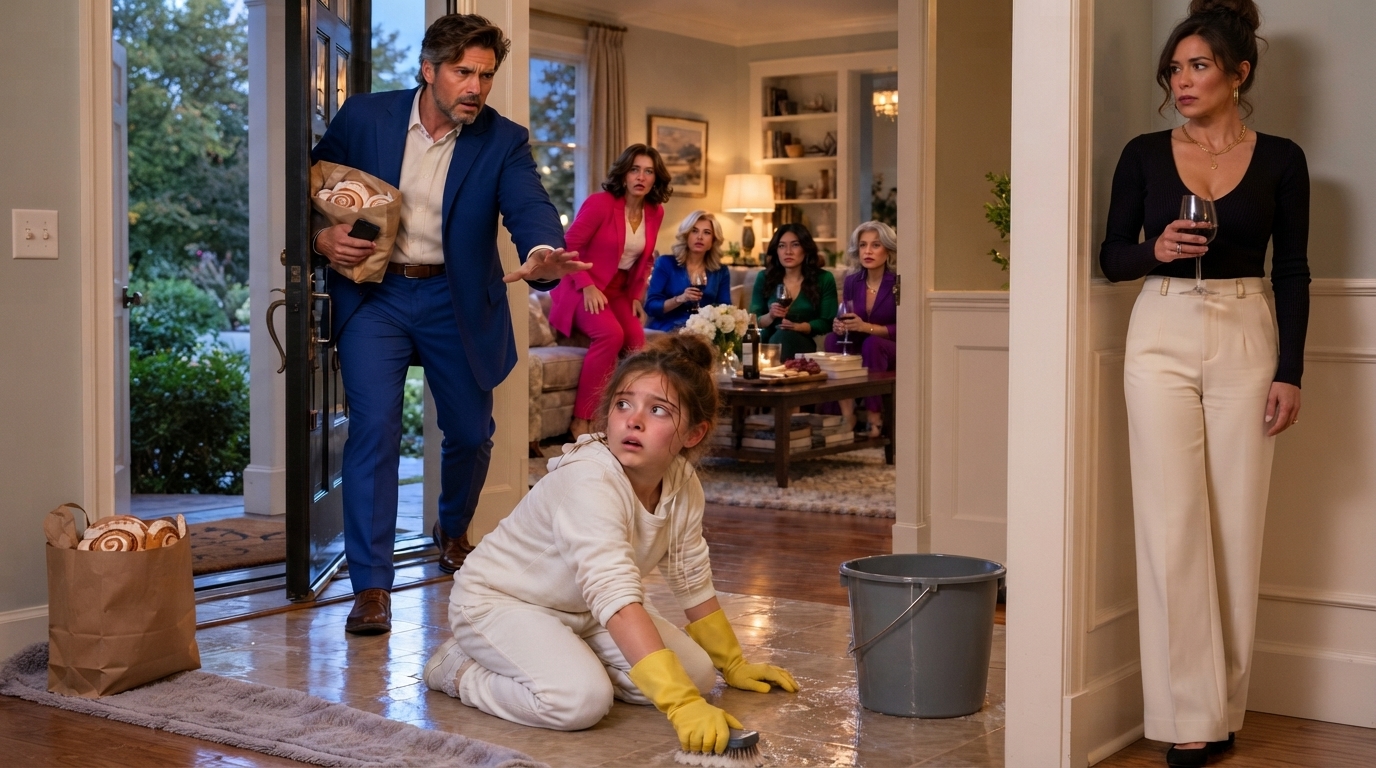
The bucket.
The rubber gloves.
The stiff brush.
The red marks on her knees.
The way she looked toward Tiffany before accepting permission to stop.
Then I looked at the shoes again.
And smiled.
Because now, when Maya came home, she didn’t immediately start cleaning.
She started living.
I picked up her backpack and placed it beside the stairs.
Then I walked into the kitchen.
On the counter sat a box of cinnamon rolls.
I’d bought them that morning.
Just because.
Maya came downstairs a few minutes later.
She spotted the box.
Her face lit up.
“Dad!”
I laughed.
“Couldn’t resist.”
She opened it.
Then looked at me.
“Can I have one before dinner?”
I pretended to consider.
“Hmm.”
She grinned.
“Please?”
I smiled.
“Of course.”
She took one.
Then sat at the kitchen table.
Not to scrub.
Not to fold laundry.
Not to complete a list of chores before she was allowed to relax.
Just to eat a cinnamon roll and tell me about her day.
I sat across from her.
And listened.
Really listened.
Because the greatest lesson of that terrible afternoon wasn’t that my wife had lied.
It wasn’t that I’d discovered a notebook.
It wasn’t even that my marriage had ended.
It was that my daughter had spent months believing love depended on how useful she could make herself.
And I had nearly missed the chance to teach her otherwise.
I looked at Maya.
She was talking excitedly about a story she wanted to write.
Her hands moved as she described the characters.
Her eyes sparkled.
She laughed at her own jokes.
And for the first time in a long time, she looked exactly like a twelve-year-old girl should look.
Happy.
Safe.
Free to be herself.
I smiled.
Then quietly made myself a promise.
I would never again mistake a quiet child for a happy one.
I would never again assume that because someone smiled in front of me, everything was fine when I wasn’t there.
And I would never again let anyone convince my daughter that her worth depended on how much work she could do.
Because children aren’t supposed to earn their place in a family.
They already belong.
That night, before bed, Maya hugged me.
“Dad?”
“Yes, sweetheart?”
“I’m glad you came home early that day.”
My throat tightened.
I kissed her forehead.
“So am I.”
She smiled.
Then whispered:
“I don’t have to ask permission to be happy anymore.”
I held her close.
“No, baby.”
My eyes filled.
“You never should have.”
And as she walked upstairs, leaving her shoes by the door and her laughter echoing through the hallway, I understood something I’d never forget.
A clean house means nothing if the child living inside it is afraid.
But a home filled with love can survive a thousand little messes.
THE END THANK YOU FOR READING !!!



