PART 3
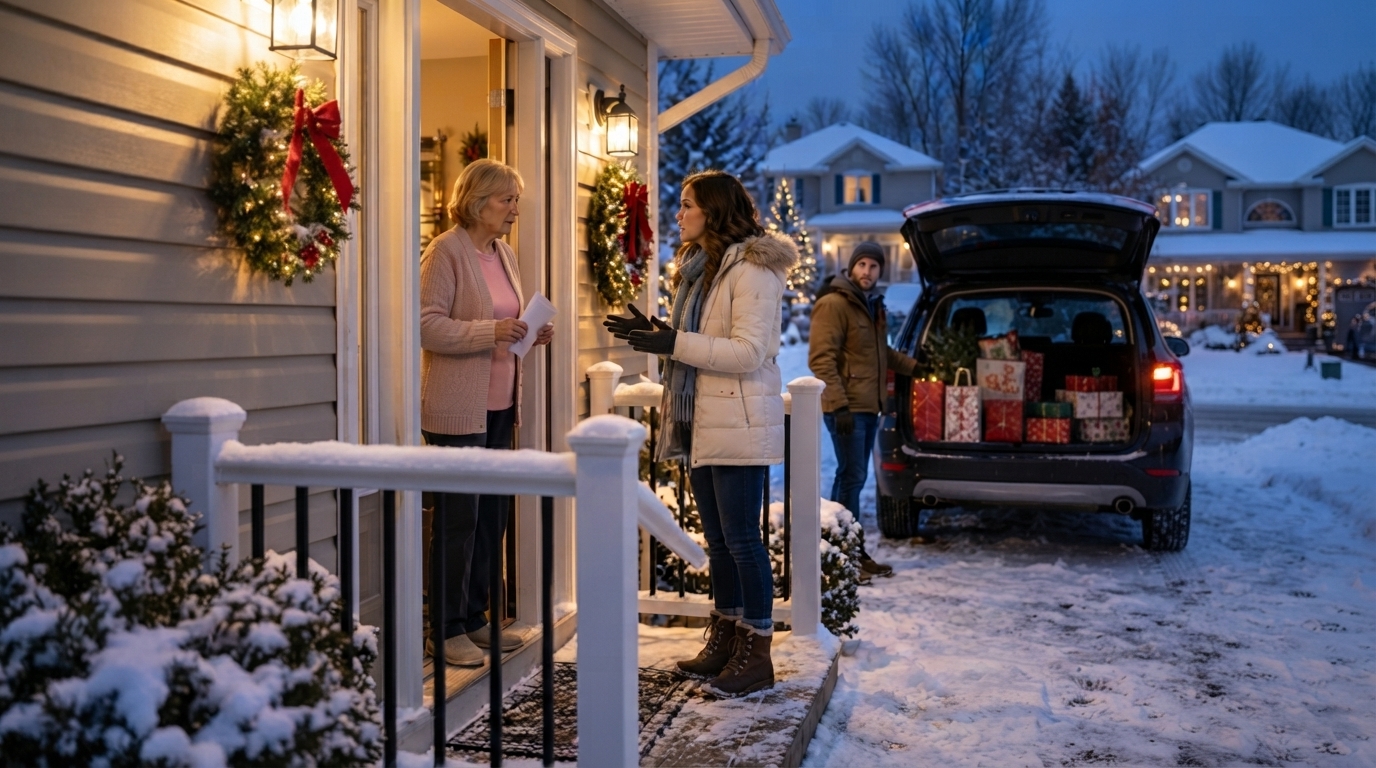
Yvette stared at the paper in my hand as though
I had just handed her an eviction notice.
For several seconds, she didn’t speak.
Then she looked at Carter.
“What is this?”
My son stood beside her on the porch, his cheeks red from the cold.
“Mom,” he said quietly, “what exactly are you doing?”
I folded the paper and slipped it back into my cardigan pocket.
“I’m making a few changes to my finances.”
Yvette let out a sharp laugh.
“Changes? You canceled our Christmas vacation and now you’re threatening to cut us off?”
I looked at her.
“I’m not threatening anyone.”
“Then what is that ridiculous document?”
“An accounting of the money I’ve given your household over the past four years.”
Carter rubbed his forehead.
“Mom, please.”
I stepped aside.
“Come inside. It’s freezing.”
They followed me into the kitchen.
Yvette didn’t remove her coat.
Carter sat at the table where, only three days earlier, I had read the message telling me they couldn’t afford a Christmas gift.
I placed the document between them.
“Before either of you says another word, I’d like you to read this.”
Yvette crossed her arms.
“I don’t need to read anything.”
“Then you don’t need to discuss it.”
She stared at me.
Carter picked up the paper.
His expression changed as he read.
The first entry was dated four years earlier.
Emergency mortgage payment: $3,200.
I remembered that day clearly.
Carter had called while I was preparing dinner.
He sounded frightened.
Their mortgage payment was overdue.
Yvette had recently changed jobs, and they were short.
“Mom, I hate asking,” he’d said, “but could you help us just this once?”
Of course I helped.
He was my son.
I loved him.
And I believed families should support one another during difficult times.
But once became twice.
Then three times.
The list continued.
A replacement furnace.
Two thousand eight hundred dollars.
Car repairs.
One thousand six hundred.
Preschool fees.
Four thousand two hundred.
Emergency dental expenses.
Nine hundred.
A family vacation deposit.
Three thousand.
Groceries.
Utility bills.
Children’s clothing.
A new washing machine.
Contributions toward their property taxes.
Every payment had been voluntary.
Every one had come from money I had worked for, saved, or received after my husband’s death.
And every time I helped, I told myself the same thing.
They’re young. They’re raising children. Things will get easier.
Carter reached the bottom of the page.
His face had gone pale.
“Thirty-eight thousand six hundred dollars?”
I nodded.
“Over four years.”
Yvette leaned forward.
“That can’t be right.”
“It is.”
“There’s no way you’ve given us that much.”
I opened the accordion folder I’d placed beside my chair.
“Bank transfers, receipts, and payment confirmations.”
She looked at the folder.
Then back at me.
“Why are you keeping records of gifts?”
I considered her question.
“Because I keep financial records of almost everything.”
She scoffed.
“So you were planning to use this against us?”
“No.”
I looked directly at her.
“I kept the records because I wanted to know where my money was going. I never expected to need them for this conversation.”
Carter set the paper down.
“Mom, we appreciate everything you’ve done.”
I looked at him.
“Do you?”
He seemed hurt.
“Of course.”
I nodded.
“Then why did you tell me money was too tight for Christmas while buying Yvette’s mother thousands of dollars in electronics?”
Yvette immediately straightened.
“Because my mother deserves nice things.”
I stared at her.
“I agree.”
She blinked.
“What?”
“Your mother deserves nice things. She’s raised a daughter, worked hard, and helped your family. I have no objection to you giving her beautiful presents.”
Yvette looked momentarily confused.
“Then what’s the problem?”
“The problem is that you told me you couldn’t afford a Christmas gift because money was strained.”
“It is strained!”
I tilted my head.
“Then why spend thousands of dollars on electronics?”
She looked toward Carter.
He said nothing.
Yvette threw up her hands.
“Those purchases were planned!”
“So was the chalet.”
Silence.
I continued.
“I reserved it in September. I arranged the ski passes in October. I booked Christmas Eve dinner six weeks ago.”
Carter stared at the table.
“I wanted to surprise everyone.”
My voice softened.
“I thought it would be a beautiful way to spend Christmas together.”
Yvette shook her head.
“So you’re canceling Christmas because we didn’t buy you something?”
“No.”
I paused.
“I’m changing how I spend my money because I’ve realized our relationship has become very one-sided.”
Her eyes narrowed.
“That’s incredibly selfish.”
I almost smiled.
For years, I’d been called generous.
Wonderful.
A lifesaver.
An angel.
Every time I wrote a check.
Now that I had stopped, I was selfish.
I looked at Yvette.
“Let me ask you something.”
She folded her arms tighter.
“What?”
“When was the last time you invited me to dinner without asking me to babysit afterward?”
Her mouth opened.
Then closed.
“When was the last time you called just to see how I was doing?”
She looked away.
“When was the last time you remembered my birthday?”
Carter shifted uncomfortably.
“Mom—”
I raised a hand.
“I’m not finished.”
My voice remained calm.
“Last year, I spent my birthday alone. You called two days later because your washing machine had broken.”
Yvette’s expression hardened.
“That wasn’t intentional.”
“Perhaps not.”
I nodded.
“But you remembered your mother’s birthday. You took her to a restaurant overlooking the river. You posted photographs of the flowers, cake, and jewelry.”
Yvette looked down.
“I saw them,” I said.
“And I was happy for her.”
My throat tightened.
“I just wondered why there wasn’t room for me too.”
Carter closed his eyes.
I looked at my son.
“Do you remember what your father used to say about Christmas?”
He swallowed.
“That it wasn’t about presents.”
“Exactly.”
I smiled sadly.
“He used to say Christmas was about making sure nobody at the table felt forgotten.”
For a moment, the kitchen was quiet.
I could almost hear my husband’s voice.
Arthur had been gone three years.
Three Christmases.
Three birthdays.
Three anniversaries.
And somehow, in trying to keep our family together after his death, I had slowly turned myself into the person who paid for everything.
I hadn’t noticed when generosity became expectation.
But I noticed now.
Yvette pushed back her chair.
“This is emotional blackmail.”
I looked at her.
“No. Emotional blackmail would be telling you that you have to buy me presents or I’ll stop loving you.”
I pointed toward the paper.
“This is a financial decision. I am no longer paying your household expenses.”
She laughed bitterly.
“And what about the children?”
I took a breath.
“My grandchildren will always have my love.”
“Then why are you taking away their vacation?”
“I’m not asking them to pay for anything.”
I paused.
“I’m simply no longer financing a holiday for two adults who have made it clear that I am not a priority.”
Carter finally looked up.
“Mom, could we pay for our own rooms?”
I nodded.
“Of course. If you want to arrange separate accommodation, you’re welcome to do so.”
Yvette stared at him.
“Carter!”
He ignored her.
“Would you still want the kids there?”
My eyes filled.
“More than anything.”
Yvette slammed her palm against the table.
“This is ridiculous! You can’t invite our children and exclude us!”
I looked at her.
“Then don’t send them.”
Her expression changed.
I continued.
“You are their parents. You decide whether they travel. I would never take them without your permission.”
Carter rubbed his face.
“Mom, we need time to think.”
“Take all the time you need.”
Yvette stood.
“You’re going to regret this.”
I looked at her.
“Perhaps.”
She stared.
“But I won’t regret finally being honest.”
They left ten minutes later.
I watched their car disappear down my driveway.
Then I closed the door.
The house was quiet.
I returned to the kitchen.
The paper still lay on the table.
Thirty-eight thousand six hundred dollars.
I stared at the number.
Not because I wanted it back.
I didn’t.
I had given that money willingly.
But I wondered how much of my own life I had postponed while making theirs easier.
The trip to Italy I’d canceled.
The new dining room furniture I’d decided was unnecessary.
The painting classes I’d always wanted to take.
The winter coat I’d kept repairing.
And the little cottage by the river Arthur and I once dreamed of renting for a summer.
I had spent years convincing myself that my children’s comfort mattered more than my own happiness.
Now I wondered when I’d started believing my happiness didn’t matter at all.
That evening, my daughter Cordelia called.
“Mom?”
“Hello, sweetheart.”
She sounded concerned.
“Carter called me.”
I sighed.
“I assumed he would.”
“He said you canceled his family’s Christmas vacation.”
“I changed the reservation.”
“He says Yvette is furious.”
“I noticed.”
Cordelia was quiet.
Then she asked, “Are you okay?”
Those three words nearly broke me.
Not What happened to the chalet?
Not Why are you being difficult?
Just:
Are you okay?
I sat down.
“I think so.”
Her voice softened.
“Mom, what’s really going on?”
And for the first time in years, I told my daughter the truth.
Not the polite version.
Not the version where I insisted everything was wonderful.
I told her about the birthday nobody remembered.
The bills I’d paid.
The expensive gifts for Yvette’s mother.
The message about strained finances.
And the moment I realized I had become useful rather than cherished.
Cordelia listened without interrupting.
When I finished, she was silent.
Then she said, “Mom, why didn’t you tell me?”
I wiped my eyes.
“I didn’t want to cause trouble.”
She sighed.
“Oh, Mom.”
I laughed weakly.
“What?”
“You’ve spent your entire life making sure everyone else is comfortable.”
I stared at the window.
She continued.
“Maybe it’s time someone made sure you are.”
I began crying.
Cordelia’s voice broke.
“I love you, Mom.”
“I love you too.”
“And for the record,” she added, “I was planning to give you a Christmas present.”
I laughed through tears.
“Sweetheart, that’s not what this is about.”
“I know.”
She paused.
“But I’m giving it to you anyway.”
I smiled.
Then she said something unexpected.
“Mom, there’s something about Carter and Yvette’s finances you need to know.”
I sat upright.
“What?”
Cordelia hesitated.
“Carter told me last month that they’re planning to buy a vacation property.”
I frowned.
“A vacation property?”
“Yes.”
“Where?”
“In Mont-Tremblant.”
I stared at the darkening river.
Mont-Tremblant.
The same region where I’d reserved our Christmas chalet.
Cordelia continued.
“He said they were saving for the down payment.”
I felt a cold heaviness settle in my chest.
“Are you sure?”
“Yes.”
I looked toward the accordion folder.
The mortgage assistance.
The household bills.
The preschool fees.
The groceries.
The car repairs.
All the money I’d given them because they were supposedly struggling.
I took a slow breath.
Then asked, “Cordelia, do you know how much they’re planning to spend?”
She hesitated.
“Carter mentioned a property listed for almost six hundred thousand dollars.”
I closed my eyes.
Suddenly, the Christmas presents weren’t the most troubling part of the story.
They were only the beginning.
PART 4
I didn’t sleep much that night.
Every time I closed my eyes, I pictured Carter sitting at my kitchen table, asking for help with the mortgage.
I remembered Yvette calling me in tears because their heating system had failed.
I remembered transferring money for groceries after she told me their bank account was almost empty.
And now Cordelia was telling me they were considering a vacation property worth nearly six hundred thousand dollars.
It didn’t make sense.
Or perhaps it made perfect sense.
Perhaps I had been so determined to help that I’d stopped asking whether help was actually necessary.
The next morning, I called my financial adviser, Margaret Ellis.
Margaret had worked with Arthur and me for nearly twenty years.
She knew our finances better than anyone.
She also knew how difficult the years after Arthur’s death had been.
“Rosalind,” she said warmly, “how are you?”
“I’m making some changes.”
There was a pause.
“That sounds serious.”
I smiled faintly.
“It is.”
I explained that I wanted to review every recurring payment connected to Carter’s household.
Margaret asked me to bring my records.
By lunchtime, I was sitting across from her in a quiet office overlooking the river.
I placed the accordion folder on her desk.
She examined the documents.
Then looked up.
“Rosalind, have you been supporting their household regularly?”
“Yes.”
“For how long?”
“About four years.”
She continued reviewing the statements.
I watched her expression grow serious.
“Do you realize how much of your discretionary income has been going toward their expenses?”
I nodded.
“Thirty-eight thousand six hundred dollars.”
“That’s the amount you’ve identified in direct assistance.”
She turned another page.
“But what about the recurring subscriptions and services?”
I frowned.
“What services?”
She pointed toward several entries.
A family streaming package.
A roadside-assistance membership.
A children’s activity subscription.
A supplemental phone plan.
I stared at them.
“I forgot about those.”
Margaret nodded.
“Small amounts can become significant over time.”
I felt embarrassed.
“I should have been paying more attention.”
She shook her head.
“You were trying to help your family.”
I looked down.
“That doesn’t mean I was wise.”
Margaret didn’t argue.
Instead, she helped me identify which payments were mine to cancel and which required notice or further review.
We checked the terms.
Confirmed that I wasn’t contractually responsible for any obligation I planned to discontinue.
And made a list.
I didn’t want to create emergencies.
I didn’t want my grandchildren suddenly losing access to something essential.
I simply wanted the adults responsible for their household to resume paying their own expenses.
By the time I left, I had a plan.
No more mortgage assistance.
No more household repair contributions.
No more recurring subscriptions paid on their behalf.
No more last-minute transfers without clear information and a genuine reason.
And no more expensive vacations arranged out of guilt.
I drove home feeling nervous.
Not because I doubted my decision.
Because I knew Carter would be upset.
For most of his life, I had been the person who made problems disappear.
If he needed money, I found it.
If he needed childcare, I rearranged my schedule.
If he needed help moving furniture, I showed up.
I had rarely said no.
Now I was going to say it.
And I didn’t know whether my son loved me enough to hear it.
Two days later, he called.
“Mom, can we talk?”
I took a breath.
“Of course.”
“Without Yvette?”
I paused.
“Yes.”
He arrived that afternoon.
Alone.
He looked exhausted.
His eyes were shadowed.
His shoulders slumped.
I made tea.
We sat at the kitchen table.
For a while, neither of us spoke.
Then Carter said, “Yvette thinks you’re trying to turn me against her.”
I looked at him.
“Are you?”
“No.”
He stared into his cup.
“Then why did you do all this?”
I took a breath.
“Because I felt hurt.”
He looked up.
“Over a Christmas present?”
“Over years of feeling like an afterthought.”
He sighed.
“Mom, we love you.”
I nodded.
“I believe you do.”
“Then why are you acting like we don’t?”
I studied him.
“Carter, when was the last time you came here just to spend time with me?”
He frowned.
“What do you mean?”
“No children to drop off. No money to borrow. No repairs you needed help paying for. Just a visit.”
He looked down.
I waited.
Finally, he whispered, “I don’t know.”
My chest tightened.
I continued.
“When was the last time you asked how I was coping without your father?”
He swallowed.
“Mom…”
“I miss him every day.”
My voice broke.
“Every single day.”
Carter closed his eyes.
I looked toward Arthur’s photograph on the windowsill.
“Your father was my best friend for forty years.”
Tears filled my eyes.
“And after he died, I kept planning these family Christmases because I was terrified that if I stopped, everyone would drift away.”
Carter stared at me.
I wiped my cheeks.
“I thought if I made every holiday beautiful enough, you’d all keep coming.”
His eyes filled.
“Mom, you don’t have to buy us to get us to visit.”
I gave him a sad smile.
“Then why did it feel that way?”
He looked away.
For several minutes, neither of us spoke.
Then I asked the question I’d been avoiding.
“Are you and Yvette planning to buy a vacation property in Mont-Tremblant?”
Carter went completely still.
He looked up slowly.
“Who told you?”
“That doesn’t matter.”
His expression hardened.
“Cordelia.”
I shook my head.
“Don’t turn this into a fight with your sister.”
He rubbed his forehead.
“Mom, we haven’t bought anything.”
“But you’re considering it?”
He hesitated.
“Yes.”
I nodded.
“How much?”
He looked uncomfortable.
“About five hundred and eighty thousand.”
I stared at him.
“Carter, you’ve been asking me for help with household expenses.”
“I know.”
“Last month, you told me you couldn’t afford a furnace repair without assistance.”
“I know.”
“And now you’re saving for a second property?”
He leaned forward.
“It’s an investment.”
I shook my head.
“It’s a vacation property.”
“It could generate rental income.”
“Perhaps.”
I paused.
“But you can’t ask me to subsidize your household while setting aside money for an optional investment without being honest about your priorities.”
His face reddened.
“It’s not that simple.”
“Then explain it.”
He took a breath.
“We’ve been saving for years.”
I stared at him.
“How much?”
He hesitated.
“About ninety thousand.”
I felt as though someone had struck me.
Ninety thousand dollars.
They had ninety thousand dollars saved.
And I had been paying their bills.
Carter saw my expression.
“Mom, that money is for the down payment.”
I nodded slowly.
“And my money was for your mortgage?”
He looked down.
I waited.
Then he whispered, “Yes.”
I stared at my son.
For a moment, I didn’t recognize him.
Not because he’d become a stranger.
Because I was finally seeing a part of him I had refused to acknowledge.
He had learned that my generosity could protect his savings.
He had learned that I would sacrifice my own comfort to preserve his.
And somewhere along the way, he’d stopped questioning whether that was fair.
I took a breath.
“Carter, do you understand what you’ve been asking of me?”
He nodded.
“I think so.”
“No.”
My voice remained gentle.
“I need you to really understand.”
I looked at him.
“I’ve been using money your father left me to cover expenses you could have paid yourselves.”
Tears rolled down my cheeks.
“I thought you were struggling.”
He swallowed.
“We were struggling with cash flow.”
I shook my head.
“You were choosing not to use your savings.”
He said nothing.
I continued.
“Those are not the same thing.”
He covered his face.
For a long time, he sat silently.
Then he whispered, “You’re right.”
I stared at him.
He lowered his hands.
“We should have told you.”
“Yes.”
He wiped his eyes.
“I kept telling myself it was temporary.”
I nodded.
“And then?”
He looked ashamed.
“Then it became normal.”
I closed my eyes.
There it was.
The truth.
Not a dramatic confession.
Not an elaborate scheme.
Just the quiet admission that taking had become easier than asking whether he should.
Carter leaned forward.
“Mom, I’m sorry.”
I looked at him.
“I believe you.”
He began crying.
“I didn’t realize how much you were giving up.”
I smiled sadly.
“Because I never told you.”
He shook his head.
“No. Because I didn’t ask.”
For the first time in days, I felt something loosen inside me.
Not forgiveness.
Not yet.
But hope.
Then Carter said something that surprised me.
“Yvette doesn’t know I came here.”
I frowned.
“Why not?”
He looked down.
“Because she thinks we should demand that you restore the chalet reservation.”
I stared at him.
“Demand?”
He nodded.
“She says the children will be devastated.”
I took a breath.
“Carter, the children haven’t even been told about the chalet.”
He looked up.
I continued.
“It was supposed to be a surprise.”
He froze.
Then slowly closed his eyes.
“Oh.”
I nodded.
“So when Yvette says the children will be devastated, what she means is that she will be disappointed.”
He said nothing.
I watched him absorb that.
Then he whispered, “I think you’re right.”
I reached across the table.
“Carter, I don’t want you to choose between your wife and me.”
He looked at me.
“I want you to build a healthy marriage.”
My voice softened.
“But I won’t finance that marriage at the expense of my own security.”
He nodded.
“I understand.”
I squeezed his hand.
“And I want to be your mother again.”
His eyes filled.
“Not your emergency bank account.”
He began crying.
I stood and walked around the table.
For the first time in weeks, I hugged my son.
He held me tightly.
“I’m sorry, Mom.”
I closed my eyes.
“I know.”
We stood there for a long time.
When he finally left, I felt exhausted.
But lighter.
I believed Carter wanted to change.
The question was whether he would.
That evening, Yvette called.
I almost didn’t answer.
Then I did.
“Hello?”
Her voice was sharp.
“Did Carter come to see you?”
“Yes.”
“What did you tell him?”
“We talked about our relationship.”
She laughed bitterly.
“You mean you manipulated him.”
I closed my eyes.
“Yvette, I’m not going to argue.”
“Of course not. You got what you wanted.”
I took a breath.
“What do you think I wanted?”
“To make him feel guilty.”
I looked toward the river.
“No.”
I paused.
“I wanted him to understand why I was hurt.”
She scoffed.
“You’re making Christmas miserable for everyone.”
I felt something inside me settle.
“Yvette, I am not responsible for making every adult in this family happy.”
Silence.
Then she said coldly, “My mother would never do this.”
I thought about the Surface Pro.
The headphones.
The iPad.
The video.
Then I answered.
“I’m glad your mother has such a close relationship with you.”
Yvette sounded confused.
“What?”
“I hope you continue treating her well.”
I paused.
“But I expect to be treated with basic consideration too.”
She laughed.
“So this is about jealousy.”
“No.”
My voice remained calm.
“It’s about respect.”
She began speaking rapidly.
Accusing me of favoritism.
Manipulation.
Punishing the grandchildren.
Ruining family traditions.
I listened for nearly a minute.
Then said, “Yvette, I’m ending this conversation.”
“You can’t just hang up!”
“I can.”
I paused.
“And we can speak again when we’re both ready to be respectful.”
Then I ended the call.
My hands trembled.
I sat down.
For a moment, I felt guilty.
Then I looked at Arthur’s photograph.
He was smiling.
The same gentle smile he’d worn whenever I worried too much about everyone else.
I imagined what he would say.
Rosie, you can’t keep pouring from an empty cup.
I smiled through tears.
Then I went into my bedroom and opened the closet.
At the back was a suitcase.
The beautiful navy-blue suitcase Arthur bought me for our fortieth wedding anniversary.
We had planned to take a trip together.
But he became ill before we could go.
I hadn’t used it since.
I pulled it out.
Set it on the bed.
And opened it.
Because Christmas was approaching.
And for the first time in years, I was going to enjoy it without trying to purchase everyone’s happiness.
What I didn’t know was that Carter was about to make a decision that would change the entire family.
And Yvette would discover that the greatest consequence of my boundaries wasn’t losing a luxury vacation.
It was losing the certainty that someone else would always pay.
PART 5
Three days before Christmas, Carter called again.
His voice sounded different.
Calmer.
“Mom, are you busy?”
I was wrapping a present for Cordelia.
“Not particularly.”
“Could I come over?”
“Of course.”
He arrived an hour later.
This time, he brought a small paper bag from a local bakery.
Inside were two cinnamon rolls.
My favorite.
I smiled.
“What’s this?”
He shrugged.
“I remembered you liked them.”
I stared at him.
For years, I’d been the person who remembered everyone’s favorites.
Carter’s preferred coffee.
Yvette’s favorite flowers.
The grandchildren’s favorite cookies.
Cordelia’s favorite tea.
It felt strangely emotional to have someone remember mine.
“Thank you,” I whispered.
We sat at the kitchen table.
Carter looked nervous.
Then he said, “I talked to Yvette.”
I nodded.
“How did it go?”
He gave a tired laugh.
“Not well.”
I waited.
“We argued.”
“I’m sorry.”
He shook his head.
“Don’t be.”
He looked at me.
“Mom, I told her we weren’t buying the vacation property.”
I blinked.
“What?”
He nodded.
“We’re not ready.”
I stared at him.
He continued.
“I sat down with our bank statements. Really looked at everything.”
His voice tightened.
“And I realized we’ve been living as though your help was part of our income.”
I felt my throat tighten.
He looked ashamed.
“We were saving money for a second property while you were helping us pay expenses on the first.”
I nodded.
“Yes.”
He swallowed.
“That wasn’t right.”
I reached for my tea.
He continued.
“I told Yvette we needed to make a real budget.”
“How did she respond?”
He sighed.
“She said I was letting you control our marriage.”
I looked down.
“Carter, I don’t want to control anything.”
“I know.”
He leaned forward.
“I told her that.”
For a moment, I saw something in my son that reminded me of Arthur.
Not his face.
His expression.
The quiet determination he used to have when he’d made a difficult decision.
Carter continued.
“I told her we couldn’t keep asking you for help while spending freely on things we wanted.”
I nodded.
“And?”
He hesitated.
“She cried.”
I sighed.
“I’m sorry.”
He shook his head.
“Mom, I love Yvette.”
“I know.”
“And I don’t want to hurt her.”
“Of course.”
“But I also don’t want to keep pretending everything is fine.”
I looked at him.
“That sounds like a good place to start.”
He smiled faintly.
Then reached into his coat pocket.
He removed an envelope.
I frowned.
“What’s that?”
He slid it toward me.
Inside was a check.
For five thousand dollars.
I stared at it.
“Carter…”
He shook his head.
“Please.”
I looked up.
“I know it doesn’t cover everything.”
His eyes filled.
“But I want to start paying you back.”
I stared at the check.
For four years, I’d given money without expecting repayment.
I had never asked for it back.
And now my son was sitting across from me, offering part of it voluntarily.
My throat tightened.
“Sweetheart, I didn’t give you that money as a loan.”
“I know.”
He swallowed.
“But I want you to have something back.”
I looked at him.
“Why?”
His voice broke.
“Because I finally understand what it cost you.”
Tears filled my eyes.
I pushed the envelope gently toward him.
“Carter, before you give me this, make sure your household can afford it.”
He nodded.
“We can.”
“Are you sure?”
“Yes.”
He smiled sadly.
“We canceled the vacation-property search. We’ve set aside our emergency savings. And we’re making a budget based on our actual income.”
I looked at the check.
Then back at my son.
“I’m proud of you for taking responsibility.”
He began crying.
I reached across the table.
“But I don’t need a grand gesture.”
He nodded.
“I know.”
“I need consistency.”
He squeezed my hand.
“You’ll have it.”
I studied him.
Then accepted the envelope.
Not because I needed the money.
Because I understood what the gesture meant.
He wasn’t trying to purchase forgiveness.
He was trying to acknowledge the imbalance.
And for the first time, I believed he was beginning to understand.
That afternoon, Cordelia arrived.
She found us sitting at the kitchen table, eating cinnamon rolls.
She stopped in the doorway.
“Well,” she said, smiling, “this is unexpected.”
Carter laughed.
“Hello to you too.”
She looked at me.
“Everything okay?”
I smiled.
“Getting better.”
Cordelia sat down.
For the next hour, the three of us talked.
Not about money.
Not about the chalet.
Not about Yvette.
We talked about childhood Christmases.
About Arthur.
About the year Carter accidentally knocked over the tree.
About Cordelia hiding her brother’s presents behind the washing machine.
About the time Arthur tried to cook Christmas dinner and forgot to remove the plastic wrapping from the turkey.
We laughed until my sides hurt.
Then, suddenly, I began crying.
Carter looked alarmed.
“Mom?”
I shook my head.
“I’m okay.”
Cordelia reached for my hand.
I smiled through tears.
“I just miss your father.”
The room grew quiet.
Carter looked toward Arthur’s photograph.
“Me too.”
Cordelia wiped her eyes.
“Every day.”
For a long time, we sat together.
And I realized something.
This was what I’d wanted all along.
Not expensive gifts.
Not luxury vacations.
Not elaborate celebrations.
Just my children sitting at my kitchen table.
Talking.
Laughing.
Remembering their father.
Remembering that we were a family.
That evening, Yvette sent me a message.
I stared at the notification for several seconds before opening it.
Rosalind, I know things have been difficult. Carter told me about your conversation. I don’t agree with everything, but I understand that you’re hurt. I would like to talk after Christmas.
I read it twice.
It wasn’t a full apology.
But it wasn’t an accusation either.
I typed:
Thank you, Yvette. I’m willing to talk after Christmas. I hope you have a peaceful holiday.
Then I put my phone away.
I wasn’t going to spend Christmas negotiating my worth.
The following morning, Cordelia and I packed for the Laurentians.
The smaller chalet was beautiful.
Three bedrooms.
A stone fireplace.
Tall windows overlooking snow-covered mountains.
A little kitchen with copper pots hanging above the island.
And a balcony where we could watch snow fall through the pine trees.
It wasn’t as extravagant as the original property.
But it felt perfect.
Cordelia arrived carrying two suitcases and a bag of homemade cookies.
I laughed.
“Are you moving in?”
She grinned.
“Only if you promise to cook.”
We loaded the car.
Before leaving, I stood in my hallway and looked at Arthur’s photograph.
“I wish you were coming,” I whispered.
Then I smiled.
“But I think you’d like this.”
We drove north through snow-covered countryside.
The St. Lawrence River disappeared behind us.
Small towns passed.
Christmas lights glowed in shop windows.
Cordelia played old holiday songs.
And for the first time in three years, I found myself singing along.
We reached the chalet just before sunset.
The mountains were purple beneath the winter sky.
Snow covered the roof.
A wreath hung on the front door.
Inside, the fireplace had been prepared.
A basket of firewood sat beside the hearth.
Cordelia dropped her bags.
“Mom, this is gorgeous!”
I smiled.
“Isn’t it?”
She walked toward the windows.
“Look at that view!”
I joined her.
For a moment, we stood silently.
The mountains stretched into the distance.
Snow drifted between the trees.
And I felt something I hadn’t felt in a long time.
Excitement.
Not responsibility.
Not obligation.
Not anxiety about whether everyone would enjoy themselves.
Just excitement.
That evening, we made hot chocolate.
Sat beside the fire.
And watched an old Christmas movie.
Cordelia rested her head on my shoulder.
“Mom?”
“Yes?”
“Are you happy?”
I looked at the flames.
I thought about Arthur.
About the original chalet.
About the gifts.
The arguments.
The money.
The years I’d spent trying to hold everyone together.
Then I answered honestly.
“I’m learning how to be.”
She squeezed my hand.
“Good.”
On Christmas Eve, we went skiing.
Well, Cordelia skied.
I mostly watched from the lodge while drinking coffee and admiring the mountains.
At lunchtime, she returned with red cheeks and snow in her hair.
“You should have come!”
I laughed.
“Sweetheart, I’m sixty-eight. I intend to remain in possession of both hips.”
She burst out laughing.
We spent the afternoon exploring the village.
We visited little shops.
Bought handmade ornaments.
And stopped at a bakery for pastries.
I bought a small wooden ornament shaped like a cardinal.
Arthur loved cardinals.
He used to say they were the only birds that understood how to dress for Christmas.
I held the ornament in my palm.
Then bought it.
That evening, we dressed for our Christmas Eve dinner.
The restaurant was beautiful.
Warm lighting.
White tablecloths.
A fireplace near the entrance.
A view of the snowy village.
Cordelia wore a dark green dress.
I wore a navy-blue dress Arthur had always loved.
When the waiter brought our drinks, Cordelia raised her glass.
“To Dad.”
My eyes filled.
“To Arthur.”
We touched glasses.
Then she smiled.
“And to you, Mom.”
I looked at her.
“For what?”
“For finally remembering that you matter too.”
I began crying.
She reached across the table.
“Mom, I mean it.”
I squeezed her hand.
“Thank you, sweetheart.”
We ate slowly.
Talked.
Laughed.
Remembered old Christmases.
And when dessert arrived, Cordelia handed me a small wrapped box.
I stared at it.
“What’s this?”
“Your Christmas present.”
I smiled.
“You didn’t have to.”
“I know.”
She pushed it toward me.
“Open it.”
Inside was a delicate silver necklace.
A tiny pendant shaped like a cardinal.
I covered my mouth.
“Cordelia…”
She smiled through tears.
“I found it months ago.”
I looked up.
“I wanted you to have something that reminded you of Dad.”
My eyes filled.
She continued.
“Not because it’s expensive.”
I laughed softly.
“But because I knew you’d love it.”
I held the necklace against my chest.
And cried.
Not because it was silver.
Not because it was beautiful.
But because someone had thought about me.
Someone had remembered what mattered to me.
Someone had chosen a gift with love.
And suddenly, I understood why Yvette’s message had hurt so much.
It hadn’t been about the absence of a present.
It had been about the absence of thought.
Christmas morning, I woke early.
Snow fell outside the windows.
The chalet was quiet.
I made coffee.
Wrapped myself in a blanket.
And sat beside the fireplace.
For a while, I simply watched the flames.
Then my phone buzzed.
Carter.
Merry Christmas, Mom. I hope you’re having a wonderful time.
I smiled.
Merry Christmas, sweetheart. We are.
A few seconds later, another message arrived.
The kids want to call you later.
My heart warmed.
I’d love that.
Then he sent a photograph.
My two grandchildren were sitting beside their Christmas tree in matching pajamas.
Their faces were bright with excitement.
I smiled.
Then another message appeared.
We told them you’re enjoying a mountain Christmas with Aunt Cordelia. They think it’s wonderful.
I stared at the screen.
For days, Yvette had insisted the children would be devastated.
But there they were.
Happy.
Safe.
Enjoying Christmas at home with their parents.
The world hadn’t ended because Grandma didn’t finance a luxury holiday.
I laughed softly.
Then typed:
Tell them I love them.
Carter replied:
We know, Mom.
I set the phone down.
And for the first time, I believed him.
Later that morning, the grandchildren called.
My grandson, Oliver, held the phone so close to his face that I could see only one eye.
“Grandma!”
I laughed.
“Hello, darling!”
“Are you in the mountains?”
“Yes!”
“Is there snow?”
“Lots!”
He gasped.
“Can you make a snowman?”
“I’ll try.”
My granddaughter, Lily, pushed into the frame.
“Grandma, did Santa find you?”
I laughed.
“Yes, sweetheart.”
She looked relieved.
“Good.”
Then she whispered, “I told him where you were.”
My heart melted.
“Oh, Lily.”
She smiled.
“I love you, Grandma.”
“I love you too.”
When the call ended, I sat quietly for several minutes.
My grandchildren loved me.
Not because I paid for vacations.
Not because I bought expensive gifts.
They loved me because I was Grandma.
Because I read stories.
Baked cookies.
Remembered their favorite games.
And made them feel safe.
That was enough.
It had always been enough.
After Christmas, Yvette and I finally talked.
We met at a quiet café.
She arrived looking nervous.
For once, she didn’t begin with accusations.
She sat down.
Ordered tea.
And looked at me.
“Rosalind, I owe you an apology.”
I waited.
She swallowed.
“I was rude.”
I nodded.
“Yes.”
She looked embarrassed.
“I shouldn’t have sent that message the way I did.”
I remained silent.
She continued.
“And I shouldn’t have reacted the way I did when you changed the vacation.”
I looked at her.
“Thank you.”
She hesitated.
Then said, “I didn’t realize how much you’d helped us.”
I took a breath.
“Yvette, I never wanted repayment.”
She nodded.
“I know.”
“I wanted a relationship.”
Her eyes filled.
She looked down.
“I think I got used to you always being available.”
I nodded.
“Yes.”
She swallowed.
“And I didn’t think about how that felt from your side.”
For the first time, she sounded sincere.
I leaned forward.
“Yvette, I don’t want to compete with your mother.”
She looked up.
“I know.”
“I don’t want you to spend less on her.”
She nodded.
“I just want you to understand that I have feelings too.”
Tears rolled down her cheeks.
She wiped them away.
“I understand.”
I studied her.
Then said, “I hope we can build something better.”
She nodded.
“Me too.”
We didn’t hug.
Not immediately.
Trust takes time.
But when we left the café, she asked whether I’d like to come for dinner the following Sunday.
No babysitting.
No errands.
No financial requests.
Just dinner.
I smiled.
“I’d like that.”
Over the next several months, things changed.
Not overnight.
Not perfectly.
But gradually.
Carter and Yvette managed their own household expenses.
They stopped asking me to cover routine bills.
They postponed the vacation-property purchase.
They built a budget.
And they began inviting me over without expecting anything in return.
Sometimes I brought dessert.
Sometimes I didn’t.
Nobody complained.
The grandchildren visited.
We baked cookies.
Played board games.
And walked along the river.
I still bought them birthday presents.
I still spoiled them occasionally.
But I did it because I wanted to.
Not because I felt obligated to purchase my place in the family.
Cordelia and I began taking a short trip together every winter.
The first year, we returned to the Laurentians.
The next, we visited Quebec City.
We walked through snowy streets.
Drank hot chocolate.
And laughed about how terrible I was at navigating unfamiliar parking garages.
I also finally enrolled in painting classes.
Every Wednesday afternoon, I sat in a bright studio with a dozen other people and tried to turn blank canvases into something beautiful.
My first painting was terrible.
A lopsided tree beside a river that looked suspiciously like a blue sidewalk.
Cordelia framed it anyway.
She hung it in her living room.
When I protested, she laughed.
“Mom, it’s a masterpiece.”
I shook my head.
“You’re ridiculous.”
She grinned.
“Learned from the best.”
And for the first time in years, I felt like my life belonged to me.
Not to my children’s emergencies.
Not to family expectations.
Not to the fear of being forgotten.
To me.
One afternoon, nearly a year after the Christmas argument, Carter visited.
He found me painting at the kitchen table.
He smiled.
“What’s that?”
“A landscape.”
He tilted his head.
“Is it supposed to be the river?”
I laughed.
“It’s supposed to be a mountain.”
He laughed too.
Then he sat down.
“Mom?”
“Yes?”
“I’ve been thinking about last Christmas.”
I put down my brush.
He looked serious.
“I was angry when you canceled the chalet.”
I nodded.
“I know.”
“But now…”
He paused.
“I think it was one of the best things you ever did for me.”
I stared at him.
He continued.
“It forced me to look at how I’d been treating you.”
His eyes filled.
“And how I’d been handling money.”
I smiled sadly.
“I’m glad something good came from it.”
He nodded.
“Me too.”
Then he reached across the table and took my hand.
“Mom, I want you to know something.”
I looked at him.
“You don’t have to pay for anything to have a place in our family.”
My throat tightened.
He squeezed my hand.
“You’re my mother.”
Tears filled my eyes.
“And I love you.”
I leaned forward and hugged him.
For a long time, neither of us spoke.
Then I whispered, “I love you too.”
That evening, after Carter left, I sat beside the window overlooking the St. Lawrence River.
Ice was beginning to form along the edges again.
Almost exactly a year had passed since Yvette’s message arrived.
Money has been really strained lately.
I thought about the woman I had been when I first read those words.
The woman who immediately reassured everyone.
Who never complained.
Who convinced herself that being generous meant never saying no.
Then I thought about everything that had happened afterward.
The canceled chalet.
The accounting.
The arguments.
The tears.
The uncomfortable conversations.
The apologies.
The changes.
And the beautiful Christmas I had spent in the mountains with my daughter.
I looked toward Arthur’s photograph.
He was smiling beside our old Christmas tree.
I picked it up.
“Arthur,” I whispered, “I think I finally understand.”
My eyes filled.
“You always told me that love wasn’t supposed to feel like a bill that came due every month.”
I laughed softly.
“I wish I’d listened sooner.”
Outside, snow began falling.
I watched it settle along the riverbank.
Then I smiled.
Because the greatest gift I received that Christmas wasn’t a necklace.
It wasn’t the refunded money.
It wasn’t even the beautiful holiday in the mountains.
It was the realization that I could love my family without financing every part of their lives.
I could be generous without being taken for granted.
I could say no without being cruel.
And I could protect my own happiness without loving my children any less.
My daughter-in-law had told me money was too tight to buy me a Christmas present.
Forty-eight hours later, I watched her mother unwrap thousands of dollars in electronics.
For a moment, I thought the lesson was about unfairness.
But I eventually understood something deeper.
The problem was never that someone else received more expensive gifts.
The problem was that I’d spent years teaching everyone to expect my generosity while asking for almost nothing in return.
That Christmas, I finally changed the arrangement.
Not because I wanted revenge.
Not because I wanted anyone to suffer.
But because I wanted a family that remembered I was a person, too.
And when I stopped paying for everyone’s happiness, something wonderful happened.
The people who truly loved me began showing up without needing a reservation, a ski pass, or a check.
I looked at Arthur’s photograph one last time.
Then whispered:
“I didn’t cancel Christmas, darling.”
I smiled through tears.
“I finally gave myself permission to enjoy it.”
THE END THANK YOU FOR READING !!!