PART 3
For several seconds, I couldn’t speak.
I stood in my kitchen with
my phone pressed against my ear,
staring through the window at the eastern pasture.
Beyond the fence,
I could see the red-tiled roof of
Silver Creek Estates’ clubhouse.
For months, that building had represented everything
I hated about Patricia Whitmore’s neighborhood.
The expensive landscaping.
The private parties.
The security guards who acted as though
my old pickup truck was a threat to civilization.
Now my attorney was telling me that a substantial
portion of that million-dollar building
might actually be standing on my property.
And that wasn’t even the worst part.
“Daniel,” I whispered,
what do you mean they’re charging
homeowners for land they never owned?
Daniel Reeves took a breath.
“According to the preliminary documents Thomas found, Silver Creek’s developer represented the clubhouse property as a common area owned by the association. Homeowners have been paying assessments to maintain it for years.”
“Okay.”
“But the underlying land records don’t show a completed conveyance of the disputed acreage.”
I leaned against the counter.
“So they’ve been collecting money for a clubhouse built on somebody else’s land?”
“That’s what we need to investigate.”
I looked toward the pasture again.
“How long?”
“The clubhouse was completed approximately eleven years ago.”
Eleven years.
The same number of years Patricia had been running the HOA.
I closed my eyes.
“Does Patricia know?”
Daniel paused.
“That’s an important question.”
I thought about the foreclosure papers.
The fabricated fines.
The way she’d pointed toward Lily’s bedroom window.
The satisfaction in her voice when she told me to teach my daughter about consequences.
Suddenly, her obsession with my ranch felt less random.
“Daniel, what if she already knows?”
He was quiet.
Then he said, “That’s why I don’t want you contacting her until we have the complete records.”
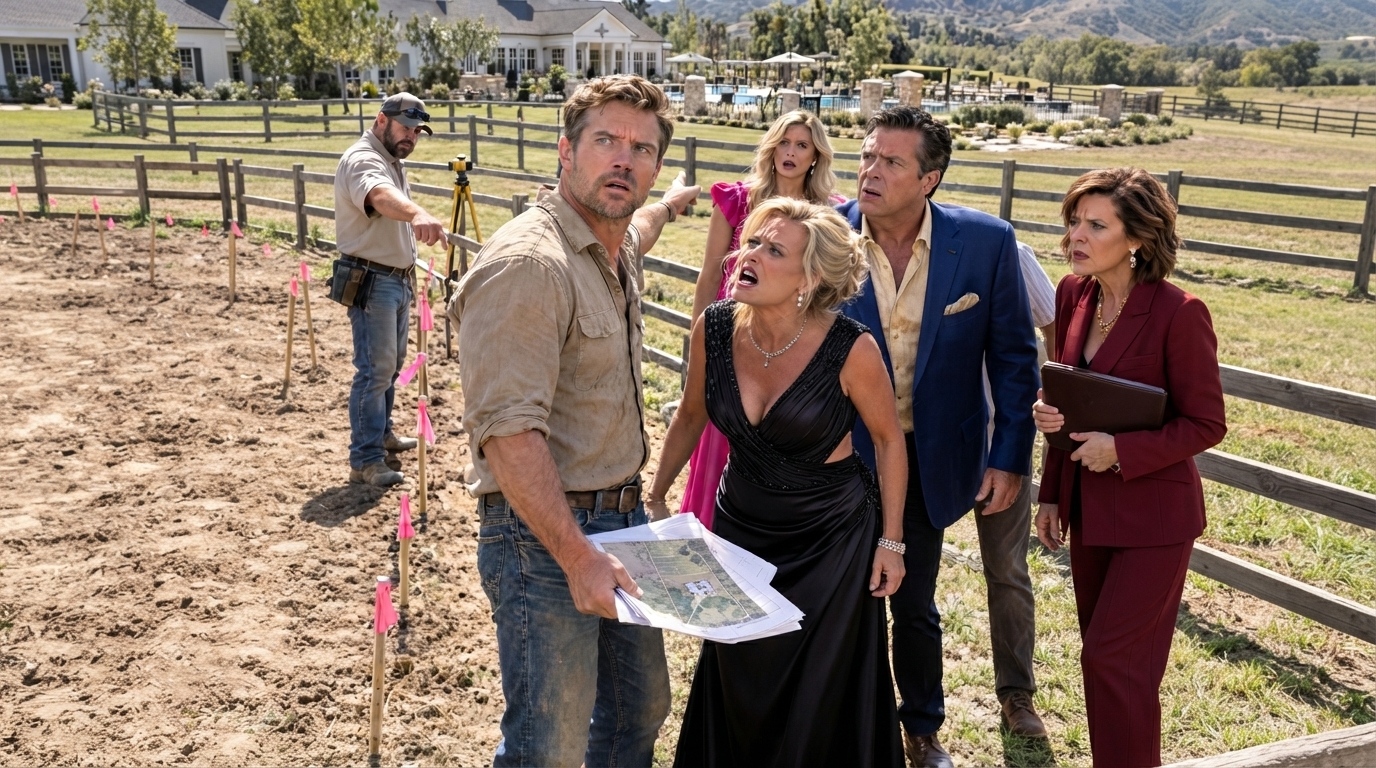
The next morning, Thomas Bell arrived at my ranch with two assistants, a truck full of surveying equipment, and a folder thick enough to make me nervous.
Lily was sitting on the porch steps feeding Biscuit a piece of toast.
“Are those the people measuring our land?” she asked.
I nodded.
“Yes, sweetheart.”
She looked toward the clubhouse.
“Are they going to take our house?”
My heart tightened.
I sat beside her.
“Why would you think that?”
She stared at her shoes.
“Because that lady said we might have to leave.”
I felt anger rise so quickly that I had to take a breath.
Patricia had frightened my nine-year-old daughter.
Not with a misunderstanding.
Not with a careless remark.
She had deliberately used Lily’s fear to pressure me.
I put my arm around her.
“Listen to me. Nobody gets to take our home just because they say they can.”
Lily looked up.
“Promise?”
I kissed her forehead.
“I’m doing everything I can to protect it.”
She nodded.
Then whispered, “I like it here.”
I looked across the pasture.
The horses were grazing near the fence.
The old barn needed another coat of paint.
And Biscuit was trying to steal the rest of Lily’s toast.
“I do too,” I said.
Thomas spent most of the morning checking survey monuments, comparing recorded plats, and measuring the eastern boundary.
At eleven-thirty, he asked me to walk with him.
We crossed the pasture toward the stone wall separating my ranch from Silver Creek Estates.
The wall looked old.
Expensive.
Permanent.
Thomas stopped near a patch of mesquite.
“See that iron rod?”
I looked down.
A small metal marker protruded from the ground.
“Yes.”
“That’s one of the original boundary monuments.”
He pointed toward the clubhouse.
“The subdivision’s decorative wall isn’t the legal boundary.”
I frowned.
“Then what is?”
He raised his survey equipment.
“The recorded property line runs well beyond that wall.”
I followed his gaze.
Across the manicured lawn.
Past a row of ornamental trees.
Through the parking lot.
And directly beneath the clubhouse.
My mouth fell open.
“You’re kidding.”
Thomas shook his head.
“No, ma’am.”
I stared at the building.
“How much?”
“Our preliminary measurements show approximately 3.8 acres of encroachment. We’ll finalize that after checking the remaining monuments and records.”
I swallowed.
“And the clubhouse?”
“A substantial portion appears to be on your parcel.”
I looked toward the swimming pool.
“What about that?”
“Part of the pool deck and supporting facilities also appear to cross the line.”
My knees weakened.
Thomas continued.
“The underground utility corridor is another issue. We need to establish whether any recorded easement authorizes it.”
I stared at him.
“You’re telling me they’ve been using my land for eleven years?”
“Possibly longer. The developer started grading this area before the clubhouse was completed.”
I looked at the stone wall.
Then at my ranch.
For the first time, I understood why Eleanor Garrison had kept that handwritten note.
I never sold them this land.
She hadn’t been sentimental.
She’d been warning whoever came after her.
That afternoon, Daniel and I reviewed Eleanor’s old documents.
Her nephew had given me a box of records when I purchased the ranch.
At the time, I’d put it in the storage room beside the laundry area.
There were old property tax statements.
Receipts for fencing.
Photographs of cattle.
A handwritten list of repairs.
And several envelopes containing letters from Silver Creek’s original developer.
Daniel spread them across my kitchen table.
I made coffee.
Then we started reading.
The first letter was dated eleven years earlier.
It came from a development company called Westbridge Residential Partners.
The developer wanted to purchase approximately four acres along Eleanor’s eastern boundary.
The offer was $85,000.
Eleanor had written a response.
The land is not for sale.
A second letter offered $110,000.
She refused again.
A third letter proposed a long-term lease.
Eleanor declined.
Then the letters stopped.
I looked at Daniel.
“So they tried to buy it.”
“Yes.”
“And she refused.”
“Clearly.”
He examined another document.
Then his expression changed.
“What is it?” I asked.
He held up a folded sheet.
It was a copy of a development site plan.
Across the bottom was a handwritten notation.
Boundary adjustment pending final agreement with Garrison.
Daniel stared at it.
I leaned closer.
“What does that mean?”
“It suggests the developer knew the boundary needed to be changed before this plan could be implemented.”
I felt cold.
“But there was no agreement.”
“Not in the records we’ve found.”
He turned the page.
Attached was a letter Eleanor had written to the county planning office.
She complained that construction equipment had crossed her fence line.
She demanded that the developer stop grading her land.
She also requested written confirmation that no subdivision approval would transfer her property without her consent.
I stared at the date.
The letter had been sent before the clubhouse was built.
“Daniel, she warned them.”
He nodded slowly.
“Yes.”
I looked at the final paragraph.
Eleanor had written:
I am eighty years old, but I know where my land begins and ends. I will not surrender it because somebody drew a prettier map.
My eyes filled.
I had never met Eleanor.
But in that moment, I felt as though she were sitting beside me.
Still stubborn.
Still protecting her land.
Still refusing to be bullied.
Two days later, Patricia arrived at my gate.
She drove a white luxury SUV and parked directly in front of my driveway.
I was repairing a fence post when I saw her.
She stepped out wearing cream-colored trousers, oversized sunglasses, and an expression that suggested the entire world had disappointed her.
“Hannah.”
I put down my hammer.
“Patricia.”
She looked toward the pasture.
“I understand you’ve hired surveyors.”
I wiped my hands on my jeans.
“Yes.”
Her lips tightened.
“Your workers have been making our residents uncomfortable.”
I almost laughed.
“They’re licensed professionals measuring my property.”
She crossed her arms.
“They’ve been standing near our clubhouse.”
I nodded.
“Interesting place, isn’t it?”
Her expression changed.
“What does that mean?”
I remembered Daniel’s warning.
Don’t contact her about the findings yet.
So I smiled.
“Just admiring the architecture.”
Patricia stared at me.
Then she pulled a folder from her handbag.
“Your fines remain outstanding.”
I looked at it.
“Those fines aren’t valid.”
“That’s for the court to decide.”
I folded my arms.
“Then I suppose we’ll see each other there.”
Her smile returned.
“You’re making this unnecessarily difficult.”
I looked toward the house.
Lily was watching through the living room window.
I felt my patience disappear.
“Patricia, you threatened my child.”
She blinked.
“I did no such thing.”
“You pointed at her bedroom and told me to teach her what happens when people refuse to follow the rules.”
She gave a dismissive laugh.
“You’re being dramatic.”
I stepped closer.
“Stay away from my daughter.”
For a moment, Patricia’s expression hardened.
Then she lowered her sunglasses.
“You really have no idea what you’re up against.”
I looked directly at her.
“Neither do you.”
She climbed back into her SUV.
And drove away.
The next week, Daniel filed our response to the HOA’s foreclosure action.
He challenged the association’s authority to impose assessments or fines on my ranch and requested appropriate relief to prevent any improper foreclosure while the dispute was resolved.
The recorded documents supported what I’d said from the beginning.
My ranch wasn’t part of Silver Creek Estates.
It wasn’t subject to the association’s declaration.
And no one had produced a valid document showing that I’d agreed to join.
Patricia’s $63,480 demand had no legitimate foundation.
But Daniel wasn’t finished.
He also began the process of asserting my property rights concerning the clubhouse encroachment.
Before filing those claims, he obtained the finalized boundary survey and arranged for a title review.
The results were even more serious than we’d expected.
Thomas confirmed the encroachment.
The title search found no recorded deed transferring the disputed land from Eleanor or her successors to the developer or HOA.
And the recorded utility easements didn’t appear to authorize every part of the infrastructure crossing my parcel.
Daniel warned me that the association might raise defenses based on long use, possession, or other property-law doctrines.
We couldn’t assume the case was won simply because the map favored us.
But the evidence was strong enough to change the entire dispute.
The HOA had come after my ranch.
Now it would have to answer questions about its own clubhouse.
The first settlement conference took place six weeks after Patricia threatened Lily.
I walked into a downtown Fort Worth conference room wearing dark jeans, a white blouse, and the boots I’d worn to feed my horses that morning.
Patricia was already seated.
Beside her sat three attorneys.
Across the table were representatives of the HOA’s board, the property management company, and its insurer.
Several homeowners had also been invited because the dispute could affect association property and finances.
Patricia looked at me and smiled.
“Mrs. Mitchell. I’m glad you’ve finally decided to be reasonable.”
I sat beside Daniel.
“Good morning, Patricia.”
She leaned back.
“I assume you’re prepared to discuss payment.”
Daniel opened his briefcase.
“Actually, we’re here to discuss ownership.”
One of Patricia’s attorneys frowned.
“Ownership of what?”
Daniel placed a large survey map on the table.
Thomas Bell stood beside him.
And then, slowly, Daniel unfolded the map.
The clubhouse appeared in the center.
The swimming pool sat to its left.
The parking lot stretched toward the entrance road.
A thick red line cut directly across the development.
Thomas pointed to it.
“This is the recorded boundary of the Mitchell property.”
One attorney leaned forward.
Another adjusted his glasses.
Patricia stopped smiling.
Thomas continued.
“Our survey places approximately 3.8 acres of the clubhouse development within Mrs. Mitchell’s parcel.”
Nobody spoke.
Then one of the homeowners whispered, “What?”
Daniel placed the recorded deed and historical documents beside the map.
“We’ve found no completed conveyance of that acreage.”
Patricia’s attorney stared at the papers.
“That can’t be right.”
Thomas calmly explained the survey methodology and the original monuments.
Then Daniel handed him Eleanor’s letters.
“Mrs. Garrison expressly refused to sell the land.”
Patricia stood.
“This is ridiculous!”
Daniel looked up.
“Please sit down, Mrs. Whitmore.”
She pointed at the map.
“That clubhouse cost over a million dollars!”
I met her eyes.
“Then someone should have checked who owned the land.”
Her face went white.
And for the first time since I’d met Patricia Whitmore, she had absolutely nothing to say.
PART 4
The silence lasted almost thirty seconds.
Then everyone began talking at once.
One homeowner demanded to know whether the clubhouse was legally theirs.
Another asked whether the swimming pool would have to close.
A third wanted to know how the HOA had managed to build a million-dollar facility without confirming ownership of the property beneath it.
Patricia slammed her palm against the table.
“This is an obvious attempt at extortion!”
Daniel didn’t raise his voice.
“Mrs. Whitmore, we’re presenting recorded property documents and a licensed boundary survey.”
She pointed toward me.
“She waited until we filed foreclosure papers to invent this!”
I stared at her.
“Patricia, I bought the ranch in March. Your clubhouse has been sitting there for eleven years.”
One of the attorneys cleared his throat.
“Mrs. Whitmore, please allow us to review the documents.”
She turned toward him.
“You’re supposed to be defending us!”
He looked uncomfortable.
“That’s exactly what we’re trying to do.”
I almost smiled.
For months, Patricia had treated legal language like a weapon.
She sent notices.
Threatened liens.
Invented deadlines.
And acted as though having attorneys meant she could do anything she wanted.
Now those same attorneys were studying documents that suggested the HOA had a far more serious problem than my supposedly noncompliant pasture fence.
Daniel slid another folder across the table.
“There’s a second issue.”
Patricia’s attorney looked up.
“What issue?”
“The association’s authority to assess Mrs. Mitchell’s property.”
He opened the folder.
“The recorded declaration for Silver Creek Estates does not include her ranch.”
One of the board members frowned.
“Then why were we fining her?”
Daniel looked directly at Patricia.
“That’s a question for your president.”
Patricia crossed her arms.
“Her property affects our neighborhood.”
I stared at her.
“Because you can see my horses from your clubhouse?”
She glared.
“Because your property reduces the aesthetic consistency of the surrounding area.”
One of the homeowners looked at her.
“Patricia, that’s not how HOA membership works.”
She turned sharply.
“Excuse me?”
He leaned forward.
“My wife and I have paid assessments for nine years. You’re telling me you’ve been trying to foreclose on somebody who isn’t even in our association?”
Patricia opened her mouth.
Then closed it.
Daniel placed the fine ledger on the table.
“Mrs. Mitchell received $63,480 in purported violations and fees.”
Another homeowner gasped.
“For what?”
I answered.
“Horses. Gravel. Fencing. My dog barking.”
The man stared at me.
“You live on a ranch.”
“Exactly.”
He looked toward Patricia.
“Why would we fine a ranch owner for keeping horses?”
Patricia snapped, “Because standards matter!”
Nobody responded.
Then the homeowner said quietly, “So does the law.”
The meeting ended without a settlement.
Patricia left first.
She didn’t look at me.
Her attorneys stayed behind to examine the survey and discuss what additional records would be needed.
Daniel warned me not to celebrate.
“We have a strong position,” he said as we walked toward the parking garage. “But this isn’t finished.”
I nodded.
“What happens next?”
“They’ll investigate the chain of title. They may challenge the survey, raise defenses, or attempt to negotiate a resolution.”
I looked toward the courthouse buildings.
“And the foreclosure?”
“We’ll keep pursuing dismissal and protection of your title.”
I exhaled.
“Do you think they’ll stop?”
Daniel looked at me.
“I think the homeowners are going to start asking questions Patricia doesn’t want to answer.”
He was right.
Within a week, Silver Creek Estates was in turmoil.
I didn’t know everything happening behind its gates.
But people began contacting me.
First came a woman named Rebecca Collins.
She lived in a large stone house overlooking the clubhouse.
She called one afternoon and asked whether she could speak to me.
I agreed to meet her at a coffee shop.
Rebecca was in her forties, with tired eyes and the nervous manner of someone who’d been holding something inside for too long.
“I owe you an apology,” she said.
I frowned.
“For what?”
She looked down.
“I voted to approve the legal action against you.”
I stared at her.
“You’re on the HOA board?”
She nodded.
“Secretary.”
I leaned back.
“Then you helped Patricia try to foreclose on my ranch.”
Rebecca’s eyes filled.
“Yes.”
I waited.
She took a breath.
“Patricia told us your property was part of the original development and that you’d refused to pay assessments for years.”
I shook my head.
“I’ve owned it for a few months.”
“I know that now.”
She wiped her cheeks.
“She presented a map showing your ranch inside what she called the community’s expanded management area.”
I frowned.
“Expanded management area?”
Rebecca nodded.
“She said the association had authority over neighboring parcels because of shared drainage and access infrastructure.”
I stared at her.
“Did anyone ask to see the recorded declaration?”
She looked ashamed.
“Not carefully enough.”
I took a slow breath.
“Rebecca, why are you telling me this?”
She reached into her handbag.
“Because after the settlement meeting, I started reviewing old board records.”
She placed a folder on the table.
Inside were copies of meeting minutes.
Financial statements.
And correspondence from the developer.
I opened the first page.
Then stopped.
One entry, dated nearly ten years earlier, discussed a “pending land regularization issue” involving the clubhouse parcel.
I looked up.
“What is this?”
Rebecca swallowed.
“That’s what I wanted to show you.”
I read the next paragraph.
The minutes stated that the developer was working to resolve outstanding ownership documentation for the clubhouse land.
I turned another page.
There was a note indicating that the board had requested clarification.
Then another entry, months later, recorded that the matter had been “administratively resolved.”
But there was no deed attached.
No settlement agreement.
No signed transfer.
Nothing showing that Eleanor had ever sold her land.
I stared at Rebecca.
“Who was president then?”
She looked at me.
“Patricia.”
I called Daniel from the parking lot.
He listened while I explained.
Then said, “Don’t draw conclusions yet. We need authenticated records and the full context.”
I understood.
But I couldn’t stop thinking about Patricia’s behavior.
She hadn’t simply made a mistake about my fence.
She’d pursued me aggressively after I showed her that my ranch wasn’t part of the HOA.
She’d ignored my deed.
Ignored my county records.
Ignored every attempt to resolve the matter.
And now there were documents suggesting that the board had discussed the clubhouse land problem years earlier.
Had Patricia known?
Had she hoped that pressuring me would somehow force me to surrender my property?
Or had she simply grown so accustomed to getting her way that she never imagined anyone would challenge her?
I didn’t know.
But I intended to find out.
The following month, Silver Creek’s board called a special meeting.
Patricia tried to keep it closed.
The homeowners demanded otherwise.
By then, word of the boundary dispute had spread through the neighborhood.
Residents wanted to know whether their assessments had been used to maintain facilities the HOA didn’t legally own.
They wanted to know why the board had pursued foreclosure against a neighboring ranch.
And they wanted to know whether Patricia had concealed information about the clubhouse property.
The meeting was held in the clubhouse itself.
The irony wasn’t lost on me.
Daniel advised me to attend only as an observer and avoid arguing with residents.
I sat in the back beside Rebecca.
More than a hundred homeowners filled the room.
Patricia stood at the front.
She looked exhausted.
Her perfectly styled hair couldn’t hide the dark circles beneath her eyes.
She tapped the microphone.
“Ladies and gentlemen, I want to assure you that our association is financially secure and that these allegations are exaggerated.”
A man in the second row raised his hand.
“Do we own the clubhouse land?”
Patricia hesitated.
“Our attorneys are reviewing historical documentation.”
The man stood.
“That wasn’t my question.”
Murmurs spread through the room.
He repeated himself.
“Do we own the land under this building?”
Patricia looked toward the association’s attorney.
He stood.
“At present, there is a disputed claim to portions of the property. The title investigation is ongoing.”
A woman near the aisle gasped.
“Then why did we pay for renovations last year?”
Another homeowner shouted, “Why weren’t we told?”
Patricia raised her voice.
“Everyone needs to calm down!”
Nobody calmed down.
A gray-haired man stood near the back.
“I’ve lived here since the development opened. I remember Eleanor Garrison.”
The room quieted.
He continued.
“She used to ride along that fence line on a little brown horse.”
I leaned forward.
He pointed toward the windows.
“She told me the developer wanted her pasture, but she wouldn’t sell.”
Patricia stared at him.
He shook his head.
“I thought they eventually worked something out.”
Then he looked directly at her.
“Did they?”
Patricia said nothing.
And that silence told the room more than any speech could have.
Over the following weeks, the board retained independent legal counsel.
A title company conducted a more extensive review.
Additional survey work confirmed the disputed boundary.
The HOA’s insurer was notified.
The developer’s successor entities were contacted.
And the board began examining whether claims could be brought against parties responsible for the original construction and property representations.
Patricia was removed as HOA president through the association’s governing procedures.
The decision wasn’t unanimous.
A few homeowners still defended her.
They said she’d kept property values high.
They said she’d maintained standards.
They said she was simply being aggressive on behalf of the neighborhood.
But most residents had seen enough.
Rebecca called me the evening after the vote.
“It’s done.”
I was sitting on my porch.
“What is?”
“Patricia’s no longer president.”
I looked toward the clubhouse.
The lights were glowing against the evening sky.
For a moment, I felt nothing.
Then I exhaled.
“Thank you for telling me.”
Rebecca hesitated.
“Hannah, I know this doesn’t fix what happened.”
“No,” I said. “It doesn’t.”
She sighed.
“But I hope it’s a start.”
I looked toward the pasture.
“Maybe it is.”
The foreclosure action was dismissed.
The HOA formally withdrew the $63,480 in purported fines and acknowledged that my ranch was not subject to its recorded covenants.
The association also agreed to remove any improper claims it had asserted against my property and to cover a negotiated portion of the legal expenses I’d incurred defending my title.
When Daniel called with the news, I was standing in the barn.
One of my horses was chewing hay.
Biscuit was asleep beside the door.
And Lily was helping me organize grooming brushes.
I answered the phone.
“Hello?”
Daniel sounded pleased.
“Hannah, we have the signed dismissal documents.”
I froze.
“The foreclosure?”
“Dismissed.”
I closed my eyes.
“And the fines?”
“Withdrawn.”
I sat on a hay bale.
For months, I’d been living with the fear that someone might find a way to take my home.
Now, finally, that threat was ending.
I covered my mouth.
Daniel waited.
Then said gently, “You can breathe, Hannah.”
I began crying.
Lily looked up.
“Mom?”
I wiped my cheeks.
She hurried toward me.
“What’s wrong?”
I pulled her into my arms.
“Nothing, sweetheart.”
She frowned.
“Then why are you crying?”
I laughed through tears.
“Because nobody’s taking our ranch.”
Her eyes widened.
“Really?”
“Really.”
She hugged me so tightly I nearly fell off the hay bale.
Then she whispered, “Can we stay forever?”
I kissed her hair.
“We can keep building our life here.”
But the clubhouse dispute was still unresolved.
The HOA couldn’t simply erase a building worth more than a million dollars.
And I had no desire to destroy something that hundreds of families used.
Children learned to swim in that pool.
Retired couples attended exercise classes there.
Neighbors celebrated birthdays and anniversaries in the clubhouse.
Those homeowners hadn’t personally built the facility on Eleanor’s land.
Many had purchased their homes believing the common areas were properly owned by their association.
I understood that.
But I also understood something else.
Their innocent reliance didn’t mean I had to give away nearly four acres of my ranch.
So Daniel and I developed a proposal.
We offered to resolve the dispute through a properly documented transaction.
The association could purchase the affected acreage at a price supported by an independent appraisal, with appropriate adjustments for the unusual circumstances.
The agreement would also address the utility corridor, access, drainage, maintenance responsibilities, and my remaining property’s boundaries.
In exchange, the HOA would stop claiming authority over the rest of my ranch.
Permanently.
No fines.
No architectural rules.
No demands about horses, fences, or gravel.
And no one from Silver Creek would ever again pretend that living next door made me a member.
The board agreed to negotiate.
The negotiations lasted nearly four months.
There were disagreements about valuation.
Questions about easements.
Concerns about financing.
And lengthy discussions about how to protect both properties.
The association’s lawyers initially argued that the land had limited independent value because it was already occupied by the clubhouse.
Daniel rejected the idea that someone could reduce the value of my property by building on it without permission.
Their next proposal was a permanent easement.
I considered it.
But I wanted the boundaries resolved cleanly.
I didn’t want my daughter inheriting a complicated legal fight twenty years later.
Eventually, the parties agreed on a purchase.
The association would acquire the disputed acreage through a properly recorded deed, subject to final title and court-related requirements.
The purchase price was $1.35 million.
It reflected the negotiated value of the land and resolution of the related claims, not simply the price of undeveloped pasture.
The HOA arranged financing and obtained the necessary homeowner approvals.
Its insurer and other involved parties contributed to the broader settlement under separate arrangements.
My attorney made sure the agreement included clear boundary protections for the remainder of my ranch.
And when the final documents were signed, I felt something I hadn’t expected.
Not triumph.
Peace.
The day the transaction closed, Daniel handed me a copy of the recorded documents.
“Congratulations, Hannah.”
I looked at the papers.
“Is it really over?”
He smiled.
“The land transaction is complete. The boundaries and agreements are recorded.”
I exhaled.
“And Silver Creek can’t fine me for my horses?”
He laughed.
“Not under its HOA rules. Your ranch remains outside the association.”
I smiled.
“Good.”
Then I looked at the settlement statement.
For a moment, I thought about everything that had happened.
The cream-colored violation notices.
The fabricated fines.
The foreclosure papers.
Patricia pointing toward Lily’s bedroom.
Eleanor’s handwritten warning.
Thomas standing beside the old boundary marker.
And the map that had silenced an entire conference room.
I shook my head.
“All I wanted was a quiet ranch.”
Daniel smiled.
“Sometimes quiet takes a little work.”
I didn’t spend the settlement money on anything extravagant.
I paid the legal and surveying expenses that weren’t otherwise reimbursed.
I repaired the barn.
Replaced the failing fences.
And established a substantial education fund for Lily.
I also set aside money for maintaining the ranch.
Then I did something that surprised almost everyone.
I donated a portion of the proceeds to a local program that helped children learn about agriculture and animal care.
Lily loved that idea.
“Can kids come see the horses?”
I smiled.
“Some of them, yes. When we arrange it safely.”
She grinned.
“Can Biscuit be the official greeter?”
I looked at our little terrier.
He was barking at a leaf.
“He’s going to need some training.”
Lily laughed.
And for the first time in months, the ranch felt exactly the way I’d hoped it would when we moved in.
Peaceful.
Ours.
Home.
Patricia never apologized to me personally.
Not once.
I heard through Rebecca that she’d moved out of Silver Creek several months after losing the presidency.
Her house went on the market.
She stopped attending neighborhood meetings.
And the woman who had once controlled every mailbox color and landscaping decision became just another former resident.
I didn’t celebrate her departure.
I didn’t drive past her house.
I didn’t send her a letter.
I had no interest in becoming the kind of person who needed someone else to suffer in order to feel powerful.
I simply continued living my life.
One afternoon, almost a year after the foreclosure papers arrived, Lily and I were walking along the eastern pasture.
The new boundary fence had been installed.
The clubhouse still stood beyond it.
Children were swimming in the pool.
Someone was playing music near the patio.
Lily stopped and looked through the fence.
“Mom?”
“Yes?”
“Is that the building that was on our land?”
I nodded.
“It was.”
She thought for a moment.
“Did we lose?”
I looked at her.
“Why would you think that?”
“Because they still have the building.”
I smiled.
Then knelt beside her.
“Sweetheart, winning doesn’t always mean taking something away from somebody else.”
She frowned.
“Then what does it mean?”
I looked toward our farmhouse.
The white porch.
The red barn.
The horses grazing in the distance.
“Sometimes it means making sure nobody can take away what belongs to you.”
Lily considered that.
Then asked, “So the ranch is still ours?”
I nodded.
“Every acre we kept.”
She smiled.
“Good.”
Then she grabbed my hand.
“Come on. Biscuit’s probably eating something disgusting.”
I laughed.
And we walked home.
That evening, I found Eleanor Garrison’s handwritten note in the kitchen drawer.
The paper was yellowed.
The ink had faded slightly.
But the words were still clear.
Land is the only thing people can’t make more of. Know exactly where yours ends.
I read it twice.
Then turned it over.
For the first time, I noticed faint writing on the back.
It was only one sentence.
And never let someone with a louder voice convince you that your silence means they own it.
I stared at those words.
Then smiled.
I never met Eleanor.
But I felt as though I’d finally understood her.
She’d spent fifty years protecting that ranch.
She’d refused to sell her pasture to a developer.
She’d written letters.
Kept records.
And preserved the evidence that eventually helped me defend what she’d left behind.
In a strange way, she had protected Lily and me long before we ever knew her name.
I folded the note carefully.
Then placed it inside a small frame.
I hung it beside the kitchen window.
Where I could see it every morning.
A few weeks later, Rebecca invited me to the clubhouse.
The HOA had elected a new board.
The new president wanted to introduce herself and thank me for working toward a resolution rather than insisting on a prolonged fight over the structures.
I hesitated.
Then agreed.
When I arrived, the atmosphere was completely different.
Nobody demanded identification beyond the ordinary visitor check-in.
Nobody complained about my pickup truck.
Nobody mentioned my horses.
The new president, a woman named Angela Brooks, greeted me at the entrance.
“Mrs. Mitchell?”
“Hannah, please.”
She smiled.
“Hannah. Thank you for coming.”
We walked through the clubhouse.
The floors were polished.
The windows overlooked the pool.
And sunlight streamed across the tables.
Angela stopped near a wall displaying photographs of community events.
“I wanted you to know we’ve changed how the association handles complaints and property matters.”
I nodded.
“That’s good.”
“We’ve also implemented independent review of significant legal actions and a process for homeowners to examine the relevant governing documents.”
I smiled.
“That sounds sensible.”
She hesitated.
“There’s something else.”
I looked at her.
“We’ve decided to rename the garden beside the clubhouse.”
I frowned.
“Rename it?”
She nodded.
“The board approved a small plaque acknowledging Eleanor Garrison’s role in the history of this land.”
I stared at her.
Angela continued.
“We learned she repeatedly insisted that property boundaries be respected. We thought it was important not to erase that history.”
My throat tightened.
“She would have liked that.”
Angela smiled.
“We hope so.”
I looked through the window toward the garden.
For years, Eleanor’s objections had been treated like an inconvenience.
Now, finally, someone was acknowledging that she’d been right.
That night, Lily and I sat on the porch watching the sunset.
Biscuit was asleep beneath her chair.
The horses moved slowly through the pasture.
The sky turned orange over the distant trees.
Lily leaned against me.
“Mom?”
“Yes?”
“Are we rich now?”
I laughed.
“Why do you ask?”
She shrugged.
“Because Grandma said you sold some land for a lot of money.”
I smiled.
“We’re fortunate, sweetheart.”
She thought for a moment.
“Does that mean we can buy another horse?”
I laughed harder.
“Nice try.”
She grinned.
Then she became serious.
“Mom, why was that lady so mean to us?”
I looked toward the distant clubhouse.
I thought about Patricia.
Her threats.
Her certainty.
Her belief that having power meant she could decide what belonged to other people.
Then I looked at my daughter.
“Sometimes people get so used to being obeyed that they forget they aren’t always right.”
Lily nodded slowly.
“Like when I thought Biscuit ate my homework, but it was under my bed?”
I laughed.
“Something like that.”
She smiled.
Then asked, “Did you get scared?”
I considered lying.
Telling her I’d been brave the whole time.
That I’d never worried.
That everything had been under control.
But I remembered the nights I’d lain awake staring at the ceiling.
The fear that someone might take our home.
The humiliation of being threatened over fines I didn’t owe.
And the moment Patricia pointed toward my daughter’s bedroom window.
So I told her the truth.
“Yes, Lily. I was scared.”
She looked surprised.
“Really?”
I nodded.
“Very.”
She leaned closer.
“But you didn’t give up.”
I kissed her forehead.
“No, sweetheart.”
She smiled.
“Good.”
I still have the original foreclosure notice.
It’s folded inside a folder in my office.
Sometimes I take it out and look at the number.
$63,480.
That was what Patricia Whitmore claimed I owed her homeowners association.
For horses.
For gravel.
For fencing.
For a barking terrier.
For refusing to obey rules that had never applied to me.
She believed that number would frighten me into submission.
She believed that threatening my ranch would make me surrender.
She believed that because she had a board, a lawyer, and a fancy clubhouse, she could decide where her authority began and ended.
But she forgot one thing.
Property rights don’t expand simply because somebody acts important.
And the loudest person in the room doesn’t automatically own the land beneath everyone else’s feet.
Patricia tried to take my ranch.
Instead, her association discovered that its million-dollar clubhouse was standing on land it had never properly acquired.
The HOA’s fabricated fines disappeared.
The foreclosure failed.
My property rights were confirmed.
And the association paid $1.35 million to resolve a boundary problem that had existed long before I bought the ranch.
But the best part wasn’t the money.
It wasn’t watching Patricia lose her presidency.
And it wasn’t the stunned silence when Thomas unfolded the survey map.
The best part was the evening Lily ran barefoot across our porch, laughing as Biscuit chased her through the yard.
She stopped beside me, looked across the pasture, and said the same words she’d whispered when we first saw the ranch.
“Mom, I think we could be happy here.”
This time, I didn’t have to wonder whether she was right.
I already knew.
I wrapped my arms around her and whispered, “We already are.”
And as the sun disappeared behind the Texas hills, I looked toward the eastern boundary one last time.
The fence stood exactly where it belonged.
So did we.
THE END THANK YOU FOR READING !!!



