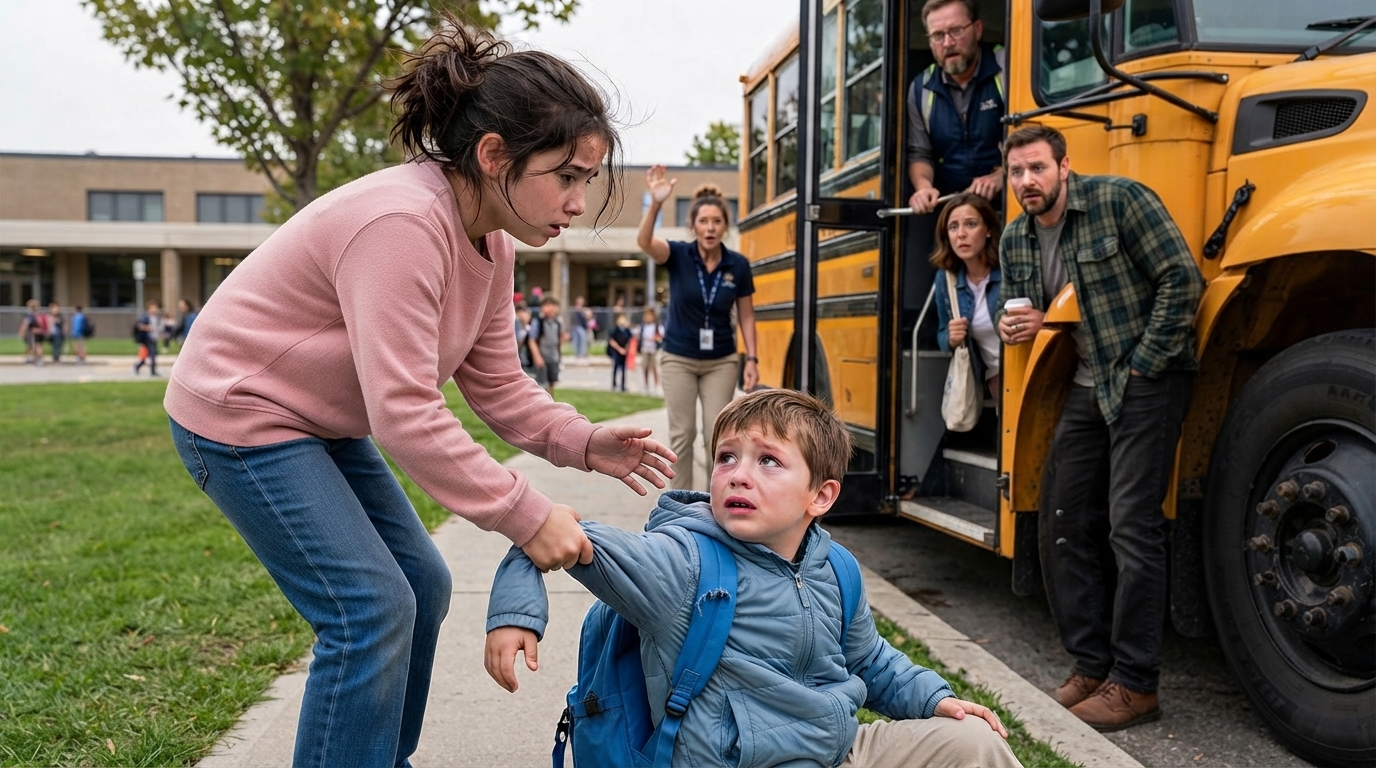
PART 3
For several seconds, nobody in Principal Shaw’s office said a word.
I stared at the photograph on the maintenance worker’s phone.
A strip of blue nylon hung from a jagged metal bracket
inside the school bus’s folding door mechanism.
The same blue nylon that had been torn from Caleb’s backpack.
The same backpack I’d packed that morning.
The same strap my husband had insisted
June must have ripped apart when she attacked her little brother.
Scott leaned forward.
“You’re telling me the bus door did that?”
Luis Vega nodded.
That’s what the physical evidence suggests.
But there’s something more important than the damaged strap.
He enlarged the photograph.
“Look here.”
I leaned closer.
A metal bracket was bent outward,
leaving a sharp edge exposed near the door’s moving assembly.
Luis pointed to it.
This component should never have been left in this condition.
It was reported during an inspection last Thursday.
Principal Shaw frowned.
“Reported to whom?”
“Transportation maintenance.”
“And repaired?”
Luis shook his head.
“That’s what I need to verify. The record says it was completed, but the damage is still there.”
Scott looked at the photograph again.
Then he glanced toward the hallway, where June was sitting.
His expression changed.
“Wait.”
Luis looked up.
“If Caleb’s backpack was caught, what exactly was June supposed to do?”
Luis took a breath.
“From what I can see, she pulled him away from the door before the mechanism could pull the strap tighter.”
I felt the room tilt.
“But she pulled him so hard he fell.”
“Yes, ma’am.”
Luis looked directly at me.
“And that may have prevented a much worse injury.”
My hands began trembling.
I remembered the video.
June lunging.
Caleb falling.
The woman screaming.
Seven seconds.
Seven seconds that had convinced me my stepdaughter was dangerous.
Seven seconds that had convinced Scott she hated her little brother.
And not one of us had thought to ask what happened immediately before the recording began.
I looked toward the hallway.
June was still sitting outside the counselor’s office.
Her elbows rested on her knees.
Her face was buried in her hands.
My stomach twisted.
“Can we please bring June in?” I whispered.
Principal Shaw nodded.
“Of course.”
June entered slowly.
Her green sweatshirt was stained with dirt.
There was a small scrape on her wrist.
Her eyes were swollen from crying.
She stopped when she saw Scott.
“Dad?”
Scott didn’t answer immediately.
I watched my stepdaughter’s shoulders tighten.
She was preparing herself for another accusation.
Principal Shaw pulled out a chair.
“June, we’d like you to explain what happened at the bus.”
June looked at me.
“Is Caleb okay?”
I swallowed.
“He’s okay, sweetheart.”
Her eyes filled.
“Really?”
“Yes.”
She exhaled shakily.
Then Principal Shaw asked, “Can you tell us what you saw?”
June sat down.
For a moment, she stared at her hands.
Then she began.
“Caleb was getting on the bus. I was behind him because Dad told me I had to make sure he got home.”
Scott shifted in his chair.
June continued.
“He was on the first step when his backpack got caught.”
I leaned forward.
“Did you see it happen?”
She nodded.
“The strap pulled tight. Caleb tried to keep walking, but he couldn’t.”
Her voice began shaking.
“I told him to stop.”
She wiped her face.
“But the door started moving.”
Luis nodded slightly.
June looked toward him.
“I heard this horrible grinding sound. Caleb’s backpack jerked sideways, and he started crying.”
I covered my mouth.
“I yelled for the driver to stop the door.”
Principal Shaw asked, “Did the driver hear you?”
June shook her head.
“I don’t know. Everyone was shouting. The engine was loud.”
She looked at Scott.
“I tried to pull the backpack loose, but it wouldn’t move.”
Her voice cracked.
“So I grabbed Caleb’s jacket and pulled him backward.”
She began crying.
“I didn’t know what else to do.”
I felt tears sliding down my cheeks.
June wiped her face with her sleeve.
“He fell, and everyone started yelling at me. I tried to tell them about the door, but the driver said I’d attacked him.”
She looked at me.
“And then you came.”
My heart broke.
She swallowed.
“I tried to explain, Amy. But you told me not to talk.”
I closed my eyes.
I remembered those exact words.
June, not right now.
I’d said them because I was frightened.
Because Caleb was hurt.
Because the video seemed so clear.
But June had been frightened too.
And I hadn’t given her even thirty seconds to explain.
“I’m sorry,” I whispered.
She looked up.
I moved closer.
“June, I’m so sorry.”
Her lips trembled.
“Nobody believed me.”
I reached for her hand.
She hesitated.
Then let me hold it.
“I should have listened.”
She looked down.
“I thought Caleb was going to get crushed.”
The room went quiet.
Then Scott finally spoke.
“June.”
She turned toward him.
His face had gone pale.
“Why didn’t you tell me what happened?”
June stared at him.
Then she said something that silenced everyone.
“Because you already decided what happened before you asked.”
Scott opened his mouth.
But nothing came out.
Principal Shaw arranged for the transportation department to preserve the bus and its maintenance records.
Luis explained that the damaged mechanism needed a proper technical inspection before anyone could determine exactly why the door moved while Caleb was boarding.
He was careful not to claim more than the evidence showed.
But one fact was undeniable.
Caleb’s backpack strap had been trapped in the door assembly.
And June had pulled him away.
The principal apologized to June for allowing the initial report to describe her actions as an attack before the investigation was complete.
Then she asked whether June would be comfortable answering a few more questions.
June nodded.
Principal Shaw opened her notebook.
“Did anything unusual happen before Caleb reached the bus?”
June thought for a moment.
“Yes.”
“What?”
“The door was making a clicking noise.”
Luis looked up.
“How long?”
“I heard it yesterday too.”
Principal Shaw frowned.
“Yesterday was Sunday.”
June shook her head.
“Friday. I mean Friday.”
Luis leaned forward.
“Did you tell anyone?”
June nodded.
“The driver.”
“What did he say?”
“He told me it was fine.”
I stared at her.
“June, why didn’t you tell us?”
She looked at Scott.
“Because Dad said I was always complaining about the bus.”
Scott went completely still.
I remembered the argument from the previous week.
June had complained that the bus door sounded strange.
Scott had been trying to finish a work call.
He’d told her to stop finding excuses not to ride with Caleb.
At the time, I’d barely noticed.
Now the memory made me sick.
Scott rubbed his forehead.
“Oh, God.”
June stared at the floor.
“I wasn’t trying to get out of watching him. I really thought something was wrong.”
I squeezed her hand.
“I believe you.”
She looked at me.
Then whispered, “You do now.”
Those three words hurt more than any accusation could have.
Because she was right.
Caleb was brought into the office a few minutes later.
He walked slowly, carrying his stuffed dinosaur.
When he saw June, he stopped.
“Junie?”
June stood immediately.
“Hey, buddy.”
Caleb looked at her.
Then at me.
“Is June in trouble?”
My throat tightened.
“No, sweetheart.”
He frowned.
“But everybody was yelling.”
June knelt.
“Caleb, I’m sorry you fell.”
He looked down at his shoes.
“My backpack was stuck.”
June nodded.
“I know.”
He reached toward her.
She opened her arms.
Caleb hugged her.
And then my six-year-old son said something that made every adult in that room look away.
“You saved me, Junie.”
June began crying.
She held him tightly.
“I tried.”
Caleb patted her shoulder.
“The door was eating my backpack.”
June laughed through tears.
“Yeah, buddy. It kind of was.”
I pressed my hand against my mouth.
Scott stood near the window.
His shoulders were shaking.
For months, he’d accused June of resenting Caleb.
For years, he’d insisted she needed to act like a responsible older sister.
And now the little girl he’d called selfish had risked being hurt herself to protect her brother.
That evening, we took Caleb to his pediatrician for another examination.
The doctor confirmed that his injuries appeared limited to bruising and soreness, while advising us to monitor him and return if anything changed.
Caleb spent most of the appointment explaining how June had rescued him.
He told the nurse.
He told the doctor.
He even told the receptionist.
“My sister pulled me away from the bad door.”
Every time he said it, I felt another wave of shame.
June sat beside him, quietly holding his hand.
When we returned home, Scott asked her to come into the living room.
She stopped in the doorway.
“What?”
He gestured toward the couch.
“Can we talk?”
June looked at me.
I nodded.
She sat down, leaving as much distance between herself and Scott as possible.
He noticed.
So did I.
Scott leaned forward.
“June, I owe you an apology.”
She stared at him.
“I watched that video and assumed the worst.”
June didn’t speak.
“I said things about you that weren’t fair.”
Her jaw tightened.
“You said I hated Caleb.”
Scott lowered his head.
“I know.”
“You said you’d suspected it for years.”
His face crumpled.
“I know.”
June looked toward the floor.
Then whispered, “Do you really think I’m that kind of person?”
Scott covered his face.
“No, sweetheart.”
She shook her head.
“But you said it.”
He looked up.
Tears filled his eyes.
“You’re right. I did.”
June’s voice rose.
“I pulled him because I thought he was going to get hurt!”
“I understand.”
“No, you don’t!”
She stood.
“Everybody thinks I hate him because I don’t want to babysit him all the time!”
Scott went still.
June’s hands trembled.
“I love Caleb! He’s my little brother!”
Her voice broke.
“But I’m fourteen! Sometimes I want to sit with my friends! Sometimes I want to go somewhere without him! That doesn’t mean I want him hurt!”
I began crying.
June wiped her cheeks angrily.
“You make me responsible for everything he does. If he loses his lunchbox, it’s my fault. If he forgets his homework, it’s my fault. If he cries because I won’t play with him, I’m selfish.”
Scott stared at her.
She continued.
“And today, when I actually saved him, you still thought I was the bad one.”
The room went silent.
Then she whispered, “I don’t know how to make you proud of me anymore.”
Scott stood.
“June—”
She stepped backward.
“Please don’t.”
He stopped.
She turned and ran upstairs.
A moment later, her bedroom door closed.
I looked at my husband.
For the first time since I’d known him, Scott seemed completely lost.
“She’s right,” I whispered.
He sank onto the couch.
“I know.”
I sat beside him.
“We’ve been treating her like a third parent.”
Scott stared at the floor.
“I thought I was teaching her responsibility.”
I shook my head.
“Responsibility isn’t the same thing as making a child accountable for another child’s safety.”
He wiped his face.
“I’ve been so hard on her.”
I thought about every morning June had been told to hurry Caleb along.
Every afternoon she’d been expected to watch him.
Every family outing where she was instructed to keep an eye on him instead of enjoying herself.
And every time she’d complained, we’d called her ungrateful.
“We both have,” I admitted.
Scott looked at me.
“What do we do?”
I took a slow breath.
“We start by believing her when she tells us how she feels.”
The next morning, I received a call from Tina Wells.
She sounded upset.
“Amy, I need to apologize.”
I frowned.
“For what?”
“The video.”
I closed my eyes.
“Tina—”
“I posted it in our parent group before I sent it to you.”
My stomach dropped.
“What?”
“I thought people needed to know what happened. I didn’t realize the situation was different.”
I gripped the phone.
“How many people saw it?”
She hesitated.
“A lot.”
I felt sick.
“Please take it down.”
“I already did.”
“Did anyone share it?”
Another pause.
“Some parents did.”
I closed my eyes.
June had been accused in public.
By adults.
By people who didn’t know her.
And now a video of her saving her brother was circulating as proof that she was violent.
I thanked Tina for telling me.
Then I called Principal Shaw.
“We have another problem.”
By lunchtime, the school had received multiple complaints about June.
Some parents demanded that she be suspended.
One claimed she should be removed from the bus permanently.
Another wrote that children like June were dangerous around younger students.
I read the comments with tears in my eyes.
Then I thought about June sitting alone in the counselor’s office.
Waiting for someone to believe her.
Principal Shaw assured me that the school was correcting its internal account and reviewing the incident with the transportation department.
But she also said something important.
“Mrs. Porter, we cannot control every parent who has seen that video.”
I knew she was right.
And I knew June would have to return to school.
Where classmates might whisper.
Where adults might stare.
Where people who had watched seven seconds would believe they knew everything about her.
I looked at my husband.
“We have to do something.”
Scott nodded.
“Whatever it takes.”
But before we could decide what that meant, Principal Shaw called again.
Her voice was unusually serious.
“Mrs. Porter, the transportation department has located the maintenance report from last Thursday.”
I sat down.
“What does it say?”
She paused.
“The door mechanism was flagged as unsafe.”
My chest tightened.
“Then why was the bus still operating?”
“That’s what we’re trying to determine.”
I looked toward the staircase.
June was upstairs, doing homework.
And suddenly I realized that the seven-second video wasn’t the only thing someone had misunderstood.
The broken bus door hadn’t appeared out of nowhere.
Someone had known there was a problem.
And someone had allowed that bus to carry children anyway.
PART 4
The following Thursday, Scott and I attended an emergency meeting at the school district’s transportation office.
Principal Shaw was there.
So was Luis Vega.
A transportation supervisor named Daniel Price sat across from us with a thick folder.
June had been invited to attend, but we’d given her the choice.
She decided to stay home with Evelyn, Scott’s mother.
Before we left, she looked at me and asked, “Are they going to blame me again?”
I knelt beside her.
“No, sweetheart.”
She studied my face.
“Promise?”
I took her hand.
“I promise we’re going to make sure your side is heard.”
She nodded.
But I could see she wasn’t completely convinced.
And I couldn’t blame her.
Daniel Price opened the meeting by explaining that the bus had been removed from service immediately after Caleb’s accident.
A technical inspection confirmed that a damaged bracket had interfered with the folding door assembly.
The damaged component had created a snag point near the entrance.
That was where Caleb’s backpack strap had become trapped.
Luis explained that the strap’s position and the physical marks on the bracket were consistent with the backpack being caught as the door mechanism moved.
The exact sequence still required review.
But the inspection supported June’s account.
She had seen the strap tighten.
She had pulled Caleb away.
And her intervention had likely prevented him from being dragged farther against the door.
I closed my eyes.
Scott reached for my hand.
Then Daniel turned another page.
“There’s an additional issue.”
I looked up.
“The bus had been reported for a door malfunction four days before the incident.”
I stared at him.
“June said she heard a clicking noise.”
Luis nodded.
“That matches the maintenance complaint.”
Daniel continued.
“The initial report described an intermittent grinding sound and resistance during the door’s closing cycle.”
Scott leaned forward.
“Then why wasn’t it fixed?”
Daniel looked uncomfortable.
“The repair record indicates that the problem was marked resolved.”
I frowned.
“Was it actually repaired?”
He paused.
“The inspection found no evidence that the damaged bracket had been replaced.”
The room went silent.
I felt anger rising.
“So someone signed off on a repair that wasn’t completed?”
Daniel took a breath.
“That’s one of the matters under investigation.”
Scott stared at him.
“My six-year-old son could have been seriously injured.”
“I understand.”
“No,” Scott said sharply. “You don’t.”
I placed a hand on his arm.
He took a breath.
Then sat back.
Daniel continued.
“The employee who closed the work order has been removed from safety-sensitive duties pending the investigation. We’re also reviewing maintenance procedures and inspection records for the fleet.”
I looked at Luis.
“How did you find the strap?”
He opened his folder.
“When I inspected the door, I noticed a strip of blue fabric caught beneath the bracket. It matched the damaged area on Caleb’s backpack.”
I nodded.
“And the original video?”
Luis looked at Daniel.
The supervisor cleared his throat.
“We’ve reviewed it alongside witness statements and the physical evidence.”
I leaned forward.
“Then I want the record to state clearly that June wasn’t attacking her brother.”
Daniel nodded.
“The investigation supports that her actions were an attempt to remove him from danger.”
My eyes filled.
“Then please put that in writing.”
He looked at me.
“We will.”
The district eventually issued a written correction.
It stated that June’s actions had been protective, not aggressive.
It confirmed that a mechanical defect contributed to the incident.
And it acknowledged that the original description of June’s conduct had been made before the relevant evidence was available.
No disciplinary action was taken against her.
The transportation department also implemented additional inspections and reviewed its procedures for taking buses out of service when safety concerns were reported.
But none of that erased what June had experienced.
The comments.
The accusations.
The way her own father had looked at her.
Or the way I’d refused to listen.
That part was ours to repair.
One evening, I knocked on June’s bedroom door.
“Come in.”
She was sitting on her bed with a sketchbook.
Her walls were covered with drawings.
Flowers.
Animals.
Little comic characters.
I’d always known she loved art, but lately I’d barely paid attention.
“Can I sit?”
She shrugged.
I sat beside her.
For a while, neither of us spoke.
Then I said, “June, I owe you a real apology.”
She looked down at her sketchbook.
“I know.”
I took a breath.
“Not just for what happened at school.”
She glanced at me.
“For all the times we made you responsible for Caleb when you didn’t want to be.”
Her pencil stopped moving.
I continued.
“You were right. You’re his sister, not his parent.”
June stared at me.
“And loving him doesn’t mean you have to spend every minute taking care of him.”
Her eyes filled.
I swallowed.
“I think we got so used to you helping that we forgot you were still a kid.”
She whispered, “I don’t mind helping sometimes.”
“I know.”
“I just don’t want to have to do it every day.”
I nodded.
“You shouldn’t have to.”
She wiped her face.
“Sometimes I want to go to the library after school. Or sit with my friends. Or just come home and do nothing.”
I smiled sadly.
“Those are all reasonable things to want.”
She looked at me.
“Really?”
“Really.”
She was quiet for a moment.
Then she asked, “Are you still mad at me?”
My heart broke.
“No, June.”
She stared at her hands.
“Because when you saw the video, you looked at me like you didn’t know who I was.”
I felt tears gathering.
“I know.”
She continued.
“I kept thinking if I could just explain it right, you’d understand.”
I reached for her hand.
“But I wouldn’t let you.”
She nodded.
I took a slow breath.
“I’m sorry.”
She looked at me for a long moment.
Then whispered, “I was really scared.”
I moved closer.
“Of the bus?”
She shook her head.
“After.”
I frowned.
She looked down.
“When everyone was yelling at me. When Dad said I hated Caleb.”
Her voice cracked.
“I thought you were going to send me to live with Mom.”
I felt as though someone had punched me.
June’s biological mother lived several states away.
Their relationship was complicated.
June visited during school breaks, but she’d lived primarily with Scott since she was seven.
I stared at her.
“June, nobody was going to send you away.”
She looked up.
“But Dad said he didn’t know what to do with me anymore.”
I closed my eyes.
I’d heard him say it.
In the principal’s office.
In frustration.
Without thinking.
But June had heard it too.
And she’d believed it.
I reached for her.
“Sweetheart, you belong here.”
Her face crumpled.
“Even when I mess up?”
I hugged her.
“Even then.”
She began crying against my shoulder.
I held her.
And for the first time in a long time, she hugged me back without hesitation.
Scott’s apology took longer.
Not because he didn’t want to give it.
But because June wasn’t ready to hear it.
For several days, she barely spoke to him.
She answered questions politely.
Did her homework.
Helped clear the table.
But she stopped telling him about school.
Stopped asking him to look at her drawings.
Stopped sitting beside him during movies.
Scott noticed every change.
One night, after June went upstairs, he sat at the kitchen table with his head in his hands.
“I’ve lost her.”
I sat beside him.
“You haven’t.”
He shook his head.
“She doesn’t trust me.”
I took a breath.
“Then you’ll have to earn that trust back.”
He looked at me.
“How?”
“By changing what made her stop trusting you.”
He stared at the table.
I continued.
“No more making her responsible for Caleb every afternoon. No more calling her selfish because she wants time with her friends. And no more deciding she’s guilty before hearing her.”
He nodded slowly.
“I can do that.”
I squeezed his hand.
“Then start.”
The following Saturday, Scott knocked on June’s bedroom door.
She was working on a drawing.
“Can I come in?”
She shrugged.
He stepped inside.
“I was wondering if you wanted to go to the art supply store.”
June looked up.
“Why?”
He smiled nervously.
“Because you said you needed new pencils.”
She stared at him.
“You remembered?”
He nodded.
“Yeah.”
She hesitated.
“Just us?”
Scott swallowed.
“Just us.”
June looked toward the hallway.
“What about Caleb?”
“I’ve got him,” I called from downstairs.
She smiled faintly.
Then looked back at her father.
“Okay.”
They were gone for nearly three hours.
When they returned, June carried a bag of sketchbooks, colored pencils, and watercolor paints.
Scott carried a small canvas.
And for the first time since the accident, I heard them laughing together.
It wasn’t a complete repair.
But it was a beginning.
We also changed our routines.
Caleb began riding a different bus after the transportation department completed the necessary safety review and reassigned his route.
June was no longer required to accompany him.
We arranged appropriate after-school care when Scott and I were working.
June could join her friends, attend art club, or come home without being responsible for her little brother.
At first, she seemed suspicious.
One afternoon, she stood in the kitchen holding her backpack.
“Can I really go to Maya’s house?”
I looked up.
“Of course.”
“What about Caleb?”
“He’s with his after-school program until I pick him up.”
She frowned.
“You don’t need me?”
I smiled.
“We always love having you around, June. But we don’t need you to manage Caleb’s afternoon.”
She stared at me.
Then smiled.
“Okay.”
She practically skipped out the door.
I watched her go.
And I realized how little we’d understood about the burden we’d placed on her.
A month after the accident, Principal Shaw called with an invitation.
The school district was holding a transportation safety meeting.
They wanted to recognize June for her quick response.
I was thrilled.
Scott was thrilled.
But June looked horrified.
“No.”
I blinked.
“No?”
She shook her head.
“I don’t want to stand in front of everyone.”
Scott looked disappointed.
“But sweetheart, you saved Caleb.”
June shrugged.
“I just pulled him away.”
I knelt beside her.
“June, you don’t have to attend if you don’t want to.”
She looked relieved.
“Really?”
“Really.”
She thought for a moment.
“Can they just say what happened without making me stand there?”
I smiled.
“Absolutely.”
And that was what we arranged.
The district acknowledged her actions during the meeting.
The school corrected the information shared with families.
And June was allowed to remain exactly where she wanted to be.
At home.
Drawing in her bedroom.
With nobody demanding that she become the center of attention.
But there was one person who still wanted to thank her properly.
Caleb.
He’d been talking about it for weeks.
Every time someone mentioned the accident, he announced that June was his hero.
She always rolled her eyes.
“Caleb, stop.”
But I noticed she smiled whenever he said it.
One afternoon, Caleb came home carrying a piece of construction paper.
He marched straight into the kitchen.
“Mommy, I made something for June.”
I looked down.
It was a drawing.
A yellow school bus.
A little boy with a blue backpack.
And a taller girl wearing a green sweatshirt.
Above them, in large uneven letters, he’d written:
MY SISTER SAVED ME.
My eyes filled.
“That’s beautiful, sweetheart.”
He grinned.
“Can I give it to her?”
“Of course.”
He ran upstairs.
A moment later, I heard him knock.
“Junie!”
“What?”
“I made you something!”
There was a pause.
Then June laughed.
“Caleb, why does my head look like a potato?”
“Because I’m still learning!”
I covered my mouth to keep from laughing.
Then I heard June say something that made me cry.
“Come here, buddy.”
A moment later, Caleb shouted, “She hugged me!”
I leaned against the kitchen counter.
And for the first time since the accident, I felt something inside me begin to heal.
Several weeks later, Scott and I received the final district report.
It confirmed that the damaged door bracket should have triggered a more thorough inspection before the bus returned to service.
The repair documentation had been closed without the defect being properly resolved.
The district acknowledged failures in its maintenance process and outlined corrective measures.
We reviewed the report with an attorney to understand our options and ensure Caleb’s medical expenses and safety concerns were addressed appropriately.
The process took time.
There were meetings.
Documents.
Questions.
And difficult conversations about accountability.
But I kept returning to one fact.
If Luis hadn’t examined the bus carefully, we might never have discovered the torn strap.
If the strap hadn’t been found, the seven-second video might have remained the only evidence anyone considered.
And June might have spent years being remembered as the girl who attacked her little brother.
Instead of the girl who saved him.
One evening, I found June sitting on the back porch.
She was sketching the old maple tree near our fence.
I sat beside her.
“That’s beautiful.”
She smiled.
“Thanks.”
I watched her draw for a moment.
Then asked, “Can I tell you something?”
She looked up.
“Sure.”
“I’m proud of you.”
She rolled her eyes.
“Because of the bus?”
I shook my head.
“Not just because of the bus.”
She looked curious.
“I’m proud of how you kept telling the truth even when nobody wanted to listen.”
Her pencil stopped.
I continued.
“And I’m proud that you still care about Caleb, even after everything that happened.”
She stared at her sketchbook.
Then whispered, “He’s annoying sometimes.”
I laughed.
“I know.”
She smiled.
“He follows me everywhere.”
“I know.”
“And he asks about a million questions.”
“Definitely.”
June laughed.
Then her expression softened.
“But he’s my brother.”
I nodded.
“He is.”
She looked toward the backyard.
“I don’t hate him.”
My throat tightened.
“I know, sweetheart.”
She turned toward me.
“Do you really?”
I reached for her hand.
“Yes.”
She smiled.
Then leaned against my shoulder.
We sat together while the sun went down.
And I realized that sometimes rebuilding trust doesn’t happen through one dramatic apology.
Sometimes it happens through a hundred small moments when you finally behave differently.
By the following school year, things had changed.
June joined the art club.
She made new friends.
She started talking about applying to a summer illustration program.
And she no longer looked frightened whenever Scott called her name.
Caleb recovered completely from his injuries.
He still loved dinosaurs.
Still asked endless questions.
Still followed June around whenever she allowed it.
But he was learning to respect her space.
If she wanted to draw alone, he had to let her.
If she wanted to spend time with friends, he couldn’t demand to come along.
And if he needed help, Scott and I were responsible for providing it.
Not June.
That was the rule.
And we stuck to it.
On the anniversary of the accident, I found the original video on my phone.
I hadn’t watched it in months.
For a moment, I hesitated.
Then I pressed play.
Seven seconds.
June lunging.
Caleb falling.
A woman shouting.
The video ended.
I stared at the screen.
A year earlier, those seven seconds had filled me with anger.
I’d believed I was watching my stepdaughter hurt my son.
Now I knew I was watching her save him.
The pictures hadn’t changed.
The truth had.
I closed the video.
Then opened a photograph from Caleb’s birthday party.
June was sitting on the floor beside him.
He wore a paper dinosaur crown.
She was laughing as he tried to balance a toy dinosaur on her head.
Both of them looked happy.
I smiled.
Then I set my phone down.
That evening, we had dinner together.
Nothing special.
Spaghetti.
Garlic bread.
A salad nobody wanted.
Caleb spent most of the meal explaining why dinosaurs were better than dragons.
June disagreed.
Scott pretended to referee the argument.
And I sat there watching my family.
Not a perfect family.
Not one that had never made mistakes.
But one that was learning how to admit them.
Halfway through dinner, Caleb looked at June.
“Junie?”
She sighed dramatically.
“What now?”
He grinned.
“You’re still my hero.”
June rolled her eyes.
“Caleb, you say that every day.”
He shrugged.
“Because it’s true.”
Scott smiled.
I looked at June.
Her cheeks turned pink.
Then she reached across the table and ruffled Caleb’s hair.
“You’re welcome, little dude.”
He laughed.
And just like that, the moment passed.
No speeches.
No tears.
Just two siblings teasing each other over spaghetti.
Exactly as it should have been.
Later that night, after the children went upstairs, Scott stood beside me in the kitchen.
He looked toward the staircase.
“I keep thinking about what I said that day.”
I dried my hands.
“What?”
“That I knew June hated Caleb.”
I looked at him.
He swallowed.
“I was so sure.”
I nodded.
“We both were.”
He stared at the floor.
“I watched seven seconds and thought I understood my daughter.”
I took his hand.
“We didn’t.”
He looked at me.
“But we’re learning.”
I smiled sadly.
“Yes.”
We stood quietly for a moment.
Then Scott said, “I hope she knows how sorry I am.”
I squeezed his hand.
“Keep showing her.”
He nodded.
And I knew he would.
I still think about Luis Vega sometimes.
The maintenance worker who walked into the principal’s office carrying a plastic bag.
He wasn’t the principal.
He wasn’t a counselor.
He wasn’t a police officer.
He was simply a man who noticed that a piece of blue fabric didn’t belong inside a bus door.
And instead of ignoring it, he asked a question.
A simple question.
“Did anyone tell you where we found the other half of that strap?”
That question changed everything.
It changed how the school understood the accident.
It changed how the district investigated its buses.
And most importantly, it changed how I looked at my stepdaughter.
Because I learned something that day that I will carry for the rest of my life.
A video can show what happened.
But it doesn’t always show why.
A frightened child can look angry.
A brave child can look violent.
And sometimes the person everyone is blaming is the only person who understood the danger.
June wasn’t perfect.
She was fourteen.
She complained about chores.
Rolled her eyes.
Argued about homework.
And sometimes slammed her bedroom door.
But she was also brave.
Loyal.
Protective.
And willing to act when someone smaller than her was in danger.
I had nearly allowed seven seconds to define her.
Now I understood how unfair that would have been.
Because the truth about a person is rarely contained in one moment.
Especially when that moment begins after the real danger has already started.
And whenever I remember that afternoon, I don’t picture June pulling Caleb onto the grass anymore.
I picture my little boy running into his sister’s arms.
I hear him whispering, “You saved me.”
And I remember the lesson my family learned the hardest way possible.
Before you condemn someone for what you saw, make sure you understand what happened before you started watching.
THE END THANK YOU FOR READING !!!



