PART 3
Attorney Dalton turned his laptop toward me,
and for several seconds,
I couldn’t understand what I was looking at.
Across the top of the document were the words:
PETITION FOR APPOINTMENT
OF SUCCESSOR TRUSTEE AND
TRANSFER OF REAL PROPERTY
Beneath them was my full name.
Major-select Elizabeth Carter.
Except I wasn’t a major yet.
I was still a captain in the United States Army,
waiting on the final administrative steps of my promotion.
And the signature at the bottom of the petition was supposedly mine.
I stared at it.
“That’s not my signature.”
Captain Morales leaned forward.
“Are you certain?”
“Absolutely.”
Dalton enlarged the document.
The signature looked close enough to fool someone who didn’t know me.
But the final letter of my last name curved in the wrong direction.
My grandfather had taught me to sign my name when I was eight years old. I’d written it the same way ever since.
Someone had copied my signature.
And they’d made a mistake.
Dalton scrolled down.
“According to this filing, you voluntarily resigned as trustee of the Carter Family Property Trust and requested that your father, Richard Carter, be appointed in your place.”
I felt the blood drain from my face.
“What?”
He continued reading.
“The petition also represents that you consented to transferring the property to your sister, Chloe, as part of a family arrangement.”
I gripped the edge of the desk.
“That’s impossible.”
Morales looked at me.
“Where were you on the date this was signed?”
Dalton pointed to the document.
“April seventeenth.”
I didn’t even have to think.
“Afghanistan.”
Silence.
Then I added, “I was at a forward operating location. I can produce duty records, travel documentation, and communications from that period.”
Dalton looked at Morales.
“That will be important.”
He opened another file.
“This document includes a notarized acknowledgment.”
I leaned closer.
The notary’s name was printed beneath an official seal.
And beside it was a location.
My hometown.
The very place where my parents were living in my house.
I stared at the date again.
April seventeenth.
I had been thousands of miles away.
Yet the document claimed I had personally appeared before a notary in Montana.
“Someone impersonated me,” I whispered.
Dalton nodded slowly.
“That’s one possibility. We need certified records and an investigation before drawing final conclusions.”
Captain Morales closed the folder.
“Elizabeth, we’re going to document everything carefully.”
I looked at her.
“My father threatened my promotion yesterday.”
Her expression sharpened.
“What exactly did he say?”
I repeated his words.
He still had connections.
It would be unfortunate if something complicated my promotion.
Morales wrote them down.
Then she looked at me.
“Your family dispute does not give your father authority over your military career. If he attempts to interfere through false allegations, we’ll address those through the appropriate channels.”
I swallowed.
For the first time since returning home, I felt my composure beginning to crack.
I’d survived nine months overseas.
I’d worked long hours under exhausting conditions.
I’d missed holidays, birthdays, and the funeral of a close friend.
Through everything, I’d believed I had a home waiting for me.
But while I was serving my country, my own family had apparently been preparing to take that home away.
“Why would they do this?” I asked quietly.
Neither attorney answered.
Because the answer wasn’t in the documents.
It was waiting inside my house.
Dalton spent the next hour explaining what he had discovered.
My grandfather, Thomas Carter, had established the property trust years earlier.
He had been a careful man.
A retired rancher who kept every receipt, every tax record, and every important document in labeled folders.
When I was twenty-three, he’d told me he wanted me to have the house.
Not because I was his favorite.
Because he trusted me to preserve it.
My grandfather had built much of that house himself.
He’d added the back porch after Grandma died.
He’d planted the apple trees.
He’d spent countless evenings teaching me how to repair things instead of throwing them away.
And he’d told me something I never forgot.
“Elizabeth, a house isn’t worth much if the people inside it don’t respect one another.”
At the time, I’d thought he was talking about marriage.
Now I understood he had been warning me about something else.
The trust documents named me as the beneficiary and designated trustee upon Grandpa’s death, subject to the terms of the trust.
My parents had been permitted to live in the house temporarily while I was stationed elsewhere.
But permission to live there wasn’t ownership.
And it certainly wasn’t permission to give the property to Chloe.
Dalton looked up from his notes.
“The original trust documents appear to support your position. However, we need to verify the recorded instruments, determine whether any court order was entered, and challenge the disputed documents through the proper legal process.”
“Can they sell the house?”
“We’ll move quickly to protect your interests. But I won’t promise an outcome until we’ve confirmed the title records.”
I nodded.
He continued.
“There’s another concern.”
My stomach tightened.
“What?”
“The fraudulent power of attorney may have been used for more than your bank accounts.”
He turned another page.
A home-equity loan application.
I stared at it.
“No.”
The application listed my house as collateral.
The requested amount was $185,000.
And the borrower information contained my name.
I felt sick.
“Did they get the loan?”
Dalton shook his head.
“From what I can see, the lender requested additional verification. We need to confirm whether any funds were advanced.”
I leaned back.
For several seconds, I couldn’t speak.
My parents hadn’t simply taken my bedroom.
They hadn’t simply moved Chloe and Vance into my house.
They had tried to turn my home into a source of money.
Again.
I looked at Captain Morales.
“What do I do?”
She met my eyes.
“First, we protect your accounts and preserve the evidence. Then we work with the appropriate civilian authorities and your legal counsel.”
Dalton added, “Do not confront them alone. And don’t sign anything they give you.”
I almost laughed.
Because that was exactly what Dad expected me to do.
Sign.
Obey.
Be a good sister.
I looked down at the documents.
Then I smiled.
Not because anything was funny.
But because my father had made one enormous mistake.
He assumed I was still the little girl who would do anything to keep the peace.
He had forgotten that I was no longer afraid of disappointing him.
That afternoon, I opened new bank accounts, changed my passwords, and contacted the financial institution’s fraud department.
The missing $45,000 had been transferred in several transactions.
Some payments went directly to Chloe.
Others went to a company called Vance Property Solutions.
My brother-in-law’s business.
I stared at the name.
Vance had spent years describing himself as an entrepreneur.
He bought expensive watches, drove leased vehicles, and talked constantly about investments.
But every business he started seemed to collapse within a year.
Apparently, he’d found a new investor.
Me.
Without my permission.
I filed a formal fraud report and provided the disputed power of attorney and deployment records.
The bank began investigating.
Then Dalton contacted the county recorder’s office to obtain certified copies of the property filings.
By evening, he called me.
“Elizabeth, we found something important.”
I stood beside my car outside the bank.
“What?”
“The transfer petition was submitted, but the ownership change wasn’t completed.”
I closed my eyes.
“Thank God.”
“Don’t celebrate yet. There may still be legal complications, but your original ownership position appears intact.”
I leaned against the car.
For the first time all day, I could breathe.
Then Dalton said, “We’ve also confirmed that the lender never funded the home-equity loan.”
I covered my mouth.
Another wave of relief washed over me.
They’d tried to borrow against my house.
But they hadn’t succeeded.
Not yet.
“Elizabeth?”
“I’m here.”
“I recommend you stay somewhere else tonight.”
I looked toward the road leading home.
“My parents are expecting me to sign the transfer papers tomorrow.”
“I understand.”
I hesitated.
Then asked, “What if I go back and act normal?”
Dalton was silent for a moment.
“Don’t discuss the investigation or put yourself at risk. We can handle the legal communications.”
I nodded.
“Understood.”
I spent that night in a hotel near the military installation.
And for the first time since returning from deployment, I slept without hearing my family laughing upstairs.
At seven the following morning, my phone rang.
Mom.
I let it ring.
She called again.
Then Dad.
Then Chloe.
Finally, a message appeared.
MOM: Your father says you were supposed to sign the paperwork this morning. Where are you?
I stared at the screen.
Then another message arrived.
CHLOE: Seriously, Elizabeth? Vance already made plans. Stop being selfish.
I read that one twice.
Vance already made plans.
For my house.
With my money.
Without my permission.
I forwarded the messages to Dalton.
Twenty minutes later, he called.
“The necessary notices have been sent to the parties involved. We are also taking steps to prevent further unauthorized transactions.”
I looked at the hotel window.
“What happens now?”
“Your family is going to receive some unpleasant information.”
I almost smiled.
“How unpleasant?”
“They’ll learn that the transfer is disputed, that your authorization is denied, and that they must preserve relevant documents. Any further effort to transfer or encumber the property will be scrutinized.”
I sat down.
For years, Dad had used one phrase whenever he wanted to end an argument.
My house, my rules.
He’d said it when I was sixteen.
When I was twenty.
Even after Grandpa placed the house in trust for me.
Now the paperwork was finally going to speak louder than he did.
At 9:14 a.m., my phone began exploding.
Dad called seven times.
Mom sent eleven messages.
Chloe left three voicemails.
Then Vance called from an unfamiliar number.
I didn’t answer.
At 9:37, Dad sent a message.
WHAT HAVE YOU DONE?
I stared at it.
Then typed one sentence.
I’ve asked the appropriate people to review the paperwork.
His reply came immediately.
YOU ARE DESTROYING THIS FAMILY.
I looked at the words.
And suddenly, I remembered something Grandpa had said years earlier.
“People who benefit from your silence will call your honesty betrayal.”
I hadn’t understood him then.
Now I did.
I placed my phone facedown.
And went to meet Captain Morales.
But by lunchtime, another piece of the truth had surfaced.
One that would explain why Chloe and Vance had been so desperate to get my house.
Vance Property Solutions wasn’t simply struggling.
It was drowning.
And my sister had already promised my home to someone else.
PART 4
The first person to tell me the truth was not my father.
It wasn’t my mother.
And it certainly wasn’t Chloe.
It was a woman named Rebecca Ellis.
She called Dalton’s office that afternoon.
Rebecca was a private lender who had been discussing a business arrangement with Vance.
According to her, Vance had represented that he and Chloe would soon own a valuable residential property free and clear.
My property.
He’d shown her photographs.
The kitchen.
The backyard.
The master bedroom.
He’d even sent pictures of the newly decorated living room.
Then he’d told her the house would be transferred into Chloe’s name within days.
Rebecca had been considering a loan secured by the property after the transfer.
When she learned that ownership was disputed, she contacted an attorney.
That attorney contacted Dalton.
And suddenly, the entire scheme became clear.
Chloe and Vance weren’t moving into my house because they needed somewhere to live.
They were preparing to use it as collateral.
Their business had accumulated significant debts.
They owed suppliers.
They owed a private lender.
And they were behind on payments for two vehicles.
Vance needed money quickly.
My father had decided that my home was the solution.
I sat in Dalton’s office staring at the documents.
“So they were going to take my house and borrow against it?”
“That’s what the available communications suggest,” he replied.
I swallowed.
“And if the business failed?”
He looked at me.
“The property could have been at risk if a valid secured loan had been completed.”
I closed my eyes.
Grandpa’s house.
The home he’d spent decades building.
The place where he’d taught me to ride a bicycle.
The kitchen where Grandma used to make cinnamon rolls every Christmas morning.
They’d been willing to risk all of it.
To save Vance’s failing business.
And they’d expected me to smile while signing it away.
I looked at Dalton.
“What happens to them?”
“That depends on the evidence and the decisions made by investigators, lenders, and the courts.”
I nodded.
He continued.
“The important thing is that you’ve acted before the proposed transfer was completed.”
I looked down at my hands.
For the first time, I understood how close I’d come to losing everything.
If I’d returned from deployment a few weeks later, the situation might have been much more complicated.
If I’d signed the documents to avoid an argument, I could have handed them exactly what they wanted.
And if Grandpa hadn’t protected the house through the trust, I might never have had the evidence needed to challenge them.
My grandfather had been dead for four years.
But somehow, he was still protecting me.
Three days later, my mother appeared outside my hotel.
I had just returned from a meeting when I saw her sitting in the lobby.
Evelyn Carter looked smaller than I remembered.
Her hair was neatly styled.
Her purse rested on her lap.
But her eyes were swollen.
“Elizabeth.”
I stopped.
“Mom.”
She stood.
“Can we talk?”
I looked around the lobby.
There were people nearby.
Security cameras above the entrance.
I decided to hear what she had to say.
We sat at a small table near the windows.
For a moment, she simply stared at me.
Then she began crying.
“Your father is furious.”
I said nothing.
“Chloe hasn’t slept in days.”
I waited.
“Vance says his business might collapse.”
I looked directly at her.
“Why are you telling me this?”
She wiped her cheeks.
“Because you can still fix it.”
I stared at her.
Even after everything.
Even after the forged documents.
Even after the missing money.
She still expected me to solve their problems.
“Mom, did you know about the transfers from my bank account?”
Her face changed.
“Elizabeth—”
“Did you know?”
She looked away.
“We thought you wouldn’t mind helping your sister.”
I felt something inside me go cold.
“Forty-five thousand dollars?”
She swallowed.
“You have a good career.”
I stared at her.
“That money was earned while I was deployed.”
“I know.”
“I missed nine months of my life. I worked dangerous assignments. I saved every dollar I could.”
She began crying harder.
“Chloe needed help.”
I leaned forward.
“Then Chloe should have asked.”
Mom shook her head.
“You would’ve said no.”
I sat back.
There it was.
The truth.
They hadn’t asked because they knew I might refuse.
So they took the money instead.
I looked at her.
“Did you sign the power of attorney?”
She hesitated.
Then whispered, “Your father handled the paperwork.”
“Mom.”
She wouldn’t meet my eyes.
“Did you know my signature wasn’t real?”
Tears rolled down her cheeks.
“I didn’t think it would become this serious.”
I felt my throat tighten.
“How could you?”
She reached for my hand.
I pulled away.
“Elizabeth, please. We’re family.”
I stood.
“Family doesn’t mean you get to steal from me.”
Her face crumpled.
“You don’t understand how much pressure your father was under.”
I looked at her.
“Then he should’ve asked for help.”
I picked up my bag.
“Instead, you all treated me like I didn’t matter.”
She began sobbing.
“Please don’t do this.”
I paused.
“Mom, I didn’t do this.”
Then I walked away.
The next several weeks were exhausting.
The financial institution investigated the disputed transactions.
Investigators examined the power of attorney and the notarized documents.
Dalton pursued the necessary civil action to protect the property and resolve the fraudulent filings.
The military legal office continued helping me understand the issues affecting my service and referred the civilian matters to the appropriate professionals.
I cooperated fully.
I provided my deployment records.
My travel documentation.
Copies of my genuine signatures.
Messages from my family.
And records showing that I’d never authorized the transfers.
The notary named on the property petition was questioned.
Her records did not establish that I had appeared before her.
The circumstances surrounding the acknowledgment became part of the investigation.
I didn’t know exactly what would happen.
But I knew one thing.
The evidence was finally being examined by people my father couldn’t intimidate.
Then came the day Chloe called me.
I was sitting in my car outside the grocery store.
Her name appeared on the screen.
For a moment, I considered ignoring it.
But something made me answer.
“Hello?”
“Elizabeth.”
Her voice was shaking.
“What do you want, Chloe?”
She began crying.
“Vance left.”
I closed my eyes.
“What?”
“He packed his things yesterday.”
I stared through the windshield.
“Where did he go?”
“I don’t know.”
She sniffled.
“He says everything is my fault.”
I said nothing.
“He says your legal action ruined his business.”
I felt anger rise.
“My legal action?”
“Elizabeth, please—”
“Chloe, he tried to use my house to borrow money.”
She began crying harder.
“I know.”
I went still.
“You knew?”
Silence.
“Chloe?”
Finally, she whispered, “I knew about the house.”
I closed my eyes.
“And the money?”
Another pause.
“Some of it.”
I felt sick.
“How much?”
She whispered, “Vance said Mom had permission to help us.”
I stared at the dashboard.
“Did you believe him?”
She didn’t answer.
I took a breath.
“Chloe, you watched Mom pack my belongings into garbage bags.”
She began sobbing.
“I know.”
“You took my bedroom.”
“I know.”
“You let Dad tell me to sleep in the basement of my own house.”
Her voice broke.
“I’m sorry.”
I gripped the steering wheel.
For years, Chloe had been the daughter everyone protected.
If she failed a class, Mom blamed the teacher.
If she lost a job, Dad blamed the manager.
If she spent too much money, someone else paid the bill.
And whenever I complained, I was told to be understanding.
Be mature.
Be a good sister.
But Chloe was thirty years old.
And she’d made her own choices.
“I’m sorry Vance left,” I said quietly.
She sniffled.
“Can I stay with you?”
I closed my eyes.
There it was again.
The expectation that I would fix everything.
I took a slow breath.
“No, Chloe.”
She went silent.
“What?”
“You need to make your own arrangements.”
“But I have nowhere to go.”
“You have friends. You can look for work. You can speak with a housing counselor. You can make a plan.”
She began crying.
“You’re really going to abandon me?”
I looked out the window.
Then I said something I’d never dared say before.
“Chloe, you didn’t worry about where I would sleep when you took my bedroom.”
Silence.
I continued.
“I love you because you’re my sister. But loving you doesn’t mean sacrificing my home, my savings, and my future.”
She whispered, “You’ve changed.”
I nodded.
“Yes.”
Then I ended the call.
And for the first time in my life, I didn’t feel guilty about saying no.
Several months passed before the property dispute was fully resolved.
The court recognized that the contested filings did not establish a valid transfer of my interest.
The original trust arrangement remained effective.
The attempted ownership change was set aside.
And my legal position was finally secure.
The bank’s investigation also resulted in recovery of much of the missing money through account adjustments and negotiated restitution.
The remaining disputed amount became part of ongoing proceedings.
I didn’t receive every dollar back immediately.
And I didn’t pretend the process was easy.
There were attorney meetings.
Bank interviews.
Hours of documentation.
Sleepless nights.
But the house was still mine.
Grandpa’s house.
And that mattered more than I could explain.
My father faced the consequences of the documents he’d helped arrange.
The investigations continued, and the authorities made their own decisions about potential charges.
I stopped trying to predict the outcome.
My responsibility was to tell the truth.
The rest belonged to the legal process.
The day my parents moved out, I arrived with Dalton and a professional locksmith.
Everything had been arranged through the proper legal channels.
I didn’t want a confrontation.
I didn’t want shouting.
I just wanted my home back.
Mom stood near the front door holding a cardboard box.
Dad was loading luggage into his truck.
Chloe had already left.
The house looked different.
The expensive decorations were gone.
The furniture had been moved again.
But the smell of the place was familiar.
Old wood.
Coffee.
The faint scent of the apple trees outside.
I stood in the entryway.
Mom looked at me.
“Are you happy now?”
I considered the question.
Was I happy?
I’d lost trust in my parents.
My sister had betrayed me.
My savings had been stolen.
My home had nearly been taken.
And the people who should have celebrated my safe return from deployment had treated me like an inconvenience.
“No,” I answered.
Mom looked surprised.
“I’m not happy about any of this.”
She lowered her eyes.
“But I’m relieved it’s ending.”
Dad approached.
For a moment, we stood face-to-face.
He looked older.
His shoulders were slumped.
The confidence he’d displayed at the barbecue was gone.
“Elizabeth.”
I waited.
He cleared his throat.
“I never thought you’d take this so far.”
I looked at him.
“You threatened my career.”
He looked away.
“You forged documents.”
His jaw tightened.
“You took my money.”
He didn’t answer.
“And you tried to give away the house Grandpa left me.”
Dad stared at the floor.
Finally, he whispered, “I thought I was helping the family.”
I shook my head.
“No.”
He looked up.
“You were helping the people who agreed with you.”
His expression changed.
I continued.
“You didn’t see me as part of the family unless I was giving something up.”
Dad’s eyes filled.
For a moment, I thought he might apologize.
Instead, he said, “Your grandfather would’ve hated seeing us like this.”
I felt my chest tighten.
Then I looked around the house.
At the staircase.
The fireplace.
The old wooden beams Grandpa had installed himself.
“No, Dad.”
My voice was steady.
“Grandpa would’ve hated what you did while I was gone.”
Dad lowered his head.
He didn’t argue.
And a few minutes later, he carried the last box outside.
I watched the truck disappear down the driveway.
Then the locksmith changed the locks.
When the work was finished, I stood alone in the doorway.
For the first time in nine months, the house was quiet.
No arguments.
No demands.
No one telling me where I was allowed to sleep.
Just silence.
My silence.
My home.
I walked upstairs.
The master bedroom door was open.
Chloe’s furniture was gone.
The walls had been painted pale gray.
The curtains were different.
But the window still overlooked the backyard.
And beyond it stood Grandpa’s apple trees.
I walked toward the glass.
One branch had grown close enough to brush against the roof.
I remembered being twelve years old, standing on a ladder while Grandpa showed me how to prune the trees.
“Don’t cut too much,” he’d told me.
“Why?”
“Because sometimes a tree needs time to grow back after a hard season.”
I smiled through tears.
He’d always been like that.
Turning ordinary moments into lessons.
I sat on the edge of the empty bed frame.
And finally, I cried.
Not because I regretted what I’d done.
But because I’d spent so long being strong that I hadn’t allowed myself to feel what had happened.
I’d come home expecting hugs.
A welcome-home dinner.
Maybe a little banner across the front porch.
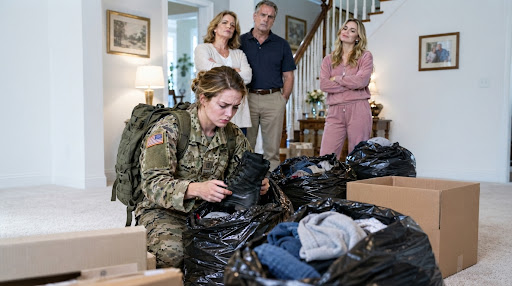
Instead, I’d found my life in garbage bags.
And somehow, I’d been expected to apologize for being upset.
I covered my face.
And cried until there was nothing left.
Over the following weeks, I slowly restored the house.
I moved my furniture back upstairs.
Repainted the bedroom.
Replaced the broken closet doors.
And unpacked every garbage bag.
My combat boots went beside the closet.
My uniforms returned to their proper place.
My old photographs went back onto the shelves.
And Grandpa’s picture returned to the mantel.
In it, he stood beside me on the day I commissioned as an Army officer.
He wore his best suit.
His silver hair was neatly combed.
And his smile was so wide that it made his eyes disappear.
I remembered what he’d whispered when he hugged me.
“Never let anyone make you feel small for serving something bigger than yourself.”
I stared at the photograph.
Then whispered, “I tried, Grandpa.”
Two months later, my promotion became official.
I was promoted to major.
The ceremony was small.
A few fellow officers.
My commanding officer.
Captain Morales, who had supported me through the initial crisis.
And one person I hadn’t expected to be there.
My grandfather’s old friend, Colonel James Whitaker, retired.
He’d known Grandpa for nearly thirty years.
When he heard what happened, he called and asked whether he could attend.
“I promised Thomas I’d look out for you,” he told me.
At the ceremony, he stood beside me while my new rank was pinned.
Afterward, he handed me a small envelope.
“Your grandfather gave me this years ago.”
I stared at him.
“What?”
“He said to give it to you when you made major.”
My hands trembled.
Inside was a handwritten note.
“Elizabeth,
If you’re reading this, you made it.
I always knew you would.
But I hope you remember something.
Rank is earned.
Respect is earned.
Trust is earned.
And nobody gets to demand those things simply because they share your blood.
Be kind.
Be fair.
Stand tall.
And never confuse obedience with love.
I’m proud of you.
Grandpa.”
I couldn’t speak.
Colonel Whitaker gently squeezed my shoulder.
“He was proud of you long before you put on that uniform.”
I nodded through my tears.
“I know.”
And for the first time since returning home, I felt like I was exactly where I belonged.
A year later, I hosted a small dinner at the house.
Nothing extravagant.
Just a few friends from the military.
Captain Morales.
Colonel Whitaker.
And two neighbors who had helped me repair the backyard fence.
We grilled chicken.
Made potato salad.
And sat beneath the apple trees as the sun went down.
Someone asked whether I ever regretted fighting for the house.
I looked around.
At the porch Grandpa had built.
The windows he’d installed.
The yard where I’d spent my childhood.
Then I shook my head.
“Not once.”
Because I’d learned something during those terrible months.
Standing up for yourself doesn’t always feel powerful.
Sometimes it feels lonely.
Sometimes it costs you relationships.
Sometimes the people you love accuse you of destroying everything simply because you refuse to let them destroy you.
But boundaries aren’t cruelty.
And protecting what belongs to you isn’t selfishness.
I hadn’t returned from deployment looking for a war with my family.
I’d returned looking for home.
And when I discovered they’d tried to take it from me, I did what Grandpa had taught me to do.
I checked the facts.
I stood by the truth.
And I refused to surrender something simply because someone demanded it.
That evening, after everyone left, I stood alone on the back porch.
The apple trees swayed gently in the wind.
The sky glowed orange above the distant hills.
I held Grandpa’s letter in my hand.
Then I looked toward the house.
My house.
The home he’d protected for me.
The home my family had nearly stolen.
And I finally understood why he’d placed it in a trust.
He knew his son.
He knew how easily generosity could be mistaken for weakness.
And he knew that someday I might need protection from the very people who claimed to love me most.
I folded the letter carefully.
Then whispered, “Thank you, Grandpa.”
The wind moved through the branches.
For a moment, I could almost hear his voice.
Stand tall, Elizabeth.
I smiled.
“I will.”
Because the greatest thing my grandfather left me wasn’t a house.
It wasn’t the deed.
It wasn’t the trust.
It was the courage to understand that I deserved respect without having to purchase it with sacrifice.
My parents thought that because I was single, I didn’t need the master bedroom.
Because I was deployed, I didn’t need my belongings.
Because I was financially stable, I didn’t need my savings.
And because I was a good daughter, I would never say no.
They were wrong.
I had spent nine months serving my country.
I had come home expecting to rest.
Instead, I had to fight for the life I’d already built.
But I didn’t lose that fight.
I recovered my home.
Protected my career.
Began recovering my money.
And learned that I could love my family without allowing them to control me.
As I turned off the porch light, I glanced once more at Grandpa’s photograph through the living room window.
Then I smiled.
Because I knew exactly what he would have said if he’d seen me standing there.
“That’s my girl.”
And for the first time in a very long time, I believed it.
THE END THANK YOU FOR READING !!!