PART 3
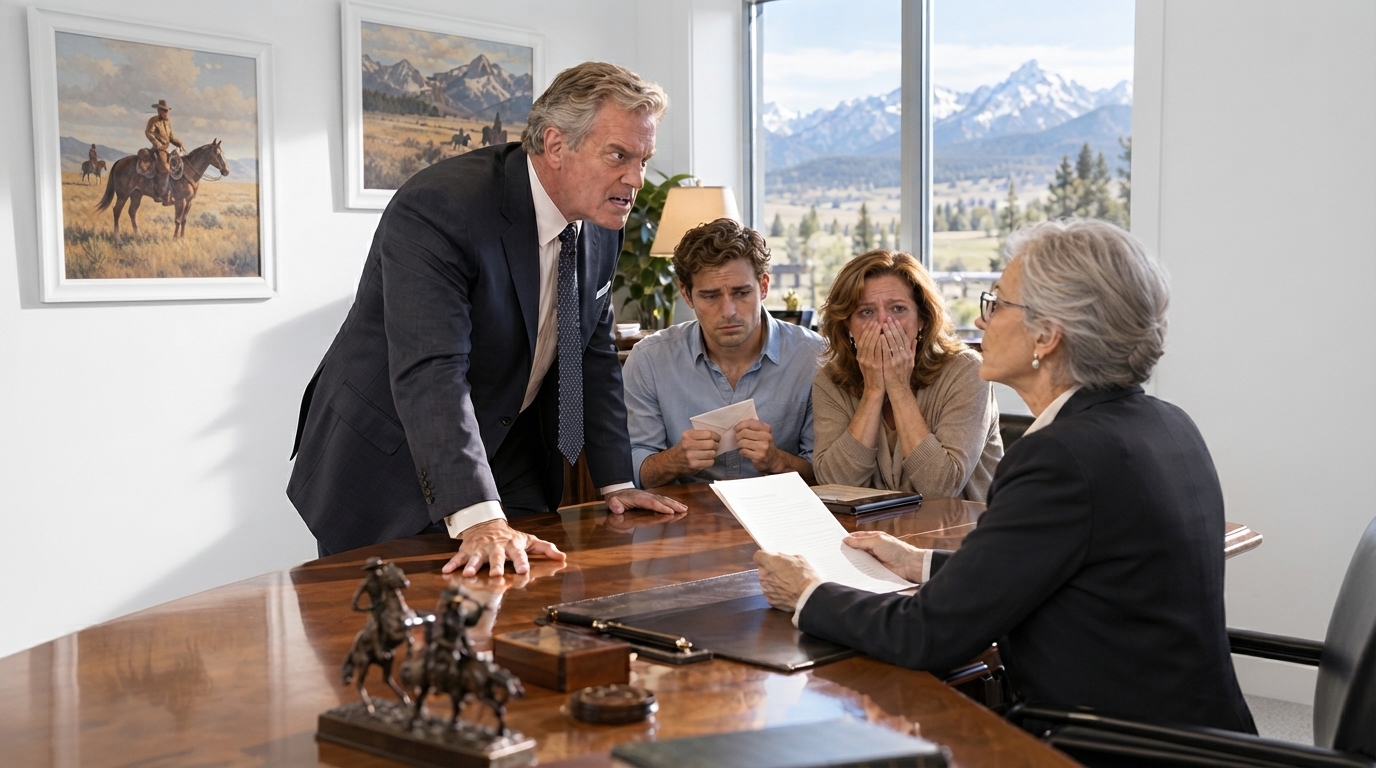
Carol Jenkins adjusted her glasses and
placed a thick document on the conference table.
My father leaned forward.
“What is that?”
Carol didn’t answer immediately.
Instead, she looked around the room.
My aunt Karen sat beside me,
her hands folded tightly in her lap.
My mother stared at the polished wooden table.
Dad looked impatient, almost amused.
He still believed Grandpa had nothing left.
After all, he’d spent eight months reminding
everyone that the ranch was gone,
the money had been transferred,
and Henry Brooks had willingly surrendered everything.
But Carol looked remarkably calm.
“Before we discuss Henry’s will,” she said,
“we need to clarify something about the sale of Silver Creek Ranch.”
Dad rolled his eyes.
“We already know about the sale.”
“Do we?”
He frowned.
Carol opened the first document.
“This is the purchase agreement signed eight months ago.”
She slid a copy across the table.
Dad glanced at it.
“So?”
“The purchase price was one million four hundred thousand dollars.”
“Exactly.”
“But Robert,” Carol continued, “the proceeds were not transferred directly to your personal account.”
Dad’s expression changed.
“What are you talking about?”
Carol placed another document beside the first.
“They were deposited into the Henry Brooks Revocable Living Trust.”
The room went silent.
I looked at Carol.
“A trust?”
She nodded.
“Your grandfather established it before completing the sale.”
Dad laughed sharply.
“That doesn’t mean anything. He gave me the money.”
Carol looked at him.
“He authorized you to manage certain financial affairs on his behalf. That is not the same as giving you unrestricted ownership.”
Dad’s smile disappeared.
I felt my heart pounding.
For months, I’d believed Grandpa had simply handed over his fortune because he trusted his son.
I’d been angry with Dad for abusing that trust.
But now I realized there was something more complicated beneath the surface.
Carol continued.
“Henry appointed Robert as his financial agent under a power of attorney. Robert was also given limited authority to assist with certain trust transactions.”
Dad shifted in his chair.
“He wanted me to handle everything.”
“Yes,” Carol replied. “For his benefit.”
My father stared at her.
Then he said, “He signed a gift letter.”
Carol nodded.
“I’ve reviewed it.”
Dad relaxed slightly.
“There. That settles it.”
“Not quite.”
She placed a third document on the table.
“The gift letter refers to a separate amount Henry intended to provide for family assistance. It does not authorize Robert to take the entire ranch proceeds.”
Dad’s face tightened.
“That isn’t what he told me.”
Carol opened a sealed envelope.
The paper inside was yellowish, folded neatly into thirds.
Across the front, in Grandpa’s familiar handwriting, were four words.
For My Family, Eventually.
My throat tightened.
I’d seen that handwriting on birthday cards.
On Christmas envelopes.
On little notes Grandpa used to leave beside the kitchen sink at the ranch.
He always wrote slowly, pressing the pen hard against the paper.
Carol unfolded the letter.
“Henry asked that this be read after his death, with all his children and grandchildren present.”
Dad crossed his arms.
“This is ridiculous.”
Carol began reading.
“My dear family, if you are hearing these words, then my time on this earth has ended. I hope I left behind more good memories than bad ones.”
I swallowed hard.
“I sold Silver Creek Ranch because my body could no longer manage the work. It broke my heart to let the land go, but I believed I was making a responsible decision.”
Carol paused.
Then continued.
“Robert offered me a home. He promised that I would never have to worry about food, shelter, or medical care again.”
My father stared at the table.
“I wanted to believe him. A father should be able to trust his son.”
Karen reached for my hand.
Carol’s voice grew quieter.
“But I have lived long enough to know that love and money can become tangled in terrible ways. That is why I asked Carol to help me protect what remained of my life’s work.”
Dad suddenly stood.
“This is nonsense!”
Carol didn’t raise her voice.
“Please sit down, Robert.”
He pointed toward the letter.
“My father wasn’t thinking clearly!”
Carol looked at him.
“Henry signed these documents while his capacity was evaluated and documented. We also have independent witnesses. If you wish to challenge them, you’re entitled to seek legal advice.”
Dad’s jaw tightened.
But he sat.
Carol continued reading.
“The money from Silver Creek was meant to provide for my care first. Whatever remained after my death was to be distributed according to my trust.”
My heart began pounding harder.
“Robert was trusted to help manage those funds. He was not authorized to treat them as his own personal fortune.”
Dad’s face drained of color.
Carol stopped reading.
Then she looked directly at him.
“Robert, we have obtained financial records showing substantial withdrawals and transfers from the trust and related accounts.”
My father swallowed.
“What records?”
“Bank statements. Transaction histories. Copies of checks. Records of purchases.”
He looked toward my mother.
She wouldn’t meet his eyes.
Carol continued.
“We’ve identified approximately $620,000 in transactions that require explanation.”
I felt the room tilt.
Six hundred and twenty thousand dollars.
Dad’s new truck.
The boat.
The renovations.
The expensive vacations.
The jewelry my mother had started wearing.
Suddenly, everything made sense.
“You stole from him,” I whispered.
Dad snapped toward me.
“Watch your mouth!”
I stood.
“You threw him into the rain after spending his money!”
“Daniel, sit down!”
“No!”
My voice cracked.
“He was eighty-eight years old! He couldn’t remember where the bathroom was! He was asking for Grandma Eleanor!”
Dad’s face reddened.
“You have no idea what caring for him was like!”
“I know exactly what it was like!”
My words echoed through the conference room.
“I was the one who cared for him after you threw him away!”
For a moment, nobody spoke.
Then Carol quietly said, “Daniel, please.”
I sat down.
My hands were shaking.
Carol looked at my father.
“The trust’s successor trustee has been notified, and a formal accounting is underway. These transactions may result in civil claims, and any suspected criminal conduct will be referred to the appropriate authorities.”
Dad leaned back.
His face had gone completely white.
Then he whispered, “He wouldn’t do this to me.”
Carol looked at him sadly.
“Henry didn’t create these documents to punish you. He created them to protect himself.”
I stared at my father.
For the first time in my life, he looked genuinely frightened.
Not angry.
Not insulted.
Frightened.
Because the money he’d treated as his inheritance had never been his to spend freely.
And now someone was finally asking him to explain where it had gone.
But Carol wasn’t finished.
She turned another page.
“There is also a separate letter addressed to Daniel.”
My heart stopped.
“To me?”
She nodded.
“Your grandfather wrote it after he began living with you.”
I stared at the envelope.
My name was written across the front.
Daniel Brooks.
Below it, in Grandpa’s uneven handwriting, were five words.
For the boy who stayed.
I felt tears rise immediately.
Carol handed it to me.
My fingers trembled as I opened it.
Inside was a letter written on lined notebook paper.
The kind Grandpa kept beside his bed.
I unfolded it.
And began reading.
“Dear Daniel,
I know I have become a difficult old man.
Sometimes I forget where I am. Sometimes I call you Robert. Sometimes I wake up believing Eleanor is still alive.
I know this must be hard for you.
But every morning, you look at me like I am still worth something.
You bring me coffee.
You help me find my shoes.
You listen when I tell the same stories again.
You never make me feel ashamed for forgetting.
I want you to know that I notice.
Even on the days when I cannot remember your name, I remember how safe I feel when you are near.”
I couldn’t continue.
My vision blurred.
Karen wrapped an arm around my shoulders.
I pressed the letter against my chest.
For months, I’d wondered whether Grandpa understood how much I loved him.
Whether he knew I was trying.
Whether he realized I wasn’t angry when he forgot things.
And now, in his own words, he was telling me.
He knew.
He’d known all along.
After a moment, I wiped my face and continued.
“You once asked me why I never sold the ranch sooner.
I told you the land was part of our family.
But land is only dirt and grass without people who care about one another.
Your father inherited my name.
You inherited something more important.
You inherited my understanding of what family should mean.”
I stopped again.
Across the table, Dad stared at the wall.
I kept reading.
“I have asked Carol to make sure the remaining trust property is handled fairly and that you are reimbursed, where legally appropriate, for the expenses you carried while caring for me.
I cannot give you back the sleep you lost.
I cannot restore the relationship that suffered.
And I cannot erase the burden I placed on your shoulders.
But I can tell you that you gave an old man the greatest gift he could receive.
You gave me a place where I was wanted.
Love, Grandpa Henry.”
I lowered the letter.
Nobody spoke.
Even Carol looked emotional.
Then Dad muttered, “So that’s it? Daniel gets everything?”
Carol turned toward him.
“No, Robert. The trust provides for several beneficiaries. But your father did make changes concerning your share.”
Dad leaned forward.
“What changes?”
Carol looked down at the document.
“Any distribution otherwise payable to you is subject to the trust’s provisions concerning debts and obligations owed to the trust. The successor trustee will also seek recovery of funds improperly used.”
My father stared.
“You can’t do that.”
Carol closed the folder.
“Those are matters for the court and the attorneys involved.”
Dad stood so suddenly his chair scraped across the floor.
“This family is turning against me!”
I looked at him.
“No, Dad.”
He glared.
“You did this yourself.”
He pointed at me.
“You poisoned him against me!”
My chest tightened.
“Grandpa was still defending you when he died.”
That stopped him.
I swallowed.
“He kept saying you were tired. That you had a lot on your mind. That you didn’t mean to hurt him.”
Dad’s expression flickered.
I continued.
“Even after you threw him into a storm, he kept making excuses for you.”
My father looked away.
For one brief moment, I thought he might cry.
But instead, he grabbed his coat.
“You’ll all regret this.”
Then he walked out.
The conference room door slammed behind him.
Karen began crying.
My mother remained seated.
She hadn’t said a word during the entire meeting.
Finally, she looked at me.
“Daniel.”
I turned.
Her eyes were wet.
“I didn’t know about all the money.”
I stared at her.
“But you knew he put Grandpa outside.”
She lowered her head.
And that silence told me everything.
I picked up Grandpa’s letter.
Then I stood.
For the first time since that terrible night at the diner, I felt something I hadn’t expected.
Not victory.
Not satisfaction.
Just sadness.
Because Grandpa had spent his life building something beautiful.
And the people he trusted most had nearly destroyed it.
But what happened during the following weeks would prove that the sealed envelope was only the beginning.
Because my father had one more secret.
And when investigators discovered it, even Carol Jenkins was shocked.
PART 4
Three weeks after the reading of Grandpa’s will, I received a call from Carol Jenkins.
“Daniel, can you come to my office tomorrow?”
I was sitting at my kitchen table grading essays.
“Is something wrong?”
She hesitated.
“We’ve discovered additional information about the ranch proceeds.”
My stomach tightened.
“What kind of information?”
“I’d rather explain in person.”
I looked toward the living room.
Grandpa’s old pocket watch sat on the shelf beside his photograph.
I’d kept it there since his funeral.
Sometimes, when the apartment was quiet, I imagined I could hear him clearing his throat from the bedroom.
Or asking whether I’d made coffee.
Or calling out for Eleanor.
I missed him in ways I couldn’t explain.
“Okay,” I said. “I’ll be there.”
The next morning, I walked into Carol’s office and found Karen waiting.
She stood when she saw me.
“Daniel.”
I hugged her.
“What’s going on?”
Carol motioned for us to sit.
Then she opened a folder.
“We’ve received additional bank records and documents from the trust’s financial institution.”
I leaned forward.
“And?”
“Your grandfather’s ranch was sold for approximately $1.4 million, as you know. After transaction expenses and the transfers that followed, a significant portion of the proceeds should have remained available for his care.”
I nodded.
“But Robert moved money into several accounts.”
“Yes.”
Carol turned a page.
“Some transfers appear to have paid personal expenses. Others went to an investment company.”
Karen frowned.
“What investment company?”
Carol slid a document toward us.
The name printed across the top was Cedar Ridge Development Partners.
I recognized it immediately.
“That’s Dad’s company.”
Carol nodded.
“He used funds connected to Henry’s trust to finance a real estate development project.”
I stared at her.
“How much?”
“Approximately $410,000 in transfers are linked to that business.”
My mouth went dry.
Dad had told me Grandpa’s money was invested.
Technically, he’d been telling the truth.
But he hadn’t invested it for Grandpa.
He’d used it to finance his own project.
Carol continued.
“The development appears to have stalled. Several creditors have claims against the business.”
Karen covered her mouth.
“Oh, my God.”
I looked at Carol.
“Can the money be recovered?”
“Possibly some of it. The successor trustee is pursuing an accounting and reviewing recovery options.”
I sat back.
For a moment, all I could think about was Grandpa sitting in my apartment, apologizing because he needed help getting dressed.
He’d worried about the cost of his medication.
He’d offered me the last few dollars in his wallet.
Meanwhile, hundreds of thousands of dollars from his ranch were tied up in my father’s failed business venture.
I felt sick.
“There’s something else,” Carol said.
I looked up.
She placed a smaller document on the table.
“This is a copy of a letter your father sent to the trust’s bank several months before Henry moved into your apartment.”
I read it.
The letter stated that Henry’s medical needs were minimal and that no substantial care expenses were anticipated.
I stared at the page.
“Minimal?”
Carol nodded.
“Your father represented that Henry was healthy enough to live independently with ordinary family support.”
My hands began trembling.
“Grandpa was already confused.”
“I understand.”
“He was forgetting meals. Getting lost inside the house. He needed a doctor.”
Carol looked at me.
“That discrepancy is one reason the transactions are being examined closely.”
I remembered my last argument with Dad before Grandpa died.
“Medical help costs money,” he’d said.
I looked at the document again.
Dad hadn’t wanted to spend money on Grandpa’s care because he was using that money for himself.
The realization made my chest ache.
Karen reached across the table.
“Daniel, breathe.”
I looked at her.
“I keep thinking about that night.”
She nodded.
“The storm?”
“Yes.”
My voice broke.
“He was sitting in that diner asking for Grandma Eleanor. He thought she’d come get him.”
Karen’s eyes filled.
“I know.”
“He’d spent sixty years working that ranch. He deserved better than a garbage bag.”
Neither woman answered.
Because there was nothing to say.
The investigation continued for months.
The successor trustee, an independent professional appointed under Grandpa’s documents, demanded a full accounting.
My father hired an attorney.
Then another.
He insisted the money had been gifts.
He claimed Grandpa had approved every transaction.
He accused Carol of manipulating the paperwork.
But the financial records told a different story.
There were payments for luxury vehicles.
Boat expenses.
Home renovations.
Vacations.
And large transfers to Cedar Ridge Development Partners.
Some transactions had legitimate explanations.
Others did not.
The trustee pursued civil recovery of the funds believed to have been improperly taken.
Authorities also reviewed the circumstances surrounding Grandpa’s treatment and the financial transactions.
I learned quickly that legal proceedings were nothing like television.
There were no dramatic courtroom confessions.
No instant verdict.
No judge banging a gavel while everyone applauded.
There were documents.
Depositions.
Accountants.
Delays.
And more paperwork than I thought one family could produce.
Sometimes I wondered whether Grandpa would have wanted all this.
Then I remembered the letter.
He hadn’t wanted revenge.
He’d wanted protection.
And he’d wanted the truth.
So I cooperated whenever I was asked.
I provided records of Grandpa’s medical expenses.
Receipts for prescriptions.
Bills from appointments.
Statements showing what I’d paid from my own accounts.
Karen provided records of the money she’d sent to help.
And Nancy, the waitress from Lakeside Diner, gave a statement describing the night Grandpa arrived soaked and confused.
She remembered him clearly.
“He kept saying his son didn’t want him anymore,” she told the investigator.
When I heard that, I had to leave the room.
I walked outside.
Sat in my car.
And cried.
Because even after all those months, the image of Grandpa trembling over that coffee cup still haunted me.
One afternoon in early spring, my father appeared outside Pine Ridge High School.
I’d just finished teaching my final class.
Students were leaving the building.
The parking lot was crowded with buses and cars.
I spotted Dad standing beside his truck.
He looked different.
Older.
Tired.
The expensive suit was gone.
He wore jeans and a faded jacket.
“Daniel.”
I stopped several feet away.
“What are you doing here?”
“I need to talk.”
“You can contact my attorney.”
He winced.
“Please.”
Something in his voice made me hesitate.
I looked around.
Then pointed toward a bench near the school entrance.
“Five minutes.”
We sat.
For a while, neither of us spoke.
Then Dad looked at his hands.
“Your mother and I are separating.”
I stared at him.
“What?”
“She moved in with Brinn.”
I hadn’t expected that.
Dad swallowed.
“She says she can’t live with everything that’s happened.”
I looked away.
Part of me wanted to feel sorry for him.
But another part remembered Grandpa standing in the rain.
“I’m sorry your marriage is struggling,” I said.
Dad nodded.
Then he looked at me.
“I’ve lost the boat.”
I said nothing.
“The development project is finished. The bank is coming after what it can.”
I waited.
He rubbed his forehead.
“I may lose the house.”
There it was.
The Cedar Ridge house.
The beautiful property he’d renovated using money that should have supported Grandpa.
I looked at him.
“Dad, why are you telling me this?”
His eyes filled.
“I thought maybe you’d understand.”
I felt something cold settle inside me.
“Understand what?”
“That I was under pressure.”
I stared at him.
He continued.
“The business was failing. Your mother wanted the renovations finished. The payments kept coming. I thought I could turn things around.”
I shook my head.
“And Grandpa?”
Dad looked away.
“He was difficult.”
I stood.
He grabbed the edge of the bench.
“Daniel, wait.”
I turned.
“He was sick.”
Dad’s face tightened.
“I know.”
“He wasn’t difficult because he wanted to be.”
“I know!”
“No,” I said. “I don’t think you do.”
My voice shook.
“He forgot things. He got frightened. Sometimes he called me by your name. But he was still Grandpa.”
Dad stared at me.
“He was still the man who taught you to ride horses. The man who paid for your education. The man who trusted you with everything.”
Tears filled my eyes.
“And when he needed you, you treated him like an expense.”
Dad lowered his head.
For a long moment, neither of us spoke.
Then he whispered, “I didn’t think he’d die so soon.”
That sentence hit me harder than anything else he’d said.
I stared at him.
“What?”
He looked up.
“I thought we’d have time to work things out.”
I felt my chest tighten.
“You thought he’d wait?”
Dad didn’t answer.
“You thought you could throw him out, spend his money, and apologize later?”
He began crying.
Real tears.
For the first time since Grandpa’s death, I saw my father break.
“I made a terrible mistake.”
I looked at him.
“No, Dad.”
He froze.
“You made a series of choices.”
He covered his face.
I continued.
“You chose to take control of his money. You chose not to get him medical care. You chose to put him outside. And you chose to lie about it afterward.”
His shoulders shook.
“I know.”
I took a breath.
“Then take responsibility.”
He looked up.
“What do you want me to do?”
“Tell the truth. Cooperate with the investigation. Stop blaming Grandpa.”
Dad wiped his face.
“And then?”
I looked toward the school building.
“Then live with whatever comes next.”
I walked away.
He didn’t follow.
By late summer, the civil case had reached a settlement.
The exact amount recovered was less than what investigators believed had been improperly used.
Some money had disappeared into the failed development project.
Other assets had depreciated.
But the trustee recovered a substantial amount through negotiated payments and asset sales.
Dad was required to provide a full accounting and relinquish claims that conflicted with the settlement.
The remaining trust assets were distributed according to Grandpa’s instructions after expenses, liabilities, and the required administration were completed.
Karen received her designated share.
A portion was reserved for charitable purposes.
And I received a distribution that changed my life.
Not because it made me rich.
But because it gave me breathing room.
My credit card debts were paid.
My savings were restored.
And I no longer had to worry about how I would recover financially from those months caring for Grandpa.
There was also a reimbursement for documented expenses I’d incurred while looking after him.
When Carol explained the figures, I sat quietly.
Then I asked, “Did Grandpa really arrange this?”
She smiled.
“He wanted you to be protected.”
My eyes filled.
“He always worried about me.”
Carol nodded.
“He spoke about you often.”
I looked down.
“What did he say?”
She hesitated.
Then smiled gently.
“He said you were the only person in the family who understood that a promise was something you kept even when it became inconvenient.”
I couldn’t speak.
Because that was exactly how Grandpa had lived.
He kept promises.
Even when they cost him.
Even when nobody noticed.
Even when the world changed around him.
And somehow, he’d managed to teach me to do the same.
A month later, Karen called with an idea.
“Daniel, have you thought about going back to Silver Creek?”
I was sitting at my kitchen table.
The same table where I’d helped Grandpa sort his medication.
The same table where he’d told stories about the ranch.
“Why?”
“I think we should visit.”
I hesitated.
The ranch had been sold.
It wasn’t ours anymore.
A private agricultural company owned the land.
The old farmhouse had been renovated.
The cattle operation had changed.
And I wasn’t sure I wanted to see it.
But Karen persisted.
“Just once.”
Eventually, I agreed.
We contacted the new owners, explained our family history, and asked whether we could visit briefly.
To my surprise, they said yes.
On a bright September morning, Karen and I drove out of Billings.
The road stretched beneath an enormous Montana sky.
Golden grass rolled across the hills.
Cattle grazed near distant fences.
And as we turned onto the familiar gravel road, my chest tightened.
There it was.
Silver Creek Ranch.
The wooden entrance sign had been restored.
The old barn still stood.
And beyond it, the mountains rose exactly as they had when I was a child.
I stopped the car.
For a moment, I couldn’t move.
Karen touched my arm.
“You okay?”
I nodded.
But tears were already falling.
We walked toward the barn.
The new owner, a kind man named Thomas Reed, greeted us.
He’d heard about Grandpa from neighboring ranchers.
“Henry Brooks was something of a legend around here,” he said.
I smiled through my tears.
“He would’ve liked hearing that.”
Thomas showed us the renovated farmhouse.
The repaired fences.
The new equipment.
Then he led us toward the old cottonwood tree beside the creek.
My heart stopped.
Grandpa used to sit beneath that tree on summer evenings.
He’d bring a folding chair, a thermos of coffee, and a little radio.
Sometimes he’d let me stay up late and listen to baseball games with him.
I walked toward the tree.
The bark was rough beneath my hand.
And suddenly, I was ten years old again.
Grandpa standing beside me.
Teaching me how to tie a proper knot.
Laughing when I dropped a bucket into the creek.
Telling me that a man’s worth wasn’t measured by what he owned.
I closed my eyes.
“I miss you, Grandpa.”
The wind moved through the branches.
For a moment, it almost sounded like his voice.
Karen stood beside me.
Neither of us spoke.
Then Thomas cleared his throat.
“There’s something you might want to see.”
We followed him toward the barn.
Inside, hanging on the wall, was an old wooden sign.
The paint was faded.
The lettering was crooked.
But I recognized it immediately.
Grandpa had made it himself.
It read:
SILVER CREEK RANCH — EST. 1905
Beneath the name was a smaller sentence.
I’d forgotten about it until that moment.
A MAN’S WORD IS HIS REAL INHERITANCE.
I stared at those words.
Then I began crying.
Because Grandpa had understood something my father never did.
Money could disappear.
Land could be sold.
Houses could be lost.
But character remained.
And when everything else was gone, that was what people remembered.
Thomas looked at me.
“Would you like to have it?”
I turned.
“What?”
“The sign. It belonged to your grandfather. Seems right that it should stay in the family.”
I shook my head.
“I couldn’t—”
“Please.”
He smiled.
“We’ve already made a new one for the entrance.”
I looked at Karen.
She was crying too.
Then I carefully lifted the sign from the wall.
It was heavier than I remembered.
The wood smelled faintly of dust and old paint.
And for the first time since Grandpa’s death, I felt as though a small piece of him had come home.
That winter, I bought a modest house outside Billings.
Nothing fancy.
Two bedrooms.
A small yard.
A porch overlooking a stretch of open fields.
I hung Grandpa’s sign above the fireplace.
His pocket watch sat on the mantel.
Beside it was the photograph from the diner.
Not the terrible night when I found him.
A photograph Nancy had taken several weeks later, when Grandpa returned to thank her for helping him.
He was smiling.
Holding a cup of coffee.
And wearing the old blue sweater Eleanor had knitted for him years earlier.
Every morning before work, I passed that photograph.
Sometimes I stopped.
Sometimes I said good morning.
Sometimes I simply smiled.
I never forgot the difficult months.
The exhaustion.
The fear.
The financial pressure.
The loneliness after my girlfriend left.
But I also remembered the good moments.
Grandpa laughing at an old western movie.
Grandpa telling me how he proposed to Eleanor.
Grandpa insisting on folding his own laundry, even when he couldn’t remember where the drawers were.
And Grandpa waking one morning, looking directly at me, and saying, “Daniel, you’re a good man.”
He forgot my name again twenty minutes later.
But I never forgot those words.
Nearly a year after the settlement, I received a final letter from my father.
It was short.
There were no excuses.
No requests for money.
No accusations.
Only a few sentences.
“Daniel, I have spent a long time thinking about what I did to Dad. I know I cannot undo it. I know I failed him when he needed me most. I am sorry for the pain I caused you and Karen. I don’t expect forgiveness. I only hope that someday I can become a better man than the one I was.”
I read it twice.
Then I folded it.
I didn’t throw it away.
But I didn’t answer immediately either.
Because forgiveness wasn’t something I could manufacture simply because someone finally admitted the truth.
Maybe one day I would sit across from my father and talk about Grandpa without anger.
Maybe one day we’d rebuild something.
Or maybe we wouldn’t.
I didn’t know.
And for the first time, I accepted that uncertainty.
I no longer felt responsible for fixing everyone.
I had spent enough of my life trying to carry burdens that belonged to other people.
Grandpa had taught me loyalty.
But he’d also taught me that loyalty without honesty could become something dangerous.
And I was finally learning the difference.
On the second anniversary of Grandpa’s death, Karen came to visit.
We made coffee.
Sat on the porch.
And watched the sun set behind the distant hills.
She brought a small box.
“Found this while sorting through some of Dad’s old things.”
Inside was a photograph.
Grandpa stood beside a young Robert in front of the ranch barn.
Dad couldn’t have been more than twelve.
They were both smiling.
Grandpa had one arm around his son’s shoulders.
I stared at the picture.
For a moment, I felt an unexpected ache.
Not just for Grandpa.
For the boy my father had once been.
The boy Grandpa had loved.
The boy who’d grown into a man capable of hurting him so terribly.
Karen looked at me.
“Dad loved Robert.”
I nodded.
“I know.”
“He never stopped.”
I looked toward the horizon.
“That’s what makes it so sad.”
We sat quietly.
Then Karen asked, “Do you think Dad knew what would happen?”
I shook my head.
“No.”
“Then why did he prepare all those documents?”
I thought about the sealed envelope.
The trust.
The letter.
The careful planning.
Then I looked at the sign above the fireplace.
“Because Grandpa understood that love and trust aren’t always enough to protect someone.”
Karen nodded slowly.
“And because he wanted the truth to survive him.”
I smiled sadly.
“Yeah.”
The sun dipped behind the hills.
The air grew cool.
And somewhere in the distance, cattle moved across the fields.
For a moment, I could almost imagine Grandpa standing beside us.
His weathered hands.
His old boots.
His quiet smile.
I thought about the last thing he’d said to me before going to sleep on that final Tuesday night.
He’d looked toward the window.
Then turned to me.
“Daniel?”
“Yes, Grandpa?”
“Did I do all right?”
I’d smiled.
“What do you mean?”
“With my life.”
I remember feeling my throat tighten.
I took his hand.
“You built a ranch. Raised a family. Loved Grandma for more than sixty years. I’d say you did pretty well.”
He’d smiled faintly.
Then whispered, “I hope I was a good father.”
At the time, I didn’t know what to say.
Now, two years later, I finally knew.
He had been a good father.
He’d loved his children.
He’d given them opportunities.
He’d trusted them.
And even when one of them betrayed him, he hadn’t stopped hoping that love might still matter.
His failure wasn’t loving too much.
His tragedy was trusting someone who valued his money more than his life.
But that wasn’t the whole story.
Because Grandpa’s legacy hadn’t ended with the sale of Silver Creek Ranch.
It hadn’t disappeared into my father’s bank accounts.
It hadn’t died in a storm or vanished with the old farmhouse.
It lived in the people who remembered him.
In Karen’s kindness.
In Nancy’s compassion.
In the students I taught to keep their promises.
And in the simple decision I’d made that terrible night to drive through the rain and bring an old man home.
I looked toward Grandpa’s photograph.
Then whispered something I wished I’d told him more often.
“You were never a burden.”
The words caught in my throat.
“You were my family.”
Karen reached for my hand.
We sat together until the stars appeared.
And for the first time, remembering Grandpa didn’t feel like reopening a wound.
It felt like coming home.
Because in the end, the most valuable thing Henry Brooks left behind wasn’t the $1.4 million.
It wasn’t the ranch.
It wasn’t the trust.
It wasn’t even the sealed envelope that exposed my father’s betrayal.
It was a lesson that would stay with me for the rest of my life.
A person’s true inheritance isn’t what they receive when someone dies. It’s what they learned from that person while they were alive.
My father inherited access to Grandpa’s fortune and nearly destroyed it.
I inherited his kindness.
His stubborn loyalty.
His belief that promises mattered.
And his understanding that nobody should ever be made to feel worthless simply because they’ve grown old.
That was the inheritance I would carry.
Not in a bank account.
But in every choice I made.
And whenever I looked at the old wooden sign above my fireplace, I remembered the words Grandpa had carved into it decades earlier.
A MAN’S WORD IS HIS REAL INHERITANCE.
Grandpa had kept his.
And I intended to keep mine.
THE END THANK YOU FOR READING !!!



