PART 3
“He did this to me.”
Those five words were barely louder than a whisper,
but they cut through the emergency
room more sharply than any alarm.
For half a second, nobody moved.
Then Emily Harris’s heart monitor began screaming.
“Blood pressure seventy over forty!” Marcus shouted.
I looked at the monitor.
Her heart rate had climbed to 158.
Her oxygen saturation was falling.
And the woman lying on the stretcher was slipping
into septic shock right in front of us.
“Start the sepsis protocol!” I ordered.
Blood cultures, broad-spectrum antibiotics, IV fluids.
Call critical care and orthopedic surgery.
Tell them we may need vascular surgery too.
Marcus moved immediately.
Behind me, Daniel Harris began shouting.
“Stop! You’re making everything worse!”
Two security officers held him near the doorway.
His expensive jacket was twisted at the shoulders, and his face had turned an ugly shade of gray.
“She’s confused!” he yelled. “She doesn’t know what she’s saying!”
I turned toward him.
“Mr. Harris, your wife is critically ill. You need to step outside.”
“No! I’m her husband!”
“And I’m her doctor.”
He stared at me.
Then he said something I’ll never forget.
“You have no idea what you’re getting involved in.”
For a moment, the entire room seemed to grow colder.
I looked toward the security officers.
“Remove him from the treatment area. And notify the hospital supervisor.”
Daniel fought them.
Not violently enough to escape.
But desperately.
As though whatever was about to happen inside that room terrified him more than his wife’s condition.
The door closed behind him.
And I returned to Emily.
Her eyes were half-open.
Her breathing was shallow.
“Emily, can you hear me?”
She made a faint sound.
“I’m Dr. Jenkins. We’re going to help you.”
Her lips moved.
I leaned closer.
“Don’t…”
“Don’t what, Emily?”
Her eyes filled with tears.
“Don’t let him…”
Then her eyelids fluttered shut.
I looked at Marcus.
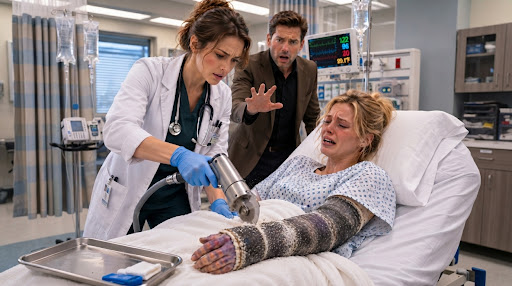
“Let’s get this cast off.”
The fiberglass had already been partially cut.
I carefully separated the remaining sections.
The smell intensified.
Marcus swallowed hard.
One of the nurses turned away for a second before regaining her composure.
I’ve treated severe burns.
I’ve seen devastating injuries.
I’ve cared for patients who arrived too late to save.
But what I saw beneath that cast made my stomach tighten.
Emily’s forearm was severely swollen.
Large areas of skin were discolored.
There were deep pressure injuries, infected wounds, and signs that the tissues had been deprived of proper circulation.
But those weren’t the only injuries.
Around her wrist were several narrow, parallel marks.
They looked nothing like damage caused by an ordinary fracture.
And embedded beneath the padding was a small metal object.
I carefully removed it with forceps.
It was a broken piece of a metal clasp.
Attached to it was a short length of dark nylon strap.
Marcus stared.
“What is that?”
I didn’t answer immediately.
Because I’d seen something similar before.
Not in an orthopedic clinic.
In an assault case.
I looked again at the marks around Emily’s wrist.
They were consistent with prolonged pressure from some kind of restraint.
My chest tightened.
“Marcus, document everything. Photographs according to hospital protocol. Preserve the material we remove.”
He nodded.
Then I noticed something else.
The fiberglass cast had been reinforced in several places with strips of material that didn’t match the original construction.
It looked as though someone had opened it and resealed it.
More than once.
I stared at Emily’s unconscious face.
A month.
Her husband claimed she’d worn the cast for a month.
A month of swelling.
A month of pain.
A month of infection.
And somehow, no one had brought her back for medical care until she was nearly dying.
“Get orthopedics down here immediately,” I said.
Marcus looked at me.
“You think he did this?”
I kept my voice low.
“I think we have enough reason to be very concerned. But right now, we save her life.”
Within minutes, the emergency department became a blur of controlled urgency.
A respiratory therapist arrived.
Critical care was notified.
Laboratory results began appearing.
Emily’s white blood cell count was dangerously abnormal.
Her lactate was elevated.
Her kidney function showed signs of injury.
Everything pointed toward a severe infection affecting her entire body.
The orthopedic surgeon, Dr. Nathan Cole, arrived shortly afterward.
He examined her arm.
His expression darkened.
“How long has this been like this?”
“Unknown,” I replied. “Husband says the cast was placed four weeks ago.”
Dr. Cole studied the wounds.
“She needs surgery. Now.”
He looked at the discolored fingers.
“We need to determine how much tissue is still viable.”
I nodded.
“Vascular is being contacted.”
Then I lowered my voice.
“There are also suspicious restraint marks. And we found a broken clasp under the cast.”
Dr. Cole looked at me.
“Was the husband present?”
“Yes.”
“Where is he now?”
“Security removed him from the room.”
Dr. Cole’s jaw tightened.
“Good.”
As the surgical team prepared to take Emily upstairs, she briefly regained consciousness.
I moved beside her.
“Emily, you’re in the hospital. You’re very sick, but we’re treating you.”
Her eyes moved toward the doorway.
She looked terrified.
“Daniel?”
“He’s not in here.”
She began shaking.
“Please…”
I held her uninjured hand.
“You’re safe in this room.”
Her fingers tightened around mine.
“He said…”
Her voice broke.
I leaned closer.
“What did he say?”
“He said nobody would believe me.”
A cold feeling spread through my chest.
“Emily, you don’t have to explain everything right now.”
She swallowed painfully.
“He told them I fell.”
I nodded.
“Okay.”
“I didn’t fall.”
My heart pounded.
“What happened?”
Her eyes filled with tears.
“He broke it.”
Before I could ask anything else, her breathing became more labored.
The anesthesiology team arrived.
We needed to move.
I squeezed her hand.
“Emily, listen to me. We’re going to take care of your arm. You can tell us more when you’re stronger.”
She stared at me.
Then whispered something so quietly I almost missed it.
“Check my phone.”
I frowned.
“Your phone?”
She nodded faintly.
“Pictures.”
Then her eyes closed.
The team transferred her toward surgery.
I stood in the hallway watching the stretcher disappear through the double doors.
For a moment, I couldn’t move.
Because I knew this wasn’t simply a medical emergency anymore.
Someone had deliberately concealed a critically injured woman’s condition.
And that woman had just told me her husband was responsible.
I went directly to the nurses’ station.
“Where are her belongings?”
Marcus pointed toward a sealed patient-property bag.
“Her purse and phone are there.”
“Keep everything secured. Document the chain of custody. We need to involve the appropriate authorities and our forensic nursing team.”
Marcus nodded.
Then he hesitated.
“Dr. Jenkins?”
“What?”
“Her husband is still here.”
I looked toward the waiting room.
Daniel stood near the glass doors, speaking rapidly into his phone.
His expression had changed.
He no longer looked panicked.
He looked furious.
And when he noticed me watching, he ended the call.
Then he walked straight toward me.
“Doctor.”
I stopped.
“Mr. Harris.”
“How is my wife?”
“She’s receiving emergency treatment.”
“Is she conscious?”
“Not at the moment.”
His shoulders relaxed.
It was subtle.
But I noticed.
“Good,” he said.
Then he caught himself.
“I mean… good that she’s being treated.”
I didn’t respond.
He glanced toward the hallway.
“I need her phone.”
I kept my expression neutral.
“Her belongings are being secured.”
“I’m her husband.”
“I understand.”
“Then give it to me.”
“I can’t release her property to you under these circumstances.”
His face hardened.
“You’re making a mistake.”
I looked directly at him.
“Mr. Harris, your wife is fighting for her life.”
He stepped closer.
“You think you know something.”
I said nothing.
He lowered his voice.
“People who interfere in marriages usually regret it.”
I felt my pulse quicken.
But before I could respond, a security officer approached.
“Sir, you need to step back.”
Daniel looked between us.
Then he smiled.
It was the most unsettling smile I’d seen in years.
“Fine.”
He straightened his jacket.
“Call me when she wakes up.”
Then he walked away.
I watched until he disappeared through the hospital entrance.
Only then did I realize my hands were trembling.
Three hours later, Dr. Cole called from the operating room.
Emily had survived the initial surgery.
The infection was extensive.
The surgical team had removed severely damaged tissue and relieved pressure in the arm.
Her circulation had improved somewhat, but the danger wasn’t over.
She would need intensive care, further procedures, and possibly additional surgery.
There was still a risk she could lose part of her hand or arm.
But she was alive.
For the moment, that was enough.
I was finishing my documentation when a woman appeared at the emergency department desk.
She looked to be in her late fifties.
Her hair was disheveled.
Her coat was buttoned incorrectly.
And she was crying so hard she could barely speak.
“Please,” she said. “I’m looking for Emily Harris.”
Marcus glanced toward me.
I approached.
“I’m Dr. Jenkins. Are you a relative?”
The woman nodded.
“I’m her mother. My name is Margaret Lawson.”
Her hands shook.
“Someone called me and said Emily was here.”
I guided her into a private consultation room.
“Your daughter is very ill, but she’s receiving treatment.”
Margaret covered her mouth.
“Oh, God.”
I sat opposite her.
“Can I ask when you last saw Emily?”
She looked at me.
“Seven weeks ago.”
I frowned.
“Seven weeks?”
Margaret nodded.
“She stopped answering my calls.”
“Did she say why?”
“Daniel said she needed space.”
I felt my stomach tighten.
“Space?”
“He said she was having emotional problems. That she was overwhelmed. He told me not to upset her.”
Margaret began crying again.
“I tried to visit. He wouldn’t let me inside.”
I leaned forward.
“Did you know she’d broken her arm?”
She shook her head.
“No.”
I watched her face.
“He told me she was visiting friends.”
My chest tightened.
“Mrs. Lawson, has Daniel ever prevented you from speaking with your daughter before?”
Margaret hesitated.
Then nodded.
“After they got married, he started controlling everything.”
She wiped her cheeks.
“Her phone. Her money. Her friends.”
I remained silent.
“Emily used to call me every Sunday. Then it became once a month. Then only text messages.”
Margaret looked at me desperately.
“Doctor, what happened to my daughter?”
I took a breath.
“There are injuries that raise serious concerns. Emily has made statements suggesting someone hurt her.”
Margaret stared at me.
Then her face crumpled.
“I knew it.”
I felt my heart sink.
“What do you mean?”
She reached into her purse.
And pulled out an old envelope.
Inside were several photographs.
Emily smiling at a birthday party.
Emily standing beside a Christmas tree.
Emily sitting on a porch.
But in every picture taken during the past year, something was wrong.
A bruise near her collarbone.
A swollen cheek.
A wrist hidden beneath a sweater.
Margaret pointed to the last photograph.
“Look at her left shoulder.”
I studied it.
A dark mark extended beneath Emily’s blouse.
“She told me she bumped into a door.”
Margaret’s voice broke.
“She always had an explanation.”
I looked at the photographs.
Then back at her.
“Have you shown these to anyone?”
“No.”
“Would you be willing to speak with the hospital’s social worker and the police?”
She nodded immediately.
“Anything.”
Then she reached into her purse again.
This time, she pulled out a folded piece of paper.
“I found this in my mailbox yesterday.”
I unfolded it.
The handwriting was shaky.
Only one sentence was written across the page.
“Mom, if something happens to me, don’t believe Daniel.”
I stared at the words.
Margaret began sobbing.
And suddenly, I understood why Daniel had been so desperate to stop us from removing the cast.
He wasn’t simply hiding an injury.
He was hiding evidence.
Evidence that could finally expose what had been happening inside his marriage.
But there was something neither Margaret nor I knew yet.
Something Emily had managed to hide from Daniel.
And when investigators eventually found it, the entire case would change.
Because Emily hadn’t just been trying to survive.
She had been preparing to escape.
PART 4
Emily Harris woke up thirty-six hours after surgery.
By then, her condition had stabilized enough for the intensive care team to reduce her sedation.
Her fever was improving.
Her blood pressure no longer required the same level of support.
But her right arm remained heavily bandaged.
And nobody could promise how much function she would recover.
I wasn’t scheduled to work that morning.
But I’d barely slept.
I kept thinking about her.
About the smell beneath the cast.
About Daniel’s expression when he realized we were going to remove it.
And about the letter Margaret had found in her mailbox.
So when the ICU called to tell me Emily was awake and asking for the emergency doctor, I went in.
She was lying beneath a white blanket.
Her face looked less gray than it had the night before.
But her eyes were filled with fear.
“Dr. Jenkins?”
I moved beside her.
“Hello, Emily.”
She looked toward the door.
“Is he here?”
“No. Hospital security has been informed of your concerns, and visitors are being managed according to your wishes and the hospital’s safety procedures.”
Her shoulders relaxed slightly.
Then she began crying.
Not loudly.
Just silent tears sliding down her cheeks.
I pulled a chair beside the bed.
“You don’t have to tell me anything you’re not ready to share.”
She looked at me.
“Did you see it?”
I nodded.
“Yes.”
“Under the cast?”
“Yes.”
Her eyes closed.
For several seconds, she couldn’t speak.
Then she whispered, “He told me it would heal.”
I felt my stomach tighten.
“What happened, Emily?”
She stared at the ceiling.
And slowly, she began telling me a story I would never forget.
Emily had met Daniel Harris five years earlier.
He was charming.
Successful.
Attentive.
He sent flowers to her office.
Remembered her favorite coffee.
Surprised her with weekend trips.
Everyone said she was lucky.
Her friends adored him.
Her parents thought he was wonderful.
And for the first year, Emily believed she’d found the perfect husband.
Then the changes began.
Small ones.
He disliked one of her coworkers.
He thought her best friend was a bad influence.
He complained that her mother interfered too much.
At first, Emily defended him.
She told herself he was protective.
That he loved her deeply.
That marriage required compromise.
But compromise slowly became obedience.
Daniel wanted to know where she was every hour.
He checked her phone.
Questioned her spending.
Insisted that her salary be deposited into a joint account he controlled.
When Emily protested, he accused her of hiding things.
When she cried, he told her she was unstable.
When she threatened to leave, he apologized.
He bought flowers.
Jewelry.
Expensive dinners.
Then the cycle started again.
“I thought if I could just make him happy,” Emily whispered, “he’d become the man I married.”
I looked at her.
“Emily, you weren’t responsible for his behavior.”
She swallowed.
“I know that now.”
Her eyes filled again.
“But I didn’t know it then.”
Four months earlier, she’d secretly contacted a domestic violence organization.
A counselor helped her begin making a safety plan.
She opened a private email account.
Saved copies of important documents.
And started putting aside small amounts of money.
She also began documenting Daniel’s behavior.
Photographs.
Messages.
Dates.
Descriptions of incidents.
She kept everything in an encrypted online folder that Daniel didn’t know existed.
Then, six weeks before she arrived at our emergency department, Daniel discovered she’d been planning to leave.
“He found my suitcase,” she whispered.
I felt my chest tighten.
“What happened?”
Emily stared at her bandaged arm.
“He asked where I was going.”
Her breathing became shallow.
“I told him I needed time away.”
She swallowed.
“He said I wasn’t leaving.”
When she tried to walk past him, he grabbed her.
They struggled.
And her arm was fractured.
Emily began crying harder.
“He told me it was my fault.”
I handed her a tissue.
“He said if I hadn’t tried to leave, none of it would have happened.”
I remained silent.
Then she continued.
Daniel took her to a private urgent care clinic.
He told the staff she’d fallen down the stairs.
Emily was terrified.
She didn’t contradict him.
A cast was applied, and she was told to arrange follow-up care.
But Daniel never allowed her to attend the appointments.
“He said doctors were expensive.”
Her voice shook.
“He said I was being dramatic.”
I looked at her bandaged arm.
“What happened after that?”
Emily turned away.
“He kept me inside.”
She explained that Daniel had taken her car keys and controlled her phone.
When she complained that the cast was becoming painfully tight, he dismissed her.
When her fingers began swelling, he accused her of exaggerating.
When she developed a fever, he gave her over-the-counter medicine and told her to sleep.
But there was more.
One night, after Emily tried to remove the cast herself because of the pain, Daniel discovered what she was doing.
He became furious.
He used a strap to restrain her injured arm while he attempted to reinforce the damaged cast.
The metal clasp had become trapped beneath the padding.
Over the following days, the pressure and swelling worsened.
Emily begged for medical care.
Daniel refused.
“He said if I went to a hospital, they’d ask questions.”
Her voice became barely audible.
“And he couldn’t let that happen.”
I felt cold.
“Emily, how did you finally get here?”
She looked at me.
“Yesterday morning, I collapsed in the bathroom.”
Daniel had tried to wake her.
When she barely responded, he panicked.
Not because he was concerned about her suffering, she believed.
But because he realized she might die.
He drove her to the emergency department.
And told us it was the flu.
I sat quietly for several seconds.
Then Emily asked, “Am I going to lose my arm?”
The question broke my heart.
I wanted to promise her everything would be fine.
But I couldn’t.
“The surgeons are doing everything they can. Your circulation has improved, but you’ll need more treatment. They’re going to keep watching the tissue very carefully.”
She nodded.
Then she whispered, “I don’t care about the scars.”
I looked at her.
“I just want to live.”
I reached for her uninjured hand.
“That’s what we’re working toward.”
Later that afternoon, Emily met with a forensic nurse and a detective named Olivia Reyes.
I wasn’t present for most of the interview.
But with Emily’s permission, I later learned what she’d told them.
She described the assault.
The threats.
The isolation.
The medical care Daniel had prevented her from receiving.
And the evidence she’d secretly preserved.
When Detective Reyes asked whether she had proof, Emily gave her the information needed to access the encrypted folder.
The contents were devastating.
There were photographs showing injuries over several months.
Screenshots of threatening messages.
Audio recordings in which Daniel shouted that she would never leave him.
And a video Emily had recorded shortly after her arm was broken.
In it, she was sitting on the bathroom floor.
Her face was swollen.
Her right arm was supported against her chest.
She looked directly into the camera.
“If anyone finds this,” she whispered, “my husband hurt me. He told the clinic I fell, but I didn’t. I’m afraid he won’t let me leave.”
The recording lasted less than a minute.
But it told investigators something important.
Emily had been trying to tell the truth long before she reached our hospital.
She just hadn’t been able to escape.
The investigators also discovered that Daniel had contacted several people using Emily’s phone.
He’d sent messages pretending to be her.
He’d told her mother she needed space.
He’d told her employer she was taking extended medical leave.
He’d told friends she was struggling emotionally.
Piece by piece, he’d constructed a story in which Emily was unstable and unreliable.
A story designed to make anyone who questioned him doubt her.
But the evidence contradicted that story.
And now Emily was alive to explain what had happened.
Daniel was arrested several days later.
The investigation was still ongoing, and prosecutors would ultimately determine which charges the evidence supported.
But he was no longer able to walk into Emily’s hospital room and control what she said.
I remember the morning Margaret came to visit after learning that Daniel had been taken into custody.
She entered the room carrying a small stuffed rabbit.
Emily looked at it.
Then she began crying.
“Mom?”
Margaret smiled through her tears.
“Remember this?”
It was a toy Emily had owned as a little girl.
The rabbit’s fur was faded.
One ear was slightly crooked.
Margaret placed it beside her daughter.
“I found it in your old bedroom.”
Emily reached for it with her left hand.
And suddenly, the thirty-two-year-old woman who’d endured weeks of terror looked like a frightened child.
“I’m sorry, Mom.”
Margaret shook her head.
“No.”
“I should’ve told you.”
“No, sweetheart.”
“I thought you’d be disappointed.”
Margaret leaned forward and kissed her forehead.
“The only thing I care about is that you’re alive.”
Emily began sobbing.
“I thought he was going to kill me.”
Margaret wrapped her arms around her as carefully as she could.
“I know.”
I stood near the doorway, watching them.
And for the first time since Emily arrived, I felt something other than dread.
Hope.
Not the kind of hope that promises everything will be easy.
The kind that begins when someone finally has a chance to make choices without fear.
Emily spent another two weeks in the hospital.
She underwent additional procedures to remove damaged tissue and control the infection.
Her surgeons were eventually able to preserve her arm and hand, although they warned that recovery would be long.
She would need physical therapy.
Possible reconstructive procedures.
Regular follow-up appointments.
And support for the trauma she’d experienced.
Some days, she was optimistic.
Other days, she cried.
Sometimes she woke from nightmares convinced Daniel was standing beside her bed.
The nurses reassured her.
Margaret stayed as often as she could.
And a hospital social worker helped Emily connect with counseling, legal resources, and a domestic violence advocacy organization.
There were practical problems too.
Emily needed a safe place to live.
She needed access to her financial accounts.
She needed replacement documents and help securing her digital information.
She needed to arrange medical leave.
And she needed time.
So much time.
But she was no longer facing those problems alone.
One afternoon, I visited her during a break.
She was sitting upright in bed, practicing moving the fingers of her injured hand.
Her face tightened with concentration.
“How’s it going?” I asked.
She looked up.
“Slowly.”
“Slowly is okay.”
She gave a small smile.
“I moved my thumb today.”
I looked at her hand.
“That’s wonderful.”
She laughed.
“It’s ridiculous, isn’t it? Getting excited about moving a thumb.”
“No,” I said. “It’s not ridiculous at all.”
Her smile faded.
Then she looked at me.
“Can I ask you something?”
“Of course.”
“Why didn’t you listen to him?”
I sat beside her.
“What do you mean?”
“When Daniel told you not to remove the cast.”
I thought about that moment.
The trembling coffee cup.
The sudden panic.
The way he’d tried to stop us from examining her arm.
“Because your condition told me you were in danger,” I answered.
She looked down.
“Most people believed him.”
I didn’t know what to say.
She continued.
“He was so good at sounding reasonable. I would be crying, and he’d be calm. People always assumed he was telling the truth.”
I nodded slowly.
“Calm doesn’t always mean truthful.”
Her eyes filled.
“And being frightened doesn’t mean someone is lying.”
“No,” I said. “It doesn’t.”
She wiped her cheeks.
Then whispered, “Thank you for believing me.”
I reached across the bed and gently squeezed her left hand.
“Thank you for trusting us enough to tell us.”
Three months later, I received a letter at the hospital.
The envelope was pale blue.
My name was written across the front in careful handwriting.
Inside was a photograph.
Emily stood beside her mother in a sunny garden.
Her right arm was supported by a lightweight brace.
She looked thinner than before.
But she was smiling.
A real smile.
On the back of the photograph, she’d written:
“Dr. Jenkins, I wanted you to see what surviving looks like.”
I sat down at my desk.
Then unfolded the letter.
“Dear Dr. Jenkins,
I don’t know whether you remember every patient who comes through your emergency department, but I know I’ll remember you for the rest of my life.
When Daniel brought me to the hospital, I thought I was going to die.
I’d spent weeks believing nobody would help me.
He told me I was weak.
He told me nobody would believe me.
He told me that if I tried to leave, I would regret it.
Eventually, I started believing him.
But when you looked at my arm, you didn’t look at Daniel for permission to care about me.
You looked at me.
I know you were doing your job.
But I need you to understand what that meant.
For so long, I hadn’t been allowed to make decisions about my own life.
And in that emergency room, someone finally treated my life as worth protecting.
I’m living with my mother now.
I’m going to therapy.
I can move all five fingers, although some days are harder than others.
The doctors say I’ll probably never have exactly the same strength I had before.
But I can hold a coffee cup.
I can turn a page in a book.
I can brush my own hair.
And yesterday, I planted flowers in my mother’s garden.
I cried while I was doing it.
Not because it hurt.
Because for the first time in years, I was doing something simply because I wanted to.
I don’t know what my future will look like.
But I know I have one.
Thank you for helping me get there.
Emily.”
I read the letter twice.
Then a third time.
And I cried.
Not the exhausted tears that sometimes come after a terrible shift.
Not the helpless tears that follow losing a patient despite everything you’ve done.
These were different.
They were the tears of someone who had witnessed a life almost disappear and then watched it begin again.
I placed Emily’s photograph beside my computer.
And every time I had a difficult shift, I looked at it.
It reminded me that medicine wasn’t only about treating disease.
Sometimes it was about noticing what didn’t make sense.
Asking another question.
Looking beyond the explanation someone else had provided.
And remembering that the quietest person in the room might be the one who most desperately needed to be heard.
Six months after Emily’s admission, I was working another overnight shift when my phone rang.
It was Margaret.
“Dr. Jenkins?”
“Hello, Margaret.”
“I hope I’m not disturbing you.”
“Not at all.”
She hesitated.
“Emily wanted me to call because she has some news.”
My heart tightened.
“Is she okay?”
Margaret laughed softly.
“She’s wonderful.”
I relaxed.
“What’s happened?”
“She’s moving into her own apartment next month.”
I smiled.
“That’s fantastic.”
“And she’s going back to work part-time.”
“Really?”
“Yes. She’s nervous, but excited.”
Then Margaret’s voice changed.
“There’s something else.”
I waited.
“She wants to volunteer with an organization that helps women leaving abusive relationships.”
I looked toward the photograph on my desk.
“That sounds like Emily.”
Margaret was quiet.
Then she said, “You know, when she first came home, she couldn’t sleep without the lights on.”
I listened.
“She was afraid of the front door. Afraid of unfamiliar cars. Afraid every time her phone rang.”
My chest tightened.
“But last week, she went grocery shopping alone.”
I smiled.
“That’s a big step.”
“It was.”
Margaret’s voice trembled.
“She came home carrying a bag of oranges and started crying in the kitchen.”
I frowned.
“Why?”
“Because Daniel used to decide what groceries she was allowed to buy.”
I closed my eyes.
“And she said she stood in the produce aisle for ten minutes trying to choose between oranges and apples.”
Margaret laughed through her tears.
“Then she realized she could buy both.”
I pressed my fingers against my lips.
Such a small thing.
Oranges and apples.
A decision most of us make without thinking.
But for Emily, it represented something enormous.
Freedom.
Nearly a year after that terrible night in Trauma Room 2, Emily returned to the hospital.
Not as a patient.
As a visitor.
I was finishing my shift when Marcus appeared at the nurses’ station.
“Dr. Jenkins, someone’s here to see you.”
I looked up.
“Who?”
He smiled.
“Someone you should recognize.”
I walked into the hallway.
And there she was.
Emily Harris.
She wore a soft green sweater and dark jeans.
Her hair fell loosely around her shoulders.
A thin scar was visible near her wrist.
But her eyes were bright.
She smiled when she saw me.
“Hi, Doctor.”
For a moment, I couldn’t speak.
Then I smiled.
“Emily.”
She stepped forward.
And hugged me.
Carefully.
With both arms.
I felt tears sting my eyes.
“Look at you,” I whispered.
She laughed.
“I’m getting there.”
We sat in the hospital café.
She told me about her apartment.
Her new job.
Her therapy.
Her friends.
She told me she had started painting again.
Something Daniel had once mocked as a waste of time.
She showed me photographs of colorful canvases hanging on her walls.
Then she placed a small wrapped package on the table.
“I made something for you.”
I opened it.
Inside was a painting.
A sunrise over a quiet lake.
Soft gold light spilled across the water.
In the corner, she’d painted five small flowers.
One for each finger she’d been afraid of losing.
I stared at it.
“It’s beautiful.”
Emily smiled.
“I called it The Morning After.”
I looked at her.
“Why?”
She folded her hands.
“Because for a long time, I thought the worst night of my life was going to be the last night of my life.”
Her voice trembled slightly.
“But it wasn’t.”
I felt my throat tighten.
“It was the night before everything changed.”
We sat quietly for a moment.
Then she said something I will carry with me forever.
“Daniel told me nobody would ever believe me.”
I looked at her.
She smiled through her tears.
“But you did.”
I reached across the table and took her hand.
“Emily, you saved your own life too.”
She shook her head.
“I was barely conscious.”
“You found ways to preserve evidence. You reached out for help. And when you had the chance, you told us what happened.”
She looked down at her scarred hand.
Then slowly opened and closed her fingers.
“Sometimes I still feel weak.”
I shook my head.
“Surviving something terrible doesn’t mean you have to feel strong every day.”
Her eyes filled.
For a moment, she looked like the frightened woman who had whispered for help in Trauma Room 2.
Then she smiled.
And I saw the difference.
She wasn’t asking permission to exist anymore.
She was simply living.
I still work in emergency medicine.
I still see patients whose stories don’t fit neatly together.
Some arrive with obvious injuries.
Others carry wounds nobody can see.
And sometimes, the person standing beside the stretcher speaks more confidently than the patient lying on it.
But confidence isn’t evidence.
And fear isn’t proof of dishonesty.
That night taught me something I already knew as a doctor but had never felt quite so deeply.
A patient deserves to be examined, heard, and protected according to their medical needs, regardless of who accompanies them.
Emily’s husband wanted us to believe she had the flu.
He wanted us to accept his explanation.
He wanted the cast left untouched.
And if we had ignored the signs of a medical emergency, Emily might not have survived.
Instead, the cast came off.
The infection was treated.
The injuries were documented.
And Emily finally had an opportunity to tell her own story.
I keep her painting in my office now.
Whenever I look at it, I remember that first night.
The fever.
The purple fingers.
The filthy cast.
The smell.
The trembling coffee cup.
And the terrified voice whispering, “He did this to me.”
But I don’t let that be the final image I remember.
Instead, I think of Emily standing in the hospital hallway a year later.
Smiling.
Walking freely.
Holding a painting she’d created with the hand she almost lost.
Because that is how I choose to remember her.
Not as a victim trapped beneath a cast.
But as a woman who survived.
A woman who reclaimed her life.
A woman who learned that she was never responsible for the cruelty someone chose to inflict on her.
And a woman who discovered that freedom sometimes begins with one person taking your suffering seriously.
The last time I spoke to Emily, she told me she had bought a little wooden sign for her apartment.
She hung it beside the front door.
It contained only six words.
“This home belongs to my peace.”
I smiled when she told me.
Because after everything she’d endured, those words meant more than any expensive house, marriage certificate, or promise ever could.
She had her own keys.
Her own choices.
Her own future.
And nobody could tell her she wasn’t allowed to leave.
Sometimes I think about what might have happened if Daniel had succeeded in stopping us from removing that cast.
But then I look at the sunrise hanging on my office wall.
And I remind myself that he didn’t.
Emily survived.
She walked away.
And she finally got to see the morning after.
THE END THANK YOU FOR READING !!!



