PART 3
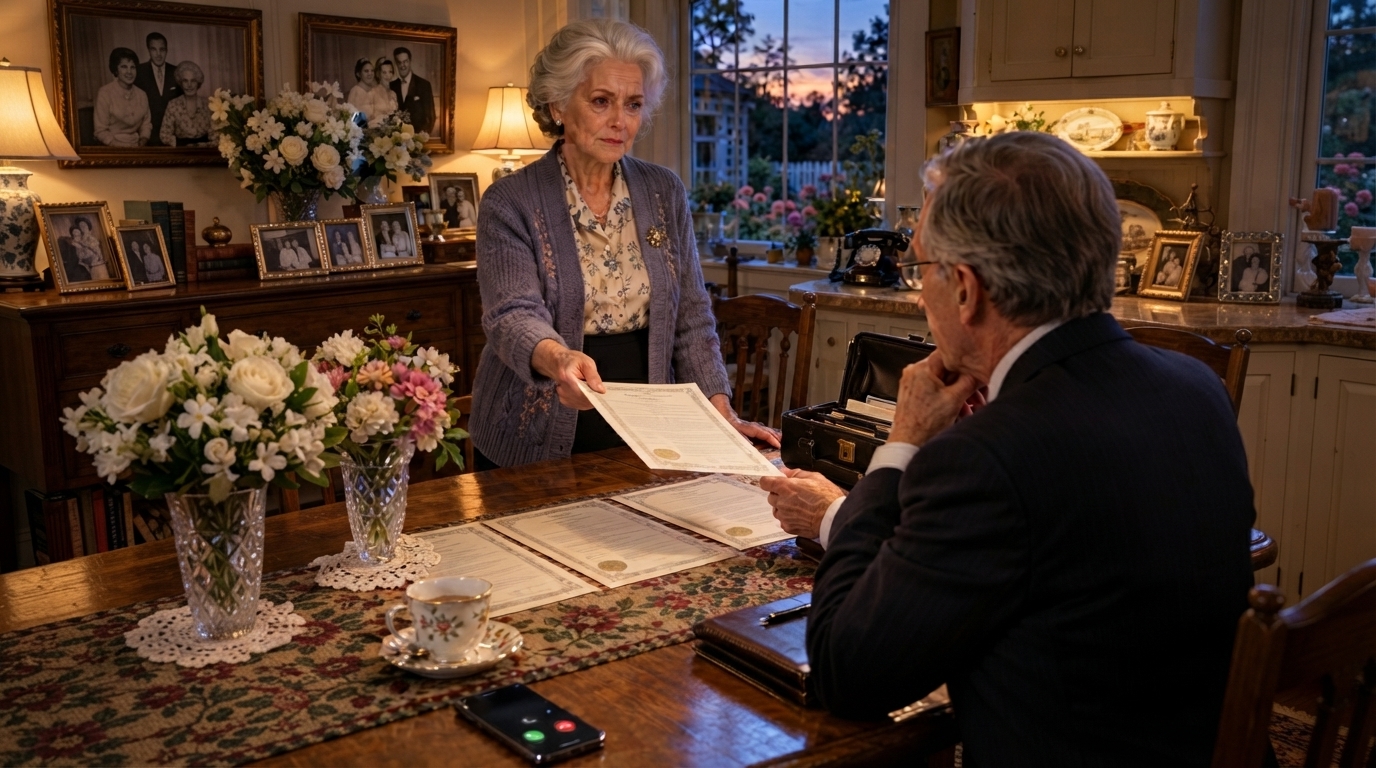
Mr. Abernathy removed a thick envelope
from his briefcase and placed it
beside the three property deeds.
“Mrs. Gable,” he said carefully,
before we discuss what happens to these houses, t
here’s something your husband wanted you to understand.
I stared at the envelope.
My husband, Robert, had been dead for eight years.
We had been married for forty-three years,
raised two sons, built a successful
construction supply company,
and survived more difficult times than I could count.
When Robert died, I thought I understood everything he had left behind.
Apparently, I was wrong.
“What do you mean?” I asked.
Mr. Abernathy opened the envelope.
Robert established a family property trust shortly before his death.
You are the controlling trustee and lifetime beneficiary.
Kenneth and Mason were named as potential beneficiaries,
but their interests were never unconditional.
I frowned.
“I know about the trust.”
“Yes, but I don’t believe you’ve reviewed the provisions concerning family property recently.”
He slid a document toward me.
I recognized Robert’s signature at the bottom.
Mr. Abernathy pointed to a paragraph.
“The trust permits you to provide housing to family members. But neither son receives ownership of those properties automatically. You retain the authority to decide whether their occupancy continues, subject to the agreements and applicable law.”
I looked at the deeds.
Kenneth’s enormous four-bedroom house.
Mason’s beautiful suburban home.
And the beach property in San Diego where Brenda liked to post photographs of herself drinking cocktails beside the ocean.
All three properties had been purchased with money Robert and I earned.
All three remained under my control through the trust.
Yet my sons behaved as though I were a troublesome elderly relative they were generously tolerating.
“Robert knew this might happen?” I whispered.
Mr. Abernathy hesitated.
“He was concerned that your sons had become accustomed to receiving financial support without understanding its cost.”
I leaned back.
Robert had warned me about that.
I remembered one evening when Kenneth was thirty-two.
He had demanded twenty thousand dollars to start a business, then become furious when Robert asked for a business plan.
“They think we’re an endless bank account,” Robert had said afterward.
I’d defended our sons.
“They’re still finding their way.”
Robert had looked at me sadly.
“Margaret, helping someone stand is different from carrying them forever.”
I hadn’t understood how right he was.
Mr. Abernathy turned another page.
“There’s also a letter.”
He handed me a sealed envelope.
My name was written across the front in Robert’s familiar handwriting.
I opened it with trembling fingers.
My darling Margaret,
If you’re reading this, something has probably happened that made you question whether our boys appreciate the life we’ve given them.
I hope I’m wrong.
But if I’m right, please remember that you are not obligated to spend your remaining years purchasing affection from people who should already love you.
I worked hard so you could live comfortably, not so our children could make you feel small.
The houses are yours to manage. The business is protected. You have choices.
Please don’t confuse generosity with surrender.
And whatever you decide, promise me you will finally do something for yourself.
Love always, Robert.
I couldn’t finish reading aloud.
Tears blurred the final words.
For eight years, I had missed that man’s voice.
And somehow, from beyond the grave, he was still trying to protect me.
Mr. Abernathy waited quietly.
Finally, I folded the letter.
“Tell me what I can legally do.”
He nodded.
“We begin with the documents. Kenneth and Mason have written occupancy agreements. We can issue the appropriate notices concerning future terms and any termination rights. We can also review the financial arrangements you’ve maintained for them.”
I looked at him.
“How long have they been living without paying rent?”
“Kenneth has occupied his house for nine years. Mason for six.”
“And the beach house?”
“That property is reserved for family use under the trust, but the booking arrangements have become rather informal.”
I almost laughed.
Informal.
That was a polite way of saying Brenda treated it like her personal vacation property.
She had even changed the electronic lock code last summer without telling me.
When I asked for the new code, she’d said, “Margaret, you don’t really need to go there anymore.”
I had paid the insurance.
The property taxes.
The maintenance.
The repairs after a winter storm.
But apparently, I didn’t need access.
“Mr. Abernathy,” I said, “I want every financial arrangement reviewed.”
“All of them?”
“Every single one.”
He studied me.
“That includes Kenneth’s employment arrangement with the company.”
I nodded.
“Yes.”
Robert’s company had continued operating under professional management after his death.
I retained a controlling interest, although I rarely interfered with daily decisions.
Kenneth worked there as a regional operations director.
At least, that was his title.
For years, I had assumed he earned his salary through hard work.
Lately, however, the company’s general manager had mentioned several concerns.
Kenneth’s unexplained absences.
Expenses that required repeated clarification.
And Brenda’s habit of introducing herself at company events as though she owned the business.
I’d dismissed those concerns because Kenneth was my son.
Now I wondered how many things I’d refused to see.
Mr. Abernathy closed the folder.
“We can request an independent review. But any employment decision must follow company procedures and be based on documented performance, not your family disagreement.”
“Of course,” I said.
I wasn’t interested in inventing reasons to punish Kenneth.
I wanted the truth.
For once, I wanted everyone to live with the same rules.
My phone vibrated again.
Kenneth.
Then Brenda.
Then Mason.
Then Gertrude.
I turned the screen toward Mr. Abernathy.
“Apparently, cutting ties has become less attractive.”
He gave a small smile.
“Perhaps they misunderstood what it involved.”
I picked up the phone and read Kenneth’s latest message.
Mom, stop being dramatic. We only meant you should give us some space. Nobody said you weren’t family.
I stared at it.
Nobody said I wasn’t family?
His exact words had been, We’re cutting ties.
Brenda had celebrated with a thumbs-up.
Mason had watched silently.
Gertrude hadn’t defended me.
I typed a reply.
I am respecting your decision. All future discussions about the properties will go through my attorney.
Then I put the phone down.
Mr. Abernathy nodded.
“That’s clear.”
But the real surprise came the following morning.
At nine o’clock, I received a telephone call from the company’s general manager, Patricia Lewis.
Patricia had worked with Robert for twenty-seven years.
She was one of the few people I trusted completely.
“Margaret,” she said, “Mr. Abernathy contacted me about the independent review.”
“Yes.”
“There’s something I think you should see.”
My stomach tightened.
“What is it?”
“Kenneth has been telling employees that he’ll soon be taking over the company.”
I closed my eyes.
“He’s been saying that for years.”
“This time, he’s circulating paperwork.”
I sat straighter.
“What kind of paperwork?”
“An internal proposal to transfer certain company assets into a new entity. His name appears as the proposed managing director.”
I felt cold.
“Did I approve anything?”
“No. That’s why I’m calling.”
I looked toward Robert’s photograph on the mantel.
“What assets?”
Patricia hesitated.
“Several commercial properties. And a warehouse your husband purchased before he died.”
I gripped the telephone.
That warehouse had been Robert’s pride.
He’d worked twelve-hour days to afford it.
“Send everything to Mr. Abernathy,” I said.
“I already have.”
After the call, I sat in silence.
Kenneth hadn’t merely wanted me out of Christmas dinner.
He had apparently begun planning a future in which I had no voice in the family business.
And perhaps that was why he’d become so comfortable treating me like someone who no longer mattered.
At eleven, Brenda arrived at my front door.
I watched her through the security camera.
She wore an expensive cream coat and carried a designer handbag I’d given her for her birthday.
She rang the bell three times.
Then she began knocking.
“Margaret! I know you’re home!”
I didn’t answer.
“Kenneth is very upset! You’re making this so much worse than it needs to be!”
I continued drinking my tea.
Then she said something that made me put down the cup.
“You can’t threaten our home just because we don’t want you at Christmas!”
I walked to the intercom.
“Brenda.”
She froze.
“Margaret! Finally.”
“I haven’t threatened anyone.”
“Kenneth says your lawyer is reviewing the house!”
“That’s correct.”
“You can’t do that!”
“Brenda, the property belongs to the trust I control. Any changes will follow the law and your agreement.”
She stared into the camera.
“But it’s our home!”
I felt a strange sadness.
For years, I’d wanted nothing more than to hear her call me family.
Now she was claiming a house while refusing the woman who had provided it.
“Brenda,” I said, “you told me last month that family gatherings were easier when I wasn’t there.”
She looked away.
“I didn’t mean it like that.”
“You said I made everyone uncomfortable.”
“Margaret—”
“And yesterday, you gave a thumbs-up when Kenneth announced that I was no longer welcome.”
Her mouth opened.
Nothing came out.
“I won’t argue about this at my front door. Please contact Mr. Abernathy.”
I disconnected the intercom.
Ten minutes later, Kenneth called again.
Then Mason.
Then Brenda.
By late afternoon, my phone showed sixty-three missed calls.
But I was no longer watching the number.
I was reading the company’s financial reports.
And what I found disturbed me far more than a family group chat.
Kenneth had been receiving a generous salary, a vehicle allowance, and substantial discretionary expense reimbursements.
That alone wasn’t improper.
But several entries needed explanations.
There were payments for luxury hotel stays.
Entertainment expenses with vague descriptions.
And charges that appeared connected to Brenda’s San Diego vacation.
I wasn’t going to accuse him without proof.
I forwarded the documents to Patricia and Mr. Abernathy.
Then I asked for an independent accountant to review them.
That evening, Mason finally left a voicemail.
“Mom, please call me. Kenneth says you’re trying to destroy everything. I don’t understand what’s happening.”
I listened twice.
Mason sounded frightened.
But he still hadn’t apologized.
He hadn’t asked how I felt.
He hadn’t mentioned the message that started everything.
He only wanted to know what would happen to the houses.
I placed the phone on the table.
Then I took Robert’s letter from the drawer.
Please don’t confuse generosity with surrender.
For the first time in eight years, I felt as though my husband was sitting beside me.
And I whispered something I should have said long ago.
“Robert, I think I’m finally listening.”
At 8:47 that night, Kenneth sent one final message.
Mom, if you go through with this, you’ll never see your grandchildren again.
I stared at those words.
Then I took another screenshot.
Because I knew exactly what had happened.
Kenneth had run out of arguments.
So he had reached for the one thing he thought could still break me.
My grandchildren.
And that was when I decided our next conversation would not happen over the telephone.
It would happen across a table.
With witnesses.
With documents.
And with the truth laid out where nobody could hide it.
PART 4
By Friday evening, my phone displayed ninety-nine missed calls.
Kenneth had called from his mobile.
Then his office.
Then Brenda’s phone.
Mason had called fourteen times.
Even Gertrude, who hadn’t spoken to me in nearly six weeks, had suddenly remembered my number.
I looked at the screen and felt something unexpected.
Not triumph.
Not happiness.
Just exhaustion.
For years, I had spent so much energy trying to be included that I had forgotten what it felt like to be wanted without providing something.
Now my family wanted me desperately.
But only after learning that my absence might affect their comfort.
At six o’clock, Mr. Abernathy arrived with Patricia Lewis.
We sat at my dining table beneath the old chandelier Robert had installed himself.
Patricia placed a folder in front of me.
“The preliminary review has raised some concerns,” she said.
I looked at her.
“Tell me.”
“Kenneth submitted proposals involving company-owned property without the approvals required by our governance documents. Some expense reimbursements also lack adequate supporting records.”
“How much money?”
“We’re still reviewing the transactions. I don’t want to give you an unsupported number.”
I appreciated that.
For the first time in days, someone was speaking to me without exaggeration, threats, or manipulation.
“What happens next?”
“An independent audit. Kenneth will be given an opportunity to explain the transactions. Until the review is completed, his authority to approve certain expenses and asset transactions should be suspended.”
I nodded.
“Do it properly.”
Patricia looked relieved.
“I intend to.”
Mr. Abernathy opened another folder.
“We’ve also reviewed the property agreements. Kenneth and Mason both have legal occupancy rights under their existing arrangements. We cannot simply remove them overnight.”
“I understand.”
“But you are not obligated to extend their arrangements indefinitely. We can provide lawful notice where permitted, establish future rental terms, and end the informal subsidies.”
I looked at the three deeds.
“Then that’s what I want.”
He nodded.
“The beach house can also be returned to direct trust management. Existing authorized bookings will be handled appropriately, but Brenda will no longer control access.”
I smiled faintly.
“Good.”
Then I looked toward the empty chairs around my dining table.
“Now I want my sons here.”
Mr. Abernathy raised an eyebrow.
“Tonight?”
“Tonight.”
I sent Kenneth and Mason the same message.
If you want to discuss the family properties and company arrangements, come to my house at seven. Mr. Abernathy and Patricia will be present. This is an opportunity to talk respectfully. No shouting.
Kenneth responded in less than thirty seconds.
Finally. We’ll be there.
At 6:58, headlights swept across my driveway.
Kenneth arrived first.
Brenda followed him through the front door without waiting to be invited.
Mason came behind them.
Gertrude appeared in a separate car.
Apparently, the family that didn’t want me at Christmas had no difficulty gathering at my house when money was involved.
Kenneth marched into the dining room.
“Mom, this has gone far enough.”
I remained seated.
“Hello, Kenneth.”
He stopped.
Perhaps he’d expected me to cry.
Perhaps he’d expected an apology.
Instead, he found his seventy-one-year-old mother sitting beside an attorney and the manager of the family company.
Brenda looked at the folders.
“What is all this?”
“Please sit down,” I said.
Kenneth crossed his arms.
“We’re not here for some ridiculous courtroom performance.”
Mr. Abernathy spoke calmly.
“This isn’t a courtroom, Mr. Gable. But several legal and financial matters require clarification.”
Kenneth glanced at Patricia.
“Why are you here?”
“Company business,” she answered.
His face changed.
For the first time that evening, he looked genuinely worried.
Mason sat down.
“Mom, can somebody please explain what’s happening?”
I looked at my younger son.
“First, I’d like to understand something.”
He shifted uncomfortably.
“Okay.”
“Why did you stay silent when Kenneth told me I was no longer welcome at family gatherings?”
Mason looked toward his brother.
Kenneth answered for him.
“Because we all agreed you needed boundaries.”
I nodded slowly.
“Boundaries.”
“Yes,” Brenda interrupted. “You’ve been too involved in our lives.”
I turned toward her.
“Can you give me an example?”
She hesitated.
“You ask too many questions.”
“About what?”
“Our vacations. The children. Our plans.”
I looked at her.
“Brenda, I asked whether the grandchildren enjoyed their vacation because I helped pay for it.”
Her cheeks reddened.
“That’s exactly what I mean. You always bring up money.”
I sat back.
“Then perhaps we should remove money from our relationship entirely.”
The room fell silent.
Kenneth leaned forward.
“What does that mean?”
I gestured toward Mr. Abernathy.
He opened the first folder.
“The residence occupied by Kenneth and Brenda is owned by the Gable Family Property Trust.”
Brenda frowned.
“No. Robert gave us that house.”
Mr. Abernathy shook his head.
“Robert and Margaret permitted you to live there. Ownership was never transferred.”
Kenneth looked at me.
“Mom, you know Dad intended that house for us.”
“Your father intended to help you establish a stable life,” I answered. “He didn’t intend for you to treat me as disposable.”
Mr. Abernathy continued.
“The current occupancy arrangement will be reviewed according to its terms. You will receive formal written notice of any proposed changes and the options available to you.”
Brenda’s voice rose.
“You’re kicking us out?”
“No,” I said. “I’m ending the assumption that everything I provide must continue forever, regardless of how I’m treated.”
Kenneth slammed his palm against the table.
“This is blackmail!”
I didn’t raise my voice.
“No, Kenneth. You are free to decide whether you want a relationship with me. I am free to decide whether I continue providing voluntary financial support. Your legal rights will be respected.”
Mason looked pale.
“What about my house?”
I turned toward him.
“The same review applies.”
His shoulders dropped.
“Mom, I didn’t send that message.”
“No,” I said. “You watched it happen.”
He looked down.
“I didn’t know what to say.”
“You could have said, ‘She’s our mother.'”
His eyes filled.
I continued quietly.
“You could have asked why I was being excluded. You could have called me afterward. Instead, you said nothing.”
Mason wiped his face.
“I’m sorry.”
It was the first apology I’d heard.
And I wanted desperately to believe it.
But I had learned that an apology was only a beginning.
Gertrude cleared her throat.
“Margaret, don’t you think you’re taking this a little far?”
I turned toward my sister.
“Gertrude, you haven’t visited me in months.”
“That doesn’t mean I don’t care.”
“Then why did you stay silent?”
She opened her mouth.
Closed it.
Then looked away.
I nodded.
“That’s what I thought.”
Kenneth pushed his chair back.
“Fine. Keep your houses. I have my job.”
Patricia opened her folder.
“Kenneth, we also need to discuss your responsibilities at Gable Supply.”
He froze.
“What?”
“Several company expense reports and proposed property transactions require independent review.”
His expression hardened.
“You’re involving my workplace now?”
Patricia met his eyes.
“This concerns company funds and company assets. The review is based on documented transactions.”
He looked at me.
“Mom, tell her to stop.”
I shook my head.
“No.”
“You’re going to ruin my career because of a Christmas dinner?”
“Kenneth, I didn’t submit those expense reports. I didn’t prepare those property proposals. Whatever the review finds will be based on your own actions.”
He stared at Patricia.
“Those were legitimate business expenses.”
“Then the supporting records should establish that,” she replied.
For several seconds, nobody spoke.
Then Brenda burst into tears.
“This is unbelievable. After everything we’ve done for this family!”
I looked at her.
“What have you done for me, Brenda?”
She blinked.
“What?”
“When was the last time you visited because you wanted to see me?”
She stared at the table.
“When was the last time you invited me to dinner without needing something?”
“Margaret—”
“When was the last time you brought the grandchildren over simply because they missed their grandmother?”
Her tears continued.
But she had no answer.
I turned toward Kenneth.
“And you, son. When was the last time you asked whether I was lonely?”
He looked away.
“When was the last time you visited your father’s grave with me?”
Silence.
“When was the last time you remembered my birthday without someone reminding you?”
Kenneth’s face tightened.
“Mom, that’s not fair.”
I felt tears gathering in my eyes.
“No, Kenneth. What’s unfair is spending forty years loving your children, helping them through every difficulty, and then discovering they consider your presence a burden.”
My voice broke.
“I would have given you anything I had.”
Nobody moved.
“And the terrible part is, I nearly did.”
I took Robert’s letter from the folder.
“Your father wrote this before he died.”
Kenneth looked up.
I read the words aloud.
Please don’t confuse generosity with surrender.
Mason began crying.
Kenneth stared at his hands.
When I finished, I folded the letter.
“Your father loved both of you. So do I. But he wanted me to have a life after he was gone.”
I looked around the room.
“And I intend to have one.”
Kenneth stood abruptly.
“So that’s it? You’re choosing money over your family?”
I looked directly at him.
“No. I’m choosing to stop using money to keep a family that doesn’t want me.”
He opened his mouth.
Then closed it.
For the first time, he seemed to understand the difference.
The meeting ended shortly afterward.
Mr. Abernathy explained the formal review processes and told everyone they would receive the appropriate documents.
Nobody was forced from a home that night.
Nobody lost a job without due process.
There were no dramatic police escorts or suitcases thrown onto lawns.
Just paperwork.
Clear boundaries.
And the uncomfortable reality that my generosity had never been an unlimited entitlement.
Kenneth left without hugging me.
Brenda followed him, still crying.
Gertrude muttered something about family loyalty before disappearing through the door.
Mason remained behind.
He stood beside the dining table, looking at the chair where his father used to sit.
“Mom?”
“Yes, sweetheart?”
His voice trembled.
“I should have defended you.”
I looked at him.
“Yes. You should have.”
He nodded.
“I was afraid Kenneth would turn on me too.”
I sighed.
“Mason, being afraid doesn’t make you a bad person. But letting someone else be hurt because you’re afraid still has consequences.”
He wiped his eyes.
“I know.”
Then he asked something that surprised me.
“Can I come over Sunday? Just for coffee?”
I studied his face.
“No discussions about houses?”
He shook his head.
“No houses.”
“No money?”
“No money.”
I smiled sadly.
“Then yes. You can come for coffee.”
He hugged me.
It was the first genuine hug I’d received from one of my sons in months.
And when he left, I cried.
Not because I regretted anything.
But because I finally understood how much I had missed being loved without conditions.
The weeks that followed were difficult.
Kenneth refused to speak to me except through Mr. Abernathy.
The company conducted its independent review.
Some expenses were adequately documented.
Others were not.
The review also found that Kenneth had exceeded his authority by advancing proposed property transactions without the required approvals.
The company board removed his authority over asset transactions and reassigned him while the remaining issues were addressed.
Eventually, Kenneth resigned rather than continue under the new oversight arrangements.
I didn’t celebrate.
He was still my son.
I had hoped he’d build a successful career through his own abilities.
But I couldn’t protect him from the consequences of decisions he’d made himself.
As for the houses, Mr. Abernathy handled everything through the proper legal channels.
Mason agreed to a new rental arrangement with reasonable payments and clear responsibilities.
He also began saving toward purchasing a home of his own.
Kenneth and Brenda chose not to accept the proposed future terms for their property.
After the required notice period and an agreed transition, they moved into a smaller rental house.
Brenda posted several angry messages online.
She called me controlling.
Cruel.
Heartless.
She even claimed I’d abandoned my grandchildren.
That one hurt.
But I didn’t respond publicly.
I had kept the screenshots.
I had the documents.
And I knew what had actually happened.
I also made one thing clear through my attorney: my grandchildren were welcome to maintain a relationship with me, and I would not use them as leverage.
For a while, Kenneth refused to allow visits.
I respected the legal boundaries while making it clear that my door remained open.
Then, one afternoon in February, I received a handwritten letter.
It was from my oldest grandson, Ethan.
He was sixteen.
Grandma,
I don’t know everything that’s happening between you and Dad.
But I wanted you to know I miss you.
I miss your Christmas cookies and the way you always make everyone take leftovers home.
Dad says you’re angry with us.
I hope you’re not angry with me.
Love, Ethan.
I sat at my kitchen table and cried.
Then I wrote back.
My darling Ethan,
I could never be angry with you for something you didn’t do.
Grown-ups sometimes make mistakes, and sometimes those mistakes take time to repair.
None of this changes how much I love you.
My kitchen is still full of cookies, and I’ll always save you the biggest one.
Love, Grandma.
A week later, Kenneth called.
This time, I answered.
“Hello, son.”
For several seconds, he said nothing.
Then he spoke quietly.
“Ethan showed me your letter.”
I waited.
“He asked why we stopped inviting you.”
My throat tightened.
“What did you tell him?”
Kenneth sighed.
“I didn’t know what to say.”
I looked out at my garden.
“Then perhaps you should tell him the truth.”
He was silent.
Finally, he whispered, “I was angry because you kept asking questions about my work and spending.”
“I was worried about you.”
“I know.”
He took a shaky breath.
“Brenda and I thought you were trying to control us.”
“And what do you think now?”
A long pause followed.
“I think we got so used to everything you did that we stopped noticing you were the one doing it.”
I closed my eyes.
It wasn’t a perfect apology.
But it was the first time Kenneth had spoken to me without demanding something.
“I’m sorry, Mom,” he said.
Tears rolled down my cheeks.
“I love you, Kenneth.”
“I love you too.”
“But things cannot go back to how they were.”
“I know.”
And for once, I believed he understood.
We didn’t become a perfect family overnight.
There were awkward conversations.
Uncomfortable apologies.
Boundaries that needed repeating.
Brenda took longer to accept what had happened.
Gertrude never truly admitted she’d been wrong.
And Kenneth had to rebuild parts of his life without relying on the security I’d always provided.
But something slowly changed.
Mason began visiting every Sunday.
Sometimes he brought groceries.
Sometimes he helped in the garden.
Sometimes we simply drank coffee and talked about ordinary things.
Kenneth eventually started coming too.
At first, our conversations were careful.
Then one afternoon, he arrived carrying an old wooden toolbox.
It had belonged to Robert.
“I found this while we were moving,” he said.
I opened it.
Inside were Robert’s worn measuring tape, a small hammer, and the screwdriver he’d used to repair nearly everything in our house.
I ran my fingers across the wooden handle.
“Your father loved this toolbox.”
Kenneth nodded.
“I thought you should have it.”
Then he said something I never expected.
“Mom, I think Dad would be disappointed in me.”
I looked at my son.
“Your father would want you to learn from what happened.”
Kenneth’s eyes filled.
“Do you think I still can?”
I reached across the table and took his hand.
“Of course you can. But learning means changing what you do, not just regretting what happened.”
He nodded.
And for the first time in years, we talked like a mother and son instead of a bank and a borrower.
By the following Christmas, my life looked very different.
I had stopped paying for vacations I wasn’t invited to enjoy.
I had ended the informal financial arrangements that left me feeling obligated to everyone.
The beach house was back under professional management, and I spent two peaceful weeks there myself.
I walked beside the ocean every morning.
I read books.
I ate breakfast overlooking the water.
And for the first time since Robert died, I took a vacation without worrying about whether somebody else needed something from me.
On Christmas Eve, I invited my family to dinner.
Not because they were entitled to come.
Not because I feared being alone.
But because I wanted to see the people who had begun making an effort to be part of my life again.
Mason arrived early with a homemade pie.
Kenneth brought Ethan and the younger children.
Brenda came carrying a casserole she’d made herself.
Gertrude appeared with flowers.
Nobody asked about property deeds.
Nobody mentioned money.
Nobody expected me to pay for anything.
We sat around the old oak dining table.
The same table where Mr. Abernathy had laid out the documents that changed everything.
Ethan helped me light the candles.
Then he looked around and smiled.
“Grandma, this feels like Christmas again.”
I felt tears gather in my eyes.
“Yes, sweetheart. It does.”
After dinner, Kenneth helped me wash the dishes.
For a while, we worked in comfortable silence.
Then he glanced at me.
“Mom?”
“Yes?”
“Last year, when I sent that message, I thought you’d call crying and beg us to change our minds.”
I continued drying a plate.
“I know.”
He looked ashamed.
“I never imagined you’d just accept it.”
I turned toward him.
“Kenneth, I didn’t accept being treated badly. I accepted that I couldn’t force you to love me.”
He lowered his eyes.
“And when you stopped giving us everything, I realized how much we’d been taking.”
I placed the plate on the shelf.
“That was never the lesson I wanted you to learn.”
“What was?”
I looked at him.
“That your mother is a person. Not a house. Not a paycheck. Not a company. A person.”
He nodded slowly.
Then he hugged me.
“I’m sorry I forgot that.”
I held him close.
“Just don’t forget again.”
Later that evening, after everyone had gone home, I sat beside the Christmas tree with a cup of tea.
My phone rested on the table.
One year earlier, it had displayed ninety-nine missed calls from people who had decided they no longer wanted me in their lives.
Tonight, it held photographs of my grandchildren laughing, a message from Mason thanking me for dinner, and a note from Kenneth saying he’d enjoyed spending Christmas with me.
I looked toward Robert’s photograph.
“You were right, darling,” I whispered.
Then I smiled.
For years, I believed being a good mother meant giving until I had nothing left.
I believed love was measured by how many sacrifices I could make without complaining.
But I’d learned something that changed the rest of my life.
You can love your children with your whole heart and still refuse to let them take everything you have.
You can forgive without forgetting.
You can help without surrendering.
And you can keep your door open without allowing anyone to walk through it just to hurt you.
Kenneth had told me our family was cutting ties.
He thought those words would break me.
Instead, they reminded me that I still had choices.
I hadn’t destroyed my family.
I’d stopped paying for the illusion of one.
And when the people who truly wanted to be there finally returned, they came for something no property deed could ever provide.
They came for me.
THE END THANK YOU FOR READING !!!



