PART 3
The first deputy asked me a question
I never expected to hear while standing in my own kitchen.
Ms. Bennett, where do you normally
keep your notary stamp?
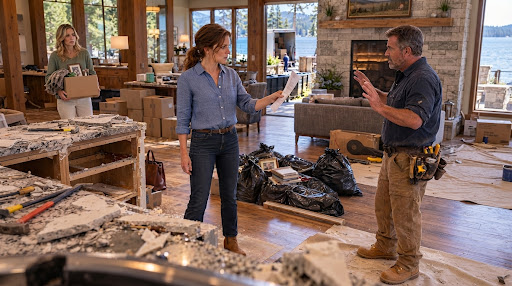
I looked at the broken cabinets scattered across the floor.
“In my work bag. Locked in my office when I’m not using it.”
“And who has access to that bag?”
“Usually, nobody but me.”
He waited.
I swallowed.
Three weeks ago,
I took it to my parents’ house for Sunday dinner.
My mother spilled red wine on my blouse.
I left the bag in their living room while I went upstairs to change.
The deputy wrote something in his notebook.
“How long were you away?”
“Maybe fifteen minutes.”
“Was your brother there?”
I nodded.
“Jacob, his wife Victoria, and both my parents.”
He looked toward the forged document.
“Did you notice anything missing afterward?”
“No.”
Then I remembered something.
“My stamp was turned sideways in its case the next morning. I thought I’d put it away carelessly.”
The deputy stopped writing.
“Do you still have it?”
“Yes.”
“Don’t use it or handle it any more than necessary. We may need to examine it.”
I nodded.
For the first time, I felt something worse than anger.
Fear.
My family hadn’t simply moved furniture into my house.
Someone had used my professional identity to manufacture legal authority.
And if they’d done it once, I had no idea what else they’d done.
My attorney, Daniel Mercer, arrived shortly before four.
He had represented me in several real estate matters, and I’d never seen him look as grim as he did when he examined the power of attorney.
“Bella, who prepared this?”
“I don’t know.”
He turned the pages carefully.
“Who notarized it?”
I pointed to the impression.
“Apparently, I did.”
He looked at me.
“That’s impossible if you’re supposedly signing as the principal.”
“Exactly.”
The document named me as the person granting authority to my parents. It also displayed my own notary credentials as though I had notarized my signature.
Daniel examined the notarial certificate.
“This is a serious irregularity. In Texas, a notary cannot notarize their own signature.”
I felt sick.
“So whoever made this didn’t even understand what they were doing.”
“Or they assumed nobody would examine it closely.”
He photographed the document.
Then he asked the contractor for the complete project file.
The man, whose name was Richard Collins, looked miserable.
“I had no reason to think it wasn’t legitimate.”
Daniel remained calm.
“I’m not making a determination about your responsibility today. But you need to preserve every contract, email, text message, payment record, and photograph connected to this project.”
Richard nodded.
“Of course.”
“And no further work.”
“Understood.”
I looked at the kitchen.
The cabinets I’d spent two years restoring were gone.
The backsplash I’d installed with my own hands had been smashed.
A large opening had been cut through the wall separating the kitchen from the dining room.
I remembered standing in that same room with my father three Christmases earlier, laughing while we tried to hang a crooked light fixture.
Now he was one of the people responsible for destroying it.
Daniel and I spent the next hour documenting everything.
The missing cabinets.
The damaged flooring.
The crushed flower beds.
The family photographs stuffed into garbage bags.
The journals my grandmother had kept for forty years.
I found one of them beneath a broken countertop.
Its cover was bent, and dust had worked its way between the pages.
Inside, my grandmother had written about the summer my mother was born.
I sat on the floor holding it.
And cried.
Daniel crouched beside me.
“Bella.”
I shook my head.
“Do you know how many times I told them this house mattered to me?”
He said nothing.
“I invited them here for birthdays. Holidays. Summer weekends. I gave them keys because I trusted them.”
My voice cracked.
“And they treated everything I loved like trash.”
Daniel waited until I could breathe normally.
Then he said, “We’re going to separate two things. The damage to your property, and the misuse of your identity. Both matter. But we need to handle them carefully.”
I nodded.
He continued.
“First, secure the property. Second, notify your title insurer and mortgage lender that an unauthorized document may have been used. Third, protect your notary credentials and professional records.”
I looked up.
“And my parents?”
His expression hardened.
“We preserve the evidence and let the investigation proceed.”
That evening, my phone began ringing.
Mother.
Father.
Jacob.
Victoria.
Then Mother again.
I didn’t answer.
At seven thirty, a text arrived.
MOM: You’ve embarrassed this family enough. Call your father and apologize.
I stared at it.
Apologize.
For discovering a forged power of attorney.
For stopping strangers from demolishing my house.
For refusing to surrender the home I’d bought with my own money.
I placed the phone facedown.
A minute later, another message appeared.
JACOB: You’re ruining my business over a house you barely use.
I read it twice.
Then I typed:
BELLA: Do not enter my property or contact the contractors. All further communication about the house must go through my attorney.
I sent it.
Then I blocked their numbers for the night.
I stayed at a nearby hotel because the house was no longer safe to occupy.
Before leaving, I arranged for temporary security and had the locks changed by a licensed locksmith after the deputies completed their initial documentation.
The following morning, Richard called Daniel with an update.
His office had located the original renovation proposal.
The contract totaled $186,400.
I nearly dropped my coffee.
“One hundred and eighty-six thousand dollars?”
Daniel nodded.
“That’s the stated project price.”
“Who’s paying for it?”
“That’s what we’re trying to determine.”
Richard’s company had received a $32,000 deposit.
The payment had come from an account associated with Jacob’s marketing business.
But the remaining balance was scheduled to be paid in stages.
And the paperwork contained something else.
An authorization to seek financing secured by the property.
My property.
I stared at Daniel.
“They were planning to borrow against my house?”
“Possibly. We need to determine whether any application was actually submitted.”
He showed me another page.
It described the project as the conversion of a privately owned lakeside residence into a combined residential and commercial workspace.
The named future occupants were Jacob and Victoria.
The proposed term?
Ten years.
Ten years of exclusive use.
My brother hadn’t been planning to stay temporarily.
He’d been planning to build his future inside a house that didn’t belong to him.
By Monday, Daniel had obtained a copy of a purported occupancy agreement from the contractor’s file.
It bore another imitation of my signature.
The agreement claimed that I had granted Jacob and Victoria the right to occupy the property for ten years at a nominal rent of one dollar annually.
One dollar.
I sat in Daniel’s office staring at the page.
“My parents gave me twenty-five thousand dollars toward the down payment,” I said.
Daniel looked up.
“A birthday gift?”
“Yes. I have the card. I have the bank transfer. They wrote that it was a gift.”
He nodded.
“Keep those records.”
I laughed bitterly.
“They gave me twenty-five thousand dollars six years ago, and now they’re trying to take a house worth nearly seven hundred thousand.”
Daniel leaned back.
“Bella, don’t assume we know their entire plan yet.”
I looked at him.
“What else could they possibly want?”
He hesitated.
Then said, “That’s what worries me.”
On Tuesday afternoon, my father appeared outside Daniel’s office.
I saw him through the glass doors.
He was standing beside his truck, arms folded, looking furious.
Daniel noticed him too.
“Do you want me to handle this?”
I shook my head.
“I want to hear what he has to say.”
We stepped outside together.
My father immediately pointed at Daniel.
“You’ve turned a family disagreement into a legal circus.”
I stared at him.
“A family disagreement?”
“Your mother hasn’t slept in three nights.”
“Neither have I.”
He ignored that.
“Jacob has already spent thirty-two thousand dollars.”
“On work I never authorized.”
“He was trying to build something.”
“With my house.”
My father sighed.
“Bella, you make more money in one year than your brother makes in three.”
I looked at him.
“And?”
“And you don’t need that place the way he does.”
I felt something inside me go cold.
“Dad, who signed my name?”
He looked away.
“Don’t start.”
“Who used my notary stamp?”
His jaw tightened.
“We were trying to make things easier.”
I stared at him.
“By forging legal documents?”
He stepped closer.
“Lower your voice.”
“No.”
Daniel moved slightly beside me.
My father looked at him, then back at me.
“Your mother said you’d understand once the renovations were finished.”
I felt my stomach drop.
“So Mom knew.”
He said nothing.
“Dad.”
He rubbed his forehead.
“Jacob said the paperwork was just a formality.”
I stared at him.
“A formality?”
“He said you wouldn’t object once you saw what he’d done.”
I could barely speak.
“You knew I hadn’t signed it.”
My father looked down.
And that was the answer.
I returned to Daniel’s office shaking.
He handed me a glass of water.
“Did you hear him?” I whispered.
“Yes.”
“He knew.”
Daniel nodded.
“We’ll document the conversation. But we still need the records and the investigation.”
I stared at the wall.
For years, I’d told myself my parents simply favored Jacob.
That they worried about him more.
That they excused his mistakes because he struggled.
But this wasn’t favoritism anymore.
This was a deliberate decision to take something from me.
And my father had just admitted he knew I hadn’t agreed.
Two days later, Daniel called with another discovery.
The county property records showed no completed transfer of ownership.
That was a relief.
But a title company had received a preliminary inquiry involving my property.
The inquiry included a proposed deed of trust and a request for information about an existing mortgage.
My brother’s company was named in the supporting materials.
The title company had not completed a transaction.
No new lien had been recorded.
But someone had been exploring how to use my home as collateral.
I sat down.
“How much?”
Daniel paused.
“Four hundred and twenty thousand dollars.”
I stared at the wall.
“Four hundred and twenty thousand?”
“Yes.”
My hands went numb.
That was more than Jacob’s renovation contract.
Much more.
Daniel continued.
“The proposed financing documents refer to business expansion and debt consolidation.”
I closed my eyes.
Jacob’s marketing company.
His expensive vehicles.
His lavish vacations.
The constant stories about how successful he was.
Suddenly, I wondered how much of it had been real.
That evening, Victoria called from a number I didn’t recognize.
I almost ignored it.
But something made me answer.
“Bella?”
I said nothing.
“It’s Victoria.”
“I know.”
She sounded nervous.
“I need to talk to you.”
“Then contact my attorney.”
“Please. Just listen.”
I hesitated.
Then said, “You have one minute.”
She took a shaky breath.
“Jacob told me you agreed to everything.”
I laughed without humor.
“You were throwing away my grandmother’s journals.”
“I thought they were old notebooks.”
“They were mine.”
“I know that now.”
I closed my eyes.
Victoria continued.
“Jacob told me your parents had legal authority. He said you’d signed the documents before your commercial closing because you were too busy to handle the renovations yourself.”
I said nothing.
Then she whispered, “Bella, I found something in his office.”
My stomach tightened.
“What?”
“A folder.”
I waited.
“It has copies of your driver’s license, your brokerage information, and several documents with your signature.”
My heart began pounding.
“Victoria.”
Her voice broke.
“There’s also a spreadsheet.”
I gripped the phone.
“What spreadsheet?”
She began crying.
“It’s titled Bella Property Exit Strategy.”
For a moment, I couldn’t breathe.
Then she whispered the sentence that changed everything.
“Your parents weren’t just planning to let us live there. Jacob was planning to use the house to pay off his debts, and the spreadsheet shows how much money each of them expected to receive.”
PART 4
I didn’t sleep that night.
Victoria’s words kept repeating in my head.
Bella Property Exit Strategy.
My name.
My property.
An exit strategy.
As though I were an obstacle in a business transaction.
As though the house I’d spent six years paying for, repairing, and loving was nothing more than an asset waiting to be extracted.
The following morning, I called Daniel.
He listened carefully.
Then said, “Don’t ask Victoria to take anything from Jacob’s office. If she wants to provide information voluntarily, we can arrange for her to speak with the investigators.”
I nodded.
“She’s frightened.”
“I imagine she is.”
“She says there’s a spreadsheet.”
“Then we need to establish where it came from and what it actually means.”
I took a breath.
“Daniel, what if they’ve done this before?”
He was quiet.
Then said, “That’s another reason to handle this properly.”
Victoria met with investigators later that week.
She provided copies of records she said she had lawfully accessed through the shared business files she used for Jacob’s company.
I wasn’t present for her interview.
Daniel advised me not to interfere.
But eventually, we received information relevant to my property.
The spreadsheet was real.
It listed the lake house at an estimated market value of $695,000.
It included my existing mortgage balance.
It projected a new loan of $420,000.
And beneath a heading labeled Allocation of Proceeds, there were three entries.
Jacob Bennett — $245,000
Richard and Linda Bennett — $125,000
Renovation Reserve — $50,000
I stared at the numbers.
My brother planned to receive nearly a quarter of a million dollars.
My parents expected one hundred and twenty-five thousand.
And I was listed nowhere.
Not as an owner receiving compensation.
Not as someone whose consent was required.
Not even as a person who might object.
I was simply the name attached to the property.
I asked Daniel one question.
“Why would my parents want money from my house?”
He looked at the spreadsheet.
“We don’t know their reasoning.”
I swallowed.
“Maybe they thought they deserved repayment for the down payment.”
“Perhaps. But a gift doesn’t become ownership merely because the giver later regrets it.”
I looked away.
Twenty-five thousand dollars.
They’d given it to me with smiles and birthday cake.
My mother had hugged me and said, “We’re proud of you, Bella.”
I’d framed the card.
I’d kept it in a drawer beside my mortgage documents.
Now I wondered whether they’d spent six years believing that gift entitled them to everything I’d built afterward.
Three days later, my mother called Daniel’s office.
She wanted a meeting.
I agreed on one condition.
My attorney would be present.
We met in a conference room on a rainy Thursday afternoon.
My parents arrived together.
Jacob came separately.
Victoria wasn’t there.
My mother looked older than I remembered.
My father seemed exhausted.
Jacob looked furious.
Nobody hugged me.
Nobody asked how I was doing.
My mother sat down and immediately began crying.
“Bella, how could you do this to us?”
I stared at her.
“Do what?”
“Get the police involved.”
I felt my chest tighten.
“Mom, someone forged my signature.”
She shook her head.
“We were only trying to help your brother.”
Daniel placed a folder on the table.
“Mrs. Bennett, this meeting is not an opportunity to justify unauthorized documents. We’re here to determine whether any resolution is possible.”
My father leaned forward.
“We don’t want a lawsuit.”
I looked at him.
“Then why did you try to take my house?”
He said nothing.
Jacob scoffed.
“Nobody was taking anything.”
I turned toward him.
“You signed a ten-year occupancy agreement using my name.”
He shrugged.
“It was paperwork.”
“You arranged renovations without asking me.”
“You weren’t using the place.”
“You tried to borrow four hundred and twenty thousand dollars against it.”
His expression changed.
My mother looked at him.
“Jacob?”
He stared at the table.
And suddenly, I realized something.
My parents might have known about the forged authority and the renovations.
But perhaps they hadn’t known everything their son intended to do with it.
My father turned toward Jacob.
“What loan?”
Jacob rubbed his forehead.
“Dad, we talked about financing.”
“Not four hundred thousand dollars.”
Jacob looked at me.
“You don’t understand how business works.”
I almost laughed.
I had just closed one of the largest commercial real estate transactions of my career.
And my brother, whose company was drowning in debt, was telling me I didn’t understand business.
“Then explain it,” I said.
He stared at me.
I continued.
“Explain why your spreadsheet shows you receiving two hundred and forty-five thousand dollars from my property.”
My mother went pale.
“What spreadsheet?”
Daniel placed a copy on the table.
Jacob lunged forward.
“Where did you get that?”
Daniel calmly moved the paper out of his reach.
“Sit down, Mr. Bennett.”
My father read the numbers.
His face changed.
Then he looked at Jacob.
“You said the financing would pay for renovations.”
Jacob didn’t answer.
My mother whispered, “You told us we’d get our money back.”
I stared at her.
“What money?”
She began crying harder.
My father looked away.
And then the truth came out.
My parents had been giving Jacob money for years.
Not small amounts.
Not occasional help.
They’d paid his business rent.
Covered payroll.
Helped with credit card debt.
Paid for a vehicle he couldn’t afford.
They had even taken money from their retirement savings.
My father finally admitted that they’d given Jacob more than $180,000 over five years.
I sat frozen.
My mother wiped her cheeks.
“He promised he’d pay us back.”
Jacob stared at the wall.
My father continued.
“When he told us he needed the lake house for his business, he said he’d use the renovation project to make the property more valuable.”
I looked at him.
“And you believed him?”
He nodded weakly.
“He said we’d recover some of what we’d invested.”
I stared at my mother.
“So you decided to recover your money from my house.”
She began crying.
“We didn’t think of it that way.”
I shook my head.
“That’s exactly what you did.”
My father whispered, “We thought you could afford it.”
I stared at him.
Those words.
Again.
You can afford it.
As though my success made my property available.
As though working hard meant I owed everyone else the rewards.
As though the years I’d spent building my life counted for less than Jacob’s inability to manage his.
I looked at my mother.
“Did you take my notary stamp?”
She froze.
My father closed his eyes.
Jacob looked away.
“Mom.”
Her lips trembled.
“I didn’t know he was going to use it like that.”
My heart sank.
“Who?”
She looked toward Jacob.
He said nothing.
I leaned forward.
“Did you take it out of my bag?”
Tears streamed down her face.
“Yes.”
The room went silent.
I felt as though someone had struck me.
My mother.
The woman who taught me to sign my name carefully on school forms.
The woman who told me never to lie.
The woman who cried with pride when I earned my real estate license.
She had taken the stamp that represented my professional responsibility.
And handed it to my brother.
I whispered, “Why?”
She covered her face.
“Jacob said he needed to copy the information for the paperwork.”
I stared at her.
“You knew I hadn’t agreed.”
She didn’t answer.
“Mom, you knew.”
She nodded.
And something inside me finally broke.
I didn’t scream.
I didn’t cry.
I simply stood.
Daniel looked at me.
“Bella?”
I shook my head.
“I need a minute.”
I walked into the hallway.
There was a large window overlooking the parking lot.
Rain slid down the glass.
I stood there remembering my childhood.
Jacob breaking a neighbor’s window and my parents blaming the other children.
Jacob failing classes and my mother calling the teachers unfair.
Jacob wrecking his first car and my father buying him another.
And me.
Working weekends.
Saving money.
Doing everything right.
Because I’d believed that if I was responsible enough, successful enough, generous enough, one day my parents would be proud of me in the same way they were proud of Jacob.
Now I understood.
They were proud of what I could provide.
But they had never learned to respect what belonged to me.
When I returned to the conference room, everyone looked up.
I sat down.
Then I spoke.
“The house is mine.”
My father nodded.
“We know.”
“No. You don’t.”
I looked at each of them.
“You saw something I worked for and decided it was available because Jacob needed it.”
My mother cried quietly.
I continued.
“You used my name, my signature, and my professional credentials without permission.”
Jacob shifted in his chair.
“And you destroyed parts of my home before I even knew what was happening.”
My voice trembled.
“I don’t know whether I’ll ever trust any of you again.”
My mother reached toward me.
“Bella, please.”
I moved my hand away.
“No.”
She froze.
I took a breath.
“I won’t protect you from the consequences of what you’ve done.”
Jacob scoffed.
“So you’re going to send your own family to jail?”
I looked at him.
“I’m going to tell the truth. What happens after that isn’t mine to decide.”
For once, he had nothing to say.
The months that followed were exhausting.
There were interviews.
Documents.
Financial records.
Insurance questions.
Contractor disputes.
And difficult conversations with the licensing authorities responsible for my notary commission.
I voluntarily reported the suspected misuse of my seal and followed the instructions I received about securing or replacing my notary tools and protecting my records.
My attorney helped me notify the relevant parties that the power of attorney and occupancy agreement were unauthorized.
The lender confirmed that no loan had been funded.
No new mortgage had been recorded against my house.
The title company had stopped its preliminary review after receiving notice of the dispute.
My ownership remained intact.
That was the first real relief I’d felt in weeks.
The criminal investigation took longer.
Jacob eventually admitted that he’d arranged for someone to reproduce my signature on the documents.
My mother acknowledged taking my notary stamp without permission.
My father admitted he had known I hadn’t authorized the renovations.
The authorities reviewed the evidence and determined what charges were appropriate.
I didn’t control that process.
And I refused to turn it into a bargaining chip for another family argument.
Jacob’s financial problems were his responsibility.
My parents’ decisions were theirs.
For the first time in my life, I wasn’t going to absorb the consequences just to keep everyone comfortable.
The contractor’s company cooperated with the investigation.
Its insurer and attorneys became involved in determining responsibility for the unauthorized work.
The crew had already removed materials and damaged portions of the house, but they had stopped when the dispute was formally documented.
After months of negotiation, the financial responsibility for the repairs was resolved through a combination of insurance payments and a settlement involving the parties responsible.
It wasn’t simple.
It wasn’t quick.
And it didn’t erase what had happened.
But I was able to begin restoring my home.
The first thing I repaired wasn’t the kitchen.
It was the small room overlooking the lake.
The room where I’d kept my grandmother’s journals.
I hired a preservation specialist to help clean and stabilize the damaged books.
Some pages couldn’t be saved.
Others were stained.
But most of the journals survived.
I cried when I opened the first restored volume.
My grandmother’s handwriting was still there.
Careful.
Elegant.
Familiar.
On one page, she’d written:
There are things a family gives you, and things you must learn to give yourself.
I sat beside the window reading that sentence again and again.
Then I whispered, “I’m learning, Grandma.”
By spring, the kitchen was nearly finished.
I chose new cabinets similar to the ones I’d restored.
A warm cream color.
Brass handles.
Wooden shelves beside the window.
I kept one small section of the original countertop that had survived the demolition.
The stone was chipped.
Imperfect.
But I had it cut and polished into a small serving board.
I wanted something from the old kitchen to remain.
Not because I couldn’t let go.
But because I wanted to remember that what had been damaged didn’t have to be entirely lost.
Victoria and Jacob separated during the investigation.
I didn’t celebrate.
Their marriage was their business.
But one afternoon, Victoria sent me a letter.
She apologized for throwing away my belongings.
She acknowledged that she’d accepted Jacob’s explanation without asking me directly.
And she admitted that, even before she knew about the forged documents, she’d treated my house as though it already belonged to her.
At the bottom, she wrote:
I was so excited about the life I thought we were getting that I didn’t stop to ask whose life we were taking it from.
I read that sentence several times.
Then I put the letter away.
I appreciated the apology.
But I didn’t owe her immediate forgiveness.
My parents tried contacting me repeatedly.
At first, the messages were angry.
Then defensive.
Then tearful.
My mother said she missed me.
My father said the family was falling apart.
They both insisted that Jacob had misled them.
But I couldn’t forget what they’d admitted.
They knew I hadn’t consented.
They knew the house wasn’t theirs.
And they’d proceeded anyway.
Eventually, I sent them a letter through Daniel.
I told them I was safe.
I told them the house was being repaired.
And I told them I needed distance.
Not forever, necessarily.
But for as long as it took.
I also made one thing clear.
Any future relationship would require honesty, accountability, and respect for my boundaries.
Not gifts.
Not guilt.
Not another speech about what family owed family.
Six months after the day I found the moving truck on my lawn, I spent my first full weekend back at the lake house.
The repairs were finished.
The furniture was back.
The photographs had been cleaned and rehung.
The garden beds were replanted.
And the kitchen smelled of fresh coffee.
I woke early Saturday morning.
For a moment, I lay still, listening.
No power tools.
No strangers.
No arguments.
Just birds outside the window and the gentle sound of water against the shore.
I made breakfast.
Carried my coffee onto the deck.
And sat watching the sunrise.
It was exactly the kind of morning I’d wanted when I made that two-hour drive months earlier.
Except now, I understood how precious it was.
Around noon, my phone rang.
It was my father.
I hesitated.
Then answered.
“Hello?”
“Bella.”
His voice sounded tired.
“Hi, Dad.”
There was a long pause.
Then he said, “Your mother and I have been talking.”
I waited.
“We’ve been talking about what happened.”
I looked toward the lake.
He continued.
“I keep thinking about the day you told us to leave.”
I said nothing.
“I was angry because I thought you were humiliating us.”
My chest tightened.
He swallowed.
“But you were standing in your own house, watching strangers tear it apart.”
I closed my eyes.
“And we were telling you that you were selfish.”
Tears filled my eyes.
He continued.
“I don’t know how we convinced ourselves we had the right.”
I took a breath.
“Dad, you wanted to help Jacob.”
“I know.”
“And you decided helping him mattered more than respecting me.”
Silence.
Then he whispered, “Yes.”
It was the first time he’d said it without an excuse.
Without mentioning Jacob’s problems.
Without reminding me of the down payment.
Without explaining how much money I made.
Just yes.
He asked whether we could meet someday.
I looked at the water.
“Maybe.”
He nodded, though he couldn’t see me.
“I understand.”
I hesitated.
Then said, “Dad, I don’t want you to call because you need something.”
His voice broke.
“I know.”
“I want you to call because you actually want to know how I am.”
He was quiet.
Then asked, “How are you, Bella?”
I looked around my restored home.
At the kitchen I’d rebuilt.
At the journals I’d saved.
At the lake beyond the windows.
I took a breath.
“I’m getting better.”
That evening, I cooked dinner for myself.
Nothing elaborate.
Grilled salmon.
Roasted potatoes.
A small salad.
I set the table by the window and opened a bottle of sparkling water.
Then I noticed something.
For years, whenever I came to the lake house, I’d imagined sharing it with family.
Hosting dinners.
Celebrating birthdays.
Watching my parents grow old on the deck.
Letting Jacob’s children run through the yard.
I had believed the house would feel complete only when the people I loved filled it.
But that evening, sitting alone, I felt something I hadn’t expected.
Peace.
Not loneliness.
Not bitterness.
Peace.
Because for the first time, nobody was asking me to surrender something in exchange for belonging.
A year later, the lake house became a place of laughter again.
I invited friends.
Hosted small dinners.
Spent weekends reading.
And sometimes, I let the house remain quiet.
I didn’t need to prove anything by filling every room.
I also became more careful about whom I trusted with access to my property and professional credentials.
Not suspicious of everyone.
Just more willing to recognize that love and trust are not the same thing.
Trust requires behavior.
Respect requires choices.
And family relationships do not erase legal or personal boundaries.
I still have the birthday card my parents gave me when they helped with the down payment.
It says:
We’re proud of you, Bella. Enjoy your beautiful home.
For a long time, I couldn’t look at it.
I thought about throwing it away.
But eventually, I placed it in a box with other family keepsakes.
I didn’t want to erase every good memory because of what happened later.
The gift had been real.
So had the betrayal.
Both could be true.
And accepting that helped me move forward.
Sometimes people ask whether I regret involving the authorities.
I don’t.
I regret that it became necessary.
I regret the damage.
I regret the fear.
I regret that my parents made decisions that shattered my trust.
But I don’t regret protecting my home, my identity, or my livelihood.
Because what happened wasn’t simply a family disagreement.
It wasn’t an argument about who needed more space.
It wasn’t a misunderstanding over a birthday gift.
It was an attempt to use my name and property without my consent.
And I had every right to stop it.
I drove two hours to my lake house expecting a quiet weekend.
Instead, I found a moving truck crushing my flowers, strangers demolishing my kitchen, and my sister-in-law throwing my grandmother’s journals into garbage bags.
My parents told me my brother needed the house more than I did.
They told me I was selfish.
They told me family should help family.
Then a contractor handed me a forged power of attorney bearing my signature and the impression of my own notary seal.
That was the moment I realized the problem was much bigger than favoritism.
My family hadn’t simply forgotten to ask permission.
They had decided my permission didn’t matter.
And for the first time in my life, I refused to make their choices easier by sacrificing myself.
My parents helped me buy a house.
But they never bought the right to take it away.
My brother needed help.
But his needs did not make my property his.
And loving my family did not require me to let them destroy everything I’d worked for.
The lake house is still mine.
The kitchen is beautiful again.
My grandmother’s journals are back on their shelves.
And every time I unlock the front door, I remember the lesson that cost me so much to learn:
You can love your family and still refuse to let them take what belongs to you.
THE END THANK YOU FOR READING !!!



