PART 3
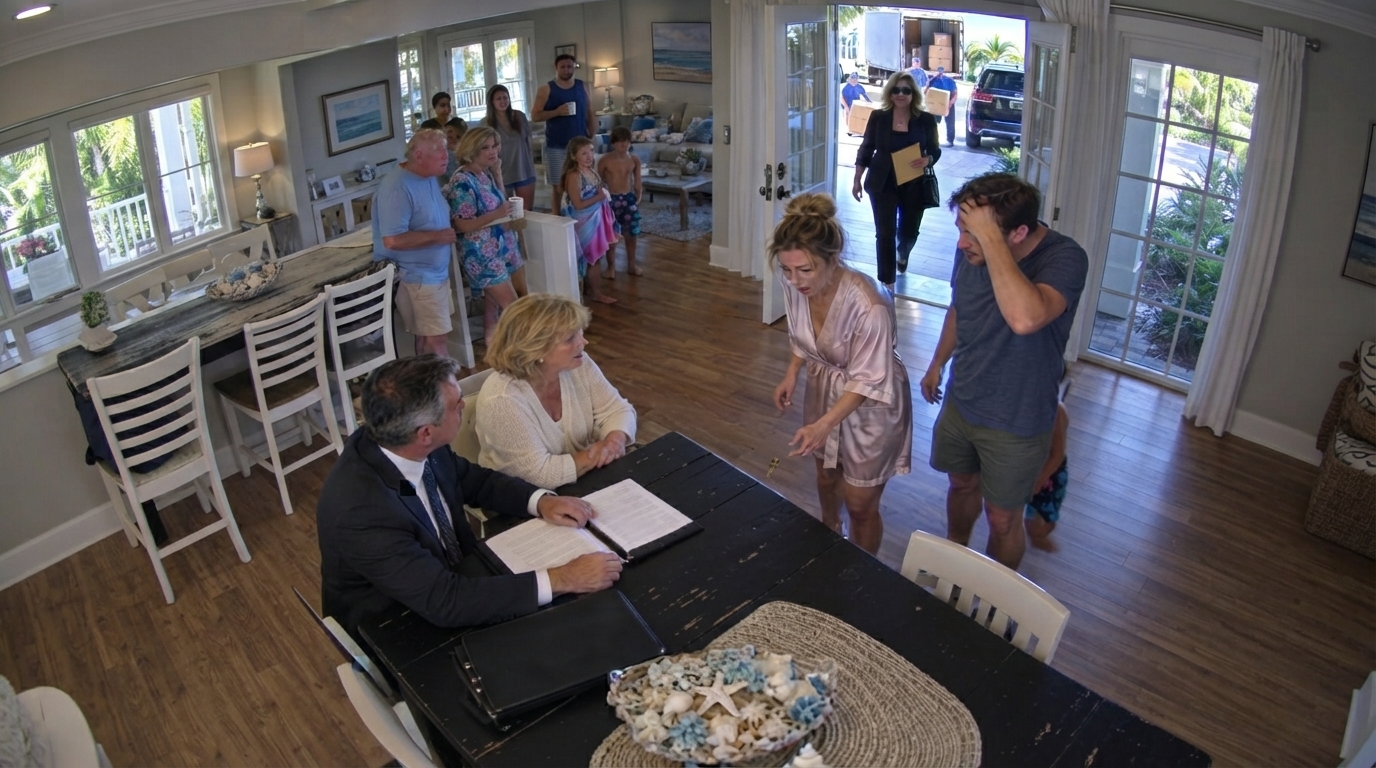
For several seconds, nobody spoke.
The only sound in my kitchen was
the ticking of the clock above the refrigerator.
I stared at the document Thomas had placed in front of me.
My name appeared at the top.
My address was printed beneath it.
And near the bottom was a signature
that looked almost exactly like mine.
Almost.
I knew my own handwriting.
I’d spent forty years signing school permission slips,
mortgage documents, insurance forms,
birthday cards, and checks.
Whoever had written that signature
had copied the general shape of my letters.
But they had missed one small detail.
I always looped the final letter of my surname.
This signature ended in a straight line.
“That’s not mine,” I whispered.
Thomas nodded.
“I know.”
Michael leaned forward.
“What kind of loan?”
Ruth looked at him.
“A home-equity loan application.”
My son’s face tightened.
“How much?”
Thomas turned the page.
“Two hundred and seventy-five thousand dollars.”
I gripped the edge of the table.
Two hundred and seventy-five thousand dollars.
Against the house my late husband, Daniel, and I had worked nearly two decades to pay for.
The house where we’d spent our last Christmas together.
The house where I’d held his hand during his final months of illness.
I looked at Lauren.
“Explain this.”
She folded her arms.
“I don’t know what you’re talking about.”
Ruth slid another document across the table.
“Then perhaps you can explain why your email address appears on the application.”
Lauren glanced down.
Her expression changed.
Only slightly.
But I saw it.
Michael saw it too.
“Lauren?”
She shook her head.
“This is ridiculous. Anyone could have used my email.”
Thomas remained calm.
“The application was submitted electronically. The lender contacted Evelyn for additional verification, which is how the attempted transaction came to our attention.”
I turned toward him.
“Was any money released?”
“No. The lender flagged discrepancies, and the application has not been approved or funded.”
I exhaled shakily.
“But someone tried.”
“Yes.”
I looked at Lauren.
“And someone signed my name.”
She stared at the table.
I waited.
Then she whispered, “It wasn’t supposed to hurt anyone.”
Michael took a step backward.
“What?”
Lauren looked at him.
“Michael, please.”
His voice rose.
“What did you do?”
She began crying.
And for the first time since I’d returned from vacation, her tears didn’t move me.
Not because I enjoyed seeing her frightened.
But because I had spent years allowing her emotions to determine what I was permitted to say.
Whenever I questioned her decisions, she cried.
Whenever I disagreed, she accused me of disliking her.
Whenever I asked Michael to intervene, he told me to keep the peace.
And somehow, keeping the peace always meant surrendering something that belonged to me.
Not this time.
“Lauren,” I said quietly, “tell us the truth.”
She wiped her cheeks.
“My parents were having financial problems.”
Ruth folded her arms.
“What kind of problems?”
Lauren hesitated.
“My father lost money on an investment. They were behind on rent, and my sister couldn’t keep up with her bills.”
I stared at her.
“So you brought them here.”
She nodded.
“I thought we could all stay for the summer.”
“And the rental agreement?”
She swallowed.
“I listed the house online.”
My stomach turned.
“You advertised my home to strangers?”
“Only for part of the summer.”
Ruth gave a short, disbelieving laugh.
“Only?”
Lauren looked toward Michael.
“I was going to explain.”
Michael stared at her.
“When?”
She said nothing.
I pointed toward the rental agreement.
“Who paid eighteen thousand dollars?”
Lauren’s face went pale.
“A family from New Jersey.”
“And where were they supposed to stay?”
She glanced toward the staircase.
I felt something cold settle inside me.
“My bedroom.”
She didn’t answer.
I continued.
“That’s why you moved my belongings.”
Lauren began crying harder.
“The rental guests were supposed to arrive in July. I thought you could stay with your sister until then.”
Ruth’s eyes widened.
“With me?”
Lauren looked down.
I stared at the woman who had handed me a brass key to the smallest bedroom in my own house.
She hadn’t merely invited her family for the summer.
She had planned to use my property as a business.
Without asking.
Without permission.
And apparently without any concern about where I would live.
Michael pulled out a chair and sat down heavily.
“Lauren, you told me your parents just needed somewhere temporary.”
“They did.”
“You didn’t tell me you rented Mom’s house.”
“I was going to.”
“When?”
She looked at him.
“When everything was settled.”
He shook his head.
“What does that even mean?”
Lauren’s father, Dennis, had been standing near the kitchen doorway.
Now he stepped forward.
“Everybody needs to calm down.”
I turned toward him.
“Mr. Carter, this is my home.”
He raised his hands.
“I understand that, Evelyn.”
“Then why are you sleeping in my bedroom?”
His expression tightened.
“Lauren said you’d offered it.”
I looked at her.
She lowered her head.
Dennis stared at his daughter.
“Lauren?”
She whispered, “I thought Mom wouldn’t mind.”
I nearly laughed.
She called me Mom when she wanted something.
But she hadn’t considered me enough of a mother to ask permission before moving my belongings into a cardboard box.
Dennis rubbed his forehead.
“We were told this was arranged.”
I studied him.
“Did you know about the rental listing?”
He shook his head.
“No.”
“Or the loan application?”
His face changed.
“What loan?”
Thomas slid the document toward him.
Dennis read the amount.
Then looked at Lauren.
“Two hundred and seventy-five thousand dollars?”
She began shaking.
“Dad, I was trying to help.”
His face went gray.
“Help whom?”
“Everyone!”
Her voice broke.
“I was trying to fix everything!”
Thomas closed the folder.
“Before this discussion goes further, I need to clarify something.”
Everyone looked at him.
“The attempted loan and the rental agreement are separate matters. Neither gives Lauren authority over Evelyn’s property.”
Lauren wiped her eyes.
Thomas continued.
“The rental agreement may create obligations to the people who paid the money, but Evelyn did not authorize it. We need to notify the renters and the platform promptly, preserve the records, and determine where the payment went.”
I nodded.
“And the loan?”
“We will formally dispute the application with the lender, request preservation of its records, and report the suspected identity misuse through the appropriate channels.”
Michael looked sick.
“Is Lauren going to be arrested?”
Thomas didn’t answer immediately.
“That is not something I can predict. The facts need to be investigated.”
Lauren began crying again.
I looked toward the living room.
The expensive sofa was covered with beach towels.
Sand had been tracked across the hardwood floors.
Someone had left a sticky glass on Daniel’s antique side table.
And suddenly, the physical mess seemed almost insignificant.
Because the real damage wasn’t to my furniture.
It was to my trust.
Ruth sat beside me.
“Evelyn, there’s something you need to understand about the sale.”
I looked at her.
She placed her hand over mine.
“You called me yesterday because you wanted to make a decision about the house. I agreed to buy it because I knew you were serious.”
I nodded.
Ruth and I had spent nearly an hour on the phone the previous evening.
We’d discussed the house.
Its value.
Its history.
And the fact that I no longer wanted to be the person everyone assumed would quietly sacrifice her own comfort.
But there was one thing I hadn’t told anyone else.
Ruth wasn’t buying the house to turn it into another investment.
She was buying it because she wanted to preserve it.
For me.
Thomas had structured the agreement with a closing date thirty days away, subject to the necessary title review and other conditions.
Until closing, I remained the owner.
And I had every right to decide who was invited to stay.
I turned toward Lauren.
“Your family needs to make arrangements to leave.”
She stared at me.
“Today?”
I took a breath.
“Thomas will explain what notice is required for anyone who may have legal occupancy rights. I’m not going to do anything unlawful. But nobody has my permission to bring in additional guests, move my belongings, or use my house for a rental business.”
Dennis nodded immediately.
“We’ll find somewhere else.”
Lauren looked horrified.
“Dad!”
He turned toward her.
“No, Lauren.”
She began crying.
He continued.
“You told us Evelyn wanted us here. You told us she had offered her bedroom. If that wasn’t true, we shouldn’t be here.”
For the first time, I felt a small amount of respect for him.
He looked at me.
“I’m sorry, Evelyn. I truly didn’t know.”
I nodded.
“Thank you.”
His wife, Patricia, appeared beside him.
She looked embarrassed.
“We’ll pack our things.”
Lauren stared at them.
“You’re just going to leave?”
Patricia looked at her daughter.
“We’re not entitled to someone else’s home.”
The words settled over the kitchen.
Simple.
Obvious.
And apparently something Lauren had never considered.
By late afternoon, most of Lauren’s relatives had begun packing.
Dennis and Patricia arranged a short-term rental nearby.
Lauren’s sister took her children to a hotel.
The unfamiliar cars gradually disappeared from my driveway.
The beach toys were collected.
The towels came down from the railing.
The music stopped.
For the first time since returning from vacation, I could hear the ocean again.
I stood on the porch watching the last car leave.
Michael came outside.
“Mom?”
I didn’t turn.
“Yes?”
He stood beside me.
“I’m sorry.”
I stared toward the water.
“For what?”
He swallowed.
“For letting this happen.”
I nodded slowly.
He continued.
“I knew Lauren wanted her parents to stay. I knew she’d moved your things.”
I closed my eyes.
“And you said nothing.”
He looked down.
“I thought you’d be upset for a few days, then get used to it.”
I turned toward him.
“Michael, I spent eighteen years paying for this house.”
“I know.”
“Your father and I chose every piece of furniture. We painted these walls. We planted those hydrangeas.”
His eyes filled.
“I know, Mom.”
I looked at him.
“Then why did you think I should get used to being treated like a visitor?”
He began crying.
And I felt my own eyes burn.
Because Michael was still my son.
The boy I’d rocked to sleep.
The teenager who’d helped Daniel repair the porch.
The young man who’d cried in my arms when his father died.
But loving him didn’t mean I could pretend he hadn’t hurt me.
He whispered, “I was afraid Lauren would be angry.”
I nodded.
“And you decided it was easier for me to be hurt.”
He looked at me.
I continued.
“That’s what happened, Michael.”
His face crumpled.
“I know.”
We stood in silence.
Then I said something I’d never said to him before.
“I love you. But I’m not going to spend the rest of my life making myself smaller so everyone else can be comfortable.”
He nodded.
And for once, he didn’t ask me to change my mind.
That evening, Ruth helped me carry my belongings back into the master bedroom.
We hung my dresses.
Put my shoes away.
Returned my photographs to the shelves.
Then Ruth unfolded my mother’s blue quilt.
She smoothed it carefully across the bed.
I watched her fingers trace the stitching.
“Remember when Mom made this?” she asked.
I smiled sadly.
“She worked on it for nearly six months.”
Ruth nodded.
“She kept complaining about the blue fabric.”
I laughed.
“She said it showed every crooked stitch.”
Ruth smiled.
“And you told her you loved the crooked stitches.”
I touched the quilt.
“I still do.”
For a moment, we were two little girls again.
Sitting beside our mother.
Watching her sew.
Then Ruth looked at me.
“Evelyn, are you sure about selling?”
I took a breath.
“I don’t know.”
She nodded.
“Then we don’t have to rush. The agreement has conditions, and Thomas can explain our options. I won’t pressure you.”
I stared at her.
“You’d let me change my mind?”
Ruth smiled.
“Of course.”
I felt tears rise.
“Why?”
She looked genuinely confused.
“Because it’s your house.”
Four words.
That was all.
Four words that made me cry harder than anything Lauren had said.
Because after two days of being treated like an inconvenience, someone had finally acknowledged something that should never have been questioned.
It was my home.
And I was allowed to decide what happened to it.
The next morning, Thomas called.
“Evelyn, we’ve received a response from the lender.”
I sat down.
“What did they say?”
“The application has been suspended pending review. No funds were disbursed.”
I exhaled.
“Thank God.”
“But there’s something else.”
My stomach tightened.
“What?”
“The contact information on the application includes a secondary email address.”
I waited.
Thomas continued.
“It belongs to Michael.”
I went still.
My son.
My own son.
I looked toward the staircase.
“Are you saying he knew?”
Thomas answered carefully.
“I’m saying his email address appears in the application. We need to determine why.”
I closed my eyes.
Because suddenly, I realized Lauren might not have been the only person who had betrayed me.
And the hardest conversation was still ahead.
PART 4
Michael arrived at eleven the next morning.
I’d asked him to come alone.
No Lauren.
No excuses.
Just my son.
He looked nervous when he entered the kitchen.
“Mom, what’s wrong?”
I placed a printed copy of the loan application on the table.
“Sit down.”
He glanced at the document.
Then slowly lowered himself into a chair.
I sat across from him.
“Michael, why is your email address listed on an application for a two-hundred-and-seventy-five-thousand-dollar loan against my house?”
His face drained of color.
For several seconds, he said nothing.
Then he whispered, “Lauren told me it was just a preliminary inquiry.”
My stomach sank.
“You knew?”
He looked down.
“Not everything.”
I felt my chest tighten.
“What did you know?”
He rubbed his hands together.
“Lauren said there was a way to borrow against the house to help her parents. She told me she was checking whether it would be possible.”
I stared at him.
“And you gave her your email?”
He nodded.
“She said the lender needed a second contact.”
I took a breath.
“Did you tell her she could use my property?”
He looked up.
“No, Mom. I swear I didn’t authorize anything.”
I studied his face.
“Did you know she signed my name?”
His eyes filled.
“No.”
I wanted to believe him.
But I had spent too many years accepting explanations because they were easier than asking difficult questions.
So I continued.
“Did you ever tell Lauren I would agree to the loan?”
He hesitated.
Then whispered, “I said you’d probably help if we explained everything.”
I stared at him.
“Probably?”
He looked down.
“Yes.”
I took a breath.
“Michael, your father and I worked eighteen years to build a life in this house. It was never meant to become an emergency fund for everyone else.”
His eyes filled.
“I know.”
I shook my head.
“No. I don’t think you did.”
He began crying.
“Mom, I didn’t think she’d actually submit anything.”
I looked at him.
“But you knew she was considering it.”
He nodded.
“And you didn’t tell me.”
He lowered his head.
“No.”
I sat back.
There it was.
The truth.
Not as dramatic as I had feared.
But painful enough.
My son hadn’t necessarily forged anything.
He hadn’t necessarily intended to steal from me.
But he’d known his wife was discussing a loan secured by my property.
And he’d decided I didn’t need to know.
I looked toward the window.
The ocean was calm.
The sky was bright.
And I felt older than I had the day before.
“Michael,” I said quietly, “I need you to understand something.”
He wiped his eyes.
I continued.
“I spent most of my life trying to make sure you never felt unwanted.”
He nodded.
“Your father and I worked hard to give you stability.”
“I know.”
“When Daniel died, I thought keeping this house available to you would help us stay close.”
My voice trembled.
“But somewhere along the way, you started treating my generosity as permission.”
He looked at me.
I continued.
“You didn’t ask whether Lauren’s family could move in. You didn’t ask whether they could take my bedroom. And when you heard about the loan, you didn’t ask whether I wanted to risk my home.”
He began crying harder.
“I’m sorry.”
I nodded.
“I believe you’re sorry.”
His face lifted.
“But being sorry doesn’t undo what happened.”
He looked down.
I took a breath.
“You’re going to have to earn back my trust.”
He nodded slowly.
“I understand.”
“And until that happens, you and Lauren won’t be staying here.”
He closed his eyes.
“Okay.”
I waited for an argument.
For a complaint.
For the familiar request that I keep the peace.
But none came.
He simply nodded.
And for the first time, I wondered whether losing access to the house might finally help him understand that my love wasn’t something he could use without respecting me.
The investigation into the loan application continued.
Thomas helped me report the suspected misuse of my identity and preserve the documents.
The lender confirmed that no loan had closed.
No money had been released.
And no new mortgage from that application had been recorded against the property.
That was a relief.
But the rental agreement was another matter.
The family from New Jersey had paid eighteen thousand dollars for a six-week stay.
They believed they’d booked a legitimate luxury rental.
They had no idea Lauren wasn’t authorized to rent the property.
Thomas contacted the rental platform and the renters’ representative.
The reservation was canceled.
The renters received a refund through the platform’s process, while the disputed payment and Lauren’s responsibility for it were handled separately.
I felt terrible for the family.
They’d planned a vacation.
Booked time off work.
Made arrangements.
And someone had used my home to sell them something they had no right to offer.
I wrote them a short letter.
I apologized for the disruption, explained that I hadn’t authorized the listing, and wished them well.
A week later, they sent a kind reply.
They said they were grateful the issue had been discovered before they traveled.
And they hoped I could enjoy my home again.
I cried when I read it.
Strangers had shown me more consideration than people who called themselves family.
Lauren didn’t contact me for nearly three weeks.
Then one afternoon, she appeared on my porch.
She looked different.
No perfect smile.
No silk blouse.
No confident expression.
Just a tired woman holding a small envelope.
“Can we talk?” she asked.
I hesitated.
Then opened the screen door.
“We can talk here.”
She nodded.
“I understand.”
For a moment, she stared at the porch boards.
Then she said, “I’m sorry.”
I waited.
She continued.
“I know that doesn’t fix anything.”
“No,” I said. “It doesn’t.”
She swallowed.
“I was desperate.”
I looked at her.
“Desperate enough to sign my name?”
Her eyes filled.
She nodded.
“Yes.”
The admission hurt, even though I already suspected it.
I took a breath.
“Why?”
She began crying.
“My parents were behind on bills. My sister needed help. Michael and I had debts I didn’t want him to know about.”
I stared at her.
“What debts?”
She wiped her eyes.
“Credit cards. Personal loans. Things I kept putting off.”
I closed my eyes.
“And you thought my house could solve all of that.”
She nodded.
“I thought if I could get the rental income and the loan, I could pay everything back before anyone noticed.”
I looked at her.
“Lauren, that’s not how borrowing works. And it certainly isn’t how ownership works.”
She began crying harder.
“I know.”
I shook my head.
“No. You knew it was wrong when you signed my name.”
She covered her face.
I continued.
“You moved my belongings into a box labeled EXTRA STUFF.”
Her shoulders shook.
“You gave my bedroom to your parents.”
She whispered, “I’m sorry.”
“You handed me a key to a room in my own house.”
She looked up.
I felt tears sting my eyes.
“Do you understand how humiliating that was?”
She nodded.
“I do now.”
I stared at her.
Then said quietly, “I hope you remember it.”
Lauren handed me the envelope.
Inside was a handwritten apology.
She acknowledged that she had listed the property without permission.
She admitted submitting the loan application using my information.
She wrote that she understood why I no longer trusted her.
Thomas later advised me to preserve the letter with the other records.
I didn’t promise forgiveness.
I didn’t invite her inside.
But I thanked her for finally telling the truth.
Then she left.
I watched her walk down the driveway.
And I realized something.
For years, I’d believed setting boundaries meant being unkind.
Now I understood that boundaries were sometimes the only way to prevent kindness from becoming something other people exploited.
The sale to Ruth became the next decision I had to make.
The agreement had been signed.
The closing date was approaching.
Thomas explained the contractual options available to us.
Ruth and I sat together on the porch one evening.
The sun was setting over the water.
She held a glass of iced tea.
I held a cup of coffee.
“Do you still want to sell?” she asked.
I looked toward the beach.
For eighteen years, this house had been my refuge.
After Daniel died, I’d sometimes sat in his favorite chair for hours, listening to the waves.
I had considered selling more than once.
Not because I disliked the house.
But because every room held memories that sometimes hurt.
Then Lauren had arrived with her family and treated the place like something she’d already inherited.
And in my anger, I’d decided to sell it.
Ruth had agreed to buy it because she wanted to help.
But now, sitting on the porch, I wasn’t sure.
“I don’t know,” I admitted.
Ruth nodded.
“Then don’t decide because you’re angry.”
I looked at her.
She smiled.
“Decide because it’s what you want.”
I stared at the ocean.
Then whispered, “I think I want to stay.”
Ruth smiled.
“Then stay.”
I began crying.
“What about the contract?”
She squeezed my hand.
“Thomas can help us document a mutual cancellation. I won’t hold you to a sale you no longer want.”
I laughed through tears.
“You drove all the way here with a moving truck.”
She grinned.
“That was mostly for dramatic effect.”
I stared at her.
Then burst out laughing.
For the first time in weeks, I laughed until my stomach hurt.
Ruth laughed too.
And somehow, the porch felt lighter.
We formally canceled the sale by mutual agreement before closing.
The title remained in my name.
The house remained mine.
And I decided that if I ever sold it, it would be because I wanted a different life.
Not because someone had made me feel unwelcome in the one I already had.
Over the next several months, Michael began making changes.
He and Lauren moved into a small rental apartment.
They started addressing their finances.
Michael found out about the debts Lauren had hidden.
They began counseling.
I didn’t ask for every detail.
Their marriage was their responsibility.
But I made one thing clear.
My home was not available to solve their financial problems.
Michael accepted that.
At first, he called only occasionally.
Then he began visiting for short afternoons.
He always asked before coming.
He never brought anyone without permission.
And he stopped assuming that being my son meant he could make decisions for me.
One Saturday, he came to repair a loose board on the porch.
I watched him kneel beside the railing with his father’s old toolbox.
For a moment, he looked so much like Daniel that my throat tightened.
“Your dad used to sit right there,” I said.
Michael looked up.
“I remember.”
I smiled sadly.
“He’d complain about the salt air ruining everything.”
Michael laughed.
“Then he’d spend all afternoon fixing it.”
I nodded.
“Yes.”
He looked down at the board.
Then said quietly, “Mom, I wish Dad were here.”
My eyes filled.
“Me too.”
He swallowed.
“He’d be disappointed in me.”
I didn’t answer immediately.
Then I said, “Your father loved you. But he also believed that loving someone meant telling them when they were wrong.”
Michael nodded.
“I know.”
I looked at him.
“And he’d want you to do better.”
He wiped his eyes.
“I’m trying.”
I smiled.
“I can see that.”
My relationship with Lauren remained distant.
She sent occasional messages.
I answered politely.
But I didn’t pretend we were close.
Trust takes time to rebuild.
And some relationships never return to what they were before.
I learned to accept that.
I didn’t need to hate Lauren.
I didn’t need to spend every holiday reminding her what she’d done.
But I also didn’t need to hand her another key.
That Christmas, Ruth came to stay for a week.
We decorated the living room together.
Hung stockings by the fireplace.
Made our mother’s sugar cookies.
And placed Daniel’s photograph on the mantel.
On Christmas Eve, Michael called.
“Mom, would it be okay if I stopped by tomorrow afternoon?”
I smiled.
“Yes.”
He hesitated.
“Just me?”
I thought for a moment.
“Yes, Michael. Just you.”
He nodded.
“Okay.”
There was no argument.
No guilt.
No attempt to negotiate.
Just respect.
And I realized that something had changed.
Not everything.
But enough.
On Christmas morning, I woke before sunrise.
The house was quiet.
Ruth was still asleep in the guest room.
I made coffee.
Then carried my cup to the porch.
The ocean stretched before me.
Gray-blue water beneath a pale winter sky.
The waves rolled gently toward the shore.
I sat in Daniel’s favorite chair.
For a while, I simply listened.
Then I looked toward the master bedroom window.
My bedroom.
With my photographs.
My books.
My mother’s quilt.
My jewelry.
My memories.
Everything back where it belonged.
And suddenly, I felt tears on my cheeks.
Not because I was sad.
But because I remembered how close I’d come to allowing other people to convince me that I was no longer entitled to my own life.
A few days later, I found the little brass key Lauren had handed me.
It was still sitting in the kitchen drawer.
The key to the smallest bedroom.
The room she’d decided was good enough for me.
I held it for a moment.
Then I placed it inside a small wooden box with the documents from the incident.
Not because I wanted to preserve the humiliation.
But because I wanted to remember what I’d learned.
I had spent decades being the dependable one.
The mother who helped.
The wife who sacrificed.
The grandmother figure who remembered birthdays.
The person who always made room.
And somewhere along the way, I’d begun believing that being loved meant never saying no.
But that wasn’t love.
That was fear.
Fear of disappointing people.
Fear of losing relationships.
Fear of being called selfish.
And I was finally finished letting that fear make my decisions.
Today, my beach house is quieter.
The driveway is no longer crowded with unfamiliar cars.
There are no strangers sleeping in my bedroom.
No children eating chips on my expensive sofa without permission.
No relatives treating my kitchen like a free restaurant.
Sometimes Ruth visits.
Sometimes Michael comes for lunch.
Sometimes I invite friends for a weekend by the ocean.
And sometimes I spend an entire Saturday alone.
Reading.
Gardening.
Walking along the beach.
Listening to old music.
Doing absolutely nothing.
And every time I unlock my front door, I feel the same quiet satisfaction.
This is my home.
I paid for it.
I cared for it.
I built a life inside it.
And I get to decide who enters.
Lauren thought that because I was sixty-four and recently widowed, I would accept being moved into the smallest bedroom.
She thought my desire to keep the peace meant I had no limits.
She thought she could use my house, my name, and my generosity without consequences.
But she made one terrible mistake.
She forgot that kindness is a choice.
Not an obligation.
And she forgot that the woman she’d dismissed as an inconvenient old widow had spent decades building a life long before Lauren ever entered it.
I didn’t need to scream.
I didn’t need revenge.
I didn’t even need to sell the house.
I simply needed to remember that it was mine.
The day I came home from vacation, my daughter-in-law handed me a key to the smallest bedroom in my own beach house.
The next morning, my sister arrived with a moving truck and the documents that changed everything.
But the greatest change wasn’t the investigation, the canceled rental, or the loan that never closed.
It was the moment I stopped asking permission to belong in the home I’d spent eighteen years paying for.
I wasn’t a guest.
I wasn’t an inconvenience.
And I certainly wasn’t EXTRA STUFF.
I was Evelyn.
I was sixty-four years old.
And I was finally living in my own home on my own terms.
THE END THANK YOU FOR READING !!!



