PART 3
At 8:07 the next morning,
Melissa Ellis and I walked into
Westbrook Middle School carrying two folders,
a damaged wheelchair brake cable,
and enough anger to make my hands shake.
I hadn’t slept.
Every time I closed my eyes,
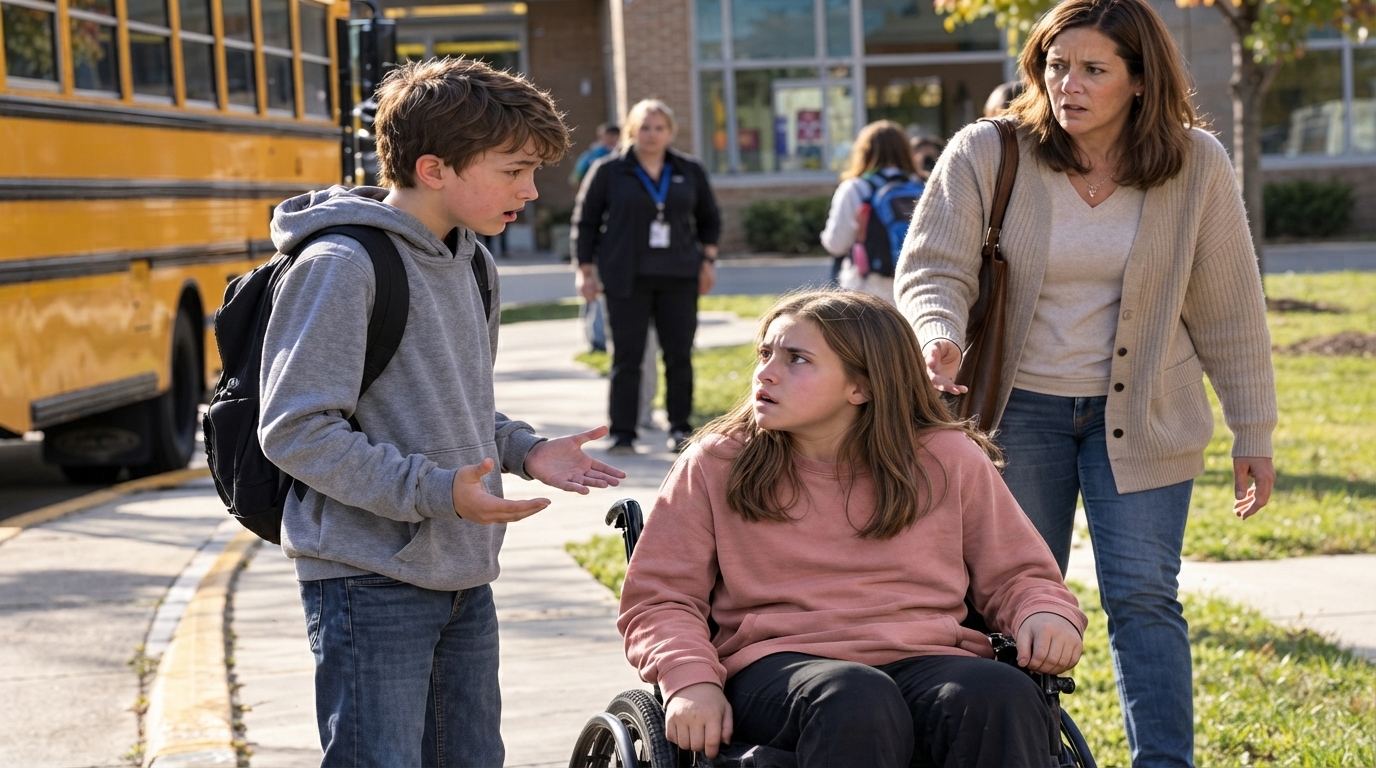
I saw the photograph of
Owen tipping Ruby out of her wheelchair.
But now I saw something else.
My son’s scraped palms.
The bruises around his fingers.
And the terrifying possibility that the photograph had
captured the exact moment he saved another child’s life.
Melissa stopped beside the reception desk.
“We need to speak with Principal Bell.”
The secretary looked up.
“Do you have an appointment?”
“No,” Melissa answered. “
But our children were involved in a serious incident yesterday,
and we’re not leaving without answers.”
I had spoken to Melissa three times the previous evening.
Ruby was home, shaken and bruised,
with a sprained wrist and a painful scrape along her shoulder.
Fortunately, the hospital had found no fractures.
But Ruby had been crying because she believed Owen was being punished for saving her.
And Owen had spent the night asking whether Ruby was okay.
Two eleven-year-old children were carrying guilt that belonged to adults.
I wasn’t going to let that continue.
The secretary made a call.
Five minutes later, Howard Bell appeared.
His expression tightened when he saw us together.
“Mrs. Price. Mrs. Ellis. I wasn’t expecting—”
“We know,” Melissa interrupted.
Bell glanced at our folders.
“Why don’t we step into my office?”
We followed him down the hallway.
The same hallway where I’d walked beside my suspended son less than twenty-four hours earlier.
Only this time, I wasn’t confused.
I was furious.
Bell closed his office door.
“Now, what seems to be the concern?”
Melissa stared at him.
“The concern is that you told me a boy attacked my daughter when she says he saved her.”
Bell’s expression changed.
“Ruby was understandably distressed after the incident.”
“She was distressed because she nearly rolled into a school bus.”
Bell went still.
I placed Owen’s medical report on the desk.
“My son has injuries to both hands consistent with gripping and struggling against moving equipment. He says Ruby’s wheelchair was rolling backward, and he tipped it toward the grass to get her out of danger.”
Bell folded his hands.
“Mrs. Price, we have a photograph.”
“I’ve seen it.”
“Then you understand why the school acted.”
“No,” I said. “I understand why the school needed to investigate. I don’t understand why you punished my son before asking the bus driver what she saw.”
Bell looked uncomfortable.
“We spoke with several witnesses.”
“Did you speak with Mrs. Torres?”
He hesitated.
“That information is part of our internal investigation.”
Melissa leaned forward.
“Yesterday, you told me there had been an act of cruelty against my daughter. You didn’t tell me she might have been in danger from a moving bus.”
Bell looked between us.
“We had no confirmed information suggesting that.”
I opened my folder.
“Then let’s confirm it.”
I took out a printed email.
It was from Elena Torres, the school bus driver.
I’d managed to contact her the previous evening through the transportation department.
She hadn’t discussed private student records with me.
But she had confirmed that she’d filed a written safety report about an emergency near her bus.
And she had asked why nobody had contacted her before disciplining Owen.
I slid the email across the desk.
Bell read it.
His face lost color.
“Where did you get this?”
“From Mrs. Torres.”
He looked at me sharply.
“School employees shouldn’t be discussing disciplinary matters with parents.”
I stared at him.
“She was discussing a safety incident she witnessed.”
Melissa crossed her arms.
“And we’re discussing why your school ignored it.”
Bell reached for his phone.
“I think we should involve our assistant principal.”
I looked at Melissa.
She looked back at me.
Neither of us spoke.
Because we both remembered what Ruby had said.
The assistant principal had told her not to mention that someone moved her wheelchair.
Assistant Principal Denise Harlow entered six minutes later.
She was a tall woman with perfectly arranged dark hair and a navy blazer.
She smiled when she saw us.
“Mrs. Ellis, I’m glad Ruby is recovering.”
Melissa didn’t smile back.
“Why did you tell my daughter not to mention that someone moved her wheelchair?”
Harlow stopped.
“I beg your pardon?”
“Ruby told me you said it would only confuse the investigation.”
Harlow looked toward Bell.
Then back at Melissa.
“I believe your daughter may have misunderstood.”
I felt my stomach tighten.
There it was.
Another adult suggesting an eleven-year-old girl couldn’t accurately describe what had happened to her.
Melissa’s voice hardened.
“My daughter knows exactly what you said.”
Harlow sat down.
“Children sometimes interpret reassurance as instruction.”
I leaned forward.
“Then explain what you were reassuring her about.”
Harlow adjusted her sleeves.
“Ruby was upset. We were trying to keep her calm.”
“Did someone move her wheelchair before dismissal?”
Harlow looked at Bell.
“Students’ movements during dismissal can be difficult to reconstruct.”
Melissa placed a photograph on the desk.
It showed Ruby’s wheelchair after the incident.
The damaged brake cable was visible beneath the seat.
“My daughter’s chair was inspected by her mobility technician two weeks ago. Both brakes were working.”
Harlow glanced at the photograph.
“Mechanical failures happen.”
“Yes,” Melissa said. “They do. Which is why I want to know whether anyone noticed a problem before Ruby was sent toward the bus lane.”
Bell cleared his throat.
“We’re reviewing the situation.”
I stared at him.
“Then review the video.”
Both administrators went silent.
Bell recovered first.
“The photograph provides a clear view of Owen’s actions.”
I shook my head.
“A photograph shows one moment. We need to know what happened before and after.”
Harlow looked at the clock.
“Unfortunately, our security system doesn’t cover every part of the bus lane.”
Melissa leaned forward.
“Which parts does it cover?”
Harlow hesitated.
“The main entrance and adjacent sidewalk.”
I thought about the school building.
Then I remembered something.
When I’d picked Owen up the previous afternoon, I’d parked beside the administration wing.
There was a camera mounted above the side entrance.
Its lens faced the service road.
The service road connected directly to the bus lane.
“What about the camera above the maintenance entrance?” I asked.
Harlow blinked.
“Which camera?”
“The one overlooking the service road.”
Bell looked at her.
She looked at him.
That was enough to tell me they hadn’t reviewed everything.
I sat back.
“Please preserve all footage from yesterday afternoon. Every camera covering the service road, sidewalk, and bus loading area.”
Melissa nodded.
“And the bus camera.”
Bell frowned.
“The bus camera?”
“Yes,” Melissa said. “The camera on Mrs. Torres’s bus.”
For a moment, nobody spoke.
Then Harlow said quietly, “The transportation department maintains those recordings.”
I looked at her.
“Then contact them.”
We left the office without accepting another explanation.
By ten that morning, Melissa had sent a written request asking the district to preserve all relevant recordings, witness statements, incident reports, and maintenance records.
I sent my own request concerning Owen’s suspension.
We also contacted the district superintendent’s office.
I wasn’t asking anyone to excuse my son because he was mine.
I wanted the school to investigate what had actually happened.
If Owen had hurt Ruby deliberately, he needed to face appropriate consequences.
But if he’d acted to protect her, the school needed to correct the record.
At eleven thirty, Melissa called me.
“Helen, are you sitting down?”
I was in my kitchen.
“Why?”
“Ruby just told me something else.”
My stomach tightened.
“What?”
“She said Mrs. Harlow was the person who moved her wheelchair.”
I gripped the counter.
“What do you mean?”
“Ruby said she was waiting near the main entrance because the bus aide hadn’t arrived. Mrs. Harlow told her the bus was ready and pushed her toward the loading area.”
I closed my eyes.
Melissa continued.
“Ruby said she told Mrs. Harlow one of her brakes felt loose.”
I stared at the wall.
“And?”
“She said Mrs. Harlow told her they’d have someone check it later.”
I felt sick.
“Did Ruby tell the principal?”
Melissa’s voice broke.
“She tried.”
I swallowed.
“What happened?”
“She said he told her to rest because she was upset.”
For several seconds, neither of us spoke.
Then Melissa whispered, “Helen, my daughter was telling them something was wrong with her chair before she fell.”
I closed my eyes.
“And they didn’t listen.”
At two fifteen, the superintendent’s office called.
The district had located the bus recording.
They had also identified footage from the maintenance entrance camera.
The superintendent, Dr. Elaine Mercer, asked whether Melissa and I could attend a meeting the following morning.
I said yes.
Then I called Owen into the kitchen.
He came downstairs wearing his gray hoodie.
His hands were freshly bandaged.
“Mom?”
I sat beside him.
“Sweetheart, the school found more video.”
His eyes widened.
“Did they see what happened?”
“I don’t know yet. They’re reviewing it.”
He stared at me.
“Are they going to believe me?”
My heart broke.
I took his uninjured wrist gently.
“Owen, I believe you.”
He looked down.
“Yesterday you didn’t.”
The words hurt more than I can describe.
I swallowed.
“You’re right.”
He began picking at the edge of his bandage.
“I kept telling you.”
“I know.”
His eyes filled.
“You thought I hurt Ruby.”
I felt tears sliding down my face.
“Yes, sweetheart. I did.”
He looked away.
I moved closer.
“And I was wrong to decide what happened before hearing your whole explanation.”
He whispered, “I was scared.”
I nodded.
“I know.”
“The bus was coming, and I couldn’t stop the chair.”
His voice began shaking.
“I thought she was going to get hit.”
I pulled him gently into my arms.
He began crying against my shoulder.
“I didn’t want to hurt her, Mom.”
I held him tightly.
“I know.”
He sobbed harder.
“I just wanted her to be safe.”
I kissed his hair.
“I’m so sorry I didn’t listen sooner.”
We stayed like that for a long time.
And I made myself a promise.
Whatever happened at the meeting, my son would never again have to beg me to hear his side of the story.
The next morning, Melissa and I arrived at the district office together.
Owen stayed home with my sister.
Ruby was recovering at home.
Dr. Mercer greeted us personally.
She looked exhausted.
“I want to begin by saying we have reviewed the footage.”
Melissa gripped her folder.
“And?”
Dr. Mercer took a breath.
“Mrs. Price, the available video does not support the conclusion that Owen deliberately attacked Ruby.”
I closed my eyes.
For the first time in two days, I could breathe.
Then she continued.
“In fact, it shows something very different.”
She turned toward the monitor.
And pressed play.
The first recording showed the sidewalk beside the school.
Ruby was waiting near the entrance.
Her backpack hung from the handles of her wheelchair.
Several children walked past.
Then Assistant Principal Harlow appeared.
She spoke to Ruby.
Ruby gestured toward one of her wheels.
Harlow bent down briefly.
Then she moved behind the chair.
I leaned forward.
“What is she doing?”
Dr. Mercer paused the video.
“That is one of the questions we’re investigating.”
The recording resumed.
Harlow pushed Ruby toward the bus loading area.
At the edge of the sidewalk, she stopped.
She appeared to say something.
Then she walked away.
Ruby remained in her wheelchair.
For several seconds, nothing happened.
Then the chair began moving backward.
Slowly at first.
Then faster.
Ruby reached for the wheels.
Her hands slipped.
The chair rolled down the sloped section of pavement toward the bus lane.
And Owen appeared.
He was running.
He grabbed the wheelchair handles.
His feet slid.
He tried to pull the chair backward.
Then the recording showed his hands dropping toward the wheels.
I remembered the injuries.
The scraped palms.
The red marks around his fingers.
He was trying to stop the chair.
But it kept moving.
Then the bus entered the frame.
Owen looked toward it.
And in one desperate movement, he tipped Ruby’s chair sideways toward the grass.
She fell clear of the paved lane.
The wheelchair toppled.
The bus stopped.
And Owen dropped to his knees beside Ruby.
I covered my mouth.
Melissa began crying.
Dr. Mercer paused the recording.
Then she said quietly, “Mrs. Price, your son appears to have acted to prevent Ruby from entering the path of the bus.”
I couldn’t speak.
Because for the first time, I was seeing the entire moment.
Not the photograph.
Not the accusation.
The truth.
And it was more frightening than anything I’d imagined.
PART 4
I watched the video three times.
Each time, my heart broke a little more.
The first time, I saw the wheelchair rolling backward.
The second time, I saw Owen running.
The third time, I watched his face.
My eleven-year-old son had been terrified.
He wasn’t angry.
He wasn’t laughing.
He wasn’t bullying anyone.
He was trying to stop a moving wheelchair from entering the path of a school bus.
And when he realized he couldn’t stop it, he made the only decision he could think of.
He tipped Ruby toward the grass.
He hurt her while trying to save her from something far worse.
I turned toward Dr. Mercer.
“Why wasn’t this reviewed before my son was suspended?”
She looked down.
“That’s part of what we’re investigating.”
Melissa wiped her cheeks.
“Why did the school tell me Ruby had been attacked?”
Dr. Mercer folded her hands.
“The initial disciplinary decision relied heavily on the photograph and incomplete witness accounts.”
I stared at her.
“Incomplete because nobody asked the bus driver?”
She hesitated.
“Mrs. Torres submitted a written report to the transportation department shortly after the incident.”
I felt my stomach tighten.
“Was that report available to the school?”
“Yes.”
“Did Principal Bell read it?”
Dr. Mercer looked uncomfortable.
“We have not established that he reviewed it before issuing the suspension.”
I shook my head.
“My son spent an entire night believing adults thought he was cruel because nobody bothered to read a report.”
Dr. Mercer nodded.
“I understand your anger.”
I leaned forward.
“Then please understand that correcting his suspension is only the beginning.”
Melissa pointed toward the paused video.
“What happened to Ruby’s wheelchair?”
Dr. Mercer took a breath.
“We’re arranging an independent examination of the chair and reviewing the relevant accessibility and dismissal procedures.”
Melissa nodded.
“Good.”
Dr. Mercer continued.
“We have also placed Assistant Principal Harlow on administrative leave while we review her actions.”
I looked at her.
“Because she moved Ruby’s wheelchair?”
“Because the footage and witness accounts raise questions about how Ruby was moved, whether a reported equipment concern was addressed, and how the incident was subsequently handled.”
Melissa stared at the screen.
“Ruby told her something was wrong with the brake.”
Dr. Mercer nodded.
“We have that statement.”
“And Harlow told her not to mention it afterward.”
“That allegation is also being investigated.”
I took a breath.
“What about Principal Bell?”
Dr. Mercer looked directly at me.
“He has been removed from responsibility for this investigation. The district is reviewing the disciplinary process and his handling of the reports.”
I sat back.
For the first time since the phone call, I felt that someone in authority was taking the situation seriously.
But there was still one thing I needed.
“Dr. Mercer, my son’s disciplinary record says he committed intentional physical aggression against another student.”
She nodded.
“I know.”
“That needs to be removed.”
“It will be.”
I stared at her.
“Completely.”
She nodded again.
“The suspension will be rescinded, and the record will be corrected. You’ll receive written confirmation.”
My eyes filled.
“And I want Owen to hear from the school that he did nothing wrong by trying to protect Ruby.”
Dr. Mercer’s expression softened.
“Yes.”
Melissa reached across the table and squeezed my hand.
Then she whispered, “He deserves that.”
When I returned home, Owen was sitting on the living-room floor building a model airplane.
My sister had gone to the kitchen to make lunch.
He looked up when I entered.
“Mom?”
I knelt beside him.
“Sweetheart, we saw the video.”
His hands went still.
“Did they believe me?”
I nodded.
“Yes.”
His eyes widened.
“Really?”
I smiled through tears.
“Really.”
He stared at me.
“Did they see the bus?”
“Yes.”
“And Ruby?”
“Yes.”
“And me trying to stop the chair?”
I nodded.
“All of it.”
His lower lip trembled.
“Am I still suspended?”
“No, sweetheart.”
He blinked.
“What?”
“The school is removing the suspension.”
He stared at me for several seconds.
Then he whispered, “So I’m not in trouble?”
I pulled him into my arms.
“No.”
He began crying.
Not loud, dramatic sobs.
Just quiet tears that soaked through my shirt.
I held him until his breathing slowed.
Then he looked up.
“Is Ruby okay?”
I smiled.
“She’s recovering.”
He wiped his eyes.
“Can I talk to her?”
I nodded.
“I think she’d like that.”
Melissa brought Ruby to our house that Saturday.
She had called first to make sure Owen felt comfortable.
Ruby arrived in a temporary wheelchair while her own chair was being examined and repaired.
Her wrist was still wrapped.
Owen stood beside the front door, nervous.
When Ruby came inside, he immediately looked at her wrist.
“Does it hurt?”
She smiled.
“A little.”
He looked down.
“I’m sorry.”
Ruby frowned.
“For what?”
“For tipping you.”
She stared at him.
Then said something I’ll never forget.
“Owen, you saved me.”
His eyes filled.
“But you got hurt.”
Ruby shrugged carefully.
“I’d rather have a sprained wrist than get hit by a bus.”
Owen gave a shaky laugh.
Melissa wiped her eyes.
I stood beside the doorway, trying not to cry.
Then Ruby held out her hand.
Owen looked confused.
She smiled.
“Friends?”
He grinned.
“Friends.”
They shook hands gently.
And just like that, the two children who had been at the center of an awful misunderstanding began moving forward.
The adults still had a great deal to answer for.
But the children had already understood what mattered.
We spent the afternoon in the backyard.
Owen showed Ruby his model airplanes.
Ruby told him about her favorite science-fiction books.
They argued about whether aliens would be friendly.
They laughed.
And for a few hours, they were simply two eleven-year-olds enjoying each other’s company.
At one point, Melissa and I sat on the patio while the children talked.
She looked toward Owen.
“I don’t know how to thank him.”
I shook my head.
“You don’t have to.”
She smiled sadly.
“He could have run away.”
I looked at my son.
“Yes.”
“But he didn’t.”
I nodded.
Melissa wiped her eyes.
“Ruby told me she remembers looking over her shoulder and seeing the bus. She said she thought she was going to die.”
My chest tightened.
“Then she said Owen appeared.”
I closed my eyes.
Melissa continued.
“She told me he looked scared too.”
I opened my eyes.
“Of course he was.”
She nodded.
“But he stayed.”
We sat quietly.
Then Melissa whispered, “You raised a good boy, Helen.”
I looked toward Owen.
He was laughing at something Ruby had said.
And for the first time since Tuesday afternoon, I felt proud without fear.
The independent wheelchair examination took several weeks.
The findings were disturbing.
One brake cable had become partially disconnected.
The opposite brake was not functioning reliably.
The examiner could not determine from the physical evidence alone exactly when the damage occurred.
There was no basis to conclude that someone had deliberately sabotaged the chair.
But the report confirmed that the wheelchair should not have been used until the brake problem was repaired.
The district also reviewed the slope near the loading area.
It was steeper than the school had recognized in its dismissal safety assessment.
That made the situation even more dangerous.
Ruby’s chair had been positioned near the slope.
With unreliable brakes, it could roll.
And it had.
The investigation found failures in how the school responded to Ruby’s reported concern and in how staff coordinated accessible transportation.
The district announced changes to the dismissal procedures.
Wheelchair users would no longer be left waiting near the sloped section of the bus lane.
Staff responsible for assisting students would receive additional training.
Equipment concerns would require immediate attention and documented follow-up.
The transportation department would have a clearer process for sharing emergency reports with school administrators.
Those changes mattered.
But Melissa and I kept asking one question.
Why had the school been so quick to blame Owen?
The answer emerged during a meeting with the district’s review team.
A parent named Mrs. Patterson had taken the photograph from her car.
She had seen Owen tip the wheelchair.
She had not seen the chair rolling toward the bus.
Her photograph was real.
Her concern was understandable.
But her conclusion was wrong.
The image had been taken at the most misleading moment possible.
Principal Bell had accepted the photograph as evidence of deliberate aggression.
Assistant Principal Harlow had provided an account that focused on Owen tipping the chair without adequately addressing the events that preceded it.
And the bus driver’s report had not been considered before the suspension.
Dr. Mercer explained the findings carefully.
“The disciplinary decision was made without a sufficiently complete investigation.”
I stared at her.
“That’s a very polite way of saying my son was blamed for saving someone.”
She lowered her eyes.
“Yes, Mrs. Price. The school reached the wrong conclusion.”
Melissa leaned forward.
“And my daughter wasn’t properly heard when she tried to explain.”
Dr. Mercer nodded.
“That’s also correct.”
I took a breath.
“Then I want both children to receive written apologies.”
She agreed.
The following Monday, Owen returned to school.
I drove him myself.
He sat quietly in the passenger seat, his backpack on his knees.
His hands were healing.
The scrapes had begun to fade.
But I knew the emotional wounds would take longer.
As we approached the school, he looked out the window.
“Mom?”
“Yes?”
“What if everybody still thinks I pushed Ruby because I was being mean?”
I felt my heart tighten.
“The school has corrected the record.”
He nodded.
“But what if they don’t believe it?”
I pulled into the parking lot.
Then turned toward him.
“Sweetheart, sometimes people believe the first story they hear, even when it’s wrong.”
He looked at me.
“But the truth matters. And you don’t have to prove your goodness to every person who misunderstood you.”
He stared at his hands.
I continued.
“Ruby knows what happened. Mrs. Torres knows. I know. And now the school knows.”
He swallowed.
“Okay.”
I reached for his hand.
“And Owen?”
He looked up.
“I’m proud of you.”
His eyes filled.
“Even though I hurt Ruby?”
I nodded.
“You made a frightening decision in an emergency because you were trying to protect her. I’m proud that you cared enough to help.”
He smiled faintly.
Then opened the car door.
When we reached the entrance, Ruby was waiting with Melissa.
She waved.
“Owen!”
My son smiled.
“Hey!”
Ruby rolled toward him.
Then said loudly enough for several nearby students to hear, “You still owe me a rematch in chess.”
Owen laughed.
“You lost fair and square.”
“I was distracted.”
“By losing?”
She rolled her eyes.
Melissa and I exchanged smiles.
Then the two children went inside together.
I watched until they disappeared down the hallway.
And I realized something.
Ruby wasn’t simply grateful to Owen.
She was helping him return to a school where he’d been publicly misunderstood.
Without being asked.
Without making a speech.
She was showing everyone that she trusted him.
It was a kindness I would never forget.
A week later, Principal Bell requested a meeting with Owen and me.
I agreed, provided a district representative would attend.
We met in a conference room.
Bell looked different.
Less certain.
More tired.
He sat across from Owen.
“Owen, I owe you an apology.”
My son stared at him.
Bell continued.
“I made a disciplinary decision before I had all the facts.”
Owen looked down.
“I tried to tell you.”
Bell nodded.
“You did.”
“I told you about the bus.”
“Yes.”
“And Mrs. Torres.”
Bell swallowed.
“Yes.”
Owen’s voice trembled.
“Why didn’t you listen?”
The room went silent.
Bell looked at my son for a long moment.
Then he said quietly, “I should have.”
Owen stared at him.
Bell continued.
“I saw the photograph, and I made an assumption. I was wrong.”
My son nodded slowly.
Bell leaned forward.
“I’m sorry, Owen.”
Owen thought about it.
Then said, “Okay.”
Not I forgive you.
Not It’s fine.
Just okay.
And I was proud of him for that too.
Because he didn’t owe anyone immediate forgiveness.
The school also issued a written correction to the families who had been directly informed of the disciplinary accusation.
It explained that the investigation had established Owen acted in response to an emergency and that the suspension had been rescinded.
The message did not disclose Ruby’s private medical information.
It did not turn either child into a spectacle.
It simply corrected the false impression.
Mrs. Patterson, the parent who had taken the photograph, sent me a letter.
She wrote that she’d genuinely believed she was witnessing an attack.
She apologized for drawing a conclusion from a single moment.
I appreciated that.
Because she had done something the school initially hadn’t.
She acknowledged that she’d been wrong.
The district’s personnel review concluded later that semester.
Assistant Principal Harlow did not return to her previous position.
The district confirmed that its handling of the wheelchair safety concern and subsequent investigation had fallen short of required procedures.
Principal Bell also left his position at Westbrook following the review.
The district did not share confidential employment details with us, and I didn’t ask for them.
I wanted accountability.
But I didn’t need every private consequence announced to the world.
The important changes were already happening.
Ruby had a repaired wheelchair.
The bus lane had new safety barriers and updated loading procedures.
Drivers’ emergency reports were now required to be reviewed promptly when related disciplinary decisions were being considered.
And students were to be given a meaningful opportunity to explain what happened before conclusions were reached.
Melissa and I continued attending district accessibility meetings.
Not because we enjoyed confronting administrators.
We didn’t.
But because we had learned how easily a dangerous situation could be misunderstood when adults stopped asking questions.
By the end of the school year, Owen and Ruby had become close friends.
They worked together on a science project about momentum and friction.
Ruby insisted on including a demonstration involving a miniature ramp.
Owen looked horrified.
“Seriously?”
She grinned.
“Relax. This time we’re using toy cars.”
I laughed so hard I nearly spilled my coffee.
Their project won second place at the school science fair.
The title was:
WHY THINGS ROLL — AND HOW TO MAKE THEM STOP.
I stared at the display for a long time.
There were diagrams.
Measurements.
Charts.
And a photograph of the two of them smiling beside their project.
Nothing about the accident.
Nothing about the suspension.
Just two children who had turned a frightening experience into something they could learn from.
When their teacher handed them the ribbon, Ruby raised it triumphantly.
Owen laughed.
And I felt tears in my eyes.
That evening, I found Owen sitting at the kitchen table.
He was carefully removing the last small bandage from his palm.
The skin beneath it was pink.
Almost healed.
I sat beside him.
“How do your hands feel?”
He flexed his fingers.
“Good.”
I smiled.
“That’s wonderful.”
He looked at me.
“Mom?”
“Yes?”
“Can I ask you something?”
“Anything.”
He hesitated.
“Did you really think I was a bad person?”
My heart sank.
I took a breath.
“No, Owen. I never thought you were a bad person.”
He looked down.
“But you thought I did something bad.”
I nodded.
“Yes.”
He picked at the corner of the bandage.
“Why?”
I thought carefully before answering.
“Because I saw a photograph that looked terrible, and I was scared. I let that fear make me jump to a conclusion.”
He stared at me.
I continued.
“Parents are supposed to protect their children, but we’re also supposed to teach them to take responsibility when they hurt someone. I was so focused on that responsibility that I forgot to listen.”
His eyes filled.
“I’m sorry.”
I shook my head.
“No, sweetheart. You don’t need to apologize.”
He looked up.
“I should have told you sooner.”
I reached for his hand.
“You tried.”
He swallowed.
“And next time, I promise I’ll listen before I decide what happened.”
He nodded.
Then he leaned against me.
I wrapped my arm around his shoulders.
And for a long time, we sat quietly.
A month later, Melissa invited us to Ruby’s birthday party.
There were balloons.
Pizza.
A chocolate cake decorated with tiny stars.
And a dozen children laughing in the backyard.
At one point, Ruby’s grandfather approached me.
He was an older man with silver hair and kind eyes.
“You’re Owen’s mother?”
I nodded.
“Yes.”
He shook my hand.
“I wanted to thank you.”
I smiled sadly.
“Your granddaughter is wonderful.”
He nodded.
“She is.”
Then he looked toward Owen.
“That boy has more courage than most grown men I’ve known.”
My throat tightened.
“He was very frightened.”
The grandfather smiled.
“Courage doesn’t mean you aren’t frightened.”
He looked at Owen again.
“It means you do what you can to help anyway.”
I wiped my eyes.
Then watched my son laughing beside Ruby.
Eleven years old.
Still missing a little confidence after everything he’d endured.
But smiling again.
And I realized how close we had come to allowing one photograph to define him.
I still think about that Tuesday afternoon.
The principal’s phone call.
The photograph.
The disciplinary notice.
The terrible moment when Owen admitted he’d tipped Ruby’s wheelchair.
I remember believing the worst because the picture seemed impossible to explain any other way.
And I remember my son sitting beside me in the car, begging me to understand that something had happened before the photograph was taken.
He was right.
There was always more to the story.
A loose brake.
A dangerous slope.
A bus approaching.
A frightened girl.
And an eleven-year-old boy who saw someone in danger and ran toward her instead of away.
The photograph showed his hands on the wheelchair.
It didn’t show the reason.
The school saw aggression.
The parent saw cruelty.
And for one terrible hour, I saw a son I thought I didn’t recognize.
But the truth was that Owen had been exactly the boy I’d raised.
The boy who helped neighbors.
The boy who apologized when he bumped into strangers.
The boy who couldn’t stand watching someone else struggle.
He hadn’t stopped being that child.
I’d simply forgotten to trust that there might be more to the story.
And I would always regret that.
Today, the photograph is no longer what I remember most.
I remember Ruby and Owen shaking hands in our living room.
I remember the science fair ribbon.
I remember Principal Bell apologizing.
And I remember the day Owen finally removed the last bandage from his hand.
There was a faint scar across his right palm.
A small white line.
He asked me once whether it would disappear.
“Maybe,” I told him.
He studied it.
Then shrugged.
“That’s okay.”
I smiled.
“Why?”
He looked at me.
“Because Ruby’s okay.”
I turned away before he could see me cry.
My son had been suspended for an act the school called cruelty.
But the truth was written across both his injured hands.
He had risked hurting himself to keep another child safe.
And while the adults argued about what the photograph meant, the two children knew the truth all along.
A single photograph can show what someone did.
It cannot always show why.
And sometimes, the child everyone is pointing at is the one who deserves to be thanked.
THE END THANK YOU FOR READING !!!



