PART 3
For a moment, I couldn’t hear anything
except the fire crackling behind me.
Four hundred and eighty thousand dollars.
I stared at the blue folder in Garrett’s hands,
trying to make sense of the number.
My grandmother had lived simply.
She drove an old Buick.
She wore sweaters she’d owned for twenty years.
She clipped grocery coupons even when I told her she didn’t need to.
She had never been interested in expensive things.
The cabin was the one luxury she’d allowed herself.
And now someone had apparently tried
to use it to secure nearly half a million dollars.
“Garrett,” I whispered, “tell me exactly what this means.”
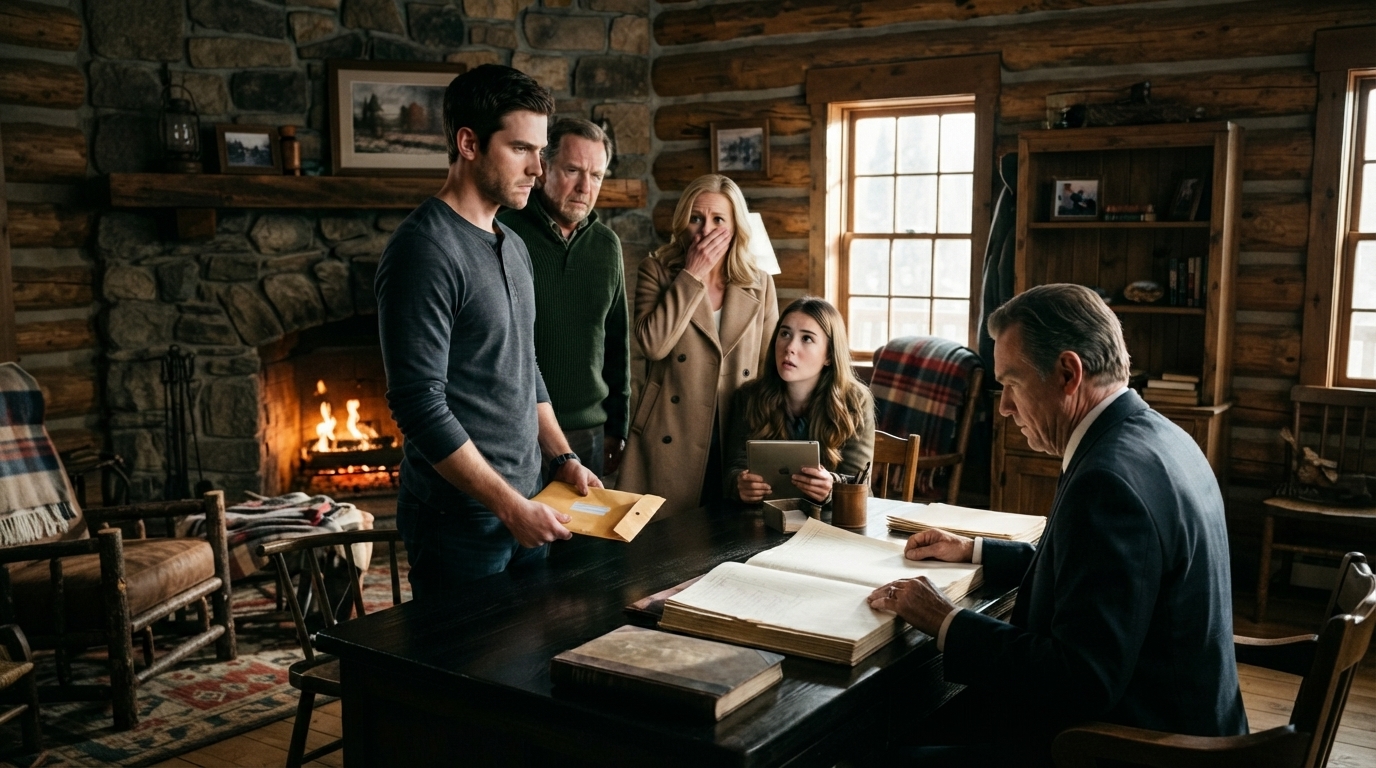
He placed the folder on the desk.
It means we have documents that appear to show your
parents attempted to borrow against property they didn’t own.
I looked toward the window.
My father’s truck was disappearing down the gravel driveway.
“Did they get the money?”
“That’s what we need to establish.”
He opened another section of the folder.
Your grandmother received correspondence
from a private lender three years ago.
The lender believed she’d transferred ownership of the cabin to a
company called Ridgecrest Mountain Ventures.
I frowned.
“I’ve never heard of it.”
Garrett looked at me.
“Your father is listed as its manager.”
My stomach tightened.
“And Rachel?”
He turned a page.
“She appears in the company’s formation records as an authorized representative.”
I sat down.
The room suddenly felt smaller.
“Did Grandma know?”
“She discovered the claim when the lender contacted her about a missing document.”
I stared at him.
“And she didn’t tell me?”
Garrett’s expression softened.
“She was afraid you’d feel obligated to come back and fight your parents.”
I looked down at the letter.
Grandma had written three pages about what happened when I was nineteen.
Three pages explaining the accusation that had destroyed my relationship with my family.
But she had said nothing about the financial burden she’d been carrying herself.
“Why didn’t she go to the police?”
Garrett took a breath.
“She did consult an attorney. The matter was investigated privately at first. The lender stopped the transaction when the ownership records didn’t match the documents it had received.”
I looked up.
“So the loan never closed?”
“Not against this property, according to the records we’ve reviewed. But the application was substantial, and there may have been related transactions elsewhere.”
I exhaled shakily.
“Then Grandma’s cabin is safe?”
“Based on the current title search, the property remains in her name. But we’ll obtain updated records and confirm that no undisclosed liens or claims exist.”
I nodded.
Then I looked at the photograph above the fireplace.
Grandma and me.
I was ten years old, holding a fish almost as long as my arm.
She was laughing.
I remembered that day.
I’d dropped my fishing rod into the lake, and she’d waded into the freezing water to retrieve it.
She’d come back shivering and grinning.
“Some things are worth getting wet for, Cole.”
I stared at her face.
And realized she’d spent the final years of her life trying to protect something she wanted to leave me.
Garrett closed the folder.
“There’s another issue we need to discuss.”
I looked at him.
“What?”
“Your parents may contest the will.”
I laughed bitterly.
“They already accused me of manipulating her.”
“Exactly.”
He sat across from me.
“Your grandmother anticipated that possibility. That’s why she arranged the cognitive evaluations, independent witnesses, and a detailed record of her estate planning.”
I nodded slowly.
“She knew they’d fight.”
“Yes.”
“Did she ever tell you why she left everything to me?”
Garrett looked toward the fireplace.
“She told me you were the only person in the family who loved this place without calculating what it was worth.”
My throat tightened.
He continued.
“She said you always asked whether the roof was leaking, whether the pipes froze, whether she had enough firewood.”
I looked down.
“That’s because I worried about her.”
“I know.”
He smiled sadly.
“She knew too.”
I wiped my eyes.
Garrett stood.
“There’s something else in the drawer.”
He reached inside and removed a small wooden box.
It was about the size of a paperback book.
The lid was carved with tiny pine trees.
I recognized it immediately.
Grandma had kept it on her bedside table for as long as I could remember.
“What is that doing here?”
Garrett placed it in front of me.
“She asked me to give it to you after you read the letter.”
I opened the lid.
Inside were photographs.
Old postcards.
A silver pocket watch that had belonged to Grandpa.
And a folded piece of paper.
On the front, Grandma had written:
FOR THE BOY WHO NEVER CAME BACK BEGGING.
I covered my mouth.
Then I unfolded it.
Cole,
The day your father threw you out, I drove to your parents’ house.
I told him he was making the greatest mistake of his life.
He told me you would return within a week.
He said hunger would teach you respect.
I told him that cruelty does not teach respect. It teaches distance.
You never returned.
And although I wished you had never needed to be so strong, I was proud that you built a life without becoming cruel yourself.
Please don’t let this inheritance become another prison.
The cabin is yours because I want you to have a home where nobody can tell you that you don’t belong.
Love, Grandma.
I couldn’t finish reading without crying.
For eight years, I’d carried the shame of being thrown out.
I’d slept on a friend’s couch.
Worked double shifts at a hardware store.
Taken community college classes at night.
Saved every dollar.
Eventually, I’d built a small construction business of my own.
But even after I became financially stable, some part of me still felt like the nineteen-year-old boy standing on the sidewalk with a suitcase.
Grandma had known.
And somehow, she’d found a way to tell me that I had never been the failure my parents claimed I was.
That evening, I stayed at the cabin.
Garrett had gone back to town after arranging for a title review and advising me not to discuss the disputed documents with my family.
I made soup in Grandma’s old kitchen.
Then I sat beside the fireplace with her letters spread across my lap.
At seven thirty, my phone rang.
Dad.
I stared at the screen.
Eight years without a call.
Eight years without a birthday message.
Eight years without even a simple question about whether I was alive.
Now, less than six hours after the will reading, he was calling.
I let it ring.
A minute later, a text appeared.
We need to discuss the property.
I didn’t respond.
Another message arrived.
Your grandmother was confused. You know that.
I stared at it.
Then another.
You cannot possibly manage that place on your own.
I almost laughed.
I had spent the last five years renovating houses for clients.
I’d repaired foundations.
Rebuilt decks.
Managed crews.
Negotiated with suppliers.
And my father was telling me I couldn’t manage a cabin.
Then the final message appeared.
We have legal options. Don’t make this ugly.
I took a screenshot.
Then placed my phone facedown.
The cabin was quiet.
For the first time in my life, I didn’t feel the need to defend myself to him.
The following morning, I drove into town to meet Garrett.
He had arranged a conference call with a property attorney and a forensic accountant.
I brought Grandma’s blue folder.
The accountant, a woman named Denise Carter, reviewed the old bank records concerning the fifteen thousand dollars my father had accused me of stealing.
She examined the transfer history.
Then she looked at me.
“Cole, do you remember signing any authorization for this account?”
“No.”
“Did you have access to your father’s business accounts?”
“Only for a few weeks when I helped file invoices during summer break.”
She nodded.
“The documents your grandmother obtained suggest the transfer was initiated using credentials associated with your mother’s office account.”
I stared at her.
“My mother worked for Dad’s company.”
“Correct.”
“And the money went to Rachel?”
“Into an account she controlled.”
I closed my eyes.
The memory returned immediately.
Dad standing in his office.
The bank statement on his desk.
His finger stabbing at the page.
You think I’m stupid, Cole?
I’d been nineteen.
Terrified.
Confused.
I’d told him I didn’t take the money.
He’d called me a liar.
Mom had stood in the doorway.
Silent.
Now I understood why.
I looked at Denise.
“Did Grandma ever confront them?”
Garrett answered.
“She did.”
I turned toward him.
“What happened?”
He hesitated.
“Your mother admitted she had approved the transfer.”
My heart stopped.
“She admitted it?”
“According to Evelyn’s notes, yes.”
I stared at him.
“And Dad?”
Garrett looked uncomfortable.
“He refused to discuss the matter.”
I felt something inside me break.
Not because my mother had helped move the money.
Not even because Rachel had benefited.
But because my parents had known I was innocent.
And they had let me spend eight years believing I’d been discarded for something I never did.
I left the office and sat in my truck for nearly an hour.
The mountains rose beyond the parking lot.
Snow still clung to the highest peaks.
I stared through the windshield.
I had spent years imagining what I would say if I ever saw my father again.
I imagined shouting.
Demanding answers.
Making him admit he’d been wrong.
But now that I had the evidence, I didn’t want to shout.
I wanted one thing.
The truth.
I called him.
He answered immediately.
“Cole.”
I stared at the steering wheel.
“Dad, did Mom tell you eight years ago that she authorized the transfer?”
Silence.
Then he said, “What are you talking about?”
“The fifteen thousand dollars.”
His breathing changed.
“Cole, that was a long time ago.”
“Did she tell you?”
He sighed.
“Your grandmother filled your head with nonsense.”
I closed my eyes.
“Answer the question.”
He raised his voice.
“Don’t speak to me like that.”
I felt the old fear rise.
The familiar instinct to apologize.
To soften my tone.
To make him comfortable.
Then I remembered Grandma’s letter.
Cruelty does not teach respect. It teaches distance.
I took a breath.
“Dad, I’m not nineteen anymore.”
He went quiet.
I continued.
“I know Mom authorized the transfer. I know Rachel received the money. I know Grandma confronted you.”
He said nothing.
“So I’m asking one final time.”
My voice trembled.
“Did you know I was innocent when you threw me out?”
For several seconds, there was only silence.
Then he whispered, “Your mother told me afterward.”
I closed my eyes.
“How long afterward?”
He hesitated.
“About a week.”
A week.
I had slept in my car for three nights.
Worked shifts at a diner for cash.
Borrowed a blanket from a coworker.
And a week later, my father had learned I was innocent.
But he had never called.
Never apologized.
Never asked me to come home.
I stared through the windshield.
“Why didn’t you tell me?”
He sighed.
“By then, you’d already made such a scene.”
I felt tears slide down my face.
“A scene?”
“You left without showing any respect.”
I laughed once.
“You kicked me out.”
“You were difficult.”
I shook my head.
“No, Dad. I was innocent.”
He began speaking again.
I didn’t listen.
Because suddenly I understood something.
My father didn’t need more evidence.
He needed to believe that whatever he had done was justified.
And there was no document in the world that could make him accept responsibility if he refused to look at himself.
I ended the call.
Then I sat there until the tears stopped.
Three days later, Garrett called with news.
My parents had retained an attorney.
They intended to challenge Grandma’s will.
Their claim was that she had been mentally incapable of making sound decisions.
I looked around the cabin.
At the neatly organized records.
The labeled folders.
The handwritten notes.
The cognitive evaluations.
Grandma had prepared for this.
But knowing she had prepared didn’t make the betrayal hurt less.
Garrett continued.
“There’s one more thing, Cole.”
I took a breath.
“What?”
“Your father contacted a contractor yesterday.”
I frowned.
“Why?”
“He apparently told them the cabin would soon be under his control.”
I stared at the wall.
“He hasn’t given up.”
“No.”
Garrett paused.
“And according to the contractor, he has already paid a deposit for renovations.”
I felt my stomach tighten.
“With whose money?”
“We don’t know.”
I looked toward the old plaid couch.
Grandma had spent ninety-three years building a life in this place.
My father had spent less than forty-eight hours trying to turn it into a rental lodge.
I took a breath.
“Garrett?”
“Yes?”
“Tell the contractor nobody has permission to enter the property.”
“I’ll handle it.”
I looked toward the front door.
“And make sure everyone knows who owns this place now.”
PART 4
The legal challenge arrived two weeks later.
My parents claimed Grandma had been confused, vulnerable, and improperly influenced.
They suggested I had manipulated her into leaving me the cabin.
The accusations were painful.
But they were also predictable.
Garrett had warned me.
Grandma had anticipated them.
And the evidence told a very different story.
Her medical evaluations showed she understood her assets and the people who might inherit them.
Her attorney’s notes documented her reasons for choosing me.
Her estate plan had been reviewed carefully.
And she had signed the final documents with independent witnesses.
There were also years of letters between us.
Birthday cards.
Postcards.
Emails.
Photographs.
Proof of a relationship that had continued long after my parents decided I no longer belonged in their family.
My parents had not expected that.
They seemed to believe that because they hadn’t spoken to me for eight years, Grandma hadn’t either.
They had no idea how many evenings we’d spent talking on the phone.
How often she’d asked about my work.
How proudly she’d spoken about my first construction contract.
How she’d cried when I told her I’d finally bought my own truck.
She had been present for every important part of my adult life.
My parents had simply chosen not to be.
The disputed property documents became a separate issue.
Garrett and the property attorney contacted the lender and obtained records concerning the attempted financing.
The documents appeared to have been prepared using information associated with Ridgecrest Mountain Ventures.
The lender had halted the transaction before funding it against Grandma’s property.
A review of the title records showed that the cabin had remained in Evelyn’s name.
No completed transfer to Ridgecrest had been recorded.
No valid mortgage from that application encumbered the property.
That was a relief.
But it didn’t answer every question.
The signature on the purported transfer authorization remained disputed.
The documents were preserved for examination.
And the matter was referred for appropriate investigation.
I didn’t know whether my father, Rachel, or someone else had physically prepared the signature.
I refused to accuse anyone beyond what the evidence established.
But I knew one thing.
Grandma had never intended to give up her cabin.
And someone had tried to make it appear otherwise.
My mother called me one evening in early spring.
I was replacing a broken railing on the dock when my phone rang.
Her name appeared on the screen.
I stared at it.
Then answered.
“Hello?”
“Cole.”
Her voice sounded smaller than I remembered.
“Mom.”
She hesitated.
“Can we talk?”
I sat on the dock.
“About what?”
She took a breath.
“Your father says you’re trying to destroy the family.”
I looked out across the lake.
“Is that why you called?”
She began crying.
“Cole, please.”
I waited.
She continued.
“We’ve all made mistakes.”
I stared at the water.
“Some mistakes are bigger than others.”
She sniffled.
“I know.”
I took a breath.
“Mom, did you know I hadn’t stolen that money?”
Silence.
“Did you?”
She began crying harder.
“Yes.”
The word was so quiet I almost missed it.
I closed my eyes.
“Then why did you let Dad throw me out?”
She sobbed.
“Because I was afraid of him.”
I looked toward the mountains.
For years, I’d imagined my mother as someone who simply didn’t care.
Now she was telling me she’d been afraid.
It explained something.
But it didn’t erase what she’d done.
“You could have called me,” I said.
“I know.”
“You could have told me the truth.”
“I know.”
“You could have asked whether I had somewhere safe to sleep.”
She began crying so hard she could barely speak.
I felt tears gathering.
But I kept going.
“Mom, I was nineteen.”
“I know, sweetheart.”
“I slept in my car.”
She made a broken sound.
“I didn’t know that.”
“Because you never asked.”
Silence.
Then she whispered, “I’m sorry.”
I looked at the dock beneath my boots.
It was the first apology I’d heard from either parent.
But after eight years, I needed more than words.
“Mom, why did the money go to Rachel?”
She hesitated.
Then said, “Your cousin was in trouble.”
I frowned.
“What kind of trouble?”
“She owed money.”
“To whom?”
“People she’d borrowed from.”
I stared at the lake.
“And you took money from Dad’s company to help her?”
She began crying again.
“I thought I could replace it.”
I closed my eyes.
The familiar phrase.
I thought I could replace it.
Apparently, my mother had believed that borrowing without permission was acceptable as long as she planned to put the money back.
But when the transfer was discovered, she had allowed me to take the blame.
“Mom,” I said quietly, “you didn’t just let Dad think I stole the money.”
She went silent.
“You watched him punish me for something you did.”
She whispered, “I know.”
I took a breath.
“That’s going to take a long time to forgive.”
“I understand.”
I wasn’t sure she did.
But for the first time, she wasn’t arguing.
And that was something.
The will dispute continued through spring.
My parents’ attorney requested records.
Garrett provided the appropriate documentation.
The independent medical evaluations became important.
So did Grandma’s estate-planning notes.
One afternoon, Garrett called me.
“Cole, I have something you should hear.”
I sat down.
“What?”
“Your grandmother recorded a statement during her estate-planning process.”
My heart began pounding.
“A recording?”
“Yes. It was made with counsel present and preserved with the estate records.”
I swallowed.
“What did she say?”
Garrett hesitated.
“I think you should hear it yourself.”
The following morning, I went to his office.
He played the recording.
Grandma’s voice filled the room.
Older.
Softer.
But unmistakably hers.
“My name is Evelyn Margaret Lawson. I am ninety-three years old, and I understand that I am making decisions about my property after my death.”
I covered my mouth.
She continued.
“I have chosen to leave my cabin to my grandson Cole.”
My eyes filled.
“He is not receiving it because he asked for it. He never asked me for anything.”
I began crying.
“He is receiving it because he understands what a home means.”
I looked down.
Grandma’s voice continued.
“When Cole was nineteen, his parents turned him away. I watched him struggle. I watched him work. I watched him build a life.”
A pause.
Then:
“I want him to have a place where he never has to wonder whether he is welcome.”
I broke down.
Garrett quietly handed me a tissue.
The recording continued.
“I love my son Ronald. But love does not require me to reward behavior I believe was wrong.”
Another pause.
“And I do not want my home turned into a business venture by people who cared more about its value than its memories.”
I closed my eyes.
Grandma had known.
She had seen exactly what my parents would try to do.
And she’d left her wishes unmistakably clear.
The dispute ended several months later.
After reviewing the available evidence, my parents withdrew their challenge as part of a formal resolution.
The estate administration continued.
The property title was transferred according to Grandma’s will.
The cabin became mine.
Legally.
Completely.
And without the uncertainty that had hung over it since the reading.
The separate investigation into the disputed financing documents continued on its own course.
I let the professionals handle it.
I had spent too much of my life being dragged into my parents’ conflicts.
I wasn’t going to spend the rest of it trying to punish them.
I wanted to build something better.
That summer, I began repairing the cabin.
Not renovating it into a luxury lodge.
Not tearing down walls.
Not replacing every old thing with something expensive.
I repaired what needed repairing.
The dock had several rotten boards.
The roof needed attention.
The kitchen sink leaked.
The porch railing was loose.
I fixed those things.
Then I restored the old plaid couch.
I cleaned Grandma’s record player.
I organized her books.
And I hung our fishing photograph above the fireplace.
Sometimes I worked until sunset.
Sometimes I sat on the porch doing nothing.
For the first time in years, doing nothing felt peaceful.
One Saturday afternoon, a truck pulled into the driveway.
I looked up from the dock.
Rachel stepped out.
She was wearing jeans and a plain sweater.
No sunglasses.
No tablet.
No smug expression.
I stood.
“What are you doing here?”
She stopped several feet away.
“Can we talk?”
I hesitated.
“About what?”
She looked toward the cabin.
“Grandma.”
I waited.
Rachel swallowed.
“I owe you an apology.”
I stared at her.
She continued.
“I knew about the money.”
My stomach tightened.
“The fifteen thousand?”
She nodded.
“I knew your mom had transferred it to help me.”
I felt my jaw clench.
“And you let everyone blame me?”
Her eyes filled.
“Yes.”
I looked away.
For a moment, I wanted to tell her to leave.
To get off my property.
To never come back.
But I stayed.
Rachel began crying.
“I was twenty-two. I had made some terrible decisions. I owed money, and I was scared.”
I looked at her.
“So you let a nineteen-year-old take the blame.”
She nodded.
“I did.”
I took a breath.
“Why are you telling me now?”
She wiped her cheeks.
“Because Grandma’s note made me realize how much she knew.”
I remembered the will reading.
For hosting the worst Thanksgiving I ever endured.
I almost smiled.
Grandma had never been subtle when she was disappointed.
Rachel continued.
“She came to Thanksgiving three years ago. Dad and your parents were talking about turning the cabin into a rental. Grandma told us she didn’t want that.”
I stared at her.
“What happened?”
Rachel looked ashamed.
“We laughed at her.”
My chest tightened.
“Why?”
“Because we thought she was being sentimental.”
I looked toward the cabin.
Rachel continued.
“She told us the place wasn’t an investment. It was her home.”
A tear slid down her cheek.
“And I told her she was too old to understand what the property was worth.”
I closed my eyes.
I could almost see Grandma sitting at the table.
Her small hands folded.
Her expression calm.
Rachel began crying harder.
“She left early that night.”
I nodded slowly.
“That explains the note.”
Rachel wiped her eyes.
“I know.”
For a long moment, neither of us spoke.
Then she looked at me.
“I don’t expect you to forgive me.”
I nodded.
“Good.”
She flinched.
I continued.
“Because I’m not ready.”
She lowered her eyes.
“But I appreciate you telling the truth.”
She nodded.
Then she turned toward her truck.
Before leaving, she looked back.
“Cole?”
“Yes?”
“Grandma really loved you.”
My throat tightened.
“I know.”
Rachel smiled sadly.
“She talked about you all the time.”
Then she drove away.
My father was the last person to contact me.
It happened in October.
The leaves had turned red and gold.
The mountains were beginning to smell like winter.
I was stacking firewood beside the porch when his truck appeared.
I stood still.
He climbed out slowly.
For the first time in my life, he looked old.
Not powerful.
Not intimidating.
Just tired.
“Cole.”
I set down the wood.
“Dad.”
He looked toward the cabin.
“You’ve fixed it up.”
I nodded.
“A little.”
He walked toward the porch.
Then stopped.
“Your grandmother would have liked that.”
I didn’t answer.
He stared at the lake.
For several minutes, neither of us spoke.
Then he said, “I was wrong.”
I looked at him.
He swallowed.
“About the money.”
I waited.
“And about throwing you out.”
My chest tightened.
He looked down.
“I should have called when I learned the truth.”
I nodded.
“Yes.”
He rubbed his hands together.
“I was angry. And proud. And I didn’t know how to admit I’d made a mistake.”
I stared at him.
“Eight years, Dad.”
He closed his eyes.
“I know.”
“Eight birthdays.”
He nodded.
“Eight Christmases.”
His face crumpled.
“I know.”
I took a breath.
“You missed my graduation.”
He looked up.
“I didn’t know you graduated.”
I laughed sadly.
“That’s because you never asked.”
He began crying.
I had never seen my father cry.
Not when Grandpa died.
Not when his business nearly failed.
Not even at Grandma’s funeral.
But now he stood in front of me with tears running down his face.
“I’m sorry, son.”
I looked toward the lake.
For years, I’d imagined hearing those words.
I thought they would make everything better.
But they didn’t.
They mattered.
They hurt.
They opened something inside me.
But they couldn’t give me back the years we’d lost.
I took a breath.
“I don’t know what happens next.”
He nodded.
“I understand.”
“I can’t pretend everything is fine.”
“I know.”
I looked at him.
“And I won’t give you the cabin.”
He shook his head quickly.
“I’m not asking.”
I studied his face.
For the first time, I believed him.
He looked toward the porch.
“Can I sit for a minute?”
I hesitated.
Then nodded.
We sat in Grandma’s old chairs.
The lake stretched out before us.
Neither of us spoke for a long time.
It wasn’t forgiveness.
Not yet.
But it was the first conversation we’d had in eight years that wasn’t about blame, money, or property.
And for that afternoon, it was enough.
Winter arrived early.
Snow covered the dock.
The lake froze around the edges.
I spent Christmas Eve alone at the cabin.
Not because I had nowhere else to go.
I had friends.
Coworkers.
People who cared about me.
But I wanted one quiet Christmas in the place Grandma had loved.
I made her favorite beef stew.
Played her old records.
And lit a fire.
Then I opened the wooden box she’d left me.
Inside, beneath the photographs, I found one last envelope I hadn’t noticed before.
It was small.
Folded twice.
On the front, Grandma had written:
For when the house finally feels like yours.
I smiled through sudden tears.
I opened it.
Inside was a single page.
My darling Cole,
I hope you’re sitting by the fire.
I hope the roof isn’t leaking.
And I hope you’ve remembered to eat something besides sandwiches.
I laughed.
Then cried.
I know what it feels like to lose people you love while they’re still alive.
I know how much that hurts.
But I want you to remember something.
You were never unwanted.
You were simply loved poorly by people who should have known better.
That was their failure, not yours.
Don’t spend your life trying to convince them you deserve a place at their table.
Build your own table.
Invite people who love you.
And leave room for happiness.
Love always, Grandma.
I pressed the letter against my chest.
Then I looked around the cabin.
At the fireplace.
The plaid couch.
The fishing photograph.
The wooden floors.
The windows overlooking the frozen lake.
Everything was quiet.
Everything was familiar.
And for the first time in eight years, I felt something I hadn’t realized I’d been missing.
I felt at home.
The following summer, I invited a few friends to the cabin.
We grilled burgers.
Fished off the dock.
Played cards late into the night.
Someone brought an old record player needle so Grandma’s favorite albums would sound better.
I laughed more than I had in years.
And when one of my friends asked why I’d never sold the place, I looked toward the lake.
“Because it’s the first home I’ve ever owned where nobody can tell me to leave.”
He nodded.
Then smiled.
“That’s a pretty good reason.”
I smiled back.
“Yeah.”
It was.
My parents thought Grandma’s death meant they were finally getting a mountain lodge.
They arrived at the will reading discussing renovations, rental income, and contractors.
They expected the property to become another asset they could control.
Instead, Grandma left it to the grandson they’d abandoned.
And she left behind something far more valuable than the deed.
The truth.
The truth about the money.
The truth about the accusations.
The truth about the family I’d spent years trying to understand.
But the greatest gift wasn’t proving my parents wrong.
It wasn’t watching their plans collapse.
It wasn’t even inheriting a beautiful cabin beside a mountain lake.
It was discovering that the person who loved me most had never believed I was a failure.
Grandma had watched me struggle.
Watched me work.
Watched me build a life from almost nothing.
And she’d been proud of me every step of the way.
At nineteen, my father had stood in the doorway and told me to leave.
At twenty-seven, I stood in Grandma’s doorway holding the deed to a place where I would always belong.
And this time, nobody was taking my home away.
My parents spent eight years pretending I wasn’t family.
Grandma spent those same eight years making sure I would never feel homeless again.
And every evening, when the sun disappeared behind the mountains and the lake turned gold, I sat on her porch and remembered the woman who had given me more than an inheritance.
She gave me back the one thing my parents had taken away.
The certainty that I deserved to belong.
THE END THANK YOU FOR READING !!!



