PART 3
For the first time in three years,
my daughter looked at me as though she had no idea who I was.
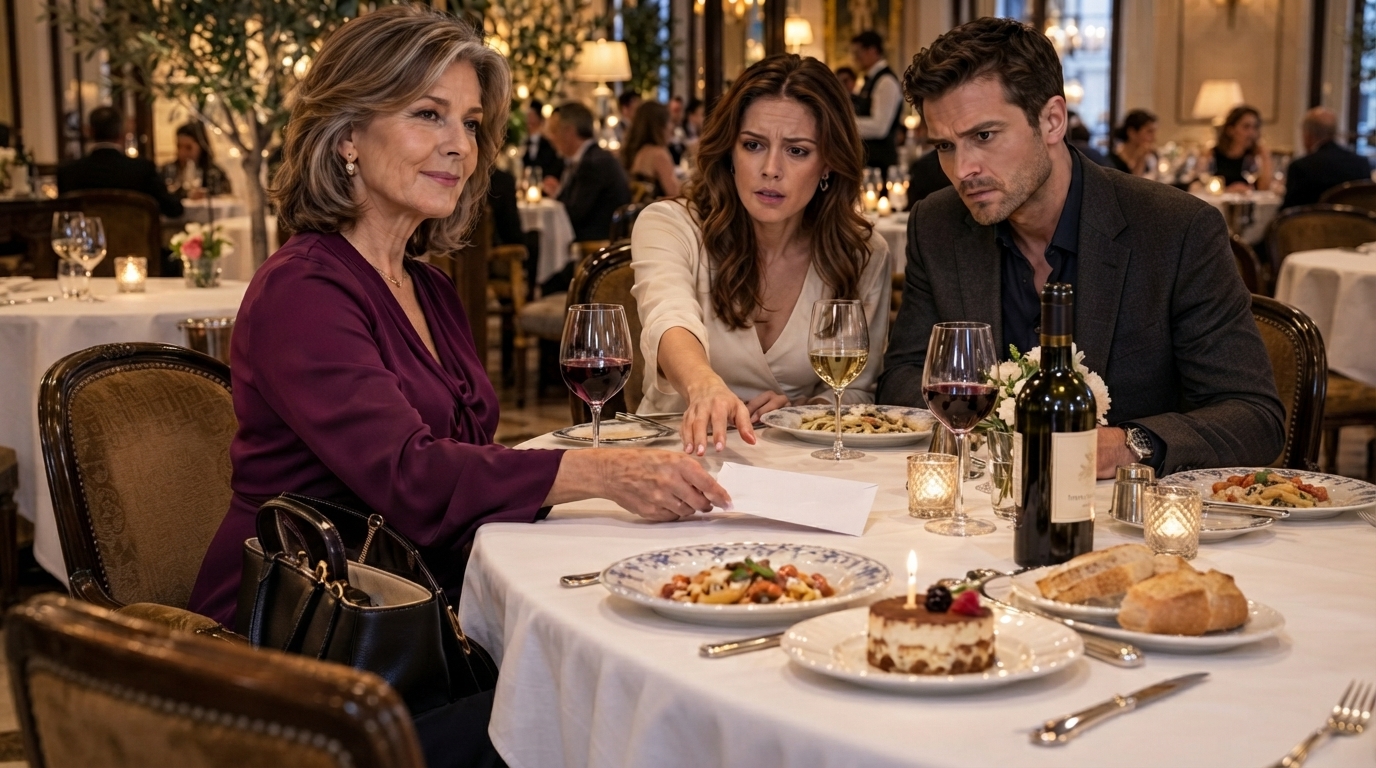
Sarah sat frozen at the restaurant table,
holding the documents in trembling hands.
Greg was still staring at the name printed at the bottom of the sale agreement.
Thomas Reynolds.
The man who had helped me reclaim my life.
“Mom, you can’t be serious,” Sarah whispered.
I calmly placed my napkin beside my plate.
“I’m completely serious.”
Greg leaned forward.
“Who is this Thomas Reynolds? Some boyfriend you’ve been hiding from us?”
I almost laughed.
Even now, his first instinct was to insult me.
“Thomas is a licensed real estate broker,” I replied.
“He’s also the person who helped me find a buyer for my house.”
Sarah shook her head.
“Our house.”
I looked directly at her.
“No, sweetheart. My house.”
Greg grabbed the agreement again.
“This is ridiculous. You can’t sell a house while people are living in it.”
“Actually,” I answered, “a property can be sold with occupants. Their rights and obligations don’t simply disappear because ownership changes.”
He frowned.
“What does that mean?”
“It means the new owner will handle the occupancy situation through the proper legal process.”
Sarah stared at me.
“You mean we’re being evicted?”
“I mean you need to speak with the new owner about your living arrangements.”
Her face reddened.
“You’re throwing your own daughter into the street?”
I took a slow breath.
“Sarah, three minutes ago, you told me I should move into senior living because you wanted my bedroom for Greg’s office.”
“That’s different!”
“How?”
She opened her mouth.
Nothing came out.
I continued.
“You were perfectly comfortable deciding where I should live. Now you’re upset because someone else has the authority to decide what happens to the house.”
Greg pushed his chair back.
“Margaret, stop playing games. How much did you sell it for?”
I studied him.
“Why?”
“Because we deserve to know.”
I tilted my head.
“Deserve?”
He hesitated.
“We’ve invested three years of our lives in that property.”
I felt something inside me turn cold.
“Greg, you lived there without paying rent. You stopped contributing to household expenses when you lost your job. And after you started working again, you never resumed paying them.”
He looked away.
I continued.
“I paid the taxes, insurance, utilities, groceries, and repairs. I even paid for the new water heater after you told me you couldn’t afford your share.”
Sarah interrupted.
“Mom, we’re family!”
I nodded.
“Yes. That’s what I thought when I opened my door to you.”
The restaurant manager approached our table.
“Is everything all right?”
Greg immediately smiled.
“Just a family misunderstanding.”
I looked at the manager.
“Everything is fine, thank you.”
He nodded and walked away.
Sarah leaned toward me.
“Mom, please. Let’s not make a scene.”
I looked at her in disbelief.
“You invited me to dinner on my sixtieth birthday to tell me I was a burden. And now you’re worried about embarrassment?”
Her eyes filled.
“That wasn’t how I meant it.”
“Then how did you mean it?”
She stared at her wineglass.
“I just thought it was time for you to move somewhere more appropriate.”
I nodded slowly.
“Somewhere appropriate.”
“Yes.”
“Somewhere I wouldn’t inconvenience you.”
She said nothing.
I leaned back.
“Sarah, I spent thirty-four years making that house a home. I raised you there. I cared for your father there when he was sick. I buried him, came home, and slept alone in the bed we’d shared for decades.”
My voice trembled.
“When you and Greg needed somewhere to live, I gave you the largest bedroom. I moved into the guest room because I thought helping you was what a mother should do.”
Sarah wiped her eyes.
“And somewhere along the way, you started treating me like a tenant in my own home.”
Greg crossed his arms.
“You’re exaggerating.”
I turned toward him.
“Greg, you once told me to stay upstairs while your boss visited because you didn’t want him thinking you lived with your mother-in-law.”
His face tightened.
“That was taken out of context.”
“You also told Sarah that my old furniture made the house look like a retirement home.”
He looked down.
“And you asked me to remove my husband’s photograph from the mantel because it didn’t match your new decorations.”
Sarah whispered, “Mom…”
I shook my head.
“No. Tonight, you’re going to listen.”
For three years, I’d swallowed my feelings.
I’d pretended not to hear the conversations behind closed doors.
I’d ignored the way Sarah rolled her eyes whenever I entered the kitchen.
I’d accepted smaller portions at dinner because Greg claimed he needed extra food for his workouts.
I’d washed their clothes.
Cleaned their bathrooms.
Cooked their meals.
And somehow, I’d become the burden.
But the worst moment had happened eight months earlier.
Sarah had invited several friends over for dinner.
I was upstairs reading when I heard someone ask who lived in the guest room.
Sarah laughed.
“Oh, that’s just my mother. She’s staying with us.”
Just my mother.
Staying with us.
In the house I’d purchased with my husband.
In the house where I’d taught her to walk.
In the house where she’d once run into my arms after nightmares.
That evening, I sat on the edge of my bed and cried.
Then I made a decision.
I wasn’t going to spend the rest of my life begging for respect in a home I owned.
Greg interrupted my thoughts.
“Fine. You sold the house. Where’s the money?”
I stared at him.
There it was.
The question I’d been waiting for.
“Why do you want to know?”
He shrugged.
“Because Sarah is your only child. Surely you’re not planning to keep everything for yourself.”
I almost smiled.
“Greg, I’m sixty years old. I’m not dead.”
He frowned.
“Nobody said you were.”
“Then stop discussing my money as though it’s already your inheritance.”
Sarah looked wounded.
“Mom, that’s unfair.”
I turned toward her.
“Is it?”
She swallowed.
“You know we wouldn’t take advantage of you.”
I stared at her.
Then I reached into my purse and removed a small notebook.
I’d kept it for almost three years.
Every major expense.
Every promise.
Every time Sarah said she’d repay me.
Every time Greg borrowed money and forgot.
I opened it.
“Would you like to know how much I’ve spent supporting the two of you?”
Greg laughed nervously.
“Come on, Margaret.”
I looked at the final page.
“Seventy-eight thousand, four hundred and sixty dollars.”
Sarah went pale.
“What?”
“That’s the documented amount I paid toward expenses you agreed to cover, money you borrowed, and purchases you promised to reimburse.”
Greg shook his head.
“That’s impossible.”
I turned the notebook toward him.
“Would you like to check?”
He stared at the entries.
The new refrigerator.
The emergency car repair.
The property tax installments.
The groceries.
The electricity.
The furniture Greg insisted they needed.
And the twelve thousand dollars I’d transferred to help them settle one of his investment debts.
Sarah covered her mouth.
“I didn’t realize…”
I looked at her.
“No, sweetheart. You didn’t want to.”
I stood and reached for my coat.
Sarah suddenly grabbed my wrist.
“Mom, wait.”
I looked down.
“Please let go.”
She released me.
“Where are you going?”
“Home.”
Her eyes widened.
“But you sold the house.”
I smiled.
“Yes, Sarah. I did.”
“Then where is home?”
I hesitated.
For three years, I’d dreamed of answering that question.
“Somewhere peaceful.”
Greg stood.
“You bought another house?”
I nodded.
“Yes.”
Sarah stared at me.
“With the sale money?”
“With my money.”
Greg’s expression changed.
“How much did you spend?”
I laughed softly.
“That’s none of your business.”
His face reddened.
“Margaret, you’re being selfish.”
I looked at him.
“Greg, you just told a sixty-year-old widow that she was selfish for buying herself somewhere to live.”
He opened his mouth.
I raised my hand.
“Don’t.”
Then I turned toward Sarah.
“I hope you enjoyed dinner, sweetheart.”
She stared at me.
“Mom, please don’t leave like this.”
I looked at the birthday cake sitting untouched between us.
A small chocolate cake with a single candle shaped like the number sixty.
For a moment, I remembered all the birthdays I’d spent making sure Sarah felt special.
The homemade cakes.
The balloons.
The presents wrapped after midnight.
The years when money was tight and I stayed awake sewing costumes for her school plays.
I looked back at my daughter.
“Sarah, you gave me a very important birthday present tonight.”
She blinked.
“What?”
“You finally told me how you really see me.”
Then I picked up my purse and walked away.
Outside, the evening air was cool.
I stood beneath the restaurant awning and took a long breath.
My phone vibrated.
Thomas Reynolds.
“Happy birthday, Margaret,” he said warmly. “How did dinner go?”
I laughed.
“Exactly as we expected.”
There was a pause.
“They told you to leave?”
“Yes.”
“I’m sorry.”
I looked toward the parking lot.
“Don’t be. I needed to hear it.”
Thomas sighed.
“Well, everything is ready. The buyer has your contact details, and your belongings were delivered to the new place this afternoon.”
My eyes filled.
“Thank you, Thomas.”
“You’re welcome. And Margaret?”
“Yes?”
“Your husband would be proud of you.”
That was when I finally cried.
Not because I’d lost my daughter.
Not because I’d sold my house.
But because someone had spoken to me with genuine kindness.
And I’d almost forgotten what that felt like.
I drove forty minutes out of the city.
Past shopping centers.
Past crowded intersections.
Past the neighborhoods where I’d spent most of my adult life.
Then I turned onto a quiet road lined with oak trees.
At the end stood a beautiful little cottage.
White siding.
Blue shutters.
A wraparound porch.
And a garden already filled with flowers.
My new home.
I parked in the driveway and sat there for several minutes.
Then I stepped inside.
The living room smelled faintly of fresh paint and lavender.
My photographs were already arranged on the shelves.
My grandmother’s china sat safely inside a glass cabinet.
My favorite books lined the walls.
And above the fireplace hung the photograph Sarah and Greg had wanted removed.
My husband.
Smiling.
Looking younger than I remembered him.
I stood before it.
“We did it, Robert,” I whispered.
Then I noticed something on the kitchen counter.
A small wrapped box.
Thomas had left it there with a card.
Happy sixtieth birthday, Margaret. Here’s to a beautiful new chapter.
Inside was a silver keychain shaped like a little house.
I held it in my palm and smiled.
For the first time in three years, I was standing inside a home where nobody expected me to disappear.
At 11:47 that night, my phone began ringing.
Sarah.
I let it ring.
Then Greg.
Then Sarah again.
Finally, a text appeared.
Mom, you need to call us immediately. There’s a serious problem.
I stared at the message.
Then another arrived.
The new owner sent us a letter.
I took a slow breath.
That was expected.
But the next message made me sit upright.
Mom, Greg says there’s been some kind of mistake. The buyer knows about the garage renovations and the lease agreement.
I frowned.
Lease agreement?
What lease agreement?
Then Sarah sent a photograph.
It showed a document bearing my name.
My address.
And a signature that looked disturbingly similar to mine.
According to the document, I’d supposedly agreed to rent my own house to Sarah and Greg for ten years.
For one dollar per month.
I stared at the photograph.
I had never signed such an agreement.
And suddenly, I understood why Greg had been so confident at dinner.
He hadn’t simply assumed the house belonged to them.
He had apparently been preparing to make sure I couldn’t take it back.
PART 4
I didn’t sleep much that night.
I sat at my new kitchen table with Sarah’s photograph enlarged on my phone.
The signature looked like mine.
Almost.
But there was something wrong with the final letter.
My husband used to tease me about the way I signed my name.
“Margaret, you always make that last stroke look like a little bird taking flight.”
He was right.
For thirty years, my signature had ended with a distinctive upward curve.
The signature on Greg’s document didn’t.
It ended in a straight line.
I stared at it.
Then I called Thomas.
He answered on the second ring.
“Margaret? Is everything all right?”
“I think Greg forged my signature.”
Silence.
Then Thomas said, “Don’t confront him. Send me the document.”
I forwarded the photograph.
Five minutes later, he called back.
“Margaret, we need an attorney to review this immediately.”
I nodded.
“I know.”
“The buyer may need to address a disputed occupancy claim. We should preserve everything.”
I looked toward my husband’s photograph.
For years, I’d believed Greg was arrogant.
Selfish.
Entitled.
But this was something else.
This was a man who appeared willing to put my name on a document without my permission.
And my daughter was living beside him.
The following morning, I met Thomas and a property attorney named Evelyn Parker.
Evelyn was a woman in her fifties with sharp eyes and a calm voice.
She examined the photograph.
Then she asked me a simple question.
“Margaret, did you ever authorize a ten-year lease?”
“No.”
“Did you sign anything giving Greg or Sarah permission to prepare one?”
“Absolutely not.”
She nodded.
“Then we’ll obtain the original document, examine its authenticity, and notify the buyer’s attorney that you dispute it.”
I looked at her.
“Could this undo the sale?”
“That depends on the facts and the contract. But we shouldn’t assume the document is valid merely because someone produced it.”
I exhaled.
For the first time since seeing the photograph, I felt steady.
Evelyn continued.
“How long have Sarah and Greg lived there?”
“Three years.”
“Did they pay rent?”
“No. They were family members I allowed to stay.”
She made a note.
“And did they ever tell you they believed they had a ten-year lease?”
“No.”
She looked up.
“That’s important.”
By noon, the buyer’s attorney had been contacted.
The new owner was a woman named Caroline Foster.
She was forty-seven, recently divorced, and had purchased the house because she wanted a large home where her two teenage children could live comfortably.
I had met her twice during the sale process.
She was kind.
Practical.
And fully aware that Sarah and Greg occupied the property.
The purchase contract addressed the fact that the house was not vacant.
Caroline had agreed to handle the transition through the appropriate legal process.
But the alleged ten-year lease had never been disclosed to her.
And now Greg was using it to claim that he could remain in the house for almost nothing.
When Evelyn explained the situation, Caroline was understandably upset.
“I bought the property in good faith,” she said during a conference call.
“I know,” I replied. “And I never signed that lease.”
There was a pause.
Then Caroline said, “Margaret, I’m sorry your family has put you through this.”
My throat tightened.
“Thank you.”
We agreed to cooperate fully with the legal review.
No shortcuts.
No threats.
No changing locks.
Everything would be handled properly.
Two days later, Sarah appeared at my cottage.
I saw her car through the window.
She stepped out holding a handbag and a box of tissues.
I opened the door before she could knock.
“Hello, Sarah.”
Her eyes widened.
“Mom.”
She looked past me.
At the bright living room.
At the bookshelves.
At the fresh flowers.
At the photographs.
Then she whispered, “You live here?”
“Yes.”
She stepped inside.
Her eyes moved around the room.
“It’s beautiful.”
“Thank you.”
She looked toward the kitchen.
“Did you buy all this furniture?”
“Most of it is mine. The furniture you said was too old-fashioned for your house.”
Her face reddened.
“Mom, please.”
I sat down.
“What do you want to discuss?”
She lowered herself onto the sofa.
For several minutes, she said nothing.
Then she began crying.
“Greg says we’re going to lose everything.”
I waited.
“He says the new owner is trying to force us out.”
I nodded.
“Caroline purchased the house. She has the right to pursue possession through the legal process.”
Sarah wiped her eyes.
“But where are we supposed to go?”
I looked at her.
“Have you started looking for an apartment?”
She shook her head.
“Greg says we shouldn’t have to.”
“Why?”
She hesitated.
“Because of the lease.”
I leaned forward.
“Sarah, did you sign that document?”
She looked away.
My stomach tightened.
“Sarah.”
She began crying harder.
“Greg told me it was just paperwork.”
I stared at her.
“What paperwork?”
“He said we needed something showing we’d been living there.”
“Why?”
She wiped her face.
“He said it would protect us if you ever tried to sell.”
I closed my eyes.
There it was.
Three years of entitlement had finally become something far more serious.
I opened my eyes.
“Did Greg tell you I signed it?”
She nodded.
“Yes.”
“Did you see me sign it?”
She shook her head.
“No.”
I took a slow breath.
“Sarah, I never signed that document.”
Her face went white.
“What?”
“I never authorized it. I never agreed to rent you the house for ten years. And I certainly never agreed to one dollar per month.”
She covered her mouth.
For a long moment, neither of us spoke.
Then she whispered, “Oh, my God.”
I looked at my daughter.
“Sarah, I need you to tell me the truth.”
She nodded.
“Did you know Greg was preparing this?”
She hesitated.
Then whispered, “I knew he was talking to someone about making sure we could stay.”
I felt tears rising.
“And you didn’t tell me?”
She shook her head.
“I thought…”
She stopped.
“What did you think?”
Her voice broke.
“I thought the house would be mine someday anyway.”
I stared at her.
Those words hurt more than anything Greg had said.
Because Greg was my son-in-law.
But Sarah was the little girl I’d carried into that house as a newborn.
The child whose scraped knees I’d kissed.
The teenager whose heartbreaks I’d listened to.
The young woman whose wedding I’d helped pay for.
And somewhere along the way, she’d started thinking of my death as the moment she’d finally receive what she deserved.
I looked at her.
“Sarah, I’m sixty years old.”
She began crying.
“I know.”
“I’m healthy. I have plans. I want to travel. I want to enjoy my retirement.”
She nodded.
“And you were already deciding what to do with my property after I was gone.”
She covered her face.
“I’m sorry.”
I shook my head.
“You’re sorry because you may lose the house.”
“No, Mom!”
“Then tell me something.”
She looked up.
“When was the last time you asked whether I was happy?”
She froze.
I waited.
She couldn’t answer.
The investigation into the lease continued.
An attorney who had prepared the document provided records showing that Greg had supplied the information and claimed to have my authorization.
A copy of my signature had apparently been taken from an older household document.
The matter was referred for further review.
I cooperated fully.
I didn’t try to protect Greg by lying.
And I didn’t ask anyone to punish him without evidence.
I wanted the truth established.
The legal process took time.
There were statements.
Documents.
Negotiations.
And uncomfortable questions.
Eventually, Greg abandoned his claim that the ten-year lease was enforceable.
A written settlement was reached with Caroline.
Sarah and Greg agreed to move out by a specified date in exchange for resolving the occupancy dispute without further litigation over possession.
The disputed signature remained a separate issue.
I won’t pretend everything was magically settled overnight.
But the house was no longer theirs to control.
And they finally had to face the reality I’d been living with for three years.
Someone else’s generosity is not ownership.
Greg was furious.
He called me repeatedly.
Left angry messages.
Accused me of ruining his future.
One evening, he shouted into my voicemail:
“You’ve destroyed this family over a house!”
I listened once.
Then saved the message for my attorney.
I didn’t call him back.
For the first time in my life, I understood that I didn’t have to respond to every accusation.
Silence could be peace.
Not surrender.
Sarah and Greg moved into a small apartment across town.
It had two bedrooms.
A narrow kitchen.
And a parking lot instead of a garage.
Sarah called me after their first week.
“The neighbors are noisy,” she complained.
I listened.
“And the kitchen is tiny.”
I smiled faintly.
“That sounds difficult.”
She sighed.
“Greg says we should have fought harder.”
I looked toward my garden.
“Sarah, do you agree with him?”
There was a long pause.
Then she whispered, “I don’t know anymore.”
That was the first honest thing she’d said to me in months.
The months passed.
My life changed in ways I hadn’t expected.
I joined a gardening club.
Started taking watercolor classes.
And began volunteering twice a week at the local library.
I made friends who didn’t know me as Sarah’s mother.
They knew me as Margaret.
The woman who loved old books.
Who made excellent lemon cake.
Who laughed too loudly when something genuinely amused her.
One Saturday, I hosted a small dinner for six friends.
We ate on the porch beneath strings of warm lights.
Someone brought flowers.
Someone else brought homemade bread.
We talked until nearly midnight.
After everyone left, I stood in my kitchen looking at the empty plates.
And I realized something.
I hadn’t felt lonely once that evening.
For three years, I’d lived in a house filled with people and felt completely invisible.
Now I lived alone.
And somehow, I felt surrounded by kindness.
On what would have been my thirty-sixth wedding anniversary, I visited Robert’s grave.
I brought yellow roses.
His favorite.
I sat beside the headstone and told him everything.
About the house.
About Sarah.
About Greg.
About the cottage.
About the friends I’d made.
Then I laughed through my tears.
“You would have told me to do this years ago, wouldn’t you?”
The wind moved gently through the trees.
I remembered something Robert used to say whenever I worried too much about Sarah.
“Margaret, our job is to teach her how to stand on her own feet. Not to become the floor she stands on.”
I’d always laughed when he said it.
Now I finally understood.
Six months after the birthday dinner, Sarah came to see me again.
This time, she called first.
She arrived carrying a small box.
No demands.
No accusations.
Just a tired-looking woman standing on my porch.
“Hi, Mom.”
“Hello, Sarah.”
She held out the box.
“I found these while unpacking.”
Inside were my grandmother’s old baking sheets.
The ones Sarah had once tried to throw away.
I stared at them.
“They were in the back of the garage,” she said. “I thought you’d want them.”
My eyes filled.
“Thank you.”
She looked down.
“Mom, can we talk?”
I stepped aside.
We sat at the kitchen table.
Sarah looked around the room.
Then she began crying.
“I’ve been thinking about everything.”
I waited.
“About the way I treated you.”
She wiped her eyes.
“About how I made you feel like you didn’t belong.”
My throat tightened.
She continued.
“I kept telling myself we were taking care of you.”
I nodded.
“I know.”
“But we weren’t.”
She looked at me.
“You were taking care of us.”
I felt tears rise.
Sarah began crying harder.
“And when you stopped paying for everything, I got angry because I thought you were taking something away from me.”
I reached for a tissue.
She continued.
“Greg and I are separating.”
I stared at her.
“What?”
She nodded.
“We’ve been fighting for months. He keeps blaming you for everything.”
I remained quiet.
“But I finally told him that nobody made us spend money we didn’t have. Nobody made us live in your house for three years. Nobody made us treat you like an inconvenience.”
She looked down.
“And nobody made me say those things to you on your birthday.”
I felt something inside me soften.
Not completely.
But enough.
Sarah looked at me.
“Mom, I don’t expect you to forgive me right away.”
I nodded.
“I don’t expect money. Or a place to stay.”
She swallowed.
“I just wanted to tell you that I’m sorry.”
I studied her face.
For the first time in a long while, I saw my daughter without the arrogance that had become so familiar.
She looked frightened.
Ashamed.
And genuinely uncertain about what came next.
I reached across the table.
“Sarah, I love you.”
She began crying.
“But things have to be different.”
She nodded quickly.
“I know.”
“You cannot treat my home as yours.”
“I understand.”
“You cannot make financial decisions for me.”
“I won’t.”
“And you cannot confuse my love with an obligation to rescue you from every difficult situation.”
She wiped her eyes.
“I know, Mom.”
I squeezed her hand.
“Then we can start there.”
Rebuilding our relationship wasn’t easy.
There were uncomfortable conversations.
Moments when Sarah became defensive.
Days when I wondered whether I could ever fully trust her again.
But she began making changes.
She found a better-paying job.
Started managing her expenses.
And stopped asking me to solve every problem.
She also began seeing a counselor.
Not because I demanded it.
Because she said she wanted to understand why she’d treated me the way she had.
Sometimes we met for coffee.
Sometimes she visited the cottage.
And sometimes I told her I needed time alone.
For the first time, she respected that.
A year after my sixtieth birthday, Sarah invited me to lunch.
Not at the expensive Italian restaurant.
At a little café near my cottage.
She arrived early.
When I walked in, she stood and hugged me.
“Happy birthday, Mom.”
I smiled.
“Thank you, sweetheart.”
She handed me a small wrapped package.
Inside was a framed photograph.
It showed Robert and me standing in front of our old house, shortly after we’d bought it.
We were young.
Smiling.
Holding hands.
I stared at the picture.
“Where did you find this?”
Sarah smiled through tears.
“In an old album. I had it restored.”
My throat tightened.
On the back of the frame, she’d written:
Thank you for giving me a home when I needed one.
I’m sorry I forgot it was yours.
Love, Sarah.
I began crying.
She reached for my hand.
“I’m not asking you for anything, Mom.”
I nodded.
“I know.”
“I just wanted you to know I finally understand.”
I looked at my daughter.
And for the first time in years, I believed she might.
Today, I’m sixty-one.
I still live in my little cottage.
The blue shutters need repainting.
The garden needs weeding.
And the kitchen faucet drips when I don’t tighten it properly.
But I love every inch of this place.
Because it’s mine.
Not simply because my name is on the deed.
But because I can walk into any room without wondering whether I’m welcome.
I can leave my books on the table.
Hang my husband’s photograph wherever I want.
Bake cookies using my grandmother’s old pans.
And invite friends over without being told to stay upstairs.
Sometimes Sarah visits.
We drink tea on the porch.
Talk about work.
Laugh about old memories.
And slowly rebuild something I once feared was gone forever.
But there are boundaries now.
Healthy ones.
Necessary ones.
And I no longer apologize for them.
People sometimes ask whether I regret selling the old family house.
I think about that question often.
I remember the Christmas mornings.
The birthday parties.
The marks on the kitchen doorway where Robert measured Sarah’s height every year.
The garden we planted together.
The last morning my husband sat on the back porch before he became too sick to go outside.
Of course I miss those memories.
But memories don’t disappear when a deed changes hands.
I carried them with me.
In photographs.
In recipes.
In the old baking sheets my grandmother used.
And in the quiet love I still feel whenever I think about Robert.
What I don’t miss is feeling like a stranger in my own home.
On my sixtieth birthday, my daughter told me I was a burden.
She told me I needed to leave.
She told me she and her husband would keep the house.
She thought she was ending my independence.
Instead, she gave me the final confirmation I needed to begin again.
The white envelope on that restaurant table wasn’t simply a collection of property documents.
It represented every quiet decision I’d made to reclaim my life.
Every bank account I’d separated.
Every possession I’d carefully packed.
Every meeting with Thomas.
Every night I’d reminded myself that I deserved peace.
I didn’t sell the house to punish my daughter.
I sold it because I finally understood something my husband had tried to teach me for years.
Being a good mother does not mean surrendering your dignity.
Helping your children does not mean allowing them to take over your life.
And growing older does not mean becoming less deserving of respect.
That night, Sarah thought she was telling me to leave my home.
What she didn’t know was that I’d already found a better one.
A home where I was welcome.
A home where I was respected.
A home where I could finally breathe.
And the greatest birthday gift I received wasn’t the money from the sale.
It was the moment I realized I could still choose the life I wanted.
At sixty years old, I hadn’t reached the end of my story.
I was finally beginning a new chapter.
THE END THANK YOU FOR READING !!!



