PART 3
For a moment,
I couldn’t hear anything except
the soft music playing above
the restaurant’s marble reception desk.
One hundred and forty-two thousand dollars.
Eleven transactions.
And a meeting scheduled for
tomorrow morning to transfer my ownership shares.
I stared at Sofia.
“Transfer them to whom?”
She hesitated, her fingers hovering over the keyboard.
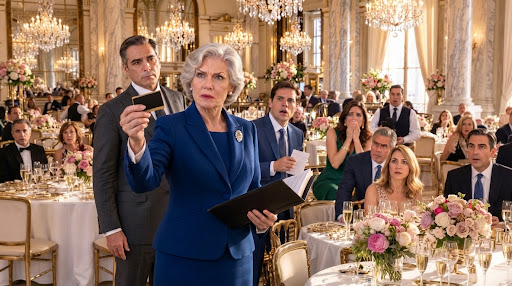
Mrs. Whitmore, the request lists Price Capital
Holdings as the proposed purchaser.
I slowly turned toward Graham.
My daughter-in-law’s father had been standing behind Adam, looking irritated.
Now his face had gone completely white.
“Price Capital Holdings?” I repeated.
Graham adjusted his expensive watch.
“It’s a legitimate investment company.”
I didn’t ask whether it was legitimate.
I asked why your company is attempting to purchase shares I never offered for sale.
Vanessa stepped between us.
“Margaret, you’re misunderstanding everything.”
I looked at her.
“Then explain it.”
She opened her mouth.
Nothing came out.
For thirty-five years, I’d raised Adam to tell the truth, even when the truth was uncomfortable.
Apparently, he’d married into a family that considered honesty an inconvenience.
I turned toward Sofia.
“Please don’t process tonight’s charge. Preserve the documents and account records, and contact Mr. Bennett.”
“Yes, ma’am.”
Adam grabbed my arm.
“Mom, can we talk privately?”
I looked down at his hand.
“Let go of me.”
His fingers loosened.
“Please. You’re making this worse.”
I stared at him.
“Worse for whom, Adam?”
He looked away.
And that told me everything.
Mr. Bennett arrived twenty-five minutes later.
His full name was Charles Bennett, and he’d been our company’s general counsel for seventeen years.
He was also one of the few people who knew exactly how much work my late husband, Edward, and I had put into building Whitmore Hospitality Group.
Edward started with one struggling neighborhood restaurant.
I handled the books while he managed the kitchen.
We worked seven days a week.
When the dishwasher broke, Edward fixed it.
When the payroll account ran low, I skipped my own salary.
When our first chef quit without warning, I spent fourteen hours washing vegetables, serving tables, and cleaning floors.
Nobody handed us anything.
By the time Edward died, we’d built a company operating nine restaurants and two event venues.
Bellavita was our flagship property.
I owned sixty-eight percent of the company.
The remaining shares belonged to several longtime investors and senior employees.
Adam knew all of that.
Or at least, I thought he did.
Mr. Bennett examined the document Adam had presented.
“Margaret, is this your signature?”
“No.”
Adam interrupted.
“That’s ridiculous. Mom signed it last month.”
I turned toward him.
“Where?”
“At your house.”
“When?”
He hesitated.
“After dinner.”
I folded my arms.
“Which dinner?”
Vanessa answered quickly.
“The Sunday we brought you flowers.”
I almost smiled.
“That was March seventeenth.”
“Exactly,” she said.
I looked at Mr. Bennett.
“Edward and I established a verification procedure for major transactions. Any authorization involving my ownership shares requires independent confirmation through counsel and the corporate records.”
He nodded.
“Correct.”
I placed the paper on the counter.
“And this document doesn’t satisfy that procedure.”
Adam frowned.
“What does that mean?”
“It means a copied signature doesn’t give you authority to sell my company.”
Mr. Bennett examined the paper again.
“There’s another problem.”
Graham stiffened.
“What problem?”
“The purported authorization refers to a corporate resolution that was never approved.”
Silence.
Then Graham said something that made my stomach turn.
“Adam assured me his mother wouldn’t interfere.”
I looked at my son.
“Wouldn’t interfere?”
He stared at the floor.
I stepped closer.
“Adam, I am not an obstacle standing between you and an inheritance. I am your mother. And I’m still alive.”
Mr. Bennett asked Sofia to print the eleven transactions.
She returned with a thick stack of receipts.
I sat at a table near the entrance.
Adam and Vanessa remained standing.
Graham paced.
Celeste sat beside the window, clutching her handbag as though someone might take it.
I read the first receipt.
A private birthday dinner.
Eight thousand four hundred dollars.
The second was a luxury wine reception.
Twelve thousand six hundred.
The third was a corporate gathering.
Twenty-one thousand dollars.
There were anniversary parties, private catering orders, and events I’d never heard about.
Every charge had been associated with Adam, Vanessa, or the Price family.
I looked up.
“Did you attend all these events?”
Adam nodded reluctantly.
“Most of them.”
“And who paid?”
He swallowed.
“I thought the membership covered them.”
I looked at him.
“Adam, the Founder’s Reserve account is an internal hospitality account. It is not your personal credit card.”
Vanessa crossed her arms.
“Your company makes millions. Why are you acting like this is going to bankrupt you?”
I stared at her.
“Because taking money without permission is wrong whether the owner has ten dollars or ten million.”
She rolled her eyes.
“You’re being dramatic.”
I felt something inside me become very still.
That phrase again.
Don’t be dramatic.
She’d used it when I asked whether I was still family.
Now she was using it because I’d discovered what appeared to be financial fraud.
I looked directly at her.
“Vanessa, you seem to believe that insulting me will make the evidence disappear.”
Her face reddened.
“It wasn’t an insult.”
“Then consider this a correction.”
Mr. Bennett turned to Graham.
“Who prepared the ownership transfer documents?”
Graham hesitated.
“Our legal team.”
“Which firm?”
He named a small corporate law practice outside Boston.
Mr. Bennett wrote it down.
“Did you tell them Margaret had agreed to sell?”
Graham looked toward Adam.
“My understanding was that the family had reached an agreement.”
I leaned forward.
“Which family?”
Nobody answered.
“Because I wasn’t invited to the conversation.”
Celeste suddenly stood.
“This is humiliating!”
I looked at her.
“Yes, Celeste. Being humiliated on Mother’s Day is unpleasant, isn’t it?”
Her mouth fell open.
I continued.
“You laughed at me for eating alone. You said some mothers couldn’t let go. Meanwhile, your family was preparing to spend thirty-eight thousand dollars using an account that didn’t belong to you.”
She sat down.
For once, she had nothing to say.
The security director arrived.
His name was Marcus Reed.
I asked him to preserve the relevant footage and access logs.
Mr. Bennett arranged for an independent forensic review of the disputed charges and proposed transaction.
Then I asked Adam a question.
“How much were you supposed to receive?”
He looked confused.
“What?”
“For helping Graham acquire my shares.”
Vanessa’s eyes widened.
Graham looked toward the exit.
Adam swallowed.
“Mom, it’s not like that.”
“Then tell me what it’s like.”
He rubbed his forehead.
“Graham said the company needed younger leadership.”
I waited.
“He said you were holding everything back.”
I felt the words strike somewhere deep in my chest.
“Holding everything back?”
Adam nodded miserably.
“He said you were emotionally attached to the restaurants and didn’t understand modern business.”
I stared at him.
“Adam, I oversee a company employing hundreds of people. I review financial statements every month. I attend board meetings. I know our managers, our suppliers, and our obligations.”
He said nothing.
I leaned closer.
“Did you believe him?”
His silence answered.
Then Mr. Bennett’s phone vibrated.
He glanced at the screen.
His expression changed.
“Margaret, may I speak with you privately?”
We stepped into the office behind reception.
He showed me an email forwarded by our chief financial officer.
The proposed transaction included a separate consulting agreement.
Adam would receive seven hundred and fifty thousand dollars if the sale closed.
I stared at the figure.
My son was prepared to receive three-quarters of a million dollars for helping someone acquire my company.
I closed my eyes.
“Does he know the company is worth considerably more than Graham is offering?”
Mr. Bennett nodded.
“The valuation documents were included in the materials circulated to the prospective purchaser.”
I opened my eyes.
“Then he knew.”
Mr. Bennett didn’t answer.
He didn’t have to.
When we returned to the lobby, Adam rushed toward me.
“Mom, please. We can fix this.”
I looked at him.
“Can we?”
“Yes. I’ll cancel everything.”
I shook my head.
“Adam, you cannot undo eleven transactions simply by promising not to make a twelfth.”
His face crumpled.
“And you cannot erase a forged authorization by tearing up the paper.”
Vanessa stepped forward.
“You’re really going to destroy your own son’s future over money?”
I looked at her.
“No. I’m protecting my company from people who believe my age makes me easy to exploit.”
Graham raised his voice.
“This was a legitimate business opportunity!”
I turned toward him.
“Then why wasn’t I invited to negotiate it?”
He stopped speaking.
I faced Mr. Bennett.
“Please notify the board that no transfer has been authorized. Secure the records and have outside counsel review the documents.”
He nodded.
“Of course.”
I looked at Adam.
“Your access to my personal membership privileges is revoked immediately. Any company access you hold will be reviewed.”
His eyes filled.
“Mom—”
“And you are not authorized to represent me in any financial matter.”
Vanessa gasped.
“You can’t do that!”
I smiled sadly.
“I can. And I have.”
I left Bellavita shortly after ten.
Outside, the city lights reflected against the wet pavement.
A young boy walked past holding his mother’s hand.
He carried a small bouquet of carnations.
“Happy Mother’s Day, Mommy,” he said.
She kissed his forehead.
I turned away.
For the first time that evening, I cried.
Not because of the money.
Not because of the business.
But because my son had deliberately excluded me from a family celebration while preparing to use my life’s work to enrich himself.
I remembered the little boy who used to climb into my lap whenever he had a nightmare.
The teenager who brought me breakfast in bed on Mother’s Day.
The young man who cried at his father’s funeral.
Where had that boy gone?
My phone rang.
Mr. Bennett.
“Margaret, I’m sorry to disturb you.”
I wiped my face.
“What is it?”
“We’ve found another document.”
My stomach tightened.
“What kind?”
“A medical declaration attached to the proposed transaction.”
I stopped walking.
“What medical declaration?”
He hesitated.
“It alleges that you’re experiencing significant cognitive decline and may be unable to manage your financial affairs.”
For a moment, the entire city seemed to go silent.
Then he added something that made my blood run cold.
“Margaret, your son signed a statement supporting that allegation.”
I stared into the darkness.
Adam hadn’t merely tried to take my money.
He had apparently tried to make other people believe I was no longer capable of protecting it.
PART 4
I didn’t sleep that night.
At two in the morning, I sat at my kitchen table with a cup of cold tea.
Edward’s photograph stood beside the window.
He was smiling in the picture, wearing the blue shirt he’d loved.
I stared at his face.
“What happened to our boy?” I whispered.
The house remained silent.
For thirty-five years, I’d believed that if I loved Adam enough, supported him enough, and gave him enough opportunities, he would become a good man.
Now I was beginning to understand that love could not replace character.
And generosity could not teach gratitude to someone who refused to learn it.
At nine the next morning, I met Mr. Bennett and an independent attorney named Evelyn Carter.
Evelyn specialized in estate planning and financial exploitation.
She reviewed the documents carefully.
Then she looked at me.
“Margaret, I need to ask you some questions.”
“Go ahead.”
“Have you ever been diagnosed with a condition affecting your ability to manage your affairs?”
“No.”
“Have you signed a power of attorney giving Adam authority over your property?”
“No.”
“Have you authorized anyone to prepare medical statements about your decision-making capacity?”
“Absolutely not.”
She nodded.
“Then we’ll document your position, verify the relevant records, and take appropriate steps to challenge any false representations.”
I looked at the papers.
“Can my son simply declare me incompetent?”
“No. His statement doesn’t establish that. Legal capacity cannot be taken away merely because a relative makes an accusation.”
I exhaled.
For the first time since the previous evening, I felt a little steadier.
Then Evelyn showed me the medical declaration.
Adam’s signature appeared beneath a paragraph claiming I had become forgetful, confused, and unable to understand complicated financial matters.
I stared at it.
The words were devastating.
Not because they were true.
Because my son had written them.
I looked at Evelyn.
“He knows I run the company.”
She nodded.
“He knows I approve budgets. He knows I negotiate contracts. He knows I attend board meetings.”
My voice broke.
“He knows.”
Evelyn placed a tissue beside my hand.
“Then the records of your work may help establish how inaccurate these allegations are.”
I wiped my eyes.
“And the signature on the authorization?”
“That will be examined separately. We shouldn’t assume every document is authentic simply because someone submitted it.”
I nodded.
“Do whatever is necessary.”
The board held an emergency meeting that afternoon.
I attended with Evelyn and Mr. Bennett.
Our chief financial officer presented the company’s current valuation materials.
Graham’s proposed purchase price was substantially below the range our advisers considered reasonable.
The consulting payment to Adam was documented in a separate agreement.
The board confirmed that no authorized sale of my shares had occurred.
I retained my controlling ownership.
The disputed documents had not changed that.
Then the financial review began.
Over the following weeks, investigators examined the eleven transactions.
They reviewed receipts, account logs, emails, authorization records, and event contracts.
Several charges appeared to have been approved through procedures that should have required my personal confirmation.
Internal controls had failed.
Those failures were addressed immediately.
The company also began pursuing recovery of unauthorized expenses and referred the questionable documents to the appropriate authorities.
I wanted everything handled properly.
No threats.
No public spectacle.
No attempt to punish anyone beyond what the evidence justified.
Just facts.
Records.
And accountability.
Three days after Mother’s Day, Adam came to my house.
I saw his car through the window.
He stood on the porch holding white roses.
For a moment, I remembered him at seven years old.
He’d once picked flowers from our garden and presented them to me in a chipped coffee mug.
“Happy Mother’s Day, Mommy,” he’d said.
I had kept that mug for twenty-eight years.
Now my thirty-five-year-old son stood outside my door with flowers and a face full of fear.
I opened the door.
“Hello, Adam.”
“Mom.”
He swallowed.
“Can I come in?”
I hesitated.
Then stepped aside.
He entered the living room and looked toward his father’s portrait.
“Everything’s falling apart.”
I sat in my armchair.
“Tell me what happened.”
He placed the roses on the table.
“Graham’s investors are pulling out. Vanessa is furious. The lawyers are calling constantly.”
I waited.
“And?”
He looked at me.
“Mom, I need you to tell them it was a misunderstanding.”
I stared at him.
There it was.
Not an apology.
Not concern for me.
A request that I make his problems disappear.
I folded my hands.
“Adam, did you sign the statement saying I couldn’t manage my affairs?”
He looked down.
“Yes.”
“Why?”
He rubbed his forehead.
“Graham said it was necessary.”
“Necessary for what?”
“To make the transaction easier.”
I felt tears rising.
“Did you believe I was mentally incapable?”
He shook his head.
“No.”
The answer hurt more than anything else.
“Then you knowingly signed something you believed was false.”
He began crying.
“Mom, I was desperate.”
“For what?”
He hesitated.
“Money.”
I closed my eyes.
“How much debt are you in?”
He stared at his hands.
“Almost four hundred thousand.”
I opened my eyes.
“What?”
He swallowed.
“Investments. Credit cards. Some loans. Vanessa wanted us to keep up with her parents.”
I stared at him.
“And instead of telling me you were struggling, you tried to sell my company?”
He began sobbing.
“I thought I’d get the consulting payment, clear everything, and start over.”
I looked at the flowers on my table.
“Adam, your father and I could have helped you understand your finances. We could have helped you find professional advice. We could have supported you in making an honest plan.”
He wiped his face.
“But you chose deception.”
He nodded.
“And you chose to tell people I was losing my mind.”
His shoulders shook.
“I’m sorry.”
I believed he was frightened.
I believed he regretted what had happened.
But I wasn’t yet convinced he regretted what he’d done.
There is a difference.
I looked at him.
“Do you know what hurt me most?”
He shook his head.
“Not the money. Not the forged document. Not even the false statement.”
My voice trembled.
“It was Mother’s Day.”
He covered his face.
“I invited you to dinner, Adam. I wanted two hours with my son. That’s all.”
Tears rolled down my cheeks.
“And you couldn’t give me that.”
He whispered, “Mom, please.”
“Instead, you took Vanessa’s family to my restaurant and tried to spend thirty-eight thousand dollars on them.”
He began crying harder.
“I know.”
“Then you laughed while your wife called me forgetful.”
He shook his head.
“I didn’t laugh.”
I stared at him.
“You didn’t defend me either.”
He went silent.
I continued.
“When Vanessa said it was a family occasion, you let her tell me I wasn’t family.”
He looked toward his father’s photograph.
“Dad would hate me.”
I swallowed.
“Your father would be heartbroken.”
He began sobbing.
For a moment, every instinct in me wanted to reach for him.
To hold him.
To tell him everything would be all right.
But I couldn’t.
Because sometimes comforting someone too quickly prevents them from understanding the pain they’ve caused.
I stood.
“Adam, I love you.”
He looked up.
“But I no longer trust you.”
His face crumpled.
“I’m going to cooperate with the investigation. I won’t make false statements to protect anyone.”
He nodded.
“Your access to my accounts is gone. You will not represent me in business matters.”
He wiped his eyes.
“And I’m changing my estate plan.”
He froze.
“What?”
I looked at him.
“Your father and I intended to leave you a substantial inheritance. We assumed you’d respect what we’d built.”
He stared at me.
“You’re cutting me out?”
“I’m reviewing how my estate will be distributed.”
His voice rose.
“Mom, I’m your only child!”
“And I’m your mother.”
Silence.
I stepped closer.
“That didn’t stop you from trying to take what belonged to me.”
He looked away.
I opened the front door.
“I think you should leave now.”
He stood slowly.
At the doorway, he turned.
“Will you ever forgive me?”
I looked at him.
“I hope someday I can.”
His eyes filled.
“But forgiveness won’t mean giving you access to my money.”
He nodded.
Then he walked away.
I closed the door.
And cried until my knees gave out.
The months that followed were difficult.
The proposed sale was abandoned.
Graham’s investment company came under financial pressure, and its dealings were examined.
Vanessa’s relationship with Adam deteriorated.
Eventually, they separated.
The disputed restaurant charges became the subject of recovery efforts and legal proceedings.
The questionable authorization documents were investigated.
I won’t pretend that every issue was resolved neatly or that everyone received a dramatic punishment.
Real consequences are often slower than that.
There were attorneys, negotiations, financial records, and uncomfortable truths.
But one thing never changed.
I remained the majority owner of Whitmore Hospitality Group.
My company’s future stayed in my hands.
And the people who’d tried to use my name without permission no longer had access to my accounts.
Six months after Mother’s Day, I made another decision.
I established the Edward Whitmore Hospitality Scholarship Foundation.
Its purpose was to help young people from low-income families train for careers in the restaurant and hospitality industries.
Edward would have loved it.
He’d started with nothing.
He understood what opportunity could mean.
At the foundation’s first ceremony, we awarded scholarships to twelve students.
One young woman wanted to become a pastry chef.
Another dreamed of opening a small café.
A young man had been working in restaurant kitchens since he was sixteen to help support his family.
As I listened to their stories, I thought about my husband.
The long nights.
The unpaid bills.
The years when we couldn’t afford vacations.
The pride in his eyes when Bellavita finally became profitable.
I realized something.
Our legacy had never been about making our son wealthy.
It had been about building something worthwhile.
Something that could create opportunity for other people.
That evening, I stood before the scholarship recipients.
“My husband believed that success meant more than having money,” I told them. “He believed it meant creating something that could help others.”
My voice broke.
“And tonight, I believe he’d be proud.”
The room filled with applause.
I looked toward Edward’s photograph.
For the first time in months, I smiled without forcing myself.
A year passed.
Then another Mother’s Day approached.
I was sixty-nine now.
My hair had grown a little whiter.
My heart had grown a little stronger.
And my life had become quieter.
I still worked with the company’s leadership team.
I still visited Bellavita.
But I’d learned to spend more time doing things I enjoyed.
I traveled.
Read books.
Visited old friends.
And stopped apologizing for taking up space in my own life.
Three days before Mother’s Day, I received a letter.
The handwriting was familiar.
Adam’s.
I sat at the kitchen table and opened it.
Mom,
I’ve written this letter a dozen times because I don’t know how to apologize for something so cruel.
I used to think Dad’s success meant I was entitled to a successful life without doing the work.
I thought your generosity meant there would always be more money.
And I let Vanessa and her family convince me that your company was something I could claim instead of something you and Dad had built.
But the worst thing I did wasn’t about money.
It was letting you believe you weren’t important enough to spend Mother’s Day with.
I know now that I was ashamed of my own failures, and instead of admitting them, I tried to make you seem weak.
You weren’t weak, Mom.
I was.
I’ve started working with a financial counselor. I’m paying what I can toward my obligations. I’m learning to live within my means.
I don’t expect you to trust me.
I don’t expect money.
I just hope someday you’ll let me buy you a cup of coffee.
Love, Adam.
I read the letter three times.
Then I placed it beside Edward’s photograph.
I cried.
But this time, the tears felt different.
They didn’t erase the betrayal.
They didn’t restore my trust.
Yet for the first time, Adam seemed to understand that the problem had never been the amount of money.
It had been his willingness to sacrifice his mother’s dignity to obtain it.
On Mother’s Day morning, my phone rang.
Adam.
I watched the screen for a few seconds.
Then answered.
“Hello?”
“Mom?”
“Good morning, Adam.”
His voice trembled.
“Happy Mother’s Day.”
I closed my eyes.
“Thank you, sweetheart.”
He hesitated.
“I know you probably have plans.”
“I do.”
“Oh.”
I smiled faintly.
“I’m having lunch with Sofia and some of the scholarship recipients.”
“That sounds nice.”
“It will be.”
There was a long silence.
Then he asked, “Could I take you for coffee afterward?”
I looked toward Edward’s photograph.
And thought about the little boy who used to bring me flowers.
The man who’d betrayed me.
And the person he might still become.
“Yes, Adam,” I said softly. “Coffee would be nice.”
He began crying.
“Really?”
“Really.”
“But Adam?”
“Yes, Mom?”
“We’re not going to pretend nothing happened.”
He swallowed.
“I know.”
“And we’re not going to discuss money.”
“Okay.”
I smiled.
“Then I’ll see you at four.”
That afternoon, I arrived at Bellavita wearing my favorite navy suit.
The same one I’d worn the previous Mother’s Day.
I pinned Edward’s pearl brooch to my lapel.
When I entered the restaurant, Sofia greeted me with a bouquet of white roses.
“Happy Mother’s Day, Mrs. Whitmore.”
I hugged her.
“Thank you, sweetheart.”
Inside, a table had been prepared for the scholarship recipients and their families.
There were flowers.
Candles.
Laughter.
And people who genuinely wanted me there.
I sat down.
For a moment, I looked around the room.
A year earlier, I’d sat alone at a table nearby, wondering why my son couldn’t spare two hours for me.
Now I understood something I hadn’t known then.
Being alone does not make you unlovable.
Being excluded does not make you unimportant.
And being a mother does not mean allowing your children to use you.
After lunch, Sofia brought out a small lemon cake.
My favorite.
Written across the top were the words:
Happy Mother’s Day, Margaret.
Everyone applauded.
I covered my mouth.
Then I laughed through my tears.
For the first time in years, I felt celebrated without wondering what anyone expected in return.
Later, I met Adam at a small café.
He was waiting outside.
In his hands was a simple bouquet of daisies.
“These were Dad’s favorite flowers to bring you,” he said.
I smiled.
“Yes. They were.”
We sat together for nearly two hours.
We talked about his new job.
His financial counseling.
The apartment he’d moved into.
And the changes he was trying to make.
He didn’t ask for money.
He didn’t mention the inheritance.
He didn’t blame Vanessa.
For once, he accepted responsibility for his own decisions.
When we finished, he stood and hugged me.
“I’m sorry, Mom.”
I held him for a moment.
“I know, sweetheart.”
Then I stepped back.
“Keep becoming the man your father hoped you’d be.”
He nodded through his tears.
“I will try.”
I smiled.
“That’s where you start.”
People sometimes ask whether I forgave Adam.
The answer is complicated.
I love my son.
I always will.
But love doesn’t erase consequences.
Trust must be rebuilt through actions, not promises.
And forgiveness doesn’t require me to surrender control of my life.
My estate plan remains changed.
My financial boundaries remain firm.
And my company remains protected.
Adam knows that.
More importantly, he’s beginning to respect it.
Sometimes I think back to that Mother’s Day when I stood six feet behind my son and heard him read my membership number aloud.
He thought he was accessing an account.
He thought he was claiming a privilege.
He thought his aging mother would never question him.
But what he didn’t understand was that I had spent decades building a business, surviving losses, making difficult decisions, and protecting the people who depended on me.
I wasn’t helpless.
I wasn’t confused.
And I wasn’t someone whose worth disappeared simply because her husband had died.
I was Margaret Whitmore.
A mother.
A widow.
A businesswoman.
And a woman who finally understood that her love was not an unlimited financial resource.
My son tried to take my money on Mother’s Day.
Instead, he learned something far more valuable.
An inheritance is not something you can demand from someone who is still alive.
A mother’s kindness is not permission to exploit her.
And the greatest gift a woman can give herself is the courage to say, “I love you, but I will not let you destroy me.”
That Mother’s Day, I didn’t lose my family.
I stopped losing myself.
THE END THANK YOU FOR READING !!!



